The breakaway is one of the most exciting plays in hockey but can be the most stressful on both the player and the goaltender. This lesson is designed to provide a confident strategy to goaltenders and a strong teaching tool for all coaches.
First of all, it is absolutely crucial that in all lessons that I share here that you focus on the “zones” which act as entrance ways or lanes to the net. Each of these lanes leads to an opening in the net called “net-space.” The goal of the player is to increase or create additional net-space by attacking the vertical angle (ice to crossbar) or horizontal angle (post to post).

Goaltending Technique - Mastering the Breakaway

Stage One

Goaltending Technique - Mastering the Breakaway

The player has received the puck and has begun an in-line attack in a selected zone. For simplicity, full value and appreciation for the successful breakaway theory we will use Zone 3 as the identified lane.
The player will likely have the puck in front of their body and making their way to the net. In most cases they will save their lateral movement until they have reached the decision point in fear that the opposition players in pursuit will catch up to them (the shortest distance between 2 points is a straight line).

The goaltender should attack to Zone 3 positioning and use micro-moves (small lateral shuffles) to ensure that:

  • the puck is directly between their skates
  • in-line with their head
  • between their gloves
  • on their navel
  • between the knees and
  • in-line with their goalie stick

Goaltending Technique: Mastering the Breakaway

Stage Two

The goaltender should learn to “capture the shooter’s rhythm.” This technique is designed to eliminate the guesswork from the goaltender’s game by literally stick handling with the same rhythm that the player uses on you, only the shooter’s motions are a lot bigger and much more noticeable. While a player stickhandles, the goaltender uses only their blocker-side wrist in small movements (wrist rotation) to open and close their blade ever so slightly. This is completed all the way through to the shot execution.

Stage Three

Goaltending Technique: Mastering the Breakaway

The goaltender will wait for the player to reach the hash-mark closest to the goaltender and begin backing up at the exact same speed as the player. If the goaltender begins backing up sooner than that the net-space will open up and the player will shoot to the open corners. This is extremely important to remember as the highest scoring area on the ice begins at the hash-marks to three-feet closer to the crease. If the goaltender’s skates are in the blue paint at that stage, he is in trouble.

Stage Four

Goaltending Technique - Mastering the Breakaway

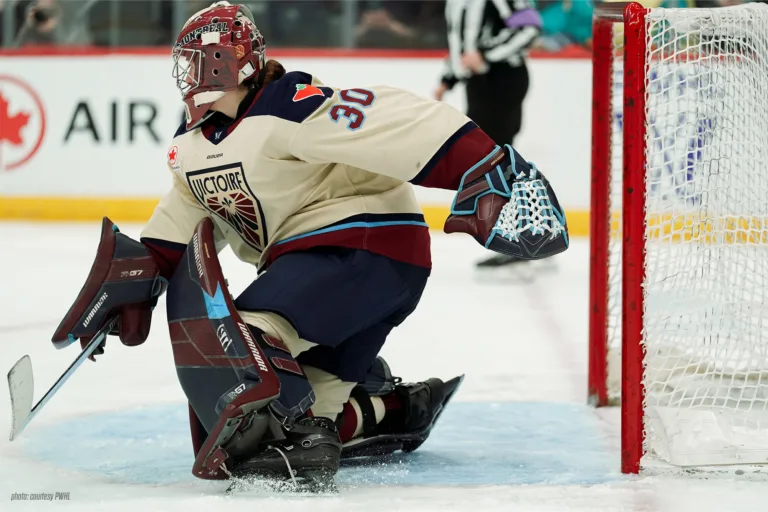
If you have played this correctly, the player will have made a decision to move to your left or right side. This move alone rapidly reduces the player’s opportunity to score because of the shrinking net-space. When the player makes their move, explode to the side that the player goes to and position yourself in a solid body blocking butterfly. Be sure to use your body to block the puck versus attempting to make a reactionary save.

Stage Five

Goaltending Technique - Mastering the Breakaway

The Post Save Recovery

After the save is made it is important to either cover the rebound, or recover from the attack back into a position of defending the net. Defending the net in a breakaway situation requires you to focus on the puck, position yourself for success and force the shooter to make decisions that place them in the worst situations to score.


Pasco Valana, is a professional goaltending coach and consultant based in Vancouver, Canada. He started coaching goaltenders in 1994 and in the process developed 41 NCAA scholarship goaltenders, 3 Hobey Baker Finalists,  2 National team members and 10 NHL draft choices. In 2009, Pasco’s clients won national championships at the Junior A Level, NCAA and Professional levels.  Pasco has joined forces with Dallas Stars goaltending coach Mike Valley in the development of Elite Goalies Canada, a Professional Development Camp designed to bring professional services to amateur athletes.

Pasco’s contact information is [email protected] and www.elitesportsmanagement.ca


5 Responses to Goaltending Technique: Mastering the Breakaway

  1. dnabyun says:

    only thing not mentioned here is how far you have to go out?

  2. ShogiBear says:

    I like the advice of starting to move back when the puck reaches the inner hash marks. Standing your ground right there really does force the player to move to either side. I never thought of when to move back, I would just kind of feel it out.

  3. Pasco says:

    Thank you for the comment. I found that when the goaltender stands their ground in that area , with the distance in mind the shooter will rapidly run out of time and space forcing the shooter to the smallest netspace. The feedback …it works from minor hockey right up!

    Take care

    Pasco

  4. chris says:

    This was helpful but I am still left with some questions. What should goalies be concentrating on when the player is skating in? His body, the puck, both? Also I find that the majority of the breakaways I guess players usually don’t pick a side. They come in straight at me and then shoot or deke at the last second.

Leave a Reply

Your email address will not be published. Required fields are marked *

*

You may use these HTML tags and attributes: <a href="" title=""> <abbr title=""> <acronym title=""> <b> <blockquote cite=""> <cite> <code> <del datetime=""> <em> <i> <q cite=""> <strike> <strong>

Looking for something?

Use the form below to search the site:


Still not finding what you're looking for? Drop a comment on a post or contact us so we can take care of it!

Photography, including main page slider, thanks in part to Scott Slingsby and Ken Denardo. Unless otherwise noted all images are copyright, all rights reserved and may not be used without permission.