

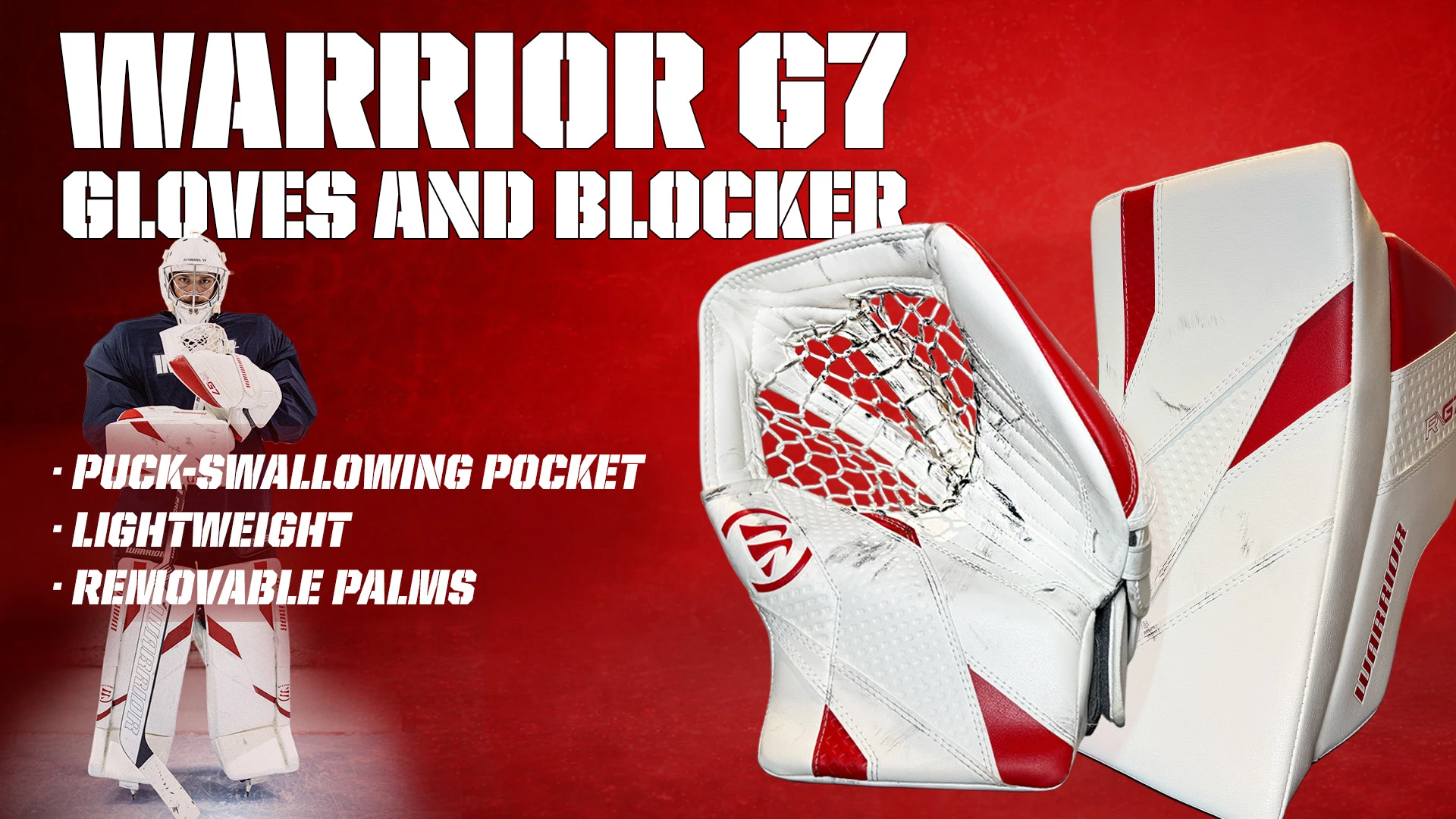
When InGoal Magazine went to work re-familiarizing ourselves with the latest from Warrior Goalie, namely the Ritual G7 line this fall, it always made sense start with the pads.
That’s exactly what we did, with as in-depth a breakdown as we’ve ever done on the many unique, innovative properties that made G7 the “fastest slide we’ve ever tested.” But a weird thing happened as we compiled feedback on the matching gloves: We kept getting feedback right up to the professional level that exceeded even our expectations.
“It’s the best glove I’ve ever worn,” Paris O’Brien, who played in the KHL and represented China at the 2022 Winter Olympics, told us after testing our entire set for a week as he pondered a professional offer in Europe that would have put him in Warrior.
Don’t get us wrong. The internal InGoal testers had high praise for the two glove models available, but where the G7 pad had an obvious differentiator with its (easily removable) hard plastic slide plate, the degree of glove love from testers at higher levels sent us searching for further explanations, trying to match what is often more of a feel to specific reasons, all while also trying to rectify that adoration with a lack of higher-end adoption.
The breakthrough moment came in our conversation with Finnish-born veteran pro Kasimir Kaskisuo, who switched to Warrior’s G7 line late this summer and wore it in the ECHL after signing with the Utah Grizzlies in mid-December, posting a 20-save shutout in his debut.
Turns out Kaskisuo, who also did some youth coaching this summer, was like us.
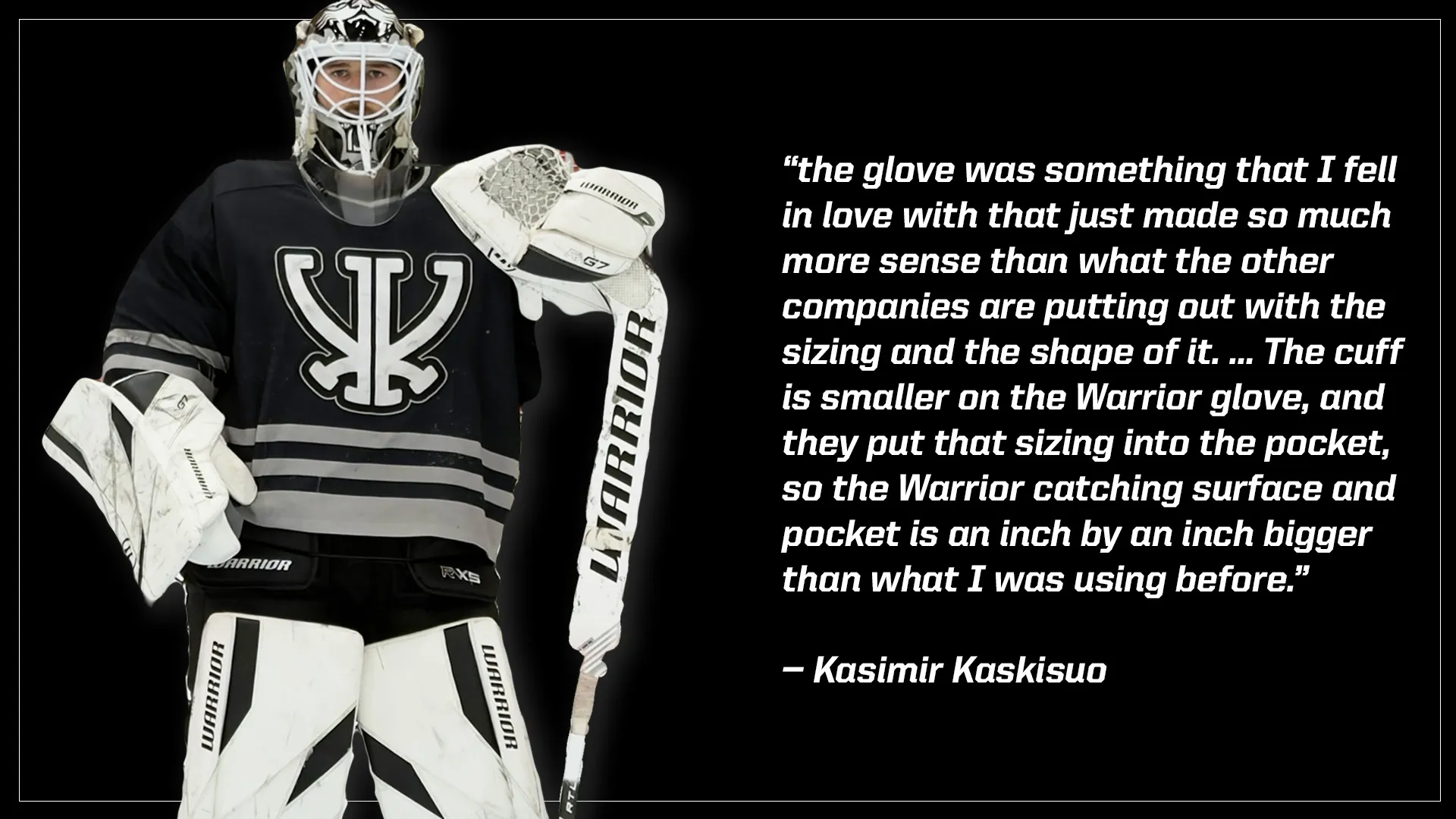
“Every time I’ve seen a Warrior glove, which has usually been younger kids wearing it, the pocket just looks huge, and they’re just making pocket saves so easily but always kind of, for some reason, discarded that since nobody in the NHL wears it,” Kaskisuo said.
“Being able to test Warrior late this summer, the glove was something that I fell in love with that just made so much more sense than what the other companies are putting out with the sizing and the shape of it. … The cuff is smaller on the Warrior glove, and they put that sizing into the pocket, so the Warrior catching surface and pocket is an inch by an inch bigger than what I was using before, and you feel that on the ice. There’s a lot of breakaway saves where I was like, ‘Okay, I didn’t maybe reach that one,’ but somehow the glove still scooped it in. And I don’t see the reason why there would be a bigger cuff on a glove. I haven’t noticed any difference in that — no protection or no coverage issues — and I’d just rather put my inches where it really matters, which is catching.”
Full disclosure, our meeting with Kaskisuo, who was recently a guest on Episode 331 of the InGoal Radio Podcast, was in Montreal as guests of Warrior and part of preparations for the Jan. 1 launch of their new Alpha Surge line. InGoal is already working on a full overview of the exciting new line but wanted to wrap up with the G7 glove review, in part because there will be some (but — spoiler alert — not complete) continuity moving forward.
To help walk us through G7 glove options, we again leaned on Kirk Allen, Category Manager for Goalie at Warrior, as well as some pros who have been using the gear, including Kaskisuo, KHL veteran Jeremy Smith, ECHL goalie Trevor Gorsuch and Sandra Abstreiter of the PWHL Montreal Victoire and Team Germany in the upcoming Olympics.
Like Kaskisuo, Abstreiter noticed the size of pocket right away.
So did her PWHL teammates.
“It’s a huge glove and I have been told by multiple players it looks massive,” she said. “And it’s so easy to hold it open all the way instead of your wrist being restricted.”
That larger pocket may help answer why so many of the goalies that tested our gloves were full of praise, but it wasn’t the first thing they noticed. Neither was the removable palm on the 7.0 model (more on that later) despite being an innovation that stands out like the slide plate on the pads. No, the first thing goalies notice is how light the gloves are.
On average, the Warrior gloves are a half pound lighter than other brands, and while that may not seem like much, it’s 20 percent, and noticeable enough that Allen tells pro goalies trying them for the first time to give themselves three skates to adjust to the weight.
“If you haven’t worn a Warrior glove and blocker before, I tell them don’t call me until you’ve skated three times,” Allen said. “It’s lighter than everyone else’s and the glove has a ton of wrist mobility, so it takes some time, because of the instinctive reactive nature of glove saves, to adjust but by the third skate, the call back is ‘I’m catching more pucks.’”
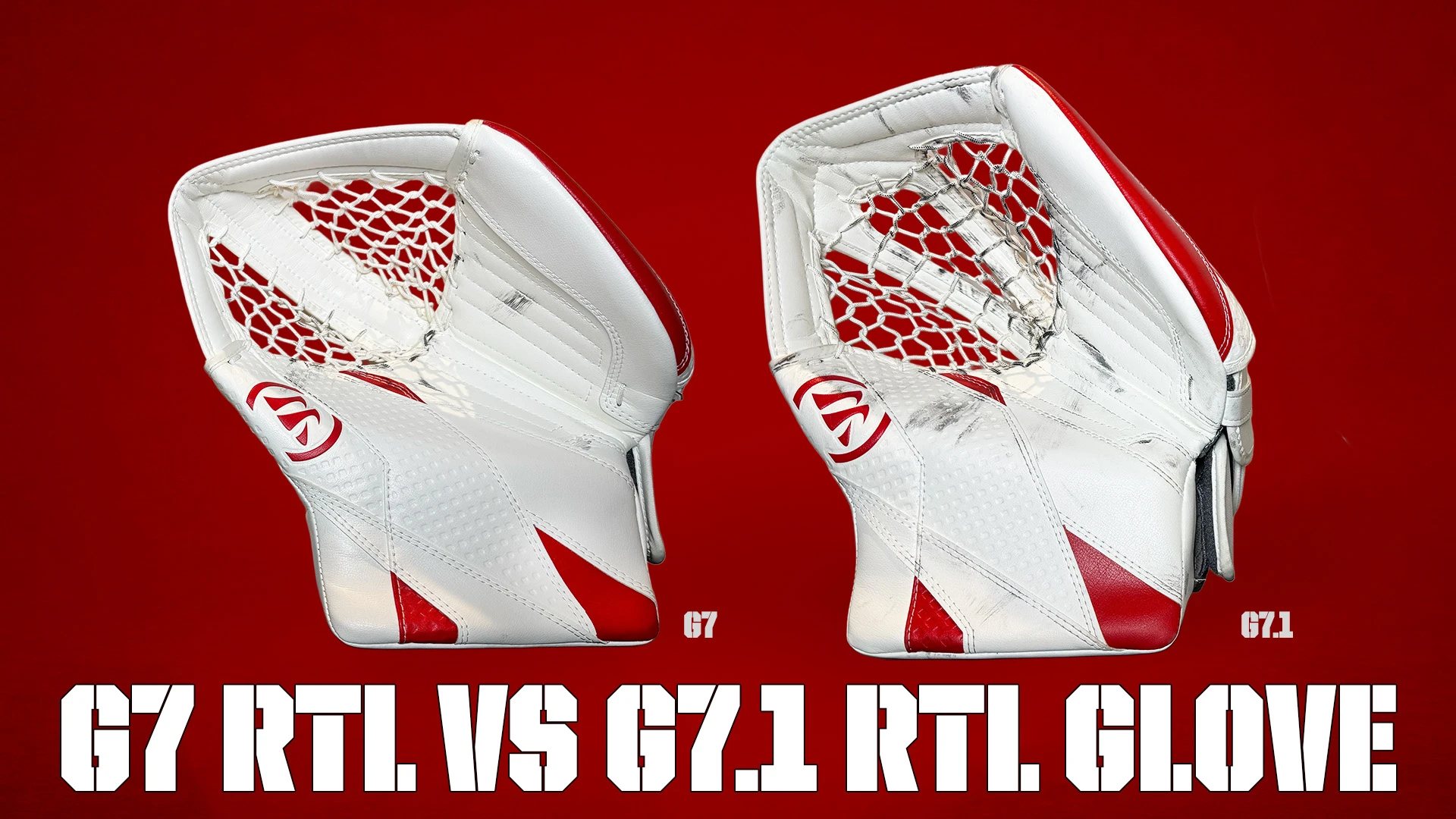
G7 RTL vs G7.1 RTL GLOVE
So, what’s the difference between the two glove models in the G7 line?
Besides the G7.1 RTL model not having the removable palm like the G7 RTL, of course.
There is the obvious: the G7 comes stock with a single-T pocket, while the G7.1 comes with a double-T, though of course you can interchange both in a custom order.
Less obvious, at least at first glance, are the two distinct shapes and how they affect where the pocket sits relative to your hand despite both the G7 and G7.1 having the exact same 75-degree break angle from the palm right up through the end of the pocket.
The G7 glove has a longer thumb and shorter finger area, creating a wider catching shape when it’s open: it looks like you could drop a soccer ball in there. That shape puts more coverage on the thumb side of that break, making it easier to catch pucks up high.
The G7.1 glove that O’Brien quickly fell for is the opposite, with a shorter thumb and the fingers extended, which creates more coverage on low side of that break line and provides more help reaching for low pucks just over pad.
Some goalies have picked the 7.1 because that shape “looks” like a 580-break we see from other brands, while others want the more “rounded” shape of the G7. Others think about that choice more in terms of where the pocket sits relative to their hand and where they might typically struggle to catch pucks, with a G7.1 helping low and G7 aiding up high.
Sales tend to be around 65-35 in favour of the G7, but that may simply be because it’s the glove that has been in the Warrior catalogue the longest and is most familiar.
“There are guys who like the 590 glove and that balance and how there may be more finger in that, and there’s obviously guys who like 580 and Bauer 600 and it’s just preference,” said Kaskisuo, adding he likes his hand to sit on the “bottom of the glove,” with the pocket up between his index finger and thumb. “You got to find what works best for you, and it’s just how I like to catch pucks, above my hand. That’s where Warrior put all their material in their pocket, so it just made huge catching improvements after my ninth year of pro hockey.”
REMOVABLE PALMS
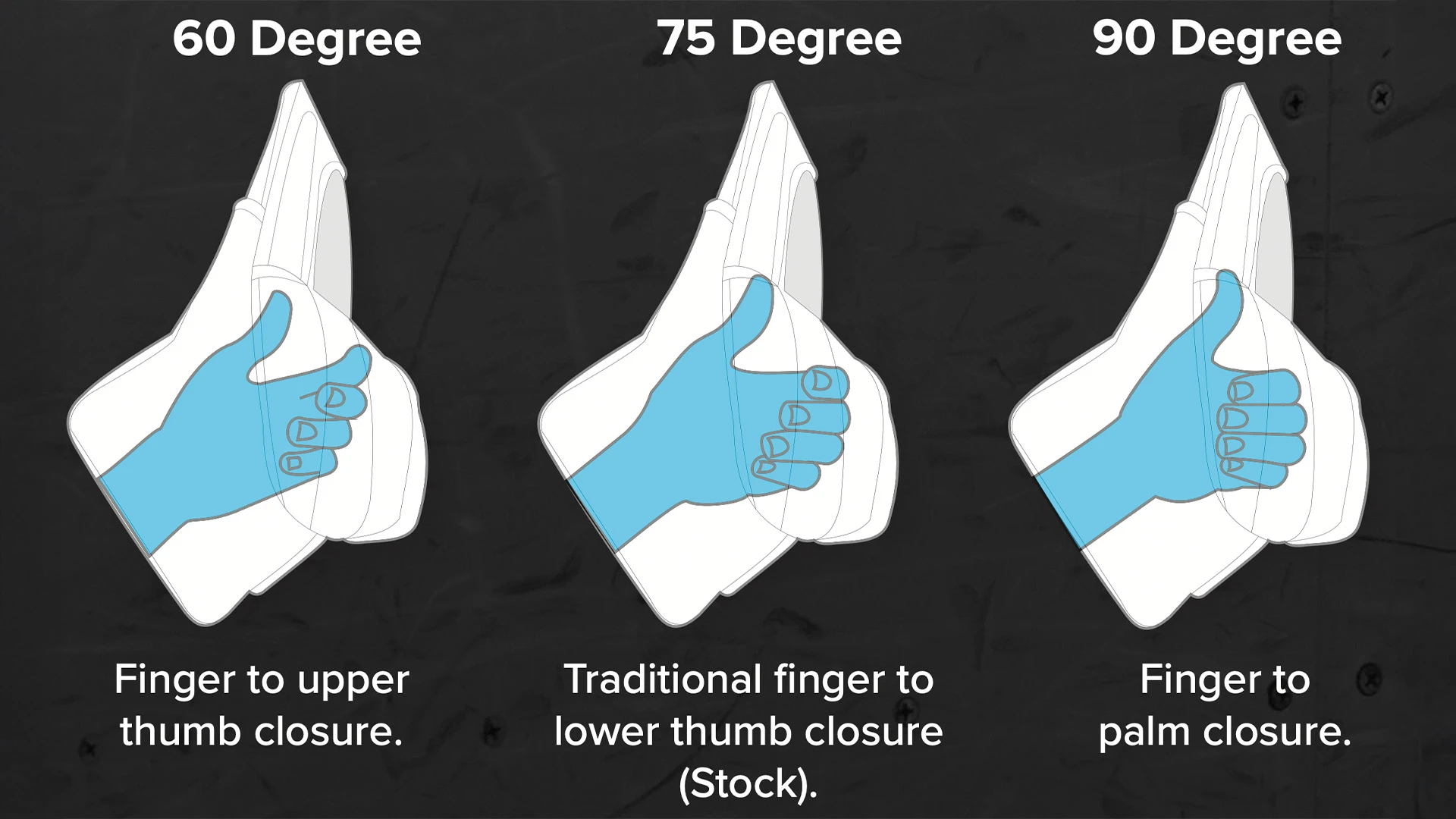
While the break angle is fixed at 75 degrees, the removable palm allows goalies to tinker with how their hand sits relative to it. The stock palm matches the 75-degree break, but you can also order 60- and 90-degree liners the removable palm in the G7 glove. (Making that liner change in a G7.1 glove would require a custom order). A 60-degree liner will shift the fingers more towards the pocket, creating a finger-tip pinch closure, while a 90-degree liner moves them away, creating more of a fingers-to-palm feel while closing the glove.
Full disclosure: InGoal didn’t try different liner angles. But we did talk to Smith about the removable palm helping him get his gloves dialled in — with the help of a digital calliper!
“Kirk nearly fell out of his chair when I pulled out the caliper,” said Smith, whose dad works in the steel industry and got it for him to make measurements as small as 1/100th of a centimeter. “I’m a bit of an old school goalie where I like tinkering with my own gear.”
Once Smith figured out where everything was lined up in his preferred palm set up in the Warrior glove, he was able to replicate it perfectly every single time.
You may have heard stories about some NHL goalies being able to tell if someone new or different at the factory had laced their gloves? Smith was “that guy” but doesn’t have to worry about it anymore thanks to the removable palm — and his caliper.
“With Vaughn, I could tell who laced my glove and there was a guy that retired from lacing my gloves, and I called [pro rep Adam Berkhoel], who is now with True, and I was like, ‘what happened to these guys?’ So, he was like, ‘listen, our glove guy retired.’ I was like, ‘how does he retire? He’s not allowed to retire,’” Smith said with a laugh. “So I was like, ‘where is he at? I’m going to go drop him off a new set and see if he can lace them up for me, you know, for old time sake.’ With the Warrior removable palm, you can Velcro that palm out, get the palm dialed in, the thumb and the pinky, and then you put it into the glove. I close my eyes and I just get into the zone, and I just feel like any goalie, you go into a sports store or goalie store and you know. You just close your eyes and you feel it, like, ‘ah, that’s it right there. Or maybe you’re like, ‘you know what, something is off. And you tinker, you get the caliper out, you get an old glove that felt really good, and you start measuring, you start feeling and you just kind of dial it in that way. That’s what’s different about the Warrior. It’s been great.”
Of course, not everyone is going to the same extreme as Smith.
The most common use of the removable palm is for goalies with smaller hands to be able to put an intermediate palm into a senior sized glove (or a G7 RTL blocker) the same day you buy it in store, without the need for custom orders and long wait times.
The palm comes in Senior and Intermediate for the glove, with practice palm option in the senior size but the blocker palm is available in Intermediate, Medium, Large and XL.
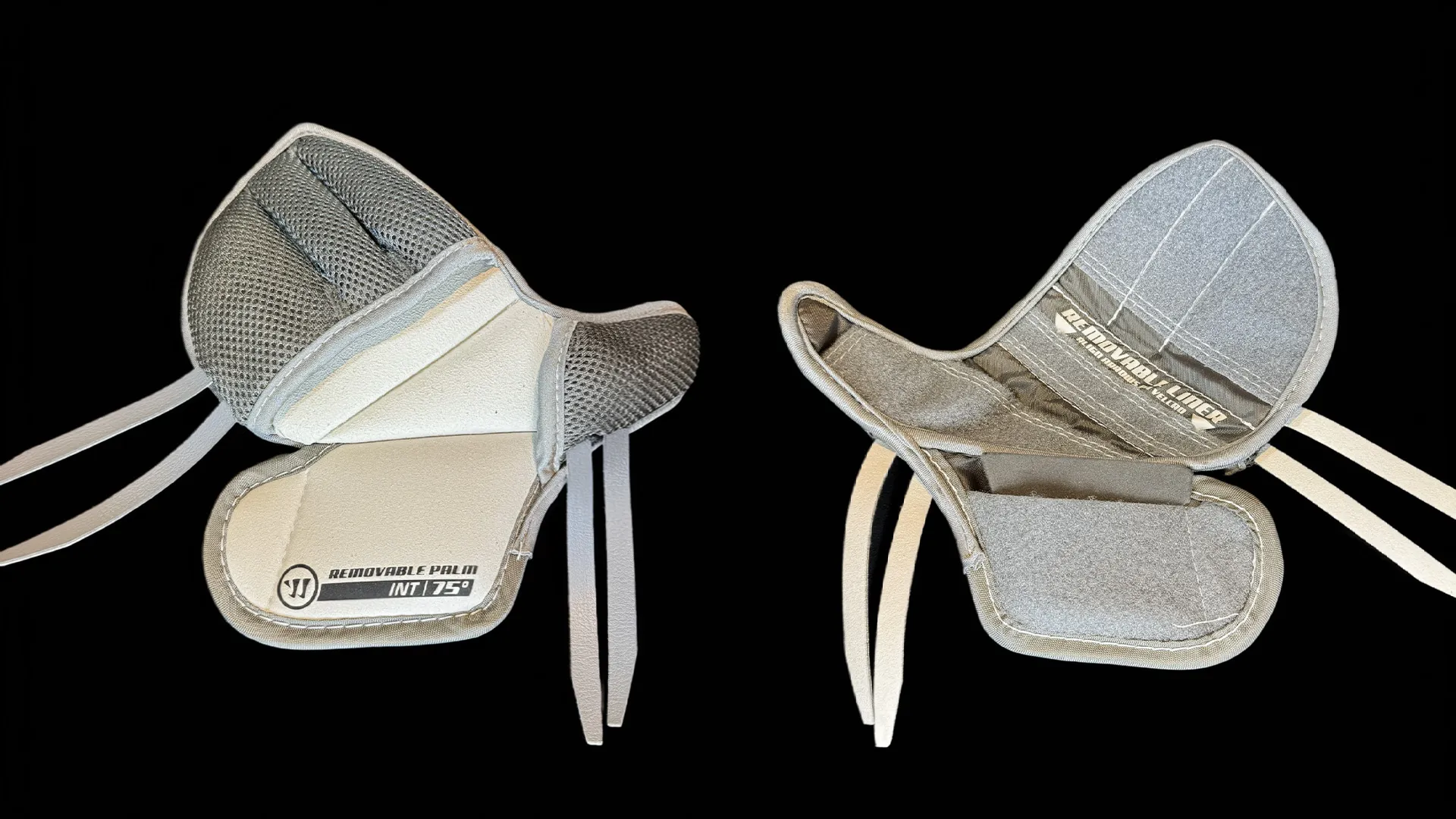
Other benefits of the removable palm? You can take it out wash it. Abstreiter does.
“It’s so easy, it has arrows and it’s so easy to put back in,” Abstreiter said. “Same thing with the blocker. It just feels like you have a better grip once you wash it and re-attach it.”
Some college goalies get a spare palm to switch out halfway through their season for a refreshed feel that “brings the blocker back to life,” Allen said.
Perhaps the strangest use of the extra palm is when selling a glove or blocker.
“Some goalies put their old palm in a new glove because they want the feel of a one-year break in and then they sell the used glove with the new palm and the person buying it thinks it’s great,” Allen said. “It’s not common but I’ve heard it plenty of times.”
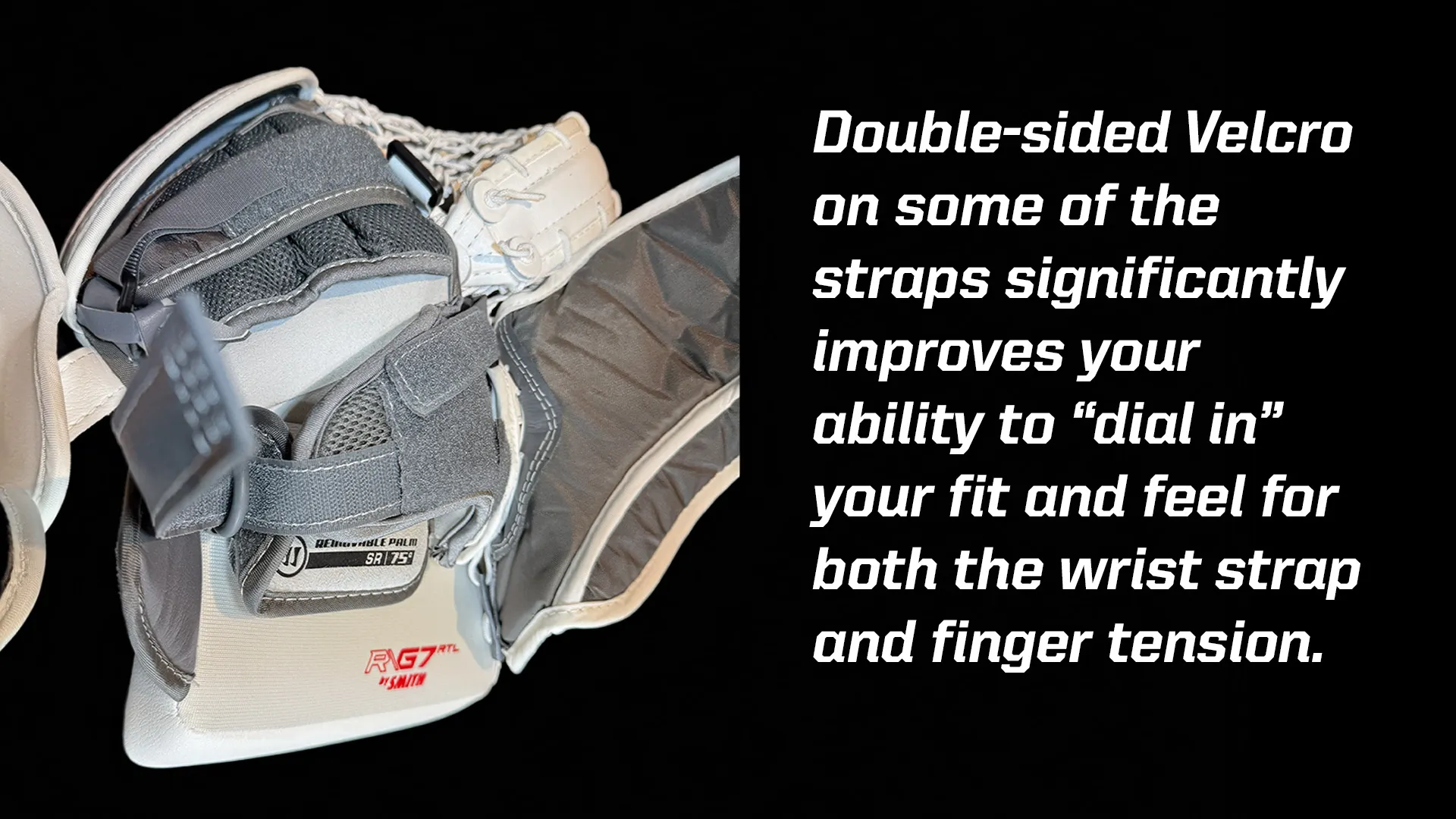
The last part that stands out about the Warrior Ritual G7 RTL and G7.1 is the level of internal adjustability with a strapping system that includes double-sided Velcro on some straps so you aren’t limited in where or how you want to strap it down, enhancing that ability to “dial in” your fit and feel for both the wrist strap and finger tension.
The cuff is really open to further enhance wrist mobility, making it easy to keep that massive pocket squared up at the shooter and looking huge.
Add it all up, and Warrior’s glove line combines innovative features with unique fit and adjustability options, but at the end of the day, it’s that big pocket goalies love.
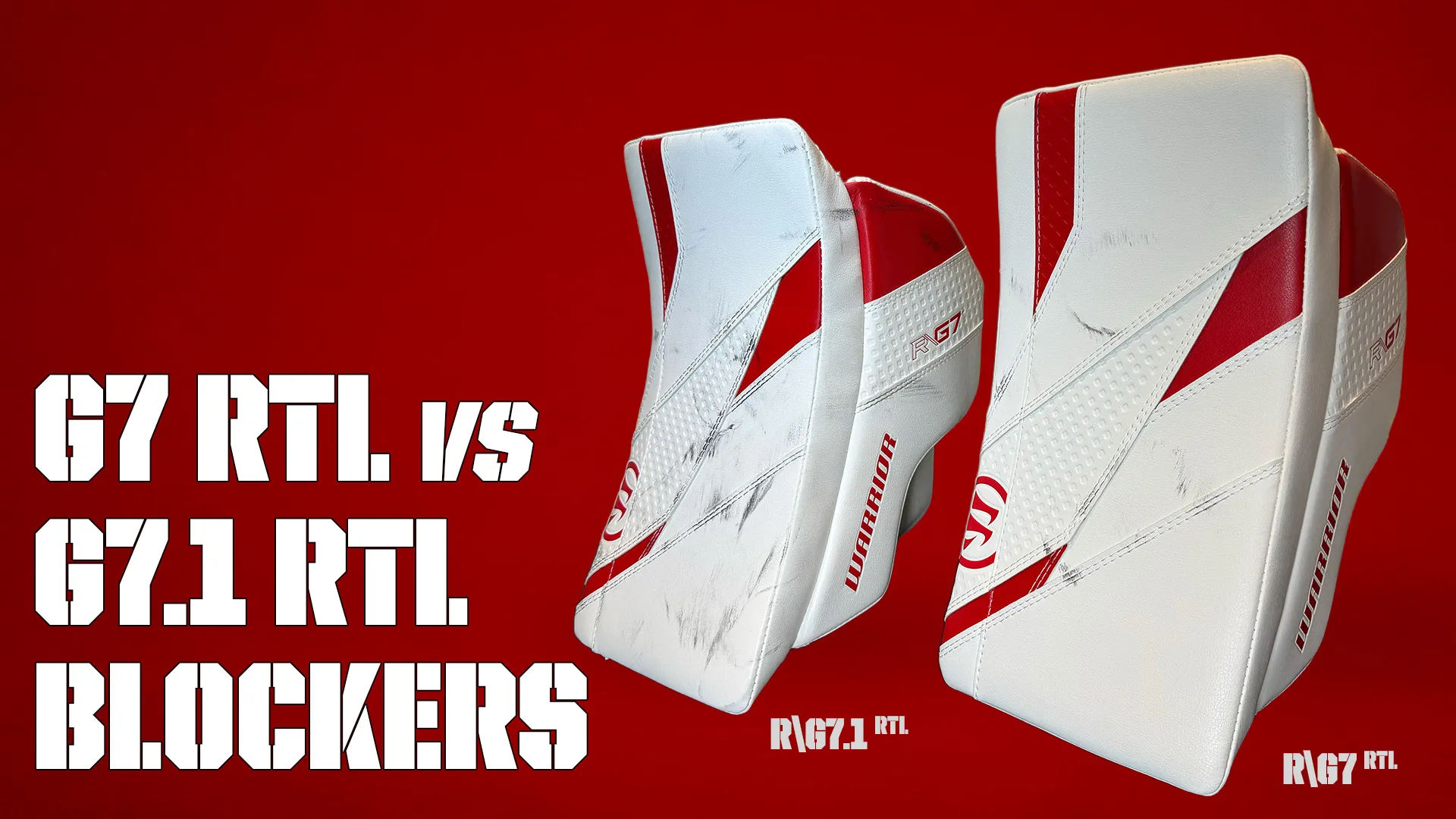
G7 RTL vs G7.1 RTL BLOCKER
Different shapes are also the big story on the blockers — in particular, board shape.
The G7 RTL has a noticeably thicker, flatter board with a 20-degree curve designed to maximize coverage of initial presentation because it’s longer top to bottom.
The G7.1 has a thinner board with a 35-degree curve that is steeper and more rounded up top, which helps in projecting the blocker and cutting off the vertical angle.
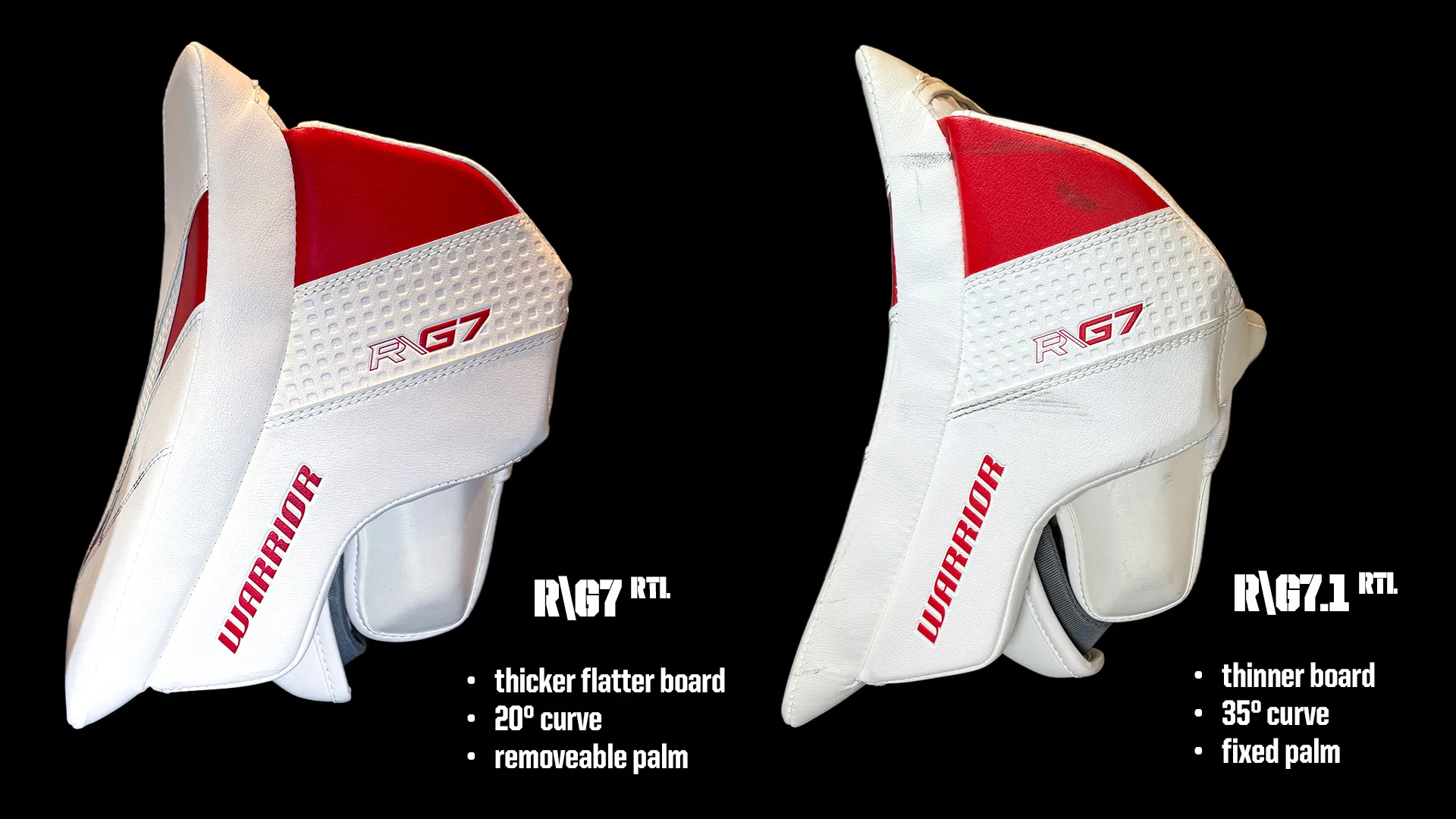
The top portion curve on the G7.1 helps limit pop ups or possible roll overs on shots that hit the top of the blocker but that’s also something Warrior began addressing with their internal padding as far back as the G5 models by tapering the foam that sits between the back of the goalies hand and the blocker board in their coverage-plus designs. With thicker foam at the top near the wrist thinning out down the face, it tilted the blocker forward.
The curved finger protection includes Velcro strapping adjustability as well as an extra piece of HD foam along the index finger that is easy to remove (and most of our testers did). The cuff is nice and open, with different options for where to attach the elastic tab on the outside of the wrist wrap that further enhances that customizable fit and feel. It’s worth noting, however, the straighter curve on G7 is inherently a little less open at the wrist than the G7.1 because it’s thinner board curves away from the wrist, opening it more.
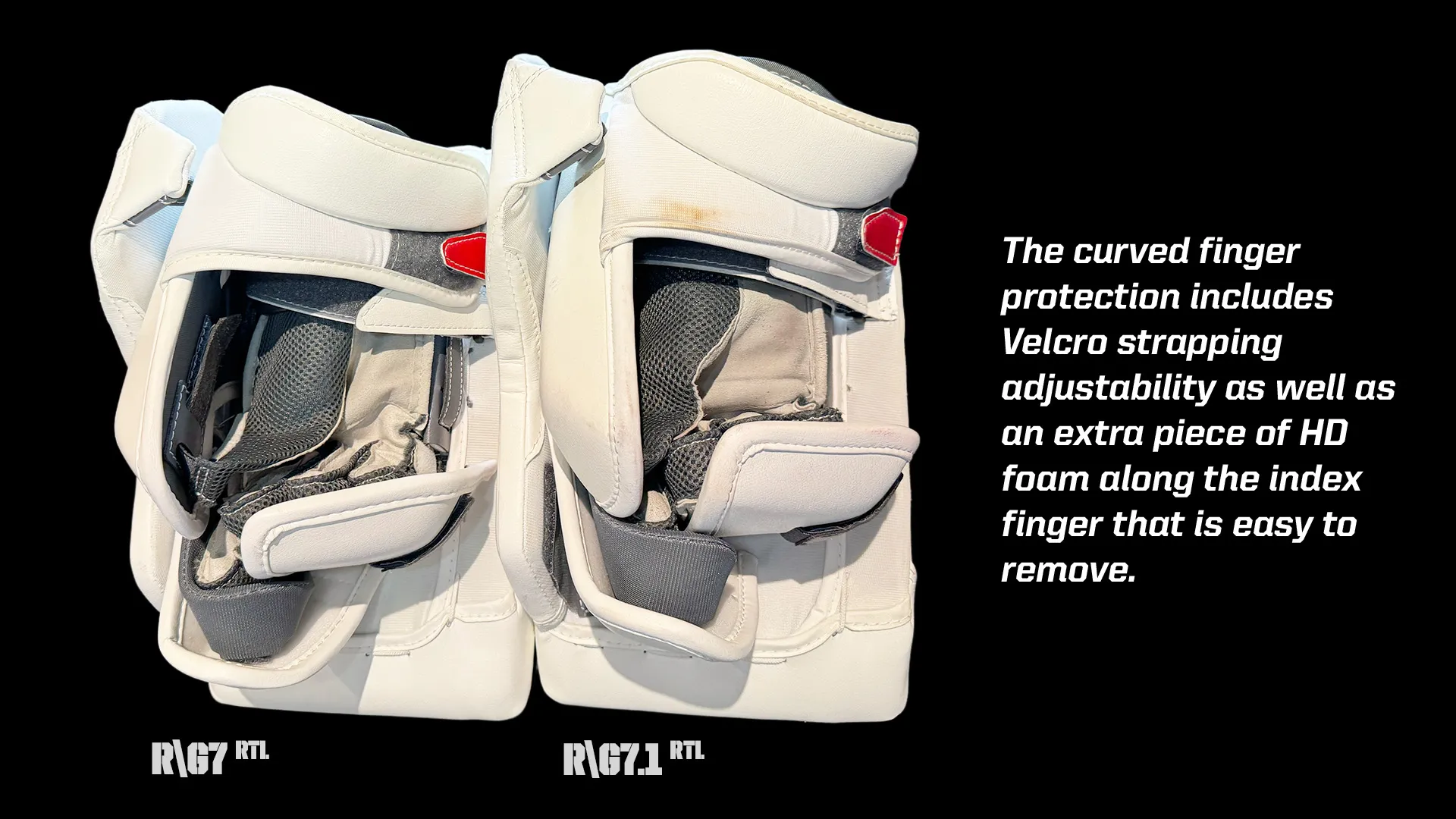
The sidewall is a sturdy, dense foam that just feels protective, and the board features their HyperComp carbon composite to enhance rebounds (they had good pop, but not as active as some other brands we’ve tested) and help the blocker hold its shape over time.
Overall, both blockers have a nice balanced feel and easy stick integration.
As for that removable palm in the G7 blocker, we’ve already told you it allows for an off-the-rack swap to an intermediate size (or M, L, or XL), and as Abstreiter outlines in the video below, makes it easy to wash. But it also allows you to adjust where the hand is positioned relative to the blocker board, making it easy to shift your coverage slightly if you are getting beat more down low or up high on the blocker side.
As you heard Abstreiter say earlier— and Smith and Kaskisuo above — that pocket is the biggest game changer for pro goalies who have switched to the Warrior gloves.
That includes Gorsuch, who has played six seasons in the ECHL since finishing at Western Michigan University, including a league-leading 1,420 saves in 2021-22 with Kalamazoo, his first season in a set of Warriors that included prototype gloves at the time.
“It wasn’t even like logoed or anything,” he said. “It was just an all-white prototype glove and I was like, ‘this is the best glove I’ve ever worn.’ It’s just a vacuum. Something about the shape, just vacuums pucks. Pucks just went in it, died, stayed in it, nothing came out.”
So, when he had a college goalie that he trains in the summers struggling to catch pucks at a, Gorsuch offered up his Warrior G7 RTL glove for a few reps.
“He’s looking at and says ‘Warrior, I don’t want to wear a Warrior glove,’ and I was like, ‘just wear it, just try it’ and immediately he’s tracking the puck in, getting full connection with his hand,” Gorsuch said. “He’s like, ‘can I keep this? I said ‘No, that’s my glove. I need that back.’ Next skate he shows up with his own Warrior gloves, and he’s just catching everything, even right out of the store. It allowed him to truly feel the connection with his hand.
Everybody’s different. Everybody feels different. But for me, that’s been the best glove I’ve ever worn and for me the glove is one of the most important piece of equipment, because I grew up a ball player, first base, third base, so having that connection of my hand, feeling like a glove is an extension of my hand, that’s the closest I’ve ever found to having feel like a first baseman, where it’s connected to my hand.”
With more exciting features coming on Jan. 1 with the Alpha Surge, and a continuation of that larger pocket philosophy, we won’t be surprised to see more pros giving them a try.

Comments
Let's talk goaltending!
We welcome your contribution to the comments on this and all articles at InGoal. We ask that you keep it positive and appropriate for all — this is a community of goaltenders and we're here for each other! See our comment policy for more information.
Besides all the good things listed above, a HUGE difference in the Warrior gloves is that they require almost zero break in straight from the factory. This is a result of the design elements which make the padding fit exactly where it is supposed to be and stay there throughout the life of the glove, never bunching up or sliding out of place. In addition, the seamless binding eliminates the inconsistency of a builder lacing the glove too loose or too tight, creating a glove that comes out of the factory perfect regardless of who is building it. Finally, the padding is designed to virtually eliminate stingers, a genius design of carbon fiber with a thin but substantial foam padding on top. This thinner pocket protection again helps to make the pocket closure easy and fast right off the shelf.
The blocker has the same consistency in quality because again the internals fit easily and perfectly into place for the builder and the seamless binding cuts out variance in glove lacing.
Going to be very interested in what is coming with Alpha Surge……