
Warrior Alpha Surge: Inside the Montreal Lab Where the New Alpha Took Shape
InGoal Magazine’s behind-the-scenes overview of Warrior’s re-engineered pad and glove platform
Most gear overviews start with a list of features.
This one starts in a room.
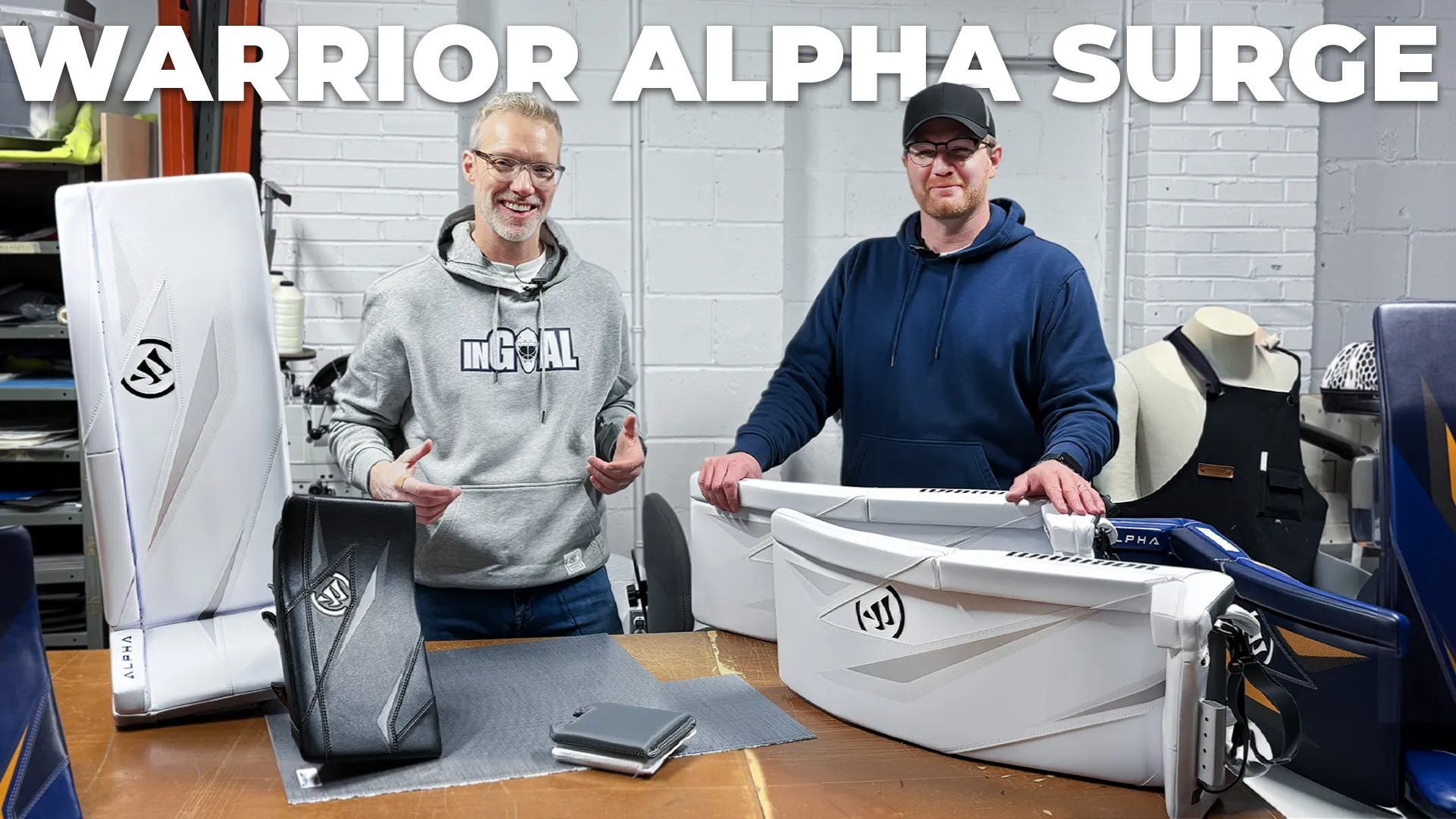
Tucked inside Warrior’s R&D space in Montreal — the same environment where ideas are sketched, prototypes are built, and assumptions are challenged — InGoal was given a behind-the-scenes look at the new Warrior Alpha Surge line with their goalie design and product team. What became clear quickly is this wasn’t about adding one new idea to an existing pad. It’s about changing how several key systems work together.
From the shape on the front to the way it’s connected on the inside edge, from totally new straps on the backside to improved materials on the inside, Warrior’s Alpha pads are a bold step forward from a company long known for leading the way in goalie innovation.
That includes, for the first time ever, a knee stack that can easily be height adjusted to take some of the wear and tear on young goalie hips while also widening your butterfly!
The new construction combines to make Alpha Surge the best sliding Warrior pad ever.
“The speed is crazy,” one internal tester said. “Five times faster than G7, no joke.”
That’s quite the claim considering InGoal labeled G7 “the fastest slide we’ve ever tested!”
So, how did Warrior speed up the Alpha Surge, even without the removable slide plate?
Read on to find out. This overview isn’t based on on-ice testing. It’s built from detailed walkthroughs, internal explanations, and design intent — the “why” behind the Alpha Surge platform — to give all goalies context you won’t get from a spec sheet alone.
But first, check out the Alpha customizer that launched Jan. 1 to get a feel for the many design options that come from a new hybrid approach to graphics, blending traditional cut-and-sew zones with printed areas that allow sharper contrast and cleaner transitions:

ADVANCED FASTENING SYSTEM
The speed increase is from a combination of several changes, and none is bigger than the new Advanced Fastening System used to attach both the knee stack and the lower calf plate to the face of the pad using bolts and composite brackets. This new system, which is on both the pro level Surge and second price point S50 pad, improves stability in both the knee and calf, while also allowing Warrior to completely remove a lacing channel.
The idea of stabilizing the knee area isn’t new. Warrior began focusing on it as far back as the Ritual G2 with their “knee drive system” and most followed suit with the increased understanding that a more fixed knee allowed goalies to seal the ice faster. With the Alpha pads, they’re extending that philosophy to the calf, shin and ankle areas to further enhance stability and support, eliminating the need for the calf pillow or cushion from the G7.
“The pad is doing more of the work for you,” said Kirk Allen, goalie manager at Warrior.
The hard plastic slide plate remains — and remains easily removable for those that prefer not to use it — but with the new fastening system there is no nylon or lacing anywhere on the sliding surface or down at the binding-less boot, nothing to absorb water or slush or grip the ice, add friction and slow you down when sliding. Speaking of less material to slow you down, the face of the pad from the knee to ankle is noticeably thinner than G7, roughly 50% as thick down near the bottom, which means less surface contact while sliding.
New Shape, Boot Angle and Upgraded HyperComp
The Surge pad has a one-piece core with no internal break, and a dual-reinforced thigh rise with an upgraded version of HyperComp composite — lighter, stiffer and more protective, Allen said — on both the face and back of the core from the lower knee break to the top.
“It takes weight out while also improving longevity,” Allen said. “The stiffness will hold up.”
The pad is somewhat flat but there is some “pre-curve” shape above the knee, and a break on the outer roll at the bottom of the knee to help goalies build in more if desired. The S50 second price point pad has a more flexible profile, with a single internal break and only one HyperComp layer on the back of the thigh rise, making it easier to put more “shape” into the top, and you can tailor the flex profile in the Surge pad on the customizer too.
Warrior’s decision to go to a flatter, 90-degree boot break as the stock option on the Alpha pad (a first for Warrior) was based on the feedback and preferences of European pros.
So far, North American testers have mostly agreed the flat boot makes it easier to integrate into the post in a reverse-VH, perhaps in part because the bottom edge sticks out in front of the skate rather than angling down to the toe, making it easier to hit that bottom edge and get a toe box seal.
Of course, the benefits of a flat boot would be negated by the two-way flex in the G7 pad that allowed goalies to flex the toe down, so Warrior has eliminated what they called their “full hinge” in the stock Alpha pad in favor of a more traditional one-way flex (you can still order the two-way flex in the customizer if you really liked it).
Of course, one of the philosophies behind a steeper boot was to help direct rebounds into the corner, and while that’s true of short-side shots, it could still leave far-side shots in dangerous spots when players utilized the pass-off-pad to target a teammate driving the net on the backside, and the flat boot should let goalies keep more of those rebounds – and more rebound in general — in front of them, which is better than a far-side rebound.
Warrior cleaned up the underside of the boot area as well, creating a smooth surface with a nylon material and no stick lines that could catch the top of a skate.
Calf ‘Hammock’ Among Revamped Strapping
There are several strapping upgrades on the Surge pad, but none stand out as much as the lower calf “hammock” that provides a new way to connect the pad to the lower leg.
This new wraparound strap is located inside the leg channel with a fixed Velcro connection that is offset from the outer edge of the pad. The inside connection point for this elastic strap is also offset from the inside edge, creating a loop around the lower calf.
Warrior’s testers praised the increased control, connection and responsive feel it creates in the lower part of pad, while also working to keep the pad centered on the leg as you moved in and out of the butterfly, helping to prevent it from staying rotated when you get up.
It builds on the theme from Warrior’s G7 pad of wanting to bring the traditional connected feeling of a softer pad to a more rigid modern pad – but takes that to a new level.
Of course, being Warrior, they also built in the ability to loosen that connection easily with multiple slots for the lower connection point on the back face of the pad, as well as the ability to connect it through the inner calf plate, where many calf straps originate.
There are other, more subtle strapping improvements on the Alpha Surge and S50 pad.
The upper calf — or professor – strap is also significantly different from the neoprene strap on G7. The Alpha Surge pads now feature a much thinner 1-inch double elastic professor strap that has adjustable tension and its own connection tab inside the outer edge of leg channel, rather than just connecting it to the outside of the calf wrap like G7.

They kept the double elastic knee introduced on G7 but changed its outer knee connection point, which was previously a larger trapezoid shape, to thinner profile matching the width of the elastic, improving mobility and making it less likely to get caught up behind your knee. It’s not first pad to have it but it’s a first for Warrior and worth noting early prototype testers who used to run their knee strap down to the outer calf wrap are now strapping it around the knee to this modified (and still easily removable) outer attachment strip.
The outer lower calf wrap strap, nylon webbing used to close off the leg channel on both sides is also easily adjustable in length using a t-lock system on the inner calf.
There are several notable improvements to the knee stack, including a beveled shape on both corners to reduce interference, especially moving in and out of the RVH, and a removable soft foam landing layer at the top that uses Warrior’s Axe Suede material, long popular on their premium player gloves, but new to their goalie equipment.
But the biggest change is the ability to remove this pad and replace it with a thicker one.
That’s right, Warrior will offer a stock accessory that lets you raise knee stack height!
For anyone wondering why we’re suddenly adding exclamation points to a review and why that is a big deal, the relationship between the knee, ankle and skate plays a key role in the amount of internal rotation of the hip and pressure on the joints of a goaltender.
Being able to raise the height of the knee stack not only makes a goalie taller in the butterfly and makes it easier to widen their butterfly flare, but it will allow us to take stress off young goalie joints especially, perhaps tapering back to the NHL mandated maximum height as they get older and closer to an age when it might matter. For those already playing at high enough levels that a maximum might be enforced, you could easily swap the thicker knee stack option in for practices to reduce wear and tear, and because it’s a stock part designed specifically to integrate with the Alpha pads, it maintains the balance principles of the Warrior knee stack design better than aftermarket options we’ve seen in the past.
This new thicker option — and the lower layer sits a lot more flush and connected than it did when we quickly popped it in for the video — will be available as an accessory for both the Alpha Surge and S50 pad when the Alpha line launches at retail in the spring.
Alpha Surge Gloves New 90-Degree Break
The Alpha Surge introduces a new 90-degree break angle to go alongside the familiar 75-degree option from the G7 and other lines leading up to it. In the past, Warrior has offered two different gloves by changing how the pocket was shaped relative to the same 75-degree break, something that InGoal broke down in depth in a recent review.
The G7 glove had a longer thumb and shorter finger area, creating a wider catching shape with more coverage on the thumb side of the break, making it easier to catch pucks high. That continues (with upgrades we’ll get to below) in the new Alpha 75-degree break glove.
The G7.1 glove was the opposite, with a shorter thumb and the fingers extended, which creates more coverage on the low side of that break line and provides more help reaching for low pucks just over the pad. That shape continues with the new 90-degree glove, but as the name suggests they also changed the break angle, shifting it steeper toward the thumb.
Like their G7 predecessors, the updated 75-degree Alpha glove comes with a removable palm, and the new 90-degree Alpha glove does not come with a removable palm. The break itself is also wider, so it feels like you’re closing your hand around something.
All Alpha Surge gloves come with AX Suede in the palm, the premium material from player gloves mentioned above being used on the knee stack, and new to the goalie line. They also include Intuition, a new heat-mouldable foam brought over from the soon-to-launch Warrior player skate that is popular in skiing and snowboarding and can be activated with a few minutes in a skate oven, or simply through body heat while playing.
“You will feel your fingers imprint into the palm,” Allen said.
Warrior also reworked much of the strapping on both gloves.
They added an adjustable tension layer of neoprene that runs over the back of the hand and knuckles, between the closed finger stalls and the backhand strapping, to further prevent any chance of the hand slipping out when the glove is closed.
There is also a new external Velcro adjustment for the pinky loop and thumb loop, and the shape and connection points on the backhand strapping were altered to create a more even pressure distribution over the back of the hand.
Warrior even added a new take on the traditional wrist strap — something they’ve resisted in the past because it tended to lock the wrist — but found a way to make it both adjustable and removable, adding a secure fit without locking you into the cuff box.
Alpha Surge Blocker: Two Curves, More Rebound Pop
Much like the glove, the new Alpha blockers build off the Ritual G7 models, but with several new features across both new models and some familiarity among the two curves.
Warrior used to differentiate their blockers with a flatter, thicker 20-degree board shape on the G7 and a steeper-at-the-top 35-degree board angle on the G7.1 model.
Based on feedback from European pros, however, Warrior realized most goalies wanted more curve, so how do theiyr differentiate between the two new Alpha models?
By where that curve starts.
The two new Alpha models are now called the mid-curve (MC) and high-curve (HC).
MC is similar to the G7.1 blocker, with the curve starting about halfway up the board.
HC starts at the top third of the blocker face and has more curve up top. The HC has a slightly thinner board than the MC but is notably skinnier than its G7 predecessor.
So, what does that mean for goalies?
Allen said it affects the sweet spot, with the HC having a larger flat area over the bottom 2/3 of the board, meaning rebounds will exit with a level arc, while still having the more pronounced curve top to cut down on high shots in tight and prevent rollovers. On the MC, the sweet spot in the middle is part of the curve, which creates more rebound elevation.
Speaking of rebounds, they are noticeably more active coming off both new blockers.
It’s a product of the upgraded version of Warrior’s HyperComp composite materials, and the fact they are using two layers — one on the face, another on the back — on both Surge blocker models. (The second price point Alpha S50 blocker has one layer on the face).
The benefits of having two layers of HyperComp, like on the thigh rise of the Surge pad, go beyond creating a more lively rebound overall. It also creates a more consistent rebound right to the edges of the blocker rather than just in the middle, something that has plagued other blockers with even thinner boards, and it improves durability.
Both Surge blockers come with the AX Suede palm material, but only the HC (and the second price-point S50) blocker come stock with an interchangeable palm (the MC, like the 7.1 that precedes it, does not have the removable palm), allowing goalies to swap out different sizes, or take the palm out to clean or simply to add a fresh new one.
Warrior also made a subtle upgrade to their index finger protection.
The small, removable extra piece that runs along the inside of the index finger used to be something goalies often removed on Warrior blockers (including InGoal testers), because it made it harder to slide the stick out or up for a poke check or to stickhandle. While we thought it was the narrowness of the gap with the “finger stick” in place, Warrior recognized the issue was actually having leather on the inside and out, so they’ve removed it from the inside, replacing it with a material that allows the stick to slide easily, and so far a lot of internal testers that used to take it out are leaving the adjustable the finger stick in.
Warrior has also offset the cuff on the Alpha blockers, responding to feedback from goalies who did exactly that using the adjustable attachment points on the outer edge of the blocker (and they remain on the new blockers, including the S50 model).
That ability to alter the angle allows goalies to adjust the degree of wrist mobility.
Summing up Alpha Surge
There’s a lot of exciting innovations in Warrior’s new line, including several features like the new strapping and calf plate and knee attachments that are going to require more on-ice testing and feedback from InGoal in the coming months leading up to retail launch.
Behind that innovation, however, are a couple consistent themes that already impressed with the Ritual G7 line, highlighted by an attempt to mix a connected feel typically associated with a more traditional soft pad onto a more rigid modern pad. Add in updates to gloves that were already earning raves from professional goalies, and being tested by at least one in the NHL, and we won’t be shocked to see more high-level adoption up to and including the world’s best with this new Warrior Alpha Surge line.
While we wait for more feedback – from both our InGoal testers and the rest of the pro goalie world — enjoy playing around on Warrior’s new Alpha Surge customizer and trying to come up with unique ways to mix their new print and sew zone combinations.
Much like Warrior goalie itself, we can’t wait to see what you come up with next.
Comments
Let's talk goaltending!
We welcome your contribution to the comments on this and all articles at InGoal. We ask that you keep it positive and appropriate for all — this is a community of goaltenders and we're here for each other! See our comment policy for more information.
You must be logged in to view and post comments.