Ilya Bryzgalov Flyers

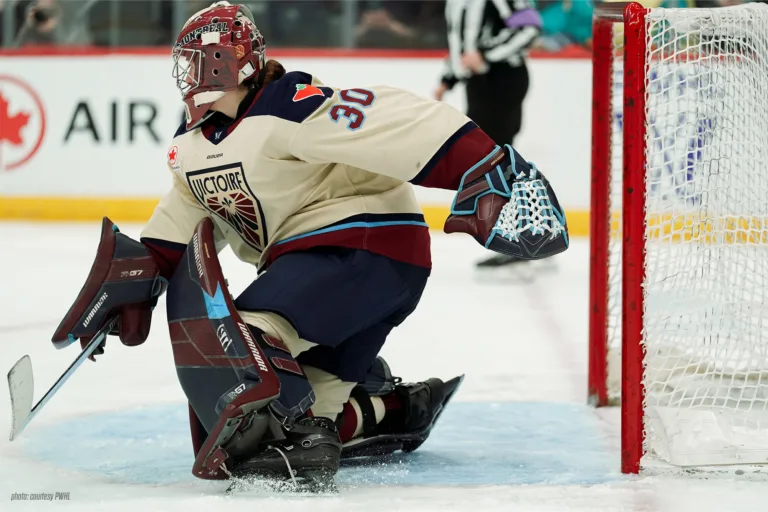
With the puck behind the goal line, Philadelphia's Ilya Bryzgalov doesn't bother trying to block a pass out. Scott Slingsby photo.

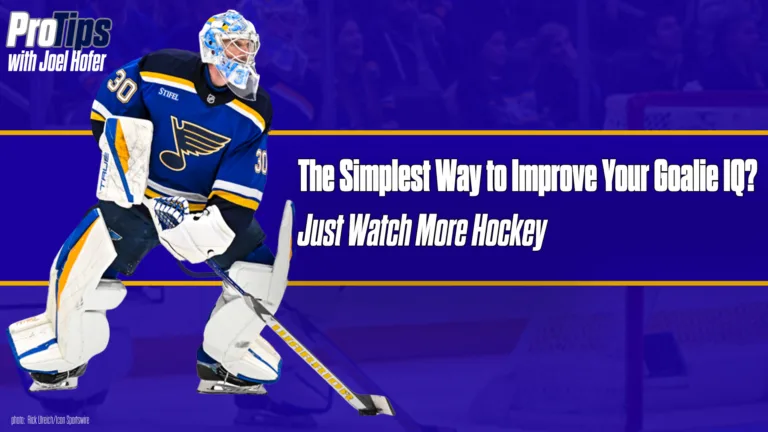
When discussing goal-post integration there are some constants and a few different options that we all encounter at the rink and at the numerous goaltender specific schools. Here are some constants with which we all likely feel comfortable:

  1. The goal-skate is on the inside of the goal-post. Young goaltenders frequently have their skate on the outside of the post which results in them falling as they move away from the goal-post to challenge the Shooter.
  2. The post skate should be loaded on its inside edge allowing the goalie to use the edge to push off towards a certain point of attack.
  3. The legs should be slightly bent at the knees to load the quadriceps and hamstring muscle groups for the purposes of storing energy and power to push off the goal-post.
  4. The goaltender should not be cheating or leaning off the post in an effort to gain a lead in heading in another direction. This has always resulted in poor short-sided goals!
  5. With respect to the stick, the knob should either be big or small enough that it cannot get stuck in the net’s meshing and the stick should always be on the outside the goal-post so it can remain active if required.

This brings use to more debatable issues including whether the blade of the goal stick, on the trapper or blocker-side post, should be turned to the area behind the net (Photo #1A & 1B) to deflect or intercept a pass-out attempt to the slot. Is this traditional teaching point of much value considering the small number of passes that are actually within the reach of the stick (especially on the blocker-side post which has shorter reach) to intercept or deflect?

A more modern consideration is having the stick blade facing the front of the net (Photo #2A & 2B)

Why? If the pass out is quick and outside the range of deflection with traditional positioning, then additional movement, and hence time, is required to re-position the stick to face the shot. This wasted time may be enough with a quick release shot to sneak through the 5-hole along the ice. This consideration is applicable on both sides of the net.

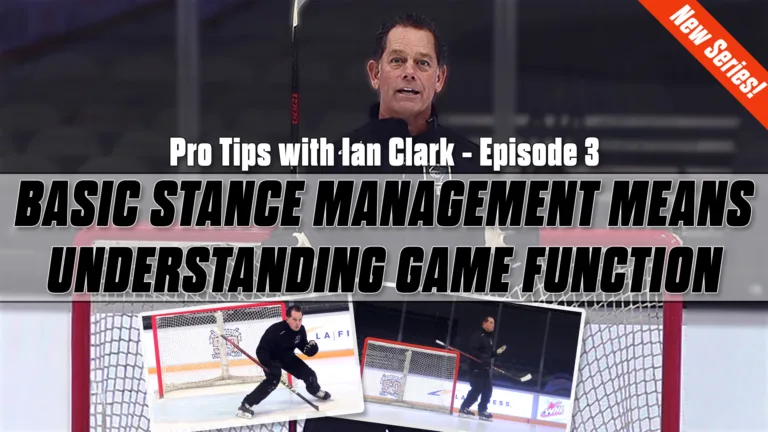
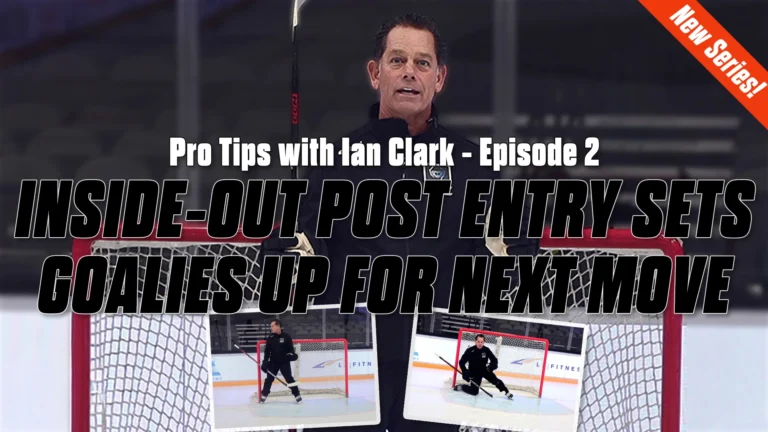
With the introduction of the V-H technique, goal-post integration has another set of principles and available options. In V-H positioning the stick is placed into cover the ice in the seam between the vertical and horizontal pad. On both sides of the net the stick may be held in an upright position which maintains the blocker in a higher position (Photo #3 A & B).

However, Another option is available on the trapper-side post. Here V-H technique may be used with the stick in a paddle down technique (Photo #4).

This allows the goalie to use V-H while sealing the ice in a fashion similar to a wrap attempt. This is not a bad option if the goaltender is uncertain whether the attacker will attempt a wrap-around or a pass-out. If the pass-out occurs the goalie merely pushes off the post towards the attacker out front while already sealing the ice to the far side of the net with the horizontal pad. The down paddle covers the 5-hole until the drag leg is brought in to create a tight butterfly.

This approach is however not without fault. With a pass-out, a shot taken moderately high to the far side of the net requires the blocker to be raised from the ice surface to make a reactionary-type save. Once again, this takes an extra move and extra time that you may not have. Therefore, if you think the pass-out is more likely to occur than a wrap attempt, you may want to use V-H while maintaining the stick in a vertical position for the aforementioned reason. This requires exceedingly quick decision making by the goaltender.

So what should the modern goaltender do concerning stick positioning as it relates to goal-post integration? I believe the modern goaltender first and foremost should be knowledgeable about all available options. Secondly, they should use what works for them and not for someone else. A lot of practice is required to make this decision. Thirdly, the goalie must remain flexible in the sense that each situation and each game may be slightly different and hence the technique utilized may not be the same all the time!

Please take a look at the different photos of the various approaches and hit the comments section to let me know what you believe is most effective or ineffective for a certain situation and why you believe that to be the case.


9 Responses to Post Integration – Stick Options

  1. Paul Szabo says:

    Hi Thomas;
    Great article; I have to admit that I am one of those teaching the placement of the stick blade close to the goal line to cut the pass, sometimes wondering if it would be better to face the front instead. However, in minor hockey there are in fact many passes that come right through the blue ice that can be cut because attacking players are not that skilled to saucer the puck over or place it more accurately away from the goalie’s stick.

    With regards to your VH photos: I take a bit of an issue with the fact that the down leg is not parallel to the goal line and the post skate of rather outside and in front of the post. I try to have my body more inside the net. The way the photo shows the goalie, a player cutting on front will easily go around the goalie and score before he can get back in the net. In the position shown the goalie will have a tendency to push out, away from the net, rather than straight along the goal line to the far post.

    I guess I don’t trust this forward a position, even if thereis a Dman in front to stop the attacker from cutting in front or passing through the crease.

  2. Tomas Hertz,MD, BA says:

    Paul, I agree with your points. I agree in minor hockey the lack of strength and ablity to saucer passes to the front of the net makes having the stick blade to intercept passes a good option. The stick is obviously used as a ramp but you know this ! There will be another article (already sumitted) in about a month that discusses cross crease passes and stick activation. I am greatly bothered by watching all goalies , including professionals, who would rather make a great lateral slide than activate their stick and intercept the pass through the blue paint !! I guess I did a poor job with the photographs. Yes, the H pad should be more along the goal-line in certain situations. I do not mind this variant on a low net drive with the attacker coming on their natural wing. A shot can be absorbed easily and if the drive is successful then a slightly more open set like in the photos may help cut the atttacker off before reach or speed gives him the far side of the net. I also dont mind this one for goaltenders who prefer to use VH on certain wrap attempts. If the goaltender is uncertain if it will be a wrap or pass out this type of set up would generally allow to to push of the post and out towards to top of the blue paint. It is tough to push towards the top of the blue paint using standard wrap technique with paddle down. Again, sorry for sub-optimal photography!

  3. BeninLondon says:

    I was always shown while growing up to keep the stick tucked around to intercept the passes out front whether forehand or backhand. I still mostly use that approach in my hockey and have found that it works well when the pass is in close. For further out passes there is the odd time that a poke check will work but you have to make the split second decision whether it is within reach or not.

    Being a goalie coach that has worked with all ages my personal opinion is that for the younger age groups or skill levels keeping the stick facing forward is the best option because there is a tendency to not keep the arms tight enough to the body and the stick close enough to the skate which could result in the dreaded “bank-in” goals or the puck squeaking through the gap in front of the skate. Once the goalie is comfortable with that and the skill and judgement has increased I try to show the stick tucked around to cut down on the cross crease passes as well as both VH options.

    I have always been told that the more different styles you learn the more tools you will have for your goaltending tool bag and you never know when they will come in handy.

  4. Retired says:

    Being of the old guy vintage, I learned to keep the blade outside the post to block the pass coming from behind the net. If the pass was far enough forward so that I could not get the blade of my stick on it, it was the D’s responsibility to intercept the pass or tie up the shooter and the tender’s job to get positioned to stop the shot from the slot. When the pass leaves the passer’s stick, the tender should be able to assess whether he/she can block it or needs to get squared up to handle a shot from in front of the net. In both pics at the top and in my comments, the assumption is that the passer is close enough to the net for the blade to block the pass.

    In the middle pics, the tender has already conceded the pass but the positioning of the tender suggests the passer is in the corner and not near the net.

    In the bottom pics, the tender is done. Unless the passer attempts a wrap around, he’s already beat. He’s already committed to the wrap around attempt by the passer and it will likely take too much time to square up and be ready for a shot from the slot. If the biscuit gets into the slot, it is in the net unless the shot hits him.

    Of course, this all assumes a level of play where the skaters skate with their heads up.

  5. josh says:

    the why i was told to play it is kind of hard to explain, but when im on the left post (my glove side) i keep the stick blade kind of close to my leg that is on the post. My goalie coach calls it “hiding the stick” then if the other teams offense trys to pass from behind the net to out front i can “pop” the blade of the stick out and deflect the pass if its a pass i think i can interrupt. The only down side is if i miss the puck if i decide to try and break up the pass…then its an easy goal if the D is not helping out.

  6. reeboks the best says:

    All of the choices are great to have to pull from, their are different situations that can have a more effective and more comfortable play for goaltender in certain situations.
    I like to play with my stick outside the post not only intercept passes, but to take the option away from an apposing player. I know players see the stick blade out there and it can make them not want to make that pass, its simple not an option just as defenseman sticks in lanes. I like to think of it as eye candy. I believe this also works in other areas such as having your glove hand too low, its eye candy for the shooter, or having a very narrow stance, people are going to shoot low for corners, or having a huge 5-hole.
    Obviously their are different situations on stick positions. I believe if the opposing player is in the corner there is no reason to have the stick out to intercept passes. You can find your self if trouble with the space between the heel of your stick and your skate or post, which can lead to a bad bounce off your stick into the net. With the opposing player close to the post, first and foremost you have to respect the shooter. Wrap around or stuffs are not acceptable as much as a pass out to the slot for a goal. You need to make the easy saves.
    Hiding you stick technique, it sounds more like your playing with the stick out and reading the play and if their an opportunity to stop that pass going through, thats a good play. But its not something to rely on and try to pop out the blade on all attempts. Eventually you will find yourself fishing for the pass, and when your fishing, your reaching and if that pass gets through your are already beat, way out of position. Nation Championship game BC goalie Corey Schnieder went fishing in overtime, missed the pass and the shooter scored with a low blocker shot. If Schnieder didnt fish he would make that save everytime.
    The H-V which is highly debated and worked on a lot. This has been adapted by most if not all in the NHL. We continue to see goalies getting scored on in this H-V or load. I t can be highly effective, and when your on a hot streak its an amazing asset. When anything can go wrong I feel like thats a dangerous position. The puck finds holes. Marc Andre fluery was a victim of this early in the season. The stick placement, the hole beteen bottom quad and top groin has a hole thats un fillable. The main thing with this option I think is just like in all other situations, you want to be square. You dont want to make a save off the side of you pad, you wnt to be sqaure and big. Shoulders sqaure pad surface square and tight to the post. When goalies over use the H-V or load position is when more problems come out. I have a visual of a load zone in the ice when I will use it as an option. I continue to watch and try to learn as much as possible of whats more effective for people in this position. Being more square to the shooter in the H-V will also lead to rebounds staying on one side of the ice, the side your already on is the best place.
    I am also curious what some peoples choice in playing a wrap around to the glove side. Like int he pictures it shows on the blocker side a H-V with the blade on the ice and the paddle down, what is the other option for the glove side

  7. Tomas Hertz,MD, BA says:

    I don not really like paddle down on the trapper side with VH. If you think there will be a wrap attempt to the trapper side, the first thing I believe is to lead with the stick blade ahead of the front pad if you think you might be late. That way you can poke check the puck away from the post. It can be effective! Paddle down with VH on the trapper side is dangerous if there is any possibility of the wrap turning into a walk-out and the attacker gaining the far side of the net. then the blocker is down on the ice and it is easy to flip the puck = over the blocker on the far side of the net. If I felt the goalie was strong enough and had time enough to slide into VH on a wrap attempt on the trapper side, I would do it with stick blade sealing the 5-hole and blocker up off the ice. Many kids do not have the motor control to do this and hence a lot of sloppy goals go through the 5-hole when the stick is off the ice and the seam between V and H pad is slightly open. I do not believe VH should be used on wrap until you are well development in your technique, and have enough strengh and flexiblity to perform this act quickly and with control.

  8. Terry says:

    Hi I read this ingoal mag like a bible.I would like to see a contest to have a days training with your favorite goalie. that is probably every young goalie dream.I am a grandma taking my grandson to every practice and game to give my support. I really believe it makes a differnce in a child. The sport is costly for all parents, so I watch and buy equiment on sale so he can stay playing what he loves to do. Its great to see kids out enjoying playing as a team.Lets give all the coaches thanks for taking the time that they do for free because they care. Thanks Terry

  9. CLint says:

    So glad I found this website. As a self-taught somewhat new goaltender these articles serve to teach me new things I’ve been missing in my technique and to confirm things I’ve been doing already but have had trouble with. Thanks.
    On the pass block/deflect I tend to go by feel. I often find myself flipping from back to front while the passer is behind the net, depending on his body position and what I’m hearing in front of the net.

Leave a Reply

Your email address will not be published. Required fields are marked *

*

You may use these HTML tags and attributes: <a href="" title=""> <abbr title=""> <acronym title=""> <b> <blockquote cite=""> <cite> <code> <del datetime=""> <em> <i> <q cite=""> <strike> <strong>

Looking for something?

Use the form below to search the site:


Still not finding what you're looking for? Drop a comment on a post or contact us so we can take care of it!

Photography, including main page slider, thanks in part to Scott Slingsby and Ken Denardo. Unless otherwise noted all images are copyright, all rights reserved and may not be used without permission.