
The name isn’t the only thing changing with the new CCM TACKS goalie line. In addition to the new graphic unveiled with the launch of the customizer in March, the new TACKS pads have a completely new V-shape and updated strapping designed to reduce wear and tear on the lower body while creating more predictable, consistent rebounds. Add in a modified knee stack that somehow feels thicker, and claims that the new TACKS pads can actually help widen out your butterfly didn’t seem far-fetched to early testers.
The totally re-designed glove features a larger pocket and improved closure that make this the best 590-break CCM has offered since launching the AXIS line that TACKS now replaces more than half a decade ago — all while still being notably lighter on the hand than the gloves that preceded and sparked those initial changes to their gloves.
As for the name change itself, TACKS may invoke thoughts of CCM’s hockey heritage on the player side, but this refresh is filled with innovations and modern technology from the company’s goalie-specific R+D lab and design departments.
Worn in the PWHL by Ann-Renée Desbiens of the Montreal Victoire and Gwyneth Philips of the Ottawa Charge, and in the NHL by Stuart Skinner, who started the season in TACKS skinned as AXIS, we’ve gathered a mixture of feedback, including from our testers, in this overview. The biggest changes are to pads and glove, but we’ll start at the bottom.
01 The Pads New Pad Shape. New Pad Core. Wider Butterfly?
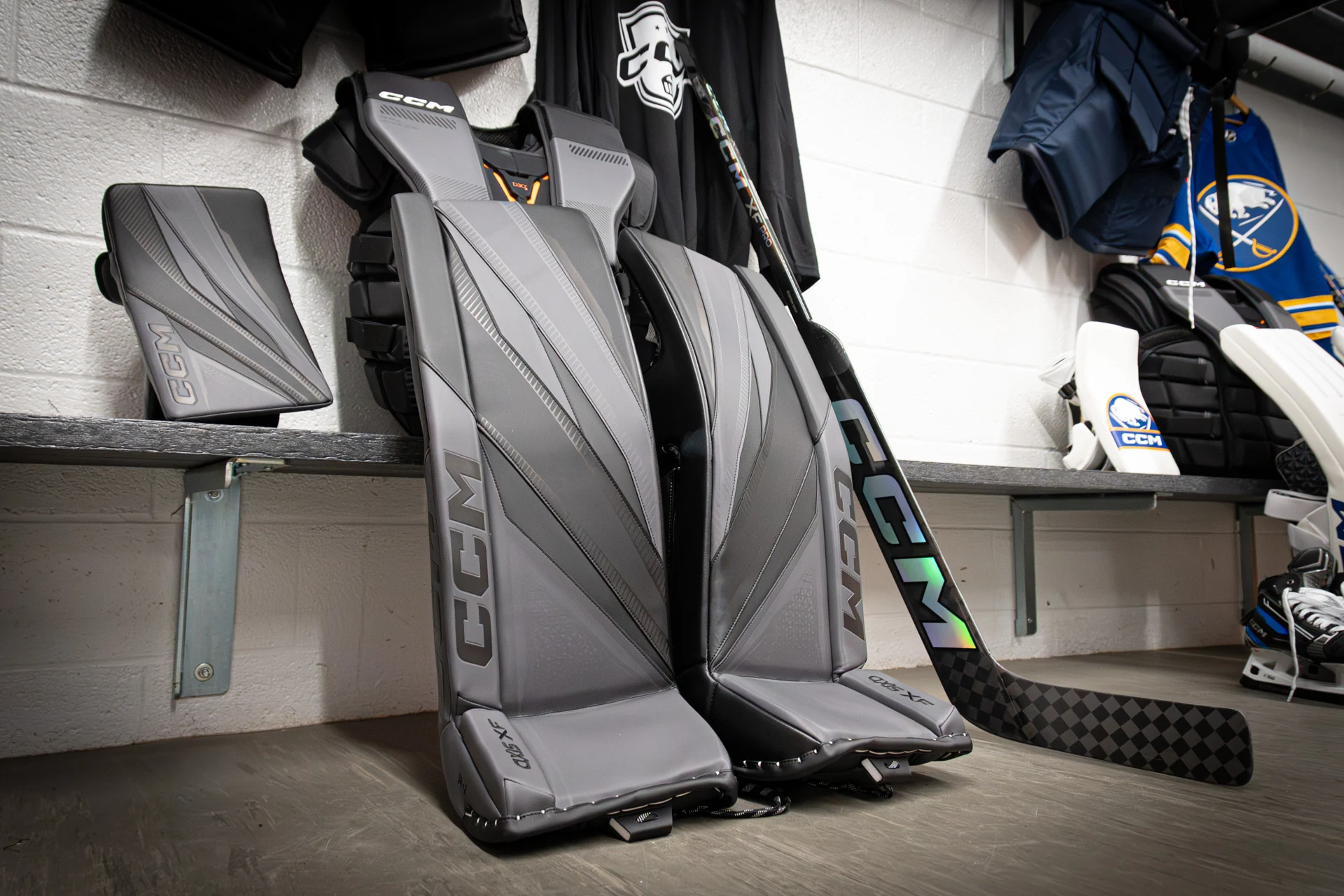
In addition to new graphics — (have fun playing around on the customizer and see how long it takes to design one that reminds you of a certain friendly neighborhood superhero) — the most immediately recognizable change is the new “V-shape” of the TACKS pads.
The new look and shape jump out, not just because of its more distinct lines compared to the more gradual, rounded curve of its AXIS predecessor and EFLEX counterpart, but also with a thinned-out profile on the thigh (which is stiffer) and boot (which is still flexible).
CCM has called it their Fusion 150 V core. The 150 stands for that new angle at the knee, created by a new one-piece core designed for easier 5-hole closure and butterfly width.
Combined with the continuation of their popular integrated knee stack (they added a small wedge to that connection point and the stack somehow looks bigger) and the calf pillow that debuted on EFLEX 7, and that added width doesn’t sacrifice seal or stability.
“The knee stack seems an inch taller,” one tester raved.
The TACKS pad is stiff above the boot break, but the shape was strategically designed with that rigidity profile to complement how goalies move without adding strain on the body. It was tested and tweaked to make sure the stiffness is less daunting and plays easily.
“There is less twerk on the knee, which I love for injury prevention,” Skinner said.
Stiffer pads mean higher-density foams, which often comes with an increase in weight, but thanks to new features like an outer edge that tapers towards the calf, our first 34+1 TACKS Pro demo pad weighed in at an impressively light five pounds, one ounce.
The shape and stiffness, along with a binding-less front face, a lack of knee rolls and use of CCM’s Infinite Power Rebound foams as a stock internal, all work together to create a consistent, predictable and active rebound profile on the new TACKS pad.
“The bottom of the pad has a great amount of predictability on rebounds,” Skinner said. “I love when the puck hits there because I know it’s going to go where I want it to.”
The bottom of the pad has a great amount of predictability on rebounds. I love when the puck hits there because I know it’s going to go where I want it to.
In terms of sliding surface, CCM’s Cross-Glide Technology (CGT), which debuted so successfully on the EFLEX 7 pad last year, returns with TACKS, and the TACKS Pro pad also features their inset Speed Channel on the inner calf area, which reduces the amount of material — and therefore friction — in contact with the ice while you move.
While the expectation would be a similarly positive sliding story as the EFLEX 7 line, the overall stiffness of the TACKS pad should take it to another level when compared to a stock EFLEX 7 pad. That was our experiences with InGoal’s ALLOUT Custom EFLEX 7 set, which was ordered with a stiffer profile for bigger rebounds, and seemed to slide even better than the softer standard EFLEX setup on our first demo set from that line. Add in the Speed Channel, which was on AXIS XF but not on the EFLEX 7 pad, and we bet you’ll notice improved sliding too.
02 Strapping New Calf Strapping
The DRS Pro+ knee strap remains the same, with an adjustable two-pronged attachment to the knee stack, double elastic strap and Velcro tab that can easily be attached either down on the outer calf wrap or more around the knee to an outer flap that can also be easily removed (or moved up or down) using two flaps for goalies that don’t use it.
The big change is their new two-strap ADAPTIFIT 360 strapping around the calf. This replaces the single upper strap QMSS 3 system found on the EFLEX 7 and QMSS 2 on the AXIS XF pad. It features a wider landing area on the upper strap that wraps around the top of the calf to a Velcro attachment tab, and a thinner cushioned landing area on the lower strap, which is fixed on the top edge of the channel and attaches to that landing area at the bottom. Combined, the new system is designed to allow goalies to play around more with how attached they want to feel to the shin area of a pad typically worn looser.
“Keeps the pads tight and high on the leg but you don’t feel them there,” one tester said.
03 Post Play New Lock-N-Push Toe Bridge
This is one feature we’re going to want to get a lot more feedback on, just because of the unique nature, but CCM has added a bigger, thicker, hinge-style toe bridge designed to help goalies get in and off their posts in the Reverse or Reverse-VH more seamlessly.
This triangular shaped toe bridge is stitched into the bottom edge of the pad only and sits in more of a “forward” position naturally, which in theory increases the target area to hit the post compared to smaller traditional toe bridge attachments. When a goalie hits the post, the hinge allows this triangle to flex back, absorbing the impact while also giving the goalie a slightly loaded surface area to push off the post with.
Of course, how you set up your toe ties (and TACKS comes stock with CCM’s combination of skate lace through the holder of the skate with a bungee Velcro tab to wrap around and attach to the skate) will affect how this performs and feels on the post. But early feedback from CCM’s partnership coaches suggested older goalies already on a path to junior or college who already had precise post integrations were less likely to want to try and adjust to it, but younger goalies still learning post play liked having a bigger target area to hit (and more feel when they did hit it right) and felt more connected to the post.
Again, it depends what level you are at and how you currently set up your toe ties, but our older, higher-level testers preferred their usual lace set up and found the larger Lock-N-Push bridge created some inconsistency in their post integration. Some also found the larger bridge interfered with how the pad sits on the skate if it got caught on the toe when getting back up from the butterfly. At the very least, it takes some getting used to.
04 The Glove Bigger ‘VORTX’ Pocket in CCM’s Best 590 Yet
That list of pad improvements above might seem long but the biggest improvement in the new TACKS line is probably the totally redesigned 590-break glove (yes, with finger stalls).
CCM was going for a best-in-class with this rebuilt 590, with a focus on closure to match the huge improvements in the 580 that came with EFLEX 7, and coverage. They achieved the latter by decreasing the palm area which allowed them to increase the size and roundness of the pocket compared to their previous gloves, creating what they’re calling a VORTX pocket (because it was engineered to suck everything in, of course). The stock double-T and break was also redesigned for a straighter closure and includes (despite what the illustration shows) a switch to skate lace in between the double-T on stock gloves as well as skate lace in the rest of the pocket (but of course, you can still custom order nylon in either spot).
But the biggest difference in the new TACKS 590-break glove is how it feels on the hand.
There is a softness and richness that jumped out the first time that testers put the glove on, and CCM confirmed it’s the result of new materials, both in terms of the new neoprene-like finger stalls and a new memory foam and grip material in the palm and fingers. It’s hard to describe (it’s snug but feels like the fingers and hand almost sink into the new memory foam material) but even harder to miss how much better it feels out of the box, and like the 580 that launched with EFLEX 7, immediate closure is also vastly improved.
“It snaps closed,” said one tester who has been a long-time CCM user, noting the D3O layer doesn’t seem to interfere with closure like it did in previous generations, and the break also integrates better with his stick when handling pucks. “The finger stalls seem tighter too, so the hand is not moving around as much as before.”
05 The Blocker Blocker Improved From AXIS XF
There are improvements in the TACKS blocker from the AXIS line but they are in line with the changes and updates seen in the EFLEX 7 blocker, which earned praise from our testers for its aggressive rebound pop, a stiffened sidewall while still cutting weight (by 17 percent) without sacrificing protection. There is also the same neoprene-like material in the cuff for improved comfort at the edge of the wrist, and the Velcro attachment for the cuff to the sidewall that makes it really easy to make it as wide open as any on the market.
They added a cutout in the material along the outer edge of the hand for better breathability and eliminated the seam at the corner of the wraparound finger protection, making sure there’s no seam gap in that added defense. And the index finger is still protected by an extra layer of D3O to help limit the damage of any pucks that ride up your stick.
While not much has changed from the last CCM blocker, that’s not a bad thing when you consider how well it was received. And with a totally redesigned glove and significant changes to the pads, it’s not like the new TACKS line is lacking for innovation.