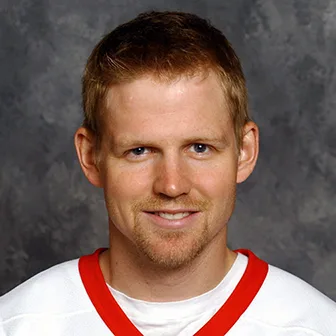
Born Nov 26, 1972 · Peace River, Alberta, Canada — Drafted 1991 · Rd 3, pick 10
| SEASON | GP | W | GAA | SV% | SO |
|---|---|---|---|---|---|
| 2008-09 | 46 | 26 | 3.09 | .887 | 2 |
| 2009-10 | 23 | 7 | 3.02 | .888 | 1 |
| 2010-11 | 11 | 5 | 2.77 | .903 | 0 |
| CAREER | 744 | 401 | 2.49 | .905 | 50 |
Chris Osgood
Career Statistics
| Season | Team | GP | W | L | OT | GAA | SV% | SO |
|---|---|---|---|---|---|---|---|---|
| 2010-11 | Red Wings | 11 | 5 | 3 | 2 | 2.77 | .903 | 0 |
| 2009-10 | Red Wings | 23 | 7 | 9 | 4 | 3.02 | .888 | 1 |
| 2008-09 | Red Wings | 46 | 26 | 9 | 8 | 3.09 | .887 | 2 |
| 2007-08 | Red Wings | 43 | 27 | 9 | 4 | 2.09 | .914 | 4 |
| 2006-07 | Red Wings | 21 | 11 | 3 | 6 | 2.38 | .907 | 0 |
| 2005-06 | Red Wings | 32 | 20 | 6 | 5 | 2.76 | .897 | 2 |
| 2003-04 | Blues | 67 | 31 | 25 | 0 | 2.24 | .910 | 3 |
| 2002-03 | Blues | 9 | 4 | 3 | 0 | 3.05 | .888 | 2 |
| 2001-02 | Islanders | 66 | 32 | 25 | 0 | 2.50 | .910 | 4 |
| 2000-01 | Red Wings | 52 | 25 | 19 | 0 | 2.69 | .903 | 1 |
| 1999-00 | Red Wings | 53 | 30 | 14 | 0 | 2.40 | .907 | 6 |
| 1998-99 | Red Wings | 63 | 34 | 25 | 0 | 2.42 | .910 | 3 |
| 1997-98 | Red Wings | 64 | 33 | 20 | 0 | 2.21 | .913 | 6 |
| 1996-97 | Red Wings | 47 | 23 | 13 | 0 | 2.30 | .910 | 6 |
| 1995-96 | Red Wings | 50 | 39 | 6 | 0 | 2.17 | .911 | 5 |
| 1994-95 | Red Wings | 19 | 14 | 5 | 0 | 2.26 | .917 | 1 |
| 1993-94 | Red Wings | 41 | 23 | 8 | 0 | 2.86 | .895 | 2 |
| Career | 744 | 401 | 216 | 29 | 2.49 | .905 | 50 |
Chris Osgood grew up in Medicine Hat, Alberta — a town that, as he once noted, produced three goalies who all made professional hockey. Blaine Lacher, who played in Boston, and Neil Little, who won an AHL championship with the Phantoms and appeared in a handful of games with the Flyers, were the other two. "It was us three trying out for our teams all the time in Medicine Hat, which is kind of incredible that a town that size would have three goalies that would make it," Osgood recalled [1].
Born in Peace River, Alberta on November 26, 1972, Osgood was selected by Detroit in the third round (10th pick) of the 1991 NHL Draft. He went on to play 744 NHL games, finishing with 401 wins, 216 losses, 29 overtime losses, a 2.49 goals-against average, a .905 save percentage, and 50 shutouts. He won three Stanley Cup championships, all with the Red Wings — the first in 1997 as the backup goaltender, and two more in 1998 and 2008 as the starting goaltender. He appeared in five Stanley Cup Finals in total, all with Detroit.
One of the formative influences on Osgood's path to the NHL was Ken Holland, then a Red Wings scout and himself a former goaltender, who mentored him during his teenage years in Medicine Hat. "It was good that I had him. He was a mentor away from the ice for me," Osgood said [1]. "When you're 16, 17, you need some direction." Osgood credited Holland with keeping him on track during a critical period, calling him "surely a big factor of why I made it and had the opportunity to play in the National Hockey League."
In Detroit, Osgood played under coach Scotty Bowman, whose attention to detail left a lasting impression. "Scotty, he taught me attention to detail," Osgood explained [1]. "He taught me you have to pay attention to detail even in the games when it's 5-1 in January, because in the playoffs, when it matters most, you're going to have trained yourself mentally and physically to be ready for those situations."
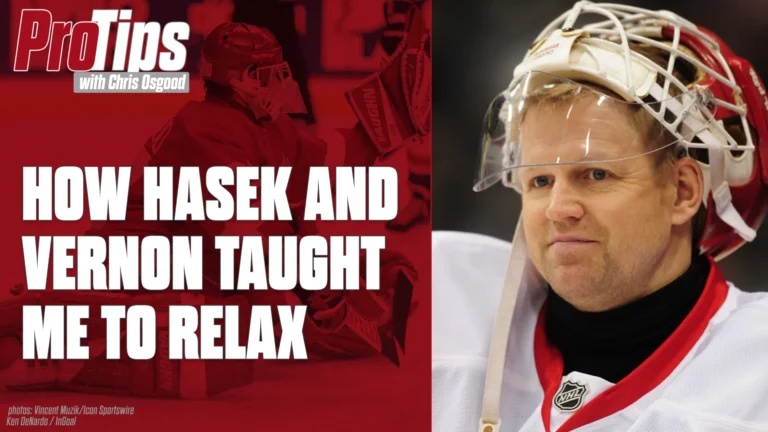
Osgood's career placed him alongside a number of notable goaltending partners, from Tim Cheveldae, Bob Essensa, and Vincent Riendeau early on, to Mike Vernon, Dominik Hasek, and eventually Jimmy Howard. "I was really fortunate that I had a chance to play with a lot of good guys," he said [1]. Both Vernon and Hasek, in different ways, reinforced the value of staying calm before games. Osgood roomed with Vernon in Detroit and observed that his preparation never wavered regardless of the opponent. "He stayed even keel the whole time. He never changed his demeanor, ever," Osgood said of Vernon [1].
Hasek presented a different picture — and a deliberate one. "Dom's relaxed. You wouldn't even know he's playing until he goes on the ice and then he's all in," Osgood recalled [1]. "He'd be in the dressing room talking to me about everything from what's going on next week to football or soccer. And then all of a sudden he'd stand up, hit his pads and go and play unbelievable." Osgood came to understand that pre-game calm as a form of mental preparation: "It was kind of like he relaxed his mind before he went out and played so he had his 100 percent mental capacity when he played to focus on the puck."
Osgood also spoke directly to Hasek's work ethic. "His work ethic is what made him. He saw the game as a goalie like Wayne Gretzky saw the game as a player," he said [1]. He described a session following a shootout loss in which Hasek placed a pile of pucks at center ice and the two of them — both established Cup winners — faced breakaways until every shot had been stopped. "There had to be 80 pucks out there, maybe more," Osgood said. "It was real fortunate for me I got a chance to play with him. He made me better."
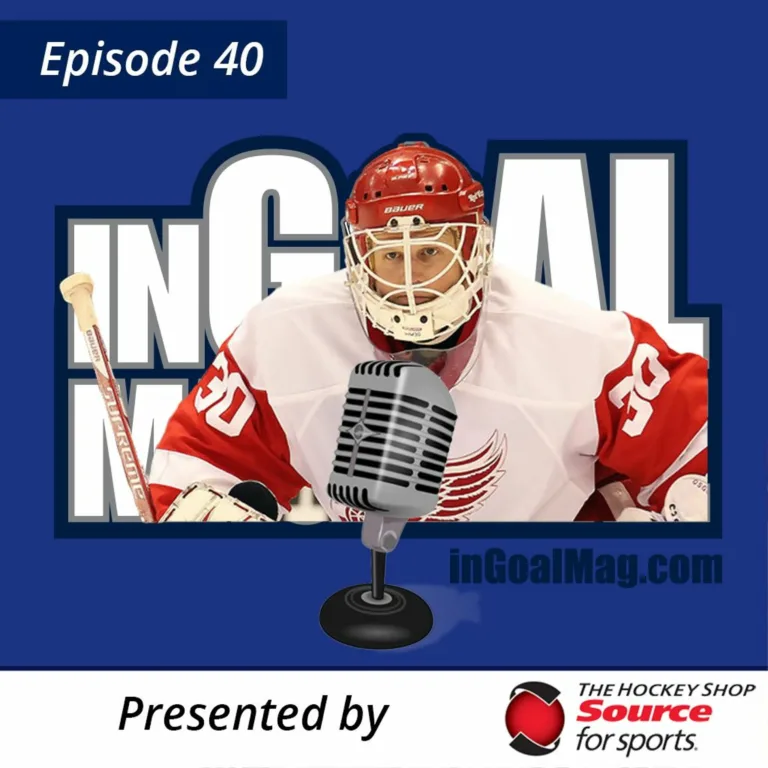
Osgood is currently a Detroit Red Wings studio analyst and part-time color commentator. InGoal Magazine has covered Chris Osgood in one podcast appearance and one InGoal article.
🚨 Goalie Goals
Chris Osgood is one of the rare goaltenders to score a goal — 2 of them, across different levels.
-
-
Also scored a goalie goal in the NHL (1996) — one of the few to score at both levels.
People Are Asking About Chris Osgood
How old is Chris Osgood?
Follow the goalies, not the noise
InGoal Magazine covers goaltending at every level — gear, technique, and the goalies behind the numbers. Get our free weekly newsletter — plus 3 free premium reads to start.
Go deeper with InGoal
Members get every Pro Read — NHL goalies breaking down their own saves — plus full gear reviews and the deepest goaltending coverage anywhere.