
Born Dec 7, 1940 · St. Catharines, Ontario, Canada — Undrafted
| SEASON | GP | W | GAA | SV% | SO |
|---|---|---|---|---|---|
| 1977-78 | 21 | 10 | 2.66 | .889 | 1 |
| 1978-79 | 43 | 23 | 3.16 | .865 | 1 |
| 1979-80 | 42 | 24 | 2.81 | .880 | 4 |
| CAREER | 418 | 227 | 2.89 | .901 | 26 |
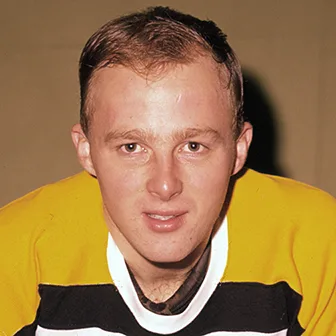
Gerry Cheevers
Career Statistics
| Season | Team | GP | W | L | OT | GAA | SV% | SO |
|---|---|---|---|---|---|---|---|---|
| 1979-80 | Bruins | 42 | 24 | 11 | 0 | 2.81 | .880 | 4 |
| 1978-79 | Bruins | 43 | 23 | 9 | 0 | 3.16 | .865 | 1 |
| 1977-78 | Bruins | 21 | 10 | 5 | 0 | 2.66 | .889 | 1 |
| 1976-77 | Bruins | 45 | 30 | 10 | 0 | 3.05 | .881 | 3 |
| 1975-76 | Bruins | 15 | 8 | 2 | 0 | 2.74 | .900 | 1 |
| 1971-72 | Bruins | 41 | 27 | 5 | 0 | 2.50 | .920 | 2 |
| 1970-71 | Bruins | 40 | 27 | 8 | 0 | 2.73 | .918 | 3 |
| 1969-70 | Bruins | 41 | 24 | 8 | 0 | 2.72 | .919 | 4 |
| 1968-69 | Bruins | 52 | 27 | 12 | 0 | 2.80 | .911 | 3 |
| 1967-68 | Bruins | 47 | 21 | 19 | 0 | 2.84 | .907 | 3 |
| 1966-67 | Bruins | 22 | 5 | 10 | 0 | 3.33 | .898 | 1 |
| 1965-66 | Bruins | 7 | 0 | 4 | 0 | 6.00 | .826 | 0 |
| 1961-62 | Maple Leafs | 2 | 1 | 1 | 0 | 3.00 | .914 | 0 |
| Career | 418 | 227 | 104 | 0 | 2.89 | .901 | 26 |
Gerry Cheevers was born on December 7, 1940, in St. Catharines, Ontario, and played his junior hockey with the Toronto St. Michael's Majors of the Ontario Hockey Association. He saw little action in his first three seasons with the Majors, then became their regular goaltender in 1959–60 and won the Dave Pinkney Trophy as the goaltender on the team with the league's lowest goals-against average. In 1960–61 the Majors won the Memorial Cup.
The Toronto Maple Leafs held his rights, and he began his professional career in 1961–62 with stops at the Sault Ste. Marie Thunderbirds of the EPHL and the Pittsburgh Hornets and Rochester Americans of the AHL. He also played his first NHL games that season: on December 2, 1961, he made 35 saves in a 6–4 win over the Chicago Black Hawks, and he played once more the next night in Detroit. Those were his only two games for Toronto. In 1962–63 he divided the season between the Sudbury Wolves of the EPHL and Rochester, and he spent his last two minor-league seasons with Rochester alone.
Rochester is where his NHL case was made. In 1963–64 he played 66 games with a 2.84 goals-against average. In 1964–65 he played all 72 of the Americans' regular-season games, won 48 of them, which is still the AHL record, and led the league with a 2.68 goals-against average and five shutouts. That season brought him the Harry "Hap" Holmes Memorial Award, and Rochester beat Hershey for its first Calder Cup.
Boston claimed him from Toronto in the June 1965 intra-league draft, after Leafs general manager Punch Imlach had tried to hide him on the protected list as a forward. For two seasons he moved between the Bruins and their Central Professional Hockey League farm club, the Oklahoma City Blazers, who won the Adams Cup in both 1966 and 1967.
The 1967 expansion settled his place in Boston: the Bruins lost Bernie Parent and Doug Favell to the Philadelphia Flyers, and Cheevers became the number one goaltender. In 1967–68, his first full NHL season as a starter, he went 21–19–6 with a 2.84 goals-against average and a .907 save percentage, and Boston made the playoffs for the first time since 1959. He was among the first NHL goaltenders to wear a mask full-time, and among the first to decorate one. The stitch marks began, as Cheevers tells it, when a puck hit his mask during a practice in one of his early Bruins seasons. He went to the dressing room, coach Harry Sinden sent him back out, and trainer John "Frosty" Forristall first painted a stitched cut on the mask where the puck had hit. After that a new set of stitches went on for every puck that struck it. The number of stitches in that first drawing varies with the telling.
Two Stanley Cups followed. In the 1970 playoffs he went 12–1, and the Bruins won the Cup for the first time in 29 years. In 1971–72 he went 32 consecutive regular-season games without a loss, which remains the NHL record. He finished that season 27–5–8 with a 2.50 goals-against average and a .920 save percentage, both career bests. He shared the playoff work with Eddie Johnston and went 6–2 with two shutouts, the second a 3–0 win over the Rangers in Game 6 on May 11, 1972, that clinched Boston's second Cup in three years.
In July 1972 he left for the Cleveland Crusaders of the new World Hockey Association on a seven-year contract worth $1.4 million; his agent later said the Bruins had offered only a nominal raise. On October 11, 1972, the WHA's opening night, he stopped 21 shots in a 2–0 win over the Quebec Nordiques, the league's first shutout. He went 32–20 that season with a 2.84 goals-against average and five shutouts, led the league in both, won the Ben Hatskin Trophy as its top goaltender and was named to the First All-Star Team. He made the Second All-Star Team in 1974 and 1975, and in September 1974 he played seven of Team Canada's eight games against the Soviet Union in the WHA's Summit Series.
He came back to Boston in late January 1976 after a falling-out with Crusaders general manager Jack Vivian, who had fined and suspended him; the two sides agreed to void the contract. On February 8, 1976, in his first NHL game in almost four years, he stopped all 22 shots in a 7–0 win over Detroit. In 1976–77 he went 30–10–5 in 45 games and started all 14 playoff games as Boston beat Los Angeles and Philadelphia before being swept by Montreal in the Final. In 1977–78 Ron Grahame started most of the regular season and Cheevers played 21 games, but he took the net back for the playoffs and appeared in 12 of 15 games as the Bruins again lost the Final to Montreal, this time in six.
In 1978–79 he was unbeaten in his first 16 decisions, going 12–0–4 before a loss in Montreal on December 30. That spring Boston lost Game 7 of the semifinal to Montreal in overtime, with Gilles Gilbert in goal. In February 1979 Cheevers was on the NHL All-Stars for the Challenge Cup against the Soviet Union and played the deciding third game, a 6–0 loss. In 1979–80, his last season, he played 42 games and went 24–11–7 with four shutouts and a 2.81 goals-against average. His 62 penalty minutes that season were then the most by a goaltender in one NHL season, two more than Andy Brown's 60 in 1973–74; by his own account he took the penalty that got him there on purpose, late in a game Boston was winning on April 2, 1980, in Toronto. Ron Hextall has since passed the mark. Boston allowed 234 goals, the second-fewest in the league behind Buffalo's 201, and the Vezina Trophy, then awarded on team goals against, went to the Sabres' Don Edwards and Bob Sauvé. Cheevers played all ten of Boston's playoff games as the Bruins went out in the second round to the New York Islanders. He retired after the season, and on July 7, 1980, he was named the Bruins' coach.
Over 418 NHL regular-season games, Cheevers finished with a record of 227–104–76, a 2.89 goals-against average, a .901 save percentage and 26 shutouts. In 88 playoff games he went 53–34 with a 2.70 goals-against average, a .902 save percentage and eight shutouts. He was inducted into the Hockey Hall of Fame in 1985.
Cheevers coached the Bruins from 1980 until February 1985, with a record of 204–126–46, and later worked as a colour commentator on Hartford Whalers and Bruins broadcasts. The Bruins named him to their All-Centennial Team in October 2023.
Sources: NHL.com (statistics); NHL.com, Dave Stubbs, 2020; NHL.com, Dave Stubbs, 2026; BostonBruins.com, Eric Russo, 2020; Hockey-Reference (NHL and WHA statistics, game logs, May 11, 1972 and February 8, 1976 box scores, 1972–73 WHA goaltending); American Hockey League.
People Are Asking About Gerry Cheevers
How old is Gerry Cheevers?
Follow the goalies, not the noise
InGoal Magazine covers goaltending at every level — gear, technique, and the goalies behind the numbers. Get our free weekly newsletter — plus 3 free premium reads to start.
Go deeper with InGoal
Members get every Pro Read — NHL goalies breaking down their own saves — plus full gear reviews and the deepest goaltending coverage anywhere.