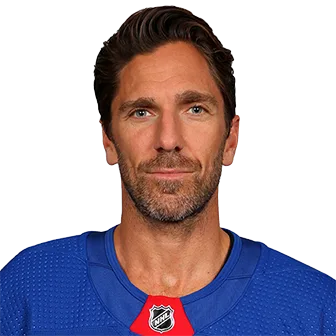
Born Mar 2, 1982 · Are, Sweden — Drafted 2000 · Rd 7, pick 8
| SEASON | GP | W | GAA | SV% | SO |
|---|---|---|---|---|---|
| 2017-18 | 63 | 26 | 2.98 | .915 | 2 |
| 2018-19 | 52 | 18 | 3.07 | .907 | 0 |
| 2019-20 | 30 | 10 | 3.16 | .905 | 1 |
| CAREER | 887 | 459 | 2.43 | .918 | 64 |
Henrik Lundqvist
Career Statistics
| Season | Team | GP | W | L | OT | GAA | SV% | SO |
|---|---|---|---|---|---|---|---|---|
| 2019-20 | Rangers | 30 | 10 | 12 | 3 | 3.16 | .905 | 1 |
| 2018-19 | Rangers | 52 | 18 | 23 | 10 | 3.07 | .907 | 0 |
| 2017-18 | Rangers | 63 | 26 | 26 | 7 | 2.98 | .915 | 2 |
| 2016-17 | Rangers | 57 | 31 | 20 | 4 | 2.74 | .910 | 2 |
| 2015-16 | Rangers | 65 | 35 | 21 | 7 | 2.48 | .920 | 4 |
| 2014-15 | Rangers | 46 | 30 | 13 | 3 | 2.25 | .922 | 5 |
| 2013-14 | Rangers | 63 | 33 | 24 | 5 | 2.36 | .920 | 5 |
| 2012-13 | Rangers | 43 | 24 | 16 | 3 | 2.05 | .926 | 2 |
| 2011-12 | Rangers | 62 | 39 | 18 | 5 | 1.97 | .930 | 8 |
| 2010-11 | Rangers | 68 | 36 | 27 | 5 | 2.28 | .923 | 11 |
| 2009-10 | Rangers | 73 | 35 | 27 | 10 | 2.38 | .921 | 4 |
| 2008-09 | Rangers | 70 | 38 | 25 | 7 | 2.43 | .916 | 3 |
| 2007-08 | Rangers | 72 | 37 | 24 | 10 | 2.23 | .912 | 10 |
| 2006-07 | Rangers | 70 | 37 | 22 | 8 | 2.34 | .917 | 5 |
| 2005-06 | Rangers | 53 | 30 | 12 | 9 | 2.24 | .922 | 2 |
| Career | 887 | 459 | 310 | 96 | 2.43 | .918 | 64 |
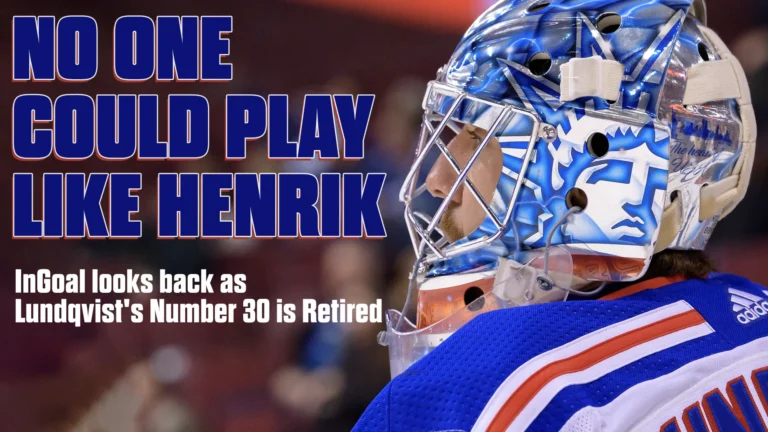
Henrik Lundqvist was born on March 2, 1982, in Åre, Sweden, and was selected by the New York Rangers in the seventh round, eighth pick, of the 2000 NHL Draft. He went on to play 887 NHL regular-season games, all with the Rangers, finishing with 459 wins, a 2.43 goals-against average, a .918 save percentage, and 64 shutouts.
Before arriving in New York, Lundqvist was playing an aggressive style in Sweden — at the top of or outside his crease — and was named top goalie for the third straight season in his final Swedish pro campaign, also winning league MVP that year. The transformation came immediately upon joining the Rangers under goaltending coach Benoit Allaire. "When I came over I was very aggressive, which you need to be in Sweden," Lundqvist told InGoal as a rookie [1]. Allaire's start-deep, inside-out approach required Lundqvist to remake his game from the crease out, and Allaire took notice of how quickly it happened. "What I see with guys that can be top goalies in the League they can make adjustments so fast," Allaire said. "With Henrik I saw in the first year – the first month – that he can do it right away" [1].
The depth at which Lundqvist played became the most discussed aspect of his technical profile. Playing as a 6-foot-1 goaltender, he operated well back in his crease — sometimes at the goal line — relying on lateral quickness and patience rather than positioning beyond the crease edges. Cam Talbot, who worked with Lundqvist and Allaire with the Rangers, described it this way: "The biggest thing is the depth that he felt comfortable at his size. He was so quick laterally and his read of the release was so good he could play deep enough that always allowed him at least a chance at making the second save. Most goalies his size continue to play somewhere around the top of crease if not further out depending on the situation. I don't think Hank ever stepped outside the top of his crease unless it was a breakaway!" [2]. Stephen Valiquette, who played alongside Lundqvist from 2006 to 2010, put it plainly: "He played deep. He'd be on the goal line just reacting to shots from 20 feet that no one else had the courage to play from there" [2]. Half-butterfly saves — with the glove-side pad staying up on saves to that side — were another element of his approach that Valiquette described as requiring particular courage: "Every goal looked like it was on him because he always got there. He was never so far out of position that it looked like he never had a chance" [2].
Lundqvist himself pointed to patience as central to how he managed playing at that depth. "You know what, I'm not as big as a lot of guys. I am 6-foot-1 so I can't block everything, especially because I play deep," he told InGoal in 2012. "I try to read where it is going and patience is key, especially for me, just to wait for the first move. If I am making the first move I am in trouble a lot of the time" [3].
Those who backed up Lundqvist described his work ethic as the engine behind everything else. Martin Biron, who spent parts of four seasons with him, said: "He works harder than anybody else I played with and I really mean that. And I played with some really hard working players and goaltenders. Ryan Miller was extremely hard working, [Dominik] Hasek was extremely hard working but I think Hank was the hardest working player I got a chance to play with. Everything he's gotten has been earned, not given" [1]. Alex Auld, whose playing partners over his career included Ed Belfour, Tim Thomas, and Carey Price, described Lundqvist as "the most focused and dialed in guy I played with. He absolutely owned his preparation like no one else I've ever seen" [1].
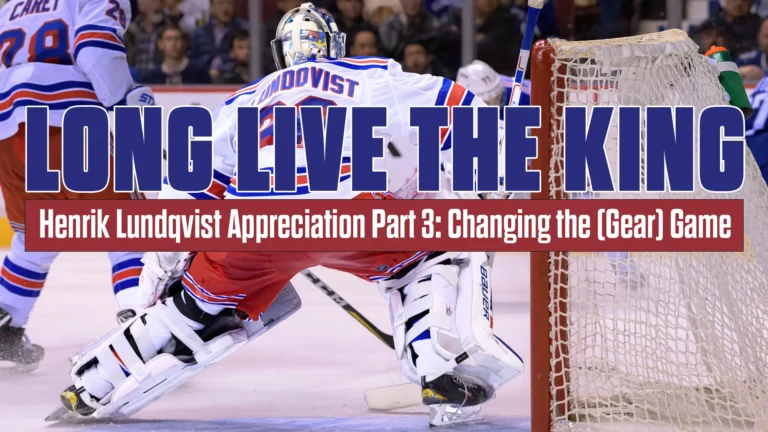
That preparation extended into the equipment room. Lundqvist's contributions to goalie gear are documented across InGoal's coverage in ways that outlast his playing career [3]. The most widely replicated is the "Lundqvist Loop" — a tab on the heel of the skate that holds the boot strap — which came about on October 20, 2011, when Lundqvist and Rangers equipment manager Acacio "Cass" Marques fashioned a homemade version during a western Canada road trip. The loop emerged from Lundqvist's decision, beginning with the 2008-09 season, to stop running his boot strap under his skate so his pads could sit higher and move up his leg as he dropped into the butterfly. Iterations of the Lundqvist Loop have since appeared on goalie skates from every major manufacturer [3].
His equipment adjustments went further. Before switching to Bauer skates in 2011, Lundqvist was trimming and shaving the cowlings on his Graf skates to reduce weight and improve edge performance. He had his skates sharpened inside-edge high — a configuration Biron described as unlike anything he'd seen: "I'd never seen that. It was literally a razor blade. He was skating on razor blades" [3]. Lundqvist also used a practice glove so stiff it could not be fully closed, developing what InGoal described as a unique basket catch style, and later explained to InGoal the reasoning behind a squared-off grip on his stick handle [4]. He served as an equipment tester for Bauer's OD1N project, and his feedback shaped the direction of that development. Henry Breslin, a manager on Bauer's goal team at the time, recalled Lundqvist's input: "The 'aha' moment was Lundqvist saying he loved that rebounds were flying off. His point was it would be nice to stick like Velcro, but if you can't do that further is better" [3]. Kevin Weekes, who played two seasons with Lundqvist, summarized the equipment legacy: "He didn't just play the position, he innovated it" [2].
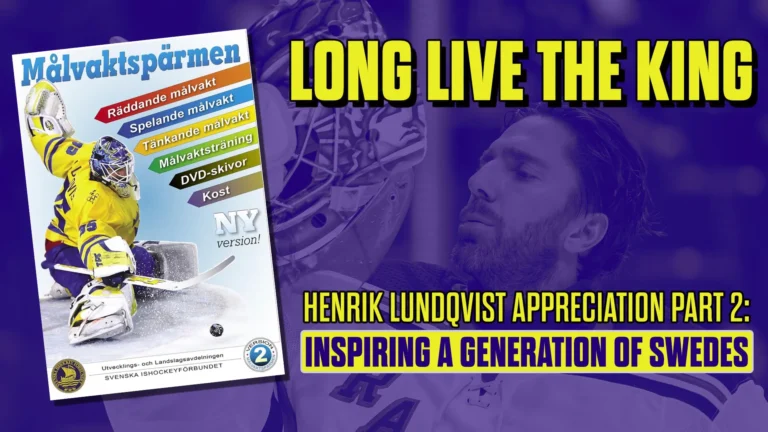
Lundqvist's impact extended well beyond New York. His arrival in the NHL in 2005-06 preceded a significant expansion in Swedish goaltending at the NHL level — only eight Swedish goalies played in the first 87 years of the league, but 25 others appeared in at least one game after Lundqvist debuted [5]. Linus Ullmark, who described having a picture of Lundqvist on his computer as a young player, said simply: "I idolized him" [5]. Thomas Magnusson, Sweden's director of goaltending since 2005, said: "Henrik's impact on Swedish goaltending in general is huge. I believe the biggest effect has been the inspiration for young boys and girls to try the position" [5]. Eddie Lack, who played 143 NHL games and shared the ice with Lundqvist at the 2017 World Championships, put it this way: "He broke a lot of ground for the rest of us. He showed a lot of people what Swedish goalies can be" [5].
Lundqvist won the Vezina Trophy in 2012, an Olympic gold medal at the 2006 Turin Games, a silver medal at the 2014 Sochi Olympics, a gold medal at the 2017 IIHF World Championship, silver medals at the 2003 and 2004 World Championships, and a bronze medal at the 2016 World Cup of Hockey [1]. He announced his retirement in August 2021 following heart surgery that had kept him out of the NHL the previous season. His No. 30 was retired by the Rangers at Madison Square Garden on January 28, 2022. He finished sixth in NHL history in wins with 459 and seventh in saves with 23,509, with a career .918 save percentage ranking fourth among goalies to play at least 500 games [1].
InGoal Magazine has covered Henrik Lundqvist in one podcast appearance and six InGoal articles.
People Are Asking About Henrik Lundqvist
How old is Henrik Lundqvist?
Follow the goalies, not the noise
InGoal Magazine covers goaltending at every level — gear, technique, and the goalies behind the numbers. Get our free weekly newsletter — plus 3 free premium reads to start.
Go deeper with InGoal
Members get every Pro Read — NHL goalies breaking down their own saves — plus full gear reviews and the deepest goaltending coverage anywhere.