
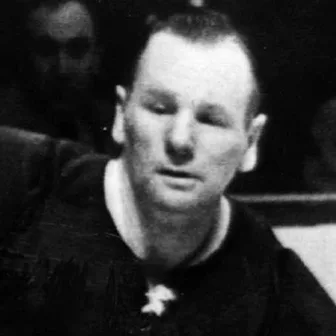
Born Nov 8, 1924 · Prince Albert, Saskatchewan, Canada — Undrafted
| SEASON | GP | W | GAA | SV% | SO |
|---|---|---|---|---|---|
| 1967-68 | 43 | 13 | 2.26 | .934 | 4 |
| 1968-69 | 20 | 6 | 2.86 | .909 | 2 |
| 1969-70 | 1 | 0 | 5.00 | .868 | 0 |
| CAREER | 552 | 250 | 2.51 | — | 37 |
Johnny Bower
Career Statistics
| Season | Team | GP | W | L | OT | GAA | SV% | SO |
|---|---|---|---|---|---|---|---|---|
| 1969-70 | Maple Leafs | 1 | 0 | 1 | 0 | 5.00 | .868 | 0 |
| 1968-69 | Maple Leafs | 20 | 6 | 4 | 0 | 2.86 | .909 | 2 |
| 1967-68 | Maple Leafs | 43 | 13 | 17 | 0 | 2.26 | .934 | 4 |
| 1966-67 | Maple Leafs | 27 | 11 | 8 | 0 | 2.65 | .925 | 2 |
| 1965-66 | Maple Leafs | 35 | 18 | 10 | 0 | 2.26 | .930 | 3 |
| 1964-65 | Maple Leafs | 34 | 14 | 13 | 0 | 2.38 | .924 | 3 |
| 1963-64 | Maple Leafs | 51 | 24 | 15 | 0 | 2.11 | .932 | 5 |
| 1962-63 | Maple Leafs | 42 | 20 | 15 | 0 | 2.60 | .912 | 1 |
| 1961-62 | Maple Leafs | 59 | 31 | 18 | 0 | 2.56 | .917 | 2 |
| 1960-61 | Maple Leafs | 58 | 33 | 15 | 0 | 2.50 | .922 | 2 |
| 1959-60 | Maple Leafs | 66 | 34 | 24 | 0 | 2.69 | .919 | 5 |
| 1958-59 | Maple Leafs | 39 | 15 | 17 | 0 | 2.72 | .914 | 3 |
| 1956-57 | Rangers | 2 | 0 | 2 | 0 | 3.01 | .882 | 0 |
| 1954-55 | Rangers | 5 | 2 | 2 | 0 | 2.60 | . | 0 |
| 1953-54 | Rangers | 70 | 29 | 31 | 0 | 2.54 | . | 5 |
| Career | 552 | 250 | 192 | 0 | 2.51 | . | 37 |
Johnny Bower was born John William Kiszkan in Prince Albert, Saskatchewan. The NHL lists his birth date as November 8, 1924, though his age was an open question for most of his career: during the Second World War he lied about it to get into the Canadian Army at 15. He had learned the game on outdoor ice in Prince Albert, using a tree branch for a stick. He served in England and was discharged in 1943 after developing rheumatoid arthritis in his hands, a condition that followed him through his playing days. Back in Prince Albert, he played the 1944-45 season in goal for the SJHL's Black Hawks and turned professional that fall.
He took the name Bower after his first professional season. He gave different reasons over the years — that Bower was his mother's maiden name, or that Kiszkan was too hard for sportswriters to spell — and once tied the change to a separation in his family when he was young.
Bower broke in with the AHL's Cleveland Barons in 1945-46 and spent most of the next 13 years in that league, chiefly in Cleveland, with two seasons in Providence. He won four Calder Cups — with Cleveland in 1948, 1951 and 1953, and with Providence in 1956 — three Les Cunningham Awards as the AHL's most valuable player (1956, 1957 and 1958), and three Hap Holmes Memorial Awards for the league's lowest goals-against average. His 359 AHL wins remain the most by any goaltender in the league's history.
His first NHL job came with the New York Rangers in 1953-54, at 29. He beat out Gump Worsley, the Calder Trophy winner the season before, in training camp and played all 70 games, going 29-31-10 with a 2.54 goals-against average and five shutouts. Worsley had the net back the next fall. Bower played five games for New York in 1954-55 and the rest of that season with Vancouver of the WHL, then two years with Providence, with a two-game recall to the Rangers in 1956-57. Traded back to Cleveland in the summer of 1957, he posted a 2.17 goals-against average and eight shutouts in 64 games in 1957-58.
Toronto claimed him from Cleveland in the Inter-League Draft on June 3, 1958. Bower did not want to go. "I was sick of jumping around the country and I wanted to settle down with my family," he said later. "Cleveland was going to be my home." Punch Imlach went to see him that summer and talked him into another try at the NHL. Bower played the rest of his career in Toronto.
He won the Vezina Trophy in 1960-61, when it still went to the goaltender of the team that allowed the fewest goals, and was named to the NHL's First All-Star Team that season, the only such selection of his career. He played in four NHL All-Star Games, 1961 through 1964. The Leafs then won three Stanley Cups in a row, in 1962, 1963 and 1964. Of the first one he said: "When we won the Stanley Cup, my head went numb, my whole body went numb. That was my dream from Day One. You just can't explain the feelings inside you." In the 1963 playoffs he went 8-2 in 10 games with a 1.60 goals-against average and two shutouts. He shared the 1964-65 Vezina with Terry Sawchuk, his partner in the Toronto crease.
Bower and Sawchuk split the net again in 1966-67, when Toronto won its fourth Cup of the decade. Bower played four playoff games that spring, winning both of his decisions with a 1.63 goals-against average and one shutout. He did not care for sharing the job. "I wasn't all that glad to see the two-goalie system come in," he said. "I wanted to play as many games as I could."
In April 1969, at 44, he appeared in all four games of Toronto's quarter-final against Boston, which made him the oldest goaltender to play in a Stanley Cup playoff game. His last NHL game was December 10, 1969, a 6-3 loss in Montreal and his only appearance of the 1969-70 season; he retired that spring at 45. Asked at the time whether he would finally give his real age, he answered, "If you don't know by now, you never will." His NHL totals: 552 regular-season games, a 250-192-90 record, a 2.51 goals-against average and 37 shutouts; in 74 playoff games he was 35-34 with a 2.47 goals-against average and five shutouts.
Bower was inducted into the Hockey Hall of Fame in 1976 and joined the Leafs' staff the same year as an assistant coach, a job he held until 1978. He stayed with the organization as a scout and goalie coach, officially retiring in 1990, and kept making appearances for the club for the rest of his life. He was a charter member of the AHL Hall of Fame in 2006 and received a star on Canada's Walk of Fame in 2007. On October 15, 2016, the Leafs retired No. 1 for Bower and Turk Broda together, and in January 2017 the NHL named him one of its 100 Greatest Players. His No. 1 was also retired in Cleveland for his years with the Barons.
He was widely credited with pioneering the poke check — leaving his crease to knock the puck off an attacker's stick — and he played most of his career without a mask.
In 1965 he recorded a children's Christmas single, "Honky the Christmas Goose," with his son and a group of neighbourhood kids; that December it reached No. 29 on the chart of Toronto radio station CHUM.
Bower died of pneumonia on December 26, 2017, at 93. The Leafs held a public celebration of his life at Air Canada Centre on January 3, 2018, attended by thousands, including former teammates, NHL alumni and the current Toronto team.
Sources: NHL.com (statistics and awards); NHL Records; Hockey-Reference; NHL.com obituary; NHL.com 100 Greatest Players profile; NHL.com on the 2016 number retirements.
Follow the goalies, not the noise
InGoal Magazine covers goaltending at every level — gear, technique, and the goalies behind the numbers. Get our free weekly newsletter — plus 3 free premium reads to start.
Go deeper with InGoal
Members get every Pro Read — NHL goalies breaking down their own saves — plus full gear reviews and the deepest goaltending coverage anywhere.