
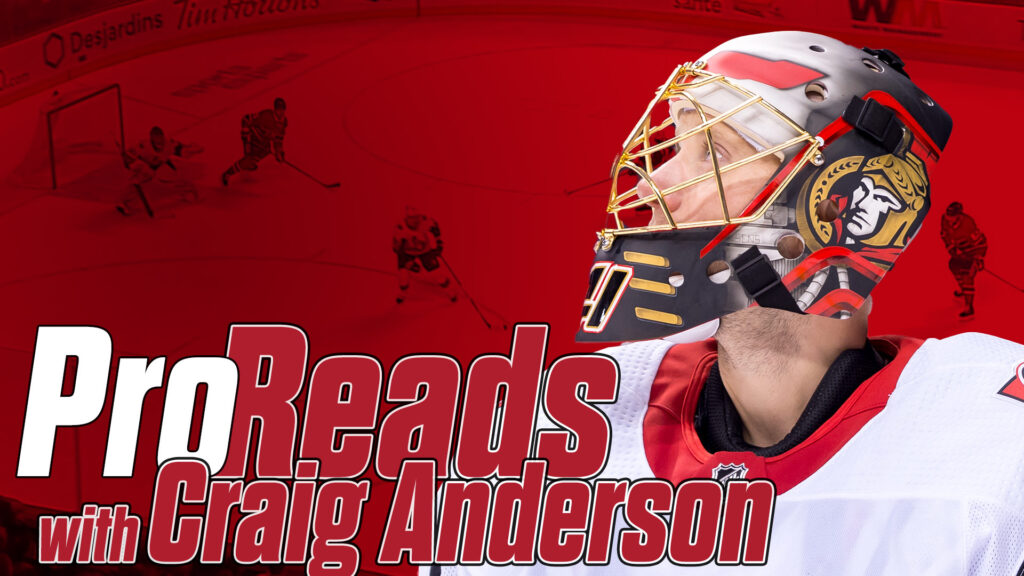
Craig Anderson breaks down a sharp-angle attack with a backdoor pass option
With Craig Anderson
To reverse-VH or not to reverse-VH, that is the question.

The #1 goalie vision & cognitive training tool trusted by over 50 NHL & AHL goalies.
“Vizual Edge has added a quality element to my preparation as a goaltender. I use the game day drills every game before heading to the rink. It’s a combination of recognition, reaction and focus that activates my brain and eyes to feel ready for what’s to come.” — Jordan Binnington
Save 10% on Vizual Edge monthly and annual plans using code INGOAL at check out! (InGoal Members receive a 20% discount – why not join today? )
To reverse-VH or not to reverse-VH, that is the question.
It’s a question that gets asked a lot these days, usually after a goalie’s decision to drop into the reverse on the post results in a goal from a bad angle and a lot of #RVHfail hashtags on social media. This week, we get to break down that reverse-VH decision on a sharp-angle attack and a backdoor passing option with former Ottawa Senators goalie Craig Anderson.
While Anderson may seem an odd choice to break down a reverse-VH play given he only added it to his arsenal in the past couple of seasons, he’s also highly regarded among his puck-stopping peers for his ability to read plays and shots. In fact, former teammate Chris Driedger once went so far as to tell us that the 39-year-old has “the best reads in the NHL.”
So, let’s take a closer look at how Anderson handles this chance just above the goal line.
The Scenario
Anderson is against his right post but on his skates still as the puck is sent down to Montreal Canadiens forward Jordan Weal at the bottom of the right circle. As Weal starts to cut towards the net, there is one Ottawa defender between him and another Canadiens player driving backdoor. Take a look at this initial screen shot and tell us what factors would determine how you would play it, and whether – or better yet, when – you would drop into reverse?

Weal actually pulls that puck back up ice after looking off that initial pass attempt, but a few seconds later finds himself in a similar spot but with different passing options, including a defenseman about to pinch down from the far side that you can’t yet see in this frame:

Looking at that play, what has changed about Weal’s position and passing options? How would this affect how you would play this? What do you think of Anderson’s decision?
The Save
Now let’s take a look at the entire save sequence. As you’ll see, the freeze frames of Anderson’s decisions about going into reverse-VH probably don’t do justice to how he plays this:
Now that you’ve seen it at full speed, what can you take away from the way that Anderson played both the initial chance for Weal, and the similar-but-different reload?
The Pro-Read
Let’s listen to Anderson break it down himself to find out why he chose to drop into reverse-VH a couple of times, and more importantly when and why he came back up and out of it:
Still ahead in this article:
Anderson names the exact spot over his short-side shoulder that Weal could have exploited — and the specific thing reverse-VH was taking away in that moment is in the next paragraph.
15+ years of goaltending film & coaching
Already a member? Log in
Think you're seeing this in error? Contact support
Keep reading
15+ years of goaltending film & coaching
Already a member? Log in
Think you're seeing this in error? Contact support
Comments
Comments are for InGoal members.