
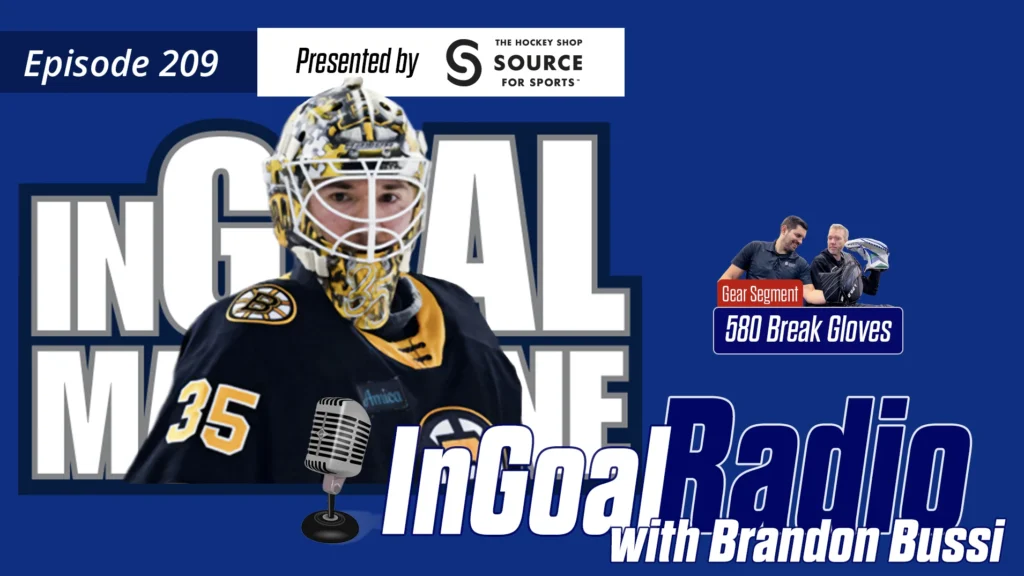
InGoal Radio Episode 209 with Brandon Bussi

Please subscribe and leave a rating — it helps us reach more goalies!


Brandon Bussi, AHL rookie goaltender for the Providence Bruins, posted an 18-4-4 record with a .926 save percentage ranking second in the AHL in his first professional season. The 6-foot-5 netminder credits continued summer work with Stop-It Goaltending and incorporating the Panda style as key parts of his development into an AHL All-Star.
- Bussi went 18-4-4 with a .926 save percentage as an AHL rookie, ranking second in the league and earning AHL All-Star honors.
- At 6-foot-5, Bussi adopted the Panda technique as a tool suited to his size, demonstrating how tall goalies can adapt their positioning style.
- Returning to Stop-It Goaltending each summer remains valuable even at the professional level, showing that elite goalie coaching doesn't stop at college.
- Bussi's path to pro included significant twists through junior and college hockey, illustrating that a non-linear development route can still lead to NHL-organization success.
- The episode includes a history of the 580-break glove, featuring insights from the Lefevre family on its origins and evolution.
Episode 209 of the InGoal Radio Podcast, presented by The Hockey Shop Source for Sports, features standout American Hockey League rookie pro Brandon Bussi of the Providence (and Boston) Bruins.
Feature Interview
presented by NHL Sense Arena
In the feature interview, presented by Sense Arena, Bussi walks us through a path to pro that featured more twists and turns than most, sharing openly how he matured and evolved through each step in junior and college before turning pro at the end of last season. Bussi also talks about his evolution as an AHL All Star as a rookie this season (18-4-4 with a .926 save percentage that ranks second in the league) and how he’s incorporated new tools over the years, including the Panda as a 6-foot-5 goalie, and why going back to goalie coach at Stop-It Goaltending in the summers still has value even as a professional goalie now.
Weekly Gear Segment
presented by The Hockey Shop Source for SportsAll that, plus a trip to The Hockey Shop Source for Sports for a history lesson on the origins and evolution of the 580-break glove, including some historical notes from the Lefevre family.
Episode Transcript
Intro
Presented by The Hockey Shop Source for Sports Langley, that new location, rocking it, and the hockeyshop.com where I get all my stuff from south of the border. It's InGoal Radio Podcast. Daren Millard along with the cofounders of InGoal Magazine. It's Kevin Woodley, and David Hutchison is on assignment right now. You will be really excited to see where he's at in subsequent episodes of InGoal Radio, the podcast.
What's going on, Woody?
I am, being held together by duct tape and bailing wire and just trying to basically survive at this point. At age 49, seven games in seven days, including three over a twenty four hour stretch, is a little much, and I am feeling the effects of my participation in the Carha World Cup here in Richmond. But what a cool experience, Daren. I got to tag along and backstop the SportsNet team here locally against teams from Australia, couple different ones from Finland. I met people and goalies from Sweden, England, all over the world.
95 teams from all over the world for this, international recreational hockey league, quote, unquote, beer league tournament. It's been a fun but busy week. And in the midst of that week, I watched Jonathan Quick hit a milestone and covered another game. So it's been I'm gonna sleep. We're gonna get off the air here, and I'm basically gonna probably go for a nap in the hot tub for, like, three days.
For those that don't know, baling wire, hold those bales together. It is strong. It is tough, and you've got the right thing keeping you together when it comes. And then you you can just cover it up, dress it up with little duct tape.
It is strong unlike my groin.
It twings that that makes the same sound like ding.
Yeah. There was your pee times, I heard a little pop.
When people find out that it's Kevin Woodley on that SportsNet team, do they go, I wonder if that's the same Kevin Woodley from InGoal Magazine, InGoal Magazine, InGoal Radio Podcast.
Well, I think after the my performances at this tournament, they're probably going, this guy talks like he knows what he's talking about. How come he plays like that? No. But I had some pretty cool moments, I gotta say. Goalie from Australia, played against a team from Australia, and this goalie was standing on his head at the other end.
They were a little overmatched. And, man, he was good. He was really good. And then in the first intermission, he came down and or or I met him at the bench and we were talking, and he asked me if I was Kevin from InGoal. And I was like, it was the most I knew it.
I it was the most flattering, and it was just like, it was sincere. Like, I'm not trying to do a Cam here from the Hockey Shop and make my head super big, but it felt so cool to meet goalies from all over the world that knew what we were all about. Some other goalies too that you know, some of that talked about, like, hey. Like, at the beer league rec league level, maybe some places where there aren't that many goalie coaches, like, hey. The magazine and the tips and the drills are are things that they use to help get better.
Goalies from played against the goalie from Finland in our final game, and he came down and talked to me about gear and said that, you know, we'll tease the the Gear Segment this week at the Hockey Shop. He watches them and says that, you know, he when new gear is coming, that's one of the resources he uses to find out more information. Our reviews are in-depth reviews he talked about on the website, but also the gear reviews we do quickly on the video, over at YouTube with Cam and here on the the podcast. Pretty, yeah, pretty, rewarding week, like to know you get working in the business, on the business. InGoal Magazine isn't a business to us, like it's a passion, but when you're so busy with it, you you you don't really get to see that there's an impact there.
And to sort of hear some of those stories, it meant a lot. Like, it meant a lot to me to hear some of those things. And we get this every once in while now. We got some younger goalies coming up, you know, into the junior and pro ranks that grew up with us that will share some of those stories. And every time we hear them, it's like, I don't know.
It feels like we're actually doing something of value here, not just not just a bunch of guys horsing around talking about goaltending and having fun with the position we love. So to all those guys that came out and said hi at the Carha Tournament, and introduced themselves, thank you so much. It made my week to hear that you're a part of the family and you enjoy being a part of the InGoal family. So thanks to you.
Well, just speaking as neutral as I can be, You look at the ProReads and the tips and then the interviews on the podcast, and why wouldn't you use that as a resource? And I'll go back to your conversation with Linus Ullmark. If he's getting things and adopting it into his game from the podcast and the interviews, anybody can do it. This guy's gonna win the Vezina.
Yeah. That was and that's been another cool moment over the past couple of weeks, and I need to send Linus an extra thank you because, it just, I mean, it was Henrik Lundqvist and an interview with Lundqvist that resonated with him and was just one small piece of him, you know, buying into some changes that have have helped his game this year and had a fantastic season. But, again, like, facilitating those interviews, being a part of the goalie world the way it means a lot to us that we are in your lives in the goalie world and part of the goalie union, and I don't know that we say that enough. Like, thank you to everyone that tells us that there's a positive impact there. Because there are times when this is hard.
There are times when it's not easy to get guests every week for the podcast. We're 209 episodes in. There are times where it's not easy to as a small company with just, you know, like, you, me, and Hutch to get content up on a weekly basis and keep going and and and keep trying to grow it. And so when people share that with us, it yeah. It I'm getting reclipped.
It just means a lot. It means a lot to hear that stuff from everyone in the goalie union, and thanks for making us a part of your lives, and we can't wait to continue for another decade or so. We've got
a really cool Gear Segment coming up, this week talking about the May break and just where that came from. And I'm excited about, people getting to hear that with you and Cam. And our feature interview, this time around is Brandon Bussi, from, the Providence Bruins. And the
Sorry, Daren. I mean, Brandon Bussi from the brew Providence first year pro. I would
I would I look at his name and I don't know Bussi Bussi. Like, it's one of those ones that I'm gonna have to hear and follow and really get involved with before I can confidently say Bussi.
Well, I got to say Bussi because I asked him, and then I was pretty sure I screwed it up at the start of the interview despite having just asked him. At the end of the day, we'll all I think we're all gonna end up knowing this name before long. I can't wait to share this interview, his path to where he got today, heavily involved with Stop It Goaltending, talks about still going back as a coach and the value that has to him as a goaltender. Bounced around a little bit in junior, wasn't sure of his path. And now here he is first full season as a pro.
He's in the all star game in the American Hockey League. And you know, Daren, you know how big a jump this is? Every goalie will tell us what a massive jump it is from Yep. Whether it's junior or college to first year pro is a bigger jump eventually than from American Hockey League to the NHL. Everything changes.
And so he has made it at an an incredibly successful clip, And so really fascinating conversation to talk with him. We get into a little bit of talk about the Panda, something he's you know, it's funny. We think of that as a technique that's for smaller goalies, who can't go into a reverse and seal short side high, so maybe they need that extra coverage of the overlap portion of the Panda. And here's a guy who's six foot five who integrates it in specific situations into his game. So can't wait to share that conversation.
We get into a lot of different things, and Brandon was, he was great. Just really open dialogue about his evolution as a person and in the position.
The Panda, I love. Also, the overlap. I'm trying to think of backward flow that you and Linus talked about being square with Bob Essenza. That's it all comes together. Some of it's basic, some of it's long term, some of it's new and and developing.
On the subject of of turning pro, when you talk about the big jump, does that make the expectations of Devon Levi a little unfair? Because he turns pro and everybody's watching what's gonna happen here.
Yeah. I I don't know about unfair. Yeah. Maybe, actually, maybe that is a good term. Like like, I feel like the expectations are just unfairly high right now for him, and maybe not enough people are recognizing how big a jump that is.
And that doesn't mean he's not gonna make it successfully and correctly because he is a special goalie. He is a special student of the game. We've had glimpses into that. And so maybe he makes it more seamlessly than others. But to expect it to be seamless is that that's that sort of goes against what every goalie we've ever talked to tells us that jump is like.
Right? And I think the other part of that is to expect it to be seamless behind a Buffalo team that I think we're seeing right now just does not have enough defensive structure. I keep hearing all these conversations about, like, what are they gonna do with the goaltending? What are they goaltending's been the problem in Buffalo. Devon Levi's gonna be the answer.
Like, first of all, that's a lot of pressure for a kid who's about to make the biggest jump in quality he's ever made in in his career. Although, again That you can make.
Right? Pretty much. Exactly.
Like and yet again, like, there's something special there, so maybe he pulls it off. Craig Anderson's top 10 in adjusted save percentage in the National Hockey League.
Wow. Eric Didn't know know that.
Eric Comrie, before he gave up the 10 goals and they left them in for all 10, was still plus point 4% in adjusted save percentage. Eric Comrie has the lowest expected save percentage in the entire National Hockey League. Nobody has played behind a tougher defensive environment in the entire league this season than Eric Comrie. You know what his expected save percentage is, Daren? .868.
Wow. Yes. This and listen. Part of this is when you get your games and they've missed key personnel at key times and Eric has been in net for a lot of those games. I think their depth chart on defense seems to get thrown out of whack significantly when Mattias Samuelsson is out as as, you know, as a as a sort of defenseman who sort of lets everyone slot into the right place and a defensive defenseman who lets some of their more freely wheeling offensive guys go play without worrying about their own end.
But but when I watch them play and when I look at the underlying numbers, like, they're thirty first in the National Hockey League and high danger chances against off the rush. Well, where do our most dangerous chances come from? Usually, odd man rush chances. Who gives up the most dangerous in the NHL? There's only one team that's worse than the Buffalo Sabres.
So it's not just the expectations of making such a big jump. It's the expectations of being a savior behind a team whose problems I don't think are necessarily goaltending. That's part of the issue here. And and I and unless you have a a look under the hood at some of the adjusted numbers and some of the expected save percentages, I understand how people can see it. Because they look at Eric Comrie's raw numbers, and they're like, it's not good enough.
Yeah. But, like, up until that tenth spot, he was above expected. And before his first injury, he was almost a full percentage point above expected. He was flirting with top 20 in the National Hockey League behind one of the worst defensive environments in in the NHL. That's not easy to do.
And I think until and we're seeing these growing pains. Like, it's not I don't think it's a coincidence they've given up ten, seven, and seven in, you know, in three of their last four games. For all the talk about freewheeling and offense and dynamic and the new NHL and lowered save percentage, the teams that are having success now as we get into their grind down the stretch have structure and defensive identity. I watched this in Vancouver and and gained a new appreciation for it. Freewheeling, fire wagon hockey does not you can score a ton, but you're not gonna win when it counts unless you have some semblance of structure in your own end.
And I don't see it right now with the Buffalo savers, and I think they're goalies, at times fairly, but a lot of the times unfairly are wearing that based on the results from people who can't see the underlying numbers like we get the benefit of seeing with clear side analytics.
I'll take my goalie hat off for a second, but I I do appreciate what Buffalo has done in this rebuild in in putting the emphasis on upfront scoring goals and then going back as they grow into it. They've got everything. They're selling a product. They're entertaining, winning fans back. I I get why they did it.
I I do. Totally. Goaltending will hopefully come and the structure will hopefully come, but they knew that this was going to be part of it, when they adopted that strategy.
And that's, you know, and and that's well said, and that's fine. But the fan base seems to be placing all the emphasis on the goaltending, and an educated look will tell you that the goaltending hasn't had the support it's needed. And I'm not surprised that down the stretch when when the teams that understand how to play tighten up, they're on the wrong end of a lot of lopsided scores. Because you can't force that offense against teams that understand how to defend at a higher level. And eventually, we see this here in Vancouver.
Right? Like, this is the danger at times too of allowing young talented players to just focus on one thing. The Canucks, Patterson, Hughes, even Besser, and, like, all their young players that came up together were propped into offensive roles where and celebrated for succeeding in those offensive roles. And it's not until the last couple of months, and some of these guys are three, four years into their pro careers, that they've been held to account defensively and structurally and are starting to build an understanding under Rick Tocchet, you can still do that offensive stuff. But these other things, nonnegotiables in terms of not turning pucks over in certain areas, being on the right side of the puck, these are not systems things.
These are habit things that sometimes young players can get away with not having in their game. Eventually, if you want to win, they have to be there. And I think the Sabres are they're they're fun to watch. They remind me a little bit of the Islanders when Doug Waite was there. Every night was an all star game, wide open offensive skill, and they've got a ton of talent.
But I still think for all the talk of offense in the NHL, you need the other side of the puck to succeed. And in this case, I maybe I'm overly critical because the goaltending has borne the brunt. And when I look at the numbers, it's not all the goaltending.
Gear
We've got a great situation happening over at the Hockey Shop Source for Sports Langley, the hockeyshop.com. We'll get to that in just a second with Cam and what's occurring over at the new location, but you got to celebrate a milestone with Jonathan Quick this week.
Yeah. It was pretty cool. Amidst all my games played and barely surviving, I got to cover a couple and Quick's 375th victory, second all time among US born goaltenders. Got a couple quick quotes from him after the game. You know, you're seeing this obviously firsthand, Daren covering the Vegas Golden Knights.
It wasn't obviously, the way it ended in LA wasn't ideal, and and that was his exact quote. But to come into Vegas and have the success he's having immediately, to see him hit a milestone like that, he's he's only, what, 16 now behind Ryan Miller for tops all time among American born goaltenders. It's been really fun to watch. And we talked about this a little bit on the podcast. The numbers were what the numbers were in LA, and they weren't flattering, the adjusted numbers.
But count out Jonathan Quick at at at at your own peril. Right? Like, he's he's succeeding with Vegas. He's a great story, and, the media is absolutely salivating over the potential of a Jonathan Quick Los Angeles Kings meetup in the playoffs. And I just I just I was happy for him to hear him talk about that milestone and what it meant to him and just, you know, to the names on that list he talked about, but then also the names that helped him get there.
He reflected on that a little bit and just yeah. It's all it's always neat to see big goalie moments, whether it's Linus Ullmark scoring a goal or Jonathan Quick, you know, surpassing John Vanbiesbrouck and moving into that spot. It's always cool when you get to see it personally and even more so because I'm still a fan of the game and obviously of the position to get to be in that room, to ask a couple of those questions after and see the smiles on their faces. Because to see I don't wanna say jaded, and I mean me, not them, but, you know, it becomes a little formulaic in post games at times to see that smile, to see that sincerity, to see that joy. It makes me smile too.
So you got to see the Vancouver victory by Quick. He came in in the lake going against Calgary and locked down a victory for the Vegas Golden Knights in relief of Logan Thompson with six minutes to go in the third. I can't think of a more awkward position to be in for Jonathan Quick in particular. The way that he is sliding around and flexing and those hips and knees and everything. And it like like it honestly looked like he played the first fifty four minutes of the of the game.
It was seamless. It was amazing.
For a long time starter to come in off the bench that late in the game, like, that's a big ask. And I'm sure, like, if you're Vegas, you're probably nervous. Right? Like, because he does play such an active style. Yeah.
But you know what? We probably shouldn't be surprised because he's also a pro, So he probably made sure that everything stayed loose throughout the game despite the fact he had no expectation to go in because that's what pros do. And in terms of those hips, I'll I'll actually throw back to a column I wrote for nhl.com earlier this season. I always do a quote, unquote, annual Christmas column. And sometimes we talk about gear, guys get under the tree, you know, that spark their passion for the position.
But every every couple of years, I will just ask goalies around the league, if you could take one thing from another goalie, any goalie in the NHL, put it under the tree, and have it in your game that day, what would it be? And you get a lot of, like, Carey Price's movement, Andrei Vasilevskiy's explosiveness, you know, Kochetkov's glove hand. This year, I got from Thatcher Demko, Jonathan Quick's hips. Just because of the way he moves, and way he has moved throughout his career, way he still moves this late into his career, the positions he can get into, the flexibility, the power, the end range power. So we shouldn't be surprised that, you know, to do that to do that as long as he's done it requires commitment physically, and to your sort of to your craft.
And so as much as I would probably have been nervous watching him come off the bench that late in the game, we also probably should have expected that if anybody was gonna have done the work to make sure they wouldn't put themselves in a vulnerable position, it's probably Jonathan Quick.
There's a a combination of smiling and then shaking my head when I watch him. Like, how does that happen? In practice too. How does that happen? And be before we move on, you looked at the the list of, top American born goaltenders as Jonathan Quick moves into sole possession of two on that list.
Was there a name that that you just love reflecting on when when you looked at that top five, top 10 list or or a name that that you hadn't thought of in a while? Mine was was was Mike Richter.
Yeah. You know, I that Richter was one. You know, the the other one who who's up there and he's not gonna end up being the top five, but, like, he's up there in games played in the top five is I think we forget about just how good Craig Anderson has been for how long. Yep. And the resurgence, I talked about him having top 10 adjusted numbers this season.
You know, a little further down, like like Connor Hellebuyck. Right? Like, the you know, I yes. There were some other names in there.
Tom Barrasso, I didn't that name hadn't crossed my mind in a while.
Yeah. Barrasso for sure. And and he, you know, had a hell of a career that I think we forget about far too often. I you know? But honestly, like like, I was looking more at it from, like, who's got a chance to catch.
Oh. You know? Like and
I was thinking the old guys.
Yeah. No. No. And and then I didn't consider it that way. Certainly, Ryan Miller, who's not an old guy, but just because I followed his career, like, there's a part of me that'll be sad when know, if and when he's not on the top of that list.
But I was when I looked at who's got a chance, like, Hellebuyck at two thirty three, you know, and yet there's still a 160 wins left to get to get there, which is like if you have five thirty win seasons, you're still not there. So it shows you how like, that shows you how hard it is to get that high up. You think of the teams that Quick played on as long as he's played, how long it's taken to get there. Yeah. You know, like, the fact that I look at Hellebuyck, and I think he's already, I think, like, eleventh on the list in wins.
And I'm like, it's not a slam dunk. And this is a guy having a Vezina level season this year, and I'm like, it's not a slam dunk he gets there. So it makes me appreciate what Miller did and what Quick is doing right now that much more to see how hard it is to be at the top of that list. Because when you splice a list a little bit like that, like, oh, okay. American born goaltenders.
Right? Like, I don't know that we appreciate that accomplishment as much until you look at, you know, how hard it is to get there. Like, he's he's get he's got a shot at 400. Like, that's you know, to take a look at the guys like Anderson, how much 300 meant to him last year. Look at how much we know 300 means who's now six shy of that.
Right? Like, the chance to get to 400 is remarkable. So, incredible careers for all of them. And I I'd again, a little part of me thinks about the future. Like, you know, USA hockey with its fifty and thirty one program.
They wanna have 50% of the NHL starts by the year 2031. And, you know, we've we've you look at a Thatcher Demko coming up, as the next wave once a Jonathan Quick is done. Like, they gonna get there? There's a lot of young goalies around the league, with American birth certificates. We focus on Russia, but USA has done a really good job with this goaltending as well.
Let's, take a break as in, looking at the 580 break as things happen over at The Hockey Shop, a Source for Sports Langley, thehockeyshop.com.
Spring break sale, first of all, make sure you check out, all the specials that they've got on over at thehockeyshop.com, or if you're lucky enough to live in the Lower Mainland or be visiting the Lower Mainland to play in a beer league tournament from other parts of the world. Because a couple of the guys have reached out and said, where's the best hockey store for us to go? Like, the Finnish team was asking me where should we go? I'm like, there's only one place to go. Yeah.
Because your goalie's gonna be happy, and they've got 34,000 square feet of hockey at The Hockey Shop player stuff as well. NHL merchandise, skates, sticks, apparel, undergarments. Like, if there's something to help you be a better hockey player or a better goalie, they've got it at the hockey shop and the hockeyshop.com. So that's where I sent all these teams from the international tournament, out to Langley to see the hockey shop in person. But if you're not lucky enough to be able to do that, check them out at the hockeyshop.com.
Because in addition to all the gear they have, they've got an expertise, and that includes Cam, who wanted to do something on the five eighty break. We're seeing it make a resurgence. We talked last week with the launch of the Hyperlite two line and the fact that in Bauer's Pro Customizer, you can get what they call their vapor 90 break, which is a five eighty. And interestingly enough, James Reimer was just in town. We had him show us his.
He's one of the sort of most infamous guys using it and why he likes it. There's gonna be something coming from another company this year that may make it even easier to get a five eighty style break. I'll tease that. I'm not allowed to say just yet. So we decided to get into the roots.
Where'd it come from? Where'd it start with? Cam was telling me all these stories about Patrick Roy, and I gave Cam a homework assignment. I said, I want you to reach out to the and get the story. And he did.
And so we'll tell it now with Cam at the Hockey Shop. Welcome back to The Hockey Shop Source for Sports. We're here in Cam's Crease, Goal Utopia, whatever you wanna call it. I think I know what Cam wants to call it. We're talking five eighty gloves.
Why are we talking five eighty gloves?
Because everybody's talking 580 gloves.
Okay. I'll I'll go with that. Cam has a little history lesson he wanted to teach us.
Yes.
I was talking the other day about like the origins of the 580 glove Directly from the Source. The Lefebvres. And so I sent them out with a little homework project. I said, get a hold of the Lefebvres. Patrick, Michelle, I don't care who.
Get the answers. So Cam did on the origins of the 580 glove. Before we get to the magical origins and how this glove was developed, let's first, actually, let's first remind people that if they can go back and check out our other video It's up there somewhere. We have a glove break video that walks through all the different glove breaks including the 580. You can always check that out to see how it compares to a five ninety or a 600 and stuff.
Some of the other nomenclature from other brands. But in terms of what a 580 is, I'll I'll go with you, Cam. What what differentiates a 580? Why do we call it a
580? That would be my question I just asked you. Koho 580. So now we're winding way way way back. It is 2003 that the Koho 580 series came out.
So, Lefebvre family looking to innovate, come up with a new break angle, organically came up with this style of glove for that series at the time. So Koho 580, that's where this name five eighty glove has originated when we refer to it as a 580 break, particularly that's incorrect because it's a 90 degree break on your hand. Literally thumb up, fingers out, bringing those fingers in.
And that finger into palm closure, which we also see on a five ninety provides a more powerful closure. It allows you it gives you more leverage in your hand than say, a 600 break where it's fingertips to fingertips, which is a little more your your power is sort of lost out on the edge of your fingers. It's that strong right? How do we make a fist? That's our strength right there.
So it's that fingers into palm and the 580 has that. But it also has that distinct sort of pocket that sits up high and
sort like a bill fold over That's at the
your that's your distinct like when you see that, that's when you know you've got a 580 glove. Whereas a 590 is going to be more of a straight line out there. So there's there's the 580. There's what we know now. I'm gonna let you get to your story time.
I'm gonna let you get there. But first to know, because it is becoming increasingly popular again, we see it all over the National Hockey League. We've seen this over the last five, six saw a real rise of it with CCM. A lot of the CCM guys in the National Hockey League switched to it over the past couple of years. But first off, before again, we're teasing the origin story because Cam did his homework and he hasn't done homework in his life.
But where who can, who can't get it? Juniors, for example. Dad's Not available at the moment. Dad sees this and he's like, I want 580 for my kid.
Not now. Not now. Custom orders. Where can
you get a 580? True in a in a in a custom order will make a 580?
That is correct.
CCM in a custom order will make you a 580? Correct. Also, new Oh, Pro Custom is now offering their version of a Vapor 90. Vapor 90 brake, which is similar to 580. It's basically designed that James Reimer's worn it for years.
And where did James Reimer start wearing a five eighty brake? Storytime with Kevin. Toronto? No. Good guess.
No. He tried Roberto Luongo's 580 CCM when he was in Florida and was hooked to even wore the five eighty CCM and then got Bauer to make him one just like it. So now story time, Kevin. That we've established the where you can get it. There's one more you're missing.
What am I missing? Warrior. There's Yeah.
Okay. 6.1 something similar along that lines in terms of for the closure of hand. Okay. So going back to the continuous Sorry, So what's added in my opinion now to a bit of its mythical status and why You've got mythical status. I do.
Thank you. So the glove went quite a long time after this Koho 580 series. A few select guys using it, again, Luongo. Holtby comes to mind.
Did Patrick Roy wear? You told me this whole thing started with Patrick Roy.
Yes. And that was starting with with him as well. I mean, there was also that that story kind of going around that he wanted a glove that he could catch, you know, pucks going up by his ears as he was dropping down and kind of originating and pushing through, you know, what we started to know as modern butterfly, you know, what was a modern butterfly style at the time. That said, Lefebevre went a long time without having anyone new ordering that glove from those original guys that started with that 580. Fast forward a number of years, Vasilevskiy rings rings them up and says, I want a 580.
Why? 580 glove, that 90 degree break presents forward fingers up without really having to move or change your wrist around. We look at the way modern goal tending has evolved and wanting to keep that fingers up, hands forward, pocket up facing your shooter position, That glove is basically doing it for you as you're having it out. Big benefit here, I'm cutting off that top corner. I'm keeping that glove forward.
I'm not having to really cock my wrist back or sideways to be able to create that good angle to cut off that top corner And that one by your ear that you normally can't get to because your glove ends about here.
Oh, hello. Hello, my friend. So now
we start to see some of the benefit and why. So a number of goalies have made that switch. Number of goalies from CCM now transferring even over into True's world as well. A number of some of the Bauer guys have had that kind of secret 90 degree break for quite a long time too as well as you had mentioned James Reimer. Honestly, like for me, this has become one of those again mythical status because it was something that you just couldn't get for the longest time.
I could be mythical there. And it's slowly started to been kind of released to the general public.
My I will tease. It's gonna be released to the general public. We've already talked a little bit. It's gonna be released to the general public even more with one of the launches this summer. Exactly.
So for me, I've in
my opinion, I find one it's the best gloves in terms of for like gripping the stick and also playing the puck too as well. We have Marty Turco on the podcast last week. We did. One of the best all time. Guess what he wore?
580 glove evidently. Mike Smith, inspired by mister Turco himself. 580 glove. 580 glove. I mean, hey, for the amount that's happened with him and everything like that, it still made me a better guy that could fire the puck.
Then who? Mike Smith or Marty Turco. Yeah. There you go. There's two of the best all time.
Five a. Done. Can you tell me why it grips so well? So when you grab the stick, because that pocket's already facing up and forward, I can put a ton of leverage into that stick for me just pushing through with the bottom of my wrist. It hooks right into that break and keeps the shaft of the stick facing up and pointed up along with
Okay, the break. The reminder, closes fingers into palm, gives you that sort of pocket up and above the hand, can help you sort of protect by the ear over top of the shoulder when you go fingers up on a high safe. Pocket up nice and high. Can custom with true,
CCM.
CCM and now Bauer. Correct. Warrior has a version, a similar version to it. It's 6.1. Junior cannot get it.
It's senior only right now. We'll see if that changes with that launch I teased earlier coming up later in the summer. 580 break. There you go, Cam. We'll get a little sort of modern.
What's going on with it now? Why is it popular? And also a history lesson. Thank you, Cam, for doing homework. Like your time to phone your grade seven teacher because they'll be shocked.
Missus Terwilliger is gonna be thrilled. By the way, give us a call. (604) 589-8299 or 1-800-567-7790. Check us out at the hockeyshop.com.
As you can see, they actually have some ordered stock in store now. They have a few in true. I think he might have one CCM kicking around. Make sure you give him a call to find out what he's got now and how to order custom if you want to get yourself a 580 glove.
Now that's some cool backstory on a 580.
Yeah. Yeah. It wasn't you know, like, we didn't get quite now nostalgia lane. It wasn't maybe Cam was teasing me about all these stories about goalies gone by. We didn't get as deep as I would have liked.
At the end of the day, it's interesting to see it come back as strongly as it has. We talked about Reimer using the Bauer version and now they've made that something public can get for the first time this year. I just think the demand is such now that companies have to have that as an option. Goalies like the way that glove closes. They like having the pocket in that location as as players are not necessarily looking high glove, but trying to put it by your ear over your shoulder.
Having a pocket where if you get to a fingers up position, the pocket actually kinda bends over or or or is positioned over your shoulder by ear to catch those types of shots, has increasing value. And there's just we talk with Turco. Right? Like like, in terms of how it closes on pucks and helps with puck handling. Like, there's just there's a reason that glove was so popular.
I'm a little surprised the popularity went away. Not as shocked to see it come back right now. And so the good news for the rest of us schlebs who aren't in the, National Hockey League with, unlimited gear and custom options is more and more of us are gonna be able to get it. Can now through the Bauer customizer, the pro customizer, and we'll be able to get it soon through through other brands as well. So it's kinda exciting times for fans of the 580, and thanks to Cam for walking us through why we should be excited about more companies offering it to us in the public.
Well, if we're allowed to hand out assignments, I would like you or Cam to tell me because it got me thinking about about the 580 break. The old GM 21 or the GM 40, the the Cooper glove. Like, it it was in all the old goalie pictures. You'll you'll see these gloves. What what do you think that break was in in the GM 21?
I'm going way back here, but I the biz before there was even, like, break styles, I guess.
I think, the good news is see, I'm too young. I'm not 50. You are. I'm not I'm not 50 yet, so I don't I don't I don't know what you're talking about. I can't tell you what that break angle is.
I don't know that I've ever had one on. The good news is Hutch is so old that he's got one sitting in his house in the backdrop in the office. So once he's back from special assignment, I think we're gonna have to get him to measure the break angle on that old piece of leather he's got on the wall behind him and and see whether it's a five ninety. My guess is it's all gonna be like, a 600 is more like a first baseman's mitt, like, if we're trying to make baseball comparisons. Yeah.
And a 590, like, is more sort of fingers in the palm. There's a big part of me that feels like in the old days, it's probably gonna be a little more like a first baseman's mitt than a five ninety that might be more like a catcher's mitt. That might that would be my guess, but we're gonna have to get out the protractors and and figure this one out.
It is a slab of leather. Like, that's the best way to describe the the old the old gloves. And I always wanted the the pocket with the the mesh in it, not the closed pocket. You know what I'm talking about? And and it's I it was my dream.
My my absolute dream.
Hey, here's one thing on the 580 break that I will talk about a little bit because right now for the most part, it's available in custom. I think it closes better with a single t. I think You do? I do. I do.
That's my opinion. If I was ordering it, I'm I and I had the option, I'd be tempted to go single t. I think that the way it closes and maybe maybe it doesn't matter to performance, but that distinctive sort of little the way that the the pocket sort of folds over on that straight 90 degree angle when you close the glove. I think it happens a little easier. Like, it's harder to do that when you've got a double t.
The double t doesn't wanna fold over quite in the same manner. And maybe that actually doesn't matter because the puck's supposed to already be in there when it closes like that. It doesn't change the position of the pocket when it's nice and open and and and accepting a puck. So maybe performance wise, it doesn't matter. But I want my 580 to look like a 580 when it closes, and I think that happens more often with a single t.
So at much like my performance at the Carha World Cup, International Beer League Tournament, it was all about fashion, not function when I'm choosing that single t.
It's funny as I was listening to you tell the story about the Carhartt Cup, I was wondering, did those other goalies know that you were Kevin from InGoal because you were pimped out in all the best, coolest equipment?
They they definitely recognize the gear from from photos. It was it was the equipment that ticked them off, then, all of our test stock comes with like, we don't get you know, when you get your custom gear, you get your name on it. Yeah. Our gear doesn't say Woodley or Hutchison, well, for for David. It it says InGoal Magazine.
So it's bit of a tell there.
The other part is I'm a double t guy. Reimer's, does is is he single t?
Or I think Reimer might actually be a double t and I'm embarrassed to say too. Because I just, yeah. Reimer's and and but he he hammers on that pocket, and so when he holds it up flat, it's kinda messed up looking. Like like, there is no the pocket does not
I totally agree with you on that.
The pocket does not bulge out. Like, to accept the pocket, it's actually flat, and it looks like it's it's going the other Yeah. It's I you know what? Let's just we'll call this a tease. We'll let James Reimer I don't know if I asked him that question, to be honest.
I did this video with him of the five eighty break, and I'm not sure I asked why. Look. His look his pocket looks so bloody messed up. But There's a unique look to his glove. Yeah.
Definitely. Definitely. Well, you'll see it close.
You'll see it working in the locker room in our video.
Feature Interview - Brandon Bussi
Alright. Sense Arena feature interview, Sense Arena VR, is, Brandon Bussi from Providence Bruins. Set us up for what's going on at Sense Arena at Sense Arena VR.
Well, they get their three times free buy any plan and get a free mount or sleeves, free ten day trial, and free shipping offer right now over at Sense Arena. You've heard us talk about Sense Arena over the years, and all the things that it can help you do, improve your reaction time, improve your puck tracking, improve box control, reading the release with pro shooters right up to the NHL, tracking plays. You've heard us talk to NHL goalies about the way they use Sense Arena even in season to stay on top of their game. And as we head in the off season, I think it becomes even more important. I'm gonna forget the name of the parent who sent us a note last year, but talked about how his son they they committed to Sense Arena going into the off season or midway through the off season.
And how his son, who he really wanted to have a summer. He didn't want him to spend the whole summer in goalie camps. He wanted him to do other things, play other sports, and how Thank
Just by well, exactly. We pre we physical literacy. We hear from from, experts at all levels about the importance, especially at young ages. But he also there's pressure there. Right?
You got tryouts coming up, and so he didn't wanna be totally disconnected from the game. He wanted to be able to perform and make the top team when tryouts came. So they went with Sense Arena, and they used it as part of their off season plan to allow him to not get worn out by goaltending, not get burnt out by goaltending because it's fun. That's the other thing Sense Arena does that we don't talk about. They create a competitive you can you can lock in on specific training modules, and I am focused, and I am gonna be like like the pro goalies do.
You know, using it for box control, just watching pucks go by them and then using the replays to see by how much, what's their net coverage like. You can dig into the finest details. Or you can just track pucks, make saves, have fun, compete against other people, keep track of your numbers. You you can enjoy it. You can do it without ice time.
You can do it without the expense of having to hire a goalie coach and get it on the ice and attend camp after camp after camp. And his son made the top team, and they credit a lot of it to Sense Arena and the fact that it kept him engaged with his eyes engaged, his hands engaged, play reading, some of the other skills that you can develop there without having to spend the whole summer on the ice. So as we head into the off season, it's just one more, reason to give Sense Arena a try, and it's a really great time to tie or time to try it. Three times free. Buy any plan and get free mount or sleeves, free ten day trial, free shipping.
And as always, when you check them out at Sense Arena online, make sure you use the code I g m 50. That's InGoalMag 50, I g m 50 to save even more at checkout Sense Arena. You can check them out at sensearena.com. Perfect time of year. If you haven't already, you can also give it a trial.
You don't have to commit completely. They've got two price points. You have to go right into the pro plan. You can start with the starter plan. Lots more options than ever before for you to add Sense Arena to your game.
And ask for our Sense Arena Sense Arena VR customers who are listening to the InGoal Radio Podcast box control. I'm terrible. Like, I I just can't figure it out. Honestly, I I look and I do a I try and fill it up. There's something missing that I that I'm not getting.
So if anybody has tips on elevating your box control technique or filling out that net, please send them to to Hutch or myself or or Woody, and I love to hear different techniques to help you out with the box control.
Oh, this sounds like a perfect time for a tease because I think we can do some lessons there, Daren, when you we're gonna we're gonna try and drag you up to Vancouver for and we're never got the dates confirmed yet, but TendiFest. We're gonna have TendiFest returns to the Hockey Shop this summer. There's a blind tease. Be more information coming, and we're gonna try and pull out the Sense Arena sets at TendiFest for people to try, and we can work on Daren's Box Control while we're there.
Please. It's it's like I I I try and chalk it up to just I'm thinner. My my head's thinner. My like, I just can't do it. It's it's just bizarre.
So we've got a great interview, and this this really does remind me of the first conversation that you had regarding Jeremy Swayman. And I didn't know Jeremy Swayman from Swayman Jeremy at the time, and I was captivated by it. But and there's a lot of those similarities in today's discussion, today's feature interview with Brandon Bussi.
Yeah. And I I love this. Right? Like, hey. Listen.
We wanna have NHL goalies on here and NHL goalie coaches on here every week. But I love when we get to connect with the next generation, the guys that are coming up. Because then when they arrive, we have the backstory. We know, and we can see it coming.
I was so cool when I knew who Jeremy Swayman was when he burst on the scene. I'm like, I I know who this guy is.
Exactly. So we educate ourselves, but also we get a sense of the paths they've taken to get here. And it's a bit of a unique one for Brandon and, a lot of lessons along the way. Like I said, there's gonna be some off the ice and some on the ice, some mindset advice in here, some tactical advice. I love that he digs into the technique side.
And also, like, hey, goalies, as you're coming up, don't get too big for your britches even if you're playing junior or whatever. You know those goalie schools, whether you were getting paid to coach at them or volunteered or whatever, they have real value as you evolve as a goaltender. There's still value to going back and teaching, and Brandon got into that in his work at Stop It Goaltending and how he sees value in being a coach with other young kids and how it can help him actually become better as a goaltender even now that he's playing professionally for the Providence Bruins. He's having a hell of a rookie season, hell of a first year pro season, already been an AHL all star. Can't wait to introduce you now to Brandon Bussi.
Yes. He's got a great first name, from my hometown, so I never forget that. Brandon Bussi is with us on InGoal Radio Podcast, the featured interview presented by Sense Arena, Sense Arena VR.
Really excited to welcome to the InGoal Radio Podcast. First time guest, first year pro Brandon Bussi. I got that correct this time. Brandon, Providence Bruins' first year. I guess just first off, welcome to the show.
Thanks for taking the time to join us.
Thanks for having me. I appreciate it.
What's this been like? Like, from college last year to a late season contract, with Providence to American Hockey League All Star in your first year first full year of professional hockey, what's the path been like? What's been what you know, like, I'm guessing there's been a lot of lessons along the way. What are some of the ones that jump out to you the most?
Yeah. It's definitely been a been a long journey. An exciting one, though, for sure. I guess the journey kinda started back in juniors. Played my first year u 18 with the Long Island Gulls.
And over the course of, three years, kinda bounced around the the NAHL with the Titans and the Amarov bulls, and then found myself, in the NCDC for a little bit with PAL. So, during that time, while I thought I was mature enough and ready to make the jump, I found out quickly that I still had a lot to learn about how to be a goalie, just how to be the person I am now through trial and error. So a lot more hard memories than good memories, but all that stuff kinda just built built me into the person I became going into my last year juniors in Muskegon, where I think, I can look back and say my hockey career started taking off from that point.
Okay. So let's let's rewind a little bit and look at that. What, like, what are some of the, you know, lessons that you can share, for others maybe going through the same? Like, what was it that allowed you to make that jump and have that takeoff start for you? How much of it was on the ice, and how much of it, you know, rather than between the crease, was between the ears?
Good fifty fifty. I felt like my skill set was there, but, obviously, making the jump from youth to juniors, there's a big skill gap. You know? You're you're playing against some older guys, an age difference that you you don't see when you're playing against the kids the same birth year as you. But, obviously, mentally, was where I needed to grow the most.
I've I've always been very hard on myself. I'm a bit of a perfectionist in a way which, obviously, you can't, but it's good to strive towards it. But I was the kind of kid early on that really took losses to hard or bad performances, and it would lead to, you know, me holding grudges or even tough nights where it affected me a lot more than it should have, and it led into the practices and the future games. And, you know, I was kind of hinted at by, you know, coaches or people around me that you you need to work on your mental strength. But while hearing that, you you don't always know how to figure that out.
Right? And I I don't know exactly how I figured it out. I just kind of going through the the ups and downs of it and the being traded and being released and going to the NCDC, which wasn't necessarily a setback in my eyes, but to some people or some goalies in the hockey world, it was. It was a bit of a demotion and a bit of an ego slap. You know?
Going through those tough times really helped build me up and toughened me up in a way to where I got to a point going into my last year of juniors with a bit of uncertainty, and just pretty much getting a a Hail Mary opportunity from Muskegon, who said that they needed another goalie, essentially, for me to be the backup goalie. And that you you could be the guy if you come in and put the work in. And going into that offseason, I went to Stop It for the first time, spent the whole summer there with Brian and the whole crew, had a refresh of my off season on the ice and off the ice, as well as I finally kinda had, like, a mental clearing. And I took everything a day at a time. I enjoyed the moment I was in and didn't harp on negatives at all.
And from that point on, I've kinda just carried that mindset throughout.
Now letting go of results and performances is you know, it's like a lot of things. The goalies, we talk about next shot mentality. Easiest thing to say. Really hard to do at times. How did you learn to let go of past stuff?
Like, you talked about going to Stop It. Was there anyone that helped you with it, or was it just you realizing the damage it was doing? Is there anything you can pass along that you know, it's one thing to say. It's another thing to do. Were there any techniques or tips that you found along the way allowed you to more easily let go of past?
I would say, obviously, being at Stop It, you you you're around a lot of really good goalies. That first year, off the top of my head, you know, Joey Daccord was obviously there training. Devin Cooley was there. We had who else do we have? We had Delia, you know, a bunch of other guys that have had professional experience, other d one goalies, division three successful goalies, and just being able to talk to them and hear their stories, where it was able to help me a little bit for sure.
But I think enjoying the moment at where I was was very important for me to not harp on the negatives. Right? I had the opportunity to go to a USHL, training camp. I could have been in a lot worse places as a as an age out who really hadn't proven anything. I was living a great life.
You know? Those were the positives that I took every day from being there and where I am now to where I'm getting to play hockey for a living at the time, you know, before going to school. I could be doing a lot worse things. So kinda having the more positive mindset like that, has really helped me.
What about on the ice? We've we've talked a lot about between the ears. What about between the pipes? How's your game evolved, you know, through junior to now? You're a big goaltender at six foot five.
Full right. So I got questions about whether that was ever a problem for you in terms of finding gear. But but first off, just how's your game evolved, up to your time with Stop It? And over the past couple of years, I'm guessing there's been an evolution going into the Boston system as well. I know Bob Essenza was just through here a couple weeks ago, and there's some things that they like to teach a little differently.
Mhmm. Absolutely. I think the I think I really liked where my game was at in juniors. I think the more of the results at the time were the mental side. But going to Stop It, I think it reassured of a lot of the things that I did think I was good at as a goalie, as well as now I had that really good fine tuning to what I needed to do to succeed at the next level.
And every year that I've gone to Stop It, whether it's becoming a faster skater or my hand positioning, my stance, whether my feet are too wide or too too close to each other, whether to play, an RVH or the Panda now. Right? All those things I've been learning over the last five years of being there to help ease myself into the levels as I've begun to progress. Like, what works? What doesn't work?
You know? Some things worked in juniors that weren't gonna work in college. I needed to make that adjustment, and now I'm going through that this year. What worked in college isn't always gonna work at the pro level.
Can you give us give us an example from junior to college, first of all? Something that you were able to do in junior that you realized whether quickly or over time just wasn't gonna work the same in college?
The big thing for me is that I felt like I was, I scrambled a lot as a goalie. I relied too much on my athleticism. While I'm feeling I'm a very good skater for my size, I was way too willing to fall on my butt and go to desperation that at the college level, you're not getting away with that. When you play North Dakota four times a year, Denver four times a year, Saint Cloud, Duluth, all those teams in the NCHC, they're gonna take advantage of you if you're not holding your feet because those players are faster, smarter, stronger. They're gonna make you pay for those mistakes.
So I dealt with that definitely a bit my freshman year, and I felt like my next two years of school, I was able to get a lot better at that. And that's also helped me here at the pro level.
I'm imagining there was probably a point, especially at your size at six foot five, where the ability to scramble, the willingness to go to athleticism and battle and compete was probably seen as a big strength. How do you make that transition? Like, what are some of the keys that allowed you to sort of probably not like, do it less, I'm guessing, but also, like, not lose it completely in your game, but not rely on it as often. Were there were there drills you liked? I'm guessing you're just all about you said holding your edges, but also when you are on your knees, moving on your knees rather than reaching.
But what are some of the things that allowed you to because it's easy again, it's another one of those things that's really easy to say, but sometimes that's tough to do.
Absolutely. And scrambling is gonna be part of the game. It's gonna happen over the course of of over the course of a game. And there's games where it's gonna happen more. Obviously, you don't wanna rely on falling on your butt or if you're all over the place because it means that things are getting hectic.
Right? But that's the nature of games sometimes. It just happens that way. Not necessarily I didn't work on anything too different in practice. I think it was just constantly reminding myself to recover, do the things where you're not relying on desperation to gain trust in yourself.
That when game time comes, you can do a quick movement to get to a spa rather than resolve in having to do something, chaotic. Because then the chaoticness creates more problems, whether it's rebound and stuff. So I think it's more of creating good habits in practice than necessarily a drill.
Okay. So just mindset and practice. Like, having that mindset of, yeah. I'm not gonna reach. I'm not gonna scramble.
I've got time to make a proper butterfly push across the crease here.
And even if it's a time in practice where, as we know, the shooters love their rebounds and all that stuff, it can get crazy. Just forcing yourself to do a butterfly slide in this situation where maybe you might not have a chance, but now I'm building the confidence and the trust that I can do it when game time comes.
I was gonna ask too because practices do tend to be more wide open. If anything, a lot of practice environments can lead to some of the other habits where it is so unpredictable and so wide open that we're forced to scramble. So it must have taken a certain level of discipline, to force yourself into that.
Absolutely. Practice is obviously the best time for, goalies or any player, right, to work on things that, they could be struggling in. But at the same time, it's also where bad habits can be created. So it's the balance of trying to focus on what you wanna get better at that day while not, you know, letting something something else become worse from it.
Absolutely. Practice is obviously the best time for, goalies or any player, right, to work on things that, they could be struggling in. But at the same time, it's also where bad habits can be created. So it's the balance of trying to focus on what you wanna get better at that day while not, you know, letting something something else become worse from it.
It's interesting. You said you were a bit of a perfectionist early on, and that was problematic. And as we talk about scrambling and the reality that it's going to come into games, like, it's such an imperfect game. Right? Like, you can't always make perfect saves.
I'm I'm guessing, like, if you're a perfectionist, that can be a tough position for you. Because you're striving for it all the time, but the willingness to let go of it is often seen as a strength and something that we have to do every once in a while if we wanna reach higher levels.
Exactly. Exactly. I I've been able to find more of the balance between, I guess I'll say self coaching. It might be the wrong word, but being able to process what has happened and let things go or be like, I made a mistake here, but this is what I was thinking and learning from it instead of being a perfectionist. But the fun part about being a goalie is that you could play a game and you could feel like you played really good and give up five goals on 30 shots.
And then the next game, you can give up one goal on 25 shots and be like, ah, I didn't really have my stuff that game. So, it's the fun part of the the position we play.
I was gonna say recognizing that is a is a is a big part of being able to succeed at higher levels. I mean, one of the things I've talked to guys with right up to the NHL is when you get into those runs where, you know, you feel okay, but all a sudden pucks are going in. I mean, it's a game of bounces too to to recognize that there are moments when you don't need to change your foundation, when things might go bad, but you but you're fine, and you don't need to chase change for the sake of change.
Exactly. And it's it's tough. You know? I as a goalie, you never wanna give up a goal ever. Of course.
But at the level that I'm at now and the level that I played it, played in in the past, there there's good players out there. Some of those guys are gonna make plays, and you gotta tip your cap to them and go on from it. So
Okay. I wanna get into draft. I wanna get into Michigan. I wanna get into Providence, but I wanna ask. I didn't I didn't rewind here.
How'd you become a goalie? You know, I know you're from Sound Beach, which I think is on Long Island. So growing up on Long Island, who were the heroes? What drew you into hockey and then into the position at what age?
So my dad played.
Okay.
He played goalie when he was younger. So I think he was a big influence into me getting into being, playing hockey and being a goalie, but he never pushed me towards it. I played roller hockey. I think I started when I was about five. Played for two years just rec league, you know, a little bit during the week, mostly over the summer.
And then, at about seven, I went to ice hockey. And I would always, do this clinic. It was a Saturday morning, one of the local youth drinks, Saturday morning at about 8AM. And we would go out there, a little bunch of mites out there just skating around, and we'd always end with, like, those half ice games. And for some reason, I was always the kid that wanted to play goalie in my forward gear.
My dad said that I needed to learn how to skate, be a really good skater, know how to do your crossovers, backwards skating, all that stuff. So I trained really hard to become as good of a skater as I could and passed all these obstacles he put in front of me. And, I was rewarded with some goalie gear and got that at about, eight and went into travel hockey and haven't looked back since.
Okay. And so being a full right, was that ever problematic? I don't know if you ever saw we we we did an interview with Andrei Vasilevskiy. Not a lot of people realized he should be a full right, But growing up in Russia, they couldn't get the gear, and that's why he catches with his left hand. What about for you?
Was it ever an issue where, you know, needing to get the gear and get the full right? Or I guess, have we gotten past that in terms of stuff being more accessible?
Yeah. I think we've gotten past that. But, again, personally, at a young age, I don't know what hurdles my dad had to go through or potentially what extra money he had to spend, to get the full right stuff. It was actually more of a challenge because I I played baseball too growing up, and I was a catcher. It was actually harder to find the opposite glove for a catcher, believe it or not, versus finding the goalie gear.
So
I can believe it. I can believe it. Well, that that leads me right to again, I wanna get to the pro stuff and and the evolution through college, but Yeah. Other sports, back catcher. I mean, I remember Corey Schneider talking about growing up, playing ball, and being a back catcher.
Similarities at all or just, you know, skills that you see translating from one to the other? We see a lot of kids, you played goal at eight, but clearly didn't just play goal. I think it can be problematic at times that we see kids now only playing one sport and only playing one position as young as the age of eight or nine.
Yeah. I think it's important to play multiple sports. My main two were hockey and baseball. I've I was only a little league guy, though. I wasn't a travel baseball.
I was just the local around town. Little League got to play for probably, like, seven or eight years, and I loved the baseball. I just loved the sport. It was so much fun playing growing up, but I had to give it up at, after seventh or eighth grade. Hockey did become my commitment, and I was okay with that.
I didn't feel like, I was pressured to do it or, like, I don't wanna do this over the summer. It was more of a choice where I enjoyed the sport enough where I didn't mind doing it, you know, three hundred sixty five days of the year.
Well, and and by grade seven and eight, that's a different conversation than eight or nine years old. Right? To Yeah. You you had an opportunity to play other sports. Coaching, goalie coaching at an early age, did you have any?
Was dad did he did he walk that line? Did he coach you a little bit technically? How was that balance? I know it for for some dads, it's easy. For some dads, it's tough to, you know, stay in that lane and and but also wanting to have a have a positive influence.
What what were your influences growing up in terms of, you know, you became a great skater playing out as we as you started to add goalie specific stuff. What was your experiences there?
Yeah. My dad was definitely the main guy for me. Again, playing goalie growing up, but he he was so important to me because he also learned as I got older. You know? I would attend goalie camps in different different places, and he'd come with me, and he'd have, the notebook out, writing down the drills.
Not necessarily, like, how I was doing in them, but writing down all these drills. And then come season time, he'd be the goalie coach for my team, and we'd be working these same skating drills, same shooting drills. So he was a real student of the game as well. And I owe a lot of credit to to him for being where I'm at today, for him pushing me. And he did an exceptional job of the balance between being a father and a coach.
While it can be hard and it can get crossed sometimes as a little kid, you know, you could be like, why is he so hard on me? I wouldn't change anything, or the way he treated me, in the hockey side of things. He did an exceptional job.
Goal tending would have changed, I'm guessing. I mean, not knowing your dad's age, but just obviously a generation older. Goal tending would have changed so much from when he played it to when you played it. Did he still play at all, or was he still on the ice, or was when you were younger?
So he would coach, a little bit just the the men's league stuff. I would actually go with him a a handful of times to the early morning and watch him play and, and see how he was feeling after for playing at his age. So that was, fun.
I just love that you talked about him being a student at the game because the position would have changed so much, and we see it a lot in minor hockey and youth hockey where whether it's parents or volunteer coaches, the way they played twenty years ago, they try and bring it in. And and, hey, there's still elements that ring true, skating and movement and all those things, but the position has changed so much. So I love the story of him sort of going to school with you. It sounds like you guys grew in the position together.
Exactly. It's the best way to put it. Not to mention, I I I've also had gone to a lot of other goalie coaches throughout the time too, some on Long Island, some in Canada. So the opportunity to go and hear these different perspectives and for us both to learn it, was big.
Okay. So we talked about, you know, the evolution of your game a little bit, but I I never asked you. What would you say is the foundation of your game? When when someone says, you know, how do you play? What are your what are sort of the anchor points for you when you're playing well?
I like obviously, I'm a big guy, so I like to try and use my frame. And being a skater, I don't necessarily think I play aggressive, but I wanna challenge shooters. I don't wanna give them time and space. So I rely on my skating to get the points fast, And, ultimately, I'm a battler. I I think now, especially at the professional level, if if you're not if I'm not battling my hardest every second, I'm gonna pay for it.
So I'm always gonna compete whether it's looking through screens, in tight people in front of me. I'm gonna fight for my eyes and all and all that stuff. So I think that that, are some of my keys to what I'm really on. You can see that.
When we talk about understanding your frame and being a six foot five goaltender and and being aggressive, it's not the old days, maybe even when your dad played, where aggressive meant you're you started the hash marks on a rush, I'm guessing, probably still in connected to the crease, heels out, toes in type of thing. How have you developed an understanding of how much net you fill? We've we've there's different philosophies. We hear about box control from the Swedes, or at least it started there. How how have you built that understanding of, hey.
Like, if I'm here, you talked about glove positioning and how that's evolved. If I'm here, if my gloves are here, I don't have to move that much. How have you how's that sort of manifested itself in your game over the years?
I think that's kinda come through trial and error, to be honest. And, Stop It, I won't say Stop It's like a a percentages thing going to train, but I feel like I've learned a lot of percentages just from working the different situations, all the stuff that we train with over the summer that it it I better understood how to play situations. And in that, trust my body and know when I'm here, I'm in the right position. So, I guess a scenario would be for me the the evolution of what we call the Panda and the RVH. Right?
While I don't always use the Panda as it's demonstrated now, or I'll I'll call it the overlap now, I've been able to learn when I feel like I need to use overlap or when I needed to use RVH So I'm not overusing one or the other. As we've seen nowadays, the RVH has not been problematic, but maybe been overused in a sense.
Yep.
So I think that's one of the situations where I've learned how my body is, what works best for me, and how to not overuse one or the other in certain situations.
Do you see an, benefit there in terms of unpredictability? Like, doing different things at different times, not only in terms of tools in the toolbox for you and what's comfortable in certain situations, but not always at the pro level, especially where pre-scouts become more in-depth, not always doing the same thing so shooters know what to look for. Do you see a benefit there?
You know what? I never really thought of that, honestly. Maybe. I just play the game, and I just go off the situations, and I and I just react. I'm one of those guys during games where I can look back in video and I realize I made a mistake in a situation, whether it's like a butterfly versus a t push to get somewhere.
But I'm just in the moment of games, I just go with what I do.
K. So into college, you get the opportunity at Muskegon. You make the most of it. Get a chance to go to Western Michigan. That decision, that process, the what led you there?
So the very beginning of juniors, I didn't say this during that time when we were talking about earlier, but, I was committed to Saint Lawrence
Okay.
Which was an unbelievable opportunity. The coaching staff there was awesome. But through those two years of me struggling a bit and going through ups and downs, I also changed as a person in what I, and and what I felt I saw in a school. So once my season started in Muskegon and things were going well, I thought that I could find an opportunity at a different school that was gonna give me a good degree as well as potentially give me the opportunity to play at the next level. And that's nothing against Saint Lawrence and that coaching staff that was there.
They were all unbelievable. It's a great school. I have nothing bad to say about them. But I felt like I could explore my options to see a better fit for who I was now, obviously, when you commit at 18 versus 20. While it might not sound like you change a lot.
Oh, huge. During junior hockey, you change a lot.
Yeah. You you can be a totally different person in two years at that age.
Mhmm. So having Western Michigan reach out to me being in an NCAA school to be honest, I had never heard of them prior to them reaching out to me, which is really funny now looking back at the experience I had at school. But I hadn't really I didn't know much about them. They're an hour and a half away from Muskegon. I went to visit.
Andy Murray was the head coach at the time, and I fell in love with the school instantly. Like, I just knew I I knew it was where I wanted to be, and I had to look back.
What'd you take talked about school and and programs. What would you end up taking?
I was an account accounting major. I still have one more year of school, so I need to go through all that to finish my degree, but that is the plan.
Nice. Awesome. During that time, you went to a development camp with many in 2019, obviously, undrafted. What was that experience like? And was there any as as you go through this evolution in college, anything that was new to you, your first taste of an NHL pro camp?
It it was a bit of a surreal experience, again, for going through the ups and downs I had just, went through. In in a year span, I kinda turned the trajectory of my career pretty quickly.
Were you thinking NHL at all? Like, at that like, as you as you're going through those ups and downs, like, is your mind at all thinking the NHL pro hockey is in my future at all, or was it really that quick from USHL, NCAA to boom, I'm in a dev camp a year later?
You know, I think everybody's goal is to play professionally and play in the NHL. So I don't think I ever lost sight of that. But Okay. Living in the moment, it was more about just going to school, finding a school that was the right fit, getting my degree. That was what was more important to me.
Going to Western Michigan, I didn't look at it as, oh, I only wanna go to the, you know, NHL or play pro. It it was just a a spa where I could look at and be like, if I do the right things, you know, I'm a good student athlete. I put in the time on the ice. This could be a possibility. You never know.
A kid from Long Island at the age of eight years old, it's your dream, but you don't know if it'll ever happen. You just work for it, and you enjoy the sport and have fun. But going to Minnesota's development camp was a surreal experience. It it was it was great to learn from the people there and get the first taste of, like, wow. Like, I I'm, you know, doing doing something special here.
It's a bit of a confidence boost.
Okay. And so you get through your third year at Western Michigan. I'm guessing there were more than one opportunity, you know, in terms of turning pro. Walk us through that decision, get the offer from Boston. You signed at the end of that season and and spent some time with Providence.
Were there other opportunities? Did you have choices to make? And and what's that process like? Because you're still a young man. These are big choices.
You haven't finished university. You said you got another year. You've obviously matured a lot over that span, but these are still really big decisions at a really young age. I know I wouldn't have been ready to make decisions like that at that age. Hell, I'm damn near 50, and I probably wouldn't be able to figure it out.
Yeah. It was stressful for sure.
Yeah.
You know, there's a lot of things that you think about during those few days because you really only have a few days. You don't you don't know what's on the on the table. You're just so focused on your season. And when it comes to a crushing end in the regional final, next thing you know, you within three days, you need to make a a really big career decision. You have to evaluate, am I ready for the next level?
Do I have more to learn at the college level? All that stuff's going through your head. You know? It was it was pretty back and forth, but I felt that I had learned so much from college that I was ready to make the jump to learn more at the pro level, if that makes sense. I I achieved enough at school where I felt my game was in a spot where now I needed to go to the pro level and make those adjustments.
And, ultimately, Boston gave me the best opportunity, just a great organization from the top down. And having the opportunity right now to work with, Donnie, you know, every day has been awesome, and it's helped me so much. And having that opportunity was just too hard to pass.
A lot of guys talk about, I've talked to guy a lot of guys over the years. They'll talk about junior to the AHL or college to the AHL being an even bigger jump than the AHL to the NHL, like that first taste of pro. How did having that late season opportunity help you prepare for this year? Were there lessons learned in that late stretch with Providence that you were able to take into the summer so that this year you were that much more prepared?
Absolutely.
Can you share a few?
I can't I can't stress how important those five games were for me. The biggest change was just the the amount you have to work in a game, specifically with traffic in front of you. Now you're playing against men, everybody. Right? College, yes, we're playing against older people, and it's hard.
But the margin of error is so much smaller at the pro level. Trying to find a puck from the point when you have five people in front of you is that much harder. And it was eye opening getting in those games to be like, wow. Like, this is a lot more difficult. And I think focusing on my foot speed was even more important over the off season.
Getting the spots faster, whether it's just a d to d pass from the, the point, getting from one side of my crease to the other side a little bit faster, whether it's a a few milliseconds could be the difference between the puck going in or you making a save.
Well, and it all compounds too. Right? Because if that it's funny because I see guys that I got point to point. I got time. But if that next guy moves it really quick and you're behind on the first one, you can get behind pretty fast at the pro level.
Exactly. Exactly. So I think it was important for me to work on my foot speed and doing things a lot faster so that in the game, it would feel slower for me and easier. That was a big thing that I worked on over the summer.
Exactly. Exactly. So I think it was important for me to work on my foot speed and doing things a lot faster so that in the game, it would feel slower for me and easier. That was a big thing that I worked on over the summer. And it it's hard to work on the battling through traffic over the summer.
Right.
But I I'd say that knowing that kind of mentally prepared me for my off season training on what I needed to do, if that makes sense.
Yeah. I know it does. And and so, you know, you talk about that battle and battling for sight lines, and some of it is just compete. And I'm guessing at six foot five, it might be a little easier than some of us that have to look around screens rather than over them. But are there any tips?
Because there are philosophies in terms of finding lanes. And sometimes it's just I gotta find a lane, but, you know, I talked to some goalies this year talking about sort of looking off the shoulder of a guy so that when you do go down, if you're on the corner of the shoulder, you still maintain a sight line as opposed to being right behind him. Like, are any tips on how you manage traffic and how you find pucks other than just competing? Mhmm.
Yeah. So in college early on my freshman year, while I was big, I was a big look low through screens. And I felt like it caused me to slouch or get smaller and give up goals high. So as I you know, my years went on at Western, became a look over the shoulders guy. I'm six five.
I'm big. I can do that. Getting to the pro level, I found out you need to just find the puck. There's no right way about it. Most of the time, am I trying to look over?
Absolutely. But I'm not afraid to get down the look either because I need to find that puck. If I can see even the littlest bit of that puck come off from the release, I know that I can project where it's going or figure out where it's gonna go rather than just guessing all the time.
The other transition in terms of managing screens at the pro level is these guys will like, you know, often you have to pick a side on a screen, and these guys are good enough that they work with their d to try and force you one way to go another. Have you figured like, is that part of the learning curve too? Like, you as much as you just gotta find it, being smart about when you shift over over and around a screen becomes important because you'll have the guy in that's standing in front of you and the guy shooting the puck, they've worked on this too now.
Absolutely. And I think that it's it's hard to train it. I think it just comes more with doing it all the time, playing the position for years. You just feel the tendencies out. Right?
You have a guy in front of you, and he's a little bit off your left shoulder, the pucks on, you know, the right side of your crease wherever, and you have a little more traffic to your left, you know I can look right, and the shot's probably gonna go right because the shooter doesn't have the lane to go into the traffic. So that's just one scenario, but there's a lot of those little things you pick up on during a game where you're looking over a screen and you could feel the pressure on one side or the other, and you can essentially project where you think the shot's gonna go.
Anything else you've had to adapt to as you as you get up to that level working with Mike Dunham? Any little details? It sounds like you use video a fair amount in terms of self analysis. I don't know how often Dunny's down there, if it's full time, different organizations are different, or if he's just part time. Is there still an element of self coaching for you when you're watching that video if he's not around?
All that stuff. I mean, I watch every one of my games with Dunny. Dunny's with us 95% of the time.
He still
does a little bit of a scouting, but he's always with us for skates. I think the biggest thing over the course of a year is it's hard to change your game a lot. You don't wanna be making any major changes during a year because that could lead to a little bit of uncertainty in your game or flat out like you're doing too much. So I think it's important to kinda know what works for you right now and just try and find those bad habits that might be creeping into your game, whether it's you're sliding a little bit too much or you're being aggressive in this situation. Just find these trends during games and kind of get ahead of them before they become a real problem.
Now I'm gonna assume you were at camp with the Bruins as well. I I didn't look that up, so I'm just guessing. Would have had some experiences with, with Goalie Bob as well, Bob Essenza. Anything it's funny. We had we had Linus and and Sway in here recently and catching up with them.
The concept of recoil, is that something it's earlier in career. Have you have you looked at that as well? The idea that we have a little drift in our game, which, to be honest, the first time I heard it, I thought it sounded counterintuitive to a lot of what's taught right now. Set square. Set square.
It's all about that. Playing with a little flow, is that something you've tried to adapt or add to your game, or is that more a down the line thing?
No. I've been working on it. It's big in the the Boston goalie system, and I think it's extremely beneficial when done properly. I'm still learning it to make sure I'm doing it correctly every single time, but I've noticed situations in games where I've added it, and it's become massive in success. And that being said, there have been situations on, like, a two on one goal where they might go across, you know, they pass it across and they score in.
It's a tough save to make in general, but we can pause the video and we'll look and be like, hey. If you had a little more recoil here rather than getting flat-footed, you might have had a better chance. And I fully agreed with it. So I think it's something I'm still working on in my game. But when I've been able to do it and I've been getting more comfortable with it, it's been leading to more success.
That's for sure.
The first time you heard it, what was the reaction? Because because, again, like I said, I like, I'm not sure. I just don't think it's taught all that much. And yet now I'm looking around the league and, you know, I won't give away names, but, you know, we had another elite top end NHL goalie in here recently. And when I started to pay attention, it's subtle, but he does it too.
Yeah. I I was open to it. I wasn't somebody you know, I'm very open to trying different things. Whether or not it works or not, I find out over time. That was that's also the fun part about going to Stop It over the summer.
There's some new things that are taught strictly off of a trial, and it works for some people and doesn't work. So I've been able to find things that work and try things that I'm just like, hey. I don't know if this is gonna work for me, and it's okay. Everybody's different. But trying the recoil early on, I struggled with it.
That's for sure. But that's the time for practice. That's the time for training camp. Right? We're getting ready for the season.
I was overdoing it too much. I was going back too much. I felt like I was moving when trying to make the save, which is weird. But as I've just continued to work on it and been able to pick and choose when to use it, I've become more and more comfortable with it as the years gone on.
I guess that's key. Right? Tools in the toolbox, whether it's the Panda in the summer or an overlap or a little bit of recoil, always being willing in a position that constantly evolves to try new things and figure out which ones to add to your toolbox.
You have to. You just absolutely have to. I remember when I was younger, probably around 11 or 12, I could be wrong with my age, but, the the r VH the VH became this massive thing, and I always used it. I definitely overused it as a kid. I can remember a handful of times I gave up goals because I got all jammed up.
And then all of a sudden, RVH comes out. You know, we we see Quick doing it who's just a freak athlete at the time being able to do these things that a lot of goalies look at, like, oh, I don't know if I'll be able to do that. And now that's become the new revolution. But then that became a little overused as time went on. Now we're going to the overlap.
So always willing to learn and make changes to a game that's evolving very fastly as we can see with the amount of talented players out there.
Now I don't know what you call it in Boston. I've heard I mean, we got call it reverse tracking within Clark here in Vancouver. Other goalie coaches will just call it a double seal, but I'm guessing at six foot five, when that plays behind the net, you also have the ability to probably just put a skate on each post.
Yeah. For sure. I'm a big try to look over one shoulder person when the puck's behind the net. To some extent, I think I'm fast enough to get post to post, but that is one of the perks, obviously, of of my size is being able to move less than sometimes just because I know I could take up space.
Love it. I love it. Like, well, I guess picking a shoulder, like, we you mentioned Jonathan Quick. Right? Like, the way he does it off the blocker side where he actually turns inside the net to keep everything in front of him with that.
So that works for him. I'm guessing at six foot five, that might be a little bit more challenging.
Yeah. Every everybody's different, and everybody plays the position differently, and it's just all about finding what works for you. That's that's also been the fun part about me coaching over the summers with Stop It. I coach a bunch of kids from the ages of, like, six or seven to college students is that you you can't coach one person or one goalie, you know, one goalie to all these different kids because everybody's a little different. Right?
Everybody's bodywork's a little different size and stuff. So it's fun being able to talk with these guys and essentially learn from them too because it makes me think, oh, well, how would I do this? And maybe what I do won't work for them. So it's fun banter in a way.
I love that. I I didn't realize you were actually also doing some coaching there. Is that something that, as long as time permits, because of those lessons? Like, do you think that's something you'll continue in your pro career? Like, do you see the benefits of those conversations even as you established yourself, you know, as a pro?
Absolutely. And I and I love I'd coach over the summer if I can every summer. Obviously, time permit with
Right.
Everything that will be going on now just being a professional versus the college side. But I think it's just a good opportunity, and I've I've made so many good friends at Stop It with all the coaches there and all the goalies that, like, it's just a fun place for me to be over the summer.
Alright. Hey. I've kept you way too long, Brandon, but I did wanna ask one last one. Just because I I love the message, the mask and having the puzzle pieces on the mask and what that means to you and maybe you could share it with our audience. Just, you know, I know you're new to the pro game, like it's only your first year, but having the ability to spread some awareness, about autism and your experiences with it, why is that important to you?
Yeah. It's, as goalies, we have this freedom to be creative with our helmets. It's one of the one of the perks that a lot of people like to get into being a goalie because they have that freedom. But, it's something that started, my sophomore year of school where, I decided to go to theme of an autism awareness helmet. And it was originally just intended for personal reasons.
My younger brother, Dylan, has autism. He was, you know, diagnosed at a young age. And it's been a big part of my life. My relationship with my brother is really close. Unfortunately, with COVID, and me being away from home, the opportunity to see him is less.
But it's nice to know that I got a piece of him with me. And as time's gone on, it's become a bigger deal out in, you know, in terms of recognition, to the fans, to just people everywhere that, you know, on social media. And it's more of a thing where I I tell my story, and if it can relate to people, can make them feel better hearing the the good and the bad times about it because of of the difficulties of it. They hear my story, and it can create a little bit of positiveness or of an ability to relate, that I've done my job, if that makes sense.
No. It totally does. It totally does. Start it personal, but as your exposure and brand goes, you have an opportunity to take something personal to you and relay a positive message and awareness at the same time. Exactly.
I love it. I love it. And I love this entire conversation. I know our audience is going to as well, Brandon. So thank you very much.
Congratulations on a great first year pro. Many more to come. We look forward to see to keeping in touch and watching you continue to grow in the game. And, yeah, I just can't thank you enough for spending the time with our audience here today.
Thank thank you so much for having me. This is awesome.
Outro
Follow Brandon's career as it rolls along now that you are fully briefed on his background and what is coming up, for the Providence Bruin Goaltender. Did did you see what happened in Ottawa this week? And and wins happen, debuts happen in strange occurrences, and then Dylan Ferguson managed to combine the two but years apart.
Yeah. I can't believe we actually forgot about this at the start of the podcast, because what a cool moment. We're actually gonna have an article up later to well, hopefully by the time this podcast goes live featuring Dylan Ferguson and the seven lessons he learned from his first NHL start. How about into the fire? 48 saves in your first NHL start after all that Dylan has been through.
If you saw on the SportsNet, the national broadcast of the game, Pete Fry, the goalie mindset guy, was there in Pittsburgh with Dylan to watch that and just showed you how connected Pete is to his clients to hop on a plane and make that trip and wanna be there for his guy as he gets an opportunity that you know, let's be honest. Right? Like, he got that he was, what, 18 or 19 years old when Vegas called him up and he got that relief appearance in Edmonton that that first year where they ran into all the goalie injuries, and it hasn't always been a smooth path from there. He won a Kelly Cup in the ECHL when he was in Vegas' franchise, doesn't get qualified, basically spends most of this year on a PTO, in the American Hockey League with Toronto, gets traded not at the NHL level. He gets traded at the American Hockey League level last month from Toronto to Ottawa's farm team.
Ottawa signs him after running into injury troubles of their own. He's in the NHL. There's a really cool story. I don't wanna tell it out of turn here because I'm not sure they're comfortable with it, but there's a really cool story about how him and Pete Fry sort of mapped this plan out and how it came to be, you know, within a time period that they had mapped out. And to take that moment and stay in the moment as well as he did while being absolutely, like, inundated with shots by a Pittsburgh Penguins team that's trying to get into the playoffs, you know, Crosby, Malcolm, point blankers, like, what a what a performance by Dylan Ferguson.
And what a big night for him, for Pete, for everybody around Dylan, and one that's well deserved by everybody that's worked so hard to get him there. I mean, Dylan's a guy who we do the goalie mindset seminars. Dylan shows up in person. Like, he's there because he believes in what they're doing. He wants to help other kids, and also he sees value in sort of sharing that environment with other goalies who are professionals that have come out to those seminars with us.
So, you know, just all the credit in the world to Dylan for sort of managing to manage a moment that would have been overwhelming for a lot of people. This is where all that work on your mindset pays off. And for Dylan, it paid off in a 48 save win in his first NHL start. What a moment.
I find it appropriate that he had the blue trim still, on on the pads, but he but he had the mask because you go back to his first appearance against the Edmonton Oilers when he was called up. He he had the Kamloops gear and the Kamloops mask at that time. So, hey, he's been in the NHL twice, and it it just almost sums up his battling journey and and finally making it through. But things don't all fit perfectly, But he's still making the most of it and then the National Hockey League.
Yeah. You know, Hayden, listen. The Kamloops thing. Like, I never I I forgot about this, and we gotta give some love to someone else too. Like, how about the factory that the Kamloops Blazers have become for goaltending?
And Dan DiPalma, the goaltending coach there, deserves some love for that too. It's funny because I almost forgot that Connor Ingram came through there. When Connor was in town earlier this year and we were just chatting casually, that was one of the things he talked about, about all the structure and all the elements in his game that we're succeeding now, and he's having a hell of a year with the Arizona Coyotes. Wow. Yeah.
How much of that started with Dan DiPalma? So when we think of Dylan Garand and Dylan Ferguson and Connor Ingram and all these goalies that come through Cam Matwiv, so I'm sure I'm missing even more because I'm not that bright. A lot of them talk about that Dan DiPalma connection. So for everyone involved, and I know when you know a guy like Dan, you know, as much as Pete flies to Pittsburgh, you know that Dan would have been tuned in and watching that one too because he stays connected to all his guys as well and would have been as happy as any of us were for Dylan Ferguson having such a big night in such a big spotlight.
I'll get, in trouble if I don't mention, from the Wheat Kings, Tyler Plant, the Brandon Wheat Kings. He's the goalie coach there. He was in Vegas for Jiri Patera's first home start and and was on hand because they'd worked together a long time ago. So those ties run deep. Just piggybacking that reminded me of of something like that, the the bond that that guys have.
Love it. I love it. And, hey, listen. Like, you know, Dillon's was a long time coming and a lot of work to get there. So has Jiri Patera has been, but, you know, these one off starts, we've talked about it before, like, one quick game towards the end of a season, and a lot of people don't make much of it or don't think too much of it.
Sometimes they get a few games in. Man, like, I can't tell you how many guys over the years. Stuart Skinner's another prime example. That one start late in a season can just be like the launching pad for guys. They seeing it for real, at the NHL level, not in a preseason, not in an exhibition game, just does something to some goalies where it's like, okay.
Either, hey. I can do this. Like, I I'm ready right now or I can do this, but this needs to get better. And then they grind through the summer and, like, they're just I've seen Or
it doesn't go great and it shows you exactly what you need to do.
Yeah. Either way, I've seen it just it becomes a rocket ship. Right? Like, that that moment those moments are so important. And so they become launching pads, maybe not that year, but in the next year or maybe even the next year in a bit. And I think a lot of people forget about the importance of those late season starts in those moments. And for a of guys, they're so crucial.
Hey. David Hutchison, was on the phone with us right before we recorded this episode, and he wasn't able to be on because he's on assignment right now. But the last thing you and I said to him was, we're gonna be brief. We're gonna make this simple. We got the Brandon Bussi interview, and we've got this great gear segment, and and we'll be in and out, and it'll be easy for you to edit while you're on assignment.
We we never follow through on that.
No. Sorry, Hutch. This is not an easy
Sorry, Hutch.
Not an easy although we didn't have any miss we didn't have that many miss we it's one take. We didn't have any mistakes
instead of pick. Seamless on that regard.
It's just I was my usual blah blah blah self, so there's a lot of talking.
And I and I matched you word for word today.
Because we're having fun there, and that's why. Right?
It's like dad's dad's away. We could we could party all day.
Sorry, dad. There's more work to be done.
Thanks to Brandon for joining us. So what an awesome story there. And, and for you to be able to follow, Brandon along now is going to be awesome over with the Providence Bruins and beyond. Congratulations to Dylan and Jonathan Quick, as well. And to, you, the goaltending, fraternity, appreciate your patronage, and, make sure you stop by The Hockey Shop Source for Sports Langley, thehockeyshop.com, and you use that Sense Arena.
We'll talk to you next week on InGoal Radio, the podcast.
Comments
Comments are for InGoal members.