

A first-shot goal is not automatically a bad goal
A goal on the first shot gets treated as the one a goalie can't allow. We put all 67,422 first shots NHL starters have faced since 1997-98 in context against every other shot.
We’ve been frustrated for a while by how a goal on the first shot gets talked about. In the stands, on the bench, and in the car ride home, it gets treated as the one goal a goalie simply cannot give up, and as proof he wasn’t ready.
But one shot can’t tell you that. A first-shot goal says no more about a goalie than any other single goal does. To know whether a goalie really struggles with the first shot, you have to look at all of his first shots, and compare them with what every other goalie does with theirs.
So that’s what we did. The NHL’s game data has logged every shot on goal, and the goalie who faced it, since the 1997-98 season. For every regular-season game from then through Oct. 27, 2026, we found the first shot each starting goalie faced: 67,422 of them.
We started with save percentage, which is a blunt tool. It counts a dump-in from the red line the same as a one-timer from the slot. So we also looked at where those first shots come from, and that turned out to matter as much as who was in net.
It happens about once every 15 starts
Across the league, 4,647 of those 67,422 first shots went in. That is a .931 save percentage, well above the .908 goalies posted on all shots over the same seasons.
With two starters a night, a first-shot goal turns up in about one NHL game in 8. A goalie who starts 60 games at the league rate will give one up four or five times a season.
And it predicts very little about the rest of the night. Starters who gave up a goal on the first shot stopped .904 of the shots they faced the rest of the game; starters who stopped it, .908. Across more than 4,600 of those games, that gap is too consistent to be luck, but it is small: about one extra goal for every 10 games or so, and some of that is the other team simply being better that night. A first-shot goal is not a sign that a bad night is coming.
Updated Oct. 29: What about the team? Some worry that a first-shot goal deflates the bench and costs the game. Going down 1-0 does cost something, whenever it happens: teams that gave up a goal on the first shot won 34 percent of those games, against 49 percent when the first shot was stopped. But it is the goal, not the timing. When a first-shot goal opened the scoring, the team won 32 percent of the time, and when the opening goal came on a later shot in the first period, the team also won 32 percent. A first-shot goal hurts about as much as any other first goal, and no more.
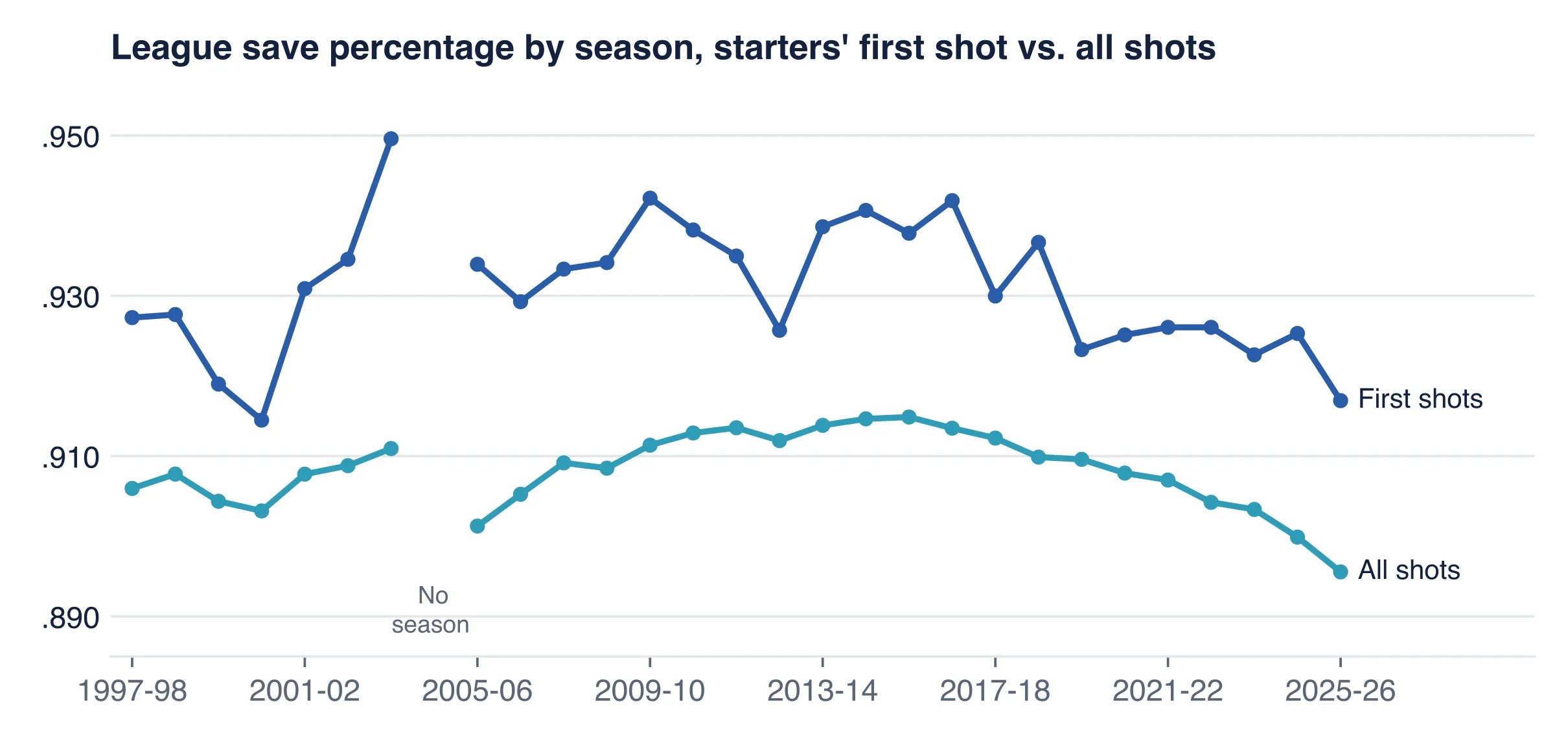
Still ahead in this article:
Next: why the first shot is usually an easier shot, with where first shots have come from since 2018-19 and how rarely they are second chances or power-play shots. Then the fair bar for a goalie playing now, how relievers fare on their first shot, and the best and lowest first-shot save percentages since 1997-98, including where Price, Rinne, Lundqvist, Brodeur, and Hellebuyck sit.
15+ years of goaltending film & coaching
Already a member? Log in
Think you're seeing this in error? Contact support
Keep reading
15+ years of goaltending film & coaching
Already a member? Log in
Think you're seeing this in error? Contact support