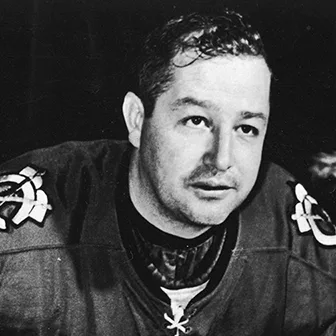
Born Oct 3, 1931 · Humboldt, Saskatchewan, Canada — Undrafted
| SEASON | GP | W | GAA | SV% | SO |
|---|---|---|---|---|---|
| 1968-69 | 41 | 19 | 2.17 | .928 | 8 |
| 1969-70 | 18 | 7 | 2.91 | .903 | 1 |
| 1970-71 | 32 | 13 | 2.42 | .918 | 2 |
| CAREER | 906 | 407 | 2.50 | — | 84 |
Glenn Hall
Career Statistics
| Season | Team | GP | W | L | OT | GAA | SV% | SO |
|---|---|---|---|---|---|---|---|---|
| 1970-71 | Blues | 32 | 13 | 11 | 0 | 2.42 | .918 | 2 |
| 1969-70 | Blues | 18 | 7 | 8 | 0 | 2.91 | .903 | 1 |
| 1968-69 | Blues | 41 | 19 | 12 | 0 | 2.17 | .928 | 8 |
| 1967-68 | Blues | 49 | 18 | 21 | 0 | 2.48 | .912 | 5 |
| 1966-67 | Blackhawks | 32 | 19 | 5 | 0 | 2.38 | .922 | 2 |
| 1965-66 | Blackhawks | 64 | 34 | 22 | 0 | 2.63 | .916 | 4 |
| 1964-65 | Blackhawks | 41 | 19 | 16 | 0 | 2.44 | .923 | 4 |
| 1963-64 | Blackhawks | 65 | 34 | 19 | 0 | 2.30 | .930 | 7 |
| 1962-63 | Blackhawks | 66 | 30 | 20 | 0 | 2.47 | .918 | 5 |
| 1961-62 | Blackhawks | 70 | 31 | 26 | 0 | 2.63 | .914 | 9 |
| 1960-61 | Blackhawks | 70 | 29 | 24 | 0 | 2.53 | .920 | 6 |
| 1959-60 | Blackhawks | 70 | 28 | 29 | 0 | 2.56 | .918 | 6 |
| 1958-59 | Blackhawks | 70 | 28 | 29 | 0 | 2.97 | .897 | 1 |
| 1957-58 | Blackhawks | 70 | 24 | 39 | 0 | 2.86 | .906 | 7 |
| 1956-57 | Red Wings | 70 | 38 | 20 | 0 | 2.22 | .928 | 4 |
| 1955-56 | Red Wings | 70 | 30 | 24 | 0 | 2.10 | .925 | 12 |
| 1954-55 | Red Wings | 2 | 2 | 0 | 0 | 1.00 | . | 0 |
| 1952-53 | Red Wings | 6 | 4 | 1 | 0 | 1.67 | . | 1 |
| Career | 906 | 407 | 326 | 0 | 2.50 | . | 84 |
Glenn Hall was born in Humboldt, Saskatchewan, on October 3, 1931.
He began in the Northern Saskatchewan Junior Hockey League with Humboldt before the Detroit Red Wings' Ontario Hockey Association affiliate, the Windsor Spitfires, brought him east for the 1949–50 season. In his second year with Windsor he recorded six shutouts and earned the Red Tilson Trophy as the league's most valuable player. He was known throughout his career for being sick with nerves before games. In a 2019 InGoal Radio interview recorded at his farm, Hall said he gagged more than he actually threw up, that pressure "pushes you to another notch," and that he never reached a point where it became too much — he felt he played better the more pressure he put on himself.
After Windsor, Hall was assigned to the Red Wings' AHL affiliate in Indianapolis for 1951–52. For 1952–53 he moved to the Edmonton Flyers of the Western Hockey League, where he spent three seasons. It was during a recall that December — Sawchuk had been injured — that Hall made his NHL debut, on December 27, 1952, arriving in Montreal to find his equipment had not made the trip. He borrowed gear from the Red Wings' trainer and played anyway, a 2–2 tie. He appeared in six games for Detroit that season, posting a 1.67 goals-against average and one shutout, then returned to Edmonton, where the Flyers won the WHL championship.
He remained in Edmonton through 1954–55, winning 38 games in his final season there. In February of that season he was recalled to Detroit for two games. When Sawchuk was traded to Boston in the offseason, the starting position in Detroit was Hall's.
His first full NHL season, 1955–56, produced 12 shutouts, a 2.10 goals-against average, and the Calder Memorial Trophy as the league's rookie of the year. He played all 70 games. Hall pioneered the style of goaltending that a New York writer would eventually name the butterfly — dropping the pads outward in an inverted V with the stick covering the five-hole. "I think it happened by accident," Hall told InGoal. He used to stretch out and stop pucks with his skate, and a groin injury made the splits difficult, so he learned to swing the pads instead. "I think necessity, like they say, is a mother of invention." Goalies of his day, he said, were told how to play by general managers who had never played goal — stand up, legs together — and you cannot move to the post with your legs together.
His second full season in Detroit, 1956–57, saw him play every game again and lead the league in wins with 38, earning First All-Star Team honours. After the Bruins eliminated Detroit in the playoffs, Hall was traded to the Chicago Black Hawks on July 23, 1957, along with Ted Lindsay, who had been organizing a players' association.
Hall spent the next decade in Chicago. He played every game in his first Black Hawks season, 1957–58, and the team finished fifth — the first time in four seasons it had avoided last place. He was named a First Team All-Star. The team grew around him: Bobby Hull arrived the same season, Stan Mikita and Bill Hay as regulars in 1959–60. "Without Glenn and (wife) Pauline taking me under their wing when I was a rookie, I would have never made it," Mikita said. It was in Chicago that Hall became known as "Mr. Goalie."
The 1960–61 season brought the franchise's first Stanley Cup championship since 1938. Hall appeared in every game, led the league in shutouts, and backstopped Chicago past the Montreal Canadiens in the semi-finals — recording back-to-back 3–0 shutouts — before the Black Hawks defeated the Detroit Red Wings four games to two in the final.
Hall's run of consecutive games, begun with Detroit at the start of 1955–56, ended on November 7, 1962, at 502 regular-season games — 552 including playoffs. Hall told InGoal the run went back further: he said he had not missed a game in junior, in his year in the American League, or in his three years in the Western League either: "I never missed a game in all that time."
He won his first Vezina Trophy in 1962–63, then a second in 1966–67, sharing it with Denis DeJordy. Through the mid-1960s he continued to carry Chicago's net, appearing in All-Star Games and accumulating shutouts, and the Black Hawks reached the Stanley Cup Final again in 1962 and 1965 without winning it.
When the NHL expanded from six to twelve teams in 1967, Hall was selected by the St. Louis Blues in the expansion draft. He was 35 years old. The Blues reached the Stanley Cup Final in their first season, 1967–68, and Hall won the Conn Smythe Trophy as playoff MVP even though St. Louis was swept by Montreal in four one-goal games. In 1968 Jacques Plante joined the Blues, and the two shared the net. Of that partnership, Hall told InGoal: "He never told me how to play, and I never told him how to play." He won his third Vezina Trophy in 1968–69, sharing it with Plante.
Hall also recalled the conditions in St. Louis warmly, including coach Scotty Bowman, who he said "knew more about me than I knew about myself," and general manager Lynn Patrick. He played his final NHL season in 1970–71, retiring with a career regular-season record of 407 wins, 326 losses, and 164 ties across 906 games, with a 2.50 goals-against average and 84 shutouts. In the playoffs he appeared in 115 games, posting a 2.79 goals-against average and a .911 save percentage.
Hall was inducted into the Hockey Hall of Fame in 1975. In 2017, he was named one of the 100 Greatest NHL Players in NHL history.
He bought a farm in Stony Plain, Alberta, west of Edmonton, in the 1960s, and lived there in the offseason and after his playing career. He talked to InGoal about the farm, his wife Pauline, and his two grandsons who played goal.
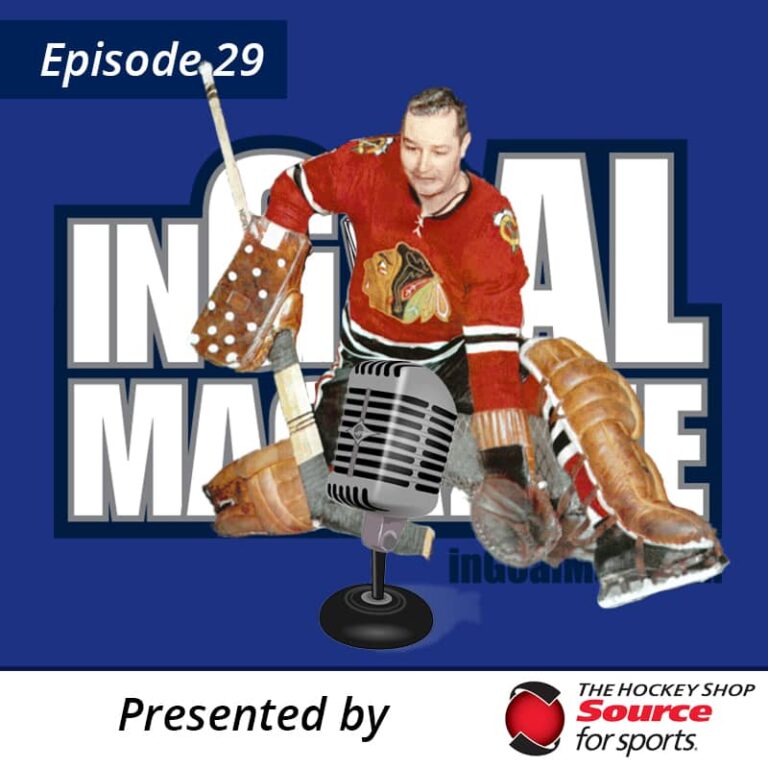
After his death, InGoal re-aired the 2019 interview in Episode 336 of InGoal Radio, whose page carries the full transcript.
Glenn Hall died in Stony Plain, Alberta, on January 7, 2026, at the age of 94.
Sources: NHL.com and Hockey-Reference (statistics); NHL.com's 100 Greatest NHL Players profile and obituary; InGoal Radio.
Follow the goalies, not the noise
InGoal Magazine covers goaltending at every level — gear, technique, and the goalies behind the numbers. Get our free weekly newsletter — plus 3 free premium reads to start.
Go deeper with InGoal
Members get every Pro Read — NHL goalies breaking down their own saves — plus full gear reviews and the deepest goaltending coverage anywhere.