
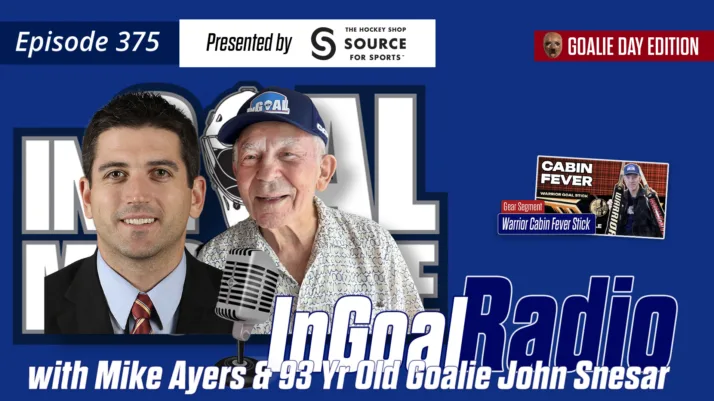
Mike Ayers: Coaching Demko, Woll, and Fowler, Plus 93-Year-Old Goalie John Snesar (Ep. 375)

Please subscribe and leave a rating — it helps us reach more goalies!


Episode 375 of the InGoal Radio Podcast, presented by The Hockey Shop Source for Sports, features a double dip of guests, leading in with longtime Boston College and USA Hockey goalie coach Mike Ayers, who has worked with several NHL stars, and wrapping with 93-year-old John Snesar, who was featured on the InGoal website celebration of International Goalie Day.
Feature Interview
presented by NHL Sense Arena
In the feature interviews, presented by NHL Sense Arena, Ayers shares some incredible stories ranging from how he got started in goal (by taking a frozen tennis ball between the eyes and getting split open by his older brother) to how he got started coaching after walking away from a minor pro career (working in a sporting good store when someone asked what the heck are you doing here?). Ayers gives insights into his time, influences and evolving philosophies from working at USA Hockey and Boston College, including with stars like Thatcher Demko, Joseph Woll, and Jacob Fowler, to name just a few, making this a can’t miss interview.
The bonus interview features Snesar and an incredible 80-plus years playing goal that all started in 1945 with an offer on a box of Quaker Oats at breakfast and a signed photo of Turk Broda that followed. At 93, he still has the photo and still plays twice a week, having witnessed first hand the evolution of a position he still loves. It’s another can’t miss conversation.
Parent Segment
presented by Stop It Goaltending U
In the Parent Playbook, presented by Stop it Goaltending U the App, Hutch answers a great question from a parent about what their young goalie can do on the bench to still learn and develop when they don’t play, and he gets help from two PWHL coaches with the answers!
To contact the two coaches featured in this Parent segment: Joey Ali, goalie coach of the Vancouver Goldeneyes, at Pro-Formance Goalie School – Fraser Valley, and Brad Fogal, goalie coach of the Toronto Sceptres, at The Goalie Training Institute.
Pro Reads
presented by Vizual EdgeWe also review the latest Pro Reads, presented by Vizual Edge, with Devin Cooley explaining what it means for him and all Flames goalies to “stay in your lines” and how it helps.
Enjoyed the episode? Rate InGoal Radio
Ratings and follows are how other goalies find the show in Apple Podcasts and Spotify. It takes ten seconds.
Apple Podcasts
Open the show, scroll down to Ratings & Reviews, and tap the stars. A written review helps most.
Rate on Apple PodcastsSpotify
Open the show in the Spotify app and tap the star rating under the show name.
Rate on SpotifyWeekly Gear Segment
presented by The Hockey Shop Source for SportsAnd in our weekly gear segment, presented by The Hockey Shop Source for Sports, we look at the new Warrior Cabin Fever stick, which comes with ODR-inspired graphics and a much lower price.
Episode Transcript
Intro
Unbelievable. I've tried to get this episode going, like, six times, and I keep getting interrupted. But we're finally up and running on InGoal Radio, the podcast presented by The Hockey Shop. Source for Sports Langley at hockeyshop.com. A whole bunch to get to, but it's going to be one of the coolest NHL Sense Arena feature interviews that you've ever heard on InGoal Radio, the podcast. We are going to chat with John Snesar. He's 93.
He's still playing. I can't wait to get to that as we say Happy Goalie Day to Kevin Woodley and David Hutchison.
Happy goalie day. Happy goalie day, Daren. I... Gotta say, we also have Mike Ayers from Boston College. And, at a time when Jacob Fowler's the rookie of the month in the NHL coached him, coached that for them, coached Joseph Woll, some other really big names when he was at USNTDP.
I think that, like, Snesar's Snesar steals the show, but this Mike Ayers' interview for anybody that, you know, isn't familiar with his story, it was fantastic as well. And as for you trying to get the show started, I know this is difficult. You're traveling. E BUG superstar that you are. Think of me and Hutch.
We've been sitting here for an hour because we didn't realize the time change wasn't the same anymore, and we're waiting for you to come on. You're you're back east for yourself, Woodley. We're in Vancouver, and it's like, I can't figure out the math on what hour of the day it is with the time change now. We didn't do the clock back here. I'm I'm losing it.
I I... It's not fair. I don't get the extra hour sleep. I've... It's just...
The NFL games start later. I'm lost, Darren. I'm lost. So you need you to guide us.
So have you done the math on how everything sorts out from Pacific time to mountain time to central time to Eastern time?
I sort of have. All I know is it gives me a headache. It's not so much, like, figuring out when game start is definitely gonna be an issue. The biggest thing for me... Like, I I live driver seven iron from the border.
When I cross the border, thank God for Nexus because I get across fast, it's an hour earlier.
Yeah. You gain an hour. Yeah. You gain an hour.
We keep... Well, yeah. Sorry. I gain an hour. Absolutely.
It's it's gonna be definitely a challenge. The the Vancouver to Seattle thing, especially because I do go down there for to talk to to goalies a fair amount. At least imagine the days of, like, when Torts used to live in Point Roberts. For those that don't know, Point Roberts is basically a peninsula. Oh, It's that would be surrounded by Canada, but it's actually America.
And, like, there's, like, maybe a couple thousand people live down there. But some American coaches that coach the Canucks and players in the past, Alex Mogilny, lived down there. You you basically would just go across a border and one side it would be an hour earlier for no rhyme or reason. So this is this is my world right now. I know, Daren, I haven't figured out.
Imagine the National Hockey League going through this.
It's a big adjustment.
It it was it was fluid, as if the schedule was coming out, and then people decided to go away from, changing the clock. So there had to be a lot of juggling from the NHL side or Western Hockey League, same thing. A lot of adjusting. So, what are your... You're part of a larger group here.
Well, especially back to backs too. Right? Like... And you get a lot of Seattle, Vancouver back to backs, and you're only... I do believe there has to be a certain gap between those starts.
Like, you can't have the second game earlier in the day by so much time. Like... So that that actually factors into the scheduling and all those different elements. It's just it's just a little bit confusing right now. I will figure it out.
I will get sorted. Don't worry, Daren.
Is Goalie Day enough to write whatever's unrest in your soul?
My conversation with John Snesar is enough to right whatever. And I think everybody who gets to listen... And I should say, not just the audio that we're gonna post here, because I did a sort of quicker interview with him, and then we we kept going. And we went through some of the photos that he has, and that's all up at ingoalmag.com, a longer feature celebrating International Goalie Day by celebrating John Snesar and his eighty one years of goaltending. He is 93, and he still plays twice a week.
And when you hear this interview, you're gonna hear about a picture of Turk Broda, and he still had that signed picture of Turk Broda in his house. And we show it to you at ingoalmag.com. We get into all the details. It's just my evening... My Halloween evening ended with...
In the locker room of the Toronto Maple Leafs, part of scrums with Austin Matthews and Gavin McKenna and Anthony Stolarz. And as as I told John's son, John Junior, or they call him Junior, the best part of my Halloween was the hour I spent with his dad in the morning. It just... Man, he is an inspiration and just an absolute delight to be around. So I can't wait to share this.
And, course, the Mike Ayers interview is fantastic as well. I don't wanna bury the lead here. They're both great.
It's kicking off goalie news. So what does goalie day mean to you, Hutch?
One of the reasons I love the stories like the one that Woody's brought us this week is because goalie day is about celebrating all of the goaltenders. For those who aren't familiar yet, Paul Campbell of InGoal coined the term goalie day ten years ago now. This is the tenth anniversary, really exciting, as a day to celebrate the position. It was a very significant day in the history of the position because it's the it's the day that Jacques Plante first put on and then kept using the mask in the National Hockey League. There's a couple of people in history that have worn masks before him, but not not sustained it, not in the National Hockey League.
And I saw it was very important date for all of us in the position. Plante wore number one, and the date is 01/11. So it was also significant there if you're a bit of a math geek as I am. And, and it's just a day to celebrate all goaltenders everywhere. We we know that we're a fraternity.
We know that when we're gathering anywhere together, it's special when you get to talk to another goaltender. So I think it's important that we have a day that we can celebrate this position. And so, you know, if you, probably getting a little bit late, but if you're heading out to play beer league tonight or maybe you've just forgot the day and you wanna do it belatedly this week, Bring your favorite goalie a doughnut. Just don't use the s word.
Doughnut.
So he got going with the Jacques Plante and the mask right around the time that John Snesar was was getting... Going in in his career. It's it's amazing how those two things kind of are in the same neighborhood.
Well... And not only that, but we've got a great mask story from John from his playing days wearing an old sort of, like, plastic shield, almost like a welder's visor because he couldn't get used to the metal cages. Right down to the slap shot that broke it, cut them wide open, and he had to play through the blood to the end of the game because, of course, back then, there was no second goalie at any level. So like I said, I don't wanna give too much away. It's just a fantastic character, a fantastic person, and I was so happy that they were...
We were able to connect with him in time for goalie day.
So getting to that young whippersnapper... I was gonna say getting to that young whippersnapper, Jaroslav Halak, he... He's thinking about coming back.
He would like to come back. He's been training for a while. It's funny. I saw... I had a bunch of people sort of message me about how good he looked because he was part of the alumni game at the Heritage Classic between the Canadians and the Jets.
And I was like, like, he looked really good. I should say too, evidently, one of the highlight goals was scored by a guy who plays weekly in my skate. So I didn't feel so bad, but he scored one of the best goals of the outdoor game. And I'm like, yeah. That guy lights me up all the time.
So, anyways, Yaroslav confirmed, sent me a text message. He just... He he really does want to come back. He misses it. And as we've talked about before, like, I don't think he's he's made a secret of it.
He wants to win a few more games. He'd like to get to to that magic 300 mark. He's just shy of it right now. And, yeah, the message he sent to me just said, I miss hockey, and I wanna win a few more games. So sort of confirming...
He's been skating for months, Daren, like, three and a half months. And I don't know. I hope somebody gives him a shot. I'm gonna be honest with you. I was shocked that he didn't get another shot.
His final year with the Rangers started slow, but within a month, he was posting some of the best adjusted numbers, smaller sample, but adjusted numbers, adjusted save percentage. The same adjusted save percentage that allowed me to predict Jacob Fowler having breakout this year, the same metric I used to forecast Devin Cooley and how good he's been before the injury this year. That same metric, I... He was near the top of the league, top 10 his final year with the Rangers. I was shocked he didn't get another contract.
So now here we are all these years later. He wants one. I hope somebody gives it to him. Because if I know Jaroslav Halak, he will have done the work, has done the work according to people close to him, and is ready to make this work. Let's see if he gets the opportunity.
So his last year was '22, '23. He's 41 years old. What do you think it takes for somebody to give him that opportunity?
Probably some struggles. Right? Like a team that doesn't have an answer internally. We've already seen the opportunity in New York. James Reimer got the same opportunity.
It probably takes starting in the American Hockey League like Reimer did. That's probably what we're looking at. Like, something where we just... Even if we think we can find something young by trade or waivers to sort of stop gap, we need the experience. And so I think that's what it takes.
Is there gonna be another one of... Are there teams right now that might fit this bill? Is there another one coming? I mean, in Anaheim, they're giving Laurent Brossoit start tonight, just because opportunity because it's been tough for them, and I would say it's been tough for them defensively. They're not exactly doing their goalies any favors, but they're looking for saves.
So, anytime you sort of get in a situation like that where teams are sort of looking or whether it's because of injuries, it's probably gonna take something like that for you already to get a shot.
Well, I was just gonna ask Woody because every one of the reports that I've seen would seem to suggest that he's just looking at a comeback in Europe, but you're telling us a
little bit different. Oh, no. My understanding is that he is intent on coming to train with somebody I know here in North America as part of the ramp up. So, yeah. No.
I I do believe he he he would like to come back to the National Hockey League. That is that is my understanding.
Could he be motivated by Semyon Varlomov being back and winning hockey games in the National Hockey League, Woody?
Hey. Listen. Much like John Snesar, I think we could all be motivated by what Semyon Varlamov has done, two partial knee replacements. Listen. I still wanna get the story on this, and I'm waiting for the Islanders to come through town so I can have this conversation as a guy who's been told he needs a knee replacement.
I wanna know what a partial is. We don't evidently do it in Canada, but they do it in The States. I wanna know what the options are here, and I wanna know... Like, I have an idea here whether I know what the surgery is gonna be like or not. It's gonna be the work required to pull it off just like it is for Yaroslav Halak to get back into shape and has been for the last couple months to lead up to announcing this opportunity.
Like, you gotta love the game. Has had a great career already. Should've had a Vezina trophy the one year in Colorado by the numbers I got. He he had every reason to just be like, okay. I'm done.
Like, my knees are done. I'm done. And yet he's battled back, like, two years between wins. It's it's a story about the medical side, but it's a story about desire and perseverance as much as anything. Like, you gotta really love the game and love the position to grind through that, especially when you're already financially taken care of.
And so, clearly, he does.
Can I just say I recently joined a group on Facebook? I'm gonna give them a shout out here. It's called Hockey Goalie Community. And over the last couple of days, as I look at all the posts going up there, would say there are a lot of goaltenders out there along the lines of John, of Woody about to deal with his knees, about Semyon Varlamov. It's awesome that people are sharing their stories.
There are guys 70 years old, guys 80 years old, hip replacements, knee replacements, still battling cancer. There's so many inspirational stories of people out there who just love the game, and that's what goalie day is all about. So, thank you for everybody for sharing their stories.
And then we're so envious of, when you're young and you're rising up through the ranks and you just got that youthful enthusiasm. Like Jacob Fowler, who's the National Hockey Leagues rookie of the month, InGoal.
Yeah. He's been so good. Adjusted numbers are off the charts. But guess what? Again, I'm not saying.
I'm just saying adjusted save percentage. It was him and Cooley one two last year. Sample may have been small, but when I talked in the preseason about him being my, quote, unquote... I get asked every year, Daren, you know, from different media outlets that I do regular hits on pick a breakout candidate. Jacob was an easy pick, not because I'm smart, but because those numbers said it was coming.
And it's been an easy way to track it, and he's just picked up right where he left off. It was nothing against Jakub Dobes, who I'm a big fan of, and I think will bounce back from early season struggles. It's just the reality. Like, when you see some of those numbers and and a guy outperform his environment to the level that Fowler did, add that into, you know, the bias that comes with a couple of personal viewings. I went and watched him in the American Hockey League last year.
Just the way he reacts off pucks, the patience, the the sort of the efficiency, the calmness. There's just so much to love about this young guy's game. And they're... Hey. Listen.
Is he gonna be the rookie of the month, for the next eight months and win everything and never look back? Like, there's gonna be ups and downs. It's the nature of the position, but the talent is obvious. The performance and results right back to last year were obvious, and he's just basically picking up where he left off.
Good cross section of, veteran goaltenders and young guys like Jacob Fowler and something they could all use, everybody could use, piece of equipment that's, really gained some traction, lately. These TrakOptix goggles. Can you tell me more about that?
Well, you've seen them. You've you've seen Carter use them in Vegas. He uses them. Does he still use them every morning skate?
Yeah. I've seen them, but I've never been able to really get an idea of what happens when you put them on, what they do to you to help you.
They basically eliminate your ability to see out the peripheral and out the bottom of your eyes. They basically force you into
So you turn your head everywhere.
Central vision. So basically central vision is what it forces. And now listen. I won't get into all the details. It's in the story.
The reason we're talking about this is part of goalie news. And a reminder, folks, we have daily updates at goalie news. Goalienews.com if you wanna go check that out. The reason we're talking about this is because this was a story I wrote for my bi weekly column at nhl.com, unmasked is the column. Thanks to my bosses for letting me do that for the last...
I guess it's, like, seven, eight years now. And this is based on Lyle Mast and Devin Dubnyk were on the podcast talking about head trajectory. And the track optic goggles, what they do is basically put your head in the optimal position if you can see the puck. And to answer your question, Daren, my guess is if you put them on, you'd find that that puck gets underneath your vision. You don't actually see it as much as you think.
And so anytime we're not seeing the puck through the middle of the sockets, right through that central vision, what we're actually doing is information our brain is assuming based on all the patterns of where it's going and connecting for us. So it's it's basically your ideal vision. But what it also does, because if you see the story at nhl.com, if you've if you've checked out the Dylan Garand preseason offseason skating videos that we posted at InGoalmag over the summer where he wears them for a section of it and talks about it, and he talks about it in this article. When you're moving around the ice, crease movement pattern. If you keep your head on the puck as you move, and, obviously, we always go head and ice first, it will encourage proper rotation from the top down so that we're not...
The tendency if you look at a puck up along the horizon, if you lift your chin up over your shoulder, is for your shoulders to pull back the opposite way of you are... That you are going. And then you make that t push, and now when you get there, you've gotta close your shoulders. You've gotta close your hips. You've gotta have your back leg catch up, and you've gotta reset your angle once you arrive.
By having that slight tilt down with the goggles, and and if you're not tilted down, you're not gonna be able to see the puck along the ice, that turn of the head down with the chin just automatically through vestibular function, and the way we balance, our body's balance, instead of that pullback shoulders pulling away, our shoulders, our torso, our hips automatically rotate in an angle, and you'll see it on video when guys are on and off it. You arrive to your next spot. You don't have to pull your leg back. You don't have to reset angle. You basically arrive set in a square and sort of on angle early.
So we call it building early angle. And a lot of the goalies I talked to over this piece, there's there's there's... I couldn't confirm all 20, but there's almost 20. I believe there's actually more than 20. If you count the American Hockey League, it's more than double that.
And there are seven teams that are, you know, formally onboard, bought multiple sets, have distributed them to their goalie. He's not mandating it, but given them the option. As these have become publicly available, because there have been prototypes for, like, the last three years, there's... Guys have been on these for three years. But now that they're more publicly available, we're starting to see them more often.
And every time we do see them or a social media intern at the rink sees them, they end up on, like, team feeds like Clay Stevenson. Right? So he was using them and then social media tracked them down after. He's like, yeah, they're just training goggles. And he's right.
Like, in a way, they're just training goggles. But what I just explained is what they're training. And so as we start to see them around the league, I thought it was important to sort of tell people that, hey. This isn't same old same old. This isn't the, swivel vision that goalies have worn for, like, five, ten years.
There's a very specific reason more and more guys are doing this. It is different. And as Carter will tell you, it helps in different ways. It also is a great way to get chirped, and that's the way I led the story because all the guys have stories about, you know, putting them on, having skaters come out, and the most common one is Batman. I thought it was hilarious.
Michael DiPietro is like, yeah. My wife calls me Batman when I wear them around the house.
That's the other part. Guys do... People do wear them around the the house. It just doesn't have to be on the ice.
Well, again, like, it's... And there is some early research on how it can aid with things like concussion recovery because it sort of helps reset that vestibular function and your ability to sort of like... I'm looking for the word. I can't remember it. Sort of sense where your limbs are, sort of your hand...
That eye hand connection, that
connection Proprioception.
Thank you, Mr Hutchison. Proprioception. It can help reset that. And Carter talked about that for the article and talked to me about it last year. Like, he felt like after three months off of injury, rather than coming out on the ice and feeling sloppy, just felt like he was dialed on his edges.
He was connected to his feet, connected to his limbs. And I think that all comes... He started using it for off ice exercises, and he also just started wearing it around the house. And so it's it's... When you buy the pro pack and and get two of them, that's what they talk about.
One is for taking on the ice, and it comes with a little carrying case. It's got holes in it, so it... It's breathable. So you you get the sweat on the band. It'll it'll air out.
The other one is just for around the house. Put them on. They say to put them on in the morning and just when you walk around for a few minutes, and it will actually make a difference. I can't vouch for it. I haven't done that myself.
My wife calls me enough names without me looking like Batman first thing we wake up, but that's that's the that's the object behind it. And there's a couple of guys in that story that talk about using it that way.
So, Hutch, you can wear them around the house for a couple of days. Give us a report on the pros and the cons.
I'd love it if my wife called me Batman. That's far better than what she thinks of me right now. That would be amazing. Credit also to our old friend James Wendland, who's got some articles up on the site about using them in his training. I think specifically with Kristen Campbell, I know for sure James has mentioned to me that he prescribes, for his goalies to put them on as soon as they wake up in the morning so that the first few things that they do, even reaching for the tube of toothpaste, are resetting their their vestibular system.
And that's that's kinda what DiPietro said to me in the story too. That's great great call out. Mentioned James Wendland in the story and his work with multiple NHLers on this. Josh Tucker, who we know True Focus Vision, like, he has his grab bag of goodies for his goalie clients. You know?
Like, you get the the the True Focus Vision bag. I've seen it, like like, Jake Oettinger's locker, and you see the bag with Josh's eyeball and the muscles coming out of it. It's like, hey. I know who you're working with. He swapped out swivel vision.
He now uses... All those bags come with a set of trac optics because he sees the same values, having it on in the morning. D. Pietro said it's just amazing once you put them on, you realize how much you rely on your peripheral vision. And while that's fine in a day to day basis, when guys are shooting pucks a 100 miles an hour at you, minimizing your reliance on it can be a positive.
You don't wanna ignore it. Yeah. And it's the other thing D Pietro said, and this has been my experience. I wear them out for warm up, and I get chirped like crazy. And D.
Pietro... Mikey couldn't believe I do wear them out for warm up. But once you wear them and then you take them off, it's like you're seeing everything in 10 times.
So is it like horse blinders? Is that comparable?
Yeah. Except horse blinders are just peripherals. That'd be like where... Horse blinders would be swivel vision. They don't cut off the bottom.
Okay. So the bottom is what really makes you look
through. It's the difference. It's what's it's what's patented. It is both, but without the bottom, you can cheat the visuals of the side to side. You can get your head up and still look down, and now you're you're not accomplishing that central vision.
Okay. Can't wait to get, more information as we go on this and as we see goaltenders adapt to it and bring it into their training, through the course of, their preparations for seasons and inside, seasons. So the Gear Segment, is brought to you by The Hockey Shop Source for Sports Langley, thehockeyshop.com. What's happening over with Cam and Company?
Well, there's a whole bunch of new stuff coming out right now. So we're gonna talk about the the the Warrior cabin fever, which is a special edition stick at at a discounted price. Doesn't have all the same features as last week we had the Warrior Answer, so Cam's gonna explain that to us. But there is new gear coming in almost every week despite the fact it's November. As a matter of fact, with November 1 here, Brian's Cryptic has launched.
So they've got that in store. You wanna go check it out. They've got it listed online. A lot of the Brian's orders are custom, so their inventory isn't as deep. But if you've got questions about Cryptic, you wanna check it out online, you wanna know what...
How to sort of set up your custom offer. We had a chance to check it out. There's some... Been some big changes in this pad. So make sure you check out the hockey shop, Source for Sports, thehockeyshop.com.
Reach out to them. We'll have a video on cryptic soon. But if you've got questions in the meantime, they've got it in store. If you happen to be blessed to live around them, you can go check it out in person, or you can give them a shout. So lots of new stuff coming this month in November, Daren.
It's like... It's almost like Christmas in November. There's... I think we got new stuff almost every week at the Hockey Shop. So make sure you're on the website, Daren, going down your rabbit holes and looking for all the new gear.
Is there a story behind the cabin fever name for this stick?
I think it's targeted around outdoor games and sorta outdoor rinks and Yeah.
And the graphic on the stick shows it.
Yeah.
Yeah. It's basically... It's, hey. It's outdoor rink season. Maybe not here in Like a retro look?
Yeah. Retro look. Definitely, I mean, we probably should have launched this ahead of the Heritage Classic in Winnipeg. It would have been perfect for that. But like I said, there's also...
This is... This thing is, like, half the price of the Warrior Answer that we unveiled last week. So there's a lot of positives here.
We had a little fun with the graphics on the video for this one. So, a reminder we give often, go check it out on YouTube.
Can't wait. So let's hear from Cam and Woody in the Gear Segment brought to you by The Hockey Shop Source for Sports Langley at hockeyshop.com.
Gear
Alright. We're back with another Warrior stick, and this one is
I have it, though. I have it. I have it. I have cabin fever.
Oh my god, man. Can you go back on vacation?
So this stick is basically the Warrior Cabin Fever model. Let's see how many puns Cam can work into this segment.
I'm just having a great song and I I...
Fine. It's like... It's it's really cool. I love the graphic. I love the look.
It's really unique. I love the... I feel like I'm about to put on my, you know, one piece... What do they call it? Flannel?
Flannel. Yeah. One piece.
That's what I was looking for. I'm a little too chic to wear flannel. Let's be honest with you.
Chic. I'm too cool for flannel.
So what is this? But you're not too cool for this stick.
I'm definitely not. So so with the wood grain and everything, like like, what is
this stick? This is a graphic on a what? So here's the thing. This is a little bit of a mashup of, you know, kind of some of old and new and everything kinda all mixed together. So to me, this is based off of the v series because it does have Vibex.
Okay.
So that is only in their v series stick. It does also have a traditional find Vibex for me. Vibex. That is a gel layering in between their composites that helps to reduce vibration off of shots to the stick.
Oh, wow. He took a month off, and now he's doing homework, he's ready with all the answers. Answers.
That was earlier. That was earlier. Okay. Alright. Back to the cabin fever part, though.
Traditional squared shaft. So ASG shaft is not here, ladies and gentlemen. It's a little retro.
Yes. Exactly. To go with the wood grain look. Exactly. Kinda fits.
So, again, not actual wood, just a graphic over top based off of what I would call that v four, that base model stick.
Okay. Okay. Price point on this folks is, like, this is your... This isn't gonna be the $400 top of the line stick. This is this is very reasonable.
Mid kick profile, again, similar to your... Sorry to what you're seeing in that V series stick. Get an outdoor twist curve unless you go down to their smaller sizes, which Kevin is holding. It goes all the way down to a 20 inch. You stick that youth 20 inch will have their mid curve on it.
Just something in that little bit of a smaller.
Okay. So get an outdoor game in your future? Hopefully. This is the twig for you.
It would be. Just don't get locked in your cabin
because you might get the fever.
Oh my goodness. Cam, if
they have any questions about the various sizing options and the price points, like I see that, like this is a senior stick at $179 Canadian.
That's correct. Okay. There's only the one.
We're talking like half price on their top end pro level stick.
That's
correct. Yeah. So really good deal here. Still a really good high quality stick. Gonna be a little heavier.
It's got the paint on it, but that's where you get the slick graphics, like the little cabin fever. That's
That's a sweet logo.
That's pretty cool, actually. That's really cool. I like that logo.
K. (604) 589-8299 or 1-800-567-7790, or check the stick out at the hockeyshop.com.
I like the retro looking stick, like the the the wood skin stick.
Oh, yeah. It's... I I... It's great. And and with the the the flannel, like Yeah.
I'm ready to... I got I got an old... I don't play beer league anymore, but an old buddy who used to play on my beer league team, and he still wears like a flannel. It... It's flannel color, but it's not thick flannel.
It's really thin. Like, the onesie with the trapdoor, he wears it under his hockey stick. Yeah. It's just crazy. I can't put these still skates in it.
Visual Edge ProReads, Devin Cooley this week. Devin, off to a fantastic start, before being injured. Looking forward to... Anytime you get a chance to talk to Devin Cooley is great. Now thanks to, Visual Edge for the ProReads.
Yeah. Hey. Listen. Let's start with the ProReads this week brought to us by our partners over at Visual Edge, and we'll get into everything that they do. Sucks that Devin got injured this week.
We did spend an hour with him ahead of the season. And as much as he has made headlines for his talk about playing in his subconscious mind, The reality is when he goes and looks at film in his conscious mind like he does this week at a at a low high scoring chance, he is as good as they come at breaking down the game and seeing the different elements. And one of the things he dug into this week was depth management and how it's not just north south relative to the top of the crease. This is a subject we've heard a lot about in the past year, especially from the Calgary Flames goalie department and seeing some of the adjustments they're making that are leading to guys like Devin Cooley having the type of success later in the season that he's had or later in their career that he's had last year and this year. He really breaks down the concept of East West as depth, the concept of staying in our lines and explains what that means to him, what he's learned about it since coming to the Calgary Flames, and how on this lateral pass...
I think I said lohi earlier, but how on this lateral play on this power play opportunity, it allows him to sort of stay contained as a rule and leads to making a very difficult second save look a lot easier than maybe it should. So a really great breakdown by Devin this week of the flames, how they manage their depth, how they're getting their goalies at all their levels to manage their depth, and the impact it's had, things that you can take away as a goaltender regardless of the level and maybe think about adding to your game. So that's what we love about Cools. It's also what we love about Visual Edge because they allow you... ProReads lets you see the game differently through the eyes of an NHL goaltender and decide what you wanna bring to your game from them.
Visual Edge allows you to see everything better. We've all had those nights where we... Everything feels slow. You're tracking puck's clean. You're reading plays early.
Nothing surprises. Then we've all had the nights where you're reacting instead of anticipating. You're a split second behind. Most goal is try and solve that by getting more reps on the ice. Visual Edge takes a different approach by training the visual and cognitive skills that help you process the game faster.
Things like tracking through traffic, picking up releases earlier, recognizing patterns, and making quicker decisions under pressure. From your laptop or tablet, take a personalized assessment to identify your visual game can improve, then you get a customized training plan that only takes about fifteen minutes three times a week. Plus open gym mode to exercise as often as you wish and an eight minute warm up called game day mode to get your eyes and brain locked in prior to puck drop. It's what Jordan Binnington uses. Other goalies like Jeremy Swayman, Joseph Woll, Cam Talbot, and now you can use it to uncover the improvement in your eyes and cognitive skills.
Head to visualedge.com and use the code InGoal, I n g o a l, all caps, to save 10%. Or if you're a subscriber to InGoal Magazine, go to any ProReads and contained within for subscribers that are logged in is a discount code to get you 20% off a subscription to Vizual Edge.
What does Devin mean by staying in his lines?
Well, you kinda gotta watch the ProRead.
I don't wanna give it all away. But it's
you'll get in trouble if he keeps giving things away.
If we think of depth as north south, we often think of depth as relative... Where you are relative to the top of your crease. Right, Daren? We talk about heels out. So goalie who's outside of his crease, the heels are above the top of the crease.
Toes toes in, a goalie who's got his toes inside the crease. Let's let's apply that to East West. And without giving it all away, it's relative to your posts. Devin talks about how they map out the ice and why they need to, they believe, stay within certain areas of the ice. It it has roots in Benoit Allaire's philosophy.
We're gonna hear Mike Ayers talk about that and the impact his short time with Benoit had on on the way he teaches the game. It's got roots in that. It's a philosophy that once you hear Devin explain it, will make a lot... Again, it's not for everyone, but I think it's gonna make a lot of sense, especially as the game gets so fast east west, and there's so much lateral play The way they manage it... And then they proof's in the pudding.
The Flames goalies are having success with it.
See, that wasn't that hard. Ask the question.
I just didn't wanna give away the whole thing. I tend to give away the whole
But see, now I'm I'm I'm even more excited.
See, I didn't give away the whole thing. There's plenty of juice in there still to happen. Is it literally
that hut.
Because it's Devin Cooley, there's, a five minute explanation.
Well, that is true. That is true. And and if you go to some of the other ProReads with Devin, you'll see lots more other fantastic tidbits about the Calgary system and his system, and he's, he's great. His, his injury, like what he said, is is really unfortunate, but I think it's the goalie world's gain because he's been using his time to share his thoughts with everybody.
Love everything about his approach. Love everything about his game, his willingness to... I think the key here too is that willingness to evolve it. Right? If he if he if he wasn't willing to try different things, does he get to where he is right now?
And his willingness to share that process should be widely applauded. By the way, for the rest of the NHL, they haven't coolly cleared waivers just two years.
Yes. Think of all the people that missed out.
Wow. You're seeing that already this year of guys that, went through the waiver process and are playing and being counted on by their team. So, it's a situation where teams might have to be more aggressive, on that side of it in the National Hockey Lake. We've got a couple of great interviews coming up in the NHL Sense Arena feature interview. But first, Stop It Goaltending U, the app, presents our parent segment.
Parent Playbook
We're keeping goalies busy on the bench. First, a message from Stop It Goaltending U, the app.
Oh, do you wanna have twenty five years of NHL goalie coaching experience at your fingertips?
You wanna tap into the goalie parenting expertise that helped Joey Daccord reach the NHL? That's what you get with a subscription to Stop It Goaltending U the app. All the knowledge from Brian Daccord has been an NHL goalie coach, scout, and director, including currently with the Detroit Red Wings, as well as all the insights and expertise from his staff at Stop It, which includes a long list of veteran NCAA coaches, all delivered in easy to digest chunks including five short daily primers, weekly style analysis and breakdown videos, as well as drills that you can take onto the ice with your team and coach. Plus, you get a subscription to InGoal Magazine included. So check it out now at the App Store and Google Play and get the best of both worlds with a subscription to Stop It Goaltending U the app and a subscription to InGoal Magazine.
Hutch.
This week, Daren, a question from a goalie parent, and it's exactly the kind of thing I was asking for in our last show and many shows before that. Their daughter's in first year of u 13, and it's her first time on a team with a goalie partner. So the question was, what can she focus on while she's on the bench during a game to help her learn the position? Instead of hearing from me this week and, given this was for a young female goaltender, I reached out to a couple of PWHL coaches, and they were kind enough to write back. The first is Joey Ali, goalie coach of the Vancouver Golden Eyes, who you heard on the show back in episode three twenty six.
He's also with Pro Formance goalie schools in the Fraser Valley near here. I think Joey's is a good response for a goaltender who's a little bit younger and only needs one thing to focus on like this goaltender, and here's what he wrote. A really good task to stay engaged I found over the years is to track shots both for and against your team if possible. If not, just being able to keep shots against is helpful. This will give you insight on where the opponent is shooting from, what players are creating those shots.
You don't have to track the players. On paper, a mental note is fine, but keep those notes for when you play them next time when you're in the net. Well, thank you, Joey, for that one. And, you know, he's saying even on a night that she's not playing, she gets the chance to build her understanding of the game, and, she's got something she can use next time she's in. Now now up, we've got Brad Fogel, goalie coach of the Toronto Scepters, who you heard on the show back in episode three sixty six.
He's with the Goalie Training Institute, and I think Brad's got a number of great ideas in here as well. For a younger goaltender, as he says, you might just pick one or two. An older goaltender could potentially look at all of them. So here's Brad. This is for any age, and, obviously, the details that get pulled will vary from age to age, level to level, but it's the best way to combat the lack of hockey that players watch today.
They have multiple games a week to watch, and they just don't realize it. So anytime you aren't starting in a game, we should have two main goals. One, be the best support for our teammates. Two, stay engaged mentally and physically in the game in case we do end up going in. It's easy to let our mind wander and just be physically present while trying to stay warm rather than being there and present as an active member of the team.
Just because we aren't playing in the game doesn't mean we can't be part of the game. Watch the game, not necessarily just the goalies. Watch the forecheck, zone entries, offensive and defensive systems, the missed opportunities, the scoring plays. Talk to your teammates on the ice. Tell them where there are open passing options if they have a time to skate a puck or if there's a forechecker close.
All the little details that you can see because of your vantage point that they might not while on the ice. This is gonna keep us mentally in the game without stressing too hard or concentrating too hard on the goalie side of things. Now as a supporter, you can talk positively and encourage your teammates after a shift. And if you can, walk up and down the bench from forward to defense while you communicate to give them a tap on the shoulder after a good shift. The bonus, and this will keep your blood flowing, it's keeping your legs and body ready in case your name is called to go in.
So thanks very much to Joey and Brad for sharing their thoughts. Both of them work with goaltenders through their schools in the summer and throughout the year. So if you'd like to be in touch with either of them, we're gonna have the links in the show notes. And, thank you parents for writing in. In this case, I hope your daughter enjoys hearing from a couple of PWHL goalie coaches and gets the chance to take in one of their games this season.
Anybody else who has a question for us or some of the people we get a chance to talk to, please write to parents@InGoalmag.com.
Hold on. I got a phone call coming in here. Oh, that's Chris Osgood on line two? He's got a little added tip to
I knew this was coming.
He needs he needs to add this one. If you're gonna track the shots from the bench, you might wanna keep your mask on.
The good thing is the minor hockey goalies do that, Woody.
Okay. Okay. I didn't know if they had rules on that. Ozzy wasn't sure. You know, we remember that story when he was on the podcast.
Mike Babcock famously used to make his backup goalies. I think it was face offs they had to track. Like, he just wanted them engaged and in the game similar type of thing. And I remember Osgood just kinda... The guys didn't like it, and Osgood told us he had a night where he almost died on the bench because he had his head down looking at face offs and a puck just went whipping by.
He also, like, fudged the face offs a little bit too. Like, some nights there'd be fewer face offs marked than actually took place, so there were more face offs marked than actually took place. He he wasn't exactly dialed in on it.
Didn't talk to a lot of... Yeah. Didn't talk to a lot of goalies that loved Babs' idea of making them track face offs when they weren't playing in the game. And interesting that, it's kinda gone the way of the dodo bird in Edmonton. I don't see guys with a pen and pencil and a and a clipboard right now with the Oilers.
I hope I'm I hope I'm right when I say that. I didn't notice it when they were here.
The the idea of of learning about the game is very valuable in Yeah. The sense of you you can prepare yourself for the next start against that particular team or just be engaged without the stress of having to stop the puck and take in more of of our sport.
Yeah. And and and I think having a task actually helps that because if if you just try and watch a game and tell yourself, learn about the game, I think it's, it's challenging. There's so much going on. What is it you have to pick out? Having that task, whether it's tracking the shots or some specific things that you're being asked to look for, really helps that learning experience.
You know, it reminds me, another sport. When I was growing up, I used to go to a ton of Blue Jays games in Toronto, and I would quite often keep score. And I wondered at first why people kept score in their own score sheet in the stands, until I started, and you get so much more out of the game because you're intentionally paying, a lot more attention to what's happening there.
I love keeping score at baseball games when I go to Major League games.
Game changer for me.
I am that guy.
Wow. I got a couple of you guys. The only thing I'm tracking at a baseball game is how many hot dogs and beers I put back.
Hey. If I could if I could say another one because I hope it never goes this way, hockey wise, I've noticed in the news a few baseball organizations not putting their games on the radio anymore, saying fans don't need it on the radio. And I'll give you another cool story from from watching baseball growing up. I was at a at a game and there were a couple of Chicago White Sox fans, sitting in front of me, and, they were blind. And I asked the guy...
As a young kid, I was, I guess, a little bit bold. I said, can I ask why you would go to the game if you can't see it? And he said, the atmosphere is absolutely unbelievable. And they had the game on the radio as well to help them through it. And they were actually traveling through every ballpark in Major League Baseball.
Really cool story.
I love that story. I've heard that before from you, and I absolutely love it. Thanks for sharing it here. Guys
game's on.
Sadly. Sadly. That is happening in the NHL already. Maybe not completely gone, but guys, NHL, we won't get into it, but radio broadcast forced to call games off television, not traveling, things like that. It happens.
So changing shift in the landscape, both sides of the border, all companies, a lot of different teams. Sad, but seems to be a reality for us.
Feature Interview - Mike Ayers
Great stuff, Hutch. Some really valuable information to take advantage of on that side. A couple of interviews this week on the NHL Sense Arena feature interview platform. We've got Mike Ayers coming up in just a little bit, John Snesar as well, 93 year old John. How how long is John playing goal?
Eighty one years.
He eighty-one years and still playing.
Twice a week. Used to be three, Daren. Had to back off a little bit.
Yeah. It was only so many hours of the day.
Alright. Fair. Give it a
little context within InGoal Day because you guys brought this up sort of jokingly that he would have been there around the time Plante put on the mask. Yeah. Sadly, Jacques is no longer with us, but if he was, he would be 97 right now. So they are very close in age.
It's funny because not the the 1959 being November 1 and and the first time Plante put on the mask, one of the clippings that John shared was from a tournament, I think. It was a tournament or a game or... I think it was a tournament that he won, and I noticed that the date on it was 1959.
Get to John in just a little bit, but first, Mike coming up. He leads us out, the NHL Sense Arena feature interview. Hutch.
NHL Sense Arena '27 is live with two new modes for goalies. Goalie shootouts put you in the crease against NHL shooters in a survive and advance challenge. Each round, you face three shooters from an NHL team, and you need to save five of nine shots to beat that team and move on. Allow too many goals, and you're out. There are opponents from all 32 NHL teams.
And the all new playmaker mode includes a goalie mode. Goalies read the attack as it unfolds in front of them. They make decisions based on threat assessment and shooting options. The first course covers tracking the puck, assessing shot threats, and finding the right position for the save. Goalies are in their own hockey IQ score on a scale from 60 to one forty where the elite live.
Playmaker has more than 300 game scenarios that gives real time feedback and offers several difficulty levels for all skill levels. Former NHL goalie, Andrew Raycroft, says that Hockey IQ lets a goalie play faster without necessarily moving faster, and he calls Playmaker a tool for turning reads into instinct. The update also includes new animations, new NHL rosters, and a whole revamp menu. Check it out at sensearena.com and use the code to save even more. That code is IGM50.
IGM50.
You got it.
Repeat and now seared right into my brain.
Woody, tell us about Mike. Met Mike at the USA Hockey Goaltending Symposium in Boston. Got a chance to be on the ice with him and in the locker room with him as they prepared to go on the ice. It was James Hagan and Jacob Fowler, the shooter and the goalie. The On Ice segment will be up at InGoal Magazine in the very near future as part of our relationship with USA Hockey.
But the way he worked that day, both explaining the drill and then communicating afterwards, the way he interacted with his athletes, I knew right away we had to get him on the podcast, and we finally made it happen this week. Didn't realize the full backstory from the playing days, the transition into coaching. There is a great story about how he first got started in goal, including taking a frozen tennis ball off the face and getting cut wide open. There is a great story about how he had walked away from the game after some not so great experiences in minor pro and was working in a sporting goods score... Store in Minnesota when somebody recognized him from his NCAA days.
And that sparked a transition to coaching. He's been at Boston College now for, I believe this is his fourteenth season, his thirteenth season, and has worked with some of the best names now right up to the NHL, Fowler, Demko, Joseph Woll, other names through the US NTDP, and he's got a great perspective on the game and one that I know everybody is going to enjoy. This is this is one of the... This is this is a great interview, folks. It's a can't miss her.
So enjoy. Really excited to welcome to the InGoal Radio Podcast, a name that a lot of people should know. He's been at Boston College as, an assistant and a goalie coach for thirteen years, A guy who is tied to some very successful national hockey league careers right now, I think of Thatcher Demko. I think of Joseph Woll. I think of Jacob Fowler, who we were blessed enough to be on the ice with this man this summer at the USA hockey camp.
Mike Ayers of Boston College. How are you? Thanks for joining us.
Of course. Of course. Good to good to be, good to be on the podcast. I've I've listened, longtime listener and obviously reader of the magazine, so excited to be here.
Well, we really appreciate that. It was really fun to sort of be on the ice and watch you work, with Jacob and and as part of that USA Hockey thing. So I gotta ask. I mentioned those names, and I know there are others as well. But is there a proud papa portion of your life when you see these guys go on and have the the success they're having it, whether whether it's Demko who's been a Vezina finalist, whether it's Joseph Woll who's already had a great career, or a guy like Fowler who's who's popping pretty quick here?
Honestly, it it it makes me happy to see all of them have success, to be honest with you. And, you know, it's just to be a a part of their path and, you know, obviously have relationships with each guy. It's it's fun to be able to just, you know, turn the TV on and watch them. My kids are all fans of all of them. They they, you know, they always talk about who's on TV tonight, nights playing, followers playing.
It's it's just... It's really fun to see everybody have that connection with all the guys, and the guys throughout the years have been so good to to me and my family. So it's it's been fun.
The... I I wanna get into the coaching and the evolution of coach, but I think people... We would be remiss, Mike, if we didn't talk about the fact that you're, hey, drafted by the Chicago Blackhawks, had a playing career, a unique one, minor pro AHL, a year over in Sweden by the looks of it or at least a start. Walk me through... You know, we kinda do a lot...
If you you listen to the podcast, you know, we do a lot of origin story here. So walk me through where this love affair with goaltending started for you.
Just like most goalies, it was all with, you know, with the equipment and stuff and being able to show your personality through your gear. And, you know, I think I think that's a common theme for for goalies, for young goalies anyway. And, certainly, that's where mine started. I was actually... I I grew up as a as a player, and I got into the goaltending.
Just loved the... Your ability to change the complexion of a game, and I I like the pressure. I like being, you know, in the in the spotlight and and having to come up with a key save or whatever it was. But I I I always have... I I do have a funny story.
When I first started playing, my older brother at the time was was kind of the star of the family, and I remember one winter day outside, he set up three balls, and it was kinda in my transition from from being a a skater to a goalie. And he lined up three balls. It was two tennis balls, which were frozen, and a street hockey ball, which was obviously very cold at the time being in the in the dead of winter. And he said, well, if you could stop all three of these slap shots, you could be a goalie. And I fur...
I stopped the first two tennis balls, and I felt pretty comfortable about the third one. And the street hockey ball rose up and hit me right between the eyes and just blood everywhere. And, obviously, I was a young young kid, and, you know, my brother who I idolized at the time came, you know, came over. He's like, well, I guess I guess you're playing goalie. So I was able to stop all three, and that's kinda where my my goalie journey began.
Oh, as somebody who started in ball hockey myself and outdoors, and and I remember playing in a university, those orange balls between the eyes, Mike, that that that... I'm guessing that would have left a mark for a while.
It was fun. Yeah. I mean, it was always a running joke in the family. So... Yeah.
It... But it was, you know, obviously, it was something, you know, I took a lot of passion in and, you know, didn't make it to the, you know, the the top of... End of of the game, but, certainly enjoyed my time and met a lot of great people along the way.
Well, and and and drafted by the Blackhawks, as I mentioned, in the two... In 2000. University of New Hampshire for four years, some great seasons there, and then into minor pro. But interesting to me that you're you're kinda coming into that level, into the college, into the minor pro ranks at a time when the game for goalies was changing fast. Right?
You're kinda right in that era early two thousands when, you know, we really started to see the rise of goalie coaches and instruction in the technical side of the game. You know, things like the VH coming out and being taught and proper leg recovery. Because that's kinda when I started covering it mid two thousands, and there'd be still guys in the NHL, you know, that had had long careers that that that didn't have proper leg. They didn't know what a proper leg recovery was, and they'd talk about the kids they'd see at camps who did it better than them. So, you know, I'm curious what your experience was with goalie coaching through universe...
University of New Hampshire and into minor pro and and and being a part of really the tipping point of that evolution of the position.
Yeah. It's it's funny you bring it up. I mean, when I was I was playing in the USHL, and I remember there was a a great goalie in our league, played for Omaha, Dan Ellis, ended up, you know, playing in the NHL for a little bit, now it's Chicago. But I remember him. We were in an all star game.
We were... I remember watching him practice. And every time he moved, I was like, oh, that looks so good. Why does that look so different? And it was all the proper leg recovery, which I...
That was the first time I had ever seen it.
Wow.
And, you know, then I started... You know, I was more traditional, would always get on the the wrong leg every time. But as I started to go through the junior path and, honestly, I watched Dan a lot, and I have a lot of respect for him. And I've gotten to know him a lot as a person post our playing careers. But when I went to college, I played for...
You know, David Lawson was there who's now with USA Hockey.
And Yep.
He kinda molded me into... I was more athletic, and he kinda created a little bit more of a foundation for me.
Okay.
When I was at school there and, you know, I had Ty Conklin who was who was there when I was a freshman. So I was able to watch Ty on a daily basis and just to see how those two work together. And then with coach working with me, trying to essentially calm me down. In the crease, he was... He did a great job of that.
I don't know how he did it, but he did it. And and obviously continues to do that now for USA Hockey Shop. It it was it was definitely an interesting transition, but I do remember vividly... Like like, it was yesterday, Dan Ellis practicing, and I just could not believe how easy he was moving around the crease.
Oh, we're big fans of Dan Ellis here as well as you mentioned. Now he... You know, you're drafted by the Blackhawks. He's a big part of drafting goalies for the Blackhawks and developing goalies for the Blackhawks now. It's interesting that you mentioned.
I wanted to just sort of pull on that thread. You talked about how much you love the position and the idea of the pressure and the spotlight and the inherent things that come with being a goalie. And I, you know, I do find it interesting. A lot of people sort of that... They identify that they wanna be ice...
On the ice all the time, not on the bench, those types of traits. Do you think we need that baked in to really excel at the game? Because I... Because you're recruiting. You're looking at these kids.
Like, is that is that one of the things you're looking for? Do you think pretty much every goalie has to have that to make it to the highest level?
There there has to be some level of that. I mean, for sure. It's... I think... You know?
And and every kid, I think, handles it differently, and I don't know if there's, like, a a perfect way to handle it, but I think you have to you have to want those lights. Like, you you you gotta have those lights on you if you're gonna have success and be able to deal with environments that are challenging. And, you know, I I think the mentally tough thing, I think that's something you can learn, but you have to have a little bit of it. You have to have some ability to be able to handle those things and and being able to let things roll off your back if things are going bad. But, you know, I...
And and every kid, I think, handles it differently, and I don't know if there's, like, a a perfect way to handle it, but I think you have to you have to want those lights. Like, you you you gotta have those lights on you if you're gonna have success and be able to deal with environments that are challenging. And, you know, I I think the mentally tough thing, I think that's something you can learn, but you have to have a little bit of it. You have to have some ability to be able to handle those things and and being able to let things roll off your back if things are going bad. But, you know, I...
Nowadays, I I think a lot about golf, and I think, you know, I I I think about how, you know, people, when you play with them, you can see their game tumbly because they're constantly thinking about the previous shot and how bad the shot was instead of pre... Like, allowing the next opportunity to now overshadow that bad shot. And I... You know, so much of it is mental with golf, and I I I think it relates really well to the goaltending position.
The the, you know, next shot mentality, I hear that a lot at both in golf because I've done a fair bit of golf writing in a previous life before I got sucked into this wonderful position of goaltending. And now I hear it. It it... I think... And I've had this conversation with a lot of guys over...
Easiest thing to say, but sometimes the hardest thing to do. How do you help them get to that point as a coach?
Honestly, I I always go back to keeping it as simple as possible because I think you can overcomplicate so much. And I think, like, you know, whether it's... If you're talking about golf, just keep your head still. Like, that... Most simple thing in my head when I had a bad shot, that's the thing.
I think the more simple you can keep things, the better the better it is for everybody involved.
And, you know, with goalies, it's it's overtrack, overexaggerate your tracking. And now you you don't think about anything else except that. And now you start actually letting your athleticism and your natural ability take over, and then you start building that internal confidence, which then leads you to to more successes down the down the line. But I think the more simple you can keep things, the better the better it is for everybody involved.
Oh, I like that. I like that a lot. Now let... Before we get into the peer coaching stuff, minor pro bounced around a little bit, had some success, posted some great numbers in a couple of spots, but looked like it was tough to get traction. What was that like for you, you know, multiple teams over three or four years?
We know opportunity can be really tough. And if if it doesn't come at the right time, we've seen it over the years, you know, so many times. So walk me through your sort of minor pro career.
Yeah. I mean, it was challenging. I I I finished school, and that was the lockout year. And, obviously, things were really weird, and you had, you know, some NHL guys playing in the American League. And so it was it was a little bizarre that way and and unfortunate, but at the same time, I think, you know, I I also learned a lot.
I did learn a lot. I I mean, at one point, I just... Like, I I got to the point where the passion I had for the game changed a little bit. Like, I I... And I always told myself when I started to lose that competitive edge that I would I would walk away.
And I I just I just... I always just... You know, I... My my father passed away when I was... When I had finished my freshman year at school.
And I think I, like, I always thought that I owed it to him, like, to put everything I had into the game. Okay. And I always just told myself that, you know, when that when that opportunity came where I just didn't have the heart for it anymore, that I would move on and... But it's... The the minor league stuff was...
It was hard. I mean, you're you're out of a bag. You know, everywhere you go, you get called up for a game or two. You get sent back down. You you know, you're going back and forth, and there was a lot of, you know...
I was like, you know, there wasn't a lot of security with it, if you will. Yeah.
And and probably not a lot of coaching support. It's always... You know, I think we're getting better at this, but the lowest levels, like like, the ECHL is the first, you know, the first level in pro. I don't mean to say lowest, but the first level when you turn pro, it's the biggest transition year for any goaltender. They...
They'll tell me that twenty years into their pro career, and yet, especially then, there would have been no support for it. We we leave these kids coming out of college with at... In the in the most vulnerable state with the least amount of support quite often, although it is changing now a little bit.
Yeah. No. You're right. And I I like... Again, I had David Lawson at UNH for four years, and he was unbelievable.
I had him every day. It was it was unreal. I left school and then went to Hartford's camp during the lockout year. Of course, I was able to do... Work with Benoit Allaire for, like...
You know, it was probably, like, a month I was there, which was really interesting to get his thoughts and his his, like, his coaching style. And I I actually use a lot of it today with certain kids. Okay. So that was interesting. But then I remember going...
Then I went to, you know, Dayton in the East Coast League at one point, and I didn't have a goalie coach. I think we had, like, two days that whole season where there was a goalie coach on the ice. Right. And the rest was, like, figure it out on your own. You didn't have a film session.
There wasn't... There wasn't... There was nothing. So it was all... A lot of self evaluation.
Like, what am I doing wrong here? And then, you know, obviously, like you said, it's changed a lot, which is... Everyone wants to blame the goalies for everything. Right? We all know that.
But you gotta give them some support too. So... But it was it was challenging. But I also think, like, now being where I am now, like, it also gave me an opportunity to do a lot of work internally myself.
Okay.
I think sometimes sometimes, you know, guys can be on top of each other or on top of guys and be like, no. You gotta do this. You gotta do this. You gotta do this. And I felt it was an opportunity for me to be able to, like, make adjustments as I practiced and not have somebody tell me what to do, but actually try to figure it out on your own.
So I I did learn a lot that way, and I I think it's important for guys to be able to have that ability to to not just be a a puppy and and... Okay. Yeah. Whatever you say, coach, I'll do that. You know?
Like, you gotta figure it out on your own. And I say to our guys a lot, like, during games, I'm not on your shoulder. Like, you have to be able to make adjustments in games, whether it's on a power play or whatever it is. And, you know, it's it's just an interesting part of the psyche that that the goaltender has to get through.
That's... It's... I love that. We've heard this from some guys in the past. They they felt like their goalies became so dependent on them as coaches.
It's like they had to ask permission to go to the washroom. Like, so it sounds like there's a conscious effort there, you know, to make sure that, you know, these guys are thinking for themselves. I I can't remember the line Ian Clark uses. Be your own best goalie. Like, you have to take some accountability for your own game.
You can't rely on others to do every part of it.
100%. 100%.
So I I gotta ask before we move on to coaching, and I wanna get into that transition with USA Hockey and then say Cloud State and and BC there. But the one that stands out, maybe it's just because on the old hockey DB, it's highlighted in green, the decision to go to Leksand in in o seven, o eight Yep. And and, and and head over to Sweden.
Yeah. It was, I had played in Denmark the year before, and the GM at the time, he was a Danish guy for for Leksandd. He had spoken to some people in Denmark, and I had I had gone to Denmark really late in, like, Christmas time the year before, which was a crazy deal. I mean, they lost my... All my gear on my way over there.
They... The the team still made me practice with head to toe gear that they just found in a room. It was the strangest thing I've ever seen, But I did it. I didn't care. I just wanted to play.
I just wanted to get out there and actually be... Just play somewhere, and all the guys... Like, at once I got my gears, I'm like, thank god that wasn't your gear. We didn't know what type of goal you were when you came up with that. So it was actually pretty entertaining, like, once I got to know all the guys.
But let's say it was great. Like, it was it was kind of a weird situation because
Wasn't that the bell... Wasn't that the Balfour year?
It was Belfour. Yes. It was. It was Belfour and Eddie Lack. We're both there.
So it was Eddie Lack and I, and there was also the rumors about Belfour coming over and, you know, management was essentially lying to Eddie and I. It's a long story. It's just like the business side of the hockey world, which is... Which can be, you know, a little cutthroat and grueling and... Yeah.
It's tough. But at the same time, it was it was cool, and and Eddie had a... He was very good to me. I he was unbelievable to me, actually. Over there, Eddie Eddie Bell for and Eddie Lack, they're both great.
And so, it was a great experience, but at the same time, it was one of those, like, get me out of here as fast as possible. Like, just not the way you wanna be treated as a... As just a human being. So
Like, what kind of gear were
you wearing? I gotta ask now because that that... I I I can't even
imagine in Denmark?
Like, when they had
Denmark site?
When they were, yeah, when they were putting you in other people's gear. Like, was it, like, old stuff?
It was crazy. Fishing it out of a closet? Yeah. It was it was crazy. Like, I can't believe I didn't get hurt, to be honest with you.
It was... I mean, it was head to toe. It was skates. It was it was everything. And, you know, the the skates weren't sharp at all.
They had rust on them, and I'm like, this is insane. I'm like, but you know what? Like, I'm gonna have fun with it. I'm gonna get on the ice. I'm gonna get a sweat in.
I'll make the best of it. And then the coach was great because the next day, he's like, you know, do you wanna wait till your gear gets here? I was like, I would love... Really like to. But if you want me to practice, I'll practice.
You know? So I felt like I was a decent sport about it, but it it was, overall, it was one of those things you look back on and get a chuckle out of.
You got some stories out of those trips to Europe. That's for sure. Those are a couple of great ones, Mike. Okay. So transition.
Because that was your last year playing. As you're learning to teach yourself, as you're picking up and having the the chance to work with David Lassonde and as incredible as he is for four years at New Hampshire, you're getting to pick Benoit Allaire's brain, was there... Like, was this path always something you consider?
To be honest with you, no. I wanted nothing to do with hockey when I stopped playing.
Just were done... Needed a break?
I I was I was done with it. I was I was sick of living out of a bag. I just wanted a normal life. I wanted a nine to five. I just I just wanted a normal job.
I saw what all my friends were doing. That's what I wanted to do. And I actually... It was during the recession, and I started working at a Dick's Sporting Goods, believe it or not. And I was living in Minnesota at the time, and I was...
I I I kinda was out of hockey completely. And couple years before my junior year at school, we had lost to Minnesota in the national championship game. And a guy came in to work one day, and I I just say to myself, really nobody knew anything about my past or anything. And a guy came in and he goes, hey. What's your last name?
And I told him, and he goes, did you ever play hockey? And I was like, yeah. Why? And he's like, I was watching you last night on the Big Ten Network in the national championship game Oh, wow. Three years ago or whatever it was.
And he goes... And he looked at me and he goes, what the hell are you doing here? And, literally, that was, like, the kinda kick in the butt that I needed to be like, yeah. What what am I doing? And, like, literally, two weeks later, I got hired by the Anaheim Ducks to work with their goalies in the American League in Iowa.
And then Bob Motzko called me to be the volunteer coach with Saint Cloud State, which was a great experience. And I was working as an area scout for USA Hockey. That same... Like, it... Everything just, like, landed in, like, a month.
All those things happened. And it was like, this is what I was supposed to do. And I started my own company in Minnesota training goalies, and then one thing led to the next, and then I I ended up getting to the national team development program.
Wow. That's... I love that story. So once you started coaching, once you started working with the Ducks, Goalies, and with Saint Cloud State and with USA Hockey, like, did it did it all just come together? Like, was it easy for you to do that, Mike, or was the pro...
There a process to becoming the coach you are today? Obviously, you've evolved over time, but did a... Were a lot of the foundations already in place you just hadn't thought of applying them in this regard?
That's a good question. I I I think, honestly, like, I think there were there were parts I felt like that were hard for me just getting in it, and it was more me personally because I have so much respect for all these other guys that have played the position and done a good job. But, like, you know, going to Iowa and working with those guys, David was there. Yeah. David played at Cornell.
We actually played head to head in the frozen four the year we lost to Minnesota in the championship game. So, like, I had so much respect for him as a goalie, as a person, and what he had done. It was it was a little different for me to all of a sudden now be his coach.
Right.
You know? And I I felt like I felt like I always was hesitant and not not... I shouldn't say hesitant, but, like, I was always cautious of being respectful and and not stepping on his toes and, like... But also, like, having him understand what I was seeing too. And I I felt like we had a decent relationship that way.
I felt like I got more and more confident with how to handle kids and and personalities and and how to challenge kids the right way, but also slowing things down for them to the point where they felt comfortable kind of building their own game within within the actual team concepts.
Yeah. But but, like, those those things for me, I thought were challenging, and that was just starting out. And I felt like I got more and more confident with how to handle kids and and personalities and and how to challenge kids the right way, but also slowing things down for them to the point where they felt comfortable kind of building their own game within within the actual team concepts.
Because I... I've always felt like there's knowledge of goaltending, and then there's knowledge of how to coach it. And they're they're not, like, they're not inherently the same. Right? So, like, there's an element to teaching.
Right? Like, you almost need, like, a teaching degree to figure this out. And so you you get thrust into this role against guys you played with. That can't be an easy transition, as you said. Getting comfortable.
Like, how much did you lean on some of the other guys? Like, was David Lassonde a guy that you leaned on a little bit? Were there other guys that... Whether they were lessons you took? You mentioned the layer in using some of his philosophies.
How has this evolved? I know it's been thirteen, fourteen, fifteen years now. How has that process evolved for you in terms of what your foundations are now with these guys?
Yeah. I mean, I've been... Again, I've been fortunate to be around a lot of awesome coaches, and, like, USA Hockey has given me that opportunity as well. And, you know, we do, you know, the Warren Strelow goaltending program, which Joe Exter started, man, probably... He probably started eighteen years ago, that that program that was there in place.
And being around, like, Jeff Blaschel, Derek Lalonde, that's apper, David, Joe, Joe, then bringing guys in like John Dan, was just so interesting to hear everybody's thoughts on how they thought read should be made or how... Like, what read should be made in certain situations. I I always found it interesting how one coach could be so drastically different from another coach. But then at the end of the day, you're trying to brainstorm the right teaching for what we're trying to do for the for the kids. And I I always I always enjoyed those conversations and and would stay up late at night watching clips and watching playoff games as a group together during those camps.
And I felt like we all, as a group, learned so much from one another that it it helped all of us. And, it's like, if if goaltending was... If there was a perfect way to do it, you'd have every kid having success. You know what I mean? But it's it's so interesting, the psychology part of it, the physical part of it, and certainly the mental part of it.
That all has to fit perfectly for a kid to to actually reap those benefits.
And the formula is different for every kid, like, physically too.
100%. The
way they apply it. That's what it's what I've always loved about it. There are no absolutes or very few even close to absolutes in the position. How much of the job now is adjusting all these things you've learned and ways to play the position to the specific kids that you're working with? And how much of...
How much when you're recruiting, are you looking for things that fit maybe your foundations as opposed to having to restructure your foundation based on the kid you have?
Yeah. I mean, everything changes with every kid.
And Okay.
I think the biggest thing for me is, like, finding the the right mentality. Obviously, you want... Like, every guy wants a big goalie who's athletic and competitive and could think it, like, from an IQ standpoint. Like, that's what everybody wants.
Right.
Now you might... What's the least important? Is size the most important thing for you? Is IQ the most... Like, that's what I think as a coach in terms of what you wanna work with every single day, like, that that ball of putty.
Like, what's important to you to have in that ball of putty? And to me, like, being an athlete is huge. The mental aspect is huge. And you get... If you get any sort of drive, any sort of competitiveness tied into that, you got a chance.
You know? And I've I've been fortunate to be around a lot of good goalies a lot... With a lot of different background, size, mental, compete, all of it. But, like, I just... It's just...
It's so unique on how kids learn. What, like, what one kid can do really well and can learn from, another may struggle. And, like, you know, I I always remembered, like, Anthony Stolarz, for instance, having a a world junior camp, a goalie camp. And you could get in Anthony's face every day, and you could be hard on him every single day, and he always responded the right way. Now do I think that that's a great way to learn?
Not necessarily, but it worked for Stolarz. Like, he was he was able to take that information and be like, nope. Now I'm gonna show you. And I give him a lot of credit for what he's been able to do in his career. It's unbelievable what he's done.
But there's other guys that need, like... They need a little bit more self confidence. They need to be, like, pushed a little bit. They need to be told that they're good and kinda reassure them that they're on the right path. Like...
So it's... So much of it is, like, understanding the human that you're actually coaching.
Now I'm curious. You talk about... Like, you mentioned the psychology. Talk about understanding the human. Do you have...
I didn't ask you what you what you took when you're going to school. Like, is this just all things learned through experience, or is there is there a psychology element to any of your education?
I I had some psychology. I mean, I'm... I... School was not my forte per se. Okay.
I mean, I I was I was interested... I've always been interested in, like, the communication part of things. Like like, I like getting to know people. I like understanding what makes them tick. I I wanna know, like, how they respond to certain situations.
I I I think that's important for for just being able to talk to a person or or, you know, address a person. Think that's an important piece of just life.
Right.
So I I I don't know. I did take psychology classes, but I'm not a psychologist. I'll tell you that.
I gotcha. I gotcha. Well, the ability to relate to people doesn't require a psychology degree, and that sounds like it's a big part of the job. But sometimes having a psychology degree or so psychology background doesn't hurt when you're trying to figure it out. You...
You've mentioned a couple times Goalie IQ. So two parts to this one. How do you recognize it as a as a as a recruiter, as a scout? And can it be developed or taught or brought along or further? Like, is there...
You know, there's... I think a lot of people think it's innate, and yet, you know, we do things like ProReads at InGoal because we wanna, you know, provide a tool for young goalies to sort of see how the best in the world watch the game and view the game and and anticipate and read the game. Can we... Are we on the right track here? Can we help teach kids, or is it is it pretty much just play as much as you can and and learn it innately?
Are there things you do to help them along?
I think you can teach it to a degree. I I mean, you gotta have a little bit of it. A little bit of it's like that type a mentality with certain things, but you can definitely teach it to a degree. I think making the kids more aware of situations, walking them through different... You know, I just...
Like, with Fowler, for instance, like, he is... He knows what every single guy shoots, which way, lefty, righty. Like, it's it's a slam dunk. He knows it. And I always found that interesting.
Even even recruiting them, like, he he was always aware of their strengths, their weaknesses. He he he just had that ability, and that... That's the way his mind works. But he's also a student of the game. He'll go home and watch videos.
He'll watch highlights. He'll... He he eats it up. He has what he likes to do. So...
But I think there's there's a level of that passion that goes with it that also helps with the IQ piece. You know, if you have a passion for it and you wanna succeed, like, you... There's a level of where that governor can be kind of pushed and put yourself in a better situation to understand the way it works.
Connecting patterns as Mitch Korn would always say. And it's interesting that you mentioned Jacob watching so much hockey. Is that is that one of the things? Not that we wanna, you know, have parents saying... You know, getting mad because Mike Ayers and InGoal Magazine said their kids need to watch more hockey.
But but, you know, like, in an era where we just watch reels and highlights, is it important to sorta... To connect those patterns to sorta watch them develop and watch more hockey?
Yeah. I mean, well, I'm a firm believer. If you have a passion for it and you enjoy watching it, why not watch it? You know? Like
It's not homework.
I think when you force. Yeah. Exactly. If you force things on it, naturally, your kid's probably not gonna like it. You know?
It's like, I didn't like doing my homework every night at 07:00, but guess what? Mom and dad made me. You know? And that's that's the way it is. And but I certainly believe that if if you have a passion for it and you wanna learn and you wanna grow and you wanna develop as a...
As an NHL goalie in this case, then that's what you just like to do. That's what you'd like to do in your downtime.
What are we seeing at at at the college level? I mean, I I I see it at the NHL level, and I apologize that it it takes so much of my attention that I don't get to watch a lot of college hockey. But the evolution of attacking, the evolution of skill and the speed, in other words, everything seems to be getting tougher for us goaltenders. Are we seeing the same things reflected in the college game right now? And then the the flip side is how as a goalie coach, do we manage it?
Do we do we keep up with all this skill and talent that players are figuring out how to unlock?
Yeah. It's a great question. I think the college game has evolved so much in the last year or two with this whole CHL, you know, movement. And the level that it's gotten to now is... It's it's actually...
It's the best college hockey's ever been. And I I don't... You know, it it will be interesting to see how much, you know, in in a couple years, it has an effect. I think the goaltending piece in college anyways has come a long way. And I think due to the fact that, you know, staffs are being enhanced, you know, the numbers of guys and I think the importance or the significance to having a goalie guy on staff has has become so...
Such a, you know, a key to success for for anybody. I mean, again, everybody wants to blame the goalie for anything. And now with having those goalie coaches in place and being able to have that time to learn and grow and develop as as a player, I think that's a... It's a big deal. And I don't know.
It's I I think you'll see a lot of changes in terms of the CHL and that movement and how it's still gonna affect, but I think the skill development aspect of the goaltending side is always gonna evolve. I think our... The athletes in that position have enhanced even more so than ten years ago.
Right.
And what they're doing on the ice now, they're making it look so much easier than it's ever been done. I, you know, I just... I think about the guys that we've had at school and just the... Every year, it just seems to get better and better and deeper and deeper. And it's to see, but it's, it's it's really rewarding when when guys start to figure it out.
Any advice for whether it's young goalies and junior that that this is the goal, they see this path, or parents that are helping them navigate it? You know, it's it's a tough question, but, you know, just approach attitude, the importance of certain things other, you know, when you're trying to make these steps and get to this level.
Yeah. And, honestly, it's so cliche, and I know it's cliche, but it's it's
For a reason? Much of
it is just being... Yeah. It is. You're right. But it's like, it's be where your feet are to me.
Yeah. I think oftentimes, like, people are so worried about the next step. And because they're worried about the next step, they're not taking advantage of the steps that they're on. And there's so much that can be learned at every single level no matter what level that is. Like like, you can you can master your your mental game if if you feel like physically you're in a a good spot, like...
Taking advantage of it and dominating the level you're at, to me, gives kids confidence. It gives kids security understanding that they're ready for that next step, but they're not getting too far ahead. And I I mean, it's hard on parents.
And vice versa. Like, I I just people are always worried about the next thing, the next thing, the next thing, and I... Taking advantage of it and dominating the level you're at, to me, gives kids confidence. It gives kids security understanding that they're ready for that next step, but they're not getting too far ahead. And I I mean, it's hard on parents.
Like, there's a there's a lot of kinda keeping up with the Joneses that comes up with this stuff, but it's it's it's so important for the... To allow the kids to be able to just go out there and play and not feel the pressure from mom and dad and and the pressures of college or signing or whatever it may be. I just think it's so important to to be where your feet are and and take advantage of the opportunity you're given.
Oh, what really, really, really well said, and I think, you know, it kinda goes back to that golf analogy. Right? Like, if you're still cursing the last shot, you can't focus on the one you got in front of you. And if you're thinking about what your score is gonna be six holes from now, you're not thinking about the one in front of you. So similar type advice about being where your feet are.
I got one last one for you because I know I'm pushing our timelines here. I feel like we could talk for another half hour, but I have one last one. I don't think you were there actually for the actual presentation from Steve Thompson, but you've probably heard as part of that presentation last year for the first time in the history of the National Hockey League, American goalies played more minutes than any other nationality. As a guy who was a big part of that, mentioned the early camps, the early Warren Strelow camps, and staying up late at night with the David Lawsons of the world who have been such a big part of this, you know, brainstorming and sharing ideas. How much pride do you take in that?
I mean, there's a handful of your guys that are a big part of it right now as well. Is it is it a source of pride?
Absolutely. Absolutely. I mean, you you wanna see... I mean, for for us, we wanna see American goalies, and this was our our big thing with Joe Exter back in the day is we wanted to get American goalies to be in the NHL. And at that time, there were not many of them.
And, you know, to see, you know, Connor Hellebuyck do what he did in the Olympics and, you know, to see all these other guys have success, it... It's it's really cool. It's really rewarding. It it makes it fun turning the TV on at night and seeing who's playing against who. And, you know, it's something that it's been going on for...
I mean, honestly, I think it's been twenty years since that program started, and a lot of it is is credited to Joe Exter for starting it and and USA Hockey's ability to help kinda organize the whole thing and to bring a lot of good minds together and create an environment for for our young goalies to learn and grow and develop. And now we're seeing that success, and now it's our job to maintain it and and keep guys... That pipeline going because how quickly it happens, it can end too. And, you know, I think that's where, you know, that next tier of goalie guys coming up, and there's a lot of great ones in our country coming up through the ranks that are gonna continue to build on that. And we're we're excited about just being a small piece to their success.
I love it. I love it. Mike, thank you so much for your time. It was such a pleasure to get me... To meet you in person in Boston.
Something I hope to get to repeat down the road. I really enjoyed watching you work on the ice with Jacob and listening in on that. We can't wait to share that at InGoal, and I sincerely appreciate it. And I know our audience will too taking the time today in the midst of of the season having gotten underway at Boston College to speak with us on the InGoal Radio Podcast. Thank you so much.
No. My pleasure. My pleasure. Thanks for having me on.
Boy, he... He's a resource, isn't he?
Oh, so good. So good. And I I was a little worried. Right? Because we...
Like, with goalie day and adding John Snesar to this, like, this is a can't miss interview with Mike Ayers. I really enjoyed it. There's lots of room for a part two. I can't wait to get him back. And I can't wait for people to see him working with Fowler as part of the the USA hockey drill series.
Like, just... I love his approach, not just to the position, but to his athletes and the way he works with his goalies. Like, just the way he talks through everything. Yeah. Count me a massive fan.
Feature Interview 2 - John Snesar
That leads us into John Snezar. 93 years old, still playing hockey, still playing goal, a couple of times a week. Yeah. A guy that that got his start in the position around the breakfast table almost by happen chance and has stuck with it. That...
Imagine the different innovations that he's seen over the course of the years in equipment, never mind the pace of the game.
There's a great story in here about skate saves and how it would bend your skate over time and how one... The blade that you use most often, the leg you use most often would end up with a bent blade. There's so much in here. Listen. Let's get away from me explaining it, let's get right to John telling you the whole story, including Daren, those Quaker Oats boxes, the photo, and how he ultimately became a goaltender for over eighty years.
I'm really excited as we celebrate International Goalie Day on November 1 to sit down with John Snesar who at age 93 is still playing the position.
You started... We did the math a little bit, like mid nineteen forties. Mhmm. Walk me through how you got started as a goalie.
Okay. I was sitting at the kitchen table one morning having my breakfast. My mom had made breakfast and she was making Quaker Oats porridge which was sort of a thing back in those days. And there was a box... The Quaker Oats box was sitting on the table and I started reading on it because I had a little picture on it, a hockey player.
I got reading about it and says, you send in two box tops and I think it was 25¢, we'll send you an autographed player from the NHL. So I thought that's interesting. I wanna see that.
Of course.
Send in 25¢ in the box tops. And and guess what? The first picture I got back was a a goaltender and Turk Broda. Alright. Turk Broda.
And he was in his white jersey spread eagled in the goal. And it looked so good. I got the picture there. And and it looked so good. I said, I ever play hockey, I wanna be a goaltender.
And that's how I got started on it. How old would you have been then? Well, I was 12.
Okay. Yeah. Okay. So 12 years old. Started go...
And I'm gonna go grab that picture because
I I... And this is... I got it. It's right here. This is...
I'm gonna grab the whole Yeah. Folder. We'll pull it over. Noodle there. Well, just
And that's him right there.
That's at the top there.
Yeah. The top one.
Is this the actual photo?
That's that's what they sent me.
Yeah. This is the one they sent you in 1945.
Me. Of course, you can see I had them posted up on the wall with... I eventually got more and more pictures of the, you know, Silapse the and Peter Kennedy and all the guys, Bobby Bond, you know, all the players that I got to know. And so here he was and so we had no TV back then. And so Saturday night, c b...
Yeah. The CBC would broadcast the games.
Yeah. Hockey night in Canada.
Hockey night in Canada. But you couldn't get the first period because the owner says, oh, I can't do the first period because people won't come to the game. So I'd get ready. I'd go into my room and lie on my bed and turn on the radio and after the first period, the Hot Stove League would be on and, you know, it was sponsored by Esso. And so these guys would be talking about the hockey, and I'd be listening to all that.
And so that's how I got started.
Okay. So you're still playing now at age 93. Yeah. How often?
Well, I play twice a week and sometimes three. I used to play three all the time, but now I'm playing twice a week. We play twelve months of the year, so we don't stop. We don't take a break. We play with the one group that I'm with.
We play an hour and a half straight. No stops. We just keep rolling. And the other group that's up the hill, the private rink here, we play an hour and fifteen minutes. Same thing.
No stop and just keep playing. So tenders are, you know, in the game for the whole time that we're on the ice.
What do you love about it? What... Like, what did you love about it back then? What do you still love about it that you wanna keep playing? Because it's not an easy position to keep playing physically.
Not. You know, I'm I'm not playing professional, but, you know, there's there's something driven inside you. You love the game and you wanna get out there and play. And for me, I've always wanna do the best I can. It doesn't matter what it is, you know.
I don't want that puck to go in. So I'm, you know, I'm doing the best I can. And, you know, we got some pretty good shooters there. Our age bracket is starting at 55. So I keep getting an old...
A year older, and they keep getting here younger. And so... But, you know, there's some pretty good players. And, you know, Byron, he... Your son?
Oh, sorry. Your...
Friend. Yeah. Yeah. The friend. He's he's in Costa Rica now.
But he and I used to play against each other. This was years ago. And I was... I think I was 64 at the time and he was just a young guy. He was a firefighter and we...
Then we lost track of each other and I think about four or five years ago, all of a sudden he reappeared. So I played against him a few times here and I played against him recently, and then he was going back to Costa Rica now. He spent spent the winter there.
And Byron is the one who connected us. So thank you to Byron for connecting us. I met... I... I've had a chance to talk
to your son, Junior, John John
Junior. Yeah. But there's some other names
you played with along the way, told me, at at various stops at various locations. Yeah.
Howie Meeker. Meeker.
Well, I played against Meeker. And there's others, but I I can't remember the names now. You know, they weren't stars, but they, you know, they did play in the NHL. And so that was a lot of fun. And then there's some amate...
Good amateurs like Pikosh from Penticton and V's and stuff like that. Oh, guy, Barry. Let... Barry, he played with the Penticton Vees when they beat Russia five nothing.
Go Vees. I've I've got a copy of that book from my grandfather that I read a long time ago.
And so, he played in our league, and I played with him in tournaments, with the old Chilliwack old-flickers.
The old... I love it. The old flickers.
The old flickers.
Now you... You've got... We celebrate November 1 in International Goalie Day, Jacques Plante putting on the mask for the
first time.
I understand you've got a pretty good story about the first time you wore a mask. Your son told me about it.
Yeah. Yeah. Well, I never liked the wire mask. I I put it on, and I thought, you know, like I was married and had some kids, and I thought, well, maybe it's about time to start thinking about wearing a mask because I I stopped wear... I started wearing a mask when I was, I think, about 26 or 28.
I couldn't remember. But I could never get used to the wire mask. Every time I looked down, I couldn't see the puck. So one day, I'm getting my skate sharpened to the New Westminster and Earl Peterson was there and he used to be my coach and junior. And so I was getting my skate sharpened, so I'm just waiting for the skates to get sharpened and I'm wandering around and I see this mask.
And it's not a wire mask. It's like a welder shield. It's plexiglass and it's about maybe under half an inch thick, you know Yeah. Rounded like a welder shield. So I put it on and I started wearing it.
And at that time, I was playing with the RCMP in the intermediate league and we're playing army out in Chilliwack. And I don't know what time of the game it was, but all of a sudden, the shot came and it came up and it hit me right here on the right cheek and the mask shattered. Blood all over the place. I... It cut into my Cheek.
Cheek here. And I'm the only goalie. Back in those days, you didn't have two tenders, so I played the full game. And here we are out in Chilliwack. I'm living in New Westminster, drive back to Columbia Hospital and get stitched up and stuff like that.
But you played.
But I played. And I... And so I thought, well, what am I gonna do? I'm never never going back to that kind of mask. So I've...
I did get a wire mask and I eventually got used to it and so there you go.
Safety first.
Yeah.
Now, equipment. Yes. Share some of the memories of what it used to be like compared
to now. It it was ridiculous. You know, your your chest protector and the the arm pads, you know, the arm protectors, they were just very thin and not much there. The goalie gloves were not very good. I ended up...
I might have a picture of it where I had to put a a pad, you know, felt pad Yeah. And tape it around my blocker. I'm a south paw.
Oh, yep. Yep.
Yeah. So I had to put that on there because I was feeling shots through there. And skates,
I would Today's goalies don't know what it's like to feel a shot through a blocker.
No. And so... Yeah. So... And you didn't have a net protector or anything like that.
And the helmets were, you know, they didn't cover the way they do now. And so, yeah, I wore player skates until I was probably about... I don't know. I played several years. And you used to make skate saves back then because you didn't go down in the butterfly.
And so they end up with curves. One the one in particular, I don't know if one... You know, I favored going out on So one skate skate save
would get more warped.
More than the other. Yeah. And then I eventually got to a pair of goalie skates and we're playing in Queen's Park Arena. I can't remember who we were playing. But in the middle of the game, one skate broke.
It cracked.
Yep.
And so I had to finish... I couldn't play the game. They always... You know, you can skate on a broken skate. And so, yeah, that...
That's the way it goes.
Now I saw some photos more recently. Like, you're in Modern Equipment now. How how do you like the new stuff with places for your knee to land if you go down?
Yes. It's it's very good. But at my age, I don't do the butterfly.
You're not doing a lot of butterfly.
No. I go I go one leg at a time.
Okay. You know?
One one
pad down.
Yeah. But since I've had this injury, I I I was telling you that I had this
Knee's been bugging you.
Yeah. So with this knee, I'm wearing that brace and I'm playing old time hockey like the old guys did, stand up hockey. But I'm... You know, sometimes you're you're gonna go down because, you know, the flow of the game and stuff, you're going down. It's still pretty fast, you know, for old timers.
So... Yeah. You played you played a little junior. Walk me through sort of, you
know, the role the game played in your life at various points.
Okay. Well, when I got to junior, we we went right up through... I started in Bantam because, you know, that was... Banham was 12 and up. Right.
Went to Bantam and then went to midget and then went to junior. Started out with the newest mister Royals. And when Carousel built their rink, I ended up going over and playing with them. And so I played there for a few years and then Chuck Millman was a coach of the PNE Junior Canucks.
Okay.
And so I went over and played with him and and Tommy McVeigh, you remember him.
Tommy McVeigh babysat my mom Yeah. Nanaimo when he was playing the cross. Tommy McVeigh is a is a is a long time family friend. So that name rings
a bell. Well, Tom McVeigh was our best player. And he had come from a trail. That's what he was. He was up in Trail and he came down.
He played the one year with us and then I lost track of him until he ended up in the NHL. NHL. Yeah. And he had
a and playing.
Playing and coaching and a great career.
And a great character.
Yeah. So you... Yes. He was. Yeah.
And so... Yeah. And then from that, I went to industrial league. There weren't teams to play. Like, there wasn't anything beyond that here.
Not like we have today.
Yeah. Not like we have today. So I ended up in the industrial league. I played with a team called RCU Flyers and several years with them. Interesting thing was when I was playing junior, we were in playing a game in Queens Park Arena and this team is coming on to play a game right after us.
And one of the guys approached me and he says, hey, he says, we're coming on after you. This is our team. We're playing in this industrial league. He said, would you come and play with us? And I said, yeah, what time...
Where do you play? And then it didn't conflict with my junior stuff, so I said, yeah, I'll come and play. So I went and played with him one game and we won the game, I think we had a shut out And then he phoned me up and he says, sorry, but the league decided you can't play until you're finished with your junior. And so that was it. And I got a picture here.
This this picture here, this is my first year when I played and I won the MVP for the league. This In junior? In in... No. This was the industrial.
Industrial league. That was the one that they wouldn't let me play the first You're too young. Too young. And you... Well, you can't play junior, you can't play with us, but if you you can play next year.
So I was just 20, so next year, I I was eligible to go and play. So that was my first year there.
I understand that, like, the way goaltending is sort of tied into your life over, like, in mysterious ways, including a daughter-in-law who you discovered upon... And I don't know if I have the story right, so you correct me. But when your son was first dating his now wife, turns out she was related to Vezina?
George Vezina? George Vezina. Yes. Yes. But That that
that made her very popular with the future father-in-law, I'm guessing.
Exactly. Yeah. Yeah. No. That was a shocker, you know, that...
But that's amazing. Yeah.
Other... As as the games evolved and changed, like, you still watch a lot of hockey? I do. You're a Leafs fan, I hear.
Leafs fan since I... Since the box start. Not Turk Broda. Since since they... When they...
When we first got a TV, you know, a little black and white TV and a little wee thing, and then you got a two or three channels on it. That was about it. And so... Yes. So...
Yeah. What do you what do you love? Like, when you watch the game, do you just watch the whole game or do you watch the goalies in particular now, even at this age?
I watch the whole game, but I do watch the goaltenders. It's just amazing. And think about it now. I played all my life and not one coach ever told me how to play the game. And now you got maybe one goaltending coach, you got defensive coaches, you got this coach.
When they start the season, whether they have about 20 guys on the bench that don't... Aren't in uniform, they're all connected with... Right.
When they introduce the staff.
Yeah. Exactly. You know, teaching these guys and when you see the skills of these players, it's just incredible.
Any favorites over the years? I mean, we know Turk Broda in the early years. Were there guys you used to love watching even through various generations?
Well, yeah, there's... Well, Silapps. Peter Kennedy, George Armstrong. There's a hard rock defenseman with Toronto, Bobby Baun. Right.
And he played with a broken leg... Broken ankle or leg in the Stanley Cup, scored the winning goal,
I think. Yep.
Yeah. And stuff like that. So, you know, these... But I... I've sort of given up.
I should say this, but I've sort of given up on the Canucks.
That's okay. A lot of people have. It'll... There's a process here.
Yeah. I'm I'm hoping they'll get back to some kind of normal, but, you know, since their their star goaltender that they got years ago was injured every year, they they are having some difficulties, you know. The tenders that they brought in are not really able to help, and and that's not all their fault.
It's a tough environment for sure. I I was gonna say we we... Like, given you're still playing at 93, maybe we need to get more guys away from the butterfly and that doing your stand up style, they'd last a little longer.
Yeah. Well, one guy on the team that I'm playing with now, you know, these guys that I'm playing with, he does this thing on the the bench app and you... They have a chat thing.
Yeah.
And so after one game, he says, Johnny says, I don't like it anymore. You're playing stand up, but I can't score on you.
These guys don't know what a stand up goal is. They don't know where to shoot.
Yeah. There's... You know, they're used to the the tops open, you know, now with... When you, you know, with... You're not stand up, you're down in the corners.
Some of these guys can pick those corners. I tell you
this. So just stand up and the corner isn't there.
Right? Because these guys have been playing since, you know, I guess, '35 or so, and they went into leagues where you couldn't use a slap shot. So you develop very strong, powerful wrist shots. And my son, John, he's got a very accurate and hard shot too.
He didn't become a goalie?
No. No. I'm I'm the only guy that became a goalie. Yeah. Okay.
That's okay. You'd... Were you... Didn't want, like, being a goalie?
Does that... Quite often, don't want their kids to be goalies.
Well, I have a little great grandson, my first one. He's... He was born in November. And my grandson and his wife were so good with them, you know, they just do everything. I couldn't believe what it went over here.
They're they're in Powell River. So my son and I went over and they were gracious enough to allow the two of us to play hockey with the... My grandson's team. And so we did go over and played and in that old arena which I played in years ago in a tournament with the Vancouver Schooners, we won the championship of that thing and I... All I remember is twisty roads and two ferries and stuff like that.
But... So my grandson, Joel, he's a pretty good hockey player and he's playing regularly. And guess what? He's bought him... How to say his son a pair of skates.
Maybe he'll be the goalie.
I don't know. They're they're player skates, but you don't even know.
We we we can... Lots of time for him to learn.
Yeah. John, this has been an absolute pleasure. I wanna go through some... Oops. Some of
the photos with you afterwards. Certainly. Thank you so much for this.
You're welcome. My pleasure. Good to meet you, Kevin. You... Yeah.
I remember your name from way back. Yeah. I do.
I appreciate that.
And thank you for coming out and spending a little time with me. I appreciate that. Our pleasure entirely. Okay. Thank you so much.
Outro
I I feel like I just want to go out for dinner with him and just listen to to John talk about everything goaltending.
We could probably make that happen there. And the next time we get
you probably should. We we
get you up here. He's... Like I said, it was the best part of my day. On a day where I covered a a pretty prominent National Hockey League team, the best part of my day was unquestionably the hour I got to spend with John in the morning. It was just...
It was... And remarkable too. I'm sure everybody is there listening. Like, they're listening to him talking. Like, there's no way this guy's 93.
Like, there's just no way. Doesn't sound it. Doesn't doesn't... Obviously, playing goal doesn't act like it. There's...
And and it's... When you... There's not enough room in this interview. There's not enough room in the story. There wasn't enough time.
But when you start to hear, you know, some of the other things that he does, the way he's involved with... And the way he helps other people in his life. Like, this is just a really great person who also happens to be a goalie and has met a lot of really cool people throughout his life because of goaltending and through goaltending. And so it makes him the perfect guest on international goalie day.
Question. Is he using new modern gear, or is he using old comfortable gear?
Modern gear
Okay.
But with an old school style. As he explains, he... He's not butterflying on 93 year old knees, including one that's been bugging him a little bit. To which I said I
a little bit.
I can't I can't butterfly on 53 year old knees. Thank you very much. But he does use modern gear and he talks... Again, talks about the differences, like the difference between the stuff now and what he used to wear and the old... But you guys have had...
I've heard these stories from you guys, Maybe not to the same degree, though, the old felt and and and how you used to feel pucks. This is just... Yeah. Just a a guy who's lived through it all. Right?
We can all talk about how how the gear has changed the game. This guy's lived it.
No masks to fiberglass masks to helmet and wire cages to combo cages. Every Now there... There's a mask. If I was a a painter, I would love to do the artwork on John Sims's mask.
Oh, yeah. It'd be interesting to see what he chooses. Right? Because he has so many memories. Like Yeah.
The story about the Abbotsford police, like, being their noon hour goalie for thirty years. And after... At 80, after more than thirty years, them gifting him a jersey, a police jersey. Like, they don't give that to people who aren't police officers. Right?
But that's the impact he had on that group. They made him... You know, they gave him that jersey. They presented it with him. They celebrated his role in their skates at that level because, again, not just not just who he is as a goalie, but who he is as a person.
It was a real it was a real honor to get to spend the afternoon.
What a way to celebrate goalie day.
Make sure you check it out, folks. Don't just listen to the interview. There's more details. We couldn't fit it all in the interview because me and him kept talking, and some of those details that aren't in the interview are in the story at ingoalmag.com, including an advertising campaign that Toyota sought him out for and ended up running during the Olympics and Paralympics internationally. So, there's a lot more stories than what we shared here in in the lead article at InGoalmag to celebrate International Goalie Day November 1.
And that article is unlocked for all to read. Of course, we would love you all to be members, but you don't need to be to check out this great story.
Incredible stuff. InGoal Radio, the podcast, I bring you stories from all over this wide world of goaltending, and that's one of the best that we've ever offered up with John Sims Arena, 93 years old, playing goal for more than eighty years and and still going strong. Thanks, David Hutchison, Kevin Woodley, and Daren Millard. We'll talk to you next time on InGoal Radio, the podcast presented by The Hockey Shop Source for Sports Langley, thehockeyshop.com.
Comments
Comments are for InGoal members.