
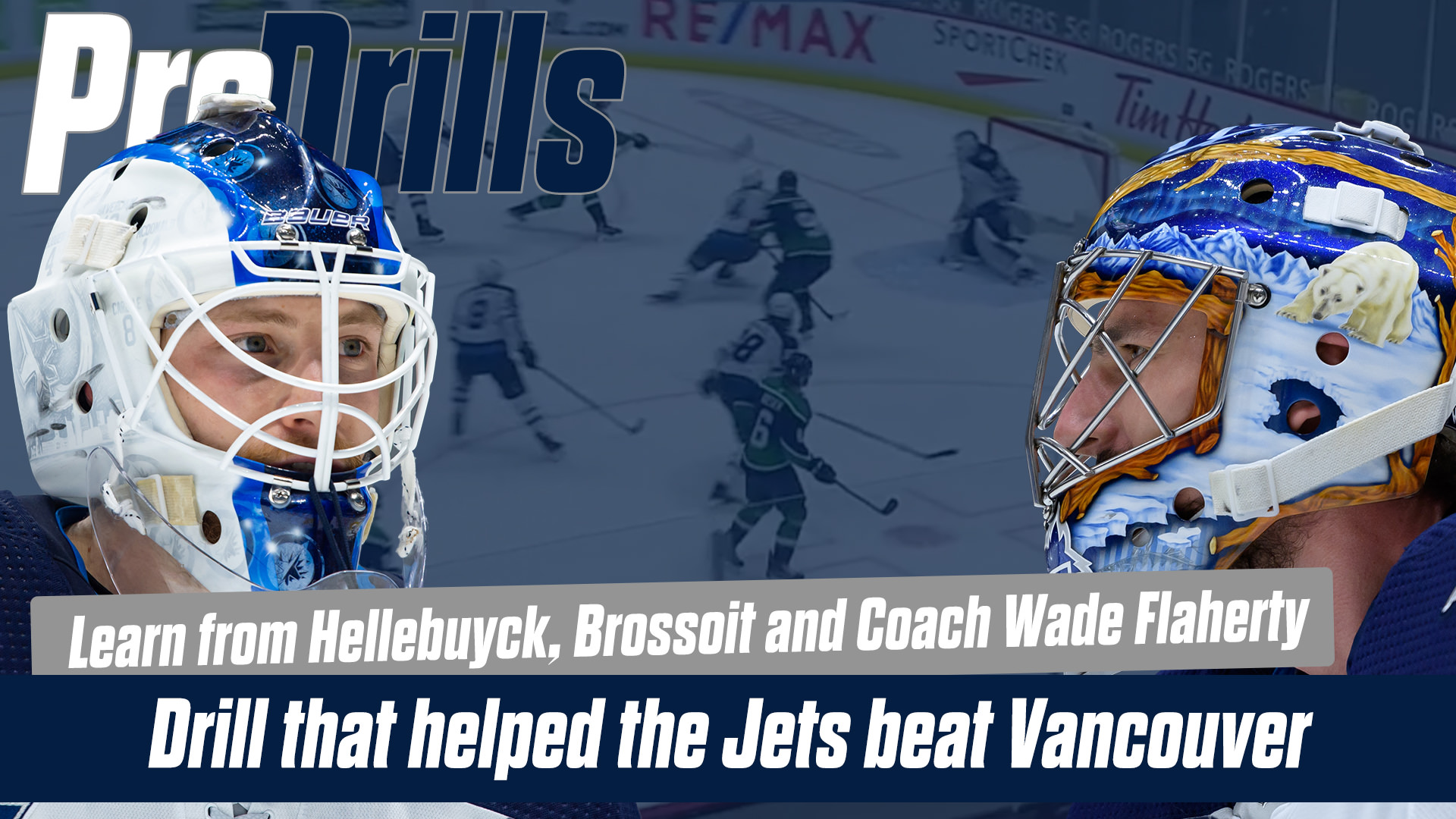
Brossoit Flaherty, Helleybuyck and the lateral drill that won Jets a game
- Brossoit and Hellebuyck were both beaten early in the season by backdoor plays because they locked too heavily on the shooter and lost their lateral rotation.
- Wade Flaherty designed a drill progression starting with stationary shooters and passers to ingrain the correct movement pattern before adding live elements.
- The drill began with the initial passer at the top of the faceoff circle and a second player at the opposite dot, emphasizing keeping hands connected during rotation.
- Brossoit's game-saving backdoor stop on Elias Pettersson in a 2-0 Jets win directly resulted from this practice work, preserving a 1-0 lead in the second period.
- Identifying a specific in-game breakdown and building targeted drills around it is an example of how elite goaltending coaches translate game film into practice solutions.
Laurent Brossoit made a handful of game-saving stops during a 2-0 win against his hometown Vancouver Canucks back in mid-February. With the Winnipeg Jets clinging to a 1-0 lead until a late empty-net goal, every save was big but this backdoor power-play stop on Elias Pettersson in the second period stood out, and not just because of the degree of difficulty:
The save also stood out because Brossoit and playing partner Connor Hellebuyck appeared to re-create the stop in practice the next day with Winnipeg goaltending coach Wade Flaherty.
It left us wondering if the Jets, who had another game in Vancouver the following day, had identified a particular play the Canucks liked to run on their power play and were preparing their goalies to handle it? It turns out, the Jets had actually been working on a progression of related drills after each goalie gave one up on a similar play early in the season.
Brossoit believes that work resulted in that save, effectively preserving a tight win.
“There was a play that me and Helle got beat on because we kind of locked in on the shooter a little bit heavy, and then weren’t able to get across on a backdoor,” Brossoit explained. “I’m pretty sure that save that I made on that power play was the result of having worked on something very similar, so I’m pretty thankful that we put the work in to do that.”
InGoal is thankful Brossoit and Flaherty were willing to walk through a few keys and tips related to that progression of drills, including the final step we captured on video that day. They said it started with stationary shooters and passers to get the movement pattern dialed in, with the initial player (and puck) atop the faceoff circle, and the other player at the opposite dot.
“Both guys felt they locked and had no rotation, so we created this,” Flaherty said. “It started with a stationary pass for the rotation, making sure the hands stayed connected.”
Shooters remained stationary for the next step, which was to add a pass-or-shoot option (no fake shots allowed) for the initial player with the puck at the top of the face-off circle, which adds a read element for the goalies. InGoal captured the next stage of the progression with the original shooter in motion, increasing the difficulty of the read-react element for the goalies:
The idea mimics precisely the type of in-zone power play scenario that Brock Boeser connected with Pettersson on in that game against Brossoit, but Flaherty said they also work on a progression where both players are in motion to replicate more of a 2-on-1 rush.
In both cases, Flaherty stressed all pucks are supposed to be passed and received on or outside the dot line. In all cases, the key is staying on the initial release, whether it’s a pass or shot, long enough visually that you don’t commit early to the ice on the first player, and then getting good top-down rotation into a one-piece push if he passes rather than reaching out early and opening up. Here’s a look at them working the same drill from the other side:
It’s a great look at an approach that paid off with a key save in a tight game, and one that Brossoit said is a staple of his ongoing work with Flaherty in Winnipeg.
“When we get a block of time, especially for me because I have more practice time obviously than Helle, it’s usually when I get beat on something or if I make a save I think could be a bit cleaner and it’s a situation that happens consistently enough, usually me and Flats try to create a drill that replicates it the best way possible,” he said. “We usually go as simple as possible and then kind of add a bit more of a dynamic element to it as we perfect the simple version.”
In this case, as Flaherty already explained, that meant getting the movement perfected first.
“You do the pass first just to get the movement down and so that was a movement pattern I’ve been working on personally over the last couple weeks,” Brossoit said, adding that just because it felt good and worked in that game doesn’t mean you don’t keep at it. “Even though it looks like that part of my game is feeling good, it’s always good to touch on it to maintain it.”