
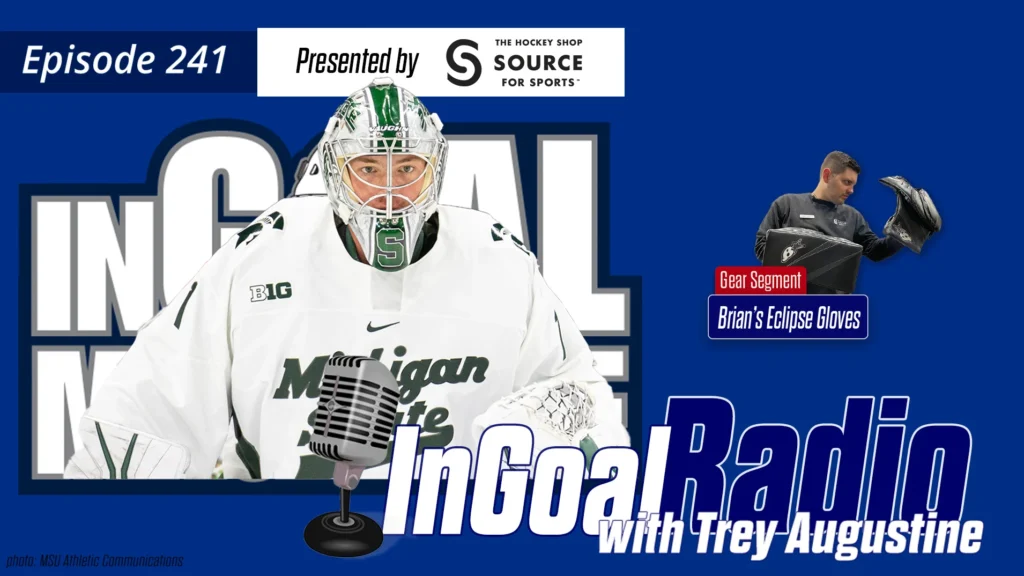
InGoal Radio Episode 241 with Trey Augustine
Please subscribe and leave a rating — it helps us reach more goalies!


Trey Augustine, the youngest goalie in college hockey during his Michigan State freshman season, told InGoal Radio that he studies game footage specifically to improve his play-reading ability. Drafted 41st overall by the Detroit Red Wings, Augustine has trained in the offseason alongside NHL goalies Alex Nedeljkovic and Scott Wedgewood, crediting those reps against older players as a key factor in his rapid development.
- Augustine studies hockey video with a deliberate focus on reading plays, not just reviewing goals against — a habit he credits as central to his development.
- Training against and alongside NHL goalies like Alex Nedeljkovic and Scott Wedgewood in the offseason accelerated Augustine's progression as a young goalie.
- Augustine won WJC bronze at age 17 and gold the following year with Team USA, managing elite tournament pressure before completing his freshman season at Michigan State.
- Drafted 41st overall by his home state Detroit Red Wings, Augustine was already the youngest goalie competing in college hockey during his freshman campaign.
- The episode also covers the new Brian's Eclipse glove line, featuring the brand's first 580-style break and updated blocker options.
Episode 241 of the InGoal Radio Podcast, presented by The Hockey Shop Source for Sports, features a deep dive with Team USA’s World Junior Championship gold-medal winner Trey Augustine.
Feature Interview
presented by NHL Sense Arena
In that feature interview presented by NHL Sense Arena, Augustine, who was already back at Michigan State University to continue his fantastic freshman campaign as the youngest goalie in college hockey, talks about managing pressure under the bright lights of the World Juniors in Sweden. Picked by his home state Detroit Red Wings in the second round (No. 41) of the NHL Draft last season after winning bronze at the WJC as a 17-year-old, Augustine shares insights into his early influences, and the work that has gone into his early success, including how much — and specifically how — he watches hockey to get better at reading plays, and what he’s learned by playing at practicing against older players over the years, and training in the offseason with NHL goalies like Alex Nedeljkovic and Scott Wedgewood. Nicknamed “Gramps” and “Buckets” at USNTDP, Augustine also gets into his competitive roots playing other spots, including pickle ball and basketball.
Weekly Gear Segment
presented by The Hockey Shop Source for SportsAll that, plus a trip to The Hockey Shop Source for Sports for a look at the all new Brian’s Eclipse gloves, which includes their first “580-style” glove break and new options for the blocker.
Episode Transcript
Intro
Right out of the gate, we gotta clean up an aisle three. I'll explain in just a little bit. It's InGoal Radio, the podcast presented by The Hockey Shop Source for Sports Langley, thehockeyshop.com. All kinds of things happening over there. We've got our Gear Segment coming up with a brand new release of mitts from Brian's, the Eclipse gloves.
They've got the 580 brake. Looking forward to it. It's a standalone. Can't wait to get into that, with Cam and Woody as we invite, David Hutchison to explain what Woody is doing over on his site. Can you capsulize just exactly what occurred as we came on the air, Hutch?
Well, know, there may have been a small coffee explosion on Woody's desk but what I really want to congratulate Woody about today, really important for us to acknowledge this I think, Daren, is he's well known for being, Captain Snap tastic. Just the smallest thing can send Woody off the ledge. And this morning, coffee all over his desk, coffee all over his electronics. There he is smiling, ready to go, enjoying the best part of his day, which is the InGoal Radio Podcast. So Woody, big step forward for you in your mental game.
Congratulations.
2024, boys turning over a new leaf. Less snappy.
You handled it pretty well. And this is after
Yeah. It was it was hot too. Hutch trolled
you with a mention of a recording issue.
Yeah. Just that's two for two today, isn't
it? And and and you handled it, Woody. And I wasn't sure what Hutch's motivation for bringing that up right before we went on the air, but this is this is pretty positive with that Zen moment that you're having.
Also, Daren, I think it's important to recognize that for quite a while now, Woody's been doing once a week early morning yoga sessions with his hockey team. So I think it's I think it's helping. He's really turned his life around. I think we can expect now that he's back in the crease after a bit of a layoff, we should probably see some impressive numbers from the wood man.
Hold on. Your your men's league hockey team is doing yoga together once a week?
I have a early Sunday morning yoga session designed specifically for old men, of which I am one, that, some of my teammates have started to attend with me. Yes. But it's not a it's not like a team organized thing. Because it's 07:30 on a Sunday morning, and we're old, and we like to sleep in, and it's been minus 14 Celsius here in in Vancouver this so it so getting everybody up early was was the tough one today.
You're obviously in a good spot. Whatever you're doing, keep going.
Zen, baby.
I do kinda miss him going. Just peeking.
Oh, don't worry. He'll come back.
We've got some big news coming out of our feature interview with Trey Augustine brought to you by NHL Sense Arena. Looking forward to discussing the gold medal championship and just his journey and what a wild breakthrough campaign in the NCAA with Michigan State. That's coming up. But did you guys see the quotes and comments from Elvis Merzlinkins this week from the Columbus Blue Jackets? Not happy about his playing time right now.
And I I enjoyed the confidence saying, I'm a number one guy. I wanna be a number one guy. I deserve to be a number one guy.
I liked it too. I I didn't see it as too loaded. Although I know as soon as things get echoed around the the hockey universe, people see the negative side of things and try and spin it in a bad way. I just thought it was a a statement of fact. Here's who I think I am.
Didn't he also just say, look, haven't even demanded a trade. We're just agreed with the team that we're looking for something different. So I thought that was downplaying things a little bit on his side as well. And, what's wrong with having a little bit of confidence that, you're ready to do the job for a team? I mean, if you think you're headed for a new situation, are you gonna advertise to the Hockey Universe?
Yeah. Maybe I'm just the number two these days, but I might be able to help somebody. That's not gonna get somebody very interested. You wanna tell them how you feel, who you who you are, and, goaltending 90% mental. So you've gotta have that confidence and he's he's ready to play for somebody.
You know what? The other thing he said, he talked about the work he's put into his game. And not privy to those specifics. Haven't talked to Elvis since last year. Ironically, last year, we talked he was talking about switching gear, and and he did this season switch switch to equipment companies.
So I don't know what the specifics are, but I can tell he it's been paying off. And so I understand the frustration on the season as a whole. You know, he's he's plus 1% adjusted, save, percentage. So he's outperforming his defensive environment by a pretty significant margin since December 1, and it's not a great defensive environment like his expected save percentage. Again, what the average goalie in the NHL would stop based on the shot quality he's facing is quite low.
Since December 1, it's 0.870, and he's outperforming it at 2.4%, which, you know, amongst regulars is flirting with the top 10 in the National Hockey League. So, as well as he's played this season on a whole and especially over the last five, six weeks, I guess six weeks now, to be sitting behind younger, less experienced goaltenders who haven't had nearly as much statistical success to be sitting on the bench watching them and at times sitting in the press box watching them. I understand the frustration. So, you know, it's it's time for a fresh start. If you're not gonna play me, trade me somewhere where they will.
Or, again, he didn't make that trade request specifically, but I get it. And there's a confidence you want. Like, it's it's like it's like Mike Weir in his prime, on the PGA tour. Never hit a bad shot. Right?
Like, it was always a bad read or whatever. Never hit a bad shot. Like, having confidence in yourself psychologically matters. He's got it. He's got numbers to back it.
The only thing that's probably present preventing Elvis Merzlinkins from getting a shot somewhere else, and I've actually had this conversation with people on other teams, you know, sort of about his situation that teams that might be interested is the contract. And this, you know, it's not quite Roberto Longo. My contract sucks. I can't get traded because of it. But there's a lot of term on a big ticket and playing behind a, you know, a team where it doesn't matter what he does.
The numbers the raw numbers aren't gonna look great. Like, that's like Eric Comrie clearing waivers. Right? Not everybody knows he had an expected of eight fifty. All they see is is what his raw numbers are, and that's that's a tough sell with that amount of term and that amount of cash left on Elvis' deal.
Let's peel back, the onion a little bit in this situation and how it could relate to somebody that's in minor hockey and, not getting the playing time that they want, but they have the ultimate confidence or junior hockey, in that regard. And they want to be in a bigger role, but the organization has made this decision. The Columbus Blue Jackets have been upfront. They wanna see Daniil Tarasov get some more time. They they are flat out honest about that in their reasoning.
So is that enough from the organization from 30,000 feet as we look this to say, okay, we we understand, what's happening, Hutch?
Yeah. I think it probably comes down to organizational goals and being very clear about those goals. And if Columbus is in a situation now where they feel that this season is a, you know, a lost one in terms of wins and losses and making the playoffs, then I think it behooves them to look towards the future and where they see this team a year, two, three years down the road. And if that means developing Tarasov, getting him in games, I mean, you have to respect that. And maybe that's why this is seen as a bit of a mutual decision as opposed to Elvis storming in and asking for a trade.
How does that compare to junior hockey and minor hockey? I guess junior hockey is probably a lot more like the National Hockey League. It's much more of a wins matter league. And, and teams do have actually a much quicker development cycle than they do in the National Hockey League since you can only hang on to older players for a couple of years. So we see a lot more turnover and so on.
So I'm sure teams have to make significant decisions around development there. And I think being honest with goaltenders and and players in similar situations is extremely important. Minor hockey, I don't know how it relates. If you're a young kid not getting the playing time that you would like, it's it's really tough because I think minor hockey teams should be, playing both their goaltenders. I like the, if we go back to the, Joey Daccord interview from from last week and that discussion that both goaltenders played all the time, I think I I really agree with that.
So so that's a a much finer topic I think to try and get into. What do you do if you're a minor hockey player and you're not getting the playing time? But but in this case, I think I I respect what Elvis is doing, but at the same time, I think you gotta understand what Columbus is trying to accomplish at the same time.
Well, also recognizing that that might not necessarily be winning.
Well, that's what I'm saying. Yeah. Yeah.
I mean, stealth stealth tank. Right? Like, they're not they're not just throwing terrorists off out there to lose. Obviously, they're throwing champ. No.
You'd be you'd be finding somebody else if you want a tank. Cause you're not gonna destroy a prospect.
If it's about if it's about wins and losses, statistically, Elvis gives you the best chance right now. Oh, for sure. Obviously not the right
I don't disagree with you. I'm just saying if you're setting up a tank versus developing somebody, you probably do that in two different ways.
And it's where they are in their season in relation to a playoff If they were closer, it would be, I would think, Elvis playing a more predominant role with this organization.
Yeah. Think so. I think so. Exactly. That's exactly my point.
If they're trying to make the playoffs, they you pick the guy who can win. If you've got a longer term view and maybe they think that the upside with Tarasov is higher than Elvis even though he's got a contract for what is it? Three more years? I think you said, Woody, then that it is a bit of an interesting decision. But but clearly, they're trying to see what they have at very least to to make an evaluation.
The only way you can do that is get them in some games.
Got the Gear Segment coming up from The Hockey Shop Source for Sports Langley, the hockeyshop.com. Does this news from Elvis change the landscape on the goaltending front leading up to the trade deadline at all, Woody?
Probably not. Because as as as we said, like, he's got this year and three more at $5,400,000 cap hit. And with the cap going up, maybe this is a contract. And like I said, the numbers trending in the right direction at least when you adjust them for quality. And, again, not every team has access to to good numbers that way.
Maybe it becomes more tradable, but the reality is there aren't a lot of teams that have that space. Like, the teams that are in a win now mode, even if they firmly believe that Elvis was their guy, a lot of them don't have the room for this type of contract. And Columbus, I'm guessing, is not willing to it's one thing if you're on an expiring deal and you eat a percentage of that as part of a trade deadline deal, but you can't eat it just for one season. It's for the whatever's left on that contract. And I I kinda doubt the Columbus Blue Jackets are gonna say, for example, eat half of Elvis Merzlikins' contract, not just this year, but for the next three after this. So, again, like to go back to the the, you know, the old Roberto Luongo quote, my contract sucks. Like, if he truly did want out, and again, he hasn't said that, but the deal he's on right now makes it tougher for other teams to fit him in.
Let's get into our gear, segment again. This is a a really cool treat. I look at it as a treat as a a stand alone release with the Brian's Eclipse gloves and interesting break there.
Yeah. I thought so. I I was didn't realize. And, again, we've gotten a little out of touch with Brian's. We talked about a little bit with the chest protector and the pants, how good those look, the Optic 3's, and and we need to get back into sort of reviewing and testing some of their stuff.
Didn't know this was coming. It was a pleasant surprise as we talk about with Cam. Christmas has passed, but there's something new you could have under the tree early. Like, it's nice. Right?
Gear
We normally wait for April for new launches, but new gear coming in every day at the hockey shop. And in this case, a completely new look from Brian's. Rather than me rambling on, let's just go straight to Cam and let him explain exactly what Brian's Eclipse gloves are all about because it is it's gloves, plural. Glove will get the attention, but the blocker's entirely new as well. Welcome back to The Hockey Shop Source for Sports.
Welcome back to The Hockey Shop Source for Sports. We're down here. Keep saying that we are in Goalie Utopia. No longer in the basement.
No stairs required.
Yeah. They don't make you hide like a troll anymore down there. Very nice. But you do have nice space here, and we're surrounded by all the latest and greatest. And guess what?
In January, there is the latest. Mhmm. Thanks to the folks at Brian's. Christmas may be over, but if you have that sort of post holiday blues, we actually have new equipment. Yeah. What's it called?
Well, let me come out of the bridge from my troll hole and let you know about the My
troll hole. I love it. Eclipse. We got new mitts. So a total eclipse.
A total eclipse. Does it
Of the? Heart? Got them.
So, A new mitts. A eclipse of the hands. Look at that. I think we know what this is right there.
So new mitts, only mitts. No pads.
No pads. Just glove and blocker. They just launched a glove and blocker. They called it Eclipse, and that may be because it will eclipse in popularity their other ones?
That's a bit of reach, but
that's Okay. Alright. Keep So,
you 580 fans. Brian's Brian's just come to the party. So Kevin's throwing it off. You can start to see that that over top duckbill style closure where it curvatures up the top, five eighty esque. Sort of
pocket out by your ear, nice and easy up here. Correct.
Now but before all of you bread and butter five eighty guys come running over, guys and girls come running over and say, oh, is this the same? Like, oh, hold on. Hold on. There is some differences for sure. I do find that this one has quite a bit more finger curl shape to it, whereas some of the other ones have kind of flattened out a little bit more in a bit more of a steep angle.
That's fine. As you close this glove, it really wants you to actually tilt it in towards you. That can really actually help with that puck retention in terms of forcing that puck into the pocket of the glove. I don't know
what puck retention is, Cam, because I might as well have two blockers on. I can't catch a cold. You're doing your best Danny Blackburn impression. That's fine. This might help is what you're telling me.
It could. It very much could. So Brian, stop Windmill. They're using their anchor offset from the actual center line of the palm as well. This is on purpose to help promote again that fold over closure that you're seeing there.
You see the break there and then the tee there. It's kind of Correct. Goes this way, a little bit of that way, a little less than that, a little
bit of snap. Yeah. Something like that. So the nice thing about this is too though, is that the way that those anchor keys are laced, there's a lot of net. So in terms of that puck hitting into that net, it's gonna come in there.
There's gonna be a lot of absorption quality to the pocket itself. It's gonna help to hold onto that puck for you pretty easily.
Speaking of holding onto pucks, can you get her with the skate lace?
You sure can?
Custom? Absolutely.
Do you have any in stock?
I know. That won't be till a little bit later, but you can custom order now and get it before stock even gets close to arriving.
Okay. So Brian's has never gone with the sort of traditional five eighty, five ninety, 600. Are they actually calling this a five eighty?
No. Well, I mean, it evolved. It's technically a 30 or sorry, a 35 degree closure is the
Iconic theories. We got one of those around here. Yeah. Right here. Cam just wanted to mix in the word iconic because he thinks he
is. So 35, optic, which happens to be
a full right here. 40. 40. And this? 45.
Okay. That makes sense.
So in terms of, again, how they're talking about this closure on the hand, like, I do kind of find this one close ish, kind of five ninety ish in the optic. And that
is the that's the 40?
Yes. Okay. And then the Iconic with its 35 degree closure, like, y ish kind of 600.
Yes. Ish.
Yes. Ish.
But this is definitely
That one now. Than ish. More more than ish.
More than ish.
Yes. Exactly.
Cam, I don't have my little eyes on here.
No. No t fives.
Aw. I kinda like the little eyes, but man, hard to get over. That is nice.
So ATOP, their new ball replacement system, comes back features. So the back end of the glove is going be very similar to the other two options that are available from Brian's. Again, turn and then to take it off, you just twist the other way now.
Nice and easy. I like, instead of pulling, just twist the other way. So if you
like a nice tight fit on your glove, this is one of the ones that like unparalleled in terms of that fit
for sure. Yeah. Like it. Okay. There is a new blocker too.
Tell me about the Eclipse blocker Cam while I keep playing with the glove.
So one of the things that I really, really like about
the feel of this blocker right off
the bat asked me the way that they've redesigned the core of it. So this is featuring their BriCore, which is their carbon enhanced foam that's helped to aid in the rigidity of the blocker over time and also that rebound pop. So neutral hand position, nice and squared off. It actually feels really solid on the hand. It like, it doesn't feel like it's too chunky in one area where it tends to tip it over or anything like that.
Again, neutral hand position. So in terms of representing it forward, your basically backhand is almost kind of dead center of that blocker board itself. So again, really good at controlling where you wanna punch those rebound.
You know what? I I as much as Brian's has always been known for their great gloves and this, you know, just based on first feel, appears like it's gonna continue that trend. I feel like their blockers have come a long way in recent years to sort of match other brand. They used to feel, and to be honest, a little chunky to me. Like and this this feels a little more, while still beefy from a protective scent, it feels a little more streamlined on my hand.
Yeah. Even though Just cleaner lines.
And it's not the thinnest blocker in the world by any means. Like, it is like, there's substantial amount of, like, meat going on there, but it's not chunky.
Yeah. It's not thin. It's not it's like, it's not unprotective. It just doesn't feel as sort of chunky as some of the past And
we'll show a little bit better of comparison to them side by side, but that said, the iconic blocker, similar hand position itself,
but You can see the difference on the inside edge in terms of how it's stitched. This is sort of one piece over the top and that one's got the Correct.
And thinner. There's a thinner block board here and then also in terms of the curvature of the blocker, it's a little bit more neutral as opposed to the aggressive curve up at the very top, for example. And then
I like this one.
To round it all off because he's hiding it over there.
It's because he made it full right.
Unfortunately, yes, it had to be Somebody needs to reorder. So straight, beveled as well, all along the side. You can see that beveling that they've got there and then also different hand position as well. So higher, lower? Higher.
There we go. Higher on. Up on. Yes. Excellent.
So, we've got a third option. Neutral hand position on the blocker, five eighty style break, the Brian's Eclipse, graphic wise in terms of matching it with your Brian's pads. They did. We'll have to have a look at some of the custom designs. Can you go on their customizer and play around?
It is live. Beautiful. So if you have any questions, give me a call. (604) 589-8299 or 1-800-567-7790 or check us out at the hockeyshop.com.
Watch. It's an eclipse. We can't see Cam.
Oh my goodness.
He's been eclipsed.
That just lands on Cam's desk. That's a nice little fun treat.
Not bad. Like, just take new gear coming in every day, like, at the Hockey Shop Source for Sports out in Langley, and more stuff coming next week. Like, there's there's there's new launches coming from Vaughn as well that he's got in stock that we're gonna go over. So exciting times. Normally, we're as I said, we're waiting for April.
The place to be for all your latest and greatest is always the hockey shop, thehockeyshop.com. Cam got into it a little bit there in the segment in terms of Brian's using different nomenclature for their gloves. This one very clearly, it feels like a five eighty break for the for the for the most part, maybe not exactly like a CCM or a true, but very similar in terms of the way that pocket closes over the top. Make sure you check out our YouTube channel and our so all our social media for a closer look at the visuals behind that. But that's you know, like, if you're not sure of those different breaks and how their nomenclature works compared to other ones, just give them a shout.
Cam and his crew, they're the best. They've all played the position. They love the position. They're passionate about the position. You're not just walking into a sports store and talking to some high school kid who's never faced an 80 mile an hour slapshot.
Like, Cam and his crew all play it. They all know it, and they'll help you find the glove, whether it's Brian's or another brand that fits your style of catching pucks and fits your game.
Basically, if you're a team in the Lower Mainland and you need a goalie at the last minute, just call the Hockey Shop. There's probably one bouncing around there. You don't have to get them off their shift, but it's good.
May have made that call once or twice myself when we were looking for a target. Really? Oh, 100%.
Yep. That's awesome. I love that. What's the most popular break in the league right now, the National League that people are using?
Oh, that's a really good question, Daren.
Interesting enough. Trends.
Well, mean, interestingly enough, we're about to our future guest is Trey Augustine is about to talk about why he's in a Vaughn glove still because other brands haven't don't don't have an equivalent and can't or won't make him one that feels like it. So the reality of the NHL, and we've talked about this before, is that what you see is not necessarily what they're wearing.
Oh, yeah. Yeah. Yeah.
You know, like like a lot of guys,
you know,
skinned as the latest, but they want the same glove they've worn for ten years. Or even when they switch brands, you'll see them, you know, in a glove that looks like the newest from the brand that they've switched to, but they've actually had it built to be like their old one. Although, again, like Trey Augustine, you know, we just saw Joonas Korpisalo switch back, switched over to True this season, but then switched back to a Vaughn glove recently. And I think there's been some changes over at True, and and it's interesting. They let go of, their pro rep, Jorg, and starting to see some guys that I think maybe they were making specialty items for to to fit and feel like they're old gloves, and maybe that's not the case.
Talking to a couple NHL guys and equipment reps that their guys are going back to older models because that's not the case. So it is fascinating. Overall, probably somewhere between a five ninety and a five eighty, that sort of straight line break and some guys wanting that sort of pocket that curls over at the top for for that protection or or that coverage around the ear would be my guess. But anybody that says they know based on just watching off TV, probably doesn't fully. You really do need to talk to the companies to find out what's underneath, that label, what really is underneath that label.
A lot of companies actually don't like to share. They don't want it out there because they don't want kids ordering. We went through this with Vaughn years ago. It's like, we don't want everyone to know that Jonathan Quick's in a glove that's 10 years old or whatever it was. Right?
Because then everybody's gonna want it. And that's not what we do. Like, your your margins are made on sort of more mass production than building custom one offs for every 15 year old that wants to be just like Jonathan Quick as an example.
Hutch, you you looked like you wanted to jump in there.
No. I was just remembering what a cool series we had way back in the day. Every time we had an issue in that old PDF flipbook version of the magazine, we had a a center spread poster, which was a phenomenal shot of, one of the NHL goaltenders of the day and then we would break down every little piece of gear that they were wearing. And when we brought it out, just thought, oh, this is a no brainer. People are gonna eat this up.
They're gonna love it. The companies are gonna wanna promote their stuff. They'll be really excited. And then it kind of fell pretty flat because as as Kevin said, Vaughn was the first one. They to be fair, I think they did give us all the information on Jonathan Quick, but but they're the ones that, also said probably not a series that's gonna go very far because for the very reason that Kevin mentioned, not wanting to make stuff, in that type for for everybody out there.
Do you wear your gloves when you utilize NHL Sense Arena?
I don't. I
do? I don't. You do?
I got a I got a sad reason though.
Why? My dog
ate the sleeve so I couldn't put it out of the glove and then I sheepishly went to Sense Arena and I said, here's what happened. Don't worry about it. They sent me another sleeve to work with and then about a week later, Doug got ahold of, the same the same replacement sleeve. So, yeah, even though I'm lucky enough to have a few sets of gloves around here and I can have them permanently mounted on, I just like grabbing the controllers and it's quick and easy and but yeah, my dog ate my homework.
It is quick and easy, but but I I've started using the gloves with them and it it does give it a different feel with NHL Sense Arena.
Yeah. I I like I like it with the gloves for sure. For sure. But but again, like, we've seen a lot of guys go the other way. Right?
So I I'm curious. Like, clearly, Joey Daccord, I've seen him travel with his case. I don't think he's latching it onto his game gloves. And, obviously, he's got extra gloves maybe, but I didn't see the sleeves on an extra set of gloves in his locker room. Now I'm gonna have to ask whether he throws the gloves on or just puts the paddles in hand.
Very different feeling when you don't have the weight of the gloves, but I guess maybe it comes down to, do you see this as a hand exercise or a visual exercise? And what's the what's the most important I to had an interesting situation. You were bringing up junior hockey, Daren. And last night, because of, one of the peculiarities of junior hockey, I have two BCHL goalies who live in our house. That's the British Columbia Hockey League, which is arguably the top junior league in Canada below major junior.
They were supposed to have a game yesterday and the first bus broke down and then a replacement was sent and it broke down and then a replacement was sent and it broke and they were onto their fourth bus, which they couldn't get into ultimately having to cancel the game because they couldn't make a road trip. So what do you do when you don't have ice? You grab Sense Arena and five people ended up over in our home last night, the two goaltenders and three players. And Sense Arena got broken out in the basement and you could hear the hooting and the hollering as the players were being introduced to what it's like to be a goaltender. They absolutely loved it.
They found it mind blowing, the realism of it. And I think it really opened their eyes up to what these goaltenders are facing. So you don't have ice, you grab Sense Arena, but I just love this idea. I think was it Eric Comrie who maybe told us in the beginning?
It was it was Eric Comrie that he'd have he'd have teammates over and he'd hey, you wanna see what my life's like? And he'd he'd throw them in a headset.
I I guess the only thing is, you know, if Sense Arena wants, to really have, like, an introduce your teammates to what goaltending is like, they should have a drill where, like, every second shot is right between the eyes just to give these guys an idea for what it's like. Because I also told you once that my son put it on and did take one in the head, sort of randomly and he had to actually take the headset off and was a little disoriented. That's how real the whole thing felt for him. Anyway, guys, Sense Arena is a phenomenal tool. You've heard it a million times on here.
Whether it's you trying to get on the ice when you don't have any ice time, you can just carry that Sense Arena around like Joey Daccord does on the road in the National Hockey League. You can use it before games as I've mentioned. A lot of goaltenders are starting to do including the guys here. And if you just want to use it for a little bit, ten, fifteen minutes of extra training, face NHL shooters, face power plays, face various screen situations. I know the guys love to work on here cause that's such a tough skill to deal with in a game or some of the neurocognitive drills like Sense Arena is absolutely cutting edge.
They make it better all the time. Just can't tell you enough about it and we thank them as always for bringing this feature interview to us this week. If you're interested in Sense Arena, head over to sensearena.com. They've got a seven day trial you can even go for. If you wanna sign up right away, you can do that too and use the code IGM 50.
As always, you'll save a little bit more.
Feature Interview - Trey Augustine
Trey Augustine, the feature interview. Set this one up for us, Woody.
The latest World Junior Championship gold medal winner to appear on the InGoal Radio Podcast. I think ever since we started this podcast, we've had every winner join us, and we continue that trend with a very worthy winner. And, you know, a young man who, as you're gonna hear, has sort of played up through the ranks. Was at the world juniors last year, comes home with a gold medal this year, just killing it as a freshman at Michigan State. Like, I don't think everyone realizes how rare it is to to walk in as a freshman and not just play, but play as often and as well as he is right now.
He's having a hell of a year. He's a soft spoken young man, but we we managed to poke and prod and get some really good details out of him that that that I think will a lot of goalies will enjoy goalie parents as well on his path, his journey, the unique nature of some elements of it, and obviously how he handled the very big moment over in Sweden in the gold medal game.
It's a great, opportunity to catch up with a world champion, and I love the things that go with winning a world junior title. You get a gold medal and you get a lead spot, a feature interview on InGoal Radio, the podcast presented by Sense Arena, Sense Arena VR, NHL, Sense Arena, all over the feature interview on our podcast.
Really excited to welcome to the InGoal Radio Podcast. First time guest, but I have a hunch it will be hopefully for us the first of many. Trey Augustine fresh off a World Junior Championship win. And I guess, first off, what jumps out? You're you're still fresh from the experience.
You're back at Michigan State to continue your freshman year. Like, when I ask you what your favorite memory of that tournament and event was, what what comes flooding to the forefront?
Yeah. I think just kinda being able to celebrate on the ice with some of my best friends I've been playing with the past couple of years. So trying to take in that moment with them and just realize how special the opportunity that we had was and just kinda just so grateful for the opportunities that USA Hockey has given to all of us.
Now you've been in those situations before on that stage. I mean, under eighteens, world you you know, now it's the World Junior Championships. Last year at the World Junior Championships. Was there any like, did the moment feel at all bigger or the stage bigger to you heading into this gold medal game than all the other experiences you've had even at Michigan State where you're playing in front of packed houses?
Yeah. No. I think just kinda for me, just, like, knowing, like, what to expect is a big part of it. Obviously, had that experience now. So if anything, I feel like I was more prepared this time around.
We hear your teammates and coaches talk about a calming presence and bringing a calming presence. Is that something you take pride in? And how does it manifest itself? Like, can a goalie, a young goalie listening to us right now who's trying to bring that, are there things you can do beyond stopping the puck to sort of make your teammates feel that?
Yeah. For sure. I think just even just kinda it's more of a demeanor thing. Obviously, you just kinda keep a level head and, like, not getting too emotional on the ice. Like, if you're going around, like, yelling at guys and stuff, it's kinda can take some, like, aspects of just focusing on the game away.
So for me, I just try and just focus on stopping the puck and then obviously let the other things take care of themselves. I don't have much control over them.
Calming presence. One of the things we've heard from other guys on in big moments, how do you help calm teammates on a big stage? Is there anything you do differently as a goaltender? We've had guys in the past actually from world juniors talk about, hey. Take more whistles.
Eat more pucks early. Set up more face offs. If you feel like the guys are frantic, you can slow things down as a goalie.
Yeah. Definitely. All those things. Was just kinda trying to slow the play down and just do anything I can to help them out. Whether it's like a puck play decision, just putting into a good area on the ice for him to have success too.
And I actually just kinda even between whistles, like, talking about things I see out there and potential opportunities that they have to make some more plays.
Give me an example. Because when your your audience here is a 100% goaltender. So, you're reading the game and anticipating the game, and you're communicating with your teammates about like, give me an example of something you might share with a teammate to help not just you as a goalie, but the team overall.
Yeah. I mean so I'll just give you one example from the gold medal game. It was think it was a kinda like a dump puck that just kinda sat in the corner, and Zeev Boyne went behind the net to pick it up. And as he kinda turned the corner on the other side of the net, there was, a lane to the middle where our center was swinging through that there was a potential pass opportunity there. And then he ended up kinda making a good play, but ended up just chipping it out of the zone and kinda allowed Sweden to get the puck again and kinda come back later in that shift.
So I just I think it was a couple minutes later. Had TV time out. I go, hey. Like, you had a little bit of time there. Like, you made a good play, but just, like, there's a little lane there in the middle.
Just, like, look for that out next shift maybe. But anything like that, you know, it's nothing too, like, serious. Like, you can't be yelling at him or anything. Just kinda talk to him as, like, a supporting teammate.
Communication sounds like it's a big part of your game. How active are you back there talking talking the guys through? And and like you said, breakouts are so key because instead of Sweden having a regroup, you might have had a clean exit.
Yeah. For sure. Communication is a huge part, obviously. Just the whole time in the game, you're talking to your DM and especially just trying to help them make their life easier. So
Okay. So your game, walk me through it and the evolution of it. It's kind of a big picture question. But quite often, we hear, like, cliches, like, I'm a butterfly goaltender. How would you describe your game?
Because I as I understand it, you're a pretty thoughtful guy. Where where are the roots of your success in your game?
I would describe myself as an athletic competitive goalie that relies on skating positioning to put myself in positions to make saves.
Yeah. I think like, I would describe myself as an athletic competitive goalie that relies on skating positioning to put myself in positions to make saves.
Goalie skating. Describe it for me in your words. It's different than than than what everybody else out there is trying to do. Right? Where where does that you you work with AJ in the summers.
Where do how do you how do you get better at goalie skating?
Yeah. You just have to do it. At the end of the day, you have to be in the net moving around. And obviously, it's not like a player where you can just skate back and forth. You have to be able to control your edges to an inch of a degree just to be able to put yourself in the prior position.
What do you like to do for drill work? Like, we see a lot of kids that'll be, you know, guys flying around, lots of dynamic drills, and yet at the highest levels, whether it's guys like like Carrie, they've always talked about crease movement patterns as a key. Do you have favorites? Do you have a routine you go through that you could share with us, say, on a game day to make sure those edges are are are sharp and and working and activated?
Yeah. So I think I haven't pregame skated my whole career, but, like, in the warmest before the game, I always do, like, a sequence of t pushes back and forth, like, kinda some slides, butterfly slides. And, obviously, just, like, some of my favorite crease movements to do are just, like, out to the top in the crease, working back in the post, trying to feel my edges and feel the control that I have.
Is there any like, so you grew up you grew up in Detroit. You've been a Michigan guy, and you've gotten to play close to home throughout your whole career. Was there a guy for you growing up watching red whether it was Red Wings games or was somebody from another team? Was it a guy you modeled your game after or looked up to?
Yeah. So, when I was super young, I used to I stayed with AJ, and then Manny Legace was also there and he was the goalie coach for Columbus at the time. So I'd say the first guy I started to, like, intently watch and try and model my game after was Sergei Bobrovsky back when he was with the jackets. So I think that's kind of where my post play has came from.
What kind of things when you watch Bob now? Like, what are there other things that that that other people would see in your game beyond the post play? You know, we talked about edge control. Man, he must have some of the best.
Yeah. No. I think the skating as a whole is pretty similar to him. I mean, they used to go back and watch all his highlight reels from Columbus back in the day. So I think just kinda see him now in Florida is just super cool.
Obviously, he's kinda kept that same structure, and I've seen he had some kinda troubles his first couple years there, but was super excited to see him play in the Stanley Cup final last year.
Okay. Are you a gear guy? Because he's got a few unique things he does with his gear. Are you, like, are you a guy who loves it, are you one of those guys that's just like, hey. Whatever you give me, I'll wear.
Yeah. I'm pretty easy. As as long as it feels good, I'll put it on. So
So there's no, like, Sergei Bobrovsky custom paddle in your in your repertoire that that that shave slope down shoulder that he loves that grip on?
Yeah. No. Nothing nothing too crazy in my repertoire.
Okay. So I did see True pads and and Vaughn Mitts. Is that just a personal preference you developed over the years?
Yeah. Like I said, just kinda whatever feels best. I like the True Pads. I love the Vaughn glove and blocker. So
Okay. So what do you like about, like, the feel of of either one? And I'm guessing you've probably been approached or you will be soon enough. There's gonna come a point where every every company's I went through this with Corey Schneider here in Vancouver. Every company wants you in their gear head to toe, and they're willing to pay you to do it.
Do do you have to sort of watch that line between one thing Corey always used to say is you'll always get paid more to stop pucks than you will to wear gear. So what, you know, are you anticipating that in the future? The personal preference over people offering things?
my Vaughn glove, it's a 700 degree break, which is I'm pretty sure super different than what's commonly out there. And I was just kind of I fell in love with it, and then True hasn't offered that to me. So it's kind of been a divide there.
Yeah. I mean, I ideally have to be in the same gear company, but obviously it's like you said, it's more important to stop the puck than to look good out there. But I mean, specifically, my Vaughn glove, it's a 700 degree break, which is I'm pretty sure super different than what's commonly out there. And I was just kind of I fell in love with it, and then True hasn't offered that to me. So it's kind of been a divide there.
So I would start with the Vaughn, glove, blocker, and the True pads.
What do you like about that model and the way it feels? Is it the closure? Is it puck handling? And what what do you specifically like about it?
Just the closure of it. It just kinda makes it easy for me to catch pucks.
Love it. Love it. Okay. Reading the game. Where does it come from?
Because every coach I talk to says that's one of the things that separates you. Where where where what are the roots of that?
Yeah. I mean, obviously, it's just kinda taking in situations when you're practicing or in game and stuff, but that's obviously just watching hockey. You can learn a whole lot through watching the game. Just kinda understanding and almost looking at it from the goalie's perspective all the time. Just trying to look at through through lens and just kinda see what they're seeing out there.
I think that's a bit of a you know, to be honest, Trey, like, we've heard from coaches of, you know, all over North America and even overseas, like, watching hockey is something goalies don't do enough. But in particular, the lens you watch it through, it sounds like you really are trying to see the game through the goalie's eyes, and that allows you to anticipate what's going to happen. Do you are you just watching? Is it mental notes? I I remember Thatcher Demko when he first came to the Canucks talked about he used to keep a journal of some of the different things he would see to sorta go back and go over them.
How how was it for you?
Yeah. I think it's more of a mental journey for me. I remember most of my plays from every game, so pretty good memory with that stuff. But then obviously, it's even like kind of I feel like watching through TV as well, just kind of how the like just technology has developed and all the different camera angles and stuff now. It just gives you so much better view of kind of the small details and the slow motion stuff where you can kind of understand like what the goalie is seeing when he's looking at a puck on the right side.
And can he see the guys on the backside, or is he just locked in on the shot or is he come off his poster? Just, like, little things like that that you can kinda just begin to understand better through the technology.
So how much are you looking at what the goalie's doing, but are you is it also about what the defense and the forwards are doing in terms of how it plays? Mitch Corn used to call it pat you know, pattern recognition and and the ability to read that.
Yeah. No. For sure, obviously. I think big players understand, like, what the shooter's trying to do and what they're looking at as well. So if you give them nothing to shoot at from a dead angle, like, they're probably not gonna just dump it into your chest.
They're gonna try and make a play, and I think it's on the goalie to read off his defenseman, understand as well what they're trying to take away from the shooter so that the goalie can kinda understand how he needs to play, if he needs to work into his RVH or anything like that.
Is video a big part of your process? Is it at Michigan State? Was it when you were at the program US, NTTB? And I always
Yeah. Yeah.
Screw that up.
Yeah. Yeah. No. It was, super prevalent there and just as prevalent here. I mean, to Michael's great job always kinda getting the clips for me ready to go, and we'll usually sit down for probably forty five minutes to an hour and just go over almost every movement clip from the games.
Is that now again, is that something you've done from an early age? Maybe not to that degree that you are now that you're in college, but in terms of the way you watch the game?
Yeah. For sure. I remember, like, back when I played for Honeybaked when I was younger, always trying to go back on the parents', like, livestream account that they were broadcasting on. I was trying to see anything I cut out there through, like, the shaky camera lens and the bad quality. But, I mean, for me, it's always just kind of been trying to just learn and understand, just kinda review my games, understand, like, what went wrong, what could I done better, and then obviously, like, what the highlights were of that game for me.
You obviously talk to goalie coaches. Do you talk to your partner? Like, even at the world juniors, are you and Jacob? Is there a lot of conversation back and forth about what you're seeing, what he might be seeing through his lens, whether it's the way teams are attacking or the way you're playing? I know it's a short tournament, maybe not as much, but maybe at Michigan State, is there a little bit and do you even ask offensive players what what they see and what they're thinking as you try and expand these reads and that ability to anticipate?
Yeah. No. For starting, like, with the goalie partner stuff, like, obviously, if they see anything that I should, like, recognize, I was always telling them, like, let me know. There's no, like I don't believe there's anything that's, like, bad information they can give me, especially if they're trying to help me out. So super grateful if that happens.
But then for me specifically, I feel like I talk to the players a lot more than I talk to my goalie partners. Just even trying to help them out and, like, let them know, like, what I see from them when they're coming down on a one and stuff like that if they're being deceptive enough or if they're just kinda hell on one thing. So I think it's kind of a relationship that works both ways like that.
Deception is such a big part of offense. It's why I think why we're seeing east the combination of increased east west speed, but also deception. Have you seen that increase even as you come up through the levels, guys showing one thing delivering another off a shot, that that type of and what's the next step for us as goaltenders to catch up to it? I I guess conversations with them about what they're trying to do would be part
of it. Yeah. No. Definitely. I think just kinda as if, like, increased ranks from the NTDP to college, especially just coming from, like, triple a, like, that first year at NTDP was, like, super difficult as you're playing, like, older, like, guys who are just better at hockey, and they've been doing, like, deception stuff.
And, obviously, it's just trying to, like, catch up to the speed of the game like that. And, obviously, like you said, now, just trying to realize, like, the visual, like, little cues that you can take from, like, their body language, like, not even, like, stick on the blade or just stuff like that that you can kinda use to put yourself in a better position and have a better idea of what they're trying to accomplish.
Okay. So focus on the puck, puck tracking, all that stuff. But as you said, the it's the other cues. Bit of a lost art sometimes even at the National Hockey League level. I remember Craig Anderson saying he wouldn't even look at the puck in a shootout, all hands and hips.
Give me can you get without giving secrets away, can you give me a little cue on what some of the things like what cues you're looking for? Young goaltenders listening to this interview. We get a lot of parents and kids that listen to the podcast on the way to tournaments on the weekend. Something that that Trey looks for to help him read a shot or a release or a passer shot that might not just be stick and puck.
the biggest thing for me is the eyes, especially, like, I don't think it's, like, right when they're about to do it. They usually look a second, half a second before, then they'll look back down at the puck, and they'll make their play. So trying to realize, like, the last thing that they looked at in that moment.
Yeah. I think, the biggest thing for me is the eyes, especially, like, I don't think it's, like, right when they're about to do it. They usually look a second, half a second before, then they'll look back down at the puck, and they'll make their play. So trying to realize, like, the last thing that they looked at in that moment.
I love that. I love that. So but you've got a much broader lens than just puck focus.
Yeah. For sure.
Okay. So AJ told me you've you've you've skated with some guys like Ned, Alex Nedeljkovic who we've had on here and and Scott Wedgewood as well. What of things are you trying to pick up when you're out there with NHL guys?
Yeah. Anything I can. Obviously, they're super competitive just like me. So we love to work together and stuff and just try and push each other to become better. But then, obviously, just trying to when you're out there, like, and you're not in the net, like, actually watch them, see, like, what they're seeing and, like, understand kinda what they're going through as well.
Is there any can you give me an example of anything you picked up from either guy? Like, I I haven't I'm gonna be perfectly honest. I haven't watched enough to know puck handle. I got stuck at the Winter Classic, so I wasn't able to watch all of your games through the metal rounds. But, like, is puck handling a big part of it?
Can you take things away from a guy like Ned who's probably one of the best in the league quietly at at at moving it?
Yeah. No. We've done some, like, just kinda shooting stuff with Vaughn's obviously super skilled at it, but we don't do a ton of it. But I think just kinda, like, scanning with both of those guys. You can just, like, see how crisp and clean their movements are and just how, like, quickly they're able to just get, like, from, like, a movement to just set and ready for a shot.
You're you're having a heck of a season as a freshman at Michigan State. What's been the what's been the biggest adjustment coming from the program into college hockey for the first time? And I guess, in some ways, is it easier? But it feels like you've always even back to you know, I heard at Honeybaked, because you were close, you used to get to go practice with with guys at the at the program at an early age. Like, it feels like you've always sort of played up.
Is that has that made this transition easier at all?
Yeah. No. I think it definitely has. I mean, I used to play with o four NTDP team a ton. So and those guys are all sophomores in college now, so I'm super familiar kinda with the top guys.
And then, obviously, I think just as a whole, like, college hockey is just bigger, faster, stronger guys. So kinda adjusting to the speed of the game, but more so, I think, traffic and just kinda managing, like, how to look around kind of the thicker bodies in front of the net.
What's, what's been any cues or keys that you can you can share or take away from how you're managing that traffic? I mean, so much of it there's that battle element that compete that just find the puck, but there's also strategy. What lane you're in? What lane you're defenseman and elements like that?
Yeah. No. I think this kinda comes back to the communication part of it, but understand, like, what side usually, like, especially on the penalty kill, like, our defensemen are told to take away the far side of the net in that shot lane. And then the goalie, I'm able to look on the short side and have a sideline to the puck. So just kind of communication with the demon and obviously just, you know, like, I'm not a super tall goalie, so I do have to kind of look around more than some guys can look over the shoulder.
But I think, like like you said, like, at the end of the day, it just comes down to compete and just finding a way to get your eyes on the puck.
Okay. So I understand competitiveness is and you mentioned it earlier, a guy who competes, whether it's pickleball, golf, basketball, I think they call you buckets in basketball. Yep. Okay. Okay.
So where does it come from? Where like and how important is it? Like, how do you balance that wanting to be that calm presence and presenting that with not losing that competitive edge that you clearly have innately?
Yeah. No. I think a lot of it comes from my mom. She used to play college basketball, so I just grew up kinda always competing with her. And then just even, like, my friend group as kids, we always just play basketball, football, baseball outside, and stuff like that.
the compete doesn't have to be you're trying to kill the guy next to you. You're trying to make him better. I think that's the difference between, like, a lot of guys.
So I think it just started me when I was young. But, like, just even now, like, I'm super competitive. But, like, like, a play is over, I'll go, laugh at laugh at my teammates and stuff and joke about it. But no, I think it's just realizing that the compete doesn't have to be you're trying to kill the guy next to you. You're trying to make him better.
I think that's the difference between, like, a lot of guys.
Did you just learn that naturally or over time? Or is, like, have you worked with people that have helped you find that balance? I mean, you've always had access through the program and now at Michigan State, probably just some mindset coaches as well. Like or is that something you just came to naturally, Trey?
Yeah. No. I think you can learn just kind of from the people you associate yourself with, but I think more so just kind of comes from personal experience and kind of like understanding just like what people are going through. You kind of see out there who the guys are that if they get mad, they'll get flustered. Then there's guys out there who, like, if they get mad, they'll, like, stay a little headed, and we'll be back right back at it next shift.
So I think just from a young age, you've kinda picked up on stuff like that.
And I guess you you chose which one to be at a young age.
Yeah.
Okay. Off season trade like, you you just mentioned all those sports. We see kids become goalie specific and and frankly, goalie only at a very young age. Did you play the other sports, like, competitively or organized? Or, you know, whether it's golf now, I understand you're hell of a golfer.
I don't know what the pickleball game is like, but, like, do you still do you still like having those other outlets, and do you think it's important athletically to continue that stuff?
Yeah. No. I definitely think it is, especially in the off season. It's a huge part of it. Just being able to go outside and take your mind off the hockey game is super important.
Obviously, I love playing golf, pickleball, anything just kinda take me away from the rink for a little bit.
Pickleball, I mean, Henrik Lundqvist throughout his career used tennis, like the idea of eye hand coordination and lateral movement footwork. I I'm gonna be honest with you. When I think of pickleball, I think of it being something for a guy my age, but it sounds like you found it sounds like you found a nice you found something that does it work for that, like, on a high hand training and footwork at all too?
Yeah. No. For sure. And I think, like, I have a like, a whole bunch of my teammates at the NTDP, we used to go up to lifetime every every weekend after the games and we used go play on Sundays and stuff. So it just kinda like, it's a simple sport, but like it's able to kinda bring that compete in and also just kinda have some fun with some of your friends out there.
I love it. I love it. And so so that's not the reason. I don't know if you wanna tell me where it came from, but I understand that the program, the nickname was Gramps. I thought maybe it's because you were playing pickleball with us old folks, but you guys were all out there playing it.
Can you tell me where that one comes from? Is that just the maturity?
Yeah. That's definitely just the maturity. Obviously, like, some of those guys kinda come in and just, like, bounce off the walls. I was just kinda my same calm demeanor like always. And I think one of guys just called me Gramps one day and then turned into pops and stuff.
So just guys being guys.
But but with the level of respect to it, like, so maybe you might not love it, but there's obviously clearly, we've seen that maturity shine through in your game as well.
Yeah. No. Definitely. I actually I actually kinda like the nickname. It's pretty cool.
So just glad I have one. It's usually a good sign. So
Awesome. Hey, Trey. I've taken up more time than I said I would, which is a bad habit of mine, but I really enjoyed this conversation. Thank you so much for sharing some insights into your game. I look forward to watching you at Michigan State.
And then in future years, pay me a visit here in Vancouver with the Detroit Red Wings. I can't wait.
Yeah. No. Thanks for your time. Really appreciate it.
Outro
So cool to be able to get to know these guys while they're still amateurs, while they're still plying their trade and and coming through the ranks. I think it's just a a great opportunity for all of us, including, and most importantly, their peers or people on the same level or or just behind them in the track towards their goals.
And as we wound that one up, you know, heard me talk about seeing him soon enough at the highest level. Like, when you talk to the people that have worked with him, at the US national team development program, privately in the summers and even with the Detroit Red Wings organization since he was drafted there last year. Like, the word they all use is there's just a maturity to his game. The other thing they talk about as much as all the technical elements are there for him, the separating factor is the play reading. And so it was really interesting to hear him talk about how much and how not just how much, but how he watches hockey as a goaltender.
the separating factor is the play reading. And so it was really interesting to hear him talk about how much and how not just how much, but how he watches hockey as a goaltender.
Like, not just watching the game, but, like, really going to school on it and paying attention to what the goalie's doing and how plays are developing. And and the ability to identify and read those patterns is something that I know the people that have worked with him think is a credit to not just how much, but how he watches hockey. And, you know, we've talked to other coaches over time about, you know, how little kids actually watch hockey these days, like young goaltenders or how they just all watch it on their phone and only see the highlight reels and don't truly study the game. And, you know, when you hear about the maturity of this kid and the maturity of his game, that's the one thing all the guys that have worked with him talk about is is sort of his ability to read and how much that comes from how much hockey and how he watches hockey. So there's a lesson there for for young goalies and goalie parents as well.
Know, You maybe get off the device and watch an actual game every once in a while.
I've got an idea. If you are a subscriber to InGoal and you watch the ProReads, which many people have told us is the best way to learn how to read the game other than being out there and playing it yourself, A lot of people ask me, what do I do for my my son, my daughter who's like nine years old, 10 years old, 11 years old? Are they too young for InGoal? No, they're not. They can they don't have to read the full ProReads article.
There's a little button there. They can skip right down, watch the ProRead video itself. But here's an idea because one a week is probably not enough other than the 200 plus we have in the archives. When you're watching the game together, maybe pause that stream for a second and just say, hey, what did you see there? What do you think maybe the goaltender saw there?
Have a little interactive, ProReads session between mom and dad and and son and daughter. And you don't have to be the expert yourself, you can hear it from them. I mean, long ago, I passed the point where I can tell my kid what he should see on the ice. He's telling me all the time what he's what he's envisioning and I'm learning from him all the time. So what a what a neat way maybe to try and learn the game, guys.
And you get to hang out.
100%. Important. Which Not just staring at the screen but talking to each other.
I think that's that's really cool for both sides. Yeah. That's what the drives to the rink and drives to the games are also all about the little bit of hangout time with everybody, which is what I love the most about this podcast, is hanging out with you guys. Whether it's the chats before, the chats after, the chats during, they're all a learning experience even though Hutch tried to set Woody off at the start today.
No snappy. You know what? Hey. Listen. Before we go and wrap this up, we probably should have had this at the top.
Speaking of ProReads, new ones up at ingoalmag.com. Connor Hellebuyck, guys, on an absolute tear right now, playing himself back into Vezina Trophy candidacy. Laurent Brossoit, who guess what? During that just ended Winnipeg Jets unbeaten streak was also exceptional and has been for a month and a half now. New one from James Reimer.
You remember him five damn things. Great exercises for opening up the hips. Great exercises for getting edge control and and control of your feet within your skate. Now we're taking it to another level. How can you get better edge control with your off ice training?
He uses a rocker board. We've got video of that up featuring Kristen Campbell of PWHL Toronto doing the demonstrations for us. So, as always, there's new content and new content always coming at ingoalmag.com to help you become a better goaltender.
Awesome stuff. From start to finish, we got it covered on InGoal Radio, the podcast presented by The Hockey Shop Source for Sports Langley, thehockeyshop.com. Play well, everybody.
Comments
Comments are for InGoal members.