
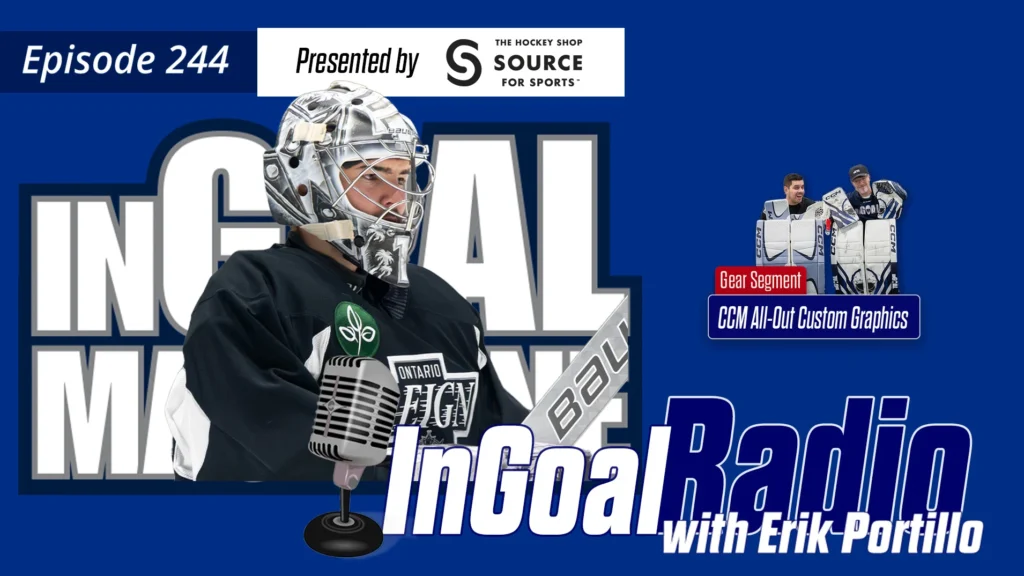
InGoal Radio Episode 244 with Erik Portillo

Please subscribe and leave a rating — it helps us reach more goalies!


Erik Portillo credits Henrik Lundqvist as a formative influence during his time in the Frolunda system in Sweden, including a personal interaction that shaped his development. Portillo later chose to attend the University of Michigan, where balancing NCAA hockey with a demanding academic program helped prepare him for his first professional season with the Los Angeles Kings, during which he made significant changes to his tactical and technical approach.
- Henrik Lundqvist personally influenced Portillo during his youth hockey years in the Frolunda system in Sweden.
- Portillo made a deliberate decision to come to North America as a teenager and chose the University of Michigan for both its hockey program and academic rigor.
- Balancing NCAA academics with elite hockey demands provided Portillo with mental tools that eased his transition to professional hockey with the LA Kings.
- Portillo has made significant changes to his tactical and technical goaltending approach since joining the Kings organization.
- When buying a hockey mask for a young goalie, fit and certified protection levels matter more than brand name.
Episode 244 of the InGoal Radio Podcast, presented by The Hockey Shop Source for Sports, features an in-depth interview with Los Angeles Kings prospect Erik Portillo.
Feature Interview
presented by NHL Sense Arena
In that feature interview presented by NHL Sense Arena, Portillo shares his roots in the position growing up in Sweden, including the influence of goalie coaching from an early age and the impact (and a personal interaction) that Henrik Lundqvist had on him as a young goalie in the Frolunda system. Portillo walks us through his decision to come to North America as a teenager, how he ended up at the University of Michigan, and the unique challenges — and personal benefits — of balancing the demands of NCAA hockey with the desire to also push himself academically in a tough program, and how it’s made his first year as a pro easier in some ways despite making some significant changes to his tactical and technical approach (which he also discusses in detail) since joining the Kings.
Parent Segment
presented by Stop It Goaltending U
We also introduce a new segment for parents, answering your questions. This week – what mask to I buy for my son or daughter? (hint: we don’t name a specific brand).
Weekly Gear Segment
presented by The Hockey Shop Source for SportsAll that, plus an in-person trip to The Hockey Shop Source for Sports for a closer look at the CCM All Out custom graphics program, and how to plan and order your own personalized set.
Episode Transcript
Intro
Welcome to the InGoal Radio Podcast. This is episode 244 presented by The Hockey Shop Source for Sports Langley and thehockeyshop.com. This week featuring Los Angeles Kings prospect Eric Portillo and a look at CCM's all out graphics. Also, hang in there coaches if you're listening in because we've got some news about a new program for you as well and something new for goalie parents. We got a lot going on this week. Yet our veteran host, Daren Millard, the glue that holds the show together, is on the IR this week. He's listed day to day with an upper body injury. We hope you'll all join us in wishing Daren well as he recovers at home. Meanwhile, I'm David Hutchison. Sitting just across from me on Zoom and about a 130 kilometers away in Vancouver is Kevin Woodley.
Together, we bring you InGoal Magazine, which is the online magazine for goalies, parents, and coaches, and all the fans of the greatest position in the game. Woody, with Daren away, I hope you're gonna be a little more patient with me this week than you were with Cam over at the Hockey Shop yesterday when we filmed the Gear Segment about CCM's all out graphics.
Well, everything I lost my patience with Cam on yesterday. That's what happens when you have too much to do. I get a little flustered. So my apologies to Cam for being a little short and snappy, but there was just so much to get through because there's so much new stuff coming in on a regular basis at the Hockey Shop. And, obviously, we're gonna talk about the CCM all out graphics this week.
But we you've heard us talking about SLR four from Vaughn, the pants, the chest. Yes. We've seen your comments on the YouTube channel about whether anything's actually new about the pants and chest. Let me know.
You got after it. The pads
and gloves? Yes. There are. So we got into that for a future segment. Just lots of new stuff coming.
New lines coming from, obviously, Warrior. We got into some new exclusive colors from Bauer. And, yeah, I was a little, this is the problem when there's too much to do. I'm not the most patient man, and it took us a little while to get through it. And that's just the that's the challenge when you have a store that is as big and as packed full of new stuff as the hockey shop.
And I gotta say, if you check out the hockeyshop.com for everything that comes in new, that means the past generation is going on sale. So some great discounts right now on the Vaughn SLR three lines, especially if you're one of those people on YouTube that believes firmly that the pants and chest haven't changed. Well, good for you. You can get the old ones cheaper. So lots and lots and lots going on at the Hockey Shop.
Make sure you check them out. It's funny. We're talking about this the other day, and they're become such a big store, Hutch. Like, 30,000 square feet of Hockey amazing. Like, just it's incredible to walk in there.
I think sometimes we forget just how grassroots it is. Like, this is the mom and pop store done well just because they're now located in a big box, you know, complex next to, like, a Best Buy and all these giant stores, and just because they have this massive retail presence, this is still the same mom and pop shop that I used to go to by the Skytrain Station in Surrey that was basically, like, with all due respect, the hole in the wall. They just had everything stacked up. So, I think we gotta remember that they may be giant now, but their roots are in that small sort of great customer service that you get from Cam and his crew at the Hockey Shop, Hockey Shop Source for Sports. When you walk into the Gold Dining Apartment, it's a big store, but they still have that attention to detail mindset that you would find from your local, like I said, mom and pop style shop.
Yeah. And don't forget that corner of the hockey shop that Cam and Woody call Goalie Utopia really does have that small store feel. I feel like I'm talking to friends every time I walk in there. It is a pleasure to hop on the ferry and head over in the morning to hang out with you guys and film it. And, yeah, you gave Cam a hard time, and it was a couple of hours of filming for these different segments and so on, but we boiled it down to just a few minutes that you will hear a little bit later on the show in our Hockey Shop Gear Segment.
You're also gonna see it over on YouTube. So head over to YouTube to the InGoal channel. Check out the video. Check out the gear. You get a look at InGoal's custom all out gear.
See what we we did. Maybe leave a comment and let us know what you thought about it. Okay. Our feature interview this week, as we mentioned, will be with LA Kings prospect, Portillo, who's currently in the American Hockey League with the Ontario Reign. That interview is presented as it is each week by NHL Sense Arena virtual reality training for goaltenders and, by the way, players as well.
Minor hockey is coming to a close pretty soon. It's amazing how early the seasons wrap up around here. Just about trade deadline time in the NHL, which you'll hear more about on the InGoal podcast soon. But, minor hockey winding down soon, and we really hope that a lot of the young goalies out there are gonna put their gear away for a while, try something different for the spring. But if you wanna stay in touch with your goaltending, maybe take a few shots every day.
You could try the neurocognitive training tools and generally just keep your hand in the game without needing to suit up, hit the ice, spend all that money all that time. May we suggest you try out Sense Arena? It's the virtual reality training system for goalies that gives you skill based game like drills, competitive challenges, training programs, even specific eye hand drills that will challenge you each day to improve and get ready for the season. Sense Arena has something for every goalie and may I say goalie parents as well. Yeah.
We'd like to suggest mom, dad, grandma, grandpa, put on the headset, see what your kids are doing, give it a go, maybe even challenge them. Playing together isn't so easy on the ice, but everyone can enjoy being a goaltender together at home. There's nothing more fun or motivating than beating your parents in your favorite drill, is there? Okay. So head over to Sense Arena, sensearena.com, check it out.
And if you wanna give it a go, use the code IGM 50 and you'll save even more than all the great savings they've got going on right now. Okay, Woody. Big interview coming up soon. The Gear Segment coming up soon. I know Daren wanted to use this part of the show to talk about goalies for the next NHL International series, the 2025 NHL Four Nations face off.
Canada, US, Sweden, Finland wanted to do a draft, but I think in fairness to Daren, we should wait until he's back. Unless you wanna tweak the rules just in our favor so we can mess with him.
No. Let's wait for Daren to come back.
Are we gonna be good to Daren? Okay. I teased something up at the beginning that we'd have something for goalie coaches this week that we wanted to talk about. You wanna let everybody know what we were thinking about this week together?
Well, goalie partnership programs basically for goalie schools, goalie camps. If you run one, if you coach one, whether it's year round, spring session, summer, we have options for you to basically make your camps, I don't wanna say better, but give you something you can give to your goaltenders that they will appreciate. Right? We've all seen the goody bags. You know, you can get T shirts and hats and cool little things like that, but why not give an entire year of goaltending to your students?
Why not give an InGoal Magazine subscription? So we've come up with a program where we partner with goalie schools. We sort of ran a pilot program last year with the Goalie Training Institute, GTI in Ontario, and Brad Fogel, had some great communication with him about how they used it, how they use it to engage their students year round. It can be like, there's two parts to it. Well, there's multiple parts to this.
It's a gift. You're giving your students something, that, help them stay attached to the game and learn from year round, but it's also a tool, not just for development in terms of how you use the content on our site with your students. And Brad's done a really great job of breaking down, especially using the ProReads as something that the students can interact with, comment on, work through together on a weekly basis, but also a way to sort of retain students, keep them engaged with you. The program offers options for promotional buybacks. You can take a discount, or you can use that money towards promotion with us on on advertising on many of our formats, including right here on the InGoal Radio Podcast, our email newsletter that goes out to over 40,000 goalies a week, as well as our social media.
The other option, if you choose to engage with us in a partnership program and and and sort of go for the ultimate package, so to speak, we'll co brand emails with you throughout the season. So you really are staying in touch with your students on a on a monthly basis with stuff that's branded to your school, tied to your school, but also integrates our content with them. So, a partnership with InGoal Magazine as a goalie school is a way to not only reward your students, but also keep them involved and engaged with you year round. So when it's time to sign up for camps next season, you're top of mind. So lots of different options and avenues.
You can check it out. We'll have the program if you want. If you got any questions, Hutch, what's the best way to go about this in terms of getting a hold of us?
I I think just the regular email address that most people send us things on, info@InGoalmag.com, Woody, would, would work great. If you already get the InGoal newsletters, that come out every week or so, then you will hear about this program in the next little bit. But, if you're particularly interested, you wanna be first to the post on this one, then, yeah, info@InGoalmag.com would be a great thing to do.
And we have different programs coming out for associations as well. If you're running a minor hockey association, we have another pilot program there that's gone very well where we're actually bringing tools and coaching, tips to the coaches. Not everybody's a goalie coach, but the the head coaches within your association in addition to subscriptions for every goalie in the association so everybody can grow and learn together. So that's a separate program. But if you hear the goalie school one and you're kinda interested, we've got similar things that we run for associations as well and having a lot of success with that.
So a chance to bring InGoal Magazine to a broader audience through schools and associations and one where we're trying to make sure we get back to the goaltending community through those partnerships.
Yeah. And if you send a note to info@InGoalmag.com and you want to know more, I know that Woody or myself would be happy to hop on a call and just walk you through everything. Yeah. Would be great to work together because I know what we've already started has been doing great stuff for a lot of goaltenders around North America and we'd love to to bring what we do to everybody. Okay.
Woody, wanted to throw in a slightly different segment this this week, see how it goes for a little bit because I know we've got so many parents that listen to the show. You're in the car, you're driving to the rink, you're driving to a game in another city, you pop in the podcast, you wanna talk goaltending. Well, let's have something here specific to parents. And I've been, hanging out on Facebook and a few different goalie parent groups recently, mostly the goalie parents Canada group because, well, I'm Canadian and I talk to people around here and about what's going on. I'm still a goalie parent myself.
My son's playing junior hockey. I suffer from the same ups and downs, the big emotional swings that you all suffer from. I've got a lot of the same questions as you do it, but I've also been through a lot of things too. So I hop in the group every now and then and just give my response and it's amazing. There's a lot of questions out there, but I often see the same questions asked Woody and I just thought we could knock one of them around.
I've already answered this one a few times out there, but I'm just gonna throw it out there for you because I'm sure you've got some great thoughts as well because you're sort of well, you're a goalie uncle. You're not quite a goalie parent, but you're pretty close. You're pretty close to a parent to my kid for sure, your family. So so you can hop in on this one too. The question I see so often is, which helmet should I buy for my son or daughter?
It's often includes stories of getting hit in the head and tears and difficulties in practice and sometimes it's accompanied by a brand. Should I buy Bauer, CCM, Covet it or all sorts of different brands we hear tossed around in there? Woody, if somebody just grabbed you in the rink and said, which helmet should I be buying for my son because it's time to get him a new one? My daughter. What would you do?
I would tell him to buy the one that fits the best.
Yep. 100%.
That's the simple answer. Now, obviously, there's complex degrees of that. There's complexities involved in sort of finding that answer, but we've seen this over the years. Like, for the longest time, it was true. Like, you would have, you know, goalies say, like, hey.
Like, this brand's mask doesn't fit me, and that could be a fair statement. I don't really think it's true anymore because even within the brands, have multiple variations of fit options depending on the type of mass power, for example, from one line to the next. In addition to having different sizing within each line, also, the different lines fit differently. You know, CCM has expanded. They were, you know, they were one of the early ones to expand the fit sizes to make sure there were multiple options for goalies.
And I think, you know, we've kind of teased it before with the XF mask. Like, think we're gonna get to the point where just like a pair of custom skates, eventually, you'll be able to with the three d printing technology, we're not there yet in terms of it being offered at retail, but I see down the line where you're gonna be able to get that liner built custom to your face. But for now, there are so many options out there that I I just think you've gotta be able to find one that fits best. Now can you do that online? Probably not.
Like, that's just the reality. You need to get into a store. Obviously, we'd recommend the hockey shop. I've seen this with Cam. I've seen Cam go through it with a goalie parent that wants to spend a whole bunch more money on a really big mask or expensive mask thinking their kid's gonna be safer, and Cam walks them through it, checks it out.
I like, it doesn't fit as well. You're not going to be safer if it doesn't fit as well. So fit is the primary factor, and you really do need to get out there and try them on. And the one thing that I would suggest too with with within that is don't pick it up and hold it by the cage out in front of you and say too heavy. Mhmm.
That's another thing that we see a lot sort of that, like, that first, oh, I I reached out and grabbed it because when it's on your head, it's more balanced. Mhmm. You know, we I've actually been through this recently with the CCM XF. It is a bit heavier. We we've had it in our review.
It's a little heavier than the previous axis generation of masks with that three d liner in it. You put it on your head, though, you don't notice it. It's so balanced, and so it feels light because it breathed so well. Like, that's just one example. So don't go by what it looks like.
Don't go by what it feels like holding it out in front of you. You really gotta get your kid in and check where the pressure points are. Check where the connection points are, and get somebody working with you to ensure that it's a proper fit. That is first and foremost. Now within that, I'm sure you say the same.
Like, you the more money you spend, the more protection you get, the safer your kid is, the less likely he is to feel those headshots at a young age, but not at the expense of fit.
No. For sure. I I was gonna get into the the bit about price Woody. I think your advice about fit mattering more and and the story about Cam, super, super important. But on top of that, I would say buy as much helmet as you can afford and it's really, it's really frustrating sometimes you see people willing to spend $2,000 on a set of pads and then they head to Facebook marketplace and look for the cheapest, cheapest mask they can find.
May maybe that's being unfair, the cheapest, but trying to save maybe in the wrong places. I would be more inclined to buy that second tier of gear perhaps, which is still often incredible stuff. And you can check out some of our reviews to learn more about that. And then maybe buy the better helmet. And and my experience was this.
Woody, you've probably heard this one before. My son was about 11 years old and he was starting to flinch. That's about the age I think when you've got some kids that start separating in terms of their strength and their development and there's some guys that are shooting like adults, and he was starting to flinch a little bit, and we invested in a pro helmet. And I mean the top of the line CCM helmet at the time. We were lucky.
He had a really large melon and that fit him. I'd say that in front of him. It's always a good good bit to tease him on in a friendly way, but but we were lucky. But invest what you can in the helmet because I swear to you, when he put on that helmet, that was the last time he flinched getting hit in the head. And, he gets drilled a lot now playing junior hockey and has a mask that fits him and he he's unlikely to switch at this point because he's so comfortable in what he has.
But, absolutely, if you can invest in a better mask, one that fits properly, one that you've tried on, one that you've had an expert help you with, I'd strongly advise going that way.
Yeah. No. It's you know, it's I I would make the same recommendation. I put the mask first and foremost. Mhmm.
But in terms of youth, I would spend more money on a chest protector than I would on like, I would if I was looking at pads versus a chest like, the things that are gonna lead to the flinches are where I would make sure my kid is the most protected. I don't For sure. Bruises, like, the game shouldn't hurt at that age. You shouldn't be scared of the puck. And leg pads, I don't care.
Like, you'd have to go pretty far. You'd have to pretty much be strapping phone books to your legs before you're gonna be feeling pucks. Like, you can go down the scale at young ages, and you're not gonna feel pucks through leg pads, but you are going to through a chest protector or through a mask. So I'm with you. Protection and get rid of the flinch and any temptation to do so would be where I would prioritize my spending as tempting as it is to have the latest and greatest and most expensive on the gloves and blocker and pads.
Yeah. At at a young age, an investment in safety is gonna help them enjoy the game more. It'll help them learn the game better and you're really giving them a gift for a lifetime at a young age. We could probably one of these weeks knock around, Daren will want to be part of this because he's an old school goalie. We'll knock around some of those things we've done to maybe augment the gear, whether it's with our young kids or our young selves.
Tips and tricks maybe to help you feel a little bit more comfortable in your gear, a little bit more protected. Okay, enough of the parent talk. I hope that helps a few of you parents. If you've got any questions you'd like us to answer, info@InGoalMag.com. Otherwise, I'm gonna pull something else out of the Facebook group next week and we'll we'll knock it around together.
Gear
Helmets are an awesome thing to be adding if you wanna do something great so you feel good, But we also know Woody, look good, feel good. And this week's Gear Segment is a great way to look good.
Oh, absolutely. I mean, we the one big thing about helmets, right, is eventually we get our mask painted, and that's that's when it's sort of for a lot of people, that's sort of a big moment in their young career. I've talked to NHL goalies, you know, about getting their first painted mask and what that means. Well, that used to be sort of exclusive to goaltenders. We show off our unique personality through our mask.
Well, now we can do it through our equipment as well. CCM's all out program that allows you to custom design, a a a graphic on your pads, on your blocker. We've done it at InGoal Magazine. Cam has some great examples at The Hockey Shop. It's the subject of this week's Gear Shop.
How do you get it? What's involved in the program? How do you make sure you get a graphic you like and a look that you like? How do they work with you? How do you order?
We went to Cam to get all the answers. Welcome to The Hockey Shop Source for Sports. I'm here in Goal Utopia with Cam Matwiv and some Purdy looking custom designs. CCM? CCM.
Not Bauer. CCM. All out custom.
We've seen some good looks this year around the NHL. Yeah. Stuart Skinner, I'm thinking the outdoor game, that heritage set, that was nice. Kinda like what they did with ours here. Cam's got a set in store.
I do. So these are available now, Cam.
They are. For your general public, you order.
Walk me through the process.
Oh, you have a bright idea. You want to
see it envisioned. That definitely you have a bright idea. This man hasn't had a bright idea in his life.
I brought you here, that's a bright idea. So this bright idea, sketch it down on a piece of paper, whatever it happens to be, even if it's onto a napkin, anything like that. Let's get a starting point. If it's a graphic from an older pad.
You've never used a napkin in your life. I did.
He's good this morning. So get that written down. Any sort of reference point that we can get, whether it be older pictures, reference points, things like that, send it on into us. So from there, CCM has a special little customizer where we're still able to do up our specs and what the back of the pad's gonna look like and things like that.
So we'll fill that all out with you. Size, flex profile, meaning all the different preferences that you have.
Correct. And that we can reference in a different video back. That said, okay. I have all your graphic. I now submit that into CCM.
CCM sends us a proof back. We say yay or nay. We get three chances to make sure that that's all correct. Few little design, you know, changes, things like that. Then we're ready.
Submitted, ordered, running right now at about eight to ten weeks, comes back, and then voila. You have your wonderful set of InGoal pads or your old cohost
five Just in case.
70 graphics.
Just in case you're wondering, the the puck marks are actual puck marks. I know most of you won't believe that I actually mix in the odd save, but they're these are actual puck marks. Those aren't graphics printed on there. You don't believe me, do you? Questionable.
Yeah. So Debatable. I get it.
But if you actually suck, you could probably actually get them to put puckmarks on your pads and make it look like you've been busy.
I mean, would be a new one. I would love to see it. I it would I'd be impressed.
Might be my best chance to not suck.
There you go. Exactly. So in terms of all this throughout this process, obviously, there's a couple caveats as with, you know, previous custom graphics and things like that in the past. Copywritten material, definitely not allowed. Offensive vulgar material, definitely not allowed.
All of these things we will definitely see, you know, when you come in, we'll tell you yay or nay pretty quick off the bat. General quick like rules, you know, you wanna make sure that that graphic is gonna fit properly onto your pad and stuff like that. We've already seen some pretty wild designs with, you know, other companies and things like that, you know, all potentially possible here. Just keep in mind the limitations of, you know, physical printing and also space itself.
The InGoal logo is a trademark of InGoal Magazine, but if you feel like you'd like to have it on your pads, just hit us up. Wow. We'll give you permission. You can be cool like us.
You heard it here? You had an offer for
No, no, no, no. I didn't say you.
I didn't want it.
I said them. I I I We have standards.
I know. I know. I exceed them every day. You're the one who stinks right now.
That's my glove.
I played last night. If you have any questions about this gear, how you can get it done up, you can make sure you can get your design process set up and envision and onto a set of pads, you can give me a call at (604) 589-8299 or 1-800-567-7790. We can chat, get it set up. We can try to get an InGoal logo on your gear if you really want to. It's possible. You heard it here.
Check us out online, thehockeyshop.com. Give us a call. We'll chat.
All jokes aside, folks, obviously, you can do your design, submit it anyway, but the place to go is The Hockey Shop. Cam and his crew will make sure that you not only does your design look great, but you get the specs that work for your game. And obviously, CCM over the years, we've seen an evolution of the gloves, different break angles, way more options in terms of what you can do with this. When you're in the all out program, you're in, like, the full custom pro, like, every option You're all out. You're all out.
You can get every custom option that CCM offers just like an NHL goalie once you're in that all out program. Cam will make sure you know what those options are and what ones work best for your game. So make sure you give them a call. Stinky glove hog guard.
Woody, I remember when we had to come up with an all out design for our set and we had an idea that we wanted the InGoal logo to be a big part of it, but we didn't have anything close to what we ended up with on our set.
Yeah, I know it was, it's tough, right? I'm not the most creative person. Right? Like, not everybody thinks visually. It's not a strength necessarily of ours.
So, we really did lean on on them to sort of help us with that design process, and that's sort of what Cam was getting to. Right? Like, you don't need to be a graphic artist. You just need to have an idea or a concept, and they'll work with you to round it out and deliver something that, you know, that really pops for us the way they sort of integrated the blue colors, almost like a waving flag, behind the InGoal logo. And then we added the InGoal Magazine logo also to the, to the outer roll of the pad.
That was our decision. So just there's a little back and forth there. Obviously, you can't go back and forth a million times. Time is money, and theirs is valuable. As Cam said, you sort of get three edits, but they really are good at working with you to come up with, you know, taking even the most basic concept or cam drawing stick figures on a pad and trying to turn it into something that really pops.
In our case, all we did was we just had a logo basically and, like, tell us how to make it look cool. And the amount of comments I get on our our EFlex six set with the custom InGoal graphic and logo on it, it's definitely worth it. So it's pretty fun to be a part of the process, pretty fun to see it come out. And as Cam said, like, just eight to ten weeks on the turnaround right now, pretty remarkable how much they can make this a part of your game in short order.
Yeah. Absolutely. I would encourage everyone to check out this Gear Segment as you do every week over on YouTube. You can listen to it here as you're driving along to the rink or whatever. But when you get home, fire up YouTube, check it out, and, maybe leave us a comment there.
Let us know what would you do if you were designing your best set. I've certainly got some dream setups from when I was a kid that I'd love to to redo. I got so many things we could do and have just an incredible wall of gear in here, much like they've got an incredible wall of gear at the Hockey Shop. Okay, Woody. Enough gear.
Feature Interview - Erik Portillo
Let's talk goaltending with, a great and interesting young prospect. Sense Arena NHL Sens Arena this week is bringing us our feature interview with Eric Portillo. Did you enjoy your chat with him?
Yeah. Very much so. Wish I had more time. We'll definitely have him on again, and this is a lengthy one. So saying I wish I had more time is, like, when when he was so gracious with it, that tells you all you need to know.
I don't wanna give too much away. First year pro, Los Angeles Kings prospect, obviously, a backstory there in terms of being drafted by the Sabres and ending up with the Los Angeles Kings. A lot of changes in his game this year. A kid that sort of understands as much as he's a, you know, admittedly a goalie geek and passionate about the position from the gear to technique. He's a InGoal subscriber.
When we met him here coming through town in the American Hockey League, he said he'd been on the site for an hour the day before, so automatically one of my favorite goalies. He's also a really well young rounded young man. Talked about his time in the NCAA and, his commitment to schoolwork and his focus on wanting to make sure he got an education out of it and how hard that was at times to balance with the demands of playing college hockey and preparing for a pro career. So I enjoyed every aspect of this conversation. I think there are things you know, obviously, technically, they're doing a few things differently in LA this year that he's added to add to his game, but also just the mindset, that he brings, the approach he brings, the maturity he brings, not just to the position, but to life and to everything else he has going on away from the position and how that helps him escape it.
You know, to have those separate things so he's not much as you can still be passionate about it, not be overwhelmed or all consumed by it. I just think he's got a really nice balance, and I look forward to following his broke career just as much as I enjoyed this conversation. Really excited to welcome to the InGoal Radio Podcast. First time guest. I'm hoping it's gonna be the first of many because in the brief conversations we've had, the couple of times we've met, I've really enjoyed it.
I think I have a goalie geek on the line with me here in Eric Portillo. Is that a is that a fair it's a compliment. Is it fair, Eric?
I think so. I mean, I think most guys at the NHL, AHL level is pretty geeky, but yeah. So yeah. For sure.
Okay. So I'm just gonna rewind here. Like, where does it come from? Like, what what are the roots for you of the passion you clearly have for the position and all aspects of it?
Well, I grew up playing back home in Gothenburg in Sweden. It was me and my two year younger brother, Gustav. He actually started, like, two weeks before me, and I got to the rink, and I thought it it looked really fun. So that's how it all started. I think I was about six years old and, you know, played for my home team home team for about yeah.
What is it? I mean, until I was 14, 15 when Frolunda starts with their recruiting and through the TV Puck, which is a big tournament. They kinda do a lot of recruiting through that channel. So that's when I started practicing with them. And when I was 15, I kind of went into their academy and stayed there for for quite a bit.
Do you remember, like, other than your brother being in the gear and playing, like, what you loved about it?
I think I just it just looked fun. You know? It's a kid's point of view. I just thought, you know, I always loved competing. Growing up, I played soccer, played handball, you know, wanted to try a lot of different things, and hockey was just, you know, the most serious thing at an early age, I think.
I was able to jump up in the ages as well and play with those born '97 because we didn't have a '99, '98 team. So they needed a goalie, and I I was able to, you know, fill that spot for them. So being able to to play with better players and being a little more serious was the thing that really stood out to me, and that's kind of how I, shifted towards that path.
Okay. So we've heard so much about, the Swedish goaltending development models and all the great work that they do. Obviously, we've had Thomas Magnuson on as a guest several times and always enjoyed those conversations. What was it like for you? Like, what do you remember maybe even before and after going to Frolunda when you were just in Gothenburg and and sort of growing as a young goalie?
Did you have coaching? Like, do you remember sort of some of the early influences?
Yes. So this is I was actually talking to a friend of mine about this. You know, in Sweden, like, since I started playing, when I was, you know, probably you know, at first, you play as a player, and then you kind of slowly go into goaltending when you're, I don't know, nine, 10, whatever. But at that point from that point, I had a goalie coach. You know?
He wasn't any, you know, any person I hired or paid for, but it was always that mindset that a guy who, he was a father to another player on the team who who's played goalie and, you know, knew the position. So he kinda took us aside and took care of us in a, you know, in a very helpful way. I think starting out early, you don't really have any foundation, anything. So whatever you can learn at that point is so valuable. So yeah.
Starting since I was, you know, nine, 10 as a goalie, like, from the start, they were he was helping me. And then, obviously, when Frolunda and you turn a little older, you you meet a lot of different people. And as soon as I got into Frolunda, they all had really good goalie coaches throughout the years there, throughout my high school years and throughout yeah. We call it gymnasium, but I it's basically high school. So, yeah, you start with goal of coaches very early in Sweden, basically.
What changed, like, as you do you remember? I mean, obviously, it's a long time ago, but sort of those early development pass and all of sudden you get the Frolunda. Did the message change, or were there's was there a I always see things change at every level. You're going through it this year with the Kings in terms of some new things being added to your game. But was there some consistency in what you were learning at an early age and and evolving into Frolunda and moving up to higher levels, was the foundation similar?
What do you remember of it?
I mean, in the beginning, it's a lot about, you know, just feeling out the pucks. But I think, like, I think there is a red thread in all of goaltending, and, you know, it's about feel. It's about being a good skater. It's about getting your eyes on the puck. It's about being able to make reads in in, yeah, situations that develops, and the reads probably comes a little later on.
I mean, in the beginning, it's a lot about, you know, just feeling out the pucks. But I think, like, I think there is a red thread in all of goaltending, and, you know, it's about feel. It's about being a good skater. It's about getting your eyes on the puck. It's about being able to make reads in in, yeah, situations that develops, and the reads probably comes a little later on.
You know, you kind of build all these building blocks together, and it it takes time, but the foundation is still there with the skating and being able to catch pucks reacting to pucks. And I think that's a thread that's been following me since then, basically.
As you're growing up, as you're getting into it, who are the who are the goalies you looked up to? And was there an age you remember where it went from, wow. Like, this guy's playing at the highest level, or I love how he plays, or I love his gear, or whatever it was you love to, wow. Look how he does this. I'm going to try that.
Yeah. I mean, I think being involved in the Frolunda Academy and and all this, like, you started out getting to know Lundqvist very early, and he was always my idol on and off the ice. It was something about, you know, the pads, the the style, the way he plays the game too, I think, is yeah. It's just unique in a really cool way, and that's honestly what caught my eye when I when I was younger and, you know, all the way following him, you know, throughout his career and even now after his career, you know, just hearing what he has to say about the game is is so it's so interesting, and it's so important for me.
So I'm guessing you listened to the episode where we had him on for an hour then.
No. I actually haven't yet. I didn't know you guys had Oh, we we need to do a
better job of advertising that, my friend. Because, yeah, we had we got him last after I think I think it was last summer for
Oh, really?
Maybe maybe it was a little earlier than that even. Time was a flat circle for me. But, we had him for a full hour. So you're gonna have to I'm gonna have to send you a link on that one.
Yeah. I usually listen when he because now he's a sports or the commentating games. Yep. Yep. I like listening to the broadcast when he when he's commentating and, you know, watching all the interviews and stuff on YouTube.
I didn't know you guys had a entire hour of it. That's awesome.
Well, I'm kicking myself now. We clearly haven't done a good enough job promoting it. I'm curious, though. You watched him in the NHL as well. I like, I don't know how much you would have seen him in the SHL before he went over.
I'm just trying to do the math in my head terms of how old you would have been.
Yeah. I was young at that point. Yeah.
That's that's what I thought. So what you're learning in Ferlunda compared to how Henrik was playing in New York? Because he I remember him telling us, you know, when he played in Sweden, he played with a little more backward flow. Like, he he had a little aggression to his game, and he retreated to match the play. Yeah. But in in New York, everything changed. Did you get sort of teaching that matched how he played in New York or a little more how he played in Sweden? And how'd you find that balance as a young goalie yourself?
I think when I played in Frolunda, it was a lot about being you know? Because Lundqvist is playing a very special way with being very deep into his net, and and, you know, that works well for him, and it worked in the NHL for him. But I think in Sweden, the players usually have more time to kinda get the puck up, and that's kinda why you wanna be a little more aggressive and have a little more backwards movement. And so I wouldn't say I play exactly like him. I've never really played exactly like him.
I don't think it's a lot of people who can do that. But, you know, you gotta find something that works for you. Of course, when I was younger, you know, you you try to be similar and hold the glove similar. You know, you look at all these stars and you're just trying to take pieces out of of their game, But then you also have to realize that some things don't work for you and yeah. Just, you know, customizing your game to yourself and and having a game plan that fits you.
I think that's key. Yeah. So I think the bigger changes happened when I moved over to the USHL, and I got to the smaller rink and rebounds and pucks off the boards came in way quicker. That was when I really had to, you know, cut it back and that's kind of maybe what you're looking more for here. Like, that's why I really had to be a little more conservative and really make sure I didn't take too much.
Because when you do that, then you get late on the next next box. So, yeah, that's when those changes happen more.
Well, I wanted to ask you a little bit about the decision to come over. But first, just to rewind it for a sec, like, being in Frolunda, growing up sort of admiring Henrik, knowing that Henrik went back home, you know, pretty much most summers, did you have a chance to interact and meet him as as a younger goalie?
I, unfortunately, haven't too much, but a few summers ago, I was actually very lucky when we were able to get on the ice together. We had a goalie session together, which was fantastic. That was sick. It was actually one of the coolest, like, yeah, happenings in my life to that point, to be honest. It was such a cool thing.
You know, you've watched him growing up the your entire life, and then you just see see him next to you doing the same drills and and working with him. So that was, you know, that was amazing.
Was that a Bauer thing, or how did that come about for you?
No. So he always works out in Gothenburg during the summers, and, obviously, I'm around there all the time. And my goalie coach at the time, he was out and was working with him, so he kinda put it together. So super thankful for that opportunity.
No. We had a chance to ask him a bunch of questions on the podcast. You had I'm sure there's a lot of goalies that'd be like, if I got the chance to skate with Henrik, I would ask him this. Were there any questions or anything that you remember or anything you changed? As you said, you're still your own goalie, but was there anything that you took away from that session that were that that sort of resonated and stuck with you?
I think every time you step on the ice with guys that are better than you or that have played at the NHL level, you realize that their work ethic and their commitment to the game and every puck in practice, it's amazing. You know, they work so hard in practice, and they do every single detail, you know, following up rebounds, all these things that you sometimes don't do at a younger age. They do that every single time, and they're so on point with their structure and how they're reading the game. I think when you get to see that up close, it's very, you know, eye opening, and it's very, good for a young guy to see that as well.
I think every time you step on the ice with guys that are better than you or that have played at the NHL level, you realize that their work ethic and their commitment to the game and every puck in practice, it's amazing. You know, they work so hard in practice, and they do every single detail, you know, following up rebounds, all these things that you sometimes don't do at a younger age. They do that every single time, and they're so on point with their structure and how they're reading the game. I think when you get to see that up close, it's very, you know, eye opening, and it's very, good for a young guy to see that as well.
It's the simple details too, isn't it? Like, we've obviously been blessed to watch guys like him and Price practice. And I think a lot of young kids thinks it think it's all about the drills with 10 guys flying around and complicated, but it's it's the simple work that they do day in and day out.
Yeah. Yeah. Exactly. And I think well, that kind of brings me to another point, but, like, goaltending practice for me has always been very simple. You know, I felt like that was a thing when I came to The US a little bit in the beginning that a lot of goalie coaches wanna do a lot of different pucks and a lot of different movements before you you actually get to the shot, and it's it's just complicated.
I actually really like to keep things simple, and I think that's when it's the most effective because you can focus in very much on on what you're actually doing.
Okay. So that jump over to the USHL, you you spent two years in Frölunda. The decision to come overseas and and come to North America and play here in the USHL to start and then move on to Michigan. What what went into that? Because it's not one that we see a lot of guys make necessarily.
Yeah. I think I mean, since I did it, I feel like more people have started doing it. I think you see more goalies in the USHL that's Swedish and that's European in general. But for me, I really always regarded school and, you know, having a different path in life as a very important thing. I I always wanted to make sure that, you know, well, to a certain point, hockey isn't everything.
I'm just not gonna burn myself completely in a different way. Maybe I was fortunate by having it easy in school, but I would always say that, you know, I put in the work there as much as I did on the ice to make sure I would have a good education when I, you know, left school and when I was ready to make the move to pro. So that was always something that I felt was important. So it was through my agent that I got the opportunity, and we me and my father first went over to Boston. We were looking at Boston schools.
And then by accident well, not by accident, but I'd never heard of Michigan before. And they were like, you need to go check out Michigan as well when you're over here. So we were we jumped on the plane, and we flew to Detroit and got to Ann Arbor. And I think as soon as you get to Ann Arbor, you get the the Michigan feel and understand what all that's about. So, yeah, I I just loved it from from the start when I got there.
And, yeah, a few weeks later, committed there. And, yeah, that was kind of how it started.
Okay. And they wanted you to spend a year in the USHL before coming to school, which is very pretty common.
I think I it was part of my decision as well because it was good for for me to you know, because at that point, I'd never studied in English. I'd never you know, it's different. You can survive in English. It was, you know, I was proficient enough to do that, but to be able to do the academics right and do it in a good way, you actually need some type of foundation and you need to be exposed a little bit to that type of work. So during my year in the USHL, I took some classes just to prepare myself and just by living in The US, you develop the language.
So, yeah, just to be more mature as a person and be able to live away from home. It's a development path that I thought was right for me at that point.
Well, I gotta ask now. What did you end up taking in school when you were at Michigan? Like, what was the focus? Where where did where did that path take you?
Yeah. So I wanted to do engineering because my grandpa has always been very he's an engineer and he's always helped me. Both grandma and grandpa has always helped me with homework when I was younger. So they they only live like two minutes away from from where I live. So I would always walk down to them, do my homework there, you know, have have some food and, you know, get spoiled down there.
So it was always engineering that was on top of my mind. But then when I got to Michigan, their business school Ross Business School is very highly regarded, and they have fantastic facilities. At that point, I didn't know anything about the professors, but I knew some people in there and I knew it was hard to get in. So that's kind of where I were looking. So my basically, how the process works is that you get into a general LSA and then you have to apply to get into Ross.
So that's what I did. During the entire COVID year, I was grinding school from, you know, 07:00 in the morning to eleven just to survive because I needed good grades to get in. And yeah, we ended up making it happen, so that was very exciting for me. It was on midsummer I got the email about my acceptance into Ross, so that was a huge thing for me as a person. I was so excited.
And not an easy thing to balance with athletics. I know you said it was it was the COVID year, but you're still working out, training, and then in the following years, playing a full schedule. How'd you how'd you manage that balance? Obviously, determination is a big part of it, and you seemed pretty determined to do more than just hockey.
Yeah. But, I mean, I think it's important as a person to grow, and, you need to sometimes, you know, you have to sacrifice some of the fun college things to be able to do those two paths at the same time. But for me, it was always worth it. I mean, all that is easy to get back at a later point in life, but I think for me at that time, it was more about just, you know, being completely focused on two things, and that was hockey, and that was school, and making sure I could excel in both of those. And, yeah, that was just the main focus at that point.
So, obviously, three years at Michigan. Is there work left to do on that side? Like, you you've turned pro this year. How do you how do you summer classes? How do you balance that?
Yeah. So that was actually something that went into the decision to stay even another year because they give you basically, when you sign a pro contract at Michigan, they give you lifetime scholarships. You can always come back. Basically, it's athletics that figures that out for you, which is amazing.
I love it.
But I felt like I wanna finish it and I think two years out of four is, you know, it's tougher because Ross doesn't allow anyone to do anything online or similar to that. So you have to be in class and be in person to do it because they want yeah. I mean, I think it's a serious thing. They want everyone there to do it the right way kind of. And, you know, business is lot about networking and getting to know your your peers.
So that's another important part of it. But yeah. So I'll have to go back and finish it eventually. So I thought one year is doable compared to two years. It's still tougher.
So
yeah. Alright. So okay. So let's get back to hockey. I was fascinate I'm sorry.
I digress. I was I was just fascinated by your approach. It's it's refreshing as as a father with, you know, a young daughter who's looking at at in a totally different sport, obviously, you know, opportunities in college, just the focus on academics just made me smile the whole way throughout. Hockey side, how'd you how how'd your game evolve? You spend that time at Michigan, a lot of practice time in the college hockey schedule, a lot of time during the week.
Yep. Physical maturity, the evolution of how you played the position. How have things sort of evolved during those three years while you're at Michigan?
I think a lot of changes happened during my time at Michigan. I mean, I think I got exposed to, I mean, the highest talent in the world. Like, you know, I was very fortunate to have a amazing incoming freshman class and even the guys who was there before me. We had so much talents on these teams. You know, Ben Liers, Owen Power, Brison Bordelo.
Yeah. Kent Johnson. I mean, you have Yorkie in Philadelphia, Beecher, like, bunch of first rounders, just very high talented, high skilled guys.
And you gotta face them in practice every day.
Exactly. And I think that really developed my game and, you know, making the right reads and understanding how because that's part of, goaltending, very big part of it to understand what they wanna do and trying to figure that out. It's a little bit of a chess chess game as well. So, yeah, just going up in penalty shots every day against Bordelo and Kent Johnson. It's it sharpens sharpens you you and and makes you better.
So I'm so thankful for for being able to work with those guys and and, you know, compete against those guys every day in practice like that.
Was it important to have a, like, important to have the right mindset going into it? Because I'd imagine with that much skill throughout the lineup, and like you said, like, it's like a who's who of recent first round picks there, could you could it get frustrating at times?
Not really. I mean, I think we had such good leadership coming from the older guys, and I think Michigan is a program that's kind of used to having these high high end names. So, you know, the Michigan culture is so strong. That's something I didn't really realize, but I've taken a lot of it with me from that program that, you know, just the way a lot of the things you do as a Michigan player, it's being done for generations. And that's very cool to understand, especially now after you've left the program that, you know, it's not like that anywhere else really but there.
So think that wasn't a problem at all, really.
So what are you learning when you're, you know, one on one reading releases? Like, how did you approach that to get better at reading? I don't know if one on one is necessarily the game, but tendencies and and being able to anticipate.
I mean, on a very basic level, it's a lot about doing it over and over again. You know, repetition. That's just the way it works. You know? You can you can do a lot of foundational things right and still let in pucks, you know, but it's about getting that repetition, seeing those shots over and over again, and then just competing.
I think that's the number one thing. Like, you have to go out there and you have to, you know, throw them 10 pucks and and make it a competition every day after practice or yeah. Just make the regular drills into a competition. Just have fun with it and and compete. That's always been, I think, one of my strengths that I come in every day and try to compete in practice.
And maybe we'll get to it later. But that's something I've been I had to work on too because sometimes you give up too much structure in practice. And yeah, that but that's something I worked on more lately. But, you know, at that point, it was a lot about getting those repetitions, competing with those guys, having fun with it.
Okay. Well, well, let's go there. Let's go to the balance that you're trying to find now as a pro because you come out of college. You you you ended up going to the Kings, signing with the Kings. You're in your first year.
And as focused as you have been throughout on on your game and on every everything surrounding it, it's different. Like, pro hockey is different big time. What what's been that adjustment for you in terms of, you know, between competing and structure and finding that balance?
I mean, I think just coming here as out of, you know, Michigan and I don't think I could have ended up in a better place, to be honest. I think starting with Bill and Bucks and Brownie, having them as, you know, my goalie coaches and having them because they're all on the same page. They're trying to get to the same yeah. You know, forming the same type of goalie kind of, which makes it very easy. I think that's very important.
Sometimes you get a lot of voices and they all tell you different things. But here, you know, everything is very structured. They know what they want and they all have different twists on it. But it's all the same foundation. So for me coming in here, I think, as I said, it was a lot of, you know, just competing, surviving in practice while when I came here, they have kind of reshaped a lot of the habits I had into, you know, competing within the structure and trying to get me to, yeah, I mean, track a certain way, keep my body a certain way.
And sometimes just trust that I'm able to react to a lot of pucks, you know, you don't have to to move before. So it's been a lot of maturing my game that way, using the size the right way, not overplaying angles. I've just gotten my entire, you know, foundation very, very sound for myself. I know what to do in all different situations. I think that's where things have changed the most even when when I play the game.
Can you share some examples of sort of, like, what you know, we I never even asked you to this point sort of how would you describe your game, but maybe the best way is to ask how you describe it now and some of the subtle changes you've had to make as a first year pro. And and I gotta say, like, that's not easy. Right? You're adjusting to a lot of other things. You're, you know, lifestyle changes as a pro.
You're playing a way busier schedule than you did in college. You know? At least you have some midweek games in California. And you're facing pro shooters, and you're trying to change your game at the same time. It's that that's not an easy to go through all those steps at once.
No. I mean, the the lifestyle changes was actually I I think I was fortunate enough because coming from Michigan and having all that stress and from school and hockey at the same time, it was very, you know, you just had to well, not survive the day, but you had to do things from eight in the morning, just you know, go to class, then go workout and find a way to find a window for lunch, class, then you go practice and then you sit until 11:00 at night just doing schoolwork. So I think coming to the pro lifestyle, things have slowed down. But on the other hand, I've really upped the quality of my work because now I actually have time and energy to be a 100% all out. So I think it's been a very nice transition lifestyle wise.
And that has also, obviously, when you do things with have more energy to put in 100% focus on hockey, and that makes, you know, that game or your playing style and all those things way easier to transition into, I think.
And some of the changes you talked about mechanically, I know we we we've got a drill that we went over where they're, you know, talking about staying over pucks and sort of leading with the head and a little bit of what they call motion or Mike Buckley calls motion in your game. These are all new elements for you. How's the adjustment process been to making them? As you said, like, it's almost like all the breakaways and all the stuff you did in in Michigan, you have to do it often enough that it becomes instinctual.
Yeah. That's been the other part. They've had a very structured way of you know, they've taken it very yeah. Step by step, basically. They've had a very detailed plan of how they wanted to, you know, transition my game starting with, you know, getting the foundations right with a lot of the head trajectory and, you know, really seeing the pucks and to the body positioning.
And then you do a lot of the, you know, just the skating and and making the right decisions at the right times. So they've had a very structured plan that we've worked towards, and that's been really rewarding for me. I've had so much fun working this closely with especially Brownie because he's the one I work with on a day to day basis. So, you know, just getting to the next step, but making sure that other foundation is already set and it's there.
Now when you get into games, how and there's probably a lot of kids that would love to know this. You know, how do you go from thinking about changes you're making in practice to just going out and playing the games on instinct? It's something that I think goalies of all ages and skill levels struggle with. How have you found that balance? As you're working through new things mechanically and technically and tactically even, how do you how do you go out and just play?
So going back to what I said earlier with the compete, I think that's very important. But in practice, sometimes you just have to accept that you wanna do it structurally right and you might let in a goal but that doesn't mean you're failing. It just means that you're, you know, getting better at what you're doing and when you're new to something, you're thinking a lot. So your reactions is a little slower and everything takes a little more time. And time is what's gonna make you make that save.
So sometimes you just gotta accept that you might not make this save the first few times, but you have to stick with it and just work through it. And when you do that, eventually you're gonna end up at a point where, you know, you don't have to think about what you're doing, but you're doing it structurally right. And when you get there, then the reactions will come and you'll make those saves. And, you know, that's when the real reward shows up. So I think trusting it, that's been a very big thing.
And, yeah, that was one of the biggest thing we talked about this summer about just, you know, do these things over and over again and and trust it.
Is it hard sometimes? Like, trusting that if you stick within the technique, you're gonna get there? Because so much of goaltending is spatial and visual. It can look at times like, man, I just gotta go. Yeah.
But you but you know going a certain way is gonna get you there in a better position and and will actually get you there just as fast. Trusting that when you look over and see, say, an open space and a guy with a puck on his stick and understanding that I don't need to go goalie nine one one just yet. Is that that a big part of this process?
Yeah. Definitely part of it. You know, understanding when you actually have to go in and use your full reach and and and you know, just go all out. Understanding that exactly like you said it. I think you said it really nicely.
But when you do it foundationally right, sometimes you'll just get there equally fast, but you'll be able to react off coverage, which is another thing that I've been working with Brownie a lot at, which basically means that you get there foundationally sound and then you react to the actual shot instead of reaching before you move or in the movement.
But when you do it foundationally right, sometimes you'll just get there equally fast, but you'll be able to react off coverage, which is another thing that I've been working with Brownie a lot at, which basically means that you get there foundationally sound and then you react to the actual shot instead of reaching before you move or in the movement.
I love that. I love that react off coverage. I just made a note. I love that phrase.
Yeah.
How have you you know, where's the comfort level? I couldn't help but notice, like, right down to the first time I watched you in a morning skate, a little bit of that. You know, we heard it from Linus Ullmark last year. They called it recoil in Boston. It became a bit of a buzzword, little motion in your game.
Was this entirely I mean, obviously, we always goalies have always had flow in their games at various points, but the when and the where he used it and the when and the where it it appears you guys are using it is a little bit different. Has that been an adjustment? And and tell me how it's maybe benefit what benefits you see in it.
Yeah. I mean, I think the biggest thing for me with implementing that was realizing that you have to have good timing. You can't just start because then you're just gonna back in too far. And at the same time, you don't wanna come too far out just to have motion because, you know, then the in zone movement is going to be too hard. So I think finding that timing is key to when you do it.
But when you actually do it right, it becomes so much easier to get to the next spot because you already have some momentum going that way. It also I don't know. It might be a field thing, but it feels like you have you can have a little more patience on the shot. You you're not just out there stuck. So you you just you have a little more, you know, patient, and you can react into those pucks.
And, you know, for me, as you said, like, we've always done it, and that's correct. But I think now what I've developed is kind of, you know, a plan to exactly when I wanna use it and when not to, for example.
It's funny because everybody sort of has a different feel for it. Right? Talking to Linus last year a little bit and Sway, you said it yourself. Like, the coaches all have the same idea, but sometimes they come through it. It can be different language, different you know?
And sometimes a different phrasing or a different feel in your body will be what clicks it. How does it feel to you?
Well, as I said, like
Tough question. I put you on the spot.
Yeah. I'm but, like, how it how it feels? I mean
It's pretty subtle, no? Like, it's it's not we're not talking about a big mood.
Yeah. For us, we talk a lot about just releasing those edges, like, letting those edges go and yeah. You don't have to, you know, sink deep into it and go fast backwards. It's just release those edges and and slowly go backwards right in the right timing, which is usually when the shooter probably winds up the shot. So, yeah, the feeling is more about, you know, that you have a little more time to react to the puck.
You know that you're you're you're gonna be able to get to the next spot, so you don't have to be very worried about that. Yeah. That's basically the feeling, you know. It's it's a simple simple game. You have to have a clear mind when you get out there, but that's basically what you feel.
You feel like you're more patient. You have a little more time.
No. I love it. Well, I mean, for Henrik, right, you talked about this, and I remember talking to Cam Talbot when he was Henrik's backup and with the Rangers about, you know, what could he learn from him? And he told me nobody will ever play like Henrik. Like, because there's only one Henrik.
But he felt like he had more time when he was deeper to to react to shots. I mean, it's not the same thing, but it can create the same confidence in terms of what we all want, which is patience.
Exactly. Exactly. Yeah.
Okay. I love it. I gotta ask gear before I let you go because you've got some sick setups. Have had sick setups over the year. I'm digging the I'm digging the digging the themes now.
A little bit of Hollywood in there. What have you always been a gear guy? When'd you when'd you move over to or when'd you start wearing Bauer? I mean, I'm guessing with Lundqvist, that was always natural. And what's your favorite setup of all time?
Because the one in the USHL was chef's kiss.
Yeah. That one is probably the one I got the most recognition for at least. It's a it's a sick well, I actually ordered new pads yesterday. I sat here. I talked to Tim, the Bauer guy.
So I ordered the new shadow graphics.
Very nice.
So those will be exciting. I think they'll probably come in here in a in a month. But back to your question, I think, yeah, the ones in Dubuque, they are yeah. As I said, probably, you know, they stood out. They were cool.
I really like those. Now I'm trying to keep it a little simpler. The palms were were a fun thing in between here until the shadow line came out, so I thought that was that was a lot of fun. Maybe we'll continue to build on, you know, that graphical bit later on. But, yeah, I've always been a Bauer guy.
I think I've worn them since, you know. I had him all through Frolunda, all through Dubuque, obviously. And and even before then, I I I've always been a Bauer guy, but, yeah. It's always been because of Lundqvist, I think. And then I've, you know, adapted to the feel of their pads, and I like how light they are.
It's, you know, hard rebounds. All this stuff that makes Bauer Bauer is kinda what I like. So yeah.
Do you play an active role when you when you're when you when it's I know the Shadow line will probably be stock graphics cause that's just the way things happen when a new release comes out. But when you do decide to do something custom, like, are you a doodle guy? Do you just talk to an artist? Come up with concepts? How actively involved are you in that?
Or even say your masks, for example.
Yeah. I think I'm pretty involved. I mean, I talk so Bauer usually have their own designer Yeah. That they work with. So me and him usually text back and forth quite a bit, get on a few phone calls here and there depending on the situation.
But, yeah, I usually see something that I really like and then try to, you know, send a bunch of things to him and see what he comes back to. So that was definitely how the Dubuque stuff came together and the Palms and stuff from LA as well. So yeah. No. I I think I've always been a guy who likes art and and things like that.
Might seem odd, but it's always been a big interest of mine. And yeah. So just coming from that, I've always liked how you can customize your pads and helmets and all this stuff. And, since I was 14, 15, I got my first Dave Gunnarsson mask. So
That's a big moment.
Yeah. It was sick. So, yeah, worked with him since then through Michigan and and and now as a pro. So, yeah, it's very exciting.
Okay. Last one. I promise. On the other side of the gear, like, some guys just find you know, Bauer's constantly evolving. Like, it's funny to hear you, like, know, Lundqvist, and I've always been a Bauer guy, but I'm old enough to remember when that stuff debuted, when it was brand new, when nobody had tried anything like that before.
As they've evolved and changed the lines, do you have a setup that you like, or are you tinkering and trying new things as they make changes? Like, you know what which glove you have? Do you do you stick with the blocker, or do you try all the new things?
No. So I've actually well, I actually try all the new things just to to get a feel for it.
Yeah. I
think my my, you know, strap setup is the same as I had starting out. It's the original one.
One s?
One s. Yes. So that's the original one. I think the glove is it's a Vapor glove, but it's that might be a little more updated. I changed it last year, but they're all pretty similar blocker as well.
I I try to keep everything very similar. You know? Yeah. That's what's kind of fun with the Bauer stuff too that you can just change the skin out of it and then, you know, pad stiffness and and just the shape of it as well. Kind of found what I liked pretty early in Dubuque there.
That's when I first started customizing them and then, you know, made very small changes in them, but keeping most of it consistent.
But see, I love that because Bauer, as they've evolved it, it's just increased the options. Yeah. Right? Like, at the pro level, you don't necessarily and increasingly, if you order custom, even even for Joe below like me to order custom, you have these options. As they've evolved the lines and added these different features, you have the ability to go back and forth a little bit and really dial it in.
And I I just sort of loved how they've caught you know, they started with a revolution, continued with an evolution, and now the evolution is being able to choose from all these different different pieces and and different parts over time. I I just I love how it's sort of moved through the years here.
Yeah. My my favorite new thing that I actually gonna put on my new pads is the new Shadow toe tie attachment. That's actually it's sick. I don't know if you've seen it.
No. Spoiler alert, but by all means, fill us in.
Yeah. No. So it basically I've because I used the bungee ties since yeah, for a long time. Okay. We all know that they break and, you know, they're not the easiest to switch out and stuff.
So now they came up with a system where well, you have the hole and you use, like, a little plastic thing that goes through and then it stops like that, like a t kind of.
Okay.
Keeps the it's very easy to switch out the bungee ties, so you can switch them whenever you want to, basically. So they're just way more effective and they are cleaner as well. You don't have to do your own, you know, knots and stuff anymore.
So it gives you can fix the length on the on the gap
a little bit? Yeah. It's kind of comes fixed already. So in, like, kind
of Oh. And so you you attach the bungee after that gap piece?
Yes. Yes. So yeah, it's it's basically the same thing as the bunnies with the strap that goes over your skate but it's just way more integrated so you can switch them out way easier because that's always been, you know, when you have to change those, you have to do a bunch of cutting and getting them through and that was always, you know, annoying. But they've fixed it in a really nice way. So I'm I was actually excited when I saw that.
See, love it. See, this is what I mean. Like, just there's always little things that that's it's like us as goalies. Well, okay. Maybe not old men like me, but you at the highest level and working up to the highest levels.
The position is constantly evolving, and that's what I love about it, and that includes the gear.
No. It yeah. I agree with you. I couldn't, agree more. Like, that's, that's I mean, gear is such a big part of goaltending, and I think that's, what caught or catches every kid's eye in the beginning when they start playing.
So, yeah, it's it's always fun to to see the new stuff when Tim comes in and shows it to you. So yeah. K. Lot of fun.
Well, listen. This has been a lot of fun, and I really appreciate you spending so much time walking us through your evolution both as a person off the ice and as a goaltender on it and really look forward to continuing to follow along your career. I know there's a lot of great tips and advice in here that goalies and goalie parents are gonna take onto the ice themselves and into life themselves. And I look forward to sort of continuing this conversation with you over the years as you as you continue to evolve as well.
Absolutely. Thank you so much for having me on. Yeah.
I I I didn't even ask. An InGoal subscriber too.
Yes. Yes. I mean, I love learning about other NHL goalies and see what they do or about NHL goalies and other pro goalies and and see what they do and how they develop their equipment. So, and and how they do the reads and stuff on the ice. You know?
It's, it's so valuable. So, yeah, just thankful that, you do this work.
Well, hey. Believe me. Well, the first time when we first met, I asked if you knew about InGoal, and you said you spent an hour on it the other day. Was you're you're automatically my favorite goalie from that point on, Eric. So I we really do appreciate you being a subscriber, and we appreciate, we appreciate that feedback.
It means the world to us.
Thank you very much.
Outro
Our thanks to Eric Portillo for joining Kevin Woodley and all of us this week in the feature interview on the podcast. Woody, it's been awesome hanging out with you. I wish Daren was here with us, but, well, we can look forward to him coming back next week.
Yes. Absolutely. Remember, everyone, if you haven't already, info at ingoalmag.com. If you got questions about our goalie coaches, goalie school partnership program, or even for an association, these are new programs that we are still developing, sort of fine tuning as we go. Like everything in goaltending, it's constantly evolving, but we've had some really good success early on in terms of helping young goalies, helping coaches who don't otherwise know much about the position, make sure that the young goalies they work with have the tools necessary, whether it's an association or a goalie school.
We believe we can bring, more to your students and more to you as an organization. So it's kind of a kill two birds with one stone thing. Everybody wins. Make sure you check it out.
Gonna be an exciting year ahead. Can't wait for it. Our thanks to The Hockey Shop Source for Sports Langley and to NHL Sense Arena VR training for goalies. And, of course, our thanks to you wherever you're listening. He's Kevin Woodley.
I'm David Hutchison. We're wishing Daren a speedy recovery as we wish all of you another great week in goal.
Comments
Comments are for InGoal members.