
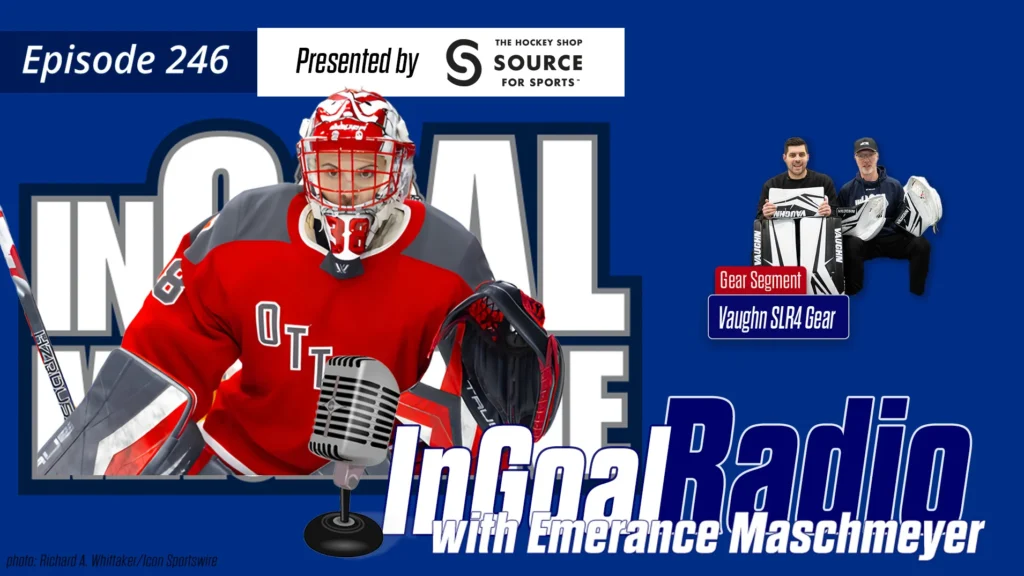
InGoal Radio Episode 246 with Emerance Maschmeyer

Please subscribe and leave a rating — it helps us reach more goalies!


In Episode 246 of InGoal Radio, PWHL Ottawa goalie Emerance Maschmeyer details specific technical changes she's already made working with new goalie coach Pierre Groulx during the inaugural PWHL season. She also traces her development from pond hockey in Alberta, playing at the Brick Tournament following Shannon Szabados's path, competing against boys in the AJHL, and representing Canada on the international stage.
- Maschmeyer has already made specific technical adjustments working with PWHL Ottawa goalie coach Pierre Groulx in the inaugural PWHL season.
- Shannon Szabados served as an early role model for Maschmeyer, who followed Szabados's path by competing at the famous Brick Tournament.
- Maschmeyer chose to play with and against boys all the way through junior hockey in the AJHL before attending Harvard.
- Goalies dealing with pegs that won't stay on need practical coping strategies to manage pressure from fans and referees during games.
- The Vaughn SLR4 pads and gloves are reviewed in-store at The Hockey Shop Source for Sports, completing coverage of the full Vaughn SLR4 equipment line.
Episode 246 of the InGoal Radio Podcast, presented by The Hockey Shop Source for Sports, features a fantastic interview with Emerance Maschmeyer of PWHL Ottawa and the Canadian National Team.
Feature Interview
presented by NHL Sense Arena
In that feature interview presented by NHL Sense Arena, Maschmeyer shares insights into the inaugural PWHL season, including getting into some of the specific changes she’s made already working with her new goalie coach Pierre Groulx. The Canadian National Team veteran also gets into her roots in the position, and evolution from playing on the ponds of Alberta with her brothers, building a relationship with Shannon Szabados while following her path by playing at the famous Brick Tournament, to choosing to play with and against boys right up to junior in the AJHL, the decision to attend — and adjustment to life at — Harvard, and her experiences and evolution playing for Canada on the international stage.
Parent Segment
presented by Stop It Goaltending U
Our parent segment shares some advice for helping your goalies deal with pegs that won’t stay on and the upset it can cause with pressures from fans and referees.
Weekly Gear Segment
presented by The Hockey Shop Source for SportsAll that, plus an in-person trip to The Hockey Shop Source for Sports for a closer look at the Vaughn SLR4 pads and gloves, a perfect follow up to previous overviews of the pants and chest protector.
Episode Transcript
Intro
Welcome to the InGoal Radio Podcast. This is Episode 246 presented by The Hockey Shop Source for Sports Langley and thehockeyshop.com. Featuring this week, PWHL Ottawa's Emerance Maschmeyer. In the Gear Segment, Cam and Woody are gonna cover the Vaughn SLR 4 line. Well, parents, we've got some thoughts for you on helping your kids deal with nets that won't stay on this week.
I'm David Hutchison. He's Kevin Woodley. And together, we bring you InGoal Magazine, the magazine for goalies, parents, and coaches. For less than a buck a week, you too can learn from NHL goalies and coaches. It's the advantage InGoal that everyone should have.
Woody, tomorrow's the trade deadline. Daren's still out with an upper body injury. Are we gonna have to make a move?
Oh, I never thought of that. That's a good question. I don't know that you know what? As we examine the options available to us on trade deadline for a replacement host, I don't think
There's not much out there, is there?
It'd be like Tampa Bay trying to replace Vasilevskiy going into the cup finals, you know, like, just it's not gonna happen. There isn't another Daren Millard. Yeah. We miss him. We miss you, buddy.
Get better. Get back. Because as much as we have scoured the waiver wire, there is no other Daren Millard.
Well, the good thing is with that, LTIR advantage, we can sort of keep him on the roster and he'll still be eligible for the playoffs. Woody, what's, what's
going on? There's there's a Vegas joke in there somewhere, but we're not gonna make it.
Well, I was trying to be a little more subtle than you. Okay. Woody, what's going on? How are our friends over at the Hockey Shop?
The good news is Daren's not here, so we can't get him in trouble.
I guess that's true. Yeah.
The Hockey Shop. You hear us talk about it. You hear us talk about it always having the latest and the greatest equipment, sales on the stuff that it replaces. But did you know that the roots of the Hockey Shop go back to tiny little hole in the wall, Surrey? You may know them from our YouTube videos as this 30,000 square foot gigantic goalie utopia in the corner, just massive, almost like a big box store.
But the roots are as a family owned business. Yes, they've moved into a bigger, better location, but they haven't forgotten those roots as a family owned business. They still operate like a family owned business, and that's why you get great service every time you go in there. That's why you have guys like Cam that have grown up as employees of the Hockey Shop, moved from selling gear to now running the whole goalie department. And I think it's really important.
Guys like Usual have been around sharpening skates and putting custom profiles on for decades. It's kind of important not to lose touch with that because I think when you see the sheer size of it, you can feel it's like going to a big university. You feel like you might get lost on it. But when you go to the hockey shop, you still get treated like you're just just one in the family, just like you did when it was a tiny little hole in the wall, that you could probably you know, even me as weak as I am throwing a puck on the ice as a goalie guy, I could probably go one side to the other with my weak sauce. That's how small it was.
So it was always the place to go. Now it's just bigger and better, but it hasn't lost the feel that it had in the original version. So if you ever have a chance to come in person, make sure you check them out at their new location in Langley. Still the same old hockey shop, just bigger and better. And if you can't make it out here, check them out at the hockeyshop.com.
Hey. And because they're family, that makes Cam your family, and you can give him a phone call anytime you have a question. He'll have the number at the end of this week's Gear Segment. Won't he, Woody?
Yeah. He's like the crazy cousin that you don't let sit at the adult table.
You just never let up on pour Cam. Our feature interview this week, Woody, you sat down with Emerance Maschmeyer. It's presented by NHL Sense Arena virtual reality training for goaltenders. And you know, buddy, this time of year, minor hockey playoffs are winding down, maybe even finished for some kids. This is a great time to trade your gear in for a headset, a Meta Quest headset.
I don't mean go sell your gear on Facebook Marketplace and go buy a Meta Quest headset, but put the gear away for a little while, grab a headset, and you can get in some off season training in NHL Sense Arena. Twenty minutes a day will keep your skills sharp this off season just like Joey Decor to the Seattle Kraken who uses it before and, yes, even during some games. You might not be able to face the same shooters on the ice that Joey can, but you can face NHL shooters all summer long in NHL Sense Arena. Imagine how ready you'll be for next season after a summer with Sense Arena. So head over to sensearena.com.
Use the code IGM 50 and you'll save even more. They've got a fantastic deal on right now. Woody? Yes? What's new this week?
I have a feeling there could be a lot new by the time people are listening to the podcast, but, what's going on around the league?
Well, I gotta be honest with you. I'm not sure there's gonna be a lot new by the time you listen to the podcast. Is it starting to feel like goalies aren't gonna move? Like, we're still seeing the ghost of Ryan Miller to St Louis way back when? Your insider's phone isn't buzzing?
No. I mean, think about it like the needs at this point. If the Devils who seem to have the clearest need aren't gonna move on Markstrom or any of the other number ones that may or may not be available, a list that at various points has included names as big as Juuse Saros, Linus Ullmark, and perhaps quietly Jordan Binnington, then, you know, if you think about it, like, one of the reasons for all the hesitation, and I go back to that year that Miller went to St Louis and even think about Flower going to Minnesota, There's just not enough runway left in the season for NHL teams to sort of get their guy acclimatized. It's not a systems thing. The systems aren't that different.
It's individual preferences and how each guy plays within that system and getting comfortable behind that. That's the bigger challenge from the goalies I talked to at the National Hockey League level. And if there's not enough time to get them comfortable and most of the needs around the league are sort of more in a maybe one b or backup insurance policy, think of Edmonton. Do they need an insurance policy? There they argue no.
Some people think yes. Either way, that backup if you go get a backup, he's gonna play, what, three, four, maybe five games for the end of the season. So if you actually need to go to him in playoffs, is it gonna be comfortable enough behind your team, behind new personnel, behind new tendencies? You know, I think I think you could make an argument maybe even less so than the backup you have on hand even if he might not have the same experience or pedigree. So listen.
I I wouldn't be surprised if we don't see a lot of moves and we're not talking about, you know, a whole bunch of things when we get back together next week that happened in the meantime. But, yeah, I mean, you never know. Could be wrong. There's still, as we record this, another sixteen hours left until the trade deadline, but so far, no goalies moved despite a lot of needs around the league.
You may have just cast the, the die right there that's gonna make things pop up and things will be happening.
Yeah. You know what? It's like when I come Yeah. When I cover an NHL game, we get to the second period. And me and the Canadian press writer next to me, we always look at each other and it's like, if there's a shout out on the go, like, hot crap. Do we look up the stats and get it ready for our story? Because that have you know, at the buzzer.
And inevitably, as soon as you look up the stats, the shut the shutout is broken. So maybe I just busted the goose egg right there.
So there's more to it. There's more to this don't say shutout rule. You can't even look up stats on shutouts or you're gonna jinx it.
Well, I don't believe in any of it, so I do it all the time. I'd rather jinx it, have a goal, and get it out of the way early. Listen. At the end of the day, hopefully, I just jinxed it and the floodgate's open. We have a whole bunch of trades of goaltenders tomorrow that make the goalies and the teams acquiring them happy.
In the meantime, we do have one news story in the NHL that is a happy one, an emotional one at times. Shortly before we, went to air to record this, Frederik Andersen first came back after the blood clots, gets the win for Carolina. Right. Does the interview on the bench postgame and is emotional in thanking the fans for all their support. You know, from us here at the goalie unit at InGoal, Freddie, a guy that I I've texted with a little bit since this all happened.
We're so happy to have you back. The NHL is a better league with you in it, Freddie. I'm glad to see that the health issues are behind you. I can't imagine how scary that was at times to have it taken away from you and to have the uncertainty of something like blood clots, but to see him back on the ice for the Carolina Hurricanes, a team that now has you know, speaking of guys available, Raanta on waivers, four goalies in the system, Luukkonen coming on, Spencer Martin giving them some really good minutes, and now Frederik Andersen back, presumably as their number one goaltender if he can get his game sorta and his feet underneath him after such a lengthy absence. But at the end of the day, regardless of how it shakes out, we're just happy to see Frederik Andersen back in an NHL net.
Hey. Last week, you had a car cast, I think. And, wasn't Freddie Andersen a car cast at one point?
He was. We did do a car cast for Frederik Andersen. That's true.
Long time, long time friend of the show. You were speaking of family at the Hockey Shop too, and there are several InGoal memberships in the Andersen family. It is a goaltending family.
It is dad, brother, all goaltenders. And Freddie's just really one of the great guys in the game as in addition to being a hell of a goaltender. So like I said, the whole goalie union just, you know, pat on the back, round of applause, all those things to see him back in the national hockey league and just see him playing again regardless, like I said, of, you know, what happens in the playoffs, how he feels, as long as he feels healthy, that's all that matters.
Glad to have Freddie back. I've sort of got the night I've got the night before Christmas going through my head right now. It was the night before trade deadline and all through the league.
I don't have any rhymes.
Not much. Just smart
of a guy.
You can't do it for me.
Parent Playbook
Alright. Not much. But what hey. You know what I wanna know? What's happening?
Because we got a new segment. I wanna get back to it. Yeah. Enjoy the lot, the first two. So what's happening with like, what's the question du jour?
What's happening in the, goalie parent world that we can help people with? Well, you, not me.
Well, it's well, yeah. Because I guarantee in this situation, you'd be going snap tastic, Woody. Saw a parent post a question this week. Question statement. They were upset because their, their goalie was involved in a in a tough situation that we've all faced before.
The net coming off repeatedly happens in minor hockey all the time. And, I know, Woody, you've got some technical solutions, to the net coming off, and you've helped some associations with that. But but this parent was upset not only that it was coming off repeatedly, but that the referee was giving their kid a hard time, threatening to give him a penalty. Presumably, ref thought maybe it was happening on purpose. Or I look.
I've even heard referees say, well, I'm it might not be on purpose, but I'm gonna have to give you a penalty anyway.
Well, I'm gonna go I'm gonna get snap tastic before we even get like that. Just blood is boiling hearing that crap.
It's probably happened to you in beer league. I've seen you go snap tastic.
It may have happened to me in beer league in the old days, but I got my own pegs now. I'm the only guy that shows up for beer league with his own pegs because he's tired of that crap.
No doubt. Look, it's it's maddening. And and I'm not gonna suggest that I'm better than anybody else in my response to it. I once watched a goal go in on my son when the net had been off for a very long time. How long?
I'm a crazy goalie dad, Woody. So I went home and I checked the video out and I actually timed it. The net had been off for fourteen full seconds before the puck went in the net and they called it a goal. Drives me nuts. And in the case of this parent who's asking, technically, the ref cannot give you a penalty unless they're convinced that it's that it's on purpose.
They can't do it just because the game's getting delayed five, ten, 15 times with the net popping off accidentally. But I don't really wanna answer this parent question in this way, Woody. I wanna come at it in a different way. I want to suggest that when something bad like this is happening and it might be the pegs coming off and there could be 14 other things that you take it as an opportunity to work on you and your goalie's mindset. Remind them that it's an opportunity.
How could the net pegs coming off and a ref being upset be an opportunity for you? I bet you're thinking, Woody.
Oh, yeah. Because I'm thinking how do I break the referee's ankles?
Gosh. An opportunity to go crazy. You have to look at it and say, there is nothing you can do about it. There's literally nothing. There's no amount of being upset that's gonna change the situation.
It's not gonna make the pegs stick. It's not gonna make the refs be happy. It's not gonna make the other parents from the other team that are screaming inevitably about your goalie knocking the net off on purpose. There's nothing you can do. So we always talk about controlling the controllables.
Here's what I say. If the ref's upset, smile at them and move on. If the net comes off, smile and move on. Even if it's five or 10 times, you just keep smiling, keep moving on. If the parents in the stands are screaming, you can smile too and show your goalie what what should be done.
Why am I saying that? Because I think smile and move on is a superpower for you as a goalie. I think maybe I'm auditioning for a guest segment with Pete Fry here, but I mean it. Why do I say it's a superpower? Because you know as a goalie that in this situation, everyone else around you is getting upset.
The ref's angry. Most importantly, the other team's angry. They're probably pointing at the goalie saying it's all their fault. The other coach is screaming. The parents are screaming.
But you know that you're not upset and that gives you a massive advantage over everybody else on the ice. If you get a penalty, smile and move on. It's just gonna tell you that you're the strongest person on the ice mentally and that's gonna get you through the situation that's there. I really, really, really believe that facing things this way is the best way to handle difficult situations because you know inside of you, if you can do that, you're stronger than the competition and you're gonna do better. You won't get it right the first time, Woody.
You won't get it right the fourteenth time, but eventually, you're gonna get known for your incredible mental strength and it's gonna give you an advantage on the ice. So if the pegs come off, it's a chance for you to be a better goalie.
Yeah. We're past me being mentally.
You don't buy it?
Yeah. No. I mean, it doesn't work for me. I think that that that ship has sailed for me, but maybe I'll try it next time. Although, again, I would just as soon get better pegs.
And I think every minor league hockey association should probably get some pegs that actually allow goalies to play the position the way they're supposed to. The absurdity of beer league pegs at any level. And if I'm not mistaken, this parent thought there might not have even been a peg in the net.
Yeah. I mean, look, all sorts of crazy things happen, but I agree with you. We've both seen
I actually like your approach. I'm I'm gonna hand you this one.
We've both
And there is nothing you can do. You're right. There's apps, so you might as well smile and move on. And then after you talk to your association and find, why don't you have better pegs?
Yeah. Absolutely. Woody brings his own pegs to beer league, everybody.
I do. Yeah. Bring it to my Monday night skate. Referees love me. To the point where the league actually purchased a bunch of sets, as did the junior B league in the area, through me at the time of the pegs we were using. The league I play in purchased sets for every net.
The only problem was goalie stole them and they ran out.
So parents, teach your goalies the superpower of smile and move on. And after you've smiled in front of your kids and taught showing them how it should be done, you can quietly send Woody an email and figure it all out from there. You you two can get upset together and you can find a solution for your association.
Yeah. Save the venting for me. Just come vent to us. How do they get ahold of us if they got a vent about anything or any questions, Hutch?
If you agree with me or you agree with Woody or you've got another question that you'd like answered in this segment, parents@InGoalmag.com. Real simple. And our parent coordinator will deal with that.
We have a parent coordinator?
Yeah. It's me too. Remember you were talking earlier about family owned businesses?
Hey, listen. I'm not the adult in the room. There's no question there. So I'm definitely not the coordinator.
Oh, yeah. We we we could have a thousand emails. They'll all just point to your inbox or mine, but we'll sound like a really big store, not a small family owned business.
That's the key.
Gear
So that's the parents, Woody. What'd you and Cam get up to this week?
Well, as usual, I just harassed him. Immature. Maybe a little bit of bullying. We probably need an adult in the room when we get together for our Gear Segment. You know what?
I actually think this week you were good to him.
No. Yeah. You may have
been mature, Woody, this week.
You and your positivity and happy and smiling crap. Now it's rubbing off and I'm nice.
Sorry,
buddy. This is this is ridiculous. Ridiculous. Well, listen, we had something to smile about. We done the Vaughn SLR 4 pants.
We done the Vaughn SLR 4 chesty. We heard from everybody in the comments about how nothing really looked like it had changed all that much from SLR 3. And we are happy to tell you that when we bring you the Vaughn SLR 4 pads and gloves, there's a whole bunch that's changed. I'll let Cam fill you in on the details. Welcome back to The Hockey Shop Source for Sports, where we're in Goal Utopia with my friend Cam Matwiv, we've got some new product.
Welcome back to The Hockey Shop Source for Sports, where we're in Goal Utopia with my friend Cam Matwiv, we've got some new product.
We did the Vaughn SLR 4 chest. We did the Vaughn SLR 4 pants.
So what's that, Dave?
A glove de blocker and the pads. Cam, I'm
gonna go to the
phone boards here as they say.
What are doing?
Yep. Just like we're on Talk Radio. We've had a lot of feedback on YouTube from the first couple and the question has been, hey, I didn't notice a lot of difference between SLR three and SLR four in the pants and the chest. A little bit more of a, if it ain't broke, don't fix it. We've got some differences in the Vaughn SLR four compared to the Vaughn SLR three.
Correct. Refinements and advances are changes and differences. So let's start with the knee cradle first. Well, I'm
gonna grab a three. We're just gonna do a little comparison. By the way, folks, you know what happens when we get new stuff? The old stuff goes on sale.
There is a sweet plug for it. I love it. Okay. So let's open that one up so you can kind of see here. Balance stabilizer returns.
This is something that already was there, but we do see a major refinement into it on the SLR four. Actually, more stable, much more rigid. Even the way that they've integrated the actual knee cradle themselves, it doesn't have that same flap. You're still returning some of the same materials, but again, this setup is now much more refined and adds the overall, you know, we'll call it stability of the pad. I mean, stability is the big word here, and it's been used across, like, all of these knee integrated knee cradles that we're seeing, you know, whether it be the Bauer, the CCM, and even more to a lesser extent too as well.
They've all had that, you know, somewhat along the same lines ish, you know, story for a little bit of a while now.
It matters. CCM had we saw first with CCM where they had their their knee stack and they did the research and did the sort of biomechanics and the measurements and basically showed that if there's a floppy knee stack, we'll actually delay your pad getting to the ice and if you have that fixed integrated edge between the knee stack and the pad, you can get it to the ice faster, which will in theory help you save more pucks.
Ideally, yeah. Alright.
Alright. So now that we've saved more pucks with Vaughn, what else is different?
Alright. Moving on down to the strapping system. So
remember folks, I got the old one, he's got the new. Not a reflection of my age.
Four. You can see the change. Actually simplified and better connective overall feel. They've gone with two straps instead of actually having that rotation control strap up top and then that closed off bottom. The pad itself will sit on the leg a little bit better.
It's gonna hug your calf a little bit better. You don't have that same kind of, a little bit of twist out and flop that I saw on some of the SLR3s once customers had them on. More adjustability too as well. So right now this is set at its tightest feature. You can switch that Velcro over onto the outside to get something a little bit looser And then to seal off the pads, you still have one central cap strap to wrap it all up.
Boots different too, Cam.
Oh, hold on. We're not done with the calf yet sorry. The cap plate has seen a major upgrade too for the pad. So if I take cap plate of an SLR three, it's quite floppy. Hands off my cap.
This one's quite a bit more rigid. So again, Murray, coined the term Stability. Stabilizer. Yes. Balance stabilizer.
More stability of that cap is going to help improve the seal of the pad and it's also in terms of for your sliding ability too, having that more rigid solid block there rather than something that kind of
flops underneath you, help to improve that side. Well, here's the thing. The more sort of surface you have contacting the ice, the more inherent friction you have. So having a thicker one could in theory slow you down but we've got primo on the inside or what do they call it?
Quick slide. Quick slide.
It's basically primo. Okay. It slides good and it's more durable. Correct. Alright.
You show your SLR four. I'm gonna show my SLR three.
Boot. Another big change. This is something we saw on the V 10. They've My gone gosh. Away
It's taller than yours.
From overall boot pad now straight to a flat tabletop boot design. No bootstrap stock on these pads. Custom. You can do whatever you want. New elastic bungee system too as well.
So we
don't Old elastic bungee system.
We don't have those anymore. This is a good thing. This max size as well. No taper to it. So this is gonna really help with that download coverage too as well.
Is there a taper in this one?
Little little bit subtle taper. Subtle taper. What about the subtle taper? Okay. So that's the differences in the pad real quick, Cam.
But it really you told me that this is kind of a big difference.
Yes. May I have the other one, please? Yeah. Okay. Why thank you.
Alright. So Vaughn has completely changed their angles for their SLR four gloves now. So now we're talking between a 60 and a 70 degree glove. Speak CCM to me, Cam, because that's the common vernacular. Five eighty.
Oh, sorry. Five eighty. This one. Yeah. Five ninety.
Close it, Cam.
Boy, he's got the strong hands, this boy.
So index finger to base of thumb closure here. A little bit more straight up, but you can really see how we can get that overall outside tee inside the thumb here. This helps to create that bit of that five eighty overall feel.
You can see the offset tee helps sort of create that. Well, you got that one by your ear? Correct.
So this
one of their last name.
This has been a change. Those Vaughn SLR gloves have been a similar angle for quite a number of years. SLR one, two, and three. Now we've seen it kind of gone more towards what would be common market trend with the 590 and the 580 kind of dominating those general glove closure angles that, you know, most consumers are looking for goalies. So overall feel wise, this is great.
I like the thinner tee on it as well. I mean, this is a personal preference thing. You know, if you don't like that thinner tee, once again, custom options are available to make you find
exactly what you're looking for. Nice deep pocket. Like it, Cam. Last thing, the blocker. Blocker.
Now here's where that word, you know, kinda similar comes into play a little bit.
Ain't broke, Don't fix it, Cameron.
However, much more rigid sidewall, actually. Noticed with the SLR four even to the three, balance point for the blockers remain pretty much similar.
Similar being neutral?
Correct. Open the cuff up a little bit more too as well. Allow with a little bit better integration with especially a bigger set of shoulder pads chesty. Okay. No, it doesn't smell yet because it's brand new.
Again, I like the feel of it. Their carbon is integrated with all pieces of equipment, but it shows it's most in the blocker itself. That's what's helping to aid in that punch. Punch.
Not free punch. Man, I wish I had a blocker and I'd punch you. I like that primo on the back there. Show that up.
There are some nice added features. And I mean, all this stuff is hand built in Canada. When you're looking at the pro carbon gear, there is an SLR four Pro and that is their offshore gear and that'll be coming soon in end of April.
So hold on. This is Pro Carbon.
Pro Carbon.
Made in North America, Canada.
Yes. Available in custom order and off the wall right now.
Pro is just Offshore. Offshore. Correct. So still pro, but pro carbon is Is the onshore. Okay.
Yes. I know some confusion. Just making sure. Just making sure, Canada.
It's such a good job.
Any questions about that, you can give me a call. (604) 589-8299 or 1-800-567-7790 or check us out at the hockeyshop.com where we have the SLR four gear up and displayed. If you have any questions about custom ordering, which is like you said, available now, get your orders in. Oh, I have a question.
If I'm an American and I wanna order this from you and take advantage of the fact my dollar's worth, like, so much up here.
So much.
Does this cross the border? Oui. It does. There you go, folks. Both sides of the border.
You can order your Vaughn SLR four pro carbon glove blocker pads, chest, pants. And hey. You know what?
If none of this stuff interests you and you're like, okay. I really still can't see the differences. Great. SLR three is on sale. Go buy it.
20% off. Exactly. But there's differences this time.
There is differences. Yeah. Definitely.
I love that you guys took this segment to point out the incremental improvement and compare the two, the SLR three and the SLR four. I know what you were saying. There's people complaining about marginal gains, those not being enough. Okay, great. Take the sale.
And if you want the best Vaughn has to offer right now, go get the SLR four. There's something for every Vaughn fan here this week. Those marginal gains have taken us a long way though. Haven't they, Woody? I mean, I think we both got a a Reebok p four sitting behind us.
And I remember looking at those thinking, what else could they possibly do? And yet every year, there's just those incremental gains that you guys were talking about that look how far they've taken us.
No. It's much like goaltending itself. Right? You're always looking for that next one or 2%.
And that might be the one that makes the save that gets you to the next round in the playoffs. You never know.
Or in my case, actually, to the playoffs.
Oh, yeah? You guys in rough shape?
Nah. I kinda suck.
Oh, well, maybe they can make a move at the deadline. I hear Markstrom might be available.
Don't know if we can afford them, but we might try.
Feature Interview - Emerance Maschmeyer
Okay. Anyway, that was fun with you and Cam. Thank you very much. And thank you to the Hockey Shop and the hockeyshop.com. Now NHL Sense Arena, as they do every week, brings us our feature interview with Emerance Maschmeyer.
And I am so glad, Woody, that we've got another great PWHL goaltender on the show.
Yeah. Member of Team Canada as well. She's been really busy. National hockey league all star game participated there, then straight to the rivalry series, which she where she had a clutch shutout in game six to force game seven in a reverse sweep by Canada winning the final four of that best of seven series. And then right back into the PWHL where she's been one of the busiest goalies in the league.
So, really grateful, to Emerance Maschmeyer for making the time to talk to us. This interview, I don't wanna give too much away. You just are not gonna wanna miss it. It is jam packed. A lot of the things she's changed over the years.
You'll hear the energy in her voice about how she started, the passion she has for the position, and sort of the constant evolution she's gone through, including this year with the PWHL where she has, you know, her first sort of at a per professional level goaltending coach in our old friend from InGoal, Pierre Groulx, who we've been on the ice with as far back as his time coaching the Canadians with with Carey Price. So, lots of great insights, lots of very specific things she shares with us that goaltenders of every age and skill level we will be able to sort of take home and, you know, bring into their own game or mindset or whether it's a skill or a mindset. It'll help make goalies, of it. Like I said, every age, every skill level better. So plenty of great tips here from Emerance Maschmeyer.
I think you're gonna enjoy this one. Really excited to welcome to the InGoal Radio Podcast. First time guest long overdue. Emerance Maschmeyer from team Canada, PWHL Ottawa. You saw her recently at the NHL All Star Game.
I was trying to like, whirlwind doesn't even even seem to describe how the past month, month and a half has been for you. How how how have you managed all this work and travel?
Oh my gosh. It's been it's been amazing. First and foremost, it's been so much fun. I'm just so happy to be playing games consistently again. It's been a little while since we've had that, but, yeah, I've been on the road a lot.
It's I think the last thirty days, I spent three nights at home in my own bed, so I've been basically living out of a suitcase. This week has been really nice to be I mean, the last two days, be at home and kinda settle in here for a couple of home games.
Lead the PWHL in minutes. So even when you're playing at there, you're busy. First goalie in the league with with an assist on her resume. What's what's it been like being a part of the start of a new league, one you'd been working towards for a long time? What like, how can you sum up what what sort of what that all means over the past little while?
Oh my gosh. It's it's really hard to put into words because it is it's something that, you know, players in the past, pioneers of the past, the present, kind of this generation that's playing into this league right now, we've all worked so hard for for so long. And to finally have it come to fruition is just it's unbelievable. Every day I wake up, I'm like, this is, like, this really is a dream. Like, this is this is exactly what we wanted, and it's been so special to be a part of a brand new franchise, a brand new league.
Oh my gosh. It's it's really hard to put into words because it is it's something that, you know, players in the past, pioneers of the past, the present, kind of this generation that's playing into this league right now, we've all worked so hard for for so long. And to finally have it come to fruition is just it's unbelievable. Every day I wake up, I'm like, this is, like, this really is a dream. Like, this is this is exactly what we wanted, and it's been so special to be a part of a brand new franchise, a brand new league.
Like, how often in your life do you get to be a part of something that's bigger than yourself, but something that's brand new and that you kinda get to write the history book of? So, yeah, it's it's just been it's been a whirlwind. It's been so special. Yeah. Every day, honestly feel I've I've pinched me moments like, this is really happening now.
You've played professional hockey before in the CWHL. Can you walk me through because I know I've had conversations over the past couple years about the differences you were hoping to achieve, the the PWHPA in terms of what what you wanted to change in this new league. Can you walk me through some of the specifics of, you know, what makes this different? What makes this better than you know, not to not to disparage what you were doing in the past or the leagues you played in the past, but there's another level here, it seems, in talking to some of the athletes of both.
Yeah. Completely. I mean, the the league is professional top down, and, you know, kind of the, you know, the CWHL and our our players association, the PWH PA that we had played in the last couple seasons, with, you know the people did the best that they could with the resources they had. And at the end of the day, we had such a small group that was working for the league that, you know, you can only do so much as as a handful of people. And so I think this league, just top down in terms of resources, staff, I think it's really every every decision is made with the players in mind.
And, you know, in terms of travel, like, the CW, we used to travel like, back when I played with the Calgary Inferno, we would fly on the day same day as we would play a game. And so sometimes our flights were delayed out of Calgary, and we'd be getting into Toronto or Boston, and we'd be going straight to the rink to play. We wouldn't even get to have our pregame meal and even sometimes missing off ice warm up. And so we don't have that anymore. You know?
Like, every decision is made with the players in mind. And then, again, like, the investment that is being put into the game, the amount of staff that's working for the league and for each franchise, it's yeah. I mean, it's just everything. We have all the resources. We have therapists.
We have equipment managers. We have and that sounds so silly when you say it like that, but we didn't necessarily have these things all the way through. So it's just we don't have to worry about all the extra noise. It's now everything is kinda put in place for us. We have the resources.
We have the staff and the people with the expertise, and and now we can just go out there and play.
Yeah. I don't think it sounds silly at all. I do I think maybe just people assumed that all existed in the past leagues. If, you know, if you've been around pro sports or the NHL, that all that's all there. But I think that was why I wanted to ask because I know that was one of what what this was all about in terms of the push for actually being a true professional league at those levels.
You mentioned Right. Yeah. You mentioned support staff and one of the things you have there that, you know, not everybody had. I don't know if you had it at at your other CWHL stops, but certainly not everybody did. A goalie coach and access to ice and and an opportunity to work on your game on a full time basis.
How's it been with PG so far?
Oh my gosh. He's the best. Yeah. Pierre is you know, I've had the same couple of goalie coaches for, I don't know, the past ten, fifteen years now. And so it's been really awesome to have a new perspective, a new set of eyes watching my game.
Him and I get along really well, and I think that's super important when, you know, in a goaltending position, when you spend so much time with a goalie coach, it's important that you build that relationship quickly and and speak the same language, and I believe that him and I do. And he's been so awesome. He's, you know, he's at every single practice, every game. So he has a full picture and the full scope of my work, and we do a lot of video. We spend a lot of time together.
So, yeah, I appreciate him a lot.
Big fans of Pierre Groulx here, at InGoal as well. Can you walk me through maybe this is, you know, something that might resonate with goalies at at a lot of different levels, at a lot of different age groups. Like, you you move on to a new team or a new level, and you get a new voice. You get a new coach. The process of sort of knowing your game, but being open to changes, and maybe some examples of some of the things that you've gone back and and forth with p Pierre on in terms of figuring out what works for you and what doesn't.
Yeah. I think that's a good point. I know sometimes it's difficult to hear, and be given feedback, especially from someone that you've just met. And I I think for me, especially in my last, I would say, five or six years of playing, I wanna make sure that I'm being a student of the game. You know, I know I have my base, and I I'm very technically sound, but I also know that the game is ever evolving.
And I don't wanna be left behind because I'm too stubborn. And so for me, it's if I get feedback, I will try and implement it right away. And I'll give it some time to set in because sometimes, you know, you try something, it doesn't, you know, it doesn't work right away, it doesn't feel right. But once you kinda actually give it an honest a try, then you end up saying, okay. Maybe this is something I'd like to implement.
And so I think being open to feedback always, no matter who you're getting it from. Also be open to watching other goalies' games, seeing how they play in different situations, because there's always someone doing something different. And maybe there's things that you, you know, you look at someone else's game or you hear feedback and you're like, okay. That's something I absolutely do not wanna implement into my game. But other times, it's like, okay.
How can I how can I use this? Is there moments in the game that this could be beneficial?
Tools in the toolbox as we always like to say. Here's are there any examples that you'd be comfortable sharing in terms of something that you are trying different or whether it's with Pierre or even in the past couple years where it's like maybe something you thought, I don't know if this is for me, but in the right situation, you have found yourself applying it?
Yeah. Actually, one thing that him and I are working on that he noticed in my game from video actually before the season, he'd he'd done a little research on me and watched a bunch of my previous games from past seasons. And one thing that I actually moved towards doing in the past was as soon as the puck was so, like, dead angle, when as soon as the puck hit kind of the hash marks of the outside of the circle, I would hit my post on my feet, but I would kind of locate my post, and then that's kind of my safety net. And so that's something I really actually liked in my game. And then he was like, okay.
I know this is something that you do, but here's my perspective on it. And so his thought and his approach to it is as soon as the puck is, let's say, below the goal line on the outside, as soon as it goes above the goal line, I disengage with my post. Only if there's no backdoor backdoor threat because, of course, if there's a backdoor threat, you you might not wanna disengage too far out. But for me, it was just freeing up my body so that if someone came and walked a dead angle, I'm not stuck on my post. And then it also gives me kinda loosens me up and frees me up to if someone was top of the circle for a one timer, then I'm just a step quicker.
And so this is something that we've been working on. And at first, I to be honest, I was like, this feels weird. I feel like I'm floating in the middle of nowhere even though I was just two inches off my post. It just didn't feel safe for me. And then as soon as I, you know, kept practicing it and implementing it into games, now I'm not even thinking about it.
I'm doing it all the time. And there's been many examples in my game that I've been like, I've made the save super easy, and I've controlled it because of this disengagement. So it's a so that yeah. That would be an example of, you know, something I was hesitant to change. But then once I was like, okay.
I'm trying this. I'm implementing it. Okay. I see where where this will work. And still, sometimes I hit my post.
There are certain scenarios, but I think having, like you said, tools in your toolkit and multiple ways to make saves the game is just know, so unpredictable, and there's no two games that are alike. So, you know, just being well rounded in that sense.
I love it. And this audience, of course, is all goaltenders, so they're gonna love hearing that as well. Not just as an example, but as as something to think about. Right? Like, now so when you take, say, two inches out, like, are you talking like an overlap or just being, you know, just Exactly.
Yeah. Okay.
Mhmm. So, yeah, like an overlap, but I'm not even I'm not joking when I'm saying two inches, just two inches off the post. So my my skate that would normally be on the post is just an overlap. And for me, if if a player comes off the half wall towards the net and there's no backdoor threat, then I'm square with them. And because sometimes, you know, when you're you're on your post and you're trying to make a save on your post, as soon as you go down trying to go on RVH, it's I find, you know, it is pretty hole holy.
There's lots of holes, and there is a moment when you're switching from on your feet to your pads that things open up, and you you almost have to push off your post to go back in. Yep. So this way, when I'm in overlap, it frees me right up, and you can basically go down straight into butterfly. And and that way, I control my rebound a lot better too.
I I was gonna say too, and if you do try and square up with a skate on the post and drop into a butterfly, like, just the human nature of a butterfly is you're you're pushing yourself off that short side as you drop with that skate touching the post.
Exactly. Yeah. And there's and there's a time and place. Like, obviously, if someone's sitting backdoor waiting to tap in a puck, and someone's skating towards the net, off the half wall, then, you know, you play the situation a little bit differently. I wouldn't be in overlap because that backdoor.
There's no chance I'm getting there. Right. So it is very situational, but, yeah, that's just a little skill, and it's almost, yeah, a mental skill that, I've been I've been implementing into my game.
Okay. So I I would be remiss because not everybody's gotten to watch you as much as I've I tried to watch the other game with the PWHL, tried to watch some rivalry series. Congratulations. Big game six shout out in that one.
Thank you.
Not everyone like, for those who haven't had a chance to watch you as much, when you say my base, my foundation, describe it for me. Describe what you see as sort of the staples if somebody were watching you, what you want them to see and identify as as your sort of staples and foundation.
Yeah. I would say that my biggest asset is, my skating ability and my speed. I'm a quick goalie. I I'm not the biggest goalie out there. It seems like our league either has five foot six goalies or six feet.
It's quite funny, but I'm I'm on the shorter end. So for me, I I've always used that as my superpower being a smaller goalie. It's like I have to be fast. My gloves have to be really good, and I have to have the best rebound control in the league. And so I would say those are my biggest assets.
It's quite funny, but I'm I'm on the shorter end. So for me, I I've always used that as my superpower being a smaller goalie. It's like I have to be fast. My gloves have to be really good, and I have to have the best rebound control in the league. And so I would say those are my biggest assets.
And for me, I can't play super deep. I have to play at the top of my crease. So you'll often find me kinda pushing those boundaries, but always set. And my feet are almost, you know, pretty calm, always set before the shot. And I like to move laterally on my feet.
I'm not really sliding around a lot in net. And, yeah, I would say my gloves are are one of my biggest assets just because they are so effective in rebound control.
Okay. So it's not a big goaltender. Having to take a little more ice, you know, obviously becomes part of the equation, but is it to the extremes? Like, you know, I think a lot of people hear that and they think, oh, she's, like, way outside the blue.
And Oh my gosh. No.
I that's not that's not that's not what I see.
Oh, I would be in big trouble if I was out there. No. When I say yeah. Like, the top at the top of the blue.
Right. Like, on or heels out?
That. Toe like, toes. Yeah.
Okay. Yeah. So, I mean, I think like, it's funny because, again, it reminds me it reminds me of Pekka Rinne and Juuse Saros. Juuse Saros shows up in Nashville at five foot ten, five foot eleven. I think they list them a little higher than that, but they're being generous.
And Pekka is six foot seven, and Juuse plays takes less ice. And we always hear it, like, there's that stereotype. Oh, smaller goalie's gotta be way out there. But the reality is you can still play within the boundaries of your crease and have success regardless of size. Mhmm.
the most important thing is being positionally sound and being being lined up to the shot and having active gloves, active hands, and being over top of the puck. So for me, it's it's more about that. It's having my feet set, having my gloves out, and making sure my balance is forward on save.
Like, at the end of the day, when when the puck is especially in tight, your net is not very big. So for smaller goalies who think that they need to play outside of the blue, the physics actually show and the, you know, the math shows that you don't actually need to play that far out. The most important thing is being positionally sound and being being lined up to the shot and having active gloves, active hands, and being over top of the puck. So for me, it's it's more about that. It's having my feet set, having my gloves out, and making sure my balance is forward on save.
Yeah. I know. I see. It's I I love that. I love that as a lesson to hear you share that with other goalies that that that'll resonate with because I do find that that can be know, you even sometimes in minor hockey where maybe there isn't a goalie coach or it's a dad who played thirty years ago or whatever, you know, that that mentality can creep in, and it just isn't the reality at the highest levels of the game.
The reason you're able to beat plays and be set and be squares because you're not being hyper aggressive. There's a control element to to playing at the edge of your crease.
Right. And if and if you're playing too far out, it's obviously you have a little less time to react to shots as well. So you you'll you'll end up resorting to a blocking mentality. And and if that's the case, there if you're blocking, there's normally gonna be a rebound. And if you're too far out, that's when you get into trouble because you're not able to recover back on rebound.
So there's definitely a fine line. And I think every goalie you know, you have to play with it a little bit. Like, I I can't I probably played further out when I was younger.
Right.
But now, you know, you you trial and error, different positioning, different, movements, everything. Right? So every goalie is a little bit different. I think it's just finding your own sweet spot.
Okay. So where did this you're clearly a student of the game. The passion in your voice comes through talking about how you play and the different elements that you bring to the game. Where'd this all start for you? Where where where how'd you fall in love with with being a goaltender?
Oh my gosh. Well, I grew up in a big hockey family. We so I grew up on a farm about an hour outside of Edmonton. So we I have four siblings. We all played, and my dad built an outdoor hockey rink when we were younger and always had the ice in every winter.
So we'd be on the ice with our minor hockey teams, and then we'd be at home after and doing, you know, shooting practice and run mean, I would always be running us through all these different drills. So my family, just a big hockey family, and then I actually started out as a player. I was a a forward. I loved scoring goals, which is quite ironic now that I'm in the net stopping goals. But I started out as a player at age three, and then when I was seven, I I was back in novice.
They would alternate us in nets, and it was my turn to go in net that day. And I remember making a couple big saves, and then after the game, told my parents, like, I had a lot of fun making saves. And that Christmas, I ended up getting goalie gear. And me being kinda like the shy, quiet kid that I was, I was like, okay. I guess, you know, I'm gonna be playing both player and goalie now.
Like, I was like, let's go. So I actually played a little bit of both for a while and then officially decided to be a goalie at age nine or 10. And, you know, I was very lucky and fortunate that my parents were able to put me InGoalie lessons and goalie training quite early, about eight years old. So I I improved quite quickly in net, and I I gravitated more towards wearing my goalie gear than my player gear. And at some point, I said, this is a lot more fun to design and wear goalie gear than it is player.
So yeah. And then I was kinda stuck in net after that. My my siblings loved having me in net.
I was kidding. Yeah. I mean, there's usually that that's a part of a you'd be amazed how many of the origin stories. It's either the gear, which you touched on, or, you you know, ended up siblings want you in net because they gotta shoot on somebody. All all older brothers?
Or
I have an older sister, two older brothers, and a younger brother. And, yeah, all of us played. And
And you were the only
goalie? Played for yeah. Only goalie. The rest well, the rest actually are well, all ended their career playing on d, but all but one started out as forward. So it's funny.
We all kinda transitioned from being the goal scorers to being very defensive.
Well, that I I think that would just suggest wisdom, right, with age. You just oh, everybody got smarter because forwards are a pain. Right? Let's be honest. But no
We we love them, and we hate them. That's for sure.
No no shortage. Well, in beer league, we don't see them. Right? Except for in the locker room afterward. They never come back.
So, that no shortage of shots as like, what do you think that did for you? You you mentioned the training, and I wanna get into that a little bit when you started to learn some of these technical aspects. But just being out on the pond with your siblings, getting the opportunity to be out there playing, like you said, experimenting. Was there a point where you were watching other goalies at the pro levels or junior or whatever and trying to imitate them? Was there somebody that you looked up to at a young age from a goaltending perspective that you you tried to play like when you're out there on the pond?
I mean, probably all those all the things that you said. Like, I I spent a lot of time on the ice when I was a kid and probably out of fall. There were days where I would have three practices kind of back to back to back. Would have my own team practice. We also went to, like, a hockey program school in Edmonton.
We were a crazy hockey family. So I spent a lot of time on the ice and then a lot of time with different goalies as well. And oftentimes, I would play up with my siblings' teams or practice kinda being just called up to their team. So I would be around older goalies Okay. And goalies who were bigger than me.
And so I always was trying to pick different pieces from other goalies' games and be like, okay. I really like that or like that. I'm gonna try that today. And a goalie that I watched a lot too was Shannon Szabados, which, you know, we ended up being teammates in her last couple years on the national team, which is a pretty cool kind of full circle moment. But she was someone who she so she grew up playing in Sherwood Park in Alberta and played guys hockey all the way through, played junior a, and and that was the path that I wanted to to be on.
And I wanted to play juniors one day. And so she was someone that you know, I I watched her game quite a bit. And she was probably the only kind of elite, I guess, national team level goalie that I was close to. You know, the other goalies, Kim St-Pierre, they're they're in Quebec. So I the access to watching them, you know, there wasn't much.
And so, yeah, I feel like I took little pieces from everyone's game, but also just found what worked for me. Right? There's you you just, for me, it was just always trialing and erring and finding out, okay. This is working. Okay.
Now it's not. Why is it not working? What have I changed? Or what could I change? Yeah.
Like, kind of I said before, just being a student of the game and just always being humble enough to know that, okay. There's something that I can improve on always.
I love that mentality. And it's interesting. Like, all like, there's not many goalies, like, for example, just at the NHL level that hit a thousand games, but everyone that does, whether it's Fleury recently or Luukkonen who I got to know before that, like, that growth mindset is always a big part of it. No matter how far along they are in their careers, they're willing to try new things. I love it.
Second female goalie, as I understand it, to play in the brick tournament in Edmonton. Is that where the relationship with Shannon started? I I I read something about the you know, getting introduced there. I don't know if that was correct or not, but what a goalie to get to know. I remember covering the twenty ten Olympics, both men's and women's side, and I think Shannon was the most technically sound goaltender on in either side of the tournament.
Yeah. So that is true. So we, she played for team Brick. I don't wanna mess up the year because she would be very angry at me, but she played, a few years before I did. And so when I played in 2004, which also makes me sound a little bit old now, but played in 2004, she came in, met me in the locker room, and I think she was about 17, 16, 17 at that point.
I was 10 years old, and like I said, I was a very quiet and shy child, and I don't think I said a single word to her. But she came and talked to me and signed a puck for me, and that is definitely where our relationship started. I had known about her, obviously, being the first female to play on Team Brick. And at that point, I believe she was playing in for Saskatchewan for the the Raiders, the junior A team.
Right.
And after that, we we stayed in touch. I'd always kinda reach out to her for advice on kind of hockey moves and what to you know, it's a little bit different being a female goalie in a in a predominantly male hockey world and Yep. Us choosing to play boys hockey. So I would often reach out to her, and she would reach out to me as well anytime she'd see I was having success or something was going on. And, yeah, it's quite it was quite interesting to eventually one day end up in the team Canada locker room together.
That's such a cool story. Now you had you did end up playing some preseason games with Lloydminster, if I if I've got that right, in the AJ. Those decisions, that path, like you said, you talked to Shannon about it. Would if somebody came to you now and asked and, obviously, now we have a league that you can aspire to that other young girls can see you playing and then say, I wanna be there one day. But the path to get there, what advice would you give?
Yeah. That's that's a tricky one because I think well, so I when I played for Lloydminster so I did play some preseason games. I guess it would have been my first year no. My second year of midgets, and then my my third year, I ended up playing for Lloydminster for the whole season. But I was the third goalie designated third goalie, but oftentimes was the backup because one of our goalies was injured.
K. So I didn't get to play a lot of games. I played, I think, in in seven games, if that that could be correct. I could be wrong. But for me, I knew that was kind of the best decision for me.
I'd played Midget AAA this season before, and that was a lot of fun. I was getting a lot of playing time, and my team wasn't the greatest, so I got a lot of shots. But I wanted to challenge myself in a different way. I knew that playing junior a would elevate my game, just being kind of a step up from the midget level. And then also, it's kinda weird, but at at at that time, I knew I was gonna be third goalie, but I think that it was kind of the best thing for me.
Because up until that point, I had been a starting goalie. And just learning how to handle that adversity and that pressure to perform on command because I wasn't playing every day. And so when you're told you're in that just finding a way to channel that pressure, you know, and that and those nerves going to those games and being able to put a product out there. So I don't know. It was it was definitely a personal decision to do that.
I could've went back and played in Fort Saskatchewan for the team that I played for the year before. But I'm, yeah, I'm also about, you know, new experiences and pushing my boundaries, and so that was for me. But in terms of of advice, I would say for for females that are trying to play in the PWHL, I think that everyone's journey is gonna look a little bit different. I know that female hockey is a lot more developed than it was when I was going through, especially in Alberta. There wasn't a lot of options for female hockey, especially elite end.
And so I think just asking questions like, for from people around around you, whether you're from Alberta, Ontario. I think the systems for hockey is a little bit different in different provinces. Same in the states. Everything you know, every province, every state is a little bit different. So I think just using your resources, asking questions, and and knowing that maybe the path that you're taking is different than others, that's actually okay, and everyone's journey is a little bit different.
You know, some people start out playing elite level. They know they want to play pro. They wanna go to college. They have their path in mind. Others are just playing for fun, and they're eventually, they're like, you know what?
I wanna take this to the next level. And so, yeah, no path is wrong. I think just finding a way to use the resources that you have.
It's like save selections. Right? Tools in the toolbox. Everybody everybody chooses a different one at different times. Exactly. Now the decision to go to Harvard is, you know, I couldn't help but notice when you talked about positioning in the crease, you mentioned physics and math. So, obviously, despite all the time you spent on the outdoor rink in Alberta, education wasn't neglected. That opportunity, that path, that decision, and the challenge of playing primarily on weekends all the time you have to practice in that environment, but also keeping up with school. Like, being a student athlete is not an easy thing. How'd you how'd you manage it?
Yeah. Academics has has always been super important to me, and I think that stems from my grandparents. And they valued education so much, and that trickled down through the family. And for me, that's something that I always took pride in was, you know, being the my best student being the best student I could be at school, but also on the ice and always being open to learning. But, yeah, it was it was difficult.
I you know, there was lots of challenges in terms of time management, kind of the workload in school and on the ice. And I know even my I guess I started playing for the senior national team my third year in college, and and with that means September camp, world championship, make like, fitness testing camp. So and that's outside of playing for Harvard hockey. So so, you know, you're just trying to find ways to stay on top of your schedule. And for me, was always like, what's the next most important thing that I need to get done?
So just prioritizing what I needed to. And, yeah, even honestly, when I think back to it, I'm like, I really don't know how I manage that. But luckily, I'm a very type a person. I'm good at making lists and checking things off.
Well, it it sounds like that not just having a list, but making sure that your list is properly prioritized, which I gotta be honest, is something I'm still working on at 50. Like, that's a good life lesson.
Definitely. And I think that's what you know, when you go to college, there are a lot of distractions for sure, and I think, it tests it tests us in many ways. And especially when you you are a student athlete, you have to, you have to make sure that mentally for your school that you're on but also for hockey, and then physically you want to be rested, make sure that you're eating right. There's just so many elements that you need to stay on top of. And, of course, you want to also enjoy enjoy the social aspect of being in college, like, because that's, you know, a fun experience in itself. So, yeah. I mean, it's definitely challenging to navigate, where to allot your time, but, honestly, I had such a such a blast doing it.
Definitely. And I think that's what you know, when you go to college, there are a lot of distractions for sure, and I think, it tests it tests us in many ways. And especially when you you are a student athlete, you have to, you have to make sure that mentally for your school that you're on but also for hockey, and then physically you want to be rested, make sure that you're eating right. There's just so many elements that you need to stay on top of. And, of course, you want to also enjoy enjoy the social aspect of being in college, like, because that's, you know, a fun experience in itself. So, yeah. I mean, it's definitely challenging to navigate, where to allot your time, but, honestly, I had such a such a blast doing it.
You mentioned the national team. Actually, I just wanna rewind really quickly because one of the things you talked about when you were playing junior and not playing as much, the ability to deliver a performance under pressure when you don't have in your hip pocket, you know, a game two days ago or four days? You're not in rhythm. You don't have that timing. You're not you're not just rolling from one game to the next.
Did you come up? Like, what were some of the things you came up with? Because there's probably a lot of kids listening to this right now, parents of kids wondering, how can I help my son or daughter get through those moments themselves when they're not playing or when they've been off for a week or two weeks and they've gotta boom? They're in the game and the pressure's on.
Yeah. I think I guess there's a few things that and I I not I didn't necessarily learn this when I was in Lloydminster. I think even over the last few years of not having a league and, like, even, let's say, last year, we would play I went to the rivalry series, so there's three times that team Canada gets together throughout the season, and then world championships. And then in between, we had the PWHL showcases, but you weren't, you know, you weren't practicing as a team. It wasn't necessarily, you know, your typical hockey season, so games were kind of far few and far in between.
And so I had a lot of practice the last couple years kind of managing that. And for me, I would say a couple of the biggest things is, one, just practice habits. I think for me, that is something that I've been focusing on in my game probably the last eight years is making sure that what I'm doing is in practice is up to standard of what I would do in a game. And so that means, you know, battling out each shot and rebound, covering pucks as quickly as possible and killing plays, making sure my pushes are hard, that I'm set, communicating with my, you know, my d, my forwards, just all the habits that you do wanna execute in a game because when you get in those moments in a game, you've already practiced it. It's not the first time you're doing it after a month of not playing.
And then I would say the other big thing is, you know, it is there. I would say it's very easy to feel good about your game when you're playing all the time and consistently, and and it's a lot easier to find. I always call it a my flow state. So when I'm in that state usually, it's a lot easier when I'm playing games every two or three days. But when I'm not away from the rink is kinda where I do the work on that.
So it's, like, a lot more mental prep. For me, I've I've implemented doing positive affirmation. So it's basically I I take my journal, and I write down a paragraph of all the great things that I do as a goaltender and why I'm so successful. And it's just for me, it's just reminding myself, okay, you've done this. You're really good at this.
You're the best goalie in the world. Like, you know, you can exaggerate these things. You can really but as soon as you're saying it out loud and you're writing it down, your brain believes it. So it's just kind of affirming that, okay, you've got this. You've done this many times before.
Just because you haven't played in a month doesn't mean you forget how to play hockey. You've been on the ice. You've been training. You've been working hard. Yeah.
So I think it's it's the physical prep and the repetition and practice, but also kind of that mental mental side of it. Think it oftentimes, that's the more difficult part is when you're not playing all the time is, you know, just being mentally prepared to play. And it is a lot of pressure. When you haven't played in a while, it's it can be difficult to kinda get into that flow state on the ice.
Well, and I would imagine too, like, it's one thing. Like, say, if you're a backup or if you're injured, you haven't played, you're going back to your regular team. But as you said, for the past couple of years, like, you have to find that on a big stage, whether it's with the national team or some you know, like, the showcases played in front of, you know, like, huge audiences in big buildings and things like that. So I love that. Right.
The was the positive affirmation, is that something you do, like, on a daily basis with the journaling, or is that part of daily journaling? I'm just trying to I'm trying to pull a little more on that one because I I think there's probably a lot of young goalies out there. Heck, goalies of all ages that might benefit from that.
Right. No. There's I mean, there's journaling is something that I've always liked to, kinda implement in my daily routine, would say. And journaling in terms of just every, everyday life journaling and just writing down thoughts and feelings, emotions, whatever you need to get off your chest. But then I also use it for hockey and anything that might be bothering me.
I find that whenever I start writing down my thoughts, everything is so much more extreme at the start of my journal entry compared to the end. Because by the end of it, it's almost like I solved my own thoughts. But, yeah, the positive affirmations, I love to do them on game day. So I'll actually before I head to the rink, I just sit down with a pen and paper and and do my positive affirmations. And and then I get into my dress clothes, I'm like, okay.
I'm ready to go. I have my armor on. I'm like I just kinda I I psych myself up. Yeah. I think I don't know.
There's just a power in using, I would say, a pen on paper. For some reason, for me, that that works for me. It doesn't mean it works for everyone. Maybe it's music. Maybe it's watching a highlight video of yourself making big saves.
Whatever it is, you know, the more you can picture yourself doing things well on the ice and making those saves, I think it's it's actually repetition happening in your brain, and I think that it will translate a lot better on the ice.
It sounds like and I got it. Like, is this something you've just figured out yourself over the years, learned it from playing partners or, you know, obviously, through whether it was Harvard or Team Canada, I'm guessing you've had access to mental skills coaches as well. Because it sounds like the mental side of the game is something you've worked on as maybe I don't wanna say as much as, but, you know, in concert with the work you put in on the ice in terms of technically and tactically.
Yeah. I think the mental side of the game is is the most important part of the game. At the end of the day, if if you're not prepared to battle it out every single game, you know, you won't get the results that you want. And it is tough. Being a goalie is tough.
Yeah. I think the mental side of the game is is the most important part of the game. At the end of the day, if if you're not prepared to battle it out every single game, you know, you won't get the results that you want. And it is tough. Being a goalie is tough.
I think all goalies, you know, we act like, oh, no. It's just another day, but it's a tough role. And so we take a lot of you know, we feel their responsibility. We oftentimes feel at fault when our teams don't win. So with that, you need to have thick skin, but I also think it's important to be honest and aware of where you're at mentally because a season can be long, and there's gonna be moments where things are going really, really well.
And then moments where you're like, this is I'm fighting the puck a little bit. Why is this happening? And I think being able to kind of sit down and be honest with yourself, the quicker you can do that, the quicker you can get out of it. But yeah, I've had, you know, yeah, sports psych throughout college with the national team especially. Yeah.
I've always kinda worked with a sports psych, I guess I guess probably the last ten years more consistently.
Right.
But I think it's important to do the work when things are going really well. Because it's easy when things aren't going well. It's like, okay. Now I'm gonna do this. I'm gonna try this.
I'm gonna but at that point, it's it's already too late. Not saying you shouldn't because, you know, it's better to start later than never, but I think it's important to get on top of the mental game before things aren't going well because in those moments, you can snap out of it quicker.
I love it. It's just like like you said. I also love the advice about, you know, covering every puck, you know, in practice. Like, that's a little habit that I think, you know, in in a practice drill, the tendency is just to sort of drop it and sweep it away kind of thing. Right?
Like, so just making sure you're I I just like the mental side. Right? If you do it on a daily basis, it becomes a regular thing for you. I love it. And I like I said, there you when you said being a goalie is hard, I can picture our entire audience, whether it's parents and and their kids driving to the rink, all nodding along in unison.
I think the only thing tougher than being a goalie is being a goalie parent. So everyone's nodding.
I feel for my parents all the time.
You mentioned some influences, and I I do I wanna make sure we didn't miss anyone, whether it's for the national team, those early goalie coaches that you had that your parents set you up with in Alberta, or, you know, we talked about PG, but, you know, at Harvard. Some of some of the different people that have influenced your game in in different ways. Obviously, I'm, you know, a lot of work and a lot of time with Brad Kirkwood in the national team as well.
Yeah. I would say I guess my earliest influence would be my dad. He he is the big hockey nut in our family and the reason we all got into playing. He was just so willing to to help all the time and find us ice and and make us ice and find the best resources. If he didn't have the answer, he would always go find someone that did.
And so so he's definitely someone who's, you know, made the probably, the biggest impact on my hockey career, especially in my younger years. But even now, you know, he's a little less coaching now, but he just always has the right thing to say and knows when to say it, just on a, you know, a supportive parent side. But then in my early years so my first goalie coach being Eric Robertson. So he's based in Saint Albert Alberta. And so him and I started working together when I was, I think, yeah, seven or eight years old, and we still work together.
So when I come home in the summers to visit, I'll I'll still go on the ice with him and, and touch base with him every so often. So we've had a great great relationship, throughout my hockey career, and he he's the reason why my game is so technical and, and clean. And, but he also has that, the other side of him, it's like just stop the puck. You know, at the end of the day, do all the little things right, but then if it's not if you're not in position, then find a way to stop it. But, yeah, him and I, we have a great relationship, and he's been definitely has had a huge impact on my career.
And then, yeah, like you said, Brad Kirkwood. So he's been my national team goalie coach for, oh gosh, a while now. He was even in my development years under 22 with Team Canada. So I think the last ten ten years, we've been working together. And he he's so big on habits and details, and I think that he's made my game super sharp.
And, yeah, we have such a great relationship, and it's it's been so awesome to always have him as a point of contact. You know, we talk, obviously, when we're at Team Canada events, but we're always in conversation about goalie stuff. So yeah, I would say Brad. And then now, yeah, Pierre. He's it's been really awesome to to work with him those last, I guess, four or five months, and I'm just excited to see where he can take my game.
I love it. Hey. What about a sounding board at home? What about like, as you said, like, every goalie was nodding along, or as I said, every goalie was nodding along when you talked about, you know, how hard this position is. Does it help, you know, having having a partner, having a wife who's been there before, who who knows what it's like to be on the national stage?
Do you talk hockey? Because not everybody does. Right? Like, I know here in Vancouver, Thatcher Demko's wife played at North Dakota, and they don't talk about goaltending. But it sounds like is that something you guys do talk about?
Yeah. It's funny. Like, when she so when she was playing and, I guess, we were playing at the same time and oftentimes for the same team or with Team Canada, we we had a kind of a rule that when we get home we we were allowed to talk about hockey in the car, but as soon as we got home, we we didn't talk about hockey because we were always around hockey together throughout the day, training, games, whatever it may be. So we it was healthy to have those boundaries of, okay, when we're at home, it's it's a good thing to maybe not talk about hockey. But now that she's retired, it's so funny.
I I like, I feel like she's my sounding board for everything hockey. And it probably is a little bit because she she misses being around kind of that hockey talk as well, but it's you know, she's always the one that helps give me perspective on a lot of things. I think sometimes when you're you're in kind of the emotion of everything and you're so close and personal to it, things can feel so extreme. And and then having her being kind of that outside voice that still understands this world and understands kind of the inner workings of our team or kind of like, you know, with Hockey Canada, everything. She knows the in like, the ins and outs of it.
She's been really awesome in giving me perspective and being like, hey. Like, it's hockey. You're playing a game. Like, remember, just, like, have fun. I'm like, oh, yes.
Yes. Yes. Like, smile and have fun too. Yeah. No.
So it's it's it's funny how it's it's shifted in this last year with our with our hockey talk.
Have you had to remind yourself at times, like, as it's become a true professional, you know, league, the first of its kind, that you're still playing a game as much as you wanna take care of all the details. Is it important? You know, again, I I point to Marc Andre Fleury, and he said it for years. Right? Like, if he's not having fun, he's not succeeding.
Is it important to find that balance still?
Yeah. Definitely. I think, you know, there are moments where I've caught myself taking myself too seriously. And, I think, you know, it's important to take take our role and take our our job seriously because it is our job. You know?
And it is a business. We need to we need to perform. We need to do our role really well. And so there's an element of, k. Yeah.
Focus. Be serious. But at the end of the day, like, we're playing hockey. We're playing the sport that we love. And for me, I I always play a lot better when I am having a good time.
So, yeah, for sure, I think all of us have those moments of, okay. I'm being I'm being a little too serious right now. All I need right now is to go out there, have some fun, make some noise, chirp my teammates, whatever it is. You know? You you just you wanna find a way to have fun, and I, yeah, I always find I make way bigger saves when I'm smiling and having fun.
I'll tell you, there's a goalie coach here in Vancouver once told me tension is the enemy of goaltending. And if we get to like you said, take yourself too seriously. Like, if we lose that, then that's not a good thing even, like, from a biomechanical standpoint. Right?
Right. As soon as you get frustrated or, yeah, I guess, too intense, your body does tense up. You get narrow focus. You might not see the game the way that you normally would. Yeah.
I totally agree with that. I feel like we all can identify with moments where we're just trying to make it work. We're trying to be so good so badly that it does the complete opposite. And so it's in those moments that you go, okay, take a breath. You know, everything's good.
Now just go out there, enjoy your teammates, have fun. You know, you're like, we're playing hockey. Like, how how lucky is that?
I love it. I love the it's I think golf and goaltending are the two things where it doesn't matter. You just can't try harder. It doesn't work.
Right. No. I love yeah. That's that's very true. I love it.
Okay. Listen. I have enjoyed this so much. I've taken up way more of your time than I said I would. I do have a favor to ask.
Please keep up the great advice. Your Instagram is awesome, but I love that you you include snippets from PWHL life, trips to the all star game, and all those things, but also, like, advice for young goalies on, you know, how to find your own game day routine. I think that stuff is invaluable, and, you know, I know the goalie union far and wide appreciates anytime somebody who's living it at the highest level shares those insights. So thank you so much for sharing your time with us today and for continuing to share those insights on your own social media accounts as well. Keep it up.
It's great stuff.
Thank you. I appreciate it. Yeah. I think it's it's been really awesome to be able to share those little tidbits. And I I know it may not suit everyone's needs and what how they feel, but, it's been really awesome to see kind of the the goalie response.
I'm like, how many goalies are there out there? I don't know where they're coming from, but there's so many goalies out there, and, it really is a goalie goalie union, and only we can understand each other. So, we have to stick together.
Well said. That's what we're all about here at InGoal Magazine. Thank you again so much, Emerance, for taking the time to like I said, I know there are so many parents, young goalies, older goalies that are listening to this that are going to be better goaltenders as a result of some of the advice they got from you today.
That's great. Well, thank you so much for having me. I really appreciate it.
Outro
Woody, another awesome interview. So much great information in there. All of us can find something in there that we can take to our next ice session.
Yeah. And I I think it shows you the growth mindset that she brings. I mean, the energy is obvious. Right? Like I talked about going in the past she has for the position.
But just that growth mindset, you know, being willing to always look for new ways she talked to. I love that you got into specifics with us. Right? Like like, how you she's stepping out off the post rather than always having a skate on the post in certain situations and making that read. And, you know, again, just, you know, one of those goalies that's always looking for ways to get better without abandoning her foundation.
So and again, like, I love the stories about playing outdoors on the pond, growing up on the pond, and and how she ended up InGoal and just just a ton there. So, enough that we definitely have to have her back on. There was there's definitely a part two in the wings from Emerance Maschmeyer. So best of her in the PWHL Ottawa squad the rest of the season and obviously with Team Canada, moving forward as well as a member of the national team.
Awesome. Thank you, Emerance. Thank you. NHL Sense Arena. Another fantastic interview, Woody.
It's interesting. I was talking to one of the coaches who is going to be a member of our new coaches program that we've talked about here a couple times, and and I won't mention the name just yet because I don't necessarily have permission to tell the story. But told me about having I believe it was an eight year old student who was so dialed on his game day routines and did so many things. He might have listened to one of those, early Thatcher Demko interviews we had that they realized he needed to sort of dial it back a notch so he wasn't too amped up for his games, but he was not wanting to give up thinking about hockey on the way to hockey. And so the coach's advice to mom and dad was put the podcast in on the way to the rink, listen to one of the great interviews, and you're gonna get some good goaltending prep before you get there.
Would think this guy's gonna like listening to Emerance this week.
Yeah. Absolutely. They're like I said, they're like, again, from right down to the technical little details, little things you can try to add to your game, see if they work for you the way they've worked for her to mindset tips to everything. So, a great interview. Lots of great takeaways.
Those are our favorite kinds. When you immediately have someone that you know is and I say this in the kindest way possible, as Johan Hedberg once said to me, a goalie geek. It's a compliment. That's what he told me.
I'm a
little insulted at the time, but it is.
No. I think in in this company, it's absolutely a compliment. Hey. If you are listening to this, show on your very favorite podcast provider, whether that's Apple Podcasts or Google or wherever, could you do us a favor? Could you stop at the end of the show and head over and give us a rating and tell us what you think of the show?
It would mean the world to us. And if what you're tempted to write down is that Hutch and Woody talk too much, then go listen to the podcast over at ingoalmag.com, and you will see a link there where you can become one of our premium podcast subscribers. And then all you'll have to listen to is the feature interview. No Woody, no Hutch, and unfortunately, Daren either. I know you'd like him.
Woody, anything else we're forgetting this week? I'm old, so I Woody is at a loss for words. Write this date down, everybody.
I don't know.
I got nothing. I'm gonna post that recording on social, I think. Just that. Just Woody. I I don't know.
I got nothing.
That's all your peace, love, dope talk over the pegs. Went full Zen yoga.
Peace and love, and you're the only dope here, buddy. Our thanks to The Hockey Shop Source for Sports Langley and to NHL Sense Arena VR training for goalies to Emerance Maschmeyer, and, of course, our thanks to you wherever you're listening. He's Kevin Woodley. I'm David Hutchison. Daren, get well, buddy.
We miss you. To all of you, we wish you another great week in Goal.
Comments
Comments are for InGoal members.