
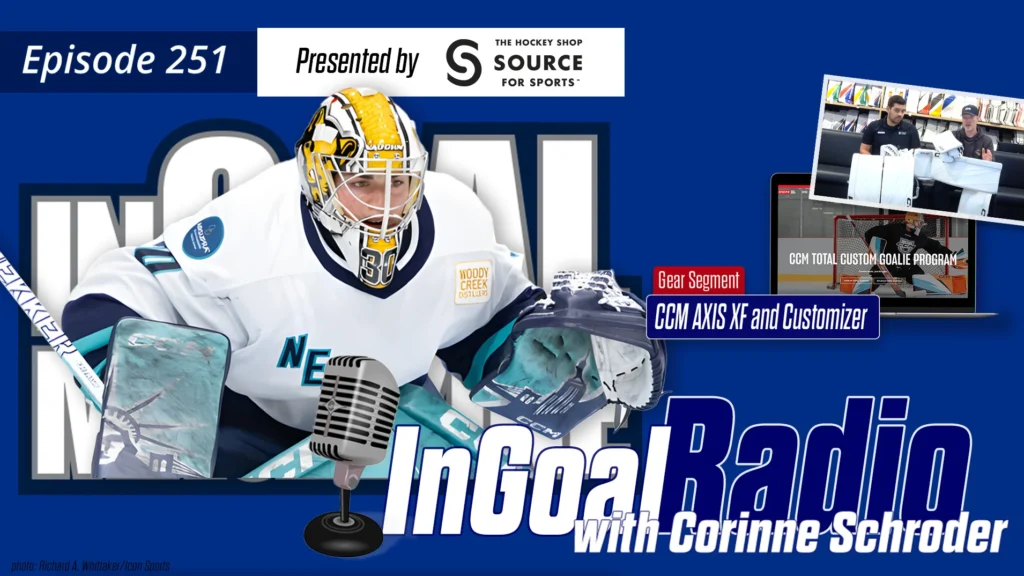
InGoal Radio Episode 251 with Corinne Schroeder of PWHL New York

Please subscribe and leave a rating — it helps us reach more goalies!


Corinne Schroeder of PWHL New York posted the first shutout in PWHL history, overcoming debut nerves to achieve the milestone in the league's inaugural season. A three-degree NCAA veteran who played at Boston University and Quinnipiac, Schroeder shares a specific mental technique for staying engaged during extended periods when play is in the offensive zone far from the goalie.
- Corinne Schroeder became the first goalie to record a shutout in PWHL history during the league's inaugural season.
- Schroeder used deliberate mental strategies to overcome debut nerves, offering a replicable approach for goalies at any level.
- Her tip for staying mentally engaged during long stretches of offensive-zone play addresses one of goaltending's most overlooked focus challenges.
- Schroeder's path included five NCAA years across Boston University and Quinnipiac, plus three academic degrees, reflecting an elite dual commitment to hockey and education.
- The CCM AXIS XF pads and gloves feature upgraded sliding and rebound control, with a new online customizer now available for ordering.
Episode 251 of the InGoal Radio Podcast, presented by The Hockey Shop Source for Sports, features a fantastic goaltending conversation with Corinne Schroeder of PWHL New York.
Feature Interview
presented by NHL Sense Arena
In the feature interviews presented by NHL Sense Arena Schroeder shares great insights and advice from her experiences so far in the first PWHL season, including how she overcame nerves in her debut to become the first goalie in league history to post a shutout. Schroeder, who counts a psychology degree among three degrees from a NCAA career that included four years at Boston University and one more at Quinnipiac University, also shares a unique tip to keep yourself engaged when the play is in the other end for long periods, plus some great development stories from her time growing up on a huge farm in rural Manitoba, and so much more.
Parent Segment
presented by Stop It Goaltending U
In our Parents Segment, presented by the Stop It Goaltending U app, we chat about tryouts and how parents can approach them in a way that will help their kids perform at their best.
Weekly Gear Segment
presented by The Hockey Shop Source for SportsAll that, plus a trip to The Hockey Shop Source for Sports for an overview of the new CCM AXIS XF pads and gloves, which feature significant upgrades to sliding and rebounds, and a walk through on how to use their customizer that launched last week to order your set now!
Episode Transcript
Intro
Kevin Woodley, David Hutchison are at the controls. I'm Daren Millard. This is InGoal Radio, the podcast. We are coming to you on the eve of the Stanley Cup playoffs. Well, eve is a little bit premature, but we're into the stretch drive a week to go.
A week from this recording, the playoffs will be underway. That's what it's saying is we're all excited about, getting set to watch the start of the chase of the Stanley Cup. But we got a lot to get to today, including our NHL Sense Arena feature interview with Corinne Schroeder from the PWHL from the New York franchise. We will also get into our parent segment brought to you by Stop It Goaltending U the app, and that is going to focus on tryouts, tips for parents when it comes to tryouts and the Gear Segment. Oh, I love the Gear Segment brought to you by The Hockey Shop Source for Sports Langley, thehockeyshop.com.
Gear
We've got the Axis XF, both the gear and the customizer. This is fun, Woody.
Yeah. So fun we're gonna lead with it, Daren. Like, that's how excited we are about this new line. We have had a chance to first time I saw it was two summers ago as part of a sort of brainstorming session with a number of goalie coaches, including Vancouver Canucks goalie coach, Ian Clark, and other people from the industry sort of providing feedback on some of the changes and evolutions in CCM's new line. We were in Montreal, got a chance to see it on the ice with a handful of NHL, AHL, NCAA, and CHL goalies, and now it's finally here.
And so the customizer is live, and you know what that means. You can order your own sets, design and order your own sets, get ahead of the retail launch, order your own custom equipment. So we figured we had to go to the Hockey Shop. Because you know when these customizers launch and CCM's not the only one with it, Bauer's got their customizer out for the Shadow. Warrior's got their customizer out for the G7.
Anytime new gear launches with a customizer, you can custom order it. But sometimes you can't touch it and feel it. So if you got questions about it or you go in the customize, you create a great design, you get a reference number, you wanna know where to go to fulfill that order, The Hockey Shop Source for Sports, Cam and his crew is the place to go, and that definitely includes the new CCM Axis XF. We've got an overview now with Cam. Let's just get let's get right to it.
Cam, tell us. What is this pad all about? Welcome back to The Hockey Shop Source for Sports. I'm with Cam Matwiv, InGoal Utopia, and it's like Christmas morning because we have new products. CCM AXIS XF Customizer has launched.
Welcome back to The Hockey Shop Source for Sports. I'm with Cam Matwiv, InGoal Utopia, and it's like Christmas morning because we have new products. CCM AXIS XF Customizer has launched.
See. You could we're gonna walk you through the Customizer in a minute. Yes. Fancy computer. Yeah.
It's kinda In the meantime, quick overview, just really quick. We don't wanna give all get we got a review coming at ingoalmag.com. Make sure you check that out. It'll get a little deeper dive ish. But the general from Axis 2 to Axis XF, the biggest change is Cam.
Maybe start with the pads. There are some changes. There are some changes. Speed channel gonna be hard to see, but at the end of the day, change in materials. Correct.
That increase sliding of speed channel and change in materials. 24% improvement in sliding. 24 on clean ice. 37, I believe, on rough ice. So CCM's done the research.
We've been to their lab. We were at their lab with a handful, Jet Greaves, some pro, minor pro NCAA goalie sort of walking through how they do this testing. It was really cool. Show you that video later. But they did the testing.
They combined the channel with the different materials. This is what they came up with. So Axis XF is faster? Yes. The rebounds are more active.
[crosstalk] I believe 37% more active rebounds off the shin, 48% off the thighs. How do you do that? They've got a new material in their Cam called Infinite Rebound Power. Well, you might call it infinite. I would call it infinite.
But infinite rebound power, like I said, that combined with a much stiffer this is stiffer. Axis XF is stiffer than Axis 2, not in the boot. It's flexible in the boot, but through the profile of the pad. Rebounds rocket, not just off the shin, but off the thigh. And I can tell you one goalie that I know really noticed it was Stuart Skinner with the Edmonton Oilers.
Mhmm. Wearing this product in the NHL, one of the reasons is the rebounds. I know there was a bunch of noise when he tentatively early in the season went back to an old EFlex set
Yes.
In practice, and everyone's like, oh, he switched him back. He doesn't like it. Truth is talk to him. He was trying it to see it, and he just couldn't move away from the rebound that he's getting off of the Axis XF. So there's a quick overview on the pads.
Like I said, we'll have a deep dive in ingoalmag.com and here on the Gear Segment when the full launch date, but we wanted to, as we show you through the customizer, we didn't want to just be like, hey, here's the customizer, but you have no idea what you're ordering. We wanted to show you what's different really quickly on the glove. They've done a bunch of testing there too. It is a 591 brake. Redesigned.
Redesigned. Way easier open and closure right off the yeah. Like, I mean, Axis 2 got there. It took a lot more break in process. They want this to be an easier break in process.
So they've redesigned the internals on the glove, The testing on sort of how wide it opens, how much force is required to open and close it, all come back significantly improved. Return of some finger stalls. Two finger stalls and neoprene on the inside, so it's got a nice sort of soft textured feel to
it. Correct.
Blocker. Blocker, new palm material,
massive rebound pop. But I digress. We have
other things to show you and other things to talk about. That's the overview. Really quick. That's the the nitty gritty dirty. Make sure you check out ingoalmag.com.
We'll have a few more photos and stuff from our session. We'll do a deeper dive, like I said, during lunch, but let's go over to the customizer. Let's see the customizer and see some of the options that we can get from CCM on the custom.
They're going to check out the customizer. Let let's bring you in here, Hutch. They're doing it, a little difficult to do on the podcast with customizer.
Doesn't really fit radio, does it, To watch a screen and listen to the boys talk about this option and that option. But actually seeing it all, I think it's pretty important to understanding the whole design. The number of times we've gone in there and despite all the stuff that we've done, not fully understood all the options that are there for us. And there's more options than ever this year at the customizer. You can basically customize this gear like a pro.
So if you want to see what these guys were doing, head over to the YouTube channel there and you can see what you've just listened to plus that full walk through the customizer. It's ten, fifteen minutes of, great content all about the Axis XF gear.
And make sure you stay because Cam makes a mistake and then Hutch uses a computer voice to correct him and then chirp the living crap out of me in the same time.
That's that may be true.
I love you, Hutch. Can I can I get a virtual hug over Zoom? Like, there he
is. Brilliant.
And I love it. Way to bring it.
I have a question for you, Woody, when it comes to the Axis XF. I have the OG Axis, and I love it. And it stood up amazing, and I face NHL shots, semi regularly. Tell me what's different in the XF from my iteration.
Well, first of all, the graphic is very sexy Yeah. And sexier than the one you have, even though you've got it in some nice colors and a nice set up. The biggest thing, Daren, is well, the the first thing that you're gonna notice is it's a way stiffer pad from sort of the shin up through the thigh rise.
Really?
And especially from the first generation. Still has a very flexible boot, but it's actually Axis 2 was stiffer than your original Axis noticeably so, and Axis XF is even stiffer. They've got a new rebound foam, and I should say, we kinda highlighted this in the gear segment you just heard. But if you want more information, including photos and details and sorta get a chance to look at it, ingoalmag.com, we have an overview of the entire line. The pads, the speed channel, why it slides faster, why there's no speed skin on the inside edge anymore, up to 39% faster depending on the ice conditions, faster than weave on on fresh ice, faster than speed skin on broken up ice.
That's why they chose it. What that speed channel looks like, and the new Infinity power rebound material on
the Infinite.
Infinite. Infinity. Infinite.
Or as Cam called it, infinite. Or
was it? He did say infinite.
Silly like that.
Yeah. Good job, Cam. I screwed it up too. See? Now Hutch can chirp me.
Infiniti. I get infinity. Oh my goodness. It's late.
The rebounds just keep going forever. That's why it's
the Infiniti.
Never stop. I iced the puck the other day off a rebound, and and that's the Axis OG. So Mhmm.
And the Axis 2 was noticeably stiffer, noticeably more active rebounds. The big thing here is they've really stiffened up the core from the knee through the top of the thigh rise because the actual this new power rebound material softer than their max rebound they had on the previous generation. So to make sure that we didn't get that soft thigh rise, the trapdoor, they stiffened up the core and added this material. 70 on on shots of 40 miles an hour, rebounds off the thigh, which is where a lot of goalies worry. Like, hey.
Yeah. Okay. I got active rebounds off the shin, but not off the thigh rise. 74% further on 40 mile an hour shots compared to Axis 2, which is already a pretty active pad. So like I said, these are these are gonna be way stiffer, Daren.
The glove's got a new configuration, much different than yours. They've got two finger stalls, pinky and the index finger now. They put neoprene in there. It's got a really nice soft feel, and they've redesigned it yet again to try and make sure we like their Axis 2 glove once we got it broken in, but we admitted in our review it took a while to get it broken in. This one breaks in a lot quicker.
Kids can go into the store, grab it off the shelf. It'll open and close open a lot wider, close a lot easier than the previous generation. So just continuing to move things forward, weighs under a thousand grams, the glove, make sure that it's a lightweight thing that that, you know, even younger kids can use. So it basically would be stiffer, better rebounds, faster sliding, and just a lot newer than what you have, which kinda feels like we need to get you back.
I I just, was curious about it. I I will say I love the original Axis blocker. I I don't know how much tweaking's been done there, and we don't talk about blockers a lot, but I love my blocker. I I really do.
You might love this one even more.
I think you yeah. Yeah. Because, honestly, in the review, Stuart Skinner talks about because there was a bun he was he's the him and Jet Greaves, the only two guys in the NHL in it right now. It's a newer pad. Stewart, I think it was around November when things weren't going well.
He went back to his EFlex 6 for a couple practices, and I know a lot of the accounts were like, oh, he might going away from it. He's going back to EFlex 6, which is totally fair. He tried it for, like, two practices and was like, man, I just the rebounds are too soft. They're all dying, like, five feet in front of the net creating scrambles. I I love the rebounds.
And he mentioned the pads and the blocker. He loves the rebounds off really crisp, sharp rebounds off the blocker as well. So I think he liked that one too, Daren.
Alright. Interesting.
Daren, you love your blocker, but you should see the rebounds off Woody's glove.
Off the pocket? Not not
just the cuff? I'm not I'm not yeah. I'm not even gonna disagree with that. Hey. Do you
serious question. Do you guys, soak your your glove before you you play? Like, do you throw some water in there so it's a little bit worked in? I've seen guys do it, or or do you just naturally let the sweat take We're normal. You are.
Right?
Okay. If my glove was drying too long in the garage or something like that before the next game and you know how they get kinda a little bit crusty and hard if they're too dry? I would squirt a little water into the palm just to make it a bit more tacky.
I'm that's what I'm I'm thinking.
It's a bit of an old school thing. Woody's too young to understand these things.
No. You know what, though? I do know I I know what you're talking about, that crispy crunchy feeling touch. And I gotta be honest with you. Don't get it in the EFlex 6 anymore, and I don't think you're gonna get it in the AXIS XF.
They've changed the materials in there. True. It doesn't crisp up and get that sort of icky, like, sandpaper ish feeling on your hand the way the previous generations of a lot of gloves did.
Gloves can dry out too much, get too dry, then you're wanna get into our feature interview brought to you by NHL Sense Arena in just a little bit, but the great news segment that we've had for a couple of episodes dealing with helping out our parents that listen to the podcast. And it's presented by Stop It Goal Tending U, the app. And this week, we are going to give a little help to parents navigating tryouts. And before we get to that, would would you and where are you on new gear for tryouts? Because a lot of stuff's coming in, and would would even I I even
I have some thoughts for tryouts that will bring that up. Okay. So why don't we just leave that as a teaser? But I know that before we give some love towards that, I think Woody needs to give some love towards our friends at Stop It Goaltending.
Tending. Stop It Goaltending U app is the world's most comprehensive goalie app for goalies, goalie parents, and coaches. I could kinda leave it at that. The world's most comprehensive app for goalies, goalie parents, and goalies coaches. Kinda says it all.
Right? It was created, by Brian Daccord, former NHL goalie coach with the Boston Bruins, goaltending scout with the Toronto Maple Leafs, and director of goaltending with the Arizona Coyotes. And when in those roles, Brian learned that elite goalies are the ones that process the game quickly, possess a high goalie IQ, and have a strong mindset and emotional endurance. The goal of this app is to use it consistently on a daily basis to grow a goalie's knowledge of the position, develop all those things that Brian saw as in elite goaltenders. They do that through the app by encouraging the goalies to be on there for thirty minutes a week.
And then over a course of a month and years, they will dramatically improve their ability to see the game. You can get subscriptions starting as low as $9.99 a month. Premium members, $19.95 a month. And you can go through on their app page, on the App Store, and see all the different features you get with both. But there is basically just consistent flow of content to keep you active, keep you engaged, keep you learning as a goaltender so that you can process the game quickly, you can develop a high goalie IQ, and you can build a strong strong mindset and emotional endurance.
The Stop It Goaltending U app, make sure you check it out wherever you download apps, whether it's on the App Store with Apple or whatever you people on Android do.
I went down a rabbit hole on the Stop It Goaltending U app the other night, and I I watched about 25 tips from from goaltenders from all over college and professional, and it was awesome. It was amazing. And the next night, I I did it again, and I I just couldn't get it. And there's short little little tips, from goaltenders in their gear being able to demonstrate it, and it's a wonderful tool. Brian and everybody has done an amazing job.
And there's so many other different segments to the app that are very encouraging that that you can use as intense or just to prime up your day. Love it. Awesome stuff. And now we're dealing with parents and tryouts. And how do parents navigate this very stressful time of the year for everybody, not just the goaltender?
Parent Playbook
Yeah. And it's, for me, it's a bit of a strange one, but I know there's a lot of organizations that are doing their tryouts now. They wanna get this all in place early ahead of the, the hockey season in the fall. I was always a a fall tryout guy when I was growing up. So it's a bit strange to me, but at the same time, it is happening and so we got a lot of parents thinking about it and I wanted to talk a little bit about how we can help our kids as parents in tryouts.
And I have a couple of things boys to talk about. One of them is how are we gonna keep our kids focused on being themselves out there and not focusing too much on the outcome? And that's that's a tough one. It's a really tough one. But I think it's really important with everything in goaltending that we're focused on the process and what we're doing out there.
And it's it's tough when you really wanna make a team and you wanna be at a new level or you wanna be with your buddies or or whatever it might be. But at the end of the day, I think it's important as parents that we help the kids understand that you can only do your part. There's other things at play here from the coaches doing the evaluations to the other people who are part of the tryouts and so on that you have no control over whatsoever. And for me, it's about not today, but it's just an ongoing conversation throughout the the weeks and months leading up to tryout season reinforcing that that you've only got control over a certain piece of this and let's just focus on that. It's it's not easy.
I understand that. But one of the pieces that relates to that for me, guys, is so many people talk about great goaltenders being people who can take every game exactly the same. You've heard quotes from guys who've won huge games in the Stanley Cup playoffs, in the Olympics, a world championship, and you've heard them say things like, yep. I just I took it like it was any other game. I know it's a big moment, but once the puck drops, it's still hockey.
Nothing's different. How can we help our kids create that feeling in themselves for the big games or in this case for the tryouts? And for me, what I say to parents around that is if you want your kids to treat it like it's just any other day, you need to treat it like it's just any other day. How many of us are guilty as parents of getting all excited about the tryouts? Asking our kids, are you excited about the tryouts?
Oh, it's a big weekend coming up. How are you feeling about that? I know you're excited, but you're creating a different atmosphere for your kids, probably creating a little bit of anxiety around that. How many of us have said to our kids, you should probably get to bed early tonight because tomorrow's a big day? Or let's make sure we're eating our vegetables tonight because you've got to try out tomorrow.
All sorts of different things that subtly we can do around tryouts or championship games or tournaments where we end up treating it differently as parents and quietly teaching our kids that something different is happening tomorrow. So how about we treat it like any other game? And look, if for you, there's some really important preparation that you take for all of your games, for sure, carry on with it. I'm not saying take it too lightly. I'm not saying ignore it.
But I think the first exhibition game of the season, the fifth game of the season, the championship game, the tryout, you need to have the same routine around all of it, both as parents and as goaltenders. And Daren, to answer your question from before, for me, that also means gear. I really don't think you want to be hopping into a new set of gear for tryouts if you can avoid it. And I know around that question about fall tryouts that makes things a little bit different because little Johnny could well put on six inches between the end of the season in March and the beginning of the season in September. So we've got some things we gotta work with there.
But maybe let's get the gear in the summer so that they have some time to make it their own. But, yeah, for me is let's just treat this like it's any other day. Let's mentally be prepared to go out there and treat it like it's any other day. And as best we can, not focus on the outcome. Just try and be the best goalie you can when you're out there.
So downplay it? Or because it it does feel like a special time.
It is, but just play it the same. Like, you can't do anything different. It's it's not downplay it. It's not, we're just going. It's no big deal, whatever.
I mean, maybe maybe there is something about that if you can. But I think if you can find a way so that you could be yourself, then you're going to be yourself when you play on the ice.
Makes sense, Woody?
Yeah. I'm gonna send this to one of my beer league teammates. Every time we have a big game, he sends us like the slapshot speech, biggest game of your life, boy. So and then I get all riled up and I suck. So maybe that's the whole key.
I think that's it.
Yeah. Or or, you know, the Friday night light speech or whatever it is or like but those are sports to go back to your column from last week, Woody. Those are sports where you can try harder and do better, but you can't as a goaltender. Yep. Right?
The whole idea that that we're this is one of the the few things in sport where trying harder doesn't help. So we get really gotta we really gotta just be ourselves and go out there and play. Because you can't you can't play your game if you are too focused on trying. If you are too focused on, I'd better make the next save. And and by the way, it's okay if a puck goes in and tryouts.
The whole idea that that we're this is one of the the few things in sport where trying harder doesn't help. So we get really gotta we really gotta just be ourselves and go out there and play. Because you can't you can't play your game if you are too focused on trying. If you are too focused on, I'd better make the next save. And and by the way, it's okay if a puck goes in and tryouts.
It's gonna happen. Just relax. Get out there and and play your game and be yourself and and have fun. I dumped my kid at the curb for probably the biggest tryout of his life when he was about 14 years old at the time. And I just looked at him and said, well, try and keep it under 10.
Go have fun. And that was the extent of what we did differently.
I like it. I like it. Yep.
Woody and I, our teams look at us and go, try and keep it under 10, but it's a legitimate question. Alright. Yeah.
I've been there too. I've been there too. Yeah. I played on a new team one time in a a pretty high level men's league and all the guys were twenty years younger than me. And I looked at him, I said, so can you just tell me what a good night would be like here?
One of them looked at me and said, well, if you keep it under 12, you're doing better than our last guy. Yeah. Can do that.
Let's let's let's do that.
Stop It Goaltending U the app. Put it in search and download it, and it's got a wonderful, wonderful multiple levels of awareness and encouragement and tools to make you a better goaltender.
And you know what it has now? It comes with an InGoal Magazine subscription.
Oh.
Oh, he buried the lead again.
Yep. That's me. I forgot about the I listen. They've developed a hell of a tool. So I don't wanna say that we're the most important part of it, but we are a very nice added bonus as part of our new partnership with Stop It Goal Tending and the Stop It Goaltending U app.
Make sure you check it out, download it, and you will have the option coming up to get a subscription to InGoal Magazine included. You know what I was thinking as we're going through the parent segment? Like, what a perfect segue because he actually went to Stop It Goal Tending with Joey Daccord, made 49 saves, only gave up one goal and a win against Joey Daccord in the Seattle Kraken. So that's, I guess, the only downside is that he beat Joey the other night, had his first win in the NHL five days before that. And you wanna talk about a stay in the moment quote?
How about Devin Cooley with the just dropping the absolute most goalie quote ever after 49 saves and when he was asked about all the shots. And And I'm just going to roll right into it. I check it every once in a while, but yeah, I just try and stay in the present moment. I just keep repeating to myself, there are no thoughts. There is no future.
There are no thoughts. There is no future. I just said that over and over and over again. So that way, I could just take it one save at a time. What were we just talking about?
One save at a time. Then I also say nothing matters. Nobody cares. Nothing matters. Nobody cares.
It keeps me grounded. Like, if I make a big save or I look up, like, wow. One goal on 40 shots or whatever, I'm like, I feel good. It's just like nobody cares. You know?
Nothing's really gonna matter. We're all gonna die. You know? It sounds a little grim, but it helps keep me grounded. And we can laugh about it, but it's a perfect mindset, and it's exactly what you're trying to achieve with your goaltenders heading into those tryouts.
No?
Yeah. Absolutely. I Woody, I I I love what he just said there. And, yeah, I think if you could go into your tryouts thinking, if this doesn't really matter, I'm just gonna go out and be my competitive self, then that'd be fantastic. I I think we have mentioned before, we also don't like you looking at the shot clock if you're a beer leaguer because you just go insane because they get the count wrong or a minor hockey player.
But on National Hockey League, they're reviewing all the shots. They know what they're doing.
Hey. Let me just, like But
it does matter. Like, we're not trying to kid ourselves here. It it does matter. It's a great quote, and it's it's works for him. But whether you're in a tryout or whether you're in a game, it does matter.
But here but here's where it doesn't. And this is a piece I left out that I should shouldn't have because this is what I lead all of this with with my kid, is it doesn't matter because at the end of the day, whether you make that team or you don't make that team, you win the game, you don't win the game. Or quite frankly, even if you decide you don't wanna play hockey anymore, I'm gonna love you exactly the same. You're still my kid, you still get a hug at the end of the day, and we're gonna have an amazing life together. In the grand scheme of things, it doesn't matter.
But here but here's where it doesn't. And this is a piece I left out that I should shouldn't have because this is what I lead all of this with with my kid, is it doesn't matter because at the end of the day, whether you make that team or you don't make that team, you win the game, you don't win the game. Or quite frankly, even if you decide you don't wanna play hockey anymore, I'm gonna love you exactly the same. You're still my kid, you still get a hug at the end of the day, and we're gonna have an amazing life together. In the grand scheme of things, it doesn't matter.
My beer league team doesn't feel that way about me.
No. They won't. The it doesn't matter part or we're still gonna love you part?
We're still gonna love you part. Yeah. But the point I
do think that's important because too many kids get focused on what does dad want? You know? How how my parents gonna feel if I don't make this team? What are my friends gonna think if I don't make this team?
And it's not that it doesn't matter to the point you don't make an effort. You need to battle.
Yeh
need to do all those things. But as we constantly try and bring it back to a one shot mentality, I just think that's what we all want. Right? Like focusing on making the team when you need to be focusing on that puck at the dot, like it's not going to help you. I had this with my kid in volleyball recently after a tragic practice, and she was broken after practice.
Like, completely, like, apoplectic in tears. But if you focus on that practice you just had tomorrow, you're done for the tournament on the weekend. There's just there's nothing you can do about it. Just look ahead to the next time you have an opportunity. She had her best weekend ever in front of in a pressure packed moment with a lot of college people watching.
And so focusing on the past, making a big deal, like, does so anytime you can find a mindset that helps you stay in the moment, whether it's Devin Cooley, who we're gonna hopefully have on the podcast as soon as the season is over, by the way, or some of the other approaches that Hutch talked about. Like, this is what we're trying to get to. We all know it matters, but trying to get yourself to a point where you're not worried about it when you're in the act of the next shot, next save, that matters too.
I had the doctor Alicia Nasser on the Chirp podcast last week, behavioral background dealing with the the mental side of the game. She also it was interesting because she said goalies are the hardest ones to convince to go down that path because they need answers before you you actually start the the process. She said goalies are very approach it very different. I thought that was interesting compared to forwards or defenseman or coaches, or even referees. But, she she suggested, to some of her clients, just have a song in your head and and put that song in your head and have it running in a loop kinda thing to distract you almost like the nothing matters, but may entertain you a little bit more.
But, it it's I'm fascinated by this this mental approach that we're discussing.
Well, if you have kids and like Marc-Andre Fleury, as he's, I think, said after games, let it go. Yeah. Let it go. Just sing the Frozen theme. Right?
Like, it kinda fits with being a goalie. And I should say, not to get ahead of ourselves, but if we're gonna tease our feature interview presented by Sense Arena, Corinne Schroeder, she has three degrees and one of them psychology. She has some great tips in this interview coming up on staying in the moment, including you're not you're gonna like there's I you're gonna like this one, Daren. We'll save it. We'll let you listen to it.
We'll talk about it after, but you're gonna love this one because it has to do with your profession and using that as a way to stay in the moment when the moment is at the other side of the rink for a long period of time.
So does Thatcher Demko say it doesn't matter, or does he have a song running through his head? How does he approach it as he comes back, just in time for the Stanley Cup playoffs?
Well, I think the first thing is we've there's another goalie that has a psychology degree from his time at Boston College. So, his approach, his mental approach, we've had tips from him in the past, his interview with us, and then a couple different tips over the years on how to stay in the moment, how he focuses that way. I think for Demko, the confidence that he's gonna come back with a lot of people like, oh, man. He's only gonna get two starts. He's missed a month.
He's only gonna get two starts, and he's right into the playoffs. Is that enough? And I think you can look at it the same way as you would the preseason. He's been on the ice for, like, ten days now with Ian Clark, and I gotta tell you, he is zipping around the ice. Like, he looks powerful, explosive, hitting his spots.
Everything looks great. So now we gotta get into gameplay. Well, what does a starting goalie normally get in the preseason, Daren? Two? Two and a half games?
Usually two starts? Maybe three? Thatcher Demko was the best goalie in the National Hockey League for the first six weeks of the season by a margin. He lapped the field for the first six weeks. That's where his Vezina case was built.
So I think that's the confidence he brings into this. He feels good physically. He's moving well. He's doing all the things he believes he need to do as a goaltender. He trusts his body and how it's reacting to the treatment.
He's ahead of schedule. As for the games, if two's enough in the preseason, two's enough heading into the playoffs, I think that's a mindset he's taking. We'll see. It's a big ask because he's also got a team that's never been there before in front of him or outside of that one little run-in the bubble. But I think he's approaching it like this is an opportunity he craves because I know he worked his butt off off the ice to make sure he'd be ready in time for it.
And fresh. Look at Frederik Andersen right now. He missed a lot, man. And and Demko's only missed a month. He doesn't feel like he's out of the rhythm of a game all that much.
Look how much time Frederik Andersen missed it. Look at how exceptional he's been coming back. And like you said, fresh.
The the fine line between fresh and rusty, but the enthusiasm that he has may make up for some of that, and we know how Ian, works and, the intenseness of of the one on one sessions that I I don't think rust will be a huge impact there.
No. No. I mean, Ian's as good as anyone to get in his goalies ready to play. He has a very specific progression he goes through, and sometimes that takes a little while, but they're well through those progressions now.
Everything looks like it would heading into a regular season. Now he just needs his two, unquote, preseason games to get him ready for the playoffs.
Feature Interview - Corinne Schroeder
Get mentally and physically, primed. Let's get into our NHL Sense Arena feature interview. And, this week, we will chat with somebody from the PWHL. Corinne Schroeder joins us from the New York franchise and gives a little better background before we listen to this conversation, which I'm really excited about discussing that mental part of the game.
Well, from Manitoba, and we get into that sort of from a small, like, farming community outside of Winnipeg in Manitoba. So automatically a check-in your box, Daren, being being from that province. And this is her second year pro, was in the the PHF last year with Boston, the Boston pride. Set some records, like, made some history. Right?
Like, first PWHL shout out. That was her. So just there's there's sort of I don't wanna give too much away. There's a lot of great background. There's a lot of great advice.
She talks about her work with the goalie coach in New York, Gord Woodhall, who actually I didn't realize he was the goalie coach there. Like, Mea Culpa, I didn't really look it up in advance. And once she said it, I remembered him from some former Hockey Canada, POE camps and webinars that we've done in the past. So talks about their relationship and and how strong that is. Just a lot of great advice, including, like I said, some great mental tips to stay focused.
Or if you happen to be playing one of the first games in the biggest league and and going for a shout out, how do you calm the nerves? We get into all of it with Corinne in this interview.
Brought to you by NHL Sense Arena, Hutch. And we know that the, impact that that, the virtual reality part and the the different tools that you can use going into this part of the season, which is the off season that can keep you sharp.
Yeah. I might have to tell everybody to ignore what I'm about to say if you're in tryouts. If you're in tryouts and you've been using Sense Arena, keep using it. But don't run out and grab Sense Arena in the middle of your tryouts and decide you're gonna start adding that to your program. For everybody else, I'd like to challenge you to do something different this week.
It's spring. We got a whole new time of year happening. It's a great time to do something a little bit different. How about you hop on Sense Arena for ten minutes a day for the next week? Daren, I'd like you to do this too, and do the eye hand neurocognitive drills.
Ten minutes neurocognitive drills. I'd be willing to bet that it didn't doesn't get used as much by a lot of our Sense Arena users, including you, Daren. I'd like you to do it tomorrow and write down your score for a couple of those drills. And then ten minutes a day for the rest of the week. And then at the end, I'd like you to see how your scores improved over the week on some of those drills.
I think spring is here, refresh time. I think you're gonna find it's gonna add a lot to your game to do these drills and also to realize that there's this great set of tools available in Sense Arena that are more than just facing shots, facing drills, simulating the on ice experience with this unreal virtual reality program. So many tools available to us in Sense Arena. And if mom and dad are listening and they like hearing the parents' advice, I would suggest you hop on Sense Arena too and try these drills. You don't have to be a goaltender to try any of them.
They're gonna help you out in your life. Give them a try. They'll make you a better goaltender. Sensearena.com. Use the code I g m 50 if you're about to try it for the first time.
Connections all over the goaltending world, with InGoal Radio, the podcast, InGoal Magazine. It is our NHL Sense Arena feature interview. Corinne Schroeder joining us on InGoal Radio, the podcast.
Really excited to welcome to the InGoal Radio Podcast. First time guest, Corinne Schroeder from PWHL New York. The first shutout in the history of the PWHL. I feel like the last couple of months must have been a whirlwind, so let's just start there. What's it been like being a part of history?
It was incredible to to start, I guess, my my professional career in this league off with, you know, a shut out. That's that's the best you can ask for, and my team just had a great great game in front of me too. So it's just it felt so so easy that it's just one of those things you you're just so excited about getting this league started and everything, and you're trying not to get nervous. I I was quite nervous for the game, but it was just so nice to kinda get that first win under our belt, get that shutout, and, yeah, really start off our season.
Okay. Not your first pro season. You played with Boston and the PHF last year. But like you said, like, there was a there was a sense that this was the start of something big. And so with that comes expectations, with that comes pressure.
As you just said, some nerves into your first game. So I guess advice, whether it's me going into a beer league game for playoffs, young kid heading into the postseason or a trial, how have you learned to manage nerves over the years?
I think the biggest piece for me is just staying in the moment, finding some way to really be present and not focusing on the future, not focusing on the past. You know, you let in a goal. You have to let it go. That's not gonna help you finish off the game. It's not gonna help your team finish off the game if you're dwelling on something like that.
So, yeah, finding any way to just stay stay current. Like, I've done a ton of things over the years from, you know, just commentating the game myself from my crease, like, as it's kinda in the other end to just, you know, stay sharp, stay focused, stay in it, not letting my mind wander. Other times, I'm just scanning the ice, making sure I've done this a lot more recently at least is making sure I know who's on the ice at at all times. You know? Is this who should I be looking out for?
Because, obviously, there's there's a number of players within this league, most players actually, that you really need to be aware when they're on the ice. So I think that's one thing that's helped me stay present is just focusing on, okay, what d pairings out right now? What's what forward line is on? Are they in the middle of a change? Like, just trying to find any strategy, I guess, or leg up I can have in that moment, that situation just to be you know, have such complete awareness of of what's going on.
Well, I I I love that you gave examples of how to do it because I do think, you know, where that one shot at a time, stay in the moment mentality is something everybody strives for. Easy to say, sometimes really hard to do. I am curious about the play by play. So are you like is this like hockey night in Canada where, you know, so and so passes to so and so? Was a way at different points where you stayed engaged, a way to sort of make sure your mind was on what was happening in front of you?
It's a different one, and I love it.
Yeah. It's not one I do so much recently just because it's it's one I typically save for slow games, those ones where you get, you know, a handful of shots per period. You're just trying to stay in it. You're trying to stay warm. You're trying to stay engaged.
So it's yeah. That one, when it's the puck spends a lot more time in the in the other zone, that's where you really gotta make sure you're not wandering in your mind or just, you know, thinking, what what do you think postgame meal is gonna be? Or, you know, things like that. Like, you don't you don't wanna lose focus even for a second because, you know, it's it's almost embarrassing when you let in easy goals, when you're just haven't been busy and goalies know it's the hardest thing to do to just stand there and wait and wait and wait. And then suddenly, you know, there's a two on one, a really difficult chance coming at you.
So I find that it's it's easier to stay engaged in slow games by doing that than just, yeah, being play by play. Like, oh, so and so passes to them. You know, it's a little battle in the corner, whatever. And then, oh, it's coming out at me. Then you drop it.
You focus on your triggers like, okay. Rush is coming from this side. I'm gonna step out now. You know, those sort of things.
I love it. I love it. So just when the play's down it's that's great because that is something that a lot of goalies struggle with. Yeah. There we have our in the moment.
Some have different fuses you were mentioning when the play is in the zone, little things about stance or tactics that just sort of keep you glued in. But when the play's down there for a long period of time, it's one of the most difficult things. Right? Like, especially if the other goalie is standing on their head. Right?
Like, oh, man. Like, they're playing really well. I better stop the next one, which is the last thing we wanna be thinking about.
Yeah. Exactly. It's especially when the other goalie is, you know, playing incredibly well. You know that that one that one minute, that, you know, little point or, like, span of time that you lose focus. That's that could be the difference between winning and losing that game.
It's gonna be a big momentum shift for your team if you let in one. So it's there's a lot of pressure in that. So I find that, yeah, you just have to find a way to stay engaged regardless of what's happening.
We catch you on a bit of a break with the PWHL right now, but is that easier or harder? When you're in season, it has been a busier schedule than a lot of the athletes are used to. Right? Like, if you're coming out of NCAA typical weekends only with some of the leagues that wasn't as frequent games as they're seeing now, that focus, does it become easier when you're playing a couple times a week, or can fatigue play into that when you're playing multiple times a week? How have you learned to manage a pro schedule that's quite a bit different than than than a lot of the athletes in the PWHL were used to coming in?
Yeah. I think that, it's been very different from having just games on the weekend. I really enjoy that, you know, we have games throughout the weeks, and it's just really consistent. I think it's better for the fans that way, but it's also better for us as a pro league to build and to kinda understand that actual pro schedule and how fast and, you know, busy a season can be. So I think managing load is one of the things that's become a lot more important this season.
So with my team, at least, we've been kinda alternating myself and and Levy every every other games here and there. It'll it'll switch a little bit. But for the most part, I feel like I've been feeling really great physically. I feel ready for every game. I'm not too tired.
I'm not seeing major injuries creep up or, like, even, like, sustained injuries that just continue to bother you and bother you, right, the more you use them. So I found that that's, yeah, a big piece, but I've we've been managing it well, on our team. But, yeah, I think I think the schedule is is different, but it's different in a really, really good way.
What about in terms of practicing and more regular ice times, I would imagine? But, also, do you have a goalie coach now? And is that different? And and I apologize for not knowing in advance because it was team by team in the PHF. There were some athletes that I talked to that, you know, didn't have a lot of goalie coaching when the season was on.
Ice time was sometimes at odd times, as everybody tried to manage, in some cases, having to have other jobs. What what has that been like for you in a league that from everyone else I've talked about, feels like it's just just that next step professionally. You know, ice times that are are more accessible and manageable help with, you know, goalie specific drills as opposed to sort of trying to figure it out on your own or in some cases in the past, having to work with a private coach on your own?
Yeah. I I think that the the consistency of ice sessions is is much better. Last year, I remember we had, I think, two mandatory skates a week and then open ice another three days of the week. So there was a handful of of, you know, myself and my teammates, handful of us that were out on the ice five days a week, but most of our team wasn't. It they were, you know, the bare minimum two or maybe three just because they had other things to worry about, their jobs outside of hockey.
And for some, it just didn't work. So, yeah, this year being on the ice six days a week is it's really fantastic that we have the option to to always be on the ice and consistently, you know, get better throughout the season and not have to worry about, like, okay. Well, we don't have the ice time available, so how are we gonna really work on this or that? You know? I find part of the team team game is lost when you don't actually have full team practices together.
You just end up working on skills with the, you know, four or five of you that go out. So that's been that's been really great, this season. And, yes, we do we do have a goalie coach, Gord Woodhall. He's actually he's from Winnipeg, Manitoba. So right here where I'm from, I've known him since I was, oh, maybe 16 or 17, you know, with the Manitoba starting out there.
And yeah. So I've I've had a long history with with Gord, and I was so excited to learn that he was he was hired here in New York. And he's just, you know, one of one of the greatest goalie coaches I've I've worked with. He's very thoughtful in everything that he coaches, and he's he's mindful about not necessarily changing your style, but allowing you to build upon it and just giving you ideas. Like, do you think this is is gonna work?
Do you want it to work? Like, that sort of thing. Like, just giving you that option to really build your own game rather than, you know, tailoring it to something specific. But yeah. So we've we've had a lot of, you know, good conversations.
Like, alright. Well, I disagree with that, but you you're saying this. So, like, we're seeing both sides of it, but it's a really good two way relationship there.
Okay. So for those that aren't as familiar with your game, maybe in your words, walk us through how you see your style and the keys, maybe some of the foundational points of what you would say. Somebody says, Hey, when you're playing well, what are you doing well? What do you see as some of those foundational things? And and how's that maybe evolved over the years?
Yeah. It's I think it's really hard to describe your own style because you don't really watch yourself play aside from the, you know, video sessions that you you look back on. I'd like to say I'm more of a hybrid style goaltender. I am a bit taller. Right?
Five eleven. But I don't necessarily hit my pads on every shot. I like to read, what's happening. Very, very few times, I'll, you know, in desperation, just butterfly out of out of habit just because, you know, you you lose sight of the puck or, you know, you don't see the release, that sort of thing. But I find that, you know, if I have that sight line, I'm going to make the best read off of the puck rather than, you know, always know that I'm gonna hit my pads.
So patience. Obviously, you have it sounds like you you probably just have them having a pretty patient game. How do you develop that over the years? Because it there's another one that's it'd be really easy to say. Right?
We all wanna hold edges and not not go down too early, not be committed into a block or seal up too early. I mean, obviously, certain moments we have to. It's the nature of the position. But how how did you develop that?
How did that become, you know, if it is a cornerstone of your game now, how did that occur for you? How did you get to that point? Because I think a lot of goalies would like to be more patient.
Yeah. Definitely. I think that it's a hard thing to develop, obviously. I think the biggest piece of being able to do it consistently and being patient on most, if not all, is the tracking ability that you have. You have to be able to see the shots and react to them well in advance of, you know, them them hitting you, obviously.
So if you're struggling with the speed of shots, essentially, it's gonna be really difficult for you to make the reads in time to be able to hold your edges because, you know, by the time you realize the puck is going low and you're still, you know, standing or something and you don't react fast enough, that's that's going five hole. That's there's not much you can do about that. So I think working on tracking reflexes and just, yeah, in general, just working on everything about your eyes and how you're able to see the puck and track it all the way in and finding those sight lines on screenplays is is they're all they're all big factors that that tie in.
Seeing a puck through the release as opposed to reacting prematurely and maintaining vision when you talk tracking, you talk about your eyes, like someone who's maybe done some work on that. Are there things you can do to help make sure your eye It used to be in the old days just like, Hey, see the puck. But now we have different tools and different sort of mechanics of how to see the puck and what the optimal head angle is and all those kind of things. What's your experience with some of those different, you know, whether it's tools or things you've done over the years to help make sure your eyes are performing at peak function?
Yeah. I think there's a lot of different tools that you can use. A big I'd say a bigger piece of it actually is just learning how to read the shot off of the blade. So making sure you're so, you know, fine tunely aware of everything about the shooter's shot, making sure you you understand where their elbow positioning is, you know, seeing where where the puck is on their stick, the angle of the stick towards you. Right? So just gaining every bit of advantage before the shot even is released can can help you to be ahead of that play before the puck is even shot. Obviously, reading the puck off the tape, that's that's the reaction piece of it.
Yeah. I think there's a lot of different tools that you can use. A big I'd say a bigger piece of it actually is just learning how to read the shot off of the blade. So making sure you're so, you know, fine tunely aware of everything about the shooter's shot, making sure you you understand where their elbow positioning is, you know, seeing where where the puck is on their stick, the angle of the stick towards you. Right? So just gaining every bit of advantage before the shot even is released can can help you to be ahead of that play before the puck is even shot. Obviously, reading the puck off the tape, that's that's the reaction piece of it. That's like, okay. So you still need to be able to track that at that certain speed.
But Right.
If you know already where it's probably going, you know, the shooter's got an open blade, they're shooting kinda across the grain there. So you you kinda understand it's gonna be, you know, this side or that side. You you have an idea where it'll be, but you still need to track it to find the precise location.
I love it.
So that's a yeah.
So reading the release, like, there's two parts there. Right? Like, you're you're describing reading the release based on all the information you get before it comes off the blade and then trying to stay on the puck as it comes through the blade and off the blade longer. Does that sound like a fair description?
Yeah. Yeah, absolutely. So all
that information that you're gathering, the ability to read a release, and I know a lot of it's probably just innate when you see it, you know. How do you get good at that? Is it just reps? Or was there a point along the way where you had a mentor or a coach that was like, hey, like, look for the elbow position or the hand position or the blade position? All these little cues that help you read what's gonna happen before it comes off that stick, how how did that become a big part of of who you are as a goaltender?
Is there any advice you can share for young goalies trying to get better at it themselves?
Yeah. I think reps are a huge piece of of learning that. Just being able to see different shooters and how they shoot, obviously, getting, you know, a wider array of understanding. Right? You see the same person shoot on you all the time.
You kinda understand how that person shoots, but not everyone shoots the same way, obviously. So to be ready for anyone's shot, you really kinda have to see a lot. But you do pick up on patterns throughout all all shooters that, like, you know, once once you figure out those patterns, it it becomes automatic in your brain. I think goaltending, it's it's all pattern based.
Yeah.
Obviously, Gord, my goalie coach, talks about it all the time. He's also our video coach, and he just studies film so much, but he that's what he preaches. He just preaches it's pattern recognition. You just have to understand those patterns. And the more you see them, the better you're gonna get at reading them and anticipating the play.
Right? So with everything, I think it's just, you know, those who really excel with goaltending are able to just read those patterns faster and understand what where the play is going before it gets there. And same with, obviously, shot releases. You understand where it's going before the player has really decided where it's gonna go.
Now does Gord ever will he ever show you a unique release or something he sees on video from an opponent? Because I'm guessing with the league change, they're probably you know, you would have seen some of these shooters in the PHF. Some you haven't. Some would be new to you. Like, would you ever dig in on video of an opposing shooter, or is that too much information heading into a game?
I'm curious.
I think that's maybe too much, personally, to look into, but, also, I'm not sure we have
That yet.
The same the same kind of video, essentially, to see the shot released on every every play. Right? Like, the video we see of, you know, Taylor Heise scoring. It's it's overhead. It's it's farther out.
We don't have those, like, zoomed in kinda shots.
We need them.
Which which is fine. Yeah. It'd be it'd be nice to analyze, but, no, I don't think it's we obviously, me and Gord, we haven't gone through anyone specifically. I think just, yeah, coming in this season, there was a lot that I hadn't seen, primarily Team USA shooters because, you know, I've I've seen the team Canada shooters throughout camps and everything. So I understand where, you know, each of them have their their tendencies, their habits, and the way they they release the puck.
But, yeah, for for The U S USA girls, I hadn't really much of a of a clue to where they're shooting, or how how their shot release comes off. So in that sense, it just takes a couple, not even games, just a single game to see kinda where they're at, where they're going, you know, watching some some of their other games. Maybe you see where their shot tendencies are. But, yeah, shot releases necessarily, I don't I don't study it. I think it's just something you pick up on.
More patterns of how teams might attack a power play where a pop moves around the ice as opposed to video to to see a release, more patterns of the game and how teams might play?
Yeah. Yeah. Gord breaks down typically the offense of the opposing team, what kind of looks they're they're trying to get, you know, like, whether they're trying to attack with three and then cut middle every time or drive low and pass out to the dot line, kinda those sort of sort of things. So each team does have their own tendencies. And as long as you kinda prime your brain and become aware of what they're looking for, you're already a step ahead in the game.
When you see it happen, you already know that's where it was going. Right? So that's more of the video that Gordon and I look at before each each game.
Okay. I'm gonna I'm gonna rewind here a little bit. I'm just gonna take me back to growing up in Elm Creek, Manitoba. It's and I should know this because my wife's from Winnipeg. But east or west, it's like 50 kilometers outside of of Winnipeg, right?
Yes. It's Southwest.
Okay. So a rural farm, grew up on a how did the passion for A, hockey and B, goaltending? How did you become a word? You clearly have a passion for it. Where did that come from?
I grew up on a farm actually just outside of Elm Creek. So a few miles outside of town, we did grain and and eggs. So we have a lot of lot of chickens still, on our farm at home. So it's it's really great to go home. I always love love just being back there.
And, yeah, I think with hockey, I just fell in love with going to to the rink every day. I I learned to skate when I was, I think, three and learned to play hockey or started playing hockey at age four. So, it's been my whole life, and it's been really, really exciting every time just just going back to my home rink. I love love being there. It's natural ice, and it's what I learned on.
But I think that's really where my passion started was just excited to get out there with my friends and and skate every day.
Okay. So how did how did that go from outskating to outskating in a very confined area as a goaltender?
Yeah. I find that my my career has gone, you know, every which way. I've played every position, actually. I started as a defenseman when I was a bit younger. Just I I was one of, you know, a few who could skate backwards at the time, you know, maybe six or seven years old, whatever.
So I think I I really enjoyed enjoyed that, but I I shifted my focus. I'm like, oh, I I wanna score goals. So, yeah, moved forward a little bit after that. And, you know, as as kids, they always rotate goalies through the nets. That was my first kinda chance at seeing what goaltending was really like.
I I might have been seven at the time or something. The first time I actually got to wear the goalie gear and not just hold a goalie stick in my player gear for five minutes, and then we switch type of things. So, that was kinda my first time doing it, but I continued to do both for quite a while. It wasn't really till I was, like, twelve twelve years old about 11 or 12 that I decided, okay. Maybe I'll maybe I'll be a goalie all the time if I can.
Right? I think that's that's really when my parents were like, okay. Maybe you should make a decision here. Let's see. Which which way do you wanna go?
So I I had actually ended up playing on a spring hockey team for the first time, and they had no goalie show up to tryouts. So they're like, okay. Do you wanna wanna come? And I was like, sure. I'll I'll come to a practice.
They'll see how how I am. And it was really, really exciting. It was a bunch of, you know, girls from Winnipeg. So they're all, you know, I thought better way better than me that, you know, they've played hockey in in in these better leagues, not just, like, little small town, whatever. I I didn't end up letting in a single goal that practice, and they're like, you're on the team.
So that was a big kinda confidence boost for me. And I was like, okay. So I can I I'm pretty good at this? I can I can do this? So that's kinda where I, you know, fell in love with goaltending.
That's when I had my first goalie coach as well. And from there, I was like, oh, there's actually, you know, a technical side to this. You don't have to just, you know, stand there and react like I probably did before, which got me far enough. But, you know, once I really learned the ins and outs of how you're supposed to move, how you can make the player see less nets, all those sorts of things with angles and whatnot, it became just, you know, the greatest greatest challenge for me, and I I just love that that piece of it.
So do do you think though, like, out of curiosity, it's I mean, it's not like you didn't start playing gold till you're 15 or 16, but playing the other positions, and we talked earlier about connecting patterns using video, like when you've been a part of those patterns, even subconsciously, did did it help as you were starting through knowing what everyone else was trying to do to score on you?
Yeah. I think some understanding of what players are are trying to do helps as well. I think, you know, at that age, we probably didn't have much for systems. But my skating abilities, I think, I can really tie to playing as a as a centerman for most of the later part of my player career. I I continued to play occasionally as as a centerman until I was, maybe 14 was probably the last game I I played.
We just kinda trade it off with, you know, the the backup goalie. If they were playing that game, I would be a forward. And
if they weren't, I'd
be a net, so we switched.
I like that, especially because especially at a young age when like, we've had this has been a theme here on the InGoal Radio Podcast, including with some some high level development people, especially in The States about, hey. At certain ages, the bat you shouldn't have one person sitting on the bench doing nothing.
Yeah. Oh, exactly. I mean, like, at at, you know, 13 years old, it's not likely the other's gonna get injured. And if they are, well, quick change, whatever. Switch it up.
But for the most part, yeah, like, it's it's so much better to get all everyone in the game. There's no point of having your parents drive you to the rink just to sit there and and do nothing. Right? You didn't even get exercise. You just you just sat there.
There's a lot of like, I'm nodding my head as we talk here. There's a lot of parents and young goalies nodding their heads as well. I love it. You mentioned your first goalie coach at at at you know, just as you got started. And it sounded, when you started about technical and started talking about taking minutes away and things like, sounded like you enjoyed that.
Is that a part of it that you really embraced?
Yeah. I think I I'm I'm a bit of a nerd. It's in most ways. I love learning new things. And, you know, in college, I I have three degrees, actually.
Okay. Now you got
some high school diploma. Lot. I got my bachelor's in psychology as well as health science and my MBA. So I've done a lot, but I just
You have?
I always just love, you know, searching for for more information and just learning more, adding more in all kinda walks of life. I've just learned that school is just so important to me, as a person. But, yeah, like, just from the goaltending side of it, it was it was always a nice challenge to learn something new and to learn, like, oh, well, this is how someone else does it, or this is how I should think of this situation. I'm I'm still always learning new things and being like, oh, alright. Well, maybe I should implement that or maybe I should give it a try.
Kinda see see what works for me in my game at this point. Now it's more like that. But in the beginning, I was like, oh, angles. I gotta figure out where where are my feet supposed to be? Where where am I in my crease?
Depth? All that sort of thing. It's difficult to learn, I think, as as a young goalie. But once you kinda understand where you are within your net and your crease, it just opens everything up. And you're like, okay.
Now I can work on the more technical pieces, the smaller, minute details that, you know, as you get higher and higher in in the levels of of it become more and more important and they become those difference makers. So I think just always striving to learn more and and add more is is something that's important to me.
You've obviously had the the tactical, the positioning, where your feet should be, as you said. You've had that down for a long time. Has it evolved over time? Is there any advice you for young boys trying to figure that out? I know everybody's different.
Someone you know? And the philosophies around this have changed quite a bit. It used to be out and retreat. Now we're seeing a lot more stay back, wait for the play to happen, and then step out. Where do you fit now, and how has that evolved over time?
And any advice for young goalies trying to find where they fit into that equation?
I think that's yeah. Like you said, it changes a lot over time. Even throughout my career, even even within the past year, I've changed things about where I'm standing in different situations. So I think most of it's just learning what works for you and what you're comfortable with. I've personally learning to use my size to my advantage a bit more, just with being like, okay.
I'm I'm a tall goalie. I'm athletic. I can afford to be a little deeper, you know, when the play's, you know, on a half wall or just, like, somewhere where a shorter goalie might feel they need to challenge. I can be a little more patient there and step out when I realize the shot's coming or, there's that opportunity for a shot, things like that. So I think just finding what works for you and not being stuck in in your ways.
I'm I'm a tall goalie. I'm athletic. I can afford to be a little deeper, you know, when the play's, you know, on a half wall or just, like, somewhere where a shorter goalie might feel they need to challenge. I can be a little more patient there and step out when I realize the shot's coming or, there's that opportunity for a shot, things like that. So I think just finding what works for you and not being stuck in in your ways.
Right? Part of part of growing and and getting better is being open to to new ideas and understanding that, you know, this might work for someone else. Maybe it won't work for me, but get let let me give it a try.
Obviously, you're a learner. You the word I can't remember if was nerd or geek, whichever. For the record, we take pride in that. Johan Hedberg once called me a goalie geek and said it was meant as a compliment, so we're going to stick with that. Do you have to be careful sometimes?
And have you learned that over the years not to I think you hinted at this already, but the game changes, new ideas, new ways of playing things. There's so much out there all the time not to chase change for the sake of change. Try, but not to, within the learning, know what works for you as a foundation, I guess.
Yes. I believe that there's gonna be new ideas and new styles of play, I guess, evolve over time. But at a certain point, you still need to understand what works for you, what makes you most comfortable. Because if if you're uncomfortable in a way you play, like, you're not gonna be confident. You're not gonna play your, you know, your best potential because you're gonna be worried about, you know, how you're playing this situation or something like that.
And, you know, when it comes to it, you're gonna get burnt one of those one of those times, and and then you're gonna blame that new way of playing that, you know, maybe your goalie coach is trying to get you to do or some someone's told you you have to play this way type of thing. So I think it all comes down to your personal style. Obviously, there's kind of within the goalie community specific things that coaches are looking for or, you know, specific technical movements that they want you to be really good with doing. And, like, they're all a piece of the game, but at to a certain extent, the way you read the play and the way you decide to play it is should be the way that you're most comfortable with and most confident with. So, yeah, chasing change for the sake of change isn't exactly isn't exactly beneficial for the most part.
It's always great to keep an open mind and be open to learning new things because it might work great for you, but not being discouraged or thinking that you have to do this. Because I I just find that, you know, in my experience, the best goalie coaches have always given me the option of deciding whether it works for me. And, like, to a certain point, if I'm resisting change and I don't really like trying something new, maybe it's just because I haven't perfected it, or maybe I just haven't given it the right kinda shot. Because, you know, eventually, there have been times where I'm like or through just throughout my career, I've been like, okay. Well, I don't like the way they're telling me to play this.
I'm gonna play it how I usually do. And sure enough, I I get burnt a couple times. And I'm like, okay. So maybe maybe I do need to change because, you know, the shooters are really taking advantage of this weakness that I have. So kinda being understanding as well of what what is a, you know, a potential weakness to fix through certain changes within your game.
So being open minded, I think, is the most important.
What about with with with crease partners? Know, Abby and Lindsay now, like, do you compare notes? I'm guessing there's nuances within each of your game, different styles. Do you do a lot of talking about, hey. I approach this.
Like, can there be can that be or with other playing parties you had over the years where you take something from the other person or at times even the other way? I know some goalies will end up on a team with a playing partner that plays things very differently. And just by watching them too much can find it creeping in into their game even if it might not be something that they necessarily do well or want in their game.
Yeah. I think that's I I have a great relationship with both Levy and and Hostey. We that we're we're, I think, the perfect little trio. We're all really tall goalies, but we all do have very, very distinct styles of play. So it's not necessarily that we compare notes about, you know, how we wanna play certain situations.
I think with our size working with Gord, he kinda understands, you know, we're all kind of in the same boat of, like, this is how we should play certain things. But it is always up to our best judgments at the end of the day, what we wanna do in certain situations. I know LiVi likes to play more of a butterfly style game, and that works for her. She's got a couple inches on me even. And she's, yeah, she's she's a big big goalie.
She can afford to do all those those blocking saves, but she's also very mobile and and able to get to rebounds quick. So, yes, there are certain things that she does that I I'm not sure I can do to the same degree, I guess, or things that I wouldn't necessarily do in certain situations. But I have definitely taken some keynotes from her with mainly with balance, but a lot with actually just her mental side of the game, not even just physical play style. I find that I've learned a lot more from my goalie partners in terms of how I can approach my position on the team as well as just learning how they stay calm and cool throughout the games.
I was gonna ask you if if your goalie partners come to you for advice on the mental side because we started this talking about managing nerves, and now you now and I apologize that I didn't realize it at the time, but you're a goalie with a psychology degree. Do those does it like, can it can it help? I mean, here in Vancouver, we deal with Thatch Demko all the time, and same thing, right? That was his degree that he got was in psychology. And there are definitely, it feels like, some advantages to being able to understand how we as humans think and apply it to how we as goalies perform.
Yeah. Having a psych degree definitely think in some ways it helps. Right? Because you have that knowledge, but it's it's a different game altogether to implement the knowledge. Right.
Within within your own game. So that's something I've definitely, like, dove into this this season is just adjusting how I approach games mentally and how I can approach even practices and everything in a in a different different sort of way. Can you
give us an example if you're comfortable sharing?
Oh, good. Yeah. So, times, I find that with new coaches, I'm not always on the same page as them with practice plans. So this year, earlier in the season, my coach decided we're gonna start every practice with a game, like a small area minigame. And I'm sitting there, and I'm like, I haven't had a single shot.
I haven't, you know, warmed up enough. I'm gonna hurt myself, those sort of things. And I'm like, okay. So panicking. So I think I struggled a lot with just being really angry right from the start of practice, just being, like, you know, feeling, you know, a little, like, helpless in a sense because you're like, I didn't get the warm up I wanted, and now we're on a downward spiral for the rest of the hour or hour and a half, whatever it is.
Right? So that's something that was, you know, really difficult. But we I talked with him, and we sorted it out, and he kinda understood my side of it. It's like, we're not warm. We're not ready to perform at that, you know, degree, essentially.
When it comes to games, everyone's competitive. You don't wanna let in a goal. You don't wanna especially, don't wanna let in, like, five goals in the first two minutes of practice. That's just that's tough, right, on your on your confidence and and your mental mental side of that. So I find that, yeah, that was something I had to work through.
Is the lesson the lessons from that, it sounds like, in part learning how to manage that yourself, but also to advocate for yourself a little bit with a coach. And what is, you know, a solution be to get more goalie can you get out there early with the goalie coach so that by the time you start that, you do feel better physically? What kind of solution did you guys come up with? Or was it just a matter of you a little bit of both, wrapping your head around it and not letting it be your spiral? What's the lesson you came out of that with?
It was a bit of both. Think our practice plans have evolved quite a lot throughout the season even.
But So it's it's important to advocate for yourself a
little It is important. I think it's important just to have that connection with your coach too, just making sure that they understand where you're coming from as a goalie because very I feel like very few head coaches were goalies. They don't necessarily understand that piece of it because the, you know, players, they get on the ice. They shoot around for a couple minutes, and then they're ready to go. Right.
For the most part, not not necessarily. But they're they're more ready than I think myself as a goalie trying to just see track a puck, you know Yeah. To get my eyes warm and and things like that. So it's I feel like, personally, it's a little more difficult goalies to get to get warm and to feel ready for practice. So, yeah, just we had a series of conversations about, okay.
Can we maybe add one drill? Just just one warm up drill, shots from outside, farther out, something like that. Just let us warm our eyes up before we get into a game. So lots of times we would do that. We would do one like, five, six minutes of a warm up drill and then into a small area game.
Then, you know, that was a lot easier to wrap my head around because I can't blame the fact that I wasn't prepared for my entire practice. Right? Like, you know, if I have a really bad practice the whole the whole time, I can't be like, oh, it started right from the like, first minute. It started from that first drill. Right?
I can be like, no. I had the opportunity to warm up. We played the game. Maybe I wasn't feeling great after the game. But at some point, like, it's on me to stop that spiral and to, you know, salvage that practice, salvage my mentality, reset something.
Right? So I think, yeah, helped me with personal accountability as well. And, yeah, at this point in the season, we typically save our small area competition games to the end of practice. We've adjusted kind of our our mindset towards them and using them a little more purposefully as well. So
Nice. I love that. I love that. Thanks for sharing that. I think it's a great exa I think there's a like you said, there's a couple of different lessons you can take out of that in terms of letting it affect you as a goalie, but also sometimes it's great to have that line of communication and be brave to open it with a new head coach and just be honest.
Yeah, absolutely. It's such a key connection, a key relationship within the team because they don't necessarily always have that same connection with their goalies. I know some coaches are always, you know, talking to their goalies, and others are like, oh, I just leave them alone. I don't want to mess with what they're doing type of thing. So I think it all depends on who they are and that sort of thing.
But as long as you understand each other, things definitely go a lot smoother.
So you talked about patients and pads hitting the ice. And so they don't always hit the ice because of that patience. But when they do, they've got a really nice seal, I bet, because you're in the new Axis XF. And I got to say, one of the nicer sets I've seen, love the custom graphics. What have you have you all like, does gear fit into your journey as a goaltender?
Was it something that attracted you at all in those early days where you switched in, or was it just something you used one of the tools of the trade? Like, are are you geeky on the gear or just want it to look good? What's where do you fall in that line with that, how are you liking the new set?
Yeah. Just quick correction on there. I am in the EFlex 6s, actually. Oh, so that really
job. Good job, Kev. Good job. Like, one strike against me. I thought I looked closely enough, and, evidently, I did.
All good. Yeah. No. They are they're really nice still. Like, I I love the design that I have this year.
I find the teal just looks so nice with the the accent navy blue at the bottom just with the the skyline of the city. I think CCM did a great job designing. Or I I mean, I designed them myself, but they made them look good.
So how like, was that the first time you've done that? Like like, designed to set like, we we all have, you know, the customizer and everything, but, like, the fact you can do the all out graphics now, was that the first time you got to go through that process?
Yeah. It was actually the first time, and I was like, at first, I was just gonna do the normal, like, boring fill out the customize or whatever. But then, like, with our team colors, they don't have that color feel available. Like, it they just don't have it.
It's not
a slight option yet. You know what we can do, though? We can print it on. So you're gonna have to do the all out design. And I'm like, okay.
Well, if I'm gonna do this, I may as well make it look look good. So I spent most of the November Rivalry series, actually. You know, all of my spare time, was in my room in my room just designing these on like, with computer graphics. I'm not too good with Photoshop, but I tried my best to kinda show where I wanted things and how I wanted it to look and then sent it off to them, and they they made it look good. So I I'm very happy with with that.
I was gonna say, it's okay. You've got three degrees. Nobody's blaming you if one of them isn't graphic design. That's alright.
Yeah. None of them really involved computers so much, but that's okay.
And they turned out great even if I got the wrong even if I had the wrong
Yeah. That's okay.
The wrong model on there. Listen, really enjoyed this conversation, Karin. I can't thank you enough for taking the time. I know the season's getting going right around the corner. You're you're practicing and gearing up for it, popping back into it.
What's the mindset as you head down the stretch?
Yeah. I think that through this last these last five games before, playoffs are gonna be huge for us as a team. I think we had a really great game to end that last little bit there against Boston, and I think we're finally, having some things click. So mindset is just, you know, take it one one game at a time. You know, every game is gonna be super important, we can't get ahead of ourselves.
We just got to, yeah, play play our best and find a way to hopefully get some wins and make it to playoffs.
Awesome. Okay. Thank you so much. Look forward to continuing to watch you and really enjoyed the conversation today. Thank you so much for joining us.
I know our audience is gonna enjoy it as well.
Yeah. Thank you for having me.
Outro
I've done the whole play that play thing when the pucks at the other end. More just to entertain myself, not to necessarily keep myself sharp, but just to practice things and give myself something to do. Sure it it helped me as much as it would Corinne, but it's a great tool, to use. And I think it, it does keep your mind involved in the game instead of floating around.
I've done it, Daren, but not play by play. It's usually color commentary. Like, what the are you doing down there? Why are both my defenses below the goal line when we're the power play or we're shorthanded up a goal with two minutes left?
What kind of giveaway is that?
I, a 100%, remember doing play by play in my head probably out loud as a kid, just because I thought it was fun as the play was down at the other end. The other one I tried, guys, and this wasn't about staying focused, but I could never understand how officials could figure out who scored and who got the two assists after that. I mean, you can figure out who scores, but two passes before. So I'd be watching the play thinking to myself all the time, well, if Johnny scores here, who got the two assists? I never could figure it out.
I don't know how they do it.
Well, you know the secret. Right?
Well, I maybe.
Well, there's there's given taking numbers in their heads, like fourteen and seventeen, and then it goes in. And if failing that, they could just go up and ask.
Well, that's, yeah, that's the real secret is
the asker.
And you all have one of these on your team. You've all got that guy that he doesn't wait for them to ask. He makes sure he skates over, and he's like, you got that first assist for 22. Right? Yeah.
Got that first you got that second assist for 22. Right? I touch that one on the way in. 22. Right?
And the guy in my team whose name who I'm not gonna use his name, but he knows who he is wearing 22 because we chirp him all the time.
He actually does wear 22 in your team?
Oh, yeah. He knows it. I love that.
It's a 22 for second assist?
Yep. Begging for second assist. Every once in a while, the refs will get tired of it, and they'll throw me an apple. Just randomly, I'll look at the score sheet later, and it'll be like, hey. I got an assist that game.
I wonder how that was.
Colin Patterson played for the Calgary Flames Stanley Cup champion, told me, one time that this is back before they had multiple different people doing keeping track of the, live in game stats, said plus minus was was a key, back then because there wasn't all these analytics in the, in the eighties. And his his secret was if he scored and he was on the ice and his team scored, he would join the huddle, the the hug, and always make sure that his number was facing the press box because then the official scorer would always be able to write his name down. If if he got scored on, he would slink along the boards on the on the opposite side, always making sure his number wasn't available and then get to the bench as fast as possible.
That's funny.
Listen. If you don't think that this still happens in the National Hockey League, I got news for you. I'm not going to name names or numbers this time, but in the somewhat recent past, I witnessed a center for a team having a long pointed conversation with the off ice officials after the game going over the score sheet, trying to get more face offs that he felt he won in a certain period changed over in his favor. So it still happens. And I gotta say, I've also seen over the years, coaching staff members go to the off ice officials and ask where the shots are.
Like, why are we missing? Why is my guy getting robbed of shots? Which definitely doesn't happen anymore because this is another new conversation around the league with goalies. One of the reasons we're seeing save percentage drop is they are not counting anything. Like, it, you know, it could be going a foot wide and you kick it out, and they if they go back and look at the replay and figure it was going a foot wide when you kicked it out, that's not a shot anymore.
So they've they've definitely shots are way down in terms of how they're counted, and it's affecting, say, percentage for some guys. But, you know, listen, I would I would argue they're getting it right even if that might cost me my goalie union card, and I would not make that argument in the room as these guys vent to me.
So if a puck is sent down the ice, iced or just flipped in, and it's on goal, is that a save?
Counts as a That it counts as a save. Clear site doesn't. They mark it separately as a dump in. But, you know, I mean, if it skips and goes in, it counts as a goal. Yeah.
I've I've I've heard it argued both ways.
So have I. I've heard some goalies say there are some barns where unless it's a legitimate attempt to score,
they won't. I've I've done stats, from Yep. Four leagues, and I was told not to count those as shots And because it's not
an attempt to do in the NHL. Yeah. They do in the NHL if it's on net.
But I'd say
And that's where clear sight takes them off and and counts them and says, hey. Like like, this was a dump in shot. They they record it separately, but they don't count it towards the analytics. Because the times it goes in is so rare that it's it's insignificant.
That's almost too many degrees for Corinne Schroeder.
Three, I know I'm jealous. Right? Like, because I it took me eight years to get one.
Yeah. Like, that's a
I was about to use the old line about, you know, Woody could
say that between him and Corinne,
there were three degrees. So
Three degrees of separation?
I guess it's four. Yeah. I guess it's four.
You're bringing something to table, buddy. That was a fun conversation. Love it. Good Manitoba. Always great to to catch up.
Manitoba's back to producing goalies. Campbell and Schroeder on the women's side, and we got a few others coming up. I like the goalie factory coming back in the Keystone province.
It's I got I got I got nothing. I got no arguments.
Let's go. Turned a pretty
good college goaltender into a really good NHL goaltender when he moved to Winnipeg too.
Yes. You're right about that.
Do you
wanna explain to everybody who that is?
Who's that guy who plays for the Winnipeg Jets? Hell the hell Connor Hellebuyck.
He now has as of tonight, he has the same amount of shutouts in the NHL as his number 37.
There you go. Really?
Fifth of the season, thirty seventh of the career. There's one more check mark in the Vezina Trophy that will be his. He'll have his name on it for the second time at the end of the season. I am of that, I am confident.
And he's not the leader in games played this year. So I think there might be a little gas in the tank, going forward. Laurent has done a fabulous job, giving him some some, quality nights off.
I'm really curious to see how they handle their last couple of games because you're right. LB has been fantastic. He had another shutout recently as well. I think this might actually be back to back between the two of them. There's a guy that's in probably gonna price himself out of what Winnipeg can afford behind, but there's a guy who's in for another race after another fantastic season with the jets.
Dare I say a guy who deserves to have his name on the Jennings trophy
and won't He won't have it on there because of that silly 25 game rule. That's that that's really tough because he does deserve it. They're gonna win the Jennings by a large margin. And as good as Connor Hellebuyck is, Laurent Brossoit deserves recognition for that because he's been excellent as well. That's best tandem in the league right now, I'd say.
It was a fun little bit going around on social today because there was speculation. Would they try and get him in for a minute of each game so he'd get his 25 appearances? And then Helly was pitching a shutout today and the game was long gone. Great game to try and get him in for that extra appearance, but you're not taking a shutout away from somebody.
Right. If he steps on the ice for even thirty seconds, neither one of them gets the goose egg. Yep.
Murray, if you're gonna appeal that, 25 game rule.
They they should it's funny because I was gonna
say repeal it.
They should probably just change it, and yet the irony is most backups are playing 25 now. You know, there's only a handful of situations where the starter's playing that much. Right?
But it's for the team who lets in the fewest goals. And if LB wasn't there, they probably don't win it. Yeah. No. It's Ridiculous.
It's totally fair. I I agree a 100%, Hutch. It's, it's a tough one, but hell of a season for both of them. A couple games left in it and then playoffs. And interesting, Daren, you talk about that.
Like, the guy that's gonna be at the other end in the first round of the playoffs with the Winnipeg Jets is is Alexandar Georgiev who has played the most games. I guess, I guess, Juuse Saros has won more than him. And a lot of conversation, especially early in the season about whether they played him too much. So be a very interesting sort of subplot to that first round series between two really good teams.
When we speak to you again, the Stanley Cup playoffs will be underway. Of course, we've got, major junior, junior, and, all the other leagues. Frozen four just, finished up. Congratulations to Denver, for winning, the NCAA crown. So, we're working our way through the spring, and, the next step is the Stanley Cup playoffs.
So for David Hutchison, Kevin Woodley, I'm Daren Millard. Thanks for listening to InGoal Radio, the podcast.
Comments
Comments are for InGoal members.