
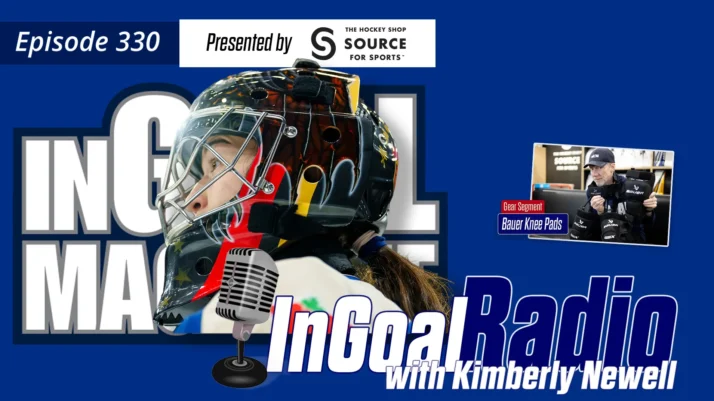
InGoal Radio Episode 330 Kimberly Newell of the PWHL Vancouver Goldeneyes
Please subscribe and leave a rating — it helps us reach more goalies!


Kimberly Newell, a Vancouver native who represented China at the 2022 Winter Olympics, made the expansion PWHL Vancouver Goldeneyes opening-night roster despite not playing competitively in the years between. In Episode 330 of InGoal Radio, Newell discusses comeback mindset, evolving goalie movement principles, and lessons learned through one of the most remarkable stories of the 2024-25 PWHL season.
- Kimberly Newell earned a spot on PWHL Vancouver's opening-night roster without playing competitively since representing China at the 2022 Winter Olympics.
- Newell shares specific mindset strategies and movement philosophy insights that shaped her successful return to elite goaltending.
- Avoid giving advice to young goalies immediately before or during a game — even well-intentioned feedback can negatively affect performance.
- Dustin Wolf breaks down off-puck awareness, rotational keys, and glove projection technique on backdoor chances in the Pro Reads segment.
- The episode reviews the Bauer Elite and GSX kneepads for goalies evaluating protective gear options.
Episode 330 of the InGoal Radio Podcast, presented by The Hockey Shop Source for Sports, features an advice-packed interview with Kimberly Newell of the PWHL Vancouver Goldeneyes.
Feature Interview
presented by NHL Sense Arena
In the feature interview appropriately presented by NHL Sense Arena, we catch up with Newell shortly after making the expansion Goldeneyes opening-night roster out of training camp — despite not playing competitively since the last time we talked to her shortly after the Vancouver native represented China at the 2022 Winter Olympics! If you haven’t already, that first interview in Episode 179 is a can’t miss conversation, and we pick right back up with lessons on comebacks, mindset advice, an evolving understanding of goalie movement and a whole lot more from one of the truly remarkable stories early in this third PWHL season.
Parent Segment
presented by Stop It Goaltending U
In this week’s Parent Segment, presented by Stop It Goaltending U the App, we talk about the dangers of giving advice to a young goalie before a game and even during play no matter how well-intentioned.
Pro Reads
presented by Vizual EdgeWe also review this week’s Pro Reads, presented by Vizual Edge, which featured Dustin Wolf with advice on off-puck awareness, rotational keys and glove projection on a backdoor chance.
Weekly Gear Segment
presented by The Hockey Shop Source for SportsIn our weekly gear segment we go to The Hockey Shop Source for Sports to look at the Bauer Elite and GSX kneepads.
Episode Transcript
Intro
Presented by The Hockey Shop Source for Sports Langley, thehockeyshop.com. It's InGoal Radio Podcast. Everybody back together. We're excited about this. But most of all, Woody, you're back on the ice, my friend.
Oh, we probably shouldn't reference that because it didn't go all that well.
Who cares? You're back on the ice.
Note to self, the first skate with the goggles that fogged up that I shared on Twitter, like, it was a little tough to see out there. That was just like a drop in skate at a pretty low level to sort of test to see whether I could actually see with these things and if I could manage the fogging. Maybe shouldn't have made the second skate and my first in close to eight weeks, 19 plus division two against kids half my age. That was it was going okay. It was going okay till about five minutes left in the third period, and we decided to take a run of penalties and basically spent the rest of the game down two men.
There was a moment there where the entire sound of the arena disappeared on me and things went a little white. I thought I was gonna pass out.
How are the goggles, though?
Goggles are okay, but, I sucked. So, the legs legs are definitely not up to, playing standards. So, it took me I I actually had to be helped off the ice. This is embarrassing as it was. Like, the legs just buckled after overtime.
So Really?
You were done. Oh, you got to overtime?
Yeah. Yeah. Because we because I blew a big lead late killing all those penalties. Because guess what? They were major penalties, Daren.
So every time they scored, nobody came out of the box. Add a pulled goalie into it, and the only surprise is that I didn't pull something other than my brain.
Well, you're you're back at it. Old guy feeling young, and then we got a young guy feeling old or looking old, performing old, Jesper Wallstedt. What what a great story we've got coming out of there as we bring in David Hutchison who's at the home office right now just listening to Woody's beautiful explanation of his men's league skates.
I always enjoy listening to Woodley, and I get a lot of opportunities to listen to Woodley. I'm just being myself, you know. I always I always said that I'm an introvert who likes to be around people, which is why I was a goaltender. I can be myself, I can do my own thing, but I still get to be kind of part of a team. That's who I am.
I'm doing the same thing here. I'm just quietly resting in the crease while you two, rag the puck down the ice.
Jesper Wallstedt is on a role just like the Minnesota Wild, but, that's that's an organization that's taken its time with him. And I'm curious as as two guys that follow it and with a son that's come up through the world of of hockey, your your approach and your ability to embrace an organization being patient with a goaltender when we all want it now, now, now, Hutch.
I think we're just talking about that, last week a little bit when we were talking about Corey Schneider coming up behind Roberto Luongo and how he had that opportunity to develop slowly and carefully with starts planned and so on. And, whereas sometimes at the younger levels of the game, whether it's minor hockey or moving up into junior, you don't necessarily get that opportunity. It's next man out. And if it doesn't work out for that guy, they'll just go find someone else. It's a lot easier to just go find somebody else in junior hockey because there's so many kids waiting for their opportunity.
And, I don't know that you get many organizations. Also, window, obviously, whether you're talking minor hockey or junior hockey is is typically just a couple of years for a team, and so they're not nearly as patient in terms of development of of of an asset. So it's great to see that happening at the National Hockey League level, and we can see the the results.
This is what Minnesota was hoping they had in Wallstedt.
Yeah. A guy that, the Edmonton Oilers ironically passed on in the draft traded down and let the Minnesota wild draft them. I gotta be honest. I had people in the goalie department in Edmonton when they did that that were were not happy, were a little frustrated because they would have liked Jesper Wallstedt coming up through their organization, and they probably would have loved to have had him right about now. I like that the patience continues this year.
Right? Like, look at the record. Look at what he's doing right now, and there's no rush to make him the every night number one. Go back and forth with Gustavsson. Develop a great tandem.
Play them both. What Wallstedt's doing in a small sample here, fifth in the NHL in adjusted, goal saved above expected, fourth in adjusted save percentage. The fact that he's played so little and he's already in the top five in goal saved above expected, which is a cumulative stat, is is remarkable. He's he's handling everything, and this is it's not like it's been a linear path. Right?
This is a guy who just a couple years ago really struggled in the American Hockey League, talked about sort of feeling the weight of that and has managed to move on. So there's there's some mental strength that he's showing there. Technically, I I think all the things that made him a first round draft pick remain, but there's just there's there's a sort of process of figuring out how to apply it at the National Hockey League level, how to apply it professionally. When he got his call ups late last season, like, didn't go well. Right?
Like, his first games were were were not great. And rather than just go sit in the corner and sulk, you know, he figured out what didn't go right and went went to work solving it. So credit all around to the wild at both levels in the American Hockey League with Richard Bachman, you know, and and up in the National Hockey League with with Freddie Chabot for the way they've managed this asset, but as an organization and as a goalie coaching staff.
Funny. When he played, it was Freddie Chabot. Now he's Freddie Shabbat. And I always
thought should be Shabbat. I I probably just screwed that up. Like, everything this week.
It should be Chabot because of the francophone.
But I do think it is Shabbat.
Shabbat is anglicized, and I don't know why it ever got that way. And and Hutch, you you're the educator of the three of us.
You've got Montreal roots. Tell us which is correct.
Yeah. I I suspect I do not know. I suspect that Daren is calling it correctly that Shabbat is the anglicized version. I think a lot of people I am guessing that if you were to ask him, a lot of people just sort of give up after their name gets butchered for long enough and just say, okay. Yep.
That's what I'm gonna go with. I bet you that's how Shabbat came to be.
That's why you have a name like Scott, and nobody can screw it up. Scott Wedgewood has been outstanding right now for the Colorado Avalanche. They're scoring a ton of goals, and I've heard it said that there's not much pressure on them. But, boy, if if there's an inspirational story for everybody about sticking with it and you can still be a top performer in the league, this is it right now. It's it's been fun to watch.
And we just happen to have a story up at ingoalmag.com from one of our past conversations with him. One of our new writers, Colin Hodd, went through podcast interviews with Scott and came up with some of the tips that allowed him to get to here. So a lot of less is more for Scott Wedgewood in his evolution to this level. As much as he has that dynamic athletic flair to his game, and we've seen that come in big moments with big saves and highlight real stops, putting himself in a position to not rely on it as often has been a big part of his evolution. So make sure you check out that article featuring Scott Wedgewood and and his path to this level at ingoalmag.com, and I I'm with you.
Good for him. Like, he showed signs of this at other stops, consistency from year to year, situations change, all these sort of questions, and yet he never stopped sort of working on his game and evolving. He's a real passionate student of the position, and and good for him. Name to name to added to the team Canada shortlist. And, Hutch, you were saying before, like, yeah.
Okay. They're a really good defensive team. And, yeah, they score a bunch of goals, but maybe that that makes him a perfect fit for the Olympics.
Yeah. I hadn't heard that angle before, but Hutch, you might be onto something here.
Well, Woody's the one who always uses the phrase horses for courses, and I know he's more talking about stylistically and a goaltender fitting in with the system that his team plays. But, yeah, we we definitely it takes a certain person to be able to play, for a wagon of a team and then deal with the fewer opportunities that come their way. And in many cases, the higher danger opportunities that come their way as result. A They might be few and far between, but sometimes if a team knows they can press, they give up something a little bit more challenging at the other end, and it takes a certain person, mentally and physically to be able to handle that situation. He's shown that he can do it.
So I think it makes sense that he would be under consideration for the Olympics because chances are he's gonna be playing behind a wagon of a team with team Canada, and and he's shown he can do that.
My favorite goalie to watch today from the Calgary Flames, and he he plays so much bigger than than he is, but Dustin Wolf. And he's he's up. He's down. He's the the lateral movement, he just bounces the the the jump, everything. Goalie I'd like to play like, though, is Scott Wedgewood.
Like, I I watch him and go, I wish I could do that. I I see that's the way I feel like I am when when I'm in the net. He's he's got it all.
He's he's a great skater. He's narrowed up his stance and and, again, this goes to that article in InGoalmag when you look at him sort of keeping his feet under him. And and I do think we could probably you know, Wolf is the same way. We talk about evolution of the game and the attack. Like, when we start to look at what's working for goalies against this evolution, like, aren't we seeing a lot more guys?
Like, it's not universal. There is no that's what we love about the position. There is no one way. There is no one type that succeeds. But aren't we seeing that trend towards guys that, you know, just move better, not necessarily square footage, massive size as as their sole strength, or as their biggest strength having success in the league.
And it's funny you mentioned Scott Wedgewood and the ability to play behind a team where you don't maybe see as many shots, but a lot of them are high danger. And how do you manage that? When it comes to the high danger chances, Scott Wedgewood's number the one one of the top, well, top five goalies in the national heat hockey league right now in terms of managing, you know, the tough stuff that he does see eventually with the Colorado Avalanche, and that's what's allowing to have him to have success. We talk about big saves, and I know the analytics people hate that. Like like, all saves are big saves, but there's something about being able to rise the occasion in big moments, especially if you haven't been busy.
And we saw it with Bennington at the four nations, and we have numbers that sort of show that. And and Scott Wedgewood right now is the guy that's doing that for the Colorado Avalanche.
Fun to watch. And just a great story too. That's the impressive part. A a year ago at this time was just was even part of the organization yet.
Barely. We revamped. We did this while you were away last week. It was the one year anniversary of them changing it.
Gear
Just re revamped their entire goaltending at the National Hockey League level, and it and it's worked for them. They're good. Gear Segment brought to us by The Hockey Shop Source for Sports Langley, thehockeyshop.com. We'll get into it in a second, but what's happening with the boys?
They're busy over at The Hockey Shop Source for Sports, especially over in that goal department. Cam is running around like crazy. There's the new line from Brian's that's come in that we'll bring to you in the very near future. There's all the new gear we've been unloading, unboxing, and telling you about over the past month. Like, it just seems like even though we're into Christmas season, there's still new gear coming in.
And, of course, there's Black Friday sales like crazy. What else would you expect from a store with as deep a list of inventory as The Hockey Shop Source for Sports? All those things at The Hockey Shop dot com. As we head into December here, a reminder that there you have to give shipping time lines. So if you're thinking of a Christmas gift, make sure you check out thehockeyshop.com, something for your goalie.
I'd highly recommend. We've we've we've highlighted them in the past couple weeks. Pro return sticks, an opportunity to sort of try a different paddle shape, a different blade. They've got tons of great options there. Nothing like getting a stick under the tree that's happens to have the name of your favorite goaltender on it and know it was made for him.
That's an option. They've got tons of them. You got about a couple weeks here before you get your into your shipping cut off, so make sure by mid December, you've got those gifts picked online, shipped, and ready for you. No better place than the Hockey Shop Source for Sports to gear up for goaltending, to gear up for Christmas. Make sure you check them out.
We are going to take a look at the Bauer Elite and GSX knee pads this week. Now you guys wear knee pads, right, when when you play?
Yeah. I just skipped the dangler there and everything else.
Okay. I just I just thought if you if you weren't gonna protect your head, you might not take care of your knees too. So far be it for me just to assume that you guys would would wanna protect yourself.
Is that Jonathan Quick on line one about not wearing knee pads?
I was gonna say it's not an assumption because I see questions all the time from new goalie parents with young goalies who aren't sure if they should have knee pads because they've got those flaps at the top. And, yeah, we've known a few people at the National Hockey League level have tried it. But, yeah, for all of us, it seems like a no brainer. But if you're very new in the position or as it were have been in it for a very long time, don't assume that knee pads are worn everywhere.
I will tell you a story on one of the reasons why I wear them, and it's not the reason that you would automatically assume. But first, let's go to the Hockey Shop and talk about the Bauer Elite and GSX knee pads.
New options for knee pads, a goalie garter belt that makes Cam feel like Batman. Not Batman. We're gonna get into all of it this week at The Hockey Shop Source for Sports. Our gear review. Cam, we did the new Bauer Pro knee pads a while back, but they've updated the next models down.
Elite for me, GSX on you, as well as we mentioned, the Goalie specific garter belt that's been updated and it's kind of cool. So let's let's start with let's let's work our way top to bottom. We've already done pro.
Let's tie this all together. Elite. Elite. So notice how I have the elite? Yes.
I'm just Why? Because you're elite?
I am. Oh, wow. It's not
a coincidence folks. That's why I have it on. So bit of a redesign, but still holding on to the same design. So, based off that original one S Vapor knee pad, Bauer's done a little bit of refurbishing to the overall outside.
Like the better straps. Neoprene. Clearly neoprene straps on the top and it's tapered, so a little And
[crosstalk] then, so it's not gonna get bunched behind you. You have that influence from that pro knee pad coming down into the elite. Bottom as well. That bottom strap has got the neoprene. Yes.
I like this sorta hold it underneath. Why do they do that, Kevin? Actually, Cam, why don't you tell me?
Yeah, I figured that was coming. So that helps- I just liked it.
I didn't know why it's on.
So that helps to anchor the strap on you and stop it from sliding down. So not a 100, but it can definitely help with that shifting of that knee pad up and down. So nice hard cap. They still have their curve X composite inside. So you are getting that overall protection and coverage.
Basically this elite knee pad, if you find that that Pro is just a little bit too substantial all the way around, this is just a little bit of a trimmed down version. It actually shares a lot of its DNA with the one that I'm currently wearing, the GSX Knee Pad, which has also gotten a bit of a facelift.
You know what I like the best about it? What's that? It says left on this one, which means I've got the right one on
the proper leg. So easiest way
[crosstalk] to remember is always Velcro on the outside. Yes, but I don't have to remember because they put a label on it. So for goalie parents, that will help a lot.
Yes. GSX knee pad. Again, little bit of a facelift, still same basic design from that older previous GSX. Nice little facelift in terms of the design and the graphic. I like how it like just the pivot feature of it.
Yes. Which again is hidden underneath there as well. And that's what gives that knee pad that flexibility, especially around. And as you can see, your knee is bent right there. Nice movement.
So with these, we have that return of that neoprene strap.
Neoprene right down to the GSX.
Yes, Exactly. So you're getting that nice little bit of flexibility, but a little bit more rigidity in the strap itself. A little anchor flaps there too. Exactly. To help hold that on.
So just a little less protective.
Yes. So there still is a nice hard plastic cap in here. No curve X or anything like that. Have that extra piece across the Exactly. So if you're looking for a minimalist knee pad, which these definitely are.
Right. Because some guys don't like to have a ton over their knees. They want it to be very, you know,
Please wear something. Some guys
have that like super wide butterfly. They never get hit in the knees.
It's only a matter of time.
Okay. But so some guys in the NHL don't wear an EFlex cam. Name two. Devan Dubnyk. I guess he's not in there anymore.
I'm pretty sure Jonathan Quick is still just wearing basically a thigh wrap.
So let's find out. I named two. There you go. Well, good for you. So there's two that one that doesn't even play in the NHL and one that clearly holds on to his old school style.
Okay. Now that said, we have one more caveat to this. Because how do
you attach if you are somebody who likes to attach your knees to your waist to make sure it doesn't shift? I do like the flap. There's another option. Cam, show them your new Batman utility belt. That's not the music for Batman.
No, that definitely wasn't in it.
We should have like the bat say, I don't know.
So probably copyright involved folks. If you are looking to have another way to anchor your knee pads, Bauer's come up with their new garter belt, attaches conveniently to the GSX Elite and Yes. Nice and easy to strap on. They have their plastic clips, which slide on right through their nylon loops, easily adjustable Velcro to be able to have that anchored perfectly on where it needs to be and a nice easy strap up front. Nice big fat Bauer logo, just to remind everyone that you are wearing a Bauer garter belt and ease of adjustability in the back.
There we go.
That's the last time I want to see your backside. Thank you very much. Quick question for you, Cam. If you were to wear it like this with this, are you still putting the socks over top? I would still recommend socks over top.
But because?
Personal preference.
Velcro on the pads?
Exposed velcro, so no matter what, that catch and grab effect can always happen. So totally up to you on how you wear your gear. I tend to recommend wearing socks over top of your knee pads. It creates a better slip surface too for the knee pad inside of the knee cradle of your pad as well. I know that's a personal preference and a
big one for you. So I wanted to give you the opportunity to share that. Once again,
I think we can find about four or five other episodes where he's done it with our audience. Any questions about how these integrate sizing, give them a shout. Hockeyshop.com. Most of the information is on there, whether it's Cam or anyone on his team, they'll be able to answer your questions. If you call them at (604) 589-8299
or 1-800-567-7790 or check us out at the hockeyshop.com.
Thanks, Cam.
It's on my bucket list to come and hang out with you guys while you guys record.
That is a very unimpressive bucket list, Daren, but we'd be happy to have you.
I'm not We put you to work on camera, buddy. Watch you guys for a bit, and then I would wander and browse, and then I'd come back and watch you guys for a bit.
We just have Daren in the background wandering through the store as we record, basically.
You you know the telestrators now that will show the dots of where the player travels through the course of the zone? That that would be great to watch me in the in the hockey shop.
How many miles can you get in?
We'll zone map it.
I I will have it totally blacked out with dots by by the end of when I travel. But that that would be cool just to just to bounce around because you guys are kinda in there before it opened. So I would have the place to myself.
You would. You could make I don't know why. You could make a mess. That's what I do.
I tend to do that, Daren.
I'd throwing stuff
all over. I start the cameras running and I take off, and I start wandering.
I I went through a phase just maybe ten years ago. I'm not wearing a knee pad because of that same reason, because there's flaps and there you were protected. And I I rarely get a shot. I wasn't playing at a a level where I I was in danger of getting a shot inside. And then a guy crashed into the crease and his skate went inside my pad and cut me right on on the inside of the knee.
Big gash and and had to go to get, big stitches, everything. And that's why I wear the knee pads. More so for that kind of situation than the puck itself.
See, that's a that's a good reminder. And, you know, to Hutch's point, we joke about, oh, like, who doesn't wear knee pads? And even there are some guys in the NHL that wear that sorta, like, that knee wrap that's connected to the pad. Just a couple of old school guys. But you're right.
Like, there's other reasons to wear knee pads. So for the parents that are listening that are wondering about this, yes, there is a protection, not just from pucks. When I started, my butterfly was so narrow that I needed the big bulky knee pads because I was making the sort of knees facing the shooter saves. Thanks to Maria Mountain, my butterfly is now wide enough that the pads close in front of me, so we don't have to worry about that.
She's the best.
But you know what I like the knee pads for? They make me taller than the butterfly. They add height to my knee stack.
How much, though?
Inch and a half with the setup I've got right now?
Enough that we've seen NHL goalies wear two sets of knee pads to get an extra bit of height.
Yeah. Because it can Yeah. And and and listen, height, like, your knee from the ice height, because the NHL is really strict on on the knee stack height, and and they got strict about it, like, fifteen years ago, started enforcing it. Not coincidentally, groin started popping everywhere that year. But the ability the higher your knee is from the ice while your ankle is still being able to get like, that angle is really important both in terms of butterfly width, pressure on your hips, internal rotation, all those things are improved by having more space between your knee and the ice.
Like, you don't wanna get carried away. We've seen people beef up their knee stacks at the Beer League level, and it can take pressure off the hips. I think, like, that is part of this conversation. There are knee stack, knee pad systems that are designed to work together. And so it's really important, maybe not for youth hockey.
I think it's important to get comfortable in the at youth hockey. But as you come up through the ranks, understanding how they function relative to your equipment and what the benefits are for you, like, matters.
K. If anybody's using a a big knee stack with a little bit of length on your toe ties, you you've experienced this. Try putting your pads together with with that setup because there's there's a play on your skates. So try to put your skates together, your pads together, but with a big knee stack, visualize this. It's it's an invert it's a v because your knees come together at the top early, and then your pads can't get together at the bottom because there's so much width at the top.
It makes you feel a little bit awkward.
Especially with old man flexing.
You guys haven't had to do that before. But but old man here, you can't do the old post play and just put your pads together because they won't go together.
I'm used to feeling awkward, but that's a different kind of awkward.
It's me just going down a rabbit hole in a different direction here a little bit, but inspired by this. We always hear people talk about how important it is for a goaltender to be tall, to take up lots of space in the net. But really, it's important to be tall in the butterfly because we make most of our saves when we're down on the ice. And some people are tall because they've got a lot of distance between their knee and their and their hip for example, and some because they have it between their knee and their ankles. And height between your knee and your ankles is relatively useless when you're down in the butterfly.
You wanna be tall between the knee and and and the hips so that you sit up taller when you're in that butterfly. But I haven't heard a lot of people talk about that when they're talking about the size of a goaltender.
I I guess it's useful getting across. Like, it's useful in a different way if you if you're tall between knee and ankle, kinda thing.
Sure. But if you're mostly just talking
about manages.
Yeah. Of course. But if you're mostly just talking about taking up space in the net, relative proportion is is really important.
You know what? You need you need big eyes through eyes wide open, like, just to make you absolutely engaged, and that's what the Vizual Edge helps you with as we slide over to the Vizual Edge ProReads and help out the goaltenders through the through our friends at Visual Edge. Well, I mean, I don't
know about the eyes being big, but, boy, ever been there when the puck looks like a beach ball? Just looks gigantic to you. Every goalie has that night here and there where the puck looks huge. You're ahead of every play. You feel calm, patient, total control.
Then there's the nights where you're half step late. You see it, but you don't really see it. You're reaching, guessing, fighting it. That's not your technique. That's your eyes and your brain not processing the play fast enough.
Vizual Edge fixes that. It measures how well your eyes track and process the game, then gives you a custom plan that trains it. Three fifteen minute sessions a week on your laptop or tablet, laying on the couch. It's what NHL goalies use to make the game slow down when it matters most. Still a couple days, guys.
December 1, end of day, so listen to this podcast quick and get on there. To save between 5055% on the Vizual Edge plan. Use code InGoal, I n g o a l, all caps, to save 50%. And if you're an InGoal premium member, log on to any ProReads to get the member code and save 55% either off the first three months of a monthly plan or off the entire year of an annual plan. Vizual Edge is designed to help you see and process the game better.
It's used by NHL goalies like Jordan Binnington, Cam Talbot, Mitch Korn of the National Predators uses it with their prospects. You can use it too, and for the next couple of days, still save up to 55%. Vizual Edge. Check it out today.
K. What's that code?
I N g O a l. InGoal, all caps, 50% off. And remember, check out ProReads. They sponsor our ProReads. Check that out for a member exclusive discount to save another 5%.
What do we have going on at, our ProReads?
Your favorite goalie. You talked about him earlier. Yes. Dustin Wolf is back. Yes.
And this time he talks about awareness, rotation, and projection on backdoor play. So projection in terms of getting the glove out there and cutting off vertical angle. It's a great breakdown, but one of my favorite parts of the breakdown this week is being able to figure out where other players on the ice are even when you don't have a chance to look off the puck. So we have a great screen cap up. It's Wolf in the crease at the edge, and all you can see is everything sort of in front of him on his right, which is three players.
And from that screen cap, you would think, hey. Not a lot of information here about where the other guys are. We can't see them. But as Wolfe explains, we know one's a defenseman. We know one came out of the corner before, so he knows exactly where that guy is sitting backdoor.
And when the puck after a strange bounce to the opponent in the side of the slot to his right is passed across, he has an idea where that backdoor threat is, and then he talks about the importance of not just pushing out to it, but getting that rotation. And Dustin is great at sort of explaining what leads his rotation. The way his head moves leads that rotation back to the post. And then in a moment of desperation, how to sort of add some technique to that by cutting off the vertical angle for that in tight play in the backdoor. It's a great breakdown, a great explanation.
Dustin Wolf does it better than I just did in terms of explaining it, and you can watch him do so. Watch the video exclusively at ingoalmag.com presented by our friends at Vizual Edge.
This is a topic with Dustin Wolf, but I appreciate his reaction after he lets in a goal or something gets by him. There's no waving hands. There's no sagging in the shoulders. He just pops up, and and he's and he's ready to go. And I I appreciate that about him and wish we were all more like that.
So in other words, you wouldn't have approved of the f bombs I screeched out after a couple of late ones? That may have been just my my screaming at my lower body screaming at me, but in my in my return, Daren, you wouldn't have liked my body language?
You you ever do that and then realize there's people in the rink? Oh, yeah.
I'm upset.
And then you go, whoops. I I do that.
Carries a long way in an empty rink.
Exactly. It's it's like a lake. Right? It's going across you here, and you're like, oh, that I I could have probably handled that a little bit differently. Even even if you're not super mad, but you'll just throw one out.
You know what? And you know what? The the one that frustrates me is the ones that are you know exactly what you did in the moment, and it's too late. And it's just like, this should have been a can of corn. This should have been easy, but I I didn't do this.
And now I've left myself in this spot, and it's just like yeah. Yep. So you're mad at yourself, but you're just like yeah. I have an internal dialogue that goes on all the time. Like, somebody said my mask should be painted like the Venom character because, know, you have the the two voices going on in the head in that movie.
Like, that's an internal dialogue. And when I drop that f bomb, it's usually just that character yelling at my other character about how crappy.
Woody, you don't need venom. You need one flew over the cuckoo's nest on your mask.
Thank you. You're welcome.
You know, I was thinking was the you the the the two angels on the shoulder or the the two people and things on the shoulder.
The angel and the devil?
Yeah. Yeah. Thank you.
Except that that
makes more sense. That that that should be on your shoulder. Like, you're doing great, Woody. You suck, Woody. You're doing great.
That'd actually be a funny mask. That'd be great because we got the two sides. That's a great idea, Daren.
That would be a, like, that would go viral. Yeah. Something like that. With
the right explanation.
I think we I think we just came up with something.
I think I think Woody's got his new mask idea. He's been rolling in the white mask for a long time.
Woody the Woodpecker.
What is that? The Woodpecker as a devil.
What's going on with that? Like, let's let's get on then.
Hey. We all can't afford fancy paint jobs, Daren. Come on now. Like Some of us
I'll supply you with the ideas. You get it done. Just get it done. I'm the idea
guy. Not everybody's in
any of the media. Right? This this is like my wife with a credit card. She spends. I pay.
Yeah. Good thing she's not listening.
The I've listen. I've already got the warm up stick. Like, I can't afford to you know, that's the closest I get to the NHL.
He's gonna have a warm up mask next, Daren.
That's not a bad idea either in in men's league.
Keep that paint
job, please, for the game. I had three shots at one time two weeks ago.
Oh, you like three shots. Let's be honest. For warm up, the warm up mask would just be a giant bubble. Well, an astronaut helmet with air in it.
Like like Hey. Soft cushy foam. The Guardian cap. The Guardian cap. Arm up.
The last guy to shoot of those three shots was the guy that I was looking at, and he still shot, but then chirped the other two guys. But still shot.
Oh. Good thing they all missed the net.
It never gets old. The I've actually contemplated. Is it better to not take any shots Oh, I can attest. In in rec league than is it is it better for your safety to not take any shots and suffer through maybe whatever comes with the the opening minutes.
Okay. So safety and sanity, perhaps it is better not to do that, but I will attest that it is not better from a performance standpoint. Because in in addition to deciding that nineteen plus div two was where I should make my return after eight weeks, I ran into a car accident that closed the highway on my way. They had to get another goalie to start the game, and I basically ran into the room, got dressed, and we actually you guys would appreciate this. I was so choked nobody ran a video that we gotta go find, like, the what's the rink camera that records it?
Oh, yeah. Rink bar?
If we do that, that means people might see how I actually played. So don't do that. We changed on the fly halfway through the first.
Love it. There you go.
I don't Had had the puck coming in the other zone. This guy was filling in, and I'm like, I just gave him the wave. I'm like, let's do it. Because it was taking forever to get a whistle. Our guys wouldn't ice it, and I'm like, let's do it.
We changed it on the fly. It was great. That was actually probably the only the only good part of my entire game was changing on the fly. It was downhill. Did get the high five in
on the way by?
Yeah. We had a lead. We had a lead. No. Hutch lead.
Yeah. Hutch, a 100%, we should have high fived on the way by, but, like, guaranteed, I would have, like, caught too much blocker on the blocker tap and, like, spun myself out of control, and they would have 60 bail. Yeah. Wow. Fastest I've ever moved, boys.
Changing on the fly. It was downhill from there. What can I say?
It doesn't sound like it was downhill. You got to overtime. First time back at that level. Yeah. Daren I think you're a little too hard on yourself.
Let's bring back the angel.
Good job, Woody.
Parent Playbook
Stop It Goaltending U, the app, sponsors our parent segment. Great relationship, with our friends over at Stop It Goaltending U.
And they do a great job over there at Stop It Goaltending U. There is a we've talked about all the different things you get through our partnership with them with a membership to their app. How about the daily refreshers? Just a minute, two minutes every day, five days a week, Monday to Friday, become a better goaltender. This week, they look at how does your goalie present themselves?
How do we present in the crease, off the ice, all those things? That's important. Clay Adams, goaltending scout for the Utah Mammoth with a great breakdown on Ann-Renée Desbiens of the Montreal Victoire in the PWHL, taking a look at her video on breaking down the strengths of her game. We talked about Scott Wedgewood. Well, how about Adam Mercer doing a breakdown of what makes him so good in this week's goalie playbook?
Again, video breakdown, strengths, what's allowing Wedgewood to have the success, all that plus a drill of the week at the Stop It Goaltending U app. You get that type of content on a weekly basis from them when you become a member, and you get a membership to InGoal Premium. The best of both worlds together. Stop It Goaltending U, the app, with their twenty five years of experience right up to the NHL, all baked onto your phone or tablet, plus a subscription to InGoal Magazine all for one price. Make sure you check it out now, at Google Play or the App Store, wherever you download apps, whatever platform you're on, it's there for you.
Log in and get the best of both worlds to become a better goaltender.
Hutch.
Okay, guys. I I saw a question this week from a parent who was concerned that all the pregame chatter and encouragement from other parents might be affecting their child when they have to go out and play goal. You know, the father of the left winger comes up and says, hey, Johnny. Have a great game. Don't forget to challenge the shooter.
Keep your stick on the ice. Focus out there. Whatever it might be. We know it's, well meaning in most cases, but they wondered, could it be causing problems for their goalie? Maybe that parent's planting a seed that's gonna distract them in some way.
In short, it absolutely can be a problem and but guess what? We parents need to be just as cautious. And, the time frame for when this matters extends a lot further out than you might imagine. It's not just as the kids skating onto the ice or leaving the dressing room or or whatever, but we'll get to that in a bit. As we know, a goalie lives in a world of split second reads.
They're tracking the puck, they're scanning for threats, they're recognizing patterns, they have to anticipate what's coming next. That ability depends on a precise balance of perception, working memory, emotional control, and it's far easier to disrupt than most parents or coaches realize. And it's especially hard for the youngest goalies. Now let's start with the obvious. We'll get back to this parent situation, but the obvious is the in game distractions.
There are no shortage of goalie parents or quite frankly parents of players who will be yelling things during games that cut right through the athlete's focus. Come on, Johnny. Focus. Backdoor. Challenge.
Even elite athletes slow down and make more mistakes when sudden verbal distractions are introduced.
And even if you think you're yelling something encouraging and supportive, it still cuts through that attention. That's that attention that scientists call selective attention. It's an ability to lock on to the right cues and ignore everything else. Even elite athletes slow down and make more mistakes when sudden verbal distractions are introduced. I love the research by Joan Vickers at the University of Calgary.
She's famous for her quiet eye work. I'm sure we've mentioned it here before. It's the ability of an athlete to fixate their gaze in those final moments before they have to react. And elite athletes, they just do it for longer. They can lock that focus on whereas the less elite athletes than the regular athletes, their their eyes are bouncing around all over the place.
Guys, I don't know if you've ever seen somebody tested for reading ability where they can show how the pupils, what they're tracking along the, along the pages they're reading. And some people, they're just locked right onto those words and characters and other people, the pupils are bouncing all over the place and surprised those are their people have some issues with with reading and so on. And it's kind of like that. Can you lock on to the puck as it were longer than other people? That that's one of the things that shows that people are elite and more importantly for today, their research has shown that distractions shorten that quiet eye period.
The longer it is, the better you are. They can show that distractions shorten it. They shift the athletes from anticipatory. Maybe we can stay the say the flow state where they're just waiting for things to happen to having to react to things and and that changes everything. This is, one scientific basis you might say for Woodies.
If you think out there, you're dead. So if the puck is in the zone, your goalie needs their full vision and full attention locked in. The science is clear. When you shout at them, even positively, you're pulling them out of the attentional mode they need. Stress responses by the way also matter.
Studies from other research have shown that even mild stress narrows your attention and and causes athletes ironically to fixate on single cues instead of reading the whole play. There there's more to it obviously than just the the fixation of that quiet eye versus being able to take in lots of cues. The the quiet eye is about that instantaneous moment just before having to to make your move. Whereas now now we're talking broader brush here. But stress matters and let's face it, goalies in particular get put in to a lot of stressful situations by parents, coaches and and so on.
Now, developmental research shows us that the youngest athletes are especially vulnerable. The brain we know develops right through childhood and beyond and often it's the youngest kids who get the most quote unquote expert advice from the parents. Cheering, by the way, becomes harmful whenever it competes with the cues that the goalie needs, even positive cheering. So what am I saying? Can you cheer?
Well, from a scientific standpoint, you probably shouldn't while the puck is in a dangerous area in zone. Wait till the puck is out of the zone, and even then, they're suggesting that you should be keeping a general and team focused rather than, awesome, Johnny. Great saves out there. That's distracting the kid away from where they need to be. I'm certainly guilty of that myself.
Even pregame technical reminders like an hour before the game can push athletes into an internal focus, thinking about those things, that's gonna slow their reactions and disrupt their automatic reactions. Supportive nontechnical encouragement before the game, that's far more beneficial.
There's even some suggestion that that parents who can be so incredibly positive and encouraging can also put their kids into a tough spot because then the kid shifts from what they need to be doing on the ice even even subtly to being focused on trying to please their parents. So back to the pregame, which is where we started. Even pregame technical reminders like an hour before the game can push athletes into an internal focus, thinking about those things, that's gonna slow their reactions and disrupt their automatic reactions. Supportive nontechnical encouragement before the game, that's far more beneficial. Have a great game, Johnny.
Susie, have fun out there. That one's my favorite. Use it all the time. But like I said, even parents who keep it a 100% positive have to be careful because it can shift kids into playing to please us, which puts them in the wrong mental state to perform. But what about coaches?
Because they're giving technical cues before a game all the time. I even heard about a coach that was doing video in the dressing room just before the kids went out onto the ice. Well, the answer is yes. They do, but the relationship with the coach is different and and it matters. Athletes expect the technical input from the coaches, and they're not seeking emotional approval in the same way as they are with us as parents.
But even then, the research is clear. Pregame should stay simple. One theme, no big technical dumps, some tactical reminders are fine. It's the mechanical ones, the technical ones that usually backfire on you. This is probably a note to the coaches who decide to go into the dressing room between periods and start breaking down technique for goalies.
Okay. It all comes down to this. Parents, the goalie parent, the parent of the other players on the team, they've got one job. Support without adding noise. Provide calm, emotional support, create a predictable routine, and let the athletes training take over.
Okay. It all comes down to this. Parents, the goalie parent, the parent of the other players on the team, they've got one job. Support without adding noise. Provide calm, emotional support, create a predictable routine, and let the athletes training take over.
That was deep dude. That was beyond my comprehension.
Go down the rabbit hole, man. It actually inspired by, well, it was inspired by a question, as I said, during the during the piece, but it was actually inspired as a concept that's been in my head for a very long time by somebody from Woody's first sport, which is baseball. When I heard a coach talking to the parents about the effect of cheering for your kid during the play that, even if you think you're being positive can be causing some negative outcomes.
This is another question is how do we apply this to Woody's devil and angel mask and the communication that running dialogue inside my head? Should I stop that before a certain time of the game? Let the good guy talk or or shut the bad guy out?
I think we are trying to stop the communication in the head when you're playing. That's for sure.
A lot of stuff up there, Hutch, buddy. A lot of stuff.
Tell me about
it.
The angel and the devil internally battling for Woody's attention, and now he's gonna have to wear earplugs with the goggles to to keep the outside noise at bay. You are going to be one stylin' dude.
Woody Woody needs some AirPods, and, you have got the the white noise playing in it, you know, that some people like to have in their bedroom when they go to sleep at night. I think that's what you need, Woody, so you're not listening to the angel.
But then he'll be snoozing.
I see. Here's the sad part, and please don't let my wife listen to this podcast, but things got so bad in that game the other day that I there was Don't say it.
There because she'll find it. She'll find out.
There there was a point where we talk about white noise where I I got lightheaded enough that I thought I was gonna pass out, and all disappeared from the rink for about twenty seconds. It just went completely, like, no sound. I'm like, am I about to heard
of what you experienced.
Am I about to were gonna drop you at five on three, and I couldn't feel anything. It was it was bad. It was bad.
I wanted a chuck before, but I've never been on the verge of white spot chasing following the the light kind
of thing. Yeah. Don't don't go towards the light. That's my recommendation in those moments.
Well, you make you make tossing your cookies sound like a a getting off easy.
Nothing ever dramatic with Woody, is it? It's it's always just common response.
Yeah. Yeah. He he just he just can't race to the bench for the garbage can. He's probably gotta, like, pass out.
There's there's a lesson here, Hutch. I did have to be helped off the ice after the game, but there is a lesson here for parent segment because there's no way I felt properly before this game in terms of eating enough, and I think that played a role in it. So there's probably a good nutrition advice down the road we can use. Don't be like Woody. This whole segment is just basically don't be an idiot like the guy that's talking right now.
First goal went in because Woody was calculating the calorie count from his dinner whether the macros were correct.
Hutch, what just a question
on Are there macros in a turkey stick?
What you you just touched on. Right. Do you do you approach other parents? Like, how do you how do you handle that
Oh gosh. On on I don't know.
Because that's that's a sensitive conversation.
That is a very sensitive
conversation. If you're if it's a sensitive conversation if you're upset that you think other parents are being a little too stern with your kid. Never mind if they're being positive and they think they're helping.
Yeah. I think you if you think you can have that conversation, it's probably one you have with the coach or the goalie coach and maybe in a in a team meeting because those happen with parents in in a lot of cases. Maybe they can address it, and maybe you address it in a more general way about all the kids as opposed to, you know, David's son or something like that. It's, yeah. How you deal with other people is above my pay grade in terms of giving advice, I think.
I think we should send the the angel and the devil from Woody. Like, rent them out to go to go talk to the parents.
Oh, now we've now we've got it. Now we've turned it from a mask idea to a profit plan. I like this
idea. Profit.
Yeah. Pretty soon, they're gonna have their own segment on the show.
I told you. I'm an idea guy. It's up to you guys to to find a sponsor for the angel and the devil. Yeah. Sounds like a cool segment.
It would be a good segment. You suck. You're doing great. Woody
Feature Interview - Kimberly Newell
NHL Sense Arena feature interview, Kimberly Newell, this week. Before we get into that, what's happening over at NHL Sense Arena?
Well, our good friends at NHL Sense Arena, of course, have an exciting holiday bundle. Lots of great things you can get, including, you know, a free biscuit and free ball to use with that cool new dangle module. They've got over 50% off on annual plans. They've got deals for the included headsets as well, and it's an amazing time to be getting NHL Sense Arena because, of course, NHL Sense Arena 26 is out and all those killer new features it has. The fact that it's on sale this time of year is even better.
Could be the best Christmas gift you could give a goaltender other than InGoal Magazine, of course, because they get unlimited reps. You can get in the net and practice all you want at home anywhere you are on the road even in the dressing room before a game. We still haven't found out if Kevin Woodley has tried that yet. It's been updated with new features all the time, but once a year, they released big new changes and and here they are for NHL Sense Arena '26 where you can now compete with or against NHL pros. They've got full NHL graphics, NHL uniforms.
It looks like you're out there with the players. You can collect and earn player profile cards. They've got this new enhanced three on three mode with full teams, a full season, new face offs, build manager team. They got new shooters in the game flow module, which is so cool for goaltenders. And of course, as I mentioned, that dangle pro mixed reality game that gives you a chance to dangle around cool objects and really work on your stick handling that you might think is only for forwards.
But, Joey Daccord has shown that it's for goaltenders as well, and who wouldn't wanna handle a puck like Joey Daccord does? All that plus they got faster reads, smarter AI, louder chirps, and real NHL energy. Like I said, 50% off, free shipping, all sorts of new stuff bundled in with the holiday bundle for NHL Sense Arena. Christmas is just around the corner. Grab yours today.
What's up this week?
Kimberly Newell, PWHL Vancouver Golden Eyes as our featured guest this week. And I gotta say before we get to this interview, I would highly, and I mean highly, highly, highly recommend going back to the first interview we did with Kimberly shortly after her appearance in the Olympics for team China. I did to prep for this interview, and I'd forgotten how many great takeaways there were. It's just loaded with advice on mindset, off the ice, on the ice, everything. Like, she's a no stone unturned goaltender.
And for her to be able to, as she did at the Olympics, come back. She was working in finance. By the way, she's got a degree in from Princeton in finance and economics, but also also took Mandarin so that when she went to the Olympics, she could reconnect with her grandfather who lived in China and able
to Sounds like a real underachiever.
Yeah. Exactly. Exactly. So smart goaltender. Was able to do that for the Olympics, was able to come back from a broken ankle two and a half months before the Olympics and play at a very high level.
I think it was nine fifty five save percentage, and she's doing it again with PWHL Vancouver, has not played since the Olympics. That is three and a half years, and she makes the team out of training camp. So just a fantastic story and a goaltender who has some great insights into the mindset of the position, everything she's overcome to sort of beat to this place. And so after you listen to this interview, go back and check it out. I'll ask Hutch to put it in the show notes.
I believe it's Episode 178, the original interview with Kimberly Newell. There were so many things in there I wanted to touch on with her again, but we would have been an hour and a half if we revisited the old and started with with with all the fresh stuff she's got going on. So great interview. One of many we hope to have now that the PWHL is back in Vancouver full time and down the road in Seattle with with these fantastic goaltenders. I hope everyone enjoys it.
Really excited to welcome back to the InGoal Radio Podcast. It's been a few years, three plus, in fact, since we had Kimberly Newell as a featured guest. You were coming off the Olympics at that time back home, And now here we are all these years later. I catch you coming off the ice at the Prudential Center in New Jersey with PWHL Vancouver Golden Eyes. There is so many questions I have about the journey from there to here.
But first off, congratulations.
Thank you so much, Kevin. I really appreciate it.
We I I've seen you around. I know you've been doing coaching locally here in Vancouver. Saw you at TendyFest trying out gear, and you mentioned that that you were gonna go into the draft. You were gonna so what leads you? And I know you've done this before, taking a big break and come back to pro hockey, but where did this spark desire to play in the p d PWHL originate from for you?
What what what brought you back to this side of it?
That's a great question. I think it all comes back to, you know, why I'm doing this in the first place. And actually, that's why I came back to the game to play professionally, I think about seven years ago now for the KRS team. Back then it was to represent my Chinese heritage to play for the first ever Chinese pro team. But this time now it's to represent my hometown of Vancouver, which is a, you know, growing up, like, it just wasn't something that I ever thought would ever happen.
And so to literally be living through it and to be able to be a part of that is just incredible. And I'm just so grateful for that.
What like, walk me through the process. Like, was this did this start when you found out that there was a team coming to Vancouver? Like, is this where you if if this had been anywhere else on an expansion list, like, say, Seattle just got a team this year, would you have considered it, or is this just specifically about that chance to do this in your hometown?
So I would say it started when, there was a takeover tour game, and, I've been coaching one of the local teams, the U 18 AAA. And so the whole team was there. I went with the staff as well. And in the back of my mind, I was like, what if what if they put a team here? Like, there's no way.
There's no way they're gonna do that. And so that was the first moment where I had that thought. But I don't think anyone really truly thought it was gonna happen. Right?
Just Especially so quickly. I was at that TakeOver Tour game. Like, to to be this fast surprised even me.
Right. Exactly. And then when it got announced, I was like, wow. Like, maybe I should give this a real shot. Like, who knows what's gonna happen?
But if I don't try, I think I might regret it. But like you said, if it was just Seattle and not Vancouver, I don't think I would be nearly as motivated because I think just like your local hometown and the fact that the TakeOver Tour game was in Rogers Arena and to see it completely sold out, it was over I think it was over 19,000 fans were there. Like, that's that's crazy. You know? Like, women's hockey, like, how far it's come?
That's so crazy.
Well, and then to I mean, back to the Pacific Coliseum, your own venue for the Golden Eyes, your your season opener, totally sold out. Atmosphere is fantastic. Full circle moment for you. I'm trying to think, like, you're 30, so would you have even been to games at the Coliseum when there was the home?
Do remember not when the Canucks were there, but I do remember going to some Giants games.
Right.
And that would have been when I was pretty young, but I have some like vague memories of the like the nosebleeds and like the Giants games and it was like, you know, it was like really cool. And to come back as an adult and have, you know, the PWHL team now in this building that has so much history, and been such a central part of, like, the city and the sporting scene there is, like yeah. It's very, very cool.
Okay. So walk me through the process. You and, again, you know, we should for those first off, if you haven't folks, go listen to episode one seventy nine of of the InGoal Radio Podcast where Kimberly first appeared after the Olympics. It is loaded with mindset, advice that just is sensational, and we're gonna get into that a little bit. But you've done this before.
If anybody that remembers that, you were you had worked in finance in New York City after graduating as a as a standout star, still the winningest goalie in the history of of Princeton women's hockey. You took two years off. You go to KRS China. You play in the Olympics, but there was a two year gap. The difference now, coming back from this gap, how did you start to ramp up?
I mean, I know you're on the ice doing coaching, but had you been playing? Had you been playing recreational evenly? How did you get to this level so quick?
Yeah. It's it was really difficult, to be honest, and I think I had to draw on a lot of my experience, playing pro and also prior coming back from not playing two years. But I was also coaching during a lot of this time period as well. So like managing my workload between actually working and doing my workouts and training, it definitely was a lot. I think I did manage to keep a somewhat relative level of fitness, like not competitive level, but some level fitness actually by playing beer league as a player.
Okay. Is it not as a goalie, though?
That's interesting. Goalie.
Goalies never go back to goaltending when they're done. You just didn't know you're done.
Yeah. Exactly. You know, gotta get out there and try to score some goals myself now. You know?
Yeah. Okay. So so that that process, like, again, you've done it once. Does that make it easier to do it twice? And how do you go from well, actually, part of me wants to ask if you learn it's beer league, but do you learn anything having spent time on the other side of it trying to score and and and sort of watching other goalies and teaching.
Like, you've done a lot of coaching. How have you improved as a goaltender do you think through the coaching and having to explain it to younger goalies?
Yeah, for sure. I think the coaching helps a lot where throughout, you know, the last few years that I've been coaching a lot, it's like really revisiting things that you take for granted or make assumptions about and really trying to understand, like, what is it that I actually do? What do other goalies do that may be different? And being able to break that down to different age groups explain it, show it, but also give options. Because the way that I do it may not work for certain goalies, but understanding why.
So it's not just teaching in a certain way, it's understanding that there may be different movement options. There may be reasons why you would pick one over another or why a certain kid may do it a certain way. But also just prioritizing. So I think through my own training, the last, I would say since basically like slightly before the draft was when I really started training hard is just like knowing what to prioritize. So I really had to like be very intelligent about, very strategic about where I'm putting my energy because coming back into goaltending especially, it's really, really hard on your body, especially like, you know, you're growing, you're doing all these movements that like you're not doing in normal day to day, even just like other activities, like, you know, if you're playing player or if you're, you know, playing sports, like you're not going into the splits, trying to reach and make a save, you know, and doing that, you know, however many times, every training session.
So, you know, I think that was the hardest part is just like, first of all, building that base off the ice, right? You need the conditioning base, you need the strength base, you need to build a certain level of mobility and resiliency. But then transferring that onto the ice and I know with my competitive mindset, I wanted to push hard on the ice, but it was June and, you know, there's still a lot of time. And, I think it was good in a sense that I had a little bit of extra time with training camp being in November versus on the men's side where a lot of those guys are going to training camp and, like, sometimes even like July, August, like during that time period. So I had a certain amount of time to work with my shrink coach to have a phased program to bring me up to speed physically.
Then the hard part came into transferring that onto the ice. Again, managing like, okay, if I go too hard on the ice, now I have to take a step back and let my body recover. So now I've lost time in the grand scheme of things. So being really disciplined with that of like, I may only be skating once or twice a week. And that can create a little bit of this anxiety of like, Oh, I want to do more.
I want to do X, Y, and Z. But you have to focus on what's most important, is keeping yourself healthy, managing your workload, putting your energy into the things that are gonna in the long term help you the most versus the thing you want to do right now, which is jump on the ice and take 50 backdoors. So I had to kind of really stop myself and it was only really in till, I would say September, October that I started skating like three, four times a week, maybe a little bit more. So like in the summer, I wasn't like on the ice much at all. I was on the ice maybe like once, twice, maybe three times a week if I was feeling good that week, but there were weeks I was on the ice once a week.
Wow.
Right? And that's kind of where like I had to be I had to remind myself that like I've been playing this position for many, many years and I've been coaching it. So from the technical perspective, it's all there. I don't have to learn it again. I just have to refresh it.
And so really just focusing on building up my physical capacity and trusting that the technical components are going to be there for me. And then progressing that over time so that I'm peaking going into training camp. Right? Yeah. It's really, really important.
And, like, we hear that from Olympic athletes all the time. Right? Like, in terms of when to taper, when to like, just it's not just about constantly being on. It's about reaching your peak at the right time, and it's one thing to have that plan physically for you. It sounds like the real discipline was sticking with it when you got on the ice.
Yeah. And the other thing too is like, there's a gap between rehab and strength and conditioning. So I've had the ankle injury from before the Olympics and dealing with that going to the Olympics. Anytime you have any injuries, it never fully goes away, But there's a lot that you can do to rehab the tissue and to retrain your body, your movement patterns so that it's not only not going to inhibit you, but actually like, you might actually improve your movement quality as a whole so that you're a better athlete. But there's a gap there.
And so in September, I actually flew down to San Jose to work with my strength coach and neuromuscular therapist in person to develop a customized program basically that bridges that gap between, okay, I've done rehab on my ankle and it's technically healed, but is it a 100% like if someone had never broken their ankle? No. Right? So we got to bridge that gap so that I can perform at my very best or at the very least not have it create restrictions that hold me back or limit my movement even in the slightest. So that's, that's a really important part as well.
It's not just training hard, but it's like taking care of your body, taking care of like any old injuries, and making sure that your body gets what it needs.
You I you've mentioned movement a few times. I saw in one of your other interviews sort of coming into camp or around camp or after, talked about studying movement of goaltending a fair bit on the coaching capacity with with InPower Hockey, which I should also mention, cofounder of that as well. When you say studying movement, can you is there are there things you can share with us in terms of how your understanding of how goalies moved has maybe evolved over the past three or four years?
this shift from a very linear mindset of like, there's only one correct way to do it, or it has to look a certain way, or this way is better than that way. Right? It's a very linear perspective to a perspective that's a little bit more open ended, nuanced, and allows for just like different options.
I think the movement like science in general has evolved a ton in the last five to ten years. There's a few principles that I like to keep in mind anytime I'm coaching or trying to work on my own development, which is like this shift from a very linear mindset of like, there's only one correct way to do it, or it has to look a certain way, or this way is better than that way. Right? It's a very linear perspective to a perspective that's a little bit more open ended, nuanced, and allows for just like different options. Okay?
So the way I look at it is you want movement that is versatile. So you have the ability in one situation to do multiple different things. So it's like pass across, you could shuffle, you could T push, you could slide, you could lateral release. Here are your options. Then recognizing that those options have pros and cons.
So maybe there is a best option, but you could do any of those. So it's not wrong to slide across, but maybe if you T push across, if you have a little extra time, now you're set on your feet versus sliding on your knees. Right? So just slightly different. But to have the versatility to be able to do all four, that is a movement quality, right?
That's a, athleticism. The other thing is adaptability. Adaptability would be like, in a situation, many things could happen. Are you able to adapt? So if players coming down, they could keep skating with the puck, they could cut across, they could pass it, They could dump it in.
There's many different options. From your position, are you able to react in different ways to those different options? So that's adaptability. And then there's resiliency. So resiliency is most important from an injury perspective, injury prevention, where basically, okay, you're in a situation, you're in a position and maybe all of a sudden there's something unexpected that happens.
Right? You can't account for everything. Someone hits you from behind. Someone falls on top of you. There's like, there's all kinds of crazy things.
I think in one of the scrimmages, a player was, like, hit into the net and the net, like, fell down on top of Mash. And she, like, kinda, like, turtled and ducked. And so the crossbar, like, didn't hit her. But just things like that that are outside of the norm. And are you able to, you could say roll with the punches?
And so that's really important for injury prevention, but it kind of plays into adaptability as well. But are you able to be resilient from a movement perspective?
Have you changed the way and you talked about all the training you did for this, but has as much as it was about sort of overcoming that gap and some of the injuries from before, do you change the way you train to try and achieve that physical ability to adapt? Because like you said, there there's a technical side of it. Do I t push? Do I shuffle? A t push forces me to open and close.
A shuffle keeps me, you know, toes up ice that I can go back and forth. There's those decisions. But to be able to have that adaptability and versatility in your body, have you changed anything in terms of the way you train or even on the ice? Do do we think when I heard study movement, I thought of biomechanics.
Yeah. So biomechanics is great. Right? Obviously, there's, the way that our bodies are designed are going to shape the way we move. But within that, you can think of every joint is a degree of freedom.
So as soon as you add more than one or two degrees of freedom, how many possibilities in terms of the way that our joints can move, it just starts to balloon. It's exponential. So that's where, again, it's like once you start thinking there's one way, it's like, well, actually there's so many different ways, but that's where when I talk about the quality of movement. So for example, today, thing I was working on was the transition between active hands and block hands, right? So you can just think that that's one thing, but it depends on your posture in your butterfly.
So if I'm in a very tall posture, it could be because the puck's further out. So that trajectory is flatter. So I want to be taller, feel more of the net. I don't need as much forward lean in my upper torso to cut off that angle. But then when my active hands go down into a block position, it's a lot further for the hands to move.
So mapping that out, where you know exactly how far the hands have to move, how much are you bringing your torso down is gonna be different from if the pucks in tight and you're really over top of it. Maybe that butterfly is not as tall because you're trying to like cut off that angle more. Your hands may be a little bit lower, so not as high active, maybe a little lower active. And then when you get into that block position, it's going to be a little bit of a shorter path, but it's different. So you have to start to be a little more granular in the way that you think about, technique where it's not just, okay, active hands, block hands.
It's okay, like exactly what posture am I having? Where are my hands? Maybe also it could be, you know, depending on the angle, because when we get up to wider angles, short sides a bit higher, far sides a little lower. So I might actually hold my hands in slightly different spots. Right?
So it just, it starts to get more and more detailed as you get into these little, little things, but the quality of that movement, right? Just thinking about, well, that's different. That's a different way. Maybe another good example is on shuffles. So I don't like to do things just one way.
I like to practice in many ways and naturally emerges when I get into a game situation. So for example, in shuffles, right? I could do kind of medium, you know, calm controlled shuffles with a pause in between. So I shuffle, k, set. Shuffle, set.
K, nice and calm, nice and controlled. That's one way to do it. Another way could be those little quick, you know, bam, bam, bam, bam, little shuffles, right? But quick. So you're constantly adjusting your angles.
You're never in a space where there's more net on one side or the other. But you kinda have to have that quick twitch ability to get those fast little shuffles in. But it's a bit of a different feel. You kinda have a little bit more of that like you're on the ball with it. Bam bam bam bam you know, calm, like, you know, you're, like, a little bit more relaxed in the medium shuffles.
But it's just different. Right? And and it could work for different goalies, but also within the single goalie, like, what happens if you practice both? That's where you allow yourself to be more versatile because you have access to different types of movements.
It all makes sense. I love it. My next question though is, like, those are deep thought stuff. Those are, like, fine details that you're working on in practice. The transition from that to just going out and playing free without thinking about those things.
Because I know you've talked a lot about mindset. Is that an easy transition for you once, say, a scrimmage starts or practice gets a little more into you know, you're in a small area game. Can you turn off that that technical small detail stuff and just go play and trust that it'll come? How do we get to that state?
No. You're good. Okay. So the way I think about it is you have to look at your training week or, you know, few days leading up to a game or maybe a set of games. And you have to understand that your brain is either in a learning mode or it's in a performance mode.
when you're in a learning mode, it's taking things that are unconscious and making it conscious. So we are consciously learning. As you practice it, right, this is when people talk about muscle memory, is you're taking conscious action and you're slowly bringing it back into the unconscious. So that's why we practice things.
So when you're in a learning mode, it's taking things that are unconscious and making it conscious. So we are consciously learning. As you practice it, right, this is when people talk about muscle memory, is you're taking conscious action and you're slowly bringing it back into the unconscious. So that's why we practice things. We try to rep it out because that is what allows us to perform these things without thinking about it.
So as you go through your training week and you get closer to the games, you don't want to be introducing anything new. You don't want be practicing anything you haven't practiced already. You want to just be either refreshing what you've been learning this week or just flowing. Allowing your brain to clear and just letting your body do what it knows how to do. Right?
clearing the mind, right? Just like having confidence in all the work that you've already put in. And the weird thing is like, even if there's been certain areas that have been issues that you've been working on, the biggest thing is if you can clear your mind and just trust that you're going to do the best that you can do and that whatever happens happens and that you've done the best that you can do. Honestly, a lot of times things just sort of work out, you know?
And so that's a big part of the preparation, especially game day is clearing the mind, right? Just like having confidence in all the work that you've already put in. And the weird thing is like, even if there's been certain areas that have been issues that you've been working on, the biggest thing is if you can clear your mind and just trust that you're going to do the best that you can do and that whatever happens happens and that you've done the best that you can do. Honestly, a lot of times things just sort of work out, you know? But that's the biggest thing is like, yes, I'm very detail oriented.
Yes, I like to think about things a lot, but there's a time and place for that. It's not all the time.
Obviously, focused on playing right now, but you seem to have enjoyed the coaching side of it. Like, do you look at that as, hey. Whenever this part of your career ends, an option? Like, at a professional level?
I'm still doing the coaching Right. Or at the professional level.
But I mean, like like, mean, the way the way you think the game and process it and are able to articulate it. I mean, being able to under because, you know, like, it's it's teaching in a lot of ways. Being able to understand the difference between those two things as well as you just explained it and then implement it for other athletes. Like, it seems to me that's a really valuable tool.
I mean, yeah, I'm definitely gonna continue coaching. I'm still running the InPower hockey business. We actually have a winter break program coming up.
As as if you didn't have enough on your plate right now.
Yeah. I was just working on that earlier today. I haven't thought about goalie coaching at the professional level, but I guess with, you know, the PWHL expanding in the future, that may be an option. Yeah. Who knows where the road will take me.
How nice is it to have, you know, a goaltending coach? And how how how do you go about building that relationship? I don't know if you obviously, I know you worked with Sean Murray for years, and he was, you know, your primary coach and mentor. Joey's a guy that worked with him as part of the same, you know, sort of company umbrella. Did you know him at all before much, or how do you go about building a new relationship with a goalie coach in a new environment and and two new playing partners?
Yeah. That's a great question. So I never worked with Joey. I think he kinda joined performance, like, later. But I've obviously seen him around the rink through my own coaching and whatnot.
So I think the most important thing is just getting to know each other. Every goalie coach has a very different style. So just understanding, you know unfortunately, I feel like our terminology across the industry is not, like, standardized. So everyone has their own way of, like, you know, just sort of, like, talking about certain things.
We're working on a dictionary glossary for everyone.
That would be great. That'd be amazing. We can all get on the same page. So just learning how he likes to communicate, what he means by certain terms and words is like huge in terms of like, if we're working on certain things in a drill, right, that I'm that I know what he wants me to adjust so that, like, you know, there's that, like, we're on the same page and we're clear on that. I think, like, with MASH, we played against each other many years ago with in university, and I think we were at my first U18 team Canna camp.
We were actually in the same camp together.
I was gonna say too. And and people don't realize this because the you know, just to bring everybody else up to speed because I think a lot of people would associate you with the playing for China at the Olympics. People forget u eighteen, team Canada, 2013, not just MASH, but teammates Hannah Miller and Sarah Nurse were also on that gold medal winning team.
Yeah. That's right. That was a that was a big moment for us, I think. But, unfortunately, we don't have the video from that game. I would have loved to, like, rewatch some of that.
But Oh, I didn't know that. Wow.
Yeah. But yeah. So Mash, I've known her from before. And then Soupy, I met her, like, through some of the training sessions in kinda September, October. And, we hit it off.
So I think we have a really good goalie group and that like we're all very supportive. And it's funny too because I feel like we all have like such different playing styles. I was
gonna say, you all play differently.
So it's been really interesting that way too because like I think from my own coaching, another thing that I've started to do a lot is I really like to watch other goalies that play different styles to be like, okay, what do they do really, really well? And how can I learn from that? Or what can I take away from that? Again, it's kind of the, like, the movement option thing I was talking about before where it's like, okay, this is how I play it. Oh, interesting.
That's how Soupy plays it. Oh, interesting. Mash plays that differently as well. Like, I wonder if there's something there that I can, like, learn or take away, that could help my own game. Who knows?
Right? So it's been really tough now.
Too, though. Like, we we see we've seen that, know, at multiple levels, even in the NHL where somebody will have a playing partner and start to try some of those things, but maybe not all of them purposely, not all of them intentionals. They can just sort of creep in and that maybe not all of them suit your strength. You have to be conscious of, you know, hey, like, yeah, that does work for her, but my foundation's different.
Totally. I think that's a great point. And I think that goes back to understanding the why. So there is a value in trying it by itself in making you a better athlete. So if we move just in one way, we get really good at that.
But maybe there is a downside. There's always a downside to every technique, every method. And so bringing a little balance to that by trying other methods, but recognizing too when it doesn't work for you. So try it in space where it doesn't matter as much, like in practice. And then you have to actually pay attention to does this work?
And if it doesn't, you have to recognize that right away. And so understanding when to do it as kind of like an athleticism thing of like, okay, can I move in different ways? Can I be an athlete? Versus I'm training this as a technique that I want to use and I got to figure out when to use it versus the way that I would normally do it. And then if it doesn't work, you got to axe it.
If it does, okay, what situations would I use this over the way that I would normally do it? So it could have benefit. But also being careful too because there's certain situations that I think you would benefit from limiting your options just because you don't wanna be necessarily making decisions all the time. It's very cognitively fatiguing. So like if you have a default option, boom, that's easy.
But you will often be in situations where, okay, you can't just do one thing all the time because have to be more versatile. You have to be able to make different types of saves in this position. So then you will have to read and actually make a decision. But there are certain places where you could simplify your game by being like, okay, I just need to do this one thing. And that eliminates any decision making.
It simplifies my game and it makes my reaction time faster because I don't have to process anything. So so yeah. So do be careful with it. I wouldn't just go and do anything. But again, like if you understand why this is happening, then you can evaluate if it's for you or not.
But if you're just trying things, it's kinda like, okay. Like, I don't know. It could work. It could not work. I'm just doing things now.
Right. Change for the sake of change is a problem at sometimes. Exactly. Well, I gotta ask one specific before I let you go because I've taken more time than I said I would. And only because I I talked with Mash a little bit about it after coming out to training camp, and I just happened to see some drills, and I know we had Joey on as well.
But but where are you at with the press?
Sorry. Say that again?
Where are you at with the press? Has Joey
With the press? Yeah. Oh oh, the shifting. Okay. Yes.
Again, similar
to terminology. Was just gonna say I I need
to I love that. Yeah.
So Slash
the action. Call it a shift.
Yeah. It's okay.
He calls it a press. Yeah. No. I I use it all the time, to be honest. Like, this was something I worked on a lot when I was in Russia.
I know, like, Nora is, a big proponent of shifting into shots and kinda leading so that your recovery is a lot easier. So, yeah, it's just been good to hone in on that again because it's a very important part, especially in the female side of the game where you get a lot of weird situations sometimes happening. So you have to be able to adjust. And so when you're able to press or shift into a shot, especially if you're changing that angle, that allows you to keep all of your options open so you're able to react, you're able to adapt to whatever the player ends up doing. It's great that we're working on that.
And I think just, like, refining it and talking about, some more details in terms of, like, what situations, what types of shot loads, and that sort of thing is really helpful.
Alright. This is truly my last one. What was it like? I didn't ask you. Like, what was that like what was opening night like for you to be there?
You know, like you said, I I have friends who brought their daughters who play hockey, and, like, the crowd seemed to have a lot of that in there. Like, to something that you didn't have the opportunity to see in your hometown growing up. Like, what do you think this means to to women's hockey, to to hockey in general to have to see this as an outlet and an option and a future?
So as we were walking, we had to go from our dressing room to kind of that that gate on the end, to skate out. I, like, got, like, the little chills, you know, like, running down your back. I was like, I'm getting nervous now. Like, can hear the crowd and the announcer was saying stuff. And I was like, oh, there's a lot of people here right now.
This is crazy. So I definitely felt the energy in the stadium and the importance of the moment. It was really cool with the mist and the lighting and everything. I think just that skate out, that moment of skating out and looking around the stadium, I knew like my parents were there. Mel was there with with her husband and and little baby.
And there were so many people that I had coached or worked with or that I just knew that played hockey. So many people in the local community that were there wanting to celebrate and support women's hockey. So that was so special. Like, I kept getting messages from people sending me like photos and videos of different angles of me skating out. It was really cool.
Love it. I love it. Okay. So thank you very much for your time. Like I said, I've taken up more than I was supposed to, but you know it's sincerely appreciated.
I can't wait having the PWHL in town. The only downside is you played the one game and then you you guys took off on the road trip. But, I'm so excited to be out at the rink more often, to see you, to see your teammates, to see visiting teams coming in, and bring some of these lessons, some on ice stuff. Get out there with the video camera. I've already talked to Joey and share some of these things with the next generation of PWHL players.
Kimberly, thank you so much for taking the time today.
No. Thank you, Kevin. Really appreciate it.
Outro
Yeah. The the arrival of the PWHL, the Pacific Northwest, and the Lower Mainland, depending on which side of the border you're on, does give you access, to a whole bunch of new goaltending.
Yeah. We plan on, trying to take advantage of that. It's been a little tough because the condensed NHL schedule, and that still is my day job to cover the Canucks. So tough at times to be in both places, but full intentions of getting out there more. Been to a couple practices already.
Recorded some drill stuff that we'll have up over at InGoal Magazine on the premium side and plan to have a lot more with both Seattle and Vancouver, and, of course, all the teams that are coming through town to visit. So looking forward to it. It's great hockey. The Coliseum was just rocking. It brought me back to my younger days watching the Canucks there in the in the nineties, and great to see this market receive the team so well.
They've got some incredible goaltenders in addition to Newell, obviously, Emerance Maschmeyer, and Kristen Campbell as well. So we'll have tons of great content from all of them and and down the road in Seattle as well.
I fully admit I did not know the Coliseum was still there. Never mind operational. And that's that's kind of for those of us that were lived through those days, that's pretty cool.
It's they've done a nice job sort of retrofitting it. Obviously, it hosted the Vancouver Giants, the WHL for years after the Canucks left and went to Rogers Arena downtown, but they've done a nice job of retrofitting it. I think it's just over just under 15,000 as a sellout. Just a like, might be, like, five under. 14,995 range is a sellout.
It was packed for it. Not only do they have the Coliseum as their home barn, and they're the only PWHL team with a dedicated, like, this is our barn. Most of the other teams are sharing facilities, including Seattle with the Kraken at Climate Pledge and their practice rank, but the PWHL Vancouver Golden Eyes have their own practice rank that's just being finished up at the PNE Forum just right across the alleyway from the Coliseum. They've got a dedicated practice rink, which, by the way, they have ahead of the Vancouver Canucks to the National.
I was gonna say that.
They're one of the
only two teams that doesn't have a practice rink, but PWHL.
The Golden Knights are gonna have their own it's just being finished, like, being
built?
Finished. It's just I mean, it's obviously it's been there. It it's existed, but their facilities are being finished. So, yeah, they will have their own dedicated practice.
That's incredible. Good for them.
Yeah. It's it's it's awesome stuff. We've talked in the past with the goalies who went through the whole, you know, PWH PA and and and in the old leagues about how much better this is from a professional standpoint and great examples of it there. Like like, Kimber Kimberly Newell's traveling as the third goaltender. Like, the PWHL isn't gonna use eBucks.
They've got a third goaltender with the team at all times on these extended road trips. Joey Ali, recent guest, traveling as the goalie coach with Vancouver Golden Eyes. So it's the this is as high end. It's not quite the NHL. They're still flying.
You know, they're flying commercial, not charters, and they run into challenges. But the level, the way they've ramped up from a professionalism standpoint, the facilities, the people they have access to on a day to day basis, it's phenomenal. It's a it's a massive step, and it's huge. I have friends who I mean, my kids are older now, and one of them playing sports. But I've got friends with daughters that play hockey, and every one of them was like, are you going to the p w like, to the the first PWHL Vancouver game against Seattle, which they won in overtime?
I they just I've got pictures from them all there and and just sort of the inspiration they provide as Kim really talked about is pretty cool to see.
Outstanding stuff. If you, got a comment, about anything we've talked about today, let us know. Drop us a line. Where do they send the note to? Hutch?
Podcast at ingoalmag.com.
Are our DMs open? Like No. The InGoal
Oh, they are on Instagram because they I think they all are, but I don't think they're open on on x. But is anybody really on x anymore anyways? Hutch, by the way, is that is that is the radio voice is that so I use that one for my devil or my angel? Good job, Woody.
I I don't think that that would work well.
Those are magic cartoon voices.
Like a devil, a powerful beast type voice. I'm not saying the angel's got a high voice. I don't wanna anybody to think that I'm calling out the angel.
I I think they're both cartoons.
They've gotta be cartoons. Absolutely.
I I Let
us know. We'll with we'll stick with
the Venom voice. We'll stick with the Venom voice for the devil. You suck.
Angel and devil. Oh, Woody's life. Whether it's filling up the car with gas, which he doesn't do a lot because he got the the electric vehicle as one of his sleds, but or whether it's on the ice. There's always that battle that Woody, why don't you wear wear earbuds? Like, throw some tunes on in there and just noise.
I'm telling you.
Play like, have some Bon Jovi going, some Honestly blue rodeo.
Just groove back there.
I thought we were ending this podcast, but we had a skate two years ago. It was, like, the last one before Christmas or after Friday afternoon skate. And, again, these skates are above my pay grade. These guys played at a level that I would never even dream of playing. I can it's it's everything I can do to keep up with these guys.
That's what I love about it. So I have to be dialed in just to survive out there. They're a lot better than me. But we had it this afternoon. They put on music one day on the speakers, and
Yeah.
I was terrible. I couldn't like, it just everything, the sounds of the game, the ability to focus, like, it was not a it was not white noise in a good way. And I don't know what the deal was, but I just hated it. So, again, maybe that's you know, I'm not that bright, and there's only so much capacity up there. But I I yeah.
Not for me. That would not
be The a good UNLV skating rebels, which won the ACHA NCAA title last year, They they play music during practices.
See, some teams do, but not I I couldn't do it as a goalie. I need to I need to focus, and clearly focus is an issue for me.
Didn't Pete Carroll do that with the Seattle Seahawks? They in practice, they would have music just blaring both for the fun atmosphere for the players, but also to learn to deal with the noise because, of course, game day is gonna be incredibly noisy in the NFL.
I'd like the earbuds idea. Throw my playlist on there. Have it going.
Try it. Try it next game, Daren. Tell us how it goes.
K.
Might wanna tape them in so they're not falling out mid game. They'll strip a surgical
Can you imagine? Hold on. Stop. Stop. I lost an ear bud.
Like the guy in Russia that has phone fall out of his pants in the middle of a KHL game?
Yes. Good to be back with you guys. One of my favorite, times of the week is, hanging out with you. And, again, if you're listening, please, send us your comments, your questions, your suggestions, your feedback, to InGoal Radio, the podcast. I would love to hear from you.
We'll talk to you next week, and follow your journey on Goal Ten.
Comments
Comments are for InGoal members.