

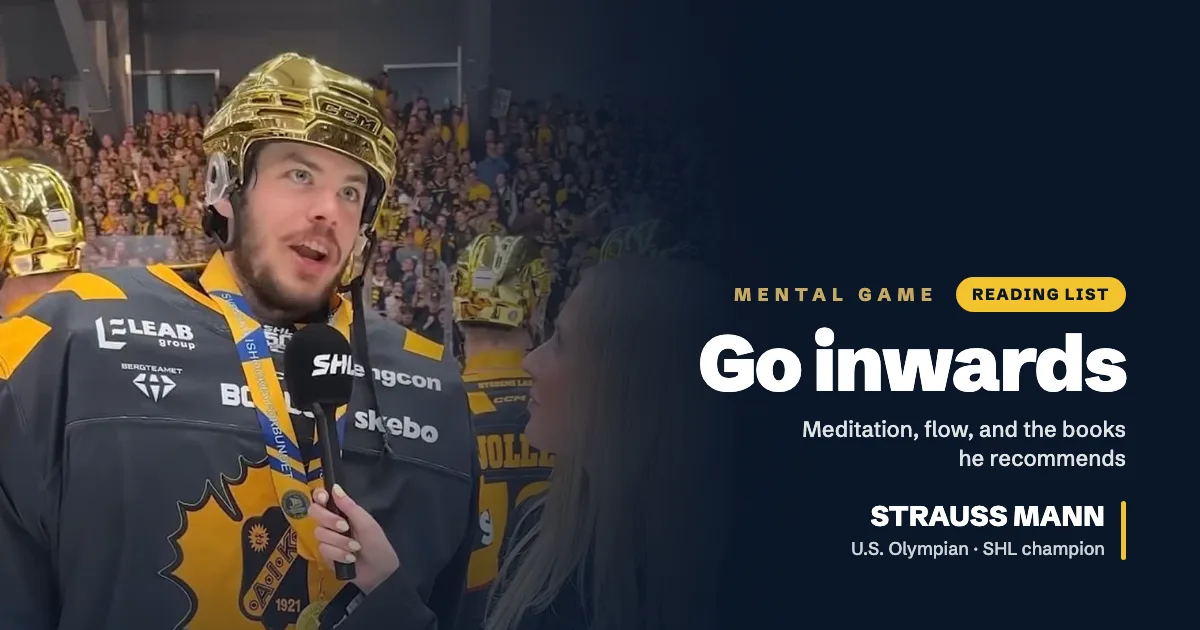
The Mental Shift That Changed Everything for Strauss Mann
(and resources to master it yourself)
- Strauss Mann rebuilt his career through meditation after a lost year in Germany where he couldn't articulate why he was still playing hockey.
- Mann spent a six-month contractless summer completing 300-plus hours of massage school alongside meditation circles and mentorship groups before earning a call to Sweden.
- His SHL season culminated in a share of the shutout record and a championship — results he credits partly to detaching his identity and self-worth from outcomes.
- Mann recommends Joe Dispenza's books as a non-sport-specific starting point for goaltenders exploring meditation and mindfulness.
- Mann cautions that meditation is not a universal solution, but a tool for connecting to something deeper beneath the result-focused, identity-driven aspects of a competitor's mindset.
There is a moment near the end of Strauss Mann’s interview on Episode 364 of the InGoal Radio Podcast where the former University of Michigan standout and U.S. Olympian stops himself before the conversation can turn into a sales pitch.
Mann had just spent the better part of half an hour describing the offseason that rebuilt him. A year in Germany where he could not answer why he was still playing. A six-month summer with no contract. Meditation circles, mentorship groups, and 300-plus hours of massage school. Then a last-minute call from Sweden, a season unlike any he had played, a share of the SHL shutout record inside half a year, and a championship.
It would have been easy to package all of that as a method. He went the other way.
My goal of this conversation is not to say that meditation is the solution to everything. The thing that it’s pointed to is that there is something beneath all those controlling aspects of ourselves, the latching on to results, the self worth tied up in results, our identity being a hockey player. There’s something deeper within each of us that we can connect to through meditation.
Despite that caveat, Mann spent a large portion of that podcast interview explaining exactly how and why embracing meditation as a foundational part of his preparation provided profound improvements in his results, ironically in part because the result was no longer a focal point. The 28-year-old did a great job “showing” rather than “telling” you how — and how well — meditation worked for him, and many of those examples are included in this article (below). Before outlining those specifics, however, InGoal Magazine wanted to share a list of resources that Mann provided after the interview for anyone who listened to the podcast and immediately found themselves wanting more information.
Strauss Mann’s meditation and mindfulness reading list
These are Mann’s recommendations, in his own two groupings, not a ranked list and not a curriculum. His only instruction was to follow the curiosity.
Not sport specific
- Anything by Joe Dispenza. Mann points people at Dispenza’s books and his wider body of work rather than one title. Common starting points are Breaking the Habit of Being Yourself (US · Canada) and Becoming Supernatural (US · Canada).
- The Power of Now, Eckhart Tolle (US · Canada)
- Positive Intelligence, Shirzad Chamine (US · Canada)
Sport specific
- Inner Excellence, Jim Murphy (US · Canada)
- The Inner Game of Tennis, W. Timothy Gallwey (US · Canada)
- The Mindful Athlete, George Mumford (US · Canada)
- Chop Wood Carry Water, Joshua Medcalf (US · Canada)
- The Oxygen Advantage, Patrick McKeown (US · Canada)
InGoal Media is an Amazon Associate and earns from qualifying purchases. The books above are Strauss Mann’s recommendations, not paid placements, and the links cost you nothing extra.
Nobody has to take his word for it
Mann understands not everyone will be convinced, even by his story. Plenty of goalies, and plenty of goalie parents, hear the word meditation and hear something soft.
“We don’t expect anybody to take our word for anything,” Mann said. “What we do is not preaching anything. It’s allowing each athlete to build their own practice of understanding what meditation means to them, and just creating space for them to go inward, sit with their thoughts.”
Disagreement is welcome on those calls, he added, because the alternative is a coach telling an athlete this is the way. What he asks for instead is smaller, and a lot more useful to anyone reading this who is not ready to sign up for anything.
“I think a lot of people that listen to me talking about what it feels like to make a glove save know what that feels like and now there’s a curiosity there about, ‘okay, maybe there is something deeper that I need to tap into,’” he said. “And I would just say if that’s anyone listening, go follow that curiosity wherever you can find it. Because there’s a lot there.”
Sports are a mirror
Mann’s framing of the mental side does not start with technique, and it does not start with routine. It starts with what a bad stretch is actually telling you.
“My belief is that sports are a mirror,” he said. “They’re a mirror to who we are as people and to where we’re at currently in our journey of self-actualization and reaching our potential in terms of who we are and who we can be.”
That is not a call to stop caring about results. Competition and comparison, he said, are “really great ways of understanding where we are in our process as athletes or as people.”
A goalie partner outplaying you is useful information. The part worth examining is what happens next, when the scoreboard starts editing your opinion of yourself: “What about me is so attached to something outside of myself, and what about that makes me see myself differently?”
His answer to that question is not to think harder about it.
“If you can really sit with that question, journal on it, breathe through it and go to the depths of it instead of just saying ‘I don’t want to feel that’ and pushing it aside,” he said, “then you can learn something really great from it, and that’s going to help you down the line.”
The save nobody can explain
Every goalie already knows the state Mann is describing. Almost nobody can explain it.
“You make a huge glove save, and then afterwards, like, how did that happen?” he said. “It’s not us. It’s not our brains. It’s our bodies being connected to that wave of the moment, that present moment.”
What changed for him is not that the feeling arrives more often. It is that he can now recognize it from the inside, because he has spent time in the same state sitting still.
“Now I know what that feels like in a still practice, so I know when I’m there, I know when I’m not,” Mann said.
And when he is not there, he is no longer left wishing he felt more confident. He has practices, meditation and breath work among them, that he trusts will bring him back, as long as he gives them enough room.
Enough room turned out to be far more than he used to allow.
Maybe I’m just going to start to make 80% of my pregame routine the meditation part. Because I know when I’m in that flow, my left hip could be detached from my body, and I’d still probably be a good goalie.
Less structure, not more
The old version of Mann’s game day was ten minutes of meditation upon arrival at the rink, followed by an hour of foam rolling and hip stretching that he now describes with unusual bluntness: “I don’t really know if that’s actually doing much, but it makes me feel like I’m controlling something.”
The structure, in other words, was doing a job, and it was not the job he thought.
“It was almost like I’m convincing myself I’m ready versus actually being ready,” he said.
So, he inverted the order. He arrives, spends most of the available time getting into the state he wants, and only then thinks about his hips. What surprised him is that the body follows on its own: “when I’m in that place, my body actually starts to loosen up so much on its own, and there’s so much less tension that I don’t need to warm up as much.”
That is what becoming a pro actually means.
“You learn to be more efficient in your process,” Mann said. “You know what you need to do. You know what you don’t need to do.”
It is why rookies watch veterans sip a coffee and walk out for warm up and cannot work out how they do it.
Five goals in a period, then a shutout
The test came early last season, and Mann wrote about it on Instagram at the time. He posted a shutout. In his next start he gave up five goals in the first period and got pulled.
“In the past, I would have been freaking out,” he said. “I would have slammed my stick and been thinking about my stats are gone for the year and I’m never going to be able to get those back up.”
Instead, he noticed that a couple had gone post-and-in that night after they had gone post-and-out the game before, decided there was not much in it, and then declined to treat the next start as a chance to prove anything.
“Everybody’s like, ‘alright, have a bounce back game.’ I’m like, ‘I’m just going to do the exact same thing and see what happens.’”
He shut them out.
“And, of course, everybody’s like, ‘oh, bounce back, mentally tough,’” he said. “And I’m just like, ‘no. I just didn’t care when I let in five goals, because I knew it just happened, and there’s not much I could do about it.’”