
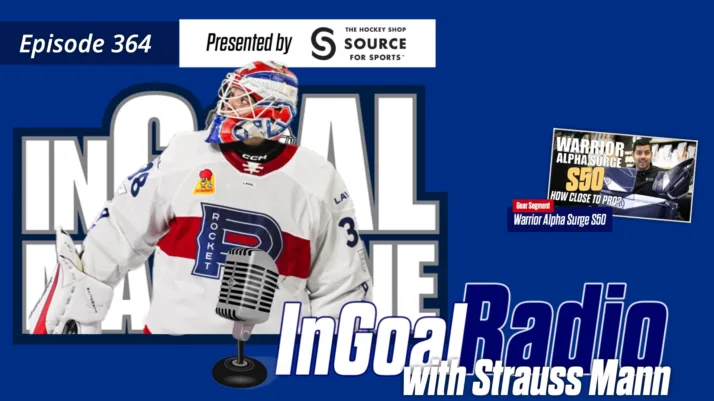
Strauss Mann: The US Olympian Who Rediscovered His Passion for the Game in Europe (Ep. 364)

Please subscribe and leave a rating — it helps us reach more goalies!


Episode 364 of the InGoal Radio Podcast, presented by The Hockey Shop Source for Sports, features a can’t-miss interview with Swedish pro and former U.S. Olympian Strauss Mann.
Feature Interview
presented by NHL Sense Arena
In the feature interview, presented by NHL Sense Arena, Mann, a former University of Michigan standout, takes us through the ups and downs of his first four years of pro hockey since the Olympics. From struggling with situations beyond his control that limited opportunities in North America, to rediscovering his passion for the game in Europe and setting top Swedish League shutout records and winning a championship last season, the lessons Mann shares from his journey really are can’t-miss for goalies, coaches and parents. They include a strong focus on meditation, and advice on how to make it a valuable tool, which in part led to a new venture off the ice called Haus (buildyourhaus.com) that offers mentorship and coaching circles as well as 1-on-1 work, not just for goalies but for their parents too, as well as a team-focused five-part speaker series this season of virtual and asynchronous workshops from world-class coaches in performance and personal development.
Parent Segment
presented by Stop It Goaltending U
In the Parent Playbook, presented by Stop it Goaltending U the App, Hutch shares key lessons and takeaways from the parent perspective from InGoal’s trip to the 2026 USA Hockey Goaltending Symposium in Boston.
Pro Reads
presented by Vizual EdgeWe also review the latest Pro Reads, presented by Vizual Edge, featuring Eric Comrie breaking down the keys to knowing when to attack and when to sit back on an open look off the rush.
Weekly Gear Segment
presented by The Hockey Shop Source for SportsAnd in our weekly gear segment we go to The Hockey Shop Source for Sports for a look at the new Warrior Alpha Surge S50, a lower price point version of the all new Surge pad with lots of the same features and a slightly softer flex profile.
Episode Transcript
Intro
David Hutchison will join us in just a little bit. It's InGoal Radio, the podcast presented by The Hockey Shop Source for Sports Langley, thehockeyshop.com, Millard, along with, my good friend Kevin Woodley who's fresh off the USA Hockey Goal Tending Symposium in Boston. How was it?
It was excellent. I don't know if I would use the word fresh to describe me right now, unless yeah. Maybe maybe a little fresh on it was it was a bit of a journey home. We had, planes, trains, and automobiles, me and Hutch. I'm not sure who was John Candy, in that situation, but we didn't have any of those arm pillows moments.
We did however make it home in a twenty four hour journey. And you know what, Daren? It was worth it. The whole thing was worth it. Steve Thompson and his crew at USA Hockey put on a fantastic symposium.
It was an open door policy. There were goalie coaches from Sweden, including Tomas Magneason, former director of goaltending, now retired but still does some events this, who did a really nice presentation on are we falling behind as goalies and what can we do to fix it. There were goalie coaches by that? Well, the shooters outpaced us. Oh.
The shooters, you know, finally caught up and passed goaltending. And and rather than just saying, okay, the game has changed, the scoring chances are up, numbers are down because of that, well, certainly a factor. But do we need to rethink how we're training to keep up with the adjustments these shooters have made? It was a great presentation. There were other coaches, many of whom we hope to have on the podcast really shortly from Sweden, from Austria, from Slovakia.
Rick Wamsley was there, obviously involved with the Hockey Canada program. Steve Thompson had spent some time at Hockey Canada's program watching their gold presentations. There were presentations from gold level coaching candidates throughout the weekend. There was on ice demonstrations featuring Jacob Fowler and Mike Ayers, who were obviously together at Boston College. Gwyneth Phillips and Katie Burt did a fantastic one on post play.
We had Mike Buckley doing a presentation, Lenny Mosca from the Boston fleet. We had Aaron Frankl up on stage with Jim Craig. Jeremy Swaiman did a presentation on stage on on how they do video with his goalie coach from Maine, Alfie Michaud, Dave Rogalski, who was with the New Jersey Devils up until this year and is a fantastic goaltending coach based out of Minnesota, works with Jake Otttinger in the off seasons. He did a presentation. Just incredible amounts of content, incredible amounts of networking with great people.
And the best news is because of our partnership with USA Hockey, we're going to be able to share most of that content. Maybe not right out of the gate. We're gonna spread it out over time, and, of course, they're gonna get to share it with their coaches as well to make sure that and this is this is important. Great event. And if you were there in person, the value of being there in person, like, it's invaluable.
The people you meet, the relationships you build, seeing it firsthand, being able to ask questions. But at the end of the day, if you hope to do what USA hockey is hoping to do with their fifty one and thirty program and continue to climb the ranks of minutes played in the National Hockey League and the PWHL, then you need to keep growing and getting better. And you can't do that if only a 150 people in the room get to see the presentation. So one of the reasons we were there was to make sure we create content from it, not just for InGoal Magazine, but that can be shared with coaches around The United States that are in The USA hockey program so that that growth goes beyond those in attendance. So, just another element of it that I applaud.
Not just about building a great conference, which they did, but about making sure that information gets to more people. And that's why one of many reasons why the one piece of news, I would say, that came out of the that weekend as part of a presentation from Steve Thompson on the state of the game, and a lot of the attention on American goaltending would go to the championships won. Obviously, sweeping the Olympics, men's, women's, Paralympics, gold medals all around, coming off their first world championship win two seasons ago in in what ninety three years. The big takeaway was when there was a slide that showed for the first time in the history of the National Hockey League, there were more minutes played by an American goaltender or by American goaltenders than there were by Canadians. For the first time in the history of the National Hockey League, Canadian goal
USA goaltenders led in minutes played?
They and and almost to the point, because this is who they had to pass for this first time ever, Canadian goaltenders did not. So the work that they're doing is paying dividends, and I love that the work is not just like, hey. Were there some technical discussions? You know, Mike Buckley's presentation on depth was exceptional. And John Muse was a part of that presentation as well.
He's coaching now in China. Had a great pro career, great college career, now coaching in China. We hope to have him on the podcast soon. Got to meet him. Really enjoyed that conversation.
But but the sorta it it's not just about the technical presentations. The how did the play position, the tactical stuff that was a part of it. There was a presentation on using smaller nets in 10 u hockey, intermediate nets. And again, not just why it's better for goalies and shooters and and building better players all around, but they tied it into health and hip health with some real science behind it in terms of measuring the impact of these small goalies having to chase behind these big nets and the damage it was potentially doing to their hips in formative years. Study on that.
So, you know, ways to grow the game. Ways to get more kids playing goal. Participation numbers are up from a percentage of players that are actual goalies in USA Hockey, but it's still not where it needs to be for them to have two goalies on every team. That's the goal. Their goal is to have two goalies on every team.
Their goal is to have a volunteer goalie coach available for every team. They've got over 3,000 people in The United States have taken the bronze level certification to give them some education when they're working with goalies, they're not just going in there blind. But that's still well short as they tell you, of one coach for every team. So those are the goals they strive towards. And because they've based their goals in grassroots, I think the growth that you'll see at the higher levels will continue to sort of happen and evolve organically.
I mean, you don't create more NHL goalies by trying to create more NHL goalies. You create more great NHL goalies by attacking the problem when they're younger and making sure you give them all the resources, and you'll end up with the end result. It'll just come naturally. So I just I love everything about the approach. It's really cool to see.
We we've all heard the reaction, of a parent, when their child comes to them and says, I want I wanna be a goaltender. And we some of it is just chuckling, some of it's serious. What do what do you think the biggest fear of a parent is when that moment happens? Is it cost?
Is it Might be it might be financial. It might be financial. We and and and we've created that stigma around that how much how expensive it is. I mean, let's be honest though, like, the game's not cheap for anyone. Right.
Do we need to find a way to make it more accessible? Do we need to find a way to make it less exclusive at younger ages? Like, so that you aren't just a goalie at a certain age. You're two you're doing other things. And and not just and I get it because there are some kids that that's all they wanna do, and you don't want it to be at their expense, but exposing more athletes to the position.
Yeah. I can't remember who we had on recently that didn't wanna be a goalie originally, but ended up getting to try it and absolutely fell in love with it and now is playing at an elite level, and it's just escaping me. We do so many interviews on this podcast that I can't remember who it was, but, like, you know, how many of those are we missing when we let it not let, or when we have a kid or who them and their parents have decided at the age of eight that's all they're doing so nobody else gets the chance to try it. Right? Like, how many athletes are you missing out because of that?
So, again, not pretending to have the answers, and I think the beautiful thing is USA Hockey doesn't pretend to have all the answers either, but they're constantly looking for solutions. And they're looking for evidence based solutions, you know, to answer some of these questions and solve some of these problems, half ice hockey, smaller nets, you know, what's good not just for the goaltenders but for the game overall. How do we how do we develop practice plans that are gonna make sure we're not creating goalie school goalies for lack of a better term, that we're creating thinkers, people that, you know, understand the game and can play the position better because they understand the patterns connected to the game. And sometimes that means playing out and not just being a goalie. How many times have we heard that over the years?
You know, from Brayden Holt beyond, you know, seeing the value in not being a goalie at too young an age, they try and quantify that a little bit and and sort of push away from premature specialization.
Something that, jumped out at me when you were talking about what happened in Boston was the the different nations that were represented, at the symposium. That's that's pretty cool. Good on USA Hockey for allowing some of these people to be involved in it too.
Rising tide float floats all boats, I think is, you know, paraphrasing, but sort of the thought process there. You know, not trying to keep any great hidden secrets. You know, they've been open about talking to other nations about their know, you a lot of what they do is based on how other countries have modeled their programs. You know, how they've had a dedicated person like Steve Thompson at the top of it and what that looks like and what best practices. And, you know, we saw in the bronze medal presentation, they talk about Norway and and the success of Norway on the sort of Olympic stage in winter sports and how that's tied to kids, you know, not being result focused at a young age.
They don't keep score, at a certain age, and they try all kinds of different things. Like so just that, you know, again, open book sharing, philosophy. I I think it's I think it's to be applauded and not just because we were there and we got to be a part of it and see what it was all about, but you get to know the people and see the passion behind it. And it's infectious. And it's so so when it's that infectious, it's really easy to see why it has success because if they're getting you to buy in like that, they're getting everybody involved to buy in at a certain level.
Look forward to the content, that will
You you don't I almost forgot. You know what the best part was at Boston? I went to a Red Sox game with Hutch.
Oh, had you ever been to Fenway?
Thirty one years ago, my friend. I was there for one night during my trip, which we've talked about on this podcast before, to every major league ballpark that took me from statistics and computer science to sports writing. My stop in Boston, there was only one night where I could get a ticket. It was eight rows behind the plate. I'm looking at the back of my office and the ticket stub is framed because on that night I was there thirty one years ago, the Red Sox clinched the AL East and it was an absolute party afterwards.
So I had two memories from that night. One watching Boston Red Sox players up on on the horses that the police were riding, like so up on horseback of of police officers after the game as part of the celebration. The post game might have been a blur after that, somehow the next day I ended up in Cooperstown, at the Hall Of Fame, but the other memory that I had and I clung to it for thirty one years was that the hot dog I had outside of Fenway before entering the gates, outside of Fenway pregame that night was the best hot dog I'd ever had in my life. The the Italian sausage, it's the bread, it's the meat, but they did something with the the peppers, like the the fried peppers and onions. They're just best I've ever had.
And you know how you build something up in your mind? Thirty one years, Daren. Whenever anybody started talking about food and hot dogs and ballparks, best dog I ever had. I've been to I've been to every major I drove to every major league ballpark that summer and lived in my car, and that was hands down like the memorable best hot dog I'd ever had. It's not Xi'an showed.
It's not Montreal bell play. It's it's different type, like an actual ballpark dog. Thirty one years later, same vendors, not the same people, but the same company, same dog, same peppers, and every bit as good as I remembered it. So it actually lived up to this grandi ose expectation I built up in my mind. But Hutch confirmed, unsolicited, without me revisiting the story, just where this hot dog ranked on his list, best hot dog he'd ever eaten.
So it's now unanimous among InGoal circles. You're gonna have to go try it for yourself one of these days. Best hot dog outside Phantom Way. We had a great day. Red Sox lost, unfortunately.
No penance clinched on this visit. They happened to be the hottest team in baseball heading into our visit, but fantastic time was fine. It was a really great way to cap off a really good, five days in Boston.
That trip that you did three decades ago, you did it all in one summer?
All in one summer. Lived in an I basically lived in a 1985 Volkswagen GTI.
Did you do it by yourself?
Supposed to have a buddy go. He bailed on me the week before and I wasn't bailing myself, so I went by myself. Yeah. And I basically lived in my car or sleeping on couches with, former teammates who had gone on to play in college and other junior colleges and div two colleges around The States, but I think I I think I got a hotel room on average once a week on the trip, and I and I had a little stove in the back of my car and everything. Started it at the Field Of Dreams in Iowa, actually went to the field where the Field of Dreams was filmed in Iowa, and of course, W P.
Cansello, the author is from White Rock, and I've had, you know, from my hometown here here since grade seven, and I've had the opportunity to meet him as well. So started it there, met a guy at Wrigley, covered the Cubs, never got his name, but he covered the Cubs for a living and actually applied for journalism school from a frat house couch that I was sleeping on, that week, in the suburbs of Chicago and never looked back.
Good for you. There's a there's a I don't know whether a book there, but certainly some kind of publishable content about that entire summer.
Well, some of it's
not publishable, Daren, but yeah.
That was publishable.
I was young.
May maybe different audiences,
not not audiences. Let me let me just say that there are a lot of things I did on that trip and I and not from a nefarious standpoint, I just mean from a naive standpoint that I don't think you could do anymore. Like, I literally would just pull over to the side of the road in random places or truck stops and just sleep in the like, put the seat back, pull the sleeping bag over top myself, lock the doors back when they were physical locks and sleep. I I just don't I don't think you could do what I did now 32 later, but it was an epic summer.
Gear
And now we have so many luxuries, like, InGoal Radio, the podcast, like InGoal Magazine, like The Hockey Shop Source for Sports Langley, thehockeyshop.com, which presents our Gear Segment.
I talk about luxuries. The luxurious new Warrior Alpha Surge, which we talked about so long ago, is in store. A lot of people have been waiting for this one for a long time and we've done the full review on it at ingoalmag.com, you can check it out. But now the product is really starting to show up in store and people are starting to get excited about the features. So make sure you go back and revisit it.
You can find it online at the Hockey Shop as well. They've got the Alpha Search, but they've also got the second price point. It's the Alpha Search. It's the Elsa Alpha sorry. It's the Warrior Alpha s 50.
That is the second price point line. Now it's supposed to be a little more flexible, we know how stiff the surge pad was, especially from the knee up through the thigh, double reinforcement. This one's, it's still pretty stiff in store, but you can see how it will soften and take a break. So I wanted Cam to walk us through sorta what features carry over from the Alpha Surge to the Alpha S 50 line as that one hits the stores and a lot of goalies excited about the price point, the exceptional sliding, the performance, unique features. I'm gonna let Cam describe them all in this week's Gear Site.
We did the Alpha Surge Pro. We waited a long time for them to come into stores but they're here now this is not pro. This is s 50. This is surge s 50. So we've got a second price point for Warrior.
We do.
The wait is over. Yes. Because from what I've seen, there's a lot of pro level features in this patent. I know that's been a theme throughout the different brands. Second price point is as good as Pro was just a few years ago.
Very much correct.
But this one really carries down a lot of the features. So because Alpha itself was somewhat new and because we we waited a little bit longer than expected to have it in store and for sale and they have the pro here as well. Let's go through it. Let's sort of go through the features like we're doing it for the first time here, Cam. And this is the second price point.
A lot of the features are the same. Wanna start with the pad?
Yeah. Well well, let's start off with aesthetics because we're looking at it right now.
Oh, because these are are these Source Hockey Shop Source for Sports exclusive aesthetics?
Exclusive. Exclusive.
So you
see that black and gold colorway, nice and slick.
I I do like the black and gold. I also like the fact that the in between the double t, the nylon is gold as well. It's a nice touch, Cam. Almost like you know what you're doing as a designer.
It wasn't just me. There were some, you know, more influence from other
A good leader resource.
A good
leader passes credit on. Good job, Cam.
Navy and white as
well Continuing on. Some of the we we had with the white accents in between the the t. Nicely. Like it.
Alright. Love about colors though. Spec wise.
Spec, what is your what is your is this Source exclusive spec or
we just
this is now we're into the general?
Now we're into the general. Okay. We'll start with the pads then.
We'll go back to the alright. Okay.
So start with the most striking feature as carried over from g seven.
Right. And of course, removed.
Classic slide plate. She's back.
You know what? I'm gonna be honest with you. We'll see with the surge, but on the Alpha Pro, the pad slides so much without it Mhmm. That, like, a lot of our testers have basically taken it off and they still feel like it's the fastest pad they've slide.
Why would that be, Kevin? Because of how hard the actual contact surface is.
And how stiff. Stiff and it's also built in
Correct.
For support.
Exactly. So a lot of extra support when you're getting into that pad. Very very stiff actual landing surface to the pad itself as well.
Very. You can see how thinned out it is. Is it attached the same way as the pro or is it attached differently on this?
Into the nitty gritty of the inside, we can start to see some of the interesting features.
So you can see that but our folk can't see it. Oh, let us sum it
up here first. Look at it actually being bracketed in.
Okay. So it is bracketed in on this one as well. Obviously, we knew that about the the Pro Pad. Correct. Second part
The Alpha Surge and now we're looking at that s 50. S 50. Yes. This is an intermediate pad by the way for everyone that's looking and says, why does that look so small? It's there You've got it in
senior sizes and intermediate.
Okay. And they're gonna be the same pad features as well.
See how fixed that is? Really good support when you're in the butterfly.
Same idea with that knee. Really good balance.
So It's also fixed in with bracketles.
That's correct.
And what's that? It's a removable knee stack.
Something that's replaceable and also available a little bit thicker.
Will be available.
You don't
have it in yet but it's coming. So so folks, if if you're wondering, because it was removable, one of the ideas that they had was, hey, we can also build replacement pieces that are thicker. What does that do for us as goalies? Take stress off our hips, take stress off our knees, take stress off our ankles, allow us to be taller in the butterfly and have a wider butterfly. It can really prevent some wear and tear for young goalies.
For those of us on the older side of the scale, it's a really good sort of well, honestly, cheap.
So we're gonna do a refresher on this when these are actually in, so keep an eye out.
I love this feature. May have called it out once or twice on the Alpha Surge's highest
level pack. Coming. Coming. Not in yet, but coming. Okay.
So back in, we already talked about how this is a nice bracket system, so very, very stiff. Very rigid. Giving you that ultimate support when you're down on that butterfly.
And boy, does she slide.
And, yes, she slides very well. I'm not gonna do that properly because it's gonna bug you. There we go. Alright. Alright.
Removable outer knee flap. So that's continues on with Warrior's features Right. From before. We look at the actual back cap strapping system itself. Got a lot of adjustability here.
So this is like a professor strap. Again, easily removable. Can attach it here and of course, because this is something Warrior is really good at, the Velcro attaches here. So if you wanna do your knee strap over top, they've got double sided Velcro on all their straps so you're not searching for an area. You can still just, you can double do the Velcro.
That's Double do the Velcro.
Double do the Velcro. Double sided. That works that Just
onto the boot here. Super flat. Flat. One hundred percent ninety degree boot. Yep.
Do you still see their original style in terms of for their elastic straps for the toe tie and the boot.
Easy to add in.
Remove, keep, you do you. You have options here. I do find the boot strap makes the pad a little bit tight and kind of torques a little bit weird, so that's an easy one to remove. The toe and the boot are the exact same length, so you already have a built in replacement for your toe if you do wish to run that toe strap
or you can just do laces if you want. One of the things that the flat boot does that we're seeing in testing because it's not angled, your skates tends to sit a little behind it and as as it sits behind it, it just creates this giant space for attaching to the post in RVH. Like, we've had a number of testers comment on how easy it is to hit that spot because there's sort of almost like an offset there. So that's been
part of that boot design, that catch wedge. You've now seen that boot flex as you're coming into that post. Also, as you're pushing in, that's helping you with that power out as well.
We've had a lot of good feedback from I I did a I did a beer league goalie camp just just like a week ago and brought out the Alpha Surge and guys loved it for that reason. They were not hitting their toe locks, us old guys, as effectively until they put on this pad. Here we go.
We're with the pad? I think we're done with the pad.
Wait. I don't think we're done with the pad, Cam.
No. No. We're not done with the pad.
Because there is a difference. Obviously, you're getting this is a lower price point
product.
Yes. One of the things we talked about with the surge pad, the top end surge pad is that hypercomp on the front and on the back really stiff like one of the stiffer pads out there but also like super active rebounds. Correct. No hypercomp. You're obviously sacrificing materials in the
second Right. Yes. And so Must be a little bit more flexy.
She's still pretty stiff, but without the hypercomp in there, it will soften up. You can
That's correct.
Flex in it more than you would be able to in or easier than you would be able to in the one that has the double layer of Hyper Comp, the surge. The s 50, again, supposed to be a little more flexible than it kinda feels out of the box, but it will take flex over time compared to the highest level. Now we're into the gloves.
Hey, they're back. They're back.
They're back. They look Where
the gloves are back.
There's so many features in here. I think we folks, a lot of the features are the same, carry over. You can go back to our original review to sorta the way the palms put together but right. There's two different Your
original review, we actually never did the gloves because we didn't have it. Right. Okay. So now let's
get into it then.
So what we have here is the 90 So
there's two options. 90, seventy five and ninety. 90 is gonna be stock with your s fifties.
Correct.
Okay.
The rest of the Schmattering
is Everybody is at U Source. Your choice.
Source.
Okay.
On these colors specifically, reason why we went with the 90, just in terms of consistency of closure, one thing is we really really find that these gloves, they need to go into the oven. Little big. You see it? These are fresh. I literally just pulled them out of plastic.
Yeah. We've got a little bit of that stiffness. It needs a little bit of that heat to help release and wrap around. We will show a glove that's been baked and that difference that it does make. We'll do a little movie magic here in a second.
Turns to overall feel wise, this is gonna be similar ish to that 7.1 that we saw of last year or years past.
G seven.
But however, Warrior did approach this as a kind of a new glove rather than take the old glove and then kind of slap a new name on
it. Right.
So the shape has changed a little bit. You do have some more catching surface. Pockets bigger. Correct. That nice double t in terms of it was a 7.1 feature.
It's been brought back over. Nice wide open feel and they're updated backhand, which definitely can't be ignored. And, Kevin, what's that do you have there? Do have a little wrist strap that comes with it automatically?
Yeah. Yeah. Easily removable, but again, the wrist strap, you could if you're somebody who likes a wrist strap, can just quickly grab it, wrap it around and attach it. Again, multiple like double sided Velcro. So even there, if you find that you put this strap really tight and you wanna pull this one over, again, there's a Velcro attachment area.
So tons of I'm not sure there's a product that has more sort of custom fit and feel options.
The ability for you to dial it in off the shelf definitely is, you know, a Warrior characteristic for sure.
So we've got strapping over the fingers that also can be tightened, but see this nice little neoprene sleeve that really holds the hand in there. Seen some gloves over time where you can sort of slip out.
Yes.
This just sort of like I said, neoprene, similar material to what my wetsuits are made of and let me tell you, they hold everything in. This does the same.
Non removable palm in the nineties. 75 has a removable palm.
Even in the second price point?
That's correct. Wow. Okay. Again, great overall feel. We went with the 90 just more out of consistency.
Feeling good.
Okay, blocker.
With the exclusive colorways, we went with the high curve blocker which means Again two
options, there's high curve and mid curve.
With that curve up in the high portion of the blocker, thus high curve. Removable palm on these guys, so we can swap this one out. Push it. So the overall feel wise, if you're familiar with the g seven blocker just the seven point o, that's what this guy is. That's this evolution.
What has changed, more openness to the actual side of the cuff piece to the glove is blocker. That ability to help really present that blocker forward. It is weighted a little bit more at kind of the that bottom edge of the blocker, so you do have that natural bit of a forward tip to it. Very stiff, very rigid, excellent pops off these blockers even into that senior models. These don't have that Hyper Comp in it.
Once again, we need to make that difference in terms of the split of price point. When you go into the surge, it will have obviously that Hyper Comp, but this is still a very rigid blocker board surface.
Okay. One other thing that I noticed that isn't there that's on the alpha surge top level is because I removed it to be honest, so maybe you chose not to have it in there but there there was an extra piece that attached in here like a little extra bit of finger punch. Almost. Not a pillow, just like a piece of hard HD foam. Easily removed but not here on these.
Honestly, almost all our testers took it out because it just interfered a little too much with the stick anyway.
Covered it. Done.
That was a lot. Like that was a lot.
So And there's just much
to these pads. Again, go check out our review at ingoalmag.com. We went deep into the Alpha Surge line. S 50 as Cam said, almost all the same features, a little bit more flex, just not the same material. So you'll be able to sort of walk through that and we'll get something up on the S 50 as it gets into stores more around North America.
And we will separately shoot another video for the mid curve and 75 degree glove. Okay.
Let's see your movie magic. That's three minutes in a skate up?
That was three minutes in the skate up.
We didn't even do the full five because I'm tired of waiting
for you. We didn't wanna wait so Seriously? Have the patience in store, unlike him. Let us bake the glove.
I see him. See him. Come on. Let me get my hand in there.
It's gonna make a huge difference. Really gonna imprint your hand. Oh my goodness. Yeah. See?
That's three minutes. That was three minutes. I didn't make that up.
It's like a warm loaf of butter. What? Shout out to Gary Price. A warm loaf I of think your hand into a warm loaf of butter.
Thanks, Pricer.
That's a hockey That is a hockey hall of fame line.
On that bombshell. Folks,
if you've got any more questions for Cam about the Alpha Surge s 50 or the Alpha Surge Surge, the highest it's price in stores now.
Yes.
It was a bit of a wait. Yes. But based on our experience and our feedback and our testing, it is worth the wait. Yes. So if you've got questions now that's in store about what he's got available, give him a call where?
(604) 589-8299 or 1805677790 or check us out
at thehockeyshop.com.
Here's something cool. As you guys were breaking things down, I I just got the the text about the the Gear Segment that came through on the the YouTube channel, the notification. So it's it's all it's all very concise.
We're we're yes. We're we are we are a smooth, smooth, smooth operation.
Things going crazy. Would would this be their busiest month, or do you think it it settles a little bit over at the
No. It's a gong show there right now, folks. So if you've got questions, still ask them. Still reach out. Send it to their email.
You can find all the connections on the hockeyshop.com, or as Cam said at the end of that segment, he he spat out the the number, and you can go watch it. And as as Darren mentioned on YouTube, segment, so you wanna see the visuals that are attached to it, go check out our YouTube channel. It's all up there. So definitely don't hesitate to reach out if you've got questions about it, but give them a little time to get back to you. It is madness there.
It is their busiest time of the year. It's why their selection runs so deep. It has to. They have to be stocked up and ready for what's to come, and that is people coming in right now, needing gear for the start of the season, less than two weeks away, training training camps and tryouts starting right now, for minor hockey, junior hockey, getting into that season. You know, obviously, way too late for custom orders, but if if that's where a place like the Hockey Shop is beautiful, their selection is so deep that not only will they have your size, chances are they've got some color options, especially when you get into the second price point stuff.
We've talked a lot about the different offerings, whether it's Bauer, CCM, or today with Warrior perfectly in time for the start of a new season. That's the beauty of being a shop as big as the Hockey Shop Source for Sports and having 30,000 or 35,000 square feet plus a warehouse off-site to store extra stuff. They have inventory and selection that will make sure you get the gear you need, the gear that fits your game in time for the start of the season. But to your point, Daren, it is it is so busy there right now. Have a little grace when you reach out to them.
Chances are they're trying to fit three or four people at the same time while on while you're on hold.
Let's grow your game with the Vizual Edge ProReads.
Yeah. We got Eric Comrie back. We're kinda we're trying to get through. I apologize if people are like, why do we have so much Eric Comrie? And I should never have to apologize for too much Eric Comrie because a, he's just a beautiful dude, just the best person in the world.
But b, he explains everything so well. He gets into the minutiae. He's a thinker, and he's happy to share the thought process. So as we try and get through now that he signed with San Jose, try and get through all his Winnipeg Jets ProReads from the past year. This week, he looks at when to attack an open look off a rush.
So, you know, when do you take that step versus sort of settling back and playing the pass options? And it's, you know, it's just, there were several different elements that go into it, including the What situation
what is a open look off the rush?
You know, like, in this case, it's what starts out as a two on one, but I'm just I'm kinda giving away a little part of this. There's a trailer.
Okay.
And the trailer ends up being the open look. And so you've still got three players attacking now. You still have that initial two on one that are sort of closer to the net, but that third guy high is wide open in the high slot. And he's just got time to put his head down and bury it. There's no pressure on him, and that's what I mean by an open look.
So do you attack it, or do you sit back because you've got these other guys funneling to the side? And Eric just I don't wanna give any more away than that, but Eric, you know, what factors matter when you're trying to make that decision about how much ice do it take to attack? How do you how much how much ice do you take? How much do you attack that open look guy versus sitting back and potentially, you know, worrying about a pass as these other guys funnel to the side of the net? What goes into that decision?
And that's what Eric Comrey explains to us in this week's ProReads, which of course is presented by Vizual Edge. And ProReads are all about helping you read the game better. Vizual Edge is all about helping you see and process the game better. Every goalie knows the feeling. The nights where the game feels slow, you're tracking pucks cleanly, you're reading plays early, and nothing seems to surprise you.
Parent Playbook
Like Eric Comrie in the video breakdown this week. And the other nights, you know, the ones when you're reacting instead of anticipating, you're just a split second behind everything. Most goalies try to solve that by getting more reps on the ice. Vizual Edge takes a different approach by training the visual and cognitive skills that help you process the game faster. Things like tracking through traffic, picking up releases earlier, recognizing patterns, and making quicker decisions under pressure.
From your laptop or tablet you take a personalized assessment to identify where your visual game can improve, then you get a custom training plan that takes about fifteen minutes three times a week, plus an open gym mode to get you as many exercises as you wish, as well as an eight minute warm up called game day mode to get your eyes and brain locked in for puck drop. Jordan Binnington used that one. It's a key part of the routine for NHL goalies like Binnington, Swayman, Joseph Woll, and Cam Talbot, and now you can see what you can uncover in your engine under the hood. Head to visualedge.com and use the code IGFALL 50, that's IGFALL 50, for 50% off your first three months, valid for new customers through the end of August to August 31, but if you're already a member at InGoal Magazine, you can check out any ProReads for 20% off for an entire year. I So guess in theory, you could try the the first three months at 50% and then switch to an InGoal discount at 20.
Either way, you're covered. Thanks to Vizual Edge and us at InGoal Magazine.
More thoughts from the USA Hockey Goal Tending Symposium through the eyes of David Hutchison and the parent segment brought to us by Stop It Goal Tending U the app.
Boy, I can tell you there was so much experience at this USA Hockey Goal Tending Symposium and Hutch is gonna get into it from a parent perspective what he saw in this week's segment. But if you want twenty five years of NHL goalie coaching experience at your fingertips, if you wanna tap into the goalie parenting expertise that helped Joey Decord reach the NHL, that's what you get with his subscription to Stop It Goal Tending U, the app. All the knowledge from Brian Decord has been an NHL goalie coach, scout and director, as well as all the insights and expertise from his staff at Stop It, which includes a long list of veteran NCAA coaches and guys working in pro. All delivered in easy digest chunks including five short daily primers, weekly style analysis and breakdown videos, and drills you can take on the ice with your team and coach. Plus, you get an InGoal premium subscription included.
So check it out now at the App Store or Google Play and get the best of both worlds with a subscription to the Stop It Goal Tending U app and a subscription to InGoal Magazine.
Impressions as a parent of the USA Hockey Goal Tending Symposium. Here's David Hutchison.
As you know, of course, by now, Kevin and I spent a weekend in Boston at the USA Hockey Goaltending Symposium, and I left with one overwhelming feeling. Our kids are in good hands. It's a bold statement in a sport that often gives parents plenty of reasons to worry. Hockey certainly has its warts and goalie parents know them as well as anyone. But after three days at the USA Hockey Symposium surrounded by coaches, researchers, administrators, parents, and goalies, I couldn't shake the feeling that there's a lot of good people doing good work on behalf of our kids.
It wasn't one presentation or one conversation that left me feeling that way. It was the culture. As hockey parents, and goalie parents especially, we gather in dark corners of rinks and we complain a lot. My kid doesn't get enough support. Who were these people running our sport?
It's all politics. We've all heard those conversations, and yep, many of us have taken part in them. Last weekend though, I had the privilege of spending three days with more than a 150 coaches and a full team of USA hockey staff. This wasn't a fringe gathering of goalie nerds tucked away in a meeting room. USA hockey presidents and past presidents were there too supporting the position and the people leading it.
So how is that now politics? Well, because it never felt like politics. It felt like an organization with everybody pulling in the same direction. 5130, well, it's certainly an ambitious vision, but beneath it is something much simpler, growing the position and improving goaltending from the grassroots up. As parents, we often judge youth hockey by the rink we're standing in today.
The symposium reminded me that there's a much bigger picture. There are people dedicating themselves to make tomorrow's hockey experience better than today's. We don't always see that work, but it's happening. The presenters range from names you'll all recognize, of course, NHL, PWHL, and international coaches to academics and local goalie coaches who had invested countless hours into research projects designed to advance the position. Their gold level coaching certification presentations covered topics like finding our future goalies, helping smaller goalies play big, goalie retention research, and many more.
There is this underlying theme that kept surfacing throughout the weekend as well, whether it was intentional or not, and that's develop athletes first. Teach kids to solve problems. Let them make decisions in dynamic situations. Give them room to explore instead of over programming every moment. As the speed and skill of shooters continue to rise, the thinking was clear.
We need smarter, more adaptable goaltenders, not simply better technicians. But one of the moments that stayed with me the most didn't happen during a presentation at all. I had the chance to spend some time talking with Jeremy Swayman's longtime coach at the University of Maine, Delphi Michaud. He talked about much more than goaltending, of course. And as he described the culture they tried to build and the responsibility coaches have to help shape young people, I caught myself having an unexpected thought.
I wish my son could have spent time in a program like that. Not because I thought it would make him a better goalie, but because I thought it would make him an even better young man. As a parent, I don't know that I could pay a coach a higher compliment. Now culture matters. That same feeling carried throughout the entire weekend.
Watching Colin Delia work on the ice, well, that was impressive. Meeting him afterwards left an even bigger impression. We'd never met before, but instantly, he had me talking goaltending as though we were colleagues had known each other for years. There wasn't an air of NHL goalie about him. He was just somebody who genuinely loves the position and enjoys talking about it.
Katie Burt also left me with the same impression. Outstanding coach on the ice, and despite somehow never having crossed paths before, she wandered over to our booth a couple of different times simply to talk goaltending. No agenda, no rush, just another conversation with someone who clearly loves the position. None of those were isolated moments. Reflected the atmosphere of the entire symposium.
Coaches had driven or flown from literally every corner of The United States and indeed, the world. Parents had brought their goalies from across the country. Professional goaltenders gave us part of their summer to help coaches become better teachers, researchers openly shared ideas, and administrators listened. More than anything though, I felt like I'd become part of something special. There was expertise everywhere, ego was almost nowhere.
Now I'd be remiss if I didn't mention the research surrounding intermediate sized nets. If you've listened to the InGoal Radio Podcast over the years, you know I've been banging the small net drum since 2019. Like many topics in youth hockey, it's become surprisingly polarizing, or perhaps it's not surprising. The former graduate researcher in me loved seeing the research, but it wasn't the statistics that truly convinced me. It was the video.
Watching side by side footage of games played with intermediate sized nets versus regular have produced one of those rare moments where you stop taking notes and simply think, well, that settles it. You can immediately see young goalies playing the position the way we teach it instead of simply trying to survive guarding a six by four net. At the same time, shooters were being challenged to create and finish quality scoring chances instead of simply firing pucks at 24 square feet guarded by a nine year old body. Whether you agree with intermediate nets or not, that almost misses the point. What gave me confidence wasn't the conclusion, it was the process.
Good people asking hard questions, gathering evidence, challenging assumptions. It's exactly how our sports should evolve. While the coaches were the primary focus of the symposium, there was also a day dedicated to parents and goalies who were invited to observe the sessions, visit the trade show as well. It gave me the opportunity to meet many of you in person, which is always one of the highlights of these events. Thank you so much to everybody who stopped by and said hi.
What struck me most was that this wasn't a closed door meeting of administrators and handpicked coaches. It was an acknowledgment that moving the position forward takes everyone. Administrators, professional coaches, grassroots instructors, research, parents, and most importantly, the kids who actually put on the pads. That's how meaningful change happens. So thank you to Steve Thompson, to USA Hockey for an outstanding weekend and for including us as a small part of it.
Thank you to everyone who stopped by to say hello. We did spend much of the weekend with our heads down covering the event, and if I have one regret, it's not having more time to connect with coaches we've come to know through InGoal over the years, many of whom we've still only met virtually. If we didn't get a chance to catch up, please stay in touch. And finally, the parents who brought their goalies to Boston, thank you. The role of a goalie parent is often thankless and almost always stressful.
But weekends like this remind me that our kids are surrounded by people who care deeply about helping them, not just to become better goaltenders, but better people. We'll stand in the dark corners of rinks this winter still. We'll grumble about ice time coaching decisions and the occasional politics. Hockey is hockey. But the symposium left me optimistic, not because hockey is perfect, but because I spent three days surrounded by people who are determined to keep making it better.
He recorded that. Otherwise, I would add add him talk about the hot dog.
Yeah. I know. We kind of lost the hot dog.
Hey.
That's too bad. Hutch, we need you to come back next week in person and verify that I am not lying about the dogs outside of Benway. People, if you you back me up on this one.
One or did did you have two hot dogs?
Oh, no.
If they're that good.
So they're
different inside than outside. This dog is specifically outside Fenway. Mhmm. And once you get in, you know, it's not the same. Just couldn't and plus it's pretty filling.
So I just had one. I just had one now. And and and the other part was, you know, we were very busy at the symposium, so there was not a lot of time to sort of explore Boston. We were basically going all day till the wee hours of the night. The symposium would end and coaches would get together and we would go back to the hotel and start processing video so that we had, you know, the video cards emptied and ready to go and the batteries charged for the next morning.
And we basically ate at the same restaurant all three nights because it was walking distance and we just needed to get, you know, energy Yeah. For the next We needed to get fueled up. So we sort of saved all our Boston experience. So rather than coming out of Fenway and having another dog, we went to a nearby place that was recommended by the world of Google apps and and and whatever search you do for a clam chowder and a lobster roll. So we did we did a full and our day started with us walking to Harvard and around Harvard and then by walked from Harvard to Fenway, had our dog, watched our ball game, might have had a couple pops then
From Harvard
to Fenway?
From Harvard to Fenway in 31. One degree heat. Yes. Kevin may have bought tickets that were, hey, you're only there once. There are great seats, but they were not in the shade on the third baseline in 31 degree heat.
So I was melting a little bit, but then yeah, we we went and had our we had a lobster roll and a clam chowder. I know it's a little bit stereotypical of us, but it was it was exceptional. Brown butter lobster roll. Oh my god, Daren. Still not as good
as the dog.
I know. I'm I'm familiar with the lobster rolls on the summer over on Prince Edward Island. So I bet you are. Censoring a feature interview this week, we would we'll visit with Strauss Mann. Can you spell off the top of your head, not Strauss or Mann, but where he plays?
Well, it's Schleftia, but it starts with an s and a k, so I know it's a little difficult. Listen, folks. Strauss has been a guest on the podcast before. He was speaking of USA Hockey and Olympics, he was an Olympian in 2022, coming off his college career at the University of Michigan, had success immediately out of college in Sweden playing for Schalepty, and then embarked on his North American career. And this is a story that is not just about like, this is not just a if you recognize the name Strauss man or not.
This is a story about perseverance, about discovery, about overcoming struggles, about being someone who sets goals but then the goals change, and sort of finding joy in the game. This is a story about a lot of different parts that I think every goalie will be able to relate to, maybe not at the level that Strauss plays at, but he went back to originally after some struggles in with the North American side of the pro game, went back to Germany for a bit, and then ended up back at Cheleftia next last year. We'll be back again this next season. Won a championship, pitched 10 shout outs in just 42 games, set a Swedish league record. And he walks us through a lot of the processes, the ups and downs, the things he went through through all those different points, and the lessons learned.
Feature Interview - Strauss Mann
That's the important thing. The value that came out of having gone through this. He's doing some mentoring now. We talk about that. His work with Hockey, h a u s, a company that he's part of sort of sounds like on a on a on a founder level where they've got mentorship groups, and they get together with people that can share these experiences to help young goalies.
He's an he's an incredibly bright young man. I love the way he thinks the game. I say young man, he's 27 already. I'm just really old. So, I just I'm a big fan from our first interview with him, and it was great to catch up with him and sort of hear, I don't say a new perspective, but an expanded perspective on the game.
And one that I think is gonna be incredible value for goalies and parents to hear coaches as well. And then I think also that the takeaway, we'll put it in the show notes, but the work he's doing and the sort of new platforms that he's opening up and getting involved with to make sure that he's there as a resource and other people who have been through these experiences are there as a resource for young goalies. Not a not so much strictly counseling, but just more of a mentorship thing. I'm excited about the things he started on that end as well. So we're gonna hear it from from him on all of that in this week's feature interview brought to you by NHL Sense Arena.
And a comment on on Cense Arena, what they're able to do right now?
If you haven't already, folks, there's still fine time to start the hockey life. It's this month's training plans at NHL Cense Arena bringing some of hockey's most respected creators, coaches, and experts each offering a different way to improve your game. You can challenge yourself with Nasher's unpredictable shot selection, sharpen your reads with Eli Wilson, build stronger movement habits with Maria Mountain or improve your game awareness alongside goalie coach Dave Stathos. It's all in NHL Sense Arena, your chance to choose the training plan that fits your goals, step into the virtual crease today, and get better. And of course, the August challenge, you can complete all seven training plans to experience the full Hockey Life collection, unlock exclusive badge, and earn entries for this month's rewards, including exclusive one time the Hockey Life badge, two free months for one lucky user of NHL Sense Arena, and bonus entries for completing the gap plans.
Make sure you start your first training plan today. Be done by the end of August for your chance to win prizes. Just one more example of the way NHL Sense Arena is constantly growing and expanding the options for you to get better and grow as a goal tenor by bringing some of the game's biggest names in training into the virtual reality world on NHL sense arena. Constantly evolving, constantly getting better, kinda like me as an interviewer but not necessarily as an ad reader.
Skeleftea, s k e l l e f t e a. Skeleftea. I wouldn't have got it in a thousand tries, but here is Strauss Man on InGoal Radio, the podcast.
Really excited and grateful to welcome back to the InGoal Radio Podcast, Strauss Man. It's been, it's been, like, four years, my friend, since we got last time we caught up with you, you were coming off an Olympics. You were not that far removed from finishing up your career at the University of Michigan, and you're kinda just embarking on the professional side of things. And here we are four years later. It hasn't always been a smooth path if you as is often the case, if you check just the HockeyDB, but you've played in North America for a couple of years over to Germany.
And now for the past year and heading back again in Sweden, there's a little trophy there, which means that last year ended up pretty well. How are you first off?
I'm doing well. Thanks for having me, Kevin. Yeah. It's it's easy to go through the hockey DBs and elite prospects and think you know everything about someone's journey, but that's why I love conversations like this as you get to understand a little bit of the the depths behind what goes on beneath the stats and beneath the the different countries that you travel to and play for. And, yeah, it's been a it's been a crazy four years, but a really full four years and learned a lot through that process.
And someday, I'm just excited to be here and chat with you a little bit about that.
Well, you it's funny. Like you said, you can check the HockeyDB and think you have a clue, but those are not easy years. I think we've had goalies at every level talk to us about the jump out of college or junior to pro hockey regardless of what level you make it to is the most difficult one in sports. It also tends to be the one where there's often the least support from a professional level. Like, it's ironic, but at a jump that all pro goalies know is one of the hardest is often at levels where there's no goalie coach.
There isn't somebody established here to help you out. So walk just walk me through your history. Walk me through how this has all gone and what led you to here and along those different spots of the path.
Yeah. It's beautifully said. I felt like I really only played my first year of that type of pro hockey after we had our first conversation. Because I backtracked and played prep school a year in the USHL, three years at Michigan, and then my first year professional. I signed in Sweden, and the team I'm actually playing for now played my first year there kind of as the backup.
I got to play in the Olympics that year. And and Europe, by no means, is pro easy. It's very professional and really high level hockey, but it's just a different it's a different system out there. Not as many players in the system. I'd like to think in Sweden, especially in my organization in, which I speak really highly of.
Like, they treat you really well. And not when I say well, I don't mean having three chefs that cook you breakfast every morning, but just treating you like a human and helping you the development side and really believing in you and when things aren't going well, not just, you know, sending you down right away or tossing you aside and bringing the next guy, but at least putting an effort to, build the human up, build the player up. And I was I felt really fortunate to start my pro career there to kind of, you know, take a a half step between the college to maybe the North American pro. And then, when I signed with the Sharks and went in there, that was like a dream come true to sign. I signed with the old management, and, you know, they were telling me I'd be the number three with the opportunity to be the guy called up right away.
And, I believed I could. I felt like I was ready for that. And then management changes. Next thing you know, they're bringing in, this they trade Brent Burns for a goalie prospect who's then above me in the in the pecking order, and then they and they sign one more guy. And next thing you know, I'm number five.
And, even though I hadn't, like, a really great training camp, I was basically told if you didn't have a good training camp, you would have been sent to the coast right away. But because you played so well, that's the only reason we're gonna keep you as the third in the AHL and still get sent down to the the East Coast League. And I don't say any of that as a knack on San Jose. It's it's hard being in management. They have a lot of decisions to make.
That's how the the system is set up, but it's obviously not easy on the athlete. And that was time of adversity for me to go from, you know, pitching a shutout in the AHL to getting sent to the coast the next game and just feeling those feelings of helplessness and, at times, like, mentality coming in. And and, yeah, I think throughout that process was just having to really dig deep and and face some deep adversity. And then that season was tough. The next season was very similar, signed with Laval and a good opportunity to to be in the AHL as the the number two there, number, you know, four maybe in the organization.
And the beginning of the season was tough. It was actually me and Dobesh there who's now Dobesh Yeah. Crushing it in the NHL. And, we were, we were both struggling at the beginning of the season. The defense was struggling.
And and next thing you know, they they bring in another goalie, and starts playing a little bit better. He's their prospect. So I'm I'm the guy looking from the outside and don't play another game from, you know, Christmas time on and getting sent to the coast again and kind of going through a lot of the similar things as I was in in San Jose. So, yeah, that that was a really, really tough process, which then eventually took me back to Europe, which we can get into a little bit more. But it's it's not for the lighthearted.
It's difficult, and there's a lot of goalies going through that, a lot of players going through that. And it's there's just so much to learn throughout that process. Process. And, the one thing I'll say is that the more you can take from that and not let it affect your self worth and worth as a player, but just, like, understand that you're doing something hard and that it won't be like that forever, there's always the next opportunity. But a lot of a lot of players give up after that point and and kinda lose their love for the game, which truly makes me sad.
Yeah. Well, and it's I mean, I've heard that story. Right? Like, a lot of times, especially, like, the thing about goaltending too, right, is that there's only so many spots. And I've witnessed it even with guys established in the American League, signed to be a three, couple things happen after they sign, promises made, and next thing you know, they're they're five.
And they're and they've and they've got a resume that says they they they should be at a lot higher level than that, but they're just watching games from the press box for half as like, it happens a lot more. Advice on how to, like you said, to to not lose your self worth in a decision that sometimes you can't do anything about. I've seen that in pro sports. I've seen it, obviously, with goalies. There's only so many spots.
Guys that have, you know, longer resumes in the American League sign being promised a three and the next thing you know, there's a trade mate or a couple of guys come in and next thing know, you're five. And you've played and you've had success in the American and you're watching half a season from the press box and there's nothing you can do about it. How do you sort of you talked about self worth. How do you how do you maintain that, you know, in the midst of a really difficult situation that challenges it that's out of your control?
Yeah. It's such a great question. Like you said, everybody goes through some variation of that in their career, whether you're a first rounder and sent down or benched or you're undrafted or in juniors and you're you can't even, you know, play a junior game. I've been, I feel like, in very many parts of that journey myself along the way. But I would I would say, like, my belief is that sports are a mirror.
They're a mirror to who we are as people and to where we're at currently in our journey of self actualization and reaching our potential in terms of who we are and who we can be. And for me, it's never been about, you know, maintaining self worth. It's actually, like, what is that scenario reflecting within me? And what I mean by that is it's very easy when things are going well and you're succeeding, you're winning, your stats are good to feel good. Everybody knows what that feels like.
And then you get to the lower parts and it's like, okay. Then everybody's asking the question, like, why do I feel this way? Or, like, how do I feel good again? But, actually, I've learned to ask, like, what about me is so attached to something outside of myself, and what about that makes me see myself differently? And it's not to say that competition and comparison are bad because they're actually really great ways of understanding where we are in our process as athletes or as people.
Like, if someone is doing better than us that year, if you have a goalie partner that's playing better than you, like, that's great information to understand and to level up, to understand what you need to do better. It's part of the process. But to actually make it hit you so deep that you start to see yourself differently as a person, that's where maybe question marks can be raised. And it's not to say that that's bad either because that's a part of our process of growing. Like, all of us goalies, especially, have been through that feeling.
But there's a question there, a question as to why. And if you can really sit with that question, journal on it, breathe through it, and, like, go to the depths of it instead of just saying, I don't wanna feel that and pushing it aside and either quitting or, blaming someone else or shutting down. If you can really look at it and be with it, then you can learn something really great from it, and that's gonna help you down the line in your next opportunity that is absolutely bound to happen even when it feels like things are never gonna get better. There's always the next opportunity if you can move on and take something from those tough times.
That process of sitting in it and reflecting on it that way, like, how did that manifest itself for you? Like, did you come close to to quitting?
Yeah. I did. And I think one of my coaches used to say it's actually a good thing when you start thinking about, giving up the game and and what life outside of that looks like because it means that you're coming closer into connection with why you played the game in the first place. And for me, that was really when I went to Germany the year after Laval going back to Europe. It was a really quick off season ending later in North America, leaving, you know, August 1 for Europe, had to make some quick decisions.
I was like, hey. This is the best opportunity I have. Let's go with it, make the most of it. And and I get there, and I start to feel this feeling of like, woah. I have played my entire career to get to the next place.
When I was in high school, was to get to juniors. When it was juniors, was to get to college. When it was college, it was to get to the NHL. And then I was back in a league where I didn't really feel like I was that close anymore, and it almost felt like I had taken a step back. The money was still good and and something to be happy about, and, competition was still, like, solid.
But it just felt like, woah. Like, I'm not a year away from from getting to my goal or even two, and I don't really know if it's possible. And that was scary to me. And it really made me think about, okay. Like, why do I play the game?
It can't if I'm gonna continue to play the game, like, for years to come, it can't be about just the next thing anymore. It's gotta be for something else. Like, do I want to make this my career for the next ten years, let's say? And and do I love it for hockey itself to play the game itself, and is that what I wanna do for my job? Or has it always just been something that has been a means to growth and and the next thing?
And I really sat in that for, I'd say, pretty much the whole season in Germany. Like, just sitting in that question, not really knowing the answer. And after that season, went home. We didn't make the playoffs. So I went home, like, March 12, something crazy early, ended up having a six month off season.
And was a year ago now, and that was really the time where I just sat with all those thoughts and feelings and all those difficulties and challenges that I had gone through and just tried to get outside of the game, distance myself. And, yeah, there's a lot there in that offseason. But also to say, like, in terms of sitting with those emotions, some of the most impactful moments in that offseason were meditation circles, being in in community with groups of people that were there to support you, whether men's groups or, yeah, meditation or, also, doing body work, getting a lot of massage done. I actually went to massage school for, like, three hundred plus hours that offseason and just, like, a lot about the human body and what healing means, but also was around a lot of other people that are committed to the healing of others. And throughout that process, there's just so much amazing conversation that helped me as a person, as an athlete.
But it all it all really pointed to the same direction of creating more stillness in your life and really quieting the noise around. All of our senses are outwards. Right? Our eyes, our ears, our hands. We're all externally focused, but the more we can bring that inwards, the more we can sit with things that are happening under the surface.
And for me, that's always been the answer to to taking a leap in the right direction that feels aligned with myself.
And through this, I'm assuming because you did go back and and back to Sweden instead but kept playing, find your answer about why you play within that.
Yeah. It's a great question. Yeah. Because I play because I love the game, and that's what brought me to it as a child. I would get up at 05:30 in the morning, wake my parents up to go to practice before school.
Like, that excitement from a child, like, that has always been within me. And then along the way, we have parts of the sport that suck something out of us, whether it's the business side or a certain coach or, you know, a dream that never got met that just hurts something deep within you. And and we start to build up this this tension and this, like, plaque that comes from the game and the experience. But beneath that all, for me and my experience, and I believe for most people, for what brought them to the game is that love, is that enjoyment of playing it. And really at the end of that off season, that was the most in contact with that I had ever been, that love, that pure love.
And it felt like I didn't have a contract until the first week of the European season. Like, I Oh, wow. Flew out. Their the team's goalie got hurt. They called me.
I it was all, like, divine timing and just kinda, like, hopped on that that that train and and went out there and played in the first game, like, a week later. But it was really right before I got that call, I don't believe it was a coincidence, that I started to feel just so excited to play again. And not for a contract, not to show anyone anything, but just like, I wanna go play with, like, my teammates and in front of crowd and, like, these things that little me would have been just so excited to do. And that was the energy that I carried into last season, and it was unlike anything I'd ever felt.
And that was back to Schalepje, which for those who don't know, whereabouts in Sweden is that?
Yeah. It's very far north. It's like a couple hours below the Arctic Circle and, yeah, like ten hours north of Stockholm, something like that.
So you got you got short days there in the winter.
Short days in the winter. Yeah. Yeah. Lot lot of time to go inwards, that's for sure.
I was gonna say I was gonna say, so you've got like and probably a place where despite you you've been there before, you talked about how well they treat you as people, not just as athletes. So there's that positive, but but probably a place, pardon the pun, but there's a lot of dark there and probably a place you don't wanna go if you didn't have this mindset. Like, if you if this had been the year before and you still are sitting in that question and you don't really know why you're playing, probably a pretty tough place to go.
A 100%. Yeah. It's people ask me about that all the time, obviously, the darkness. And I always say, like, you can't run from it. You have to go into it and sit with those thoughts and and and not just try to distract yourself all day with video games or the next TV show.
But if you really, like, spend the time of those months to go inwards and just, like, let things be a little bit calmer and and notice what comes up, you learn a lot from yourself. I mean, people like, they've talked about Aaron Rogers doing his darkness retreat before he decided that he wanted to play. I think it was for the jets at that time. Like, that's that's that's a spiritual practice. Going into darkness, it it means going inwards.
And so I've actually found that to be, like, of course, extremely difficult, but something that has deepened this practice that we're talking about.
What so what was last year like? Like, I see it, like you said, you know Yeah. I joke about the HockeyDB, and you've got a few of them that end with trophies, but last year was one of them. So you go from not knowing why you play to sort of finding that joy again to a last second contract back to a place you know, what was the year like? I can see what the numbers say.
You tell me what
the Yeah.
You tell me what it was like personally and and to sort of find that joy and go right back on the ice again.
Yeah. It was it was incredible. I mean, the first half of the season, like, I already spoke to this, but came in with this newfound energy and just, like, presence and enjoyment with no expectations. The thing that everybody's always, like, wanting to get to where you're just so unattached from the outcome playing freely, but we're all a little bit too afraid to, like, jump into that place because we wanna control it and grip it so hard. Like, I had just gotten to that point because I felt like I had nothing to lose, and I I didn't have anything to lose.
I was ready to retire. Like, I didn't I didn't really care. Like and but I cared about my craft, and I still, like, took it seriously, but was just like, alright. Let's go do this thing. And then, you know, we're 23 games into the year, and I had tied the SHL shutout record, like, in half a season.
Maybe it was, like, 27 games in or something. And I I don't say that as, like, this, look at me thing, but it was just, like, confirmation that that is the way. Like, the thing that everybody's talking about, like, surrender the outcome, trust the process, be present, enjoy, have fun. Like, we all kinda believe it, but we're too scared to go there. And and I experienced it.
And now there's like for me, there's no going back because I just know what that feels like. And I know when I'm there, and I know when I'm not in that place. I know when I'm gripping too hard. I know when I'm in the old version of myself that's really, like, getting way too in the future anxious about the next contract or what my coach thought about that that goal against or all that stuff that I get it, but it it doesn't really contribute to you playing the sport at the highest level. And that that happened last year.
It happened more consistently than it ever happened for me.
Okay. So you're confident you can get back? How like, do you do you have a process for getting back there?
Yeah. It's like Great question.
Because we like, I mean, it's the technical side of me. Right? Like, there's a process for getting for a to b set in square and all these things. So, like, here we are letting go and talking about that, but my first question is, like, do you know how to get back there? Is there and also so maybe share that with us if you're comfortable.
And then is is there there's other probably people listening to this saying, like, I've been there or I'm in this right now. How do how do I get to that place?
That's a great question. I would say there's a process, but it's not repetitive. Because each time it's a new like each moment, what are you trying to do? You're trying to ride that wave of the present moment, get into that flow. We're always talking about flow state, but each moment is different.
So if you take the last time you got into that place, say, okay. I just gotta do this again, then you're trying to control something and you're gripping so hard. And that's why it's so hard for people. That's why it's like, how do I get into that flow? I know what it feels like when I feel confident and good and everything's going well.
Everybody sees the goalie from the outside. It's like that guy's standing on their head right now. Like, it's so easy to see. It's easy to feel, but nobody knows how to get back there. And I do feel like I know how to get back there now because I know what that is.
And it is our as humans, like, our spiritual side. It is the connection with something greater. That's why it feels like when every goalie knows this feeling, you make a huge glove save, and then afterwards, like, how did that happen? Like, it's it's not us. It's not our brains.
It's our bodies being connected to that wave of the moment, that present moment. And this is like you can get very deep into the universe and spirituality and quantum physics and all that stuff. And I've gone down that rabbit hole and there's a lot there. But all else to say is like it's not our minds. It's not our thinking brains that do all that.
And so it's about getting in contact with that part of ourselves that is deeper than that. And for me, that's been found through meditation. And now I know what that feels like in a still practice. So I know when I'm there, I know when I'm not. And when I'm not, it's it's not like it used to be where I'm like, oh, I just wish I could, like, be more confident or be more in flow and, like, what's going on?
Like, I I understand the parts of me that are getting in the way of me accessing that. And I have practices that like meditation, breath work, different things that I know if I allow myself enough time to sit there, it doesn't mean it will happen right away if I do a ten minute headspace meditation. But if I really give myself enough time, like, I will get back there very quickly.
Okay. And that's just was that something you do heading into a game? Like, just like as part of does it become part of your game? Yeah. Like, again, as much as you don't wanna chase too much structure and put too much structure around it, it's just as simple as, like you said, giving yourself time to meditate on a game day.
A 100%. Yeah. So I actually it felt like in the past, like, I I'd meditated and done breath work and visualization in the past, but it felt like, okay. Like, I'm gonna do ten minutes when I get to the ranks so that I'm in the right mindset, and then I'm gonna go into my hour long foam rolling and hip stretch routine, which I don't really know if that's actually doing much, but it makes me feel like I'm controlling something.
Last year structure it too much.
Yeah. Tried to structure it, and it was almost like I'm convincing myself that I'm ready versus actually being ready. And there's something to that. Like, routine can get you in a in a good flow. But when I once I started to realize how I could get into that flow without needing to convince myself I was in it or create, like, the perfect parameters for it, I was like, you know what?
Maybe I'm just gonna start to, like, make my, you know, like, 80% of my pregame routine the meditation part. Because I know when I'm in that flow, like, my left hip could be detached from my body, and I'd still probably be a good goalie. We all know what it feels like. Like, when you're in that place, you can be sick, you can be injured. It doesn't matter.
Like, you play well. And so I'm like, I would rather let's say have an hour when I get to the rank to really, like, do what I need to do. Like, I would rather take almost all that time to get into a good place. And then when I feel like I'm I'm in that flow, I'm in that pocket, I feel calm, clear, seeing the room around me in a really clear way, then I'm gonna go, you know, okay. Like, I wanna get my hips moving.
And and I find that when I'm in that place, my body actually starts to loosen up so much on its own, and there's so much less tension that I don't need to warm up as much. So, yeah, like, I create a lot more time for that in my pregame routine now
for sure.
Yeah. Yeah. And if you're if you're yeah. You're not just doing it for the sake of doing it now.
Yes. Exactly. Exactly. There's a and I I think that's what becoming a pro really means is you learn to be more efficient in your process. You know what you need to do.
You know what you don't need to do. And it's why, like, we all rookies love watching those veterans when you you come into a rink and they just sip on their coffee and then head out there for warm ups. And part of you is like, how do they do that? The other parts like, oh, like, they don't care about themselves, but they don't overstress. They know what they need to do and that guy's played for like fifteen years.
Like there's something there, you know?
Yes. We talk about we talk about, you know, finding a way to stay in the moment and be in the moment. We talk about all these different things. You know, there's there's there's mental tools and techniques to help us get there, but being able to sort of let go of all the the external stuff. And that's the position, right?
Like, we're trying to take in all this information when we're out there, like, it's hectic. But to to let go of all the other stuff that's not in the like, that's not easy to do. And every I guess the key would be everybody's process to get there and discovery of what it takes, the journey to that discovery is different.
So true. Everybody's journey is different. And if I hadn't learned this one thing as a 15 year old from my coach, like, the thing that I learned now would feel completely different or hit in a completely different way. So it's everybody's journey is gonna be different. Mine has taken me to this place, and and I'm grateful for it.
And I feel like I've learned a lot from it, but everybody has to experience the thing themselves to fully believe in it too. Like, I don't expect anybody listening to this podcast to just, like, say, yeah. Like, I'm yeah. I know exactly what he's saying. I'm gonna do all this meditation and really in my like, deep within my core believe that it's gonna work.
I think a lot of people that listen to me talking about what it feels like to make a glove save know what that feels like. And now there's a curiosity there about, okay, maybe this there is something deeper that I need to tap into. And I would just say if that's anyone listening, like, go follow that curiosity wherever you can find it. Cause there's a lot there. Yeah.
Do you know you've you come home, you do camps, you know, you're training in the summer, you're talking to other goalies. This conversation resonated with Pete with other goalies?
Yeah. A 100%. We have, a mentorship coaching platform called Houzz that me and some other current and ex hockey players have started, and we have circle calls going on. I do a little bit of one on one coaching, especially with goalies.
Oh, okay. I didn't know
this. Okay. Yeah. Yeah. But we we every Sunday, we have calls at 2PM eastern for high schoolers and have a college group too at a different time.
We actually have a pro group now and just spaces for for athletes to come together and talk about this stuff and be supported by each other. And we do a lot of mindfulness and meditation as well and, help people with this side of the game that we truly believe is not talked about enough because it's not understood enough. Like, nobody really knows how to help you get into the flow state. And we feel like we can give you those tools to do it and and that that is the most important thing in your process, but also in your life. So, yeah, we're doing that very consistently.
We've been doing it all year and and growing that group. It's been incredible and really gives me a lot more purpose in my daily process as a goalie because now it's not only about me. It's about what can I learn to to share with other athletes and younger athletes? And, yeah, that's that's been really cool. And I think the goalie's always appreciated a little bit more because as you know and as everyone listening to this podcast knows, like, we're in a position that's very difficult.
It's very demanding, but it forces us to go inwards. It forces us to ask these questions. And because the the margin of error is so small, we're always looking for those next things to kinda give us that edge. So I find that goalies definitely gravitate towards this because we all relate to that feeling of flow state and how much that impacts our game and our life and our confidence and and everything.
Now you mentioned house and, I believe it's h a u s just because Yeah. The only reason I knew know that actually because I didn't know you're doing this was the, your your login had that originally. So h a u s for those that are looking, we'll make I'll make sure I get a link off Strauss and we'll put it in the, in the show notes for this episode as well. But do you get some that are a little resistant at times to some of the steps? Like, especially now in hot like, quite often, it'll be like, it's not the kid always.
It'll be the parent. You gotta do this. You gotta do that. And do you get kids that come in that are maybe, like, a little skeptical of some of the you know, people hear meditation, and they can think it's a little touchy feely and stuff. And, like, have you encountered that at all?
Yeah. For sure. And like I said earlier, like, we we don't expect anybody to take our word for anything. What what we do is not preaching anything. It's allowing each athlete to build their own practice of understanding what meditation means to them and and just creating space for them to go inward, sit with their thoughts.
And then we welcome challenging thoughts. We were on the call yesterday, and we were saying this. It's like, if you disagree with anything we say, like, we're not a coach. You're saying, like, this is the way. It's like, tell us what resonates, what doesn't, and maybe we can help guide you closer towards where you're trying to go.
But that's that's the beauty of it. And at the end of the day, it is just a space where we support athletes, and all different athletes are going through different things. Like, one of our kids was coming off of a tryout that he got injured at and was going through some of the adversity of feeling like it was his last option to make a a junior team, and he gets hurt. And he's like, I can't perform to my highest ability. And then other kids, you know, in their summer training, getting ready for a big season, and each of them are learning things from each other.
So it's just a really cool community that we're proud of. And, you mentioned the parents too. We're actually, like, starting to work with a lot of parents and have a parent circle where we have someone, Thomas, a former player who played in the queue who's gone all of us have gone through a very similar life journey, and that's why we met and are passionate about this stuff. But he's he's been really passionate about working with parents and helping them understand how to help their kids and how to channel that care and that love for them in a healthy way that allows them to flourish and feel safe and empowered and, like, they're leading their journey. Because I there's just a lot of lot of stuff going on these days, and I think that's something that's not talked about enough.
It's just like it's beautiful that parents care that much to yell in the stands and to, like, come after their kid. Maybe if they didn't play a good game, we're all pointing the finger like, oh, that's not good parenting, and and maybe it's not. But there's a lot of care in there and, just not enough people have the tools to know how to channel that.
Right.
It's our belief.
Right. Let it manifest in a different way. Yeah. The letting go of results, like, you know, being able to let go of I think you used the word victim mentality at one point there in this conversation when you were, you know, in in San Jose and you're next thing you know, you're in the ECHL. Easier said than done sometimes, especially for young kids too.
Like, right now, there's so much pressure. Like you said, like like, the game's changed. Like, your three years at Michigan, hard to do now. Right? Like like, getting three years in one spot, there's there's portals and there's transfers and there's and that pressure trickles down to junior as well.
The ability to sort of like the kid in the tryout to let go of the circumstances around you and sit in that moment. Outside of med like meditation is obviously a part of it. Is there any other advice like just like sort of stressing the importance of not getting caught up in something that feels like it's the most important thing in your world because it won't let you actually perform how you need to perform. It does no good to think about it or to dwell on it.
Yeah.
It's a hard one because it's easy to say and hard to do and I guess that's the question, how do we do it? Meditation is a tool towards that but how important is it to do that, to to get to a place where you just find the joy in playing and not stress on the fact that, oh, this circumstance led to me not playing, as that kid said, at my best in a key moment?
Yeah. It's another great question. My goal of this conversation is not to say that meditation is the solution to everything. I'll start with that.
But for you, it's been a big one.
It's been a big one. And and the thing that it's pointed to is that there is something beneath all those controlling aspects of ourselves, the latching on to results, the self worth tied up in results, our identity being a hockey player. There's something deeper within each of us that we can connect to through meditation, and we can connect to in other ways. Religion, we can connect to through community. And sometimes we can connect to deeper from quitting hockey and, you know, going exploring life in a different way.
But I think each of us somewhere deep within us know that hockey is not everything. And the jerseys that we wear on the outside are just a game. Like, it is it is amazing. It is a beautiful sport. We love it.
It can be a big part of our life's experience. But at the end of the day, whether you win or lose, like, tomorrow's gonna happen anyways, and it won't matter. And yet there's this part of us that latches onto it because it it makes us feel a certain way. It gives us an adrenaline rush. It makes us feel like we can be seen, appreciated, feel like we're enough, and that's great.
And, like, that's cool that we have a game to play that can give us those feelings. But when we get lost in that illusion that it is who we are, that's the difference. And I think whenever we get too wrapped up in the results of our process, like, we start to drift into, am not gonna be okay or I am not gonna be enough or something within me is lacking if this doesn't go how it goes. And that's when I say that sports is a mirror because that is pointing towards something within you that is not complete and not whole. It's not the game.
The game is artificial. Humans made it. It's it's not us. And the more you can get in contact with that deeper part of yourself that already knows that, that's when you don't need to be like, oh, I don't care about that result. Right?
Like, you just know. You're like, And I I wrote about this on Instagram, like, one of my first games last season. It was the first time I really feel like I felt that. I had a shutout, and then the next game, I let up five goals in the first period. Five goals in the first period.
And in the past, I would have been freaking out. I I got pulled obviously and, like, would have slammed my stick and and been thinking about my stats are gone for the year. I'm never gonna be able to get those back up and and all that. And then, but it was the first time where I was just like, like, I still tried my best. Like, I was still really focused.
Couple went post and in. One last game, they went post and out, and I just felt that. Like, I felt the difference of where in the past they would have made stories about what I I didn't didn't prepare the the right way or maybe this means I'm not a good goalie or and then ironically, like, for the first time, I had trusted that and just been like, I'm not gonna freak out about this. I'm not gonna try to prove myself next next game. Everybody's like, alright.
Like, have a bounce back game. I'm like, I'm just gonna do the exact same thing and see what happens. And I had to shut out the next game. And, of course, everybody's like, oh, bounce back, mentally tough, like, all this. Like and I'm just like, no.
Like, I just didn't care. Like, I didn't care when I let in five goals because I knew it just was it was that happened, and there's not much I could do about it. But all is to say, like, the less we have can fight that but just find that part of ourselves that just doesn't really need that to feel a certain way about ourselves, that's for me always been the place I wanna live from from game to game.
That is so well said. Difficult question and an incredible answer. There are other things I wanna ask you about. Technically, like you've gotten all these voices, you're playing in different leagues, different parts of the world, the influences on goaltending, but honestly, that answer, I don't wanna I I we have to end there. It was chef's kiss.
It was perfect. Strauss, we're just gonna leave this for part three. Yeah. The journey, the coaching, the technical, the support at the different levels, and all the different things you've been through, all over the world. But let's leave this one on that advice because it was so well said.
Thank you. Thank you for being so open to sharing what you've been through over the past four years and and not always an easy road and coming out on the other side. And and last but like, what's your last I will ask one more question because that's what I do. You win a title. What's what's what what like, what's that moment like when you guys finished that that season last year?
Yeah. Just the cherry on top. Like, I've truly felt in that moment, like, I didn't need that to happen. Like, I I'd let go of the you know, I will feel a certain way about myself when that happens. But it was when when there isn't that attachment and you don't need it, it really allowed me to just soak in the beauty of the moment and just, like, sharing that with my teammates, sharing that with the city and the town.
And it was just, yeah, it was just an amazing thing with a team that worked really hard all year and really cared about each other. And, it just yeah. It felt really good, and it it felt good too to, like, to move on pretty quickly and just, like, continue my process of growth and not always be in the past with that. And so moving into this year, I'm just excited to create something hopefully similar. But
Well, I had to ask even though I know you don't wanna be thinking about the past year in the moment, in the present, but I had to ask because
No.
I mean, are the fun things.
Outro
Yeah. Yeah. A 100%. But it's it was incredible and yeah. It was it was an incredible moment.
Yeah.
Awesome. This has this has been great. Thank you so much again. Like I said, we'll have, information on house hockey in the show notes, for anybody that wants more. Strauss, thanks for doing this with us.
Thanks for letting the more of the hockey world know about what you're doing. And I'm so glad that you came back to the game and found that joy in it so that we can get to have more conversations like this.
Yeah. Thank you, Kevin. Thank you for holding this space and just loving goaltending because I love goaltending so much too, and it's such a great place to have these conversations. And, yeah, you've created something really special. So thanks for having me a part of it.
Wow. We're that we're on I I I don't know what to say to that. But we're honored that you'd be a part of it and that, at least there's a lot of us that love the position and, yeah, love talking about it. So thank you.
I appreciate it.
Perseverance, certainly a big part of his journey, but I love just his his new endeavor that he's got going.
Yeah. No. And I think I think it's one that's gonna be quite valuable. I mean, we you know, I mean, there's mentorship out there for sure. I love the idea that he's doing it in a group environment.
Right? Like, the chance to bounce things off. And and so, listen. Like like we've said, no apologies for being a fan. We're allowed to do that in in this realm.
I'm not allowed to be a fan of certain teams, but I'm definitely a fan of certain people and certain goalies since Strauss' man is high on that list. Have always sort of appreciated his approach in the cerebral way he goes about sort of thinking about the game. The things he's overcome even before this point, the success he had at Michigan, battling as an undersized goalie and the stereotypes that come with that and overcomes these challenges in in North American pro to have just this incredible champion championship season in in the top league in Sweden, and looking forward to sort of I'm looking forward to sort of following along and see where this where this goes next for him. He seems really happy there. I would be not at all surprised, if there's another great season in the works.
Windmill type show today. I mean that, in relation to the hot dog that we had, going on. Fun stuff. Or enjoyed it. I can't wait for the next time that we all get together with David Hutchison.
Kevin Woodley, Daren Millard on InGoal Radio, the podcast.
And the hot dog radio show.
Comments
Comments are for InGoal members.