
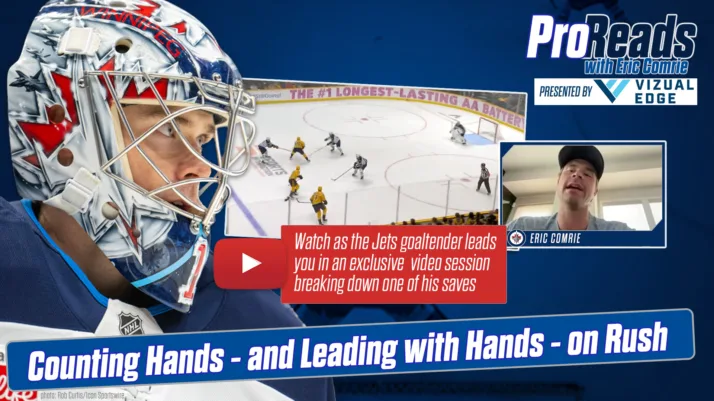
Counting Hands — and Leading with Hands — on Rush with Eric Comrie

The #1 goalie vision & cognitive training tool trusted by over 50 NHL & AHL goalies.
“Vizual Edge has added a quality element to my preparation as a goaltender. I use the game day drills every game before heading to the rink. It’s a combination of recognition, reaction and focus that activates my brain and eyes to feel ready for what’s to come.” — Jordan Binnington
As an InGoal Member you can save 20% off monthly and annual plans! Just click here and use the code IGMEMBER to save!
We’ve loaded up on Eric Comrie Pro Reads this summer, and not just because we wanted to use up all his Winnipeg Jets saves before he joins the San Jose Sharks.
Sure, the fact he since signed with San Jose as a free agent expedites the need to use up all the footage he broke down while with the Jets, but it’s also never a bad idea to get more insights from a goalie who has always openly shared how he — and former playing partner Connor Hellebuyck and Winnipeg goalie coach Wade Flaherty — look at the game, both in real time and in video breakdown sessions.
This is the last of those Pro Reads sessions featuring Comrie with the Jets, and in typical Comrie fashion, it is loaded with great advice well beyond what would fit in a headline, including discussions on depth, hand placement, top-down rotation, prioritizing angle over depth when picking a lateral path, the mechanics of a good slide – and what goes into deciding to slide rather than skate across.
In short, it’s a rush read Masterclass disguised as a Pro Read.
THE SEQUENCE
This time Comrie breaks down an even-man rush against the Nashville Predators:
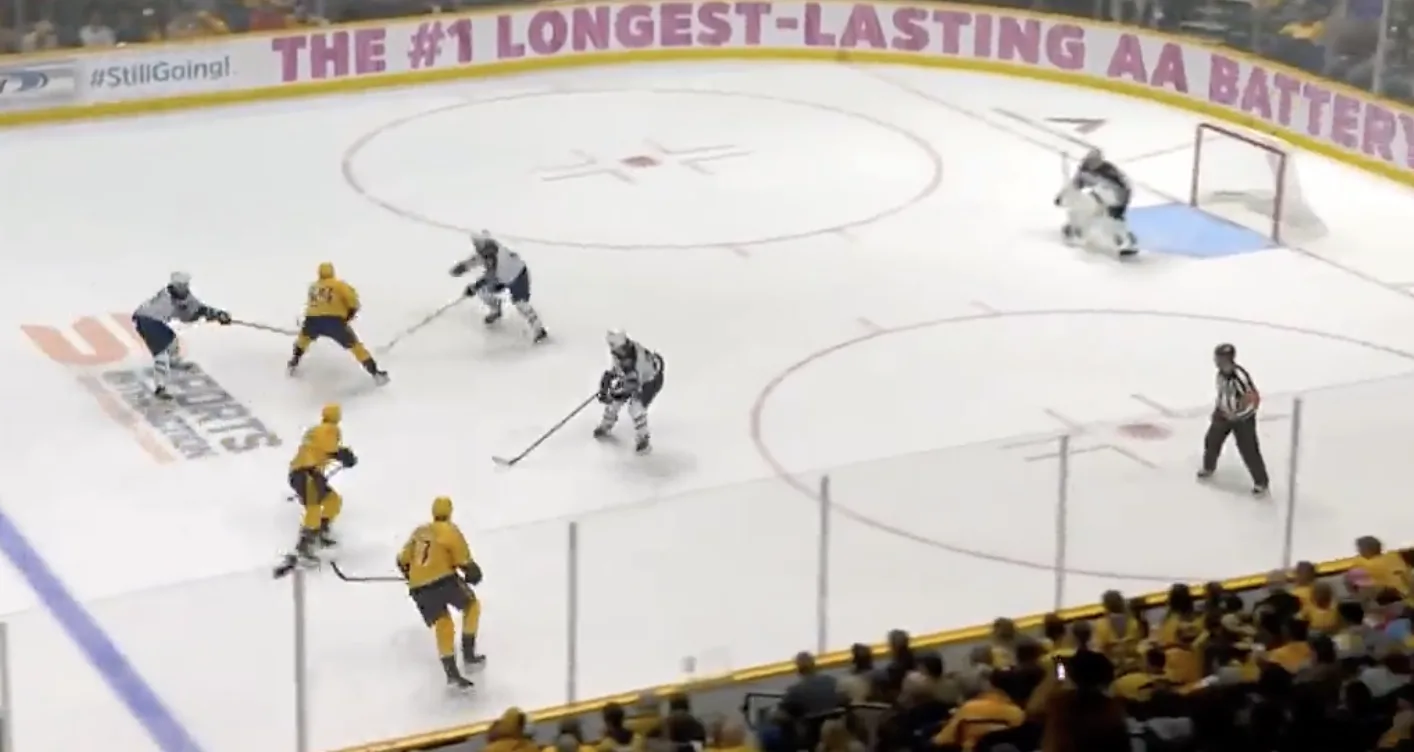
As already mentioned, this Pro Read goes deeper than most, even by Comrie’s lofty standards, but it all starts with his ability to analyze the freeze frame above.
So, looking at that still photo, what information about this rush stands out?
We’ll tell you now there is a trailer about to enter the scene from the top left corner, but Comrie has already identified the information that matters most.
Can you?
Beyond the attack, what do you make of Comrie’s positioning given the information available? Can you see any reason for him to retreat a little deeper?
THE SAVE
Since it’s a rush chance, pace matters, so rather than sharing more freeze frames, we’ll go right to the replay. Watch it all unfold below and see if the information you gathered above becomes relevant – and more specifically, in what way?
Did it play out how you expected? Was it based on the information you already had?
Now that we’ve seen the play, watch it again and shift your focus to Comrie.
What did you make of his depth? What about the decision to slide rather than come across on his skates? Any of his mechanics stand out as key to make this save?
THE PRO READ
Now let’s hear from Comrie and get his thoughts on how he played this rush:

Comrie starts with the same read we asked you to make at the start.
“It’s awareness of where the one-timers are and I can see all three guys coming in the zone are lefties, so I know all my one-timer threats are on my glove side,” Comrie said. “So, I have to be aware of that (and) make sure I’m ready to move to this.”
Did you identify that right away too?
As for his depth, that should come from identifying those one-timers and looking back at the tape, Comrie would prefer to have been a bit deeper too.
“I’m probably a little bit far out, but I can see he’s going to drop to the guy (entering the zone late) and once again, I can see there’s two lefties in this scenario, so it’s probably going to be a one-timer pass now,” he said. “So, I kind of give up a little bit of ice from where I started. I would have liked to probably give up a little bit more.”
That subtle shift from heels above the edge of the crease with the puck mid-zone, to having the middle of his skates on the edge, almost all the way inside, with a slight flattening out of his left side as the drop pass is made, may have been less of an adjustment than Comrie would like in retrospect, but it still helped.
Next up is a skate-or-slide decision, which starts with having identified a one-timer.
“For me, it’s time and if you feel you have time or not,” Comrie said. “It’s hard to describe it but I know in this scenario I’m a little bit far out and this is a long path. I’m not going to have a lot of time to get there on my feet, in my opinion. I just know it.”
Comrie credits drill work with Flaherty for dialling in that instinct, even if the emphasis of those practices is often holding his feet whenever possible.
“We do a lot of drills with ‘Flats’ where there’s a shot or one-timer option and in practice I’m trying to hold my feet every single time,” Comrie said. “And he tells me even 2-on-1s, hold your feet. Hold your feet. Hold your feet. And I think the longer you hold your feet, because you can always go into a slide if you committed to it, and I’m trying to hold my feet. I hold my feet. I hold my feet, and then as soon as I get vision, I’m like, ‘okay, I don’t have time anymore. Now I got to go into my slide.’”
The mechanics of that slide start with that vision and his head, something Comrie has stressed several times in this format, but the hands are also important here.
“Understanding it’s a one-timer, just getting set and getting as much over there as you can, and just keeping your eyes on the puck and even though you’re sliding and you’re taking up ice, you still got to stay reactive because these guys can hit corners,” Comrie said. “Even though you’re taking up the big majority of the net, you’ve got to make sure you keep your hands up, hands reactive. ‘Helly’ and ‘Flats’ and me always talk about leading with the hands. I could have maybe done a better job leading with my hands here, but I get my hands up and big on it, and it allows you to react and keep your hands in front of you and allows everything to kind of come together.”
Comrie’s path across is also important. Note he may not push right back to his post, but he does work back in that direction, which creates a good angle to the shooter, rather than say, pushing straight across to the other corner of the crease.
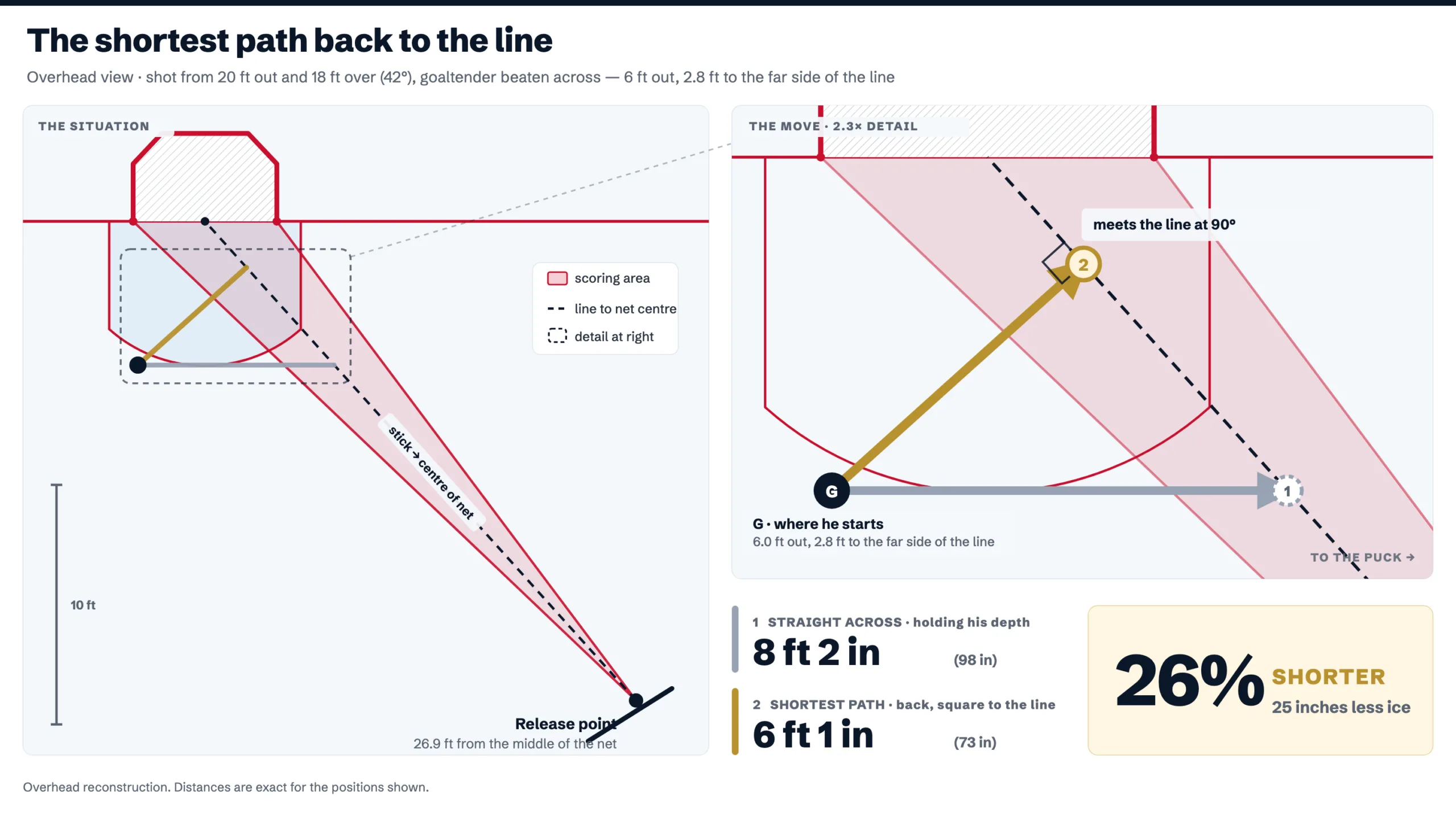
Why Comrie works back toward his post instead of pushing straight across: meeting the line square is about 26 percent less ice to cover than sliding flat. His position and the shot location are estimated from the video, so the distances illustrate the principle rather than reconstruct this exact save.
“It’s funny because if you’re getting vision on the puck and on the stick blade before you go, it’s going to create your angle for you,” he said. “A lot of guys will slide almost blindly at things and like just kind of throw their body at it. Instead, if I’m getting my eyes and my chest and my head onto the puck and my hands, it’s going to rotate me as I’m doing it. So, if you look, here I’m getting my angle by looking at it instead of just sliding already. I’m almost getting vision and then sliding instead of, as I would say, going ‘body first’ and sliding. I’m getting vision first.
“Vision, head, hands, core, chest — whatever you want to think about it — but getting that on the puck before you initiate your slide is going to give you the best opportunity to get as much angle as you can,” Comrie continued. “I think the biggest thing that gets you that rotation is just getting vision or your eyes on the stick blade. It’s easier than just shoving your leg at it and sliding straight across and flat. I think that’s going to get you a lot more trouble. Not going to get you the angle. Yes, it might feel a little bit faster, but you got a lot longer to go than if you slide on an angle. If you slide on an angle, you’re going to be taking up the net a lot sooner you are than if you slide straight across.”
What a fantastic way to finish this extended Pro Reads session with Comrie. We hope to have more as he settles in with the Sharks this season but don’t forget to go back and watch his earlier entries — from this sit down and four seasons earlier.
Looking for a goalie coach?
Browse coaches in our directory — powerful search tools, contact coaches directly.
More Eric Comrie on InGoal
Understanding Shooting Lanes on Late Game 6-on-5 with Eric Comrie
Eric Comrie: ‘People Play Best When They Understand Who They Are’

InGoal Radio Episode 280 with Eric Comrie

Eric Comrie and Buffalo Sabres Goalie Coach Mike Bales Share Skating Drills for Goalies

Pro Tips: with Eric Comrie

InGoal Radio Episode 179 with Eric Comrie

Comments
Comments are for InGoal members.