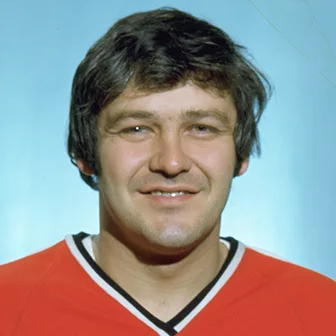
Born Apr 3, 1945 · Montréal, Quebec, Canada — Undrafted
| SEASON | GP | W | GAA | SV% | SO |
|---|---|---|---|---|---|
| 1976-77 | 61 | 35 | 2.71 | .899 | 5 |
| 1977-78 | 49 | 29 | 2.22 | .912 | 7 |
| 1978-79 | 36 | 16 | 2.71 | .893 | 4 |
| CAREER | 608 | 271 | 2.55 | .915 | 54 |
Bernie Parent
Career Statistics
| Season | Team | GP | W | L | OT | GAA | SV% | SO |
|---|---|---|---|---|---|---|---|---|
| 1978-79 | Flyers | 36 | 16 | 12 | 0 | 2.71 | .893 | 4 |
| 1977-78 | Flyers | 49 | 29 | 6 | 0 | 2.22 | .912 | 7 |
| 1976-77 | Flyers | 61 | 35 | 13 | 0 | 2.71 | .899 | 5 |
| 1975-76 | Flyers | 11 | 6 | 2 | 0 | 2.35 | .907 | 0 |
| 1974-75 | Flyers | 68 | 44 | 14 | 0 | 2.04 | .918 | 12 |
| 1973-74 | Flyers | 73 | 47 | 13 | 0 | 1.89 | .932 | 12 |
| 1971-72 | Maple Leafs | 47 | 17 | 18 | 0 | 2.57 | .915 | 3 |
| 1970-71 | Maple Leafs | 18 | 7 | 7 | 0 | 2.66 | .916 | 0 |
| 1969-70 | Flyers | 62 | 13 | 29 | 0 | 2.80 | .921 | 3 |
| 1968-69 | Flyers | 58 | 17 | 23 | 0 | 2.70 | .925 | 1 |
| 1967-68 | Flyers | 38 | 15 | 17 | 0 | 2.49 | .926 | 4 |
| 1966-67 | Bruins | 18 | 4 | 12 | 0 | 3.65 | .891 | 0 |
| 1965-66 | Bruins | 39 | 12 | 20 | 0 | 3.69 | .898 | 1 |
| Career | 608 | 271 | 198 | 0 | 2.55 | .915 | 54 |
Bernie Parent grew up the youngest of seven children in the Rosemont district of Montréal, Quebec, and did not put on skates until he was around 13 years old. As he told InGoal Radio in 2020, a skating test at his first tryout settled his position for him: when the other players circled the rink in thirteen to fifteen seconds and he came in at twenty-one, the coach pointed him toward the net. The first game he played, opponents scored 22 goals against him, and the coach sent him home. Five weeks of practising in the street on skates brought a second chance, and that second game went well enough to keep him going.
He played his junior hockey with the Niagara Falls Flyers of the OHA, making the trip from Montréal alone, by train, at seventeen or eighteen, speaking no English. Niagara Falls won the Memorial Cup in 1965, and Parent's junior career ended on that title. The Boston Bruins had him in their system by then, and he arrived in the NHL with Boston in 1965–66, appearing in 39 games for a club that finished fifth in the six-team league. By his own account, Ed Johnston and Gerry Cheevers were ahead of him when he went to his first Bruins training camp, and he also spent time with the Bruins' farm club in Oklahoma City of the CPHL. His second season was split between Boston and Oklahoma City again, and after two years with the Bruins he was left unprotected for the 1967 NHL Expansion Draft.
The Philadelphia Flyers selected him on June 6, 1967. In that first expansion season he shared the crease with Doug Favell, and the Flyers finished first in the West Division. Parent stayed in Philadelphia until midway through 1970–71, logging 58 and then 62 games as the club's primary goaltender in 1968–69 and 1969–70. On January 31, 1971, he was traded to the Toronto Maple Leafs in a three-team transaction that also involved Boston.
Toronto turned out to be where Parent's game changed. His boyhood hero, Jacques Plante — whose sister had lived next door to the Parent family in Rosemont — was then a Maple Leaf, and the two became teacher and student. Parent told InGoal what Plante gave him: how to position himself on the puck rather than the man, how to read each defenseman's tendencies, how to fill the post with his catching glove on one side and the butt of his stick on the other to know exactly where he stood in relation to the net. Nobody had taught him that before, even as an NHL goaltender: "First time. First time," he said. He played 47 games for Toronto in 1971–72.
When the World Hockey Association formed, Parent signed with the Philadelphia Blazers for the 1972–73 season, appearing in 63 games. A contract dispute ended his time there, and he sought a return to the NHL. Toronto held his NHL rights, and in May 1973 the Maple Leafs traded those rights back to Philadelphia in exchange for Favell and a first-round pick. Parent told InGoal that the risk of leaving the established NHL for the new league had, by a roundabout path, delivered him back to the Flyers.
What followed were the two seasons that defined his career. In 1973–74, playing 73 games in a 78-game schedule, Parent led the league with a 1.89 goals-against average, a .932 save percentage, and 12 shutouts. He shared the Vezina Trophy with Chicago's Tony Esposito and was named to the NHL First All-Star Team. In the playoffs he went 12–5 with a 2.02 goals-against average and 2 shutouts over 17 games, including a shutout in the deciding sixth game of the Stanley Cup Final against the Boston Bruins. The Flyers won the Cup, and Parent won the Conn Smythe Trophy as playoff MVP. The following season he posted 12 shutouts again, with a 2.04 goals-against average and a .918 save percentage over 68 regular-season games. He won a second Vezina Trophy, a second First All-Star Team selection, a second Conn Smythe Trophy, and a second Stanley Cup, this time against the Buffalo Sabres — again with a shutout in the deciding sixth game. His 1974–75 playoff numbers were 10–5, a 1.89 goals-against average, and 4 shutouts in 15 games. His 47 wins in 1973–74 stood as the record for most wins by a goaltender in a season until Martin Brodeur won 48 in 2006–07. Parent appeared on the cover of Time magazine on February 24, 1975.
A pre-season neck injury requiring surgery limited Parent to 11 games in 1975–76. He returned to the lineup late that season. Over the next three seasons he remained Philadelphia's goaltender, and in 1977–78 he led the league with 7 shutouts in 49 games, posting a 2.22 goals-against average and a .912 save percentage.
On February 17, 1979, in a game against the New York Rangers, an errant stick entered the right eye hole of Parent's mask and caused permanent damage to his vision. He was hospitalized for two weeks, and the damage left him unable to continue playing; he retired at 34.
The Flyers retired his number 1 on October 11, 1979. He subsequently spent years in the Flyers organization as goaltending coach, working with Pelle Lindbergh and Ron Hextall, and later served the club as an ambassador. He was inducted into the Hockey Hall of Fame in 1984. In 1998, The Hockey News ranked him 63rd on its list of the 100 Greatest Hockey Players. In 2017, he was named one of the 100 Greatest NHL Players. He wrote a book, Journey Through Risk and Fear.
Across 608 regular-season NHL games, Parent finished with 271 wins, 198 losses, 119 ties, a 2.55 goals-against average, a .915 save percentage, and 54 shutouts. In 71 playoff games he went 38–33 with a 2.44 goals-against average, a .916 save percentage, and 6 shutouts.
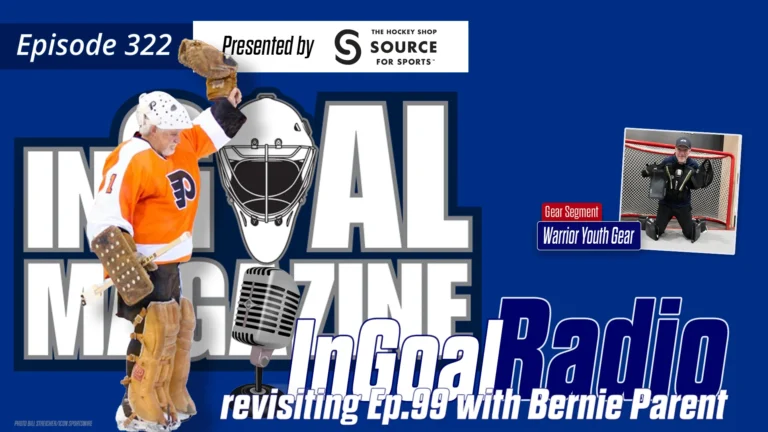
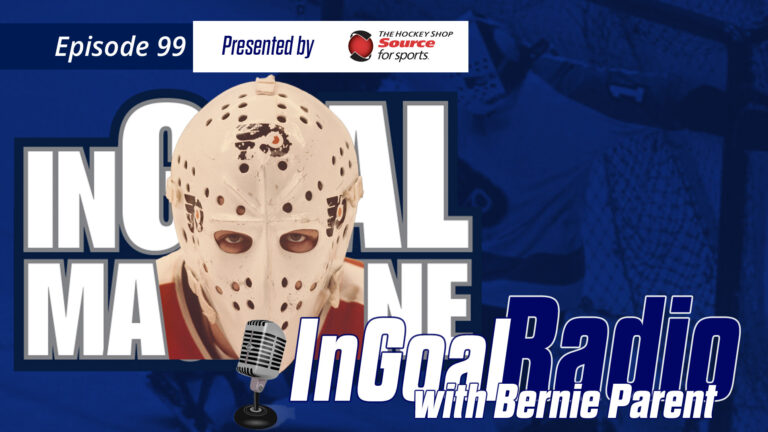
In that 2020 conversation, Parent also talked about his approach to preparation and communication on the ice and what he made of the game's evolution. After his death, InGoal re-aired it in Episode 322 of InGoal Radio.
Bernie Parent died on September 21, 2025, in Avalon, New Jersey, at the age of 80.
Sources: NHL.com and Hockey-Reference (statistics); NHL.com's obituary; InGoal Radio.
Follow the goalies, not the noise
InGoal Magazine covers goaltending at every level — gear, technique, and the goalies behind the numbers. Get our free weekly newsletter — plus 3 free premium reads to start.
Go deeper with InGoal
Members get every Pro Read — NHL goalies breaking down their own saves — plus full gear reviews and the deepest goaltending coverage anywhere.