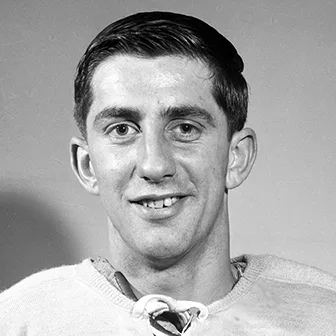
Born Jan 13, 1939 · Trail, British Columbia, Canada — Undrafted
| SEASON | GP | W | GAA | SV% | SO |
|---|---|---|---|---|---|
| 1975-76 | 47 | 13 | 3.36 | .901 | 2 |
| 1976-77 | 47 | 17 | 3.36 | .894 | 1 |
| 1977-78 | 46 | 10 | 4.03 | .870 | 1 |
| CAREER | 568 | 190 | 3.27 | .901 | 30 |
Cesare Maniago
Career Statistics
| Season | Team | GP | W | L | OT | GAA | SV% | SO |
|---|---|---|---|---|---|---|---|---|
| 1977-78 | Canucks | 46 | 10 | 24 | 0 | 4.03 | .870 | 1 |
| 1976-77 | Canucks | 47 | 17 | 21 | 0 | 3.36 | .894 | 1 |
| 1975-76 | North Stars | 47 | 13 | 27 | 0 | 3.36 | .901 | 2 |
| 1974-75 | North Stars | 37 | 11 | 21 | 0 | 4.21 | .881 | 1 |
| 1973-74 | North Stars | 40 | 12 | 18 | 0 | 3.48 | .898 | 1 |
| 1972-73 | North Stars | 47 | 21 | 18 | 0 | 2.90 | .910 | 5 |
| 1971-72 | North Stars | 43 | 20 | 17 | 0 | 2.65 | .920 | 3 |
| 1970-71 | North Stars | 40 | 19 | 15 | 0 | 2.70 | .914 | 5 |
| 1969-70 | North Stars | 50 | 9 | 24 | 0 | 3.39 | .908 | 2 |
| 1968-69 | North Stars | 64 | 18 | 34 | 0 | 3.29 | .905 | 1 |
| 1967-68 | North Stars | 52 | 22 | 16 | 0 | 2.77 | .912 | 6 |
| 1966-67 | Rangers | 6 | 0 | 1 | 0 | 3.84 | .864 | 0 |
| 1965-66 | Rangers | 28 | 9 | 14 | 0 | 3.50 | .894 | 2 |
| 1962-63 | Canadiens | 14 | 5 | 5 | 0 | 3.07 | .896 | 0 |
| 1960-61 | Maple Leafs | 7 | 4 | 2 | 0 | 2.43 | .928 | 0 |
| Career | 568 | 190 | 257 | 0 | 3.27 | .901 | 30 |
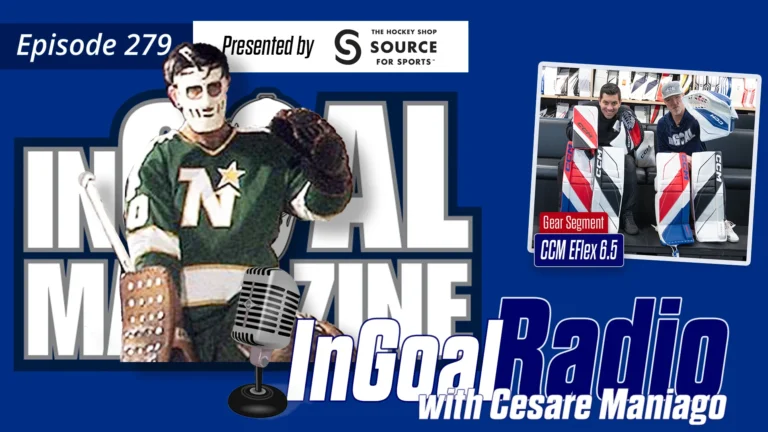
Cesare Maniago grew up in Trail, British Columbia, the youngest of three brothers, and the porch outside the family house happened to be the size of a goal, so his brothers and the rest of the neighbourhood took their shots at him there. He sewed his first goalie pads out of catalogues and potato sacks and strapped them to his legs, and wore them for years, he said. His favourite goalies were Turk Broda and Chuck Rayner, and during games he would slide back and forth across the hardwood floor pretending to be one of them. He was self-taught, he told InGoal Radio in 2024.
Born on January 13, 1939, Maniago was six-foot-three at a time when, he said, the league's goalies were all under six feet, and he was told again and again that he was too tall for the position. Minor hockey in Trail supplied his equipment; his first goalie skates came at 15, in his last season at home, and his first set of pads of his own at St. Michael's College in Toronto, where he went at 16 and played two seasons of junior for the Majors. In 1959–60 he played senior hockey with Kitchener-Waterloo and then with the Chatham Maroons, who won that spring's Allan Cup against his hometown Trail Smoke Eaters.
His NHL debut came with Toronto in 1960–61: seven regular-season games and two in the playoffs. He spent most of that season with Spokane of the Western Hockey League (30 games), with two games for the WHL's Vancouver Canucks and 11 for the Sudbury Wolves of the Eastern Professional Hockey League. With Johnny Bower hurt, he said, he was called up to back up Gerry McNamara, who was hurt in his first game, leaving Maniago the only goalie under Toronto's sponsorship. He played in Toronto, flew to Sudbury the next day, played there that night and took the midnight train back, and kept it up for seven games in six and a half days, something he doubts any other goalie has done.
Montreal claimed him from Toronto in the league's June 1961 draft, and he spent most of the next four seasons in the minors: Hull-Ottawa in the EPHL, the Quebec Aces and Buffalo in the AHL, Omaha and Minneapolis in the Central Professional Hockey League. His NHL games for the Canadiens all came in 1962–63, when he played 14 and Jacques Plante the other 56. It was in Montreal, as Plante's backup, he said, that Plante asked whether he wanted a mask of his own and booked him an appointment at the Montreal General Hospital for a mould. The mask, the brown, stringy kind they called a "pretzel mask", arrived within days. He put it on for shooting practice at the Forum, coach Toe Blake asked what he had on his head and suggested he think twice about it, and Maniago took it off. He did not wear one again until he reached New York.
In June 1965 Montreal traded him to the New York Rangers in a multi-player deal. Emile Francis, the Rangers' general manager and coach, told him, Ed Giacomin and Don Simmons that the best training camp would win the starting job, he said; Giacomin got it and Maniago was sent to Baltimore of the AHL, where his wife and daughter joined him. When the Rangers struggled, the two goalies swapped places for close to a month, by midnight train. He recalled a night when a Baltimore snowstorm left him walking halfway home from the station, and deciding then to tell Francis he was going home; Francis kept him in New York instead, and his family moved up for the rest of the season. He played 28 games for the Rangers and 27 for Baltimore in 1965–66, and six for New York in 1966–67 while Giacomin played the rest.
Minnesota took him from the Rangers on June 6, 1967, its first selection in the expansion draft. In 1967–68 he played 52 games with 22 wins, a 2.77 goals-against average and six shutouts, still his career bests in wins and shutouts, and all 14 playoff games as the North Stars beat Los Angeles in seven and lost to St. Louis in seven. He was Minnesota's starter for nine seasons, and his 420 games for the North Stars are the third most by a goaltender in the North Stars/Dallas Stars franchise, behind Marty Turco and Kari Lehtonen.
Minnesota finished last in the West Division in 1968–69 and missed the playoffs. On February 27, 1970, the North Stars acquired Gump Worsley from the Canadiens; Maniago said the club talked him out of retirement. He went straight to Worsley at practice, he recalled, told him he was struggling and did not know why, and asked him to watch. Within five minutes, he said, Worsley had found the problem and fixed it, and from then on Maniago felt every team should have been required to carry a goaltending coach. The North Stars made the playoffs in each of the next three seasons. In the 1971 semifinal against Montreal, Minnesota's 6–3 win in Game 2 at the Forum on April 22, with Maniago making 32 saves, was the first playoff win by one of the 1967 expansion teams over an Original Six club; those teams had been 0–17 in such games.
Maniago's working arrangement with Worsley was candid. For a few weeks, he said, Worsley would be named to start at the morning meeting, then arrive near game time saying he did not feel ready, and Maniago would play. He pulled Worsley aside and told him that if he knew he was not up to it, he had to say so early enough for Maniago to prepare, and Worsley agreed. That was how it went, he said, until Worsley retired after the 1973–74 season.
It was also in Minnesota that Maniago made the mask permanent. In March 1968, with the Spectrum's roof damaged and the Flyers playing their home games at the Quebec Coliseum, Maniago left a game against Philadelphia after 16 minutes; he had been hit in the face without a mask and broke his cheekbone, he said, and he wore a mask for the rest of his career. He connected the decision to the death of teammate Bill Masterton, who fell and struck his head on the ice in a game against Oakland on January 13, 1968, and died two days later. Masterton and Dave Balon had wanted to wear helmets, Maniago said, and management and the coach were firmly against it, the reason given being that players would lose their identity with the fans. That reasoning, in his words, was "a big crock of crap."
On August 23, 1976, Minnesota traded him to the Vancouver Canucks for Gary Smith. He played 47 games for Vancouver in 1976–77 and 46 in 1977–78, then retired with 568 NHL regular-season games, a record of 190–257–97, a 3.27 goals-against average, a .901 save percentage and 30 shutouts. In 36 playoff games he went 15–21 with a 2.68 goals-against average and a .915 save percentage.
After his playing career Maniago went into the wholesale sporting goods business. Later, when Pat Quinn and Brian Burke arrived in Vancouver, he said, they asked him to work with the Canucks' goaltenders. He told the goalies he would not change the styles they had spent years building, only look for small things: playing the angles, bending the knees a little more for balance, opening the pads up a bit. When Quinn wanted him to stay on, he recalled answering that he had a business to run and that what the team needed was a full-time goaltending coach, which Quinn agreed with. He was inducted into the BC Sports Hall of Fame in 1996.
In the 2024 conversation, Maniago also talked about the weight of water-logged pads in the old Chicago Stadium, playing Bobby Hull's curved stick in a chest protector with half an inch of felt, and his admiration for the goalies of today.
Sources: NHL.com (statistics); Hockey-Reference (statistics and transactions), franchise leaders and the March 10, 1968 box score; BC Sports Hall of Fame; The Hockey News; NHL.com, This Date in NHL History: April 22; NBC Sports Philadelphia (the Spectrum roof); InGoal.
People Are Asking About Cesare Maniago
How old is Cesare Maniago?
Follow the goalies, not the noise
InGoal Magazine covers goaltending at every level — gear, technique, and the goalies behind the numbers. Get our free weekly newsletter — plus 3 free premium reads to start.
Go deeper with InGoal
Members get every Pro Read — NHL goalies breaking down their own saves — plus full gear reviews and the deepest goaltending coverage anywhere.