
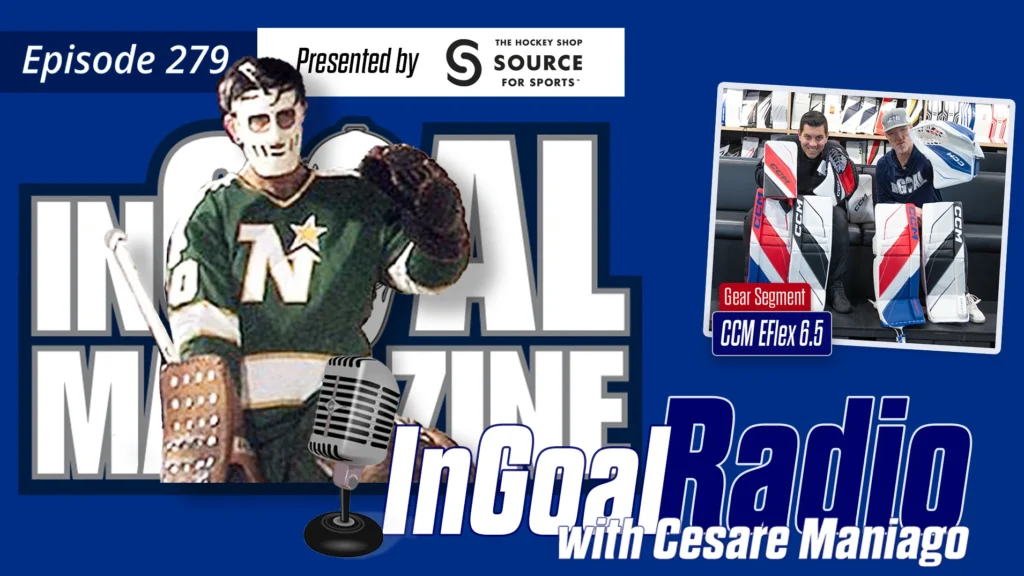
InGoal Radio Episode 279 with Cesare Maniago

Please subscribe and leave a rating — it helps us reach more goalies!


Cesare Maniago was present when Jacques Plante first wore a mask in a game and recalls Plante helping him get fitted for one — only for Canadiens coach Toe Blake to scare him off using it. Maniago, who learned to play with catalogues taped to his legs, later played with and was coached by Gump Worsley in Minnesota, an experience that inspired him to become one of the NHL's first dedicated goalie coaches.
- Cesare Maniago witnessed Jacques Plante's historic first use of a goalie mask in a game and was personally fitted for one, but was discouraged from wearing it by Canadiens coach Toe Blake.
- Maniago learned goaltending basics using catalogues taped to his legs as makeshift pads, illustrating how primitive early equipment was and how much it shaped playing style.
- Being tall was considered a disadvantage for goalies in the 1960s–70s, a mindset that stood in stark contrast to the modern emphasis on size in the position.
- Maniago credits his experience playing alongside Gump Worsley as a turning point that showed him the value of goalie-to-goalie mentorship, motivating him to become one of the NHL's first goalie coaches.
- Joseph Woll of the Toronto Maple Leafs uses Vizual Edge visual training programs and discusses the technique of looking off the puck to improve tracking and decision-making.
Episode 279 of the InGoal Radio Podcast, presented by The Hockey Shop Source for Sports, features former long-time NHL goalie Cesare Maniago and fantastic stories about the life of a top-level puck stopper from the 1960s through the early 1980s.
Feature Interview
presented by NHL Sense Arena
In the feature interview presented by NHL Sense Arena, Maniago shares his experiences backing up Jacques Plante when he first put on a mask in a game — and how Plante helped him get fitted for one only to have legendary Canadiens coach Toe Blake scare him off using it. Maniago, now 85, talks about learning to play with catalogues taped to his legs, about starting off with Johnny Bower in Toronto, competing against Ed Giacomin and Don Simmons with the New York Rangers, then playing with and getting coached by Gump Worsley in Minnesota. Maniago’s can’t miss interview is loaded with great stories and anecdotes that resonate today, including how being tall was a problem back then, how equipment changed the way goalies played, and the importance of having a fellow goalie to help you, which led to him becoming one of the NHL’s first goalie coaches.
Parent Segment
presented by Stop It Goaltending U
In our Parents Segment, presented by the Stop It Goaltending U app, we dig into the stress that can come with watching our young goalies compete and offer some techniques to help manage it.
Pro Reads
presented by Vizual EdgeWe also review this week’s Pro Reads, which features Joseph Woll of the Toronto Maple Leafs talking about when to look off the puck, and is presented by Vizual Edge, which is fitting because Woll uses their programs to improve his visual skills.
Weekly Gear Segment
presented by The Hockey Shop Source for SportsAnd in our weekly gear segment, we go to The Hockey Shop Source for Sports to continue our look at the various options for young goalies, with a focus on the CCM EFlex 6.5 line.
Episode Transcript
Intro
We've gathered again. Oh, we are so happy about this. Daren Millard along with the cofounders of InGoal Magazine, Kevin Woodley and David Hutchison, and we have a lineup for you today as we bring you InGoal Radio Podcast presented by The Hockey Shop Source for Sports Langley, thehockeyshop.com. We will head over there for the Gear Segment with Cam talking about the CCM EFlex 6.5. That's the junior line, the kids line.
We're gonna explain it all, but it's for for the little ones. Not the little little ones, but the little ones. Again, I'll we'll walk you through that. I'm gonna make that so confusing that we're gonna have to explain it from the very start. We've also got
Hold hold on. Perfectly put. Are these are these for Hutch?
Oh. Oh, I actually could wear
blocker. Zing. Zing. Just the blocker.
I legit could.
It it is hard, though, when when you're talking about junior lines, I think junior hockey, but so it's it's it's weird how you have to translate that stuff. And there's no fault of anybody's. It's just society's look at it and then our look at it, and then you put in the hierarchy of of of the game. We've got the Stop It Goaltending U, the app parent segment dealing with the stress of your child playing goal and how that can affect you and how you can work around that. The Visual Edge Ion ProReads.
That's our new segment that we launched last week. Joseph Woll is gonna walk us through the ProReads and our feature interview presented by NHL Sense Arena. We are going to chat with Cesar Maniago, Kevin Woodley. I'm so envious that you had to have this got to have this conversation with Cesar at a tour of the history of goaltending, like a a walking tour of of goaltending.
Yeah. From a guy that, you know, we're we're little over ten days removed from November 1 and celebrating International Goalie Day and Jacques Plante putting on a mask for the first time. Well, guess who was there as his backup in Montreal? Cesar Maniago. Had an incredible career after that and before that played with Johnny Bower in Toronto.
Still holds or is at the top of most goaltending records in the Minnesota North Star slash Dallas Stars franchise. Had a nine year run there. It was exceptional. And from literally strapping catalogs, The the old what what are those? Department store catalogs?
I don't even have department stores name or depart Eaton's Eaton's. Most people don't even know what Eaton is. They're on West Lair.
Your leg and protect yourself.
And I wouldn't suggest doing it with your laptop, but that's how he that's how he started playing goal literally with tape and old catalogs. And from there to the National Hockey League, playing with some of the greats of the game and having some Gump Worsley, one of the first goalie coaches in the NHL, Cesar Maniago. We get into all of that in this week's feature interview presented by NHL Sense Arena. It's a good one. It's it's a little bit more historical, but there are some fascinating lessons on old stereotypes about size.
And guess what? As a big goalie, it was harder for him. So it was it was a really great conversation, and I I think everybody's gonna enjoy this one
about the first time that he walked on the ice with a mask is mind blowing. Won't give it away too much right now, but he went out there with a mask and he didn't finish with a mask. So it
Really telling what these guys went through.
Incredible. We're at the point now where teams moving past that 15 game mark. Are we able to look at goaltending numbers in the National Hockey League and go, okay. This is this is starting to become real.
I personally don't think so. But, But, I mean, we gotta look at something, so I understand. As a matter of fact, we had I had this conversation really quickly with Stuart Skinner of the Edmonton Oilers this week. And the audio quality is not great because it's just me with a with a phone in a locker room and a lot of background noise. But let's hear what Stuart Skinner has to say.
It's hard to not look at it, I find, especially kinda I mean, I'm at a point in my career where I'm old enough that I could kinda look at the board and see probably how games are at where my numbers probably could be. Right. But in saying that, so sometimes, especially the way things, have been to the start, you always wanna look at them to see what the maybe how bad or how good it how good they are and all that. So it is a challenging part. I don't really have, like, a a 20 game check or 50 big check or
Who's an active with a former NHL? I can't remember what it I said, numbers mean nothing for goalies. At least 20 games.
Yeah. Yeah. And honestly, I would probably agree with that. Yeah. I think and you could probably look at it in Christmas time and be like, okay.
Where am I at? I always look at it after a season just to see kinda how things went. Yep. Season. But, yeah, I don't really have, like, a set mark.
Sometimes I just look at it sometimes I don't, but really trying to not look at it.
Well, that's interesting that he, like, tries to like, if there's a conscious effort to to not look at it.
Well, let's be honest. As we talked about before in the parent segments, it's not like it helps you to look at those stats. If if anything, it's gonna hurt you because you've got it in the back of your mind playing to some standard everybody else has. It's chasing results over over process.
Yeah. But at some point, you're you want feedback from statistics. Do you?
I like Woody I like Woody's Clearsight statistics far, far better. And as he's proven, it makes a difference in selecting a goaltender to look at the real numbers, not the, don't get me back into my parent segment rants about stats, please.
Just gonna say, didn't didn't we cover this on the parent segment? And over and over. Of statistics? I just find it, you know, it's fascinating and maybe for others to hear as they struggle to not pay attention to him that here we have Stuart Skinner, guy who was in game seven of the Stanley Cup final last year, admitting how hard it is not to look at numbers early in a season. Now Stuart's basically his numbers are washed from two tough games.
And, you know, for certain, one of them, the Columbus game, nobody showed up in front of him. It was just odd man rushes and backdoor tap ins, and his numbers took a beating. I thought it was really interesting that after we had this conversation in the morning, they played the Canucks at night, felt them pretty good. Seven two late. One of his teammates take a takes a kinda lazy, frankly, I didn't love the call penalty.
And Vancouver pumps their third goal into the net on a late power play on a similar backdoor one timer. And you could see the frustration, and I can't help but think that part of it was him doing the math in his head and realizing that three on 25 wasn't gonna help those numbers, but two on 25 would have or whatever it was. I can't remember off top of my head whether it was 25 or not. But, you know, just to give you the example, like so if that's where the mind is going because we're paying attention to the numbers, then for sure, it's not necessarily in the right place as the game is going on all the time. Right?
Like, we're admitting there that it's it's made that focus is not necessarily on the process. But again, it's really, really hard. Except for maybe me and my beer leaks case where it doesn't really matter all. But even then, you're like, oh, man. Like, I've given I've lost the first to five twice in a row.
I can't you know, like know what I'm hearing from? That's hard.
Even a good start can get into your head in the sense of you've got these sparkling numbers, and then you have one of those nights, and then you're in your own head going, oh, there go my numbers.
See, and I think that's why I wait till 20 games, and I think it was your old media partner in Vegas, Mike McKenna, that told me that and made a really good case for it back in the day and explained why 20 games The numbers are just
a goaltender plate?
For the goalie. Sometimes don't get there. Like, Juuse Saros. Why? That's true.
That's fair.
It's true.
And and that's that's totally accurate. But the reality is, like, your numbers are a little more baked in. Right? Like, even Kevin Lankinen here in Vancouver who's who's basically, like, helped not save their season because they're a good team, but has been a massive part of them not having a
very He fortunate
went in at yeah. Very much a perfect word. He went into that Edmonton game with a .923, right, near the top of the league. He hadn't had a tough night yet, like one tough night, and he did that night. And so all of a sudden he's down around .905 and his his numbers are closer to league average.
Although these days nine zero five is still well above league average, but you know what I mean? He's not on the top 10 page. Has his start been any worse? Like, Kevin Lankinen has been exceptional for them. But that was his first regulation loss, but the numbers now all of a sudden don't look nearly as
good. Look at the numbers. Maybe something like how many good games versus not good games you've had. Like, you know, have you had
Quality starts. Yeah.
Thank you. That's much better. Just interestingly talking about the numbers being baked in, if you just well, Woody, ask you a question.
Uh-oh. Is there gonna be math?
No. There's not. Are you happy with what what's the difference between a .900 and a .910 in terms of your perception of a goaltender?
Well, I mean, it's starting to change as the league average save percentage dips below 900. But for the longest time, that was the difference between maybe this guy's an American leaguer and maybe this guy
What is it now?
In the NHL on a long term contract.
Well, it it it I'm not actually trying to pull out what the difference is. I'm just make the point, you know, a 900 versus a 910 is a pretty big difference in terms of our feelings about a goaltender.
Well It's one goal on a 100 shot.
It's it's yeah. Or if you've played 10 games and then you pitch a shutout, you can go from like a .900 to a .909 at about an average of 30 shots a game. Like one good game makes you the difference between an AHL and NHL goaltender? No, of course not.
And I think the bigger picture is it's not the shutouts, especially early in this season, because we have seen some crooked numbers all around the league. It's avoiding the the crooked numbers. It's avoiding the big one. And this kinda goes, yeah, this kinda goes to when defenses are looser and teams are trying to figure out systems and everybody's trying to figure out where they should be in front of you. So this kinda goes to what a lot of goalie coaches have told me over the last five years.
And I remember talking to guys like Roberto Luongo who are in the hall of fame and that whole generation of guys that would play 70 games. And they used to talk to me about how to manage your b games. And this is a lot where technique came into the league. Right? Where what do you do?
What is your foundation? So when you don't feel it, when all the all the sort of feel and rhythm and timing elements don't feel great, do you have a foundation that lets you get hit by pucks? And that was for like, seriously, for an entire generation of goaltenders, like, having that base was key. So do I put myself in a good position technically to get hit? When I don't have my a game, how do I survive?
And a lot of these guys did and played 70 plus. You cannot, the more goalie coaches I talk to you now, you cannot get away with a b game anymore. A b game in today's NHL, unless your team is playing like the 95 devils and shutting everything down and it's harder and harder to do that, A b game is when you end up with a crooked number and and everything goes sideways. That's when the hands
I initially asked the question just because I was curious. I wasn't actually looking at it from the eyes of the goaltender. I wanna know when can I start taking the numbers that I'm looking at and processing them at at face value where there's enough of a a, I don't know, work body of work there that that this is
what it is? This is who the guy is this year. So, basically, you know, we talk a lot about the ties between Christmas and goaltending and all of the presents we used to get under the tree as kids that inspired us to become goaltenders. This is yours for the year, Daren. You're allowed to look at the numbers on Christmas day.
I'm sorry I'm sorry about the first two months. It's it's not that far, but it's probably into December before anybody hits 20 starts. Right? Like, even the workhorses. Juuse Saros, we're November 12.
He's played more than anyone else. He's at 13.
Played 12. Hockey's played 11. Kochetkov has played nine
I think nine. We know that and we know Juuse Saros is good. We know Connor Hellebuyck's otherworldly. Right? Like, we know that those eyes are good.
I think where the conversation starts is like, hey. The guys that have had a couple crooked games whose numbers are underwater, when when can you sort of look at it and say, is this guy gonna pull up?
Swayman's at 11, and he's under five hundred. Under five hundred? That that gets people's attention.
Oh, wins and losses, I hope you mean. Yeah. Were just talking save percentages.
Well, no.
Swayman's at three thirteen, eight ninety six, and he's four five and two.
Don't quote goals against average, Daren. We'll kick you off this podcast.
Well, it's don't think save percentage is much better. How much, how much of a swing in save percentage, I guess, says that you're you're well established if you wanna talk about number of games? Like, I just mentioned that after 10 games, one start, you can swing it by 10 points. Well, 20 games, one shutout can swing it by five points. Is that more stable?
What do you call stable? What do you call a body of work you can look at?
Well, I don't wanna wait till Christmas before I start taking things in and absorbing them. Wow. Just kinda
I'm just I'm telling but but well, but think I mean, yeah, you you were one of those kids that are always looking to see what was what was hidden in the around
the risk of taking it down down the rabbit hole, Woody, has anybody got numbers for consistency?
I mean, I think quality starts is one of them. Right? I like But within
To me to me, being the math geek, I wanna do standard deviation on all of guys' scores and find out if that's a number for
Quality starts, bad starts, but like there there's like like when I look at Clearsight, they have a multiple categories including, like, you can get a win and a bad start and that's when the team bails you out. Right? Like, you know, and and it's all you can't do any of these numbers without some of the adjusted metrics on shot quality Because a quality start when your team gives up 20 shots and and none of them are grade a's versus a quality start when your team gives up 20 shots and seven of them are grade a's are two totally different numbers. So at the end of the day, we come back to the same thing. We we need context.
There is a quality start metric without using the Clearsight numbers, and it's a little suspect as well. It relates to league average save percentage and how your save percentage in that game was and so on. I I should look up the actual definition. But, yeah, I just, I I just harken back to you saying something to me before, Woody, about, somebody getting really excited about Goaltender X having, you know, four shutouts in their first 20 starts and then all of a sudden but but wait, their goals against average is the same as everybody else in the league. That means they must have had four or five not great starts.
So how do we judge a goaltender's consistency?
Well, that's Mitch Korn used to say that when it was Vezina time. Right? The guys with, like, nine, ten shout outs is like, okay. But if he's got the same the rest of his numbers is the same as my guy, that means he's had nine or 10 sort of blow up games. Right?
So it's it's You talk about quality starts. What are you effectively doing in a quality start measurement? You're grading a goalie on a single game, which we talked about during that parent segment.
I'll give you this example.
There you go.
Logan Thompson. He's 7 and 0 to start. It just jumps out at you. But Logan Thompson, when it comes to the other numbers, isn't isn't putting up a a 7 and 0 type season.
He's not he's got a nine ten in this day and age. That's a hell of a start, two fifty five. So yeah. But I hear what you're saying. At the end of the day, we probably need more information on a lot of these guys before we start making hey.
Not that we at InGoal are making judgments.
He's he's .902. He's eight and one. Like, you
Yeah. Yeah. It's how you can you're you're
asking Logan Thompson Logan Thompson's seven and o, but hasn't Ovi gotten off to a ridiculous start this year as well? He's a goal a game or something?
It's But he's on on a heater right now. Yeah.
Yeah. The Caps certainly were not on a heater last year. And so there's gotta be context. And with all respect to Logan Thompson, I haven't watched him play this year. I'm just putting it in the context of the team has to play well too.
So here, I'll give you so just because we we we've gotta move on. I'll give you as an example. Logan Thompson's .910. His actual defensive environment hasn't been that great. He's got an expect of expected say percentage of .879.
His adjusted say percentage, so his performance relative to shot quality is actually fourteenth in the NHL right now. So Good for him. He's had a really good start with the Washington Capitals. And yet being seven and o, you know, I'd I'd I'm not looking game by game right now, but even if there's one you can still have a nine ten with one game that's average, but if your team scores a bunch and you still win, that's how you get to seven and o. Right?
He's been really good, so let's not take away from that. But the reality is it's really I guess what we're saying, and we've spent ten minutes dancing around it, is it's really early and it's really hard anyways to compare guys. And even more so when the sample is so tiny. We're at we're talking about making judgments on guys' season in samples that we would never make a judgment on the guys as a goalie overall.
I've never seen Connor Hellebuyck play better. And I I don't care how many games he's played. It's 12. But he he's been unbelievable. And Winnipeg's off this rocket start, but Hellebuyck has been sensational.
He's been really
That's the eye test. I've watched more of their games, and it's just
He's been really, really good. He also has what the we're gonna do counting. I'm waiting for something to load here. One,
I love I love how there's always a follow-up statistically
He's good.
With Woody.
He's he's got nine of five expected. What did we just say Logan's was? Eight seventy nine? So Hellebuyck has been incredible. No question.
And yet he's playing behind, right now, the fifth easiest defensive environment in the NHL for any goalie.
26 points in expected. That's huge.
But then that's what you get in small samples. But and and and again, Hellebuyck is outperforming that environment by a, you know, at a top 10 level, like another Vezina trophy. Absolutely. Please do not hear know, listen to what I just say and think that's a criticism in any way because I'm with Daren. He is dialed to start this season.
There's always a but.
I'm a I'm a contrarian.
There's no but.
I'm a contrarian.
And. It's not it's an and. It's not a but.
Just I just wanted to be able to go on the radio or TV and be able to say, this guy's having a great year. This guy's
You can. Over. You have my you have my permission to Oh, I do? Yeah. You can you can say that Connor Hellebuyck is having a great year.
Oh, he can say yeah. But nobody else.
There's a few. Send send me notes. I'll tell you who you can say it and not.
Gear
K. Let's get over to The Hockey Shop by Cam and Company talking about the CCM EFlex 6.5 line as things continue. You guys recorded this the other day and you made a reference. There is construction happening.
Well, when you're the this is like goaltending in general. When you're the best, you don't rest on your laurels. You know, whether it's Marc Andre Fleury, Roberto Luongo, the greats of the game, Martin Brodeur, Pat, they always evolved. The Hockey Shop's the same way. 34,000 square feet of space as they continue to grow and pack the place with hockey players who'll forgive them for letting the skaters into the building.
But the goalie corner, they've always looking to upgrade and make better use of that space. So there is gonna be a little construction noise in the background of our gear segments on a week in, week out basis here for the next little while. But that's the commitment they have to you, whether it's the staffing in the goalie department and making sure that everybody in there plays the position and is passionate about the position, whether they're older, younger, they bring that same knowledge base, or making sure they have the latest and greatest. We talked about the Brian's new optic floor line last last week and all the options they have in stock or discounts on past stuff as they move on to new generations, the older generations are discounted, there is no better place to do your shopping than the hockey shop and the hockeyshop.com. Obviously, Black Friday coming up here in November.
Time to get your gifts for Christmas. They've got a Christmas wish list for goaltenders published on their website at thehockeyshop.com. So make sure you check it out. Get ahead on your shopping through the hockey shop and the hockeyshop.com.
Before we get into this, run me through the levels of this CCM goaltending line.
Oh, well, in general, I think the thing that has confused us a little that is not specific to CCM is the terminology of the different levels.
Okay.
Right? So youth is your smallest goaltender. I would suggest in an upcoming segment that we've we've actually now added one below youth, which is the Try a goalie line. And Bauer has a segment coming up with the Hockey Shop shortly. But youth generally is that first set of pads that you have.
And after that, you get into junior gear. So you're out of your first set, maybe you're seven, eight years old, something like that. And the junior lines, depending on your size as a goaltender, go until you get intermediate. And, and then after intermediate, you're into your senior lines. And there's specific sizes whether you're, you know, a twenty seven, a thirty, thirty two that are available in each of those.
And and I don't want to get into the weeds too much because they'll differ a little bit between different companies. The widths of those pads change, obviously getting a little wider as you get up until until you hit pro, which are all 11 inches wide. So those change maybe a little bit between manufacturers, but the nomenclature, youth, junior, intermediate, senior. And we just feel a little confused when we hear that junior because it doesn't mean you're playing junior hockey. Little bit like some of those companies, as Woody has pulled out before, use the term pro for their second line of gear, which is a little bit confusing as well.
So I probably just made it even muddier, didn't I?
No. All you gotta remember is youth, intermediate. No. Youth I see. I youth, junior, intermediate, and senior.
That's the order, folks. Did you
do that on purpose?
I wish. I wish I could say I did that on purpose Daren. I'm not
I'm gonna be talking about concussion baseline testing later, Woody. This may apply.
I'm not a smart This
week's Gear Segment over at The Hockey Shop, Source for Sports Langley at hockeyshop.com is focusing on the junior? Correct.
But I believe the 6.5 line also includes intermediate, or am I wrong?
I think I think you you guys deal with
think we need Cam to explain it Alright.
Let's go over there now.
Welcome back to The Hockey Shop Source for Sports where our look at kids lines continues with CCM, one of two offerings from CCM. A quick note of apology in advance. There is construction going around us because they're always looking to get better here at The Hockey Shop Source for Sports as is CCM with their youth line. Junior. So junior I see.
I never know what to call it. Junior, you I just say kids. This is for the kids. Cam will correct me. We have got the EFlex 6.5.
There is a second line in the XF Axis line.
Axis 5, which I am sold out
Axis. Axis. Sold sold out of that right now. We'll get to it when it gets more in stock. Probably a good sign that it's sold out.
Today, we're going 6.5.
EFlex. Little refresher off this. Yes. We have previously talked about this in the past, but it's been a while, so might as well go over it here. So EFlex 6.5 leg pad.
Stuff that we have seen a little bit here before with a few new bells and whistles. One of them being that integrated knee that was brought on by the EFlex 6. This is something that you're seeing now giving the pad more stability, especially in the knee cradle. Big upgrade off of the previous models. Further into the back, we can see that leg channel.
Very, very similar to some of the years past. That rotation control system strap wrapping around QM-SS two. Still a bootstrap on there? Still a bootstrap. So reason being that it's carried over and stayed on the junior lines is just, again, that little bit more control on those shorter legs, keeping that pad up on that boot of the skate itself.
We don't wanna be, like, torquing this down super, super tight. But, again, depending on how the fitment of the the kid that we have in the pad itself can really help to create a little bit more stability.
I was just gonna say, we talk a lot about not getting pads that are too big. We know parents wanna allow a little room for growth. Correct. But it can be really tough if the pad is too big and doesn't fit on the leg. It'll affect their skating.
It'll affect their balance in the butterfly. It'll affect their ability to enjoy the game. I however, as testers up to pro level equipment, sometimes we'll get a pad that's a little too big and if it has the bootstrap, you can just tighten it a little bit and pull that pad down and help you get a better fit until they grow into it. So having a bootstrap on the pad can benefit you in that way if you're looking at a sizing. Of course, I would recommend talking to the guys here at The Hockey Shop Source for Sports to make sure you get the right size for your kids.
Okay. So that's the pad.
Yes.
Any other features we need to go over?
Single break.
Kind of already showing
up a
little bit.
Sizes. Let's go with sizes because again again, I get confused about the different, like, youth, junior, intermediate. What are these for?
Twenty six, twenty eight, and thirty. Standard plus one?
That's correct. There we go. Okay. So that's the range we're looking at. That goes in your intermediate or is that
So it that's crossover size. So, yes, intermediate also has a 30 inch, but there's a junior 30 inch as well. So, again, that really depends on the goalie, their size, are they ready for an intermediate pads. It's just giving us
the Okay. So hold on. So let's just go over this right now to educate parents. A junior 30 inch and an intermediate 30 inch, what's gonna be the difference? Price point two?
The price point two is They're more expensive in the intermediate?
Well, it's a different pad. So you're looking at would be the 6.9. Okay. And 30 plus one in an intermediate, That pad will be more rigid. It's a little bit wider.
There's it's it's a bit heavier too as well. So that also depends, like I said, on the goalie themselves. Are they ready for that pad? Are they still transitioning? Have they hit a gross spurt, but they haven't quite built out from that growth spurt?
These are those things that all kinda come into play when fitting.
And these are the reasons you come to The Hockey Shop Source for Sports to talk to Cam and his entire crew in the goalie department. They all know the answers to these. They'll all be able to ask you the questions to get you the answers to get your kids in the right gear. Okay. Shifting gears.
Nice. Glove. Hey. It was a segue.
I like that. So this is
a Source for Sports exclusive in your hands. In my hands, you have a regular one. There's a standard one. You can see the difference in the pocket and the
That's correct.
So lacing.
When you see these 6.5 gloves on the wall, the ones that are marked with SDC will be our Source exclusive model. Double t, extra one inch skate lace. So deeper pocket, skate lace pocket really will help the
pocket in that That's correct. Depth of wow. Yeah.
Okay. Definitely back to their 581 style glove. So it will be similar ish to a five eighty style of a closure. Kevin was able to get his hand fully kind of in there.
This is in this is a five eighty?
This is a five eighty one. Yes.
Oh, sorry. I didn't when you said Source for I thought just that one.
No. No. No.
Both both are. Gotta x three k.
Yes. Exactly. And, again, that upgrade being the skate lace and just the plus one into the t. Blocker? Blocker?
Is that Source for Sports? Oh, you gave me a left handed blocker, you silly guy. I I know.
Just to screw with you a little bit. Just to see if you're paying attention. So blockers themselves, very similar to the EFlex of the past. Nice open cup, nice tight fitting palm, lightweight, thin blocker board, very well balanced, very rigid though too. It's not like you're really giving up a whole lot here.
That's one thing that I do like, it's gonna maintain that blocker rebound like quality itself. Again, good balanced overall feel. Yes. There is a Source exclusive one, but really it's just coming down more so to colors. There's not really
a spec upgrade on it. Okay.
Cameron, does this mean you have full right?
Yeah. Well, I mean
In the kids line. I it
does, you know, kinda obvious there if you have it on the on the other hand.
Well, I didn't know. Well, I never asked this question before. I mean, Andrei Vasilevskiy, if you had had this if you would had this in Russia when he was a kid, he would do this. But because they didn't have it, he does it the other way. I think And this is this is good for kids.
I I think he does just fine playing regular though.
I hear he's pretty good. You're kinda missing my point on this one, my friend.
I know what you're saying. Yes. It is available in full rates both the lines. So if you have any questions, give us a call here at (604) 589-8299 or 1-800-567-7790 or text out at the hockeyshop.com.
You finished strong. I'll give you that. We've got a whole another line from CCM. Like he said, the Axis line is sold out right now, but there's more coming in and we'll get you a full breakdown of that as we continue to work our way through. Not youth, but kids Junior.
Here.
Don't mess with me.
Intermediate, junior.
I'm sure. I is confused. Thanks, Kevin.
See, clear as mud, but it's it's great set of gear and and that you get into the transitional stage from one level to the other, and that's when you really need the help of Cam and company to get you past that stage of what's best for my child.
Then listen to them. They know. I know that we talked about it in the segment. The temptation to go bigger so the kid has room to grow into it. If they can't move, they can't play, they can't skate, they're not gonna have fun.
I know it's tough. Really easy for me to say from here, but that sort of temptation to go bigger so that it'll last longer, as much as I understand it financially, can have an impact on on how they sort of function in the gear in the short term.
Love the bootstrap though of just buying you a little extra time at the start and you can grow into that path.
Yeah. I know that's just good really good point, Daren, because we we've, you know, it's something I know I'm not sure a lot of people would even think about. The bootstraps largely disappeared from equipment, but Yeah. We use it in InGoal because, you know, we'll have testers and we'll have test sets come in that are just a little bit big. And if it's got a bootstrap on it, you can, you know, just make sure that you're still landing on the knee.
You can hold that pad down a little bit with the bootstrap. And for sure, I think in this case, when we talk about a little extra room to grow, having a bootstrap on this CCM model is a really good idea.
ProReads
Hutch, you're going to decide. Are we going to do the Vizual Edge Ion ProReads next or do we wanna get into our Stop It Goal Tending U the App parent segment?
Oh, that's a whole lot of pressure. I think we're gonna look at, Vizual Edge.
Okay. That's great.
Good friends from Vizual Edge have brought this new segment. So why why why hold back? Give it to the people. They want to know.
On the on the ProReads.
Well and I mean, a perfect week to focus on the ProReads. Our second week with Visual Edge is sponsoring our famous ProReads segment, our most popular segment over at ingoalmag.com. And we have a Visual Edge user as our ProReads feature guest this week. It's Joseph Woll of the Toronto Maple Leafs who amidst all the hype around Anthony Stolarz and well deserved, Daren, you're allowed to say that he's having a good season. Joseph Woll's come back off the early season injury and put in a couple great starts himself.
So, this is a product, Vizual Edge, that is designed to basically help you train your eyes on all the key aspects as they relate to goaltending. Think of it as weight training for the eyes and the brain, a way to strengthen your visual and cognitive processing skills for peak performance, tracking, reaction speed, visual stamina, focus, and more. For me, it's divergence and convergence, especially convergence. I've been working in the program for the last week, noticed it, didn't have my best game last night, but I felt like I was seeing the puck better last night as I start to dig into this. That's what it's all about.
Tools specific to goaltending to help you sort of train your eyes and your brain. Joseph Woll is a user, one of over 50 in the National Hockey League and American Hockey League. And so perfect that he's our guest this week on ProReads where he talks about post bump keys and when to look off the puck. We talk about our eyes and the ability to process. Training them in a way to look off the puck is important.
So I'll ask you guys. I don't wanna give away what Joseph Woll tells us about when to look off the puck. When do you guys look off the puck?
Not sure I do.
I do when it's shot at me, evidently. That that's when I don't see it, but I'm I'm on that.
I I don't do it nearly enough, man.
Hey. Hey. Maybe there's Honestly. Maybe there's some homework for everybody, especially the beer leaguers out there, but maybe the young kids as well. When you're when you're in practice this week or when you're in a game this week, just check yourself how often and when are you looking off at the puck and send us a note.
We've certainly heard it from scouts, watching kids that they're they're evaluating, you know, at the junior levels. And and quite often they'll be like, oh, man, like, puck focus, not looking off the puck. I see it in Vancouver. We talked about the Kevin Lankinen and start to the year. Unreal.
The difference between him and Arturs Silovs who's had a bit of struggles this year who I still believe is gonna be just fine folks, even if, you know, they have spent a little time in the American League again after getting them to the second round of the playoffs last year. But the amount of times and how automatic it is for Kevin Lankinen and to look off the puck and scan the zone when the puck is in a non dangerous area, the juxtaposition is is quite telling. And so I
It's harder to look off the puck now because guys will shoot from such sharp
everywhere. Right. And that's why you need to know where those soft areas are, and that's why Joseph Woll again, we don't wanna give it away. If you're an InGoal premium member, go check it out. But Joseph Woll explains some of the key ones and and it leads helps him lead directly to a tough save.
Let's get over to it.
What you start to learn too is as you get older, is the moments you get that you're able to take looks, especially when, you know, the puck's getting rimmed around, you know where it's gonna be, that's a great time to take a look.
You're in a safe spot.
It's not Exactly. Coming Like on dump ins, if the puck's getting dumped in, you know where it's gonna end up, it's a great time to take a look. You know, anytime anytime, you know, there's a player that doesn't have it, his eyes up looking at you, like that's a it's a good time to be able to take a look and, you know, the the more of an image you can create of the zone, it just helps you, you know, to be a a step ahead of the play.
That's a little tease of of what you'll see.
Over at ProReads.
And here.
Every week, folks there what Hutch, have we got I haven't I've sort of lost track. How many hundreds are there ProReads at ingoalmag.com?
I don't have the exact number, but I know it's just gone past two fifty. Gone a little over
7 thousand 222. That that's how how many.
Let's just
go back to Cesar Maniago.
Little over two fifty, but let me just say in the ProReads presented by Vizual Edge, you do get more than one video. And for people who aren't familiar with them, you go into the ProRead, Kevin presents you with a little scenario often with an image to look at just a moment in time, then you get to see the save itself so that you can think, how would I have done this myself before you then see the entire ProRead where the the NHL goaltender unwinds and unpacks everything for you. So it's kind of a cool educational way of looking at things.
And I'll give you a little hint. Just because the NHL goalie does it one way doesn't mean it's the right way.
And these are... This is the honesty that these guys bring to our conversations that I love. And that's why we show you we show you the snippet, then we show you a video. We say, do you agree? Would you have done it this way? And Joseph Wall was one of them this week. When he looked at the video, he's like, I think I had enough time to beat this play a different way or come across a different way than I did. And that's the type of analysis. If we can watch the best in the world break down their game and look for ways to get better, just think of how the next time you're in a similar situation...
Because at the end of the day, there are only so many different plays. It's puck cycled up the wall and then funneled across. Like, how you play that compared to him and if you can find takeaways, even though you're not facing NHL shooters, that apply and will help you get better. So ProReads is all about. We're so happy to have Vizual Edge as a sponsor of it. Make sure you check out, in the ProReads, we've got discount codes for the public as well as private. The public discount code, Hutch?
InGoal. It's really simple. If you go over to Vizual Edge and you wanna order one of their programs, you get the opportunity to put in a discount code. You put in InGoal, and you will save 15% off the listed price.
If you If you'd
like to save 30%, then you need to be an InGoal member. Go check out the ProReads and the code for InGoal members. If you're logged into the site, we'll be presented for you so you can get your 30% off. You ask me, that makes a membership well worth it right there.
Visual Edge, the s in visual is a zed. Visualedge.com.
Or is it a z? Or a zed? Tomato. Tomato. I
thought it was zed. K.
You've you've been a That's
a living in The States. That's gotta be tough for you.
Oh, yeah. Although though, there's words that I've had to absolutely alter how I say them.
Well, especially as a Canadian who spends his summer in the Maritimes, there's lot of a boots.
Process process is the one that that highlights the whole thing, and then we've worked down, from there. ProReads. I would love to do a ProReads with John Davidson from back in the day and have JD walk me through it because he's such a wonderful articulate That would announcer hockey guy.
Welcome, Daren. Welcome, Daren. That'd be awesome.
That'd be so cool. Alright. Now now we will get over to our Stop It Goal Tending U, the app parent segment, with Hutch, dealing with, the stress of a goaltender. Before we get to that, Stop It Goal Tending U, the app continues to provide knowledge.
Yeah. I mean, there's new videos up every week. We've talked about it many times before. They try and segment it. So you don't have to... We talk about rabbit holes. You can go down a rabbit hole at Stop It Goal Tending U, app, and spend hours working on getting better. Or if you wanna just digest it in small segments, they've got daily primers every day. Most recently, the focus with Brian, the founder of Stop It Goal Tending, former NHL goaltending coach, director of goaltending, son Joey in the National Hockey League right now. Brian walked through five different Monday, Tuesday, Wednesday, Thursday, Friday on leadership. How to be a leader as a goalie.
Maybe they don't put the c on your mask like they did for Roberto Lawango, but you can still be a leader. Starts talking about examples and actions. Talks about choosing your words carefully and being positive. Having empathy for teammates. Some of these things Hutch has talked about in the parent segment. Having empathy, not always just blaming the goalie, but also, hey. Like, having empathy for the mistakes that happen in front of them rather than just blaming them. Doing the... Having the habits that you want others to have. It's one thing to want your teammates to show that professionalism and good habits. You have to have them yourself.
And then follow it up with, you know, what you say you're going to do, make sure you do it. So that was just... Those are the five daily quick one minute primers from Brian that you can find on the Stop It Goal Tending U app. They also had a five minute video on wraparounds two weeks ago. This week, they've got a power pep with UC Saros and a playbook breaking down the similarities and differences. And, again, kinda like ProReads, some of the things they do uniquely specific to how they play of Igor Shesterkin and Ilya Sorokin, two of the top young Russian goaltenders in the game.
So there is something for everyone at Stop It Goal Tending U, the app. And, of course, we talk a lot about ProReads and all the things we do over at ingoalmag.com. When you get a subscription to Stop It Goal Tending U, the app, you automatically get a subscription as well to the InGoal Magazine premium product. You become a premium member. You're able to unlock all those ProReads and hundreds of drills and tips that we've got from NHL goaltenders over the years. Make sure you check it out. Stop It Goal Tending U, the app.
Everything is really connected. Hutch.
Today's segment might be because I was feeling a little disconnected, Daren. That's because my son plays junior hockey. He lives in a different city. I don't get to be at all of his games, and I'm feeling a little alone over here sometimes. And so I just wanted to tell all the other goalie parents out there, you're not alone. Could be a little bit lonely being a goalie parent because there aren't many of us anyway. Most of the hockey parents can sympathize with us. I've heard lots of them say they are thankful that their child isn't a goaltender, but they just don't get what it's like being a goalie parent.
And sometimes it can be a bit challenging dealing with the emotions that we have to deal with. So I don't think I'm the only one feeling this way. I wanted to let all the other parents out there, especially the young goalie parents, to know that, having that roller coaster of emotions that we all face is perfectly normal. InGoal is a fantastic community. We talk about it all the time, guys. They were always amazed by the notes and the conversations we get into as as we come together as a community of goaltenders, goalies, coaches, and this case parents. For me, it's nice to know that there is that large community out there.
It is a roller coaster emotionally. I've gone from seeing my kid have moments where he's literally living his childhood dreams to a week later having to deal with some some heartbreaking pain after a tough game. And, and that all happens in a in a short span of time, and then that roller coaster heads back up again. It's challenging being a goalie parent. So what's my point? First off, just to let everybody know it's perfectly normal and it's okay if you're struggling with the emotion of being a goalie parent, especially if you're new to it. And, I'm here to tell you you're not alone and to give you maybe a couple of tips for dealing with that roller coaster.
First, don't put that stress on your kid. I don't think we should ever be saying, I'm so nervous every time you play. Let's save that for a friend, a spouse, whatever. It's okay. You need somebody to talk to, but let's not put that stress onto a child. They've got a difficult enough position to play already. I would say, and I'll mention it later though, it's probably a good thing to be honest with your kid that stress is a normal thing in life. Just maybe not you're stressed out when they play. Number two, they always say to goalies, never get too high or too low. I would say that to goalie parents as well just for your own sanity, but also to model for your children how we'd like them to be when they're goaltender.
So let's not get too too excited when things are going great. Let's not get too too low when things aren't going well. Let's model that for our kids. Some specific techniques. We mentioned it before on a podcast on a previous episode when we had Luciano Summerville in to talk with us. Double breathing or the physiological sigh. That's great for that momentary dealing with stress. That's where you take in a great deep breath, and then before breathing out, you just take in one more breath and then a long exhale. Do that three times. You will feel a momentary stress relief that really is scientifically proven to make a difference.
Yeah. Beep... Many people are doing that right now.
Parent Playbook
Like practicing double breathing just as you as you say that?
Good. I hope so. I hope so.
Good. Like practicing it. Not not because they're stressed. They're just practicing.
So I also bet if people listen to this podcast that they're also doing number four a lot of people and that's go and get some exercise. If I get really stressed, whether it's hockey or something else, for me there's nothing like some exercise. Hard ride, a run, a brisk walk. For me, it takes a good while, thirty minutes or so before it really makes a difference to my stress that reduces stress hormones, increases endorphins, which are those neurotransmitters that help us reduce stress amongst many other good things. I know some people like to listen to music or perhaps this podcast while exercising and I do it on occasion too.
But if I'm dealing with stress, I think it's more important for me to just be with my thoughts not to avoid them. So exercise helps in the short or intermediate term, but also having it a regular part of your routine, I think will help dealing with stress as a goalie parent. And then fifth, meditation. You can find a lot of meditation exercises online from free resources like YouTube to apps like Headspace, Apple Fitness. I've tried them all.
And again, they help both short and long term to sort of calm your mind. And we have these busy lives guys where so much screen time even. And if we're honest, it's not just the kids with too much screen time. It's hard to find time to quiet our minds. So ten, fifteen minutes to to learn the practice of meditation honestly can help with stress and is is a good thing to try.
And then lastly, find somebody to talk to. Someone who will listen though, not someone who's just going to reinforce your feelings. I think that idea of two goalie parents sitting together and talking about how stressed they are, I'm not sure that's going to relieve the stress. You just want somebody who can listen and sympathize. Most importantly, though, this week, I just want everybody to know that you're not alone.
It's okay to be feeling this way. And we want you to show your child that it's perfectly normal to be dealing with stress, just maybe not the stress of their particular games. I don't want my kid to think he's the cause of my stress. So I don't say every time you play, I get nervous. It's tough enough to do that as a goaltender, but I want him I wanna be a model to him and obviously I can't now, but when he was in in minor hockey of being calm before games, not getting too high, not getting too low as I said.
And, maybe just share that I have ways of dealing with stress when when life maybe through a tough day at work or something gets me a little bit more stressful. So anyway, a few thoughts there dealing with a stressful position as a goaltender or as a goalie parent to let you know you're not alone. And, as always, if you have anything you'd like to share with us or even if you just need somebody to vent with, feel free to reach out to me. Parents@InGoalmag.com.
And your stress is your stress. My stress is mine, and nobody's is, more overwhelming than another. You you're living what you're living.
I think that's a great point.
Can you imagine because I and I and I mentioned that because I'm trying to imagine what Cesar Maniago was going through, back in the day. He is our NHL Sense Arena feature interview guest this week.
Or his parents.
What what just a I didn't watch Cesar play. I knew of him, but his his stories is it's like it's a book through the evolution of so many parts of goaltending.
Yeah. And like we said, like, tying it in, we mentioned plot. I don't wanna give too much of it away to you know, he talks multiple times about how, as Hutch said, it can be a lonely position as a parent back then, especially. I mean, it still can be as a as a goalie. It can be lonely.
You're alone back there. You know, you don't have anybody to help you. And in Cesar Maniago's case, like, literally, there was no such thing as a goalie coach back then. Later in his career, he got a little help from a former pro.
He barely had a partner. Yeah. Back in Caesars day.
Very true.
Like, speaking of that, like, wait till you guys hear the story about how many games he played over and how many bus rides and airplanes he took after his first call up to the Maple Leaf. So you know what? This thing is loaded. It it may not be like a lot of stuff about the modern goaltending, you know, and technique and stuff like with our with our guests that are in the NHL right now, but there are a lot of correlations and lessons that come from it. But more than anything, there are just fantastic stories about what the previous generation went through to get us to where we are as goaltenders today.
Feature Interview - Cesare Maniago
It's a valuable lesson. It's an entertaining listen. Let's get to Cesar Maniago. Really excited to welcome to the InGoal Radio Podcast, Cesar Maniago, who played over 500 games, 568 games in the National Hockey League before retiring after the nineteen ninety seven seventy, Sorry. 1977-78 season.
Mr. Maniago, how are you?
I'm fine, Kevin. Yourself?
I'm I'm I'm good. I feel like the timing of our conversation is is perfect. We're we're ten days removed from November 1, and the night that Jacques Plante wore a mask for the first time here at InGoal Magazine, we celebrate that as International Goaltending Day. I understand you may have been present for that.
Yes. I was, in Montreal at that, same time. And in fact, there there was a bit of a problem, which I'll get to in a second. But when I arrived there, I was in Montreal as a backup for Plante. And, he came over and asked if I wanted a match to be made.
And I said, yes. Absolutely. He says, fine. He says, I'll make an appointment up at the Montreal General Hospital in which they're gonna take a mold and then make the so called they called it the pretzel mask in that It was brown and kind of stringy. So had that made up there, they delivered it within a few days.
And I'll never forget the first practice that we had at the forum. And the team comes out and they limber up. They skate around, and then you line up for shots. And anyways, at that time, I grabbed the mask, put it on my head, and getting ready for shooting practice. Toe Blake, who was the coach at the time, came over and he says, what's that you got?
I said, well, it's a mask. He says, what do you intend to do with it? I said, well, I'm going to wear it in practice. And he just said, he says, if I were you, he says, I'd think twice about it. It was almost like saying, you take it off right now, and that was it.
So I did take it off, and I didn't wear until I got to New York. And so Plante, because he had been there for so long, he was definitely a little upset. But he wore his and nothing was done to him as far as penalty or a situation where everybody would be upset.
Wow. And that mean by the time you get to New York, that's 1965. So, you know, a pretty good gap there. What do you remember of the night he put one on for the first time?
Well, it it was kinda iffy in that, put it on, but there is a a certain spot in the mask where if the puck was just literally below your head, there was block out vision. So I started experimenting with it. And eventually, the time that I made it permanent was when the Philadelphia Flyers' Spectrum roof blew off. They're playing their home games in Quebec City. And unfortunately, what happened there is playing without the mask and got hit in the face, broke my cheekbone.
And from that day on, that was it. That's as I'm wearing a mask for the rest of the time that I'm playing.
I gotta be honest with you. There's probably a lot of people my age and younger listening. I'm 51 that just have trouble with even the concept of playing goal without a mask. But I'm guessing that's just that's just the way it was as you grew up. Was there any other incidents earlier in your career where, you know, you you took pucks off the face and had had thought about doing this earlier, or or did it take Jacques to kind of blaze the way a little bit for everyone else that it was okay?
Yeah. I know it was a combination of things. And that, Bill Masterton, who they have a trophy after his name now. Yep. What had what had happened was we were playing at home against Oakland, and he got hit, went back, hit his head on the ice, and he passed away during the night.
And we, at that time, we were one always wanting to wear a mask. And there was two players, Dave Balon and Bill Masterton. They had wanted to wear a helmet. And management and coach was deadly against it. And that's an unfortunate thing because he lost his life because of that.
And we, at that time, we were one always wanting to wear a mask. And there was two players, Dave Balon and Bill Masterton. They had wanted to wear a helmet. And management and coach was deadly against it. And that's an unfortunate thing because he lost his life because of that.
And the thing is, their reaction to it, especially the coach and GM, was they wanted us to wear not to wear the helmet or the mask because we were losing our identity to the fans, which was, as far as I'm concerned, a big crock of crap. And it's a little upsetting right now, even as I'm talking to you about it. But that was their main reasoning about it. And eventually, after Bill passed away, they didn't say anything with a couple of other players that we had on our team, started wearing helmets, and then that's when I started wearing the mask permanently.
Well, I don't mean to upset you. I'm sorry to spend so much time on the mask, but it is a fascinating part of the game and a fascinating part of the history of the game. I'm sorry you had to go through that. It's, especially the identity thing. Now we see with all the the designs on it, goalies may be the last ones left that can show their personality through the paint jobs.
Exactly. I mean, the, the position has has just changed completely. I was just, reminiscing the other night in that even as I was playing, there times and emotions that would come into it. And I'd really be concerned that if there's too much negative thinking behind it, then I'd maybe be forced to take it off. But no, I've stayed with it and just continue to wear it.
And luckily, you know, I mean, I had shots to my head after, and this is wearing the mask. I'm telling myself if I hadn't had it on, you know, bad of an injury would I have had?
Yeah. It's like I said, for a lot of us, it's it's almost impossible to wrap our minds around it, to be perfectly honest with you. Couldn't even imagine doing it. Some of the guys, you you had a fascinating career, a long career, a lot of success in Minnesota, especially, but the early years with Toronto back in an era where there was only one goalie and, you know, you spent a lot of time in the minor leagues, but also got a chance to work with Johnny Bower when you would go back and forth. Do I understand that correctly?
You would actually go back and forth between Toronto and Sudbury in those early days?
Yeah. Well, in fact, I don't know if it ever happened to another goalie at all, But the situation there was Johnny I was playing in Spokane at the time, and I belonged to Toronto. And Johnny Bower was injured, so they called me, and I had to be the backup to Gerry McNamara, who's the second in line in the Montreal chain of goalies. In the first game he played, he got injured. So now I'm the only Toronto sponsored goalie in their system.
And I also was playing in Sudbury to fill in for Gerry McNamara. But now that he got hurt, I was the only one. And the schedule as it was between the NHL Toronto Maple Leafs and the Sudbury Wolves of the Eastern Pro League, I ended up playing in Toronto, then flying out the next day to Sudbury, play there that night, catch the midnight train from Sudbury back down to Toronto, and it went back and forth. In that, I played seven games in six and a half days between Sudbury and Toronto. And I think that's gotta be a record.
And I also was playing in Sudbury to fill in for Gerry McNamara. But now that he got hurt, I was the only one. And the schedule as it was between the NHL Toronto Maple Leafs and the Sudbury Wolves of the Eastern Pro League, I ended up playing in Toronto, then flying out the next day to Sudbury, play there that night, catch the midnight train from Sudbury back down to Toronto, and it went back and forth. In that, I played seven games in six and a half days between Sudbury and Toronto. And I think that's gotta be a record.
I was gonna say, and now here we are these days, the goalies we keep hearing, they can't even play 60 games in a season.
Things have changed, haven't they?
They have for sure. I wanna ask, some things don't change though. What what drew you to the position as a young player? What what was it about goaltending that that that sort of drew you to it and that you love?
Well, it really happened right right at home. I had two older brothers who always wanted to practice their shots. And I'm the youngest one. And it just happened that the porch that we had outside our house was literally goal dimensions. And so because I was the youngest one, everybody in the neighborhood took shots at me.
And really, I was just fascinated with the position. I remember making a pair of goalie pads out of catalogues of potato sacks. And I just sew it up and just strap it around my leg. And that's what I wore for the longest time from a kid of, what, maybe nine, 10 years old.
You you grew up in Trail, which has a very strong for for for listeners outside of British Columbia and our audience is is international all over the world, There's a very strong hockey history there. Was that a part of your roots in the game and and your experiences growing up?
Oh, definitely. You know, just idolized all the players that played for the Trail Smoke Eaters, which was the senior hockey club there. And I had favorite goalies that I would follow. Was a Duke Scodellaro who wore a baseball hat all the time while they played goal.
Wow.
I tried wearing that for a couple of games, and it didn't work. So unfortunately, I never did wear a baseball hat while playing in the net. But in those days, when you're young and I and it's just no different now, I'm sure. Young kids, they idolize players. They they just know all their stats.
And I was doing the same thing with goalies. And growing up, my favorites were Turk Broda and Chuck Rayner of the New York Rangers. So with that in mind, I'd be sliding back and forth on the hardwood floor watching the hockey game and pretending to be one of those goalies in the NHL.
So there you go. The more things change, the more they stay the same because the game and the position is so different now. But a lot of goalies even today share similar stories about being the younger brother and going in net and watching their idols on TV. As you watch them, did you you know, I said you're you're emulating them. Obviously, a different era.
Now kids got goalie coaches from the ages of seven and eight, but were you just trying to teach yourself? Did you have help with that when you were younger? Or even as you became a pro, were guys like you played with so many greats. Were they did they become did they help each other? Did you mentor each other?
Talk about the the technical aspects of the position even back then.
You know, I'm I'm glad you brought that up because as I was saying, I'd be watching Turk Broda or Chuck Rayner. And what I started to do was drag the one leg. Like, right now, all the goalies have the same system. They put both legs down. Well, I'm thinking the same thing, and I was always dragging my right leg as they do there, but I couldn't get my left leg to go down because I thought I'd split my groin in half.
And that's the way I look at the goalies now. A lot of their injuries are groin injuries having to do the splits the way they're doing it. And I tried emulate them the same as they're doing now. But the only thing was I was just able to get my right leg down. And about the only time that I really asked for help, was having problems.
It would have been maybe the second or third probably the third or fourth year in Minnesota. And that's when they convinced Gump Worsley to come out of retirement. And as soon as Gump got to Minnesota, I went up to him. I says, Gump, I says, I'm really having a problem, and I don't know what the heck I'm doing wrong. And this was at practice.
And I says, if you don't mind, just kind of have a look to see what I might be doing wrong and see if we could correct it. And within five minutes, he told me what I was doing wrong, adjusted to it, and it worked. After that, I felt that it should have been compulsory that every team have a goaltending coach, someone that was familiar with that position.
And, of course, they didn't back then. That would have been 1970, I believe, with the Minnesota North Stars where they talked Worsley into coming out of retirement. That's a fascinating story. What other memories do you have of Gump at that stage in his career? One of the the legends of the game.
I'm guessing there's a few stories from that laugh.
Oh, yeah. Yeah. I mean, he he was totally against flying. I mean, he would white knuckle it. And the guy started making fun of it while we were flying and coming in for a landing, whatever.
And I can remember he threw a cup of coffee at Lou and Annie because he was teasing him above his white knuckling affairs. And there was a few laps along the way, but we got along great. We were roommates on the road. He always liked sleeping with the needs of the older hotels, where you're able to raise a window in the bedroom. And I can remember this one time in Buffalo, as Gump, I says, it's freezing in here.
And that was in the morning. And sure enough, he had raised the window about six inches, and we had a layer of a foot of snow on the windowsill. And I said, gum, you can't do it. And he says, oh, yeah. He says, it was too hot in here.
I had to do it. Just bear with me, please. So I I never did open my mouth again whenever he was raising up a window.
What was it like playing with I mean, he still played too. You guys, I know in the early years that you excelled in Minnesota. They're having a little trouble finding someone to play with you, that that could sort of match the level you were playing at. They bring in Gump. At that stage of his career, like, was he able to play as often as he wanted, or were there mornings where he just wasn't feeling it?
Yeah. I mean, you hit it on the head and is kind of talking out of school. And that when he was there, depending on who we were playing, we'd have the morning meetings. And he'd be told that he's going to play that night. He'd come in at close to game time and just basically says, I don't feel well.
And I don't think I'm ready to play, so I'd have to play. And I just and this went on for maybe about two or three weeks. And I pulled him aside. Said, hey, listen. If they're telling you you're playing tonight and you know that you're not up to do it, let me know right now so I could prepare myself.
And he says, Okay. And that was the understanding we had. He basically was naming what he wanted to play. And I basically said, I'll go along with that as long as I know well ahead of time that I'm taking your spot. So that's the way it was until he retired.
We talked about some of the other names you put. You you mentioned the stint with the Rangers, you know, Don Simmons, Eddie Giacomin, some of the some of the different well, it was so hard
to get a spot in the National Hockey League because there were only so many teams. How tough were those early early years when you were back and forth a little bit until you got yourself established and stayed in the league for more than well over a decade?
Yeah. I'll tell you, I mean, that was a tough time in that if you have family, and this happened in New York. And I'll never forget prior to training camp, and there's Eddie Giacomin, Don Simmons, myself were the goalies in the New York Ranger chain. And this is just prior to training camp, and the cat, Emile Francis, who was the GM coach at the time, literally told the three of us, said, listen, he says, the starting goalie for the season will be the one that has the best training camp. So training camp happens.
I feel I have a good training camp. Eddie Giacomin had a good one. Don Simmons had a good one. So they chose Eddie to start, and I was sent down to Baltimore. So my wife and daughter, they came down.
I thought I'd be spending the rest of the year down in Baltimore. So they came down. We got a place to stay in Baltimore. And then it happened that the Rangers were having problems winning games. So what happened is they sent Eddie Giacomin down to Baltimore, and then I was sent up to New York.
And this went on for close to a month. And I'll never forget the one time. If I played, say on a Sunday, I would catch a train at midnight in New York to take down the Baltimore. And there happened to be a snowstorm in Baltimore. And I literally had to walk from the train station about halfway to the place that I was living.
And I swear I was going to die of freezing. And I made up my mind there. I got to tell the cat. I said, that's it. I don't think it's longer.
I'm going home. So I had that meeting with him. He says, well, why didn't you tell me that? And I said, well, I thought maybe you'd have a change of your mind that I would stay up here. He says, well, you are right now.
And so that's when I had my wife and daughter moved up to New York, and we stayed there the rest of the season.
Must have been hard to do that, though. We're talking about an era where, as you told me before, they didn't want you to wear masks and players to wear helmets, and you had to you had to stand up for yourself in an era where I'm not sure a lot of players would have been comfortable doing that.
No. No. I mean, you you talked to players that played it at that time in the sixties and maybe early seventies. And that they're always being dictated to, and we had no comeback. And fortunately or unfortunately, that's when Eagleson came on the scene.
And he was good at the beginning, but unfortunately, he got carried away with a few other things. And it didn't work as well as we thought it would work.
One thing I noticed, and I I wanted to make sure I asked you about this. We hear a lot about the size of goaltenders nowadays and how it's gotten, you know, so much bigger. And there are guys that played, you know, before that, you know, under six feet on a regular basis. And when I met you the other day, I was struck by how tall you were. You played at six foot three.
Was that rare for the day? Because I it it feels to me like a new trend, and yet you were not a short goaltender.
Yeah. It is funny that you brought that up because I was always told, and all the goal all of the goalies were shorter than six feet. And I was always told that I was too tall to be a goalie. Now I have to laugh in that they won't even look at anybody unless they are over six'three. I mean, some of them are six'four, six'five.
And that's the first thing that the scouts look at. They won't even look at anybody that's shorter than, say, five'eleven. And as it turned out, I able to get that thinking that tall is negative versus tall is positive.
Do you think was it just because the game was so different? Did they think somebody who was taller wouldn't you talked about dragging your right leg to to protect the bottom of the ice. Did they think tall goalies wouldn't be able to get down and and protect the bottom as well, or they wanted their goalies closer to the ice?
Well, it it wasn't their style to to play according to coaches and general managers. I could remember watching a televised game, and we had this while I was still playing. And Gary Smith was playing for, I believe, Toronto it was. And it was Howie Meeker. Okay.
Okay, so now he's a broadcaster. And Gary Smith led in a goal between his legs. And he was on his knees. And Howie Meeker came on and said, he doesn't know how to play a goal. You've got to stand up in this game.
You've got to constantly stand up. Well, again, that was a crock as far as I was concerned, because there was a new style coming in. And probably Glenn Hall was one of the first ones to go into a butterfly situation. And you can't criticize him in that he was a brilliant goalie. And so that's how it started.
Then Esposito played the same style when he broke in with Chicago. And like I say, I was always dragging my leg. Once I made the NHL, it was just a new style that I adopted and stayed with him right to the end.
So it's interesting because I do think the butterfly and maybe it's just me being later to the position and and not really coming to goaltending in until the last fifteen years. And in my mind, I think a lot of people credit it to sort of the Patrick Roy and the, you know, François Allaire in the mid eighties in Montreal. But, you know, clearly, those steps were coming earlier and you were around to see it. Was it something that you talked about with fellow goalies? Did you discuss how different guys used to play?
Did you try different things in practice? Did you talk amongst yourselves about the evolution of the style back in that day?
No. Not really. And that's the sad thing about it is even in those days, more like they have now, I wish that there was a goalie coach, someone that had played the game and that you would listen to. And it would be like, say, when I said Gump Worsley when I was having a problem. And he basically saw the weakness that I had with one particular style, and he corrected it within five minutes.
And I said, unfortunately, that's when they should have started to bring in goalie coaches. But it wasn't until a few days or a few years later that they ended up having three or four coaches behind the bench. And I missed that era unfortunately because I think it would have helped my game tremendously to have someone there if you're running into those problems.
So you were pretty much left on your own for most
of Absolutely. Your Well, I could remember in Minnesota, and Jack Gordon is the coach, And this is when I was having problems. And he's basically frustrated the way I'm playing. And I says, Jack, I says, F off. I said, I'm doing something wrong, and I don't know what it is. And I'm trying to work out of it. I said, so leave me alone. I said, unless someone comes in that has had the experience to correct what I'm doing wrong, I'll take that. And then that's when we got Worsley about two weeks later.
Fascinating. You had a great career in Minnesota. You still are among the leaders for that franchise even now that it's moved to Dallas in terms of appearances, pretty much every major statistical category. And then in your last couple of years, you get you end up coming get traded to Vancouver. What were those final two seasons like with the Canucks team that, hadn't really established itself in the league?
Had only been in since 1970.
Well, we we we had a couple of rough years, and unfortunately
That's tough for a goalie.
Yeah. For a goalie. Yeah. Exactly. But anyways, I have to laugh at this.
And because of the amount of time that I spent in the league, I would try to get my teammates going for the game. And so we're in Toronto, this one game. And I opened my mouth. I says, Okay, guys. I says, here's the deal.
I says, if we keep them down to under 25 shots, I will guarantee a win, and I will buy dinner for everyone. Yeah, yeah, yeah, yeah. So anyways, after the first period, Jerry O'Flaherty came up to And I had 26 shots in the first period. He says, Cesar, he says, did you mean the period or the game? And and he brings that up all the time wherever we're at.
He loves telling that story.
Money on the board, and
they couldn't they couldn't back it up. Yeah. Exactly.
So after that, though, you it's funny because you mentioned goalie coaches, but it you know, it you spent after retiring from the game after the two seasons in Vancouver and obviously staying here, you served a couple seasons as the goalie coach. So you were one of the trailblazers in terms of, you know, like we talked about with Worsley, providing some resources for the guys who came behind you.
Right. Yeah. And that's when Brian Burke and Pat Quinn came here. I knew them quite well. And I had already started a new career in sporting goods business.
So they asked if I would come out and just help with the goalies that they had. And is was there then.
Richard? Yeah.
Hanlon was there then, and Caprice.
Frank Caprice, Glen Hanlon.
Yeah? Yeah. Those are this
that's the era I grew up watching.
Yeah, and those were the three goldies. So basically, I came on and I said, listen, guys. I said, I'm going to observe you. I said, one thing I will not do is I won't change your style of play because you've worked at this style for years. I should not change it, but there's going to be little things that I spot that I'll try to cut you on.
And hopefully, it'll help. And really, that's the attitude I took, and hopefully, help the three guys that were there at the time.
Now what can you give me an example? I know this is hard because this is a long time ago, but what even Worsley's advice? Because I think, you know, try to get familiar with the modern game and some of the things and the adjustments that I see goalies make. What types of adjustment will we be talking about back, whether it was Worsley in 1970 or your time as a goalie coach in '77, '78 era?
It would be a combination of things. Playing the angles properly.
Right.
Be it like with me, your knees just a little more for a better balance, open them up a bit rather than having your pads strictly together, and just little things like that. And really, that's what I found in adjusting my own style, being self taught rather than having anyone close by that knows the position well. And with that in mind, I think from their end and they wanted me to stay on longer, Pat Quinn did. I said, Pat, I've got a business to run. I said, what you need is a full time goalie coach.
And he says, Cesar, you're right. He says, you you you got your own business to run, and we do need a full time coach.
You were ahead of the curve. By by by almost ten years before the NHL finally came around to that idea.
Uh-huh. Absolutely. Yeah. But sometimes when you mention things like that, that is is this guy nuts or what? What's he trying to do?
Well, between being six foot three and and and the need for goalie coaching, you're ahead of the curve in a lot of different areas, Cesar. I wanted to ask you a couple last ones really quick. You mentioned, you know, being a kid and and the Sears catalogs and making your own equipment. How did that evolve over the course of your career? Nowadays, NHL goalies get multiple sets of equipment.
It's custom made for them. What was it like back then in terms of taking care of your equipment, getting new equipment, making it last for the year, And how did that evolve over your career in terms of the quality of the equipment, the protectiveness of the equipment? We started with masks, but everything else changed too.
Well, the thing was, while I was still in Trail, you had the hockey organization.
Minor hockey?
Minor hockey. Yes, the minor And they provided all the equipment for a goalie. So it really wasn't until I went to St. Mike's in Toronto, played junior hockey there with Father Bauer, that I was provided with my own set of pads and gear. First time I had a pair of goalie skates was when I was 15 years old still in Trail.
It was my last year in Trail before going to St. Mike's.
And as you got into the NHL, did you get new stuff every year? Did it have to last?
It lasted. I'd say a set of pads probably lasted me at least two years. Nowadays, it just seems that they're switching every two or three weeks.
Yeah, you're not wrong.
And I would have loved to have tried the equipment that they have now because it's so much lighter than what we had. I'll never forget in Chicago, the old arena there, is that the dressing room was below the ice surface.
You
had about maybe anywhere from 12 to 15 stairs. And I literally would be bushed. And I'd be the first one, I would say, to start the second period. Tom Reid was the defenseman, and he'd always climb the stairs behind me. And I said, Tom, I'm so tired, these pads are so heavy.
I said, give me a boost to get up these stairs. Literally, he had to push me up, get me on the rear end, and hoist me up to the next step. The thing is, in Chicago especially, when they flooded the ice, a lot of water was still in the crease area. So if you went down, the pads would absorb all this water. And they became, I would say, at least between the two of them, 50 pounds versus right now the lightness of them.
I said, give me a boost to get up these stairs. Literally, he had to push me up, get me on the rear end, and hoist me up to the next step. The thing is, in Chicago especially, when they flooded the ice, a lot of water was still in the crease area. So if you went down, the pads would absorb all this water. And they became, I would say, at least between the two of them, 50 pounds versus right now the lightness of them.
Four and a half pounds a pad basically on average in the NHL.
Oh, I would have just loved a pair like that. Just
And the way they design now, you talked about dragging the right leg. You would have been a you know, it's designed basically to support you when you drop into a butterfly. It's totally different.
Can I start my career all over again?
Well, with all the experience and knowledge, and you've got the right size for it.
Yeah. Yeah. It would have been great to try it. Well, I know there's certain things. The goalie pads weren't part of it.
But all the upper chest equipment, going into training camp, the trainer would have a whole new set of everything. Stubborn me, no, I said, give me my old stuff back. Oh. Yeah. And anyways, he was disappointed.
And then that's how I ended up. I still had my old chest protector, my old quilted arm protector. It's my grandson, he's got a hold of all my equipment, and he's kept it all. Once
in a while,
I have a look at it. I'm wondering when the mold is going to set in.
The I mean, as much as I talked early on about a mask and and couldn't imagine standing out there without a mask, some of the chest protectors you guys used to wear wasn't doing much to protect. You were probably feeling anything that you didn't catch cleanly in the hands.
Oh, Bobby Hull. Now you're bringing back nightmares.
I'm sorry.
Know when they when they, him and Mikita, when they first came out with those curved sticks and where they didn't know they were going, and they were all high, all high shots. And the thing is with the chest protector that I had, it was maybe a half inch of felt. And the arm slings, they were just quilted with cotton bat inside. And I can remember when I was in Vancouver here at Harold's Place, I literally would be black and blue all season long. And it would take maybe a month in the off season to get rid of all the smelling and the coloring. Oh, that's That's telling you something and how poor the equipment was. But it stubborn me too.
I could have gotten along with the newer stuff that they brought on.
You just wanted to feel like you could move probably.
Yeah. Exactly.
Yeah. The new stuff is unbelievable, but it is a little more restrictive. I think for all the talk about mask and and equip, I think the chest protector might be the biggest change in the game because in your generation, goalies didn't use their body to make saves on purpose because it hurt.
Yeah. Well, like I say, with Bobby Hull, when he came with the new curve stick, I get the puck in the gut, and I would feel it. Normally, you'd think, oh, well, okay, you're gonna be protected with it. But even guys that I had on my own team, like Vic Hadfield, he had a heavy shot just like Hull. And then Dennis, the brother, came along.
And a lot of these guys, all you were concerned about was maybe two or three guys on a team that had heavy strong shots. I look at it now, everyone, every player has a strong shot. And I commend the goalies. Of them are just so brilliant in how they react to everything. And I I really admire that, and I'm sure they they work hard at their their position.
Is there anyone do do you still love to watch? Is there anyone that jumps out that you love to watch when you when you watch hockey, or you just still enjoy the game in general? Any goalies you love?
You know what? Pretty well, I would say at least three quarters of them are basically brilliant, brilliant. The others, very good. And I I, you know, I just don't see many weaknesses in the in the goalies nowadays.
That's that's that's fair. That's a good comment. It's, it's unbelievable how deep the talent pool runs in the National Hockey League and even down to the American Hockey League these days.
Yeah. As far as the American Hockey League, I think they're just so close to being at the NHL level. And really, that's how you get your break. If someone gets hurt and you're brought up, it's just like the goalie that they've got now in Vancouver.
Lankinen. Yeah, Lankinen and Kevin Lankinen.
Yeah. So the other goalies got hurt. He comes in, and he plays phenomenal. Now he lost the other night. He let a few shots go in.
It happens.
But the thing is he's opened up a few eyes to where, okay, he could start most of the games right now. That's how much confidence we have in
Yeah, absolutely. This is mister Maniego, this has been a real treat, a real pleasure, a real honor. I don't wanna keep you any longer, but thank you so much for being so generous with your time and with your stories from a fantastic career full of many wins, many adventures, many great teammates, and sharing all those stories with us. I know our audience is really gonna love this. So thank you so much for your time, and I can't wait to see you again at the rink in the near future, hopefully.
Great, Kev. Good talking to you, and I I I was giving you some insight that what goaling was all about.
Outro
I wrote it down. Seven games in six and a half days.
With With bus trips in between.
Yeah. Train. I think he said he took the train back from Sudbury. So they'd fly him to Sudbury, he'd play, and then he'd get on a train at midnight back to Toronto. Crazy.
His stance was awesome. It had so crouched right down.
Well, he had to because it they didn't want him to be tall.
With that, I loved his mask too. So we'll maybe we can find a nice photo and maybe it'll be on the feature image this week. But I love that old school fiberglass mask. It was so unique. One of the things for me, I love the paint jobs, but there were some guys that just stood out for what that plain white or tan mask
You're right.
Looked like. And and I love that, you know, the Dryden one was very different. Maniago's was different. Rogie Vachon, Gilles Villemure, get so many you can go through that are absolutely didn't even need the paint job to know who you were looking at.
You're describing the great goalies poster of the seventies, eighties.
You certainly reminded me of them, but boy, they're they're top of mind for me because I did watch him play. Maybe I'm a tad older than you, but just the names that I grew up with.
So cool. And some of those I always wanted the Plante mask, but some of those pretzel masks and the Maniago mask
and Or or The Plante was my first.
Or how about the story of of him getting to Montreal and Jacques Plante being the the guy there? And Jacques asked him if he wanted a mask and he says, yes. So they go to the hospital Hospital. To get fit
in ocean.
Before before you get cut, you go to the hospital to get fit for it.
Well, that's modern medicine. That's modern medicine just looking at preventative measures, isn't it? Yes. Exactly. That from our physicians today.
Let's get a mold of your face so we know how to put it back together properly after it takes a few pucks.
I'm not sure we've ever been further from our presenter of the feature interview, NHL Sense Arena with with Cesar Maniago. Two very different worlds here.
Oh, very different worlds. If imagine if Cesar could put on Sense Arena. And we've led the program with Sense Arena a few times recently, guys. And coming up behind the the feature interview this week, we just wanted to mention something. As Cesar was playing without a mask, it really reminded me of the dangers of the game back then.
And guess what I was doing this week in Sense Arena boys, NHL Sense Arena. I put it on a couple nights ago and I tried the concussion baseline testing. You did? Yeah. I did.
Good for you. Yeah. It was it was obviously, I I'm not at great risk of concussion because I'm not playing these days but, I did wanna try it out and just sort of see what it was like. It's I believe it's under the subcategory of the USA hockey approved things. We're not suggesting that this is a replacement for proper treatment and proper professional consultation.
But having that baseline testing available to you, I think is really nice because so many teams nowadays have all their players go through concussion baseline testing before the season. So they'll have something to refer to should they need to. But it's it's just sort of there. You don't know what it is. You don't know what it means.
You can't refer to it later in the season if you'd like to see where things are going. Not suggesting that NHL Sense Arena is a great way to hop in there and decide whether you need to go to the doctor or not. If you have any, concerns, obviously, you go to see a medical professional, but it's still really cool to go through this program and sort of see where you stand. And it's a great example of all the different neurocognitive drills which are available in NHL Sense Arena. We talk all the time about it being this great tool for simulating plays and simulating shots and not even simulating.
It feels so real for that off ice component of feeling like you're on ice. But these neurocognitive drills, let's not forget that they're there. It delivers so many ways of dealing with that interface between your brain and your vision and your eye hand coordination. And there's just a whole suite of drills. In in the case of the concussion training, it was I think it was 13 different drills that I had to go through.
Things like match matching words and colors and grabbing pucks of different colors as they're throwing through. They really challenge your system. And then there's a big twist at the end that kind of threw me off. So, maybe I'll just leave it at that and suggest that people go in there and see how it goes for them and see what that experience is like. I'm gonna follow your lead.
I'm gonna go do it.
And the other thing that came to mind, I don't want to turn this into fifteen minutes on NHL Sense Arena because we could probably do hours, but Woody talked this week in the in the Gear Segment about how the hockey shop is always evolving. And that was the other thing that stood out for me with NHL Sense Arena is I put the headset on and I was in this case standing in the Edmonton Oilers dressing room and I thought, oh my gosh, how far this has come from when we first got those headsets, Woody? I mean, we thought it was an incredible tool back when NHL Sense Arena first started and this is light years. This is like Cesar Maniego all the way up to speaking of the Oilers, Stuart Skinner today, the evolution of goaltending. That's about how much NHL Sense Arena has evolved.
I guess if if we're just gonna give them one little challenge, NHL Sense Arena, let's put in a Maniago mode so we can go go out there maskless and have a little fun. Brown pads, no mask. Anyway, folks, NHL Sense Arena.
You go out with the mask and you're told to take
Like, it you have to go to that.
Toe Blake.
Toe Blake skates onto the ice and rips it off.
You planning to you planning to wear that all practice kid?
NHL Sense Arena, it is It so is so powerful. It is just an incredible tool for training off the ice as a goaltender. Head over to sensearena.com and there's also a code for Sense Arena users, IGM 50, and you'll save even more.
Great stuff. Thanks to Stuart Skinner and that little snippet from the room. Appreciate you sharing, what you go through and you experience and, the interactions that you have, Woody as well as senior man Cesar Maniago with our Sense Arena feature interview. Guys, we gotta go to some NHL rinks, so we gotta fly. We'll talk to everybody next week on InGoal Radio, the podcast.
Comments
Comments are for InGoal members.