
Born Apr 6, 1970 · Johannesburg, South Africa — Drafted 1989 · Rd 1, pick 19
| SEASON | GP | W | GAA | SV% | SO |
|---|---|---|---|---|---|
| 2006-07 | 54 | 22 | 3.00 | .910 | 1 |
| 2007-08 | 54 | 25 | 2.91 | .892 | 1 |
| 2008-09 | 8 | 2 | 3.66 | .898 | 0 |
| CAREER | 719 | 303 | 2.71 | .906 | 35 |
Olie Kolzig
Career Statistics
| Season | Team | GP | W | L | OT | GAA | SV% | SO |
|---|---|---|---|---|---|---|---|---|
| 2008-09 | Lightning | 8 | 2 | 4 | 1 | 3.66 | .898 | 0 |
| 2007-08 | Capitals | 54 | 25 | 21 | 6 | 2.91 | .892 | 1 |
| 2006-07 | Capitals | 54 | 22 | 24 | 6 | 3.00 | .910 | 1 |
| 2005-06 | Capitals | 59 | 20 | 28 | 11 | 3.53 | .896 | 0 |
| 2003-04 | Capitals | 63 | 19 | 35 | 0 | 2.89 | .908 | 2 |
| 2002-03 | Capitals | 66 | 33 | 25 | 0 | 2.40 | .919 | 4 |
| 2001-02 | Capitals | 71 | 31 | 29 | 0 | 2.79 | .903 | 6 |
| 2000-01 | Capitals | 72 | 37 | 26 | 0 | 2.48 | .909 | 5 |
| 1999-00 | Capitals | 73 | 41 | 20 | 0 | 2.24 | .917 | 5 |
| 1998-99 | Capitals | 64 | 26 | 31 | 0 | 2.58 | .900 | 4 |
| 1997-98 | Capitals | 64 | 33 | 18 | 0 | 2.20 | .920 | 5 |
| 1996-97 | Capitals | 29 | 8 | 15 | 0 | 2.59 | .906 | 2 |
| 1995-96 | Capitals | 18 | 4 | 8 | 0 | 3.08 | .887 | 0 |
| 1994-95 | Capitals | 14 | 2 | 8 | 0 | 2.49 | .902 | 0 |
| 1993-94 | Capitals | 7 | 0 | 3 | 0 | 5.37 | .844 | 0 |
| 1992-93 | Capitals | 1 | 0 | 0 | 0 | 6.00 | .714 | 0 |
| 1989-90 | Capitals | 2 | 0 | 2 | 0 | 6.00 | .810 | 0 |
| Career | 719 | 303 | 297 | 24 | 2.71 | .906 | 35 |
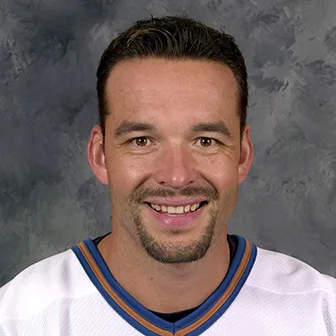
Olie Kolzig was born on April 6, 1970, in Johannesburg, South Africa — a biographical detail that made him one of the more unlikely first-round selections in NHL draft history. Washington drafted the 6'3", 224-pound left-catching goaltender 19th overall in 1989, but his path to becoming the Capitals' franchise netminder was anything but direct.
After playing just two games in the season he was drafted, Kolzig went years between NHL appearances, returning for a single game in 1992-93 before slowly accumulating 7, 14, 18, and then 29 games in subsequent seasons. Over 719 career regular season games, he finished with 303 wins, 297 losses, 24 overtime losses, a 2.71 goals-against average, a .906 save percentage, and 35 shutouts.
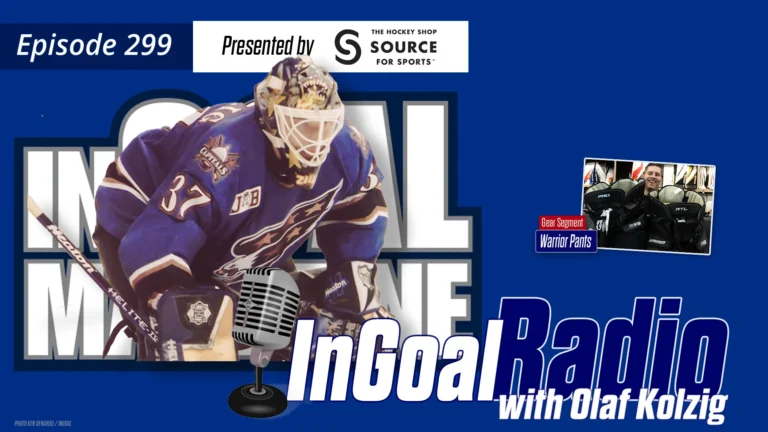
The turning point, as Kolzig has described it, came in 1997 when goaltending coach Dave Prior joined his circle. The two had worked together previously with the German national team. "My career really took off when Dave Prior came in in '97," Kolzig said during Episode 299 of the InGoal Radio Podcast [1]. "David and I had worked together a couple of years prior with the German national team. And we just hit it off. My fiery temper, his laid-back demeanor just kind of offset each other. He helped me channel my emotions in a different direction, because the emotional part of me was really what was kind of getting in the way of taking that next step and becoming a No. 1 guy." From 1997 through 2008, Kolzig averaged 64 games per season for Washington, never playing fewer than 54 games in a season during that stretch.
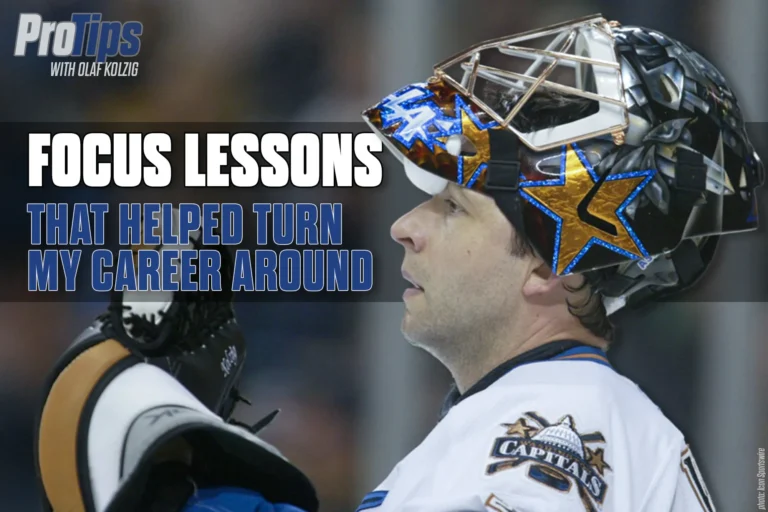
The emotional and mental dimensions of goaltending are central to how Kolzig has reflected on his career. In a detailed piece for InGoal [2], he traced the work he undertook in the minors — specifically in Rochester — to address what he described as a short fuse that would pull him out of games mentally. "God, I had a short fuse," he said. "So if I let in a bad goal or things weren't going my way, I just didn't know how to move on from it. More times than not, they'd come down and within a minute, I'd get scored on again just because I had my mind on something else." His solution, discovered through a mental toughness book he read in Rochester, was a verbal reset cue. "It started in Rochester. I got a book, a mental toughness book, and so I just took it upon myself that year to read and adapt some tools that when I started having negative thoughts, to just verbally tell myself to stop, reset," he said [2]. He credited that season as the best of his pro career up to that point.
The reset technique he developed — literally yelling "Stop" in his head — eventually became internalized. "Over time that kind of just faded away because I didn't need it anymore," he said [2]. He also worked with Prior on redirecting competitive energy during practice, shifting his response to frustrating situations in ways that, in his telling, carried over into games.
Kolzig also spoke to the broader mental challenge facing young goaltenders. "These kids that get drafted, there's a reason why they get drafted," he said. "They have the physical ability, they have the skill set, whatever it is. When guys don't end up having any sort of a pro career, much less an NHL career, it's usually because they haven't figured out the mental side of it." He added: "I wish I would have gotten on top of the mental game a lot sooner. Maybe I would have more games in the NHL, maybe more wins. Who knows?" [2]
InGoal Magazine has covered Olie Kolzig in one podcast appearance and one InGoal article. Following his playing career, Kolzig has worked in player development with the Washington Capitals.
People Are Asking About Olie Kolzig
How old is Olie Kolzig?
Follow the goalies, not the noise
InGoal Magazine covers goaltending at every level — gear, technique, and the goalies behind the numbers. Get our free weekly newsletter — plus 3 free premium reads to start.
Go deeper with InGoal
Members get every Pro Read — NHL goalies breaking down their own saves — plus full gear reviews and the deepest goaltending coverage anywhere.