
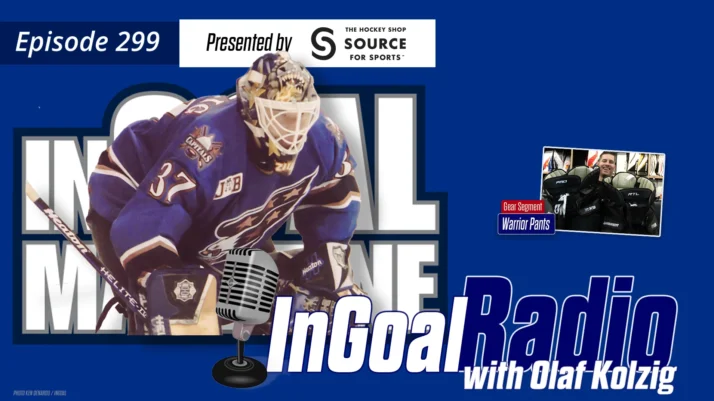
InGoal Radio Episode 299 with Olaf Kolzig

Please subscribe and leave a rating — it helps us reach more goalies!


Olaf Kolzig, who won the 2000 Vezina Trophy with the Washington Capitals, credits a mental breakthrough with helping him overcome consistency struggles earlier in his career. Now in a goalie and player development role with the Capitals, Kolzig emphasizes the importance of off-ice self-care for young goalies. He also revealed that Connor Hellebuyck wears No. 37 in his honor.
- Olaf Kolzig identifies a specific mental breakthrough as the turning point that helped him achieve Vezina Trophy-level consistency after years of struggles.
- Kolzig, now working in goalie and player development with the Washington Capitals, shares actionable advice for young goalies and their parents about off-ice habits.
- Connor Hellebuyck wears No. 37 as a tribute to Kolzig, and the two recently met at an event Hellebuyck organized.
- Cam Talbot explains how to manage a moving or flash screen and credits Vizual Edge vision training with improving his performance in traffic.
- The new Warrior Ritual X5 pants feature a completely redesigned leg shape and are available at two price points.
Episode 299 of the InGoal Radio Podcast, presented by The Hockey Shop Source for Sports, features a fun and informative interview with 17-season NHL veteran Olaf Kolzig.
Feature Interview
presented by NHL Sense Arena
In the feature interview presented by NHL Sense Arena, Kolzig shares stories from a career spent almost exclusively with the Washington Capitals, including the arrival of newly crowned NHL goal scoring leader Alex Ovechkin, winning the 2000 Vezina Trophy and the mental breakthrough that helped him reach those heights after battling consistency earlier in his career. Kolzig also shares insights and advice from his current role with the Capitals in goalie and player development, including several valuable lessons for young goalies and parents, as well as a recent meeting organized by Connor Hellebuyck, who wears No. 37 because of Kolzig.
Parent Segment
presented by Stop It Goaltending U
In the Parent Segment, presented by Stop It Goaltending U the App, we build on Kolzig’s talk about the importance of learning to take care of yourself off the ice with a cooking and nutrition challenge for all young goalies and their parents.
Pro Reads
presented by Vizual EdgeWe also review this week’s Pro Reads, presented by Vizual Edge, which features Cam Talbot of the Detroit Red Wings explaining how to manage a moving (or flash) screen, and how working with the Vizual Edge vision and cognitive training platform has improved his results in traffic.
Weekly Gear Segment
presented by The Hockey Shop Source for SportsAnd in our weekly gear segment, we go to The Hockey Shop Source for Sports to look at the new Warrior Ritual X5 pants, with a completely new leg shape and two price point options.
Episode Transcript
Intro
Speak behind the curtain. I always count down three, two, one, and then rerecord. That way, Hutch, when he puts all the tracks together, has a good starting point. And I got to three this week, earliest I've ever ever been cut off. Usually, I get down to two, maybe one and a half, and Woody's got something to say, and then we talk for another twenty minutes, or Hutch has got something to go to make sure I mention.
This week, three. I didn't even get to two, and Hutch stopped me. It's InGoal Radio, the podcast presented by The Hockey Shop Source for Sports Langley, thehockeyshop.com. What was so important that that you had to interrupt me, Hutch?
Just trying to get us all synced up, get us all on the same page.
Think you wanna talk about the goalie guide.
Oh, the goalie guide. Been flying this week. As many people know, we released a guide to goalie schools and coaches. It's a magazine style flipbook that you can see at ingoalmag.com and a searchable online directory over a 160 goalie schools in there where you can search for whatever program you're looking for, wherever you would like to work with a coach. Maybe you'd like to go on vacation somewhere and throw in a little goaltending.
Great place to go check it out. There is a contest ending pretty much as soon as you're listening to this, the fifteenth late at night. We will shut down entries for a custom mask from CCM, but there'll be another contest following hot on its heels. So stay tuned. Check out the guide.
Check out the directory. You can actually go into the searchable directory and find a school you're interested in and there's a button there for the school that you can click on and send a note to them right from the directory before you forget. Just you've got that question top of mind, send them a note. Hey, My little Johnny has been playing u 11 here. Do you think your camp is a good place for him?
Let him know. Start a conversation. And then when you've done that, send us a note too because we love hearing from you.
Alright. That that was worth interrupting me for. That that that was solid. Hey, Woody.
You know, when I do the three two ones when we're doing our videos forever, I just went three two one and started talking right away and it drove Hutch crazy
still do sometimes. Had to work in the space there.
Yeah. I know. I know. I learned. I learned.
Doesn't sound like
it. Hutch Hutch's calling me out.
It's so good because with Daren's, I can see on the audio waveform where to cut it without even listening. I just know that's where the show starts. Woody, I could tell every time you're gonna say from your waveform too and I just chop some of those out for you.
How about
that one?
Woody, is that is that your, like, process I'm
trying to
I'm trying to peace I'm trying to peace love dope this right now as I'm getting ripped to shreds on the podcast early.
Hey, congratulations. This is 299. InGoal Radio Podcast.
So close to 300, guys. Can you believe the journey's been this long?
Well, speaking of long journeys, we got a great guest this weekend, Olie Kolzig, who played 17 NHL seasons, Vezina trophy winner. And we're gonna hit 300 with another guy who is winding down an exceptional journey next week with Marc-Andre Fleury, our featured guest. So, lots of exciting things as we get to a milestone here in the InGoal Radio Podcast. Good times.
What's the favorite part about the Olie the goalie conversation?
I know what your favorite part's gonna be. It's when I ask too many questions at the end. And as I say, just one more, I I am compared to Dale Hunter at the bar after the game.
I was gonna say
I gave it away?
Woody.
Gee. Delete that, Hutch. You're the boss.
No. No. No. He's gonna
make a long beep.
He he can't help himself. He can't.
Well, you asked me for the best. Okay. I guess I'm not good at teases or three two ones. I'm going back to bed.
But you could have said you could have left it open ended.
Yep. You gotta check out the end.
Rewind. What's the best part, Woody? Pause. Three, two, one. Hutch, cut it here.
No way, Woody. The best part
I'm not
doing it.
You're gonna learn. We're gonna we're we're I love Olie Kolzig. He he had what how would you describe his style?
Sick Gear style.
Sick Gear.
Oh my gosh. Long before most people were doing it. Some of the most detailed masks, the Godzilla on there, the setup on the pads and gloves when that was a rarity in the game. Yeah. Just loved it.
And he was also like, I mean, when we go back to Ken Dryden in terms of big goaltenders, but Mhmm. Sort of the tip of the iceberg on that becoming a league wide trend size and and, you know, goalies were sort of all small or trended towards small. As a matter of fact, we've heard from other goalies who were told they they were too big. And Olie was a guy that played the game big and played the game different as a result. And he talks about that in this week's episode too.
We're in we're in the final week of the National Hockey League season, and I don't know how much influence what you do right now has on the future. But if you're going to say it can carve out a path to change your fortunes, you would point to Jet Greaves, who's been recalled by the Columbus Blue Jackets, and they may be out by the time people are listening to this. But what he was able to do in being recalled in the absence of Elvis has been extraordinary going 3 and ), played four games in five nights with the American Hockey League tacked on, and it it's created a conversation.
It should.
In this tiny little sample of a season, 260 chances against, Jet Greaves is top 10 in the entire National Hockey League and goals saved above expected. His per shot performance relative to environment is not just the top of the NHL this season, And, again, admittedly a tiny sample. But over the course of the three years, all the games he's played in the NHL, and, they're call up here, call up there, often in difficult circumstances. And, obviously, these are gonna juice the numbers because tough defensive environment, but he's outperformed that defensive environment at a level no one in the entire National Hockey League has over those three years. All he does is come up and get results.
We're obviously biased. We are massive fans of Jet Greaves because we got to meet him at a CCM event in Montreal a couple years ago. And anyone who's met him, especially from the goalie side because he is a very passionate, you know, student of the position, is also gonna be a fan of him. He's just a great kid. So, good to see him have the success late in the season opening eyes much like Dustin Wolf that a six footer can have success in the National Hockey League.
And so good for him. Moby keeps it going because he's one of the good ones.
And they they put him right in. He passed over Tarasov.
Yeah. And I don't know where the where where dental's, like, season is at in terms of health. You get this latency. Like, I don't know what the circumstances, so I don't wanna speak too much about it. Tarasov certainly are really encouraging.
Tarasov's a prospect who has so much upside as well and just got cut in a really tough spot because of injuries. He requires waivers. He didn't get enough games in the NHL, but because of his a injuries kept him from getting enough games. And because of his age and time in the league, he requires waivers. The jackets didn't wanna send him to the AHL because they thought he'd get claimed.
And given the pedigree, it's very possible. So they kept him in the NHL, and it's not exactly a development league. It's a tough place to learn. He's been caught in a really bad spot, but I know a lot of smart goalie people that believe he's legit too.
You guys got to meet Jet in Montreal. I wonder who the next Jet will be as you head off to Calgary, for a a great weekend with Hockey Alberta Hutch.
Yeah. Not jetting off though, driving off to Alberta. Heading to Calgary this weekend because Hockey Alberta, the provincial organization governing hockey in Alberta, is, now a partner of InGoal Magazine. So they have a series of development camps. As you heard when their goalie director, Weninger, was a guest on the show not long ago, And this is the first one, the U 15 group.
We are gonna make an appearance there. We're gonna collect a little bit of content from some of the young goaltenders and the and the great WHL coaches who are a part of the camp. We'll be able to deliver some of that to goaltenders across Alberta and to the InGoal audience as well. I think big excitement about this is that they're, trusting InGoal to be part of the development program for their young goalies and their coaches because they've got a well developed coach mentorship program as well. So we're gonna be bringing a lot of goalie education to their goalies and to their coaches and we're, feeling really privileged to be a part of the future of Hockey Alberta.
Little less privileged to be driving to Alberta with Hutch though.
You guys driving together?
It's looking that way. Flights became a little problematic. My schedule's a little weird, so Hutch is gonna have to put up with me. I think he might lock me in the trunk. Imagine twelve to thirteen hours with me.
Why they
It's it's poor Kevin who's in trouble because Maddie's coming too and the two of us team up and we bully poor Kevin worse than we bully him on the show here.
Well, I if I'm in the trunk, I'm assuming Maddie's getting strapped to the roof. So listen, the last time I drove to Calgary was for game seven of the 1994 Stanley Cup playoffs first round on a whim. Five guys packed into a Volkswagen GTI. Might have been a cooler full of, beverages in the back of that GTI. Overnight drive, game seven, double overtime, Pavel Bure, I'm Mike Vernon, I'm Mike Vernon.
Epic road trip. I'm not sure you guys are gonna be able to live up to that, but we might we might have to ride a mechanical bull on Friday night. So if anybody's at Calgary, hit us up. Let us know where we should go.
Hutch, do you drive? Yes. Okay. Who's who's in the shotgun seat and who's in the back seat?
Oh, I'm I'm the guest in the back seat.
Yeah. Oh, I Matt Maddie will get the front seat. But I tell you this much, Maddie ain't driving, not with me in the passenger seat.
Well,
I've been in an off road vehicle with that kid before, and he scares a living.
K. I want I want I want some content from that trip.
Oh, great.
Oh, we're Little GoPro in the dash. The whole thing?
Just a little GoPro in the dash. Just give me give me a little conversation.
Minutes. We'll FaceTime you for episode of the odd couple?
Yeah. Be fun.
Hey. Listen, Daren. I I did wanna just pull back a little bit on the late season call ups because Jet's a great story, But we had one here the last night, Nikita Tolopilo, getting his first NHL start and his first NHL win. A guy who two years ago was in the Allsvenskan, a Swedish second division. I had a hell of a year in the Allsvenskan, but his path up till that point, like, was on no radars anywhere until he got that opportunity.
One year in the American Hockey League, late season call up, gets his first win, big six foot six goalie. I've watched him develop, with the Canucks over the last two years and watched his game tighten up and come together. And so moments like that, it reminds me, we focus on only the success stories too or the guys that get stretches and and, like, Jets an incredible story. But I'm reminded a little bit of Stuart Skinner. His first call up was much like that.
It was late in the season. It was one game. If I I can't remember the team they're playing. It might have been Ottawa, and they won the game. He got his first NHL win.
It was a night where the Oilers ported on and scored a bunch for him. But him telling me the following year as he had as he gained some traction in the NHL for the first time, how important that late season one game call up was. Because he got off the ice. Goalie coach Dustin Schwartz came up and they celebrated the win. First first start, first win in the National Hockey League.
It's a big deal. But immediately looked at each other and said there's work to do. And so some of these sort of appearances late in the year that we can quickly gloss over or look over and and not Tolopilo because, you know, he talked about how far he's come from from from his home in in in Belarussia and, you know, this path and this journey and his parents. And it was, you know, it was it was really neat to see him have that moment. But these can also serve as springboards for these young goalies, even when they have success, even when they have a win.
Something's different, something that never really clicked with them that needs to change in their game that they take into the off season and come back that much better. I remember Skinner that year went straight to the American Hockey League, and he'd been really flat in his development, and it hadn't and just boom, took off like a rocket. So sometimes these sometimes these late season opportunities for NHL goalies, young NHL goalies, not just a chance to build traction like Jet is, but even the one offs can be a real springboard, to what's to come.
Well, it's it's a carrot. It shows you that you can make it to that league. Now you wanna be there all the time. Whether you win or you lose, there's different motivating factors out of both of those results. But just getting there inspires you to work that much harder in the off season to get back there full time.
Especially if you get there on the road. Never hungry, league. It's a it's a different lifestyle when you're traveling in the NHL. The five five I know what five stars are. Five diamonds are a different deal and they live I've had a few guys tell me that, yes, I wanted to be here.
It's a dream and everything. But after I got to travel, I really wanted to be here.
Favorite thing on our charters whenever I've been able to travel, the peanut butter and jelly sandwiches.
Oh my goodness. Come on.
Oh, yeah. How grassroots have
you, They're they're the best. I grabbed one on the way onto the plane and I grabbed one on the way off the plane.
That's very that's very Canadian prairies of you.
Thank you.
I love it.
I appreciate that. That that's that's a hug.
It's a compliment. 100%.
Gear
Love it. The InGoal Radio Podcast Gear Segment brought to you by The Hockey Shop Source for Sports Langley, thehockeyshop.com. Things happening over there. Got the latest email the other day regarding some sales that are happening, which I check out. And then when I don't find what I'm looking for in the sales section, I go over just the the main.
And then it's like, My my latest and thing I don't need anything right now, but my latest thing, you guys will laugh at this, is is upper body. I'm for some reason, I'm going down a a track of upper body gear, and I don't even need anything. I just like checking it out.
Well, there is plenty to check out at the hockey shop and the hockeyshop.com right now, including today's gear segment's gonna be the war the new Warrior Ritual X5, RX5 pants, but there's also the chest protector online, and we'll have that review next week. We'll do both separately. But a reminder folks to sort of go back to last week's Gear Segment, Bauer, Pro Returns. They're all online now. The sticks, your chance to try out a trigger grip if you don't wanna do a custom order, you just wanna try it once.
There's they've got lots of models with trigger grips on there. Pads, gloves, blockers, Vasilevskiy, Linus Ullmark. There is so much cool Pro Return Bauer gear. It's selling fast, but there's still inventory. Make sure you check it out at the hockeyshop.com as well as all the new equipment and sales.
And we know this every time something new comes in previous generations, they got to make room for the new stuff on the wall in the back rooms. And that means as Daren mentioned, lots of great sales on as well. Your chance to get the previous generation models at a steep discount. So make sure to check it out in person at the Hockey Shop Source for Sports Langley and the hockeyshop.com.
Got a cool story for you that I was goofing around with in the garage. After we get to today's Gear Segment, dealing with the Warrior pants, you wanna set this one up before you head off to Cam?
I would say that this is a departure. As much as quite often there are tweaks from one line to the next, This is a significant departure for Warrior on the pants side compared to previous generations. And because Cam is the expert on all things Warrior, I think we defer to him as he explains how. Welcome back to The Hockey Shop Source for Sports where it is my favorite type of day, dress up day.
I was gonna say standing room only in here, but that's okay.
We get to be chummy, buddy. Chummy. Nice and tight. I love playing dress up. I love coming in here, trying on all the gear, and then leaving it on the floor for Cam to clean up after Kinda reminds me of when I was a kid.
[crosstalk] But now What do you got there? What do wear?
Why don't you clean up what exactly I'm wearing? This is the Warrior RX5. This is the RTL, so I learned we learned this in the chest protector video. RTL is the high end. I'm guessing you've got
the second price point because it says pro. Yes.
Don't ask me why the pro line
is the second price point. A lot
of companies do it. It drives me nuts, but here we are. Yes. What is new? Because, Cam, I like the fit.
Not sure if these pants make my butt look big, but they feel nice. Yes. But there's some differences from the old Warrior pants. I'm like
call it, like, a call redesign. Completely different. Yes.
What's the first thing we noticed?
Well, let's start with the waist and then move our way down. Okay. So segmentation, not the waist. We pull out an older RX four pant. We would see that this is one solid piece of plastic along the side.
Used to cause a lot of folding to the pant and make it sit a little bit weird. This segmentation, a, will help it bring it tighter around the waist if you wish.
I see. If you wish is key, we don't all want our pants to fit tight.
Exactly. Or
not all like you in your skinny jeans.
You want it to flop out a little bit or to be able to tuck in your chest. Once again, you have that ability to. So they've made that a lot easier with the overall fit of the pant, but they've kind of kept some of their hallmarks. Warrior's internal belt system returns the exact same as what we saw before. It is also removable as well if you wish to take it out.
So in terms of overall fitment wise, again, we still have a very, very similar style of fit that we've had in the years past. However, just a better overall improved fit around the waist because of that segmentation. So moving down. Lace returns. Be able to, again, lace your chest in.
So that front lace is kind of hidden right behind there, what we call neoprene elastic kind of crotch area, for lack of a better term.
Neoprene crotch.
Neoprene crotch. Got it. To be able to fit that bigger, especially a Warrior Jockey in particular that does have that big plate in front of it, it definitely has that extra space to be able to accommodate for something of that size.
I am not wearing a Joc under this, and yet there is still a bunch of space to accommodate something of that size.
So we will leave the cup check out for now. Thank you, Cam. You're welcome.
K. Use that to tie down.
Moving down. What is something you noticed?
This is the one that jumped out to me, and I'm gonna be honest with you. I was a little biased. I like the old way, but I understand that I do like this. We we listen. Before we go to this, you did make the joke about, you know, the the neoprene. Yes.
But, like, when you have extra laces, don't you hate it when it just sorta ends up but you can actually just, like, tuck the extra lacing into that little pouch. I know it's, like, it's this tiny little thing. Nobody's buying these pants because of it, but I gotta be honest. Like, that speaks to me. Kevin's new favorite feature.
Being able to tuck the lace in and make it go away. Right? I'm a
little OCD.
I don't like laces everywhere. Genuinely excited.
This is tighter look. I'm excited now, and it over it actually almost overshadows the fact that as Cam was about to tell us
The thighs.
The thighs are now rounded.
Yes. Typically, in years past, we've seen that flat thigh. I think we measured it out to be about 14 inches wide at one point.
And it was fixed inner edge. So as soon as you close the legs, it basically built a wall. I kinda liked it. It was cheating central, but I kinda liked it. We've gone to a bit of more rounded look, but you still get that seal
Yes.
When you close the legs. It's still nice and tight.
More traditional rounded shape. Again, a little bit more ergonomical to bring those legs together now. Right. So a little bit easier in that sense. However, we haven't lost the thickness, which is important in terms of protection.
A 100%. And I'm holding the pro and it's quite substantial. Obviously, when we go into the RTL, you're gonna get their Hyper Comp material as well. So again, we're gonna help to aid in that protection level. That would be your big upgrade difference.
You also see some of the finishing differences between the two. If we're looking at the thigh specifically, that leather cap rounding.
Little high higher wear material.
Exactly. However, that
said, it's a really like, as we do this, it's like, this is out of the box, you know, and I'm like
He's getting his leg up going today. Very flexible. And that's always been a Warrior staple and a hallmark, especially with their plates. So if he's done moving around, last little too much coffee this morning. I'd like to call out is the redesign of the hip pads as well.
So they've changed the way that they've segmented their hip pads in particular. Before, there used to be some free floating pieces and whatnot. Now they flex very well as Kevin was just showing off. Easy for, yep, lunges. I mean, hopefully, you're doing, you know, butterflies and not jumping jacks while you're in the net, but that's fine.
Whatever you need to do to keep the puck out of the net.
Right? That was a lunge cam. That wasn't a jumping jack.
You were close to doing a jumping jack.
I came out of the lunge into a jumping jack. I'll give you that.
But One quick last little call out again to correspond with the Warrior knee pads themselves. We still have a lace in tab on the inside of the thigh so you can lace in your knee pads to your pants if you wish.
Comfy, mobile, okay so they don't have the flat front but as Cam said a more traditional fit and feel without losing a lot of the tech developments that Warrior was noted for. I do like The new waist? The segmented waist and the ability tuck on tuck. We saw the Warrior chest protector last week. This feels like it'd be a really nice complimentary piece.
Exactly. So if you wanna know more, give me a call. (604) 589-8299 or 1-800-567-7790 or check it out at the hockeyshop.com.
I love getting your evaluation. And if if you can give me your first blush thoughts about those pants and then now that you've had a chance to think about them a little bit.
Well, my first blush thoughts were and we talked about it in the video. Like, I wore for the longest time and really liked Warrior's cheater pant. There's no other way to to call it. Like, it they fixed the front of the face, which was square across, like it just formed a wall. And the inside edge, it was a fixed corner.
So when you squeeze those legs together, it just formed this, like, giant straight wall. So every rebound off them popped out front. No pucks went through. These pants obviously are rounded barrel thigh protectors, more traditional. I'm not sure whether they're NHL legal or not, but they certainly look like like they might be.
And so you take all the things that Warrior's done, the way they've segment their pants, the way they Warrior's pants have always been out of the box, like, broken in. You don't need because of the way they construct them, it's just on the ice and go. You know, it's pants tend to be a little stiff for a couple skates. It's never been a problem, but they also had that flat front. That's gone.
There's a little bit of a shock for me to see the difference. And there might be guys who still use the old ones that are going to the hockey shop right now and looking for the sale item on on the x four generation so that they can stock up. It's like when it's like when the PGA Tour or or or the, you know, the RNA or whoever governs golf equipment rules changed the grooves on wedges. I immediately went to Golf Town and bought a bunch of wedges with the old illegal grooves so I could have more spin. So I'd have a couple generations worth.
There might be some guys that are looking at this going, I want that big flat front. But I do like the way that fits with the barrel, and I understand the trend going towards something that's a little more traditional looking and traditional feel by Warrior. But, yeah, I wouldn't be surprised if there's some beer leaguers out that are like, I need to stock up on those old ones with the big flat face.
I'm not sure you're really allowed to go down this path or whether it's considered to be proper. But Woody, what size of pants do you wear?
I wear the biggest pants that I possibly can, It's it's usually a large. I have worn XL in the past because, again, like, belts.
Inner belts
aren't legal in the NHL. But can they not CCMs?
A little clunky at the at the bottom?
It's length for sure. Yeah. But that's the thing. Like, like, Warriors two, the way they segmented them where the the front sort of just slid over. You know what I mean?
Like, it didn't bunch up. The panel sort of, like, moved over top of each other rather than catching. And so having it a little extra extra size in the Warrior ones, I didn't find bothering me. But you're right. The biggest thing is length and starting to get interference with the pads when you drop into the butterfly.
That can certainly be an issue and something you have to keep in mind. But, you know, I mean, let's be honest, if you're not cheating, you're not trying at my age. So anything that adds a little bulk and a little size, I'm all over.
Do you know what size Matthew wears? Hutch? No. I actually don't.
I I assume they're as big as you can get at his size, but I'm actually not sure.
XL length, medium waist, skinny little bugger.
Yeah. No kidding. Hey. It's it's funny last week you were I think it was last week you were teasing me about having used the Roberto Luongo pads because I just had to. And way back in year one of InGoal, Warrior sent us some ProReturn Pekka Rinne pants, and I wore those for the longest time as well.
And I'm not quite Pekka size either. But there was just something about walking into that beer league dressing room with the Nashville logo on the pants and Renee stitched into them that just made me feel extra super cool.
That's funny. On the subject of that, you just tweaked my brain. There's stick and puck at City National Arena and my desk, my cubicle is about three rows, three desks away from the window that overlooks the rink and every now and then you'll have hear pucks going off. So I I was out there maybe a month ago looking down at the stick and puck, and there was a guy, maybe 35, full Calgary Flames gear, practice sweater, pants, gloves, helmet, everything. And he was pretty good.
And we were trying to figure out who he was. So we went down and tried to see the register, but he hadn't signed in properly. And so I still don't know who this guy is, But he had pro shot. He had everything, and he had all the gear except he took his his hockey bag out to the bench with him. And I don't know whether he was taking his skates off and jumping in his car in his gear.
Like, there was a couple of things that didn't fit, but then there was a whole bunch that did. So it's funny you see guys with the logo and stuff and you go, that that guy play?
I don't know. Maybe if he's in the show and he's got an NHL shot, it might have just been the Rolex he didn't wanna leave in the bag in the room.
True. But then then he was at stick And Puck, and he was there a few times. So what
You gotta you started the show
up at stick And Puck.
Was so confused.
Down, Daren? No. No. Was so impressed.
Started sleuthing, but now you need to continue. Like, finish the job, Daren.
It was a three person sleuth job. Finished the job. And and and if you pay by your credit card, they've got your name. So we checked that. He didn't pay by credit card.
It's pretty easy to just say, hi, I'm Daren Millard.
The people that that had signed up, I was I I ran all their names through Hockey DB because you don't know which which person's which out there.
That's good.
Yeah. I still don't know who who this guy is, but I'm I'm very curious. And he was warming up a couple of goalies out there, and he was just ripping shots when when those guys weren't in. It was it was tons tons of fun to watch and gave us a bit of a project to do. So those are the Warrior of Pants that we got to dissect and and break down.
I'm I'm with you on wearing as big as you can. I just worry about the clunkiness at the bottom. So thanks for kindly telling me what size you wear.
Full disclosure, there is nothing about me playing goal that isn't clunky, so might as well have the biggest gear while I'm doing so.
And it's not the cheater pants. I call them the advantage pants. I feel
I I feel like that's I feel like that's something I might have to wear when I get into my sixties and have bladder problems.
Parent Playbook
Those are the clean pants. Stop It Goaltending U, the app parent segment with David Hutchison coming up before we hear from Stop It Goal Tending U.
Yeah. We talk a lot about all the new content every week at Stop It Goaltending U. Daily primers this week with Brian Daccord on becoming an ethical goalie. So really interesting five part series and a reminder that every week with the Stop It Goaltending U app, you get five one minute primers every day. Just a quick sorta watch the video in one minute, take it with you, keep yourself sort of constantly learning, little mindset tips, little tricks that Brian's learned and Brian and his staff have learned over the years.
We've also got a video breaking down the frozen four goalies from the NCAA championship over the last weekend and a drill of the week one v one rushes with a cut into the middle. So they walk you through a drill diagram. They've got examples from the NHL of those types of scoring chances and provide a few tips. That's a great one for coaches and goalies alike. You can take it onto the ice this summer.
The Stop It Goaltending U app brings you twenty five years of Stop It's goaltending experience into a nice, easy to digest format. Like I said, you wanna spend one minute each day on the primers, you do that. You wanna deep dive a little bit and watch other goalies and break down how they play, see how it can apply to your game. You can do that with a weekly video, and they've had drills, fresh drills each of the last two weeks. So more of those coming on the Stop It Goaltending U app.
And as I tell you every week, not only do you get all that great content on their app, you get access and an InGoal premium membership. So the best of theirs, the best of ours combined from one monthly fee included in your Stop It Goaltending U membership, a membership to InGoal Magazine premium. The best of both worlds for goaltenders. Hutch.
That's another thing that I look for in the in the audio track of the broadcast. I see Daren's three, two, one, and I know it's time to start the parent segment when I look at it because I see that one little peek. Hutch. I could jump in before it, but now I sit and wait for it because it makes me just feel special, Daren. You wanted us to start a vlog of our trip across Western Canada to Calgary and now maybe we need to start a show in the kitchen because of today's parent segment.
We've talked before about helping your young goalie develop independence, not just to grow as an athlete, but to thrive in life. This week, I wanted to be just a little bit more specific, once again by listening to our featured guest. As you will hear and, many of our past guests have shared, the jump from junior to pro is a huge one. And one of the biggest adjustments is simply having to look after yourself. There's no more billets.
There's no more parents. There's no dorm cafeterias to help you out. Now it's time for shopping, paying bills, cooking, often for the first time for a lot of these guys. But the truth is learning these skills even earlier can pay off. So this week, parents, I have some homework for you.
Teach your child to cook something. Of course, keep it age appropriate. I'm not suggesting your seven year old goalie go fire up the barbecue or play unsupervised in the kitchen, but do make sure that little Johnny or Susie is one step closer to being able to take care of themselves. Maybe they'll end up with a billet family that only cooks dinner for them and they'll have to make their own breakfast and lunch. That happens a lot.
Maybe mom and dad are having to race home from work to get to the evening practice and if they can look after themselves a little bit better in the kitchen, they'll be able to eat healthy and prepare themselves for hockey and not just the quick convenience meals that a lot of us are forced to use. It's easier and often faster, of course, just to do it for our kids and we all do that. But take this week please just to, pass on one skill. Teach your goalie to cook a hot breakfast, scrambled eggs, oatmeal, something nice and easy instead of just toast and cereal this time. Show them how to make a smoothie maybe with some fruit, yogurt, maybe a scoop of protein powder.
For the older kids, maybe teach them how to make their favorite pregame meal. Something that one day they're gonna have to make on their own before they head to the rink. I think we had we need to face it, guys. Whether your goalie is away from home or just managing a busy schedule at home, getting the right fuel is really important and it's not always easy. So just like you give them the tools to succeed on the ice, this week I wanna see you all give them the tools to succeed off the ice as well.
It's a pretty rewarding feeling to get the message from your child to say they've just stopped at the grocery store, grabbed what they needed, and cooked their own healthy meal before heading to the rink. So what's on the menu this week for you and your goalie? Let me know. parents@ingoalmag.com.
You remember the first meal you learned how to make? Like, where you felt like a grown up?
No. And that's probably why I still don't cook.
You I feel like it's I feel like it's probably scrambled eggs as a youngster.
That's a good one. Mine was grilled cheese. Oh. Just just the idea of of putting something on there and cooking it and flipping it over and and being able to actually eat it. And I know I realize it's not a meal, like like, it's not like cooking a steak, but when you're 14 or 15, that was a heck of an accomplishment.
Well, and it's so easy to screw those up because you can't see them burning on the bottom.
Yes. Yeah.
Listen. I I feel like everybody had that, like, probably a lot of people, it's like pancakes were a big one. Right? Yeah. Like, mixing the batter, you know, whether it was a dad or with a grandpa or mom or I feel like pancakes.
I I probably the only thing I make, which probably, again, speaks to the fact that I can't cook.
First meal you ever made, send it into us. Alright. I'm I'm curious. Or the first grown up meal. Grown up.
You feel it.
Pancakes are grown up.
I don't Kraft dinner, don't put in Kraft dinner. That doesn't count. I
That's not what we mean by a
healthy meal. Screwed up Kraft dinner the first time. So I'm embarrassed to tell you that.
I screwed it up for a giant group. We had about 15 or 20 people on a camping trip and I was left to make the Kraft dinner. Oh. And I read boil it for eight minutes. So I put it all in the water and then I let the water boil and then I left it for eight minutes.
So it had been in there for probably twenty and it was just the worst mush ever. Now I never use the clock I always taste.
First meal that you remember making. Hutch, where do the people send that to you?
parents@ingoalmag.com.
And we love hearing from all of you. If the most random notes, if if it's on your mind, send it to us because we read it all and we share it with each other. And some of it, Hutch won't remember. What does that have to do with anything? And then we we talk it over and go, oh, yeah.
There was the reference there in Episode 274 that we're discussing this, that, and other.
A lot of it revolves around Woody's various adventures.
I am an adventure.
You you are an adventure. A Vizual Edge ProReads. We've got Cam Talbot this week as we continue to benefit from the expertise of Visual Edge.
Yeah. And a perfect combination this week with the ProReads because it's a flash screen or a moving screen. And Cam's been so good in this format. It's been nice to have him back in. We did we did some of these with him when he was with the Minnesota Wild three, four years ago, and had a chance to sit down with him recently as part
of our partnership with Vizual Edge. And this one brings both of those worlds together. We've talked about Vizual Edge as a vision and cognitive training tool. Use your computer and their glasses and their program to help find and see pucks better. You take their visual edge test, you get a score, it breaks it down into multiple different components of sports vision, and then develops a program again on the computer.
Simple. You can use it fifteen minutes a day or go longer that will help you see pucks end the play better. And this flash screen, as Cam tells us, is a great example of one of the skills he believes has improved significantly in the three plus years since he switched to Vizual Edge. He doesn't think it's a coincidence that all of his NHL all star game appearances are since making that switch. And so having those bodies move through and finding a puck on the other side of a flash screen or a moving screen, one of the most difficult to manage in the NHL today is something that he believes his training with Vizual Edge has improved.
Now, of course, there are other elements, and ProReads is all about sharing how goalies make decisions on the ice and why. And Cam explains them all in this week's ProReads. When to shift from short side to middle, what factors determine that, and the importance because this flash screen comes off a rush initially into the zone that gets turns into more of a settled play in zone opportunity, but we watch as Cam explains how he manages the rush and how his depth decisions allow him to set himself up early to manage this flash screen. It's all in our latest ProReads presented by Vizual Edge. Course, you can find that at ingoalmag.com.
And one of what? We've got close to 300 of them now, Hutch, almost 40 different goaltenders walking you through saves every week, doing video breakdowns to help goalies of all ages and skill levels think the game differently, think the game better. It's a perfect combination with Vizual Edge because they'll help you see the game and see the puck better.
I tell skaters all the time that the flash screen is more effective than a static screen. You you you may feel like you're getting more accomplished standing right in front of the goaltender, but being able to work on the moving screen or flash screen and timing it right and having a a bit of chemistry built in with the shooter, it's really effective. And it does take timing with the shooter to be able to read off you and you read off them that that makes it more difficult than a static screen.
Yeah. It's a little tougher too sometimes for the guy standing in front of that. It's funny. I had this discussion recently with Brock Boeser because before the Canucks traded JT Miller, those two on the power play were deadly last year. Brock actually was top four in the league, 17 goals scored directly as a result of his screens.
And a lot of that interplay, like, he would move into the short side to force the goalie into the middle. And it's funny because this is part of this week's it's like, hey. If the guy's moving into the short side lane, I can go to the middle because I know his his shooter's not gonna shoot at him because he's now in that space or it's less likely to get through. But they got to the point where it's like, okay. I'm shifting into the short side.
As soon as the goalie shifts into the middle, shoot to the short side, I'll get out of the way. And, there's a little hazard pay involved there because JT broke his hand with one of those shots when it when the release was before he got out of the way. So, reality of going to the net, but, man, the interplay at the NHL level, I think it is one of the most difficult things for young goalies to sort of adjust to and learn how to manage. And as Cam does in this week, there are strategies here. As much as sometimes it's just find the puck, there are cues and ways to help you find it more effectively, more efficiently, and more often, and that's why we love things like ProReads breaking it down for us.
Max Pacioretty and Mark Stone had it dialed in when they played together in Vegas, and Mark Stone with Jack Eichel have developed the same type of chemistry. And we've got shots like Pacioretty and Eichel coming at you, adding a flash screen. Wow.
But I I think You're lucky to stop those ones and you could see them.
Well, exactly. And and I think some of that goes to just Stone's awareness on the ice. He's he has instincts that are top five in in the National Hockey League being able to read plays. That's why he's such a good player with the with the with the takeaways. But the the flash screens are are difficult.
Even the static screens. I don't know how people see around because I get stuck right behind the person and I don't move. I don't cheat far enough, and then I just throw up my hands and go, ah, I have a screen. Even in my age appropriate league, I I get stuck there. And I
And it's not usually one person screening you. Like, not only I mean, obviously, in the National Hockey League, you get these crazy multilayered screens, but you gotta fight your own defenseman in most of
those cases too. That is it.
Yeah. One of the best drills that I it's probably my favorite drill I learned at Eli Wilson's camp where it's it's simply having a goalie look to one side of a screen and shooting to the other. And when kids get in there the first time, they find it next to impossible because when a major junior player releases a shot from the hash marks and you've got to get to
the other side of the screen to go get it, it's incredibly difficult. I love that drill not because of the screen factor, but because it teaches patience. Because the only way that you can actually make that save is not leave until you see the release. It's gotta go from being a guess to being a patience thing. I've worked with a lot of goalies using that drill to improve their patience in the game, not just their work on screens and find it it's fantastic.
One of the tips that I've gotten over the years from some goalies is sort of where to look over the screen. If it is a stationary static screen, Daren, like making sure you look not over the shoulder beside that player's head if you're tall enough to see around it, but actually look at the edge of the shoulder. So have your head lined up to the screening forwards, like right on the seam of the shoulder rather than over his shoulder. Because then when you drop, you should in theory be able to maintain a sight line down the side of his arm versus dropping in behind him. Right?
Because you're on the edge of his frame rather than in the middle of his frame. So where you set up relative to his head, if you're looking over his shoulder, the edge of his shoulder rather than over his shoulder can help you see the puck longer when you inevitably have to start moving or going down. The other one, we had a great ProReads, not to throw it back to ProReads for all this, but we had a great one with Joseph Wall just about a month ago, in our ProReads section where he talked about sort of separating the upper and the lower body when managing screens. And so trying to maintain stable base and then look around with the upper body without moving too much and staying square in his feet and in his base as he used his upper body to sort of look around and over. Now how it helps when you're taller like those guys, but, you know, I think those are just two examples of some of the advice that you'll find at ingoalmag.com in our premium subscription, especially in those ProReads.
There are so many different aspects that go into this. But we have like an eleven minute video with Matt Murray on how to manage screens. It's one of the it's one of the best ones we've done. He's a real thinker of the game. And so there is no one simple solution, but there's all these different elements that go into it.
And I think we've covered a lot of them over the years over at InGoal Mag and InGoal Premium.
I I remember that Matt Murray video. I gotta go back and use that as a refresher. I do believe, just like if a player totally fans on a shot and you think it's going high glove and it beats you along the ice, you should be able to appeal that and and have it taken off the board in men's league. Same with with tips. If a guy goes to tip a puck and you play the tip and he misses the puck completely and it beats you, you should be able to feel that.
Like, he failed. That shouldn't count.
Well, hey. I mean, I'm all for as many appeals as we can.
Take it off your statline at least. Woody would do that, I'm sure.
We talk about the difficulty. Let me just give you guys and give our audience a little number here. Quite often screens force you as Hutch said. You the idea is to see the release so you can actually make a reactive save on the other side if you're moving across the screen. But the reality is quite often what it reduces us to is shifting into a space and maybe not being able to see it clean the whole way.
So you're just trying to get your body behind a space. So quite often you end up sort of shifting or sliding or you end up moving into that space on your knees. Now, obviously, if you can see the release, hopefully you get a glove on and all those elements, but quite often goalies end up shifting, which is why on a layered screen, if there's more than one person between you and the shooter in the National Hockey League, if that shooter hits the top corner on either side, it goes in over 40% of the time over the past two years in the NHL. That is a higher percentage scoring chance if you can hit a top corner than a breakaway. So there's a little food for thought when we talk about how difficult screens are and how hard it is to manage these for goaltenders at the National Hockey League level.
And every goalie coach and every goalie I talk to say it's one of the hardest parts of the game right now at the highest level, the numbers back it up.
Save or not, we made progress with the goalie dictionary. Thanks to Hutch with the flash screen.
Well, we did. We did. I was having a little bit of fun with this week's ProRead and I had Daren in the back of my mind when the term flash screen came out. Daren is a big proponent of us creating the goalie dictionary. I'm sure we still will do that.
So if you go check out this week's ProRead, we just overlaid a dictionary like definition of the flash screen because we know not everybody's as familiar. We're gonna have some goalies who this is a completely familiar term. It's something they understand inside and out, but, I know we've got a lot of goalie parents listening to the show as well, watching the ProReads so they can learn to help their young goaltender. And so we want to we want it to be accessible to everybody.
Wonder how many words or terms we'd need to be able to put out a book on Amazon. Goalie lingo. Oh, sorry.
You've already told all the shooters how to score. Now we're gonna tell everybody else how to get something on Amazon.
Well, Woody edited out half the first block, so you can take that out. I literally was
thinking of that on a dog walk last night, Daren.
You guys can punish me when we punish me when we publish the dictionary. When we get to the word sieve, you can just put a picture of Woody.
K. That's actually a really good idea.
Yeah. Warm up stick. All of it. It's it's it's all gonna be there.
Oh, warm up stick. I need my picture in that one.
I remember somebody telling me as a child you're about as useful as a screen door in a submarine.
That's pretty good.
Speaking of seives.
That's really good. Might use that too. Episode 299. This is the first time Olaf Kolzig has been with us. Is it not?
It is. And that was yeah. We lead with that kinda surprise that we haven't connected over the years. He was, as you guys mentioned, the gear style. He when I first got into this as as a writer and as a goal learning the goal setting position, he was sort of at his prime.
Right? Like, my first year in the league covering the NHL was 2000, and he was the Vezina trophy winner. So deep regrets that we didn't do this sooner, but, man, it was a great, great interview. I think everybody's gonna enjoy this one.
Feature Interview - Olaf Kolzig
The feature interview brought to you by NHL Sense Arena.
NHL Sense Arena. It's one of the best tools available for training your game away from the rink as we all know. In fact, it lets you work on skills that you can't often work on on the ice. It's not just a replacement for on ice training. In many cases, it's even better.
So obviously that includes things like the neurocognitive drills. It's even got baseline concussion testing built into it, but it also gives you other options that you can't really do in practice on the ice so well. Would you like to face a shooter who hits the exact same spot every time? Pretty hard to get that on the ice. NHL Sense Arena can give that to you.
Would you like to know exactly what your reaction time and puck tracking are doing? NHL Sense Arena gives you data that you'll never get on the ice. And as we were talking about earlier, guys, would you like to train against screenshots? That is tough to do in practice. As Woody just said, few players want to stand there and, risk themselves in practice even though screens are one of the biggest challenges goalies face at the higher levels of the game.
But you can get all the screen training you would like in NHL Sense Arena. And the best part, the rink is always open. You don't have to wait for practice. You don't have to spend on expensive private ice time. You just get quality targeted goalie training anytime, anywhere, maybe even on the road to Calgary this weekend.
Train as often as you want in season or out with NHL Sense Arena. Visit sensearena.com, and, of course, use the code IGM 50 to save even more.
Olie Kolzig with us on InGoal Radio, the podcast, the NHL Sense Arena feature interview. Enjoy.
Really excited to welcome to InGoal Radio Podcast. First time guest, long overdue. Olie Kolzig, long time of the Washington Capitals. I can't believe it's been this long since we and we've been doing this podcast for about five, six years. And when I realized I hadn't had you on, it was it felt like a major omission.
How are you? First off, how are things?
I'm I'm I'm good. You know? And I've been retired thirteen year or, god, fifteen years, sixteen years almost. It's easy to kind of forget people when they're not in the league anymore. No, I'm doing good.
Like I said, things are pretty good in cap land right now. And happy to see only finally get the record so that we can just focus on on getting some good momentum going into the playoffs.
Well, it was a tweet of his that reminded us we hadn't had you on. But I first wanna, like, update people on your role with the Capitals because you're still involved on the development side, particular to goaltending. Maybe just let people know how that sort of looks for you. Maybe not so much on a day to day, but overall.
Yeah. So I'm part of the player development department. Up until about five years ago, it was myself and Steve Richmond, and I looked after basically all our prospects. And and and not so much from a skill development standpoint, but teaching these kids how to be pros, you know, when they leave junior hockey, college hockey, and and come over from Europe. It's a big adjustment.
And so my role is to kinda help these kids along and and, you know, help them develop timetable off the off the ice so that they can become consistent on the ice, whether it's taking care of their bills and their rent and, you know, insurance, all the little stuff that these kids never dealt with when they were billeted at home. Teaching them how to do laundry, some of them. You know, we've had our nutritionists help these kids in grocery shopping because, again, they've had billets or or their parents do most of the grocery shopping for them. So that wasn't their role initially. And then as the years went on, we hired Brooks, a terrific player and an all world pro, and there's probably not a better guy that can help these kids along.
And then Jim Slater, formerly of the Atlanta Thrashers, Winnipeg Jets, another all world pro. So we've got a really, really good group. And, so now I just I've kinda tailed back more to just the goaltending and, and our junior prospects when they get drafted. You know, the three of us kind of travel all over and and establish relationships with these guys so that when they turn pro, we've already, you know, got a relationship, and then we can move forward in in helping them develop. So it's, it's a really good group, and I'm having a lot of fun doing it.
Such a crucial role too. I can't I mean, the hundreds of interviews we've done over the years, so many guys have told us, you know, maybe they'll get to the NHL, and they'll talk about that jump out of college or junior to pro as being a much bigger step than eventually going from the AHL to the NHL. And a lot of it is learning that we hear that all the time, learning how to be a pro. As the landscape shifts and so many young prospects end up starting in the ECHL, how important is it to have that connection and have somebody they can go to with questions no matter what league they're in?
Well, so I'm I'm sort of unique in that I can cover any question that a guy has. I was a first round draft pick. I made the NHL my first year. Got sent back to junior. I spent two years in the East Coast League, spent four years in total in the American league, became a backup in the NHL for a number of years, became a starter, became a star.
Then I had to settle back down into kind of a mentor role for my last year or two and then, retired. So when I talk to these young guys, and there's not a question I can't answer. You know? And I'm a big advocate of the East Coast Hockey League. I I think, it got a bad rap back in the day.
Our organization probably utilizes the East Coast League more than more than most, in the NHL, and And we have a great track record. You see all the goalies that have come through there. So for us, it's a really easy sell when we get our prospects and we tell them, listen, we have a plan for you. It's not a punishment. This is where you're going to go.
And then we we tell them about all the guys that have gone through and have done done the same thing. And then especially when we say Carey Price or Braden Holtby and then Philipp Grubauer, then all of a sudden their eyes light up and go, really? They were down here? And look, you know, the careers that they've had. So it it's vital to have somebody we like to look at ourselves as big brothers.
We're not managed. We try not to be management. We're not coaches, and we we try to establish a level of trust with these players so that when something comes up and they don't necessarily feel comfortable, go to the coach or go to the GM, maybe even to their agent sometimes, can come to us. If we don't have the answer, then we'll do everything in our power to try to help them. And so I think it's a vital role.
And like you said, the biggest jump and we say the same thing. The biggest jump is not American League, NHL. It's junior to pro hockey. And, I think more more times than not, guys really get their eyes open when they when they finally play that first East Coast League game or American League game and go, woah. This is a different level of hockey.
I love that you guys and I was gonna say Logan Thompson, another example. Clay Stevenson, somebody we've gotten to know. I mean, he had offers where other teams were promising him American League right away. He chose you knowing it was the ECHL, I think, large part because of that support. And so
Well, we're we're very transparent. And we we tell these guys and we told Clay right out of the gate, this is our plan, and I think he really appreciated that. We weren't blowing smoke. You know? And I think that's that's what he loved about our group.
Yeah. And I I like I said, I love the support that you offer at that level because it is amazing. I'm not gonna name names or organizations or anything, but the amount of kids that I talk to that start there and feel like they're just on their own. And as you said, it's become such an important development league to leave it alone, and it's becoming fewer and fewer teams, but it still exists. So kudos to the Capitals for being way ahead of the curve on this one.
I wanted to touch base a little bit, you know, on current events. What what it was like to watch a guy who was a a teammate, you know, for so many years, later in your career, early in his, have a moment like that this week. And then the tweet, the five assists. You seem genuinely surprised that he remembered that. Is that a statement about who he is?
Yeah. So the the whole run was just incredible. Three years ago, there was a stat that came up, then I just I all of a sudden, I opened the record books, and I looked at Gretz's goals and then I looked at all these goals and I'm like, My God, he's only so many goals away and he's got That was maybe four years ago. He's got four years left, but you're thinking, Okay, he's 39 now and, there's a point with every athlete where you just fall off a cliff. And, and so you're like, oh god.
You know, like, just hope it doesn't happen to Ovi, but you're like, he's so close. And I go, you never in your lifetime thought there was a a record that Wayne Gretzky had that was gonna be breakable. Right. And so, you know, after last year, you're like, okay. This is you know?
Can he do it this year? I mean, he's 39. And then he starts out, like, one of the best starts he's ever had in his career. He breaks his leg. First major injury he's ever had.
And now you're like, oh, boy. Can he get that momentum back? And he comes back from get the the first game back, and you're like, you he doesn't look good. He looks a little, you know, little slower. And then the second game back, he just said, I he scored two goals, and then he got another goal.
And he got two goals. And you're like, wow. Here we go. And he never he he he it was unbelievable. He never felt any pressure.
I think he lived for the moment. He's always lived for the moment. That's the way Ovi is. He's that kind of character. And and then just to see the the exuberance, not just from his teammates in the organization, but the NHL, Wayne Gretzky, Wayne's wife, everybody.
It was just I think it was a great moment for the NHL. But I think now that it's done, I think he's happy it's over, and I can just focus on getting the caps rolling into the playoffs and hopefully have a long run and maybe a Stanley Cup again. But I sent him a text shortly after knowing that he was going get thousands of texts, but we've had a pretty good relationship. Felt like I was a big brother to him when he first came in. So we've always sort of had a close relationship.
So I texted him and I told him, Congratulations, what an accomplishment. You've become such a great leader. You're such a role model and somebody these kids can look up to, yada yada yada. And he texts me back and he goes, thanks, babe. And that's just typical of me.
Thanks, babe, but you're a part of my history too. And I said I go, You only scored once on me. And he goes, no. You assisted on five of my goals. And I'm like, I I didn't even know that.
How does he know that? And I just chose and I said, that's kind of what what what it says about Alex Ovechkin. He he understands the history of our organization. It started back when we were the Stanley Cup in 2018. And as a staff, we came on the ice, and everybody was the players had already done their their laps, and they're getting ready to leave for the dressing room.
And had the Stanley Cup, and he was skating by. And out of the corner of his eye, he saw me, And he turned left and came right to me and he goes, Can you believe we won this? And he handled to me with the biggest smile. And I thought, This guy gets it. He knew that we fell short in 'ninety eight and that I've been a part of the organization for so long and how important this moment was.
And, and then he did it again when we were in the team hotel when they when they showered and had all their beers in the dressing room. And the families were in the in the, in the hotel meeting room, and and my kids were there, my wife was there, and he did the exact same thing. Walked in and the first person he came to was me. I go, My God, this how special this is for my kids, for him to do this. And he just gets it.
And, and then like I said, for him to know that I have assisted on five of his goals and in 895 goals, it's just this says everything about the guy.
It's funny. I I happened to be in the locker room and covering the team when they were coming through Vancouver when LT signed his extension. And so automatically, as a journalist, you need Ovi's reaction. And as exuberant as he was for LT, after chirping him as he came off the ice that day, he very quickly made sure to talk about Charlie Lindgren and the importance that he had. And, obviously, Charlie ultimately resigns as well.
And I just thought it was a glimpse that of how dialed in and connected he was to the room and his teammates, how light he keeps it, but also not frivolously. He seems very aware of everything and and what's important to the team dynamic. It was it was kinda eye opening because all the questions were about LT, and he did not waste any time to make sure he got Charlie into the mix as well.
Yeah. And and other players in the league. I mean, we saw what he did last week in Minnesota with Marc-Andre Fleury at the end of the game. He he called all the guys back on the ice, and he knew that that was gonna be the last get the last game that they they they would meet each other. They had a long history, obviously, when when Flower was in Pittsburgh.
And and so they wanted he wanted to acknowledge, everything that that Flowers done and and have everybody come back out and shake his hand. I thought that was that was just you don't see that from from all believers in the league. That was special.
Okay. So I wanna get into your career a little bit because it spans some different eras. Let's take it back, and I'm gonna rewind. But we like to ask this question of everyone because there's typically only a handful of answers. How did how did Ole Kolzig become a goaltender?
What lit the spark for you?
So I was born in South Africa, which isn't really a hotbed for hockey. Spent a couple of years there. We moved to Cope. My dad was in the hotel business, so we moved to Copenhagen when I was three. We were there for another year, and then he got transferred to Edmonton.
And my dad was a big hockey fan growing up, never played the game obviously in Germany. He played soccer, but he loved watching the Olympics and then the hockey. So obviously, he thought it was natural moving to Canada that he'd get his son involved. So we started out and we in Edmonton at a young age, you're you're introduced to the outdoor rinks. And for anybody that's been in Edmonton in January, it's not a pleasant pleasant place to be.
And so I was learning the game of hockey. As when you're when you're a young guy learning the game, you go through all the positions. So it was my turn to play net, and it was a really cold evening. So I was in net. And in mite hockey, there's not a lot of action, right?
There's people falling over and it's just chaos. Anyway, this one kid had a breakaway, happened to get a breakaway. And I was so petrified to get hit by the puck because it was so cold that I just turned around and went behind the net. And so, you know, nobody would have predicted that I I would have ended up being, number one guy in the NHL winning a Vezina yada yada yada based on that night. But my my my true first time, I think, was I was about nine years old, and, our goalie, for some reason, didn't make the game.
And so they needed somebody to play. I ended up playing the game. I got a shutout. And, you know, everybody's patting me on the back, and I thought, this is this is pretty cool. I can see myself doing this.
And it wasn't until I think I got lit up one night that I was like, oh, maybe this wasn't so good. But I stuck with it, and, yeah, kind of the rest is history.
I was gonna say in a in an incredible history, you mentioned the Vezina, multiple Olympics with with Germany, 04 World Cup, multiple time all stars, still one of only four goalies to have a scoreless period in the all star game. So, from from humble beginnings hiding behind the net to a heck of a career, it was so different back then too. And you must experience this on the player development side perhaps too much. Kids have goalie coaches from such an, you know, a really young age. And and and what was once considered a positive and maybe missing, now we've seen that pendulum swing.
What about for you? Where did it become something that you just went out and did? And I'm guessing learned from watching others. How was your evolution? I'm guessing you probably didn't have a goalie coach for a
while. Yeah. No. It was, we didn't have YouTube either. So Right.
We, yeah. I I grew up first, I I before I became a goaltender, I was living I lived in Toronto, and I really like Mike Palmateer. I just thought he back then, he was he was probably one of the first guys that really handled the puck, he was just acrobatic, and he just fun to watch. Not somebody that you want to idolize, but fun to watch. So then I really got intrigued with the goaltending position.
I think that's why I stuck with it when I was given that opportunity. Then the Edmonton Oilers came around and Grant Fuhr. And I just absolutely fell in love with Grant Fuhr, his competitiveness, his, big you know, timely big saves, and and just just the way he played the game. And Patrick Roy came in, and and and I think, you know, that's where I really established my style. I think most young guys did, the butterfly style.
And, and then Ron came on the scene, and and I kinda probably related more to Hockey than I did anybody else because I had a fiery temper. I was a big guy. And so I really I really started idolizing Hockey. And the ironic thing is I scored a goal. I was the first Western League guy to score a goal in '89.
I had the Victoriaville, the white Vic with the black lettering that actually had same kind of heel curve. And shortly after I scored, I got this Manila envelope in the mail, and it was a five by seven, you know, typical autograph card from the pros. And it was from and said, congrats, Olie. Looking forward to many, many times facing each other in the NHL. Yeah.
I thought it was just the coolest thing.
Wow.
And and, yeah. So I I had a numerous amount of guys that I kinda followed, and I really didn't have a legit goalie coach, I think, until my third year pro when I was loaned out to Rochester, New York, and I I got introduced to, Mitch Horn. So Mitch was my first real guy, and like I said, was a loan out from Washington, and I'll give Mitch credit. He treated me every bit as nice and showed me the same amount of time as the other guys that were there, that were Buffalo's property. And so I learned a lot from that.
My career really took off when Dave Prior came in in '97. New coaching changed, new GM changed, and David come in. David and I worked together a couple of years prior with the German national team, and we just hit it off. My fiery temper, his laid back demeanor just kind of offset each other. He helped me my emotions in a different direction because the emotional part of me was really what was kind of getting in the way of taking that next step and becoming a number one guy.
Yeah, so I was just fortunate to be part of the caps organization. They were so patient with me. I I don't think in today's game or today's salary cap era, teams aren't as patient with players anymore. You've got a certain window. If if you if you're not developing or in in in the time frame that they like, generally you move on.
But I was fortunate to be with the organization and they still believed in me. And then like I said, everything came together for me in 'ninety seven. But you're right. Young guys, know they're all, from a technical standpoint, they're all great when they come. The one issue you do have though is when your organization has certain philosophical views on the position and how we want it played, and then you have a kid that has a goaltending coach that doesn't necessarily believe in that, that's where the butting of the heads come.
We really have to our work's really cut out for us to really show these kids our philosophy really is the right way.
Now is it is it when you say that because I'm imagining a lot, especially in the early years. I mean, although I know Mitch got into technical, I imagine a lot with Dave was probably tactical and a little bit of technical, but it sounds like a lot just, you know, head headspace. Right? Mental side of things and approach. When you say your philosophy with young kids, is it is it technical?
Is it tactical? Is it a little bit of everything?
Actually, it's it's a combination of everything. We we're big about posture so that when you do we don't want guys like, when they go down the butterfly, we don't want them sitting down too much because it's tough for them to gain an edge if they need to to come across for a rebound. So we're really big on on on leaning a little bit more forward with their butt a little bit higher so that when they do drop, they're able to get access to their edges and then be able to move the latter a lot more. Hand positioning, depth, you know, when to take depth, when to retreat a little bit. We've really bought into the recoil philosophy that that Bob Essensa
Bob Essensa had in Boston. Right? And so we were really big believers in that. And, you know, and a lot of guys have have gone through that. Here's a prime example.
Garrett Yorkland played for Medicine Hat Tigers on a very poor Medicine Hat Tiger team. And so he really I mean, very athletic kid, developed some poor habits just because he was doing anything and everything to stop the puck, whether, you know, just diving all over the place, overshooting the goal. And so his first year pro, he had a back injury, so he missed the entire season. Comes back next year, and, you know, all of a sudden, he just he just remembers his time in Medicine Hat. And so it took us it took us a little while to kinda rewire him and retrain him.
And I'll give him all the credit in the world this year. He he came in. He really bought into what we were saying. He really applied himself in practice and arguably had, you know, one of the all time great seasons for the South Carolina Sting Raiders in his ECHL. And now from the beginning of the year where we're like, Well, I think we're just going to move on from him.
Now he's back in the picture, and he's won his first two games in the American League on a call up basis. So that's a prime example of a guy that bought into our philosophy, worked at it, and now he's reaping the the rewards for it.
And it sounds like a prime example of patience too. You talk about the patience the organization had with you to give him this year to sort of see if he would. Yep. I love it. Tall thighs and and and high hips and clearance to be able to move east west is
Yeah.
It's funny because it's a philosophy that I've heard from some coaches for fifteen years, and yet it started to disappear as guys started to sink a little bit. Now we see it coming back. So when you see young kids, and I know you're mostly dealing with, you know, got kids that are already in the prospect level, we hear a lot about and and you said you didn't have YouTube. We do hear a lot about maybe kids don't watch enough hockey, that in a goalie school environment, they look like pros. And I remember having conversations towards, you know, middle like, towards, like, mid 2 thousands, proper leg recovery.
Guys like yourself and Curtis Joseph that were never taught it would watch 13 year olds do it perfectly. But now we've hit this point where, technically, it looks amazing, but when it's time to play the game, maybe the processing isn't there. Do you see that at all in kids as they get into your window?
Oh, yeah. Yeah. A 100%. The we we call it the the gut in like, just playing a goal. Just gut instinct.
Just stopping the puck, not thinking about, am I doing it beautifully enough? You know, like, okay. I'm gonna come back over here in in in great sequence. Everything's tight, but I'm not gonna get there in time. So I look good.
They score. I look good. Maybe I don't you know, coach is like, oh, it wasn't a bad goal. He got you know, he just got beat. But are you really trying to stop the puck?
Are you doing anything and everything to try to stop the puck? Like, prime example again, 2018 against Las Vegas, game two of the Stanley Cup finals. Braden Holtby just reaches back with a stick. It's kind of a hope play, but that's all he could do at the moment and arguably the biggest save in in Caps history. So it's it's those type of things.
They're a little too robotic and not enough natural instinct. I guess that's what I was trying to say, natural instinct. I like we'd like to see more of that, and we really try to we really try to preach that. Yeah. We want we want you technically sound, and, you know, we work on that in practice.
But when it comes to game time, your your natural instincts have to take over times. Because the the game is just so fast and so so much East West, that you just you're never gonna be you're never gonna be able to get to a certain area in a perfect position. You just have to let your body take over and just try to stop the puck.
Well, it's funny because I I know exactly the save. I think we all know the save you're talking about.
Yeah.
And yet there were still sorta you talked about posture and things. There were elements of biomechanics that allowed him like, if he had been sitting down, does he have the access to turn and get ahead? And and Right. As instinctual as the save makes, the foundation still played a role in it in having talked to him about that save since then.
You're right. And that's that's the thing. Like, you could be technically sound and it and and still be able to have that natural instinct. Right? Like you just said, like, because he had that technically sound, position or he was technically sound in a position, he was able to get there.
That's, yeah. And so you need that combination. Think that's the best way to be. Mean, you look at a guy named Jonathan Quick. Mean, he's got unbelievable instincts and he does anything and everything to stop the puck.
Go back in the day, Tim Thomas, wasn't anything beautiful to watch at, but he was able to And we got a guy in our organization, same thing, Hunter Shepard. It's that's not beautiful to watch, the but guy wins wherever he goes. And so there's not one way to play goal. And, I think there's too many too many kids that they think it's there's one certain way, and they just become robots. And that's what we have to get away from.
I think that's my favorite thing about the position is after twenty five years of learning about it, there is no absolutes in it. There is no one way. There's principles and foundations, and you can see how they run through things, but there are no absolutes. Do kids watch enough like, do you feel like sometimes your prospect could benefit from watching more hockey, or do you get them into straight video sessions too? As Mitch used to say, because obviously he was the goalie coach when he won the cup too, so you connected on multiple occasions there early in your career.
And then on the transitioning to the coaching side, hockey goalie is a game of patterns. How kids connect those patterns? Can you, in this role, help facilitate that, or do you think it's at by this point, they either have it or don't?
No. I think you can I think you can, you can teach it or start to ingrain it with these kids? We're fortunate. Like, we we our our scouting staff does a fantastic job on vetting players. You know, they do character checks, all this stuff, what type of kids they are.
Do they love hockey? Do they watch hockey? Are they just good at it and do something else? So all the kids that we have, they love the game. I'll be in South Carolina and we've got Christopher Gibson there and Carson Bjarnason, and we'll sit down at dinner or whatever.
And they're like, hey. Did you see the game last night at the caps? Or did you see the bears game last night? Man, Clay was awesome. You know?
So they're they're following. You know, whether they're following to see if someone at their falters so that they get an opportunity to you know what I mean? Like, when am I getting called up? You didn't play that good last night. You know?
Or is it a genuine they just it doesn't matter. They're watching the game. And and they we do have a pretty good camaraderie. Like everybody in our system gets along. We have a training camp.
Scott Murray always puts together a goalie day where we go to a local bar and we play darts and shuffleboard and have a couple of beers and just get to know each other. So we've got a great group of kids that truly do look out for one another and support each other when one's starting and one's backing up or the opposite. There's always that support there because you tell them, Hey guys, you're the only two guys on the scene that know how to do this. You have to have each other's back because nobody else is going to be there to support you. You guys know what each other are going through.
And so we're really proud of the fact that we have a great group of guys that that are not out to see each other fail or stab someone in the back. They they generally are happy, for everybody when they have success.
Does it get overlooked maybe by us on the outside in the media of how important that is at every level? The you know, we we saw celebration of tandem and relationship in Boston. You mentioned Bob, Asenza and and with Linus and with Jeremy. So maybe we're more cognizant of it from the outside, but is that, you know, really an important thing?
I think so. I really do. I think the worst thing you could have, and I made a point when I was a goalie that I would always involve my partner in everything. We're basically, we became good friends with any partner I had from Bill Ranford to Rick Tabaracci, Sharpey. I call him Sharpey, Sharpe Entier.
Brent Johnson was one of my good friends, Craig Billington. I always had a really good relationship with my partner and I just think it frees the guys up. You're not worried about what your partner's thinking, or you're worried about this guy saying bad stuff about you or backstabbing you. One less thing to worry about is just go and play. Then if you have a tough game, you struggle, you've got somebody you can vent to or complain about, whether it's you had enough night or the guys in front of you weren't playing well.
You have somebody that you can relate with. Yeah, chemistry is the biggest thing in hockey. You can get away with it in baseball, you can get away with it a little bit in basketball, but hockey I think is the ultimate team sport, and you have to have everybody has to have each other's back.
You you mentioned, like, there is no one way to play this position, but we have seen sort of trends towards some commonality in the position. For you when you played, like, were you a guy that compared notes with like, were you helping each other out talking about technique or tactics with your playing partner, or was there so much uniqueness back then compared to how those conversations might be more similar now for your guys?
Well, I was a little different because I was I was one of the bigger guys in the league, not just from a goaltending standpoint, but players in general. And so my game would be a little bit different than someone else's game. And we would never compare notes, but with Dave being there, we were always together. So whatever Dave was teaching or whatever we were working on, it was the three of us. So there wasn't really any need to share anything.
Because of my size, I could play a little bit different. And I was actually fairly athletic for my size too. I could be a touch more aggressive and still have that ability to come. I don't know if I could do that now, but the game is just it's way too I guess it's too fast, too east west. You just can't play that way anymore.
Because of my size, I could play a little bit different. And I was actually fairly athletic for my size too. I could be a touch more aggressive and still have that ability to come. I don't know if I could do that now, but the game is just it's way too I guess it's too fast, too east west. You just can't play that way anymore.
But for us, my philosophy was forcing a guy to shoot wide was just as good as making a save. You wouldn't get recognition for as far as stats go. It wouldn't go towards your save percentage, but that's the way we played the game, forcing guys to to miss the net. And so, yeah, I always give these long winded answers. But
No. They're great. They're fantastic. I'm making notes as you go.
We never sat there and actually collaborated, but, I I don't know. I don't know if the I don't know if the guys nowadays do.
Some do, some don't. That's why I was just curious. Right? I hear from different situations. I mean, even, you know, like, Cam Talbot and Hellebuyck have the best relationship in the world.
They talk about everything, but they clearly can't play the game the exact same way. So it's Right. You know, there's a uniqueness.
And Eric's Eric's a goalie nerd. Like, he we I had him in Tri Cities. He just you'd never think he came from money the way that this kid just loved hockey and just anything and everything about goaltending. And, actually, two weeks ago, maybe it's long enough, maybe a month ago, Winnipeg came into town, and I just happened to be in town. And Connor had reached out to our PR guy and said he wanted to meet me.
He's never met me. And he was the reason why he wears I'm the reason we wear his thirty seven. So we we met after the game. It was pretty cool. And then, Eric was there.
And, obviously, I had Eric in Tri Cities, so that was that was pretty cool. Scottie O'Neil, the head coach, he was assistant in for a while, so he was there for a bit. And then, Wade Flaherty, I played against flats, in the Western League. And then my brief time as a goalie coach, we interacted quite a bit. So it was pretty cool.
We had, like, five of us other than Scottie with five goal four goalingers just sitting there and BSing and catching up. And, I I thought it was it was pretty cool, that, that Connor set that all up. But
That's a Yeah. I could definitely neat moment.
Yeah. I could definitely see, Eric Eric wanting to compare notes because he's he's just all about goaltending.
What, as your career evolved, you you know, you mentioned '97 and the emotional side of it, maybe touch on that because there's probably lessons you learned from Dave in terms of managing your emotions and that fire, which we we want. Right? We want competitiveness. How did it get in your way, and how were you able to channel it differently? What what clicked that allowed you to approach it differently?
Yeah. So I I mean, Scott, I had a short fuse. So, if I let in a bad goal or things weren't going my way, I just I didn't know how to move on from it. And, more times than not, they come down and within a minute, get scored on again, just because I had my mind on something else and how can I let that go in or this and that, or whatever it was? Couldn't channel myself and just stay focused in the moment.
And it kept me from I mean, there were so many times where I was given the opportunity to take the ball and run with Washington, and more times than not, it never I never did. Whether it was you know, we didn't play well as a team in that moment. I didn't play well. Whatever it was. I just it never happened.
And so then Dave came in, and we just basically had a sit down. And actually, it started with me in Rochester. I got a book, and I read it was a mental toughness book. And so I just took it upon myself that year to just kind of read and adapt some tools that, you know, when I started having negative thoughts to just verbally tell myself to stop, reset, just kind like Colts did with the water where he throw it up and get his eyes on it and just stay focused. And so for me, it was just a word I used, and it really helped me that year in Roch.
Had a It was my best pro career up till that point. Ended up losing in the Calder Cup to Cape Breton, but I took some big steps on my own. Now Dave came in, and Dave kind of helped me take that next step. Where if my teammates are pissing me off in practice, instead of taking a puck out and then shooting it at them, why not just piss them off by just focusing on stopping them the next time they come down? And it was just little things like that, then all of a sudden it went from, yeah, guys had less wellness in the back of their legs and getting more pissed off with me because I was stopping them and then I was chirping them.
And so it was just little things like that. Then all of a sudden it just carried over into a game. And that first training camp Dave was there was the best training camp I had since my first year pro, or since my first training camp when I made the team out of camp at at 19. And we had new coaches. Ron Wilson was there.
Billy Ranford had just gotten traded there at the end of last year. Billy had a great camp as well. And so Billy was the de facto starter going into the season. But I really felt good about my game and where I was at. And we're in Toronto opening night, and Toronto had nothing good to me.
And I my my second game pro when I was 19 was in Toronto. Had a great first half of the game. We were up we were up four nothing. Ended up
losing the game eight four. And, I was on a on a plane back to junior shortly after. But, anyway, so first period, opening night, Billy takes one and takes one in the, nether regions and finishes the period, but in the dressing room, he's like, I can't. This is killing me. Can't go.
So they put me in that, said, You're going to finish it out. And we had a five nothing lead at the time. And just because of my history in Toronto, I was like, oh god, don't blow this. Don't blow this. Know, last time I was there.
The exact exact opposite of what I was just telling you, I worked on. I'm starting to, you know, play games with myself. So first minute of the second period, I I I make a grade a save, and then all of a sudden, those thoughts kinda they kinda went away, and the rest was history. We ended up finishing the game five nothing or five one. And it took Billy a couple weeks to get back, but but by then, I just finally said to myself, here's your opportunity.
And I just took it and ran with it, and I had a breakout year. I played in the all star game. I was second team. Yeah. Maybe not.
I don't think I don't know if I was an all star that year, but at the end of the year. But we we ended up going to the Stanley Cup finals. We lose to Detroit in four, unfortunately. But so that was that was the opening. Again, I said, give it lot of credit to Dave Prior for really steering me in a different direction.
I'm curious. If you're not comfortable, that's fine, but I'm curious what the word was that you used to refocus. Cause we see guys now, they'll write it on sticks and blockers and catchphrase.
For me, it was just something simple like stop. Like, just literally yelling in my head, stop. And just kinda and then just rechannel to what the moment was at, just whether it's the face off at center ice or whatever it was. But that was it. Was a stop.
And, you know, over time that kind of just faded away because I didn't need it anymore. And so these kids that get drafted, there's a reason why they get drafted. They have the physical ability, they have the skill set, whatever it is. More times than not, when guys don't end up having any sort of a pro career, much less NHL career, it's usually because what they got between their ears and they haven't figured out the mental side of it. It is such a pivotal part of goaltending.
So many guys play games with themselves, whether it's coach hates me, I'm getting screwed over, why didn't I do that, or why didn't that happen to me, or I wish the guy's gonna play, like that in front of me. You know, all these things that that that it's useless stuff that the guys think of that just it just fogs everything up. If they can get over that hurdle and just focus on the task at hand, you're going to see so many better goaltenders, or guys that you thought were gonna be good goaltenders pro that that fizzle out. You know? Like yeah.
Yeah. I wish I I wish I would've got a top of the mental game a lot sooner. Maybe I would've had more games in the NHL, maybe more wins. Who knows?
Well, I was gonna say 17 NHL seasons is pretty impressive to me. Starting at 19, the these kids do have access to that, it seems more, like you said. Like, there's more you know, you took it upon yourself to read a book that helped you, but a lot of these kids have advisers, have, you know, mental sort of skills coaches. And it's funny because as soon as you talked about Holtby being in water, I we did a seminar with Holtby and Jon Stevenson here at InGoal during the pandemic, and it wasn't about constantly focusing for sixty minutes. John said it was about recognizing that human nature is your focus is gonna drift, knowing when it does, recognizing it, finding tools to pull it back in.
Yeah. Is that part of the messaging that you give now too?
No. For sure. For sure. Because, I mean, if you can't stay sixty minutes is a long time to to keep your, you know, your focus. And there there's there's opportunities to kinda just let your, you know, just thoughts linger a little bit.
But then once the opposition hits a certain point on the ice, then it's like, Okay, re engage. We're all human, or obviously we're all humans, but it's all human nature to kind of just drift off. Some guys have ADD, attention deficit disorder, and they've obviously got to work at it harder than other guys, but we're all victims of it at some point, but you're right. You just got to develop the tools to get yourself back reengaged.
Well, and that's funny, like you said, like and they do have more tools now than ever. They have more access to this stuff, and yet I still hear the same things. You know? Like, hey. Like, why isn't the team playing as well for me as they are?
Like, that is human nature. It can creep in, so it must be nice to have somebody who's been through it that they can talk to.
For sure. And, you know, our our our our big thing with our guys is no excuses. You know? Yeah. Your D man screwed up in front of you, but what about the the the goal you gave up from center ice last week?
You know what mean? Like, All things even out, hockey's probably the biggest game of mistakes out there. And it's just the team that makes the fewest of the players that make the fewest are the ones that become successful. Everybody's prone to mistakes. We're not immune to it.
Just focus on what you can do and, you know, focus on on on bailing your bailing your teammate out after he does make a mistake. Because I know they'll they'll do the same for you when you make a mistake.
Now we've heard that too from different
Yeah.
You know, mental skills coaches. Embrace a penalty kill. Don't be upset that your team took a penalty in the final two minutes. See as in an opportunity. Want those types of challenges.
Always put a exactly. Always put a positive spin on it.
Love it. Love it. Olie, yeah, I
got one more because I'm famous for asking one last question, and I wanna tie it back into we were talking about Ovi earlier. The shot. I'm guessing that early career, Olie Kolzig might not have been as patient with early career Alex Ovechkin in practice. I've had this conversation with Holtby as well. So I wanted to first ask, what was it like facing it in practice, and did you have to get him to tone it down a little bit?
And then we've had some guys tell us about the unique nature of it and and how much they think that is why he's continued to there's all lots of reasons, but that is one of the big ones. Because that shot is so unpredictable and can come off that blade in so many different ways, what were your memories both from a practice standpoint and from the role you think it played in his success?
Well, the very first practice we had was an informal practice before training camp, and, there's just a handful of us out on the ice. And, I'd met I'd met Ovi before the year before, was a lockout. I was playing in Germany, and he was in Cologne for some reason and we were playing there and we never really drafted him and he knew of me and I knew of him. So we met and it was obviously a language barrier, but he had this big smile on his face and I go, Wow, most Russians are very standoffish and takes them a while to gain their trust. Right away, Ovi had a smile on his face and there was just a personality there.
So anyway, we have our first and formal practice before camp and Ovi took a one timer on me. And I was just like, Woah. I said, I'm so thankful. I'm not happy I let in the goal, but I'm like, I'm just thankful it didn't hit me. It just had a different It had a fizzle when it went by you.
Like it was just a bomb. And I remember going to Ovi right after, I go, Hey, that was pretty impressive. I don't need to see that every day. So could you just, when you're coming down on me, take a snapshot or whatever. And to his credit, he did.
When we did power play drills in practice, he would take a one timer, but he would keep it on the ice, or he would shoot it at 75%. And then when it was warm up, he would come take one step over the blue line snapshot. So again, he had that respect with his older teammates. We would definitely rib each other throughout practice. He loved to trash talk.
He couldn't understand some of the times when he was trash talking you, but if he scored on you, he'd let you know. If I stopped him, I'd let him know. But, yeah, he was very respectful when it came to that. I don't know if Holtby pissed him off, and that's why he kept shooting hard on Holtby. But with me, he was pretty good.
The far as the shot itself goes, he's got such a big toe hook on a stick, and he's such a powerful man. I mean, he's, like, two fifty and just big. I don't think people understand how big he is. And when he gets that momentum behind that one timer, if he gets it right in the crook of that blade, it's catapult, and it's gone. And you just can't catch up to it.
You just hope either misses the net or he hits you, which part of you are like, don't hit me. Don't hit me. But you don't want it to go in the net, so it's gotta hit you. And then if even if he gets it off the toe or off the heel a little bit, it puts this movement on the puck with velocity. So it's it's tough to get a read on where it's going.
It'll dip. It it it just whatever. It is just there's a reason why it's the greatest goal scorer ever. Just a combination of of power, timing, that stick. It's just everything.
Love it. I do actually I apologize, but I am gonna ask one more because I meant to ask this early.
You're be able handle Hunter when we're at the bar. Let's have one more.
There you go. It's the first time. I I'm gonna hear about this one. But I didn't wanna talk you, at a time when not everyone did, you were a really strong advocate. You started, athletes against autism or in support of it.
I do some work with Canucks Autism Network and have been involved with that for a number of years here. Just wanted to sort of catch up. I know you also part ownership. The Tri City Americans still retained a small ownership role there. The things you're doing off the ice, Holy.
Just just a chance to sort of talk about why they're important to you, how you're still involved, and make sure we we spread some of that message as well.
Yeah. So my son was born in 2001, and and he went in for his fifteen month appointment. And our pediatrician was very, very knowledgeable on autism, which back then in 2001 wasn't Everybody just thought of Rain Man, or it just wasn't as well known as it is now. Now it seems like every week you're hearing something about autism and the breakthroughs they have and this and that, but it wasn't the case back then. He got diagnosed at 15 months.
The first part of the nightmare was obviously getting the diagnosis. The second part is trying to find the interventions for your son and the therapies, because you you get out the computer and there is just a world of different stuff and not everything works the same for every kid. Different combinations work for one kid, doesn't necessarily work for another kid. We really spent a lot of time on getting advice and working on finding what's going to work great for our son. We were fortunate that I got put in touch with Scott Mellanby through Sue Barnes because Sue, because Scotty's boy Carter is autistic.
And so Suewie set the meeting up and I talked with Scottie for like, God, seemed like an hour or two, he was awesome. He told us, Just kind of go this way, go that way. This is what we did. Here's somebody you can be put in touch with. And then he was also brutally honest and says, I'm not going to sugarcoat it.
It's going be hard. It's going be hard on your marriage. It's going be hard on everything. And so once we got our son put in the right direction and everything in place, a year later, Byron Dafoe's son, who's my godson, gets diagnosed with autism. And got together with Byron, and Byron kind of went through the same thing, trying not to find all these things.
And so we got together and said, Hey, listen, why don't we put our group together, whatever, get Scotty involved, make autism awareness a lot more prevalent. And so we established Athletes Against Autism. And the only reason we did Athletes Against Autism was because it was AAA, right? Was an easy monitor to remember. Yeah.
In hindsight, we probably should have said athletes for autism. But anyway, partnered up with Autism Speaks and we had a, it was probably a four or five year run. We ended up getting Ernie Els on board, and then the recession hit in '08. And just like any other company, you know, the charity the charities were respected as well. So unfortunately, some of the first cuts that Autism Speaks did was, you know, they cut the Autism Against Athletes Against Autism program, which was too bad, but, you know, it was what it was.
And so I ended up starting my own foundation here in Tri City, the Carson Hockey Foundation, which is obviously in light of my son. What we did is we helped fund a responding to autism center, which is a center where families can go if they suspect anything's wrong with their child. Three times a month, they can go there, they'll have pediatricians there that can diagnose your son or kid and direct him in the right area. So these kids when they were three, four years old are now young adults. So now they're doing placement programs.
And so I ended up starting my own foundation here in Tri City, the Carson Hockey Foundation, which is obviously in light of my son. What we did is we helped fund a responding to autism center, which is a center where families can go if they suspect anything's wrong with their child. Three times a month, they can go there, they'll have pediatricians there that can diagnose your son or kid and direct him in the right area. So these kids when they were three, four years old are now young adults. So now they're doing placement programs.
So they're helping these kids develop tools so that they could just go to get jobs. So it's great little It's in our little community. It's not on a national stage anymore, but obviously autism is near and dear to my heart. We were fortunate because we had the means. We were fortunate because we had a lot of We had a children's hospital in DC, so we were fortunate in a lot of ways that we were helped out quite a bit, and there's a lot of people that don't have those fortunes that we did.
We're just trying to give back as best we can and help those families out that, like I said, aren't as fortunate as I was.
I appreciate that. I know a lot of families do too. Also I appreciate your time today. I asked for a lot of it only, and I really I enjoyed every minute of it. So thank you.
Yeah. Yeah. Yeah. I love these things. I love talking I love talking shop and and all things hockey.
So I'm, I'm glad I came on finally.
Awesome. I really appreciate it. And, I you know, there's I still have more questions. It just means couple years from now, we'll have to do a part two.
We'll have do it again. Yeah.
Outro
What was your favorite Olaf Kolzig setup? Do you remember? The masks were great, but then the pads and the gloves were outstanding.
Yeah. There's a really, really nice one actually on the cover for this this podcast, one of my favorite favorite ones. So go check that out. We had a photographer down in Florida who generously shared a whole bunch of his sort of vintage stuff with us. And so they're part of some of the things that we get to, and I managed to pull one out of Olaf Kolzig.
We kinda talked about sort of like, he came around at a time, you know, we talked about proper leg recovery and modernizing his game, and and the game was kinda changing around then. You know, I think of his heat and setups, but then also, like, he was he was kinda one of the RVH guys at one point as well. You know? And it looks like a bit of a hybrid setup between old school soft and sort of the new core core pads. So I actually regret a little bit not asking him about some of his gear and some of the evolution of that during his career as part of that interview.
But as we've said many times before, it just sets us up nicely for a part two.
I look forward to that. I'm I'm writing it down right now. Before we say goodbye, next week, 300. Good reminder for everybody to make sure you bookmark it, you rate, you like, you subscribe, whatever allows you to be on the lookout for InGoal Radio, the podcast episode 300.
It's a timely one too. Right? Wrapping up the regular season, wrapping up the year, wrapping up the career of Marc-Andre Fleury, our featured guest for episode 300. We wanna make sure we had a good one, and there are a few better guys than Flower in the league and few that have played more or as long as him first ballot hall of famer, and we've got him for episode 300 on the InGoal Radio Podcast.
Have fun in Alberta, boys.
Wish you could join
us. I would fly and meet you there.
Okay. Don't wanna be the fourth fourth guy in the little VW drive?
I don't I don't mind driving. It's not a VW, buddy. I would just I would wanna drive. I'm not a good passenger over that time. I get bored.
You can drive.
Okay.
Pick you up at the airport in Victoria and you can drive.
The question is, would you drive with me?
Would with you driving? Yeah. No. You drive way too fast.
I have I have a small group of friends that I golf with every summer. Well, we used to golf once a summer that absolutely refuse if I'm driving.
Yeah. You
you you just drive too fast. I don't need to get there. I don't need to get there.
K? I guess I can understand why.
I I I don't need to get there that fast. I'll meet you there. Fine with that. And we'll see you at episode 300 of InGoal Radio, the podcast. Enjoy the week, everybody.
Comments
Comments are for InGoal members.