
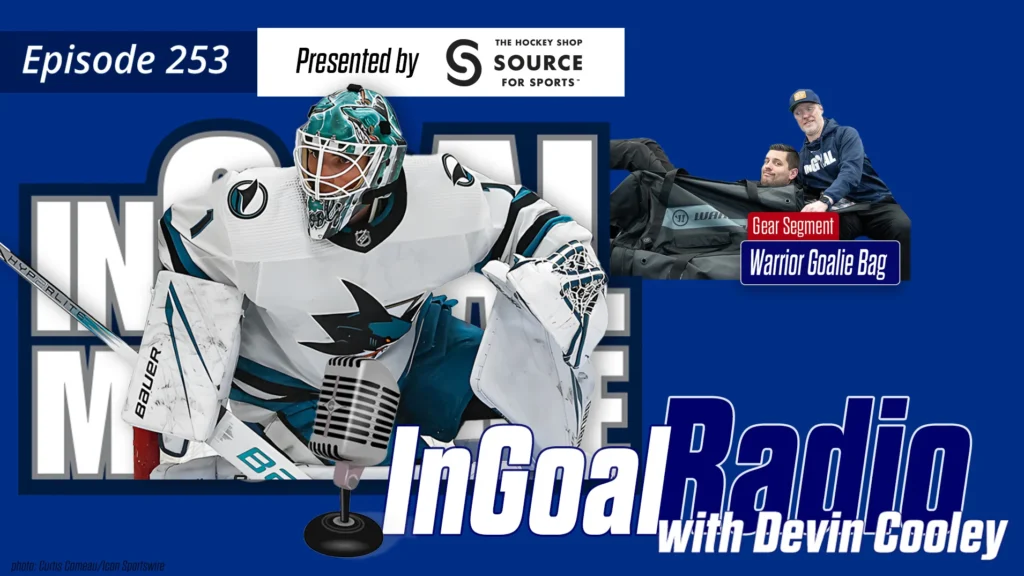
InGoal Radio Episode 253 with Devin Cooley

Please subscribe and leave a rating — it helps us reach more goalies!


San Jose Sharks goalie Devin Cooley credits Seattle's Joey Daccord and his father Brian Daccord of Stop It Goaltending as key figures in his late technical development. After a memorable 49-save win in Seattle, Cooley used the mindset mantra 'nobody cares, nothing's really gonna matter, we're all gonna die' to manage the emotional weight of his NHL debut with his hometown team.
- Devin Cooley made his NHL debut with the San Jose Sharks after a late-season trade to his hometown team, recording his first win in front of family.
- Cooley's '49-save win' mindset relied on a philosophical detachment mantra to manage pressure — a concrete example of emotion-regulation in high-stakes goaltending.
- Joey Daccord and Brian Daccord of Stop It Goaltending played a pivotal role in Cooley's technical development as a late bloomer at the NHL level.
- Goalie coach Thomas Speer contributed a key technical adjustment that supported Cooley's growth after joining San Jose.
- Parents should be intentional about what they say — and don't say — to young goaltenders after tough games, a topic addressed in the episode's dedicated Parents Segment.
Episode 253 of the InGoal Radio Podcast, presented by The Hockey Shop Source for Sports, features an energetic, informative interview with San Jose Sharks goalie Devin Cooley.
Feature Interview
presented by NHL Sense Arena
In the feature interview presented by NHL Sense Arena, Cooley takes us behind the scenes of his late-season trade to his hometown team, NHL debut and first win in front of family for the team he grew up cheering. He also shares insights into the mindset tools that helped him manage the emotions and the now infamous “nobody cares, nothing’s really gonna matter. We’re all gonna die,” quote after a memorable 49-save win in Seattle. He walks us through his path as a late bloomer technically, and the key role Seattle goalie Joey Daccord and his dad, Brian at Stop It Goaltending, played in his development, and a key change made with Thomas Speer in San Jose.
Parent Segment
presented by Stop It Goaltending U
In our Parents Segment, presented by the Stop It Goaltending U app, we talk about what to say — and what not to say — to your son or daughter after a tough game.
Weekly Gear Segment
presented by The Hockey Shop Source for SportsAll that, plus a trip to The Hockey Shop Source for Sports to look at a new Warrior wheel bag.
Episode Transcript
Intro
Back in my happy place, my comfort zone. This is my own private personal crease. It's InGoal Radio, the podcast presented by the Hockey Shop Source for Sports Langley, the hockeyshop.com. If I could pick anywhere to hang out, it'd be would be with David Hutchison and Kevin Woodley. You guys bring me joy, knowledge, and comfort.
It is the goalie union right here. I don't know who the vice president is. I'm not the treasurer, but I can certainly fit on any type of board that you guys want to to put me on.
We're just happy to have you on our team.
It's so much fun hanging out with you guys. We're we just talk Goaltending. And and the people that listen, subscribe, and are part of this, we couldn't do it without you. Quite frankly, it'd be quite lonely even though I'd like hanging out with Woody and Hutch. This just you make it worthwhile.
And and Hutch, the voice of reason on the podcast, you are beacon, our our shining light to keep us within the lane.
Oh, that's too kind of you. I was gonna say that all those listeners that send a note into us are part of the very same conversation too because we inevitably forward that note to everybody else in the group chat here. And and so if you wanna have a chat with all three of us and get involved in the conversation, send a note to info@InGoalmag.com. We'd love to hear from you.
And it doesn't have to be a really intricate question or inquiry. Any type of interaction is great. What happened in your game? Did you get a hose by the referee because the net came off and they didn't call it? Like, anything that gets a conversation going, we love it.
And and if you had some kind of meltdown, find out how it would compare to Woody's meltdowns. Like, there's there's that's the barometer. It would it be a two out of five on the Woody scale? Would it be a five on the five on the Woody scale?
Five Woody's.
Five Woodies. Five Woodies. We got a lot to get to today. It's going to be an awesome show. This episode is going to include our parent segment, brought to you by Stop It Goaltending U. The app, the NHL Sense Arena feature interview is, going to chat with Devin Cooley, and NHL Sense Arena, a big part of Devin Cooley's progression to the National Hockey League.
Sure is. We usually use this part of the podcast, Daren, to talk up Sense Arena and tell everybody why we think it's so awesome and why we think they should go give it a try. But honestly, I think the message is listen to the feature interview. You're gonna think that we actually set up these interviews just to pump Sense Arena's tires, but that's not what happens. Kevin kind of hears through the grapevine that somebody's used it and might ask the question, but, that's exactly what ends up happening.
And we get to find out how Devin Cooley got started with Sense Arena, how important it is for him, how he uses it. And so I'm just gonna say this right now, goalies and parents, grab yourself a Meta Quest headset, head over to the main Meta store in your headset and try Sense Arena this summer just like Devin Cooley, Joey Daccord, Devin Levi, even Kevin Woodley uses it on vacation. And if you're heading on vacation, you're gonna find out you don't have to pack the stinky gear. You can just bring your headset, try some drills every day while you're at the beach, while you're at the cottage, while you're camping. Maybe even try the Joey Daccord game day routine like Devin Cooley.
I've said guys, it's the best off ice tool in the game for helping you become a better goaltender.
And and I'll go back to the warm up utilization of Sense Arena, NHL Sense Arena. You can work on just your glove pad. Work on just blocker saves. It's it's unbelievable how you can just dial it in before you get on the ice. And for if you're if you are a recreation goaltender and you go through that two minute warm up where everybody's shooting three pucks at one time and four at your head, I know that math doesn't work, but if you're part of a mentally warm up rec league warm up, it does.
It does.
There there's actual real usage and benefit to to using it as a warm up.
Absolutely. But, like, it's for anyone that can't get on the ice on a regular basis. Right? Or, like you said, doesn't have a proper warm up. I mean, if they're using it in the National Hockey League to get ready to play a game like Devin Cooley and Joey Decord do, enough said.
Right? Like and and Devin Levi. Right? Like, a lot of big names using this. I think we're gonna see more and more kids, and I love that these guys are sort of normalizing it, making it so, you know, if you're a young goalie and you're worried about somebody maybe teasing you because you're you've got this headset on before a game, you're doing something that looks a little different.
All you gotta do is point to guys in the National Hockey League that are using it and having success with it. And as Devin Cooley will do in the interview, swear by that process as well.
No. If if anybody teases you, I'm talking to the listeners right now. If anybody teases you, send me a note. Tell me their name, and I'll deal with it. Alright?
We're not gonna put up with that. Zero bullying. I we we we totally, stand up to that in its most innocent form. If people just think it's joking, but there's a little bit of bullying to it, we'll stand up to that. But if anybody's bullying you because you're using NHL Sense Arena to make your game better, seriously, send me a note.
I'll grab my buddies Kevin and Hutch, and we will deal with it with with that
coach. A five on the Woodley scale. Person.
We we will deal with
it. Five Woody's.
Yep. Oh, no. We got we got a few more to go with that. But you might see five Woody's if if somebody's teasing or picking on somebody for making their game better. Because why why would you why would you tease somebody or make fun of them for trying to improve their game when they're probably on your team?
That's most likely where it's happening, and it's gonna benefit your team. That's that's where, I'm just yeah. Drives me a little bit around the bend.
The Hockey Shop.
Sounds like a parent segment coming up because it happens all the time.
Yeah. You're true. What And I don't
just mean about NHL Sense Arena. Guys on teams get on the guys who try hard and work hard. Let's make that a future parent segment starring Daren Millard.
What are you gonna do
in the parent segment today, presented by the Stop It Goaltending U app?
We're gonna have a little chat, boys, about what you can say to your goaltender after they've had a tough game. And I don't mean an hour later or that evening. I mean that awkward moment when all the parents are hanging out in the lobby waiting for the kids to come out of the dressing room. It's been a tough game. Your goalie walks through all those parents.
What can you say to them? We'll get there. You think about it, boys. We can have a chat in a few minutes.
And, of course, that will be brought to you by the Stop It Goaltending U app, the world's most comprehensive app for goalies, goalie parents, and goalie coaches. The goal isn't just to stop the puck with the Stop It Goaltending U app, it's to become unstoppable. No coach, scout, parent, or person is gonna stop you from following your dreams and maximizing your potential as a goalie. Become unstoppable in just thirty minutes a week using the Stop It Goaltending U app, and the extra time you'll have, you'll be able to get it at dedicate it to reading InGoal Magazine. Because as of now, two titans have united.
The Stop It Goaltending U app and InGoal Magazine have partnered up. Everyone that subscribes to the Stop It Goaltending U app will get free access to InGoal Magazine. The best of both worlds of goaltending, the best way to get better as a goaltender, to read both, make sure you check it out, wherever. It's at the stop at goaltending.com. You can go to the app download there or on the App Store or at Google Play.
There's more information between Stop It Goaltending U, and InGoal, than anybody can devour. And I say that with all due respect to the most passionate fan, but there's not enough hours in the day to go through all the gear segments, all the ProReads, all the drills, and then then the Stop It Goaltending U, the tips from from the goaltenders themselves, the gear segment, the the lessons. It's it's just overwhelming how much information is there.
You know what? But we're about to come up on the summer, the slow months, the summer months. You know what we hear most from goalie coaches? The biggest problem with young goaltenders, they don't watch hockey. They don't embrace the game.
They don't watch enough games. And there's no better way to learn how to sort of read and process the game than our ProReads at ingoalmag.com. And as you said, Daren, there are literally hundreds of them up there now. Videos of us sitting down with NHL goalies, reviewing plays, getting tips, getting directions, figuring out why they play certain shots a certain way, when they go into the post, when they square up, how they manage their depth, all those decisions, what side of a screen to look around, and you can devour that. If you're a young goaltender, wait till school's over, hidden into the summer.
If you're worried there's too much on there, just spend some time in the off season, and you'll be a better goaltender when the fall rolls around for having done so. Pretty much every goalie coach we talk to agrees, Just not enough kids taking advantage of it.
And Stop It Goaltending U, the app. You've got goaltenders, high level goaltenders, in their gear walking you through different tips and safe selections, and it is marvelous. Trust me on that. It's a rabbit hole, and my my house is littered with those rabbit holes as I've been down, down, and spending a lot of time on Stop It Goaltending U. Unbelievable stuff from Brian and company.
Let's get into some conversation in and around the Stanley Cup playoffs And the idea that you can lean on one goaltender is being pushed way, way farther away with the Boston Bruins flip flopping in the early stages before settling on Jeremy Swayman. But we've got three teams that have already consciously made decisions to start multiple goaltenders. You've got a couple of others that have made in goal changes, and the Vancouver Canucks have started three different goaltenders. So if you don't have depth, and we're not just talking a backup, like significant depth within your organization, you may not be able to win a Stanley Cup anymore.
Yeah. It's like, what, like, 16 teams in the playoffs, and we've already got six of them are down using more than one. You mentioned the Islanders going from Varlamov to start to Sorokin and back to Varlamov. Boston swapping with Swayman and Ullmark early. Vancouver, Demko, injury DeSmith, injury.
Silovs is in there right now as the third guy. Winnipeg starts with Hellebuyck. Saw some action tonight after he got pulled. Toronto pulled Ilya Samsonov and went to Joseph Woll last night. Wouldn't be surprised to see Woll get a start.
And if I'm gonna be brutally honest, I'm a little surprised he didn't get a start before this. And then the LA Kings
Angeles. Yeah.
Going to David Rittich tonight. And, again, there's another one where, listen, I get it on some levels, but from a statistical argument, that's a switch that could have been made earlier as well, at least in terms of how they performed overall in the regular season. David Rittich was a top five adjusted save percentage guy in the in the NHL this year.
Right. And if it's not working, why not make a change? Just to give it a different look. I I don't mind it at all what the LA
You don't have a lot of time. You you don't have a lot of time.
Yeah. And I don't don't I don't like putting it all on one guy either at the end. Boston did it last year with Swayman. It's a it's a lot to level on the shoulders of of of somebody. You have to win or else it's over, and you're the guy standing there at the end when it wins, and you didn't have, much rope to to deal with.
Yeah. And, Tay, I mean, case last year, what, two weeks without a start and then boom, here you go, game seven. So I like the way they've done it early on there. Swayman's been fantastic all year against the Bruins. He's continued that.
So not surprised to see them, you know, go to him in back to back starts because he was so good and because he has that track record. He's number one in the NHL playoffs and adjusted save percentage, but it's not like he has Linus Ullmark was bad. He's number two. Right? So that was just sort of both going well.
One guy just owns a particular team, and we've seen a lot of talk about is he in the Leafs head. So, certainly, you're gonna go back to that guy. Wouldn't it all be shocked if it goes the other way later in the playoffs?
Talk to Jake Allen, our buddy from the New Jersey Devils now, and he was on the Chirp Podcast, with me. We were walking through a bunch of goaltending, situations, and he was he was ahead of this before they stuck with Swayman for game number four. He thought it was a foregone conclusion. He thought it was he painted the picture. After game one and two, that's our plan.
And then it's open for interpretation. Do you think that was the case or do you think the situation of Swayman's performance in games one and three turned the tide?
We've seen that model a whole lot in international hockey, haven't we?
Yes.
You know, world championships, Olympics. You you know you're bringing a couple of really good goaltenders with you, so you give them each a shot and then you sort of see what happens. That would, if they carried over that sort of a vision for things, you you could understand it.
Yeah. I I I agree. And and the one thing is, like I said, though, like, they've gone back and forth all year. So this is fine for now, but I think you almost reset again in round two. I don't know if you get into a situation where you just keep rolling Jeremy Swayman.
I know he's out. I know Jeremy Swayman's a young goaltender. He probably isn't gonna have any problems in terms of getting fatigued, but he's never done it because of the nature of their tandem just like they talked about with Ullmark last year. Hadn't played that many games in a row all year. Why would you start now?
Really interesting, bit of analysis there that after you get through Toronto, things could move in a different direction because most people would be locked in right now that Swayman's the guy as deep as they would go.
And he's playing well. So there there there's an argument to be made there, but it's funny because I think a lot of people I heard from a lot of people playoff saying, oh, like, you gotta go Swayman. He's been the better goaltender all year. Statistically, he wasn't. Statistically, he was slightly below Linus Ullmark from an adjusted save point save percentage standpoint.
So numbers don't say the whole story. And like I said, Swayman's dominated the Bruins all year, absolutely owns them. But depending on the next opponent, depending on how things start, I just think they won't be hesitant to go back and forth with both of them. I'll be curious to see if they do, like you said, the international sort of plan. Again, in round two, play them both and go from there.
Logan Thompson was brilliant in a game three loss for the Vegas goal tonight's overtime there. Just shelled for the first thirty minutes of that game. Jake Oettinger, really consistent. Looks like he's worked his way through there. It's a two one series lead as we record this for the Vegas Golden Knights.
The best series, though, from a goaltending fan has to be that Florida Tampa Bay set. You you can't get anything better than the two superstars and Vezina Trophy winners and Stanley Cup champion than Sergei Bobrovsky and Andrei Vasilevskiy, the the the big cat against Goalie Bob. It's been marvelous.
Yeah. There's been lots of great highlights. It's that one where Bob got turned around and, like, all goalies will when they make a save they that that isn't when, you know, the highlight reel that's because they're a little behind the play. First thing he said in the postgame is I got behind the play. But the ability to sort of find desperation and to spin around and get that with the back of his arm, you know, take an empty net away.
You know, the rule is, right, like, yeah, it's desperation. Yeah. It's find something, but what do you wanna find? Get something to the middle of the net. Because most guys staring at a wide open net aren't picking a corner.
He gets something in the middle of the net, and the guy did him a favor and hit him right in the arm.
Oh, and that takes a level of athleticism that not everybody has. It's one thing for us to say that there was a little bit of luck involved, but man, you've gotta have athletic skill to put yourself in that position.
Yeah. He was spinning like a top in there. It was I would have been in the corner probably collapsed lying flat on my stomach.
Just an another comment from Jake on that was it's easy to react if you're the goaltender and make a move, but it's like you gotta be in a zone to actually put yourself in a position to to legitimately make a safe and go that extra little bit to take about, apart the middle of the net. Like that he he he called that being in the zone, being able to make that safe, not just turning around and flailing your arm. What do you think?
Yeah. I agree. How many guys get stuck in a difficult position and sort of just get caught flat footed knees buckle and they watch the puck go into the net? Yeah. I think that's a fair comment.
Makes me think of something I was gonna bring up later today, but Pete Fry, think about the fans mindset versus the athlete mindset. And I think too often once our knees buckle, we turn into fan mindset and just hope the puck doesn't go in the net, but, not so with Bob.
It was spectacular to watch.
It it it was odd. And and Vassi's been, like, really good too. Not as, he didn't have the save, but, boy, oh, boy, yeah, he's come up with some splendid performances and just those hips that go out. I I every time he butterflies, I have both pain and admiration when when he makes a save.
Pain and admiration. I like it.
Gear
Yeah. That's the butterfly. Let's get into our Gear Segment brought to you by The Hockey Shop Source for Sports Langley, thehockeyshop.com. And this one deals with the Warrior wheel bag wheelies. Now are we wheelie guys or are we non wheelie guys?
There's it's one of the most divisive topics in hockey, the wheel bag or the carry bag. What are you guys?
You're totally setting us up for another parent segment, aren't you? I was a wheel guy. I had no trouble. Technology invented the wheel and I'm fine with us using it. The only time I wasn't a fan of it was coaching really young kids in a really small dressing room and everybody had those giant wheeled compartmentalized bags and you couldn't fit them all in the room.
So that's the one little issue I have with them. But this week's one is a beautiful one. I will say, as we've mentioned a few times before guys, that all the gear segments are available over on YouTube. And this one has a little bit more at the beginning than the audio version you'll get on the podcast. You might wanna go check it out on YouTube.
We aim to entertain. I, however, am a carry bag guy, Daren, but it has nothing to do with pride or any stupidity about, you know, not having wheels on your
head. Woody. It's It's pride.
Well, it's pride related to wanting a nice car. That's all it is.
Mhmm.
Yeah. No. Because I I if I had a truck, I'd have a wheel bag. I don't have a truck. I have a car with the trunk, and there's no way I'm putting that hard rib plastic and pulling it out across the back of of of my nice car.
So that's That's
it for me too. It's it's the vehicle that I happen to be driving at the time.
Wheel wheel bags are tough on trunk. Really tough on a trunk. If you're pulling it out, like, it's the and then the the plastic on the bottom tends to crack and break if you're shoving it in there and pushing it in there. Squeezing it.
Yeah. I hate when those cars are so tough on my hockey equipment. That's what you mean. Right?
Yeah. It's the car's fault.
I'm I'm sensing a little bit of bullying and and I'm not gonna stand for you bullying my buddy, Woody. You you you apologize to my front friend, Kevin. I'm sorry, Kevin.
I'm sorry, Kevin.
I'd give you the full five Woodies here, Hutch. But you know what? I'm just excited about what's going on at the Hockey Shop Sagoal. I'm gonna mellow out again. Picture my fun times with Cam.
We have the Warrior wheel bag. There is another launch from Warrior that we weren't quite able to record the gear segment on because they didn't have the pads in advance, but we'll be there this week to give you a breakdown. Cam's already got it on his socials, the new Warrior G7 line. You can check that out at The Hockey Shop, on The Hockey Shop social media spots. And and they got a whole bunch extra Warrior G6 in stock right before the Warrior G7 launch.
So they've got a massive sale on the Warrior G6, and it's not just it's not just sort of the leftovers. It's not what what's been sitting around this whole time. They went out and stocked up on extra available Warrior G6 because it was a pretty popular line, and they wanna make sure they're selling it out at discount prices as the Warrior G7 rolls out. So we'll have more on the new line next week from Cam. But this week, it's bags and the Warrior bag.
And as Hutch said, listen, but then make sure you check this one out on the YouTube channel as well. It's a goodie. Cam already welcomed us back to The Hockey Shop, but we woke him up, got him on the bench because we wanted to find out a little bit more about goalie bags and this new option from Warrior.
Yes. Warrior Ritual goalie bag. So the reason why we're talking about this is, a, we haven't talked about bags in a while, and two, we actually really like this wheel bag. And we don't really agree on a whole lot of things, but we agree this is a nice wheel bag. It's big.
As wheel bags go. Dimensions? 44. 24. By 24.
So basically, it's almost four feet long by two feet wide by two feet tall.
For reference, I'm six foot tall and I like, there was space inside here. So for those of you that are planning on putting your pads and everything else inside of this bag
Maybe including your local hockey shop representative? I yes.
Might be a little hard to wheel though afterwards as you found out.
Back surgery is coming.
So, again, why? This bag's huge and it's got compartments, which is something like intrinsic for when it comes to wheel bags. You don't really just see a big bag with wheels. We've got separate compartments that you can pop your skates in. On both sides, your undergarments and things like that, can keep totally separate.
The liners are nice, thick nylon with the outside being a heavy duty, almost like canvas, tent like material, we'll call it. But either way, terms of her stopping those skates from say punching through that bag or other skates when people step on your bag, for example, you get some good defense against that.
Yeah. My defense would be stay the hell away from where I'm getting changed. Rest of my teammates, this is my area and bugger off, but not everybody gets that type of not everybody's the snap show that I am and gets that type of sensitivity. No. Cam, do I spot a stick carrying compartment?
Oh, you found it. That's exactly pretty cool. Yes. You can slide your sticks in through
the side of the bag. Got a little, like, umbrella holder
on a golf bag. Exactly. But for your goal sticks. So in terms of keeping everything together, this bag's one of the best.
Okay. So, Cam, we obviously, we saw the whole wall of bags. He's got a whole bunch of options. You have wheel bags from Vaughn Yes. Bauer, believe CCM as well.
And Brian's. And for those who don't want wheel bags, we I saw True. I saw Warrior, which has always been a bit of a staple. Right. You can get team logos put on those through CCM.
The team sales department. Lots of things there. So there are
lots boxes. Sorry. I had to make sure we hit them all.
Yeah. We did hit them all, but there's a reason you picked this one. Yes. Durability. You have found that in terms of returns and people not having problems with, like you said, skate cuts and things punching through and the durability of the bag.
This one's really holding up.
So let's clarify 100% here. I don't believe there's like one wheel bag 100% that's gonna last you forever. It just doesn't exist. That said, so far from what we've seen this Warrior bag has been one of our best though. In terms of issues, problems, returns, anything like that, been very, very low and we've been very, very happy with it.
So that's why we are talking about it today. And it crosses the border. It sure does.
If you're buying from The States, can buy this from the hockeyshop.com. If you got any questions about this bag, other bags, do you need a wheel bag? Can you fit a wheel bag in your car? Just tell Cam what the model of your car is and I guarantee you, he'll go out into the parking lot and do all the measurements to make sure that you can tell whether it fits in your trunk or not.
See, look that. Give me a call here at 604. To do that. 89-8299 or 1-800-567-7790. I guarantee you, I will ask Kevin for help.
Not an automotive expert or Cam Matwiv, but he knows what wheel bags fit in what car. I guarantee it. I promise. Call him. Make sure you bug him a lot about this one.
Check it out at thehockeyshop.com.
Good stuff. The the wall of bags, like, the the pad wall and the glove wall, and it's it's all impressive. But that wall of hockey bags at the Hockey Shop, goalie bags and skaters, it's just impressive looking up there and seeing that amount of space dedicated to something.
You know what? And I should say, I don't know if we can't remember if we did in the Gear Segment or not, but the Hockey Shop has a massive custom business. Jerseys, uniforms, workout wear. If you've got a minor hockey team or a beer league team and you want custom uniforms, they'll take care of you. And that includes bags.
You can get custom logos done on your bags, whether it's beer league, minor hockey, whatever, including a whole bunch of those ones you see up on that wall there. And I have one, my beer league team. We had the the team logo, the sort of seahawks logo wearing a JOFA. We had that done on our beer league bags a few years ago, and the guys loved it. So, not only do they have all those bags, but you've got the option to customize them as well.
There's a team in Vegas for a men's league tournament this weekend. I think they were the Sioux City Mallards, and they had three sets of jerseys. Three complete sets of jerseys, and they were, Mallards across it. And I actually asked them. I said, find me a way to get a jersey.
Find a way to get me one of those jerseys. It was amazing. So I'm I'm right in with you with the custom stuff. Does Warrior does Warrior ship across The States if if you got some American friends looking to cash in on on the great deals in the hockey shop?
Yeah. Whether it's a new Warrior G7, the Warrior G6 line that's on sale, or that great bag we just unveiled in the Gear Segment this week, you can order that from The States from the hockeyshop hockeyshop.com, and it will ship across the border. Now I know people get upset. We were talking about this before. There are some companies that they're not allowed to ship across the border.
CCM and Bauer, I believe, are two of them. Please, folks, when that happens, do not take it out on our good friends at the Hockey Shop. It's not their fault. It's the rules they play by. And frankly, every company on either side of the border shipping in both directions is supposed to play by those rules when it comes to those equipment companies.
So hands are tied, by the companies they work with, but not in the case of the Warrior bag G6 or G7 line at the hockey shop and the hockeyshop.com.
Just call your local politician. They love to hear. But if if you're complaining about hockey stuff, they'll listen. Roads and potholes, they're not gonna pay any attention. But mess with the hockey stuff, they'll they'll really dive in and and and help you out.
Parent Playbook
Let's go over to Hutch, our guiding light. He does make sure that we are in the proper lane on this podcast. If we swerve a little bit, he brings us back without admonishing our behavior. That is, why he created and is the producer of the parent segment, brought to you by Stop It Goaltending U, the app, and this week, helping up our goaltenders when things get a little bumpy.
Yeah. This is one that, I've held onto since I was a young goaltender and I had my no. I had more than my fair share of bad games. When you have a tough game, what can you say to your kid immediately after the game? And that's that difficult moment in the lobby as you're waiting or wherever it might be.
I just remember walking out and so many parents, good game, Hutch. Good game, Hutch. And I knew that it was not a good game. I was not happy. And it upset me even more to hear good game, Hutch.
So what do you say? And I ran this one by my kid after I'd written the whole parent segment out for this week, guys. I said to Matty, what do you wanna hear? And immediately he said, don't say good game. So there's the first one.
I know you want to make your kid feel better. I know you want as a parent to say the right thing to them. They're they've had a tough time. Don't tell them they've had a good game. Don't immediately blame anybody else.
We don't wanna say your defense suck. You had no support out there. Like, even if it's true, that's not what we're gonna say because our job as a goaltender is to be there to help our team when they do make mistakes. After all, guys, if the team was perfect, there wouldn't be any shots at all. So I'm a little lost
right now because now I've got nothing else to say. Can't say good game and I can't blame anybody else.
Nope. You can't, but we're gonna get there.
I just tell my kid she sucked.
That k. I've actually said that sometimes, but he knows I'm kidding and it gets a laugh out of him. But but no, we don't want to blame anybody else. And I don't think I mean, we want our kids to accept responsibility, guys. And I think any half competitive kid would feel exactly the same way.
That's where I was talking about Pete Fry. He actually talks about having the athlete mindset and wanting your team to turn the puck over. Pete thinks as a goaltender, you should be looking at every situation hoping it's gonna result on a shot so that you can make a save. So so we're not gonna blame anybody else. I do hope and this should go without saying that you're not gonna do what Woody just said and tell your kid that they suck or they played a bad game.
They don't need your help, Woody. They're upset enough. I don't even think a coach should say that to a goalie too often. But, as a parent, you certainly don't need to. So we're not going to justify.
We're not going to tell them, hey, you had 75 shots on goal. Don't worry about it. It's our job to deal with it. And, and I think if you do say that, it's probably going to fall in deaf ears. So what can you say?
I think my answer is nothing. My answer is you give them a hug, you give them a pat on the back, whatever you guys are comfortable with because I know not all teenagers wanna be hugged in their lobby in front of other kids. Whatever it is, I don't think words are even required. You just need to make it clear somehow that you're there for them. Sometimes I'll say, I'm proud of you, especially if it's after one of those games where you and they know that they're in a really tough spot.
So that might be along the lines of your defense suck, but sometimes you're just against an overmatched team or playing for an overmatched team. And if you said to them, I'm really proud of you today, I think that helps. And ideally, guys, I think you want to be specific so that the words have real meaning. I'm proud of you because of how you battled right through to the end of that game. If that's something you saw happen.
I'm proud of you how you never lost your composure like uncle Woody does all the time. I'm proud of you because even though your team was out of it really early in the game, you actually had your best period in the third period and didn't give up any goals or only gave up a couple, whatever it might be. If you can be specific and tell your kid you're proud of them, I think that's great. The other one that I like to throw in there sometimes is quite frankly, guys, I love you and I love watching you play. I think it's important for them to know that when they're really feeling down.
So those are the kind of things that I typically do sometimes, And it's kind of a rare one, but sometimes you can hold this one in your back pocket. I know you're not feeling well right now. I know you're not happy right now, but you're gonna look back on that game sometime and you're gonna realize you actually had a great game. Cause there will be those nights. You have to be honest in everything that you say to a kid because they can see through dishonesty.
You have to be honest so that when you have words to share that they have power to them. Because when you do say good game, it's gonna mean it. So those are my thoughts, guys. I would love to know what you guys think in a second. I just wanna remind all the parents out there that we would love to hear from them and what they say to their young goalies after tough games.
Parents at ingoalmag.com. So, Daren, you've been a goalie since you were knee high to a grasshopper. What did you like to hear if you ever had a tough game?
No. I just your point about I like how you handled the situation or I love the way you didn't get caught up in the antics as your other teammates were losing their tempers. I that's a real positive reinforcement of being able to be mature along the line. That's a life lesson too, not just a hockey lesson. So I had not thought of that angle, I'm really grabbed by the idea of being proud of my child the way they were able to keep it together and be be mature about the situation.
Yeah. I think I had a professor in teacher's college who used the phrase catch them being good as something that as teachers we need to do. Because telling somebody they're doing something bad really doesn't often help. But if you tell a kid that they've done something well, they're gonna wanna please you till the end of time and they will keep doing it, as we all do. I mean, every now and then, Woody actually tells me I've done a good job and I wanna keep doing that.
I deny that accusation. So Woody, what do you
So Woody, what do you wanna hear after a tough game? What do you wanna hear from your family as they're waiting in the lobby after your latest beer beer league debacle?
Good game?
First time will
be the last time.
I've seen your family in a game I was at even.
I not good game. I I love this segment. You're absolutely right. If it isn't a good game, that's the last thing you want to hear is good game. I have, in fact, jokes aside, I never tell my kid she sucks.
I have I'm sure. After her volleyball games, when things haven't gone well, subconsciously tried to find things and not even thinking of it as a plan thing the way you're talking, Hutch, but I love the idea of just trying to find things you like, whether it's compete or moments or trying to pick the team up and, you know, get them going when every when when everybody's down. And the one thing that you said there that really resonated was, and I've said it a lot to her, I just love to watch her play. Like, it just brings me joy to watch her compete and play, and that's not based on winning or losing. It's the competitiveness.
It's the moments within the game that I cherish and making sure she knows that. Although I gotta be honest, you have to judge your kids as people, and there are times when she just doesn't wanna hear anything right after a game. And so
Which is what I started
with. Yeah. Understanding the the silence part of it is something as as you guys may find this hard to believe, I struggle with that sometimes. Just being quiet. But, I've learned to just zip it every once in a while and maybe ask a few open ended questions if I can sense she's really upset.
Just see if she'll share and talk and allow her to vent and get it out of the way.
Yeah. And I think that's a really good one that we could get to down the road, Woody. For me, this was just sort of the lobby talk as opposed to, you know, the chatter at home afterwards or whatever.
No. It was great. It was great, Hutch. It was great.
Quite often, it ends with where do you want me to buy you a steak as well because we gotta do something on those after those tough games.
It's a Dairy Queen for
us. Hold
on. Hold on. What? Steak? Like, what what happened to just, like, the frosty drive through on the way home?
We we've gone from ice cream to steak?
Oh, the game's got pretty tough sometimes.
So so the Daren note note to Daren and Kevin, invite Hutch to watch us play beer league and then suck. We're getting a steak dinner out of this thing.
Guys, guys, when your kid lives at home and it happens a lot, you can drive through the frosty lineup. When your kid lives with somebody else and you only get to see him here and there, it's a steak. I have I have a funny story I shared with you guys on text message when it happened, but my son was having one of his toughest games of the year. It was one of those situations where I don't think it was expected to go very well and he was having a disastrous game. And I watched walk in, Dylan Playfair, one of the actors from Letterkenny.
And I thought, I've really I gotta do this. I gotta go say hi to him. I went over, I said, Dylan, I really sorry to bug you buddy, but my son is having a terrible day. And I sort of pointed down towards the end zone, but I didn't make it clear who my son was. I said, he's having a terrible day, but he's a huge fan of you and your show.
Do you think you and I could get a selfie with him, to to cheer him up? And he's like, oh, for sure. And he points down towards the ice level as well where a bunch of kids are playing. He said, which one is yours? I said, the goalie.
And we both had a good laugh. We got the selfie taken and I swear to God, as soon as we took the selfie, what is in the background of the picture? But another breakaway on Matthew in the background. I didn't get to see the breakaway but he came up with the save so that was kind of cool. And after a tough game when he was not a happy boy, getting the photo, not in the lobby, made for a good laugh later.
That's wild. And we we can, like the the parent actually gets something out of it.
Yeah. Oh, I had fun doing it too. And and and let's face it, as a parent in these tough situations, as Woody alluded to, you're often looking for what can I do to help? You wanna help so badly. So
What does a parent wanna hear after a bad game from the other parents?
You know what? Let's make that the next segment or let's make that a future segment. Let's not go there, but I think it's a great question, Daren. And maybe maybe before we can do a little research here, parents parents at ingoalmag.com, what do you want to hear from the other parents?
Like it. Hey, I should remind you. I should remind you.
Your kid left my kid out to dry.
Yeah. Yeah. Yeah. I gotta remind
Five Woodies. Five Woodies fistfight in the lobby.
Tarps off. Let's go. Yeah. I gotta remind everyone. I know we did the big read earlier, but the parenting segment is brought to you by Stop It Goaltending U app, our new partners.
Reminder, not only it is the greatest app for goaltenders, goalie coaches, and goalie parents, But now when you purchase a subscription to Stop It Goaltending U, the app, you automatically get a free subscription to InGoal Magazine. The best of both worlds when it comes to improving as a goaltender, goalie coach, and goalie parent.
Feature Interview - Devin Cooley
Plenty of great advice coming up in our feature interview brought to you by NHL Sense Arena with Devin Cooley, who made, just a marvelous debut in his hometown, this year with the San Jose Sharks. And there there is a lot, in here, and I love the interviews that inspire Woody to send a text to Hutch and I right away. Dang. You guys are gonna love this.
And then I'm editing it, and I send my kid a text as I'm editing it. You're gonna love this. And I did it with this one as well. He made a fabulous debut in the NHL this year and he made a fabulous debut on the podcast.
And I gotta say, I'm not gonna give too much away, although there is a lot of energy. And, yes, we do talk right away about his famous quote about everybody's gonna die and his mental approach to the game, but we get into everything here. His enthusiasm for the position, for the sport, for life is infectious, and it made this a really, really fun interview and a little teaser. He also stuck around, and we did 45 mins of video breakdowns for ProReads. So there is lots of great tips coming from Devin Cooley in the very immediate future at ingoalmag.com.
It's the feature interview brought to you by NHL Sense Arena on InGoal Radio, the podcast.
Really excited to welcome to the InGoal Radio Podcast. A first time guest, but an InGoal Magazine subscriber, Devin Cooley of the San Jose Sharks. When I looked that up and found that out, Devin, I was like, this is awesome. Those are the moments that we live for here at InGoal when we find that guys that have come up through the ranks and pros and making their NHL debuts like you did late this season Actually knew who we were, knew what InGoal is all about. I love it.
Yeah. You guys have been doing some awesome stuff for the Goalie community, so I'm happy to be a part of it.
What's this what's this last little stretch been like for you? You make your NHL debut, you get your first NHL win, and it's in your hometown playing for your hometown team, the San Jose Sharks. What walk us through the emotions of the past couple of months.
Yeah. It's just been, like, like, crazy. Like, since the trade deadline, like, getting traded, didn't know I was gonna be going to San Jose at all. Then I get traded within one day, like, I'm going from Buffalo to San Jose or Rochester to San Jose, and then I get a call from my agent. He goes, hey.
You're be playing your first NHL games, like, blah blah blah. And, like, for my hometown team, like, it was it was just insane. And, obviously, to to get my first win in there too and first game out of the way, it's it's definitely a huge weight off the shoulders and have a few good ones in there too to, like, prove to myself, like, I can play in this league. I can be a great goalie in this league. You know?
It's it was just really cool, really special.
I was gonna say a couple outstanding ones in there. Would say the St Louis game, 34 on 36, and then Seattle against your old friend Joey Daccord, 49 of 50. What just what I said whirlwind, you know, and and I think goalies, maybe not to this degree, maybe not being traded in the NHL, making your NHL debut and your hometown being mixed in, but I think goalies at every level go through situations that are, you know, crazy and feel harried and a lot of things going on. How'd you ground yourself?
Yeah. I think, like, one thing about goalies, especially especially when you get to pros because there's not that many goalies in each organization, you know, you only have, like like, if you're a backup in the American League, you're only, like, a couple injuries or a couple trades away from like being in the NHL, you know? So it's like things can change really quick. And that's one thing I've learned like throughout my career is that like, you could be not having the best year, you could be frustrated with where you're at or blah blah blah. And then literally within one day, it's like you're being thrown into a situation, you're being given a great opportunity.
It's just like you never know when that's gonna happen, you know? So it's been pretty crazy. But obviously, yeah, like trying to grab myself. I don't know if you've been seeing, like, all the media, me and, like, my certain sayings and whatnot.
We may have brought up, you know, the one I think it was after the Seattle game, you know, the nobody cares one, which, of course, like, we may have mentioned that on the podcast a couple of weeks ago when we're trying trying to get you as a guest. But but, I mean, I mean, we all know it. Right? Like, it's really easy to sit to say to ourselves, stay in the moment, but that's one of the things that helps you do so.
For sure. Yeah. And it's like, when I say, like, nothing matters, nobody cares, we're all gonna die, you know, it's like, of course, it matters. You know. It matters to me like a ton, like, I wanna do so well.
For sure. Yeah. And it's like, when I say, like, nothing matters, nobody cares, we're all gonna die, you know, it's like, of course, it matters. You know. It matters to me like a ton, like, I wanna do so well.
But I found that when I wanna do so well and I'm trying so hard to do so well, that's when I can kinda like screw myself a little bit. And so if I can be like, oh, it doesn't matter, I really don't care. Like, it's just like, whatever happens, happens, you know, I can just focus and be in the present moment and not being like, oh, I've made, you know, 49 out of 50 saves. I'm making so many saves. This game is going so well.
Like, we're almost there. Just gotta really push through. It's like, as soon as I do that, it's just a distraction, You know? So it's so instead, it's like, look up and I'm like, okay. I've made freaking 45 saves.
You know? I've only led at one goal or whatever. It's just that I'm gonna be like, nobody cares about that. Like, it's not gonna get you anywhere. Like, blah blah.
It's like, it's it's super negative, but it keeps me really grounded. And it's the same way, like, if you give up a crappy goal or, like, Literally, right after my Seattle game, I got freaking lit up for eight goals, you know, brutal against Edmonton. And you can it keeps you it protects you from getting too low and too down on yourself too. Like, you're giving up eight goals. I'm like, eight goals, like, 22 shots.
Like, wow. It must really suck. You know? Instead of, like, really beating myself over, I'm just like, nobody cares. No one's gonna remember this game.
You know? And I look back, and I'm like, hopefully, you know, at the end of my career, I can look back at that game and just kinda laugh at it. Like, it really had no effect on the overall outcome of things. And I think it's just a good mantra that because goalie is like, you can't be too high. You can't be too low.
You'll drive yourself crazy. I think if you can just stay very level headed throughout your whole career, like, it's gonna be super beneficial.
Any other like, obviously, that mantra got a lot of traction. The the the quote got a lot of traction. Are is there any other advice, you know, for how you how you arrived at that yourself? Like, as a goaltender, moving up the ranks to a, understanding the importance of level headedness and staying in the moment, and maybe any other tools that you've used to sort of achieve that? Because, you know, like you said, you put you you went into some pretty big moments late in the season that didn't seem to be trending that way.
Yeah. Yeah. So I also say there are no thoughts, there is no future, and I just repeat that over and over again in my head. I find that in the middle of a game, you know, if I can just repeat phrases over and over again, like in my head, it just keeps me from it it blocks everything else out. It keeps me from thinking about the score.
It keeps me from thinking about, like, how much time is left or how the game's scoring or blah blah. So, like, I'll repeat like those couple phrases just like over and over again when I find my mind wandering. And while my while I'm doing that, I'm just like watching the puck, especially when it's on the other end and you don't have to worry about your peripherals. I just like watch the puck the whole time and I'm just like saying those phrases over and over again. And it really kind of puts you in a trance, helps me get in that like flow state.
What else do I like to do? Oh, I like to like like on face offs, I'll check the d hands, like what what hand they shoot, and I'll check the the wingers, what hands they are. So if say, you you have two d who have like a kind of hard to explain, but if you have a left handed d and a right handed d, and they're on the outsides, I'll be like d on the outside, d on the outside, and I'll see if there's any one timers. And so I'll be like, d on the outside, one time it to the left, and that basically means that there's a one timer, the wing on the left side is on its one timer, and the d have their sticks facing the outside. So now I'll just say that over and over again.
I'll be like, d on the outside, one time to the left, d on the outside, one time to the left. And so it helps me prepare for the face off and know that if a d gets a puck, which way I wanna look for the screen, like, originally, and then it helps me know if there's any one timers, and then it also helps me repeat a phrase over and over again, keep me in the moment, keep me in that flow state, instead of thinking like, oh, when are they gonna drop this face off? Or, oh, how's the game going? Or, oh, what are people in the crowd doing? You know, it just keeps me dialed in.
I love the when the it's funny. We just actually ran from Corinne Schroeder for PWHL New York. When the play's at the other end and she's not having a busy game, she'll start doing play by play a little bit to sort of stay stay engaged. But I love how you say you track lock on the puck when it's at the other end to sort of stay in the moment. That's another
I just I'll watch the puck the whole time or if we're on the power play, I'll kinda like not a play by pay play, but I'll like look and try to figure out what they're gonna do next, you know, like try to be okay, this guy has the puck on my team right now, he has this option and this option and I'll be like constantly scanning. And it's the same mindset, know, when they're in your zone, but when they're in their zone, it it it keeps you focused and you can kinda, like, really keeps you styled in.
It's funny because people I don't think people realize just how hard it is to stay focused for a sixty minute hockey game because it's actually, like, three and a half hours or two and a half hours, and it's it's hard and guys' minds wander. So all these little things you do to stay locked in on the puck and and, you know, present in the moment, did this come like, did you work with anyone, a mindset coach, or are these just little things you developed on your own over the years?
These are just things that I've developed on my own. And people say, like, you know, like, goaltending is so mental on so many aspects. And a lot of it and I think that's why it takes goalies so long to develop for the most part. I mean, obviously, you have guys that kill it right away, but, like, guys like me, like, I'm a late bloomer, you know. It takes a long time and I think it's because for me, especially, like, there were so many things that I needed to work on mentally.
And I've worked with a lot of sports psychologists and blah blah, but a lot of it came from literally just playing in games and figuring out, like, what works for me and trying to keep, like, keep track of everything. I have a full notes app with, like, little mental stuff that I have that I review before every game and just little quirks and things that I do here and there and that that help me stay engaged and help me stay dialed in. And every year, it gets better and better, you know. Like, when I was in juniors, I remember, like, I had never worked with a sports psychologist before and I was just like, I have no idea how to prepare for games mentally. I was so lost and it was like, so like, it was like, I was either dominating or I was getting pulled, you know?
Like, it was just like such a freaking mess. And so it took me a really long time to figure it out. But you talk to certain guys, like certain guys already have it, like really doubt it. Like Devin Levi, like I played with him in Rochester and in Buffalo's organization. The mental side of his game is, like, pretty incredible.
Like, I love talking to him and seeing him, like, some of the stuff that he does. And for him to be doing that at, like, that young of an age is, like, super impressive because, again, here I am 26. It's, like, taking me some, like, freaking five years pro or four years pro to, like, figure some of that stuff out. So it's definitely a trick, or it's definitely a a little bit of a challenge, but it it's different for everybody too. Like, you gotta find what works for you.
Okay. So the notes app, I'm curious, a nice little reminder that you've kept over the years. And we've talked to goalies over the years, like, guys who keep notebooks, how they're feeling before a game, and then they can look at what they did before a good game and maybe what they did before a bad game and sort of dial in the process. For you, that that little notes app and your mental preparation, is it always growing and adding? Or are you subtracting?
Or does it sort of do a little bit of both over time?
Yeah. So I have I have two pages on my notes app. One is just hockey, and one is mental. So like one is like as hockey as like every single time that I learned something new, or say I went through a practice, was like, oh, I liked I liked when I did that, you know, then I'll write that down so I don't forget it. Or if it's there's something I didn't like, I'll, like, kinda cross it out, you know, and I'm constantly, like, changing it and adapting it based off, you know, what I'm learning and what I think is better.
So that help helps keep everything organized. And because I'm not a I'm not a huge fan. I've tried the journaling thing, and I'm not a big fan of the journaling. I'm not a big fan of just writing and just talking about, like, a million different things. But I do really like keeping track of, like, the big things.
Like, I need like, I'll I'll open it right now and maybe read a couple of
Yeah. Share. Share. I was gonna ask, but I thought that might be I might be pushing too much, so I like it.
Yeah. So I have, like, a ton of different things. So I'll go through the mental one first. And so the mental one is just like a bunch of random phrases that I can kind of say to myself and also things that like help me get over certain things, like when I'm feeling a certain way. So first, like the phrases like, I am zen, I'm emotionless, I'm at peace.
if you're not willing to look stupid or fail, nothing good is ever gonna happen to you.
And then the ones that I told you, there are no thoughts, there is no future, nothing matters, nobody cares. And then for things when you're like feeling a little bit anxious and you're a little bit worried, you say, I'm going to beat my mind today. I'm not afraid to fail. And then if you can't fight the fear and you can't get over that anxiety or whatever, then just do it scared, you know. Just push through because if you're not willing to look stupid or fail, nothing good is ever gonna happen to you.
And then I said, uncertainty is the root of all progress and all growth. If you have control, there is no experience. And I said, whenever you have butterflies and are feeling anxious, that is when you are the most powerful. And whatever happens, go the distance. And then I said, the joy is in the climb itself, falling over the process, not the final summit.
And then there's a whole bunch of little things and just going over stuff that I've learned from sports psychologists and what I really like for me, but that's kinda like the basic gist of like what that stuff looks like.
Love it.
So yeah, a lot of like good stuff, you know?
Yeah, really good stuff.
Which which works for me, but again, everybody's different, you know? Some some people don't need to
But but I think by writing it down and sort of documenting it and having something you can refer to whether you know, some people, like you said, some people is journaling, some people it's in an like, for a notes app like this
A 100%.
It it becomes more concrete and something that's, you know, it's less fleeting. Sometimes when we think, oh, that works for me. I'm gonna keep doing it, but we don't remember why we don't, you know, if we don't sort of put it down somewhere where we can refer back to it, it can it can become something that disappears on us or changes, you know, even over time, but not on purpose.
Yeah. Yeah. Definitely. And so, like, before every game, like, I go in, I'll go to, like, the bathroom or whatever right before the game and right before I start getting dressed, and I'll review, you know, my mental notes app and my hockey notes app of things that I'm working on or things that I really wanna focus on for this game. It depends on my emotions before the game.
Like, if I'm feeling a lot more anxious before the game, then maybe I'll focus on the phrases, you know, that have to do with getting over anxiety and beating my mind and stuff. Or maybe if I feel super calm and I feel really good, it'll be more about like, I'm zen, I'm emotionless, like, just to keep that feeling going. It just depends on the day, but that's why I have all these phrases that I really like. And even like like I find stuff on like social media, like on TikTok or whatever, and it's like the motivational stuff. I'm like, oh, that's a really good one.
Like, I'm gonna write that down to maybe use at a certain point or help it to get over something. And then, yeah, for hockey, it was I have a whole ton of stuff. But it's basically just like every single time that I learn something new or I do something, I'll just like write it down. So like
Is it technical, tactical,
or all technical. And some of it's kinda just, like, motivating, like, just, like, be the better athlete. But, basically, like so, like, with San Jose, there was, like, a a lot of things that, like, I was working on, you know, because I was working with the new goalie coach.
And We know we know Speercy well. We get to spend some time with him in the summers up in Kelowna.
So he's awesome. So, like, we were working on a ton of stuff, and it's it can be kinda information overload. So, like, my first game in the in the NHL, it was just like, just survive. Like, just make the save any way you can. You know?
It doesn't matter how you do it. Like, just make the save. And then the the second game, it was like I had worked for, like, a week with him or whatever or maybe even less than that. And we had already started to learn so much, but it was like a little bit overwhelming. I didn't have enough time to like kinda get that muscle memory.
So my second game, I was thinking way too much and I was like, I was reacting a little bit slower and I was giving up some crappy goals. And then you give up one or two goals and you're like, okay, I'm just gonna go to just, like, just make any save that you can, and then you get exposed for the flaws that you were trying to fix in the first place. So it could be a little bit of a a
a That's a pretty tough process to go through in a six I think you were six days between starts. And, obviously, so, like, that's only five probably had three or four ice times in that span. And and you're trying to do it in the NHL.
Yeah. So the first two games were a grind against Chicago, just, like, trying to learn all this new stuff, trying to just survive a little bit. But then I was able to get a lot of time because Blackwood, like, played a bunch and it was I think they were like, hey. We've gotta give Cooley some time to, like, learn some of this stuff. And so, like, I was able to spend, think it was, a week and a half or whatever, just with Speer's , just, like, working before and after every single day, getting that muscle memory down.
It was unreal. And then I we saw the result, like, in Saint Louis and Seattle. Like, those games weren't flukes. It was like everything finally coming together, all this new stuff that I'm learning, and then feeling really good mentally on top of it, and then just going out and playing. And that's when I think I had the really good results.
But yeah, some of the stuff, it was like butt up, narrow stance, don't think, react, head first, slow things down, big and relax, set your feet, trust yourself. Lots of random little quick phrases. And then I have just like so in practice, we were working on just straight shots because we didn't do a lot of straight shots in Rochester. And with Speercy, we started working on, like, a new stance and, like, a new way to, like, kind of play stuff. And I kept getting beat on straight shots because I'm thinking about all this stuff and I'm getting too wide and I'm getting too locked in.
So I was like, in order to, like, keep my mind clear and just focus on, like, a couple things, I'd be like, for straight shots, check for squareness, make sure you're set, have your head tilted down, and then just shut your mind off and watch the puck. So then I have that organized, and so then I don't have to think about a million different things. I'm like, okay. Just focus on these things and then just watch the puck and then just play. So it's just like, yeah, anytime I learn something new or anytime, like, I'm working on something or I have something I think can help my game, I'll just write that down super quick and keep it organized.
But, yeah, there's a million different things on here. I'm not gonna go through every single one. But I just think that's a super good tool for, like, anyone who's still learning, and I think everybody's still learning, you know, to a certain extent that just anytime that you hear something that you really like or think that something's gonna help your game, just write it down somewhere, you know, even for just, like, the tactical side of goaltending and the mental side of things too. It's it's a good tool, and I think it's a good tool for for life as well, especially the mental side of things because it it helps you, you know, outside of hockey as well. It's not just a goalie thing.
I love it. Speercy and some of those changes, certainly some of those, rang true. Things I've seen him work on up here, with with a lot of different goalies at one of the camps we, attended together over the last couple of summers, butt up. Was that and changing the stance, sort of getting a little more over top of things. Yeah.
Was that a was that a big change for you? I think a lot of people So the Narrow stance to get to get the feet closer together so you have more power and more movement. But, man, you sink that butt, you're lost in today's game.
For sure. So, like, what I found is the reason my butt sat back all the time is I'm still really mobile with my butt sitting back and I can get really wide in a flare and I can like still push really hard. So I don't get as exposed with it, but where I get exposed is that when I sit back, well, number one, you're way smaller, you know, you're getting feet over the shoulders, but I'm also getting beat under the arms. Like, there's holes under my arms because I'm sitting back so much. So it's a little bit of a mess, like, I gave up like a couple crappy ones, you know, from that in general, both against Chicago.
And I was like, k, like, we gotta fix this. So, yeah, it was it was sitting up being a lot more upright, and then in your stance, not getting so low and locked down and not worrying about having your stick on the ice, especially me because I'm six five, you know. So like, we worked on being a lot more narrow, not having my hands so far out, but more of like a neutral position, letting the puck come to me a little bit more.
More relaxing.
By having my stick on the ice and it just like everything felt so much more controlled, so much more mobile. I, like, was so much bigger, like, filling space. It was just a lot better. Those those were definitely the biggest things.
It sounds like in some ways your ability to move from a low wide stance and and and sort of with sitting down a little bit, the fat like, lot of guys would be locked at that point. You weren't, but in some ways, because you weren't, you wouldn't have recognized the need or or a need to maybe tinker with that.
Exactly. Exactly. Because it's like, could still move. I could still do everything, you know, and then I didn't realize that I was getting exposed, you know, under the arms as a result of it. And then it wasn't until, like, there was literally a Chicago game where my second game in against Chicago, it was just like, very low wrister, like, from the flank, like, through a screen.
And I when I looked through screens, I would get too low and too wide and just worry about the flare, you know, and that would force me to sit back. And so I'm looking through a screen. It's just a little wrister. I'm like, oh, easy save. Do the my butterfly.
I'm sitting back like crazy. I'm so wide and it just squeaks right under my arm. Like, just like, such a bad goal, like, should never go in. And so, like, once that happened, I was like, want you to experience the afterwards. I was like, k.
We're I I just wanna do a million reps till I can't feel my legs anymore. Like, I just wanna get that muscle memory down because I don't ever want that to happen again. It was such a terrible feeling, you know? And so we just nailed a bunch of reps and still like a little bit of an issue that creeps in, especially when things like aren't going well. But when I have it down and I feel really good, like we see the results like we did like in Seattle and St.
Louis where it was like, hey, like, I'm dialed in. My body and mind are working together. I'm not thinking about anything. And so I'm really excited, like, to work with him a lot this summer and just, like, get that muscle memory down to where, like, even when things aren't going bad or I'm a little bit more chaotic or whatever, or are going bad and I'm a little bit more chaotic, those bad habits aren't gonna creep back in my game.
Right. So it's sorta almost like a new foundation, a new staple.
For sure. 100%.
Which, you know, that's not easy to do. Like I said, like like, know I kind of said that a couple times now, but I'm kinda like, my brain's kind of exploding here right now. Like, you're making changes like that in the NHL late in the season in your first taste of the show. That's that's that's not easy to accomplish. Take me back to the first win and playing at home in San Jose or even the first start.
Like, for it to be your hometown to, you know, to have your like, your family's there. I saw the shots of your mom. Like, how special how special is that?
Yeah. It was insane. Like, the the first win felt a lot more special than my first game. But my first game, it was just like that was in Chicago. Yeah.
And it was just like all nerves. Like, I couldn't sleep the night before. I couldn't even do a pregame nap. I was just like bouncing across the room, you know. I had so much energy and adrenaline the entire time.
And so I could feel myself. I was very sleep deprived the whole time, but I had so much adrenaline and so much like nerves. I was just like, I'm just gonna do it. I'm just gonna go like, pick a bunch of caffeine and just went and played. And then once the game started, it felt like way better.
I felt a lot more comfortable, you know, but the lead up to the game was really hard. And then, yeah, the first win was sick. I was, like, feeling pretty pretty good, like, the whole game, like, pretty relaxed. And that's when I really started to do the the nobody cares, nothing matters, you know, we're all gonna die. Because my first two games, the first two periods went incredible.
They went great. And I was like, oh, we're gonna win. Like, this is gonna be great. Like, in Chicago, it was two to one with, like, nine minutes left in the third of my first game, and they scored three goals in, like, a minute. You know?
Like, literally, like, ninety seconds, they scored three goals and we ended up losing. Like, it was, like, four or two or five two because they got the empty net. And then my second game against Chicago, same thing. It was it was a four zero game, and then after this after the second, like, halfway through the third period, it was four to two. And then, again, they got, like, quick goals, and then they scored in overtime, and we lost.
And it was just like I just felt that towards the end of those games, I was getting so intense and being like, oh my god. Like, only this I just gotta make it through. I just gotta make it through, like, these next twenty minutes or these next ten minutes, things that I was just, like, constantly looking at the clock, worried about the score. I was so stressed for, like, every single save because I didn't wanna mess it out So I I really wanted to get my win and things are going so well. And both those games, I things fell apart in the third period, you know, things turned into a disaster, and it was just so disappointing.
So then the Saint Louis game came, and it was like kind of like a similar similar game. It was like two to two to zero, and then it was like two to one. And they had scored with like a minute left or something like that in the third period, and we went to overtime. And we won in overtime, it was amazing. But the whole game, I was just like, nobody cares.
Like, who cares? Like, I'm just gonna play. Like, there there is no future. There are no thoughts. There is no future.
You know, it doesn't matter. Nothing matters. And I wasn't. And I was, like, looking at the clock and instead of counting down the clock, I was like, I love it out here. I was like, I'll spend.
I wish we could play a whole another game. I wish we could I wish we had two more periods coming up, you know, when there's, like, five minutes left in the third. I was like, I'm not I don't want the game to And so I just totally shifted my mindset, and it helped a ton because then in overtime, like, I made a bunch of good saves, like, off the PK in overtime because they had a power play right away, and they scored, like, very last minute. Just like Mensi, I was like, I don't even care. Like, this is just fun.
Like, I'm just having a blast. And then Ecklin sniped the the game winner in overtime, and then it was just like I would at that point, I was so emotionless because I was just, like, just standing present moment. Like, nothing matters. I had no emotions. It's like, man, like, when they score the final goal, they score the final goal, I feel like I'm not even gonna react.
I'm not even gonna have any emotions. Like, who cares? And then that's what I was telling myself. And then when they scored, I just, like, completely lost it. Like, just went absolutely nuts.
And it was just, like, the best feeling. I got chills, goosebumps, and stuff. And then to do, like, the interview after the game with, like, all my my friends and family in the crowd, it was it was unreal. And I don't know if you saw the post, but my mom was balling her eyes out. They usual.
And it was just, like, the best feeling. I got chills, goosebumps, and stuff. And then to do, like, the interview after the game with, like, all my my friends and family in the crowd, it was it was unreal. And I don't know if you saw the post, but my mom was balling her eyes out. They usual.
And, yeah, it was it was a really special one.
I love it. I love it. Now growing up in Cali, how did you like, you're from like, are you, like, are you literally, like, at your parents' place now? Like Yeah. Is that when you got traded, you're just like, what went yeah.
That's crazy. So growing up there, how'd you get like, how'd you become a goalie? Who was the guy? Like, was it Nabby? Or
you are
you young enough that it's not even Nabby? That's how old I'm gonna feel in a minute here.
Yeah. So I started skating at, like, five, and I think I became a goalie at, like, seven or eight. And I just wanted to be a goalie just because I thought I was so cool. So when I was growing up, when I was first a player, the youth programs, we didn't have any goalies. It was just everyone was going out and skating and just scoring on an empty net.
But eventually, they changed it to where if you wanted to play goalie, you could in your player gear. And I always wanted to do it because I thought it was so cool, like, being able to stop the puck. I literally remember the very first goal I ever let in, like, when I was, like, you know, like, six or seven years old. It still, like, burned in my into my mind. But yeah.
And so I just absolutely loved it and then ended up borrowing some gear and and trying it out. And, again, just loved it. Played it in roller hockey, like, that summer. And then for my birthday, when I was, like, seven or eight, my dad called me my own set and just, like, never looked back. I just always just loved it.
It just seems so much fun to me.
What do you love about it? Like, I I think you've sort of you've given us glimpses of everything, but what was it that drew you to it?
I really like how every single game you can be a difference maker.
Yeah. I really like how every single game you can be a difference maker. And that's the coolest thing for me because it's like, you go into a game and it's like, oh, maybe this team's way better than you or blah blah or maybe it's a big championship game. And I feel like when you're a player, a lot of the time you have to kinda take a back seat to, like, how the team plays. Like, you could be, like, the best player in the world, you know, like a McDavid or whatever, and you could score a few goals or whatever.
But, ultimately, like, you really need your team to kinda, like, help you out. Whereas, like, I feel like if you're a goalie, like, obviously, you need your team to help you out a lot, but, like, sometimes you can just steal games, you know, and that's the coolest feeling ever. It's like, you're getting outplayed, you know, we're not even getting any chances on the other net, but maybe we got one lucky goal and we're getting out shot like crazy, but, like, they just can't score. And that's it's so cool to, like, have that feeling. But it also, it works against you too, you know?
Like, you could be the guy that that everybody hates, you're the scapegoat, you know, if things go wrong, like, if you're losing, like, the first thing people are looking at is is how did the goalie play, you know? And so it's it's great. It's a lot of pressure and I like I like having that kind of pressure and it's a lot of fun to every single like, when you win, it's like a lot of people are usually giving props to the goalie, so it's a cool feeling.
So as you grow up and become a goalie, did you did you have a guy? Do you have a guy that you're like, I wanna be like him. Or as you're you know, now you're making notes on how to play, were you a guy that watched other goalies and then went on the ice and tried to imitate them? Was there anybody that stood up there?
I really liked Pekka Rinne a lot growing up just because of his his style and his size. And it was funny because I had signed my first entry level contract with Nashville, and he was, like, the first guy I got to train with and skate with in the summertime. And so that was that was a really cool really cool feeling. He's an awesome guy.
He might be the nicest man in hockey.
Yeah. He's he's so nice. He's super super humble, really really awesome guy. So, yeah, probably watching him and then obviously, watched a ton of Nabokov, you know, but he had a very unique style, like, growing up. I watched, like, Martin Jones too, Matt Murray, you know, when I it was a little bit later, like, in college and in high school just because they had similar body types.
And Matt Murray, when he went on that back to back cup run, like, how can you not wanna play, like, somebody like that, you know? But but, yeah, that's pretty much it.
Nice. Now from there, you you you go into the USHL at a young age. That's where you meet Joey?
Yes. Yeah. My first surgery.
I read a story. It sounded like you get to the USHL. And had you had a lot of goalie coaching to that point or any at all? Or are you still pretty much raw?
Yeah. So I I had, like, no goalie coaching. We had, like, a little bit of goalie coaching, like, with the junior sides, but it just wasn't consistent at all. So, like, my goalie coaching, like, throughout my entire youth career was literally just, like, trying to teach myself and just try to skate as much as possible. Like, all I wanna do was be on the ice as much as possible.
But I was probably working really hard, but probably not very smart because I had no idea what I was really doing. I just wanted to be on the ice. So, yeah, I I go from from that and playing youth hockey to right into the USHL where everybody's naturally talented and everybody has, like, you know, some good goalie coaching. And I just got lit up too. It was so bad.
I I got called up and, like, again, it was just, one of those situations where it's just, like, you just it's just all adrenaline. You know? You just do everything you can to stop the puck. And so, like, that's what I was always really good at is because, like, I had that natural ability. So, like, when you get enough adrenaline, you get that, like, motivation.
Like, I could really do well just off, like, pure, just, like, natural talent. So, like, yeah, Joey mentioned, like, I had gotten called up. I killed it, like, in the first couple days of camp, and then I played, like, a preseason game against USA, had a really good game. And then literally the next day, they're like, hey. You're gonna be you're gonna be on the team.
And I was like, sick. This is so cool. I, like, couldn't believe it. Because the USHL was, like, the really good player. So I was like, yeah.
I'm not a really good player. Like, no way. And then all of sudden, wanted me on the team. It was the craziest thing. And then, yeah, that year, I just I I think I finished last place in goals against average and save percentage.
I don't know how that didn't send me down. I'm I'm thankful they didn't send me down, you know, but I was definitely, like, way out of my outlet. I just get lit up every single day. And so yeah. So Joey was, like, obviously, he wasn't very intimidated by me.
So he was, like, really just being a good guy and, like, helping me out and and trying to coach me and stuff because he had had goalie coaching his entire life. And then he ended up inviting me to his dad's camp with Stop It Goal Tending in Boston. And I went there and they totally just, like, revamped my style and my career. And, like, we started from, like, complete scratch. Like, literally, like, two weeks, no pucks, nothing.
And it was just like, okay, stand up. Okay. Stand up. And it's like, now go to your stance. And I go on my stance.
And then they would fix all the things. They'd they'd fix all this, they're like, okay, stand up again, and go on your stance again. And I would try to remember what they had told me before, and I would just do that over and over again. And we did that with every single movement, like my butterfly, my t push, you know, my stance. It was like just completely started from scratch.
And so it was a ton of work. Like, I remember we had to change the way that I held my blocker or whatever, and the way that they wanted me to do it, my the muscles in my forearm weren't capable of it yet or something like that. So like, literally for, like, the first week, I'd come off and, like, my hand would be shaking like crazy because I wasn't able to move my wrist, but eventually I got it to, like, the way that they wanted it. And now, like, I can hold it really weird and have no issues and stuff. But, like, yeah, totally from scratch.
It was it was a lot of work, but it ended up working out. So I'm super thankful to those guys.
Now along the way, as you as you move up and get different opportunities, who are some of the other guys that obviously, I'm guessing after an experience like that, you probably head back to Stop It as part of your your your routine for several years.
So I've been going ever since. So it's been like eight, nine years now where I've I'll go there and I'll get an Airbnb or something for the summertime, and I'll just go there, skate every single day, sometimes twice a day, and do yoga, work out there, do all the vision training they have there. It's they have a great setup.
Was gonna say they there's pretty much everything. Right? Like, you're looking to check boxes yeah. They've got it.
It's it's awesome.
Including and I'd be remiss if I didn't ask because they've been a longtime sponsor of our podcast as is Stop It Goaltending with our parent segment. But Sense Arena, you're a user.
Yeah. Yeah. So I that's something I just started doing. And I remember so I didn't have the best start in Rochester, and a lot of it felt like looking back now, it was like, hey. There were some big flaws in my game, you know, that I had to fix.
But before that, before I came to San Jose and realized the flaws of my game, I was like I felt like it was more of a mental thing, and I felt like I was really struggling in the first ten minutes of the game. I felt off. If I didn't have a couple of good saves right away, it took me a while to get into it. And then I remember in the second and third periods, especially in third, I would feel better. Better and better as the game went on because I got more dialed in and I felt a little bit more comfortable.
But a lot of time, it would be the opposite too. Like, if I went in and I gave up two quick goals, it would reverse. I would feel less comfortable and be more stressed out, you know? And so I was like, how can I get rid of that to where I'm so dialed in before warm ups even start to where, like, by the time the game starts, it already has felt like I've made, like, a million saves? And so I started, like, I had already done this, but I I changed my vision.
So I started doing a lot more, like, I did a bunch of juggling and charts and stuff beforehand, but I was, like, I'm gonna start doing more game like stuff. So, like, putting on my helmet, my glove, and throwing the tennis ball off the wall, like, to make it more game like to really get dialed in. And then I played with Levi, obviously, who's like
I I I was gonna ask if the Devin had anything to do with
this I watched guy. Him put that video out, and I had used it before with Stop It Goaltending. And I watched the video that the NHL did on Joey Daccord and how he does it. And he mentioned, he's like, it's great because I go into a game and it felt like it feels like I've already taken, like, 200 shots. And I'm like, that's exactly what I need to do.
This is amazing. It feels like I'm really dialed in before I even start playing. And so it's definitely felt like a little bit of a a cheat code.
And the season wasn't going well, so I was like, I gotta try something to get me out of this spot. So I tried it in my first few games, like, using it went really well, and I was, holy crap. This is amazing. It feels like I'm really dialed in before I even start playing. And so it's definitely felt like a little bit of a a cheat code.
And, obviously, it's not an end all solution. Like, I've had some bad games off it too, but I've had some really good games off it as well. And it just makes me feel a lot more comfortable mentally going into the game.
Can I ask what drills you do? Do you have you set up, like, a program? Are you using puck cannon?
Yeah. So on there, they have the training routines, like, that's done by pros, and Joey Daccord has his morning skate routine. And so I literally just do that, and I I really liked it. And every once in a while, I'll change up the drills and stuff if it's, like, before practice or whatnot. But before games, I'll literally just go through his morning skate routine.
And sometimes I don't finish the whole thing, maybe only do it for, like, ten minutes or whatever until I feel, like, kinda down and mentally, and I'm like, alright. Good to go.
I know Dev's a big big big on it, and I know Joey too. Like, we did a story this year. Joey, like, you used it in between periods.
Really?
Well, just maybe wasn't feeling the glove hand, so he loaded up the puck cannon, caught a few in between periods. I had some guys say that, hey. Like, if you don't if you have a period where you see three shots and you're not feeling comfortable like you talked about, you know, throw it on for five minutes in in in your mission, and you sort of get those reps you didn't get in the game.
Yeah. So it's super cool. They've done a really good job with it, and it's gonna keep getting better, you know, I assume. So it's it's definitely a little bit of a cheat code, I think.
Nice. Other impacts, you know, during your time at Milwaukee would have been Dave Rook, I would imagine for at least at least at the beginning. Rochester, would have had Seamus Kotick, both guys that we've that we've gotten to know over the years. You know, as you start to work with different boys, you talked about Thomas. He saw some things he wanted you to do different. Along the way, your approach to sort of new ideas and new concepts and how each of those guys helped you at different points.
Yeah. So Dave Rook, like, I worked with him a lot, you know, obviously, my whole first few years pro. And he had a we did a ton of stuff together. Like, that was a huge transition period for me because it kind of felt like I did really well in college and then I went to pro and had a really good start in pro and then it was like, I started to get exposed on these flaws. And that's kind of been like a pattern, you know, as I've gone up the levels.
A little bit of like a fake it till you make it to where it's like, okay, I do really well at this level, then I go up to the next level and it's like, woah, woah, I kind out of my element. I'm starting to get exposed to all these issues I didn't even know that I had. And then you're trying to fix all these issues while in the middle of your season, you know, so it's kinda it can
That's be hard.
It's really hard. Yeah. So with with Dave Rook, like, kinda hit a point where he's like, okay, like, you're just not gonna play games. Like, I didn't play for, like it was, like, two or three weeks or whatever, and we just, like, worked on stuff every single day. And with Robo too, down in Florida on the East Coast League, So we just did like, a lot of his focus was post work because I really struggle with, like, the RVH and post work and stuff because the the RVH didn't come out till I was, like, in my second year juniors or first year juniors.
That's when people started using it in the league. So it was kinda like a new thing I wasn't super comfortable with and I wasn't, like, that great at. And so all we did was just a ton of post work, especially in Nashville's system. They love their post work. And now it's, like, one of my biggest strengths in my game.
Like, that's just, like, I if you say, like, what are your biggest strengths? I would say, like, post work for sure. Like, it's really good. So that's definitely a credit to him. And he was a big on, like, the mental proponent as well, sometimes a little bit more than I wanted him to be.
Like, he'd be like, it's all mental. I'm like, dude, no. It's not all mental. Like, I feel good mental. It's like, I got some issues with that game, I think, too.
But I think he was he was definitely right in both ways. And
I I forgot that you had with time with Josh Robinson. Like, I and another guy that we're big fans of No.
I did a ton of post work with him. So, like, when Rooks wasn't there, it was, like, every single day before and after practice, we were doing post work and just, like, trying to work on things. And I really liked him as well. He was awesome. And then with Seamus in Rochester, a lot of it was depth management.
Like Tactical. Exactly, exactly. So not being knowing where you should be in certain plays and certain areas. Especially in Rochester, they don't do their practices are pretty crazy. It's, like, super offensive.
So, like, all you're seeing all practices, like, three on o's, three on ones. You know, there's never any just straight shots, a lot of breakaways. Everything's backdoor. You know, so it was great.
They're trying to prepare the goalies for life with the Buffalo Sabres. I kid. I kid. I kid. That's me saying it.
I'm not putting those words in Devin's mouth. That's me joking around.
Yeah. So it's literally just like goal scores practice every single time. It's just how many goals can they score.
Mindset on that. That's gotta
It be transition was period. It was like the first couple weeks, I was like pissed off, dude. I'm like, this is so frustrating, you know?
When's my turn in practice?
Yeah. Like, I'm trying to, like, feel good and it's just like, we all know where, like, guys are making 10 backdoor passes, know, or they'll have a wide open net instead of shooting, they'll have another backdoor pass. It's, like, driving you nuts. And so the first couple weeks, you're kinda getting, like, pissed off because I was the guy that really enjoyed that stuff. And when I played in Milwaukee, remember going to the coach back.
Can we do more like odd man rushes and game like stuff? Because I really liked making those saves. It was fun. And then Rochester was like the other stream of that where it was like, okay, this is like almost too much even for me, you know, because you're trying to like figure out new things and work on stuff, but it's really hard to do that when your only shots you're seeing are your backdoor, odd man rushes. And so you again, you get exposed for those kind of plays.
It's like if you're playing too aggressive or whatever, you're not gonna be able to make those saves at all. So with with Seamus, a lot of it was like, hey, being a little bit far back, using my size a little bit more, and not having to be so aggressive and chasing pucks and reading plays a little bit better. And so that was a big focus with him as well and, like, being sad as well and just having a good stance and being prepared.
And, of course, I I, like, I I don't even know if you would have been aware of this, but we talk about San Jose roots. I know everything comes full circle after the trade and and growing up in San Jose and playing your you're playing there and getting your first win there. But, of course, Seamus would have had roots with the San Jose organization. I don't even know if you knew that with, with Warren Strelow and and the the old school, the Nabokov and a lot of that stuff. He's a great guy.
Yeah. So it it was it's just it's such a such a small world. You know, the goal like, the hockey world's crazy small, but the goalie world's even smaller, you know, and everybody knows somebody somewhere or has a relationship with somebody. So it's it's cool how it all gets gets connected.
Gear, I gotta ask. I'm just curious. Like, I did, like, did you like, you love the position. You thought it was cool. Was gear a part of it at any point?
And how's that evolved? Are you just a guy like, give me what I had, or are you dialed into this stuff?
Yeah. I'm not I'm I'm a guy that if I feel like my gear isn't giving me the best chance to be the best goalie I can be, that I'm gonna switch it and I'm gonna change out and I'm gonna experiment with new things. So I'm not super picky about the gear. I'm not super loyal to one brand or the other. I've fluctuated throughout my career based off certain things.
In college, was all Vaughn because of Matt Murray was in Vaughn. Was way back to back Stanley Cups. I was like, he's gotta be doing something right. You know, I had a lot of success with Vaughn. Then when I got to pro, I started noticing some issues with the gear that I wasn't super stoked on.
And so I was like, I'm gonna try out, you know, another guy I heard, like, Bauer was really good. I I played with Askarov. He had really liked Bauer, you know. So then switched to Bauer and a lot of those issues were fixed and I've I've really liked Bauer ever since. But I still use the Vaughn pants.
I use the Vaughn helmet. I've Vaughn everything pretty much except for the pads and the stick and the chest protector. And I use a CCM chest protector because that's, I think, what's gonna make you look the biggest and have you the give you the most broadest shoulders and the most protection from pucks. So I'm not loyal to anything, and I'm always looking for things that I could potentially change to make me better.
Does it?
No. It does make sense because sometimes guys will just stick in a brand because, hey. It's what I've always used or sometimes it's because, hey. They're gonna pay me as opposed to looking for something that, you know, make sure it performs better. I'm curious though to go from a Vaughn to a Bauer, it's a very different feeling pad.
Was there an adjustment period there? And and and what is it you like about the Bauer? Like, you a big fan of the active rebounds and things like that? Is that something you find benefits you?
Yeah. So what I really liked about the Bauer's is I had an issue with well, the Vaughn had the the extra slippery stuff on the bottom, and I think that actually hurt me because I was so big and I was moving around so much that when I dropped sometimes, I would still be moving in my butterfly, and that makes it really hard to make secondary saves. And I like the Bauers because when you drop, you just stick. Like, you're just there, and that keeps me really controlled and helps me go for secondary saves. The seal on the Bauers were really nice.
So, like, up by the five hole, like, no pucks are sliding underneath. Like, it's really great. The pucks explode off the rebounds, you know, which is huge in the pro game to just get things out of there and not have it just hit you when it's dropped there because you're gonna get exposed pretty quick. The toe seal in the RVH was really nice with the Bauers. I like that as well.
And then the glove is unreal. Like, it's the seal is really, really great. I like that a lot. And, yeah, I also use the Konekt skates, which is, like, a pretty new thing.
Is that just this year?
That's I did that I switched into those before playoffs last year
Wow.
In the hockey. But it took me a long time to get used to them. It took me, like, a couple months of wearing them in and out before I got used to them. And the reason I did that was because I was in the True one pieces with those skates, and I was having a bunch of ankle issues with the True one piece. And I kept felt like I kept slipping too because I can play really low and really wide.
And I felt like with those skates, kept slipping. There wasn't a lot of bite. And I would watch Askarov because I was playing with Askarov. And that's, like, that's one of the things I do is that anyone that I play with, I kinda figure out what they're doing with their gear. And it's like, okay.
How can this help me? You know? It's like, try to steal, like, some of their ideas. And so I was watching Askarov play and stuff that he was doing in the RVH, like, with his ankles and, like, he'd be in an RVH and he's leaning far over. Was like, dude, my ankle would snap if I did that.
I was like, there's no it's like, am I just getting old? Like, is my body I'm 20 just not as bendy as he is, you know?
I'm just getting old. You're 26. You're killing me.
Yeah. Right? But, you know, he was, like, 20 years old. I was like, maybe just it's wearing on me before it's wearing on him. And I was like and he was getting so wide too.
Like, he can get so wide.
His ability to push and still have edges when he's so low and wide is actually he's so remarkable.
I was just like, in my house, like, there's no way it's just like a physical thing. I was like, he's gotta be doing something. So I was like, what gear? Like, what what are you wearing? And he was wearing Bauer skates.
And so I reached out to the Bauer guys, and I had tried those skates in the summertime because I didn't wanna tie my skates anymore, and that was a good snatcher item. But what I really didn't like is the heel moves. Right? And so with someone I'm a really powerful, quick guy, and so when I push really hard, there's a lot of power, and I push and I felt like I would push, And then I wouldn't move. The the heel would move, and then I would go.
So there was, a delay. Delay. Yeah. Push, go. It was a push, move, then go.
And so it was messing up with my balance and stuff, and I really didn't like that. And so I was like, I just gassed him. I was like, it's not gonna work for me, you know. So I reached out to Bauer, and they asked about getting, like, skates that had more of a bite. And I also saw that video of Broissoit warm ups with I forget what team he played for, maybe Vegas.
But he had gone from standing up to a full split in warm ups while holding his edges still, which was like the craziest thing. And I was like, dude, what skates is he using? So I I went to Bauer, was like, what skates are is he using? And he's like, he's using the Konekts. Was like, crap.
Like, already I tried the Konekts, like, they don't work for me. And he goes, well, hold on a second. Like, he had brought up that Georgiev with Colorado had was having ankle issues with his True one pieces or whatever, and he went to the Koneckts. And he doesn't didn't like how they moved or whatever, so they ended up bolting them down, and they ended up really liking them. And I don't know if he still uses them or whatnot.
And I was like I was like, dude, I'm having ankle issues, you know, with my skates too. And he goes, well, like, I think Askarov has a pair there. You can try them out. I was like, okay. Perfect.
So trying them out, both of them down, so now they don't move at all. And now they're like my favorite skates ever. And all those issues are fixed. I never slip anymore. I can get really low and still have a bite.
I don't have ankle issues anymore in the RVH, and I don't have the tie my skates. So it's great.
Win win win win. Exactly.
But, like, that's I feel like as a goalie, like, that's the kind of thought process you have to have, like, constantly, like, how can I get an edge? Like, anytime there's a problem in your game, be like, okay. Is the problem me or is it my gear? Or, like, what is it? Figure out what's causing that problem, and then, like, be proactive in finding a way to fix it.
And, it's interesting because, I know LB sorry, he definitely modified his a little bit too. And I don't wanna speak out of turn because I can't remember what the exact specs were, but now I feel like I gotta send him a text message to find out if they're the same change that you made because he tinkered with them for sure. It's like anything. You can you can make adjustments. Right?
Yeah. A 100%. That's the beauty of being a goalie and and having, like, so many different brands and types of gears that you can change things and figure out what's gonna work for you. Because everybody's so different too. It depends on your style as well.
So, like, what works for me may not work for somebody else and, you know, the other way around.
So I gotta ask, just out of curiosity because we did hear this a little bit from some guys. Having done the switch, in addition to the ankles, did you notice anything else in terms of wear and tear and how you felt physically in those skates compared to maybe beforehand?
Yeah. It was just like the ankles. Like, I was my ankles were getting killed, man. And I was, like, constantly doing things to, like, repair them. I was doing, like, a full warm up, like, literally full section of my warm up dedicated to ankles with bands, with hops, with a million different things just to warm them up, and I was constantly dealing with bad ankles.
And it just felt like my ankles were always, like, kinda getting sprained or just, like, in pain when I was in the RVH, which was annoying because in Nashville, they hammer the RVH. You know, that's they're really big on that, and I was a big part of my game too. And so it's like, you're freaking going into practice and your goalie warm up is like backdoor RVH plays and post to post and blah blah. And if your joints aren't good enough, like, you're gonna be really struggling. You're gonna be in a lot of pain.
And that was what was happening with my ankles to the point where, like, towards the end of the season, I was like, hey. Can we kinda, like, chill, like, on the ankle stuff? You know, like, my ankles are kinda hurting, but you also, like
You don't ask.
Yeah. Like, when you're a pro, like, you don't wanna be like, hey, my body's not really working for this. Like, I else, it's like, they're kinda gonna be like, well, why is your body not working, but Askarov's body's fine? You know, you don't wanna kinda put yourself in that situation. So a lot of time, I just kinda stuck it up.
And then now that I've had, like, different skates, they've just been awesome. I I have no more issues anymore.
Love it. Last one. What does the summer look like? What are like, how long do you like to just talk about letting the body heal and stuff? How long do you stay off the ice?
When do you start when you head back to stop it? When you start to gear back up?
So I love skating. That's like, that's like my favorite thing to do ever. There's a lot of guys that are like, oh, you know, I'm not skating until like, you know, a month before training camp or whatever, you know.
You're like looking for drop in ice and
I public told Speercy, I was like, I'd start skating tomorrow, you know, if I could. But like, I think it's important to like, you gotta let the body heal. Like, like, my hips a little sore, my groin's a little sore, like, I'm fine but like, it's important to let your body heal everything and kinda chill out. So, like, with Stop It and those guys, they they like to say, like, take eight weeks, you know, I'll probably do more, like, six or so, you know, like, probably something like that maybe less just because I get really antsy when I can't skate and I wanna start skating. But especially now because we're done so early, you know, I might take a little bit more time.
It's just it's hard for me to take that time because I wanna do it. It's a lot of fun. Don't like working I don't like working out. I don't know if you can you can tell. I basically work out only for injury prevention and for speed and, like, to be better on the ice, which is what I guess what most people do.
But there's a lot of guys that, like, are like, hey, sweet. Now I can just work out and just chill and not be on the ice. It's like, I would be on the ice three hours, four hours a day if it never meant I had to work out ever, you know. But it's like, you gotta do it, you know. It's part of the job and I still do it.
But so, yeah, I'll I'll probably spend, you know, six weeks kind of hanging out at home. I'm gonna see a bunch of friends, you know, all over the country and do a couple vacations here and there. We're going to the Mediterranean with my girlfriend and my dad and stuff. We're gonna sail around the Mediterranean, which will be cool.
Very nice. I'm going to
Palm Springs, San Diego. Just like a lot of, like, little trips, Colorado here and there, figure out like stuff to do. And then I'll probably start working out in the next week and a half or so. And a lot of that will start with just like Pilates and yoga and just getting a really good base. And I'll do that for like a few weeks before I start doing like actual weight and dumbbells and whatnot, just to make sure my body is completely healed and I'm in a good spot where I don't start lifting heavy right away and injure myself or whatever.
And then, yeah, now that I'm in San Jose, obviously, I don't know what's gonna happen contract wise or anything, but Speer's here, so I'm gonna be skating with him a lot to start the summer. And then I'll go to Stop It, like, mid July and then be there until Stop It's done and then find a good pro skate to get ready for for training camp wherever that's gonna be.
Well, in the meantime, you can take your break, do your vacation, and if you feel like you need to stop pucks, just throw the headset on. Pack that.
Exactly. And that's that's the best part about it too now. It's like, I'm definitely gonna take that the the VR stuff with me when I'm sailing through the Mediterranean, you know, on the boats somewhere.
Dude, we want pictures of that for sure. I got a picture of me on a surf vacation up on the rocks. The break is behind me, and I got the Sense Arena on with, like, the big, like, like, the big, like, cat, like, the huge sort of, like, cowboy style, but, like, more, like, surf hat. And I'm, like, doing Sense Arena with the ocean in the background from
the ocean. That's sick. Yeah.
We need some Mediterranean shots.
A 100%. Last year, I took we went to Mexico, and I took my glove and blocker and my helmet with me. And my girlfriend got a good video of me throwing a tennis ball off the wall, like, at our house in Mexico and just, like, tracking pucks and making saves. Like, the grind never stops. You know?
Love it. But now and it'll be sweet because I don't have to take my glove and blocker and tennis balls. I can just take the headset.
Yeah. And you don't I mean, let's be honest. Who wants a stinky glove and blocker in in the in in with their swim shorts?
For sure. Yeah. But yeah. I'll definitely have to get have her get a picture of that that we post online. Maybe maybe they'll give me a sponsorship.
You know?
We got always gotta work on it.
Yeah. Yeah.
Devin, this is awesome, man. This has been really fun. Our I know our audience is just gonna absolutely full of great advice, but also just the energy and love you have for the position comes shining through. Thank you so much for spending the time today. We really enjoyed it.
Yeah. Yeah. It's been my pleasure. It's been a lot of fun. I got nothing else going on. So
Awesome. Well, we'll have to hold you to another one down the road.
Sweet. Sounds good.
Outro
Listening to that, I want more. And thanks for telling us that he's going to be doing the ProReads because
You're gonna get more.
Get enough. I can't get enough, of Devin.
He was great. Just like, again, there's an enthusiasm and energy for the position. You know, bit of a late bloomer. Didn't have a lot of coaching. Young until he gets to the USHL.
Great stories about, know, ties right in whether it's Sense Arena or Stop It Goaltending and all the work he did with Brian Daccord and Joey Daccord back at Stop It Goaltending, you know, in in Massachusetts, in the Boston area. Just there's just a lot to love there. And I think there's a goalie there, as you heard, learning new things still at age 26 from Thomas Speer, who's excited about the next step in his career as he continued to add new voices and have new things resonate with him at different times. It was, yeah, was a really, really fun interview.
Stop It Goaltending U, NHL Sense Arena, The Hockey Shop, Source for Sports Langley, thehockeyshop.com. We keep you busy, as we jump around to all of these, glorious subjects. So with the parent segment, with the Gear Segment, with the feature interview, it's a a very, very passionate crusade that we're on when it comes to goaltending. Hutch, Woody, enjoy the back half of the first round. Anything going on over at the website?
We have, ProReads from American Hockey League All Star and NHL just finished the season in the NHL with another great start for the Columbus Blue Jackets. Set records in the American League with Cleveland. Jet Greaves, another great breakdown from him. And we've got lots more of that coming at ingoalmag.com, including we will probably roll out a Devin Cooley clip, not just the ProReads, but he's got a great one on sort of how to use your head to seal the short side in the RVH that he actually pulled out the clip for me. He had it on his phone ready so that he could break it down and and explain Oh my gosh. How and why he uses his head. So maybe we'll roll that one out right away at ingoalmag.com in the next couple of days.
Honestly, you you have to use your head on the on the RVH. Unless you're taller. Mhmm. Unless you're gummy.
You if if you have terrible posts, if you have really good posts that are drilled in like the NHL, you can push up into those two. But, it's definitely it's a great thing. Daren, I just came back from three days up in Kelowna where I spent a whole bunch of time with James Wendland. So, he's become well known on the site for his five damn things series, and we recorded several more of those. So looking forward to bringing those to everybody as well.
What are the five damn things that you you there's the hips?
Well, you know, it actually belongs in a parent segment funny enough almost because the first one is how parents can assess their child and how parents can do a very, very basic and gentle adjustment that will help them when they're struggling, with sort of back pain or hip pain. And when I say gentle, he sort of uses the analogy of you're only pushing or pulling sort of with the pressure you would use on a tube of toothpaste. So we're not we're not turning parents into chiropractors. We're just helping them guide their kids through some stuff that can help them out.
I to acknowledge too that I found the danglers in my office, off the mask that are up on the wall and there's multiple versions of the danglers. So if you guys if you guys would like, I will send these to you to make sure that you take care of yourself. Because if you're using your head to seal the post, you're gonna get pucks or sticks up there, and I want you to be safe. If you're not gonna buy them yourself, I've got danglers to give to you.
Literally. That was kind
of you. Cam doesn't have to ship across the border to get them to us, and we probably should do that.
And literally, Daren, it's one of the things that Devin Cooley talks about exposing when you lift that head up to cover that short side RVH post.
Should be mandatory. Right. I'm just trying to drill it home to you guys, and then I'll work on the rest of the world after I win that battle. Thanks to Kevin Woodley and David Hutchison on InGoal Radio, the podcast. Thanks for listening, and send us your comments.
Send us your questions. Send us your thoughts in the parent segment. Send it everything.
Comments
Comments are for InGoal members.