
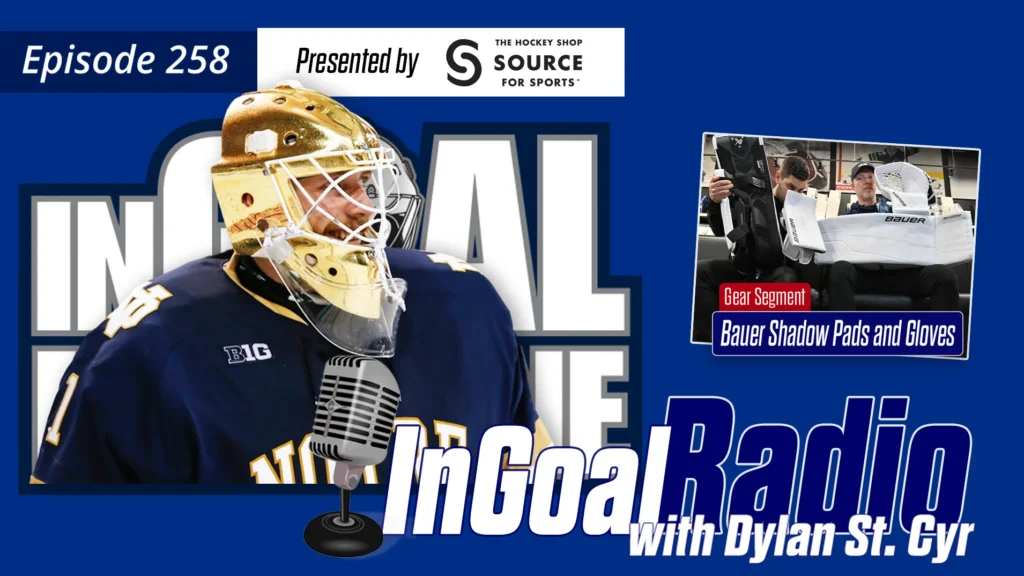
InGoal Radio Episode 258 with Dylan St. Cyr
Please subscribe and leave a rating — it helps us reach more goalies!


Dylan St. Cyr, the 5-foot-8 son of NHL pioneer Manon Rhéaume, played through the US National Team Development Program, Notre Dame, Quinnipiac, and Michigan State — where he started 37 of 38 games — before turning pro in France. St. Cyr emphasizes that smaller goalies must eliminate margin for error, and now passes those hard-won lessons to the next generation coaching camps at Armour Goaltending alongside his mother and coach AJ Walczak.
- Dylan St. Cyr overcame height stereotypes as a 5-foot-8 goalie by developing a technically sound foundation that allowed zero margin for error at every level of play.
- St. Cyr's NCAA career included stops at Notre Dame, Quinnipiac, and Michigan State, where he started 37 of 38 games to cap his college career before turning pro in France.
- Being the son of Manon Rhéaume — the first woman to play in the NHL — shaped St. Cyr's path through elite goaltending development, including the US National Team Development Program.
- College goalies facing limited minutes should build consistency in practice and preparation, as St. Cyr's experience proves opportunity can arrive suddenly and requires readiness.
- St. Cyr now coaches goaltenders at Armour Goaltending summer camps alongside his mother Manon Rhéaume and longtime coach AJ Walczak, applying his professional experience directly to player development.
Episode 258 of the InGoal Radio Podcast, presented by The Hockey Shop Source for Sports, features a fantastic and informative interview with American-born, now France-based pro Dylan St. Cyr.
Feature Interview
presented by NHL Sense Arena
In the feature interview presented by NHL Sense Arena, St. Cyr shares his roots in the game as the son of Manon Rhéaume, the first woman to play in the NHL, and his path to the US National Team Development program, then college and now overseas playing professionally in France — all as a 5-foot-8 goalie. St. Cyr talks about he overcame some size stereotypes and other situations where it left him with no margin for error, and the lessons and advice that come from trying to overcome both, including some really important thoughts for college goalies. He also gets into playing style and the foundation that allowed him to excel even in limited minutes at Notre Dame and Quinnipiac before finishing his NCAA career by playing 37 of 38 for Michigan State, and how he applies it all now as a coach working camps this summer with his mom and long-tome coach AJ Walczac at Armour Goaltending You can find them at: @Armour_Elite @Dylanstcyr @Armourgoaltending
Parent Segment
presented by Stop It Goaltending U
In our Parents Segment, presented by the Stop It Goaltending U app, we share 5 great tips for new goaltending parents.
Weekly Gear Segment
presented by The Hockey Shop Source for SportsWe also go to The Hockey Shop Source for Sports to look at the new Bauer Shadow Pads and Gloves.
Episode Transcript
Intro
This is gonna be so much fun. We get to hang out with the mayor of Goalieville. It is awesome. I I can't believe it. I'm I'm I'm my heart's fluttering right now. It's InGoal Radio, the podcast brought to you by The Hockey Shop Source for Sports Langley, thehockeyshop.com, Daren Millard, along with David Hutchison, the cofounder of InGoal Magazine, and the mayor of Goalieville.
It's Kevin Woodley over at the USA Hockey Goalie Symposium.
I is confused. Why am
I the mayor? Because you were like the star of the USA Hockey Goalie Symposium.
No. No. No. No. No.
No. Didn't even speak at the USA Hockey Goalie Symposium, but I sure
Because everybody was talking to you.
I will say, and I wanna make sure I give a shout out. And if I were to try and remember every name, I would miss one and that would suck. I met so many people that listen to this podcast, and a lot of them subscribed to InGoal InGoal Magazine, the premium product. And so I was not the mayor, Daren. Let's make no confusion.
I was just a guy on the wall in the background, but I ran into a lot of people that said some very kind words about what we do here on the program and talked about car rides that they've listened on and car rides that got them through and lessons they learned from our various guests over the years. And so I wanna shout out two things. I wanna shout out USA Hockey for including us in their first ever National Goaltending Symposium and Expo here in Saint Paul, Minnesota. It was a fantastic event. Look forward to sharing some of the details with all of our audience talking about it here today, but also over at ingoalmag.com in the coming months, some of the concepts and and ideas that were presented there from the various people, some great takeaways.
But mostly, wanna shout out all the people that came and said hi, introduced themselves, and shared moments where InGoal Radio Podcast, helped them with something or just enjoying it. It can be a grind as the three of us know sometimes, just even to find a moment on the schedule when we can all be together to talk to do the intros. It can be a grind sometimes to find guests at different times of the year and keep this all going. But those interactions and those stories to hear from those people this weekend, just put a like, just a giant, not to go soft on your hair, but just the the biggest warm fuzzies that I've had in a long time. And it it it meant an absolute ton.
It meant a ton to hear those stories. It meant a ton to hear that the work we're doing is being so well received, by Goalie Nation, and and by so many different goalie coaches. So, yeah, thank you to everyone. Special shout out to Steve Brochu for making me cover my ears during his presentation because he included a clip of me and Steve Valiquette in it, and you guys know how much I love hearing the sound of my own voice. So that was kinda cool.
And Just the whole it was incredible to be a part of. They're doing a lot of great things down here. And mostly for me, just those warm fuzzies. Thank you everyone that came and said hi and introduced themselves to me and shared a story.
It's kind of a unofficial gathering of InGoal Radio, the podcast. Stop It Goaltending U the app. Stop It Goaltending had a presence in Minneapolis and so did, our buddies over at Sense Arena.
That's a good point. Side by side at the trade show, the expo trade show was excellent and that was one of the positives. Got to meet Tyler Lipinski in person. The great Tyler Lipinski who does so much behind the scenes for Sense Arena including making sure our accounts all work and babysitting Woody when he's a dummy and can't figure out the tech. So thank you, Tyler.
And then Brian Daccord got to spend a lot of time with Brian Daccord at this event. He had a booth there, was very popular lineups, a lot of people for both products throughout the day on Saturday at the expo. Just a great chance to sort of, you know, sit around after the event with a bunch of different goalie coaches, Brian included, and just share ideas and stories and listen to them talk. Also, you know, massive shout out. We haven't had him on the podcast in a while, but Justin Goldman was one of the presenters there, for Lift the Mask and the work he does on the mental health side of the game.
So, you know, I wanna make sure I gave a huge shout out to him. It was really special. There was a lot of there's a lot of focus on goalie mental health throughout the weekend. There was a sports psychologist, Julia Allain, whose dad, Keith Allain, was one of the first goalie coaches in the NHL, former NHL goaltender. She had a fantastic presentation. There was a lot of focus on mind and mindset, mindfulness, but also taking care of mental health. And I think sometimes I forget to just thank Justin for all the work he does in that sphere through Lift the Mask.
So that was cool to see him up there presenting as well.
Lift the mask and, don the headset, if you're feeling great, with Sense Arena, an opportunity to really connect with people.
Sure is. And I was so jealous that I couldn't be with, Woody on this trip. I'd had some cool stuff going on here at home that, that kept me from that, unfortunately. And it would have been great to connect with our friends from NHL Sense Arena especially because it's that time of year, guys, when people are preparing for their next season. And who's got you covered better than NHL Sense Arena?
One of the things I love about NHL Sense Arena guys is the fact that they're continually upgrading it, adding new things, modifying the product. If you could put the headset on and check out what we first saw and we're so excited about, it's just completely different from what it is today. And one of the things I was thinking about in terms of getting ready for the summer is all the training plans that they have in NHL Sense Arena. When they started, I think it was four or five different training plans you could follow along to help with your training. Well, today there's an app, iOS, Android.
You open up the NHL Sense Arena app and they've got an option to assign a training plan for you to complete. Are there four training plans there now, guys? No. There's 52 different training plans when I went and counted through today. Everything from Joey Daccord's morning skate to one by Brian Daccord we were just talking about to multiple training plans approved by USA Hockey.
The people that were hosting Kevin and so many great goaltending coaches this weekend to another guest at the symposium, Maria Mountain, has her own training plan to help you build your off ice stamina using NHL Sense Arena. So if you'd like to work on your training this summer, it's an incredible investment and they've got lots of tools in there to guide you through your training. Remarkable tool. If you want to become the best goalie you can this summer, it's well worth considering adding Sense Arena to your toolkit. So head over to sensearena.com, check out all the features, grab your headset, get it on, start training.
Maria was awesome here
too. Not one dimensional.
Maria was. I'm sure she always is.
I was just thinking, like, it used to be one dimensional, like train, look at pucks, and but there's so many different add ons to it now.
It's unbelievable. And look, that's some people say, why do I pay every month for some software? Well, the the world has changed. And companies that are are taking subscription for software like NHL Sense Arena, They are investing that money all the time, continually improving the product. And, it's just so exciting to see something new come down all the time.
Then we know they've got some great stuff, because they've given us a few hints, but we won't get into that just yet, guys.
Lot of you know what the other thing that I noticed about NHL Sense Arena at the expo? Kids were the just kids having fun.
I got hay.
Kids having fun.
We're gonna
talk about stopping. Virtual pucks, and that's that's important. That's important because one of the other messages from the symposium was, you know, a shortage of goaltenders, you know, on this side of the border down in The USA and and a bit of a challenge there. And so I I hadn't even thought about it till we were just talking about it, but watching how much fun they were having doing it in that environment, you know, they've added a gameplay element too. Right?
Like, you can compete against other people. So you you build you work on competitive skills as well while you're in there, but you can have fun too at the same time. So it was great to see that. Probably the biggest lineup if you ask me, like, that was that location. Big crowd gathered around on the NHL Sense Arena booth and Tyler Lipinski doing a great job.
He was grinding, man. That it was a six, seven hours that it was open, and he was busy the whole time.
It's all probably as big a lineup as the Kevin Woodley autograph booth, wasn't it?
Yeah. That was a short line. A very short line. I did sign my name to something this weekend.
Did you?
Oh, yeah?
Yep. Hutch Your hotel? Yeah. Hutch will see it in the expense report. Yep.
You should be in the dunk tank.
There you go.
Yeah. Maybe. Maybe.
New idea for TendyFest.
Oh, please please don't give them any ideas. We'll put Cam in a dunk tank.
Hey. It's just around just around the
corner though, Woody. It is. You're right. The the parent segment, brought to you by Stop It Goaltending U, the app, five tips for new goalie parents, and the Hockey Shop Gear Segment focusing on the Bauer Shadow Line, which people will get an opportunity to see up close at TendyFest.
Yeah. TendyFest is less than two weeks away now, June 15, 01:00 Fleetwood Arena. Listen, you can check if you if you don't have the details, check all the Hockey Shop, Hockey Shop Goal socials. Hopefully, you subscribe to our newsletter. We sent it out last week.
If you're not, make sure you get on our news. Hutch, how would if I wasn't subscribing to the free, I should stress free, weekly newsletter by email that InGoal sends out, where would I sign up for that?
Yeah. Ingoalmag.com. If you are not a current subscriber to InGoal Mag, when you scroll down, you'll actually see a little offer to come and join us at InGoal and an opportunity to sign up for the regular weekly newsletter. You wouldn't see that, Kevin, because you're probably logged in. You stay logged in once you're a member, but everybody else will see it.
Cost you nothing. Just get your name on there and then we'll let you know what's going on, at InGoal and in the goaltending world in general.
Yeah. And if you had been a subscriber to the free newsletter, let's be clear. There's a free newsletter and then there's our paid subscription to the website, but you can still get the newsletter for free. And that would have let you know all the details and all the links for TendiFest. So we'll have that again in next week's newsletter as well.
So make sure if you haven't already, up for that because TendiFest is gonna be amazing. Confirmed guests. We can confirm on the ice teaching some behind the net play, and then a quick follow-up in a classroom session and a q and a with none other than Bill Ranford. So that's a special guest we're bringing out to TendiFest with us from InGoal Magazine. Can't wait for a special afternoon.
Again, on the ice, you can listen to Bill Ranford walk through net play segment, and then in the classroom, we'll go over it real quickly, and then we'll open up to a q and a, and that can be about the teaching he's doing specifically or about anything. We can get into sort of development, young goalies, some of the things he looked for on the scouting side, whatever you wanna talk about at Tendy Fest, June 15, brought to you by the Hockey Shop Source for Sports in Fleetwood. Check their socials, check our email, get the details on how you can go hang with us and Bill Ranford.
I can't believe this happened this year, but I coached some junior goaltenders and I told them how excited I was that we'd done a podcast with Bill Ranford and they looked at me with blank stares because they didn't know that Bill Ranford is the director of goaltending for the Los Angeles Kings, three time Stanley Cup winner, an incredible person. Check out the InGoal interview if you don't know Bill, but I'm sure most of you do and would love to come to TendyFest and check out what he does.
Yeah. He's awesome. And then again, I was gonna say the other thing too is don't forget, yes, we've got special guests. Yes, there'll be booths where you can check out the latest and greatest. But of course, the biggest part of TendyFest is take the latest and greatest InGoalie equipment on the ice, including including you can multiple different profiles on your skates on the same ice sheet.
They will switch them in and out. You're gonna have the ability to test different sort of blade profiles through our friends at Pro Sharp.
[crosstalk] It it all funnels through Hockey Shop and Cam. Huge gear giveaway too. Oh, huge gear giveaway. So cool.
$500.
So many reasons to come and you can get Kevin Woodley's autograph.
I'll pay you for it.
I would pay for that.
Somebody I will pay I will pay the first person that asks just to make me feel good.
Are you gathering some content for InGoal Radio, the podcast over at the USA Hockey Symposium?
Yes. We are gonna have a ton of guests out of this week. I don't know the order we're gonna run it in, but we've already locked down and done interviews with the New Jersey Devils, NHL goalie coach, Dave Rogalski, in combination with their American Hockey League goaltending coach and development coach, Brian Eklund. So we've got that one in the can. Phil Osaer, the director of goaltending and scouting for the Detroit Red Wings, former, national goaltending, like ran the national US program for goaltending.
He the was sort of first one in that position, created the 51 in in 30 initiative, was a big part of the bronze, silver, and gold medals creating that, and we're sort of starting seeing all that come to fruition. We had him on the podcast talking about the state of goal tending, and his role Now with the Detroit Red Wings, we have Alex Cavallini, two time Olympic champ or, yeah, two time Olympian with USA Hockey. She just recently had a child. She's she's sort of out of the game right now, but talking about her experiences on the international stage in college, growing up with coaching, some great tips and advice from her. We've got Mike Richter lined up for the very near future after getting a chance to meet him here and sort of locking that down.
Hoping to have an interview with Charlie Lindgren tomorrow. We confirmed some time with Alex Lyon. And, also, we just have we have a ton. Like, by the end of the the end of this, I got three in the can right now and probably another four or five coming. There's gonna be a lot of USA Hockey Goalie Symposium content at InGoal Magazine, podcast in the coming months.
See if we can keep up, with all the news, which includes some shuffling in and around the National Hockey League go with some different positions, a couple of New York teams, and the Nashville Predators with a reunion with a good old buddy of ours.
Yeah. No. I don't think this is surprising the goalie coaching world. I think when Barry Trotz took the job as a general manager of the National Predators, a lot of people were just wondering, when does Mitch Korn's contract expire within New York Islanders? And sure enough, it did. And he's in Nashville reunited with Barry Trotz in a director role. I love seeing when teams are expanding in the director role, and this creates one more. Nashville didn't have one.
Now they have Mitch Korn. The New York Islanders continued in a directing role promoting Chris Terreri up into that and hiring a new American Hockey League coach. Incidentally, Ilya Sorokin's former coach in the KHL is now gonna be their American Hockey League goalie coach. So, yeah, big news. I mean, selfishly, I'm very happy to see Mitch Korn back in Nashville.
It feels natural to see him back with Barry Trotz in Nashville, but it also means that, hopefully, I don't know for sure, but hopefully, the media moratorium that he was under with the New York Islanders and Lou Lamoriello is over and we'll actually get to talk to Mitch again, at least on the record. We'll get to share those conversations with everybody else for the first time in a long time. It'll be special.
And the New York Rangers also with a little bit of an offering force?
Yeah. And after being eliminated, the reports came out that Benoit Allaire, Benny Allaire is moving into a director role and some speculation on what might happen beneath that, who moves up. I've heard different you know, there's there's different takes on what's gonna happen. I can be honest with you. I knew that Benoit was done as the goaltending coach of the New York Rangers several months ago.
I don't know that that was a state secret. I think that around the goalie coaching world was something that got out. But there were a lot of people that I was just gonna, you know, straight up retire, rather than moving into the director role. That was kind of the buzz that was around that. Benny has not traveled for a couple of years now with the Rangers, so I haven't got a chance to even see him in Vancouver because he doesn't travel anymore.
And so it was time to move up into a different role that's maybe a little less demanding physically. The goal and I think we underestimate how much of a toll the goalie coaching position takes on the body. You know, I know goalie coaches with knees that are shot or barely hanging on shoulder surgery, remember, with step on weight both sides. It's demanding when you you know, the amount of time you're on your knees and demonstrating and things like that, and just even being on the ice as often as they are. So, I mean, an incredible career, a guy who, you know, you've heard me make the argument many times Francois Allaire should be in the Hockey Hall of Fame.
And Benoit, even though he's continuing to be employed, and Mitch Korn still in director roles, they should all be in the Hockey Hall of Fame with Francois. So congratulations to Benny on an incredible career as a goalie coach, and you know there will be continued success as long as he's involved with the organization in the position in a director role.
I don't know the number. I should. But roughly, how many teams have a director of goaltending?
Well, we just we just went and did a little math here after you asked me that, Daren. I got kinda depends. There's a couple where the director title exists, but maybe that's not all they do. But at the end of the day, the director title, as far as I can tell, is attached to 13 different teams in the National Hockey League in total. So almost a third.
That's good
and growing. Yeah. And that's what we like Yeah. To We like to see support. You know, it's funny. I think we talk about goalies being an isolated position and you really can feel like you're out there on an island sometimes. That happens to goalie coaches a lot.
Now you're part of a staff for sure, and you have a family within that staff and that becomes quite tight. But in terms of understanding the position and what you're trying to do, it can be very isolating at times and you can feel like you're in a bubble. Some organizations, you're never allowed to talk to anyone, and that can be even more isolating. It can be hard to stay on top of things and develop when organizations What do mean you're
not allowed to talk to people?
Well, you're just not allowed to talk to other people in the position outside the organization. Like, you really they do put you in a bubble. You're just cut off. You're not allowed to attend you're not allowed to, for example, attend a symposium like this. There are teams that just don't want you sharing their stuff, so they don't allow you to go to things like because it's very real thing, and it becomes a very lonely position.
So having a director, even to have somebody that you can talk to about the things you're trying to accomplish, and in these cases, guys with incredible amounts of experience doing so, you know, hey, listen. Some goalie coaches maybe don't want somebody above them, but when they've been doing it for as long as they have, if you can't find value in having that person as an adversary on your side as part of those conversations, I think we may be doing the the position of director of goal tending a disservice.
We love our net minders. The NHL Sense Arena feature interview will discuss, things with Dylan St. Cyr, a six year NCAA goaltender. COVID, obviously offered up some opportunities, and, we'll walk through, his wonderful journey, and he's playing in Europe right now. Also, really cool backstory with Dylan that we'll expand on as we go through it. But the Gear Segment brought to you by The Hockey Shop Source for Sports Langley, thehockeyshop.com.
Touching on the much anticipated Bauer Shadow line.
Yeah. And hey, listen. You're gonna hear this. There's some elements of this that definitely require visuals. Right?
The all new toe ties that we got a sneak peek at, not visually, but a tease. Eric Portillo. I don't know if you guys remember when Eric was on the podcast and we started talking gear and he talked about his shadow and how much he loved the new toe tie system. But then he was, like, worried that he'd spoken out of turn and couldn't share what they were with us. Well, now you can see what they are.
And as you hear us talk about it, make sure you go check it out at YouTube. The video is already up. It was up almost a week before the podcast came out because Hutch is on top of things. The launch was a little over a week ago. There are a lot of cool new elements to the Bauer Shadow line.
We get into them now with Cam on the podcast, but be sure to go check out the YouTube channel so you can see it as Cam describes it.
Gear
Welcome back to The Hockey Shop Source for Sports. I'm here with Cam Matwiv, and it is an exciting day here at the hockey shop. Exciting.
Exciting.
We're a little delayed. We're about a week behind. You've been selling this for a week. The new Bauer Shadow line. We're gonna get into everything.
Pads, gloves, sticks, chest. But today, we're keeping it to the pads and the gloves. Cameron Matwiv, can you tell me about the new Bauer Shadow Pad?
I shall. I can. So, yes, we are looking at the brand new Bauer Supreme Shadow Pad. So let's go over some
the Hold on right away. Oh, oh, Bauer Supreme. And if it's a supreme line, I'm thinking a little more stiffer profile compared to the Vapor Hyperlite model.
Yes. But some differences from the Mach that are very important and stark starting with because I happen to have my hands on it right now.
The Mach being the previous iteration of this Mach. Mach? Who's Mach? It's a buddy of mine.
Yeah. You know what? The buddy is now talking about the Supreme pad. Cam's got the
New Supreme Shadow. I'll shut up and let Cam go.
There we go. Good. So stiffer outer roll, this has changed since the mock. So what they're trying to do is to help to prevent those pucks from skipping over. We've heard about this before from other brands.
It's now kind of really being brought into the foresight. We are seeing a lot of those pucks start to bounce and ride up the face of pads, especially in tight situations. So that stiffer angled outer roll back to in front of the pad itself will help with that puck that's kind of rolling up. Now deflected back in front. Good starting point.
Back of the pad. One of the things that I really, really like and then changed up since the mock pad is actually the calf system. So while they now made it contoured so that when you actually sit into the pad, it almost creates this nice comfy cushion, for your leg as you're actually driving down to the butterfly. Before, it was more of just straight a wedge. This is actually, again, now contoured and the way you flit into it doesn't affect rotation or anything like that.
So you're creating a great overall feel without sacrificing any of, that good rotation that we've had to come from the supreme pad.
I don't wanna get into, legal and not legal, but there's no way that's legal in the NHL, is it?
You're mister NHL locker room.
I mean, I'm gonna have to look into this one.
So tune fit plus still returns as well. Again, we saw this on the mock pad. It's now, you know, transferred over to the shadow. This system is swappable with just the regular tune fit so that you find on the vapor pads as well. It just Velcros in and out.
So you do have some immediate customization on your own without having to order custom as well.
Tight or loose, you can adjust that. How how tight you want that to fit just with Velcro tabs. And what about this outer tab? Will that go
On the inside? Or I've actually seen you guys go all the way to the outside with it, although it's not necessarily the way it was 100% intended. I mean, it still will work. I wouldn't try it down there, though. That's when it starts to get a little wonky on you.
One of the nice things that have carried over from the Hyperlite pads too as well is that bottom cap strap as well just to help seal and carry that more roundness to to the actual leg channel itself. We still have the ability to pop in a bootstrap. They still have the pocket for it over in there and also hidden on this side as well.
But it doesn't come with.
It doesn't come with. What that now leads us to is our new toe tie system as well.
Oh, we had a goalie tell us about this a while back, tease us about it, now I can't remember who it was.
What they basically tried to do here is create that gap, especially for now integrating, your toe into the post of the, the net itself. So by having that loop gap there, we're now creating a more area for that skate to get in front of the post, or sorry, behind the post and allow that boot to get in front of the post and help to seal it off. Bungee elastics, still there. Still a nice simple system.
So there's no elasticity to that initial gap?
No. This is just straight nylon. So
I like that. Okay.
So we have a fixed end point.
Is this adjustable or is it a fixed length?
It's a fixed length.
Have you measured it?
Looks about an inch and a half to me.
Okay. We're gonna have to get the tape measure out and and see, you know, compare like, you know, the old Demko, like, has a very specific formula relative to the post in terms of wrapping. We'll have to see if whether that satisfies it. Okay. Is it easy to move remove in and out?
This is new things. We can't skip over new things. I'm excited by this. I see you have four different attachment points.
Yes. Because you can offset the toe bridge.
To various degrees. Does this is it pretty easy to sort of move it around and change it? You know what? You don't wanna make
it too too easy. Otherwise, it would come out
Right.
Fairly easy. But, yes, you can slide it back through those holes and take it through. So we're just using that rubber piece and pinching it and sliding it through.
Nice. Bauer is innovating. I like this. So new ways.
Couple quick things to kinda go over too as well. It's still we see the return of. Stabila Slide Knee. So that stiffer version versus the Hyperlite pads. Again, as you're driving down into that butterfly, we're creating that support surface.
Great overall stability for the pad, thus calling it Stabilla. Your overall calf plate and overall knee plate remain very, very similar to what was on the mock itself. Nice and hard, great slide of service. It's our slider two point o skin, which is an advanced advancement of the original Cortex skin itself.
Offset, little channel in here. Correct. Primary point of contact is that thin little strip here, so reduces the amount of contact points on the ice, which of course reduces friction, which allows you to slide faster. Yes. Unless you can and you've got a butterfly about as wide as my hands.
That's great.
Oh, you know. Tougher.
That's why you have good stick discipline. You keep it covered. So last really key thing we ended up cover with the pads itself, different flex profile from the mock pad. Mock pad was a stiffer pad than the Shadow. What's changed here is they've gone back to what will be their mid flex or closer to their ultrasonic stiffness profile.
It's getting a bit more s bend, natural s bend to the pad itself, bit more thigh flex up top as well. That said, you still have their CURVEx composite in that thigh to help prevent against those trapdoor goals.
That's still a pretty stiff pad.
It's still a pretty stiff pad. So don't get us wrong. It's it is a stiffer profile, but it's not as stiff stock as the mock. Obviously, options available custom. You should definitely go over, but we should move on because there's still the glove and blocker
We still got more to go.
We still
got more grab the glove, Cam. I got the block.
Shadow glove. What's different from the mock? Same break angle,
very simple. It is.
Their overall 600 style break. Thank you. Using that full hand style of closure. Very easy closure out of the box, I must say. Very comfy materials on the inside so that continues over from the mock.
Very open backhand, again, over from the mock but we can see the addition of somewhat kind of wrist strap. It's not as far down. So you're still creating that great presentation that the mock can do with very easy rotation and range of motion.
This is the first time that great presentation in cam have been mentioned in the same sentence.
Great presentation, Cam. That's me. So easy adjustment, nice tight backhands, overall nice wide opening. What does really set this apart from the Mach is it's actually an inch bigger. So what we didn't really touch too much on is that the older mock was actually not full regulation size, believe it
or not. But you tell me now Cam.
Hey, we like to keep a little few secrets here. So this one is now full regulation size. So, yes, when you put the mock and shadow side by side, this one will be
bigger. Where's the extra inch, Cam? I got it.
In the overall perimeter. It could be here. It could be there. It could be over there. So it's a perimeter size.
You've been selling people an undersized glove for all these years?
I didn't sell them. Blocker. K. So continuing off of
I ought to punch you with it after telling me you've been selling it.
Off a popular Mach blocker, biggest change you're gonna see in the sidewall in particular. So we saw that great rotation and easy range of motion that we would find at the cut piece of the mock as you're comparing that from the vapor to the, what would be now the shadow line. Again, more open, sidewalls change. It's actually elongated. What I do find is is that there's a bit of interference just with the way that this is cut in terms of how the stick grabs.
So make sure you do pick up at the stick, have that feel because you will feel the difference between that and the older mock blocker out of the box for sure.
Let's see how you can't get it. Is there a little extra padding on the index finger here, Cam? Is that new or is that part of the mock too?
Just a little bit of extra. We are upgrading the overall palm of the blocker itself. So we're adding an additional piece on that side. So again, those pucks that are riding up the stick, you have that additional protection. Nice tight fit in the palm.
Yeah. Dura Connect really nicely. You know, they got rid of the extra material a few years ago and made that a nicer fit. I am feeling that extra protection in around the index finger. Nice.
So if you have questions about this line, can give us a call. (604) 589-8299 or 1-800-567-7790. Lots of ability to customize. Let's not forget DigiPrint. That's also something that can be done for these pads.
A blank canvas for your creativity.
Exactly. So give us a call and talk about it. We disappear off into the shadow.
What what was your first reaction? And, Hutch, I I know that you're involved in this as well, when you guys finally got to see the new Bauer Shadow physically in front of you.
Well, okay. It's exciting anytime we get a new piece of gear. So, we tip typically do four to five of those segments at a time with Cam over the Hockey Shop, so it's really cool. But the Bauer Shadow specifically, there were a couple things that jumped out huge to me there. Aside from those toe ties that Woody was mentioning, the new calf pillow system.
And you can see that on the video if you go check it out on YouTube. The fact that it's kind of contoured and and hugs you really nicely. I thought that was super cool. And I was blown away standing behind the camera when Cam mentioned that the new glove is actually larger. Like, can you believe the guys were playing with a not full size glove?
That was kind of huge to me. So to think they've got that now, pretty, pretty cool.
I also felt like I've been living a lie for a long time.
Well, everything's being shrunk. Right? And to be able to get it, expand on your coverage is is really different.
You know, I I it it the funny part is it felt like the pocket area just felt big when you put it on, but I never thought anything of it. And then Cam says, oh, yeah. By the way, the other one was about an the perimeter of it was about an inch below max regulation before. Well, now it's full max. And I don't think it's just that they added the inch and got to the full maximum allowable circumference, but there are some elements as to how they did it that just make the pocket feel massive in this thing.
And so I haven't had a chance to go out and catch pucks, but I think Hutch is right. That really jumped out. The other part that jumped out, obviously, was the new toe tie. And it's a great idea. I love the innovation.
Essentially, it's another new way of creating pre creating the gap between the bottom of the pad and the toe of the skate and having it a fixed length. You can anchor it at multiple different points more than you could before from centered to offset to various degrees of offset. I can't remember how many points. Go check the YouTube video. Be able to count them as you watch.
Four, says Hutch. But at the end of the day, like, we're we're going through great lengths to do something other than tying a bunch of knots in the toe of this gate, and this is another new one. It's quite different. I'd never seen anything like it. I like the the idea of a fixed non elastic lead, and then you can still have elastic around the skate because obviously, any elastic in the lead between the skate and the and the boot can cause issues pushing off post, that's gone.
But there's still elasticity and simplicity in terms of how you do up the Velcro straps beyond that. So I like that. I'd like to get it on the ice and play with it and see if it performs the way it was designed. And I await the opportunity to do it. Again, we always like innovation and new ideas and there's lots of it in the new Bauer line.
InGoal Media on YouTube is where you can find the visual of the Bauer Shadow line. So check that out. It's playing actually right down to my left. I'll have to rewind it because I can't do two things at once, but I'm I'm liking what you guys are There's always just different elements. Even I I can't hear what you're saying as this thing plays, but I can tell that you and Cam are chirping each other, which, which is always good.
Daren, I think, like everybody everybody listening, we'd love it if you'd leave a comment there. Let's get the discussion going. Let's get more people. Let us let us know what you think of the new Bauer Shadow Line or whatever you're wearing.
Can I can I leave a comment?
I was also told that my comment is from the people at USA Hockey Symposium of the all the people that came up to me. There was one, maybe two or three that suggested me and Cam have a cage match. I told them it's all in good, Justin. We are truly good friends. We're just having fun with it.
Still like cage match?
Tendyfest.
I'll take that.
TendyFest. Pay per view.
I take it. I signed up for that. We've got
Parent Playbook
I'm assuming I'm the Mike I'm the Mike Tyson and he's the Jake Paul of this this boat.
NHL Sense Arena feature interview is coming up with Dylan Sense Arena. But first, let's slide over to the parent segment, brought to you by Stop It Goaltending U, the app. What do you got for us this week, Hutch?
Five tips for new goalie parents. We were driving along in the car today, actually, to a rink to check out, camp that was going on and just watch some hockey. And I said, hey. I think it's time to talk to new goalie parents. What should we talk about, Maddie?
And between the two of us, we came up with five new tips. But Woody, tell us a little bit more about Brian Daccord because you guys were hanging out this week.
Yeah. It was great. You know, it's funny that you mentioned five tips because as we were going over some of the things that they're doing at the Stop It Goaltending U app, like, it really is a lot of quick hits and easy tips. The ability to deep dive, if you wanna spend a lot of time on a certain subject and improve in a certain area, but just those constant reminders and refreshers. We talked about mental training with Pete last week and how it's all about doing it daily.
There are there's something quick and easy every day in the Stop It Goaltending U app to help you get better, and it evolves constantly over time. Yes. There are longer lessons you can dig into, but there are nice quick and easy tips. At the end of the day, you combine it all and, like, thirty minutes a week guaranteed, you're going to be a much better goaltender for the time spent with the Stop It Goaltending U app. And, of course, now all new subscribers to the Stop It Goaltending U app also get a subscription to InGoal Magazine.
So, yes, me and, Brian Daccord hung out a lot this weekend here at the USA Hockey Goaltending Symposium, because those two things go together. InGoal Magazine and the Stop It Goaltending U app, they go together very nicely. They're a great way for goaltenders to get better and enjoy the position. It's enjoyable. It's fun to watch NHLers break down their saves.
It's fun to watch the guys that Stop It Goaltending U share their expertise in quick little hits that'll make you a better goaltender every day, and now you can combine the best of both worlds. A subscription of the Stop It Goaltending U app gets you a subscription to InGoal Magazine.
Get on it. Let's go. And if you're a new parent to a a goaltender or if you're a parent to a new goaltender, I should phrase that, or if you're a new parent, something's sometimes things come out of the blue. This is a situation where you can get educated on the position with Stop It Goaltending U, InGoal Magazine, and here to help us out is David Hutchison.
Yeah. I think both Stop It and InGoal are great ways for parents to learn about goaltending. Although this segment this week, guys, is tips for new goalie parents, I would like all goalie parents to listen in because if I don't mention something that you think should be mentioned, let us know. Parents at ingoalmag.com. Let me know what your tips are because every week, we actually publish the parent segment as a separate piece over at InGoal.
And it would be a great place for you to also go there and leave a comment and people can, can hear from some more things and maybe we'll add in some other things over time as we hear or do another segment in the future if you've got some other tips for us. But new goalie parents, for me, before we get into the tips, boys, this all starts with philosophy. What is your philosophy behind your kid being a goaltender? Why did you let them become a goaltender? I'm hoping that the answer is that you want them to have fun.
Something is we've talked about a bunch of times already, when Woody was talking about Sense Arena especially. So my tips are around that. And I think it's important that we don't get sidetracked from our main goal, which is letting them be kids, letting them have fun, be patient, or you will quickly be the parent of a former goalie and that's not what we want. So round about that, here's what we talked about today, that we would like to share. Number one, find out how to wear the gear properly.
If you are new to goaltending, find yourself a goalie. I don't care if he's a 12 year old goaltender at the local minor hockey association. Find it through Facebook by asking other goalie parents in your other parents in your area, a coach, whatever you do really early or get into a place like the Hockey Shop and talk to somebody like Cam and find out how to put the gear on properly because it's almost impossible to have fun if you're not out on the ice wearing gear that fits properly and is worn properly. How many times have we all seen a brand new goaltender out on the ice with the pads on the wrong legs or cinched up as tight as possible or talking about those toe ties earlier, those toe ties dangling on the ice where they get cut because you step on them and the pads flopping around. Look, can't blame the goalie parents for that because it's hard to know all these things.
But please, if you've got a new goalie in your family, find out as soon as you can how to wear the gear properly. You will make them have much more fun on the ice every single time. And I think we should probably publish that guide over at InGoal at sometime soon, boys. Number two, when you are getting gear, think about safety and comfort more than anything else. Maddie looked at me and he said, tell them get a new helmet before they get a new stick.
And he was thinking the most important thing is that you have to feel safe and you have to feel comfortable on the ice. I can remember at age 11, Maddie was flinching, worried about shots that were coming high. I went out and spent probably more than I should have on a beautiful helmet for him. I've not seen him flinch at a shot since. And so whether it is getting a helmet before you get $2,200 fancy pads or before you buy a $400 stick, invest as much as you can in those items that will make them feel safe and comfortable on the ice.
Number three, learn how to skate. That comes up actually in the feature interview this week, so listen in. If you can't skate, you can't make saves. But if you can skate, you can probably make a few accidental saves even. And it's not just about skating around the crease.
And that also comes up in the feature interview this week. It was really cool to listen to that after we'd written up this parent segment. I don't care if you go to power skating lessons, if you put on some player skates and go to the local drop in to play shinny or whatever you might do. Learning how to skate well will help you enjoy the game more. Plus, it's miserable not being able to skate when you're dragging all that extra gear around on the ice as a young goaltender.
So skating, skating, skating, but make it fun.
I actually thought you were going to say that the parents should learn how to skate when you first start.
Well, you can go with your kids and learn too. Yeah. You can also put Sense Arena on and learn how to stop pucks parents.
Love that.
From a coaching perspective, it doesn't need you don't need a whole lot of coaching as a young goaltender. And any coaching, make it fun. If you're not sure where to send your young goaltender for some coaching, go check out what you're seeing on the ice and are the kids having fun? I was so lucky that when Matty first started working with some other coaches as a youngster, they understood that he was a little bit goofy. He needed to have some fun out on the ice.
We want them to enjoy being goaltenders. We don't wanna be running through drills until they're completely bagged and focusing on technique and just let them be athletes and let them have fun. Fifth, goaltending is like golf. One big save will keep you coming back again and again, just like one big shot in golf will keep you coming back again and again. So focus on the fun.
Find one thing that your kid does well that day, raise it and forget everything else. It can be like that big 300 yard drive that'll make them want to come back on the ice the next time. You don't need to talk through the goals. You don't need to worry about the score after a tough game. Just go over what they thought was fun that day.
Forget everything else. I think I've told this story here before. A buddy of mine, his kid played goal in a game at about age six. They got absolutely destroyed, and I was felt so bad for the kid. He stepped off the ice with a massive smile on his face and he said, did you see that glove save?
It's all that mattered to him. Focus on the fun and you will have a goaltender who loves the game for many, many years. So that's my five and I'm gonna give you one bonus tip, guys. Get your kid a baseball glove and use it a lot. Learn how to catch.
That's about it.
Like play catch. Actually Like Yeah. Just learn how to catch.
Oh, learn how to catch. Actually, have a little a little fun story that goes with that one as well. When Maddie was a very, very young baseball player, I'm gonna say six years old, maybe younger, he was scared of trying to catch a pop fly. I was chucking balls up in the air and he just did not want to get hit by that thing. Even though he could get
Throwing him into the sun.
Yeah. And he could catch pitches and he wasn't worried about that, but he didn't like fly balls. So what did we do? We got creative. I said, go get your goalie mask.
Put his mask on and then nothing scared him. Didn't have a problem after that, which gets back to that thing about goaltending on ice. If you have the right gear and you're wearing it properly, you're gonna feel safe and you're gonna have a whole lot more fun. So that's it. Oh, and subscribe to InGoalmag or the Stop It Goaltending U app.
I thought that was number one.
It was number one, and then it was it was number one, and then I circled back. On you. No. I circled back because Woody started with that. And if you if you read all the great stuff that Woody publishes, he always starts with something in the first paragraph and then the last paragraph he cycles back to it and just sort of reminds you.
So it's something I've picked up in my
learning Like a good comedian. Course. Ties us all back.
Yeah. It's like Woody and Cam together. Comedians.
Hi, Woody.
Woody's just sitting there silently now.
Hi, guys. Lot of lot of lot of parent talk here at the USA Hockey National Goaltending Symposium this week. Like, parents need to be making them a big helping educate them, helping make them a bigger part of this, helping them understand goaltending and not fear it. I think that's an important piece, and there's a lot of great presentations about ways Yeah. To do We're so that's something we wanna work on as well.
So it was really interesting to see that, and I think your parent segment here, Hutch, is, you know, could be a really, really big part of that. Listen. I I realize, like, I've there's gonna be people I forget from the symposium. I I we I don't know that we mentioned Maria Mountain yet. She did a great presentation.
I mean, we all we know her work. We're lucky. We're blessed here at InGoal. Heck, we're probably not where we are without our start, including Maria Mountain and all the work she did, sharing her great insights and and coaching tips on how to train to be a goalie, starting out here at InGoal Magazine. She really helped us sort of get up and running, and we we owe her a ton and value her continued friendship and support.
But so to see her up there, and she's always a part of this these symposiums, whether it's I mean, she's Canadian, but doesn't matter if she's in The States. She's in Sweden because she just cares about helping goaltenders stay healthy. That was cool. And one new name, somebody that, Daren, you may know from the broadcasting side, a name I knew, a voice I recognize from listening to broadcast over the years, did not realize is he had a goaltending background and coaches goalies and works as Dave Starman. He did a great job emceeing this and sort of an emcee actually doesn't even do it credit.
Like, he really and you know how hard this is, Daren. When you're good at it, you make it look easy, so you think it's easy, but the amount of work that goes into it just seamlessly from one presentation to the next, keeping the audience engaged, keeping things moving along, engaging the audience himself in various discussion points and jumping off points and and and just everything he did was masterful. And so you're not surprised to find out that, a, he's a he's a goalie, but a goalie coach as well and in love with the position. And so it was really neat to get to meet him for the first time and and hopefully build a connection there that we we keep going because I really enjoyed listening to him speak, and just seems to genuinely genuinely love the position that we all do here. So it was really cool to meet Dave Starman as well.
Feature Interview - Dylan St. Cyr
Off the parent segment, we go into the NHL Sense Arena feature interview with a person that has a pretty impactful parent themselves in Manon Rheaume. Here is Dylan St. Cyr as we discuss things with the Sense Arena feature interview. It just set this up for us a little bit, Woody.
Well, you know what? Yeah. You know, I do think like a lot of people know Dylan because, you know, his mom was Manon Rheaume. But I got to know Dylan. He was in town in Vancouver before I left for this to see his his kid brother playing hockey at a tournament there.
And so we connected and we talked and I quick realized that Dylan himself is a great goaltender with a great story to share. And so I wanted to make sure that that didn't get lost because originally, he he's starting to do some work with Armour Goaltending as is his mom. She still does some some coaching, works with the Little Caesars program, in the Michigan area. And so they're combining with Armour Goaltending. And AJ Walzak, who was at the US National Development Program Camp just last week, up in Michigan as well.
They're all working together on some camps. And so we originally got an email about it, and I was talking about having them both on. And then I met Dylan. And then I talked to Dylan about goaltending. And I realized that this needed to be about him and about his story because there were great lessons and great stories.
And maybe we get men on on as well down the road. But his story needed to be told. His voice needed to be heard independently because he's got some great lessons. His experience in junior sorry, in NCAA hockey, and then now playing professionally overseas in France, battling through as a five foot eight goaltender, not easy to do in today's game, and just some great background on his roots in the position and his evolution through it that, like I said, really needed to be shared with our audience. You know, sometimes we we always wanna have NHL guests on here, but the best stories sometimes that we get and the best anecdotes and the best lessons are from the guys who maybe aren't quite at that level yet or are playing elsewhere professionally.
And I always say this is a can't miss her, and I think Dylan St. Cyr is a can't miss interview for all of those reasons. So many takeaways you'll get from this folks. So please stay through to the end. Really excited to welcome to the InGoal Radio Podcast. First time guest, Dylan St. Cyr.
You probably if you followed college hockey at all for the last decade, you recognize him. Three years at Notre Dame, Quinnipiac, finished up at Michigan State University, a dominant career in the NCAA, like, pretty much posting numbers, but somewhere between nine fifteen and nine thirty five throughout. Played last year, went overseas to France. Wanna sort of get into the background with Dylan and that decision. Had a short stint with Grand Rapids, in in the Detroit organization.
Let's start off with where you got started. How how did Dylan St-Cyr become a goaltender, which is where we start a lot of this with a lot of our goalies?
Yeah. Before I touch on that, I think you mentioned if you've watched college hockey or followed it all for the past decade, you you might have recognized my name, and that's probably because I almost played for a full decade in college hockey considering I I spent about six years in school. So we can get into that after. But yeah. So kick starting back to back to the beginning.
Little tykes playing, honestly, both player and goalie. So I I grew up on skates. My mom being a hockey player herself and my dad, both of their backgrounds. My dad was a, I would say, powerful, tough guy, but also was able to score goals. Kind of a dying breed nowadays.
But really for him, he he fell in love with the game at a young age being a Canadian himself and really went through a a long career, played a little bit professionally, and played some games in the WHL, East Coast League and on. So he had a great career. And then, obviously, with my mom on her side, she was the first and only female goaltender to play any games in the NHL. So that was a great accomplishment on her end. So I was basically born on skates.
Right? I not that I was forced into it at all, but that was the influence around my house. So I I was the kid that didn't really have the toys growing up, more so as the hockey sticks so I could go out and and skate around and and play around with friends. So that that was kind of the beginning of it. And then like I said, I was playing both player and goalie until I really had to make a decision 13 years old.
And even then, I I decided to be a goalie most selfishly because I didn't wanna come off the ice. So I I was really having a good time out there, and and hockey was really all I knew at that time. So I did decide to become a goalie. And I would say even when I was playing goalie during the winters, I I was quite excited because roller hockey was a big background in both my parents' hockey careers as well. My dad had played professionally in for Team Canada, captain there, and and coached team Canada at their their tournament as well.
So for me, that was a big influence to play roller hockey as a player, in all the summers. So I was really goalie in the winter, player in the summer, and, all the way up into the US National team development program.
Okay. So what did you I mean, what was that ultimately push you towards goalie? What what do you like, what do you love about the position? You and I have had a chance to connect and chat, and clearly, there's a passion that you have for the position of goal. What was it at that age?
Do you remember even about that sort of led you to that decision other than not coming off the ice, which is a popular response, by the way?
That's funny. Yeah. Quite honestly, I think I was probably too young, and it was more of a coin flip. And I think I happened to stick with goalie. And once I kinda made that commitment, it was something that I really just stuck with, and and it worked out pretty well.
I think if I knew I was gonna only be five eight, I probably would've went the other path now that players that are that are smaller have a little bit better chance to go further. But quite honestly, it was a great experience to have a playing player up until that age and even in the summer. I think that helped my skills. Trying to score goals in roller hockey that helped that I was that I was a goalie or trying to stop the puck. I think that helped that I was being able to play both.
And and, honestly, one of of my greatest assets that I feel was puck playing and puck handling, and I think that really came from, playing player for so long.
Okay. So do you same hand when you play out? Like, that's a that's a one thing. We we do see that sometimes for goalies. Right?
It can be a little bit different. Now roller hockey is a bit of a different sport from a goalie perspective, or at least it feels like it for as an outsider. I played it a little bit growing up as a, you know, like, just pick up stuff and league you know, like, rec league stuff. As a player, I wonder how it would work. Like, did you ever get tempted to to try goal?
Because with the sliding and everything being so different, I I honestly, I don't know. Like, how much different would it be?
I was never tempted, and I really wanted to stay away from it. There was one tournament where I had to play because we didn't have a goalie. So, obviously, I was I was the obvious choice to fill in. Did quite well, but I was just miserable, man. The worst part about it is you're just so hot.
Right? Like, in that rink, you're wearing all that equipment, and you're in an indoor rink steaming with all those guys rolling around. So the sliding and all that was annoying and and something to get used to. Obviously, you can't shuffle, so you're doing your t pushes all the time. But, yeah, aside aside from that, I I didn't wanna do it again.
So I had a lot more fun trying to score goals, during the off season rather than rather than being back in that.
Okay. I wanna get into, you know, your time with USA Hockey and the development program and into college all the success you had there and then ultimately the decision to go overseas last year. But first, I always like, for guys that stuck with playing out, in your case, in roller hockey and even up to 13 as a as a nice hockey player, You've mentioned the benefits. You think it helped you puck handling. Are there any other benefits in terms of you know, not to lead it a little bit, but this is a popular theme, like learning to sort of understand and read the game because you're on the other side of it.
Yeah. Yeah. 100%. I think the Hockey Sense was great. A great benefactor of that because, obviously, you're seeing it from the other side of the ice, and you're just really flipping the script.
So I think they fed into each other very well that way, and it was a huge advantage. And, honestly, I think another great thing is that really because I didn't play too many other sports and roller hockey was my, quote, unquote, other sport during the summer, it really made me miss being in the goalie position for the for the winter. Right? So that was something that was another, I think, small advantage because when you're off the ice or really looking forward to play like, I was towards the end of the winter season looking forward to play player, and when I was playing player, looking forward to play goalie. So I think that was an advantage in itself to continue to to work hard, and you almost feel like you're maybe behind the eight ball a little bit, right, because you've been playing roller hockey all summer.
So I think that was another motivational factor that probably helped too.
Okay. So by 12 years old, you're on Honeybaked, obviously a pretty well known program, out of The States. That taking time off, were you still working? Like, at what point do you start working on goaltending as more than just going out and playing? At what point are you adding coaches and technique and elements like that?
And was there any interference with that because of the roller hockey, or was there a point where you had to be like, you know, I kay I gotta do my goalie work in the summer. I can't go play roller hockey. And I I love the idea that it fueled the passion, you know, missing it. And when we know guys like this, you know, right up to Carey Price would not touch the gear till August because he wanted to be excited by it instead of burnt out doing it all the time.
Not only is it good for that passion and and to get that back each year because hockey seasons tend to be very long. But especially in today's day and age with the way that goalies are playing and the stress you're putting on hips, it's actually nice just to move like a normal human being every once in a while. Right? So I think getting into the more natural positioning, even if you're training off ice, that becomes really important to take time off just so that you're not putting your body in stressful situations for the entire year. So can you lead me back to that to that question before?
Yeah. A 100%. And I and I think that just to touch on the Carey Price point, I think that's the thing that I really wanna emulate now. Right? It's like taking that time off. Not only is it good for that passion and and to get that back each year because hockey seasons tend to be very long. But especially in today's day and age with the way that goalies are playing and the stress you're putting on hips, it's actually nice just to move like a normal human being every once in a while. Right? So I think getting into the more natural positioning, even if you're training off ice, that becomes really important to take time off just so that you're not putting your body in stressful situations for the entire year. So can you lead me back to that to that question before?
I think I missed that.
Mean, well, that no. That's a great answer. I kinda asked you three questions in one there. And it's funny. Headed to the USA Hockey Symposium here this week, and Ryan Miller is one of the guests there.
And I remember having him talk about it taking months every offseason to sort of start being a human again because everything we do in goaltending puts us in positions that just aren't natural for the human body. Have you got a program that you follow in the offseason to sorta try and get back to sort of that balance between needing to be in goalie shape and goalie conditioning, but also sorta almost performative?
Yeah. I think it's really, a unique position because even step on the ice as a player, it's pretty easy to pick back up. And I would say your injury risk is much lower as stepping on on the ice. There's a lot of things you can mitigate. Obviously, not, like, taking super hard strides, the contact, all these different little things as you're kinda starting to work into it.
But as a goalie, especially the summer skates, you're either doing skates that don't tend to be very beneficial for you in a lot of three on three kind of stuff or scrimmages, whatever, and or doing goalie drills and goalie lessons, which I think that in itself is also pretty stressful on the hips. So for me, I had a really fortunate experience working with GBM, the off ice group here in U at USA Hockey Arena, Brian Gallivan and and Will Morlock and Joe Maloney. Those guys are really, really bright group, and they've helped put together a plan, making sure that when you are taking time off and you're coming back to the game, you're introducing it slowly so that you're not as high risk of injury. Right? Like, you can't fully eliminate risk, but I think the name of the game for them is to try to reduce reduce the probability of of injury happening.
So getting on the ice once a week, then twice a week, and really just reintroducing that ice, I think is more beneficial that way because you never really wanna count yourself out of the game. That's where you miss big leaps and strides forwards rather than just trying to rush back into it because you're feeling behind. So, yeah, I typically try to ease my way into it.
How long do you take off?
This year, honestly, we ended pretty early be I would say a factor of playing in Europe and the the lack of success for our team this year, but this will be basically almost month number two. So I'm getting ready to start getting back on the ice and just feeling it out. And then, again, I'll have about two and a half months to hit the ground running before getting up and showing up to camp.
Okay. So we also wanna talk about we'll get to it. Wanna make sure we we let people know too. In addition to getting ready to go back to Europe to play again this season, you're gonna be doing some coaching, some camps this summer with Armour Goaltending. So we'll get into that in a bit.
The other part of that question that I like I said, I'm really bad at this. I ask you, like, four four as part of one. Coaching influence. At what age, you know, you get into Honeybaked? At what point did goaltending become something, you know, that you were just going out and doing and emulating maybe what you saw on TV or or goalies you watched, you know, in in local leagues, whether it was college or junior or whatever, to influences on how you play technical.
You know, when did that start to become part of your game, your approach, and who were some of the influences?
Yeah. I was very fortunate to have just because of the background in my family with Hockey Day connections. And quite honestly, like, would think I was working with my mom from an early age, and I was until I didn't wanna listen to a parent figure. So it's like, alright. Now we need to go outside of of the family bubble to to look elsewhere, not that she didn't have the experience, but more of my the lack of wanting to listen.
Right? So I think that was a big thing for me was to look outside. And honestly, a pretty young age, once I did make that commitment to go goalie full time is really when I started to pick that up. And I was very, very fortunate. One of the very first camps, I believe it was at Suburban Ice Arena, which is in the Farmington Hills area, Phil Osear, who's now with the Red Wings organization, he was the first coach that taught me how to play the puck.
And at a very young age, again, I told you and spoke about the influence on playing player, but then doing it in goalie gear is a whole different animal itself. Right? So I think at such a young age to make that an importance that stuck in my in my brain, and I think that really was the biggest asset for me moving forward outside of maybe skating and and hockey sense to help me move amongst the ranks.
So it's funny because we know it's become increasingly important. Sounds like it's a big part of your game. We know that coaches want it, and yet most, you know, head coaches in an organization don't give the goalies time to work on it. So take me back to those sessions with Phil, who I'm super excited to catch up with at at this upcoming USA Hockey Symposium, and let and tell me, you know, how how'd you learn how to play the puck? Like, how'd you what's that process look like?
What can other kids do this summer to get better at something that, again, I think a lot of coaches want in their goalies, but they don't know how to work on it or they don't give them the time to do it.
Right. Yeah. And I I think that's that's funny that you say that too because I I saw Phil at my brother's U18 tournament worlds in Finland. And I think every time I see him, we bring up we bring up the puck handling thing, and I'm always like, thank you for that. I really appreciate that because that that was a driving factor for me.
So I think, obviously, there's a lot of structured drills that you can do, and I don't wanna to stop and stop giving credit there at Phil because I did continue to work with Stan Matolla, and he does Bandits goaltending. I worked with him for a great number of years, and they also really implemented puck handling for for quite some time. And and I was working with Stan up until maybe The USA time when I was at NTDP, then ended up working with A.J. Walchuck.
But backtracking to what goalies can do now is, obviously, there's a lot of drills that you can work on and focus on handling the puck. But when you're really getting started, I think it's just getting touches. And I think that's what you said is the lack of importance placed on it by coaches, whether it's goalie coaches and or the coach like, head coaches for practice. Right? Like, that's not really something you do practice.
And I was very fortunate, even my college career, that coaches place an emphasis on it because it could be a huge asset for our team. So, obviously, it's something that you could work on as a team. But when you're a kid, I think really just getting those reps, whether you're just messing around, you go on five to ten minutes before the ice. I mean, it almost seems silly, but I I'm out there shooting pucks just like players are before practice when they're warming up and and whatnot. And I think for me, that's been the biggest thing to continue to to grow my puck handling skills is is just getting yourself in different scenarios.
And even if it's not something you're gonna see in the game, just being comfortable getting the top hand control, all these little things that you wouldn't really think about. I mean, I'm trying to catch pucks on my backhand and get quick shots off like like an Auston Matthews, just for fun, but really that are things that are gonna end up translating even if it's not the exact movements you're gonna use in the game.
Sounds like it reminds me of our conversation way long ago with Marty Brodeur. Like, if you have a chance to go handle a puck, do it. That's how you get better.
Yeah. And and it seems elementary, but honestly, that that's really what it is. And, just because, like you said, it's very I wouldn't say unnatural, but not a lot of goalies tend to think about, hey. I'm gonna go out there and just mess around with the puck because they think, oh, I could be working on skating or post player, which is all important stuff, but those are things that you really focus on with coaches anyway. Right?
So I even laugh about it because my goalie partner, one of my goalie partners at University of Notre Dame, Ryan Vyzal, He was also a great pocket handler, and we would shoot out five to ten minutes before the coaches even came out to do goalie lessons on the ice just so we could pass around each other. And I can only imagine what people who would be watching this would would be thinking, but you got two goalies ripping around one timers, or just shooting on the net and pretending like we're players in our goalie gear. But those those are little skills that you work on, like I said, that really move the needle on the puck handling.
No. I love it. I love it. For those that aren't familiar, that haven't watched college hockey for, we joke, 10 in the past ten years, Your game, the foundations of it, what you see as the keys to your success, and how you built that and came to that. Because rarely do the things that we start as seeing as key to our game maintained throughout?
Like, it tends to evolve. Where where after all these years at age 25 coming off your first year pro, where is the foundation for Dylan's goaltending game?
Yeah. I I'd like to think of, like, the three pillars of the skating, the hockey sense, and and the puck handling for me. And I and I continue to put puck handling up there because, like you said, it's, I think, an undervalued skill that can really help a team if everybody's on the same page. And I think those three areas have have really moved me along and have are three things that can adapt with the game. Right?
Like you said, it's always changing. And the technique, the structure, all these different things, the way the game's played, they're gonna change throughout time, whether you're using the VH or the the RVH, the butterfly, all these different things that have changed in the past how many years of playing hockey. But those are the three fundamental pillars that I've consistently been able to use and really modify throughout my career.
Okay. So puck handling, obviously, won skate. Like, what is good skating to you as a goalie? Because we you know, I think goalies for the most part understand it, but sometimes I think, you know, when we've seen this expand. Right?
Like, it used to be everything was crease movement, and certainly that's important. But now we see a lot of goalies outside their crease before they start their drills working on more dynamic edge work type situations. What to you is good skating, and how has that evolved over your time?
I think that is a very a bad misconception for the position because I think you need to be a fantastic skater to make it to the next level. And I think that's one of, if not the most important thing you need to work on. And, of course, crease movements are very, very important.
Well, I think it's funny because, a lot of people and when they're just getting started, they maybe stick someone who's not a great skater or, the bigger kid who's just gonna fill up more space in that just because that's what oh, you don't need to skate to be a goalie. And I think that is a very a bad misconception for the position because I think you need to be a fantastic skater to make it to the next level. And I think that's one of, if not the most important thing you need to work on. And, of course, crease movements are very, very important. In today's day and age, post play is is really important.
But I think I I forget what the stat was, and I and I might butcher it, but I think something like almost 65, 70% of the time when the puck is in zone, you're touching your post or one of your posts. And whether that's being up on your feet, down in the RVH, at some point, just going on and off the post, things moving east to west, whatever it is, and that end zone play, this isn't off a rush, but all that end zone time, you're really using that post a lot. And for me, I had to maybe use a different formula for my goaltending than someone who's six three. I'm a five eight goalie. And, obviously, that is not the standard size.
And for me, holding edges is really important. Right? So how do you beat the beat the pass and get there on your edges so that you have your chance to get back on a second backdoor player or something like that. Right? So for me, how can I beat the beat pucks on my feet?
How can I hold my feet? How can I have certain depth that's gonna give me the best chance to stick with the puck?
What how is, like how's that evolved? Like like I said, like, is it is it just speed? Like, is that how you beat the play? You just gotta be quick, or there there's a level of anticipation? Obviously, as we get older, we learn new things, and it's constantly evolving about what efficiency looks like because it used to be there there are goalies even today that will look really busy, but if you were to actually put a stopwatch on where they get from a to b, it might not actually be as fast as the more efficient guy.
Like, how has that evolved for you in terms of, you know, how you be to play, how you be to play on your skates and hold your edges, and how you develop the patience required to, once you get there, stay on your feet.
Yeah. I think it's more knowing the situations. And, obviously, if you can read the play, it's gonna give you a better chance to stay on the feet, and you find that maybe goalies who don't have that on ice awareness, that's when you get swimming. Right? So for me, if I'm doing more, that's not necessarily the right thing.
It's you wanna do less and the most efficient skating that you can be. Yes. You can be really fast and scrambling. That's been the biggest thing for me as I continue to mature as a goalie is how can I do more with less? Right?
So we started off probably when I was quite young, and this was with Stan Matwiv is learning, like, the the house. So that was the very standard skating drill that we used all the time. And I think that's evolved in the way of I'm not as structured in just saying, okay. If the puck's there, this is where you need to be. That's something when you're younger, obviously.
But now it's different situations. It's like, okay. What hand is he? Where is he going? If he's moving behind the net, are you pulling off your post right away or not?
Right? So these are all small things. It's how can you be more efficient, move less so that when you do move, you're in the right position.
Hockey sense obviously comes into that because a large part of that, what you just discussed in terms of handedness and situational awareness is the hockey sense part. So as much as, like, we can talk about the technique, knowing where it's going probably helps you get there.
100%. Yeah. And I like, whether it's a rush, whether it's an end zone play, it's all gonna be different types of skating, and it's gonna be very situational. Right? So the more you see, the more you watch hockey, the more situations you're in, the better you're gonna be at handling those situations.
Okay. So does the Hockey Sense we talked earlier about playing out as a player and how that helped. Are there other things besides just games that you did over that time to to develop it? We hear a lot from coaches that say kids don't watch enough hockey anymore. I know some guys at pro that, you know, they use the video work they do to sorta help them gain some of the experience where they if they're not getting enough reps in games by watching and breaking down video with their goalie coaches.
How what do you see as sort of the keys to continuing to develop Hockey Sense, maybe even at times when you're not getting enough reps to do it just through experience?
Yeah. And, obviously, ice is very expensive, especially for kids who are looking to get ice, right, in the summer. So trying to find how can I better my game without necessarily needing that ice? I think that's, like you said, a very important is watching video. You can watch hockey games.
And just for me, when I watch a hockey game, I watch how a goalie moves. Right? So most of my hockey game watching is gonna be different than how my brother, who's a d d man, watches a game. I'm watching both goalies the entire time no matter what's kinda going on just because I like to learn, and it's natural for me to watch these guys. I'll notice little things that most players are they won't even know which goalie is in the net at a given time.
Right? I'm like, you couldn't tell they're wearing different pads and helmet and five inches different? No? Okay. So, yeah, like, these are all things, right, that for for me, I like to be a student of the game and and watching the goalies, how they move.
Everybody's got a unique style. And how do you implement maybe one piece of Bobrovsky, one piece of Vasilevsky, one piece of Carey Price, whatever that is into your game. And, obviously, those guys are all much bigger than me. So, right, I'm I'm more looking at, like, Juuse Saros. That's gonna be my guy that I like to to emulate the most.
Okay. So Juuse Saros, as an example, like, I think a lot of people and I think it's funny you mentioned, like, you know, you didn't see the five inch difference on the different pads. I'll walk into a rink with my peers, as a reporter, and they'll be like, hey. That's Demko down there. Right?
I'll be like, no. Like, that's not the right brand of equipment. It's not the right color of equipment. How have we been here this long and you don't know this automatically? But do I get you there?
On that note, one of the sort of most sort of stereotypical things we hear from the media, especially with the Juuse Saros, is, oh, he's not the bigger goalie, so he's gotta be way out and and super aggressive. And yet covering the national predators for a few years and getting to know Juuse and getting to know Pekka Rinne, Pekka Rinne actually learned to play more conservative from watching UC Saros. So as much as depth is probably important to your game, it doesn't mean I'm guessing, and I actually don't wanna put word in your mouth, but it doesn't mean hyperaggression all the time.
Yeah. And I think I would just say depth management is more important than just depth. Right? So Right. Certain situations, if you're trying to fight due traffic as a smaller goalie, yes, that's when you wanna be kind of up right right on that guy that's in front of you, top of your crease.
But if you're at a bad angle shot and you find yourself way outside the crease trying to catch up and maybe make up for size, Well, the guy backdoor is still gonna have a wide open net no matter how how big you are. Right? So I think the depth management is the biggest key rather than just grabbing depth. You can be aggressive as you want, but you're gonna catch yourself swimming regardless. Right?
So I think that's a big thing for for goalies and maybe, like, a misconception. I'd prefer how can I hold my edges longer and how can I find myself where a goalie might be in an RVH? How can I be standing on my post and give myself an advantage there and just be smarter with how I'm on my edges?
Now through your career at different points, whether it's, you know, Honeybanked or into the USNTDP program or into college, were there various points where you had to push back at all on on a coach, probably not a goalie coach, but maybe a head coach being like, hey. You've gotta be more aggressive in these situations. Just like, was there ever a point where you had to where that became a stereotype you had to deal with as a goaltender?
Yeah. I think, honestly, even, at the time, it was the USA national goaltending camp. I believe it's the USA goalie camp now? Yep. Yeah.
National goalie camp. So, obviously, that that time, it's a evaluation camp for all the the goalies going through the different stages, whether it's the NTDP, the world juniors, men's world. And being a part of the NTDP program, I was able to do that for a couple of years. And I think that was probably the time that I would have, let's say, the most pushback. Because when you're having one on one lessons or semi private with a couple of guys out there, it's a lot easier to talk and try to figure out how you can change your game.
But when you're there with how many ever 20 other goalies that are all at least six one, six two, six three, whatever it is, we're gonna be playing a quite a different game, and I'm gonna be not ruining the drills for the other guys. But if I'm I'm sitting there talking and saying, hey. I wanna do this and that. Right? I I don't wanna be taken away from their time.
So I think that was my first year, honestly. Probably a big critique for the people who are watching me was that wasn't necessarily coachable. But I think for me, that was more trying to be a student of the game and saying, hey. Well, I don't think I should be doing this. Not just to be a pain in the ass, but more so just because for me, I don't wanna be put in a situation where I'm playing, like, a six three goalie and I'm gonna get burned because I'm not.
Right?
Right. Right. Now that's gotta be tough. I've heard that from guys. They don't even run the camp anymore.
But when Hockey Canada used to run their equivalent of that, the POE camp, I've heard the same thing. Like, you you go through all this time learning your game and what's best for you, and all a sudden, you arrive at this camp, and you've got five different voices telling you five different things. It's a bit of a maybe not the ultimate or ideal situation for all goalies.
No. And it's a great and honestly, it was a great camp and I really enjoyed enjoyed that time. It was more so I think I just have such a different game than the model for The USA hockey goalies. Right? So I think for me, I was trying to learn how can I fit my game into the things that they were teaching, but being open minded, right, on on how I can, work within that structure?
Any other like, yeah, I mean, I I think we've talked around it just in terms of, you know, how you play and how it's evolved over time. But any other advice? This is a battle that a lot of goalies go through, the size thing. The you know? Yeah.
It's funny because, Ian Clark here in Vancouver, the goalie coach for the Vancouver Canucks and director of goaltending, he always says, like, if there's an ideal size, it might be six two, maybe six three. But he believes that on either end of that scale, you have to overcome your size. The difference I think we see is three inches smaller doesn't get a chance, and three inches bigger gets every chance in the world. So any advice for other guys that might be going through this right now? What you've been through in terms of the challenges, not just in terms of stopping pucks, but some of the stereotypes that come with, you know, playing at a high level as a smaller goalie?
Yeah. I think you nailed in the sense it's not necessarily that the the six three goalie and the the six foot goalie, like, the biggest difference is that they won't be be getting the chances, so you have to be ready to to kinda conquer that chance. Right? Whether like, I've had even in my freshman year of college, like, KL Morris, fantastic goalie and great friend of mine. When I was there, he was a sophomore.
Cal Petersen had just left, so the the two of us were battling for an open net. I had two great games to start off my my college career. I think it was, like, a shutout, and then we tied two two at Denver at the time who was top five team. And then the next two games where one was just okay and a bad game after that, and that was my season. Right?
So he went on a fantastic goal of a year and goalie. Had saying we went on a 16 game win streak, and he won the Richter Award that year. And then that really set up four years of college hockey being in the same school, but only really starting for for a half or one year, which is my senior year. So, honestly, being ready for those opportunities because you don't know how that's gonna change the trajectory. I'm quite thankful that that's what happened because there's a lot of areas in my life that I was able to improve while I wasn't playing, and that changed the mindset completely.
So I wouldn't change how that that event turned out, but it's important knowing that if you're gonna be an undersized goalie, you gotta really take advantage of those opportunities that you actually have.
You just the margin for error is not there. Right? Like, there is it almost feels like they're always sort of looking for the excuse to to to say that size is an issue. At least this is me from the outside, what I see quite a bit.
No. A 100%. And I think similar, not, obviously the same circumstances, but with my mom being, the only goalie or the only girl playing. For her, she was kind of battling a similar stigma in the sense that everybody wanted to have a reason for her not to play. So she couldn't cry if she she got hurt or whatever, like, even when she's a 12 year old girl, just because she knew as soon as there was a reason, she'd be done.
Right? So I think that's the biggest thing is making sure you make the most of every opportunity, and we always talk about not giving them the choice. Right? You have to outperform because you don't wanna give them the choice. Make them play you.
Was it frustrating coming like, I mean, your your second season at Notre Dame, you you like, again, you only get into six games, but you post a nine thirty five. Like, is there a point where as a goalie, you have to get past, like, the hell else am I supposed to do here?
Yeah. Well, we had a great team, great defense, great structure. So that all helped and played into it. I think it was just the fact that Cale Morris, he was a great goalie. Jeff Jackson likes to ride one guy for the most part.
Right? So that's his coaching style.
And You do that in college too with the weekend games.
You're only playing two games a week. Right? So that's kind of the nature of the beast and the way that the chips fell. I definitely could have gone the other way if maybe my last game was better or whatever that that may be. Definitely don't know if I would have been doing the same numbers in 16 game win streak, but, you know, like, there's different things and the chips may fall in different ways.
But with the limited opportunity, it just goes back to making the most of it.
Okay. So I know you focused on school big time too. I don't wanna get into some of the you know, how you made sure you took advantage of that. I think it's a good lesson for other kids that are considering playing college hockey. But you did get a chance to start finding, like you said, your senior season there, post the 09/21.
Is there an any element at all of sort of proving to yourself too? Like, that like, hey. Like, I'm sure there's a belief throughout, but you get the opportunity and you're able to not just roll with it, but have a lot of success.
Yeah. And I think it was more just waiting for that moment because knowing and I think it's the fear that drives you. Right? Because that's three years of of not playing. There was two years that I that I was in the lineup.
And, honestly, the third year of my junior year, I completely redshirted just so I'd give myself an extra year because I didn't wanna live limit myself to four years. Then the COVID happened, which gave me an additional year on the back end. Right? So that's how I end up playing six years of college hockey. But, yeah, I think it was more so just be fueled by the fear.
Right? You don't wanna be the guy sitting on the sidelines. They're extremely competitive. And I think that was another thing that humbled me with not getting that chance to play for for those first few years even if it was for a few games. I was trying to do my the best that I could.
But knowing there's a lot of things that I couldn't control, you really had to focus on the things that you can't.
Okay. So COVID gets you a little more time. The decision to go to Quinnipiac and then Michigan State University for the final season, both of which, like, Quinnipiac in 13 games, nine thirty six. And then Michigan State, like, I think you played 37 of 38 games. Talk about going from, you know, a little taste and and not busy to, I'm guessing without looking it up, the busiest goalie in college hockey that final season.
I mean, 37 to 38 is a run.
Yeah. So the decision to go to Quinnipiac, I've been at University of Notre Dame for four years. Absolutely loved the time there. The schooling aspect was fantastic. Some of the best friends that I'll have for life.
So I was very fortunate with that, but I knew if I was gonna continue to play, I needed some sort of change up. I decided to go to Quinnipiac University. They had a great program there. And when I did go there, it was the plan, obviously, coming out as a grad transfer was to go and start. I I went there.
I had a great training camp, ended up getting a concussion just a week before I think we started games in practice. So I wasn't able to make it the first weekend, and Yaniv Perets, who was a freshman at the time, did very well against BC, and I think there was another game as well in there. And then quite honestly, there was one which was a a big weekend at home. I gave a a bad pass up the wall, and the guy was able to put it home. And that's one of the things with being a puck handling goalie is you're gonna take risk, but sometimes they work against you.
And it might be one thing that happens once every two seasons, but that happened to be kind of the line in the sand. Right? So he he ended up winning his game. I lost mine, and that was the the story for for my season again. So I think that was, again, another hard time to battle the adversity knowing that I was capable to perform.
But, again, in the college schedule, one goalie can kinda run with it, and Yaniv had a great season as well. I think he was also up for the Richter that year, And we made it to we were one game short of the the frozen four.
I guess tougher lessons too. It's one thing when you don't get the opportunity for, you know, for whatever reason, but another thing when it's taken away from you with with an injury.
Yeah. And I don't even wanna say because that makes it seem like Yaniv didn't earn it at all. Like, he was prepared and ready to take the net, and, like, anybody's gotta be ready for that too. Right? So that's just the nature of the beast.
And, like, kudos to him for being able to go in there and take it and ends up winning the national championship the next year. So
Yeah. Hell he's a hell of a goalie too. So and and then the last year, Michigan State, where you, like I said, 37 to 38, all kinds of awards, another good season. What led you there, you know, to make that decision to go for one last year there? Is that schooling too?
Or
Well, no. I was at a point in my career, which I didn't know if I wanted to stick with it, honestly. I had my four year degree from University of Notre Dame with finance. I learned to really enjoy the school when I wasn't playing as much. And then I was able to go to Quinnipiac University and get a two year MBA program, and I accelerated into one year just by kinda overloading some summer school courses and having a little bit of a busier in your session.
So with that, I had already six years of schooling after five years and was looking to maybe move on and do some quote unquote real world work. And I ended up getting a call from a couple of different schools that I was that I was looking at. But I think what really drove me to to Michigan State University, the new coaching staff coming in there with Adam Nightingale at the head, and then even bringing in a familiar face with Will Morlock being the strength coach, who I mentioned I had been training with for the previous three seasons at or off seasons at GBM, really building a culture and trying to be maybe a linchpin of having a lot of experience in college hockey and and how are we gonna move forward, and build a new culture at Michigan State University. That was really enticing to me, and I think that sales pitch is what really got me wanting and itching to go to Michigan State University.
So being something being a part of something bigger was what that was all about?
Yeah. Really. And, honestly, like, you go to two programs like the University of Notre Dame and Quinnipiac University, two established universities that have great cultures, really to have a chance to take pieces from both of those schools and try to implement a similar culture at Michigan State University. Obviously, rich history there, but maybe been on a little bit of a slide in in years prior. This was kind of something to to lay the foundation for something new, and I think that was a really, really cool experience.
K. You touched on school. You obviously sunk yourself into it. Multiple degrees accelerated with the second degree from Quinnipiac. Lessons there, advice for other kids that are considering college hockey?
Because when you went into it, I don't know that your mindset was focused on the academics, and you come out of it obviously with two multiple degrees and in areas that you can pick and choose probably how you wanna proceed with your career if and when you decide that hockey is not the biggest part of it.
Right. Yeah. I I think the biggest tipping point was that that game that we went back to is when I when I stopped. I I shouldn't say stopped. When I didn't end up starting for my freshman season.
I think going into it, hockey was everything that was on my mind. NTDP, that's my main focus. I go into University of Notre Dame. Maybe a little bit of ego thinking, okay. Had a great year winning the world championship.
It's gonna be a great season at Notre Dame starting. And you faced a little adversity. I think my first semester of school, which granted, don't even know if I if I was finishing any of my work or or putting the most effort in, I ended up having, like, a 2.4 GPA in my first semester. And, obviously, that was an eye opener for me. And just about that time, was it like, alright.
Well, I'm not playing as as much as I would like to be. I really need to focus in on school, and I I can't throw away a huge four year program like the University of Notre Dame. So I really buckled down that second semester. I ended up getting a three five and continued to improve my grades. Went from someone who was looking nowhere near the business score or finding the easiest major to someone who really wanted to pursue something like finance, finding something that was interested and and really diving into that was was a big help to to help battle that adversity in hockey.
Right? It was it was good to maybe get your mind off of things if everything wasn't going great in the rink. So and then, yeah, like you said, these are things that are gonna be a forty year decision. That's what they talk about at Notre Dame. It's a four year decision for most people, but this is a forty year decision because this is a a degree that will follow you around for a lifetime.
I love it. I love the approach. I love that you adjusted to it, and there's probably a lesson there that people need to you know, again, like opportunities in college hockey, sometimes it's all about the hockey, but, you know, you gotta consider the other things as well. The decision to go oversee so you get you get a quick stint, half a game by looks of it with with Grand Rapids at the end of the year with Michigan, and then you go overseas. I know you talked about even in college hockey, there was a point where you were considering, you know, focusing on real life and not hockey anymore.
What led you what led you to take the the opportunity overseas this this past year?
Yeah. So even at Michigan State, because I had six years of schooling and two degrees, I pursued a sports coaching certificate, but I also did an internship with the state of Michigan Retirement System, which was the pension team there. Wanted to put my finance degree and get some real real world application. So I was working four hours a day, four days a week, and that was basically my schooling. So I think that was really interesting.
It was I was one of a five person team on the venture capital side. So that was really cool because I kinda fueled my passion outside of hockey. And I was looking to even do that full time once I was done. And I think I got a call from a few teams. I knew I didn't really wanna pursue hockey here in North America, just being an undersized goalie.
And like you said, the lack of opportunity was the number one thing on my mind. And I just kinda wanted to use hockey as a as a means to get some real life experience that could be really cool and playing the game that I love. So that that was really the decision of what made me wanna go out to France, and I ended up in a town that I couldn't be luckier to to stumbled upon, honestly. Biarritz, France is a little beach town in the Southwest Of France just on the border of Spain. And I think that was not knowing much about the region before and kind of stumbling upon it now.
I'm I'm very happy with the decision that I made to to continue to play hockey.
What about the hockey side? What was the hockey like? What was the biggest adjustment style of game, things like that?
Yeah. Obviously, playing an Olympic sheet. I think, being at huge budget programs, like the the revamp, it was, a $35,000,000 revamp at Michigan State University of their their locker room. Going to a professional league, which isn't the highest of leagues out in Europe. So I think that was an adjustment for sure.
But knowing that that was gonna be a thing, I was more so expecting to experience the life experience there. But, also, there there was a good group of guys that I was able to connect with. And, again, these relationships are something that I'll be able to carry with me forever. And, I mean, how many people get to say they go live in the South of France at the age of 25? Right?
Like going out to going out to France and and then coming back here, I was pretty fortunate to be able to take that opportunity.
Okay. So where you're at as a goalie, you have all these you have opportunities whenever you decide to pursue them on the finance side, and yet you're gonna do some coaching this summer. So Yeah. Are you are you still, like, walk me through where you are in that life balance between the world of hockey and the other things and and how coaching fits into it? Do you do you enjoy it?
Have you done it at other levels? And and and just let our listeners know where the opportunities are, you know, to maybe even work with you. There's we've got a pretty big network of people listening, including probably some in Michigan. What, what are some of the opportunities with with you and Armour Goaltending this summer?
Yeah. So A.J. Walchuck has been my goalie coach for for the past, I guess, six, seven years now, when I was working with him starting on CDP. And he's a part of the group, Armour Goaltending with Dave Kennedy and Zach Burke.
Zach Burke working with Ottawa and the Senators, and then Dave Kennedy working out of Toronto. And their vision really is to build a network of goalie coaches, of great people with great experience that they can share for for ages to come. Right? And I think, again, let's let's rewind to Michigan State University being a part of a culture and a fit of building something really special within hockey. This is another thing that intrigued me, and and I felt there's a way that we could do something similar within the goalie community.
And and that's really what we're trying to do is to build out a goalie community that really trains what it takes to be a goalie at the next level, sharing life experiences, and then sharing goalie expertise as well. So, obviously, AJ has some notable people that he works with now, Trey Augustine, Kyle Keyser, Scott Wedgewood, Vizual Edge. So all these guys that are that he's skating with, the pro guys and then a lot of goalies up through the ranks is is something that I I thought would be really cool to try to get involved in. So now this summer, we have a a camp, 32 goalies, 16 boys and 16 girls at USA Hockey Arena. That'll be going on July eighth to eleventh, and that is called Armor Elite Goalie Camp.
And for us, that's gonna be a really cool experience that we can try to really give people a lot of value in a four day camp on how to become a pro, what it takes to be at the next level, all the things that I talked about will really create a community within the Armor goaltending group of people that we wanna have for for their careers. Right? We wanna build and and start this foundation early, and we want these people to be checking in with us during the year, really seeing how they're progressing and start start to build these long term relationships rather than just, hey. We'll we'll see you for a couple lessons in the summer.
Nice. Nice. And so male goalies, female goalies as well. Your mom's involved as well with this. Is it that camp, or she's also I know she's doing some stuff with the armor.
I just wanna make sure we get it right. Yeah.
Yep. Yeah. And she will be. And, obviously, she's been crucial to recruiting the the girl side of things. We were very fortunate.
We only put out with 32 spots and announcement. And within a very short period of time, we had much more than that wanting to sign up. And I think what we really wanted to focus on was giving the best quality with with the three coaches that we have. And we really wanted to make sure that this is gonna be a camp that kids remember. This is gonna be an experience that they can use learnings for the rest of the year.
Right? So we're quite excited to get that started and we want to make sure the quality was high. Obviously, there's a lot we want be able to cater to a lot more people, but we didn't want the quality to come at the expense of that.
So start small and build from there.
Exactly. Yeah. And and, again, we don't know, where this is gonna go. We wanna see how it goes the first year, how we can improve, make minor adjustments. But like we said, the biggest thing is we really wanna form this community, and I think we have the right people to do that.
Excellent. I love it. And so anybody that wants to get information on that, obviously, if it's sold out, but, Armour Goaltending, I'm assuming you'll skate with that group as well during the summer. Like, is that part of your routine to I know you go back earlier, but, you know, with the Wedgewoods and the Nidelcoviches, and I think a friend of InGoal, Cooper Black, might be part of that group as well.
Yeah. Yeah. Yeah. So I've skated with him a few times. And
That's something I would like to see, by the way. The two of you, like, who's learning for like, there's gotta you talk about different goaltenders. That's the two extremes.
Yeah. I mean, he's, what, seven foot twelve. So I think that's a big difference between the two of us. But no. Yeah.
It was quite funny. I think we ended up probably getting a picture. We'll have to ask AJ for something on that, but that was pretty comical. But hats off to AJ for being able to work within a system where these two guys can have very unique or, yeah, unique styles in a sense that not many goalies are as big as he is and not many goalies are as short as I am. Right?
So but back to that, yeah, I'll be doing some skating with them in the summer and doing the training out of USA. And I think if people wanna follow us, we have an Instagram now, Armour elite. I think it's Armour underscore elite. If they want to reach out and contact, they can DM us through there. Continue to build the brand, again, not so fast that it dilutes any of the quality, but we really want people to have a way that they can come and join the community.
We wanna be able to cater to other people. So we're gonna try to find ways for for people that we're not currently working with, how we can provide value and and get them to be a part of our community.
Love it. I love it. And I know your background, as as you sort of unique as it is with all the different experiences you have, you'll be able to bring that with that goal in mind with probably more unique experiences than anybody else could offer. So, excited for that. Excited for everyone that's gonna be a part of that. And mostly, Dylan, can't thank you enough for your time today. I took up more of it than I said I would, but I have a tendency to do that. I really enjoyed the conversation. I know there's a of goalies that lit... They'll be listening to this in the near future that will not only enjoy it, but take something away from it too.
So thank you so much for your time.
No worries. Thanks, Kevin.
The heck of a journey. Heck of a story, coming out of Dylan. I I I wasn't as familiar with his career. That was a fun conversation and connection.
Yeah. I know. And and I was a little bit college and obviously coming through the US national team development program, but I didn't know the full story. Right? And so that's why as soon as I met him at the rink and we just started talking and sharing stories, not an interview, just, like, informally, casually, I'm like, man, like, I need to have you on as a guest at the InGoal Radio Podcast and just you. And so, I'm glad we got to share that. He does have a great story. It's an ongoing one. You know? Doing some coaching this summer, going back to play more in Europe, in France this year, and not yet sure where it all takes him, but, you know, that's a fascinating part of the journey as well.
I love there's lessons there about, you know, once he realized he wasn't gonna be a starter, making the most of his educational opportunities, right, like, that first year. Some great lessons on perseverance. Right? Like, and always being ready. The importance of that, he talked about. There's just so many great takeaways there. For a guy in today's game at five foot eight with the emphasis on size, imagine all the obstacles he overcame and sometimes probably didn't get opportunities, obviously, even when he played well. You know, coach is always waiting for the first excuse to put in the guy who's six inches taller.
That's just a reality, but the way he's battled through that and is playing pro and he's enjoying like, what an incredible opportunity. We talked about that, like, living in France in a fantastic region of France. And, you know, it's not always about just making the NHL. There are other opportunities that can come out of this position for players that go through college in a number of different ways. And so he made the most out of it, and he continues to make the most of it.
He's got a great story. And I would imagine if he decides to and and, you know, we'll have students that experience this this summer at his camps with him and AJ and Manon, I imagine if this is the path he chooses, he's gonna be a hell of a coach.
Outro
Yeah. There's so much knowledge there. Just talk about people are born to be goaltenders. Right? Parent, child, great knowledge being passed down.
And, more opportunities for knowledge with Pete Fry.
For sure. Our good friend Pete Fry was the featured guest on the podcast last week, and we just wanna remind everybody that if you would like to work with Pete, gonna give you a couple actually notes. One, come by TendyFest on the fifteenth, then Pete will be there. He'll be hanging out. Great chance for you to meet him.
If you would like to see him in person this summer, July is your month. July 4, he's in Ottawa. July 6, he's in Toronto. July 13 in Calgary and July 20. We are helping Pete host a session in Vancouver.
You can come in person. You can join us online for the virtual seminar. Go to petefry.net and grab your spot today. Or, actually, if you also, if you attended Eli Wilson goaltending camp this summer, you'll see Pete there as well. So lots of opportunities to work on your mindset as a goaltender, and we know how important that is, guys.
Isn't that amazing how the goalie community works together? You've got Stop It Goaltending U, NHL Sense Arena, InGoal Magazine, InGoal Radio Podcast, along with Pete Fry and Eli Wilson. It's it's so cool. Maria Mountain,, how it all intersects.
It's a very small goaltending world, and, we very quickly realized that we're all a part of it.
And Woody's right at the middle, right at the center.
I'm trying to be.
Woody's not very good at taking a compliment.
I'm little I'm getting we're getting a little punch drunk over here. There were a lot of long days. There might have been a few late nights and and you also know, you know what the hard part about being a minute? Have you guys ever heard of cheese curds. Yeah. I got to experience those in my stomach.
Yeah. I'm not talking about Have you
ever had poutine, buddy? You put you posted that like cheese curds were new. No.
Cheese curds are on poutine, but they don't deep fry the cheese curds This is deep fried cheese curds. This is different, Hutch. Believe me, I know poutine. You took me to Montreal. I know bagels, and I know poutine and I know smoked meat, thanks to Hutch and our trips to Montreal.
But this is different in Minnesota and evidently Wisconsin, the deep fried cheese curds. And I gotta say, they were delicious, but I am paying a price.
But you tried it. I'm proud of you, buddy.
Thanks, Daren. I'm all about it's it's like a new technique. Right? Tools in the toolbox, folks. You always gotta be willing to try
something up in five years, you'll be able to say, tried it. This is the way it happened. Awesome stuff.
Woody Woody is not the toolbox, he is the tool.
You guys are great. Thanks to Dylan for joining us. Obviously, the parent segment is so much fun, and the Gear Segment too with the Bauer shadow line. We got a lot done today. Thanks to David Hutchison and Kevin Woodley.
Yes. Woody.
And thanks to USA Hockey and Steve Thompson for allowing me to be a part of this fantastic weekend of goaltending development. I truly feel blessed to have gotten met to meet so many of you that was a part of this as well. Thank you for coming up and saying hi, everyone.
Be in contact with us. We'd love to hear from you. Anyway, whether it's through the YouTube page, through the podcast, or through ingoalmag.com. It's all available. Just reach out to or or call Hutch at his home.
Sure.
555-1212. Direct line. How did you know my number? I I, memorize it. I'm better than Cam.
Impressive. Thanks for being with us on this journey of goaltending on InGoal Radio, the podcast presented by The Hockey Shop Source for Sports Langley, thehockeyshop.com. Talk to you next week.
Comments
Comments are for InGoal members.