
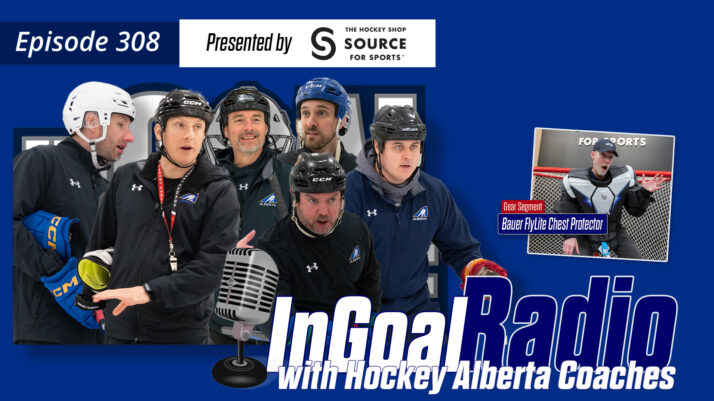
InGoal Radio Episode 308 with Hockey Alberta Coaches

Please subscribe and leave a rating — it helps us reach more goalies!


Joseph Woll of the Toronto Maple Leafs breaks down a shootout chance against Alexander Ovechkin, offering specific advice on managing depth and using ice markers to match your retreat with a shooter's approach. Five WHL and AJHL goalie coaches — including Matt Weninger of Hockey Alberta, Ian Gordon, Dave Rathjen, Kurtis Mucha, Kraymer Barnstable, and Adam Marcoux — discuss goaltender performance and development in a roundtable recorded at a Hockey Alberta goalie camp.
- Use ice markers as reference points to calibrate your retreat depth relative to a shooter's approach on breakaways and shootouts.
- Five WHL and AJHL goalie coaches share development insights from a Hockey Alberta goalie camp, covering performance, coaching philosophy, and player progression.
- When purchasing or modifying goalie gear, five practical equipment tips for goalie parents help navigate sizing, fit, and customization decisions.
- The Bauer FlyLite chest protector offers improved protection, coverage, and adjustability compared to previous models, according to The Hockey Shop review.
- Coaches from Red Deer, Swift Current, Edmonton, and the AJHL represent a cross-section of Western Canadian goaltender development pipelines.
Episode 308 of the InGoal Radio Podcast, presented by The Hockey Shop Source for Sports, features a great roundtable discussion with five coaches from our trip to a Hockey Alberta goalie camp April.
Feature Interview
presented by NHL Sense Arena
In the feature interview presented by NHL Sense Arena, we dig into a wide range of goalie-related topics about performance and development with Matt Weninger of Hockey Alberta and fellow WHL goalie coaches Ian Gordon (Red Deer), Dave Rathjen (Swift Current), Kurtis Mucha (Edmonton), as well as Kraymer Barnstable (Red Deer, formerly) and Adam Marcoux, who coaches in the AJHL.
Parent Segment
presented by Stop It Goaltending U
In the Parent Segment, presented by Stop It Goaltending U the App, we continue to look at equipment with five more pieces of advice for dealing with goalie gear, whether purchasing or modification.
Pro Reads
presented by Vizual EdgeWe also review this week’s Pro Reads, presented by Vizual Edge, which features Joseph Woll of the Toronto Maple Leafs breaking down a shootout chance against Alexander Ovechkin with advice on how best to manage depth and use markers on the ice to match your retreat with a shooter’s approach.
Weekly Gear Segment
presented by The Hockey Shop Source for SportsAnd in our weekly gear segment, we go to The Hockey Shop Source for Sports for a review of the Bauer FlyLite chest protector, which includes improved protection, coverage and adjustability.
Episode Transcript
Intro
We're not done yet. The Stanley Cup Final has been wrapped up, but the Calder Cup playoffs as this recording takes place continues. So we'll get into that in just a little bit. It's InGoal Radio, the podcast with David Hutchison, Kevin Woodley, and Daren Millard. We've also got, TendyFest memories to wraparound.
What what was it like, boys?
TendyFest was an awesome day. We arrived, quite early to set up. They had done things a little bit different. They had a VIP group that got the opportunity to go in ahead of time. It was really cool because you walk into the dressing room for the VIPs, they had their preferred gear that they wanted to try set up first like in an NHL locker room, little swag bag of stuff for them.
And it just gave them the first class treatment. I think it was 12 VIPs got to go go in early and yet when we arrived, probably an hour and a half early, there was already a huge lineup out the front door of people excited about getting in there and trying all the gear. We spoke to people that had flown in, we spoke to people that had driven up from The United States to, check out what's going on at TendyFest. All the major gear companies were there, there was tons of stuff going on and, we got the opportunity to speak to a whole lot of goaltenders and that's always exciting. It's, I gotta say, Daren, it's it's a little bit odd every time I go up to somebody and say, hey, have you heard InGoal Magazine?
About 50% of them in Vancouver say, oh yeah, I'm a buddy of Woodley's. I play with Woody. So, no, I'm chopped liver, but it's still nice to have those conversations with everybody and appreciate the people who took the time to come and meet with us there.
The the the second sentence out of their mouth is I can't believe you let that guy, given how poorly he plays, be a representative of your company.
Not at all. It's a Not at all.
Was there a VIK area? Very important, Kevin?
No. But I didn't... Kevin was always very important.
I I did get fancy on it. I had to go take some grad photos. I had to I had to duck for a little bit. I had to dip as the kids would say and go take some grad photos with my daughter that was that date was booked with a photographer long before Tendy Fest was set.
Let me tell you that. And in the interest of staying married, I had a suit with me. I put it on in the in the bathroom at Tendy Fest and then went out for an hour. And when I came back in the suit, I was too lazy to change back. So I just high rolled it the rest of the way in my in my in my in my fancy suit and played the big timer, you know.
I get it's all about role playing for me. So I pretended I was important by wearing a nice suit.
Hey. You got the Gear Segment coming up, brought to you by The Hockey Shop Source for Sports Langley at thehockeyshop.com. But, I'm I'm curious. At Tendy Fest, the Hockey Shop people do such an amazing job. Oh, did you get a a feel that there is one line, one piece of equipment, either a pad or a glove or a skate that, that people were most interested to give it a shot?
I'd say less I'd say less than ever. I I definitely think there've been years that people have come in and I have got to try. I mean, definitely people had the preferences. Definitely as we checked with people, there was something they wanted to try. But I feel I feel like not one standout line as maybe there have been in past years.
I don't know, Woody, maybe you had different discussions.
And it all depends who you talk to. Right? Like, Bauer showed up with an absolute literal
Huge amount of gear.
Truckload of gear. And they were hopping all day. I think because Fly Light had just launched a few weeks earlier. A lot of people wanted to try that. I mean, we've talked about that pad and the flex pile profile of it, how much softer it is sort of at the knee.
So I saw a lot there. I heard a lot of like, I heard a lot of feedback on the CCM EFlex 7 glove, which launched the day before. So that was brand new in terms of being available at retail on the Friday, and there's Saturday, you can take it on the ice. And I don't know if it's, hey, I need to get it there and try it, but I sure heard a lot of good feedback about the glove afterwards from people that did try it, that that five eighty break and the new internals and how well it closes. So heard a lot of good talk there.
You know, the Warrior booth was not too far from us. Seemed to be a ton of people there and and, you know, didn't have a chance to talk to a bunch of people, but there seemed to be they're just consistently busy there. So, yeah, it was it was good. Vaughn was there and Brian's was there. We ran into at the Brian's booth, Kimberly Newell, who's been a guest on the podcast before and found out talking to her that she's making a comeback or she would like to make a comeback.
She's declared for the PWHL draft, not with the expectation of being drafted because she hasn't been playing for a couple of years, but with the idea that she has to go through that process to become a free agent. So there's a name to keep an eye out for. Obviously, represented, China at the, at the Beijing Olympics and has played professionally overseas. And so, yeah, that's the kind of thing you get at Tendyfest. You get, like, pro goalies out there trying gear, talking to other people about their gear.
It's it's a it's a pretty good day in the goalie union, I gotta say.
On the skate side of things, I'm thinking back a couple of years. The the Bauer Konekt was just an overwhelming product launch with no laces and and the there's buckles. True one piece a few years ago, that was a change. Where are we in the in the in the skate market right now? And what's leading the way? And is there anything that's that's on the horizon?
The one thing that stood out to me, the Pro Sharp folks had set up over on the side of one rink and you could try different profiles on your skates. So they had a they had a rack of blades. You can come in, put on a new profile, go out. I think that's something that would be a challenge to dial in for yourself on your own because, you know, you bring the skates in once a week to get them sharpened at the hockey shop or wherever you go. And then you come back and maybe not on the ice for a couple of days.
Does the profile feel the same as it did last week? How is it better? I think it'd be really difficult to dial in the right profile for yourself. Whereas here, you're able to just step off the ice. Can I try this profile instead?
You go out immediately get that feedback. I I think profile becoming a little bit more of a thing for goaltenders these days, that's a pretty cool opportunity that they provided for for all the goalies. So that was the one that stood out for me skate wise.
Yeah. I know that's the second year they've done that. We probably should have shouted it out going in because you're right. It's it is something that I don't I I mean, you could do on your own, but you'd also have to be willing to have you know, and steel is not cheap. You know?
Like, the only way to really do it at that level would be to have multiple pairs and have a have a shop create multiple profiles so that you could come to the boards and and swap them out on the ice at the same time. And, you know, anytime you're profiling a skate, you're taking steel off of it. Right? So that'll be you're right. That's that's a really unique sort of, you know, once a year opportunity to sort of try and figure out something that can have a pretty significant effect on your game because it basically sets the angle of your feet to the ice.
And as you said, Hutch, we're seeing more and more guys sort of experiment and try and dial in the different various options.
Stanley Cup has completed. Sergei Bobrovsky adds to his resume with a second Stanley Cup and out duals the tandem of Calvin Pickard and Stuart Skinner. Bob, what an impressive back end of this contract at a time when some people didn't think he was gonna finish the contract, and now we're talking extension.
Yeah. Like, it's funny. We had the we had the Mount Rushmore last week discussion on, you know, if he wins a cup, where does he go? I heard a lot more of that as the cup final went on. Like like, I saw some people saying like, hey, is he top four? Is he top five all time? He's got two cups.
And I think it goes back to what we talked about. This story isn't written yet. Like, it's there's more chapters to come. I watched the way he moves. We've got the articles up at InGoal about how he's changed the way he trains, sort of that martial arts influence from Finland in changing who he trains with.
You watch him do his warm up, which we've also documented it over at ingoalmag.com. I'd highly recommend people go to our Instagram channel, click on links, and there's one there that'll take you to all of our Bob stories. And there's video on there showing you all these various drills that he does. He's he's in such incredible shape. He takes such good care of himself, and that was well documented during the cup final, especially, like, the the the weight lifting he does on game days and things like that.
Like, unless he loses the the passion for it, and I don't see that, there's there's years left here, and he is already well up into the top 10 on the all time wins list, the way that panthers team plays. He's not going to need to play 60 games a year to continue climbing that. So it'll be interesting to see where he finishes. I think there's lots more left to come. And you and you're right, Daren.
A guy who came in with a lot of hype, but a lot of uncertainty in Philadelphia, completely changed how he played in Columbus, won two Vezina trophies, went through all the doubts and questions when he got the big payday in Florida about the contract and the value of it. And now look where he is now. Nobody is questioning or complaining what he makes a year given what he's meant to the panthers. And we saw it in that series. Right?
Like, the overall numbers on the playoffs for him, second or third among all the goalies and goals saved above expected. But, man, in the in the big moments, the high danger chances at key times, he came up with, you know, as I would describe them momentum and potentially series changing saves at the toughest times.
Well, the idea that Florida scored first in the final four games of the series, five games of the series, that that tells you where Bob was at his best. He he leveled the playing field early on.
And I think by the end of the series, he had the Oilers shooters at times trying to be perfect. Like, I just feel like like he I don't wanna say he got in their heads. That's always a stretch. But I feel like his some of the saves he made impacted the way he they attacked him. Now I will say, I do think they missed Zach Hyman.
And because nobody else on that team knew how to be a net front presence. They did nothing in terms of taking away his eyes. I shouldn't say nothing, but next to nothing. The amount of screen chances offensively that they created were so low. Corey Perry's a great story at his age and all, you know, tough luck, all these finals he's been to.
What is that? Five of the last six and and bridesmaid throughout. But if I saw him stand in Bob's eyes and then move out of the way off to the side looking for a tip before the shot was released one more time, I might have thrown something through my television. Like, it's just it doesn't it doesn't work. They he had a lot of looks at a lot of releases, and it allowed him because he's so good, there were deflections and tips and plays that he managed to get into and fill space on that were really great A's because he saw the release, and he doesn't drop straight down to his knees.
He shifts into space. Even off pretty good looks, like he is very rarely defaulting straight down. And so he would shift across. There was one in game two crucial one off the inside of a leg of a defender or a guy and then, again, another screener who had popped off to the side. And Bob gets over there with a glove and with coverage behind it because he's able to see the release, and he's so good at not committing straight down to the ice.
He shifts and moves into pucks. And I just I just didn't think they created enough chaos. Probably wouldn't have made a difference, but on the looks they had, he had a good look at too many of them.
Not the same plays you're talking about, but sort of along the similar lines. The anticipation. He he made a rebound save. I can't remember what was game four or five, but he anticipated where that rebound was gonna go or that bouncing puck was gonna go. And if he doesn't read the play perfectly and get over in time, it's it's a sure goal.
And I don't know I still, after watching it, like, 10 times, don't know how he read where that puck was gonna bounce.
Thousands and tens of thousands of repetitions and game situations. Like, it's funny. I do I do find it a little hilarious when people make the comparison to Skinner and, you know, who outplayed who and Bob was the difference. It's like, yeah, one's a third year starter still learning a lot of these things and the other guy has been in the league for what, a decade and a half now? You know?
So like like this is he's he's got the experience, He's got the physical tools, and he refines them constantly. He's got the technical acumen. Like, the way the sort of the Bob project has been built from his work in Columbus with Ian Clark on the technical side and tactical side to the work he's done rebuilding his body. Again, we talked about about that, you know, the the the, martial arts background based in terms of how he moves and how he warms up his body to move. Like, there's just there's so many different steps along the way to get to this apparent complete, you know, completed project that is Sergei Bobrovsky at age 36 winning back to back cups.
It's a it's a fantastic story, and there's a lot of things in his game that I think a lot of people could learn from.
Let's give the guys in the Calder Cup championship series some love, Hutch. We've got Charlotte and Vancouver going head to head to Florida's affiliates. Florida going for the double there. And Vancouver, up in that series. It's been a fun series.
It's been a fantastic series. I haven't quite seen it from the inside the same way Woody has. Woody's been covering it, for nhl.com, but I was in the rink the other day. It is the loudest building I've been in and I I can't remember far enough back to 2011 with the Canucks big run, but, I feel like it was at easily as loud as that in the building. And, quite often, the source of that noise was the crowd cheering for Artie.
They love him so much. He can make a routine gut trap from 60 feet away and the crowd goes crazy. And, so that's a a ton of fun to watch that. He's on top of his game. He's getting out shot and controlling it for Abbotsford.
Just a fun story to watch. At the other end, you got Korpisalo who's got, I think it's something like a 160 games of NHL experience, but he's in his first playoff run ever at either level. He's a lot of fun to watch. This is a guy who makes a lot of saves standing on his feet. He doesn't go down and and just tracks the puck and makes the save.
Very athletic. Just a whole lot of fun to watch at both ends of the ice. Great series if you can get out and get a chance to watch it or watch it online. But, but Woody's had a bit of a different view from from the inside than I have.
Okay. So I gotta do before we get to that my view, I gotta go back here for one quick sec, guys, and I apologize for this. But I was brain cramping when I was talking about Sergei Bobrovsky and the way he sort of changed the way he trains in his early thirties. And I just wanted to make sure because the article's great. Make sure you check it out at ingoalmag.com.
Like I said, you can go to all the Bob articles through our link off Instagram, or you can just go to ingoalmag.com and search use the search function to search Sergei Bobrovsky, and you will get, you know, six or seven different articles with video of his of of some of the work he does. The trainer, I wanted to make sure I gave him a proper shout out. It's Sammy Karjalainen, and, of course, the goaltending coach who a lot of people know from Finland, Hannu Nyquist. They sort of started this project working with Bob in the off season. And so I thought I just thought it was important.
I, for some reason, could not pull the name up off the top of my head as I was talking about it earlier. Okay. So back to the American Hockey League. The view I had has been kinda cool, but not just, you know, talking to Arturs who man, this guy in big moments and big occasions, he was named to Latvia's Olympic team, one of the first six along with Elvis Merzlikins as the goaltending tandem. As the series shifted back to Vancouver, they were outshot ninety six forty three in the first two in Charlotte, he won one of those in double double overtime and lost another one in overtime.
He's won two straight here. I had a shutout going in the third period the other night. They won three to two. Charlotte obviously ported on in the third period a little bit. His ability to rise in big moments, whether it's the world championships where he was MVP for Latvia, got them their first ever medal at a world championships in 2023.
Stepping up, coming out as the third stringer from the American Hockey League and getting the Canucks past the Nashville Predators into game seven against the Edmonton Oilers last year in the playoffs. This year, obviously, didn't go the way he expected. He had two wins and 10 starts for the Canucks in the NHL, eight sixty one save percentage, and a really difficult year because he spent large portions after he lost the opening night starters job sitting around in practice, sharing a net as Thatcher Demko started to work his way back from two different injuries. A lot of times, he didn't get much of those reps. He he was just out there late with a couple guys after practice.
He only played 31 games all season. This guy was in his fifty years of pro, he's paid a 110 games in the American Hockey League. I would argue that's not enough. But every time he's in a role, bright spotlight, big stage, and he gets a chance to just go out there night after night and not worry about or overthink things, and I talked with this with him about this, that that's the difference a little bit, man, he performs. And it's athletic and it's acrobatic at times, and sometimes it's borders on a little bit out of control.
And there are still things that he probably needs to rein in and and some some some issues on longer distance shots in terms of how he tracks that would probably benefit him at the higher level. But you got to applaud a guy who had a season like that as an and is finishing it on this note. He's got a last check nine thirty two in the American Hockey League playoffs after a career 0.906 through those first 110 games. He has five shutouts already, one more ties the American Hockey League playoff record. And, oh, by the way, out of those shutouts, three of them were in series clinching games, Something we also saw him do against the National Predators last year, a one nothing shutout in the series clincher.
So kudos to Arturs. Korpisalo, as you mentioned, got a chance to catch up with him. Hutch already talked about the fact that seven years in a pro in North America, never played a playoff game, and here he is, takes the ball and runs with it all the way to this to the Calder Cup final. He's been exceptional as well. Sate percentage are up there near the nine thirties coming into this final.
It's been really fun to watch. But can I tell you, Daren, what the most fun thing to watch was from my standpoint, especially in game three? The interactions off to my right in the top of the stands with the Hutchison family and Charlotte's or the Florida Panthers prospect and Carol and and Charlotte, he's number three on their depth chart right now. They're one of the part of their black aces in practice goalies. Cooper Black.
All Cooper yeah. All six foot nine of them. That was cool. And I don't know I don't know if I'm putting him on the spot how much he wants to talk about this, but just sort of seeing I mean, this this kid is so special and so nice. I talked to him after the morning skate and such an intelligent young man about the way he thinks the game.
But just to see he's also a former David Hutchison billet in Nanaimo and to see those those interactions and them catching up in between periods as that game three was going on. It warmed the dark places of Woody's bitter snap tastic heart.
It was a lot of fun. Cooper is a very special person, member of our family, and always will be. So, yeah, we were there as his guest. Got to spend a whole lot of time with him before the game and the next day as well. And, yeah, I think there is something special there, Woody, and not just as a human being, but, to find somebody who has control over his limbs at six foot nine at such a young age is kind of remarkable to see.
I've been sending him from Tendyfest. Bauer, I guess they must own the Cooper trademark now. So Bauer's done up an old pair of retro Cooper gear and I sent them to Cooper and I said, you gotta go retro. Bauer, all black, Cooper. I don't think he's going that way but it would would be fun to see.
Yeah. No, he's good good person. I think, Woody, that one day, I hope that we'll be able to revisit this as a really good development story and kudos to the Florida Panthers, goalie development staff because they seem to me from a distance to be bringing him along in a very careful way so that they can, prepare him for the future. So he got some experience last year, got an extended run-in training camp this year. Most of his season, pretty much the entire season spent at the American League level this year, but they carefully got him into 17 games where he put up a goals against average under two, save percentage around nine ten, and I think he was one shutout away from the the franchise record for a rookie as well.
So had a fantastic season and I think just the way they're carefully using him and giving him this experience as he moves forward bodes well for the future.
I think that, he is the one guy that could wear all black equipment and not have to worry about looking smaller in the net.
This is also true. Is also true. But those pads are so long. I don't know. They look pretty skinny maybe.
Maybe, but he is like his black is slimming. But I'm telling you, Daren, like there was a point where I was watching their morning skate and I'm like, Oh, the goalie coach who also deserves a shout out, Sly Rodrigue, who went over to Charlotte the Anderson Oilers organization in the off season. Every time you talk to goalies that work with this guy, they've got nothing but just fantastic things to say and they tend to have success. So there was a moment where I looked down and I'm like, Oh, Sly's left the ice. I'm like, Oh, Cooper must be on his, like he was working with Cooper and I'm like, Oh, must, Cooper must just be out here at the end to sort of, you know, be a target.
And that's part of the job, right?
Sure.
And as he told me, he loves it because what else his alternative is to be at home taking shots from guys who aren't nearly as good. Right? With all due respect to his shooter, like, just inconsistencies. One guy's played at one level. Now he's got these American Hockey League veterans shooting on him, really elite shooters.
And I thought, oh, okay. The goalie coach has left the ice. Maybe I'll catch him. And then I turned my head on his back. He had just disappeared behind Cooper for a second.
Like, literally, his waist comes to the crossbar. Like, goalie eclipse.
Like, goalie eclipse.
Yeah. Like, you know, when we sort of hunch over at the end of a long skate and sort of turtle our way back into the net Yeah. You know, for a breather? He literally can't do that because when he hunches over, his butt would hit the net as he backs into the crease. It's we hit the crossbar as he backs in.
So he's it's really fun to watch. And to touch his point, in all seriousness, his control over that frame. I was watching backdoor plays down around the goal line that they were working on, And it's not just control, but it's power. There's a precision and a power that he's got in his game right now that is, you know, really fun to watch during, you know, drills and goalie drills and shooter drills, and can't wait to see it get applied more and more in games as they bring them along.
Have to talk to Cam and Company over at the hockey shop to, get him some of that, Cooper Black gear, in in stock form of Cooper Black, obviously, familiar with the Hockey Shop Source for Sports Langley at hockeyshop.com, our presenting sponsor of InGoal Radio Podcast.
And there is a ton of new stuff on the shelves at The Hockey Shop right now. Just a ton. And we're gonna get into one of the pieces. Bauer Flylite Chest Protector. That's the focus, the spotlight in this week's Gear Segment.
But a reminder that there is Flylite pads, Flylite gloves, Flylite blocker, new Flylite stick, including a Hockey Shop Source for Sports exclusive trigger grip available at retail on the website at the hockeyshop.com and in the store. And, again, they're such a big store. They have such a big footprint, and they have so much equipment that anytime we have a new launch, you know what I'm about to say, that means you can get the old stuff at a discount. And right now it is the previous Bauer Vaporline Hyperlite two, all 25% off. There's lots of inventory left, but it won't be there for long.
So make sure you check it out whether it's the newest, the best of the new season, they've got it. Or if it's a previous generation on sale, they've got that too. Make sure you check them out at The Hockey Shop Source for Sports and thehockeyshop.com.
Gear
Cam and Woody standing by with the Gear Segment with the Bauer Flylite Chest Protector.
Pretty. The new Bauer Vapor Flylite chest protector. You can see some of the new features in the wrist right off the way. You can hear someone. We're gonna get into all of it plus what part of this chest protector feels like an old couch cushion but will actually help you stop more pucks and what new sizing, exciting new sizing options are available for the first time in the highest end chest protector with the new Bauer FlyLite.
We're gonna get into all of that, but first, next to me is Cam. We're at The Hockey Shop Houli Utopia to talk about the new Bauer Flylite chest protector. And, Cam, you're excited about this one.
I am. I can't wait to fly in and show you some of the new specs.
Were you excited about the chest protector or just your bad dad joke?
Oh, both. But I'm excited about the new colorways that we see here. Vapor has now gone away from the red. We see this almost neon blue kinda highlighting out. Looks good.
New look kind of gone across the line. You see that even with the the Flylight ,Pads, Glove, blocker. In sticks is a bit of an example, but that's okay.
A lot of white, little stormtrooper look on the front.
Can't believe. A bit of a stormtrooper kinda style of a look. But if you don't wanna be incompetent like a stormtrooper, this is a chest for you. Reason being, couple new features. Let's start off with the shoulders in particular.
We maintain adjustability that we've had in the past, being able to dial in your fit. A nice new added feature though, Velcro strap over the shoulder floaters themselves, that ability to lock down a set of suspenders, not something previously on the Hyperlite two. This will now help, you know, those guys that are looking to tuck in their chest protector, have those suspenders up and over top. POC, not really anywhere to kinda run them. They would kinda sit at almost in the middle and kinda fall off as this isn't the same as, like, what you would see in a traditional chest with having those shoulder floaters kind of, like, separated here so you could run something in between.
Obviously, here with it being connected, it's kinda hard to have that suspender just stay put. Now we have that feature. Nice little added call out for sure. Nice. I like it.
Moving down the chest into the actual sternum plate themselves. This, a little bit more raised. New kind of foam in here, very shock absorbing as well. Your ability to add that deadening feature.
Oh, yeah. You can feel how soft it is. I like Correct. It looks it looks hard like Stormtrooper esque, but it's quite a
bit softer. Adding that absorption quality, being able to cradle that puck, that's important. Moving down that body of the unit itself, this is where we get into similarities between that and a Hyperlite 2. The same style of rigid blocks with removable padding either side as well as in the center, being able to have that adjustability in terms of added length that you might need or
might Depending not whether you tuck or untuck, that might affect whether you want it or not.
Exactly. Internal tie down as well. Yes. Nice little call out there. A little hidden.
So, again, having your chest over top but still wanting it secure, nice way to add a little bit of
security down to it.
K. You're looking on the inside and you saw
that first.
Let's stay to the arm.
Let's stay
to the Yeah. Let's go to the Let's go to the arm.
Same to couch cushion for later. Alright. Maybe I'll find some change.
So the Dynamic Flex arm, adjustable, held in by Velcro, so similar system to what they've had in the past. The ability to pull that up, move it down, whatever you need to do. What has changed though Oh, I like that ability to adjust the leg. Yes. That flex wrist.
So exposed curve composite here down at that wrist position. Now It's kinda cool looking. Exactly. Almost reminiscent of the one x chest protector. So the original and the vapor.
So bit of a callback to that. What has changed though is the wrist portion itself. So rather than having just that wrist strap over top, you have the ability to slide that one on. You have it a little bit sit a little bit lower, but you don't have a hard piece. So it's allowing you to integrate with the glove a little bit easier.
It almost creates a
little of sleeve. It's almost like a neoprene.
It is a neoprene sleeve basically. But it's padded. Correct. So little bit of protection.
I mean, it's not gonna save you, but you're not getting anything direct up there anyways. It was big.
But you allow that flexibility, and that's kind of what that big call out motion is. So even with that, that flex portion of the wrist moves. It can kinda get out of the way a little bit more. You have that added risk or traction on the back as well. Something that we've seen from Bauer before as well as that elbow cup.
Again, similar arm this side.
You get really locked in.
Exactly. Exactly. Little extra.
You get the extra protection down here. Backhand, little extra around if you're in a reverse VH. You still have that front.
Flap in the back. And a
lot of flexibility on this secondary shoulder flap, like, to sort of integrate. And and because of the the extra sort of seams on it, you're not likely to get it caught up one to the other. It's not gonna bunch on you. That's correct. It's gonna be maintain that mobility.
Okay. We look at the back. Designed to breathe easily. It's quite it's thin. Lighter.
It's not like we've seen other people go rigid. This is quite thin and light and it's got material on the inside that it says should breathe a little better. Buckles are tucked in and what are they tucked into, Cam? My couch cushions. Here they are folks.
Look at the size of that rib protector.
So much more pronounced than it has been in the past.
And I gotta say, I like it on multiple levels because not only is it clearly gonna be more protective, I mean it's a great cushion, but I mean that's gotta be inch and a half thick in spots Cam.
That's correct.
So that's sticking out off your rib cage protecting you and also maybe catching a few more squeakers under the arm. You know what I'm saying? Like
Why not add to that presence of the chest a little bit as well, right?
Yeah. We think of bulking up a chest protector as being around the perimeter and making you look bigger, but anything that's gonna help you catch an extra puck under the arm, and I think this would, is a huge benefit. Great job by Bauer for finding a new way to sort of add both protection and frankly a little bit of coverage. I like it. Exactly.
And that material is also the same as in the back here which is supposed to be thermal core zero which helps you sort of keep the heat from staying bunched. You also find it in the elbows as well, the nice blue call out to it. Cam, there's a lot to like about this new chest, but am I missing anything?
Well, yes. The ability to order custom as well. Including sizes? Yes. Well, intermediate is also available now.
Is that two sizes? Do you have
it in the store? Stock off the wall. Woah. Woah. Yeah.
Top price point chest protector, top level chest protector, and intermediate. Is that a first for Bauer?
That's a first dish for Bauer.
Yeah. First dish? Okay. Well, maybe I had you got a little sighted there. I thought you're saying it was first, but still big still big deal.
Not a big deal. Big deal.
If you're interested in the chest, if you're interested in ordering custom, that's something that's, you know, available offline. So it's something we'd have to talk to you specifically about.
So And would we be we'd be customizing graphics on all of this?
Graphics, the ability to add more protection, shorten the arms if need be, mix and match, like beef
up certain areas. Exactly. Different features from different lines.
Well, do you like the shadow arms? You can put shadow arms on here, things like that. You have those options.
And I can get custom graphics?
No custom graphics. That doesn't exist anywhere.
Oh, I was gonna put your face right here. So every time I took one off the chest, it's like a
If you like to learn more about it, give me a call. (604) 589-8299 or 1-800-567-7790. Check us out at the hockeyshop.com. You'll see the chest up online. If you wanna talk about custom, that's something you guys gotta either call in or email in to talk to us.
Very easy enough to do. Flylight. I'm under
Fly light. Lot to like.
Yeah. Fly on out of here.
He's been saving that one for a while.
Nice to know that you two had lots of energy left after TendyFest.
We had nap. We're old. We've
had nap. Never stops. It's all good.
The good thing the good thing about the the the chest is you can kinda, like, roll it up or situate it for a for a pillow. Be be a good pillow.
Oh, well, they and and we talked about in that segment, there's some extra pillow there. I love they've added I I made the joke that it's like a couch cushion around the rib cage. So super comfortable. But also, like, if I've got an eye towards, you know, making myself a little bigger, especially if I don't tuck, because I I would think tucking it in would sort of pull it against you. So lots of rib protection, but honestly, I think it would make you you know, it's gonna help you catch a few more of those ones that might otherwise squeeze under the arm.
Haven't had a chance to take it out, but it sure felt like that trying it on in the store. It's they they've really beefed up the rib protection, but not in a, like, hard thin foam way in, like, your your your grandparents' nineteen seventies couch cushion way. It's great. I like it.
Our Gear Segment gives you a look under the hood, with, all the equipment, around the goaltending world, and Vizual Edge ProReads lets you inside the mind of goaltenders. This week, Joseph Woll, taking us through our journey or our experience of real time plays.
Yes. And, of course, the those ProReads are weekly at InGoal Magazine at ingoalmag.com. Every week, we bring you a new video breakdown with an NHL goaltender where they walk you through a sequence or a play and try to explain for young goaltenders why they do things a certain way. Not that every young goaltender needs to do it the same way, but to walk through their mindset, the not just the, hey. Do it this way, but here's why I do it this way.
Here's why I choose this depth on this breakaway as Joseph Woll facing Alexander Ovechkin, in this case, on a penalty shot. We already did the breakaway that he saved about a month ago in Joseph Woll's last entry. Now we've got the ensuing penalty shot. So what's different? How do you manage your depth differently as a goaltender?
Where do you wanna be on the ice relative to your crease when Alex Ovechkin hits the hash mark? Where do you wanna be relative to your crease by the time he gets towards the bottom of the circle or in the low hash mark? Joseph Woll walks us through all of that. It is one of more than 285 such videos up at InGoal Magazine, ingoalmag.com right now. And a subscription not only gets you one year moving forward, so 52 more of these ProReads, but a complete access to the archives, all 200.
I think it's 86 now. ProReads, guys like Hellebuyck, Demko, Woll, Freddie Andersen, some of the biggest names in the game sitting down with us to bring you their video and how they read the game. There is no better way to learn to read the game than watching ProReads like this week's with Joseph Woll. And by the way, there's no better way to see the game better than the sponsor of ProReads. Perfectly fitting that it's Vizual Edge, an online based visual and cognitive training system used by guys right up to the NHL.
You get some funky glasses. One looks like sort of the three d glasses, but a lot nicer version that you'd wear at the movies. One eye blue, one eye red. You go through their online program. You take the test.
You get an edge score, which is a baseline. It targets it sort of shows you what your strengths and your weaknesses are visually. Do you see the puck coming at you, which is convergence? Do you see things, you know, divergence, which is being able to sort of quickly look out and scan the whole zone, which is a strength, which is a weakness, and then it dials in a training program for you. Once a day, work on your visual skills.
It also helps you warm up your eyes and your cognitive skills. Jordan Binnington said it's added a quality element to his preparation as a goaltender. He uses the game day drills every day before heading to the rink. A combination of recognition, reaction, and focus that activates my brain and eyes to feel ready for what's to come. So Vizual Edge, you get a discount code when you check out InGoal ProReads.
If you're a member, you get a bigger discount code. Make sure you check out ProReads at ingoalmag.com and get your bigger discount to Vizual Edge.
Parent Playbook
Perfect opportunity to slide over to our Stop It Goaltending U, the app, a parent segment. Hutch, I want you just to give us an idea of what we're gonna talk about, and then we'll hear from Woody about Stop It Goaltending U, the app.
Last week, we went over five tips, about gear for goalie parents. I would say largely that it was directed towards parents of younger goaltenders, but I think there was some good stuff in there for goalies of all ages. And, much like Woody, I always have too much to say. So I had to hold off to this week with number six through 10. So I'll just leave it at that.
We're gonna carry on and I think maybe some of this stuff applies to older older goalies as well, but, but also just good stuff for the goalie parents out there how they can help their kids.
Woody, what's going on with Stop It Goaltending U the app?
Well, the daily primers this week, and if you're not familiar with it, Stop It Goaltending U the app sort of breaks out the content they give you into three different segments. Daily primers every day of the week, Monday through Friday, you get a one minute video sort of just designed to give you a quick mindset focus or a quick focal point, not always mindset, on how you can get better as a goaltender that day. It's a great way to sort of check-in and sort of stay on top of some advice that will help you continue to develop from some of the best in the game. Brian Daccord has been doing this for twenty five years with Stop It Goaltending. He's played professionally.
He's coached in the NHL as a goalie coach. He's been a goalie scout for the Toronto Maple Leafs, a director of goaltending for the then Arizona coyotes. He's done it all. He coaches at Boston University now, and he brings you that daily advice. This this week, it's on the power of focus.
And, of course, there are other videos sort of walking sometimes they're just pep videos, like some good music and some good goaltending to get you in the mood to go stop some pucks. There's drills every week. There's all kinds of new content each week on the Stop It Goaltending U, the app, and best of all, you get our content too. When you buy a monthly subscription to Stop It Goaltending U, the app, you get automatic access, easy for me to say, to InGoal Magazine, ingoalmag.com, and all our great content, including those ProReads I talked about earlier. Not just what's new each month, but full archive access, all with the subscription to Stop It Goaltending U, the app.
It's the best of both worlds in goaltending. Make sure you check it out. Hutch.
Last week, we went over five gear tips for goalie parents. I think maybe there was an underlying message to a lot of those tips guys about not feeling guilty. As parents, we often what we do is driven by this fear of guilt that we haven't bought the latest coolest gear for our kids, that we haven't protected them so they can face NHL shots and so on. And I wanted to relieve some of that guilt guilt with some tips, that will help your kid go out there, feel safe and have a whole lot of fun. This week, we're just going to carry on with five more tips and, might need a little bit of help from you, especially Daren who's a bit of an old timer with the gear.
The first one though is let them do the work. It's a recurring theme I've had here before that we want our kids to be empowered, We want them to be independent and having them do the work, things like taping their own stick, which you could do as young as six years old. It might not be as clean as you can do. It might not be as quick as you can do it, but that ritual of taping a stick right up to the National Hockey League is a big part of the game. Let the kids learn how to do that at a young age.
Cleaning pads. I'm actually surprised how many questions I see online from parents about how to clean off goalie pads and the number of them that are doing it for their kids or even against their kids wishes. I don't quite understand that. It is not hard to clean off a set of gear if you would like to do it. Yes, there are some tips for how to do it that we could cover sometime, but let your kids do it.
It's you might need to give them a nudge, you might need to guide them. It's kind of like cleaning your room. Don't go in there and clean the kid's room for them. Let's help them do it for themselves. Number two, here's where we might need Daren because back in the day, we spent hours fixing our gear, adding some foam here and there.
Have fun tinkering with the gear. Our old friend Glenn Hall, hall of famer, who played over 500 consecutive games without a mask on told us he used to literally add bubble wrap to his arms way back in the day. Great sense of humor. He said he did it so that his defenseman would have something to do in between periods bursting the bubbles. But it was about protection and we used to have a whole lot of fun with it.
Daren, I'm sure you did some cool things. I'm going to share a couple things and then I'd love to know what you did. We actually got a parent, sorry. We we got a listener on YouTube share with us. Tag name, Okay Goalie says that, they use a thigh guard from a set of from an old set of Bauer reactor pads to protect my exposed wrist on the glove hand and I also wear a d three o wrist guard.
And that reminded me of one of the things that I did to my kids gear and that was as he got a little bit older and the arms got a little bit longer. Of course, lot of chesties are adjustable in arm length, but if you lower those arms down, you risk maybe exposing some upper arm. And so we went to his old youth set of CCM gear. Yep. His youth set of CCM gear.
We pulled off the thigh guards and we put them into the upper arm. There's still the little Velcro there that even holds it in place. That padding remains on that chest protector that now his mother is using, as a goaltender. So that was a use what you can find, how can you apply it to make yourself feel, you know, safer out on the ice? Daren, did you have any things you did back in the day?
Always kept my chest protector arm chest protector if I replaced one and I would inevitably take a piece off the old one and sew it into the current one. And it doesn't have to be a pretty sewing job. You don't have to know how to what you're doing. It doesn't have to be effective from a look aspect. Just find a place that you're getting dinged and and put a piece of padding on there.
I use the you know, the the sweat guards, the wrist guards? Yep. That that people wear. There's, like, slash protectors for forwards. Yep.
I I wear those on the blocker to this day just because there's a little spot that I always seem to get nicked up just above the blocker on my wrist, so I I use that. And I think I've told you this before, but on the on the knee guards, I I have my current set. I took some padding off of a a Home Depot, like, the the knee pads that you would wear for flooring and installation.
And
I put those in to just soften the the blow inside my my knee pad. So just it doesn't have to be pretty, but it's those things have stood up for eight years.
And use what you have. What do you you're like the guilty parent. You want to just go out and buy new gear if something doesn't work, but have you tweaked something too?
Well, let's be honest. We're pretty spoiled here at InGoal. We get to try all the new stuff and, you know, I don't think they like us stitching things into it very often. I have, in the past, used added padding to knee guards or sorry. Not knee guards, knee like, the landing area of the pad, the the knee stack.
Added layers of padding that to make it taller off the ice. I think I think well, if you don't know, if you're a parent, this is this is an interesting thing, and this is something we might be getting into in the near future as an option. I it's something we've talked about in the past even with Maria Mountain. Like, if you the thicker you make the knee guard, obviously, it can't be so thick that when the kid lands, his knees are above the edge of the pad. But the higher the knee is off the ice relative to the ankle being on the ice, which is why we want toe ties with gap in it, the less stress on that entire chain.
Ankles, knees, right up through the hips and internal rotation. You get a wider butterfly out of it, and you can get less stress. So I've definitely added padding to the knee stack in the past, especially before I was maybe taking as good a care of the lower body as I try to now. And so that that's that's the biggest one for me. That's the biggest sort of, you know, ad padding cheat.
And it was more just because it it just made my hips feel so much better.
Daren, as you're talking about using which you can find the other one that I did, when my son was the youngest. Pants are getting better for kids now. Maybe still not completely where they need to be, but when he was probably eight years old, almost zero hip protection, very close to being like a a player pant. There was some, but it was when you're facing older kids, you're at that age where some kids seem to grow faster than everybody else and and I I remember some kids he played against that at eight years old looked like they could shoot like men. Really needed some protection in there.
So I went found the old youth set of goalie pads, pants from age five and six and I ripped out the inside that protected the hips and the tailbone and literally sewed it onto the front of his junior pants. And talk about looking janky, but it provided bulletproof protection and created that feeling of safeness for all those gut trap saves that you make. So, yeah, use what you have.
Know what this reminds me of?
Go ahead.
Marty Marty Brodeur. Right? Like, remember Marty, like, right towards the end of his career, and then he ended up getting a chest protector sore. I think it was Pecorina, his old chest protector, and that's when he switched. But he had, like, super old, outdated, like, not a lot of padding chest protector.
And I'll never forget, I think I was in on one of these conversations with him and Chico Resch in Vancouver because he had come off an injury, and he talked about every time he feels something, like, it's gotten worn out to the point where he's feeling pucks on it, he just added padding to the spot that hurt. So at least for a a portion of his career, that was his approach. Obviously, by the end, it had changed and things, but I feel like that's one of those things where I'm like, I feel like I heard that conversation or maybe I'm just I remember reading it, but I do remember being in the locker room here in Vancouver with him and Chico Resch, and it was mostly me sort of eavesdropping on their conversation waiting to ask Marty some questions of my own and just an absolute couple of beauties just deep diving and talking about his chest protector. And I was looking at the thing thinking, I wouldn't even go out in beer league with that thing. And you're out here stopping NHL shots, of course. Marty didn't block very much. He he he didn't need to. He had such good hands. He he got everything before it got to the chesty.
You know, back in the day, I used to add a lot you know, inside of your your thighs, it the the old pants, it used to
[crosstalk] get bruised up Nothing.
All the time in there, and and I would bulk up that area. The pants are pretty good now. I can't tell you. Last time that I felt the stinger probably happened today. But the I would I would layer the inside of the whether it was the girdle of a Cooperall back in the day or a goalie pant, and just try to make sure you don't get a big bruise in there.
Well, now most pants have an extra pad that you can remove if you feel it's too bulky. Like most Mhmm. You know, high end pants, they they they come with that sort of Velcro off insert extra soft tablets. And that's an interesting one to me because I feel like if you put a little more padding in there, not only is it safer, but as long as it doesn't
Woody's always looking for the cheat here.
Oh, yeah.
As long as it doesn't You got more pucks? Yeah. Well, your five hole close the the pant portion of the five hole closes a lot faster. As long as it doesn't, you know, like, hurt your skating, absolutely, that's a good one. Hey. Listen. It's not like I'm telling you to go KHL on this like some of the goalies that played there told us and insert yoga blocks underneath their chest protector.
I I love the I love the, Marty Brodeur reference and when it hurt, he added some padding. It's not like he got hit in that spot for the first time. I did mention last week that buying old gear is okay. It absolutely is. Chesty's definitely the foams in there have a lifespan and there becomes a point where they've been compressed enough that things start to hurt a little bit.
So adding a little bit more in there, not a problem. It's one of the good things you can do.
I have a chest protector in my garage right now. It's an older Bauer unit that was very well worn. The first year they sent it to us, we sent it out with a tester who wore it through an entire junior a season. It's been used since. Its foams have definitely passed their best before date.
But every once in a while, I get guys that wanna get back into the position, and so they're looking for a little help. And I keep some of our older gear around for just that. And it's interesting because one of them recently just in the this is this is probably about a year and a half ago. Harnarayan Singh, who is the play by play voice for Hockey Night in Canada, Punjabi, former goaltender, wanted to get back into playing goal, and he is now fully in, like invested. I'm learning things about gear care from him now.
Now that he's got his whole new set that he's bought, he's got wicked custom stuff. He is right into it. Both feet he dove in. But in the beginning, he wanted to just to sort of see. And so we had some old Bauer pads and this chesty, but this chesty didn't have a lot of life left in it.
So up in my garage right now hangs a chesty that has old Brian's knee pads sewn into portions of it for extra protection because he was feeling too many cuts and it was maybe a little small on him as well. So we got a Frankenstein in the garage. Thanks to Mantar, who is by the way, like, I I wanna write his this is we're gonna make this a parent segment, Hutch. His gear care tips in terms of coming off the ice and taking it home and how to dry it and how to make sure it doesn't stink. I was taking notes when he showed me his setup.
It's so good.
Nice. That's awesome. Yeah. Hey. That
at some point.
No kidding. Parents, it's fun. You know, it it look. You can see the I wish this was on video and you can see the smile in Daren and Woody's faces just about that thought of tinkering with the gear, playing Arturs Irbe, sitting in the the plane fixing up the gear. It's
it's great fun.
Yeah. Enjoy enjoy, everybody. Enjoy and and let us know what you've tried, so that we can hear your great stories too. So here we go. Number three, don't chase quick fixes because it's a quick way to go broke and I can tell you I have done this.
Little Johnny lets in a goal through the five hole because the pads have gotten a little bit too floppy and I have sent Woody text messages the instant that puck goes in. Had x got too floppy, goal went in, need to get something new. Don't feel you have to go out and buy some new gear just because something like that happened. I'll ask you a question, would you spend a thousand dollars to get that one goal back? Because it might not happen again this year.
And, maybe if the stick was activated a little bit better, it never would have hit the pad in the first place. It's okay. Goals go in parents, don't feel guilty, let them go out there and have some fun and that's all that matters. So don't chase quick fixes with gear and spend a whole lot of money to do it was number three. Number four, learn how to wear the gear properly.
This is partly a safety issue, but really it's about if the gear isn't worn properly, it is very difficult to play the position, correctly. For example, Woody brought up having slack in the toe ties. We've seen many a young six, seven, eight, nine year old goaltender skate out onto the ice with the pads cinched up as tight as they possibly could cinch them, and then they don't rotate around the leg properly. There's all sorts of great little tips for making your gear work for you so that you can play properly and have fun doing it. It's no fun tripping over your gear.
No fun not being able to move. So whether you're checking out the Pro Gear section on InGoal or the Pro Tip section on InGoal to learn stuff about gear or walking into the store and asking questions, Even if you're not ready to buy that day, Cam would love to talk to you about how to put the gear on young Johnny or young Sally so that they can play the game better. Or if you're in the rink and you're watching your kids struggle on the ice and you see a goalie walk in with some gear, ask them a question. I haven't met a goaltender yet who isn't thrilled to talk about the position and talk about their game. So if you see a 15 year old walking in with his pads and you see your kid struggling out there, just say, hey, what do you think about how he's he's wearing his gear?
What do you think I could do to help them put it on properly? Don't be shy. Ask for help. Five, we've gone over this one a little bit in the past. If you were going to invest in some new gear, my priority is a helmet because there is nothing more important than protecting your kid's head or mask as I get told I should be calling it all the time by the guys.
There's nothing more important than protecting your noggin. And then the second one for me probably would be a glove because being able to work athletically athletically with your glove, something that fits you properly and protects you, in my opinion, would be the next place I would invest some money. You can play with some old pads, you can play with some old pants, but you need to have a helmet that fits properly. Fit, fit, fit, by the way, we've gone over that before. And as a related one, I had to get this one in.
A little bonus glove tip, get your kid a baseball glove. Get out there this summer, chuck a ball around, learn how to catch properly. Great gear tip for all the parents. That's it. We've been at this one for a long time guys, so we'll, we'll shut her down.
I have a question. Yep. At what age should you start wearing goalie skates?
Oh, I don't know that I don't think there's a time that's too young, Honestly, I know, a lot of people certainly, there's a cost issue. I I don't question that. And if you're at that age where your kid is switching between, goal and not playing goal, maybe you don't want to invest in two sets of skates. But I it's a different type of skating and it's a different sort of balance and an interior till you're in those goal skates, you're not gonna learn that. So I had no trouble putting my kid into goal skates, quite young as soon as he he was able to fit a set.
I don't know if you've got different opinion on that, Daren.
I'm I'm with you. If you can afford it, it it just helps the the child out.
Yeah. I no. I don't think skating and player skates is a bad thing either. We we did a tip earlier long at the beginning of this series about having your kid be a referee because they have they actually have to wear player skates as a referee. And learning that edge control and being on a skate that's a little tippier than a goal skate is probably athletically a really good thing for you.
But having that balance and that precision and that safety of a goal skate, I think, is a good thing from a young age.
And you feel like you can fly when you get those
Oh, and the player skates? Skates on. Yeah. Turn and yeah. And getting a feel for what you can do in a player skate, I think, translates back to what you would like to be doing in a goal skate if you could.
Why is Woody laughing?
He's probably never worn player skates. You Have you, Woody?
That's good question.
I I have. I did I played really bad forward for I didn't grow up playing hockey. Let's not forget that, boys.
Yeah. No. Well, that's why I thought maybe you had never done it.
In university, I started playing drop in hockey just to to to try and and go and skate before before before my work with Ian Clarks Magazine switched me to a goalie. Before you learned
it's easier to balance on goal skates.
Yeah. And I didn't have to go. I was a really bad forward before I became a a really average goalie.
So you improved.
Yeah.
Attaboy.
Awesome stuff. Let us know your reaction, your comments, playoff of what what Hutch had to say with the parent segment, this week brought to you by Stop It Goaltending U the app. Our NHL Sense Arena feature interview is, brought to us by NHL Sense Arena. Hutch.
It sure is. NHL Sense Arena, as we all know, is one of the best tools you can use for training away from the rink. In fact, it lets you work on skills that often you can't work on when you're on the ice. So it's not just a replacement for on ice training. In many cases, it's even better.
So that includes things like the neurocognitive drills and even baseline concussion testing. But it also gives you other options that you don't have available in practice that you might not have thought of, guys. Like, what if you'd like to face a shooter who hits the exact spot you choose every single time? NHL Sense Arena lets you do that. If you'd like to know exactly what your reaction time is, if you'd like to know a number that defines how well you are tracking the puck and how it's improving, NHL Sense Arena gives you that data that you're never gonna get on the ice.
Would you like to train against screenshots? Tough to do in practice. Who wants to stand in front of the net and take one in the shins or take one in the gut? You've got screens as one of the biggest challenges in the game right now, and young goalies can face them all the time in NHL Sense Arena if they would like to. And the best part, of course, guys, is that the rink is always open.
It's tough and hard to afford ice time if you wanna get little Johnny on the ice a little bit more, but in NHL Sense Arena, you put the headset on, you don't have to wait till practice, you don't have to drive to the rink, you don't need expensive ice time, you just get quality targeted goalie training anytime, anywhere. So you can train as often as you want in season or out with NHL Sense Arena. Visit sensearena.com, and as always, use the code I g m 50 at checkout to save on your subscription. And I'll just add one other thing to go back to TendiFest. Woody brought Sense Arena to TendiFest, had people going over there in the corner, and there was very quickly a lineup of people who were excited to check out NHL Sense Arena.
Pretty cool to be able to do that for folks.
It's definitely a good way to make sure your booth is busy. Put the Sense Arena set next and the and the kids start lining up to try it. It was pretty fun.
Feature Interview - Hockey Alberta Coaches
Fun stuff. Let's get into, the feature interview this week.
This one we did a while ago. Now we wanted to sort of space it out before we brought it to you because some of the guests had been a part of the show leading into this interview happening. This is from our trip to Calgary for Hockey Alberta's camp with their elite goaltenders, and we had all the coaches gathered around. WHL coaches, one that works in the AHL, they'd all been a part of the camp, and we just did a roundtable interview with them. There we get into everything here from, you know, sort of some of the the youth advice, what they're looking for as kids move up the levels into junior, hockey development of young ages in this country, in Canada, what they're doing in Alberta, that's setting them apart, including having InGoal Magazine be a part of the development for their elite goaltenders.
It was just a there's gonna get a lot of different voices thrown at you here, but there's it's a great back and forth wide open discussion on the game, where it's going, where it's at, and where goalies in this age group tend to be and what they need to focus on to get to the next level. We kinda touch all the bases in this one. This is the first on the InGoal Radio Podcast. We're gonna be doing a roundtable from Hockey Alberta's u fifteen elite camp this year. We got six guys who have been coaching around the table.
And rather than me introduce them, we're gonna have them pick up the mic and introduce themselves real quick starting with Dave.
Dave Ratch in hometown Edmonton, Alberta. I work with Swift Current Broncos in the Western Hockey League.
Kramer Barnes stable, based out of Red Deer, a run stable in the net goalie school, previous goalie coach for the Red Deer rebels.
Matt Wattinger. I'm the manager of goalie development for Hockey Alberta and the goalie coach for the Moose Jaw Warriors in the Western Hockey League.
Curtis Muka from Shore Park, Alberta and work with the Edmonton Oil Kings.
Adam Markku, DMSG here in Calgary, grizzlies of the AJHL and the Northwest Flames Quadrant.
Ian Gordon, Edmonton, Alberta, goalie coach of the Red Deer rebels.
Alright. So we're gonna run few through a few questions and hopefully just spark a discussion. First one, I wanted to know how a camp like this where you've got I didn't do the math. How many kids we got here? Like, 40?
42 registered and one kid couldn't make
it last so 41. Right? Okay. So how does teaching at a camp like this, especially when it's over the course of three days and you're throwing a lot of information on these kids, how does this differ from what you guys would do in a team environment?
We have some experience running this camp. Started with the 02 birth years. We've had discussions before getting here of kind of what are the what are the key points of what we want to address while we're here to be consistent. With having six nets on the ice, it can't be so off the map from the message from one to the next. I mean, we've we've had these discussions before we got here.
So if we we come in prepared to know exactly what we want to deliver for the goalies to maximize the weekend for them to to to provide that development opportunity.
And can you give us some examples of where those discussions around what they would have centered? And is it everybody automatically on the same page? Is it some back and forth on I don't wanna say nonnegotiables, but things that you wanna make sure you hit as staples in a camp like this.
Well, yeah, Kevin. Like, this is this is year eight. So, like, I I know when we first started, we were there was conference calls, and there was, well, this would have been pre Zoom, I guess, even before before COVID, but, like, that's where it started. So, yeah, back in those days, it was, I'm just talking like it was, like, in the olden olden days, but, like like, back then, it was, like, consistent message, and and now we're eight years later, and it's a lot of the same guys. So it's like, you know, we take Adam for example.
Like, what's this? Your second or third year running this camp? Third. Third. Yeah.
So so it's you bringing in people like that who are around the guys that have been here for for eight years, and I think they get a pretty good understanding of what we're trying to achieve. And, yeah, I think that messaging comes comes from the group.
Yeah. I think this camp, if you look back over the years, it's it's really evolved into something more than just a camp for the goalies. Like, there's a lot of networking between the six to eight coaches involved too, and and I personally look forward to this weekend every year to to grow myself. And and it's good to see the goalies, and and there's there's, you know, benefits for me to to come and watch these kids ahead of the Western Hockey League draft, but, it's evolved into a pretty fun weekend. You know, there's a lot a lot of good discussions, coach to player, but also, just within the coaches too.
I think for us as coaches, we we learn more from each other, but just as much from each other as the kids learn from us. Just watching the ProReads video with, Joey Daccord the other day, like, that blind plug was a term that, not a lot of us had heard about before. So we have that discussion amongst ourselves and a lot of the goalies going from from net to net. There may be some details, some different perspectives that they see, but I think the overall message, remains the same. And, it's a great great camp this weekend for all the kids to to kind of be on the same page with with all of these these great goalie coaches with with what we wanna what we wanna do, and I think being consistent with a lot of things is is the most important.
Okay. So walk me through what some of the focal points are because it's it's funny because I've obviously watched two days of it. We've got it on video. We're gonna share it with people, but a lot of our audience doesn't know what we've seen for the last couple of days. So some of the things that you guys are focused on in this and and how you get that messaging across because some of those things might be new to some of these kids, it seems like for some of them.
Yeah. It probably is. But, I mean, I think for us, what we wanna do is we wanna start with the simplicity of it, the habits, the details. So like we start with our our first session on the Friday night, which is just skating. Right?
And then the Saturday morning, we spend the time with the simplicity of tracking and, like, basically, stationary tracking. Like, tell the kids in the morning, like, you basically know where we're shooting from and where we're shooting. And then from there, it's like the ability for the kids to tie those things together. Right? Be able to tie the skating into their tracking as we advance the camp.
So, yeah, it's like I said, it's just that opportunity for them that a lot of the stuff we start with isn't new. But as we get going and as we start tying skills together, that's where it probably gets to be some new things for them and probably more so just new on, like, the expectation of of the execution for it that they probably yeah. That they probably find new, especially if they haven't been coached before.
Yeah. I think the the big thing with the way these camps are built is they're really foundational. And to start off, obviously, with the skating and tracking, and then even this afternoon, like, if you look through the drills, the drills themselves weren't overly complicated. There wasn't a lot of extra movement within it. I mean, the drill that I was working at today was a high pass down to low, back to high, and there's a shot.
There wasn't a lot of extra detail within it, but I think where the value comes from these kids is you don't have to have, you know, 10 passes, you know, a bunch of moves here and there. It's it's the details within a simple play like that. And I think as we as the camp advances into tomorrow, we'll be doing post play, and and that's that's a detailed skill in and of itself tomorrow morning, and we'll we'll progress that way. But it's not it doesn't have to be advanced. I think it's just the the approach that each one of us as coaches when we see each save selection, each shot, there's the little details and the nuances that that's what makes being a goalie complicated, but also simple at the same time.
And the fact that if you have one job to stop the puck, but if you do one little detail off, like your eyes aren't on the puck all the way or you you twist or your stick isn't on the ice, those are the kinds of things that can turn into goals. And I think that's what the set of the eyes around the table do a good job of seeing that and relaying that information to the goalies so they can progress.
You mentioned I think it was Matt that mentioned level of execution, and and, Dave, I saw like, you talk about things like tracking as a simple thing, and yet a lot of the goalies, like, I know because we had you mic'd up for a couple of drills where if the execution was off, it it was the level of detail, like, going back and making sure they were doing it correctly. And is that part of the like, is it understanding that at as they move up levels, those simple things need to be executed consistently and frankly to a higher standard than maybe for some of them was being done coming into this?
Yeah. I think that the neat part about this is, like, everybody's, like, under peer pressure. Like, even with the coaching staff, like, we're we're all, we all do this. A lot of us do it, for our livelihoods, and the kids also are playing at the at the highest level. So to answer your question, like, we talk about tracking.
To me, like, you know, on a on a shot, everything's box control. So it's a shot triangle created by the puck and then how we're playing within that shot triangle. So I I guess, when you're watching a kid go down, if they lose their feet early and they're reaching to the side, you can kind of get into detail about trying to get them to understand. You know, first off, your job is to really more or less be in the way of a shot triangle. And and if you're gonna use your hands or or your, you know, your stick or whatever that may be, that you can really go into detail about it.
So as through the drill and piggybacking on what Tom Kramer was saying is that you can take a simple drill and go into details and layers and layers and layers of it. And I think that naturally, you know, tomorrow morning, we'll be there fourth a session. So now we're four four a session's in, and we're gonna be relaying the same messages and adding on another layer and another layer.
Is the work and this is maybe one for for everyone here because you all you all work with teams at higher levels that these kids at u fifteen are trying like, that's what a lot of them probably aspire to. Is this getting them prepared for these are the details you have to have at the next level? And does this work resemble what you do at the next level? Like, we tend to think I think parents, we hear this a lot. Like, they think of the higher levels being, like, these crazy dynamic drills that they see on Instagram with multiple moving parts and crazy saves.
But is what we've seen the last couple of days more representative of the work you guys do in junior hockey?
I I believe the details of the consistency from any level. And for fortunate enough, in Hockey Alberta, we start even at a grassroots program. So some of them may not have seen that, but we do start at simplified. But your details build your consistency. So throughout the season in the Western Hockey League, you're going stick to your details.
That's going keep you consistent throughout your games. With how many games we play and the moments we when we work with our goalies in Red Deer, it's all habits. It's all details. And so the drills that the guys in Red Deer would do daily are the same drills these guys are going to see here. Simple.
One pass move. Point a to point b was a very important point made by Curtis on Friday night in the skating. That's how the game is played. It's not with three pucks. It's not with, you know, just a bunch of chaos going on.
We're gonna try to keep it as simple as possible no matter where you've come from. So I I mean, for example, I have one goalie who would have done the bulk of his training growing up in Manitoba. So how can I help him succeed in the Western Hockey League? Through his details. Through his cons that will give him consistency to play.
Give me an example of some of the detail like, Curtis, some of the details you've seen this weekend and some of the focus focal points here. How much of a progression are these kids that have been through this program for multiple years? Like, we're at u fifteen. Have have maybe not all of them, but some of them have been through this coming up. And have you seen those details improve to where they are now at u fifteen?
Yeah. Some of them have been I mean, this program starts at the u 11 level. Right? So some of them will be in here for multiple years. Some will be just jumping on on the train moving right now.
Right? So there's there's so many details. This is a very diligent group. Just going back from basic stuff in your stance, stick on the ice, not not to not building width in your stance. Hands are up and out away from your body as a as a foundational detail for for sure.
I keep going back, and the the group has gone back to execution multiple times. For me, the one of the best parts about being a goalie, and I talked about this on the ice multiple times today, when you do something right or when you make a change in your game, you get the result immediately. You you'll make a save. You you do something right. You make a save.
You make a change. You make a save. Gordo talks about con consistency. That the challenge for the goalies is once they get that result is how often or how sorry. How long is it gonna take them to to do that same thing consistently executed well?
And that's a challenge. Some goalies, it takes them a week to to make that into their game. Some some takes two months. Some takes six months. Some never get there.
Right? And this is going from grassroots into the western hockey. You see goalies that don't improve because they can't consistently, execute at the level that's required to play there. So that's kind of what we're trying to work on with these kids is is help them find solutions, help them make a few changes here and there. And and then the fun part, like I said, is they get the result right away, but now they got to commit to doing that every single time they step on the ice.
And that's the challenge. It's if everybody could do it, we'd all be posting good numbers and and wins all the time. It's just not that easy. Right? So we're trying to create a a game plan for the kids and and help them progress.
And I and I I commend Matt and the rest of the group for, you know, in Hockey Alberta for doing a really good, a good thing for their their membership in Alberta. And, it's it's awesome to be part of it myself.
Yeah. I I can jump in and, like, I think the thing for me is is being whatever manager of it is or the privilege I have is is to work with these guys and the privilege that the the goaltenders have as well. Like like the one thing that we have as a group when I look around the room is is we got guys that have all coached major junior, right, or or junior hockey, but their background is like goalie schools and coaching younger kids. So they have that really deep understanding of like the steps that it takes to get there, right? Like again, from my perspective of coaching in the Western Hockey League, okay, like, this need this is and it's not it's far from the finished product, but here's here's what a major junior goalie looks like.
Right? And so now we're here with these u 15 AAA kids, for example, that are three weeks away from the Bantam draft, and it's it's making sure that that they park their egos at the door because as a group, we've parked our egos at the door to be like, this is what it takes to get there. This is the expertise and the experience that we have, And here's everything that we're going to do to help you get there. Because right now they're not close. There's so many steps that these kids have to take to get there.
So now taking it back even a step further when we're at the U11 and U13 double A's and the U15 double A camps and stuff, it's again that understanding of what the finished product is, understanding of their progression and steps that it takes to get there. And yeah, like it comes down to it. Like what Gordo said, it's the execution. Right? It's those habits and those details that these kids have to be able to execute.
And again, the higher they get up in levels, the more the expectation is for those habits and details to be executed. If they're not, they're just they'll struggle. Right? So, again, I look around this room, there's a lot of experience and a lot of guys that have, know, again, experience up here at the Western Hockey League level and experience coaching kids from those younger age groups and knowing what it takes and those steps and progressions to get there.
And again, the higher they get up in levels, the more the expectation is for those habits and details to be executed. If they're not, they're just they'll struggle. Right? So, again, I look around this room, there's a lot of experience and a lot of guys that have, know, again, experience up here at the Western Hockey League level and experience coaching kids from those younger age groups and knowing what it takes and those steps and progressions to get there.
What advice do you guys give to these kids coming to this camp? It's a lot of information in a short period of time. Like, what would you say say to someone coming in for the first day, maybe you did. How do they get the most out of these opportunities?
I think the most important thing is is being open and willing to try everything. You you may hear some terms that you've never heard before, so asking a lot of questions. But I think a lot of goaltenders that have the same goalie coach for many years, they'll hear something said a different way or a different term and then something will just click. And it's really about creating that relationship with that goalie in the short amount of time, but the trust that you have with that goalie, we're all here to make these goalies better. And so I think for the kids coming in, being open and being willing to ask questions and try new things, there's there's nothing worse than than you're trying to get a goalie to do something and like, no, I don't I don't play that way.
I think the most important thing is is being open and willing to try everything. You you may hear some terms that you've never heard before, so asking a lot of questions. But I think a lot of goaltenders that have the same goalie coach for many years, they'll hear something said a different way or a different term and then something will just click. And it's really about creating that relationship with that goalie in the short amount of time, but the trust that you have with that goalie, we're all here to make these goalies better. And so I think for the kids coming in, being open and being willing to ask questions and try new things, there's there's nothing worse than than you're trying to get a goalie to do something and like, no, I don't I don't play that way.
I don't do it that way. You know? Try everything, and then these guys are u 15 triple a. They're gonna be hopefully playing junior hockey, major junior in the next few years, and they can kinda decide for themselves. Yes, this works for me.
No, this does not work for me. But at least if they're able to have everything in their toolbox that they can use.
Do you turn off the evaluation portion here? I'm just curious. Like, because you're trying to develop, you're trying to teach. Is there an evaluation component as well, or do you are you trying to like, that line between performing in front of coaches who have influence on on decisions versus just trying to learn and do because it's, you know, do different things, try different things. Is there a message there?
Oh, I'd be lying if you're saying we're not looking at them. One one of the messages from Friday night was have an open mind, embrace your coaching. So there's different coaches on the ice. So you do want, when you get up up close to an athlete here, is he coachable? Is he willing, like Adam said, to even listen?
Because if you know this could be something that's harder as it as it matures, you have to be mindful of it. It's not so much all on ability. Like it is, what do I see when I'm looking at that goalie coming back at me? Like what's that telling me body language wise? What's that telling me willingness?
Is he digging his heels in and he's going to do it his way and he's a young athlete? Or when you ask him to make adjustments as he gets older, is he going to be to be willing? I mean, there's no denying the fact that hockey is a business in goalie schools, skill coaches. And when they become under our roof in the Western Hockey League, how set are they in their ways from whoever's coached them throughout? Then that's no different if they're a player or a goalie.
If they're if they're going to be coachable, then you have to be willing to make adjustments and and to be able to be a player in a team environment. So you you are you're reading off of the personality when you go to the net to to maybe address something in a drill. Maybe you are you're asking them to maybe try something. And, I mean, throughout the course of eight years, I can't say I've left here with the impression of a goalie that there's no way I'm gonna be willing to look at him as an option. But it's only been eight years.
I can't help myself. David Hutchison has to hop in here. Definitely, we've preached the message many times before about the importance of working with multiple coaches and being a coachable athlete. But how would an athlete, a young athlete, 15 years old, approach a coach and engage in a conversation that can remain respectful but maybe doesn't necessarily agree with what you're doing or my coach asked me to do it this way so that it's not an argument, that it's not I need to do it my way. I just like to have a little bit more understanding here.
I think that goes back to that whole point of having a having an open mind. I think that there's an I've had a number of conversations with goalies where, know, if they have a goalie coach that's very specific in a way that they teach and and maybe it's it's a little bit different or nuanced from someone that that here teaches, I think when they come up to a drill, if you explain the drill to that to that goaltender, and then he says, you know, I'd like to do it this way or my goalie coach would has taught me to it this way. If I have no problem with the kids in that, actually, I'd prefer them to tell me that. So then I know going in, okay. I'm gonna be doing something that's probably different with this kid now.
I want them to be vocal about that. It's different between a kid saying, my goalie coach tells me this, but then we're gonna work through something different versus my goalie coach tells me this, and I'm disagreeing with you or I'm arguing with you. One thing that the kids have to understand in this room and are in this camp that's important to know that the coaches in this room and the coaches that run-in this camp is we spend we've spent our life either playing the position and now, you know, ten, fifteen, twenty years some in this room that have spent the time getting in the details of coaching the position, and we're here to make sure that the kids are getting the most out of this and and getting what we see is the best chance for them to be successful in whatever situation we're working on. So if a kid comes up to to us in a drill and they say they've been taught in a different way, then we say, hey. Have an open mind.
Try it this way. Like, a perfect example from this weekend and a perfect example from Hockey Alberta is is the stick on the ice question that we have all the time. Some kids think that their stick doesn't need to be on the ice where we have seen time and time again the importance of having your stick on the ice. And so we say, hey. For this weekend, let's get that stick flat on the ice.
Let's have it in the five hole where it should be, and let's see what comes of it at the end of the weekend. And if you wanna leave here from this weekend and never and have your stick off the ice for wherever you wanna play and you think that's what's gonna make you successful, all the power to you. But let's have that conversation start. I wanna know what your goalie coach is is telling you. That's there's no issue with that.
Just make sure you have open minded to do what what I'm telling you now. And, like, I I forget who said it around the table here, but if you leave here and you never do it again, I think it was Adam said that, but if you're in and you go back to the way that your goalie coach wants you, that's fine. But you might pick up something that actually is a game changer here if you take the time to receive that information.
Like, just last week leading up to this camp, I had, met well, Matt reached out to to all the coaches with an email, and he kinda listed off five goalies that hadn't he hadn't heard from yet, hadn't signed up for this camp. One of those names was a kid that I I work with here in Calgary, and I reached out to that kid right away. I was like, you need you need to come to this weekend. You need to learn from Muka. You need to learn from Ian Gordon.
This is a fantastic weekend, and and he's here this weekend having a great time. But it's just one of those opportunities where, like, we all work with individually, we all work with a lot of these goalies in the camp, and we want our goalies to come to this. We want our goalies to experience different perspectives from these guys.
Yeah. And I think, Kevin, like, it's it's like the age old, like, the art of coaching. Right? Like, it's building that relationship with the kids so that you can have a discussion and and more and more now kids want to know, like, the why. Right?
So let's say it's it's having your stick off the ice or on the ice. And at the end of the day, it's like explaining the philosophy to the kid and explaining why. At the end of the day, like our philosophy and belief is if your stick is on the ice, your hands are forward, your chin is forward, you are putting yourself in a position to in a power position with your skating, power position with your track. Now at the end of the day, like that's our philosophy. And if if if that kid has has learned it a different way and maybe there's some nuances and not everything in our position is black and white, there's some gray.
So, you know, if his stick comes off the ice, but at the end of the day, he's he's in a power position and his hands are in front and his chin is forward. Okay. Like, you know what I mean? That that's a little bit different and that's where you're with that athlete and maybe slightly different than than a different athlete with a different who's coming in with a different set of background from how he was taught. Right?
So, again, it's just like that art of coaching of dealing with with with the kids, and I think that's why, you know, in in this camp with with what it is, you get an opportunity to communicate with these kids a lot and and have a lot of discussion and hopefully be able to explain that why and that conversation for the philosophy for the kid to understand.
What separates kids at this level and your guys' eye? There's a lot of different things that could go into this. It's a pretty wide ranging question. What do you see at this level that maybe is the most likely to hold a kid back from taking another step that is something like, I don't mean, like, physical size or but that you can that they could work on if they were to commit to it.
Yeah. For me, like, size is one thing, but to I I, like, I first thing I look at a goalie, can they move? Can they skate well? And for this group, like, where the down draft is a few weeks away, and it's different at the grassroots levels. You're you're really hammering the the skating foundation into them.
But for these these 15 year olds, if if their skating ability isn't very good, it's it's I don't wanna say it's too late, but the the window is closing on them to play elite hockey and to play junior hockey. It's hard to get a 15, 16, 17 year old kid to improve their skating. You almost have to take a different approach and and play play deeper or play a different way with them. So for me personally, I look at their skating ability for first and foremost. Can they skate?
And that that that'll open up different avenues for me. Then it's like, how's their positional play? How how do they track bucks? And then, you know, down the road, like athleticism, can they make saves? Like, you if you can skate good, but you can't make a save, there's an issue there too.
So there's a lot that goes into it. For me, I just I like goalies that can move. Big, small, I I need you to get from a to b and the league guys to see. So that's what I personally just look at their skating ability. I think the best goalies at this camp, the best goalies at last year's camp, the best go the o eight go back to the o twos, the ones that have had success that are playing pro, the ones that have had success in any junior league could all move fairly well at this age, and they continue to improve that skill.
So that's for me the biggest thing.
Okay. So I wanna sort of just pull back on that a little bit because you said skate well, and maybe throw this around the table for all of you. Because I think a lot of what I'm see we've seen in this camp in terms of the focus on how to improve skating through tracking, through efficiency, through some of the mechanics of it, stick on ice, hands forward, all those things. Like, what is skates well to you guys? Because I think from the outside, non goalie coaches look at it, and I'm not gonna name names, but there was a comment on Twitter earlier tonight about one of the goalies we're watching in the NHL, and they were talking about how fast they were.
And I just nudged somebody and said, don't confuse busy with fast.
Yeah. I'll jump in just a quick version of it. Like, to me to me, skating well, we're like link you're starting to track passes, which sets your angle so you can push well. Or sorry, push hard. And and then you're not dragging your back foot, which is slowing you down.
So you are efficient. So you're right. Like, it's very generic when I say you need to be able to to move on and skate well. But don't don't make it harder on yourself. Don't create delays.
Don't give your don't don't have your body creating ways to slow it yourself down essentially. That for me, it's just yeah. It starts with the eyes. You gotta watch passes. You gotta move properly.
Your footwork is clean. You're pushing hard. You're setting hard. That'd be a quick version for me.
Okay. And I was gonna say, let's go around with this one because, the point is not to put you on the spot with this question. It's just more I've been impressed with the way you guys focus on movement here, and I wanna make sure that the audience that doesn't have a chance to see that hears it in your voices the way you guys stress how guys skate and how that efficiency and speed can improve and access to edges and all those things.
For me, at this level so when we do a lot of the movements outside of warming up the body, when we we go through a c cut progression, we do a lot of stuff that would function in the crease. I mean, so that is the space that you're gonna move in in the games. When they're young at the grassroots level, you see a lot of that stuff, blue line to blue line, shuffle as many times as you can, and you're doing slides and ups. When you get to this level, you want some functionality to the skating so it's clean. What we've stressed to this point, through three ice times, everywhere you get to, we want you to get there on your feet.
Like that has been all the passes for the most part in the drills, the shots have been released would be above the face off dots, putting you in a kind of a no slide zone anyways. So we want point A to point B efficient, C passes, B recognizing plays. So, and as you progress, that's where that goalie IQ comes in, that you can see plays happen so you can get there with good time, and you're set when you get there. You don't go there then get set. So when we work more into down stuff, how is it efficient when we're in tight will be the next progression.
As Curtis put guys through patterns on Friday night, you will see some of this now come into drills where we're gonna have to access edges on our knees. We're going to have to get into posts on our knees and move around goal line to goal line. Some of that is built at a younger age, but now how can you execute that in the net and it not be a mess? How do you not end up on your stomach? How do you not be diving?
Like, these are where all those little powers goalie power skating sessions, how can you implement that into gameplay? And so when you are skating is, are you on time? Can you move around efficiently so that you're not just for us, today was a one shot, that you're just not a clear sighted shot goalie. Once it hits you, what does it look like from there? And that can define your skating is how are his recovery skills?
How is he when the puck gets below the goal line? How is he in all these situations is how you can really define your skating, I believe.
I heard, I can't think it was Curtis talked about, setting early angle. Ian just talked about arriving square, not arriving and then squaring. Dave, can you build on that a little for us?
Yeah. Like, you know, just to pick kind of piggyback on what other people are saying. We talk about skating from point a to b, and arriving. And then I'm I'm I think that when you arrive to your angle, if you're a good skater, then you're gonna have a good balance and you're a good foundational stance, which is going to lead to structure off shot one that will lead to, recovery, to shot two. So if we are fast goalies and we are powerful goalies and we arrive from point a to b, but our structure of the save, doesn't allow us to stay in the play, then you're not necessarily a good player.
It'd be like having a I I I like I like to refer to, like, goalies with, like, as, like, you like a sports car, like a Porsche. A Porsche is very, powerful but has very good braking and handling. So we can get to where we want to go, but we can stay on track and be in control and have structure and we can stop and start again under control. That's how I would relate that. So with the young kids out here, you're seeing different areas of their growth.
So some are very strong, some are not as strong, but a good skater to me would be someone that can enter shot triangle from point a to b, taking away space, but being set, having a good process of of their track, but also, good structure off their shot so that they can stay in
the play. Just going back to like when we talked about more that like the technical piece of like setting angle, like there's a process that has to happen. Like, when you watch a pass go, you are setting angle. Your tracking of a pass is setting your angle, and that's keeping your feet underneath you. The ones you've turned or rotated or whatever terminology you wanna use, then you have a decision to make.
You're then t pushing, which as Ian talked about, dots up has been the main focal point all weekend so far. That'll change tomorrow morning. But you have a decision to make once you've set your angle, your t pushing or you're sliding. That's that's essentially what you're doing. And and either one, if you do it properly and and quickly, you'll end up beating the pass like Ian talked about as well.
So that's to me the the technical process, Kevin, is your your tracking of the pass sets your angle, then then you're pushing. It doesn't matter to me what kind of push you're doing. That's setting your angle to where you gotta get to. And then as as Rattie talked about, that's you're gonna occupy your space by the time you get there.
I think if you really wanna break it down to someone that maybe doesn't know goaltending as well, let's try and understand what makes a good skater. And you've heard the words all of us have said it here, some have gotten some technical terms. I'm trying to think of someone that doesn't know goaltending all that well. Maybe they're on Twitter. They're watching, you know, the NHL playoffs tonight.
They're thinking, well, what does all that mean? How do I if as a armchair critic, how do I understand what makes a goalie a good skater? And I think for me, it's it's checking three boxes, and we've talked about all three boxes tonight. It's efficiency, which I think everyone here has used that word. It's quickness, and it's technically sound.
Now the technically sound part is where we would come in and we'd be able to have that offer that expertise in those layers because of of knowing the position, understanding it, whereas your average everyday person that doesn't know a whole lot about goaltender other than what they read on on the Twitter or or see on YouTube or whatever the case may be, that's gonna be what they'll they'll gain from it. But if you think of a goaltender that can have that anytime he moves from point a to point b efficiently in a in a good technical matter, which is eyes first, on your feet, all that sort of stuff, and then does it quickly, that to me makes a good well rounded skater. I think you check those three boxes. If you check just one of those boxes so if he's just really quick, but he did it poorly, he's not set, all sorts of things, he didn't do it technically, he's not I wouldn't consider him a good skater. If he's really technical sound, but he's late on all the shots because he's not quick enough, then he's not it has to check all three boxes.
And I think if you're watching the NHL, a really good young boy that checks all three of those boxes, Dustin Wolf. It's pretty easy when you watch. Everyone can look and see, wow. That guy's a good skater. But, yeah, he checks all three of those.
He's technically sound. He's extremely quick, and, and he's extremely efficient. So those three, I think, are are really an easy way to break it down for someone who's maybe not as diverse in in goalie speak, because I think you can you can see those things, and it's hard to quantify them to the to someone that's not trained in the position. But those are kind of the three main basis points that I'd say make a make a good skating goalie.
Just to to to get to his point about Dustin Wolf here, like, I think it's fantastic that that the flames have a a goalie like Dustin Wolf that a lot of my my young athletes look up to. I have a picture saved on my phone of just just Dustin Wolf's stance. A lot of my private one on ones, I'll use an iPad, and it's a very common mistake that I see is is goalies being way too wide in their stance. I'll pause it. I'll zoom in, and I'll put my phone side by side, show the picture of Dustin Wolf.
Hey. Like, you wanna be like this guy? Look at the stance. Right? Look at how wide your feet are.
Look at how narrow his feet are. And we talk about skating, but for me, it's even before that, we have to put ourselves in a position to have a powerful push. Way too many goalies have have their feet really wide. And at the end of the day, you can you can simplify a lot just by having your feet a little bit more narrow. You know, you're you're stuck when your feet are wide and you look smaller.
Right? Those are like the two the two main things that happen when when goalies get really wide. So having narrow feet simplifies everything and like these guys said at efficiency, getting across the crease.
K. You'll have to stop me if I if I get long winded here. Okay, Kev? This this is as much like a developmental and you you asked the question about skating and and hopefully I can somehow tie this this back into skating. But like like when we're talking developmentally, like I feel like u 15, triple a kind of becomes like the first year for these kids where the goalies are like big enough and athletic enough that they catch up to the shooters in the sense of like like, okay, now they cover enough net, the net at U 11, U 13, the net's too big for them.
Right? Like they're not covering enough net. A good shooter has way more access to the net. So at U 15, AAA is kind of the first time where I feel like the goalies catch the shooters a little bit. My belief at this age group and going forward, if you're at the right level, a clear shot, you should save.
You should save it the overwhelming majority of the time and analytics would tell you that that's the facts. So for the goalies and what we're trying to instill with them, and again, you asked about skating and I'm tying positional into this. But my philosophy, my belief, if you can find a way as a goalie to make as many shots as you possibly can a clear shot, you're going to have success. Right? So whether it's a cross a pass through the Royal Road or a cross ice pass or whatever you call it, Like your job as a goalie is to get there as effectively and efficiently as possible and turn that cross ice pass into a clear shot, right?
Not a shot that are, that you failed to get set for, that you are down too early, you've slid on, etcetera. So again, your job as a goalie is to turn that shot into a into a clear shot. And the really good goalies and the goalies that that you're gonna have success at the next level are the ones that can do that. So our job as coaches is to give them a roadmap to be able to turn as many shots as possible into clear shots.
I like it. I Okay. Okay. And it wasn't long winded.
Mean It was long I I I yeah. I went I went with the Coles
notes of it. The only the whole the only downside here is that it's clear Matt's never listened to the podcast because otherwise, he would have heard me and know what long winded really sounds like. I think this is gonna tie in beautifully to my next question because I've heard you guys mention this as a focal point in terms of the importance of this at the next level, and getting their set and square is probably a big part of this. But how important is controlling pucks in your guys' world and as these kids get up and hope to make it into your guys' world of junior hockey?
Well, I'll jump in, right away. Again, this is now comes into the goalie managing the game. We we worked on chest keeps this morning, and the message to the goalie, it sounds and it is maybe the the most boring drill to do would be a chest keep if you don't understand the value of what took you to get there and the importance of how it might affect your team. We talk about it. Nobody in my terminology is nobody has shot a puck through your stomach, out your back, and into the net for a goal. So if a puck is released, you are square, you are set, and it hits you in the jersey, the puck has to die.
At the Western Hockey League level, it is a non negotiable because now, one, you're going have to work, and you've just rewarded bad hockey. So just on the simple chest save. So the coaches at most levels, I'm not including goalie coaches, but coaches, parents, fans, don't understand the work that goes into making the chest save, the movement, the stance, the square. Okay? But now, this is a save that has to be executed and with no reward to the team trying to create offense.
So if a puck is released and that puck hits your jersey, there should not be a rebound. And that's how important is that to the goalie at this level? It's important when it becomes important to them. When they realize their team needs a whistle. When they realize we need a change.
When we realize this is a power play. We can't be chasing it. So but that's them taking ownership of just a simple save of how important the chess save is. And when it comes into, don't have, a lot of them don't have the mind developed of maturity of understanding the game of what creates offense. So we talk about pass off pad.
We talk about screens. They haven't even seen traffic yet. I mean, when they get to our league, it's non negotiable to screen the goalie, and you'll talk to any goalie who's played in the Western Hockey League and say the screens aren't even near what you're going see in pro hockey. So these things, the controllable clear sighted shot to the chest, don't reward bad hockey. So but it once it becomes important to the goalie, then that's something they can take even from our message this morning is pocket's a jersey, there's not a rebound.
Just to echo, Ian is bang on. Like, I I track whistles when I watch our Oil Kings games, for our goalie, like whistles achieved and whistles that should have been that were were bad rebounds, whether that's from their glove or their or their body. And there's it's, you know, sometimes correlated to to goals against or extended d zone that ends up in a penalty that leads to a goal against. Right? So whistles are to me, it's such a it's the it's the one main area goalie can directly control a game.
And and just think about it. He enlisted some examples. You you can kill thirty seconds on your penalty kill with a whistle, win the draw 200 feet. By the time they get the puck back in your zone, there's twenty to thirty seconds off the clock. Like, there's there's numerous examples we could run through.
It's my favorite save. I I love a chest cradle. It's boring, but it's my favorite save. I like the dive across windmills are sweet to look at, but I I like a chess cradle. I like my goalie to be there set early, and I like them to finish the play.
I don't because my my my most hated save is the opposite of a it's a cradle that doesn't happen and gets out, and now we're we're running around. And and the cradles and and whistles just in general are magnified on every team. If you're on a bad team, they're really important. If you're on a good team at big moments in your season and playoffs, they're really important. Like, it's to me, it's, my favorite save, but it's it's really important.
And it's not always easy. There's lot of work that goes into it. But the the fan in the crowd, the mom or the dad, the layman fan, it's shot right at you, they think it's easy. And some are. Don't get me wrong, but some are not.
Some are like you just beat a pass on your feet through traffic and bodies. You're set. You closed. Your timing was good, and you
get the whistle. Like, some of those are very difficult too.
Pucks out of gloves too. I'm sorry. I didn't mean to cut you off, Adam. You got something there too, but also, like, we saw a number today where pucks in and out of gloves. Now personally, I'm used to that.
I mean, I'm pretty much the Dan Blackburn in my beer league league. It's like having two blockers on, but at that level, it seemed you know, I know you guys stress a number of the drills and that's in the glove. It's gotta stay in the glove.
Yeah. I mean, absolutely. We want that glove forward. We want that goalie to be able to look at that puck the whole way. And, you know, when it comes to the chest save being, you know, our favorite save, I think something that's very relatable is looking at these high performing NHL goalies.
They'll make a save, and everyone's gonna think, oh, that looks so easy. Well, why did that look so easy? Because they're square, and they've simplified the game. And I think that's really important for kids. Like an example that I use when the puck's in tight and the goalie's in the overlap, you're covering the whole net.
Right? The puck's in tight. You don't need to move. I see a lot of goalies going and reaching out in front for that puck. And it's like, man, like from that angle, if you could see from behind the puck, there's no net there.
Right? So so simplifying it and and explaining, like, you do not need to move when that puck is this close. And I think, like I said, just relating back to, like, simplicity is that's that's the main reason I see a lot of NHL goalies make a save, and it's like, holy crap. Like, that's that looks so easy. And we and as goalies and goalie coaches, we know that it's it's not that easy.
They just simplify everything.
I can take this a bit of a different direction because it's something that's been has been bothering me a lot lately from goalies that I work with, and especially a lot of young goalies that I see, and it comes back to that whole thought of control and rebound control specifically, and it's shots that are low. And what I see so often from so many goalies is we've become so reliant on our pads that when we go down the butterfly, they will be there that we forget we have a stick in our hands for one re one thing. And then we think as soon as they see that puck off the stick and they see it's coming low, they've decided in their mind that they no longer need to track that puck because their pads will do the work for them because they know it's got the bottom of the ice covered. So what I see so often is from a lot of young goalies and being able to control pucks is as soon as that puck is shot, the bottom six inches are less than six inches off the ice. They're dropping down, and they're not tracking it in.
They're not bringing their head to the puck, and they're not bringing their stick to the puck.
And that to me is a is a goalie that can't track a puck low. And if you can't track a puck low, we talk a lot about the hands and we see pucks and they they kick out of the glove. I get that. But the amount of times where we have ones that hit our pads, where if we would have tracked it all the way in and got a stick on it and put it off the glass or even better yet in the mesh, there's another play that's that's a dead play that we could've had, but kids get or have become so reliant on their pads and just they're they're there. So my stick can kinda just hang out wherever I want it to be, and I don't have to track it all the way in.
And then all a sudden, hits that pad on a knee roll or catches the toe or whatever and kicks back up to the slot. Not only have they not tracked it in to control where it's going, but now they're in a position where as soon as it comes out for the first six, ten feet off their pads, they have to try and reassess where they're at and find that puck out in that area. If they would have tracked it in, even if they didn't get a piece of it with their stick, they would have the and then maybe they didn't get the best control they had, but they're in a position where they can move to where that rebound's going. And so it's been a pet peeve of mine for a lot of younger boys. They and they think that they can just use their pads.
They get a wide butterfly. They're gonna work on their hips, they're gonna get really wide. But as soon as you start kicking pucks into the slot, yeah, you're gonna make that first save. But as you if you wanna get to the next level, first off, there shouldn't be a second shot, a second opportunity. And if there is, we have to be in a position to be able to move to it.
So that control piece, yeah, chest saves, we talk about hands are really important, but controlling pucks low, I think that's a skill that a lot of kids need to spend a lot more time on and not just become so reliant on their on their pads.
And just a quick point on that, like, I I had a drill today on the ice. It was a high to low play. So player at the top of the circle and the other right around the goal line, and we would go low, back up high for a shot. Once in a while, as the low guy, I would just throw that puck right through the crease and just see if they're willing to use their stick from that angle. And a lot of times, it it went right through the crease.
So I'd call the goalies in and say, hey. Can we agree that there should not be a puck going right through your crease? This is a very this situation applies to power plays. Right? High to low.
There might be a guy backdoor, so let's use the stick from that angle.
This is already way longer than I said it would be. You guys had to suffer through me instead of an entire third period of a Stanley Cup game tonight, and I appreciate that. If I could close it up with one question, what's the biggest improvement you've seen in your goalies in the eight years of running this program? Like, you guys seeing the difference that this is making as these kids keep moving up? Or overall yeah.
It could be in general overall. Maybe everybody has a different takeaway. Where do you see the improvement the most? Because I think you guys deserve a lot of credit for the work you put into a camp like this. We're just seeing it at the sort of oldest level that you operate, but I know it starts these kids have been here before.
Where do you see it having the biggest impact, I guess, is a more open way of asking that question.
Well, I I think from what I've seen is maybe as much as anything, it's like the goalies that have kind of been through these programs, I think, are not overwhelmed as they go. You know what I mean? Like, we probably in some ways overwhelm them with with information both on and off the ice this weekend. Right? Like, whether it's the vision training, whether it's the mental skills, whether it's it's whatever.
But it's I mean, it's it's all valuable and it's all stuff they're gonna have to come across on their journey. But like I said, like like they're getting it here this weekend, and it's probably for 99% of them more than they've ever got at any point in their careers. So now hopefully, when it becomes a meaningful moment later on in their career, whether it's training camp in the Western Hockey League at some point, whether it's Alberta Cup in a week, whether it's whatever whatever it may be, where where it's it's an overwhelming moment that hopefully in those moments, these goalies aren't overwhelmed. And I think from my experience, I I've seen several goalies come through these programs and move on, and that's probably been a lot of the feedback that I have gotten. Yeah.
Like I said, that they're not overwhelmed, that they're comfortable in those moments, that they are leaning back on the development that they've got in these programs that now sets them up for success in the future. So a lot
of things that you're introducing now, instead of being new to them in a new environment at a bigger level, they've got a taste of it.
Yeah. Like I said, that's that's the hope, and I think that's, like I said, that's what we're trying to achieve. Yeah. The opportunity to be on the ice with the coaches that we have. For a lot of them, the vision training's new.
I mean, Friday when we went through the ProReads. Right? Like not only were the ProReads new, but it was like the opportunity to sit in the classroom with guys and talk about it. Right? And talk about different scenarios and situations that, again, now they've done it and at the next step in their career, it's not overwhelming for them.
I would say the one thing even on our end is, you could kinda look at this as professional development for us. So I would think in the eight years, the messaging and communication has become more consistent throughout the province. If I work with a goalie that Curtis has worked with or Dave has worked with or Kramer, Adam, I know the messaging is gonna be fairly similar. So knowing that leads to common ground when we're coaching. And I think we've been exposed to each other as coaches, been in the same setting, different athletes.
So now they know it's consistent across the board. So when they walk out of here, they have a pretty consistent message wherever they're going back to that if they leave here and say, well, I did a drill with Curtis or Dave or Kramer, and he said, I gotta do it like this. For the most part now, I think it started with regional leads in the province when when Matt started with Hockey Alberta with this with the goalie program in the province. And some of that intention, I believe, was to have some consistent messaging in the province and to to make us a leader in Canada as far as goalie development is concerned. And through these programs, I believe we are doing stuff that other provinces should model after.
And part of that is in the messaging, that it was mentioned here that we have to park our egos. I have a huge one. And but when I come here, I have to I gotta be in line. So but that's but for me, I need to walk out of here feeling I've done better for myself as a coach as well. And I can take something better to my athletes, whether that's in Red Deer or in the camps I run.
Well and, like, another cool part of this too, just similar to topic is, like, goalies that have come through this program are now giving back. Beckett Lankow, Josh Benigni. Who who else? Like, there's Carl like, there's goalies that were in this camp who are now coming back and helping the next wave of goalies, which is really which is really cool to see for me. It's, coming full circle, and they're they they obviously see the value.
They saw the value as a goalie, and now they're they're on the other side helping out the next generation essentially. So to me, it's pretty cool to see these kids do it.
I think the biggest thing after eight years that an Alberta goalie has taken over the camp is foundational skills. And I think some of the coaches already alluded to it. So, you know, one of the things is, if you were to ask me something is that stick on ice in a scoring area. So stick length over the ring out line and inside dot line. You're gonna increase your save percentage.
And I think every coach in here and it's a big topic of discussion with the kids today, And you guys overheard that is that's got to be in place because that's what they're going to hear. And then obviously stance foundation about feet and narrowing your feet so you have mobility. So the kids are going to walk over here and not have to go through all of that. We're probably saving them five ice sessions of that when they get into that circumstance when they really need to do it and be inputting those situations.
Yeah. I think just over the eight years, I look back at the first year we did this and the first summer where we came in or I came with Hockey Alberta. And for me personally, I can think to myself going, man, I've become a much better coach. I think back at that time, I thought I was a pretty good coach, but, being around these other guys and seeing the things and learning. And even back then and seeing what Hockey Alberta offered, yeah, it was it was good to get the ground hit the ground running, and we had a camp for age at this level.
And now we have there's camps almost every weekend that Hockey Alberta has for grassroots all the way up. And so there's an ability for these kids to to train with these coaches year in, year out, and you get some of the best coaching, not in not only in this province, but I think across the nation that you have access to at no matter what age and what level. And not only that, you get to see these same kids, and maybe you're from Grand Prairie and another kid's from Lethbridge, and they're coming here and and they come for three summers in a row, they start to create those bonds and those relationships too, which I think is really neat, to see and understand that part. And now to see that kind of through eight years, and you can start to see kids that start at u 11 and work their way up, and you can form relationships. And I think at the end of the day, yeah, we want all these kids to play pro.
We want all of them to reach their their highest potential, but it really is about personal development. It's about relationships. It's about friendships. It's about having fun and and being the best that you can be at whatever you're trying to be. And I think that Hockey Alberta has done a really good job at reaching those goals, and hopefully, it'll just continue to grow as the summers progress.
I guess I'll probably, you know, kinda wrap this up here with with everybody. But
Perfect timing. We just hit an hour.
Oh, did we? Yep. Oh, jeez. Time flies. But, yeah, like like I look back on this and I and I think that, you know, my my role as a goalie coach, whether it was, you know, with the Moose Jaw Warriors or whatever, like like the one thing I know as a goalie coach in in a team environment is you're on your own a lot.
Right? Like like a lot of the other coaches don't they don't quite have the understanding that that we do of the position, the intricacies of the position, the on the ice, the off the ice, the between the ears, the the between the posts, all that sort of stuff. And I think like like the one thing that I would recommend to you know, I hope other branches, I hope other programs like this continue to grow, you know, across our country and and and throughout the world. But but again, I see it from my perspective. Like I'm just happy, like after eight years of doing this, that we can come here to Calgary or Edmonton or wherever it is on a weekend, and I can get a great group of coaches together that are like minded, that want to be part of making themselves better and making the goalies better.
And I think that's easier to build than people think, right? You just have to get it going. You have to get it started and you have to find good people to do it. There's a lot of great people in this province and and a good chunk of them are sitting in this room right now. And hopefully, like hopefully, other people can see this.
And again, Kevin, I'll thank you for for giving us this platform and this opportunity to to showcase it. And and hopefully, just somewhere else, somebody else sees, you know, what we're doing and and the professional development and the and the bringing everybody together, in the goalie world and and can hopefully grow that against somewhere else.
Well said, guys. I really enjoyed this, and thank you very much for letting us be a part of it this weekend.
Outro
Now let's just do a a couple of clarifications, a little housekeeping there.
Yeah. I just I I'm not sure if it was made clear when we were going into that that this was not just a goalie camp run by a bunch of goalie coaches in Alberta. This was part of Hockey Alberta's high performance program. I believe all the goaltenders at this camp, this was a U15 camp, were there by invitation. They run a number of camps.
I think it's about seven of them at different age levels that is part of the provincial high performance, goalie development model. So we really like what Alberta is doing. You already know that we've been involved a little bit with USA Hockey and are impressed with their development model. So it's just a great opportunity to see what this provincial association is doing for their goaltenders. And as Woody said, they've brought InGoal in to be a part of that development process for all of their goaltenders and their coaches as well because they also have a coach mentorship program that we're gonna be a part of.
So, thank you to them for inviting us. Right at the beginning, when the coaches were introducing themselves, Matt Weninger, who is the director of goaltending for Hockey Alberta, mentioned that he is also the goaltending coach for the Moose Jaw Warriors, a team that you might know my son plays for. They had a great relationship this season. Matt, unfortunately, has had to move on to a different position. It is a nice step for Matt closer to home with a with a great organization, but I can't don't think I'm at liberty to mention where he is going yet, But there will be a new goaltending coach in place of Moose Jaw, and I also know who that is, and I can't mention that either.
But, good things happening there. Just wanted to clarify that for folks.
Boy, you're keeping things pretty tight to the vest. No shares.
He's a he's a WHL insider.
Yeah. No. I just don't know
I'm to
tell, and I don't wanna put my kid in a bad position. How's that?
That's okay. No. Just just tell me though. Just tell me.
Just whisper. Whisper out. I'll write it on a piece. What do want?
I'll write it on a piece of paper and show
you here. K. Nice. Oh, really? That's awesome.
Actually, he didn't write anything. He's he's too he doesn't trust us. What do you get that that sense? Hutch doesn't trust us.
Can't can't really say I blame him.
No. No. I I had it half written on on Twitter. I just had to insert
the I'm names and sure people are just waiting to tweet out who the Moose Jaw Warrior's goalie coach is.
Daren's got it. Daren's got a WHL insider burner account.
Yeah.
Oh, I know you're connected. I know you are. I could still remember when my kid was about 13 watching what was going on for the older kids in the WHL draft and getting a message from Daren. This kid Brandon just drafted. What can you tell me about him?
He's excited.
Yeah. I I I track my Wheaties. Track my Wheaties. Alright, boys. We're tracking the Calder Cup, and then then we get into some draft stuff next, week in Los Angeles and free agency after that.
So still a a lot of moving parts along with our regular features with the feature interview, the Gear Segment, the Parent Segment, and the, obviously, Visual Edge ProReads. So a lot of stuff still going on.
The NHL season may be over, but the off season is busy for a few weeks, and we don't stop all summer. So stay tuned.
Alright. I'm gonna go bug Hutch via text for all that information. Have a good week, everybody. Enjoy it, and we will talk to you next time on InGoal Radio, the podcast.
Comments
Comments are for InGoal members.