
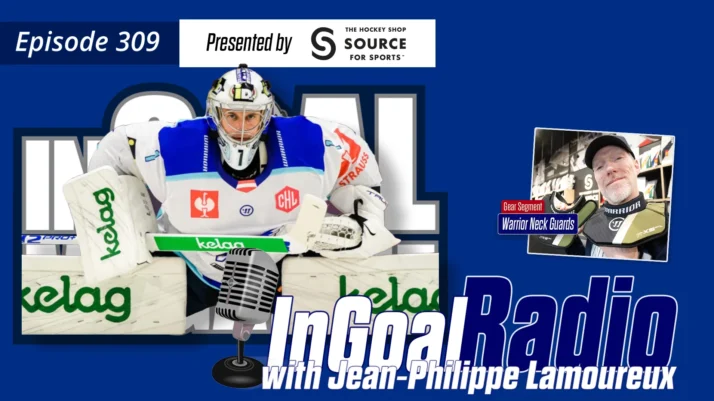
InGoal Radio Episode 309 with Jean-Philippe Lamoureux

Please subscribe and leave a rating — it helps us reach more goalies!


Jean-Philippe Lamoureux retired after a 17-year pro career to become director of hockey operations and analytics at the University of North Dakota. In his final pro season he used Clear Sight Analytics for tracking work, and he is currently writing 'Focused: 10 Systems of Thought for Hockey Goaltenders,' a book combining his road-trip reading influences with his own goaltending philosophy built over 14 years of coaching through JPL Goaltending.
- Lamoureux transitioned from 17-year pro goalie to director of hockey operations and analytics at UND, leveraging 14 years of summer camp coaching experience through JPL Goaltending.
- His upcoming book, 'Focused: 10 Systems of Thought for Hockey Goaltenders,' blends favorite road-trip readings with personal goaltending philosophy.
- Lamoureux used Clear Sight Analytics for performance tracking in his final professional season, highlighting the growing role of data in goaltender development.
- The rapidly shifting NCAA transfer portal landscape could significantly impact how goaltending talent develops in Canada.
- Parents of young goalies get 5 practical tips for helping their child handle disappointment in the Stop It Goaltending U parent segment.
Episode 309 of the InGoal Radio Podcast, presented by The Hockey Shop Source for Sports, features a wide-ranging discussion with recently retired 17-year pro Jean-Philippe Lamoureux, who is now settling in as director of hockey operations and analytics at his alma mater, the University of North Dakota.
Feature Interview
presented by NHL Sense Arena
In the feature interview presented by NHL Sense Arena,Lamoureux takes us through the decision to retire and start his college coaching career after 14 years of already coaching summer camps through JPL Goaltending. He talks about his early mentors and professional coaching influences and how they shape the foundation he brings to the new role, as well as the fast-shift NCAA hockey landscape and how it could impact goaltending in Canada especially. We also discuss his tracking work with Clear Sight Analytics in his final pro season, and his pending book, “Focused: 10 Systems of Thought for Hockey Goaltenders,” which combines his favourite readings on road trips with his own experiences.
Parent Segment
presented by Stop It Goaltending U
In the Parent Segment, presented by Stop It Goaltending U the App, we share 5 tips to deal with disappointment and some great advice for how to best handle those moments for your young goalie.
Pro Reads
presented by Vizual EdgeWe also review this week’s Pro Reads, presented by Vizual Edge, which features Vizual Edge user Cam Talbot of the Detroit Red Wings breaking down a power play chance against the Montreal Canadiens.
Weekly Gear Segment
presented by The Hockey Shop Source for SportsAnd in our weekly gear segment, we go to The Hockey Shop Source for Sports for a review of the Warrior X5 RTL and Pro neck guards, with a closer look at why the RTL should be a go to for older goalies.
Episode Transcript
Intro
In the Lower Mainland to Los Angeles, we've got it covered. The National Hockey League draft taking place as we record this. This is InGoal Radio, the podcast presented by The Hockey Shop Source for Sports Langley, thehockeyshop.com. And out of the National Hockey League draft comes a lot of dreams coming true and igniting a fire under others that may have been passed over. But the biggest news for goaltending, guys, is a development on the E Bug.
Don't know all the particulars yet, Woody and Hutch, but the E Bug took center stage this weekend.
I think dreams are ending for a lot of people that had hoped to get into a game and have one of those magical moments that have been so well documented over the years, whether it's in Chicago with the accountant or the Zamboni driver in Toronto against with Carolina. Great stories, great theater, grabs headlines. But at the end of the day, as we've talked about many times, this is a $6,000,000,000 industry and maybe the results of your games with all that's on the line shouldn't come down to that, and it sounds like the NHL agrees. And it sounds like without having all the particulars, and I'm fascinated to see where this goes, but it sounds like they've tried to solve two problems here. And the other problem is practice goalie.
Having some rules around the practice goalie. And we have talked about this for years. I think I have written this column at nhl.com every year for the last six at some point that as we get into sort of that workload management, load management stuff that we talk about in other sports with goalies, and the games played come down. And the best do this with their starters. They manage these minutes in terms of practice and how much of the practice isn't actually benefiting the goalie, you're just out there as a target, do you really need to waste those reps and that workload on your number one goalie?
We're finally gonna have a combination E BUG practice goalie officially. Teams have used it for years. I've watched teams travel practice goalies. The Leafs came in with a practice goalie one year. The Penguins evidently travel with a practice goalie.
I met him once. I don't know if it's every trip. I know the Canucks had a practice goalie on staff for a while. They were talking about traveling. I don't know that it had that ever happened.
So there are teams with money that have done this. There are teams that have a a next goaltender on their staff. In Carolina, it's the equipment manager. He'll go on the ice. In Washington, it's the video coach.
He'll go on the ice, former NCAA goalie. So we've sort of had this. I think there's a benefit of it. The one I point to the most is the year Devan Dubnyk went to Minnesota, and they had a three goalie rotation. And I can't remember how did he play, like, 50 games in a row or something absurd like that?
602.
Yeah. I should have looked it up, obviously. But it was an absurd number, and people are like, how can he do this? And the answer was because he went on to practice, he got his goalie work in, he took a couple of rush drills to field the puck and everything, and then he got off. He left.
He preserved that energy, and he was able to play basically every single game. And so there is value to having that guy, and it sort of created a beyond the e bug stuff, there was a wild wild west in terms of haves and have nots and who was doing what and who was supposed to be and allowed to do what. And I think having a set of uniform rules that'll solve both I don't even know if it's a problem, but solve both things and put everybody on the same playing ground is never a bad idea.
So the emergency backup goaltender will still be there in the rink.
It'll just be somebody who is part of the team. Each team and I'm I'm assuming again, we haven't seen the rules, but I'm assuming this person will now be part of the traveling entourage.
So you'll have your own e bug. Each team will have its own e bug.
Yes. Now I don't again, I don't we haven't seen the language on this. There have been a number of proposals over the year, and there is a lot of fear about teams taking advantage of it, finding a way to maybe have a guy who just recently retired who actually is a capable NHL goalie, you know, go out there and be a part of this. Like, you always look for loopholes because teams are always looking for ways to get better. The fact this is being written into the CBA tells me that they're they've explored this deeply.
I know one of the proposals and it was discussed. I have no idea how far it went or whether this is a part of it or is this will be a part of how it ultimately shakes out. But Bill Ranford talked about this on our podcast. His proposal, and it wasn't e bug, it was more practice goalie, and he had concerns about it being used in the e bug role, but his was ECHL goalies. Because increasingly, organizations are starting their youngest goaltenders, their youngest prospects spend time in the ECHL.
And guess what? Most teams don't have a goalie coach in the ECHL. Some do. Some parent clubs send one down. Some some of the local the actual ECHL franchises hire a guy, but you are talking about the point of your career where you may need help the most.
And most guys are left to their own devices. Just turning pro, just starting out, figure it out on your own kid. We don't have support for you. So Ranford's proposal was to alternate between your two ECHL goalies. And one at a time, every other month, they would be up with the NHL club.
You're flying on the plane. You're facing NHL shooters. You're working with an NHL goalie coach. You're making sure that the number one can rest by getting those practice reps, and it's actually helping you in the development process. But you don't stay there all season.
You go back and forth. So you one month, you're up there. The next month, you're down playing games. So that was part of the proposal he sort of explained to us here on the InGoal Radio Podcast. I'd encourage listeners to go check it out, and I'm curious if that has worked into this solution in any way, shape, or form once we get all the details.
I'm curious about why it needs to be in the CBA and the implications of that. Because as you said, teams have already done this to an extent, and they already have to have an e bug in the building. So that sort of implies that there's salary cap implications and the fact that this could be players that are regularly under contract to a team, much like you're saying using an East Coast guy. Maybe it's an American League guy because some teams carry three guys there now as well, and they could do some shuttling. And teams increasingly have their American League teams close to home.
So my guess is it's gonna be something around that. I'm also fascinated by what you you just said about Devan Dubnyk and something that's designed to, in one way, alleviate the strain on the starter might actually change at the NHL level what we're seeing, and we end up seeing some starters that have even more games played now.
Yeah. I agree. I think it might the unintended consequence or result may lead us to more 60 plus guys, more more guys playing 60 plus games than than we're than the current trend, which is backing off that.
If you have a modern thinking coaching staff that sees the value in letting your starter have time off of practice.
And here's the rub, and this is why and I believe you're probably right, Hutch. This is going the reason it has to be in the CBA is because my understanding, and I don't wanna put words in any anyone's mouth, but my understanding of past proposals, formal or informal, to solve the practice goalie dilemma was that the players association was like, hold on. That's an NHL practice. That's an NHL job. You need to have a contracted goalie.
And, of course, once they're on the team, even on a practice day, they're counting against the cap. Right? So you don't the PA is there to protect jobs. And so if this is a job that they believe should be serviced by an you obviously have to collectively bargain that. And so the fact that this is in the CBA tells me you're right.
This is probably a part of it on the practice side as and and then if you're allowed to use them as an e bug, then and like you said, they'll they'll have to look for there will be loop there will be teams that try and find a way to use this to their advantage, and so you'll have to be careful how you do it. But it it it does make, you know, it does it does make a lot of sense to me. And and I and I and this is not to discredit any of the incredible stories that we've had over the years. Right? But at the end of the day, and I've had this conversation with a lot of, you know, NHL staff people, goalie coaches around the league.
They're great stories. Everybody loves it in the moment, but you're a professional sports league. You're you wanna be one of the big sports leagues. You're a $6,000,000,000 industry and growing. What we had the night that Roberto Luongo went to the hospital, came back.
Al Montoya got hurt as the backup. Robbie Tallas is getting dressed. Loungo ends up in the net after coming back from the hospital and leaving the game. The delays, the chaos, as much as that made for some pretty good headlines. And I think the panthers even did an e bug tryout the following summer and got a whole bunch of people, including Linda Cohen from ESPN down there trying out to be the e bug and got a lot of attention out of it.
It still doesn't sit well to a lot of people in terms of, hey. Like, we're trying to be the best professional sports league in the world. Having having Joe from accounting come into and, you know, come into the net doesn't really I I should even say, like, Joe from accounting was supposed to be a joke, but we actually did. We had Scott Foster in account account. Should've said Scott from account.
Like, in the net and winning a game probably isn't the greatest reflection of of of how you do it.
How far have we come since the day of only one goaltender per team not wearing a mask and some kid who plays junior sitting in the stands to maybe come in for either team. And here we are. I think what's gonna be fascinating, guys, is you will see teams using this role in different ways and which are the ones that take the best advantage of it in terms of development, which is the thing I'm most interested in. This could be used as a great development tool. As you said, Woody, a chance to bring in a a kid who doesn't get the to work with the NHL goaltending coach, in some cases, doesn't get to work with a goaltending coach at all.
I think you're also gonna have some teams that don't think it through and don't see the value in it, and there's gonna be some young kids that rot on a roster and don't get to do anything except take line rushes and don't get into any games and their development is stifled. It's gonna be really interesting storyline to see
I'll just how this evolves. Some teams may not need it. Like, if if they have, three goaltenders, like Minnesota last year, we're rotating three goaltenders through for a time. You don't really need a a practice goalie because whoever's up at the time, if they have two goaltenders, they want all the all the shots because they're they're splitting time. So there's there's gonna be specifics that that that are detailed into each team, not across the board.
Absolutely. And each individual goaltender. Some starting guys might love to have some days off practice and some are not gonna want them at all. Some coaches will allow it and some coaches will not. It's, it's we've got a really neat storyline coming up here over the next two, three, four years, I think.
So I think in Winnipeg, I don't think it gets talked about enough, but they're very conscious. It already points to Connor Hellebuyck's workload, but he doesn't practice, like, much. Right? Like, he gets a lot of time off, where he just does his work with Wade Flaherty and does a little bit. And the to Hutch's earlier point about how will teams handle this.
And they have their American league team in the same city, so they can take advantage.
Same bill same building. But one of the pushback points that we've had over the years and different head coaches buy into this at different levels, you have a lot of shooters that get pissy when it's not their NHL guy. They don't wanna shoot on Joe from accounting. They're NHL players, and they wanna shoot. So getting the level of this practice goalie up and a lot of teams have guys that are really good at this, and they had careers, and they and they played at a high level.
So they're perfect for it. But that's important to a lot of teams because because there are veterans that are like, I'm not you know, like, they wanna shoot on their NHL guy, and they don't care that walking into the hash marks three straight drills in a row isn't doing that NHL guy any good or that he might only be able to play 55 games instead of 65 because they insist on it. But that is a real part of the pushback or has been over the years from NHL shooters and some NHL head coaches.
People walk into the hash marks and let loose?
It's like being at a drop in skate.
You know, the best part about being an an e bug or getting an opportunity to to practice with NHL people will be that that person doesn't face multiple shots at the same time. They'd be like, this is a real warm up. I love this.
Actually, hold on. Hold on.
We It's safer. It's safer than than than playing in your in your pickup skate where there's three shots coming at the same time.
We miss we miss the plot here, Hutch. We need to ask Daren how this affects him. Does he
Oh, I don't I have no idea.
So you if if you're officially the practice goalie, does this mean there's a chance to actually be an ebug too?
Well, I don't think there's anything official about me. I think I'm very unofficial. And and and I do practice at times. I do certain rehab skates at times, and and it's very enjoyable. And I would be disappointed if that ever went away, but I would understand if if they brought in somebody full time.
But we the team that I work for in Vegas, also has their American League team in the in the same city. So there's there's opportunities, to maneuver, through this new, landscape, with with that, with that advantage as well.
We will hope it works out Woody's way and that the new E Bug, goalie three, whatever we call him, will be traveling with the team so that there's still rehab skate opportunities for broadcasters.
Now that would be fun. Yes. That that would be awesome. At the end of
the day, the most important thing here is that Daren gets to keep skating and practicing.
It's really the only thing that matters in this whole negotiation.
I would just like to go on the New York trip and be able to skate MSG. Oh, that would be cool. Amazing.
Yeah. That's I was gonna say bucket list, but most people couldn't even put that on the bucket list.
Gear
No. Exactly. It'd be it'd be wild. Let's get into, our show today. We've got J. P. Lamoureux coming up on our NHL Sense Arena feature interview. He's back with us. Stop It Goaltending U the app, a parent segment. We'll, feature, David Hutchison, a Visual Edge ProReads. So and we've got the hockey shop gear segment. And this week's, gear segment is the Warrior Neck Guards brought to us by The Hockey Shop Source for Sports Langley, thehockeyshop.com.
Yeah. You know, we talk a lot about all the great gear that's in at the hockey shop. All the 2025 gear is there. We've been breaking down. You know, we had this EFlex seven, the 7.9, the new Bauer Flylite, the Bauer SV Pro.
We've been working through all these new lines that have been arriving over the past month of the Hockey Shop Source for Sports, and there's more coming. New gear coming, it feels like every day. Launches into August. We're gonna get into some of the other aspects, some of the other elements. So why are we going to Warrior, which launched this new neck guard couple of months ago?
I think we recorded this one, Hutch. We've had it in the can because it's a yeah. Because it's a perfect example of the best thing about new gear at the Hockey Shop. There are new features on this neck guard. We'll get into them with Cam.
I think it's actually probably one of the best kept secrets in in goaltending. This is an exceptional neck guard if you don't need B and Q certification. It's sort of like that old Maltese, But but the beauty is it's always been a little more on the expensive side, but because there's a new version, Cam still has inventory of the old stuff. And so that's why this is the best time of year to go on the hockeyshop.com. Whether it's this new warrior neck guard, meaning that the previous generations, which, you know, there are new features, but you still get a lot of the protection, on the older models for a lot less money or EFlex 6 and its second price point lines being on sale or Bauer Hyperlite two being on sale, now is the best time of year, whether it's the latest and greatest or discounts on the stuff it replaces.
Make sure you check them out at the hockeyshop.com.
I think you were just saying how with the e bug discussion, we sort of missed the point, and we got on to Daren. I think you might have missed the point talking about the Hockey Shop this week, Woody.
Well, I often do miss it.
Because when we were there, we met InGoal listener, InGoal reader, Chris Matola, who came up from California. InGoal legend. InGoal Legend. Yes. Featured on the site as well.
Came up from California and as people do from time to time and we encourage you to, he sent us a note and said, hey, gonna be at the Hockey Shop. If you guys happen to be around, let's grab a coffee. We did that. The cool part of the whole discussion for me was when I said, so, Chris, what brings you to Vancouver? The Hockey Shop?
Well, what do you mean? I had to get some skates. Oh, why else are you in Vancouver? That's it. When are you going home?
Tonight. So there you go. Like, that's endorsement for the hockey shop right there. He flew all the way from Los Angeles to Vancouver, Ubered out to the hockey shop, got himself set up with some great gear, and then flew home that night. And by the way, he actually told us he saved money in the process.
I guess that tells you how, I don't know if that's Canadian dollar, the landscape of stores in Los Angeles for hockey, or just the great service at the Hockey Shop. But what a cool experience, and we really enjoyed, getting together with Chris and and anybody who stops by.
And I think before we get to Cam in this this week's review, the one key point that he made is not just that, yeah, he ended up coming out on the right side of the ledger in terms of saving money, and he actually has he sets it up so he's looking for the discounted flights that match up with sale times and and other items at the hockey shop. So he's got, like, it all kinda planned out. But the reason he chose to come all the way up and he bought he ended up buying a glove and some other items, but he needed skates. And what's the most important part of skates? Getting fit and baked and set up properly.
And the expertise and the people at the Hockey Shop make that worth the trip. Literally for him from Los Angeles to Vancouver to make sure that not only did he get skates, but he got the right skates for him, the right fit, the right bake process, everything set up the way he can go back and know he's got something he'll be able to play in for years. So that was that was kinda I'll be honest, like, that was a little eye opener for me. Like, holy crap. Like, all the way from California because that's how much he trusts Cam and his crew at the Hockey Shop Source for Sports.
And thanks to Cooper because Cam was busy for making sure that Chris got some wheels that fit.
There's no better place for a goaltender. Goalie Utopia, the Hockey Shop Source for Sports Langley, thehockeyshop.com over to Cam and Woody.
[crosstalk] We're gonna tell you what's new, what's improved in the Ritual RX 5 RTL neck guard, and if you stick around to the end, massive savings. Don't forget about the pro on how to protect your neck better. Welcome back. Hockey Shop Source for Sports. Goal Utopia.
Ritual RX five RTL and the Pro. This is higher end neck protection. This is base level neck protection. This is a little more pro style. Yes.
We've seen it before. This is the third generation. Yes. Soft foam, super protective, high neck.
What's since we're getting into it
What's improved? High
High impact, soft, shock absorbing foam becomes rigid upon impact. Very reminiscent of some neck guards from some companies that no longer exist, to be honest.
I was trying to remember.
You might be thinking of Maltese. Right.
So this was kind of the replacement for the Maltese. It's been so long. Like I said, this is the third generation of it from Warrior. When Maltese was no longer available, they came out with this, and it was it was a really good replacement.
And this is a fantastically protective neck guard. 100%. One quick note because it does come up. Both these neck guards
Not B and Q certified. Yes. What do they mean?
Non ballistics nylon or no ballistics nylon in your neckline. Obviously, you can't get anything in here, but nothing in terms of for
Skate resistant. So you would have to if you require that, you would have to put an undershirt on?
In theory, you would have to have a B and Q certified turtleneck.
Turtleneck. Yes. Okay. So there are options to incorporate it.
I'm gonna go that other way.
Okay. Now previous generation, we have it right here. It doesn't look I mean, hey. You can't see me camouflaged. Oh, hold that.
But doesn't look a lot different. But when I was feeling it, there is a slight difference in the foams. Yes. This one is noticeably now, obviously, it softens up when you're heating up on your body. This one does too.
But this one to me was noticeably noticeably. Noticeably. There you go. For me to say. Just more flexible and malleable while still having that thick protection.
What I noticed was the two layers of foam in there seem to be separated, which allows it to just be a little more mobile than the solid piece of foam in the old generator.
What that will mean, not having that rigidity, especially underneath your chest protector. As you're moving, it moves with you, not against you, so you won't have that neck guard riding and wanting to twist and, you know, choke you out as you play, basically.
Okay. So anytime we get something new, it means the old goes on sale. Now this is not an inexpensive piece. I'll be upfront. But we
don't wanna mess around when protection. Exactly. Yeah. Especially if
you play against guys that can shoot. We we if you ever had black and blue and cuts on your collarbone, you know.
I seem to remember when the first generation came out, you hitting me with a hammer to show off the
Do wanna revisit that? Do we have a hammer?
I'm I'm okay. Well, wish we had that.
Somebody please find me a hammer. Cam's asking to be hit today. Oh. Please, somebody.
Thank you for not responding.
Okay. So let's go over
this one. Well, first of all, let's, yeah, let's complete the rest of the line. So this also replaces their base model neck guard as well. Updated materials is still very similar to the last year's. We still got the same style of, like, foam on the inside as well.
We don't have the same shock absorbing foam that's reserved for our high end price points. That does mean, though, I do have last year's version as well.
And So it's on sale.
Yes. Exactly.
Okay. So last year's version, around 150, a little more than 150. I think it's $151.95. Full one is $189. 99, but I've heard I've heard we set a special surprise on how to save big money for this. We did.
Where is it? Where's the big money saver? The OG original Cameron may have overstocked on this a little bit when it first came out because Kevin got them a little too excited. Again We have a few. This one's a little stiffer than the ones that have followed suit, including the new art the Ritual 5.
But still, as it heats up, it gets a little softer on your body. Tons of protection. And this one is on sale sale. This is on, like, double secret probation sale. Yeah.
Oh, baby. $132.79, which I gotta be honest. Hundred and eighty nine ninety nine, hundred and fifty one ninety five, hundred and through 3297. I'm not sure what I'm confused more by. Ritual calling the pro model for their second line or Cam changing the ninety nines to ninety fives and ninety sevens, but it's a big discount.
And he's got lots of them at the hockeyshop.com. If you have any questions about these models, about making sure you're B and Q certified, where do they get you, Cam?
(604) 589-8299 or 1-800-567-7790, or check us out at the hockeyshop.com.
And since nobody's gonna find me a hammer
I didn't wanna stick my neck out for this one, so it's okay.
Dad jokes. You're definitely someone find me a hammer. The old video's up here.
Don't knock dad jokes. That was a good one. It it was just sitting there for us.
I am not a dad joke guy, but, Cam, for a guy who doesn't have kids, he's exceptional.
He's preparing well.
It's it's really good. I I I appreciate his sense of humor. And, you guys, with neck protection, we we debate the the dangler all the time. I actually caught one the other day with my dangler. It and the mask and the neck guard underneath, it was perfect.
And I thought if I had any ability to take a picture during my skate, I would have done that for you guys just to show everything.
Who knew rebound control is a feature of the day?
I know. I'd actually told my guys that too. I'm like, that takes skill.
Skate to the bench. That's awesome. Somebody grab a phone. I gotta show Woody and Hutch.
In men's league skates, there are phones on the bench too. I'm way too important. I have to have my phone out here.
Well, for me, it'd be more having it there to make sure my heart doesn't explode. Just warning signs going off. Why is Woodley's phone on the bench going nuts? His heart might explode. Somebody find the defib.
No. Everybody everybody wears a neck guard. Right? What I'm not talking about dangler, but the under the chest protector.
Man, I've seen some guys in the NHL that barely have one or have one so More
for the clavicle.
And so beat up.
Yes. Yeah. Yeah. I don't know who doesn't use them for the clavicle. But
Oh, I've I've seen
seen lots of them sit quite low.
I've seen some of them in the NHL that wear the padding. It's like the old Vaughn ones where there's barely anything there, and that padding on the clavicle is pretty pretty thin because they've been wearing them for decades. Like, just, like, weird. To me, it's I need more protection, but and this is the beauty of this Warrior one. It's to me, it replaced the Maltese, like that sort of soft gel type.
Did you have a Maltese? I did.
I didn't, but I do remember guys right up to the NHL, Daren, when Maltese stopped making them, guys texting me asking, what do I get next? Like, NHL goalies being like, what do I get next? And to me, this I'm I'm not sure how many guys have it in the NHL. I'm surprised we don't see more because to me, this is the Maltese of the modern era.
It was a it was a little heavier, but it was so strong for protection. And I'll admit the the thing that goes around your neck that that bothers me a little bit. I have trouble tightening it up and and making it firm, but that clavicle protection is so important.
To me, this one's a bit of a from a men's league perspective, for sure, if you if you've ever, this is this is a bit of a no brainer. No bruises since.
And you don't know where those shots are going. We get to a higher level. A lot of times that they're they're easier to read because in a sense of they're not coming at your head or your chest or your neck. Does that make sense?
It does. And I think every goalie knows this. The guys that it doesn't go where they're trying to shoot it. But, yeah, I I digress because this may be a source of frustration after a recent skate. Stop all the good ones.
Can't stop the bad shooters.
I once had a goalie coach tell me, hey. The guys that are on lower level, they don't know where it's going. How would you ever be expected to know where it's going? I'm good. I can, I can let, Joe score a little bit more?
Parent Playbook
Let's get into our Stop It Goaltending U, the app parent segment. Hutch is standing by, but, first, Woody, with a message from Stop It Goaltending.
Yeah. Stop It Goaltending U, the app. All of the twenty five years of Stop It Goaltending led by Brian Daccord, former professional goaltender, goalie coach for the Boston Bruins, goalie scout for the Toronto Maple Leafs, director of goaltending for the Arizona Coyotes. He's done it all. He has all that experience.
You know what he's done? He's taken it, and he's put it in an app for you. The Stop It Goaltending U, the app, has daily primers this week. They're looking at maximizing your off ice training. One of them was talking about playing tennis, a little hint there.
You can easily digest these daily primers, quick one minute videos to help you get better each and every day. They've got a great goalie systems video breakdown this week, slide versus shift. The drill this week, is is is on passouts. You can walk through that drill, something you take into practice. And, of course, they have the Stop It Goaltending U Journal, a PDF you can download and use for journaling.
So tons of information, twenty five years experience, all packed into the Stop It Goaltending U app. Make sure you go download it. And, of course, anytime you get a one a monthly subscription to the Stop It Goaltending U app, you also get a subscription to InGoal Premium.
Hutch.
Daren, this week, we are going to talk about helping children deal with disappointment. Five tips for helping children deal with disappointment. It was interesting as you mentioned
Woody, grab me a pen.
I'm making notes already.
It was interesting that you mentioned that we're on the eve of the draft and that, as many dreams are being made. There are gonna be twice as many kids that are disappointed today and, the Western Hockey League and and, the rest of the CHL have had drafts, USHL, and lots of kids have tried out for teams and not reached the level that they had hoped to. So dealing with disappointment as a parent, is something that happens all the time. So here we go. Five tips.
Number one, acknowledge. I think it's important to acknowledge your kid's feelings. Too often as parents, we want to quickly gloss over how they're feeling and get right to the don't worry it's gonna be okay stage. I think it's really important that we let our kids be upset and we let them process whatever emotions that they have, whether it's sadness, embarrassment, anger, whatever it might be. Let them know it's normal to feel that way and it's okay to feel that way.
Number two, part of that is encourage expression. Let them process what they're going through by asking them some questions. Again, don't rush to fixing it. How do you feel? Ask them to reflect on it.
Why does it bother you? Helping them again understand that it's okay to feel this way. Let them process this a little bit, rather than having them sit around thinking I feel terrible and and now everybody's telling me I shouldn't be feeling terrible. Let them let them express how they're feeling. Number three, we do get to this point, reframe.
Eventually, we need to help them shift their mindset. Some call it positive reframing. What did you learn from the experience? What's this gonna do to turn into an opportunity for you? Don't get stuck with your kid blaming politics or how unfair the situation is, even if it is, because that's not gonna help.
Remind them of the good that has come from this in the past for them because they probably have been disappointed before and it's turned into good things, or for other goaltenders or other athletes or other people that have suffered some sort of difficulty and then gone on for something better. So we can help them reframe it into something more positive. Number four and five are probably really ongoing things during the year, but it fits with this too. Teach coping. We need to help the kids build coping skills not just from going through these experiences and this individual event, but, things like rituals on and off the ice that help them deal with difficult emotions.
Maybe they learn some meditation, something I've tried guys that I think is fantastic. Teaching them self talk. Lots of great techniques from people we've had on the show like Pete Fry, of course. Help kids learn to cope with their emotions. And then number five, I think this is so important and we forget it as parents a lot.
Expand their identity. Help them understand that their self worth isn't tied to their athletic performance. And this is something kids struggle with and professional athletes struggle with when they eventually retire even if they've had nothing but success in their careers. We need them to understand that they are good human beings not because they are goaltenders, but because of all the other things that they do. And so for me, that's reminding them that, you know, I love you because you've got a great sense of humor, because you're a kind person, because you try and help other people all the time, because you're really curious, you learn well.
And part of that, I think, guys, is helping them have other things away from the rink. We talk about having other sports so you'll be another a better goaltender. Be careful. It can't all be about being a better goaltender. How about just going out and playing baseball because you do other things that are fun or learn to play the guitar because that's kind of a cool thing.
Whatever it might be, encourage friendships away from the hockey rink. I think there's a lot of things that are really important here to help kids in an ongoing basis by expanding their identity. So five tips just to refresh, let them acknowledge how they're feeling, encourage the expression about how they're feeling, then we can start to let them reframe this into something more positive. Don't rush to that stage. Teach them how to cope with things when they're difficult, and then expand that identity so that they're not rooted in just being a goaltender and success on the ice, meaning they're a good person.
Sorry. I was just finishing the last one. Writing it down. Hutch, nice work on that. It's so valuable and to to be able to acknowledge more than anything, what what your child is going through.
Yeah. We want to fix things all the time. And sometimes we hear these great legendary things. I don't even know the number, but people say, oh, you know, Tiger Woods father would allow him to be upset for exactly one minute or something like that, and then he had to move on. And let's not think that that applies to life all the time.
Maybe you do have a time limit just to get through to the next shot or the next shot in a tournament of golf or or in a game of hockey. But but in life, we've got to be able to process these emotions or they will build up over time and the dam will burst eventually and obviously, we want our kids to be healthy.
Then you're left with Woody.
You're left with all of us. It's normal to be weird, Woody. We all are.
I was thinking weird. I was just thinking snap tastic.
Snap tastic. Yeah. Well, we all do that too.
I'm just gonna call him unique.
I don't think you're allowed to call me weird, Hutch.
No. I I I thought that was
a little bit strong. Way, Woody. In a good way. I'm calling HR.
Yeah.
Oh, boy. Here we go. Losing my union card again.
A little firm. Hutch. Little firm.
Oh, hold on. I just called HR and it's Hutch. We're good.
And he says, get back to it. Awesome stuff. Vizual Edge ProReads, Woody.
Yeah. And we've got a Vizual Edge user in this week's ProReads, Cam Talbot of the Detroit Red Wings. If you've enjoyed his ProReads to date, then you are going to love this one. Cam has been great. Cam is a Visual Edge user.
He's talked in these ProReads about how using Visual Edge has allowed him to sort of have success more success later in his career, but how it allows him to sort of open up the scope and see the field of play better, but also dial in on details and pick pucks on up through screens. There's a little bit of element of all of that, especially IDing options on the power play in this week's ProReads against the Montreal Canadiens and the Calder Trophy winning defenseman Lane Hudson. So that's a big part of the breakdown this week, sort of being able to sort of look at the zone and identify options. So you're zooming in. You're converging on the puck.
You're diverging on what's going on around you. Those are just two of the visual elements that you can train to be better through the Visual Edge tools like Cam Talbot has, like Jordan Binnington told us in recent weeks through the quote we had, on on his use of it on a daily basis to prepare for games. Visual Edge is a great tool not just to get the eyes going and to train the eyes and to warm them up on a game day, but cognitive. There's a cognitive connection element between the eyes and the brain and how they work. It's all trained through the Vizual Edge system.
Make sure you check them out. And as an InGoal reader and subscriber, we've got a discount code for all our readers, for everyone of InGoal, and we've got a special one. If you go to the ProReads at ingoalmag.com and read a pro as you see your subscriber only discount, which is a significant increase. And one last note for upcoming this Monday, which is June 30, there is a big one time one week discount. If you wanna get involved on an annual subscription to Vizual, it's a chance to save 30%.
We will have that for you on Monday. Keep an eye out for it. If you hopefully, you hear this podcast over the weekend. If you listen to it later in the week once the week has started, that will be active for an entire week. So make sure you keep an eye on our social channels, our email, and as well as in the ProReads for the discount codes to Vizual Edge.
It's a great tool to help you see the game and the puck better, and it's a perfect complement to our weekly ProReads segment.
I love ProReads. I do. And it's the it's the video work that the NHL goalies are all doing, but you get to look at it through their eyes.
One of our favorite parts and one of our most valuable tools. We've heard that from right up to the NHL from from goalie coaches down to young kids developing coming into junior. We know a lot of coaches, some with permission, some without, use our ProReads in their summer camps, their goalie schools. They they basically walk kids through the ProReads because the whole idea here is get them thinking about situational stuff on the ice and how they would play it. And there's never just one answer.
Right? Like, is it changes for everybody depending on your strengths and weaknesses, how you play a situation. But hearing an NHL goalie explain how they play a situation and why might open up your mind to thinking about it a little bit differently and help you build out sort of your ability to read and anticipate what's coming at you.
There's a randomness to to hockey, but the the more that you can, limit that or be able to, predict the randomness is, going to make you a much better goaltender, a much better hockey player. NHL, Sense Arena a feature interview. Let's get to it. JP Lamoureux, joining us. Nice to be back with him, but this is a a different stage of his career as we are, enjoying the relationship with NHL Sense Arena.
NHL Sense Arena actually has something on right now. We were talking about how we are on the eve of the draft, and they have an NHL draft twenty twenty five competition on right now. And we're getting to the podcast a little bit late for this competition. It only runs up until the June 29. But all you have to do is post your best score so there is still time to get in on it.
And the top performers in the competition get to walk away some with some great prizes, gift cards to nhlshop.com or some free time on NHL Sense Arena. For me, it really just highlights that there are so many levels to NHL Sense Arena, so many things you can do on it, and competitions are just one piece. You can get in there, go into the menu, find the competitions, and take part in the latest one. And if you're not just into training for training sake, you get this opportunity to go head to head with other people around the world in your training. And let's face it, so many people who are goaltenders are very dedicated and very competitive people.
For goalies, in this case, there's eight high intensity drills that you, that you try. You're being scored on the total number of saves that you make. And another highlight of cool things about NHL Sense Arena, there's a tiebreaker. If you happen to have the same number of total saves as another person, the tiebreaker will be your reaction time. And, you can't do that on the ice.
You can't get a reaction time indicator, but you can do drills in Sense Arena. You can get tracking stats. You can get reaction time stats, all sorts of cool things in NHL Sense Arena that are not available to you just going out on the ice and skating. So fantastic tool for training off the ice is NHL Sense Arena. Go to NHL Sense Arena excuse me.
Go to sensearena.com and use the code IGM 50 as always to save even more.
Feature Interview - Jean-Philippe Lamoureux
Nice catching up with JP.
Yeah. We've had him on before, so I would encourage people go back and find the old episode if you want a little more sort of history of his playing career because it was a fantastic one. And as you mentioned in the intro, Daren, now we're getting into a bit of a shift. 17 pro seasons, mostly overseas, fantastic seasons, that he talked about last time retiring despite putting up, I think, a nine eighteen this season. So it's not like he's it's not like his play had dipped, but it was time.
He's switching over. He's gonna be working at the University of North Dakota. We're gonna get into that. And just the perfect timing to catch up with him. He's got a book coming out.
He's a very thoughtful goaltender. Really thinks the game at a high level. He's got experiences with a lot of high end coaches, early before he went over to Europe. Used to work with Ian Clark a fair bit. He has been running JPL goaltending, so he's done coaching in the summer for the last fourteen years.
There's just a lot to his approach, his experience, way he thinks the game that I thought it would be great to catch up with him again. And, honestly, the other part too is this is a shifting landscape. He's moving back into the NCAA at a time when the rule changes around the CHL. A lot of people have questions. We get into that a little bit.
What could it mean for goaltending and why? He thinks maybe this could be a good thing for Canadian goaltenders. So we get into all of that. It's a great, a great interview full of resources, tips, and advice, from one of the real, you know, deep thinkers of the position, and I enjoy I really enjoy this. I think you will too.
Enjoy it. It's the NHL Sense Arena feature interview on InGoal Magazine. InGoal Radio, the podcast.
Really excited to welcome back to the InGoal Radio Podcast. It's been a few years since we caught up with JP Lamoreaux, Jean Philippe Lamoreaux. Seventeen professional seasons. He called it a career. After this past one, he is now at the University of North Dakota making a massive transition.
He has a book coming on goaltending, one of the all time great guys in the game, and a really thoughtful guy when it comes to goaltending. I'm excited for our follow-up conversation. First off, I think it was around the pandemic the last time we talked, so cup just coming out of it. Walk me through the last few years, the end of a career, and walking away over in Europe after seventeen seasons. That can't be easy even though it looks like you've settled in nicely to the next chapter.
Yeah. I mean, the timing is, timing for me was kind of perfect. So accepting this position at University of North Dakota, it wasn't in the plans. I think from the outset, people probably think it was, Hey, you knew you were going to walk into this, but it was lucky with the timing. But I thought it was the right time for me to transition to the next phase of my career.
I want to get into coaching at the collegiate and professional levels. And this opportunity was sort of a dream come true to be able to come back to my alma mater.
Okay. So you the title is Director of hockey ops and Director of analytics. The role, the amount of goaltending work you'll be doing, how that all phases. I don't wanna get into the analytics part too because you've also done some site some some work with ClearSight Analytics, who we're obviously big fans of. But just walk me through what this transition has been like and the role and what your plans are, what the goal is.
Well, I'm just kinda getting my feet wet. So I'm just back, you know, we're in the month of June now, and I've been running my goalie school here for the last fourteen years. And so I'm sort of getting my feet wet, getting accustomed to what the job's going to entail for me here. But primarily going to be working with the goalies, assisting with practice plans, and a big part of what I'm going to do with contributing to the coaching staff is going be the live cutting of the video and helping with pre scouts and things of that nature. Hopefully, I can add to the sterling coaching roster that we have here and just want to be a positive member of the staff that adds to the great culture here at North Dakota and hopefully help turn out some prospects and help them achieve their professional dreams too.
From a goaltending standpoint, obviously, there's there's a lot of things that have been well established and well structured there already and a lot of success, including yourself. What, like, what do you see as next steps at a time when the landscape of college hockey is undergoing what is potentially a seismic shift?
Yeah. I I think before I get into that, I do have to say that, you know, I am standing on shoulders of a giant where, you know, one of my mentors, Carl Gearring, was here for a number of years. In my opinion, the greatest to ever play here at the university. You know, he still holds the wins record, games played record here, national champion, all American. So he did it all as a player.
And then, you know, his time here as a coach was, you know, inspiring to me and what I, you know, the footsteps that I want to try to follow. But as you pointed to here, there's been a seismic shift in junior hockey and at the collegiate level. And so I think we're sort of seeing a realignment of what the junior level is going to look like because that affects the player pool that the NCAA is going take, that will pull from. What I'm excited about is I think it's going be a real positive thing for North American goaltending. One of the things that I see, and I'm not sure if everybody agrees, but I'm going to see a longer runway for development for specifically Canadian goalies.
I know it's been an issue in Hockey Canada that they've talked about for a while, but I see really good goaltenders getting a longer runway to develop. I think more playing opportunities for younger goaltenders. And then that extra year, two years for those CHL kids to play at a high level before they have to sign those pro contracts. You know? And then I think, you know, it's gonna be the same on the American side.
Well, I hey listen. Preaching to the choir on that. It's not meant to be a criticism of the CHL, but the reality is it's a results driven league where the window for goaltenders to develop is so small, and this will extend that window. So when people ask me and and I'm not putting words in here. But when people ask me what's wrong with Canadian goaltending, that window in the CHL of like, hey.
You're getting a chance to start at 18, and, okay, maybe you get your 19 year. And by 20, we saw it here in Vancouver. Ty Young was a 20 year old last year who put up a really good save percentage as a first year pro in the ECHL, and yet there was nobody in the CHL willing to take him as a 20 year old goal center. His development window was essentially two seasons. That's just not long enough.
No. If you're going to look at, okay, you're starting your first professional contract and how many games are you playing before you get there? You want to be able to make a dent in the organization that you join. And you're going to have to have, I think, at least 150 to 200 games at the amateur level to feel like you can make some sort of impact right away. And it's tough.
You know, not everyone's gonna play number one minutes. There's still a lot of quality goalies that still might be playing, like, a 1B role in the junior or collegiate level. And you've seen guys develop at the at the pro level where, you know, they finally get a little bit of runway, a little bit of to develop in the East Coast League, and guys will develop and play, professionally for some years just because they get the opportunity to play. So, I see this as a as a real positive thing for, for the goaltending, in my opinion.
Is it just the extra time or the fact that this commitment is also like, we see teams making there's always been a certain commitment, but, like, it's not just getting the extra games and the extra years, but there's really good coaches and really good people around you. There's an opportunity to grow physically when you're playing on weekends and training during the week at the college level. There's other opportunities to develop beyond just adding the years and the experience.
Yeah. I mean, there's been, you know, a debate for years about, you know, is it better to play the major junior schedule? You play about half the games at the collegiate level. The trade off there is, yeah, you play less games, but you have more practice time, which aids in development. You have more time in the gym, which aids in your physical development.
I think there's a really great support system in general with four goalies at the collegiate level now. Most schools didn't have a goaltending coach presence in my era of playing. Most schools have some kind of bull tending presence now, which I think is great. That's what you want as a young prospect, to feel like you show up to the rink and there's some attention to the details that you need to get better at each day. And so looking through it from the CHL lens, I would say you can take your three, four years of major junior hockey into the collegiate level, where you can have more practice time.
You're playing with older players, some of the top players at the amateur level, and you'll be able to develop, play in high pressure situations, and I think be ready and be seasoned to, like I said, make a dent in your organization that you end up signing with.
K. The lack of games or, you know, all that practice time is a positive. From a coaching standpoint for you coming back to it, what do you think are the important things you'll have to bring to make sure that they get the most out of those days, but there's also an like, can you build an element of game reading development, gameplay development without having the actual games? Is that possible to sort of make strides there? Is that one of the challenges as a coach to help them come along in those aspects without necessarily getting live game reps?
Well, pressure situations are sort of the final testing ground to see where your skills are at. And that's going to be a trade off where you're not getting the volume of games. If you're not a true number one, and you do see it quite a bit where you're going to see a handful of guys who play almost every single game. That has a tremendous benefit for guys that are going to turn pro. The one goalie that comes to mind right now who just signed is Jacob Fowler in BC, a guy that played virtually every game that he was available for at BC.
And he stepped in, and he's hit the ground running at the American League level. But it's trying to be able to find most teams, you're playing maybe an eightytwenty to a sixtyforty split with your tandem, that one B goalie, that's going to be a little bit more of a challenge. The practice time, the quality of practice is really important. And so, with the extra practice time, I really think you can institute a really good development model with the practice time, depending on either you've your Monday, Tuesday, Wednesday, Thursday practice, that's four days of practice, where you can really hammer in on technical details, in game reads, more time with video. You have that element, but you do have the trade off of you just don't have as many in game reps for it.
That's fair. Then I'd be curious. What are the comparisons for you from your time in Austria? And we didn't sort of explain this completely, but as you wrapped up your career, you finished after some time in the AHL to start with the Abbotsford Heat where we met. You head over to Austria, won championships with Vienna and Salzburg, last four years with VSV.
Are the seasons similar, the play similar in terms of weekends, or were you doing a lot of midweek? Like, do you have experience? And in particular, I wanted to ask about the game reading stuff because we talk a lot about this with lower levels. Like, how do you use video if you're not playing all the time or if you're only playing on weekends to actually become a better goaltender?
Yeah. Well, Europe, I would say, is similar to college, but you do still play a lot of midweek games.
Okay.
The typical schedule that you're going to see is you're going to play a Tuesday or Wednesday, and then your Friday, Sundays. You're rarely playing a back to back night. Especially early in the season, don't play a ton, you just play Friday, Sundays. But in a general sense, we only play 48 regular season games, and then you have your playoff rounds. So that would probably be the only difference.
It's a similar schedule in that you are playing north of 45 games. College, you're going to be playing. You know, if you're making the tournament, you're gonna be playing low forties. So, I mean, there are some similarities there as opposed to you played East Coast League or, you know, the the American League where it's it's a true grind. You know?
They don't do the three and threes anymore, like, you know, from my era, but which I think is a good thing for the players. But you don't have that volume of games all the time, the road, the travel, all those sort of things. But I really enjoyed the schedule. I thought it was quality. It was like the perfect blend of quality practice time with still getting a good in game rhythm.
When you say quality practice time, what are the defining characteristics? I mean, you're fresh off your career, so you know this. You've been working with young goalies for years with JPL goaltending on the coaching side. What are the important aspects of quality goaltending for goaltenders?
For me, it's the pre practice ice for goalies. I'm indebted entirely to my long time goalie coach in VSV and Salzburg, Marcus Keresbomber. Anybody in Europe has probably heard that name, but for North Americans, he's Austria's Francois Allaire, I would say, put him in that category. He's influenced a ton of great goalies. He's won four championships in a row in Salzburg now.
But it was always dedicating that pre practice goalie ice. It's thirty minutes, sometimes you don't use all thirty minutes, but you get out there, you do your skating fundamentals, hitting some crease movements and some fundamental tracking, and then having time for one or two drills where it's sort of more of a in game reads or reading certain plays. For example, if we were working on net play stuff or maybe some slot line looks or slot area one timers, getting an opportunity to work on more in game tactics that you might see on the weekend and consistently having that set up every practice. Not to mention just having a really solid pregame, pre skate routine, which is just a compound interest of quality reps. I think having a voice to talk to through the ups and downs of the season, and then being able to kind of comb through video also throughout the year.
But it was always dedicating that pre practice goalie ice. It's thirty minutes, sometimes you don't use all thirty minutes, but you get out there, you do your skating fundamentals, hitting some crease movements and some fundamental tracking, and then having time for one or two drills where it's sort of more of a in game reads or reading certain plays. For example, if we were working on net play stuff or maybe some slot line looks or slot area one timers, getting an opportunity to work on more in game tactics that you might see on the weekend and consistently having that set up every practice. Not to mention just having a really solid pregame, pre skate routine, which is just a compound interest of quality reps. I think having a voice to talk to through the ups and downs of the season, and then being able to kind of comb through video also throughout the year.
If you have that consistent access, you're just gonna you have that steady incline of development.
When you talk about the drills, and obviously it would depend on what you're working in and depend on the situation and where you're at in the season and how you're feeling about certain things, But you mentioned reads. Is it important to make sure some of them have a read element in terms of some uncertainty about ultimately where that final shot is coming from? Is that the way you build a little bit of game feel into some of those reps even if it's not the same thing exactly?
Yeah. I'm my opinion is I think earlier on in my career, I wanted to have more of the the goalie friendly, make you feel good type shot before practice. You know, we know where the shot location's gonna be. Here's point a, point b, point c that you're gonna move to. I think which is you need that foundation for the technical skills.
But as I kind of got older, we start with one of those, the feel good drills, so that you kind of have all the visual tracking habits in place. But I got more towards trying to push myself a little bit where we're trying to actually read the play. Players have options. They always have the opportunity to shoot to score because that's what a game is like. And so you do try to formulate the drills where you're working on a specific area.
For example, if you wanted to work on screens and inflections, putting that together where there's an unpredictability aspect to a drill, and then you just have to go play. And here's some things that we're going to try. We're going get scored on sometimes, but we get back, we have another rep, and you kind of readjust. And I think that's where you get the biggest improvement is, you talk about trying to push yourself outside your comfort zone. I think sometimes the goalie coaching community or goalies, we we just want everything to be friendly and just tailored to us.
I think it's important that we don't get kind of stuck in, you know, goalie choreography out there.
I like that word, goalie choreography. But at the same time, as you said, when you're working on a specific technical skill, there can still be value in that, in whether it's a movement or the way you're moving into a puck or a save or a save execution or coming off a post. There's times where it can be as great to work on things. But if that's all you're doing, you're right. It it gets hard when we remove the choreography element in a real game.
Yeah. I mean, there's for sure utility in it, but I would like to that when you formulate a drill, you want it maybe you have that, quote unquote, choreography element to it, but as soon as the puck gets to a shooting point, then it's then we're playing hockey, and then the players have to have some freedom to make plays. And then what else are you developing through that is that the battle element of WHL, is, I think, if you want you know, everyone watches the NHL games and listens to the commentators. And I think one of the biggest dunks that you hear commentators make is that, Oh, everything is blocking. Everything's a system now.
And I don't believe that to be the case, but that's sort of the critique of the goalies and the goalie coaches, that, Oh, goalies aren't athletic like they used to. I don't believe that. I think the goaltending, are as athletic as we've ever seen in the game. Anybody who's paying attention to goaltending or watching NHL hockey, our superstar goaltenders are incredible athletes, ones to be admired. But to in the practice element, you get you have to have a part of the drill where it's you just have to play.
You have to battle to make the save.
Some of your mentors and influences along the way it's a long path. You mentioned your coach in Austria. Some of the guys along the way, in addition to him as well as him that have sort of helped formulate how what you're gonna bring, the the approach, the foundation that you want from your goaltenders coming into this new job. And I know some of it's been applied already through JPL goaltending in the off season training you do with young goalies. But in this role, as you move up the levels, what are some of the names and some of the ways that they've influenced you that you'll bring to coaching as well?
Well, I mean, I've had so many great mentors and people that I've learned from. You You also learn from goalies that you've played with and against, things that you admire about how they play. I always encourage goalies to don't be threatened by competition, look for things that you admire and take pieces of their game that you think, Wow, they did that really well. You know, I think we're all a goaltending community, and, you know, I think sharing is a really important thing that the goaltending community needs to continue to do. But, you know, I mentioned Carl was, in my younger years, one of my biggest influences.
I don't think I'd be sitting here right now without him, but another one that came along the way was Ian Clark, who has add me to the list of the literally probably hundreds of goalies at this point that have been influenced by him. But in sort of a midway of my college career, he was able to institute a little bit of structure, which I did not have a ton of. And I needed a technical overhaul of how I approached the game, and he was able to give that to me in spades.
I love the way you talked about learning from partners or anybody that jumps out over the years that give me any it doesn't even have to be something that you will necessarily teach, but an example where you ended up doing something slightly differently after seeing the guy you were playing with doing it that way and re maybe having to rethink it or or being open to rethinking it because of how he did it.
Well, two guys really jump out to me. You know, the first one was when I was a rookie in the USHL, just seeing an an older goaltender in the league who just, in my opinion, is the numbers that he was reaching and the number of games and the save percentage he was hitting was. The first one was Bobby Geffert. He played for Cedar Rapids, went on to play at Providence and St. Cloud.
We played against each other professionally in the East Coast League and in Europe. Bobby was a guy where was an absolutely electric, exciting goalie to watch. Maybe one of the best battlers in the net that I had ever played against. We had some history where we had some long overtime games that we played against each other. I'm not sure if this record still stands, but at least at the time when we played, it was the longest game in USHL history.
Bobby ended up coming out on the winning side of that. It was like four and a half overtimes, but Bobby was tickling 80 saves in the game. I was about 20 less than him. But just seeing a guy that absolutely refused to give up the next one, I just learned at a compete level. That year, was goalie of the year.
He played right around 50 games. He had a nine thirty six in two two. In that era of hockey, you weren't seeing a ton of nine thirties in that era. And so he was a guy that raised the bar to me of what battling in the net really looks like. And then the other one was a goalie partner that I played with in North Dakota, Jordan Parese.
And again, Jordy was a great battler as well, but I never saw a guy work so hard on his technical game. And Georgi was a guy that he put the team on his back when I was a freshman and sophomore and was able to really will our team deep in the playoffs. I always admired how he played in the playoffs for our team. Watching him practice, watching his approach, the pride that he took in his game. Those are two guys when I was younger that, really stood out to me that made a, I think, a positive impact on me.
Yeah. I think Jordan signed with the Devils. I know he I think I met him through Ian Clark as well, I've had to talk with him over the years, Zach's brother. So, that's awesome. Bobby and that compete, all these years later as a coach, do you have ideas on how we can help that along in young goalies?
Like, you probably see it with JPL. Like, not that kids aren't trying, but sometimes they don't know what that next level of compete can look like without having an experience like you did with Bobby Getford. Is there is there a way as a coach you try and pull that out of some guys?
I mean, we can do our best, I think, to manufacture it. I think some of it can't be taught. I think we can encourage it within how we structure drills. Some of it is just the I think part of it is love of the game. You just love to compete.
Because there are some goalies that you watch and they're just like, Man, that guy just loves pucks. You can't get enough of it. Or as soon as you say, Okay. The guardrails are off, anything goes. Do you see us smile underneath the mask to to wanna compete for the puck?
We have a we have a portion that we talk about. What does it take to become an elite goaltender? And I kind of ripped off Ian's seven rules or his elite You guys had talked about it on the podcast some years ago. But how do you train that elite How do you get to that elite level of goaltending? And it just comes down to repeating the compete, that competitiveness that that he had talked about.
And you can't do that unless you give the freedom to the players and the goalie that they were battling this puck out until it's frozen or in the net. And you can't When you're trying to make these highlight reel saves, that's not from structure, that's from competitive will. And so you have to find a way We don't know what that save's going to look like right now, but you have to find a way to make that save and be creative within the the the time space that we try to create as coaches. But that that's the the the funnest part of goaltending is are those saves that you make in practice and then hopefully carry over to the games.
Okay. So I'm gonna switch a little bit here. I mean, and and I was gonna say because this other side of it maybe doesn't show up there, but at the end of the day, it could still show up in the numbers. How'd you get into the analytics work with ClearSight and spending the year tracking there? And how does analytics play into your role beyond the title at the University of North Dakota?
Well, I was really fortunate to kind of get that opportunity. I had a coach that had worked for me, a former North Dakota goaltender, Peter Toulmag, who was a draft pick up. I believe he was a draft pick at the Ian's when he was with Columbus. But he originally I'd been a fan of the analytics for a number of years. I was introduced to it through a former adversary in Europe, Andy Chido.
We had played against each other for, I think close to six, seven years, but he was kind enough to share a little bit of information at the time. And so I'm like, I think this stuff's pretty on the mark. And I just reached out and said, Hey, look, in whatever capacity I can be involved, I would love to learn more about it, contribute to what you guys are doing. And so they gave me the opportunity to track games this year and go through the exercise of manually tracking shot types. And then you learn how those come together.
You not only see it through the goaltending lens, but I think I learned a lot more about how players see it through the offensive side. And you see what's a true high percentage chance, what's more of a mid percentage chance, and then ultimately the low percentage chances. And I think you're definitely seeing an influence of things like that in the National Hockey League right now. You're seeing less shot volume and more shot quality. I'm pretty sure I can put out these numbers because I've heard Steve talk about it on some podcasts publicly, but just the number of east to west attempts has gone up close to 60% over the last three seasons.
So I believe it was like a 30% increase in 22/23, and then an additional 30% the following year. Players know the value of the slot line play and they're trying to generate structure around generating more of those chances in volume.
And and, obviously, as as we know, because there's been this discussion in the National Hockey League, that save percentage is gonna come down when you not only because there's more dangerous chances and they understand them, but the low percentage chances, goalies don't see as much of them anymore, which makes it really hard to get yourself into a game when every chance is a dangerous one.
Exactly. You're not seeing a ton of the zone entry shots from the outside anymore or the mentality of pucks to the net, pucks to the net. If it's going to go to the net, there needs to be intent with it. I think one of the great things is, you shooting? Are you trying to shoot to score?
Are you trying to shoot to create? I think that's useful language for players. It doesn't necessarily overhaul maybe the team systems that teams will do, but I think it aids in player decision making.
Was there anything that surprised you? I mean, you've you've been playing seventeen years as a pro as you go into that shot tracking exercise. Did most of it match up with the lens through which you viewed the game in the crease?
Well, some of the things do. You can tell the company is designed by goalies. It's just naturally I think only a goalie who's seen shots can sort of understand. You see how they've labeled their shots, how they've categorized them. Only a goaltender, I think, can do that, In my opinion, I'm sure they probably get pushed fair pushback from the other parts of the players of the game.
But, you know, I think one of the things that surprised me the most was the difference in deflections. So the value of deflections on the ice versus deflections in the air, and there's a pretty big discrepancy there. Deflections on the ice are considered low percentage chances as opposed to a deflection in the air, which is more of a mid percentage chance. So I don't want to go too deep in what the actual numbers are just because I Out
of respect for their Yeah.
Out of respect for them, but that was one that had stood out to me where most coaches would be, Hey, just put on the ice, get a deflection, and, you know, it's you know, that needs to be a little bit more intent than just, you know, getting a stick on it. If you can get it elevated, that's gonna give you a much better chance, only on the on the initial, but the rebound chance that also generates from that.
Well, I mean, it kinda kinda makes sense. Right? Because for the most part, goalies have got the bottom taken away. And with pads having such active rebounds now, if you put along the ice, chances are that things along the boards next, or it's at least least further away from the crease, which is interesting. I don't like the fact that I always feel good about those saves.
And let's be honest, JP, I need to I don't make many overall, so I don't want the world knowing that those are low danger because everybody always appreciates a good tip save.
Oh, exactly. It's, you know, I think goaltenders, you know, we want to try to inflate our stats as much as possible. We want the shot volume, you know, extremely high. But that was that was what kind of one of the tough things is you get, you know, and have shots flagged and they'd be like, no, this isn't on net. I'm like, it kind of looks on net.
Let's go with, you know, benefit of the doubt. Let's go with
give the goalie credit.
Yeah.
Well, we're seeing shots come down anyways in the NHL because thanks to gambling, the over unders on shot totals, they're being a lot more sort of studying whether it's on net or not as well. Guys aren't getting the shot totals like they used to.
Oh, and it's pretty alarming. I want to say if you look at Bob's run here, they were tracking his saves five, six years ago, he would have been like a nine thirty five goalie in my opinion.
That's a good point. Yeah.
You know? And he had a fantastic run. It was so enjoyable to watch just as a fan of goaltending. You know? But historically, the raw save percentage isn't in the crazy category.
Like if you think of Quick's run, Tim Thomas, you know, the Giggy run, when I was a young teenager, when, you know, you're looking at guys that are north of nine thirty five for the playoffs. I think he would have been close to that had it was you know, they were tracking, you know, as they historically did.
You mentioned Bob and enjoying watching. Do you have favorites as you've come and I realized you were overseas and not watching, but, coming back and what like, do you have goalies that you like to watch still that that have that combination of where you can appreciate what they're doing, but there's a flare to it?
Yeah. I mean, I love watching goalies. Ever since I was a young kid, just loved watching the goaltending position. My childhood here I'll get to the NHL guys current day, but sort of going back in time here, my heroes were Mike Richter from New York Rangers. Loved watching him.
Dominic Hasek was another one that I loved, but my ultimate hockey hero was Eddie Belfour just because he played here in North Dakota. We were able to become friendly, but I actually really admired Eddie's evolution of his style of play. When he entered the league in the mid-90s, he was kind of one of the first guys that would use the paddle down pretty frequently, and that started to get a copycat effect. And you kind of saw an evolution of his stance in the net where he was played really hunched over, which a lot of guys in the 80s and 90s, they played like that. But you could see an elevation of the spine playing a little bit more tall.
The way he skated in the net, I think was a little bit unique. He was starting to play his feet a little bit wider on plays and how he used the butterfly. I just I really enjoyed like, I I actually would tape his playoff games when he played for Dallas when he had some of those great runs in the late nineties, early two thousands. So that was, you know, my obsession from the goaltending side. And, you know, ironically enough, I actually got to meet Mike Richter two years ago.
One of your childhood heroes, never think you'd have an opportunity to meet him, but our European team played Yale in an exhibition game. And so I got to play against his son, which just blew me away. And he was gracious, and his wife was gracious. I got to meet him and talk to him after the game, and that was that was really a thrill for me. But getting into the goalies of of today, I I love the Russians.
I gotta say I'm just a little bit biased. You know, for, For goalies who've attended my camp, I've been using teaching videos. We did a ton of Vasilevskiy six, seven years ago. I threw in Vasi this year again, but we used Sorokin, we used Shesterkin. I was actually showing Sorokin videos when he was playing in the KHL five years ago with some of our teaching clips, just because I was aware of him when he was playing for CSKA in the KHL and got to watch him quite a bit.
But, I mean, a lot of guys are just a lot of fun to watch. Saros, incredible. Great tracker, footwork, net play. An exciting American goalie coming up now, Dustin Wolf. Loved watching him this year.
I actually tracked a lot of Calgary games this year, so I got to see a ton of him.
Favorite save to make? This is a new this is a new one I'm throwing out into the interviews because I'm always curious.
Favorite save to make? This is going back to my childhood upbringing, the Hasek barrel roll. So think guys coming down glove side, and he's going to pull it across slot line. And so what would Hasek do? He would go paddle down, stack, roll to his put the glove hand on his back, and then he would roll and then stack the pads on the other side.
So I don't think this gen Z era of goaltending can really understand what that looks like. But does YouTube Hasek it? He did it against I think it was Jagr against the Penguins or something on one of the highlight reels, but that's my all time favorite save.
What about for you, Matt? What was the one that, like, as a goalie when you were playing? Because I'm guessing did you did would I'm I'm thinking you didn't do a lot of Hasek rolls. Although, I mean, I would probably need surgery if I tried, but what was the favorite one? Like like, is it the backdoor?
Is it the cross ice? It is a clean glove. Like, what are the ones that you love to make that just put a big smile on your face?
Well, the gloves says were always the favorite. I mean, any of my teammates would, I think for sure when I was in school, was a little bit flashy with it. So I got a lot of crap from the guys where I go, All right, buddy. We get it. I think one of my favorite ones was Frozen Four in St.
Louis in 2007. Ended up being number one on Sports Center that night, but it was We're on the short hand on the power play. There was a seam pass to Nathan Gerbe on the It would have been my left dot. I went across, paddled down into a stack. So this is sort of pre Ian Clark influence.
So I put myself out of the play and then Gerbe got it, stepped to the middle. And so I was totally out of it. And so what I ended up having to do was roll onto my back. And so if you can sort of visualize, my skates are pointing towards the rafters. And so I ended up making the save, looking up at the ceiling with my skates up towards the rafters, eliminating the upper part of the net.
And so that would probably be one of the favorite ones. And then I had made another one that was in Champions League against Salzburg, my first year in Vienna. Five on three power play, seeing pass, didn't see it through a screen, and then I was able to just kind of dive back and make a glove save on that. So those are kind of the two that sort of pop pop into my mind.
Well, it may not have been a Hasek barrel roll, but I think I underestimated you when I said it probably wasn't the same because that sounded like it ended up similar.
Yeah. It was very Hasek-esque if you're gonna try to compare the two or at least put it in this in some sort of category. But, I would say that was a terrible read. What what do we do down there right away?
I was gonna ask what the coach would say about that now that you're in wearing a different hat. That last year, doing the tracking and playing, did it inform you in any way? Was it a distraction in any way when you were playing last season in your final year?
No, I wouldn't say it was a distraction. I would always try to schedule my games on days off, and ClearSight was great with me with adjusting. My tracking schedule was, a little bit sporadic, but, I was able to really, take on a ton of games at the end of our season.
Did it help you? Like, seeing the like, did you did it inform your game in any way? Did you change anything in terms of a read?
Yeah. 100%. I would get drill ideas. I would have a notepad, and I would have drill ideas, or I would see, you know, tendencies. And I mean, like, I'll or, you know, again, being a fan of goaltending, being able to track and watch a guy.
You know, if you admire a goalie or or see something that that stood out to you. Those were things that I was trying to pay attention to, sort of double dip, so to speak. Was making sure I get my shots in and submitting the game, but trying to get some other personal value out of it too.
You've had such a long career playing professionally and now the transition. I gotta ask you. I saw that you're you got a book too coming out. Can you tell our audience about what's coming? Because I know it's goaltending focused, and I'm kind of excited to see this myself.
Yeah. Well, lucky for you, I got a copy right here.
That's it.
But it's called 10 Systems of Thought for Hockey Goaltenders. The inspiration was, from my own personal journey, as any goaltender that's made it to the collegiate, junior collegiate, or played in a professional, it's a journey. Every goaltender's journey is going to be a little bit different, but the crossovers that are The parallels that you're going to see is that there's the mental adversity that we have to go through as goaltenders. There's going to be some overlap. And so the inspiration to write it was, one, my personal journey to really try to master the mindset of what it takes to be a number one goaltender, dealing with the pressure, dealing with anxiety of having to play.
I think the three big things that I kind of touch on in the book are expectations, scrutiny, and consequences. Usually when we're talking about pressure situations, our attention is going to one of those three things. It's ten to twelve years of just reading books on the bus where you're trying to find that next level of, What can I add to my game? What approach can I take that can be different, that can help me? That drive to want to achieve your personal potential.
Then the second part of the component is just that I've been running my goalie school now for fourteen years, and so one of the things that I've tried to do is offer my services to goalies during the season. And you say, Hey, if you're having a hard time or you want to goaltending or anything, here's my contact information. And so it's sort of a collection of frequently asked questions from goalies and parents over the last fourteen years. And so giving a framework for goalies to work from when you have those valleys during the season. The position can sometimes feel unfair with the pressures of youth sports nowadays and the criticisms that naturally our position takes on.
But you need a framework, in my opinion, to work within so that you can be better for it, learn life skills that go beyond the rink, and hopefully empower you to really embrace the position and and make it, make it a positive experience for you.
I cannot wait. I think it's mid July, so we gotta wait a little bit. This interview will drop, and folks, you're gonna have to wait a little bit before you get an opportunity to to buy and read JP's book. But in the meantime, all those years of reading books on the bus, to use your words, are there some that that influence you more than others? Maybe we can start a reading list for people out of your past and work them towards your book launch.
Yeah. Well, in the back of my book, I have a bibliography of all the So all the chapters are based on books that I had read that were impactful to me. So it's sort of a list. In this book, there was about 14 books that I had used as references for the different chapters. But there are certainly One of my favorite writers that I have read is Steven Kotler, and he has written on flow psychology.
If anybody has read, The Rise of Superman is fantastic. One of my favorite books is The Art of Impossible. And so he basically makes a case for, I guess I should step back, defining what flow is. Flow was sort of a term that was defined by Mihaly Csikszentmihalyi, a Hungarian psychologist. He worked at the University of Chicago.
And so he came up with that term because he would interview people about when they would feel their best or perform their best. And the most common word that they would use is it felt flowy or it was in a rhythm or flow, and so he just defined it as flow. And so Steven has taken it a step further. He had studied all of his work and then he's condensed and done just incredible writing. He's a great writer to read.
So he's been one guy that I've read a lot over the last number of years. If you want to get more on the technical side of flow, Mihaly Csikszentmihalyi, his books are great. So you can just buy a book. He has a book called Flow, Just Flow, and that's a great place to start.
We hear a lot Flow State. Right? We hear a lot about that, but we want to achieve that as athletes, as goaltenders in particular.
Yeah. And I think that's the athlete's bliss is flow state. So I think that's a state of mind that I ended up trying to make that my goal game by game. It's not the outcome. It's not anything that comes with winning a hockey game.
It's just the bliss of trying to play your best. And so I tried to put more of my attention on, okay, this is where I want to get to. Here's sort of my flow checklist. And there's a bunch of different tools and techniques that athletes can try, and I go into it in the book on kind of what athletes can do to sort of formulate a system that works for them. But that's just one of the chapters that I talk about flow, but philosophy has been really impactful for me.
I've enjoyed a lot of Ryan Holiday's books. The three main ones that I touch on are The Obstacle is the Way, Stillness is the Key, and Ego is the Enemy. Those are the three big books that I lean on in mind. Those are great places to start if you want learn about stoicism, great philosophy. There's so many lessons within it that directly apply in my opinion to goaltending that would help goaltenders.
But those are just a few things, but like I said, 14 books that I had read that's kind of went into this work.
I love it. I love it. And, like I said so we won't be able to have a link in the show notes because it hasn't launched yet, but we promise we'll put it out there on social media when it's available to the public, which should be sometime in July. So look really, really looking forward to that. I'm curious, we got into flow state.
Where are you at in flow and goaltending? Backwards flow. The game has changed since you played, my friend. How do we find that balance?
I don't know. So actually going back to my book, so deliberate practice, that's Anders Ericsson. He sort of has a formula about, okay, how can we perfect a skill acquisition? And so, it's having some sort of plan, a deliberate practice, having feedback, pushing yourself outside your comfort zone, those are all elements that what he defines as deliberate practice. And so I think within deliberate practice, you're going to find sort of that flow state within your training.
I think one of the things that really resonated with me, Marcus shared this video with me about a golfer named Jason Day, which I'm sure sports fans have heard. Jason Day has a pretty interesting backstory where he's an underprivileged kid growing up, I think, from Australia or New Zealand, sort of that region of the world, but was talented at golf. And then in his younger years had a coach that really pushed him to, Hey, you have something here, push yourself. And so he got what he describes in the video that Marcus had shared with me was he got addicted to the process of getting better. And so when you have a structure of deliberate practice with the enjoyment of pushing yourself outside the comfort zone and then sort of getting that daily feedback.
You get this positive habit formation, positive feedback loop where the reward becomes the development process. And so I think as far as flow, I think you combine all these things, you have some sort of checklist that you go through. I think you really get enjoyment, personal enjoyment out of the development process. I like that. I like that.
So it's more than just more than just achieving a state for the game. It's about how you prepare, and then it also gives you enjoyment.
Yeah. And you find know, it's the the dynamic of hockey is great. You show up to the rink. You see the boys. Joke around the locker room, but then you start your process, and you can incorporate the team aspect within your preparation where you make the preparation part enjoyable, where the pregame routine isn't super tense and like, have to do this because I have to win the game.
It's, no, I'm doing this because my body's going to feel good. My body's going to feel good, so my mind, I'm going to be loose. And when I'm loose, I'm going to execute the way I want to on the ice. And we're going to do our best to try to win this game. And I'm going to be a contributing factor to the team.
And within that, there's different pockets of the game dynamic of a pressure situation, but you find time to joke around with guys on the bench, or you have jabs with each other in the locker room, but you still are able to kind of bring yourself back to that focused state that you need to execute. That's where I think a lot of the enjoyment can come from. And it doesn't have to be like, okay, it's this super serious checklist that I have to do because I want to be this super successful goaltender and great player. It's being able to blend all the great parts of just being part of a team with, hey, I have this personal goal. I want to try to achieve my potential.
And just blending all that stuff together. And you'll really just you'll fall in love with the process of getting better and trying to elevate your team goals.
Is that import like, how important is that? We do tend sometimes to think of like, we talk about it. Right? Like, this podcast, for example. If you're not a goalie, you're probably lost.
You probably tuned out a while ago, probably tuned out long before we got to your interview just listening to me earlier. But if you are, sometimes we get so caught up in our own stuff that we lose the fact that we're part of a team. And there are times like, for example, for years, I used to talk about how, like, oh, like, practice. There's parts of practice that are terrible for goalies, but that's also part of the job. Like, so making sure that you're connected with your team and your teammates and and making that a part of it as a goaltender, the experience is along the way for you in that in terms of recognizing the importance of, you know, being there for them and not just focusing on yourself, and and can it help you ultimately perform better when you find that balance?
Yeah. And I think that's you know, if you find struggles too when you're playing this position or you're trying to climb the development ladder, is if you think you're struggling, look, I think the best way to get back on track personally is to first go outside yourself. What does the team need from you? What sort of support? Maybe it's not something you physically do.
Maybe it's like a gesture to a teammate or something, or celebrating someone else's success. Especially in the goaltending position, not every goalie gets to play. Sometimes guys got to sit on the bench, or sometimes guys are just the practice guy. There's still things of value that you can bring to the team that your teammates will appreciate. And if you can do that in hard times for yourself personally, the team is going to respond for you when you need them.
And you don't know when that time's going to be, so it's sort of like a leap of faith a little bit. And so I think if you look outside yourself, when you're maybe at a low point, you're going to get yourself back on track better because you're just going to invite positive things back into your sphere.
Listen, I've taken up way more time than I said I would, JP, but this is just loaded with great information. The interview is, I know the book is going to be as well. So again, we'll keep an eye out for that. Thank you so much for making so much time. I know it's a busy time right now for you.
You're heading back to Austria to get the family. You're transitioning into a new role at a busy time of year, and you still found an hour for us here at InGoal. I can't thank you enough.
No. I I love the podcast. Been a fan for years and keep doing what you're doing. And, for all the goalies, book will be available in mid July, so keep an eye out. And, again, appreciate what you guys do.
Thanks for having me on.
Yeah. And we'll like I said, we'll put some links to social in the show notes that people can find you. And and once the book's ready, we'll make sure we pump it on our social media too. Thank you so much. Such a great thinker of the game.
I know how much passion you have for it to sort of hear those words about what we're doing. It means a lot, man. Thanks.
Yep. Thanks. Appreciate it, Woody.
Outro
It does sound like the stars align here with the retirement and then the opportunity.
Yeah. And and and I had assumed they had aligned, and it was one leading directly to the other. So, but it wasn't. Like, it was the retirement decision was made in advance, and then this all fell into place. And not surprising, though, when you have a guy that, you know, clearly thinks things and thinks the position and understands it as well as he does.
And look at the work he did, like wants to embrace knowledge. He talked about all the reading he does and how he's incorporated that into his new book, which is coming out in mid July. But also think about the decision to be a tracker for ClearSight analytics during his final season of pro play because he wants to learn more about that side of it and bring like, you have to bring you don't have to, but I think you should be trying to bring so much different knowledge points to a goalie coaching position directing type job. Like, the more of this you touch, the more you're gonna be able to influence things, not just for the goalie, but around the goalie in a positive manner. So to understand all those elements, even if intuitively as a guy who played the position, he already understood what made a chance dangerous to sort of see the math, see the numbers, figure that out.
Like, just he's he's a guy that is constantly embracing new knowledge, and why wouldn't you want that if you're the University of North Dakota at a time when the landscape is shifting? Bring in a guy who has clearly shown that he is willing and eager, in fact, to do the work to shift with it.
Evolving. That's what we, should, title the theme of this, episode. E bug evolving. JP Lamoreaux evolving. Neck guard protection evolving.
Hutch is evolving.
Kevin is counter evolving, de evolving. Is there, like, a reverse evolution, like the the opposite of the ape moving up to standing? That's But
when you when you go counterclockwise, it makes Hutch look even going the right way.
Kevin is Kevin is full of it. He is evolving all the time. He shot an unboxing video, mister Cool Social Media.
Oh, yeah. Who shot it? Who's behind the camera for that?
That is the that is my my phone on a tripod. Yeah. What? I'm learning. Look at look at him.
I'm trying to keep up with the kids.
The only thing he's missing is he wasn't dancing to music, although he was kinda humming actually. So it's full TikTok time for Kevin.
That makes Was that glove that was right out of the box, being able to close that glove?
Not only was that right out of the box, Daren
It was not staged.
Because yeah. Yeah. Like, you see me actually cut open the box, I think, with the scissors. I literally wanted to make sure there was nothing fake about that. That was just quite literally coming out of the box, cutting open the box, all those elements.
But I think we should have noted this actually in in the, in the video or, you know, in the notes. We had heard so much and had our hands in an EFlex 7 glove a year prior. And the improvements that they made to the closure were so significant that when Cam told us he ordered pro palms rather than game ready, we did the same. So not only is that video right out of the box open and close it, but that is a pro palm with with D30.
Which is to say thicker than the regular game
palm. Right. Like, a lot of people go game ready so that it will close easier because you got it there's a break in process usually with a pro palm. And that is a pro palm right out of the box with the extra layer d three o. So quite a bit of thickness to that glove, quite a bit of protection, and still it opens and closes like that.
And I don't know if people caught it. I kind of included if you go past the video on Instagram, scroll over to the photos, it is a floating t. So the t is not Somebody
did in the comments.
Yeah. Yeah. The floating t. And I gotta say I had it on the ice for the first time yesterday. And let's be honest, I'm gonna blame the fact it's a 580 in the pockets.
It's a little different than my five ninety. So, you know, I typically have two blockers on my hand even though one's supposed to catch puck. Dude, a couple went right into the pocket, which is a shock in itself, but you can feel on your hand how much more sort of of the puck is absorbed by that floating tee pocket. It just feels like it melts into
So you love it?
Oh, yeah. Like, I'm see, I'm not a 580 break guy, and, obviously, we ordered 580 because it's a new one, but I think it's important important for people to understand that all the upgrades they made to the gloves are also carried over to the 590 and the 600 model. I love it enough in the floating tee that I'm like, I might have to go out of pocket here and order a glove to match this set in the five ninety break that I prefer.
Really? I I like the five eighty break.
Well, most people tell you I can't handle the puck at the best of times. I find it tougher to grip a stick in a circle.
I never thought of that part. Five eighty? Sorry. I never thought of that.
So, yeah, that's my but, I mean, let's be honest. I my well, anybody who's ever played with me would tell you that I shouldn't be handling the puck anyway, so maybe this is for the best.
Leave it. Leave it. You should Leave it.
Play every puck you can get on. It's beer league. Have fun.
That's what I do, dude. But, like, most people say, you know, normally it's the goalie or they call it leave it leave it to leave it behind the net. My guys scream, leave it.
Leave it.
As in don't leave the net.
Don't touch it. Leave Don't it.
Don't leave your net. Leave the puck. So instead of leave it, they're like, don't leave. Don't leave.
It's a good answer. You said leave it, so I left the net and went and got the puck. Yeah.
Yeah. Probably pass it to the guy wearing the other color.
Tie tie you in that blue. Tie it tie it down. Little bungee cord. Well, like,
meet me with I'm like, that's the the Simpsons the Simpsons meme.
Yes. Yeah. Yeah. Awesome stuff, guys. E Bug, we'll continue to watch it with great interest.
And the National Hockey League draft development camp's right around the corner. That's the next step, and we'll have some just reporting and play off of some of the players that are invited, and we'll we'll follow it along on both the social media and InGoal Radio, the podcast. Hutch?
I have a I have an assignment for next week. Yes. Right now, I'm putting you all on the spot. How many goalies get picked in the first round of the draft tonight? Zero, one, or two?
A one.
One. But then there's a run-in round two.
Early?
And I don't know about early, but, once it starts, you break that seal, it's like, gone.
Right. Second question.
Yes.
Will the currently projected number one goaltender that everyone has in the first round be that first goaltender pick? Joshua Yes. Ravensbergen?
Yes.
Okay.
Why is Hutch not saying anything?
Well, he's biased. He's in the he's got people in the WHL. So
Oh, that's true.
We gotta be careful with that one. We don't we don't wanna put him on the spot there.
Going yes. One and yes. Okay. So basically saying he goes to the first round.
I'm very curious. I saw a lot of conversation shift after Dan Milstein brought the Russian goaltenders over and had a showcase in Fort Lauderdale last week. So I'm curious to see how much late decision making. But I think I'm with you, Daren. I think it'll probably happen in the second round.
I think there's a possibility we see two in the first round, however. Oh. There's my there's my bold prediction. It'll either be zero or two.
Something else to watch as, we go into the first round of the National Hockey Draft as we record this, or, if you're listening to it after the draft, you can, reflect on on the brilliance of Woody.
Gonna be totally wrong now.
It's awesome.
Have a
good week.
I reserve the right to edit.
No chance, buddy.
Thanks for listening to InGoal Radio, the podcast presented by The Hockey Shop Source for Sports Langley, thehockeyshop.com. Have a good week, everybody.
Comments
Comments are for InGoal members.