
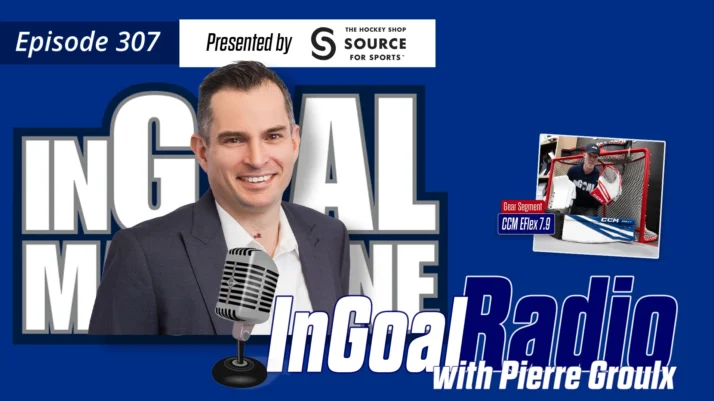
InGoal Radio Episode 307 with Pierre Groulx
Please subscribe and leave a rating — it helps us reach more goalies!


Pierre Groulx, who spent 15 seasons as an NHL goalie coach with the Florida Panthers, Montreal Canadiens, and Ottawa Senators before joining the PWHL's Ottawa Charge, notes that coaching in the PWHL requires adapting video use for goalies who haven't had the same level of in-season coaching resources before the league raised the bar. Key foundational techniques he developed in the NHL — including the 'Dead Arm One Knee Down' method used with Carey Price — remain central to his approach.
- Pierre Groulx adapted his NHL goalie coaching methods for the PWHL by adjusting how he uses video analysis with goalies who had less access to in-season coaching resources prior to the league's formation.
- The 'Dead Arm One Knee Down' technique, developed with Carey Price, is a foundational save mechanic Groulx carried from his NHL work into his PWHL coaching with the Ottawa Charge.
- Working with elite NHL goalies like Craig Anderson and Carey Price helped Groulx cement core coaching principles he now applies at every level.
- The CCM EFLEX 7.9 pads and gloves represent CCM's best second-price-point option ever and offer customization beyond name and color.
- Devin Cooley of the Calgary Flames breaks down how goalies can read, approach, and manage a shooter's three options when cutting to the net off an angle on a rush chance.
Episode 307 of the InGoal Radio Podcast, presented by The Hockey Shop Source for Sports, features goalie coach Pierre Groulx, who is coming off a trip to the PWHL final with for the Ottawa Charge after spending 15 seasons in the NHL with the Florida Panthers, Montreal Canadiens and Ottawa Senators.
Feature Interview
presented by NHL Sense Arena
In the feature interview presented by NHL Sense Arena, Groulx talks about his transition to coaching in the PWHL and some of the trends and tendencies that might differ a little, whether it’s on the ice or in how you manage the increased use of video for goalies that haven’t had the same degree of coaching in-season before the PWHL raised the bar for resources. Of course, a lot of that work is similar to what Groulx did in the NHL, so he shared some of the foundations and lessons that he developed along the way, and the how working with goalies like Craig Anderson and Carey Price helped cement many of them.
In this episode we mention a technique with Carey Price, the “Dead Arm One Knee Down” , we originally published with Pierre Groulx that you can enjoy here.
Parent Segment
presented by Stop It Goaltending U
In the Parent Segment, presented by Stop It Goaltending U the App, we go over the first 5 of 10 gear tips for goalie parents. While this week is aimed largely at parents of young goalies, we’re sure everyone will have an opinion on them and a few of their own to add in as well.
Pro Reads
presented by Vizual EdgeWe also review this week’s Pro Reads, presented by Vizual Edge, which features Devin Cooley of the Calgary Flames with a fantastic breakdown of a shooter’s 3 options — and how to read, approach and manage each one — when they’re cutting to the net off an angle on a rush chance.
Weekly Gear Segment
presented by The Hockey Shop Source for SportsAnd in our weekly gear segment, we go to The Hockey Shop Source for Sports to for a deep dive on the new EFLEX 7.9 pads and gloves that launched this week and represent the best second price point option CCM has ever offered, including opportunities to add some custom option beyond name and color!
Episode Transcript
Intro
InGoal Radio, the podcast presented by The Hockey Shop, thehockeyshop.com, Source for Sports Langley. We are all celebrating. What a marvelous accomplishment. We love it when the hockey world recognizes the goaltenders, and we have a heart trophy winner from the crease. Daren Millard along with the cofounders of InGoal Magazine, David Hutchison and Kevin Woodley. Woody, you've been tracking this as much as anybody.
The Vezina was a slam dunk, but the Hart trophy, where are you on the expectations compared to what actually happened with the voting?
The goalie union is always in support of goalies getting more trophies, recognition, and awards. So this is awesome for Connor Hellebuyck. And I got to applaud the NHL for how they delivered it. Right? Like, have having his family surprise him.
Yeah. He's out on the boat with his agent, Ray Petkow, we had on the show and and and obviously know very well and are big fans of. Boat pulls into the dock. He sees his family gathered. They've got the Vezina.
Surprised at that. It's a great moment. But then to have Eric Comrie come running as only Eric Comrie would do around the corner and be like, oh, hey. You're here? Oh, hey.
Where is it? Like, it was so good. Where's the other trophy? The Hart. So kudos.
Kudos to Connor Hellebuyck, who's headed, like we said, straight to like, that's the thing. There's still a lot of years left in this career. Like, he's gonna continue to climb the all time charts. He's already got the hardware to be a slam dunk first ballot hall of famer. Like, what a remarkable for a guy who, you know, was a late bloomer and when he before he got his first opportunity in the NHL, you know, was going to public skates to work on his game.
Right? Like, playing if I'm not if I'm not mistaken, high school hockey at a time when that wasn't the the top level. So tons of good stuff here. Now if I can go devil's advocate using the numbers, and this is just what the statistics say, and we're not gonna say he doesn't deserve it, but if this is the standard, more guys should have gotten it. In the past four years, if you wanna judge individual goaltending seasons relative to environment, defensive environment, so we'll say goal saved above expected, this is the twentieth best season in the last four years by any goaltender.
Really? And it gets the award because all the raw numbers it's been so long since anybody led all the raw numbers.
No. No. That was historic. Right?
They leaving the raw numbers. But the fans. And here's where I can also make an argument that he deserves it. The fancy numbers tell you that the environment was the most favorable to goaltending in the entire National Hockey League. Expected, say, percentage of .903.
No starter was higher than that. The only two goalies that were higher that were his teammate Eric Comrie and Calvin Pickard when he was in net for the Edmonton Oilers during the regular season. And so when you goal saved above expected was second to Darcy Kuemper on the season, slightly below at just just under 20 for Connor Hellebuyck. The year that Igor Shesterkin was a finalist and didn't win it, his goal saved above expected was 38. Like, that's a significant margin.
Ullmark was 32 playing less than 50 games.
And what was Hellebuyck?
Saros Saros, the same year that Ullmark won Hellebuyck is just under 20. The same year that that Ullmark won the Vezina deservedly so, Saros who played more was 37 goals saved above expected. So but here's where I'll I'll say I'll defend it too. How much of that team environment that buy in defensively comes from the foundation built behind them by Connor Hellebuyck? By the fact that they they don't have to.
If we play our game, this guy's not gonna make mistakes. If we play our game, we don't have to try and go out of the lane we're supposed to be in to block a shot. Bucky's got it. We don't have to dive across on this. My goalie's gonna get it.
So now I'm in position for the next one. So I think a goaltender can affect the defensive environment, and I think you can absolutely make an argument. And so I'm not saying you shouldn't get the Hart. I'm just saying there's some other goalies in the past couple of years that deserve to mention too. It's just Shesterkin for sure should have won it the year he was a finalist but didn't win it.
And I think sometimes this just comes down to voter fatigue over the other options. You know, like, Leon Draisaitl probably won it in a year when he shouldn't and now doesn't win it in a year when maybe he should've. So it's it's really interesting. At the end of the day, who cares? Let's celebrate the goaltending.
I just think it it paints a picture whereby if this is the standard.
More guys should be in contention.
More guys yeah. And everybody always talks about, well, the goal you know, because here's the reality. Freaking goalies should win it every year.
No. No kidding.
Right? Like, that's the reality. And this is sort of case in point for that. It's not a negative. It's a case in point for that.
Because when you look at the saves he made, when you look at like like, I'm on board with this. I'm on board with this. But I think we do have to look at the numbers and sort of judge it historically. And the numbers that jump out that that you like you said, Daren, historically, nobody's ever led in what was it? Shutouts, goal save or sorry.
Shutouts, goals against average, save percentage, although I think Stolarz got enough games wins. Stolarz got enough games played right at the end and had a higher say percentage to to qualify and clip him there. He won the Jennings. Like, it's just that if if if we're truly trying to understand environment, some of that was the environment. Now I still think you can actually credit Connor Hellebuyck for the role he plays in creating that environment as sustaining it.
Watching him at the rink this year, staying out late, working with guys, playing games with shooters, having fun, like, just everything that goes into a team buying into playing that well for their goaltender. Connor Hellebuyck played a role in that for sure. So I'm all on board with this, but, like, again, like, you could take a step back and look at the numbers and say, we just gave it to the twentieth best, quote, unquote, goalie season of the past four years.
Hutch, how do you react to that? There's a lot to unpack there.
Yeah. Well, there's more that goes into it than just who's got the best goalie performance. Because is it not Woody, the person who's most valuable to his team?
Yeah. And then that's a Right? Like Dumb part of the trophy. We we got we got
And and so that so if that's the case, then the argument has to be that the reason they defend so well is Connor Hellebuyck because his performance
Yeah. And that's fair. That's that's fair. But all I meant is that you still have to take that performance and put it into context. Context for how important it is to his team, context for the performances of the other players around the league.
And I'm not one to evaluate the performance of the skaters, but if they were not as dominant relative to their peers as perhaps some players had been in previous seasons, then that makes the chance of a goaltender winning the award a little bit more possible this season. But but I'm also with you, Woody, that really a goalie should win it every year because if you don't have goaltending, you've got nothing.
It's it's interesting that, like, to it's interesting because the numbers that get him to this level are because he was in an environment where it was possible. Shesterkin didn't get it because he was in a terrible environment and outperforming it at a rate that was superhuman, but the raw numbers that everybody ultimately votes on don't stack up to what Hellebuyck did this year because the environment's so crap. So you need when you need him to be when you need the goalie to be Superman, to be everything behind you because there's nothing in front of him like was that year, he doesn't get it. And, again, that may be relative to what other people have done in the league. I'd make I watched Quinn Hughes this year.
The Canucks were an American Hockey League team statistically when he wasn't on the ice. And when he was healthy until the end of the year, they were not just a good NHL team, like, numbers were elite. Does that make him more valuable? I I think he finished, like, fifteenth on the list. Right?
Like, you know, so, like, do we reward guys carrying bad teams? Like, there's so much that goes into this. At the end of the day, I wanted to throw this out there. I did wanted to throw it out there because I went through, like, ranking the last four years. Like, his goal saved above expected.
There are 19 guys who have, quote, unquote, better seasons. But when you watch what he did and you watch the role he plays in this team and the confidence he brings it, I have no problem, and I'll make the argument that he deserves the Hart trophy. I just wanted to throw all that stuff other stuff out. At the end of the day, we could go to another trophy. I think Dustin Wolf got absolutely jobbed in the Calder because it's really hard to compare forwards, defensemen, and goaltenders.
He got beat by a defenseman, which is the one thing I will say. Young defenseman in the National Hockey League are really challenged, and Lane had a had an outstanding season. That that was
the Incredible. And Celebrini too was remarkable in San Jose. I can't look that's the other I can't wait to watch all of them play for long careers. Right? But Dustin Wolf's numbers, when I read the write up about it, they talked about his nine ten save percentage, which, you know, nine ten's pretty good, but it doesn't just jump off the pages like, wow.
Like, that's incredible. I can't believe Dustin Wolf had a nine .910. Well, what if I told you that his adjusted save percentage was almost identical to Connor Hellebuyck's? I think that would have gotten a different reaction from voters than a nine ten. Like, on a per shot basis, Dustin Wolf had the season that Connor Hellebuck had behind a much worse team.
He outperformed his environment by the same level. One guy gets the Hart, and the other guy doesn't get the call. I just think we need to how we I don't know we need to. It is what it's just a bunch of awards, but I think we could do a better job of evaluating those things. And one last thing to go back to Hellebuck that we forget about, do not overlook how much he plays and the value of that.
Yeah. A time you know what? So at a time when, you know, Ullmark won the Vezina but was, I think, less than 50 games, Connor remains the gold standard for elite and workhorse.
Hutch, you're are you not highlighting the problem we have with evaluating goaltenders at all levels? I mean, people jump to the numbers. They forget the context. They forget where they're playing, the team that's in front of them. And And again, this isn't taking anything away from Connor Hellebuyck, but looking at raw numbers and what they mean our challenge.
But we think we also need to acknowledge that the models, well, better than raw numbers are just models. And if models were perfect, you could make billions of dollars in the stock market just by looking at what was done last year. And there is no model that perfectly outlines what's going to happen in the future or what has just happened. So it's only it's only some context in that eye test that you've talked about with respect to Connor Hellebuyck, I think is so important. Putting context to those numbers.
This is the flip side of the article we wrote. Like, when the playoffs weren't going well and everybody was talking about Connor Hellebuyck's home and road splits, I dug through the numbers and did a story and saying, hey. Is the narrative correct here, or is this the fact that the Winnipeg jets have eroded defensively when they're away from home? Like, the environment around him is totally cratered, and and it showed in the numbers that that's what was happening. As much as the focus went on Hellebuyck, it was actually what was happening around him.
This is the flip side of the argument. This the counterpoint to that is, okay. Well, are we overvaluating are we overvaluing his role in when it was going right? Like, this was always sort of the counterpoint to it. Like, hey, they've eroded defensively, and that's why things have gone terribly in the playoffs or part of why things have gone terribly in the playoffs.
But the counterpoint to that would be, well, does that mean that the reason they went so well in the regular season is because they were the best defensive environment in the entire National Hockey League.
Also makes me think to that piece we had up from the Devin Dubnyk interview on the podcast recently. We clipped it and put it up on social. A great goaltender can't make a bad team good. It's it's the flip side to that. We can't the way we use numbers, the way we look at context and so on, I I we we create these narratives that I don't necessarily think describe who these goaltenders are.
A great goaltender on a bad team will just not get the respect that he deserves. And a a good goaltender on a great team might get more respect than he deserves. Not talking about Connor Hellebuck in this. This is just conceptual. But
no, you can apply it to Thatcher Demko. Yeah. Thatcher Demko three seasons ago was incredible. Thatcher Demko and that was when Bruce Boudreau was the head coach in Vancouver and things were a little more wide open. They played fire wagon trade chance hockey.
And Thatcher Demko was unreal, and the numbers backed it up. Should have been a Vezina finalist was a top three goalie in the league statistically. The following season, Rick Tocchet comes in. The defense gets cranked up. Thatcher Demko performs at a very similar level.
As a matter of fact, I think he might have even been better statistically by the adjusted numbers the year before and ends up being a Vezina Trophy finalist. And I would argue if he doesn't get hurt late in the season, probably wins the Vezina Trophy because he was trending up at the end of the year before he got injured. Like so there's the stay the same goalie making no changes, having the exact same performance, but one environment doesn't let Joe Public see it in the raw numbers and the other does. One guy isn't even in the Vezina conversation. I think he got one vote that year.
The next guy is a finalist. It's the same goalie.
Gear
Oh, got another conversation that, wanna get to as we sit, in the Stanley Cup final where it's all even and, going to a best of three. But first, let's get into the Gear Segment brought to us by The Hockey Shop, thehockeyshop.com, Source for Sports Langley, focused on the CCM EFlex 7.9 line.
Yeah. And this is a major step forward for CCM. Custom options, a second price point pad that, you know, rivals the kind of things that were being produced as top price point pads just a few years ago. We've seen this trend. I I give credit to Bauer for starting it.
We got to the point with their gear where we're like, why would you buy the top price point unless you were a pro? Right? Like, that's kinda like it was so good, and CCM has followed and that's dead. So and and I think we at InGoal have to be a little bit careful too because we only review or we have in the past only reviewed the top end lines. But, like, you you don't need to be in the pro gear as a young goalie.
You don't need to be in it as a beer leaguer. This stuff is remarkable at the second price point, and CCM has stepped into that class with this new 7.9 offering. So we'll let Cam explain it, but in the meantime, a reminder, you can go check it out at The Hockey Shop Source for Sports. And, also, as the new stuff comes in, including EFlex 7, which launches today, the old stuff is on sale. So if you loved your EFlex 6 or your second price points in that and they've still got it in stock, there's a good chance you can get it at a discount right now at The Hockey Shop Source for Sports in Langley or thehockeyshop.com.
Cam, I thought we were doing the second price point EFlex 7.9. This feels a lot like EFlex 7. Holy cow. This is seven. Folks, wait till you see how many top level features have carried on to the second price point pad in CCM, including custom options that we'll get to at the end of this video.
But first of all, welcome back to The Hockey Shop Source for Sports. I'm InGoal Utopia with Cam, and I'm a little bit shocked at how good this feels and looks for a second price point path. Didn't you say even just before we started that this is the best mid level of CCM gear you've ever seen? Absolutely. Absolutely.
Didn't you say even just before we started that this is the best mid level of CCM gear you've ever seen? Absolutely. Absolutely.
Now full disclosure and full credit, this is a trend that I believe Bauer deserves credit for starting in terms of bringing pro level features and gear that's gonna last and be durable down to the second price point. When you brought this out, easily CCM's nicest second price point. Frankly, Cam, I was like, this felt like 7. EFlex 7, not 7.9. This there's a lot of features here, including their slide material.
What's CGT. CGT. Cross Glide technology. So let's start with the pads, Cam. Let's start.
I mean with Cross Glide Technology. Yeah. Yeah. Hey. Quick tip.
No more speed skin. It's there. Yeah. We still have that rigid slide, it's a little bit softer than the EFlex 7 for sure. I can feel that definitely, but you still need that same material.
So it's gonna slide better.
Yeah. So Second price point, ladies and gentlemen. We are getting those upgrades where they need to be to get some more value. Okay. Fully in value.
[crosstalk] The fit is The feel is gonna be the same. Still a soft flex pad. We're talking about the same size. We're talking about the similar Talking about similar construction. In terms of the core, what's gonna change is you don't have their same fancy foams.
[crosstalk] You don't have infinite power rebound technology or anything like that going into the actual core of the pad. There's just the the the the materials other than cross glide technology aren't quite as high density some of the foams, not some of the fancier, like, layers on the front. Listen. To break this down really quickly and make it super simple, k, we still want a pad that's gonna perform very, very well. If you need something that's gonna perform at that elitist level, that's why we have EFlex seven.
That's why we have Cam to talk about the elitists. If you have, ideally, you don't need something like that. You're growing. You need something of good value. Beer league, options.
Price point. Cam's not growing anymore and this would be a perfect pad for him. I'd I'd wear this. Okay. Let's get into some of the details on the back.
[crosstalk] Knee stack, it's integrated on the inside, so a little bit of stability there but not without being locked in. You don't have the same Sure Grip. But as almost like a Sure Grip light material. Yes. Just more of a standard kind of Nash SBA kind of style material.
Similar story once we actually open up the pad, you still get that nice air knit material all the way throughout the pad with that same extra wear features. Again, ladies and gentlemen, if you're wearing knee pads, which you should be, you should be having socks over top of those knee pads. Otherwise, you are going to wear this material. We went over QMSS QMSS three in our EFlex seven, so it's just got way more adjustability, kinda like their version of a professor strap. What's different on the seven now?
Again, you can see that difference in material between the two. So same material that you see in the knee cradle, so no sure grip here as you would have found into the EFlex seven. But still the same adjust ability. You haven't lost anything like that though. Same adjustability, same ability to get that fit that you're looking for.
Same strapping. We've got the lower calf strap, which we talked about with the EFlex seven has been adopted by guys like Markstrom and Demko at the National Hockey League level. Take a pad that's designed to fit a little more, you know, attached to the leg to feel more attached and give you the ability to cinch it up or if you don't like it, you like it more open, it's gone easy as that. Same strap on the outside. Pillow, which we've seen for the first time in EFlex seven continues down to EFlex 7.9, just a little bit more stability in the butterfly.
What you want it? Some what's this? High wear area? Yeah. High wear material?
Oh, Speedskin. Oh, we found Speedskin on the pad, ladies and gentlemen. That would be it. It's you know what? It's being used as a wear material to again to protect because you're gonna have your skate.
There's gonna be lots of rubbing in that area. That's being used as a wear material to help protect the inside of that pad. You also get the same. It looks like Push lace. Push lace.
So solid skate lace up here and then elastics around the skate. Again, you want, drop it off the laces. Drop it off to a bungee even if you like to as well. There's options here. It's easy enough.
[crosstalk] The nice solid toe bridge gives you that ability. Again, folks, like, we're trying to do this quickly. The easiest thing I can say is go check out our EFlex seven review up here because a lot of the features in terms of fit, feel, and performance are gonna be the same, just slightly less materials. Thin upper edge, little extra wear material here. They still do have their dual light core and what also we're gonna get single internal break, single external break.
That still gives the pad some good flex. Soft boot construction. Great overall feel. Let's move on. Still custom options.
We'll get to those in a minute. We promise you that. Glove though. 580 brake. Off the wall.
And again, the difference here would be as much as there's custom options in the glove and the pads, ordering different brakes is not one of them. No. So you are in the five eighty, stuck in the five eighty, not a bad place to be especially the rebuilt five eighty with finger stalls back. You see the closure. It's vastly improved from past models.
You can really get in and out of this glove quickly. You don't have to have the break in time that you did with past generations. Nice big pocket. Finger stalls. Finger stalls.
Yes. No D30. So let's start to talk about some of those differences that we're gonna feel here. So not a Sigma palm, game ready palm. You still get that same still get the same strap on the back.
Again, that general feel single t, scale lace, deeper pocket, great overall initial feel off the shelf. Again, this would be geared towards, you know, hey, growing, wanna complete the set, you know, looking for a little bit of value here. If you need something that's gonna be thicker, that's where that EFlex 7 comes into play. Palm wise into the blocker, we still get that same hex palm. But look much thicker.
[crosstalk] Another thing that we really like in the pro model has carried down to 7.9. No D30 in that finger in particular. But you do get the one piece wrap around the outer protection. That's an improvement from past generations. Correct.
[crosstalk] Not as stiff of a board. Again, we have to make some differences between the two. Rebound pop's not gonna be quite as dynamic. However, I still feel the balance hasn't been changed, anything like that. So you get Fit and feel is very similar.
Again, it comes down to materials are the difference. And again, as Kevin talked about before, we still have that ability to open up that cuff even more if you like. Custom. Custom. Custom.
You could actually customize a second price point pad. Intermediate and senior available. This is an intermediate pad here. This is an intermediate size. Yes.
But you know what? If I wanna add a little bit extra, I can get plus two in this as well. Hold on. Hold on. Hold on.
You're telling me second price point with all these and you can order a plus two thigh rise? That's correct. What else can you customize? So color. Add your name.
We're starting to lean out in terms of whatever else is out there, but hey, we can't bring all of the customization down. Are there custom glove and blocker features? Color? Color. Name?
Name. Glove, 580. That's it. I mean, hey, again, we have to take away some things because that's why that higher price point exists. Color, name, same idea.
File, available with your custom colors. At the moment, your name on it. Yep. Plus two options in the thigh rise. Fit, we didn't talk about this with CCM E flex 7.
I would recommend talking to Cam and his crew about the fit. We do find in the past generation or so, it's fitting a little taller. You might actually drop your sort of base from a thirty four to a thirty three depending it here in the middle. And make sure you talk to them, Cam, where they can where can they ask you these questions. 604-589-8299 or 1-800-567-7790 or check us out at the hockeyshop.com.
CCM EFlex seven, the best second price point option that they've had to date. A really exciting step for them, whether it's the pads or the glove, a vast improvement. And I think, like I said, gonna be a really exciting summer for CCM with this product on the market.
The options abound over at the Hockey Shop. Thank you, Cam, and thank you, Woody. You guys are always fun to sit around and rip on things.
It's a little bit of a longer one there. I would remind folks that it's up on YouTube as well. If you wanna go watch it, sorta see we talk about a lot of the new materials in EFlex 7 and that carries over to 7.9 again. Great. Chance to see it.
It makes a difference. Like, it really does. That sliding surface really it's hard to capture, but it really does. The smoothness of it compared to even a Gen Pro is is is more evident on camera than it is with, you know, me and Cam talking as much as I like to hear the sound of my own voice. Definitely recommend watching.
Can mix and match a little bit. You could go, the 7.9 pads and the EFlex 6 gloves or EFlex 7 gloves or something like that. You can you can pick and choose where you want the the pro level gear or the secondary price point gear.
Yeah. Some people do that and we've seen that in the past like a pro level glove. I will say this, the EFlex 7 and 7.9 glove regardless. Can't stress this enough. The closure is so much more improved.
The break in process that we went through, I love my EFlex 6 glove. It's a 590. I've just got broken in perfectly. I love it. But that process was longer.
Like, the gloves didn't close as well, and I had a pro model. This is night and day. This is a game changer for them in terms of a glove that right out of the box, we've taken them out of the carton and instantly just had that snappy feel. So, whether you're shopping at the 7.9 or 7 level, so far our experiences has been that both do just that.
Pierre Groulx is standing by. We'll get to him in just a little bit in the NHL Sense Arena feature interview, but stick tap as we sit right now in the Stanley Cup final. We're on the heels of Calvin Pickard coming in and shutting the door and giving the Edmonton Oilers an opportunity and remains undefeated in this year's Stanley Cup playoffs and is now the guy, by all expectations, Woody.
Yeah. I mean, hey. We thought that was the case coming out of the first round. Right? Like, things change in a hurry, so we'll see where this goes.
But you just as you had to love the way Stuart Skinner came back after losing a job in the first round and went on that run, much like early in the first round, it wasn't like you're blaming him because every single goal that went in in Stuart Skinner before Calvin Pickard took over in game four was high danger. But at some point, the guy at the other end stopping more of those high danger, and you need to match a little bit. And one of the things that Pickard's done is he's had really good numbers on the toughest chances. Steve Valiquette, I listened to him earlier this week, and he said that cup winning goalies only give up one goal in every five high danger chances. And through the first three games of the play of the Stanley Cup finals, Stu was 13 on 25, Bob was six on 31.
And so as much as you can look at him and be like, hey. Like, could he have? Maybe. Should he have? No.
It's not his fault. That seems to be a delineation on cup winning goaltending. You need some of those high danger saves, and and Calvin Pickard has given them that. And he gave it to them again coming off the bench cold, which is remarkable, in game four to get them back in this series.
Hutch, you were you were chomping at a bit there.
At so many levels. Like, I want Woody, I thank you for bringing the context of the number of saves on high danger chances because I saw some numbers. I don't didn't have access to the ones you have, but there were a lot of high danger chances in the first period of that game last night, far more than there were in the second and third together. But I love the context that you brought to it. I just wanna say, I absolutely admire Calvin Pickard.
I love watching him play. I I used to see this guy come in who didn't have that refined technique and think, oh, this is just not nearly as entertaining. And now I'm seeing him make some saves that it's just a whole lot of fun to to watch. It's not accidental. It's absolutely intentional.
It I hope I'm not being unfair to Calvin to say this, but there were times last night watching him, I thought it looks a little bit like you've taken the most most athletic player on a team, skater, and he wanted to be a goalie for a day. So we put on the goalie's gear and he just went out there and played like an athlete. And with making all these saves and you're like, this is incredible. And to just to see the way he very purposely tracks a puck, makes a save, and maybe it's not tight and maybe it's not preparing him for the the next shot the way we'd like to see. He's doing the most important thing.
And and sometimes we forget what that most important thing is. And, yeah, it's just a real pleasure to watch. And Bob as well, I'd say of all the guys that I've watched in the playoffs this year, the ability to react to a tip to a shot going where you didn't expect it to go to. These two guys, to me, are separating themselves from everybody else. A lot of goalies, you'll see a tip go in and there's not even a reaction to it and you're like, yeah, well, you know, it's not his fault.
It's almost impossible to react to a puck that's tipped 10 feet out in front of the net. And yet yet Bob and Calvin both have this way of of seeing that puck and making a reaction to it unlike other goaltenders as well. So that's a there's a different level of athleticism involved in being a great goaltender than I think we traditionally maybe define with other athletes in the sport and in other sports. And and especially with Calvin. There's a there's a real particular type of athleticism I love watching there.
Well, anybody that criticizes Cal Pickard, I just point the save that he made off Sam Bennett in overtime where he got a good chunk of it off the glove and hit the crossbar, but it goes straight in without that. And it was a great push and a great read and incredible execution on a point blank chance.
Yeah. That was a dandy. He made a few of them.
Wasn't it great how he looked at his glove afterwards too? Did I get that?
And, hey, we talk guys, we talk we talked about team and environment and things like that, And so much of the focus has been on the goaltending of the Edmonton Oilers, both sides of that equation. The reality is they are giving up to Hutch's point about high danger. There were six in the first period, eight the rest of the game. They are giving up way more.
That's interesting, Woody, because and and I I forget whose model it was. It might have been Sport Logic, but I saw reported this morning that there were 13 or 16 high danger chances in the first. So you can see the
difference Don't between get me don't get me started.
No. And I'm not trying to get started, but I think I think when people say this is the way it is because this model says that, but there are different opinions on all of those things. And I know absolutely we believe in in Steve Valiquette and and ClearSight, but it is important to give some context to that.
Don't get me started on a on a quote unquote model that relies on data coming from
AI.
Well, and and that I had a team told me they vetted the data, and it wasn't the model. It wasn't this analytics or the application of math to it. It was the actual recording of the event and what's happened on the ice matching at about a 73% rate, which would get you a C+ in high school, but many teams in a 5 or $6,000,000,000 industry are using as to your point, like their facts. I'm like, my kid doesn't even get into a good school with 73%, and these billion dollar organizations are relying on that data. So, we talk a lot about the public data.
We say things like garbage in garbage out. I think there's more of that than people realize when it comes to some of the analytics companies that aren't tracking things individually as well, and I will leave it at that. But to the point about this series in general, like, Stu saw six high danger chances in the first period. In the first game, he saw six high danger chances. The Oilers since that first game, and this is some of this is the Panthers.
They have gotten away from the defensive identity that got them to the Stanley Cup final. And some of this is not being able to handle the pressure of the panthers and the way they force turnovers and the way they create. Some of this is just brutal penalties they're taking, putting themselves behind the eight ball and the penalty kill, not being able to bail them out. But for all the focus on goaltending in Edmonton, the Oilers haven't even been close to replicating the defensive environment in the final that they created for their goaltenders pretty much from game three of the first round on.
Woody, what's a what's a decent number of high danger chances for a team to give up in a game?
Like, decent as in that's a good defensive performance?
Yeah. Like, I would
what what Single digits, six or seven. Once you're into double digits by Clearsights numbers, you're you're into trouble.
So the average would be eight ish? Nine ish?
Probably probably around there, and I should probably do a little research on this rather than top of my head. But yeah. And the Oilers in this series, like, were 14. After that first game that they were six, you know, they got into a trade chances game. In game two, they gave up 12.
When you take more penalties, you're gonna give up more high danger. That's that's the number four.
And and that's why that's why I said. That's the that's the caveat. But they've been in double digits pretty much every game since the first.
I don't mean that, Daren, to evaluate the team's performance, although I guess it can. I I mean that to give context to a goaltender's performance. But to as a I mean, of course, we can get into the analytics and goal save above expected and so on. But just as a as a pure way of judging the the environment that a goaltender at any level is involved in, how many high danger chances did they face in a game? And you'll see as you go down into minor hockey, it's probably 20 a game.
It's crazy. But, yeah, I think it's it's good to give some context to that to people at all levels as they evaluate the game.
Parent Playbook
Well, context is a perfect way to segue into our next segment, the Stop It Goaltending U, parent segment with David Hutchison. Stop It Goaltending U providing all kinds of
But first, Kevin Woodley.
Great, great input and guidance in the world of goaltending.
Well, it comes from the twenty five plus years now of experience led by Brian Daccord of Stop It Goaltending U. We've talked about his background, both playing professionally overseas, coaching the Boston Bruins, goalie scout with the Toronto Maple Leafs, and a director of goaltending with the then Arizona Coyotes, now Utah Mammoth. He has done it all. He has seen it all. He has led Stop It Goaltending to one of the premier schools in the country through it all.
They have an incredible facility, and they also have an incredible app that gives you weekly tips and advice to help you become a better goaltender, whether it's their daily primers, quick one minute videos that you can use to sort of focus yourself and think about different things as the week goes on. This week, it's on the power of focus. Video goalie playbooks where they break down how different goalies do it, sort of think of it as their version with their coaches leading it of a ProReads. They watch pro film and walk through the decision making process with their coaches talking about it. Dustin Wolf is in the spotlight this week.
And drills, weekly drills. This week, they've got one on a behind the net wraparound. So walk you through a drill that you can take out on the ice and work on with your coach. It's all part of the Stop It Goaltending U app. And, of course, as we always say, one of the in our minds, the best part to the Stop It Goal Tending U app is it comes with a subscription to InGoal Magazine premium.
So you get our ProReads where we do the same thing with NHL goalies explaining their decisions. You get our drills. You get our articles. You get all of it. Stop It Goaltending U and InGoalmag premium, the best of both worlds to become a better goaltender, all available when you buy a subscription to the Stop It Goaltending U app.
Hutch.
I can't say anything until you say
that, Daren. It just makes my day.
For people listening who obviously couldn't see, I just had to gesture my hand towards Daren and say, Give it to me.
Let's go.
Okay. Today, I have 10 tips on gear largely directed at parents of goaltenders of younger ages, but I think some of them will apply at all ages. In fact, it's not 10, it's five this week and then we're gonna do five next week. So Kevin, I need to give you a warning. I do want you to chime in on some of these, but you're not allowed to jump to your own new tip because it might already be on tap for next week.
You got that, Woody? Nothing new, but you can comment on what we're doing. Okay. Let's get right to it. First tip, make sure they are protected.
It is no fun when it hurts. If you want your young goalie to have fun and to grow into a confident goaltender who doesn't shy away from the puck, who can play the game the way their coach wants them to play the game, they have to have gear that protects them. And I know that kind of sounds crazy, but I do think it's important that we think about that and make sure in so many ways that our kids are protected so they can enjoy the game. So I would rather you get them something used that protects them rather than waiting another year to afford something new. I'd rather you invest in a helmet that fits than shiny new pads.
Or take some time and that's a tip later on next week to make sure the gear they have works for them. Number two, coming on from that one is that old gear is okay. We talk a lot about the features of the latest gear here and the innovation is incredible. But even ten year old gear has better protection and more features than the gear Daren and I grew up playing in. It's an expensive sport.
Don't be ashamed to try and save a little. If little Johnny needs new pads to get excited about going to practice, is he really excited about being a goalie? Sort of reminds me about guys about a close friend I had, different sport. He was a tennis player. He was so good.
He was facing that decision about to the parents mortgage the house to send him to Florida to train with pros. And everyone he played in and around Toronto would show up with six or 10 of the most expensive rackets you could afford and all the top of clothing and the best shoes. And my buddy'd show up in ripped shorts and a ripped t shirt, one racket and he would beat the pants off all of them. If you love the sport and you're talented at the sport, it's okay to not have top of the line everything. So association gear, something used, it's okay.
Number three, and that reflects on what we were saying in the Gear Segment this week. If you do buy new, second tier gear or even third tier for the younger kids is incredible. We were asking the question just offline. The 7.9 from today's segment or the Bauer SV Pro, incredible gear. Kevin, it's better than the top level gear of how many years ago?
You don't have to go back far.
You don't have to go back far. We don't we didn't we never came up with an answer to that. The 7.9, for example, carries features that were not even available in last year's EFlex 6, but then last year's EFlex 6 had some great things too that maybe you don't get in the second tier gear. But if you wanna go back to ten years ago, I'd take this year's second tier gear any day. It's okay.
Number four, sometimes it does just hurt. One stinger doesn't mean that you have to race out for new gear. The fact is that at every level, pucks have a miraculous way of finding seams. You could give the CCM Innovation Lab NASA's research budget, guys, and pucks will still find a way through the best defenses. So don't go home feeling guilty that you didn't get little Johnny the new chesty after he left the ice for a few minutes in tears.
If it happens too often, obviously, we've got a problem. But a couple of stingers don't mean you have to book a call with Cam. Number five, I think we need to say that they have to be able to move in their gear. Fit is so important. Old gear that fits is better than new gear that doesn't. If they can't move like an athlete, they won't learn how to play like one. Sometimes parents chasing bulletproof protection for their kids end up buying gear that is too much for their kids.
It just isn't right. You know, a CCM pro chesty is incredible but it's not made for an eight year old no matter how badly you'd like it to fit her. Trying to save a little bit of money by buying gear that's going to last for a couple of years when they're not landing on the knee stack properly this year. Well, maybe it won't hurt and maybe it'll save you a few bucks, but if they can't skate because they're tripping over their pads, if they can't catch because the glove is too big for their hand, they are gonna end up hating the game faster than you can buy the next piece of gear. Let them be an athlete out there.
It's so important. Those are five tips guys. I've got five tips to follow on from that that can help parents at all levels next week. But I think that's a great way of giving a little bit of context, especially to the new goalie parents who are so worried about doing everything just right. Relax, make sure your kid's got some gear that fits and protects them and let them go out there and have fun.
Love your comment about sometimes pucks just get through and sting you.
Yeah. And believe me, like we've we've all done it as goalie parents. You see your kid get hurt, leaves the ice in tears, and meanwhile, you're on the hockey shop on your phone wondering what piece of gear you're gonna have to buy to fix it for them. Yeah. And sometimes you just gotta I
I do that and I don't even have kids that play goal. It's for me. Go to the bench.
We have a few.
I go to the bench. I have I have a little cry. Everybody's like, where the hell the goalie goal? And I search it up on Hockey Shop.
And and we'll get into some of the ways we can help our gear work better for us next week. But but sometimes, yeah, sometimes there are seams like take a take a and I will talk about a solution next week for this one, but take a chesty where if you've got extra long arms, maybe you'll loosen up that shoulder and let the arm out a little bit more, but that's gonna leave a little space exposed. There's no way of avoiding that. Or if you have shorter arms and you pull them up, maybe that changes something at the bottom. There there are things that happen and pucks find ways.
So it's okay.
And I don't think there's anything wrong with fiddling with here. If you're getting if your kid or you are getting hit in a certain spot, adjust it in the sense of
Adjust it.
Add a add a piece of padding there.
It Okay. Let's not go too far because that is a part that is a part for next week. So I will just I will just say, adjustments that you've made for your gear, Daren, come back with your favorite one or two because guys our age tinkered with our gear all
the time. Older goaltenders who are listening to this right now, send me a note this week, podcast at ingoalmag.com. If you've got a cool adjustment that you used to make to your gear when you were younger, we'll remind everybody of my very favorite one from Glenn Hall when we meet next week.
Can I send a picture of Sergei Bobrovsky's shoulder floats?
I don't think that was because of stingers.
Those things are huge. Listen, I'm gonna add a little note to this. K. Parents, I don't I I I guess it would be too pointed of you to send this to the evaluators, but I would like those goalie coaches that serve an evaluation role to listen to this segment because I've been a part of it. I've seen a kid cut the house because he just didn't look the part.
And sometimes we prematurely judge based on and I you you guys I I use this with Darcy Kuemper, and Hutch almost killed me. Looks like a goalie. He just, you know, looks like a goalie. Man, we gotta watch that in our evaluation. And there's a lot that goes into that.
Like, you just judge on
Time when you
100% plays goalie like an unmade bed. So did Tim Thomas. That's the last guy I used that line for, and he did just fine. So so when it doesn't always look like it's brand new out of the box professional, don't judge a kid based on that, folks. I've seen it.
And people are like, that wouldn't happen. I've seen it happen. So 100%, if we're gonna have these rules, then the bloody people evaluating the goaltenders at next year's tryouts need to pay attention to them too.
I had a coach once, won't name the brand, but he just said, if I see a goalie in that brand, he's cut and he was joking. But was he?
Really?
Yeah. And he was joking, but it does serve to underline some of the stuff that's going on out there as as Woody describes. Obviously, nobody's cutting a kid because he wears the wrong brand, but they are judging them.
Wow.
I would have been cut for sure with my old Miller stuff.
That's great gear.
Yeah. I can I can I can walk in wearing the best stuff in the NHL and I'm still getting cut? So
it took me a while to come around to the DNR pads, but I like those back in the day. The little pre curve.
You come around to? I was so jealous of my buddy who had those. I wanted them so badly. Really? Because they had the pre curve to them.
I just had my straight Coopers and my buddy, who has helped us and done some writing for InGoal. He's he's a broadcaster in Montreal now. Michelle Godboo had had these DNR pads that had the pre curve to them and I was so jealous.
Really? That's funny. That's beautiful. We came up to that from opposite directions.
Completely different angles. Yeah.
Absolutely. Let's get into the Visual Edge ProReads for this week.
Yeah. Visual Edge ProReads this week features Devin Cooley of the Calgary Flames, a guy who I think is actually probably gonna we'll see what happens in
Yeah. There's a lot going on with him.
Yeah. I I have a feeling he's gonna end up a part of the tandem in Calgary next year. I could be wrong. I don't have any inside information, but there's a hunch there. So, anyways, before we get to Devin Cooley and what he broke down on video for us this week, let's talk about Vizual Edge, which presents our our ProReads and another elite NHL goaltender in Jordan Binnington.
When we talk about visual tools or programs like Vizual Edge to help improve both your sports vision and sort of get your brain warmed up, the cognitive function, that's what Vizual Edge is all about. And I'll just leave you with this quote from Jordan Binnington who's who reengaged with it and was using it at the four nations right through the playoffs. Vizual Edge has added a quality element to my preparation as a goaltender. I use the game day drills every game before heading to the rink. I'll say that again.
I use the game day drills every game before heading to the rink. It's a combination of recognition, reaction, and focus that activates my brains and eyes to feel ready for what's to come. That's how Jordan Binnington regards his work with Vizual Edge. We've heard it from other goalies right up to the NHL, guys like Cam Talbot who have been a part of our ProReads. And so enough said, in terms of validation from the highest levels.
Now speaking of the highest levels and where Devin Cooley found himself two years ago, and I think we'll find himself last year, we went through video with him after his sort of late season breakout with the San Jose sharks, including this week's ProReads, which focuses on attacks off the wing. So you know how it is, like, of it's a rush. There's a little bit of pressure, but that guy's got a half step as he comes around near the outside edge of the circle, and he's cutting on goal. Cooley did a great job of breaking down the three options he's got. What do you think they are, Daren?
What are our three options at that point that we're looking for from a shooter, and what
I'm looking to dive a dive poke check. Just just saying that right.
Re regardless of his options?
Of his You're
my hero. I'm just
I'm just looking to to to get puck, stick, feet, or all of the above.
So you're going full Johnny Bauer, two pad stack poke check, not head first?
Guaranteed. Yeah.
Okay. So I would have gone head first poke check and probably ended up in the hospital because that's where I tend to end up with collisions and and my brain being as soft as it is after all the other collisions. What Devin Cooley did was identify three options.
Gonna be hand? Like, which are they in the forehand?
Handedness matters.
Forehand
backhand. But then yeah. Forehand backhand will play a role into which of these three you think is most likely, but he walks us through the three scenarios, and you can see this now at ingoalmag.com, and how to manage them. We see you've got your shot, your short side shot. You've got your deacon in the middle and and and attempt to sort of shove it five holes, the goalie pulls across, or you've got cutting through the crease and trying to beat you to the far post as your sort of your three main options.
What do you think is the most that we see the most guys attempt? What's the most common of those three? The shot, cutting it in the middle, and then trying to slip it five hole, or all the way around? Five hole or shot? I think Cooley says five hole.
Yeah. And so he walks us through the different approaches to each opportunity, why he predicted this particular shooter, again, the tells of why this particular shooter he thought was going to go five hole, and making sure he didn't push too early and open that up. So some great advice, some great explanations in terms of those reads. So the next time somebody's coming down off the wing and gets a step on your defenseman, you can think in these terms, and it will help you prepare for those options and choose which one you're gonna defend first and foremost. Obviously, understanding you have to have an answer for all three.
It's a great job by Devin Cooley. It's why we've loved him in this ProReads format. It's why we would highly recommend it. There's 286 of them now online. A subscription to InGoal premium through ingoalmag.com will get you access to all of them.
There is no better way to learn to read the game than ProReads, and Devin Cooley is another great example of that this week. Just like there's no better way to get seeing the game better, seeing the puck better than Vizual Edge as a training tool. We combine the best of both worlds. When you log in to ProReads, make sure you check for the discount code. There is a discount code for the public, but when you go into ProReads, you get an even bigger discount code.
Make sure you get our membership to InGoal, get your discount to Vizual Edge, best of both worlds when it comes to seeing and stopping more puck.
With a player who's fast, I wonder how that changes your assessment of that to just dive take a little bit deeper on that. That would be that would be my biggest challenge. He he's got set of these fasties. Do I and I don't wanna leave my post too early. So
Well, and there's that, but then there's also how is the play breaking down? Is there a second diff is it just the defenseman that's try that is on his hip trying to prevent him? Is there a second defenseman coming from the other side? Where's your support? That all goes into that read.
Because I'm thinking that you think of a fast player, Daren, more likely to beat you to the far post. But if there's defensive pressure on the weak side, is that a play he's gonna attempt? So all of these things go into it, and Cooley walks us through all of it in this week's ProReads up at ingoalmag.com.
Feature Interview - Pierre Groulx
Fun stuff. NHL Sense Arena feature interview, and it's a guest that we've talked about at length before. Pierre Groulx is going to join us as we piggyback NHL Sense Arena.
And, Daren, you didn't even toss to one of us because you can't remember who does this one. It just Because you guys gets you every week. Gets you every week, and I'm gonna make it even weirder this week for you. Because normally, do hop in here and normally I talk all about Sense Arena, but we had a little fun over at the Hockey Shop. We posted, a short video up on our various social channels of Woody walking you through the latest and greatest with NHL Sense Arena.
So we're just gonna listen in on it right now.
High blocker. Low glove. High glove. Oh, sorry. Didn't see you there.
I was busy doing Sense Arena's new goaltender advancement program, GAP. It's a two month training system dedicated to three different ways of getting better. They do angles, they do traffic, and they do what I was working on, which is a shot release mastery program. What was I doing right there? Same thing Brian Daccord does with the Boston University goalies.
He has them read shots and call out where the puck is going so they can work on improving their anticipatory skills. There's tons of different ways you can do that in this new program. The shot release reading program includes shot predictor systems, ghosting where you just watch shots for hours and try and predict where it's heading. Don't even have to make saves. Devon Levi, the Buffalo Sabre sits on his couch and watches releases for hours.
It's all in NHL Sense Arena in their new gap program. It's a two month comprehensive progressive program that will help you get better as a goaltender without needing to go on the ice.
That was like the old talk shows where you brought a clip.
We brought a clip again. Yeah. So I actually think that Woody Woody did a great job on that one describing it all. It worked with the audio. But, if you wanna have a little fun seeing Woody making some saves with the headset on, head over to our social channels and find that video.
You notice how I didn't turn the volume up in the headset so that people couldn't tell if I actually made the saves or if the crowd was cheering because the the puck went in behind me.
There is a goal horn in NHL Sense Arena just for those who have not tried it yet.
Daren, there are days when I'm in Sense Arena and I hear that goal horn that I think your little eight year old friend out in the Vegas rink is running it. Him.
The the impressive part of that was you were able to do a presentation to the camera while not even seeing the camera and being distracted because you're looking at a rink. Like, knowing what you're dealing with behind that headset made me even more impressed with your ability to deliver.
I start I my eyes are closed when I'm playing goal anyways, Daren. So it's so quite easy.
Hey. And how cool is NHL Sense Arena? There was a lineup of people waiting to try the headset after Woody was done doing this little filming. We happened to be in the hockey shop. So we went over to the goal crease that they have there in the goalie section and and everybody wanted to try it.
Why wouldn't you?
Well, it's Yeah. Amazing. We're we're gonna get into it. Funny enough with with our featured guest this week, Pierre Groulx, who spent a ton of time with Craig Anderson both in Florida and in Ottawa and talked about his incredible ability to read releases and how he used to practice it doing things that would be tough for a young goalie to do in practice because practice time is so sparse and valuable and ice time is so expensive, but is exactly what Sense Arena's new goalie advancement program features in its shot reading release mastery program. Like, the idea of just sitting there, not watching the puck, watching the other elements.
And Pierre is gonna talk about what he thought was one of the key elements to watch from Craig Anderson as part of this feature interview. So these worlds are colliding. I feel like George Costanza. World is our colliding. Our our our sponsors and our guests are lining up perfectly this week.
Really excited to welcome for the first time to the InGoal Radio Podcast. First time guest here with me on the podcast, but you've seen him at ingoalmag.com over the years, helping us with drills, with the Ottawa Senators, now with the Ottawa charge and the PWHL, Pierre Groulx. Pierre, how are you?
Doing great. Yourself?
I'm really good. I wanted to get you on, talk about it's funny because Oversight, we talk so much over the years that I just assumed you'd been on the podcast with me before. And so I know so much of your story, but we haven't had a chance to share it. So Ottawa Charge going all the way to the final in the PWHL before losing out to Minnesota Frost, two time champion in the in the end. We reconnected and I'm like, man, we gotta get you on the podcast.
So first off, how has the transition from coaching in the NHL for well over a decade, close to fifteen years to working in the PWHL? What's been the biggest difference for you?
Honestly, coaching goalies is coaching goalies. It doesn't change, the position doesn't change. I think it's the way the ladies, they haven't had this since this league, this professional type league. So having the hunger to learn, having that thirst for knowledge, where they haven't been used to having an everyday goalie coach with them. So I think it's just that.
I think they're even just as a matter of fact, last year, first year is, know, okay, we're going to do pre scout video, we're going to do post game video, we're going do this on the SN, we're going work on this. I think it just took them back for a bit, like especially Emerance. But I think once we got going there, you're like, wow, this is great. This is something that we haven't had. So I think the biggest adjustment is, was that is just them not being used to having a full time goalie coach, but the thirst for knowledge from the women, it's been pretty impressive to be with.
That that level, that that breakdown, that video work, I'm guessing some of them would have had. You meant you mentioned Emerance, Maschmeyer has been on the National team before, but outside of maybe an Olympic tournament or world championships, they probably haven't had that same level of detail that you would have done on a day to day basis through, like I said, close to fifteen years in the National Hockey League.
Absolutely. Like, it's just for those short short tournaments, they do they do get it. But I think they've never had a league that allows them to have this. So, I mean, when Mike Hirschfeld came to me at the start to become the goalie coach, I'd start there, go, they were hemming and hawing about having me full time. I'm like, well, if you want to do it right, that's what you need to do.
And it goes back to probably twenty years back in the NHL where there were still part time goalie coaches in the NHL. So now you see that most teams have three and sometimes four people in the goalie department. So I think Monique Quick really recognized that it was an added value that was needed. And I think me to be there full time with them and for me to be constant with them, I think really they weren't used to it. So it just it became something that was, you know, something that was well received for sure.
Okay. So video and I mean, even instruction to a certain degree, we know that there are probably times as a coach where you have to recognize when too much can be too much. And if you're not used to getting that level of information on a daily basis, how did you find that balance? Is it was it through communication with your athletes? Would do some of them differ in terms of how much of that information we want about opposing teams, especially on a pre scout?
I think the first thing, and as you know, like, the first thing I like to build is relationship with the goaltender. Doesn't matter which league you're in. Once you build that relationship, once you build the trust, now they know, okay, now we can, we go on the right path. I'll give you an example. Emerance Maschmeyer is a big student of the game.
She can take on so many things, but sometimes I'd pull back knowing that, you know what, she was not in the right headspace. So we'd start videoing like, okay, that's enough, like, we'll just move on. And it's not something, you know, we don't need to beat down a mistake in the game. So, but it's just adjustments. Whereas Gwyneth Philips, the goalie we had last year, this year coming from Northeastern, started this year to correct some technical aspects, but I quickly saw that that wasn't what she needed.
So it was more of a just stop the puck mentality. There's maybe other words I could use there, but it was more of a stop the puck. So, you know, we got that onto there's one thing I want you to do on every shot and then just be be controlled on the first shot. After there after that, be you because the pre scouts became too much thinking for her in her games. So we quickly adjusted.
So it just really knowing the goalie and sometimes it's trial and error. Sometimes you try, doesn't work. Okay, we move on. It's not, oh, it's you know, we can't do this again. It's just trial and error by every goalie and it's been like that my whole career, but I think it's just recognizing what the goalie needs.
The that go to for technical, you mentioned it with Gwyneth, like, especially when it's in season. Is is is it off season the time where you make big changes and then finding that balance in season between being able to introduce new things without overloading them with information.
Absolutely. Like I saw a little technical thing with with Masha's blocker last year that, I found different ways to try to get her to do it, what I wanted her to do, but when we first got back on the ice in July last summer, we spent five practices working on that exact blocker move. So it's not something I wanted to correct during the year because it's something that would have gotten in our head and it would have been too much. So that's when in the summer I said, okay, first five practices, all we're doing is blocker work. So then it just it's just repetition, repetition.
And by even by the end of the first day, she's like, oh, I see the difference already. I'm like, okay, that's great. But we have four more practices like this. With Gwyneth, it's going be the same thing. It's just I'm going to tell her what we need to work on.
It's probably glove position and just sometimes she gets a bit too wide in her stance. So that's going to be the time to do it. In season, try to do it in a fashion where it's not overdoing it, but at the same time, you're trying to correct it to make her better that for next game. But the big changes are definitely off season changes.
I was going to say for for Gwyneth, especially coming from Northeastern, like for a lot of pros coming out of college, you go from a weekend league to you don't have that time between games anymore because the PWHL plays a plays a pretty tight robust schedule. Like there's a lot of games in a short period of time. You no longer have those four or five days to work out certain technical elements. If you start thinking too much about one thing that could become problematic when the puck drops a couple nights later.
Well, And I think the biggest challenge for our team too is travel because we do fly commercial. So sometimes, you you're at the mercy of the commercial flights to Ottawa. So for her coming from Northeastern, was definitely an adjustment because, you know, you play Friday, Saturday, Sunday's probably off, Monday you get back and it's a leisurely pace and you get back to it. But with us being a normal pro league with travel, sometimes you have little practice time, so if you try to hamper down on really one tactical aspect, it's not the time and its place. So you may have to look at the schedule and say, okay, this time we have two or three practices in a row, that's when I can really try to target that area.
But that is definitely an adjustment for players coming from college where it's a weekend league and there's bus rides travel, yes, but there's you know, you're not spending three, four, five days on the road because of, you know, commercial flights and whatnot.
You said goalie coaching is goalie coaching, and it's all the same, but what like are there for you and coming from the NHL and working with all kinds of different ages over the years, maybe you could share us what what are your foundational points at this point in your career? Like, what are the things that and they probably don't change from league to league, but what are the things that you see as like staples? Hey, we have to have this. This is where we start.
Well, to me, it's it boils down to three aspects of of the goalie. I always say if your feet are set, your hands are set, your eyes are set. So I always thought, start from the bottom. If your feet are set on the shot, your hands are going to be set, your eyes are going to be set. If you're kind of laterally drifting or forward drifting or whatnot, your feet are going to be set, now your gloves are going to move, now your eyes are going to you're going to lose the plane of sight on the puck.
Well, to me, it's it boils down to three aspects of of the goalie. I always say if your feet are set, your hands are set, your eyes are set. So I always thought, start from the bottom. If your feet are set on the shot, your hands are going to be set, your eyes are going to be set. If you're kind of laterally drifting or forward drifting or whatnot, your feet are going to be set, now your gloves are going to move, now your eyes are going to you're going to lose the plane of sight on the puck.
So I always start and that was the biggest thing with witness is this, have your, not set in the cement, but have your feet set. So now your hands are set and your eyes are set. So I relate to me, that's my biggest foundational piece that I've gotten over the years. Yeah, I'm a big component of having gloves in good position, but the gloves can't be in good position unless the feet are set. So it's I always go feet, gloves, eyes.
So if your feet are set, everything out, the other two will be set and it starts from there. If your goalie that's overactive in a net, you're probably gonna give up some goals that you don't want to, you're probably gonna give us some rebounds that you don't want to, and you're probably gonna make your life more difficult. So it's my foundational piece is feet, hands, and eyes.
And that seems it's funny because as the game changes, it feels like having those staples, they all do kind of come back to the same things as as crazy and dynamic as it gets in both the PWHL and the NHL and every level coming up as kids learn to shoot like they never could before and how to score on goalies. Those being set and square and things like that, those those those sort of basic elements seem to becoming more and more important and more back into the focus.
Absolutely. And to me, it goes down to a point to it. It doesn't matter if you're facing Connor McDavid. And sometimes when you face a better player, you tend to have your feet more active. Where if as you're set, yeah, he's a great player.
He's gonna find a way to beat you, but to me, and I can relate that to kids too playing minor hockey, you know who the best player is on the other team. If you overreact on the best player versus their third or fourth line players, where you're set on those third, fourth line players, you're making that save. When you get to the top end player, sometimes you think you have to do more and it's quite the opposite, you actually have to do less and be more in control to make that save. So it trails down from minor hockey all the way up to PWHL or NHL. I think it, yes, it's scarier to face Connor McDavid or Leon Draisaitl or whatnot.
But at the same time, if you are set, if your feet are set, the likelihood of make you making a set, a save percentage goes goes way up in my mind.
Speaking of Connor McDavid and Leon Draisaitl, your old team, this is a great segue to take me back to how it all started because your old team is facing them right now. Florida Panthers, you started at the NHL level goalie coaching with the Panthers in 02/2006. Maybe walk walk walk our audience who like I said, we've we've known each other for years, but maybe maybe for our audience that that isn't as familiar, how you got started? How you ended up a goalie coach?
Well, I finished, it wasn't much of a playing career, it would have been minor pro, but I had to quit because I had too many concussions, I had five of them and I wasn't going to be a goalie that was going make it to the NHL or whatnot. So I decided to, when I was 21, I decided to take a step aside and start coaching. I was coaching junior hockey here in Ottawa, tier two as goalie coach slash assistant coach. And at the same time, Jacques Martin called me and said they needed somebody to do video part time with the Sense at the time. And again, it goes back to when video coaches were part time, now there's two or three per team and goalie coaches were part time, now as we said, there's more.
But that gave me the avenue to come in a league and learn the league. And honestly, I was doing video work as far as the whole team, but I was really watching goalies around the league and especially a guy like Patrick Lalime back in Ottawa was great to be around just because he was such a good person and you could just talk hockey with. And it was just, it gave me a good segue to know how goalies are in the NHL. And then Jacques always knew I wanted to coach goalies and video working with Jacques was a tremendous segue for me to become an NHL goalie coach because it taught me how to be organized, how to look at the game and not overreact to certain things. And we all know Jacques, it's like this the whole time, there's no overreaction to anything.
So that gave me a good segue. And then when he went to Florida from Ottawa, I asked, I said, you know what I want to do? He's like, yeah, absolutely, I do. First year, Phil Muir was there as part time goalie coach, but it ended up that, you know, the next year, you know, Roberto Luongo and, Jamie McLennan were there and, I wasn't the goalie coach at the time per se, I was an assistant coach, but I got on the ice a few times and got to talking with them, and those two guys are great. And then that summer, decided to name me goaltending coach and Thomas Vokoun came in and Craig Anderson.
But that summer, one of the best things I ever heard, and that's what made me the most comfortable is Roberto Luongo, I was sitting in the locker room with him in the summer and he said to him, I'm like, you know, I didn't play in the NHL, but I think I can be a good goalie coach because I understand the game. And he says, as long as you can talk the game with the goalie and make the goalie feel at ease, you'll be okay, you'll be fine. And that gave me the just a, not a moment, but a moment where I'm okay, because at that time, Roberto Luongo was obviously one of the best goalies in the league. And for him to say that, he was obviously on his way to Vancouver, but for him to say that just gave me sort of a weight off my shoulders and told me I was okay. And Thomas Vokoun and obviously he's great to work with.
And then Craig Anderson, actually, sorry, it was Alex all the time. And then Craig Anderson came in later on, but we acquired Craig to play in Rochester and I couldn't ask for three better guys to have my first year with as far as Vokoun and Alex and then Craig because they made everything easy and it was just, you know, with Vokoun came in and I said here, you know, yeah, in my first year, but we got to widen your stance, you're playing too narrow. And he was all for it. And it just, that wasn't my start into it. And I think for me, the message from Luongo then that message, you know, the way Vockey was and the way Alex was, you know, gave me a few tidbits on how Benny Allaire worked in New York, which helped me too.
So, and then at the end, Craig came in, but I think those three guys really solidified that I, you know, I can do the job and I was going to be able to do the job at the NHL level.
Okay. So it's interesting that you, what Roberto said to you really strikes a chord with me because I think so much of us, at least on the outside, right, those of us who who haven't done this at that level, think of, you know, the ability to teach. We think of the technical. We think of the tactical. We think of trying to change goalies.
Right? And one of the first questions I asked you about finding that balance between introducing new things and making them comfortable, and yet Roberto's line was being as long as you can talk to the goalies and make the goalies feel at ease. Like, how much of this is is sort of psychological and relationship building versus technical and tactical and x's and o's?
It's it's funny because I I mean, watching the US Open today and just like, you know, it's at Oakmont, it's it's treacherous. Like, it's dangerous. But I always a a lot of times make the analogy about a caddy with a golfer. A a caddy is not gonna tell the golfer, hey, you're swinging this way or swing. He's gonna give him the seven hour and he's like, you got this.
Trust this. You know, you hear on TV, trust it. Trust it. And to me that the caddy to golfer relationship is a lot like a goalie coach or goalie relationship because, yes, we do want to implement ourselves into the goaltender and make changes and whatnot. But goalies at the professional level, you're tweaking things here and there, you're not changing the way they are.
They've got to where they are by being a really great goaltender. So to me, yeah, you are tweaking, but it's in the video and it's post game and sometimes in between periods that sometimes you just one keyword could help them just get over a somewhat subpar period or a subpar game. So it's just that aspect of it. Yeah, like some and I talked to some coaches, goalie coaches, that have hockey schools and goalie schools and whatnot. They're like, oh, I got to change the angle to 45 degrees instead of 35 degrees.
I'm like, hold up, you're getting way too technical, you can't get technical. So to me, it's all about being able to make the goalie at ease, make the tweaks that need to be changed. I'm not saying there's no technical work at all, there absolutely is. Like if a goalie in a game is doing certain things, you have to work on that. But in the end, by the time that drill is finished and you're working on certain things, he feels that when that play happens next, there's no worries, there's no doubt in his mind.
So my philosophy always, when the goalie leaves practice, it feels great. Like it's not about being best buddies or whatnot, but you're playing a part and making sure that their headspace is in the right way.
Craig Anderson was such a unique goaltender. It's funny because we were just talking about him, as part of a piece we did with Sense Arena. They've got a new play reading thing. And one of the drills is to they call it ghosting. You don't watch the you don't watch you just you don't watch a puck.
You watch all the other things to learn about the cues. And it took me back to Craig talking about not watching the puck so that he could work on his shot reading ability. And I don't think anybody read the shot like him. And yet No. You you guys had a great relationship twice from Florida and then again later when you were coaching with the Ottawa senators.
And I watched you guys work, and I think it would surprise people how much of it was situational and how much work he put in, even though it maybe didn't look like the kids did at the time coming up with reverse this and reverse that. But how much work you guys put in on being comfortable and competent, say post for example, his post plan coming in and out of the post and, you know, again, it didn't look like everybody else, but there was a ton that went into it.
Absolutely. And I I mean, I remember that vividly is that we knew, like Craig was a stand up goalie on the post and I'm like, we gotta upgrade this. Like, we can't be doing this. So Craig was, he was a different goalie, his reads were outstanding. Like, yeah, some practices we stand on the goal line and just hit pucks with his paddle and just to make sure that he's reading puck right.
But when he got to post play, we figured out that on the blocker side, he could go toe in, on the glove side, he couldn't because of his hip wouldn't allow him. So we went sorry, we were toe on the blocker side, toe in on the glove side because it freed him to be better to go on the post. And he understood that he had to get that component of the reverse into his game, but we quickly realized that, okay, one side's not like the other. We can't do it the same way on both sides. So in the end, was to him, he was going to use it, but he was more comfortable on his edges.
So he wanted to overlap more than other goalies would at that time. I'm like, that's fine, but when it comes down low, a lot more players were coming down low at the time. I mean, we got to get adjusted. So we spent a lot of practice trying to get him to be comfortable on those areas, but we quickly realized that one side wasn't able to do it versus the other. So it just you adapt to what the goalie can give you.
And Craig, I mean, he wasn't young ish at the time, but he wasn't, you know, in the end of his career, but he quickly understood that I can't do this, but I have to. And after practice, yes, he would be in the Therapy Room getting worked on his hip because it hurt him. But where the goalie, where most goalies now would go in reverse automatically, Craig was very hybrid at that point from overlap to reverse, but he knew on one side it was different than the other. So it was quite the adjustment, but yeah, he was, we had such a great relationship that it was, we'd laugh a lot because he'd do it wrong and I'd say, Oh my God, you're bad at that. But he'd be able to recognize that he needed to adapt his game and his reads could take him only so far.
But when he went to Buffalo later in his career to be sort of a backup third goalie type thing and then in Washington too, he taught those goalies how to read games and that's his biggest asset was, that's why he was so successful. But that's why it probably took him longer to be becoming a number one goalie in the NHL because of his different style of play.
The reads and to your point, we've talked to so many goalies that spent time with Craig, as a backup most often that just were blown away at the ability to read a release and read a shot. Is there any lessons you remember from him that you still use today or have used with goalies over the years about how to improve those elements of the game? Because we hear so much about the young goalies that do have all those built in technical skills and they move like NHL is at 12, but the processor maybe sometimes doesn't catch up. How do we teach that?
That's tough to teach, it is. But I think to me, we always talk about scanning zone when the players come in the zone. So your eyes are always active, you're always scanning the zone, you're always trying to pick up, okay, it's a lefty on this side versus a righty on that side. You have to be able to compute what is coming at you. And in the end, Craig was so good at recognizing, oh, this is this player, 90 pi 95% of the time he's gonna pass.
So Craig could could learn that, but he was such I hate to say this because he'll come back to bite me. Craig's such a smart guy and he's probably gonna come back and laugh at me, he's such a smart guy. He knew the game. He knew the players. He knew even in practice.
Like one time Bobby Ryan came down the wing and practice shot and Craig didn't go down and puck went wide. Bobby comes to me, he's like, why the crap didn't he go down? I'm like, well, why do you want him to go down? The shot went wide. Every goalie in the NHL goes down on that shot.
I'm like, well, no, Craig read your shot. But what I'm getting is that one practice, he said to me before practice, he's like, I'm never going to look at the puck, I'm just going look at the bottom hand. And I was like, okay. And kid you not, he probably stopped 98% of the shots in that practice. And I went back to him after the practice, I'm like, okay, that's great, don't do that in a game please.
But I'm like, gave it all away? He's like, well, if you look at the bottom hand, it tells you where the hand is, what they're trying to do. So if the hand is coming down below, you know it's going to be a high shot. If the hand is sort of coming over the stick, it's going to be a low shot. So he just said, because of that, I never saw the puck, but knew where the shot was going.
So to me, to young kids, if you want to learn that first to me is, by all means, know the players that come at you, scan the zone that's coming at you, know lefty, righty, what's coming, but start watching the bottom hands in practice. See what what the bottom hand is practiced because as soon as it comes this way for a left handed shot, you know, it's gonna be low if it comes you know, if they tweak it a bit, it's coming high. So that was the one thing that I would tell goalies is just try to watch the hand the bottom hand, see what it does.
But tell your coach first. He he did give us that warning. Tell your coach first because it might look a little awkward at times.
It it will. And it's I mean, for any goalie, you might whiff on the first few, but after that, I think just doing that would help goalies, you know, read the players better.
Yeah. Well or you could just do, like we said, Sense Arena, you can practice it without having to worry about what the coach thinks because you can just watch shot after shot after shot. One of the beauties there. It's funny you mentioned Bobby Ryan because I think one of the stories we posted once about how insane Craig was about reading the game as part of, you know, InGoal Mag. I think he actually commented on it on Instagram sharing a story about how good Craig was.
Some of the other things, some of the other lessons from guys that, you worked with along the way in the NHL, things that jump out at you, mentors for you from a coaching standpoint. You talked about Alex sharing tips from some of the guys he worked with. Who were the guys that that helped sort of form the foundations of Pierre Groulx coaching style?
I think like anytime I we played the New York Rangers, anytime I had a chance to sit down with Bennie Allaire, I took the chance to and just chat and just basically not necessarily goalie talk, but just how we handle those goalies. At the time he had obviously Henrik Lundqvist, which was a great, great tool to work with. But to me, like Rob Tallas was in Florida now, like when I left Florida to go Montreal, Rob took over in Florida, but then rehired me after I got let go in Montreal to be in the American League. So Rob and I talk. Andrew Allen, who's played a long time in American League, coached in Buffalo, Chicago, now he's in Seattle as a goalie scout type thing.
Those type of guys. And I think it's mentor for sure, I think mostly acquaintances around league where you become good friends and you just anytime you can just chat, I think those guys like Andrew Allen and Rob Tallas became guys that anytime we could just grab a beer or whatever and just chat about goaltending, that's great. But I think a lot of times you learn from the goalies you work with and the guy behind you, number 31, when I was in Montreal, I think what I learned from him is that he made me a better coach because he was so good at everything. And you know, Carey, I mean, every practice there had to be a purpose to the practice. Not that my practices didn't, but it just, it intensifies what I had to do do to be ready.
Every video session had to be a theme behind what are we looking at? What are we trying to learn from it? So it just if it was redundant, Price would tell me, he'd be like, no, that we're going on too long here. That that's enough. If it was non effective, he would just say it.
But our relationship, like we have really good relationship when I was there, it grew quickly because I knew, okay, right away, first practice I had with Price, it was just like, you have to be ready, you can't make up stuff on the on the goal, you have to know what your purpose of either goalie practice or in practice or video, the purpose behind everything had to be there. So I took a lot from from him as far as he was so good at everything that, you know, I carry on to this day with the PWHL, it's just what's the purpose behind it? And it might just be one drill that you're doing in goalie practice, but what are we working on? What are we trying to do better? And yes, sometimes we get on the ice for goalie practice and it's basically, you have ten minutes, we're just gonna warm up the hands and eyes and we're just gonna get going.
But when we do have goalie practice, what is the purpose of this goalie practice and what is the per the purpose behind this video. So to this day, when I look at my video for, you know, for my goalies post game or for the pre scout, okay, what's my purpose? What the what's the story do I wanna tell here? What what am I trying to evict out of this video, out of this practice? So as far as mentors and stuff like that, but I think, goaltenders were my best teachers on how to be a better coach.
Now it's funny. So do you do do the re not necessarily the results, but the trends of the game, whether the results in terms of goals or saves or just what you're seeing, does that fuel a lot of that? Like, does that inform what you guys do the next time you're out in practice based on what you're seeing in the games? And do you have to be careful not to force it too much? Like one goal goes in, you can't try and reinvent the wheel to prevent it.
No. You're absolutely right. And I think the mistake of a lot of goalie coaches do is that one bad goal goes in and all of a sudden it's twenty five minutes spent on that exact move. Now it becomes counterproductive because, yes, you're working on a move, but now in the goalie's eyes, I suck at this. I got to do this for twenty five minutes.
So now I suck at this. So to me, it's the planning that goes behind everything. So if you see something that happens once, okay. If it's, might not be a goal, but might be a scoring chance, might be a save that could have went in, then that's when a trend starts to happen, that's when you start working in a way where I like to jumble into a drill where they don't know it's that exact thing we're working on, but it is. So you get to your purpose in a different way.
But if you come after a game and there's a bad goal goes in and you go twenty five minutes on one thing, the goal that you're going to send, there's the wrong message of the goal. So to me, it's all about planning, it's all about, okay, next week I should really work on this, we haven't done this in a while, let's say it's glove save or trapping the puck or post play or whatever it is. I always like to have a plan. I'd like to work on this coming week in practice, but don't be reactive to goals. Don't become reactive to what happens in the game because then that can be counterproductive.
So yes, if it's something that happens, you will talk about it, you will do it. If the goal is to want to work on it, it's a quick drill. And then it can become longer, but in the end, don't overemphasize a goal that, yes, it's a bad goal, but it's not necessarily something that is a trend for your goalie.
Okay. So you you mentioned Carey Price and your work with Montreal. We were blessed enough to be on the ice with both of you a couple of times in Montreal during some summer stuff and some things with CCM. The one that jumps out at me, I think it's still on our original YouTube page, is probably, like, well over a million hits, the old dead arm VH.
Oh, yeah.
It's funny because we still see there are still goalies that'll pull it out, pull out a VH, not necessarily the dead arm all the time, but there's a place for it. And some of these kids, you teach it now, like they've never seen it before.
I know. And it's it's funny because Gwyneth, one time, she actually like likes the VH on Her love side, she
never everybody usually has one side, right? Like, it's.
Yeah, That's why I had to think what side it was. Well, for
her too, with the wrong hand and all that.
Exactly. So then
full right hand.
All right. But it's funny because she was doing it and she had her arm. I'm like, no, just drop it. And then I said, just make it play dead. Now you're covering the post.
She's like, I never thought of that that way. But it's that was what, fifteen years ago or whatever it was. I don't know when it was, but
It's got it's 50 it's at least I think it's at least it was early in your Montreal day, so it's gotta be around fifteen years, Pierre.
Yeah. So it's it's something that we were looking at the trends and we're looking, okay. The VH was in his heyday right there, but then I'm like, we're giving up the short side. We're giving up, you know, and then what we thought was the dead arm, it actually changed the skate angle a bit to help him push to the rebound. So he Carey was like, yeah, I like that.
So now because you know with the VH, was an automatic rebound, you were not collecting the rebound. So then how can we get ready for that rebound? So by dropping the the arm in a dead arm action, we actually changed the the skate angle tiny bit to help him push. And, you know, price Right.
Because because the knees inside the knee is gonna be inside of the arm as opposed to when you put your hand up, the knee yeah. Tended to be That's right. The skate would point straight at the shooter instead of being tucked in a bit.
Exactly. And Pricer was so strong, his legs were tree trunks. So by doing that, that rebound would happen. He made so many saves off of rebound right to the slot cause he was already his skate angle is in the right position. So when I brought it back with Gwyn, you know, and then obviously with Price now, Jonathan Quick started to do a new reverse.
So now we switched to that. But it's funny to think back to that, it was just, we were just thinking on how to change the the skate angle to make him ready for that rebound because it and then covering the short side. So that's that's when the dead arm happened. And it's just I don't know how the terminology, but that was the best way I could explain it. Just make just have a dead arm.
And just it's sounds funny, but it covered the short side and got him to be ready to push to to the rebound. So it's come around to this year with Gwynneth, so it's quite interesting, but it had all to do with the skate angle and covering the short side to get ready for those rebounds.
Tools in the toolbox. Right? And and like any, when we learn something new, sometimes we over apply it. Right? Whether it's VH in the day or then when reverse came out, you practice it so much that you can tend to maybe overuse it in games.
Yeah. But each tool has its place. I think even some of the ones that are long forgotten.
Absolutely. And I think, like, the game has evolved so much as far as for a goaltending, but also the players. Like, it all depends on tendencies. Now, like, you know, when the reverse came in, it's because there's a lot of jam plays and things like that around the net. So but then now goalies, the play would come down the ice on, you know, far hash mark and the goalies would be down in reverse.
So now players would be like, okay, thanks. I got the nice short side right here. I can shoot at it. Perfect. Now you're giving up quote unquote bad goal, even though it's a great shot.
So now it's like, okay, what do we do? So now the overlap came in because now you're staying on your edges and now, but when I go to camps in the summer, I still have trouble with this with the goal is that, well, if I'm in the overlap, I can't push across. I'm like, absolutely you can. You know, if the goalie wraps the puck around, I'm like, 100% you can. It just you feel vulnerable in this situation, but I'd rather, you know, deny that shot that's coming off the wing in the overlap, make the player go, reverse c cut into your post and push across.
But it's just, I think the tendencies and the trends have always sometimes thinking, hey, what can we do? But sometimes they're hesitant to use something that is not the norm. And it just, but to me, the overlap, I love the overlap and that's one area last year with with Emerance that early in the year, I'm like, we got to get off your post, you're too attached to your post. So she started getting overlap, she's like, oh, okay, I see what it gives me. For, Emerance is not a big goaltender by any means, but I'm like, you're almost a step ahead of the past to the point now because you're in the overlap, you're not back on your post.
So I think the trends in hockey decide for us what we need to do sometimes and sometimes going back to the old staple of the tools in the toolbox that you said, that's what we need.
Is is is there an element too of if you have all the tools and you apply them I mean, maybe somewhat rigid, like you have plans for what works when, but if you can throw them out there in different looks every once in while, un you know, you as you talk about shooters coming down the wing and looking for goalies that are dropping into a reverse early, the the the concept of unpredictability.
Well, absolutely. And when when I do drills sometimes, like, I remember our third goalie Logan Angers this year, we're doing a drill off a goal line play and she's like, do you want me to stand up or go down? I'm like, you choose. You choose what the players that are on the ice with us dictate for you what to do. She looks at me, I'm like, we don't need to get into a certain situation, in a certain movement every single time.
So if you feel you need to stand up on that play and be in overlap versus being in reverse, that's your read, that's what you need to do. So to me sometimes, we talked about how to learn your reads in the game, well, the players will tell you how to read and what to do. So that practice she did, on glove side, did a bit of both and she's like, I like this better on this play. I'm like, why did you like that? Well, the player was closer to the goal line.
There's your read. The player's beneath goal line, now I can go on my reverse, there's your read. So I think it's important when we do goalie drills is not to pigeon point certain movement for every single time. If we're working on a certain technical aspect of going down to the reverse, absolutely. But when to me, when you get in players involved where it's not the goalie coach really directing the puck to where it needs to be, when the players are involved, now let's get the reads going and do what you feel is right.
I love it. I love it. Hey, speaking of trends that change, I was I I had to make a note of this because I knew I had to come back and and sort of pull on this thread, but kind of funny for me to hear you talk about Thomas Vokoun way back in 2005 needing to get wider at a time when one of the biggest trends we see is trying to get goalies not being too wide and narrow them up. Because if you give away your mobility by widening out with how dynamic the game is, you can't move. So walk me walk me through the thought process there and and and is that a conversation I'm guessing you're probably not having with anyone these days?
No. Definitely not having with anybody these days for sure. But when when I was watching a video from from Thomas in Nashville, like his skates were pretty much this wide apart. So first practice on, we got on the ice, we're just skating around, I'm like, Vokoun, I'd like to work on this. And he's like, okay, in a thick Czech accent.
Okay, I understand. But why? I'm like, well, you're just so tight here that you're actually, your lateral belly is not there. So because he was so tight. So what I ended up doing is that, I said, okay, stand in your stance in the crease.
So I took a marker and put his skate blades where they were. And I said, stay there, put the marker down. So it showed him it was this wide. And then what I did is with a different color marker, I went, let's go here. So I'm like, we're not going crazy here.
We're just just adding a few inches on both sides. And he looked at me, he's like, okay. I I get that. So when the play would come down on the ice, he would be in his normal width of Nashville. But as the players were getting the shoot, he would sort of widen out to where we wanted him to be.
And after a couple practices, he was like, yeah, I see the benefit of that. But now, we're trying to get goalies to come in narrower because now as much as you lose lateral mobility because you're so tight, you lose it when you're so much farther apart. So it is funny you say, when I said that, knew you'd catch on to that, but it's just something that I thought for Vockey would know at that time, in 2005, the game was getting less linear this way, it was coming east west more. So I was like, we need to get you to be able to come laterally better. So he like I said earlier, he was so easy to work with.
And as soon as we did a couple of drills with that, he understood it. He's like, yeah, let's let's go with this and and then surround with it. But the the imagery on the ice for him to see the two different lines. He's like, yeah, I see what you're saying. Let's do it.
One of the most underrated guys in the history of the league.
100%.
He's so good.
Oh, and the way he competed, the way he battled for pucks, he wasn't the prettiest watcher sometimes, but the way he battled and he wasn't if you look at him without gear, this guy this guy's not a goal. Big upper body, legs weren't overly big, but muscular guy. So he wasn't a prototypical goalie and the way he played, it was a lot of compete and a lot of compete saves. So it was just one of those things where now you look at, you know, goalies are all, you know, you see them without equipment, you're like, how am I he's so small and lanky. They're all lanky and tall and lanky.
Where Vokoun was like a chunk I wouldn't I don't want to say chunky, but just he was built. Like he was a, you know, he was good, good frame, good frame on him. So it's just, but the way he competed for pucks and the way, like he was such a competitor and there's, yeah, like he, not pretty to watch at times but just effective in making saves and the kind of guy you want just to, he just battles his ways into saves and it was great to watch.
One part of the job, at least when you were in Ottawa, and and I know this probably changed the different spots you talked about when you started in the league in Florida as a goalie coach, there weren't even I mean, not everybody was full time, bunch of teams didn't have full time. Now we've got entire departments, but scouting and having an eye for it. Is that something that's part of the gig in with the PWHL as well in terms of identifying talent? Because I always considered it, whether it was your free agent signings in Ottawa and the voice I know you had there or, you know, Filip Gustavsson, for example, look at the success he's having. It's not in Ottawa, but I know that was a guy you went to bat forgetting when you were with the senators.
How much of that is part of the job now and how much pride do you take in that when you see a guy like like Gus have the success he's having?
I take huge pride in that because when I came in, especially, we'll talk about Ottawa, when I came in with Pierre Dorion, when I said, I want to be involved in the drafting of goaltenders because I want to know who I'm going to work with coming into the organization. And the scouts would do their job. And one thing I told the scouts, I'm not trying to do your job. I'm not at all. But in January, we could list the top 10 goalies for the draft.
And then I would, if I could go watch these goals live, because they were close, I would, but through video, then I give them my ranking out of those top tens. And the one thing that still to this day, the pride I had is when I'm not proud by getting fired in Ottawa, but when I left Ottawa, the goalies that we're there from Craig Anderson to Marcus Hogberg to Filip Gustavsson to Joey Daccord, Kevin Mandolese to Devon Levi and to Mads Sogaard, those are all guys that I was implicated in drafting And that's the one pride I really retained from obviously being on Ottawa was the depth that we built in the goaltending department. Now you have Filip playing in Minnesota playing, you know, he's the number one there, Joey Daccord is in Seattle. And I remember going to see Joey play at Arizona State, which my wife laughed at me. She's like, you're going to Arizona State to watch a goalie? I'm like, yeah.
She's like, come on. But I had to go and watch him play. But I quickly saw the type of goalie Joey Joey was gonna be. And, you know, the we talk about a competitor, we talk Joey's the type of guy that first in last out any day and just the the attention and details in his game. So that's the bit, you know, a great pride of mine is that the way I left that organization, they were deep in net.
With the PWHL, I just finished, you know, we have the draft coming up on June 24 or twenty fifth. I just, again, watched nine goalies for the draft and ranked them, sent them to their GM and, you know, gave them my thoughts on every goalie, they fit, what they could, could they be in the PWHL, if they have a chance to play in the league, if if they're possible of seeing them be a number one, two, a third. And obviously, there's some goalies you watch and be like, no. They just don't have it in this league. So that's one item that I I take pride in is looking at video, go and see goalies play and then, you know, because in the end, you know, I want to be with the charge for a long time.
So, you know, I will work with these goals. So I'd rather, and I was way back with the Sense with I want to know what we're getting. And if I don't have a piece in the sale of what we're getting, then shame on me because then, you know, I it's not just a I'll coach them when they get here. No, I want to know what we're bringing in the organization.
I love it. I love it. I and that reminds me one thing I meant to ask you and haven't yet, so we'll we'll we'll close on this. The challenge of working with three goalies. We hear a lot about in the NHL, three doesn't go into two.
There's two nets and all these things. PWHL carries three. I've advocated for years at the National Hockey League level, the idea of a practice goalie or a third goalie so that the number ones don't get worn out. Walk me through what you see as the strength of having that. There are probably times where it is a challenge.
How do you balance it?
Well, it's funny because we had a goalie injured for a couple of, you know, four practices and our GM, were and the head coach was panicking to get a third. I'm like, no, we're okay, we can go through practice with two. So it's just the adjustment, but I actually kind of like it because what it does is that a couple of instances this year where, you know, Maschmeyer played, we had travel, she had played a lot of hockey and she really wanted to come and skate and face some shots. I'm like, okay, that's fine, but I'm gonna you're gonna do two reps and I'm gonna pull you out. And then I waved her.
I'm like, I'd send Logan Angers to go into that to Mash's net and pull her out. And Mash would come. I'm like, that's enough. You know, you just you don't need too many reps. Here's why.
And she quickly understood that, okay, I'm doing this for her, not necessarily to be the guy that dictator that that's what you got to do, but quickly understand that with three, you can manage better the reps of the number one. And it goes back to Gwyneth Phillips when Mash got hurt, Gwyneth Phillips was the same situation. She's like, I need to face some shots today. I want to feel, you know, that get that anxiety out. I want to feel some shots.
I'm like, fine, no problem. I'll be at your end, when I call you out, you come out and then the other goalie will take your spot. So it ends up being a situation where you can really manage the number one minutes if that goalie wants to go in net and participate. And on off days, if you feel the number one needs a day off, then you're not scrambling to get a second goalie for a practice, you have one in house. So it is a challenge to work.
There is a hierarchy of one, two, three as far as what you work on the ice. The number three will get most of their work done after practice, but the luxury of having three is you can manage the number one and manage their time in practice. And if there's a crazy drill that coach wants to do, it's a three on o with no chance, It's definitely not a goalie drill, but it's a practice scoring drill. Okay, number one goalie, you're not doing that drill. Let them go hard on the number three goalie or number two, you are not doing that.
And so I think if there is a big advantage to it, It takes time to get it. It took me probably two, three weeks to get adjusted to having three practice just to as far as my mindset, who do I pay my attention to. But when they do come out of the net, you have time to actually talk to them about that drill that they just did. So you can have that time to really talk about the drill they just did and the mistakes or what they did well before they go down to the other end and rotate the three nets. So it is an advantage, it's just something that needs to get, you need to get used to, but at the same time, it's a great way to manage your number one, as far as the minutes are in practice and practice time.
And quality too, right? Like rather than being out there as a target where the quality of the rep starts to diminish because they're tired, you can manage that as well. They're getting good reps when they are in the net.
Absolutely. Like, yeah, it's you're absolutely right. So it just, you know, they might want to do a drill longer because the forwards need it. Well, the number one doesn't. So it's a great way to do it.
Okay. Last one. I I hopefully I can ask you this. I I don't want to put you in a bad spot here because she's no longer your goaltender. I know how big a fan you were of Emerance Maschmeyer as as as are we at InGoal having had a chance to meet her and watching her over the years with the national program.
But because I'm in Vancouver and it's my home audience here, how excited should the fans be here in Vancouver to have her coming in as the goaltender?
Yeah, Mash is probably the goalie aside from Craig Anderson and Carey Price, goalie that I have the best relationship with because she's such a student of the game, She's such a good person, probably one of the best human beings you'll ever meet. I think Vancouver is in for a treat. She's going to make saves that you're just like, wow, you're gonna she's gonna win games for your team that you're gonna be like, we had no chance in winning. She's gonna be a great teammate, a great leader in that locker room. Like I don't get me wrong, I love Gwyneth Philips, I think Gwyneth Phillips has a great future ahead of her, but losing Emerance Maschmeyer for me is tough because we built a great relationship, but I think it was a tough couple days when the news came out and she got the news.
It's Vancouver's, you're getting such a quality human being, but you're getting a quality goaltender that's gonna win you games and she's determined especially with the Olympics coming this year. I think Kara Murray did a great job of picking up Maschmeyer And I think you'll see a lot of 38 Vancouver jerseys in the stands because, yeah, she is a great goaltender, but first and foremost, she's just a great human being and Jen Lacroix and their son Beckham, you're getting a great family and you're getting such a great individual. It's as you can tell, I
We am got you, your loss is our game but hey, for fans of Vancouver that are listening to this, be very excited because this is, it's gonna be fun. She she she really is that special. So we're looking forward to it here, Pierre. Pierre, speaking of special, this time has been fantastic. It is sincerely appreciated.
It is long overdue. We are definitely gonna put the dead arm VH in the, show notes here, as well as links to some of the other articles. My friend, it's been really good catching up with you. Thank you so much.
Absolutely. Anytime.
Outro
I like catching up, and hearing you, connect with Pierre.
Yeah. I it's funny. I I I genuinely we went to start the interview. I'm like, how many times have you been on? Like, before I hit record?
And he's like, none. Like, what? Because we just I mean, our he's just one of those guys who was always open to sharing. And, of course, Craig Anderson was too, so that's what made them a fat fantastic combination anytime they came through town. Hutch, you remember we get into it.
You know, the the dead arm VH with Carey Price in Montreal filming that on the ice with Pierre and how special that was for us at InGoal to get to be a part of that. CCM brought him out to be the coach at one of their events, and we're we're at their rink and we're in their building. And, you know, like and we had a similar experience with Stephane Waite who followed him as the goalie coach, in Montreal. So the guys that are just so they're not worried about protecting secrets. They just wanna help the game of goaltending.
They see it, you know, through through a lens of teaching and everybody benefiting, and Pierre is one of those guys. And so, you know, it's, glad to see him having success in the PWHL and in a role that's allowing him to have more time with the with the young family than than the NHL jobs did, but he's also a guy that I think, deserves and will get a shot should he decide to pursue it at some point, once the kids are sort of more grown and and and that side is more balanced to be back in the NHL as well. Not that that's, again, like, unfinished business for him too there.
The amazing part, of all the relationships that, that you guys have is that you can you can still find people that you've known forever, and they're first time guests on on InGoal Radio, the podcast. And we're still we love meeting new people, but you guys being able to walk your way through your your connections is is neat. Love it. We are getting set for a sprint to the finish in the Stanley Cup final. You've got the future hall of famer against the journeyman.
And isn't that a Hollywood script for us to be able to live out in real time with the greatest reality? It shows our sports, and that's what you have right now with Bob and Pickard.
You know what? I never thought of this, but you know that we've also got the Calder Cup final starting tonight with the Abbotsford Canucks, so a Canadian team. And, a Canadian team out of Quebec won the ECHL championship. So are we looking at the potential here? Trois Riviere won the ECHL championship.
Do we have the possibility as so much focus is on a Canadian Stanley Cup champion for the first time since '93? Could it be swept? Just just one more sort of I don't know if that's Cinderella, but there's a storyline.
If it happens, there's gotta be a picture of the those three pick those three trophies together.
Yeah. For us Canadians, that'd be pretty cool, but also acknowledge that it's potential for Florida to win it at both the NHL and American League levels because the Charlotte Checkers are Florida's American League team and and they're in the final as well. Yep.
Well, it's not funny. Usually, you have, like, one really good team in those leagues and the other side is trying to compete. You hopefully compete. Or sometimes it's one really good team at one of those levels and a bad team at the other. But to have two going at the same time is unusual.
It's a feather in the cap for Bill Zito and everything he's done with his and and he'll be the first to say by building out a staff around him to support it since he got to Florida.
Woody, Hutch, thanks for this. Enjoy the Stanley Cup final. It could be over by the next time that we talk, although based on the schedule of the Stanley Cup final, it could be into August too, depending
We could be over before it ends.
Way that things go on. Thanks to the listener, and thanks to Cam. Thanks to Pierre, and thanks to everybody for being part of this journey on InGoal Radio, the podcast presented by the hockey shop, thehockeyshop.com, Source for Sports Langley.
Comments
Comments are for InGoal members.