
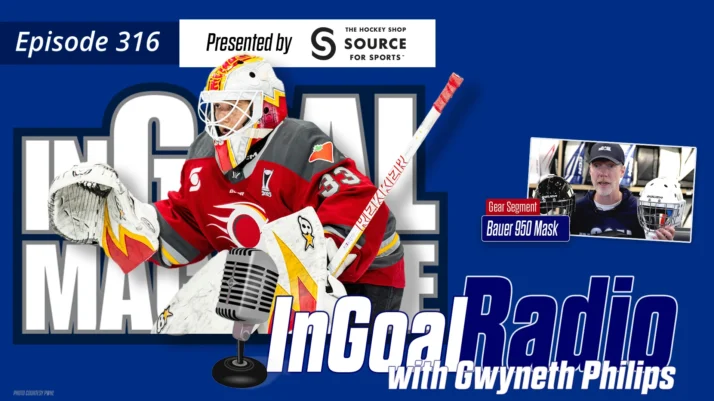
InGoal Radio Episode 316 with Gweneth Philips
Please subscribe and leave a rating — it helps us reach more goalies!


Gwyneth Philips entered the 2025 World Championship gold medal game off the bench in the third period after college teammate Aerin Frankiel was injured — a moment she credits with jump-starting her late-season and playoff run with the Ottawa Charge, where she stepped in after starter Emerance Maschmeyer also went down. Philips, the PWHL Playoff MVP, discusses balancing her athletic, acrobatic style with efficiency and how to approach goalie-unfriendly practice drills without abandoning your natural game.
- Gwyneth Philips entered the 2025 World Championship gold medal game mid-game as an emergency replacement and parlayed that momentum into a PWHL Playoff MVP award with the Ottawa Charge.
- Balance your acrobatic goaltending style with efficiency — Philips explains when athleticism is an asset and when cleaner, simpler saves are the smarter choice.
- Approach goalie-unfriendly practice drills with a specific strategy — Philips offers advice that runs counter to instinct but protects your game long-term.
- Eric Comrie of the Winnipeg Jets contributes a second straight Pro Reads entry breaking down the key factors behind skate-or-slide decisions.
- The Parent Segment covers catching pucks in the pocket, preparing for draft season, and the growing problem of goalie shortages in youth hockey.
Episode 316 of the InGoal Radio Podcast, presented by The Hockey Shop Source for Sports, features PWHL Playoff MVP and 2025 World Championship gold-medal winner Gwyneth Philips.
Feature Interview
presented by NHL Sense Arena
In the feature interview presented by NHL Sense Arena, Philips takes us back through a whirlwind rookie season in the PWHL, including coming off the bench for injured college teammate Aerin Frankiel in the third period of the gold medal game and how it jump started her late season and playoff run with the Ottawa Charge after starter Emerance Maschmayer was also injured. Philips, who went off the grid camping shortly after the season ended, also talked about finding balance on and off the ice, including between her athletic — sometimes acrobatic — style and times when efficiency is the better choice, and shared great advice on how to approach the parts of practice that aren’t greta for goalies that runs counter to that style, plus so much more.
Parent Segment
presented by Stop It Goaltending U
In the Parent Segment, presented by Stop It Goaltending U the App, we continue to empty the mailbag, answering questions about catching pucks in the pocket, preparing for draft season in various leagues, and Hutch gets on his soapbox to talk about goalie shortages.
Pro Reads
presented by Vizual EdgeWe also review this week’s Pro Reads, presented by Vizual Edge, which features a second straight entry from Winnipeg Jets goalie Eric Comrie on key factors behind skate-or-slide decisions.
Weekly Gear Segment
presented by The Hockey Shop Source for SportsAnd in our weekly gear segment, we go to The Hockey Shop Source for Sports for a closer look at the updated Bauer 950 mask.
Episode Transcript
Intro
It's the middle of August as we are recording episode 316 of InGoal Radio, the podcast presented by the Hockey Shop Source for Sports in Langley, British Columbia. And yet out my window, Kevin Woodley, it looks like it's about October 15.
It's brutal on the Lower Mainland. Daren is in Vegas where it is gorgeous and hot, but unfortunately, that meant he's on assignment and he's leaving us to our own devices. He's got the good weather. We've got mid October, but we are gonna make the best you know what it feels like, honestly, going out today? Hockey weather.
Hockey weather. Good point.
Played last night. I'm like, it kinda felt like I was coming out of the rink in November.
Well, don't let Woody whine. I get to whine because I'm gonna be stuck in this cruddy weather. Daren's in Vegas. Forty eight hours from now, Woody's gonna be in Hawaii. And I've got wonderful British Columbia, the smoky skies, the forest fires are just up the road on Vancouver Island.
But that's okay because we're here. We're having a great time. We're hanging out. We're talking goaltending. Our Sense Arena feature guest this week is Gwyneth Phillips of the Ottawa Charge in the PWHL, and I loved this interview, Kevin.
Yeah. I didn't know what to expect because I was kinda given a heads up. Like, you know, we get into the geeky stuff here on the InGoal Radio Podcast. We get into the minutiae, the technical, the tactical. And I was warned that this is a goaltender who very much just loves to go out and play.
And so, you know, I didn't know how the conversation would be different from some of the other ones we have, but I just found it so refreshing. Her approach, her openness in sharing it with us, doesn't mean that there's not value in all the other stuff. She's the first one to say it. But for her, she has something that works and doesn't mean she's not willing to try new things. I mean, not like she's not out there Dominic Hasek again.
She has, like there's a lot of, you know, technical and things that she's added to her game over the years, but just her approach to it, her mindset, wait till you hear the stories about what she did after the PWHL final, where she was the PWHL playoff MVP and just basically dropping off the grid completely. There's some great stories in there. There's reminding me a little bit of the jersey over my shoulder to a lesser degree. Carey Price used to talk about putting the pads away. Not touching them, not looking at them, nothing until August.
Going to take that a little bit a little bit further. So fantastic interview. Clearly a fantastic athlete and a fantastic goaltender. Gold medal winner for Team USA coming off the bench. She tells that story, mindset, how she got through it, how it fueled the rest of her season.
Just a ton of great stuff in here. Can't wait for everybody to listen.
We hear from parents a lot, and they tell us that they are listening to the podcast in the car on the way to the rink with their kids. I love hearing from people. Parents queue this one up for the next trip with your kids. Because as I was editing it, I would put it on pause. I'd run down the hall where my son is hanging out right now, and I was like, you gotta hear this piece.
And I'd tell him the little tidbit, have a good laugh together about how great it is, and then and then I'm back to editing. So, yeah, this is a great one for parents to share with their kids. We love hearing from those parents parents@ingoalmag.com. We share them around the group, have a little conversation about what you're sending to us, and it's really, really appreciated. So please, if you have a second and you're by a keyboard, send us a note.
Let us know where you're listening. Let us know why you're listening. We love hearing from you. And if you could take a second and go subscribe in your favorite podcast provider, maybe leave a comment or a rating, it would mean the world to all of us. Okay.
This week, let's just get rolling, Woody, with ProReads presented by Vizual Edge this week. What have you got? It's a bit of a follow-up from last week.
Yeah. We've got, Eric Comrie, and it had been so long since we'd had Eric on the ProReads that we wanted to go back to back. And for those that watched last week's ProReads, yeah, he actually referenced he talked about making the decision to come across on his skates on last week's ProReads rather than slide, and he actually referenced the save later in the season against Jack Eichel. And I just happened to have that save queued up for our video session later on, and I figured why wait to get to it? Like, he referenced it.
Let's go to it. Let the people that watch ProReads are trying to use it as a tool to get better. See the differences in these plays that he's talking about. Why he comes across in a slide on one and on his skates on the other. So this time, it's another lateral backdoor pass.
He's identified the hands early in this case. What's the difference between a one timer on the backdoor or or off on the opposite side of a cross ice pass versus somebody who's gotta catch it across their body? How does that fuel his decision making? And a middle net drive as well that influences how he pushes. First, to shuffle across before going into the slide and the difference between a shuffle and a t push in this situation and how it allows him to access that slide continuing in the same direction so much better than if he had opened up into a t push and had to close that that lead leg, shift the weight back to the to the left side, and push down into a slide.
So you see it all play out in video. Eric walks us through the things he's looking for that lead to those decisions, and then he walks us through why those decisions allow him to make a very difficult save look pretty easy. It's another great example of ProReads, is all about helping you as goalies learn how to read and anticipate the game better, not just in terms of what's gonna come at you, but in terms of how you set yourself up for it. Footwork, movement patterns, decision making on what side of a screen, whether to slide or or push across up on your skates as Eric did in these last two. It's all there in ProReads to help you read the game better.
And ProReads, of course, is brought to you now by Vizual Edge, which will help you see the game better. Vizual Edge is a visual or eye and cognitive training tool based off of your computer using a pair of glasses that they send you. You can train just three times a week, thirty minutes at a time. You will improve your ability to pick up pucks through screens as Cam Talbot has told us. Your ability to see the puck, see the game, whether it's a puck coming at you, convergence, or quickly looking around the zone and spotting what's going on divergence in a much broader spectrum.
So they train all the different visual tools. And as we've heard Jordan Binnington say, also help warm up the brain. He uses it every game day, not just a vision training tool, cognitive as well. So Vizual Edge, if you're InGoal Magazine subscriber, check out ProReads. We've got a special discount code, which will give you 20% off.
It's 10% if you're not a subscriber using the code InGoal. Check them out at visualedge.com.
ProReads, in many ways, the bread and butter of InGoal Magazine. It's, bringing NHL goalies into your living room in many ways to help you learn the game. Kevin and I every now and then get the chance to join up with other goalie schools and bring ProReads to them. This week, I stopped by three different places, Central Alberta goaltending, Travis Hoy goaltending, and, and a shout out to the guys at True North goaltending up in Edmonton where I had a a good long session just yesterday. And it's just so fun talking ProReads with young goalies, Woody.
As I as I'm looking across this room, and to be fair, it was from a laptop camera in a large room, but looked like a pretty young audience. And I thought, how's this gonna go? And how it went was fantastic. Like, the answers and the intelligence of young goaltenders today that looked in many cases like they might be eight, 10 years old, and yet we have this interactive back and forth with the coach, myself, the kids, talking about different situations, different ProReads. If anybody out there is a coach or maybe you're talking to your goalie coach, Kevin and I are happy to stop by your camp and and spend an hour with you.
Gear
Doesn't cost anything. We're just happy to share the ProReads message with everybody. But the other thing that we love at InGoal Magazine aside from ProReads, Woody, is gear. And you've mentioned many times that Bauer is sort of the driving force behind the elevation in the second price point and how great it all is, and you've got another bit of second price point gear from Bauer this week.
Right. The Bauer 950 mask, which has got some redesign elements. And to be honest with you, been a little while since we shot this segment, so I can't remember what they all are. We're gonna defer to Cam and and and this week's video and refresh my memory. Not just because I've taken too many pucks off the head, but I'm a little fatigued today.
So I would like to remind you though, if you're confused by all the different price points, if you've got questions on what is the difference between a Bauer 960, a Bauer 950, a Bauer 930, like, as much as the brands have done a great job of streamlining and sort of tightening things up in terms of the SKUs and the number of different products they have, there's still confusion out there. Whether you're a goalie, a young goalie, a senior goalie, or a goalie parent, there is no better place to get the answers to those questions as I'm about to than Cam and his team at The Hockey Shop Source for Sports. Everybody in the goalie department plays the position. You are not going as much as it is a 35,000 square foot warehouse crammed full of all the latest in hockey, you are not headed to a big box store. This isn't some high school kid behind the counter that maybe sorta might have played once, plays hockey, doesn't play goal, can't help you.
Let me look it up. These are all passionate goaltenders who understand the position. I've been doing this for years. They will know how to ask and answer the questions that will lead you to the gear you want, whether it's for a five year old, a six year old, or a 65 year old. So make sure you check them out at the hockey shop, Hockey Shop Source for Sports, not just for the latest gear, not just for discounts on previous models, and the back to goal back to hockey, back to goalies sale is on now.
I almost said back to goalie school sale. But for expertise that you can truly take on the ice and will help make you a better goalie, find gear that works for your game, make sure you check them out. A hockeyshop.com, The Hockey Shop Source for Sports in Langley.
Loved how you describe the distinction between The Hockey Shop and maybe some other stores where they carry goalie gear. Made me think of how the game has evolved, Woody. You know, you could go to a store that sells goalie gear and has a guy who kinda knows something about the position. You could play in an organization that has a coach that maybe sorta knows something about goaltending, or you could go to a great NHL organization that has an entire goaltending department to direct the position from the bottom up, and the Hockey Shop has an entire goaltending department that has your every need taken care of. It's, pretty cool.
And leading up that department is our friend Cam, who's gonna fill us in on the Bauer 950 this week.
It looks like a 950, but there is 950?
There is a ton Ton? Of new things in this, including a mystery never available before in the Bauer 950 mask.
Not what's in the box this week, it's what's in the bag.
Hidden away Oh. To show you at the end. So let's find out. Let's get caught up. What's new in the Bauer nine fifty?
I'm here at the Source for Sports, Hockey Shop, InGoal Utopia Yes. With Cam, and he is gonna walk us through what's new and improved on the Bauer 950. For those of you that are like, okay. Remind me, Bauer 950 960 is the highest price point. 950 is the second price point.
Along with enemy one up there. 960 I enemy need you to explain these
things to me, Cam. Okay. So nine fifty is kinda like second price point next generation down. Yes. Okay.
And then nine forty, nine thirty? Right. Looks tough for another day. This is new Yes.
For 2025?
That's correct. What are the new features? Well, first of all, as you can see, we have both white and black. Something that wasn't previously offered, black has started to make its return into Bauer's lineup. Something that was cut a little while ago and now has come back.
So if you're after a black helmet, don't worry. 950. We got you. Okay. But let's talk about the actual helmet itself.
So what we are gonna see on the inside, very eerily similar foam package to that nine sixty. One thing that I can't drive home enough is that this is one of the best value home that's on the wall for sure. You're getting a lot of pro level features for that lower price point.
Okay.
So Crayvon, new material for the nine fifty this year. Right? Remember crayvon from the September of a few years ago. So you're getting a new carbon damp or dampening enhanced material. Holy crap.
That's a hard one to say. Along with the fiberglass base, depends on for your shell. You're getting PORON in the cheeks and their DEFLYNX cloud technology. So their other shock absorbing foam will all be in the crown
of the helmet itself. So this foam, I mean, obviously different. It looks like it's encased. No issues. We had some, and this was a few years back.
So previous previous generations with sweat being retained in the foam. They've got the way this is all in case. That's not gonna be an issue.
So a lot listen, folks. Like, if you're the kind of person that sweats a lot, you're playing multiple games and stuff like that. Yes. There is gonna be water trapped inside of the foam. There's nothing we can really do about that to a bit of a degree.
The big thing is it's But it's not your mouth. Point it was before. Exactly. Exactly. Because, yes, that was a little bit of a problem.
TCT in the chin cup as well. A little bit of impact absorption there as well as the elasticity of their chin cup holder.
Again, a pro level feature that's brought down. It's just more of a comfort thing at that point too as well. Cage, same profile cage across the entire lineup. So as long as you're in senior small all the way through large, it's gonna be the same cage for your 930 senior, your 940 senior, 950 senior, Enemy One, 960, all the exact same cage. Okay.
Fit and feel. Is this going to fit on my head the way say, I I no longer need the the 960 level protection or I'm looking at this and
I'm like, man, it's got so many features that are nine sixty esque. I can live with this Yes. At a lower price point. I wanna save the money. Is the fit the same?
Correct. Size one to one. Okay. How many sizing options? So three in senior and one in junior.
What's in the bag? New. Completely new for the season and completely new for Bauer. That 950 has now been brought down into junior sizing. All the same features?
All the same features. Junior style fit.
It definitely is not fitting over your monster head.
It will not.
This a great new option.
Exactly. So if you're looking for that better level of protection, this has always been a little bit of a gap. You know, nine forty is no longer cutting it. I want that step up, but that head size hasn't necessarily caught up yet. Bingo.
We have a great option for you now. This is fantastic. I you know, been calling for for a little while now and now available. White and black or
is this one
just black. Smaller cage. Keep in mind, any of the Bauer junior helmets now show that same cage size. Again, something just available for, you know, when we get into the aftermarket conversation. But that said, great, fantastic option.
Okay. Bauer's 950, redone for 2025. You get a lot of new pro level features carried down into that second price point. And as Cam mentioned, for the first time ever, a junior mask is available in the Bauer 950. Cam, if they got any questions about it, where do they get you?
(604) 589-8299 or 1-800-567-7790. Let's try
and see if we can get this on your head.
That's not that's that's just not gonna
oh, Al. It doesn't fit Cam, but it might fit your kid, and it's got better protection. Make sure you check it out at The Hockey Shop Source for Sports today.
As I saw that Bauer 950, and I think it's fair to say the 960 is one of the iconic masks in the game today. It's a it's a look you see everywhere that people want. And that 950, I mean, if if you could have had that mask five years ago, ten years ago, you would have seen it as the top mask in the game. That's what Bauer is doing again, bringing just those pro features down a level, little bit more affordable, and now with a junior size mask too. It's, I would have been running for that 950 ten years ago.
No. It's a it's a good point. You know what? And, again, we've given Bauer credit for really we talked about this with gear, and it's not just them anymore. Like, other companies have followed.
The second price point would stand up to top level pro, quote, unquote, equipment. I should be careful because most of call pro their second price point now anyway. Just to give you sense. NHL level gear from five years ago. So everything keeps getting better.
We've got more options than ever before. And, I I would reiterate, like, sometimes we don't know whether whether it's parents or young kids, You know, we assume we need the best. And listen, if you can afford it, that's great. But sometimes it's overkill. Sometimes you really don't.
And there's options out there that are gonna be more than good enough, whether it's to make a save or protect your head. Make sure you check out our friends at The Hockey Shop to find out which one's best for you.
I think you answered your own rant there when you called this gear pro. It might be the second price point, but you could probably play in a lot of this as a pro. Woody doesn't wanna say anything because he's just shot down his old rant, and now he can't rant anymore. And we have Woody speechless, but that's okay. Coming up in a little bit, we've got our feature interview presented by NHL Sense Arena with Gwyneth Phillips of the Ottawa charge.
Parent Playbook
But, first, we're gonna slide over and talk to the parents for a second, Woody. The parents segment always presented by Stop It Goaltending U, the app.
Yeah. They've got, as usual, the five things, five daily primers this week. And this week, I mean, how to get more ice time? Who doesn't want more ice time? That sounds like good advice to me.
So Monday through Friday, you can walk through, watch quick one minute videos, quick tips on how to get more ice time this season. They got a great goalie clip on Filip Gustavsson, and something new this week that I love, they've done drill of the week goalie clip. They walk you through a drill, and then they walk you through plays featuring the goalie of the week, Filip Gustavsson of the Minnesota Wild, making saves that are directly related to the patterns established in the drill of the week. So always great content coming from our friends over at Stop It Goal Tending U on Stop It Goaltending U, the app. And a reminder, if you buy a subscription to Stop It Goaltending U, the app, not only do you get all that content, all that expertise led by Brian Daccord in his twenty five plus years in the game as a goalie, as a goalie coach, as a goalie scout, as a director of goaltending at the National Hockey League, but you also get a subscription to InGoal Magazine, InGoal Premium, and all our great content included.
It's the best of both worlds, and you get it when you buy a subscription to Stop It Goaltending U, the app.
Following up on last week's discussion of gloves and when you need to get a new one, a reminder. We were talking about a junior goalie who was getting stingers and a parent who wondered if that glove maybe was done. It had a lifespan. Is it time to get a new one? And while we know that that certainly happens, we pointed out that as you move up, the shots are harder, and and it will be time to go to an intermediate glove eventually.
But I mentioned off the top that we love to hear from readers. And Christian Stickney wrote to us and said a lot of things that were great to hear, but one of the points he wanted to make about this segment was that if you do catch it in the palm, it always hurts. Well, couple of things I just wanted to respond to. I I shared with Christian directly, but it sounded like something good to bring up for everybody this week. Well, I don't completely agree that every time you get hit in the palm, it's, it's gonna hurt.
I've definitely checked with a number of other goalies to make sure I'm not imagining things, but the point does stand. And I did make it a while ago about some other gear, Woody. I remember, I think it might have been a chesty where I said, you don't have to go out and buy gear every single time something hurts because sometimes it just finds a place and it does hurt and and that's okay. You you move on. Goalies are tough.
We're good. But Christian also made the point that you do need to learn how to catch well. You've gotta catch it in the pocket if you want it not to hurt. And he accepted that he is not perfect with that and went out and bought a padded glove and he even gave a shout out to Cam, which I thought that was great. But, I think that point that it's not always about getting a new glove because it's hurting.
It's about learning the skill of catching the puck well. And I just wanted to give some reinforcement now about that because it's the end of the summer. You've still got time. We're all sort of as parents, think, this time of year, you get a little bit frantic. There's only a couple weeks left in the summer.
Gotta get that last bit of fun in with our kids and make sure we get that family time and school's gonna start soon. We don't wanna miss out. So why don't you go get a baseball glove or two and hang up with your kid and go play catch? I've said this before, but I'm just gonna say it again because it relates to to the note we got. It's not the same thing to just go bounce a ball off a wall with your bare hands, a tennis ball, whatever.
You've gotta learn to catch a puck in the pocket and with a baseball glove, you'll learn to catch it in the pocket as well. And mom and dad, you can go throw with your kid, get a couple of gloves even if you feel nervous about it. Maybe you didn't grow up throwing a baseball around, and you're thinking you might embarrass yourself. Awesome. Great thing to do is to go out and show your kids you're willing to take a risk to embarrass yourself so that maybe they'll feel comfortable doing that at some point as well.
So grab a baseball glove, get out in the backyard, have a chat, turn the TV off. Good family time at this time of year is really important, and maybe those stingers won't hurt as much as a result. K. I had another parent write in asking, because their kid was going into his CHL draft this season and wanted some advice. We have gone over some of that before.
We did have Connor Hellebuyck's agent, Ray Petkau, on here couple of times. Once as a feature guest, once as a parent segment guest at least. I will link to them in this segment when we do it. And I just wanted to share what I had responded to this note with. You probably don't need an agent or an adviser, at least until you've been drafted and it's time to look at that contract.
Things have changed in the CHL quite a bit recently because of the whole NCAA changes. And you probably need somebody with expertise to help you review that contract if it does come time to sign one in the CHL. But until you're picked or unless you're a high pick guaranteed of being picked, you probably don't need that agent just yet. Now to be fair, parts of this I don't have as much experience with, especially with the changing landscape. And if you feel better having somebody represent you and your family, they might help you get a few extra junior opportunities than you might have had as you on your own and that might help your child a little bit.
I think that they're capable of opening the door for some kids who are sort of on the bubble. But those top end kids, they're gonna find their way anyway. Those kids who aren't necessarily gonna get drafted and they're just playing and having fun. Let's not overburden ourselves with with that. If price is an issue for you though, you can get to as many junior camps as possible.
Talk to your kid's goalie coach who hopefully has some connection with with junior teams and just go out there and get some experience. But at the end of the day, you've gotta just go play. Go play. Go have fun. You don't necessarily have to be chasing down an academy or an expensive triple a team.
It's very possible to make it without going those routes. And, you know, we chose to keep our kid at home as we've told you before and things worked out for him. You've gotta make the right family choice for yourself. Also, just don't freak out about the CHL draft. It's not the be all and the end all.
The best example probably recently, Kevin, is Josh Ravensbergen. Right? He was a first round draft pick of the San Jose Sharks. He was not drafted into the Western Hockey League. In fact, he didn't play the top level of hockey in BC before he made the Western Hockey League.
And, he played sort of what a lot of people would consider to be a double a level, and I believe your recent guest Harrison Meneghin also hadn't been taken in the Western League Draft. We've had lots of people like that. So by all means, go enjoy the season, but don't freak out. Go play. Go enjoy the game.
It's okay. There are options. You gotta do what's right for you and your family. And not a full bet here, Woody, but I did wanna give a shout out to the parent on Facebook who was responding to the question about how to break in a chesty. And the answer was this.
Have him sit in the bathroom with the shower super hot to create steam, maybe fifteen or thirty minutes, then have him go vacuum. Gotta kill two birds with one stone. I thought that was a good sense of humor. So thank you very much to that parent for sharing that with everybody who really made the point. You just gotta get out on the ice.
Sweat a little bit. It's gonna break it in. But I do think it does make that point. It's the back to hockey sale at the Hockey Shop right now. Go get your gear sooner rather than later so that you do have time to break it in, Woody.
And I've got one more little parent thing, but I'm gonna save it until the end of the NHL Sense Arena feature interview.
Well done. I like it.
So we're gonna get on to the NHL Sense Arena feature interview. Gwyneth Phillips is with us and just sitting in the green room as Daren likes to tell us. But before we bring her in, we just have to talk about NHL Sense Arena for a second.
Her green room's a camper in Yosemite, by the way.
Yeah. That's right. She's in the green camper. I love that. As I mentioned already, this time of year is is tricky because as families were trying to get that last bit of summer in and and it might mean that there's gonna be a quick family trip somewhere before school starts.
And you're probably thinking, ugh, I need to get ready before the season starts. And that's where NHL Sense Arena has been such a game changer. Because no matter where you are, whether it's at home, a hotel, could be a cabin in the woods with if it's got decent WiFi or a hotspot on your phone and you can still get some quality reps in on the ice with NHL Sense Arena. And what I love, as you know, is that they're always updating it. So we talked last week about how they've added NCAA shooters.
They've got NHL shooters, PWHL shooters. You're seeing the best of the best. And you can choose to follow the goalie advancement program this summer, or you could jump into one of the training plans with a pro coach. You could just build your own program from the many, many, many drills that they've got in there. It's just it's almost endless goaltending.
And it might not be just exactly the same as being on the ice, but in some ways, it's better. You can actually measure your reaction time, how your puck tracking is improving. You can tighten up your box control, things you would never really do out on the ice in one of your regular sessions. So whether you're trying to use it to get sharp before tryouts or to keep your game dialed in, NHL Sense Arena can be that extra edge you're looking for. So check it out at sensearena.com and make sure you're using the code IGM 50 at checkout to save a little more.
I would highly recommend the goal. Like, it's August 15 as we record. You've got two weeks for like, three weeks almost for back school. I'm guessing hockey is usually around Labor Day in terms of tryouts for a lot of these kids. That's more than enough time to rip off, you know, a little bit here, a little bit there and get through at least two of the three programs of as we have.
We're working on the screen and the traffic management segment of the goalie advancement program, but I would I would recommend highly going through the shot release reading one, the angle mastery course. Like, I think I struggle to see how especially for kids or us beer leaguers, it like, anybody short of the NHL, how working on those fundamentals don't make you better, and there's still plenty of time to do it in virtual reality.
Well, we know there's NHL guys doing it too.
There you go.
Feature Interview - Gweneth Phillips
Okay, Woody. Let's go to the NHL Sense Arena feature interview. We will get Gwyneth Phillips to, pull the camper over and get out of the green camper and come into the studio here in a second. I'd like you just to set it up for us. You gave us a little bit off the top of the show.
I do have one request because in there, mentioned a couple of times PG. And, of course, we don't mean parental guidance. This is not a PG rated show. Well, it is PG. It's probably even cleaner than that.
But, Woody, who's PG?
Pierre Groulx, the goaltending coach of the Ottawa Charge, former goaltending coach of the Ottawa Senators. A friend of the show, as they say, friend of InGoal Magazine and premium, a guy who we've known for years, and he's he's now he's now the goalie coach there. So you're right. I do reference him as PG quite a bit in the interview. Part of that process for for Gwyneth has has been building the relationship with him, and for him working with her as a very different athlete than her playing partner who's now in Vancouver, Emerance Maschmeyer, from the Canadian national team.
So like I said, at the top. This is not just an interview with the Isobel Cup playoff MVP for the Ottawa Charge even in a losing cause kinda like Giggy with the Ducks way back when. And the good news for for Gwyneth and the charge is that Giggy ultimately went on to win his cup, so he got his championship. It's coming. It's not just an interview with the gold medal winner from the world championships and a and a goaltender who dominated in her two seasons of as a starter at Northeastern University.
Like, just posted redid like, video game numbers, like nine fifty five say percentage, absurd stuff. This is an interview with somebody who has a different approach, who came to it from a different background, who brings a different mindset to it, and a really good reminder of the importance. We've talked about this with with other goalies of of being yourself in a position in a sport that sometimes demands conformity. Being comfortable with who you are and how you do things can be a big part of having success. And so there are so many great takeaways in this interview.
As Hutch said earlier, you know, this is one to queue up in the car on the way to hockey with your kids. Frankly, given her nomadic nature this summer, I think it's one to queue up in the car on a road trip before you go back to the rink.
Well, here we go. Thanks very much, Woody. Gwyneth, come on in and, have a sit down with Kevin Woodley.
Really excited to welcome to the InGoal Radio Podcast, Gwyneth Phillips of the Ottawa charge coming off a big season both for the charge in the playoffs and The United States at the world championships. Pressure packed right till the end, gold medal coming in late, like you have had a season. How have you unwound since then?
Well, I wouldn't even say it was a season. It was like two months of a whirlwind. But since then, I've I bought a camper in April and I went out for about a month out to California and just camped for like twenty days.
Away from the game, how does your off season like, when do you get back in terms of getting that separation from playing and then bridging back into getting on the ice and and and back into the job now now that you're a professional athlete?
Yeah. So this summer looks a little bit different with the Olympics coming up. So, like, we just got back from national team camp, going back in September and once again in October and then rivalry series. So this summer's a little bit more packed with training, but I think, you know, one of the things that's made me pretty successful is I've always been able to really separate myself from the game and really take my time in the off season. So, you know, this this summer, definitely starting training a little bit earlier, looks a little bit different because it's so early.
You know, I don't wanna cram too much, but definitely a little bit more of a bulky summer.
When you are playing at the level you're playing and at the intensity level you're playing, how important is that to find a way to separate those two things and get away from the game for you?
Yeah. For me, it's imperative. I you know, there's definitely some kids, girls, guys, whoever that they they wanna live at their rank. They wanna live in the gym. It's not really my thing.
Like, I love hockey more than anything, but, like, I also love to do things outside. It keeps me fresh. It I think it really helps a lot with my game too. Like, I think I'm not the most x's and o's kid. I'm I'm a lot of athleticism, and I think I've developed that over the years.
Like, I love hockey more than anything, but, like, I also love to do things outside. It keeps me fresh. It I think it really helps a lot with my game too. Like, I think I'm not the most x's and o's kid. I'm I'm a lot of athleticism, and I think I've developed that over the years.
Just doing, like, all the all other kinds of sports and activities.
What give me give me an example of we love to hear other kinds of sports and activities. We we love the idea of fit as physical literacy. We're constantly telling the goalie parent segment not to make them just goalies too early. What are the others what are the other sports?
Yeah. So, I mean, I played player all through high school too in hockey. Growing up, played volleyball, track, little bit of basketball, little bit of flag football, lacrosse through high school, all kinds of stuff. And then in my old age, I've picked up, like, rock climbing, cycling, just like other things to get me outside of the outside of the rink, and I I found that that's really refreshing.
Where does goaltending fit in that? Like, what at what point as you're doing all these things do you start to narrow that focus? Actually, let's rewind it even more. When did you get into like, when did you first become a goaltender? What what drew you to that?
You know, I don't really remember what it was. Right? Like, a lot of people say, oh, it's the equipment. It looks cool. I I just wanted to do it.
My parents, super against it. Didn't want me to have any part of it, but just kinda kept pushing, kept pushing until finally my parents caved. But I don't I mean, I I was a full time goalie by the time I was, like, maybe 12.
Okay.
But I still played player for, like, my high school team because, like, it was, like, tier two or so. So, like, the it wasn't, like, super competitive as a goalie, but as a player, like, I that's where I was. So I had I I kind of multitasked.
Okay. So when you weren't in the net like, what how how'd you manage that? Like, again, we love this. We love hearing this because we're always like, you know what? Like, like, at nine and ten, they're like, hey.
You're a goalie. And if you're not playing today, you're sitting on the bench. Like, let them go play hockey and learn the game. Right? Like Yeah.
Is that what you were doing? Basically, if you weren't starting, you were playing?
Well, so let's I think when I was that age, like, nine or 10, I think I played on, like, three or four teams. Like, we were just, like, bopping around. So I definitely was, like, goalie for one team. And if I wasn't playing, like, I was sitting, like, my other goalie was playing. But I was, like, a full time player on another team.
And then my third team, I was, like, goalie or player. It just kinda depends on, like, what the other goalie was doing. So, like, I that's kinda what I developed. And then in high school, we all played club hockey and then high school as, like, where we train through the, like, the week. And so there were I think my freshman year, there were three goalies.
There's me, a girl, a grade or two above, and then, a senior.
Okay.
And we all could skate out, and so we just kinda took turns playing goalie or player just based on, like, what we were feeling. So I that that kept it fun for me. Like, it's like I said, like, it was tier two. There's a couple, like, really strong players on my team that, like, went d one, but, like, overall, the games were not super competitive. So, like, more fun to play player and, like, like, learn different thing.
You're playing all these different sports. You're having success in different aspects of them. Are you completely self taught at this point from a goaltending perspective? Or are you because you talked about being a read and react and and not wanting to overthink things, but is it totally self taught, or do you start to get some instructional help along the way? At what point do you add some of those layers of technique to all this athleticism?
No. I I'm definitely not self taught. There's a lot of people out there that have contributed a lot to my success. But when I was, like, 10, kinda starting to really get into goaltending, my dad signed me up for, like, the Mid-Am District tryout. I was, like, completely underage.
And you could tell, like, I was tiny and all these kids were, like, 12 and I was 10 or something. And there's a woman in the stands who kinda run Penn's Elite, and I guess she saw me and was like, okay. This kid has potential, but she has no idea what she's doing out there. Right? Like, I'd never had coaching at the time.
And I I guess she found my dad and was like, here here's what you should probably do. And so she kind of pushed me into the world of, like, Woman's hockey for one. Like, she was really influential in that, and then also just, like, kind of convincing my dad, like, hey. Like, this is a good idea to continue this. Like, she's decent at this.
And so around then, I started, like, getting a bit more specific training. And in high school, I worked with a goalie coach every, like like, every Wednesday or something, I think, once a week. So not not not self taught. I I can't claim that, but I definitely I definitely started out just as talent with no, like, no systems, no idea what's going on out there, just like pure athleticism kind of doing whatever I should do out there.
Okay. So how as you start to get taught and and obviously transition into Northeastern and and playing college hockey, you're gonna get voices, I'm assuming, goalie coaches that wanna add things, change things. How does Gwyneth Phillips find that balance between how she wants to play and how a lot of people are probably adding things? Like, where do you just open mind, try everything? How what's your approach?
Because this was probably a lot of goalies that some want all that and, you know, some don't.
Yeah. So I had the same coach all through high school, which was, you know, really great. Obviously, doing camps, get different things, get different ideas, tidbits of knowledge, whatever, and just kind of incorporate them. Then when I went to college, I was really fortunate. My head coach at Northeastern, Dave Flint, is a goalie guy.
And he's he's a bit, you know, unorthodox, and I think he really takes a chance on people. Right? Like Aerin Frankel, who was there before me, she she's a bit undersized, and people didn't really wanna take that risk on her, I think. And Northeastern was willing to and happy to, and she turned out to be, like, an absolute stud. So I think he he was he's really understanding, thing.
And I think he he always was like, hey. I don't wanna change anything, but have you thought of this? Or, like, he he really drives home. Like, he doesn't wanna change who we are at our core. He's just gonna, like, give different ideas and maybe, like, suggestions.
And if I wanna incorporate that, that's great.
Tools in the toolbox as we like to say.
Exactly.
Yeah. Can you give me an exam like, me an example? Because it's funny because I I was told that, you know, you and you said athleticism and a little more read and react, but I don't wanna overdo it. It's not like there's not a foundation to your game. What would you how would you describe your foundation?
I I think I'm sure I do have a foundation. It's just like I I can't put a finger on it. Like like, if the coach is like, oh, why'd you make this decision? I could, like, rattle off things that probably went through my head, but, like, I just I can't actually say what went through my head. Like, if someone's coming down the the wall in a rush, like, I'm probably like, okay.
I should go I should probably be like this this far out of my crease because they're this hand and there's this threat, but, like, it's just happening.
It's all instinctual.
And I and, like, pretty yeah. And I and, like, I'm a pretty fast lateral moving goalie, so, like, I kind of can I know that? So, like, I can kind of rely on that, maybe bait a player a little bit because I know, like, hey. I can definitely get over there. So, like, I want you to make that pass.
Is hey. That baiting, like, again, lost the lost art of baiting shooters. This is now you're speaking my language here. That experience at Northeastern, you you talked about the coaching side of it, and you mentioned Erin, like, you're behind her for the first three years. Every time you play, you have success.
I think three shutouts in your first three. She's having success. How tough not to play as much as you obviously, especially somebody who grew up playing all these different sports on the ice active all the time. How tough was that? What was that relationship like?
You're both obviously at the at the world championships when you win gold this year. Talk me through what you learned from her or what you got what'd you learn together in all those years?
I'm really, I'm so thankful for the way my college career played out and, you know, through those first three years with Aerin, like, you know, I think we were great goalie partners. I learned a lot from her, and, I don't think we like, we we're pretty foreign in age or, like, class and, like, kind of different groups within our team. So I'm I'll be totally honest. Like, we weren't that close. K.
Now fast forward, it's, like, six years or something, and, like, she's who I sit with at the bus with the national team. Like, she's one of my closer friends on the team, and I I'm I'm so thankful for that relationship that we developed in Northeastern, and now we have the amazing opportunity to continue it playing together on the national team. And from a hockey perspective, you know, I said it, like, she's she's a little bit smaller, plays pretty unorthodox at times, just such an athletic goalie. So I've, you know, I've tried to take some of her her things, and incorporate that into my game as much as possible. Sometimes for the better, sometimes not so much.
You know, I can't do everything she can do, and I shouldn't even try. But, yeah, I'm I'm really thankful to have done that and watched her for three years at Northeastern, see what it takes to be a successful goalie, and then put that into my game.
Did you talk a lot about it? Like, are you are you even, like, at at the world championships, like, are like, are you a come to the bench, have a conversation with your playing partner person, or you don't wanna be thinking like, again, as you said, everything's just instinctual out there.
Yeah. It's funny when I so, like, like, I watched Erin do everything for three years. So when I first started, I I just did what she did, and I like, I thought nothing of it. And then so when I went to the P-dub and Mash was my partner, she didn't come to the bench and chat. And I was like, oh, it's not what you do?
Like, you can't because she would stay in the net and, like, kinda stay focused. And Aerin would come over and we'd have a little chitchat. So then when I started, I'd come over the goalie and have a little chitchat. And then new goalie partner, they don't chitchat, so I didn't know what to do. But, yeah, we I just kind of followed her along and did what she did, and I thought that was the norm.
And it it it's not, I guess.
You get the opportunity to start in your fourth year and just tear it up to go from not playing as much behind one of the best goalies in college hockey to becoming one of the best goalies in college hockey yourself, that jump, because you're probably facing a similar jump this year in terms of playing time and managing that balance between rest and minutes in your game. What what do you remember that what were some of the key points? What were some of the hard lessons maybe along the way? Although, at least statistically, it didn't look like you had to learn many.
It was certainly a jump, and I think taking what I learned from there into my pro career has been really helpful. I think everything's amplified now. It's just everything. The game's faster, harder on the body. So when I learned in college how to take care of myself, recover, I have to do that four times harder in the pro level.
But again, like, really thankful for that because then I I I know how to handle myself at least a little bit. And, like, I saw Aerin do it for three years. So kind of have a good idea, and that's that's still something I'm working on now is, like, how how to be able to play 30 something high at level compete games with, like, plane rides in between and and stuff like that, just managing the pro lifestyle.
What what did you learn from Mash? Again, you you're two different goalies in terms of how you prepare. I I like, I'm talking to PG. I know she likes to, like, pre scout, like, an NHL level detail, and you don't wanna you don't want that. You're that's not how you want to approach the game.
How did you two feet off each other?
Yeah. So me and Mash, pretty different goalies, especially in the way that we approach the game, but, you know, I still managed to learn a lot, you know, because we are pretty different styles. Kinda learning some control into my game that I could pick up from her because I I tend to scramble a lot.
Yeah. So me and Mash, pretty different goalies, especially in the way that we approach the game, but, you know, I still managed to learn a lot, you know, because we are pretty different styles. Kinda learning some control into my game that I could pick up from her because I I tend to scramble a lot.
Can you give me an example of, like like just because everybody listening is a goalie. Right? So, like, when you say control, is it like a containment positional thing? What are some of the if just one little taste.
Yeah. Yeah. Like, if there's a rebound, maybe, like, a shot from the point, rebound on the front, like, I'm gonna be doing back flips out there to save the puck. And she's gonna do, like, the small littlest adjustment to just get to where she needs to be. And it's like, yeah.
I couldn't have done that. You're right. Like, I should probably do that. And so definitely trying to pick up that from her. Like, just the, hey.
Like, I can just, like, move here to here. I don't have to back flip there. Like so yeah. I I mean, I'll be doing the splits for, like, no reason, and I don't need to do that. And she doesn't do that.
So learning that from her and, like, you know, she's played pro hockey for a few years, so she knows what it takes off ice too. So just kinda seeing her manage that has been was really helpful. And then she had my back. It was a great goalie partner when she got hurt, and I had to take over. You know, she's battling injury, but being so supportive of me.
Just, you know, learned a lot about, you know, what it takes to be a good teammate for her as well.
Okay. So the back flips on the recovery, they look good, and they and you're obviously they're working for you. But and I know that's an exaggeration. It's not a backlog. We're not we're not going full Hasek out there.
Although, there's a good story about how the old barrel roll was actually a technical thing from Dom himself. But do you see value? Like, when you're when you're looking at those things, are you looking at like, hey, like, I gotta play my way, but also like, hey, this might when you talk about wear and tear and managing your body, like, a little efficiency might might get me through the year with a few less bumps, bruises, and all the things that come with backflips.
Absolutely. Actually, that lesson was hammered home in the past, like, month or so. So I'm definitely definitely gonna carry that with me. Yeah. It's an efficiency thing.
Get their point a to point b faster, more controlled, make the second save, but it's also a maintenance thing. Like, every time you do the splits for no reason, it's one extra split. Like and you need to do that. Hurts the groin. So, yeah, there's there's a lot there's a lot to be done in that realm for me.
Alright. And there do you still approach it like a learning process? Like, you you had such a good first year, and obviously, this the world championships and the gold medal. But do you still approach it like the tools in the toolbox still open to to try new things? And what are maybe some of the things P.
G. Talked about you talked about Aaron and and yourself not being the biggest goalie, managing traffic.
Yeah. I mean, everything's a learning experience. Just coming back from camp, we were there for, like, ten days, and we were talking about all kinds of stuff. Working on things and, yeah, like, even getting new tools in the toolbox. You know, you you think you know everything, but there's always something to be learned or, like, something to be corrected.
Like, we were working on kinda tips in front and, like, instead of sliding, just kind of, like, off center dropping, which is, yeah. I knew that, but, like, did I? Because I'm not doing it. And and so just, you know, hammering things home, I think, is really important.
What was what was camp like? Like, ten days that you said it's Olympic year. It's a big year. Lots of competition. Lots of how how was the, jeez, I almost said vibes.
How are the vibes at camp? I can't believe I just said that.
Vibes are good.
It's okay.
Everyone everyone's everyone's, like, friends. Everyone wants to make everyone better, and it and it's really funny to see, like, how, you know, aggressive and put how much we push each other on the ice and then, you know, when practice is over, laughing it up. You know, that I think that's what kinda makes an elite athlete is the ability to kinda separate the two things. But, yeah, I mean, every you know, everything's cranked up a little bit. It being an Olympic year and everyone was going hard and practices were high intensity, high movement, and everyone's really taking care of their body because, you know, it's August.
PWHL season doesn't start till November, so we got some time. But, you know, we all had to be kind of at a certain level. So it was a lot of fun and, you know, really grateful to be a part of that and, like, learn. Like, there's there's no better hockey than when you're playing with your national team. It's it's so fun because, like, as someone that's competitive, like, every puck is, like, do or die with everyone out there.
So it's just, like, everything's a battle.
There's always parts of practice, and we ask this a lot of goers. Always parts of practice that aren't necessarily for us as goalies. Right? And that's part of the job. Like, sometimes you're a target.
Sometimes it's three on o's against the best players in the world, like a national camp. How do you approach that to to sort of find that balance? And I guess, again, the athleticism probably and the competitiveness comes in, but are you do you do you pick little points and try and work on them or you just go out and compete? Are there moments where you're doing both? Where you pick a drill to do one thing, pick another drill to do another?
Yeah. So US team, we we love a good three on o line rush. We do them all the time, and it's tic tac toe. So it's hard. Like, I'll see I know it happens to me.
I can see it in my goalie partners. It's like, oh my gosh. That's the fifth backdoor tap in in a row. And it's and it's frustrating because, like, we we do wanna make those saves. Like, we know it's unrealistic to have a three on o, but, like, we're really pushing to have those saves.
So, yeah, like, one of my things is control. So, like, if that is the backdoor, I'm not gonna, like, reach and, like, do everything I can to make that save and practice. I'm gonna be like, okay. If I can just practice this controlled backdoor slide, like, at least then I'm getting in the into that, like, the muscle memory, and then I can get faster on it. So that way I'm not making this a desperation save.
I'm making it a controlled slide, and then, like, I can incorporate that later on. So just kind of like, yes. Like, that is a backdoor tap in, but right now, like, maybe instead of tearing my groin, it's still early. Like, I work on pulling that backside leg in and making it like a butterfly slide.
Sounds like something like, it's funny when you talk about that. It sounds like something you've been working on, like, that controls.
That was yeah. That's exactly it. And
and so share. Like, again, goalies everywhere. Share details. Give me details on, like, what what you're when, like, you've had all this success and it's like, okay. I wanna I need to get that backside leg in.
What what are your focal points to be, like, get better at a more controlled backdoor slide, not go goalie nine one one every time? What what things do how do you break that down?
I think the first thing is just, like, accepting that you might get scored on. Right? Because, like, that's that's a big thing. You're making that desperation save because you don't wanna get scored on, and it's like, okay. But if I can make this a controlled slide, I might get scored on today and tomorrow, but maybe by the third day, I'm getting a toe on it.
Then I can just get, like, that much faster at it. And then you kinda have to accept, like, once I start making that save, like, if there is a second save, like, to be made, like, I can do it because now I'm not in a desperation mode. And, like, I think my goalie coach at the national team is so, like, she's very encouraging of that. And she realizes, like, that's that's okay. It's okay to get scored on if you're working on things to get better and to be able to not get scored on later on.
I I love that. Advice on coming in cold because you did it on the biggest stage. Well, second biggest stage. Right? I guess the Olympics, but world championships are a big deal.
Biggest rivalry in in hockey Canada USA on the on on the women's side. Aerin gets hurt in the third period of a gold medal game. What's the mindset? How do you how do you how do you come in and have the success you had? Like like, if other goalies are like, hey.
Like, nobody wants to be on the bench, but when you are and you gotta come off, how do you do it?
Yeah. I don't think there's a lot of profanity going on in my head. It was pretty I'll be honest. Like, I was I was nervous. Realistically, I'd only played a game and a half at worlds.
Not a ton of experience under my belt. Close game. And I I just, like, I knew, like, you know, this was it. Do or die. I was gonna have to step in.
I was, like, in my head, begging. I was like, please, Erin, get up. Please, get up. Like, I can't be the reason we lose. Like, you gotta get up.
And watching that hit, there was no way she was getting up. So I just kind of the way that I I almost this sounds so bad, but I just accepted my fate. I kinda go out there and I just decide to, like, have fun. There's only so much that I can control. Couldn't really get warm in the two minutes that happened in between.
So I just kind of decided, like, hey. I'm I'm just gonna go out there and give it my all. You know, I've been in this experience a little bit going in cold. Your adrenaline kicks in, and you're kinda ready to go. Definitely some aches and pains after that game because, you know, it snaps on like this, But you just kinda have to go about it your own way, and that that's kind of that experience helped me with the rest of the pro year that followed just kind of knowing this was my approach for this game.
Carry that on into other games too.
Nerves are okay. Right? Like, it's how we manage them and finding a way to manage it and saying, I'm just gonna go have fun. Like, it feels like a pretty it feels like a win to me, like, in terms of from a mindset standpoint as much as you might not have wanted all the profanity.
Yeah. I mean, there's I kinda knew it was a do or die situation, and that's kinda my personality. It's how I approach things. It's like, hey. Like, I can do the best I can do.
I'm just gonna have fun, and that's usually when I play my best. So we'll go at it like that.
And is that the mentality you brought in? Mash goes down, playoffs, you're you're, like, into the end of the season and into the playoffs, you're like, it's your job. First year, rookie, PWHL, just go have fun with it?
Yeah. Pretty much. So during that US Olympic game or gold medal game, sorry, my goalie coach at Ottawa was watching it, and he kinda said, like, he could see my mindset, which was like like I'm trying to think of, like, oh, screw it. Like, let's just have fun. He he said he could see that.
Hey. I know I know p g.
He probably could.
Yeah. And so he was like he he saw that, and he was like, okay. Like, now I know how to how to go, like, react how to how to work with you. Right? Because he was with Mash, and, like, it's all x's and o's and analytical.
And he was kinda trying to do that with me, but then he he saw it click, and he was like, that's not how she functions. That's not how she works. And so going on to the rest of the season, he was like he could kind of repeat that mantra, which was like, oh, screw it, we'll say. And just like, that's how we work together, and it and it clicked. And so, like, having having that kind of good relationship with my coach and then kind of building that same type of relationship with my players that under that mentality, I think, really helped.
How were you approaching the X and O approach at the beginning? Like, was that a little difficult? You got having sort of Pierre being on a bit of a different page with Mash and having to learn your game and how to approach coaching you? Was there a process there where obviously, this was a big moment getting through it, but was it tough? Like, were you struggle struggling at all with the approach to that point?
I I don't think I knew I was struggling. I mean, we'd sit down and we'd do pre scout and, like, kind of tendencies on the other team, which I'm not gonna say is a bad thing. I think it's a great thing to know, like, the other team's power play, but, like, that's not really my game. Like, if I don't know even what our face off plays are. Like, if you're gonna tell me their face off plays in the ozone, like, I'm gonna be, like, kind of fixated, and then I'm that, like, for me, like, I'm gonna worry too much about that and not worry enough about, like, just making the save.
And I think that was kind of the stumbling block that we're kinda getting stuck on. And so then, you know, once he saw that switch at worlds, the amount of video we did decreased. And I'm not gonna stand here on this podcast and say, don't watch video. Do what works for you. But we definitely we definitely did less because that's just not my game.
Like, I'm not a study, look at the books, know their plays. Like, I'm just kinda, like, gonna go off vibes.
Okay. Okay. I gotta say, vibes are good in goaltending, and this is fine. But the whole I'm not a study person. I did need I did need to mention, like, you you you've got an engineering degree from Northeastern.
You didn't just go to school to play hockey.
Yeah. So I studied in college, but not at the rink, I guess.
No. No. I mean, it just the the distinction there. Right? Like, this is just this is just how you approach the game.
Yeah. Yeah. No. And I I do think it's different from a lot of goalies, but, you know, you just gotta find what works for you. And so far, it's been working for me alright.
What was your takeaway from the playoffs? Because like you said, it did work for you. And as much as your playoff MVP and I can go back to a lot of different playoff MVPs that lost and they that can be a bitter pill to you you got individual success, but the team didn't quite get there. They're all in overtime. You know, that's a mental roller coaster.
How'd you manage it?
Yeah. I mean, like you said, bitter pill, but I think that whole run just kinda gave me a little bit of confidence. Just like you said, like, rookie going in kind of bash went down right while we were starting to battle for playoff contention. And, I mean, I I didn't I didn't know like, I knew it it was gonna, you know, be a close run. And I didn't have a lot of games playing with the team, and I think we were kind of off to a rocky start.
But just kind of, like, building that relationship and that that trust with my players, I think, kind of, in return, giving me a lot of confidence. Like, if I can see that they're relaxed, you know, they trust me behind them, then I kind of get a little bit of confidence. So just kind of building that rapport and then leading it into playoffs, that turned into, like, a little bit of confidence. And, like, I I got more comfortable. I I showed myself that I could compete at this level, and I think that's gonna be really helpful for next year.
I think, you know, it'll be hard not to have Mash to support me and to learn from her. Like, now I'm you know, the Ottawa Charge goalies are all pretty young. I think we're all gonna be two thousands, which is a bit scary, but, you know, I'm gonna have to find that leadership in other realms with, like, Brianne Jenner and stuff, but it's gonna be weird not to have kind of that backbone goaltender with me.
When you talk about building confidence in teammates and seeing confidence, any advice? I mean, obviously, the puck in games is a big one and and build that confidence that way. But are there things you can do as a goaltender in practice to help sorta make sure your teammates are feeling good when you're back there?
I I just think building that relationship on on and off the ice was really important. Think when I was the backup, you know, I was a little bit timid, not myself, just because I felt like, you know, it's a little bit of an outsider, and I I don't think that's a good approach. I don't think you should ever limit yourself, but that's that's just what happens to me. That's kinda what happened with Aerin too when I was in Northeastern, like and I think but once I'm in that starting role, I get a little bit more, like, confident, which and I and I I kind of build I work on those relationships a little bit more and become closer friends with the girls, and I think that can be done when you're second, third string, whatever. But just the way that I am, like, I'm a little bit more reserved.
But I think, yeah, once I kinda started having the confidence to be a little bit more myself and build those relationships, crack the jokes, have more fun in practice, I think that that bridge kinda bonded between me and the rest of the girls, and that that really helped build that that connection and that confidence in each other.
But I think, yeah, once I kinda started having the confidence to be a little bit more myself and build those relationships, crack the jokes, have more fun in practice, I think that that bridge kinda bonded between me and the rest of the girls, and that that really helped build that that connection and that confidence in each other.
The summer camper. Walk me through how I I I do need a little taste of because as soon as that ends, are you like, I need to just get away from hockey? I'm gonna get a camper and I'm gonna go camp. Okay. You said West Coast, so California?
Yeah. I don't know. I've always like done random things, I love Yeah. I love driving. I was like, oh, I'm just I'm gonna buy a camper and go out West.
And so I bought a camper and I went out West as soon as the season was over. And, yeah, like, I just kinda used it to to decompress. Like, you know, hockey is a lot of fun, but can be a lot, like, a lot of stress. And everything for me was, like, ramped up at the right in, like, April. Like, I was just kinda cruising by and then, like, things snapped.
And all of a sudden, like, was under a lot of stress, and so I think I just kinda needed to hit the hard reset. And for me, I guess, that means, like, disconnecting from all things hockey, Internet. I mean, I was out, like, I didn't have service for most of it.
For how okay. So you're professional athletes. You got PR guys asking you to do interviews with clowns like me all the time. How disconnected are we talking here and for how long?
Well, it's actually a funny story. I hiked up a mountain, and I I didn't have service for the few days. And I hiked up a mountain, I got, like, one or two bars. And just by chance, and I get, like, a million texts. And I guess I had missed the expansion draft and free agency.
So I'm getting all these texts from, like, people being like, this girl's no longer on our team. This girl's no longer on our team. Like, this girl's on our team. This girl's over here. And I'm like, oh my gosh.
My phone's blowing up because I just went, like, two or three days without service. And now all of a sudden, like, all these things are unfolding and, like, the league is getting so shaken up. And I I just was like, airplane mode. I can't deal with this right now. I'm on top of a mountain.
That's the only reason I have service. Like, I can't deal with this.
Yeah. The lesson there can't be don't climb too high.
Yeah. Like, once you hit, like, you're up in the sky, stop. Just turn back around. So that happened and, like, there was one media thing. And so I was in Yosemite and I was like, okay.
I'll like, I'm walking on a path, have some service and it declines. So then I walked back to where I had service on a hike and I'm just like standing there. Yeah, I can I can hear you? Can you hear me? Like, kinda trying to make it work.
But I did say I did request to not have a lot to to do because I wanted to be pretty disconnected. And I I was, like, there was not a lot to be done to reach me.
I love it. Well, it makes me appreciate the fact you've taken more than half an hour of your time today in the midst of what is still the off season despite the national camp starting. So, I really enjoyed this. And and I know like I say, I knew you coming in that your approach was maybe not like the goalie geeks that we often have on, but there are good there are good lessons here. And it's good for for kids to hear that there isn't just one way to approach this.
And so thank you so much for taking the time to share it with us today.
Yeah. Of course. I know it's bit unorthodox, so, you know, maybe don't take everything from me. Maybe make sure you guys are out there and you're reading plays and watching film, but have fun with it.
Well, considering our bread and butter on our website is ProReads, we do appreciate that.
Yeah. That's fair.
Outro
Kevin, the one that stood out for me, I mean, there were lots of good pieces in there, but the first one that I made a note about, I think every goaltender should listen to and take to heart, and that was her take on 3-on-0 drills because so many goaltenders complain about how this isn't realistic. This isn't fair. I'm gonna get hurt. And she actually turned it on on on its head because she's a self identified back flipper out on the ice throwing herself everywhere. If ever there was a time to be doing that, it's in a 3-on-0 drill when you have to do everything you can to make a save.
And instead, she accepted that there's an excellent chance she's gonna get scored on anyway. So why not test her limits in control with structure? I just thought it was beautiful advice.
Yeah. There and there's a ton of it. Right? Like, from personality stuff, we talked about coming into it and being yourself to yeah. For as much as we talk about I love the back flipper term.
I have the visions of doing a barrel roll as she described, you know, playing out a rebound. But understanding that you can still be that, but embrace things that will help you become more efficient in her case because she's about to go from not playing much to playing a ton down the stretch when Mash got hurt to being the number one in Ottawa with a very young goaltending department. So, you know, even if even if that's your preferred style or something you never wanna take out of your game, and and why would we? Right? That reactive element, that dynamic the stuff that gives you another level and another layer.
But still recognize that there are times where maybe not going to that as soon as the sequence might preserve the body, might allow you, as she said herself, I'm gonna get to that first one on the backdoor extended, but do I have a chance on the next one? And so there's an awareness there built within that dynamic nature that there are times where you have to leave, you know, you have to leave the car doors closed before you open them wide wide open and call 911.
But what a what a better time to try that than on that 3-on-0 drill. And what a great mindset of hers to say you have to accept it's okay to be scored on. And that's that's tough for young goaltenders to get to that. It's tough for any goaltender to get to that point. Okay.
I said I had a little extra parents bit after that one, and I was making notes as she was talking about playing on three or four teams growing up, and I loved it. As you know, I think it's awesome that she was a player on her high school team. And I can't tell you lately, Woody, the other thing I wanted to address in the parent segment was the number of posts I've seen recently of teams looking for a goalie for this season. And we're not just talking U7 here. We're talking U15, U18, multiple levels of the game, all sorts of places across the country, across North America, and and that's just really sad.
And we know that Hockey Canada and USA Hockey are trying to do things to improve the way we support goaltenders, the number of people that are playing on goal. But here's my soapbox rant that you've heard from me before, Kevin. Let kids register on multiple teams if they are a goalie at one of those levels. Right now, at least in hockey Canada, you get carded on a single team and that's it. And, yes, you can AP up a level if you for a few games and so on.
But in order to support the growth of the women's game in Canada, we allowed girls to register on a female team and on a boys team. Great. Awesome. Why don't we do the same thing with goaltenders? So if you are a double a goalie, you might not have the skill to be a double a forward in those days you're not starting.
So how about let them go play on a on a recreational team? Or how about the triple a player who's a great athlete who maybe doesn't wanna take the chance on being a goaltender gets that chance to experiment at a lower level. And and I know it's not easy because what we don't wanna do is get a kid who's passionate about goaltending losing a spot on a team because the triple a forward decides to come down and he's just such a great athlete. He dominates and and so on. There's gotta be some control around it, but let's have some discussions about getting more kids to try being goaltenders by allowing them to be on multiple teams.
Well, part of that is getting rid of some of the stigmas and we joke about a lot of it too. But honestly, like, it's it's gotten a little to be a little too much and we've turned off, you know, not an entire generation by any stretch, but we've turned off a lot of parents who are the decision makers in the family around the idea of playing goal because of a lot of those negative stigmas and you're starting to see it. We we heard about this when we were at the USA Hockey Symposium. Like, they have a shortage. And I think a lot of people are naive when they think that Canada doesn't because I've heard lots of examples, and it seems like more and more and more over the past three seasons, we have teams up here that don't have goalies.
And if you wonder why, it's how we treat them.
It is. It is. It might also be related just to the expansion of the game. And and I mean by that, there are so many more options for kids to play. Sanctioned teams, unsanctioned teams, different leagues, different places.
And it's not hard for them to find players, and you can field a team without 18 or 20 players, but you need your goalies. So as these options diversify themselves, it's more important than ever that we have goalies for these teams. So let's let's make it happen.
There's goalie shortages at Beer League too, Hutch. Let me tell you. I feel like I could play like, it's August 15. And if you check my phone, I could have played every night this week.
And when you did show up, your team still thought there was a shortage of goalies.
That's fair.
I'm just kidding. You always do that to yourself. I've watched Woody play. He falls every now and then, but he's a heck of a goalie.
I know. And my next mask is going to be Woody from Toy Story, And the quote on the back is going to be, that's not flying. Except instead of flying, I'll say goaltending. That's falling with style.
Nice. Excellent. What a great way to finish the show. I think we're just gonna leave it there, Woody. Our thanks to The Hockey Shop Source for Sports, out in Langley and the hockeyshop.com, to our friends at Vizual Edge, NHL Sense Arena, and Stop It Goaltending U the app.
And, of course, to you out there for listening, for commenting, for writing in. We always love hearing from you, and we hope you all have a great week in goal.
Comments
Comments are for InGoal members.