
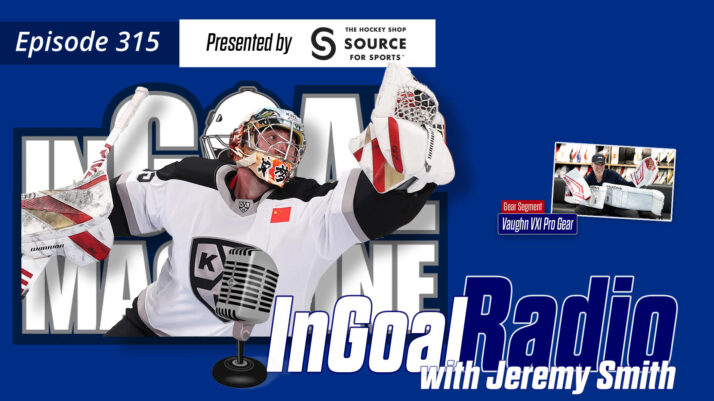
InGoal Radio Episode 315 with Jeremy Smith
Please subscribe and leave a rating — it helps us reach more goalies!


In InGoal Radio episode 315, 16-year pro Jeremy Smith details working under elite goalie coaches Mitch Korn, Bob Essensa, Francois Allaire, and Ian Clark during his 10-year North American career after being drafted by Nashville. Smith also explains his transition to the KHL's Kunlun Red Star and the 2022 Olympics with China, including adapting to a different style of play and becoming the highest-level pro to use Warrior's plastic slide plate in league competition.
- Jeremy Smith worked under four elite goalie coaches — Mitch Korn, Bob Essensa, Francois Allaire, and Ian Clark — during his 10-year North American pro career after being drafted by Nashville in the second round.
- Smith became the highest-level professional goaltender to wear Warrior's plastic slide plate in league play during his time in the KHL with Kunlun Red Star.
- Transitioning from North American pro hockey to the KHL and representing China at the 2022 Olympics required significant adjustments to a different style of game and coaching approach.
- Managing screens effectively requires early awareness of shooter handedness to make better skate-or-slide decisions, as broken down in the Eric Comrie Pro Reads segment.
- The Vaughn VX1 Pro, despite its name, is Vaughn's second price point pad and glove set — an important distinction for goalie gear buyers comparing product lines.
Episode 315 of the InGoal Radio Podcast, presented by The Hockey Shop Source for Sports, features a wide-ranging and information-packed interview with 16-year pro Jeremy Smith.
Feature Interview
presented by NHL Sense Arena
In the feature interview presented by NHL Sense Arena, Smith shares experiences with some of the biggest names in goalie coaching — Mitch Korn, Bob Essensa, Francois Allaire and Ian Clark — during a 10-year run in North American pro hockey that started with being drafted in the second round by the Nashville Predators. The 36-year-old Michigan native also gets into the decision to leave it all behind and play for Kunlun Red Star in the KHL and China in the 2022 Olympics, adjusting to a very different style of game and touching on some of the different coaching he’s received there, as well as starting insights into his use of Warrior equipment overseas, including being the highest level pro to wear their plastic slide plate in league play. It’s a fantastic conversation loaded with great insights on several aspects of the position.
Parent Segment
presented by Stop It Goaltending U
In the Parent Segment, presented by Stop It Goaltending U the App, we continue to empty the mailbag, answering questions about the shelf life of youth gloves, how to keep kneepads in place, and how to help kids who want to quit playing after a bad experience.
Pro Reads
presented by Vizual EdgeWe also review this week’s Pro Reads, presented by Vizual Edge, which features the return of Winnipeg Jets goalie Eric Comrie and a breakdown on managing screens and the importance of early awareness of shooter handedness when it comes to skate-or-slide decisions behind traffic.
Weekly Gear Segment
presented by The Hockey Shop Source for SportsAnd in our weekly gear segment, we go to The Hockey Shop Source for Sports for a closer look at the Vaughn VX1 Pro, which despite the name is their second price point pad and gloves 😉
Episode Transcript
Intro
Presented by The Hockey Shop Source for Sports Langley, thehockeyshop.com. Welcome to this journey called Goaltending InGoal Radio, the podcast Daren Millard. David Hutchison, Kevin Woodley. We're kind of in that sweet spot where guys are gonna start really getting on the ice. We're gonna get some pictures.
We're gonna get some first looks at new setups for this year. This is kind of like a version of Christmas where we all get to see the new looks.
And teases too. Right? You see all the stuff that goes up on social saying, goalie x is switching from CCM to Bauer, Bauer to true, whatever it might be. And everybody forgets that it's also the time of year that guys are trying new gear. It does not mean they're switching.
And let's not forget, there is often financial considerations behind this as well. Contracts expire with equipment companies. Guys try new gear because there's a paycheck involved with it. Some of them go with the paycheck. Some of them decide, hey.
It's too different. Some guys go purely on performance. Joey Daccord last year, we had the story about how he switched his blocker to Bauer because of how active rebounds were off of it compared to the True he was wearing, and he and he basically played with a mismatched set last year. So we get a lot of this. We went through this last year, Hutch.
Right? We're up in Kelowna with Devin Levi. He's trying True, and we've got all this video, and and everyone's like, he's he's switching. He's switching. I'm like, hey.
Let's see. And he ends up staying in CCM, and we've got all this video of him and True, and we're like, I can't we can't really use this. But maybe we can because he didn't so it's, yeah, it's that time of year, Daren, but it can be a little misleading at times. Let's put it that. You know what's not gonna be misleading or long term?
You've noticed this probably at some of the world junior camps, the CHL, and some major changes coming to the equipment there. You've probably seen guys that are going back to junior go to their dev camps and all of sudden they're in different gear. CCM no longer in the Canadian Hockey League. It's now a Bauer league primarily with your only other options being, I believe, Vaughn and True. So there are a number of kids around the Canadian Hockey League right now because that was a pretty big CCM league They can't wear or maybe they'll get grandfathered in for the short term, but long term can't wear the gear they've always worn.
And it sounds like for some of them, at least beyond Bauer, it's been hard to get gear to even try in the summer. Training camp's a month away, and a lot of kids don't know what they're wearing when the season starts. And we all know how important the CHL is for kids in their draft years and stuff. So that's one to keep an eye on for sure. And if you're wondering why you're seeing some of these guys in gear that they've never worn before, that's the reason this summer there's a lot of testing and experimenting going on as guys try and find an alternative to CCM and the CHL.
Hutch, let's look through Mattie's eyes. How many equipment options would he have available to him to test, to try, or is it just his set that he gets playing in the Canadian Hockey League?
No. The companies for major junior guys are pretty generous, because they'd like to see them in the gear. He has tested a couple of sets of Vaughn gear. He has tested a couple of sets of Bauer gear, and, the only company that's been a challenge testing is True, who interestingly were incredibly on it with sticks. They made him and other goalies he knows were were given sticks from True that were custom made to their specifications, colors, everything right at the beginning of the summer because they wanted to switch guys into their sticks.
So they were really on it. But apparently, they've only got a couple of test sets of gear that they're moving around the league. And it's really hard to get into them. He was able to try some stuff at TendiFest, but, but other than that, it's been really tough to test their gear. Our understanding right now from the team is that there is a bit of a grandfather time that they'll be able to wear last season's gear.
They can't order new gear from CCM. But if you were a CCM goalie and, and you've got some stuff from last year, apparently, you'll have a window that you can use it. But everything's sort of still up in the air. It's tough.
It's interesting about the the grandfathering in that I I actually when I first heard Woody say that and use the term, I thought if you were a CCM goalie at 17, you might be able to Well, wouldn't that be CCM gear through your junior career. But just just whatever you have, you can keep wearing.
I mean, it sounds like it, but that's the communication from the
And is there an approval person, a a Kay Whitmore? Don't play Western Hockey League?
Not that I'm aware of. No. The the league definitely has some pretty severe equipment regulations, which actually get imposed upon the equipment managers for the team, but I don't know who the individual is that does this. I know Mattie's first year in Vancouver. The equipment manager was fined because one of the defensemen was wearing white skate lace in his pants and it was hanging out below his jersey and that's a no no from the league.
There's all sorts of different ones and it would actually get imposed on the equipment manager. So they end up having to enforce everything pretty strictly with their own teams.
And and that includes, like, there are certain items that you are even more restricted on in terms of brands. Is there not? Like, in terms of pants, not chest protectors, but there are some items where you have to be in specific brand limitations. And now that the CHL is, quote, unquote, because I don't know what this all means. Maybe you do now that it is a Bauer league is how how it was phrased to me.
Does that mean every goalie that was in, say a CCM pant before mandatory is now having to switch to a Bauer pant?
Yeah. I there's all sorts of different exceptions for things, and I don't even know if the players see that. I think it's how it's all communicated, I'm not aware. They definitely will have to switch to Bauer pants. They are able to keep their CCM skates is my understanding.
Teams generally have to wear the Bauer skates, but I believe they get a couple of exceptions per team. Whether it's drafted guys or by age or the team can just nominate them because some guys have deals with equipment companies in junior hockey. There is an option. My understanding was a few years ago, the Kelowna Rockets signed a deal with True, and they put all their players in True skates and I think True sticks as well, even though they weren't technically allowed in the league, and there was some financial penalty for that. They were they were welcome to do it if they still spend an equivalent amount on CCM sticks or something.
I again, don't quote me because it's not super clear. But there are ways that they make exceptions, but you can't really wave your hand and say, I've been wearing CCM my whole life. Can I please do that this year?
Interestingly enough, like, I had this conversation with a goalie and actually be on the podcast here in the next couple of weeks with it. We got them sled it slated in scheduled, who playing pro in Europe. And oftentimes in Europe, the teams are sponsored by a company, and so you have to wear that gear. The exception is if you have a signed contract with another equipment company. At least the way he explained it to me, that's your out.
So if you as an individual athlete have a signed contract with CCM or True, but you go over to Europe and it's and your team is sponsored by Bauer, that is like a I can wear what I want card because you have that sponsorship. Now you may have to make that aware when you sign or something like that. I'm not entirely again, there's there's a lot of sort of Gotta be parameters. This is what this guy says, and it can change from I'm sure from one league, one team, like, everything's different, but it really is interesting to sort of see this. And at the end of the day, like, don't begrudge anyone.
Like, this is this is all part of investment and business, and this is the way it goes. But I would suggest that, you know, August 8 as we sit here and record with training camps opening in a month or less than a month is it's probably a pretty small window to ask somebody to basically completely change the tools of their trade going into a season because we know how unique these things are. The personal preference, how a pad not only looks but feels and performs on your leg, from one brand to another. You know? And I know for true it's a challenge because, obviously, there's limited capacity in the North American factory, and they want these kids in the North American Montreal made equipment.
But this is the time of year where every pro that wants to try it, NHL guys are getting their gear. Like, they they there's just only so many sets they can make out of that factory. So I would imagine that that, as you said, getting demos out to all the goalies that want it has proven impossible by the sounds of it. They haven't been able to do that. And then the next step would be, like, if you're ordering now, like, if you do get a demo set and you're ordering it, like, when's that showing up?
Two months into the season? So, yeah, it's it's a really interesting time, and I think we need to, you know, be cognizant. There's an effect on young athletes who are playing for their futures in many cases.
As familiar with the scene in the NCAA, but my understanding is there are individual schools with contracts with gear companies, and the goalies must wear that one company. That because there are some brands that are quite I mean, look, a Bauer pad is very different from a CCM pad, for example. If you had to make that switch, that could be a real challenge.
We're going through this right now. We're testing the Warrior pads. Our featured guest on today's episode is Jeremy Smith, who wears them over in the KHL. And much like our early reviews of the Bauer pads, there's an adjustment process in terms of how you set them up. They perform a little differently, getting them to sort of move with or around your leg depending on your personal preferences, you know, much like those early Bauer pads.
Remember, had the article with Mike McKenna talking about the different strapping options, and and here's how I would do it to sort of get it to perform like what you're used to. And so going through that process with us as testers is one thing or with some of our young testers, but going through that process two, three weeks into a season, I would argue is less than ideal.
Just on the testing part of it, when you're moving a set with unique variabilities like the Warrior pad, are you finding that the different people that are trying it out are trying it and testing it in different ways?
Yeah.
Setting it up in different ways.
Absolutely. And and that's part of the education process. You have to. You have to let them know. You know, I had a really great sit down with Kirk Allen from Warrior before we started this process, we walked through, like, listen, here's how it's designed to work with this strapping.
But understanding that not every goalie is gonna want their strapping, you know, they're not gonna all want the, the active response system, which is their elastic style toe tie system. It's not even a toe tie system. It's just elastic strap that runs through the toe of the skate down near the boot. Not everybody's gonna want that. They they might want laces.
But if you change how you're doing up the pad at the bottom in terms of the laces and a big big gap in toe tie, you're probably gonna have to adjust how you strap it at the top in terms of tightness to get it to perform optimally. And so it's a little tough with us, especially this time because, again, for a lot of our test goalies, this is the first time in this gear, finding their personal preferences and then getting them enough time on the ice to really feel comfortable with it. You know, it it it's a process. It takes some time just because it's unique. Again, re really reminds me of the Bauer process.
Now if you've if you've played in Bauer before, you know what those differences are, the strapping differences. And Bauer's made adjustments since then where you can, on the fly, change the way that pad interacts and feels on your leg with some of their different different strapping systems over the years. So there's a uniqueness to those two brands pad style wise that might just take a little longer if all you've ever played in is a Vaughn or a True or a CCM, that Soft Flex. They all kind of have similar properties. There's a uniqueness to to the Warrior and Bauer that can take a little while to adjust to.
Got some great listener questions coming up in the Stop It Goaltending U, the app parent segment, the Visual Edge ProReads, chatting with Eric Comery, and our Sense Arena feature interview sits down with the aforementioned Jeremy Smith. But the Hockey Shop Gear Segment brought to you by Source for Sports Langley, the hockeyshop.com, focusing on the Vaughn VX one pro line. And just for clarification, this is the second price point?
Second price point. Because if it was the top price point, it would be pro carbon. We can probably insert or you can probably count on a little woody rant about names in this one. So we all know that, you know, the idea they're not the only brand. Like, this is not an attack on Vaughn.
A lot of them call their second price point pro now. You know what the truth is, though? The second price points have come so far that quality wise, they are like, if you were to take a pad from five, six years ago and compare it to the pro even gloves too, compare it to the pro level pads now or the second price point now, the old pro, would compare very favorably. It's remarkable. And and the charge, think, you know, credit worth due led by Bauer, to really sort of take those second price point pads to a new level.
Chance for parents to save money as kids are growing. Frankly, a chance for beer leaguers. This stuff is more than good enough for most of us. You know, it's and and this is another look at it. So if you have questions, not just about the Vaughn VX one Pro we're about to review, but about any of these lines, whether it's the second price point, the 7.9 in the new EFlex line from CCM, Bauer's second price point, true all Warrior, all of them.
Call the guys at The Hockey Shop Source for Sports because they're gonna be able to give you an answer specific to you or your goaltender. What level are they playing at? What's the difference? How's it gonna feel? Is this protective enough?
No, I think the pads are all protective enough. It's more the gloves from a protection level. You get more foams in some of the more expensive ones. Pads, it's about durability. The these these might not last quite as long if you're looking to get two years and your kids on the ice five, six times a week.
So those are the types of questions that they can answer at The Hockey Shop Source for Sports so that you can make an educated decision on which line you need. Do you need the top of the line? Is this second price point good enough for you or your young goaltender? Make sure you give them a shout. Check them out if you're happen to be in the Lower Mainland visiting or live here.
It's The Hockey Shop Source for Sports in Langley. For everybody else, thehockeyshop.com, and never hesitate to reach out to them. We always talk to Cam, but everyone on his staff plays the position, has a passion for the position, understands the position, and can help answer position specific equipment questions. Make sure you check them out.
Gear
Vaughn. I think of the Vaughn pad and I immediately go a white pad. I don't know why. It's it's the only manufacturer where I go that there's a specific color that jumps into my head, but I always think of Vaughn and solid white pads.
So like a good guy, bad guy thing with cowboys and what color hat they wear?
I don't know. I had a Vaughn white set when I was 16, 15, 16. I love them. They were my favorite pad. Maybe that's it. But
You must be the good guy because we've got an all black set sitting in the next room here.
Really? Yes.
The VX one pro
Good guy, bad guy. Don't get that confused with good goalie, bad goalie.
Oh, yeah. No. You'd be good and I'd be bad.
No doubt about it, buddy. No. Not a chance. Let's get over to it. Cam and Woody with the Gear Segment brought to you by The Hockey Shop Source for Sports Langley at thehockeyshop.com with the Vaughn VX 1 Pro.
Vaughn VX 1. But this is just pro, not carbon pro or not pro carbon. So what's the what's the difference? What's different? And why does this glove feel so good on my hands?
We're gonna answer all those questions today We are. At The Hockey Shop Source for Sports. We're in Goal Utopia with Cam, where we're gonna get you the answers and why you can save a whole bunch with this line compared to the Pro Carbon. Where do we start? There's so much here.
Let's start with the pad.
Start with the pad. I guess that's a place that makes sense.
Keep it
We've up as a had a little bit of confusion mostly in my own head, which let's be honest folks happens a lot. Pro carbon is their so this is one where Vaughn, instead of making pro their second price point, has the word pro in both their top and second price point. The top one is pro carbon. This is just pro. Correct.
Is it more forgivable in Kevin's little brain than the ones that don't have any pro in their top? Y'all are messing me up. At the end of the day, this is the second price point pad in the new v x one line Velocity. It's called pro. Yes.
Differences, features of this pad compared to the one we reviewed in the Pro Carbon. Was that about a month ago? Six weeks ago?
It's a little while ago, but I think we can go over more similarities than differences.
Okay. There you go, Cam.
It's good sign.
Lead me through the similarities. One of which would be we've got knee rolls, we've got a traditional look. We don't necessarily have that soft traditional flex that this line has been associated with.
Well, we're not let's be clear, not functional knee rolls. Everyone wants to get on almost any pad now nowadays. So, flattened out knee rolls gives you that illusion of, like, we're having more flex, you know, that more traditional look, we'll
call it.
I like that one. Cool. However, this is quite actually a stiff pad Yeah. Versus, you know, what we've seen previously from Vaughn. So even in comparison to a V 10 pro, the last year's version of this mid level pad, this pad itself is quite a bit stiffer.
Yeah. That's like this is not this is not Jonathan Quick's velocities.
No. And this isn't yeah. This isn't your grandpa's velocities. There you go.
Did you just call Jonathan Quick grandpa? Well, I mean, you know, he's A 100% passing that along and making sure he sees that one. Holy smokes. Guy's still in the show.
Stop down. I may have just busted myself to, you know, one the most American goaltenders of all time.
All time. All time. Wow. So Can't believe you went there.
Well, more differences between his pad and, you know, say this pad and, you know, why you should be looking at this versus some of the older velocities of the past. That rigidity that we see in the in the overall pad more aligns with some of the more modern pads that we do see on that wall.
So traditional look, modern build.
Correct. Thinner thigh rise up top, also binding less design, which is something that's been a little bit different from them. We saw that on, obviously, the Pro Carbon version. Now it's been brought down to here as well, allowing for a little bit easier overlap in your overall stance. So to aid with that overall rigid thigh rise itself, if something's too thick up there, you're gonna bind up.
This allow your dominant leg to kinda cross in front, especially in any those post situations, things like that. Side of the pad, we do see their version
of Primo. Exactly. I don't know if I was supposed to say that, it's That's click slide. Looks like it's almost the same. Click side.
Okay. It's it's high wear, and it slides well. At the end of the day, we talked about this with the Brian's line as well. Yes. It's one of the better sliding materials out there, and it wears really well.
Correct.
Super slick. Little harder on the inside, which probably contributes to that rigidity.
That's top to bottom. Again, aiding in that overall feel for that pad itself. So when we look at the actual knee cradle, balance stabilizer makes its return here. What that means is Bauer's version of their or sorry, Bauer Vaughn's version of their integrated kind of style of a knee. Not the exact same, but quite a bit different than I've seen from them in the past, allowing for, again, much more stability when you're down in that butterfly.
Allows you to sit nice and tall. One of the things that I do find different material too as well. It's almost like a
It's a it's a richer texture to it.
Yeah. Exactly.
Exactly. Soft. Nice soft lining area. Give them that.
I would say definitely 10 out of 10 though with the style. Recommend, you know, socks over your knee pads. Don't wanna have exposed Velcro against this.
Oh, it'll wear it through.
Right. I do find it kinda wears a little bit. So, yeah, for your knee pad wearers, which should be everybody anyway, Socks over your knee pads, which is something we always do recommend.
Kevin never misses a chance to shamelessly plug his preferences on this show.
Yes. There we go.
This is
Leg channel.
RRC plus.
Yes. What's it stand for?
You tell me.
I I believe you have the the acronym down right off the bat there.
It's racing. Racing
to get a little bit tighter on your leg. No. So their version of the different rotational control straps that we've all seen all over the place, adjustable, easily removable if you are finding it too too tight, Very similar, almost true esque, if you will, in terms of for the way it looks.
I just looked it up, Cam. It's reactive rotation control, just so you know.
There you go. Again, I'm glad one of us remembered what exactly it was between the two of us.
Thank you, Google.
Yeah. That'll happen. But, again, good old connection, tight fitting pad. It always has been.
A lot of adjustability.
It still will be. That's correct.
Even can you wear it as tight at this stiff compared to the old softer ones?
Yeah. You still get, you know, a little bit of a difference, you know, of that stiffness profile. You're gonna feel it on the leg when you do hammer it on the tighter side of things, but again, that's why it is adjustable so you can kind of dial in yourself.
Well, and and again, you wanna this is for goalies that like to feel that leg attached. You've got quite a bit of softness in sort of against the shin, so there's a little bit of give there as well.
Yep. Moving on. Flat boot construction. So it's gonna sit tabletop. As with previous Vaughn series, this will cause the pad to fit a bit bigger than what you've been used to.
Again, Vaughn pads
Even from a V 10 to this?
V 10 is still similar sizing. Okay. But that was something we had called out previously in the past that the pad was fitting up quite a bit bigger. Okay. Especially on Goalie, so you might find you have to size down.
Keep that in mind.
What's going on here?
Vaughn's elastic clip toe ties make their return. Easily adjustable, easily swapping them out to something else if you choose.
Easily removable is what you're
saying Yes.
If this is not your style. Now elastic. No, and and I mean, we haven't tried this so whether it works or not, how durable it is, I can't say. But like for us immediately is at a at any high level goaltend higher level goaltender, you're probably not gonna want that as elasticity. You're gonna want something that's fixed between the toe of your skate and the toe of the pad, especially if you're using reverse and push offs.
Correct. Okay. Moving on. Blocker.
It's a blocker.
Yes. Bit more of that old school style palm when it comes in. Now we're nice thick Sure Grip to the actual palm by portion of the the blocker itself, added durability feature in terms of for not wanting to wear it through right away. Good overall balance feel. If you've been a Vaughn fan in terms of blockers in the past, you're still gonna feel quite comfortable here.
Quite a steep angle sort of in terms of being able to cut pucks off and knock them down, be A worried about
little bit more of a centered hand position. Really feels easily like, to be able to get that punch to it, we'll call it. Stiff, stiff sidewall. So this is something that I do notice as a bit of a difference, quite a bit stiffer on the sidewall itself.
We had a ProReads this week where the NHL goalie talked about not wanting to stab at it, Cam, but, hey, that's the difference between you and NHLers. Glove. 600 brake.
Yeah. Why don't you take a stab at that then?
This might be my favorite part. That Okay. Good. That's got some nice closure to it. I was quite enamored with it in the VX 1 pro carbon line and enamored with this in the way it closes and feels on the hand as well.
Again, that fingertip to fingertip, little more first baseman style pocket sticking out from the edge of the hand.
To coin a term, 600 break. Yes.
I said 600 break.
I'm just making sure that people I
said that.
I know.
They know what I'm talking about.
I just wanna take a stab at
the Mike Vaughn originally sort of walked us through the differences. We think in terms of how it closes, but he thinks in terms of where the pocket is relative to your hand. And if you're missing pucks when you catch in certain areas, maybe the pocket should be in a different location, and that's why you change the brakes. This one for a 600 style glove, I just it's it closes really nice under out of the out of the
Comfy soft that literally just got broken out today. So
That's not bad for right out of the box and onto my hand. Great overall option. So senior, intermediate, junior. Oh, junior sizes too.
Yeah. That's correct. And there also is a youth line as well, but just not as comparable to obviously that junior.
So We talk a lot of second price point, and I apologize to the people out there because we haven't done those stuff, but all the brands. What are we looking at roughly different? Like, $600-700 less per for the pads
compared to a pro carbon?
For example, it's about $1,000.
So Comp okay. So about $1,000 less than gloves?
Relatively $200 to $300 depending on exactly.
Okay. There you go. Just giving you a ballpark, folks. Of course, if you wanna get any more information, all the specifics, check them out at the hockeyshop.com or give them a call.
(604) 589-8299 or 1-800-567-7790.
Vaughn Gear ships across the border as well. There's no limitations on where they can send it, so make sure you check them out. Get all your questions asked. V x one pro, one step down from the pro carbon. Thanks, Cam.
Vaughn VX1 Pro. If you want the top of the line, it's the Carbon.
Pro Carbon.
Pro Carbon, that's the second price point line and it sounds fantastic.
And that's the thing. I may have my little rants about the names, but at the end of the day, as we said earlier, this stuff in the second price point, oftentimes for almost half as much as the top end stuff is providing not just really good value, but really good quality. And so one of the things too that we don't talk about is sometimes at the top level, and I'm not saying this specific to Vaughn in any way actually, it's more of a generic across the brands comment. We want and this this kind of echoes into sticks and we've had this discussion before. We want lighter, we want thinner, right?
But that material sometimes, like the lightness comes with
the cost of durability. Like sometimes, and we talk about the second price point stick will almost last longer than a highest price point stick because the carbon's a little thicker and it's a little heavier. And so I do think for the most part, durability is higher in pads at the pro level because you do get carbon inserts that's gonna last a little longer, help the pad hold its shape. But there are other elements there where the difference isn't that much. It really is a remarkable product at a second price point and again, charge led by Bauer, We should all be thankful, especially parents, that you really don't need to buy the highest level gear every year for your kid, especially at the, you know, early teen years.
For pads, if you're playing twice a week, second price point, like, that's right in your wheelhouse. But if you're a kid that's on the ice five times a week, is is that the determination that you'd start looking at the the top of the line of of the equipment? You're shaking your head, Hutch.
I don't know that I'd look at it based on the number of times per week you use it. We found, as Woody has recounted the story many times before, that some second price gear can hold up a very long time, and that was three, four years ago, maybe a little longer now. So in terms of durability and quality, it it can last a long time now. So whether you play twice or five times a week, I don't know that that really impacts it. And I I think it's more just a question of do you want the absolute ultimate in performance?
Do you want the absolute ultimate in protection if we're talking gloves and rebound characteristics and so on? Then then maybe you're ready to invest. But you gotta be at a pretty high level in of the game before you absolutely need that. But but it's an individual thing. Mean, Daren, you're a cyclist, and, what cyclist doesn't want a better bicycle than the one that they already have?
I mean, I would love to go hop on a Tour de France bicycle and I can't possibly justify it, but if I had the cash, I would do it. It's, it's really a personal preference thing because I could also go and race in a terrible bike, and I've done it before. But this equipment is really good high quality stuff that I I think you could wear frankly right up to junior hockey and be just fine. I mean, look, I said I I told you also the story that my son was wearing CCM's EFlex six off the shelf chest protector in the Western Hockey League and doing just fine. Thanks very much.
That is in a sense the second price point of chest protector because they offer a pro level one with pro protection, and I think that probably carries over.
Woody's nodding.
Well, I was going to say that there actually is a second price point of the CCM EFlex chest protector.
No, but you know what I mean? Like, there isn't a Yes, the pros can get some.
There was a six there is a 6.9. So just to be just to be there is a lower price point version that matches the glove.
It just depends how you wanna look at it though, because there's the Pro Chesty and and the off the shelf EFlex six is a level below that. So depends how you wanna interpret it, but I think the point still stands.
Do any of those stop pucks from going like the 18 hole between my elbow and my my ribs? The 18 hole.
Yeah. That's a good one. You'll have to add that to the goalie dictionary.
Oh, yeah. How are we doing about that?
Darren. I I got a chest protector for you. We've been playing with this new Warrior one. You know you know how some of them have the belly extenders? So, like, if you want a longer unit, CCM has it as well.
A lot of them do where there's, like, a Velcro extension you can add to the bottom of the chest protector. The Warrior one, and this is a little trick that Kirk showed me, can you're not gonna use it, if you don't need the length, you take it off the bottom and the way they've got the rib protection set up, you can actually insert the Velcro in between the rib protector underneath the arm and sort of create a custom sort of how high you want it. Because we all know if a chest protector gets too much into that armpit and it pushes in there, that's really uncomfortable. So you can sort of adjust that, but it adds a level of protection over the ribs under the armpit. And it also helps you seal the 18 hole or whatever the hell you're calling it.
That's awesome. So it's like
It's a little ex Love handles. Yeah. Exactly. Love it's like elevated love handles that that'll help squeeze the odd one that sneaks under the arm. You bet your butt I'm trying it.
Can you let me know how that goes?
I'll just ask guys to shoot at my chest in the hopes of sneaking one under my arm all day. Hey, guys. Forget the top corner. I'd like you to try and beat me right here all day.
I love it how mad guys get when they hit you in the chest. Like, they don't even consider that a save and I mean, it shouldn't go in, but I'm like, I don't get don't yell at me. Like, that's a that's a stop for me.
We we did hear a coach actually treat that one a little differently when we're at that Hockey Alberta camp, Woody. Ian Gordon, coach of the, Red Deer Rebels in the Western Hockey League, was trying to emphasize the importance of controlling a shot to your belly. And and whether that's absorbing the shot for no rebound or controlling it with your hands at that point, he said, if they hit you in the belly, that is bad hockey. Do not reward bad hockey. I still Really?
Yeah. And now look, we also know from the goalie side, you've gotta be a good skater and put yourself in a position to get hit there, but I don't think there's many coaches that want their players hitting you there.
No.
Parent Playbook
True. But I'm still counting it. Get to our Stop It Goaltending U, the app parent segment. We got some questions from people sending them in. But first, what's happening over at Stop It Goaltending U?
Well, listen. We got some big change coming in the next month over at Stop It Goaltending U, some exciting new things that we can't wait to unleash on our audience because, of course, anytime you get a subscription to Stop It Goaltending U, the app, you also get a subscription to InGoal Magazine Premium, the best of both worlds. We're gonna make that interaction a little easier here in the coming months as part of some new changes over at Stop It Goaltending U. But as always, every week, what do you get there? You get your five quick daily primers, quick one minute videos.
This week, they look at five things to think about before the start of a season. The full video of this week is on Headspace heading into tryout. So as we shift into August and into back to hockey season, by the way, almost forgot back to hockey sale at The Hockey Shop is on right now. But as we shift back to hockey season, everything this week at the Stop It Goaltending U app is sort of focused on making sure you're asking yourself the right questions. You're preparing yourselves for tryouts, for back to hockey.
As usual, it's twenty five years of experience from Brian Daccord and his staff all packed into one app, whether it's drills on the ice, mindset tips, a little bit of everything in the daily primers, they've got you covered. A chance to dive in deep for hours at a time and get better or just listen to those daily primers every day, you will end up a better goaltender thanks to the Stop It Goaltending U app. And thanks to our partnership, you'll also get a chance to be a better goaltender by watching, reading, and listening to all our great content over at ingoalmag.com.
What's happening, Hutch?
We're gonna talk about a few questions that have come in over the last little while. We got through three or four of them last week and we're left with a few more. So we thought we'd just hop back in. And if you guys wanna jump in, feel free. But, first off, back to the gear.
And we had a parent asking about an 11 year old goaltender wondering what is the lifespan of a glove? This 11 year old goaltender starting to feel a little bit of pain from shots using a glove from last year and is there a lifespan? The answer is yes. Obviously, you could use them for as long as you want, but the protection does diminish. Pro goaltenders go through many gloves a year.
Junior and NCAA goalies go through two or three gloves a year. It is not always a protection issue, but it is in part a protection issue. So work backwards as you get younger. It is possible that after a year, a glove will be, quote, unquote, worn out. This, though, was a question about a junior glove, which, of course, has the least padding in them of as we move up in the in the ranks.
And it could easily just be that when a goalie gets older at this age, the shots are a lot harder. Kids mature at such a fast rate when they are so young. And all of a sudden around age 11 and 12, you've got some kids who can really that shot. So it might be the glove. It might be the age.
Perhaps it's time to think about moving up to an intermediate size glove, which can have all the pro features but is just built for a hand that's a little bit smaller. It's a very individual thing. And if it's not in the cards for you financially, because it is very difficult to do for a lot of people, you could try some of those padded inner gloves that Cam has over at the Hockey Shop and other people have available. There's lots of great options there to help with the pain.
I wear one of those.
Perfect. There you go.
That was gonna be my suggestion. But of course, Hutch is already on top of it and Daren's already tried it. Look at me behind the times.
All gear has a life a lifespan and we've talked about it here before. We were just talking about chest protectors and we got to the point with a test unit we had for a few years where the belly shot started to hurt. The foams start to get compressed. Everybody has probably had a pair of running shoes that after a little while you felt like you were walking on concrete. That's just what happens with modern foams.
I I was watching my kid practice one time back age 12, 13 and I just noticed that the shots were not coming off as blocker as hot as they usually do. And so we pulled out the blocker board. CCM blockers have a zipper at the top, it's really easy to pull the blocker board out. Compared it to a brand new one and the thickness of that blocker board was diminished by I would say 50%. It was really shocking how much those foams had compressed.
Put a new blocker board in there and the shots were just popping off again. So, yeah, gear wears out unfortunately for all of us. But sometimes it's fun to be able to buy something new and cool. Another one that came up we have talked about here before, another it's a very common question, how do I keep those knee pads in place? And, we we had the new Bauer Pro Knee Pads on in last week's Gear Segment.
Really cool neoprene sleeve in there that should help. But please go check out the video we have over on our YouTube channel. Cam did one with Woody talking about ways of keeping your knee pads in place. For us, the real simple one guys is knee pads on, socks over top, strip of sock tape underneath the knee and there's nowhere for it to fall down to. Some like a little strip on top as well.
There's garter options, tying into the pants options, but we've never really tried those because we haven't needed to. I will make a note that socks over top, as I think Cam may have even said in the video last week, extend the life of your pads to an extent because you don't have those rough Velcro surfaces rubbing on your pads from your pants. Woody, you had a hand up there? Did you have something to throw in?
I just we got a note from Kristen Campbell, PWHL Vancouver traded from Toronto. That's right. Sent us a DM on Instagram after our Bauer pro knee pad segment launch saying that she's tried these this summer and then in her mind, the best knee pad she's ever worn. So, there's a vote of confidence. Obviously, a Bauer athlete to start with, but this is a new product that's created a lot of buzz.
And as Hutch mentioned, a neoprene sleeve that you slide into, which in theory and with the way they've kinda created segmentation underneath the knee should really help it stay in place. I I also wanted to ask, like, Daren, you play you're out there with NHLers, AHLers taking shots. Like, do you do you put socks on over your knee pads? Like, I don't know a ton of beer leaguers that do or maybe I'm my group is just the exception because we're all old.
I do. I probably started it ten years ago. I wore the knee pads just on their own and then started putting socks over top and it holds them together and in place so much better. I use a garter belt too and I use the the Vaughn padded underlayer, and I use one because I've got the Velcro there. I use one of the straps on my knee pads to to lock into that, and then the other two do it do it up traditionally the way they're supposed to, and then the socks over top, and that's great.
And don't even use a garter bell on my socks, I just pull them up over the knee pad and it just holds them in place on
the You don't attach the socks to like the like my undergar, I don't wear socks, but my socks have an undergarment attachment at the or my undergarment has a sock attachment at the top. You don't even attach No.
I just pull them way up and it's and it it's it's great for the two hours that I'm on the ice potentially.
It's it's This is so this is a parent question for young kids, but it sounds like what do you need to get with the times and put some socks on himself as the old man?
Socks are the key. I I you know, there's been odd times where I haven't had my socks there. Shame on me. And they're they're all over the place. So that that is significant.
Notes to self.
Gotta test it, Woody. The last one's a little tougher. It was more of a parent rant than anything, but I just thought I would jump in on this one. And and it's a parent of a goaltender who's decided to quit. And decided to quit because the stress of playing the position is too much.
You know, my commentary on that is is simply, I am so so sorry that your young goaltender has had to go through this. I had a chat with a goaltender excuse me. I had a chat with a coach this week who will be guesting on the parent segment in the not too distant future. And without taking away from his piece, one of the things that he said he recommends for all young goaltenders is that they get some mental skills, some sports psychology support. It's never too young because it's a tough position to play.
Spoke to another parent who told us that their child had flown across the country to play in a spring tournament age 11, played fantastic, helped their team make it to the final in this tournament, and it didn't go so well. And during the game, the coach was screaming at the kid from the bench telling him it was all his fault. This is terrible. It's terrible that young kids still have to go through this. I mean, we're talking to the choir here.
We're preaching to the choir here. We're not gonna convert any of these coaches very sadly, but but I hope some somebody will get through to some of these people and remind them why they're behind the bench and why these kids are playing the game. We've all been there feeling this pressure. We've all been there feeling how difficult it is for our children. And all I can recommend in terms of advice is what I've told our son before and will continue to tell him.
I said, if you don't want to play next year, that is totally fine. I said, if you want to switch positions, that's okay too. His mother and I just want him to be happy, to have something in his life that he's passionate about and that he wants to work hard at, whatever that might be, and we'll support it. We always make the point to him, we love you as a person for who you are as a person, not because you're a goalie and that's never gonna change.
I I said to him when he faced this as a I think also age 11, he wondered if he wanted to keep playing. And I said, if you don't want to play next year, that is totally fine. I said, if you want to switch positions, that's okay too. His mother and I just want him to be happy, to have something in his life that he's passionate about and that he wants to work hard at, whatever that might be, and we'll support it. We always make the point to him, we love you as a person for who you are as a person, not because you're a goalie and that's never gonna change.
Guys, I check-in every single year and deliver that same message. If you wanna quit, you can and I'm still gonna love you. That's okay. Now he is as passionate about the game as he's ever been and is working his tail off and I'm very glad about that. But I just think it's so important that kids don't get defined by the sport and don't get feeling that their parents, with all the support we throw behind our kids, with all the best of intentions, we don't want to give that message that we're loving them because they're a goaltender.
So very sorry to this parent who's been through this and and I hope their their son or daughter finds some something that they can that they can love and I'm sorry goaltending has done this for them.
Well, sorry you had to go through that with the coach too. I mean, once you get to beer league, my my guys on the bench are always yelling at me. It's all it's like the chant in Nashville. It's all your fault. It's all your fault.
But but I'm old. I'm used to it. Like, that's just absurd. The yelling at 11 year old in the middle of a game that it's all, my goodness. Like, I'd like a couple minutes with that coach not to go hockey mentality on this.
That's absurd. Absurd.
Feel bad for the for the for the parent and and for the child, and wanna just make this point personally. I love love goaltending, but I understand how it could be hard on a child, and if it's it's too much for your child, find a way to stay in the game, change positions, but but try and stay in the game somehow. And if we'd love you to be a goalie, but if it's not for you, play play play a skater position.
If you can play a skater position, I offer that opportunity as I said to our son once. Absolutely do that or just go to stick and puck and love the game there. I I've seen a number of people in forums, probably parents of kids who play on travel slash triple a teams or whatever saying, well, just tell them to drop down to house league for a year and just go and enjoy it. I've seen some terrible stuff in house league too. Like, it should be the place that you just go to have fun and everybody's out the next shift and the goalies are splitting and and you've got some people that take that far too seriously as well.
It's, it's unfortunate but let's just make sure we're all doing right by our kids as I'm sure the listeners of this show are.
Good timing to move over to the Vizual Edge ProReads with Eric Comrie. Vizual Edge, a great partner of InGoal Radio Podcast.
Yeah. Visual Edge, as we've talked about in the past, is the best way to improve your ability to see the game, to see the puck, and that makes them the perfect sponsor, the perfect partner for our ProReads segment because it is all about helping you read and anticipate the game. And this week, we've got Eric Comrie. It's his return. It's been I think it was almost four years between checking in with a video session with Eric Comrie, coming off another great season with the Winnipeg jets.
Just something about that fit there for him, the relationship with Connor Hellebuyck, the relationship with Wade Flaherty. Had a great season last year after a tough one the year before in Buffalo, and we went through video from that year. And and as always, Eric was gracious with his time, insightful in his commentary, and this week's starts with the a sort of a a lateral feed. There's a screen management element of it in terms of short side preferences, but then also a push across, like pushing through traffic and early identification of handedness, the importance of it, and how that allows him to come across on his skates in a shuffle rather than panicking and sliding. And so there are all those elements worked into about three minutes of video breakdown with Eric Comrie of the Winnipeg Jets.
That's in this week's ProReads brought to you by Vizual Edge. As we've said before, Vizual Edge, a great way to improve not just your eyes, but cognitive as well. Jordan Binnington of the St. Louis Blues used it during his run to gold medal at the four nations last year, uses it every game day to warm his eyes and the cognitive side up. We've got a great sort of testimonial from him on the website. And, of course, you, as a ProReads reader and InGoal Magazine premium member, can save on a Vizual Edge subscription.
If you don't subscribe to us, you save a little less using the code InGoal. If you do subscribe, we will double your savings. Check out the ProReads. If you log in as an InGoal member, you will get the discount code for members and you can save double what everyone else does on a Vizual Edge subscription. See the game better, think the game better, thanks to Vizual Edge.
Eric Comrie was busy over the last year. He did a lot of different things. Saw some solid features about him, then he was helping out with the presentation and the the art trophy. Like, he he became a personality this year.
Well, we had him we had him on the podcast too. Right? Would highly recommend go reading that go listening to that edition that we had during the year because one of the things that he talked about and I think I I think I need to turn this into a story because we've talked about it since. But feeling comfortable with his personality and letting it come out in the locker room and not feeling like, hey. I'm a goalie.
I've gotta bottle everything up and go into super intense mode and be like Henrik Lundqvist on every game day because that's not who I am. That's not the person I am. That's not how I relax, and I'm the most comfortable. He's a chatty guy. That's why we love him.
Right? He loves to talk. And so you've seen that personality come out, but talking to Eric in the podcast, it became pretty clear that feeling comfortable allowing that personality out is one of the reasons that he's having this success and that he has this success in Winnipeg where he's comfortable with the guys and with the group and comfortable in being himself, which, you know, you can you can flip that. It means you're not trying to be someone else or something you're not. In a position that is full of lots of challenges mentally, having to pretend to be something you're not to fill to fit a stereotype that the league or people in the league hold of goaltenders, that's a pretty tough way to exist.
And so I think that's a really important lesson from that podcast, and we've got lots more important lessons on the ice with Eric Comrie coming up. We spent a good hour with him. We've got close to what we it must be close to a dozen ProReads coming from Eric Comer over the next week.
A bakers dozen, I think, Woody.
Yeah. We we he was great. Lot of great clips. We're actually gonna go double up. We'll have Eric Comrie on next week's ProReads visual edge because he talks in this one about comparing this save to one he makes later in the year where he has to slide because there is a one time option on the other side, and I just happen to have that video queued up.
So we'll go through that one next week. Double the fun with Eric Comrie in our ProReads, and then we'll get back into our rotation. A lot of big guests coming up in ProReads that we're working on video sessions for this month. Gonna be another exciting year of ProReads video breakdowns at ingoalmag.com.
North American pros, filtering back onto the ice, as we are in early August. But for those, going to Europe and the KHL, it's, full speed ahead as, training camps are right around the corner. And our feature interview this week, on the Sense Arena feature interview is Jeremy Smith.
Before we jump into that, there is a way you can keep up your training before you get to training camp without hitting the ice, and that, of course, is NHL Sense Arena. This week brought another exciting announcement from NHL Sense Arena, and that was that you could stay game ready now with NCAA d one level training this summer. And while the announcement tells us, quote, the summer's grind is next season's shutout, I'm not sure it's a grind in NHL Sense Arena because it's so fun. You're a 100% in control of what you do. You're a 100% in control of when.
It's just fun. And who wouldn't love the chance to step on the ice with NCAA players? So they've added six new video goalie drills. Few of them are updates on some older drills by adding in NCAA shooters, and others are brand new. They have a three on o drill, guys.
I know. A lot of people are thinking, why would that be fun? I know goaltenders who think a three on o drill is a lot of fun because you get to be athletic. It's a huge challenge. It's all about mindset, guys.
They've got warm ups number two and three have been refreshed by adding in NCAA shooters. They've got this new pro circuit with this high speed movement that challenges your footwork and angles. They've got a screenshot drill. They've got an shot from the slot drill where you're facing these close range scoring threats. All, like I said, NCAA video shooters.
Sense Arena is always improving, and you will too if you make it part of your training routine this summer. Head over to sensearena.com. Use the code IGM 50, and you will save even more.
Feature Interview - Jeremy Smith
Jeremy Smith, interesting story. Played in North America and now in the KHL with, Kunlun, which my buddy Gerard Galant, not official just yet, but is going to head be the head coach.
Yeah. A fantastic story. A guy that we probably should have cut up with a long time ago. Ten years in the NHL. And as you're about to hear, with some of the most influential it stops along the way, some of the most influential goalie coaches in the league, that have impacted him in his development starting as a draft pick of the Nashville Predators with Mitch Korn.
I had some time with Francois Allaire, some time with Ian Clark. Like, he has been through some of the biggest names in goaltending as a pro, moved around a fair bit over his ten years in North America, then decided to go overseas where he had the opportunity to play for Kunlun in the KHL, but also be a goalie for China at the Olympics. So we get into all of that, some great experiences, some great stories, and some great lessons most of all from Jeremy. Because when you move around as much as he did in North America to different organizations with different coaches, you're trying to learn, but you're also trying to impress. And so as we head into tryout season and a lot of young goalies are out there trying to play their best to make a team, but also have to maybe try new things in the midst of that with new voices and new coaches.
How do you balance that? How do you manage that? Just one of the many things that Jeremy gets into this interview. There are a ton of great takeaways here. And, of course, we wanted to talk to him a little bit about his Warrior gear.
The only goalie we know of and I should be careful here because there might be a few others, but but certainly the mow the the highest league level that are wearing Warriors hard plastic slide plates on their pads while playing pro hockey. And so we wanted to talk to him about that experience as well as we go through the testing process with the Warrior gear ourselves. So it was really neat. This is a guy who takes his gear seriously, not just the slide plate. We get into calipers, measuring how a glove finger sits right down to the micrometers using calipers that he got from his dad.
So it's a it is a wide ranging, fascinating conversation that I'm sure our audience is really going to enjoy with Jeremy Smith. Really excited to welcome to the InGoal Radio Podcast. First time guest, probably long overdue Jeremy Smith. It's sixteen years pro, first ten in North America, last six overseas with Kunlun Red Star in the in the KHL. First off, just how's it going?
It's good to have you on.
Thanks for having me. Yeah. I think long overdue. I'm a big fan of InGoal, and happy to be here. Thanks for having me on.
Okay. Well, let it's it has been a while. We our paths crossed in the past, probably even before I was doing InGoal or right around that time, drafted by the Nashville Predators. I just wanna like, there's so many different things I wanna talk to you about different parts of your career. Why don't we just even rewind it further than that?
Growing up in Michigan, how did you become a goalie?
Well, let's go all the way back to learning how to skate. My older brother came home from school and was like, mom and dad, I wanna play hockey. All my friends play hockey at school. And my dad's a football player. My mom's a cheerleader.
Like, that's how they met. High school sweethearts. And they looked at each other and they were like, I don't know how to skate. I don't know how to skate. So they called my grandma up who knew how to figure skate.
And so she picked up my older brother and I tagged along with him. And my grandma taught us how to skate. We had the double blades, like the old double blade skates. That's how we learned to skate. Me and my brother learned to skate.
And then, like, I I picked it up pretty, like, easily skating around. So I was way faster than everybody, like, in mini mites. But I was a wrecking ball. I would just run into everybody. Like, I played it, like, football, like, the backyard, like, the Nerf football.
We just tackle each other. And so I was just taking penalties all over the place. And so my dad was like, you know what? I'm paying this money for you to play hockey, and you're spending more time in the penalty box than on the ice. So they threw me a net, and I was like, it it just stuck.
I was really good. And then my first might season, I'll have to look up the the I have a you know, they used to have, like, varsity jackets for, like, your, like, a like, hockey association. So I grew up in Wayne, and I had, like, one of those jackets. And every time you got a shutout, they they they put a patch on your jacket. And, like, the first year, I don't even know how many.
I'd have to count, but it is covered in shutouts. And so the next year, told my dad, I was like, it's just too boring for me. I wanna skate. And he was like, you know what, Jeremy? You don't have a choice.
You're playing goalie because you're too good. And so after that, my ear just stuck.
Okay. So we've had a lot of different origin tales. They usually usually follow a couple of different, you know, paths like my older brother and they needed a target or fell fell in love with the gear. Jeremy Smith is our first I was a goon in mini mites and took too many penalties, and my parents told me I had to be a goalie. I love that story.
Actually, I have it right here.
Oh, that jacket is just covered in patches.
Yeah. So I I mean, my I told my parents, I was like, I'm I don't want my goalie. And they're like, listen. You don't have a choice. You just you just it just I just picked it up really easily, and my parents were happy because I wasn't in the belly box.
Yeah. So that that's, that's how I ended up in the gear.
So goalie goalie forced into goaltending. At at what point did you come to love it as opposed to dad get me out of the crease so I can take some more pims?
I mean, yeah, I think it just that first year, like, you just start to love it because it's something different. It's not it's hockey, but it's a like I told you before, it's a sport within a sport. We're playing hockey, but I'm not playing. I'm playing a different sport than, you know, the ten ten ten guys on the ice. There's only one other guy at the other end playing the same sport as me.
And so it's unique, but, you know, you you grow to love it. It's it really is something that you you can change the game. You you're the only player really on the ice that if you don't let up a goal, you win the game.
Is it important to embrace that? Like, there's a lot of guys do like, some guys like it because of that. Did it take you a while to because that that pressure that comes with it, and we probably don't feel it in might, but it it becomes such a baked in part of it that I feel like guys that embrace it are gonna have more success with it down the road.
Oh, yeah. Yeah. I think like as a young hockey player, you just wanna have fun. Like, I didn't it wasn't like that mental approach didn't really come into play until much further down the road. But, as a young goalie, you're just having fun out there.
Like, I always wanted to be in the act. So I was I was happy to be in that, especially in practice. I never had to stand in the corner. I was you know, every there was shot, shot, shot. So but, yeah, that that mindset, I think that kinda grew on me as the intensity started to ramp up and, you know, getting closer to, like, OHL level.
I was gonna say, and you're in an area in Michigan where there's a lot of great hockey. Obviously, part of part of the belt tire program at sixteen u, comp u wear at eighteen u. What was what was sort of your upbringing goal? Parents didn't play. Grandma's a figure skater.
When did it become something that you were just went from something you were just out there competing with to something you started to maybe develop a little bit of technique around or as you said, understanding that you're playing a different sport within hockey.
Yeah. I mean, I spent eight years with Victory Honda, but before it was Michigan Ice Dogs. My dad, one of the players from that my team was like, I'm gonna take my kid out for travel tryouts. And so I was like, oh, okay. Like, it was like my best friend on the team.
So I was like, oh, we'll go with you. And so we went and we went and we both made a team. And that team ended up being like Michigan Ice Dogs. Like, we went into triple a together, like, the whole squad almost. So I was with that group, but, like, we were together for eight or nine years.
And a couple years into it, One of the dads who is my dad's best friend still to this day, Mark Hamilton, he was standing there on the glass and was like, Why why is Jeremy doing this? It's like and my dad was like, I don't know. I have no idea how to do this. And he was like, well, I'll talk to him. My dad was like, what do you like, did you did you play?
He's like, I played junior c. I mean, I was like, well, get out there. And so that's how my first goalie coach came about was mister Hammy got on the ice and started teaching me techniques that because, like, up until that point, I it was just go out there and have fun. And he kinda built the system of, like, how to how to play, how to approach the game, and just small things that have stuck throughout my career.
Was there anything other than that coaching? Like, were you do you hit a point where you had a guy that you watched? Like, you will do you like to watch NHL games? Were did you hit a point where you're like, okay. No longer just watching because it's hockey, but now starting to watch like, hey.
He's doing this. That guy's doing this. Why don't I try some of this?
That's probably, like, 16, like, OHL level. Like, before that, like, I You were just playing. Yeah. I would watch other goalies and but it never really was like, oh, I'm gonna take, like, this little bit for my game or, you know, start making my recipe. That was probably a little later, like, in OHL level where what I had done before wasn't quick or good enough at the OHL level.
That's when you're kind of like, bucks are flying by you and you're like, woah. I gotta change. You know? Something's gotta change. And so then I start watching, like, the older guys and seeing what they do and trying to make myself bigger in the net.
Plymouth in the in the Ontario Hockey League playing for them, is that did you like, it's changed. Right? Like, now there's a lot more coaching. Yeah. Back in o five, o six, what what you know, were you on your own figuring that out?
Do you have a little bit of help? Who are some of the early influences?
Well, I mean, yeah, let's go back. So before the o, there was the program, the National Developmental training program. Yep. The USA. Yep.
So I want the national team, that's what I that's what I'd like. Like, that's what was my goal. And I had, like, a couple of good select tournaments, told my agent that's what I wanted to do, and eventually go to Michigan. That was, like, you know, the dream for me. And then they ended up picking two Minnesota goalies that year.
So it was the '89 year. They picked two Minnesota goalies. So I was a little bit upset, but my agent was like, you can either go to the o now, like, at 16, or you can, you know, play a couple more years with minors, maybe go to the USHL after that, and then go to college, like, kinda go out the different route. It's a little different now with with everything changing. But my route was, like, at 15, you're making that decision, like that fork in the road.
And so Plymouth Plymouth was right down the road from home for me. So I was like, yeah, like, that sounds great. And so I signed my contract with Plymouth. And then a week, I believe a week after, USA called my agent and was like, hey, The two Minnesota goalies turned down the national program. We'd like to have Jeremy.
And my agent was like You signed signed the papers.
Oh, USNTDP. So that was I mean, how do you handle that? You're I was just gonna I was just about to say, that is a major fork and a major decision at such a young age. And now the path you had in mind was opened, but after you'd quote like, that's not easy mentally at that age.
Yeah. No. It was a it was, like, a very mature decision because, like, you know, things could go wrong. You could get hurt, and your hockey career essentially could be dwindled, to a point where you can't, you know, turn pro when you want to be. I think, like, the CIS would be a route that I could go after that, but that's a tough road.
That's not a lot of guys come out of that league and make it to the NHL. It is possible. Like, I know guys that have done it. But, no, that was it was a big turn it was a big fork in the road decision for me, but it worked out. So, you know, I I I'm thankful that I I got to learn it from the OHL.
And who knows what would have happened had, you know, a week went by that I didn't sign with the O and choose the program chose the program. But, yeah, that was that was how the the OHL game came about for me.
One year one full season in the OHL before you're drafted by the predators. What do you I mean, what do you remember of draft day? Were you there in person? What kinda what are the memories of being drafted into the National Hockey League like for you? And a second round pick too.
Yeah. So, I mean, it was really it was in Columbus. So it's right down the road from Detroit. So I had a whole crew with me. And it's like, I had, like, a whole extended family.
Everybody wanted to come. It was it was great. Like, I had a lot of support. And I didn't know where I was gonna go. Like, goalies are kind of, like, one of those things where you can go early or you can they could like, no one can pick a goalie for a long time, and then all of a sudden, they realize, oh, there's all these goalies, and then it's just like wildfire.
So I I wasn't sure. But the way that they seat you, I don't know if they still do it at the draft, is they seat you based on, like, the ranking, like, the draft rankings. And so I was, like, of the highest rated goalies, ranked goalies. And so they sat me, like, front row. So it's the first round.
It's like all the lights, everyone, like, first, it it was pain. Van Riems, like, and tourists went up there. Like, they're taking photos. Like, big show. And it was really cool.
And then, like, as, like, the draft goes on, you're kinda waiting and waiting. And I didn't really expect to go, until it got to, like, the I think it was, like, one of the last picks of the first round, and it was the Detroit Red Wings. And my agent sitting right behind me taps me on the shoulder. And I turn around and he goes, you're going to Detroit. And I'm like, my my dad hears it.
Like, the whispers start whispering. And they're walking right in front of wait right in front of me. They they have the jersey. When they have the jersey, they have it all folded up because, like, they have the name on the back. Right?
Right. And so he they're walking by. Detroit's walking by. And in my head, my mind's just going a mile a minute.
I can imagine.
Because, like, hometown, I was like, this is gonna be incredible. Like, you know, like, it's just meant to be. And when they're walking by, the jersey slips. And it's a Smith on the back. And and my whole family is like we're like, my brothers are elbowing each other.
Everyone's ready to go, and they get up there, and they're like, Detroit Red Wings select, Brendan Smith. Oh. Halfway out of the seat? Yeah. Good thing they didn't have the cameras on me because I was like,
oh, man.
My agent was like, show me the text. It was Smith to Detroit. And he was like, I am so sorry. But you know what? It's one of those stories where you're like,
know great story, but in the moment, again, like, the emotions of it cannot be easy.
Yeah. So so, yeah, that was the end of the first and then went back the next day for the rest and, yeah, Nashville picked me in the second round. I was super excited. Mitch Korn called me right away. So I get drafted.
And
What's that like getting that call from a guy who I mean, I you know, don't know at 18 years old and not even 18 that you you recognize the sort of the status of some of these guys in the game and their place in the game at that point. But, I mean
Yeah.
At this stage, you think of Mitch Korn, and you're just like, wow. Like, that's one of the that's the OG goalie guys.
Right. I mean, I just remember the photo with Mitch and and Hockey. You know? Like, think they they had they're, like, surrounded by trophies.
Yeah. In Buffalo.
Yeah. Exactly. And so getting in that call, like, he he's just so homey. Like, Mitch Korn is just, you know, he's just a great figure, like a father figure almost on the ice and takes care of you. And we actually after Nashville, Milwaukee, we ended up circling back in Bridgeport.
He was with the Islanders. Right. And so, like and he helped me immensely with my game too. Because I mean, when you're when you're playing for as long as I am, like, you always have to adapt. Like, you're you're kinda like we talked about earlier, taking small things, and it's always ever changing and evolving.
So it was it was great to have Mitch kind of, like, help me along that the way. So yeah. No. Nashville was a great place to go. And Ben Ben Vanderklok, who's there now Yep.
We were together in Niagara. And so that's how Ben got into Nashville system was because I was in Niagara, and he was working with Mitch. So that's how Benny got the job through not how he got the job, but how, like The connection. The why
he was built.
The connection. Yeah. Exactly. Oh, that's great.
So so we we've talked about it a little bit. You've hinted at a little a couple times over, you know, sort of when you get to the point where you put your I can't remember if you use the word system or your plan together as a goaltender. Can you walk me through some of the things that had to change maybe for you as you start taking these steps? Let's say, OHL to pro and working with a guy like Mitch, and what kind of things are there things that you added to your plan or your system at that point that remain staples in it even today and maybe some other things that have had to go by the wayside because the game's changed.
Yeah. I think being ready earlier was, like, the first big thing for me. When like, before when you're playing and the game's a little slower to you, like, you could get ready at any time and then the shot comes. Where, like, when you turn pro, the shot comes on. It comes faster at you, like, the speed of the puck, but it happens quicker.
I think that's the biggest thing for goalies that get out there with, like, really good shooters is they don't realize how much earlier they have to be ready before the shot's coming.
So you can always get away with it at lower levels and sort of timing your arrival, so to speak?
Yeah. Like, that that release is a lot slower. Even that that per that player getting ready to release that puck, that's a a a much longer, you know, motion for them. But, like, there's guys in the NHL that can stick handle right over the blue line and release release it in the same movement where, like, there is no cues. There is no, like, hey.
getting ready earlier. Like, setting your feet, getting ready, and just, like, really focusing on on the puck instead of, like, kinda drifting out, moving your feet, like, stuff like that. From the from the OHL to pro, I think that would be the biggest one.
I'm gonna get I'm gonna shoot this puck. You gotta get ready. So I think that's the first thing is getting ready earlier. Like, setting your feet, getting ready, and just, like, really focusing on on the puck instead of, like, kinda drifting out, moving your feet, like, stuff like that. From the from the OHL to pro, I think that would be the biggest one.
So a little less. And and, I mean, the game's changed too since then. Right? Because that's even that's sixteen years ago now. Yeah.
But in terms of depth and you funny. You talk about getting out there and and timing your retreat. Like, we don't see a lot of that anymore. Is that something you have in your game in the KHL, or is it a little more sit back and wait and pick your spots before you make a move out?
No. It's it's funny you say that because that is probably the biggest change for me throughout my career was calming my game down. I played a very athletic game, almost like a Hasek game, where, like like you said, get out there, get your debts, come back, like, read the play. But you really can't play like that in today's game. It's more about managing your depth, reading the play, being able to get post-to-post, you know, fill up that space, make saves with, like, the center of your body.
Whereas before, like, I was always dependent on the small piece of equipment to make every save. And now it's don't let any pucks through me and get this whole body in front of it.
Right. You can have a great glove hand, but a glove can miss, and it's hard to miss with a chest.
Yeah. Yeah. Now I play percentages. Yeah. I'm just trying to get as much much of my body in front of this little biscuit.
So you spent ten years in North America, bounced around a little bit after Nashville, a couple different teams, got into to some games with the Colorado Avalanche before deciding to go overseas. Who were some of the big influences during that stretch? You spent time with, I believe, Boston, Columbus, obviously, Nashville, and then Colorado. Who were some of the you know, as you added different pieces, who were some of the voices that stand out to you as as having played a a key role in terms of the transition to where you are now?
Manny Legace. I would say Manny Legace was like a big I I owe a lot of credit to him because he was one that saw my game and saw, like, how much I needed to, like, work. Because this was the first time I got outside, like, the Korn bubble was with Columbus. And Ian Clark actually was the head goalie coach in Columbus, and Manny was the assistant in Springfield. And so Ian Clark's a very intense person.
Almost the first first session, it was almost like I was he was focused on Bob. Whereas Manny took me under his wing, really took care of me. And I owe a lot of credit to him because he, he really showed me, like, how to be athletic without being sporadic.
I was gonna say third 2013, '14, that was your first year in Columbus. That's I mean, that's right around Bob and Ian's arrival together with that team, I think. So you would have you would have seen a rapid sort of reformation in his game going on on the other side of the rink.
Yes. Oh, yeah. It was it was incredible to see Bob work up close. He he was almost robotic to a default. Like, it was almost too much, but it was incredible to watch him work to, like that's that's when the reverse or the RVH that's when it was first introduced to me.
I had never done that until, you know, I got to see it up close with Bob and Ian Clark, which I mean, those are two legendary reverse icons. So I got to learn up close and and personal that. And those were all, like, all the rules that came along with it. Like, when to use it, where to use it. And so yeah.
I mean, it was great. But Manny actually was the one that helped, like, teach me and allowed me to learn and use it in games. And so that was that was a tough year to learn, but that was like a a a growth a growth pain, you know, like a time for me to really evolve.
That process is not an easy one to go through, especially, you know, this far into your career. How did how was Manny able to sort of help you find that because sometimes there's a step back when you're adding that many elements. You have to sort of until you're comfortable with it in a game, Advice for other young goalies or coaches maybe going through that, like, the best way to sort of handle it. What was it about the way Manny handled that allowed you to come through on the other side a better goalie?
Like, I I think it comes back to, like, the care and patience. Like, he was just very caring on and off the ice for me and and understood the patient, like, how much it takes to learn a new a new skill. Like, how how hard it is to implement it in a fast paced game in a pro in a pro game. And so it was it was it was it was difficult. That was probably one of my most challenging years.
Also, another thing with that year, they cut down my pads by, like, four inches.
This was around the time of the gear cutbacks.
Yeah. I had a 38 inch pad. Everybody did. Everybody did. Including Manny.
Yeah. Oh, yeah. At the end. Yep.
And I remember I showed up to camp and my pads, it looked like someone took, like, hedge clippers and, like, hedge clipped my pads straight across, like, the top. I almost had no thigh rise. I went in the butterfly, and I couldn't close I couldn't close my thigh full. And I was trying to figure it out, and that was before they knew, like, how to, like, I don't know, get around the rules or, like, how they measure. No one knew how they measured the pads.
Right. It was kind of all new. So nobody has sort of figured out how to take your maximum height and shift it up your leg a little bit. Yeah. Or Move the knee stack down or get the yeah.
Get the s curve in your pad because that's they they measure it kind of like, you know, like, low to high. And and when I would get my pads, they would be completely stiff. I would tie them up in a knot, you know, get the clear tape, get the the the skate lace, and I would tie them all up.
You like you like them to be more flexible?
Oh, yeah. Back in the day, for sure. And and I so I'd have like this big ass curved pad. But when Vaughn would deliver them to me, they were like a brick. Like straight as can be.
And so I think that was probably my downfall that year was I had no bend in the pad when I went to the off the NHL office. And so the NHL pretty much drew a line and sent him back to Vaughn. But clip clip. They chopped him. So that was that was tough.
That was tough because your pads, you know, those are your tools in the trade.
That's hard. That's hard. It's interesting. It's inter it's an interesting year, like, to go back to the CHL and OHL days. Like, this year, there's changes in terms of who the actual companies are that can supply pads in that league.
Yeah. It's become a Bauer league, there's a whole bunch of goalies going through it right now. It's early August, and they haven't figured out what they're gonna wear the next year. And I'm sitting there looking at that, and I'm thinking, man, like, this this is a big year for a lot of these kids, and and that uncertainty is really hard to deal with. I can't imagine arriving at training camp and losing four inches off your pad.
That's even harder.
I know. Yeah. I know. Trust me. I put them on, and I was like, oh, no.
Where's the rest Yeah. Of
Exactly. Yeah.
Okay. So after that, some time with Boston and then Colorado. Some of the different you know, Boston, I'm trying to think of the Bob Essensa there. Another, you know, really strong inch bunch of names here, Mitch Korn, Ian Clark, Bob Essensa. They should be in the Hockey Hall of Fame.
Note to the voters. Get on there.
Yeah. So that was Boston was probably where all the like, not the work, but the the patience and the learning that I learned from Manny kind of like, that's when it blossomed with Bob Essensa and and Tuukka. Tuukka is one of the nicest goalies I have ever been, like, been able to call a a goalie partner. He is so nice, and he taught me how to reverse with your pad inside the net.
You have to shin on post. He was
on post. And I I don't know if you've seen any of my games the last four or five years. I have he taught me it, and it is amazing. I still use it to this day. I think it is so great in certain scenarios.
So that's like the the Boston, Providence years where, like, that's where my game started to, like, really flourish because I started to learn and know when to use these, you know, these new tools in the in the toolbox.
So you've added all these tools, some rules about when to use them, and now you add the shin shin on post reverse. Benefits, like, if you're if other goalies are asking, hey. How come you use that? Is it is it situational completely, or is it is there there a toll on the body that isn't there compared to skate on post?
It's definitely the it's definitely easier on the body. I know so many guys now that have ankle injuries, hip injuries because, like, when you're skate on post, you're really cranking your body and twisting your body, putting all your weight into this high ankle that it's gonna it's gonna take a toll. And so Bob and Tuukka were explaining to me, like, you can seal the short side. You know, you're taking away all this, and you can still push off. I think that was the hardest thing to learn was how to push off from the post.
I remember the first time Bob asked me, he was like, hey. Can you push to this point in the crease? I thought he was crazy. I was like, I need my I need my edge. And he was like, no.
I was like, okay. How about the post? He's like, no. You you use your toe inside the net and get to this point. And I and he we just did it over and over again until it almost just became natural.
And then it was that's when you know, like, okay, when do I use this and how do I like, what, scenarios is it beneficial to use this over the reverse.
Are there still times where you'll go skate on post or is it, again, all situational, but having that extra tool allows you to not do it all the time?
Yeah. I mean, of course, there's gonna be times when you have skate on the post or toe bridge on the post. Like, you you always have to have the ability to do it. Like, not like, there's no not one goalie in the world that's gonna hit their spot every single time. They're like, when you're a pro, you're gonna hit it a lot.
Like and there's gonna be times where, you know, you get bumped. Something happens. You know? You you lose an edge, then you gotta have a late push, and your angle is not where you want it to be going back to the post. But you have to be able to, you know, change and and find a way to to get your balance and skate on post, over jump post, skate in the net.
Like, it it all works for me.
Two years in Boston and then off to Colorado for a year. Get a chance to play. I mean and you've been up, but you hadn't had a chance to play from what I can see up until the Colorado champ. What was that like? Who are the some of the influences that you arrived in Colorado with?
And and where's your game at by this point?
Yeah. So I'm feeling really confident with my game at this point. Like, it was it was working for me. Like, it it were I had two really good years in Prov. I had a little stint in Iowa when I was the last one cut from Boston.
We were at the team dinner. Everyone was together, and Sweeney calls me into a meeting and says, hey, sweetie. We're actually gonna loan you to Iowa. So I was a little shocked. I was the last one cut from the Bruins, and I just assumed I would go to Providence, but they, they had McIntyre and Subban there that year.
And so they ended up signing Gustavsson, and I went to Iowa. So I had a a stint in Iowa, but then halfway through the year, they loaned me back and finished the year in Providence. So two good years in Prov.
Two really good years.
Yeah. Two great years in Prov. And then so I'm think I'm going into this Colorado. Have had a really good contract, really good opportunity in front of me to, you know, here's my chance. And that's Francois Allaire.
And I'm not sure if the listeners know who Francois Allaire is. He's Jagr's goalie coach.
And and Patrick Roy and, like, we we another hall of fame name, but there might have been a from a style perspective, a different coaching philosophy than I'm guessing you were used to and probably different from sort of your style of play.
Well, yeah. Like, so, like, like, what we said earlier about the rules. Like, there was always rules for Mitch Korn about when to use things. There's rules for Ian Clark, and you go through the list, like, even Bob and Tuukka. When do I use this tool?
When do I, you know, when do I go shin in in the net? And but Francois Allaire was the one that was it was almost like orientation all over again for goaltending for me. They sat us in a room. He had a whiteboard and he, for like an hour and a half, two hours, he explained to me how to play goalie and the rules that he has where you have to go straight down. You're not allowed to slide.
You when you go down, both knees have to touch the ice. Your shoulders have to be square. You can't have your shoulders twist left and right. Your gloves when you make a save, your gloves have to be, you know, two to three inches in front of your body because if you make that save and and you miss it and it hits a piece of your glove, you want it to hit your body. Or if you want it to hit the net, like, miss the net.
There this was like a whole new world.
Probably a lot of things that in when you're on, you're probably doing already, but it's a little firmer.
It it was very firm, but it works. Like, it was almost like you're like, I don't know how this is gonna implement into my game, but you know what? I'm open to the possibility it works. Just going back to like that art like the reverse learning from Nashville to Columbus, where it doesn't happen overnight. It takes time and and practice to, like, have that implemented into my game and and be successful.
And so that was a very hard almost jump in the deep end of the pool with Francois Allaire where, like, he would watch us in practice and he'd be like, nope. Do it again. Nope. Do it again. Because, like, he's like, you're you're gonna wanna do this in certain ways.
And so it works. And, I mean, there's a reason, like you said, Patrick Roy, Jagr, these goalies that are hall of fame goalies, it works for them. And so clearly, it's gonna work for me. But it just took a long time, another two or three years to learn how, like, how to implement it.
How to get yeah. So, again, like, you're you're feeling good. You're coming in, and it's like, there's nothing wrong with what you're being taught, but it's like, wow. I gotta start again on on a whole bunch of different things. And getting to a point where it's innate in your game, that's a lot.
if you're an NHL goalie that grows up in a system and you go straight into, like, the NHL, if you're, like, a backup or even a starter and you stay in that system for your whole career, you're probably gonna have like, you you're not gonna have to go through these growth, you know, these learning bits because your game has got you to the highest level. Whereas a goalie like myself where a bubble AHL guy needed that work, and that was probably like some of the hardest things was learning how to get better, learning how to get bigger in the net, learning these new skills.
That's right. And, like, if you're an NHL goalie that grows up in a system and you go straight into, like, the NHL, if you're, like, a backup or even a starter and you stay in that system for your whole career, you're probably gonna have like, you you're not gonna have to go through these growth, you know, these learning bits because your game has got you to the highest level. And your game is is essentially good enough to, like, produce at that level. And so essentially, they're just gonna try to keep you, you know, refine little skills and and keep you feeling good about your game. Whereas a goalie like myself where a bubble AHL guy needed that work, and that was probably like some of the hardest things was learning how to get better, learning how to get bigger in the net, learning these new skills.
I think that's why my career has lasted so long was I was able to you know, I wasn't hard headed per se. I was open to learning new skills.
Advice there? I mean, and you probably just gave it because, I mean, you went through it to the extremes. Like I said, we we just listed off a bunch of goalie coaches who should be in the hall of fame, but also all have very in some degrees, some of them rigid and very specific ways to play. Young goalies go through this a lot. Like, different coaches, summer coaches, get on a new team, junior, you gotta impress that guy.
Best way to manage this is a young guy who has to impress the guy who wants you to do something different because he controls whether you play or not, but also has to find a way to stop pucks and feel good about their own game. How what would you say to those young goalies?
Yeah. I mean, it's it's it's hard to be it's very difficult to be hard headed and and think that your way is the only way to play goalie. Because there there's a thousand ways to play goalie, and they might all work. And and, of course, the game changes. But even still today, Jonathan Quick is successful in the end of show in today's game.
And you look at, like, hell of a who is also successful, and they and their games are, you know, day and night comparing them. But you you just have to be open minded to to to change. And sometimes it works and sometimes it doesn't. But giving it that opportunity to see if it works for you, I think is probably the advice that I would give to the young young goalies.
Okay. So being open minded to change, one more year in North America, and then you make the decision to go overseas. Can you walk us through how you end up in Kunlun and end up at the Olympics representing China in Beijing? Like, that process because I'm assuming the decision to go over there was tied to that opportunity. I'm not sure if that's the right decision assumption.
But
No. No. No. You're right. So, yeah, I I had a a good year in Bridgeport.
That was the year where Mitch Korn and I reconnect, and and he helps me out, like, get my game where it's really great. Like, I played a ton that year in Bridgeport. I had good year a good good year, good season. And before the end of the season, I got a call from an agent. He's like, you might wanna sit down for this one.
And I'm with my wife and she's like, what is you free agency is not till July 1. Like, even she knows this is like, what's going on? And so he's like, I got an offer from China. And I kinda giggled. Was like, what are you talking about?
Like and he was like, they have a team in China, and they're looking for a goalie, and and you're top of the list. And I was like, alright. Well, tell me the details. And so you told me the details, and it's in Beijing. They're gonna take care of you.
Like, they're, they're looking to put together a team for the Olympics. And I was like, the Olympics? And he was like, they don't know if it's possible, but you're eligible. Like, you're you're you're a prospect, like, for that. And I was like, what?
The numbers numbers were great. And so we signed the deal. We signed the contract and went over there. The case is a completely different world. They breed these Russians to play hockey.
The two biggest buildings in most of these cities are the church and the ice arena. And so you see the skill that these guys have. Like Mitch Goff, for example. He's he would I saw an interview recently where he says he hates jump and chase hockey because he wants control of the puck as soon as he gets over the blue line. There's a million of them over there.
There's a there's a thousand of them where they just get over the blue line. They curl, and they look for their they look for the other guys that wanna keep the puck, and it's it's a different game. It's not that that funnel to the net. It's it's and to be honest, I appreciate it so much more because it's like a dance for them. They wanna make it look beautiful.
Okay. So as a goalie, and we've heard this from different guys that went obviously, during the lockout, guys went over, had different success, came back with different stories. But one of the ones that some guys embraced, and some guys have embraced it and then come back, felt more patient because of it. Other guys couldn't. They just couldn't do it.
But pass, pass, pass, pass, dust it off, pass a couple more like, just that that, you know, not everything to the net, not everything funneling, the amount of East West, the amount of patience required as a goaltender to sit on that.
Yeah. It it's it's another learning curve, another where I had to be open minded where my game was successful to a point. But before on a two on one, I would have, like we said, like, I'd have a little bit of depth. They make that pass over, and I'm doing everything I can to get back to that post. And guess what?
I I would get there. There would be nothing to shoot at. But as
But they're not shooting.
As the rushing They're shooting. They're coming back cross-crease, and this guy taps in an empty net. And I I it you kinda you're like, wow. I'm a like and this isn't one guy in the league that can do this. It's every guy in the league.
It's the defenseman that jumps up in the place. He's doing it too. You're like, it's just it's in their blood and and and they're really good at it. So you just got to learn. You got to learn to see, like, the game in a different way.
Do you stay do you we talked too about depth and the evolution of the game. Do you stay a little deeper and let those things unfold before you make a commitment?
Oh, yeah. Kyle Keyser was with us this past season. His first three practices, we're sitting on the bench together, and he goes he looks at me. He goes, hey. Why do you play so deep?
And I was like, I have to. He was like, really? I was like, yeah. He goes, why do I play so far out? I go, I don't know.
He goes, I'm gonna have to train. And so he's even like, it took him, like, three days to realize, like, he'd get across and then it it, you know, it come back or, like or it it it's just a fine line of, like, feeling the play out. And so it it's a different game over there. But even in the summer, like, I'm skating with NHL and NHL guys here, like, works. If you're able to find that, that calm goalie that where calm is fast.
You know? No panic mode where you're you're getting your body in front of the puck no matter what. Like, it's that. I think Hellebuyck's a good example where he plays a little deeper, but he gets his body in front of it. He's not, panicking very often.
And, I mean, you can tell it's successful because of I mean, he he won how many trophies this year. Like, he he had a couple big ones.
Well, I was telling you before we came on, we had Eric Comrie on the other day to do a ProReads and a lot of conversation. He feels like early in the season, he gets a little too aggressive. But as soon as he gets that patience and everything is about early angle and you're in the space, you kinda you know, we had Rick Wamsley talked about learning that lesson in the eighties. Like, you're a goalie. Play in the net.
Mhmm. Yeah. Exactly. Play within your parameters. And, like, my Russian goalie coach who, Vladikoulikoff, he'll probably be in the NHL in about two years.
He's a Kochetkov guy, so I think he'll be over in Carolina if Pyotr is gonna be there. But he says it's a small triangle. So you got the two posts in the middle of the crease. He goes, stay within the small triangle. Everything we play is a small triangle.
Even even if, like, you make your save, small triangle back to the post. And you know what? It it works. Especially when you're not feeling great, you stay within that small triangle and pucks hit you.
Is there a little bit of a layer in that? I remember Francois, like, for some guys, everything was default back to the post and recovery. And for some guys that was new to them, they'd be like Mhmm. Like, even by the time he got there was like, hey. What, like, do you mean back to my post every time?
And and he saw the benefits.
Yep. Oh, yeah. And so I I'm a big believer in that. Like, I think that's I think being with Francois Allaire helped me into the Russian game because it was like a small triangle. Go back to your post.
It took me a while to figure it out, but it definitely helped out. Like, it was, beneficial to have that knowledge from Francois Allaire.
Okay. So we've talked about the skill that you see on a nightly basis over there and how patient they are with it. Can we can I ask you what you're seeing on the goaltending side? You talk about Kochetkov and his coach. Like, clearly, there's a trend here.
Most of the ones that I talk to, and I don't know how much you get a chance to see this, but they talk a lot about at the younger ages, skating, skating, skating, skating, no pucks. Like, just they're like ballerinas out there on their edges as well.
Yeah. Yeah. I you see a lot of goalie coaches in Russia do a lot of, like, outside the crease things, feeling your edge. And I I do agree with that. Like, I do, to a point.
Because when you have the crease underneath you, you really know where you're at. And when they have us do, like, t push slides, t push slides, like, from the blue line to blue line, you're like, is this for cardio or is this for really making me a better goalie? Because if I wanna do it, like, I don't need pucks. I want my crease. I want my post because I wanna I wanna be accurate.
I wanna hit that post, you know, exactly where I wanna hit. And so that's I think that's a little bit where I maybe not disagree, but it's a little different.
I could see the benefit for younger kids too. They they learn to control their edges and stuff. Maybe they're not within a crease, but at at a smaller size, the crease sort of means different things anyway. So just the skating and the edge work for young young young goalies might be where where some of the source or the roots of what we're seeing at the older ages comes from.
Yeah. Yeah. No. I I and the crease and the post, like, I don't know where everyone starts at. For me, it's my right post.
Not every time, but that's where I'm comfortable.
That's your anchor.
That's my anchor. And so that's where I I feel comfortable starting right there on that right post. And but, yeah, just staying in the crease.
Okay. Stay in that
small triangle.
I gotta ask about gear before I let you go. I I I I probably should've asked this earlier, but you talk about, like, huge changes
Uh-huh.
Over to the KHL and they like, big changes in equipment as well. Part of that is the KHL, but you were a Vaughn guy growing up, Michigan guy. That's pretty common. The switch the switch over to Warrior because you're one of the one of the guys who's used the slide plate at the pro level. So I'm really curious because we're reviewing it right now and I got junior guys out in and trying it.
Your experiences and why you embraced it.
So so, yeah, I was a Vaughn guy. I very loyal to Vaughn because it had I had success with it. But at the same time, I I don't wanna be it goes back to I don't wanna be hard headed. I wanna be open. I wanna learn and I wanna grow.
And so Warrior contacted me and said, hey. We have a new line coming out. We'd like for you to try it. Our headquarters is twenty minutes down the road. Come to the headquarters and and and we'll to show you.
And I said, you know what? Like, that's fair. Like, I'll I'll I'll try it out and and give it a fair a fair kick of the can. So I went in and I met Kirk. That was the first time I met Kirk.
Kirk Allen's incredible. Really, really good guy. Great goalie rep. Cares about the product. Cares about the goalies.
So he gave gave me the breakdown of the the G6. And, like, everything sounded phenomenal because everything they do has a reason. There's a there's a a reason why they're doing this. Like, the slide plate, Everything was, like, to make it appear bigger and make more saves. And so he he showed me it and I said, yeah.
I'll give it a fair try. So I put it on in the summer. I put this G6 on And skated with it for probably two weeks. And I was like, you know what? This feels pretty good, but I'm gonna try the Vaughn's.
And so I put the Vaughn's on. And I went out there and I couldn't skate them. I just I couldn't skate them. I had gotten so used to the Warriors, the way that they rotated on my leg, how big I felt in my butterfly that the the Vaughn, they almost, like, grew out of them. But I wasn't sure about like, I I wasn't like It's a
big change. Yeah.
Big big change. And I wasn't sure, like, is it just summer skates? Like, when speed ramps up, is this gonna still feel the same? And so then I I ended up going over that year with Vaughn's and Warrior pads because I I wasn't sure. But the Warrior stock, and I I mean, I had three all star games out of four years in Warriors.
So, I mean,
the,
the Olympics. Yeah. I played the Olympics, three all star games. One got canceled because of, you know, the the pandemic. But when people kind of they ask me about the Warrior pads, I and I'm brutally honest.
I'm like, listen. It works for me at at the the KHL level. And it's the same pad that if you go in the store and buy, it's the same pad. And so, worked for me. I had a lot of success with it.
That slide plate, I think that's another thing that we really haven't touched on. It's the next evolution. When they brought out carbon fiber sticks as opposed to the wood sticks, people were like, woah, what is this? What is this? I think this is just that next step in evolution where it just makes sense.
That slide plate, I think that's another thing that we really haven't touched on. It's the next evolution. When they brought out carbon fiber sticks as opposed to the wood sticks, people were like, woah, what is this? What is this? I think this is just that next step in evolution where it just makes sense.
It makes sliding so much easier. Doesn't matter how rough the ice is. And you get used to it. There's the learning curve. Like, it feels like you're really fast out there, but that and, you know, once you get used to that speed, it's easier.
It's not as much of a toll on your body. Yeah.
Do you feel like do you feel like it's I don't know. So I don't wanna say added years, but do you feel like physically it's it's been easier because you don't have to push as hard to get where you need to go? Is that is that am I overstating that?
No. No. I don't think so. I I mean, I like, if if I were to go out there and skate for twenty minutes, could I tell a difference of, like, with or without a slide plate? Maybe not.
Like, on my body, like, you wake up the next day? Probably not. But if you're playing and, you know, a game and you have 50 shots, goes into a shootout and you make a save and that slide plate gets you across the ice that much faster and you win the game. And then the next day you wake up, like, it's it's impossible to like, you know, compare the two exactly without yeah. But I think for sure it's not as much of a toll on your body because there's less drag.
Like, I've seen guys melt candle wax and put it on the inside of their pads to make it slide better. Whereas this is it's it's a little piece of plastic that goes on the pad that, you know, eliminate eliminates drag. So it works.
I one thing that I noticed, like, thought it probably there's an adjust I'm guessing you went through an adjustment period. You talked about that. Once you sort of trust that you're faster is I found it easier to be patient.
Mhmm. Because what you said earlier.
Feel like I had to get there as like I had more time.
calm is fast and patience. Like, if you're not panicking and you're calm, you can be fast because you can get there. And when they catch that puck, if you're there and you feel big and you're taking away all this space, those guys look up. They're the ones panicking, not you.
Yeah. Like we said earlier, calm is fast and patience. Like, if you're not panicking and you're calm, you can be fast because you can get there. And when they catch that puck, if you're there and you feel big and you're taking away all this space, those guys look up. They're the ones panicking, not you.
And that's what you almost want is you want you want the shooter to feel panic. You want them to feel that pressure of like, oh, I'm getting closer to the goalie. There's nowhere to go. What am I gonna do? And you're calm and you're there.
And then then they throw it into the these, like, skates. Or they're like, I don't wanna look like it. Like, I don't wanna look like I don't know what I'm doing. Boom. Right in your belly.
You know? Like, you you when you're calm and patient and square and big, that's when it's you're fast. Because and if he does make a great place, then he gets it back cross ice. You're already there. You're you're ready to push.
And like you said, like, the faster you are, the more saves you make.
Do you use or did you try the ARS system, like the elastic toe side system, or have you gone to more of a traditional?
I did try it. Kirk set it up for me, one of my first skates. The only thing is when I was pushing off, like, there was too much give, and I felt like I was, yeah, I felt like I was losing power as opposed to having like the the skate lace where I felt like that transferred the power from to bridge on or even where I do shit inside. Like, I felt like when I was pushing off, like, I was losing things up. I was losing that power where that elastic was, like, allowing my my foot to slip and then, you know, I wasn't getting as hard of a push across.
Yeah. And that's what we see with a lot of, like, the I mean, the elastic toe tie systems were kinda becoming increasingly common, but at the highest level guys kept going back to skate lace because it's a there's a fixed endpoint. And when you're into the post on it and you push, there's no sort of, like, it's just immediate.
Yes. Exactly. And it's almost to the point where similar to the three d tongues, like the new true three d tongues. So I tried those this summer, which it's similar to it's very like a it's not elastic, but it's very squishy. Right.
And it takes away a lot of the pain from lace bite. But when it gets down to it, you don't have that hard felt tongue where like when you're pushing, want all the power to go from, you know, you work so hard, you lift so many weights, you do so many jump squats, and, like, you want all of that power, all that work that you've done to translate into your pushes on the ice. And I felt like the three d tongue, the toe ties with the with the Warriors, Like, I feel like I'm losing efficiency. I'm losing that pop bar.
Yeah. Try yeah. There's a there's a delay before it transfers. It goes into the elasticity, into the squishiness before it connects to the ice.
Yeah. Exactly.
Absolutely. Okay. I gotta ask you one last one. I've kept you a weight longer than I promised, but I I need to know about actually using the removable palms at the pro level Uh-huh. Calipers and why.
Yeah. Yeah. So I think Kirk nearly fell out of his chair when he asked me something about the pad and I I pulled out the caliper. My dad works in the steel industry. And so when I was younger, I'd asked him.
I'd be like, hey, can you get something that I can measure? Something really small? He's like, I'll just get you a digital caliper. And I was like, I don't know what that is. He's like, here.
So he handed it to me. And it's literally just a sliding measurement tool where you can get down to like 1,000 thousandths of a centimeter. And so I was like, oh, this is perfect. And I feel like I'm a bit of an old school goalie where I like tinkering with my own gear. Like, I last year, I I cut a I cut a G7 open.
I think, like, I just wanted to see inside.
See what was inside. I love it.
Wanna see what He wants a
Ryan Miller in you.
Yeah. I know. The NHL you can't do that in the NHL. You can't touch your stuff. I was like it was like a knife to the heart when they were like, you you can't do any of this.
What are you doing? You gotta send it to the office. And I was like, what are you talking about? Like, it's the same gear. But in the K, like, I stay within the the rules and regulations.
They're a bit old school. They have these wooden measurement tools. So they take you put your gear on. No jersey. You stand there and they they just measure everything like this and take a video, send it into the league, and you're good.
So as long as it's within the the measurements, you're fine. So I can tinker and play with it and everything. But yeah, that digital caliper, I think Kirk fell out of his chair because I asked him about the palm or like where it connects and everything. And he was like, yeah, here, open this one. And I opened it and I measured them and he was like, what are you doing?
I was like, well, I want it to be exactly the same. And so with the removable palm, you can make that the close the angle of the glove. So, like, different like, the five eighty and the 600, I think.
Right. So the the glove's got a fixed break, but how your hand sits relative to that break, you can adjust it with the palm. We've heard right up to the NHL level, guys will be like, they know if a certain guy made their glove or another guy on the line and they want a certain guy. With the calipers and the removable palm, you're able to basically make sure the fingers are in the exact same spot every time when you put in a removable palm. You're essentially eliminating any human error when your glove is made.
A thousand percent. I think that's a great way to put it because with Vaughn, I could tell who wears my glove. And there was a guy that retired from lacing my gloves, and I I called Berkey, who's not a true, but I called him. I was like, Berkey, what happened to these gloves? She was like, listen.
Our our glove guy retired. I was like, how does he retire? Like and so
He's not allowed to do that.
He's not allowed to retire. And so I was like, where is he at? I'm gonna go drop him off a new set and see if he can lace him up for me, you know, for old time's sake. But no. You're right.
So with the Warrior removable palm, I'm still in the Warrior gloves. I love them. You you can you can change them. The only thing is when it comes to you from the factory, it's not gonna feel great. It's not gonna feel perfect.
It might. There's a chance it might. But with a warrior, you gotta Velcro that palm out. You gotta get the palm dialed in, the thumb and the pinky, and then you gotta put it into the glove. And for me, I I close my eyes.
And I just get into the zone and I just feel like I think any bowler that puts it like, you go into a sports store or a bowler store and people
You know.
Know. We know. You just close your eyes and you just feel it. You're like, oh, that's it. That's it right there.
Or maybe you're like, you know what? Something's off. And you tinker. You get the caliper out. You get an old glove that you're like, this one felt really good.
And you start measuring. You start feeling, and, you just kinda dial it in that way. And so that's what's different about the Warriors, but it's worked for me. It's been great.
When you're into that level of detail, I gotta ask you, do you do you do a lot of video work too? Like, do you the degree of feel and that, like, calipers out for your gear.
Uh-huh.
Do you approach that when reviewing your game too? Or do you want to find a little more gotta just go out and play balance between that level. You would talk about precision and efficiency.
So early on in my career, I was more athletic and I didn't video. I was just like, I don't wanna watch that.
Right.
But now it's now I'm I'm very depending on dependent on video or theme. And also, like, it's I'm playing deeper, so my games has to be more precise. I need to see where I made mistakes and and, like, where I was at. Video for me is great. I mean, I have a whole album on my phone of all my gear and the gear that I really like and how it felt.
I take video of it because the thing about the gear is it's always changing because it's always breaking down. I think if if I could freeze a pad that feels so great and have it feel like this the rest of my life, I'd be like, yeah, this is it. But it's impossible because it's it's foam. It's it's stitching and things are stretching and it's gonna feel different a week from now, a month from now. But what I do is I take the video of the gear so that when I get the next set, I'm like, okay.
This is how it felt in this moment. Can I replicate it? Can I make it feel the same? With the setup. Exactly.
Okay. So here's one for you. Have you ever have you ever thought about getting a set to that point or close to that point where you know it's perfect and then taking it out of the rotation in practice like would do in the NHL? He had a practice set, so he'd get his game set to where he wanted it. And he's like, well, I'm not gonna let it stretch and and sag and twist by taking two hundred and fifty drops in practice for the next two weeks.
It's at its point. I got another set for practice.
Yeah. So I would think you were crazy until this past season where I had a G6. And Warrior, I asked him, I was like, make me three sets of G6 before the season. And they were like, listen, Jeremy. We only make G7 sound.
And I was like, okay. So make me three sets of G7's, and I'll just you know, I'll I'll dial it in. But I actually I really struggled with the G7's, but the G6 was the best pad I've ever worn. And so I would call you crazy about having a game set and a practice set, but this past season, that's what I had. I had g sevens in practice and g six in a game, and it it worked.
I mean, I had a great year, 43 games, And, those g sixes, they they took a beating, but they made it. We made it to the end.
Well, it's so funny because my understanding is some of the changes on g seven were based on some of your feedback off g six. So it
I know.
It's it's amazing how it can just I mean, G7's an incredible pad too, but something that just feels slightly different to you. That's all that matters.
Yeah. So, I mean, to get down to it, they changed the the strapping behind the knee. Right.
And for me, I I couldn't figure that out. Like, I don't know. I didn't have enough time to figure it out. Whereas, like, for some goalies that put it on, it works for them right away. But I couldn't figure that out.
And I and it's it's a performance based job. Right? You don't have the time to, like, make mistakes. And so for me, I was like, listen, I know the G6 works for me. I'm gonna stick with the G6.
And so I just stuck with the G6 and it worked out. And this this summer, I've been tinkering a lot working with Kirk on Warrior, Bergey with True, really being open and and seeing what's out there. Just just to try to emulate that g six feel.
Love it. Love it. And like you said, you always gotta you can't you always gotta be looking. Right?
You always gotta
trying new things, and and I love that. I love that. I love your whole approach to everything, Jeremy. I can't believe it's taken us this long to get you on the podcast. I can't believe I've taken this much time and taken you away from your your young son who just turned one.
So Yeah. Last one is, will Orson get to be a goalie? Will he get to make the choice at least? Depends how many pins he takes.
Yeah. I mean, my wife and I always say, like, if he wants to go in and be a goalie, he's more than welcome, but we're not gonna force him into anything. But Ollie, the goalie sounds pretty cool, so I think we got the nickname down. But if he wants to be a player, he's more than welcome to shoot on me. I think he'll have a good shooter tutor for years.
But, yeah, we'll see.
Love it. Jeremy, thank you so much for your time. I know our audience is gonna love this interview.
Alright. Thank you so much, Kevin.
Outro
The Kunlan's interesting in the KHL because they were based out of China, but now they're going to play out of Saint Petersburg this year and share the SKA Arena in Saint Pete's.
Lots of changes by the sounds of it. So it was great catching up with him and and getting sort of all his experiences there, overseas, different coaching voices, like like like, you know, we talk about other ones in North America, but now, you know, what does he see in the Russian goaltenders that are, you know, so I don't say popular is the wrong word, but, you know, in demand. We see NHL teams trying to find goalies from Russia all the time. So just I I really enjoyed the conversation. Clearly, a guy who's passionate about the position.
Sixteen years as a pro already, passionate about the gear, lots of great feedback there, and just an an open honest conversation about how his games evolved and how he's seen the game evolve around him. Really enjoyed that.
He's gonna have a great jersey collection and mask collection when it's all done for the man cave.
I never asked about that. I should have because, like you said, a lot of different organizations. Spent time with Bob Essensa in in Boston. I forgot to mention that going into the interview. Another great goaltending coach.
Just you're right. I I never asked. Everybody's different, but I would assume that that is gonna be a heck of a, like, back wall display for the office when it's all said and done.
We need to we need to find out because there's a few guys who have outstanding little setups. I think Brian Elliott, who we've had in the podcast, had a great mask display. Bill Ranford had an unbelievable office setup. So we've seen some really good ones.
Roberto Luongo, when we had him do the webinar Yes. That that we broadcast where all the the like a wall of mass behind him with lights, like, oh, that was that's that's one of my favorites.
And the way that you can trick it out a little bit is is pretty cool. So
Daren Millard with the mask wall behind him.
Yeah. Look at Yeah.
I I gotta I gotta figure out a better way to put them up. I use hooks with fishing line on them so they they they hang really well. Wait. You gotta There's gotta be
Call Billy. Billy and ask for his interior decorator.
Yeah. Think there's some custom cabinetry involved in some of these ones that we've seen, Daren. It may be it may may require a carpenter and I don't know about you, but I'm not allowed to touch power tools in my house. So that means outside help and outside costs.
No. At the at the cottage back at PEI, they the family physically took the chainsaw away. I'm you.
Chainsaw. There's no way in a million years I should ever be allowed to handle a chainsaw. I once built a I once built a swing set with a little fort in the backyard for my kids. I did have to cut the lumber. It wasn't all prefab.
My brother and dad literally set an over under and took bets on how many times I would end up in the emergency ward. They apparently let me change the light bulbs in this place.
Yeah. What's the answer?
There in the hospital?
I actually managed so two things. I will give myself a little back pat here. There were zero hospital visits. There were zero injuries sustained. And when we sold the house, fifteen years later, that swing set and fort and slide kit was still standing and I might add sturdily for the next generation that bought they had young kids, they kept it in the backyard.
I built that thing properly. So the lesson is even if you should not be around power tools, which I fully admit I shouldn't, if you're careful and everything is well planned, you can survive. You got this. You can survive building a swing set.
Well done. What do we have going next week? Give us a little bit of a heads up on the next episode of InGoal Radio Podcast.
Well, we did catch up. This is this is a name that and I'm not sure in the rotation because we've got a couple of people lined up this week. We did catch up with Cody Porter, who is a name a lot of people might not recognize outside of this area in Vancouver, but a guy who has been grinding from the WHL overseas in Europe. I think I I like six different leagues over the last six years. Been through some tough things personally a couple of years ago, bounced back this year, splitting his time between Kazakhstan and the DEL two in Germany.
He's played in Sweden. He's played in Finland. He has played everywhere. He's got some great experiences, some great stories. I just happened to catch up with him this week.
He was working at a camp with our friend Connor Ingram, and then a little pro skate here in Vancouver where we caught up with him. Couple of guys you might have heard of shooting on him at this pro skate. One Connor Bedard, Macklin Celebrini. There was a Kent Johnson out there. Just a loaded pro skate, and Cody's been the goalie out there all summer.
So, you know, maybe maybe not a household name for our audience, but some really good stories, of perseverance and some really interesting anecdotes about what it's like playing for goalie coaches from all over the world. So I'm not sure if that'll be in the rotation next week, but in the coming couple of weeks, that that's an interesting one to keep an eye out for.
Obviously, some great love of the game, as well, from from Cody. Hutch, I want you to do me a favor this week. Try and be a little more positive. Just I I I noticed a little dip in the tude. Just just be a little more upbeat.
Woody and I can't be the bright lights of inspiration every week on this podcast.
I've only got so much positivity to go around. I
just feel like you you you need a little bit of a a push, Hutch.
I don't even know how to respond to that, Daren. I've been feeling really positive, so I'm positively confused.
Woody and I, just nothing but flag waving, backslapping, zen feeling aroma.
Careful, Daren. He controls the edits and there may have been a few off air moments that don't make the podcast that if he leaves in, would definitely take out a voice.
Oh, everybody. Hop on social this week.
Hope you guys enjoyed it. Chat with you next week on InGoal Radio Podcast presented by The Hockey Shop Source for Sports Langley, thehockeyshop.com.
Comments
Comments are for InGoal members.