
Johnny Hicks: From the Bench to NCAA Champion and Frozen Four MVP (Ep. 365)

Please subscribe and leave a rating — it helps us reach more goalies!


Johnny Hicks went 16-0-1 with a record .957 save percentage after coming off the bench mid-season, then posted a .955 save percentage in the playoffs to backstop the University of Denver to the NCAA National Championship. The undrafted goaltender — who went winless in his first BCHL season — earned a Frozen Four MVP and an invite to the Edmonton Oilers development camp in the summer of 2026.
- Hicks set an NCAA record with a .957 save percentage during a 16-0-1 run after spending nearly half the season as a backup.
- His path included a winless first BCHL season, a powerhouse AJHL program, and one year in the WHL before going to the University of Denver.
- Hicks earned an Edmonton Oilers development camp invite in the summer of 2026 despite going undrafted.
- Hutch warns that chasing extra reps right before tryouts and training camps can harm both on-ice performance and mental readiness.
- Dustin Wolf breaks down when to use RVH versus holding your feet on passes from below the goal line — a recurring theme in recent Pro Reads.
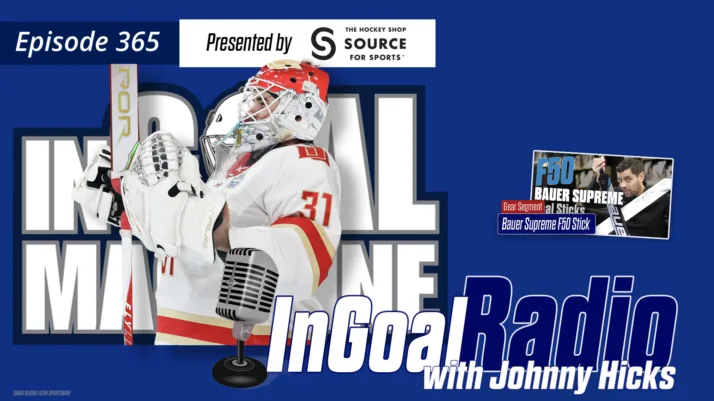
Episode 365 of the InGoal Radio Podcast, presented by The Hockey Shop Source for Sports, features a great interview with NCAA champion and Frozen Four MVP Johnny Hicks.
Feature Interview
presented by NHL Sense Arena
In the feature interview, presented by NHL Sense Arena, Hicks walks us through the preparation and process that allowed him to mostly sit for half a season, then come off the bench and go 16-0-1 and set an NCAA record with a .957 save percentage before backstopping the University of Denver to a National Championship with a .955 save percentage in the playoffs. It’s a great story made all the more remarkable by his unique path, from a winless first season in the BCHL, to a powerhouse team in the AJHL — and the unique lessons from both stops — then the WHL for one year before going to school. Add in an invite to the Edmonton Oilers development camp this summer for the undrafted Hicks and it really is a can’t miss interview.
Parent Segment
presented by Stop It Goaltending U
In the Parent Playbook, presented by Stop it Goaltending U the App, Hutch talks about preparing for the fast approaching season and why chasing late extra reps before tryouts and training camps can often do more harm than good, both between the pipes and between the ears.
Pro Reads
presented by Vizual EdgeWe also review the latest Pro Reads, presented by Vizual Edge, featuring Dustin Wolf with a quick but important breakdown on when to use RVH and when to hold your feet on passes from below the goal line, something that’s been a theme in a lot of recent Pro Reads.
Weekly Gear Segment
presented by The Hockey Shop Source for SportsAnd in our weekly gear segment we go to The Hockey Shop Source for Sports for a look at the new Bauer Supreme F50 Pro, a second-price point stick loaded with top-level options, including one never before offered by Bauer at anything other than the highest prices.
Episode Transcript
Intro
Get into it. InGoal Radio, the podcast presented by The Hockey Shop Source for Sports Langley, thehockeyshop.com. Daren Millard along with David Hutchison and Kevin Woodley. The guys are giving me grief because I did not install my own dishwasher. I don't think Woodley could either.
Oh, I don't Woodley could either. Barbs.
I wasn't giving you any grief. Are you kidding? They don't they barely let me change the light bulbs around my place. I once build a playset, like a swing set and fort in the backyard of our first home for my kids required cutting lumber. My dad and my brother set an over under on how many times I'd end up in emergency.
Trust me buddy, Why they're
are you throwing shade on me not installing the dishwasher?
No. Just because Hutch did it. So I was just saying, Hutch Hutch is better than both Yeah. Of
That's throwing shade. Trying to get
to Nobody knows actually how long it took me to install the dishwasher.
Hey, Hutch. We didn't get a chance to talk to you about your overall experience at the USA Hockey Symposium on goaltending in Boston last week. What was your impressions? Let's start with the hot
dog and then we'll work our way towards goal. The important stuff first, was it the greatest hot dog you'd ever eaten?
It was the greatest hot dog I've ever eaten. The price tag was pure insanity and yet, I'd probably pay it if I went back.
How much was the hot dog?
We had two sausages and two pops and it was a total of I think 52 US dollars.
Wow. Yeah. It was not a cheap dog, Daren, but it was a filling dog.
The price until it's already in your hand.
Yeah. Don't forget, we're Canadian. So that's like a mortgage payment right there. 52 dollars Americans like, honestly, God, what is it? Like $75.70 bucks Canadian.
It it is ridiculous. Right?
It was worth it. I'm sorry. It honestly was.
It honestly was.
And the symposium?
I mean, it was fantastic. If anybody wants to to know what I thought of it, they probably already do because that's what last week's parent segment was about. You know, the the general theme of the segment was just I think parents are in good hands. We we often, as a group of parents, gripe from time to time saying that the higher ups don't know what they're doing and they're not doing enough for our goalies and all sorts of things like that. Everybody knows the drill.
And and I think when you get into a room of a 150 plus coaches who've paid their own way to go to Boston and take part in this of a huge group of people who are in the goaltending department in at USA Hockey, right up to presidents and past presidents showing up because they want to make an impression on the goaltending community and to help the development of goaltending in their country and that they welcome people from around the world. It just left me feeling that we're in good hands. People are really working hard to make the game better for the kids.
What was your takeaway from the on ice portion?
Would have been nice to be there. So we were so busy, probably busier than I think we anticipated when we went there that for the most part, Kevin looked after the on ice and I looked after the I I I would call it classroom sessions, but the classrooms were on the infield of a 200 meter track. Yeah. So I I did get to see a little bit of it. I think only one session, Brian Robinson doing a session on net coverage, which was fantastic.
But I will tell you, how about next week, Daren? You asked me that same thing because I've spent the last week and a bit putting in crazy hours to finish production of all the classroom session videos and I will be going this week through all the on ice videos. So ask me in a week.
Fingers crossed, Daren, because if I was responsible for the on ice, that means the cameras and the mics are probably half assed compared to the stuff Hutch was doing.
Tell me about between the two of you back here and into the swing of things and putting out the content, what what's the rollout like of of what you saw and when people are going to experience the the different elements from the USA Hockey Goal Tending Symposium?
Yeah. To be honest, that's part of a larger conversation with USA Hockey. The agreement is to share the content, through both parties. I don't know if that all will come through us. I don't know that all needs to.
There's some elements there that are definitely more geared towards, you know, leadership and and mentorship and some other components that might stay exclusive to USA Hockey. Timeline though, I think we wait a little bit, Daren. As as eager as we are to share it, maybe there's some snippets, some small quick takeaways from the on ice especially that come out early before we roll out the entire half hour segments in their entirety. Just because as Hutch mentioned, you've got a 150 goalie coaches there that have made that personal commitment to come to Boston both time wise and financially in the midst of a busy season. And, you know, part of that benefit is sort of having an exclusivity for a certain period of time.
I applaud USA Hockey for the initiative to bring us in to make sure it's all captured and that all those lessons are shared through a broader audience both through their mechanisms and with our InGoal Magazine membership. But you wanna respect the timeline a little bit. Give those that that spent the money, that committed the time to be there a chance to sort of be first, have that exclusive. I I think that's, you know, the benefit of paying to be there is twofold. It's the exclusivity live, it's the relationships, the chance to network with people, and then a little window where you're ahead of everybody else.
And then we'll we'll probably start rolling it out, think, as we head into September here. But again, exact timelines to be determined depending conversation with Steve Thompson about you know, how they'd like to do it. Make sure we're all on the same page here. One big happy family even if, half our side of the family lives north of the border where hot dogs cost $75 for two.
I get most of my hot dogs at Costco. How many is that?
Oh my god, you'd be Joey Chestnut trying to eat 75 hot dogs. Costco dogs. That would be fun
watching you two have a hot dog eating contest.
A little nauseating to be honest, but, yeah, it might be fun for a while.
At things back up and running, a lot of captain skates taking place around the National Hockey League, a little bit of glimpses of some new gear being worn, some new lines being offered that may not be to the retail public. Anything catching your your eye as we as we scan around social media?
Well, I'd be honest with you, Daren. We've we've been on the ice with some things that might, you know, be a sign of big changes to come. You know, we had we had some access to some NHL goalies as well. We were in Boston outside of the USA Hockey Symposium and we're on the ice with them at the Bruins Practice Arena. And there were some changes there that, you know, again, not finalized, and this is one of the things that that we've sort of committed to is trying not to make a big deal out of things until we know they're happening.
And that's actually one of the reasons you haven't seen that video or photos from that session is we wanna make sure we honor that goaltenders decision making process. We've done this before. I remember being up in Kelowna one summer and, it was Devon Levi. We got all this great footage of Devin on the ice, working with Adam Francilia one summer, but he was trying out a different set of gear. And he got back to Montreal, and much was made of the fact he was wearing a different brand of gear, and but we knew no decision had been made.
Ultimately, he stayed in CCM and, the video of him in the other gear ultimately ended up on the cutting room floor. I don't think that'll happen this time, regardless of the decision because said goalie was actually split between two sets. He was still wearing parts of his old one and parts of what might be, you know, I would say a fairly significant change in the NHL, with some new gear. So I get the excitement. I get why people wanna see it.
I get why people wanna know about it. Sometimes when you're behind the scenes and and sort of know the process and and you know these guys and you know that they don't wanna be in that spotlight all the time on social media, you just you you you run with a little more caution there and have a little more respect for that process before rolling it out. We could have I could have had a picture out two weeks ago that would have broken the Internet, right, from a goalie gear sightings perspective. But the relationship with that athlete is to me more important than those headlines and those clicks, frankly.
Is there a headline regarding new gear, new concept, new new product going into next season, or is it all just like tweaking, whether it's skates, it's blocker, glove, pads, mask?
Oh, that's a good question. I'd be honest, don't fully know. I see that Brian's has a new line that's rolling out in October, and quite often, they're one of the few brands that will actually launch a new line, at the start of the season, often with their athletes at the NHL level wearing it or or at least a version that's skinned. Quite often wearing the actual gear. So I I'm curious to see.
I gotta get more information on that one.
It's the cryptic line.
The cryptic line. And certainly, were other ones. Speaking of cryptic, there were other ones that we've seen that that we know our skin to look like something old, but is absolutely something new, that won't roll out till April and they'll wanna keep that under wraps. Again, this is part of sort of trying to honor that process and people will be like, oh, who cares? Like, let us know.
And the reality is these companies are trying to honor their retailers. Goalie gear is expensive for sure. Seeing somebody in something that's not gonna launch to April and having a whole bunch of people not wanna order the previous generation because they see it's coming, can be really tough on the retailers who get stuck with inventory and have to discount it. So, again, just, you know, we're we're probably a little more cautious maybe than we should be, as part of that process, but we've always tried to honor it. I saw, you know, we were on the ice with Jacob Fowler, and he wasn't wearing them at the time, or I'd like to think he wasn't because I'd like to think I would have noticed, but, Goalie Gear Nerd had pictures sort of Zapruder style film from somebody who had sent images of him in what appears to be a new Bauer skate that I didn't know about.
So we're learning along with everyone else, but also there are things we are privy to in the same breath that we again, you can make you can get the clicks, but if it pisses off the guy wearing it because he doesn't want the attention because he hasn't made his mind and he's got contracts, then that doesn't help me as someone who tries to build relationships with these guys. And you could argue that maybe that's it's not pure journalism, but you know, I think we're as much about building relationships and the give back that these guys provide to us with, you know, things like ProReads and access to their time as opposed to running out screaming from the rooftops every time a guy, you know, switches a piece of his equipment. I think it's one of the reasons why NHL goalies reach out to us. Like, we get DMs and text messages from guys who are trying different things and asking about fit and style and what we're hearing and what looks biggest and how to adjust this and how to adjust that. And it's pretty it's an honor.
It's kind of a neat part of the gig, but it's also not something that we run around screaming about here on the podcast or on our social media channels because it's incompetence.
One trend that I am starting to pick up on is a return to the white boot on a couple of different fronts. Hutch, that's right down nostalgia alley for for me anyway.
Well, then I guess I'm older than you because I started in black boots then went to white boots and what goes around comes around a couple of times over here. I like everybody's I like
the return of it though.
Yeah. Yeah. Everybody likes when something's a little bit different, don't they? I mean, I was I was on the ice with a coach this summer who everything was black. It was complete blackout from the blades to the holders to the boots and everybody in the room noticed what a sharp set they were.
And if you show up in in some boots that have added white to them as we're starting to see now, everybody gets that, gets excited by that too. And of course, we've even got a few companies letting you customize the color to some extent as well. So they just I I just love that that it allows us to personalize everything that we do and and fit to our personalities certainly a lot more than we did way back when you and I played and there might have been two choices if you're lucky.
I've got I've got a white boot, a white blade and the true logo is gold. They allowed me to personalize that. That's
Is this something that's coming, Daren? Or something I it.
It's I've been wearing it for six months or so and and Oh. Oh, so so beautiful. Two piece? Two piece.
Okay. Attaboy. Staying out of the one piece. We like your hips the
last I was in a one piece and I went back to a two piece.
Uh-huh. How do the hips feel after switching back?
Yeah. That that you you you drilled that into me.
And did you notice it?
Oh, I could I feel much better and I'm not doing out the two top two eyelets. That gives me a little bit more range of motion, but but yeah, the two piece from Kevin Woodley, going down that path was something that I had in my head when I ordered them.
Next one and, I gotta I'm trying to remember the name of the young junior guy that tipped me off to this one. Not everybody loves them, but he certainly raved about the three d printed tongue that True offers as a custom option. Again, he feels like much like the the three d printed liner and the CCM mask, I really love the comfort. He raved about the comfort, the breathability, but then also that little bit of absorption into that that forward flex without necessarily having to do the top eyelets quite as loose as you're talking about. So there's there's another tip.
We're we're always learning from other goalies here at InGoal. We like to share those pass those along. And if you're wondering why we're talking about one piece skates and sore hips, it's certainly not an absolute. But, man, the number of goalies that I've talked to in the past number of years who switched out of that one piece skate, which is so rigid and and gives them access to edges to the point where guys change their sharpening. They feel so connected between their foot and the edge of the skate.
But that whole concept of no lost energy, well, the energy's gotta go somewhere when you bang into a post at full speed sliding across your crease and it's into the knees and up to the hips and the number of guys who after switching out talk about their hips hurting less, it's a real thing and it's something to be cognizant of. I know there are NHL goalie coaches that when their goalies are considering that, they have that conversation with them.
Gear
I appreciate your guidance on that. Let's get into our gear segment brought to us by The Hockey Shop Source for Sports Langley, thehockeyshop.com.
It is a busy time at The Hockey Shop Source for Sports. They are jam packed full of people shopping because it's too late to get custom gear. It's August 21. There are come some companies that are up to thirty weeks for wait times and custom orders. You're not you're looking at getting it early next 2027 if you're ordering now.
Thankfully, at The Hockey Shop Source for Sports, they have such a wide range of inventory that chances are not only will they have your size in the model, in the brand, in the style that fits your game, but they'll have some custom color options on hand for you. That's what comes from having 35,000 square feet of retail space and another warehouse storage facility off-site. They are floor to ceiling with goalie gear in the back and that means they've got all kinds of inventory to help you walk into the store and walk out of the store with the gear you need or if you're ordering online, same process. Make sure you hit them up at the Hockey Shop Source for Sports or the hockeyshop.com, not only to order, but to ask any questions about any of the gear you're considering. Whether it's Cam who's a part of our segments or any of the team he's hired, these are all people that understand the position and are passionate about it as deeply as we are, as deeply as you are, and they will try and get you into equipment, not just to sell you something new, but equipment that actually works for how you play and how you want it to fit and feel on your body.
So check them out, hockey shop, sourcesports, hockeyshop.com. Lots of new options including this week's. This is by popular demand, this gear segment. We apologize it took this long to get to it. We had to go back and film it because a handful of you were asking for it, and we saw those questions on all the different gear reviews.
Please tell us about the Bauer second price point f 50 goalie stick. So we'll do it this week with Cam at The Hockey Shop Source for Sports. You asked. Several of you, in fact, on the comments on our YouTube channel. We deliver.
We're back at The Hockey Shop Source for Sports for the Bauer Supreme Fuse f 50 stick. Several of our audience members have asked for this review. Thank you Cam for making it possible.
Second price point.
Right? Keep that facing that way for now. Okay. Yeah. Very good.
Okay. Yes. Pro features.
Second price point.
Second price point. So what we have seen, we're it's no secret. That top level pro stick keeps creeping up in price point. Starting to get a little bit crazy. The awesome thing is the mid level stick keeps getting more and more features of that pro stick to help out with things a little bit.
And let's go over one of the cost
of The features.
The reveal. The spine on the second price point.
Oh, has it never been on the second price point? This is why they're so excited and asking me in the YouTube comments.
Is what everybody wants to see.
This is news to me. Ergo bridge technology in a second price point stick for the first time.
For the first time.
Wow. Oh, now
I Now you get it.
Now I get it, folks. Now I get it.
So not only that, you're also getting that p 28 absolute banana curve. Available. It's like price point. Available or only? Available.
Okay. Not only.
Oh, come just check-in.
But it's at senior and intermediate gets it as well.
Oh, does intermediate get the bridge too?
Yes. Wow.
Yes. Now I see the excitement plus the pentagrip.
Again, keep on going through. Yes. You do get your pentagrip.
Pentagrip, but not the ErgoGrip. ErgoGrip, which is like like basically like your handshake.
Almost like a pistol style of the
grip. Correct. Okay. Okay. So we get pentagrip, not ergogrip.
So that's one of the big difference. Yes. And they're still their standard shoulder. Not the exact same carbon count for the stick, so there is a little bit more weight to this. This is
still a really light stick. Probably the lightest mid level stick And that's let's out be honest with you, like one of the things that we've seen is that the more expensive sticks are lighter. The carbon count, the way things are done, these sometimes tend to last a little longer.
They can. That's Still too early
to We haven't gotten there yet. We haven't gotten there yet. You haven't had them out for a
Don't don't don't run before you walk.
In other models and multiple brands, the second price point has proven more durable in the past. We shall see.
So again, some time will tell. Overall flex point for the stick, you still have that same overall kick point.
Point where is it? Mid? That's correct.
Okay. Mid kick point stick. As well as that nice sleek all white well, not completely all white but white colorway. Like me, it's pale. It is.
It almost matches him. Few other color options that are available too as well. No custom here. This is just straight what you see off the wall. However, again, we have seen that gradual improvement of that mid price point and this is very much reflective of that.
Okay. So there you go. I got a question for you and I don't think you're gonna be able to answer this one right away. Bauer sticks, obviously massively popular, About the only downside that we encounter at the highest level is that tendency to sort of almost whip out, like they lose their flex and they kind of feel dead. Have you had that at the second price point as well?
Is that just the top end stick?
The tough thing is is that we're talking about a non quantifiable. We're talking about hearsay. Feel. Exactly. Feel is always based off of perception which isn't necessarily reality.
Oh, it's reality, Cam.
At this point, no. However, some may feel that it does clap out over time, but I mean that's a Clap out.
Set a new alright. There you go. See, I didn't even have the right phrase.
Yeah. Absolutely. So this is a very conceptual feel based thing. It's the same thing with feeling bulky in a chest. Some feel bulky in some chest, some don't.
Some feel that a stick may lose its whip. Some feel like it may maintain its whip. It depends on you, the goalie. That's why there's options on the wall, and that's why we keep doing these videos. So if you wanna learn more about this goal stick, give me a call.
(604) 589-8299 or 1-800-567-7790 or check us out at the hockeyshop.com.
Sticks, sticks, sticks. There's different little iterations adjustments that can be made to them. What was your walk away from that?
There is a lot of I think the biggest Change. Yeah. Like the the fact that you get the Ergo spine in a second price point for the first time ever. Like, we've talked about this with all different lines and, you know, we've given credit to Bauer for leading the way on a lot of this in terms of how many top end features have trickled down to second price point products, and that's a big one. For them to offer that in the second price point significantly reduced price from the highest pry you know, the highest price point stick, That that's a really really big deal.
I applaud them for it and I understand once Cam explained that to me, why so many people are asking for that review. Now you heard us mention as well, this is one of the things that we've sort of seen like that sticks, pro sticks, and we'll have to test this one to see whether it it exists at the second price, but sort of losing a bit of that whip, a little bit of that feel, for Bauer compared to other brands. It's it's feedback we've had from from junior goalies as well, PWHL goalies, but I think as you get into the second price points, it's even less of a factor just because the carbon tends to be like that's the one thing you get, a little heavier carbon, a little more durable carbon fiber layups compared to the highest price point which is lighter, which is thinner, which may be more prone to that, that trend. So, it's it's a pretty impressive stick for the price point and again, this is good for goalies when we see these features trickle down into that secondary price point. I think you probably, Hutch, make the same statement we make on pads and gloves.
Like, the stuff that was the most expensive even just a couple of years ago is pretty much now the equivalent, if not less than what you're getting at second price points.
No question at all. I don't know if it's because of them pushing features down or maybe it's because of the great Kevin Woodley talking about his warm up stick, but more and more I hear people talking about using a couple of different sticks, one for practice, one for game and so on. Maybe that was a little harder for people because they felt like they'd be making too much of a change, flipping over to their so called practice stick, but you can see people starting to do that now. I think that the trend might even continue because gosh, if I was having to buy sticks for my kid today, it certainly wouldn't be the top of the line price. It's an expensive game and these second tier ones are so good now.
Unless you're sort of an absolutely elite puck handler- Like myself. Case maybe you will notice the difference. Yeah. Unlike Kevin Woodley, you're probably going to be really well served by some of the stuff that's being being marketed today. And and to to Kevin's point, pads and gloves, absolutely the same thing.
Daren, you and I have said this before. We wish we started playing hockey and the stuff that five year olds are wearing I
went through four in two days this week.
And sometimes that's just dumb luck. Right?
Yeah. Yeah. But it was still Yeah.
It was four. Try
Even the guys guys were looking around going, like, what's going on?
Hey. Try try using the blocker instead of the flagpole of the stick there.
Shaft That's right.
And that and that's where three of them did break.
Oh, no.
Was was right on the on the shaft now.
That's a skill move.
Yeah. Skill. I I always say it's part of my gear. But but then they lie they get the last laugh when it snaps in half. But, man, I was thinking if if I was gonna be buying these six, thankfully, I'm I'm I'm not at this course of of of the season.
Didn't have to shell it out, but, that would be a lot of cash.
Are these Daren Millard, Vegas Golden Knights models, or they just use sticks from other goalies over the years?
Two two of them two of them were courtesy of a batch that Sherwood was was great to to send me, and now now they've been they were a little
bit Decimated.
But but the other two were just from other guys. And so they're different manufacturers.
They broke them they broke them in for you.
I had an embarrassing one one time playing beer league when I broke a stick in the middle of a game and I hadn't brought a backup with me because because I hadn't needed one for months and I was just lazy about carrying it. What'd you do? I had to skate down to the goalie at the other end of the ice who I had never met and beg him to use his backup stick. And I actually gave him a stick afterwards that I had sitting in the garage unused that was not a top of the line one, but he was thrilled to have it as as a thank you. And, we bump into each other from time to time still and have a relationship over that.
So it's kinda fun.
The, I will say this, Daren. I mean, I'm not asking about what you were using and what the different shapes were. Because we we've talked about how I've got one particular ex pro who had tens years or so in the NHL who who skates with us on Monday nights. He's a firefighter now and he's just got this rocket. And for the most part, he spares me the full version, but in warm ups, he likes to go over the blocker and he keeps getting the shaft of the stick.
And it would just he was breaking them like kindling for a while there on me. But since they like, some of these companies have changed the geometry and made rounded edges rather than square edges, but what have difference? Not just CCM, but also Warrior with their, new shaft. Like, I the amount of times he's hit it up there and I've been like, oh, crap. There goes another one.
I'm like, hey. No. And then, like, 10 games later, I'm still using the same stick, and I'm like, this thing didn't break. So I I again, credit to the companies. They've reinforced them.
I know for CCM, for example, they use, I believe it's called Aluply, which is like strips of aluminum down the shaft to reinforce it, but also just not having those square edges to catch pucks with. That rounded edge seems to just take some of the direct impact off.
Well, it's not just it's not just that they're rounded so they don't catch the puck.
Oh, science lesson coming in.
Well, a dome is a stronger structure than a flat roof. See, there you go. See? So, it's effectively building something which is stronger.
I love it. See, I told you, science lesson coming in. Inbound, Daren.
Hey, what what about a like a sloped roof?
Sorry. I'm just trying to imagine the stick but no. It's about flat surfaces versus rounded surfaces.
Okay.
The slope roof, you'd just be hitting at an angle. Maybe that helps. It
would. Like the warrior you get you can make the argument with the Warrior one with the the unique sort of grip for for handle handling a puck up top. That's sort of like the equivalent of a slope group, and I'll tell you right now, that's not breaking on me either.
Are we gonna see Warrior in the NHL this year?
I it's actually a good question. I don't know. I haven't asked if they paid the rights fees. I do think, we've seen Surge, a lot more now that it's hit retail, but the delays in that process might lead me to believe that this is more of a next year thing. You know, I do think anybody in a True Hzrdus pad, just again, just because of the nature of the pad, flat boots, straight up, less of a precurve to it, might be the type of goalie I'd be targeting if I was Warrior, the type of goalie that would be able to transition more easily.
Certainly, I've had them out a lot recently. I'll show you guys the puck marks. We're we're putting in We're we're starting to make the white ones look a little darker as as we rack Did them
you hit?
I'm getting I'm getting hit by pucks. Nice. And and that straightness of the pad, we talked about this last week with the Alpha Surge S50 in the hopes it would be a little more flexible above the knee and I think it will take a break whereas the surge is just straight. Man, I need to widen my butterfly to get a little help with that. Right?
Like that straight pad and a narrow butterfly, there's just no five hole coverage.
Yeah. I
Or not as much. Right? Like, I think for guys that have that don't have that have a little more width, it wouldn't be a problem. But for us old farts that have a narrow butterfly, she's a little tougher. Love everything else about it.
We'll have lots more details coming out at InGoal on some of our social just recapping now that it's out in the public. Some of the features that we've really liked as the testing is ongoing now for for months.
Keep you up to date on that as we slide over to Vizual Edge ProReads on InGoal Radio, the podcast.
And now I gotta remember who was up at ProReads this week. We've been kind of alternating back and forth between Dustin Wolf and Eric Comrie. There's
lot of one this week.
We're trying to get through all of theirs before we run into the next season. Got a number of guys lined up for some some interviews and and video sessions next week. So trying to get through these guys who have material still on hand from the past year. This week, it's Dustin Wolf with another sort of behind the net decision making process on when to go down into reverse and when to stay on your feet. And it's something he's talked about in a couple of different ProReads, so a great sort progression through that decision making process and something he's openly talked about trying to do less of in terms of his commitment to the reverse, holding edges, being more patient, beating plays on his skates and so in this one, as the puck goes behind the net once, he goes into a reversed, and then the next time is that head behind the net, he stays up on his feet.
And Dustin does a great job of explaining the differences, the nuances, what he's looking for when he makes that decision in a way that will help other goaltenders be able to make similar reads and similar decisions more quickly and with a lot of the right information in mind. It's a great learning tool and it's all available now at ingoalmag.com, the latest ProReads presented of course by our friends over at Vizual Edge. You talk about reading the game and seeing the game, we all know that feeling as goalies. Those nights when the game feels slow, you're reading everything clean, you're tracking pucks, you're reading plays, nothing seems to surprise you. And then there are the other nights where you're reacting instead of anticipating, just a split second behind everything.
Most goalies try and solve that by getting more reps on the ice. Vizual Edge takes a different approach by training the visual and cognitive skills that help you process the game faster. Things like tracking through traffic, picking up releases earlier, recognizing patterns, and making quicker decisions under pressure. From a laptop or tablet, personalized assessment, identify where your visual game can improve, then get a customized training plan that takes fifteen minutes three times a week plus an open gym mode to get as many exercises in as you wish. Plus an eight minute warm up called game day mode to get your eyes and brain locked in for puck drop.
That's what Jordan Binnington uses. Head to visualedge.com and use the code IG fall 50. That's I g f a l l 50 for 50% off your first three months as a new user. Or if you're a subscriber to InGoal, go to anyproreads and get our subscriber exclusive 20% off discount code for the full year, combine them. Try three months at 50% off, there's no obligation to stay for the year, then if you're a member at InGoal, use the 20% discount code.
Honestly, you're not a member, become a member, that 20% savings on Vizual Edge alone will be paid for with your membership and you get a full year of access to those ProReads like the one that we just walked through with Dustin.
Makes total sense. I may have trouble dissecting all the goaltending part of it, but the common sense of what you were just explaining about different sign ups and what you gained from it and the code IG fall 50 is perfect.
I would expect nothing but common sense from you, Daren, considering you paid somebody to install your dishwasher. That sounds like common sense to me.
That sounds like a recipe for success, having somebody that knows what they're doing.
And the code is fall fifty, that refers to the time of year and not to Kevin's goaltending.
It's also only available to the end of August, so we got ten days left as we record this. August 31 folks, that's when that discount ends, make sure you take advantage.
Parent Playbook
Parent segment brought to us by Stop It Goaltending U, the app.
Do you wanna have twenty five years of NHL goalie coaching experience at your fingertips? You wanna tap into the goalie parenting expertise that helped Joey Daccord reach the NHL? That's what you get with a subscription to Stop It Goaltending U the app. All the knowledge from Brian Daccord has been an NHL goalie coach, scout, director, now currently with the Detroit Red Wings in that role, as well as all the insights and expertise from his staff at Stop It, including a long list of veteran NCAA and minor pro coaches, all delivered in easy to digest chunks, including five short daily primers, weekly style analysis and breakdown videos, and drills you can take on the ice with your team and coach. Plus, you get a subscription to InGoal Magazine as we outlined included free.
All part of your subscription to Stop It Goaltending U the app. So check it out at the App Store or Google Play and get the best of both worlds and become a better goaltender.
Hutch. Daren. My note to parents this week is to tell them you're already ready. But a quick note before I say that, depending on where you live, this might feel maybe like old news. Some of you are past this because school is back in some places.
Tryouts perhaps have started, maybe even seasons. The rink to rink shuffle is really already your reality. If that's you, the same principles are going to apply, but maybe just shift the timeline a bit. The goal isn't a specific date on the calendar. It's more of a mindset about arriving settled instead of scrambling.
If you're still in that last stretch of summer on the other hand, here's how I think you should use it. There's a particular kind of panic that shows up with a lot of people late in August. You can feel it in the group chats, you can see that the rink in the parking lot, that sudden urge to cram in three more skates, book an ice slot you don't normally take, add a session with a coach just to be safe before the season starts. I get the instinct, but I think it's the wrong instinct. Escape here, escape there.
That's okay, but not a sprint to the finish. If the extra ice already fits your regular summer prep pattern, great. Keep doing what you're doing. But trying to jam in a pile of additional work like, David Hutchison cramming for a university exam in the last couple of weeks here doesn't sharpen a goalie, it tires them out. And it does something worse with a lot of kids, it plants a seed of anxiety.
Suddenly, feel like they have to do more, like showing up just ready isn't enough. Like there's a deficit to make up before the puck drops. Maybe even a bit of fear of missing out when you see other people doing things. That feeling doesn't come from the calendar though. It comes from us.
We already coach our goalies to be even keeled, have that same demeanor whether they let in five or maybe they steal a shutout. We tell them not to ride the emotional roller coaster from game to game or moment to moment. That principle doesn't stop applying in August though. It applies to the season as a whole. Don't build this up as a big year.
Don't be saying you've gotta do this. You've gotta do that. Let's not have that creep into our talk about the season. The message we want landing with our goalies is simple. You're ready.
Not you'll be ready if you do x y and zed in the next ten days, just ready as you are. If you've got a stretch of unstructured time left before that rink to rink shuffle starts, don't fill it with more hockey, Fill it with family. A weekend away, a late day, a late dinner on the deck, whatever summer means to you and your family. Once the season starts, that time gets scarce really fast. This is the last real window for it, so use it as that, not as training camp you forgot to schedule.
If there's one thing worth actually doing in these final couple of weeks, it's not on the ice. It's the stuff that makes everything else work. Summer, as we all know, lets routines drift. Bedtime slide later, morning slide later, meals get a bit looser. None of that's a problem in July of course, but it does become a problem in September if the reset happens all at once on day one of school, day one of tryouts, day one of the season.
So start now gently. Bedtime, start walking it back until the We get closer to what the season time routine is a bit every night, not all at once. Same thing with waking up. Let's not have a jarring shock later as we have to start playing and eating well as well. Let's not do anything too dramatic but let's just tighten up a little bit from that loose summer that we all enjoy.
Those Fenway Park hot dogs maybe need to go aside till next summer. None of this of course is about performance. It's about making the transition into the season feel unremarkable because for a goalie who's supposed to look the same every night, the best possible thing for the season itself to arrive without drama. Bottom line, you don't need to earn readiness in a last minute scramble. Whether you've got two weeks of your summer left or you're already three practices into the season, keep the normal pattern, protect whatever family time you can, get the sleep and routine dialed in if it isn't already, and carry your goalie into the year exactly the way you want them to play, steady, unbothered, already prepared.
Sleep is such a valuable asset to to whether you're playing hockey or not, but the athlete certainly needs to monitor it far more than we ever believed twenty years ago.
I think that's absolutely true and the other side of what I was saying affects your sleep as well. If you're in that mindset of panic, mindset of having to do too much, maybe physically doing too much, that sleep is a little harder to come by. So that's that's how some good good habits coming here. It's probably good advice for the three of us as well.
I was just gonna say, what's this sleep stuff you talk about? I need some of that. Hutch needs some of that. Daren Daren, you look like you might need some of that buddy. You've been going hard.
It's huge. And I and I took me a while to get around, like, going to bed earlier because you didn't feel like you should be going to bed at at a particular time. Now, I'm all in.
What time?
08:30, Shut up
him. Really? Yeah. Wow. Good for you.
Yeah. No. No. In the season in the summer, I go to bed earlier. In in the season, you're waiting.
You can't. Yep.
You got games or you're watching games.
That's the hardest part for me. I managed to get into a routine in the off season and then all a sudden we hit the hockey season and it's like home game up till one in the morning because I'm working. You know, late night skate on a Monday up till one in the morning because we don't get off the ice till 11:45. Like, it's just and then that cycle is really hard to maintain. And I guess that's probably the similar for a lot of these athletes.
They're playing late night games, their schedules change, the more more they can sort of prepare and rest and be ready for it, and make sure they're getting those eight hours minimum, the better off they'll be set up for success.
On non game nights, you gotta force yourself, shut it down early. Earlier than you would even think and then because it's probably gonna take a while.
Well, mean, for us here at my household, it's really easy to go to bed early most nights outside of, like I said, those outside influences because we eat dinner at 04:30 like we're Florida retirees. It's kinda crazy. People laugh
at 04:30?
Yeah. Like, honestly, it's the craziest thing in the world. I don't know how it started but it's even my kids laugh at us. I've They join us, but they laugh at us.
Because he eats like a bird all day long and he's starving by 04:30.
Yeah. Exactly. That's exactly it.
Need more Fenway dogs. Can't afford them. Send money for Fenway dogs. That's a t shirt that I'm gonna make up.
Feature Interview - Johnny Hicks
To our Sense Arena feature interview. This week, we're gonna catch up with Johnny Hicks from, Denver University.
We sure are. And this, interview with Johnny Hicks is brought to us by NHL Sense Arena who are the official VR training partner of InGoal Magazine and, of course, as we all know, the leading virtual reality training platform for hockey players and goaltenders. If you've listened to this podcast for any length of time, of course, you've heard us talk about the value of quality reps. NHL Sense Arena gives you the opportunity to get those reps in anytime, anywhere with game realistic situations designed to challenge your reads, your tracking anticipation, decision making, not about replacing ice time. It's about making the most of the time you have between practices and games or in the case of some goaltenders, even Joey Daccord in the National Hockey League before games and practices to get ready.
Whether you're a young goalie looking to accelerate your development, a competitive player trying to gain an edge, or an experienced goaltender wanting just to sharpen your hockey sense, NHL Sense Arena offers drills and scenarios that translate directly to what you'll see on the ice. Best part I think is that they have regular updates, new training programs designed all the time with elite coaches, elite players. It's become an important part of the development toolbox for goalies at every level. And a little Sense Arena fun this year sounds like a great new routine to bring in for your season. Right now, that's only about $25 a month.
If you buy their annual plan, is discounted 57%, a small investment for some big results. To learn more, visit nhlsensearena.com and see why more and more goalies are adding VR training to their weekly routine. As always, use the code I g m 50 and you'll save even more.
So tell us about Johnny Hicks.
Well, I mean, what a story, and we're gonna get into all of it. I think I talk a lot even in the intro about the year he's coming off of. National championship at Denver University, frozen for most outstanding player, set an NCAA record with a nine fifty seven save percentage eclipsing the previous mark held by Jimmy Howard with Maine, had a 1.2 goals against average, third all time behind Howard and Quinnipiac's Yaniv Perets. Like, just a season for the ages, and yet what makes it more remarkable is the path to there. First year in the NCAA, obviously, we know the rules have changed.
Played WHL in Victoria the year before, but before that, he had actually been looking for college and had stayed in the BCHL and the AJHLHL. BCHL started with a merit team that didn't win a single game with him in net in his first season. Moves on to an elite team in Brooks where the pressure and the expectations change. So his path just winds through all these different areas and these different sort of expectations and environments. Ultimately, he ends up at Denver, doesn't play much at all for the first half of the season.
An injury in late January gives him the net and he takes off. So we get into the mindset required to talk about being prepared for opportunities and not stressing. We get into the mindset, we get into his path, we get into some of the different processes. He uses that word a lot in this interview. There's just a ton here.
I've already talked too long. Let's just get to it and let Johnny Hicks explain one of the most remarkable seasons in recent memory and everything that led up to it.
Enjoy the feature interview brought to us by Sense Arena.
Really excited to welcome to the InGoal Radio Podcast, a young man who is coming off well, there are great seasons and there are great seasons. And anytime you set a record with the all time greatest NCAA percentage, although I know you don't like pay attention to stats, put a nine five seven fifteen o and one and to top it off with the national championship at the University of Denver, Johnny Hicks. What a year. Thank you so much for making the time to talk to us about it today here at InGoal.
Thanks for having me.
What is what's it been like? Like, I mean, there's so many different ways we can go, but let's just let's just start with what was the celebration like? What was the moment like? What do you remember looking back a couple months later? What stands out the most to be a national champion at that level?
Probably the moment I remember the most is just the feeling I had once that last buzzer went. It was a feeling that's kind of unexplainable. It's something that you try to try to find for the rest of your life as well. Like, I'll be looking forward to that in the next few years and this year coming up again. And it was just such a surreal feeling throwing your gloves up in the air and the whole arena is just going crazy.
Like, our our student section or our fan section was was so loud, I was just, like, jumping up and down. And when all the guys were together, like, hugging each other, like, there's just so many tears running down our our faces. So I would say that was that was the most memorable moment I experienced. And just after that, celebrating with our families in Vegas for for that night, it was it was very special. And then, obviously, when we came back to campus, the the students gave us a warm welcome, and it it was just an amazing week or two celebrating and we got right back to work after that.
So, yeah, it was a real it was really fun though.
Now, do you did you have classes to go back to? Like, did you have to go like, school doesn't necessarily end when the hockey season ends. You know what I mean?
Yeah. Yeah. We, we had classes still, but
Little tougher to pay attention at that point? Yeah.
Yeah. I guess you could say that.
So and then what like, I wanna get into the season you had and the transition and your experiences from BCHL to the AJHL to the WHL and then going to college, but let's start with the current. Like, your summer after a moment like that and coming into the off season, you get invited to a development camp. There's a lot of attention on you that comes with not just winning a national championship, but you're the frozen four MVP. Was it overwhelming at times, all that attention? How'd you how'd you manage that, and how'd you transition from that euphoria and everything that comes with it to, as you said, getting back to work for next year?
I mean, I think it's just the culture we have as a group. You know, it was really nice getting that win, but I think our goal is always to to look forward to what's in front of us next. And what's in front of us next is a really important season coming up and another national championship on the line here. So I think it it was just a group effort. It wasn't anything individual.
It was our it was our whole team and staff that were moving on together as a group, and it just happened naturally. I mean, everyone has different periods of times where where they feel like it's right to move on, and I think we all did it collectively as a group. And it was about halfway halfway through the summer, I would say, where where I really felt it start to slowly started fading away, and we started shifting our focus on the next year and yeah.
What when so what, like, what what does the summer look like for you? Like, from a training perspective in terms of on ice, off ice, in a position that's constantly evolving and all about constantly getting better, how do you do that in an off season? Who are your who are your on ice sort of influences, and what does it look like?
Well, off the ice this summer, I think I I took a really big step physically. I feel like I haven't really treated I've treated my body well, but I I feel like I took a whole another step this summer with with my strength and conditioning. Our trainer in Denver, Matthew Shaw, he's an amazing strength coach and person and he can transform your body in just a few months. So I've been working with him every single day this summer, every weekday, and he really gets the team into shape. And I love him and all the guys do.
He works us hard. And on the ice, I I do my I I I don't try and overdo it on the ice because I I do really emphasize taking a break on the ice. Because for on the ice for me, it's it's very mental. And I try to take a break from the mental stuff during the off season a bit more, or I don't take a break from it. I just dial it down a bit because during the season, it's just so intense.
Right.
And you can't maintain that intensity for three hundred sixty five days. So I I just try to to limit myself and have a balance with with that aspect of the game.
Okay. So, from a physical standpoint, when you talk about taking a step, it's probably probably a lot of young goalies right now that that, you know, hey, think they've done the work, but as you said, you there was another level for you this off season. What does that look like from a focus standpoint? Like, is it mobility? Is it lower body strength?
Is it a probably a combination of everything, but what changed specifically? Johnny Hicks two years ago could talk to Johnny Hicks today, what from what you're doing now would you have added?
I just think I would have added I I don't think it's even just the strength Okay. Point of view on things. I I think it's just the the discipline and consistency in the gym every single day. Like, I this is, like, one of the first summers every single day. I've trained five days a week, and it's five hard days a week.
And, you know, this is I mean, is what I'm gonna have to do if I if I wanna keep progressing. Like, you've you have to want it more than the other guys and that's what I'm that's what I'm trying to do right now. So I would say just the the discipline and consistency even when you're you're not in season. That's just, like, super important just for building that trust and that trust going into your next season.
And, you know, this is I mean, is what I'm gonna have to do if I if I wanna keep progressing. Like, you've you have to want it more than the other guys and that's what I'm that's what I'm trying to do right now. So I would say just the the discipline and consistency even when you're you're not in season. That's just, like, super important just for building that trust and that trust going into your next season.
When you talk about the mental side and dialing it back a little, can you sort of walk me through what you mean by that? Like, is it just terms of like the the intense focus required in a season? But are there exercises you do to sort of lock in mentally or are just trying to sort of dial back that intensity a little bit? Because like you said, to do that three sixty five would be would be exhausting.
Yeah. Yeah. It's exactly that. It's just that focus intensity towards your process and what your goal is like every single day during the season. I mean, my focus is on myself and what I can do to get better.
And during the off season, you can still have that, but you need to for me, it's really important to to get away from that as well, whether that's playing the guitar, painting, going to my cabin, going on a hike, any of that kind of stuff because, I mean, it's it's very important to have a a life away from hockey as well.
It reminds me a little bit of so did the pads get just sort of put away for a period of time? Carey Price used to tell us about this too, right?
Like Yeah.
You know, a guy who put the pads away till August 1, never never saw them, just felt like it, he needed that that break, but then also when he got back to it, was a little more fired up about it.
Yeah. Yeah. That's like what I try to do in a way. And you can you can feel the anticipation too with with that. And that's yeah.
I mean, that's what I try to do. I I I mean, I play I play shell, if that counts. That's why I'm on ice for for a lot of the off season. But, yeah, other than that, I yeah. I try and take a good break.
Okay. Now, so are you ramping back up now in terms of of all nights? What does that what does the timeline look like? Put you know, how big a break? When how much of a sort of ramp back up do you need before the season starts?
Yeah. I mean, every week for the last ever since the WHL Champs, like, July, I've been skating once or twice a week, and I'm trying to get into three times. And training camp's gonna start, and that's five times a week for a whole month. So I feel like just having that, like, small transition that's, like, rolling and keeps getting bigger every single week, that's gonna fit perfectly into what I'm trying to do. I'm not just trying to to go and do it all of a sudden, I'm trying to give my body a chance to get used to everything one step at a time.
Okay. So you're still you're still touching ice, you're still putting the pads on, it's just not every day during the
off Yeah.
Just trying to like keep keep a bit of that rest up.
Okay. What what does it look like when it's once a week when you get back in? Is it is the focus skating? We we were up in Kamloops last summer, got to spend a day with Dylan Garand and it was just skating. That's all
he did.
Yeah. Didn't didn't touch a puck in terms of a save, used them as markers around the ice, but it was like an hour of straight skating. What is your, you know, what does your process look like in an off season when you are on the ice? Yeah. Who's who's you got a coach that helps you out up there?
No. No. The coaches aren't allowed skating with us in the season.
Like like private guy or somebody you'd Oh.
Yeah. Well, before the Oilers camp, I was on the ice with Nathan Wolf, He's I've been working with him since I was 15 years old in Merritt now. And Okay. We've been working really closely together ever since.
And, I mean, for that first, like for the first four weeks, was back on the ice. So aside from the Oiler's camp, I was skating with our new transfer Tyler in Denver as well, just me and him. It's just skating. Like, that's pretty much all all it is. It doesn't have to be for long.
It's just doing what you have to do and then getting off and as long as you feel good. And I'm just trying to to keep that mindset going into the year. But now it's more flow practice style things I'm doing with with the group I'm skating with in with guys like Logan and Josh Stone, it's a it's a really good group and yeah.
Okay. So a little more get get into that more of that, the drills you might see during a a practice when you're back and things like that. Yeah. Skating, when you say skating, goalies say, okay. What do we mean by skating?
Like, crease movement patterns? Are you doing, like, edge work all over the ice? Like, it means different things to different people, but I think the importance of being good at skating, being able to hold your edges and control your edges, I mean, it just keeps getting more and more and more important. What does it look like for you when you say just skating?
Yeah. Well, I start off with crease work always and then Tyler Kochetkov, my my goalie partner now for next year, he has a lot of skating drills I've never seen before.
And Okay.
So he's showed me a lot of new different things that I can work on, which is pretty nice because I always love to find new skating drills I can do. And I I do a lot of stuff with the blue line, just edge work things. It's hard to explain what it's like.
I know. It's kinda tough on this. Yeah. Did this like, Dylan Garand did the same thing. And funny enough, he told us that, he got most of his from Dustin Wolf.
Literally I got most of his for most of mine from Grant.
So There we go. There we go. It's one big happy family up in Canton. Yeah. I love it.
I love it.
Yeah.
Obviously, a strength of your game? The ability to move and hold edges and and and sort of control edges?
Yeah. I find skating, it's just a really fun thing for me to do. It's very satisfying.
Which is funny because a lot Yeah. Has it always been that way? Because we hear so much, like, that's usually a pro mindset. You're younger coming up, kids want drills, parents wanna see pucks moving all over the place, like dynamic stuff. Sometimes guys don't discover that love for skating till later.
Where how long have you sort of felt that way about your game?
Well, I quit hockey when I was 10 years old and I came back when I was 12.5, 13. And then my my dad bought me a big sheet of synthetic ice, a big synthetic ice crease. And it was right during COVID, so I had, like, two years. And I feel like when when no one was on the ice or when all their rinks were shut down, like, all I would do for, like because I wanted to show my parents I wanted to get back into hockey too. Like, I I needed to show them that I wanted to put them at work because I'm I quit for two years, and it was a big deal coming back after that.
And I wanted to show them, so all I did was skate on the synthetic ice for, like, three to four hours every single day during COVID. And Wow. Yeah. It was, like, two hours in the morning, two hours in the afternoon. And, I mean, that's all I did when I was 13, 14, 15.
And I feel like that really made me fall in love with skating. And it's it's really hard to skate on that synthetic ice so they translated just really well to on the ice.
Just to increase movement patterns?
Yeah. Literally just like RVH, sliding. I've I can try and find some videos for you.
We might we might have to see that, that's incredible. I like that. Yep. Okay. And if you just now, so if you don't mind me asking, what took you away from the game for a couple years and what made you wanna come back?
That was kind of funny. I was a striker in soccer I was I feel like I I was really good at soccer and I I loved it as much and it got to the point where I had to choose one or the other.
Come on. At 10 years old, we have to make choices like that?
Yeah. Well, it was more so my choice of, like, it Okay. I was playing high level at two two different sports and
Which is hard. Yeah.
Yeah. And, I mean, I was playing for a team BC Brick at the time, and we won three tournaments. And then the Brick tournament was next, and I quit right before that, which was unfortunate. But I I, yeah, I ended up choosing soccer, and then I remember it was, like, grade seven. It was a lunchtime in grade seven, and there was, like, hockey going on at lunchtime.
And all my old teammates were like, hop in that. Go on that. Go on that. We need a goalie. So I went in that just for, like, ball hockey, and then I I just realized I missed it a lot.
And, yeah, I had to convince my parents to to get me back into it after they they let me go for it the first time.
Three plus hours a day on this synthetic guy sounds pretty convincing to me.
Yeah. No. I was I was really I was really worried.
You're like, I've skated on that and you're right. It's a lot harder.
Yeah.
When you got back on the ice, did like did like, do you see a benefit there? Did the game feel easier in terms of skating and movement because of how hard you had to work on the synthetic?
Yeah. I felt like it it put me ahead a lot, which was which was really nice. I feel like just my edge work and everything got so much easier and more powerful after that. I mean, you're pushing on you're sliding on plastic, and then when you go to realize and start sliding on realize, it's just like a crazy difference that it makes.
Okay. So you go away from the game, come back to it. Can I ask where the love started from? We always do the origin story. Like, how did you fall in love with goaltending before you left it?
What started you as a goalie?
My dad was a goalie. He he never really played ice hockey too much. He was more of a ball hockey goalie from California. When when I was growing up, he I always used to watch, like, his his ball hockey games, and he was always a goalie for them. So I was always, like, around the rink kind of, but it was more in the summertime where it was the the ice wasn't in.
And I remember my ice pirates team, that's what we were called. They they had, like, it was, rotational goalie with the team. So I went in, and it was, like, gear from the minor hockey association. And they just let me have it because I was the only kid who wanted to keep playing. So they I just they just gave it to me, and I just wanted to equally sensitive.
Sometimes those association pads can be a little outdated. Like, we're not talking like Yeah. No. Nobody grabbed the brown leather out of the closet, did they?
No. Yeah. It might have been like Koho from the nineties. Don't know.
Oh, hey. That that style points right there just for having Koho.
Yeah. I know.
Did you, like, did you start to follow the game a little more back then too? Like, were you, like, was it were there goalies? Did you watch the NHL? Did you watch college? Did you watch the dub?
Were there goalies that you're like, hey. I wanna play like him, or who did you emulate back in the back in in the early days?
Yeah. I mean, the first goalie who I really look up to was I loved Jonathan Quick, like, a lot. He was he was my number one guy. I I watched, like, his Stanley Cup his Stanley Cup games and everything with my dad, I remember.
Was your dad a king Kings fan being from California?
No. I honestly, like, was the Kings fan. Oh, yeah. It was just he was a really fun goalie to watch. And when I got a bit older, when I was, like, 13, I would say Grant became, like, that that main piece and role model I could look look up to.
Watching him with the Blazers and team Canada and Yeah. Awesome. Okay. So what point does this become something that you're like, hey, like, I wanna do this at another level? What when do you start thinking about junior hockey and how did how did the opportunities there start to present themselves?
I would say when I was 15 years old, our season ended, and it was actually kind of funny. Nathan Wolf, the goalie coach for Merritt Yeah. He had ice in the summertime, and he didn't really know who I was, but it I was in Kamloops and he was in Kamloops and he heard about me just for, like, goalies to ask out for training. Right. Because he's also trying to get his name out there.
And he asked me to come out, and I told him I I was gonna try to. And then, I mean, he he was the main cause of it because I I he didn't I wasn't ever really offered anything until I went to that ice time. It's kinda funny. The day before it, I got evacuated because of a fire.
In BC interior is lot of smoke and fires and stuff up there. Yep.
Yeah. And he just let me come out for free, was really nice. And then after he watched me, like, two ice times in two days, He invited me to Merritt's main camp, and I was also going to Salmon Arm main camp at the time. And Merit I had to choose one or the other. Merritt was just a better option for me at the time.
So I chose Merritt, and that's it kind of all just happened very fast since
You're still 15, 16? Yeah. Mo moving away from home? Not a really easy thing to do. Although Merit Yeah.
Merritt and Kamloops isn't too far, but that's a tough thing. And that was a tough team to play for. Like, they were in a tough sort of stage of their build that season. Probably not an easy team to be a goalie behind. How, like, how'd you manage that?
And how did you, like, how'd you approach that opportunity and manage sort of some of the losing that came from being on that team and still continue to to grow as a goaltender? Because it can be tough as a goalie on a on a team that's struggling.
No. It it was it was really tough. I mean, I won I didn't win a single game my first year. I think that's where I really built a foundation for who I am today, and it it honestly just taught me a lot of lessons. I would rather go through that than anything else at that point in my life because it it taught me so different so many different things.
Just having the patience of my process and believing in something bigger than myself. And it really forced me to look at the bigger picture of things.
Can it be tough to trust your process when the results aren't there? Is that like part of the part of the process is learning to trust it?
Yeah. I mean, this year, that was that was one of the key factors this year that I really leaned on was just, since I didn't play for the first part of the first half of the year, just tried to focus on myself the best I could. I let those things take care of themselves.
So Just understanding that if I do this in practice, if I do this off the ice, if I take care of this, the results will come.
Yeah. Exactly.
Are there anything that process away from the ice or practice, are there any key focal points that you anchor yourself in that you could share for younger kids that might be looking to sort of figure out their own process and what that looks like?
I think the biggest thing is you just need to be patient. Don't be hard on yourself and be be open to to to learn. Like, have that growth mindset and don't set up under any boundaries for yourself.
Yeah. I mean, you just need to be Yeah. I think the biggest thing is you just need to be patient. Don't be hard on yourself and be be open to to to learn. Like, have that growth mindset and don't set up under any boundaries for yourself.
Or I mean, it it takes time to find a routine and something that works for you. And just don't be too hard on yourself when when you're going through that phase because when you're younger, it's it's very important to just be open with everything and be open to growth and be open to making mistakes because those mistakes are are what are gonna lead to who you become in the future. And you just need to be okay with making them and learning from them.
That's a great lesson. Tough one to probably learn at 15, 16 years old though. That shows a lot of room maturity that you're able to. Thank you. Another year in Merritt and then off to Brooks, which is obviously a, you know, a wagon program in the AJHL and and now in the BCHL since the switch.
Walk me through that process. Yeah. We've we've we've talked a lot about Nathan who I've actually had the pleasure to to talk to in the past. Any other influences as you move to a different organization and probably get exposed to some new voices?
Yeah. It was it was pretty tough at first just moving farther away from home.
Right.
But it it was also a pretty hard transition just with the team in general. Like, it was the complete opposite of Merritt just because, I mean, they win every they win a lot.
So this is expectations. Right? We go from a place where, yeah, it's really tough to be a goalie because you don't win, there's no expectations to a place where there's a lot of them. How do you manage it?
Yeah. It was it was also a transition, but I mean it with all change, it takes time. Like, change takes time. And you're I mean, you're never gonna fully get used to something right away. Like, it takes time to adjust.
So, again, the coaching staff and all the players believed in me, they gave me time to adjust. And when I adjusted, it was it was the right time. And it was right during playoffs I started to feel like myself again. We we ended up winning the the championship that year, and it was a really special year with that group of players and it's something I'll never forget.
That any advice on how to manage expectations when they're when they're high? Like, it it's a tough thing to sort of quantify, but is there any tips?
I mean, for me, I really just try and have my own expectations for myself. There's only I I think that's one of the only things that's really in your control is your expectations for yourself. Other people can think whatever they want about you, but at the end of the day, it's it's that that bar you set for yourself.
Is it and those expectations you build for yourself, Johnny, are they more around the process as opposed to the results? Is that a key?
Yeah. Yeah. The results are not part of my process. It's just something that that comes with me focusing on my process.
Was that an easy thing for you to learn or did it take you a while to get to that? Because it's I I mean, I know goalies in the NHL had a conversation I'm not gonna name names. Had a conversation with a guy last year that admitted he looks at his stats at a time when the stats are changing so rapidly, and he was having trouble wrapping his mind around the fact that sub 900 was the new normal because that's not what he was used to and that was getting in his head. It's so even at that level, it can be really easy to say, I don't look at stats. It's all about process.
But to be able to do it the way you're doing it, guys at the highest level that haven't figured that out yet.
Yeah. It it definitely takes a lot of mental discipline to to be able to do that, and it takes letting go of what you can't control. You need to let go of a lot of things, and that's one of the things that I really emphasize on letting go of in my life.
Okay. So letting go of stats, letting go of expectations results based expectations. How hard was it to let go of stats when you're rocking a nine fifty seven and everybody wants to talk about it?
I mean, my coach has, helped me of, just not worrying really about the those interviews or any of that just because I I mean, I do have a job to do at the end of the day, and none of that would have mattered if we didn't win. So that that was my main goal was to to win with that group. So, that's all I really cared about.
So you get to Brooks. You have to manage different expectations. You're learning how to do that. What about your game? Did it change is it evolving throughout this new voices, different voices, anchors that stay the same?
How has your game evolved there and and then into Victoria and the dub?
Yeah. I mean, I think my game is always evolving. I'm I'm learning different techniques or different mental abilities. But at the end of the day, the process I learned in Merritt was the process that I've kept throughout this whole time, and it's my foundation. And, it's changing and it's adapting, but that's the the base core and that's what I've rode with this this whole time.
And it's not gonna change because that's that that is my foundation. I just I I can build onto that foundation, but that's my foundation.
Can you share elements of that foundation with us? Are you comfortable with that? Or like like is it there's the process, there's the preparation. Is there, for example, a positional foundation? Like, I wanna be here, this is where like, the guys will write it, like posture, positioning, different things that they they wanna have as their anchors in their game when the when the puck drops and the game starts.
Yeah. I mean, one of my anchors is process. I can say that. But that's I I have a lot of different things. It would take a while for me to to say all of them
but Totally fair. I was just curious, like, from a from a technical or tactical, that part of the game, what you root yourself in.
Yeah. No. Yeah. I would just say process is my top three biggest ones.
Okay. Victoria, which you you were focused on NCAA, you'd committed to the University of Tennessee, I think, way back when you were with Merritt.
Yeah. In Brooks.
Right. Oh, sorry. In Brooks. Okay. And then the rules change, and you can go to Victoria and still go to the college after.
What that process, that decision to go to the Dub for the second half of that season? Is there can you share sort of the you know, what went into that? Because that's a big step.
Yeah. I mean, there was a lot of different factors that went into it, but I really just wanted to put my through myself through the biggest challenge and I I thought that would be going to Victoria. And they were
You just wanted to make things harder is what you're saying?
Yeah.
Okay.
Well, thing things were hard already, but I just wanted to, like, challenge myself with the the best players. And, I mean, I feel like one of the biggest things for me was just proving people wrong and proving that I can play at the highest level. And because I played in the BCHL and, you know, maybe scouts or schools, they didn't talk to me because it wasn't the WHL. And when I went to the WHL, that was one of my biggest motivators, just proving people wrong, but also focusing on my process and letting results take care of themselves. And when I got into the playoffs, I started playing the hockey that that I really felt like myself in.
And then Denver came came knocking, and I just couldn't say no to that. So
Okay. So Denver approached you during the playoffs? Is that where that conversation started? You were already in the playoffs. You had a nine again, I know we don't numbers, but it's in the past.
We can talk about a nine thirty nine. That was a hell of a playoff run.
Thank you. It it was, after playoffs. So, like, kind of once our season ended, like, the day our season ended.
And Tennessee State's program wasn't ready to go?
Yeah. No. They they weren't ready.
So the portal opens and you can go to University of Denver. But as you said, I left this for later. First half of the season, you're not you're not the guy, you're not starting. Process gets you through that time?
Yeah. Yeah. It was it was tough because I've never been in that position before where I'm just not playing any games at all. So, I mean, that alone was a pretty tough transition, but there's there's a lot of challenges that are gonna come into my life other than this. And I just really took it as an opportunity to learn to get past just another challenge.
And I started just having the mindset when my time comes, then that's what's meant for me. And I just, really stuck with that mindset of just everything happens for a reason and I I just put faith in just everything happening the way it's supposed to.
And from a practice I mean, we know about process, so we know you're doing the right things in practice. But again, another new voice, another new goalie coach. Yeah. Any anything changed? Anything different there?
Was there an adjustment period?
Yeah. I would say there was an adjustment period. He Ryan Masch here, he's an amazing goalie coach. He is, I'm not gonna share any secrets, but he's a very special goalie coach, and he was a massive part of why we had success this year.
Without sharing any secrets, is it more technical, tactical, or between the ears again?
Between the ears.
Okay. Okay. And you're psych throughout this, you're a psychology major as well. Yeah. So you're you're dialed in on the the process and all those like, you've got an idea about how these things all work.
Yeah.
You enjoy that part of it? Like, have you enjoyed the schooling part of it?
Yeah. I do. Yeah. It's a it's a lot different. It's more I mean, like, dysfunctions or mental different things mentally, but it's not as much.
I mean, I just took a neuropsychology class this summer which talked to a lot about sports, but not so much with like disorders or any of that
Well, you're just you're just getting started too. Yeah. You're a freshman. You got a lot of school left ahead of you.
I do.
You do. Okay. So you get in the net, you you say what will be will be when the time comes I'll be ready and you are and you get on this run. We hear about flow state, hear about all those things. What what allowed you to just stay in the moment for as long as you did?
I'm guessing the answer is process but.
Yeah. It was it was process and it was I just really tried to have a mindset of every game was my last and just leave everything I had every single night, and I was just going to war with the group of guys because, I mean, they they were really supportive of of me and my process this year. And I felt really comfortable to just do what I had to do, and they did what they had to do. And it was like a it was a codependent relationship that we're we're having. Like, we were just working simultaneously together every single day.
Like, they let me do my routines off the ice, and I have some weird off ice routines. Like, I don't talk to anyone or anything. So they all let me be with that stuff and it all just worked out.
Game day? Like, you're just Yeah. Game day and I was like Yeah. Yeah. Which is I mean, you say you say weird, but, like, like, if I move my head here, you can see the jersey over one of the shoulders.
Mean, I Henrik Lundqvist was famous for that. It's not for everybody.
It's important that not everybody tries to be that person because some goalies aren't comfortable that way. But if you are, it's not it's not that weird.
Yeah. I agree.
Okay. Win the national championship. We've talked about that. Last one, Dev Camp. How was Dev Camp for you and your was that your first one with Edmonton?
Was.
Yeah. It was it was really fun getting to know the staff and the facilities in Edmonton are just next level.
Yeah.
And I stayed with I stayed in the same room with a a player a goaltender named Nathan Day, and we became best friends, like, right away. So yeah. I mean, we yeah. We still stay in touch, and it was really special getting to know him and developing another special connection with a with a goaltender because I I always feel like developing special connections with with teammates is just it's a very important thing. And, yeah, it was just it was just a really fun experience all around.
And, again, I've asked this a few times at different stops, but new voices, new thoughts. I mean, I don't I'm not sure if it was Peter Aubrey or Jeff Saleski that was there, or the American Hockey League goalie coach, like but just more eyes and more views on your game. Was there anything that you took away? Like like you said, always being open to new ideas, stick with your foundation, but anything you added that you thought about differently after having been through that camp?
Yeah. I mean, it was just more about being a pro at the end of the day. And
We hear that a lot.
Yeah. Yeah. And it was I mean, when you're there and you're looking at everything, like the facilities and all that, you you look at the bigger picture of what what could be ahead of you, and it it really just motivates you to to wanna work that much harder to to, like, get to that level because when you see that stuff, you're so close, but you're also far away. And there's a lot of work that needs to be put in, and it definitely just motivated me a lot more.
I was just gonna say, you're but you still got time. Like, you continue to grow and you're just coming off your first year and what a year it was in the NCAA. So there's no rush, but now you've seen it. Does it light Yeah. That fire a little bit even more?
Like, not that you need it, but
Yeah. It does.
Awesome. John, hey, listen. This has been fantastic. I took up more time than I said I would, but we really appreciate it. There's a lot of great insights in here.
I look forward to watching you again at the University of Denver this year and following your path the rest of the way. Thank you so much for taking the time to talk to us today.
Thanks for having me.
Outro
Love the fact that he he's staying with school too.
Yeah. I mean, and and, you know, I I didn't ask if there were offers, if that wasn't he he went to Edmonton's development camp. You know, being five foot ten will probably be a barrier to pro opportunities. Whether that should be is an entirely different thing, but I would hope that if he has anything like the season he's just coming off of, that that some of those opportunities present themselves. I would think they would, but, you you know, you just never know.
There's such a bias beto away from smaller goaltenders even with Juuse Saros and Dustin Wolf having the careers that they've started to have and Jet Greaves and hopefully this year Devon Levi following suit, speaking of guys with the Edmonton Oilers. So, just really enjoyed the interview. Obviously, a little guarded about process and what specifically that meant, but I thought he was really open and honest in a lot of other regards and there were some great takeaways and lessons that young goalies, parents, and coaches can all benefit from.
Talked about Jet Greaves. Sounds like he's gonna have a different partner for the first part of the season.
Well, yeah. I mean, no timeline, but news this week that Elvis Merzlikins sustained some shoulder pain or a shoulder injury while off season training ultimately required surgery. And, no timeline. I always love when the press release says he had successful surgery. I don't know what unsuccessful shoulder surgery would have looked like.
Maybe they put, like, gave him two right arms or something, and he would have had to go Dan Blackburn with a couple of block. I have no idea what it looks like. But successful shoulder surgery and still no timeline. Although, Daren, like, most shoulder surgeries are usually a four to six month or, like, that is not one you just pop back from. I would imagine glove versus blocker would play a factor, but I'm not expecting the seamers looking soon, and I'm curious to see what they do.
Because the only other goal that they have signed right now with NHL pedigree is Phoenix Copley. There are a number of veteran names that are still in unrestricted for agency, including including a guy in Connor Ingram who had the best numbers of any unrestricted free agent still unsigned. I wonder what the Blue Jackets do now because as big as we are a fan of Jet Greaves, nobody plays them all anymore. Right? You need to especially first time we're gonna see an 84 game schedule.
It will be condensed at times, maybe not to the degree of last year, but you're just not gonna be able to play as much. There's more back to backs. I would think they go as much as we're also big fans of Phoenix Copley, I would think they need to round up their depth chart. It'll be interesting to see whether they do it below Phoenix Copley or if they go after one of these names, whether it's a James Reimer or a Cam Talbot or a Petr Mrazek who was back on the ice skating or like I said, a Connor Ingram who whose numbers I know the playoffs didn't go as expected, but whose numbers in the regular season would have him atop my list, and a top should be a top most list for unrestricted fridge and goaltender signings and yet he's still out there.
And we are in the back half of August working our way towards September. The the sort of freeze on news that that happens every August because everybody slips away. I wonder when that starts to thaw, whether some of the movement on whether it's skaters or or goaltenders on the free agent market start to become pursued a little bit more earnestly.
I had a converse I've had conversations with two general managers this week, one in Seattle and one in Vancouver who, you know, both have players on their teams who, you know, have been mentioned in trade rumors a lot and my sense was nothing imminent from either. I I I wonder if this is the kind of thing that we got really abbreviated camps this year. Like, really abbreviated. Like, boom, four games, you're into the season. I wonder if some of these teams that have considered moves just stick with what they've got for because they see benefit and continuity and familiarity rather than, risk of change so close to a season that's gonna give them, you know, almost no lead up time in terms of systems and changes because the condensed season comes with a really condensed preseason.
It's gonna be harder for some of these goaltenders that are just turning pro or or down the depth chart to get any time in in preseason games now with only four per team.
Okay. Okay. Absolutely. You're totally true. We've seen in years past where there's as many as eight and a lot of young goaltenders would get some reps in there.
Yeah. But tell me the last time a goaltender won a job in the NHL preseason, did something that was so undeniable that they had to keep him and they sent a veteran down instead. Literally cannot think of a single one. It's been that long. Like, this is largely predetermined.
Maybe a guy goes on an absolute heater and he sticks around as a three longer. Maybe a stinky preseason or one tough start in the preseason allows the team to send a guy down sooner to the American League without getting claimed on waivers. But in terms of, like, actually coming in and winning and stealing a job in preseason games or or in training camp, like, I just can't like, it just doesn't happen. I can't remember the last time. So much of this is predetermined by contract status and looking at larger history over the small sample of a preseason.
That's I I honestly, that's kind of the the truth. Oh, am I missing some? Daren Millard might steal the job soon, but other than
that I think I think you're right, Woody, but I think some teams still try and set it up like the opposite is true. And I won't mention any names, but know of an NHL goaltender who's one of those young guys who maybe should have a job and has been told by his team he still has to make the team in camp.
Know who you're talking If they send him down, it's absolutely absurd and just strictly contract and Of course. And and course. That's the reality. You can go down.
But I'm talking about the mindset here and what you're doing to a young kid and and only to say the teams are still trying to set that atmosphere even if as you say Woody, it's all predetermined.
Yeah. That's we can get into the absurdity of of doing that to certain guys and what it does. But I guess it's a game full of pressure, so adding a little bit here and there, they think they're actually
Creating competition.
Good. Yep. Yeah. Because because the position's not hard enough on its own. Right?
Let's let's add let's add
a little manufactured pressure. You're telling me you need to create a competitive environment for a National Hockey League goaltender?
And they're not stupid. Like, they're looking at four preseason games, and so if they only get one, because your starter probably wants two. If they're only getting one and they feel like they need to prove something to stay, like like, what is that? Like, I guess learning to deal with that that pressure could be seen as a positive, but are you setting him up for success or failure in that in that regard? Feel like we we should have started with this discussion, we could have been here a while.
If you
have two established veteran goaltenders Mhmm. Who are gonna start your season
Mhmm. With
with with your team, they they both want two starts, don't they? Maybe split split the first two?
They they might want
get They're probably only getting one. It'll be it'll be one one and two, especially if it's over a condensed period of time, Daren. And then and then the other part of that is, I yeah. I just if you're the one, like and again, I'd be really curious to see, because this is all new. Let's see what the rosters look like.
Because let's be honest, I've seen goalies that are like, oh, this is my chance. I'm gonna get in there. And they get half a game, sometimes the back half of a game, but they're on the road. So they're dressing a team full ECHL and AHL bound players with minimal veterans against the home team might be in in the case of the Vancouver Canucks, the home team might be the Edmonton Oilers and they've got Draisaitl and McDavid out there for first unit power play reps. Right?
Like, it's it's men against boys because of the roster in front of you and it's not an actual real chance, but imagine the extra pressure you put on yourself because for you it's your only chance. You know, mean, this is guess this is yeah.
This situation for guys.
And that's how you should embrace it, but the reality of it is not really. And the reality of it is there this is gonna be a this is gonna be a discussion. There are going to be veteran tandems and guys on the back on the second role of those veteran tandems that from a performance perspective might not deserve to stay in the NHL but will because the guy pushing at least coming out of camp doesn't require waivers and they do.
My initial question to you Woody on that was fascinating. And not the question per se, but the answer because you you weaved around some pylons there and got it all the way back to the start and then started asking and answering the question again. It was great.
Only the only thing that this
edge work is any good is on the podcast,
It was it was beautiful. Guys wait to see my my
elite edge work on television later this year.
You getting some TV time?
I signed an NDA, so we gotta wait a few more weeks before I can tell you, but yes.
I look forward to that and getting to the bottom of it.
Oh, it's gonna be laughably good.
Signed an NDA. Now, where could that be going and taking you? I've got some thoughts on that, but but I won't put you in jeopardy regarding that NDA. And do you violate the NDA by telling people that you signed an NDA? Nope.
No? Answer he's ever given us.
I read it.
Hutch, did you peruse the NDA before you signed it?
This is the first I'm hearing of it, Daren. I'm hearing it with you.
I can't wait to see what this brings about. Is it okay. I won't I won't put you on the spot. Thanks, guys. This has been fun catching up with you with all three of us around.
How how were the the flights to Boston, you guys, when you went there? Oh, come on. What do you
you come on. You're just trying to set us up on a bad ending here. The flights to Boston were great.
When you went to Boston?
Oh, yeah. Yeah. The flight
by each.
Yeah. So what? Side by each. We were side by side.
Yeah. Yeah. Yeah.
Yeah. We're we're as a matter of fact, Daren, we managed to get aisle, window, nobody in between for one of the flights. Hey, how good was that? Yeah. Yeah. A little elbow room.
So we didn't have
to Impressive.
I didn't Yeah. She didn't have to deal with me nodding off on his shoulder. Now, sitting close to each other on the way home amidst our twenty two or in Hutch's case, twenty five hour journey when you add the ferry, the 5AM ferry I dropped him off for. I think there was some periods there where we'd had just about enough of each other during that, those travel delays and and, rough experiences, but we are home. We made it.
Nobody died. Neither member of the InGoal Founders Union killed each other. It was some close calls there, but we got through it.
Impressive. Happens to everybody. The fact that you can get through that, well done.
If was Hutch if I was Hutch, I would have stabbed me with a pencil at various points. Hutch?
No comment. I was I was Zen on the trip and I remain Zen today.
Thanks to Johnny Hicks for joining us as well as everybody over at The Hockey Shop wishing you the best of luck as we creep our way towards September. Talk to you next time on InGoal Radio, the podcast presented by The Hockey Shop Source for Sports Langley, TheHockeyShop dot com.
Comments
Comments are for InGoal members.