
Robbie Beydoun: He Walked Away From Pro Hockey — Now He Trains NHL Goalies’ Eyes (Ep. 363)
Please subscribe and leave a rating — it helps us reach more goalies!


Robbie Beydoun, a former Michigan Tech and Wisconsin goalie who posted a .920-or-better save percentage in the ECHL, walked away from professional playing to specialize in vision training for NHL goalies. Now a practice goalie for the Minnesota Wild, Beydoun works with Vizual Edge and counts Jordan Binnington, Jeremy Swayman, and Joseph Woll among the NHL goalies he has helped improve their puck-tracking.
- Robbie Beydoun graduated in 3 years from Michigan Tech before transferring to Wisconsin — where he played alongside Cole Caufield and Dylan Holloway — long before the transfer portal existed.
- Beydoun went 7-3 in the ECHL with a save percentage of .920 or better before choosing to leave professional playing behind.
- After a personal breakthrough with Vizual Edge, Beydoun pivoted to vision training and now works with NHL goalies including Jordan Binnington, Jeremy Swayman, and Joseph Woll.
- Beydoun still puts on the pads as a practice goalie for the Minnesota Wild while running his vision-training work.
- Goalie parents: 7 tips for improving your goaltender's puck handling are covered in the Parent Playbook segment, alongside a look at the new CCM Tacks goal skates endorsed by PWHL star Ann-Renée Desbiens.
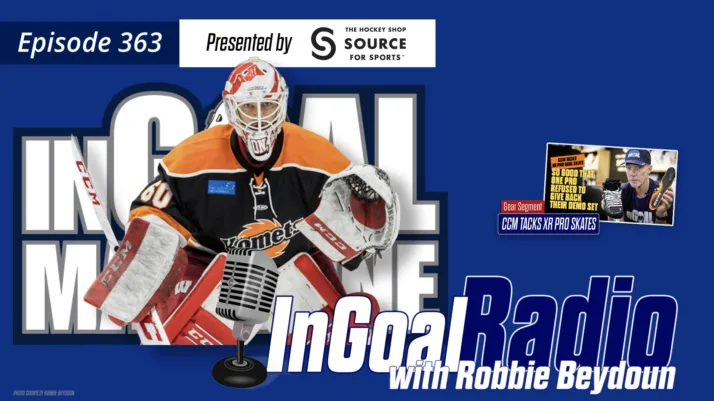
Episode 363 of the InGoal Radio Podcast, presented by The Hockey Shop Source for Sports, features the fascinating journey of former NCAA goalie turned vision specialist and sometimes NHL practice goalie, Robbie Beydoun.
Feature Interview
presented by NHL Sense Arena
In the feature interview, presented by NHL Sense Arena, Beydoun shares stories from a unique path to college hockey that included graduating in 3 years from Michigan Tech, transferring (long before there was a portal) to Wisconsin to play his final year on a team with Cole Caufield and Dylan Holloway, then turning pro, winning in the AHL and going 7-3 in the ECHL with a save percentage of .920 or better, then walking away — at least from playing professionally. Along the way, Beydoun, who still puts on the pads to practice with his hometown Minnesota Wild, had a breakthrough using Vizual Edge, and now he helps goalies see pucks better in his work with the company, a journey that includes working with Jordan Binnington, Jeremy Swayman, Joseph Woll and more. It’s a great story that comes with an added bonus: 50% off the first 3 months to try Vizual Edge as a new user in August using the code IGFALL50.
Parent Segment
presented by Stop It Goaltending U
In the Parent Playbook, presented by Stop it Goaltending U the App, we cover 7 tips for helping your goaltender improve their puck handling. In that segment we reference an article at InGoalMag.com on improving your shooting strength from Maria Mountain.
Pro Reads
presented by Vizual EdgeWe also review the latest Pro Reads, presented by Vizual Edge, featuring Eric Comrie with a smart breakdown on managing depth on the penalty kill and the importance of not overcommitting positionally to non-shooting threats, even NHL All-Stars with 358 career goals.
Weekly Gear Segment
presented by The Hockey Shop Source for SportsAnd in our weekly gear segment we go to The Hockey Shop Source for Sports for a look at the new CCM Tacks goal skates, with a forward pitch more comparable to Bauer and lots of great new features that have made them a hit with our testers and PWHL star Ann-Renee Desbiens.
Episode Transcript
Intro
Welcome back to the InGoal Radio Podcast. If you're hearing my voice, that means that our fearless leader, Daren Millard, is en route in transit, making his way back to Las Vegas from his summer place, which means me and Hutch. I'm driving the bus. Hutch is riding in the passenger seat. We're going to
I just put my seat belt on.
Yeah. I was just gonna say like this this is, this is a bus that requires seat belts because I am behind the wheel. Means people get to hear more from me, which is a little bit of a scary thing. Hutch, how are you buddy?
I am so good. Thank you, Woody. It was a pleasure to hang out with you over in Vancouver yesterday.
Well, what were we doing over in Vancouver yesterday? We were at the Hockey Shop Source for Sports, who is of course the proud sponsor of this podcast. We were filming new gear segments including one that we're gonna run out today. It's hot off the presses as they used to say when we had presses in newspapers, and it is the CCM Tacks skate. We we we know, we heard you, we heard the demand for the Bauer F50 second price point Supreme Fuse stick, and that is coming next week.
But we had to get the tax out because we have had a ton of good feedback on this skate. So, it was great to catch up with Cam. We've got that coming up later in the show. We've also got our featured guest this week, a bit of a different one, Robbie Beydoun, who played NCAA hockey at Michigan Tech, got his degree in three years, which allowed him to transfer to Wisconsin for his fourth year of eligibility, playing alongside Cole Caufield and Dylan Holloway. Heard of them.
Not bad. Not bad. And then turned pro, won his only start in the American Hockey League, went seven and three with a .920 save percentage in the ECHL, and then walked away, but not entirely. So Robbie is now working for Vizual Edge. He's also occasionally a practice goalie with the Minnesota Wild, and he has a phenomenal story.
Like, he's not a pro rep, so to speak, but he's almost like one because he talks to goalies all over the place, including the guys he works with at Vizual Edge, guys like Binnington, Swayman, and Joseph Woll. So he he coaches the game still. Just fantastic stories from a path that is, to be honest, all about perseverance and somewhat inspiring to to as a late bloomer to make the NCAA and then to get your degree in three years? Because there's no transfer port transfer portal back then. Like, the only way you could transfer from Michigan Tech without taking a year off and go to Wisconsin and play with those big names is because he already had his degree, and he went and did his grad studies at Wisconsin.
So fun conversation, maybe not a name that a lot of people are gonna know, but one of those ones that by the end you will, and you will come away having learned lessons from his path, and the sort of stories and samples and examples that he shares from it. So great stuff coming up in our feature interview presented by NHL Sense Arena. But first, we should get over to the Hockey Shop Source for Sports where they have got new inventory still coming in. There's Warrior Alpha Surge, and s fifty second price point line. We're gonna have the second price point coming up in a couple of weeks on the Gear Segment.
That's in store. We're talking about the Bauer Supreme Fuse F 50, the second price, that's in store, the stick, and these new CCM Tacks skates. Last time we were there, they didn't have them in. They do now. And, of course, anytime that you've got new stuff coming in, it means Cam and his crew needs to clear room off the shelves to get rid of some of the older inventory.
And that is the back to hockey sale right now in August on at the Hockey Shop Source for Sports and Langley, the hockeyshop.com, where you can save up to 50% on some lines. Warrior, CCM, Bauer, there's tons of great sales. Make sure you go check out the website to get the latest deals. And if you're up for something new, the latest gear, including this week's featured product, the CCM Tacks Pro Skates.
Gear
New skates from CCM. And it's not tacky.
Oh, that was good Cam. Not really, but it's the XR Pro. And there are a lot of features in terms of fit and feel, customizable arch in through the
It's pretty slick looking skate. Let's start off with just even that.
It's attractive. Yeah. But I think the biggest feature on this that is new for CCM, at least when we talked to Ann-Renee Desbiens who wasn't really able to get into their more neutral skates, we've got a bit of a forward pitch.
Do you
see similar
That heel lift block in the back?
Yeah. So in other words, this one's gonna put you a little more on your toes than past CCM models which were some of the more neutral skates in terms of pitch angle. So a lot more forward pitch. The feedback we've gotten very similar to Bauer, that's sort of what they're after because that's a very obviously popular pitch angle. That's a big difference.
It is. But it's not the only difference because there are a ton of new features in this one. Cam, I'm gonna let you walk us through.
Toe cap. That's different too. We designed, trimmed down, more in line with some of the other options.
Speaking of angles, it will help you get a good attack angle.
Correct. Because I'm not having as much chunk and bulk up in that front area. It's also reducing volume area at your toes, so I want that nice snug fit. Getting rid of void space inside of your skate is gonna help with that energy transfer and overall performance of the skate. Then we don't have that slip, then we don't have that rubbing, we don't have problems with bunions and things like that because of the toes moving inside of the skate.
Less volume, tighter fit, better fit, better performing skate.
Okay. What
else? What else? Let's look at that tongue. Okay. Memory foam tongue.
Yeah. It's pulled together here. Upright against lace bite. You're getting that nice forward flexion out of the tongue. Super soft.
Soft. Install hauling your skates a little bit but not have that actual restriction which helps cause that lace bite. Again, need that net soft memory foam there to be able to create that better fit for that overall feel wise.
We hear a lot about the just how soft it is around the ankles too. Soft. Like the way it sort of locks your ankle in which is in part due to the insole.
And the memory foam that's actually lining
Right. Really soft. Great fit.
Great feed activated. We've heard a lot of feedback
on that.
So we do that mold to your skate to help get that overall wrap which brings us to the actual eyelet package of the skate which has been extended out. Typical old CCM fashion was very very straight. Now we've got that more curved in and extended to help create that wrap to your skate when we actually go to go mold that skate.
So suck your heel back into the back.
Improving that overall fit, keeping your foot anchored. Once again, improving that energy transition. Hey, this is we're we're talking about a good skate It's
Scott. A lot of positive early feedback on this one. Now, are we gonna get to the insole or are we
gonna stick with the outside? Well, let's finish off. Okay. Step steel, black edge step steel. You're gonna find stock on the skate itself.
With a profile built in. Yeah. Already has a 10 foot 27 foot radius so you are gonna get again continuing that little bit more of that forward tip.
So the forward the forward tip, the forward pitch is is is the skate itself but also accentuated. What we consider onto
the balls of your feet.
Can we get to the exciting like the pull out the
So at first glance, we see a standard rivet cover. At closer inspection we actually have a CCM support insole. A customizable CCM support insole. So if you have a high arch, you need a little bit more support out of the insole, that's a peel and stick piece that now attaches to that bottom of that insole and giving your foot the natural support that it needs. Nice.
Customizable out of the box.
Love it. Tons of great features but most of all, this is a skate that if you're in another brand and you liked that forward pitch and you had couldn't consider CCM in the past, now you can. And Ann-Renee Desbiens told us because she was one of those goalies. The first time she tried this, she wasn't able to get into CCM before. It's first time she tried this, not only did she love it, she kept it, she wouldn't give it back.
She's been using it ever since. So think that's a combination of the comfort, but also the fact that that that angle, that forward pitch is similar to what a lot of goalies are used. So CCM no longer sort of different and neutral and back on your heels.
Is a viable option that is now on the skate wall that you should be considering when you go to go look at your next pair of skates. That was a long winded way of getting there.
What he said. What he said. So Cam, if they got any more questions about this, about sizing, where do they get you?
(604) 589-8299 or 1-800-567-7790 or check us out at thehockeyshop.com.
There you go. We've got lower price points as well. You'll get all the same features and check those out at thehockeyshop.com. We'll come back with some more reviews on those in the future. Thank you, mister Matwiv, for walking us through a skate that we've heard great things from including from Ann-Renee Desbiens, big fan of the skate as well.
Put it on, as I said in the segment there, put it on, wouldn't give it back. Probably a pretty good sign.
We had a similar experience here, Woody. CCM sent a preview set to us quite some time ago that you Well, you might not have even had your hands on it, Matthew had his feet in them out in Moose Jaw, I think last year. It was as they were prepping this new release and he loved them so very much that he asked if he could keep using them and the answer was no because they couldn't be seen by the world yet.
It is As we said, it is a it is a departure for CCM to have this level of forward pitch on their skates. It puts them sort of in tune with other brands, and I think that forward pitch is something that goalies just a lot of goal so many goalies expect and want now that it's a necessity. And so they've added a lot of great upgrades, but Yes, that is a big part of yes sir.
I have a question on that. Then maybe I'm just getting technical on all of this, but I'd swear somebody once explained it to me that technically all these skates are not forward pitched. It's just that the CCMs were a little bit backward pitched before and then when you got into the others, you felt like you were throwing forward or have I got it reversed?
I think CCMs, older skates, the previous models, I always thought of them as neutral.
Maybe they were neutral then.
Neutral, and then the other ones are I mean, at the end of it, it's it's all relative. Right? It's all relative. And I I remember, like, so for gear reviews, we'd throw I'd throw on the Bauer skates after wearing the CCM ones, and it like, for the first five minutes, I was toe picking everywhere because I just felt like I was over top of it. So for me, it'll be an adjustment.
But for most goalies, this is what they're looking for, and so it makes sense that CCM offers it. Okay. I'm coming off a big week. Mhmm. We have a big week coming up.
That's why we had to head over to the Hockey Shop and get all this recording done in advance because we're headed to Boston to the USA Hockey Second National Goal Tending Symposium. They're running them every two years. First one was in Minnesota two years ago, obviously, and now the second one is coming up this August in Boston. So folks, there's a trade show as part of this, coming up next Saturday, so I guess I should do dates because people don't listen to this at the same
eighth, I think, Woody. That's separate
news from today. Saturday, August 8. We will be there. So come say hi to the InGoal crew. We're gonna be a part of the the entire three day event, behind the scenes doing some recording and and making sure that we document And as part of our partnership with USA Hockey, we'll be able to bring you those recordings as InGoal premium subscribers.
You'll be able to access them over the coming months. We will bring the show to you, so to speak. But if you're in the area, make sure you come check it out, especially at the trade show.
Yeah. Nothing beats being there in person and we will have lots of hangout time and we love talking goalies. So do come by, let us know what you think of what you're seeing at the symposium, let us know what you think about InGoal, the podcast. We just want to hear from you so that, like I said, it's just great talking goalie.
It ends on Saturday with the trade show. We may have overstayed our welcome by not coming home right away on Sunday. So if anybody's got Red Sox tickets to the afternoon game on Sunday, hit us up. Hit us up. We wouldn't mind checking out a Red Sox game.
Memories for me, that was one of my my featured stops, on the journey to every major league ballpark in 1995 that ultimately led to journalism. Last time hey, Red Sox fans.
I've been there too.
The Sox are firing, like, they're as hot as any team in baseball right now. And if you're feeling pretty good about it from a karma perspective, the last time I was in Boston and went to a Red Sox game, they clinched the pendant that night in 1995. So maybe some good Woody juju by bringing me along as your guest to the Red Sox game next Sunday, August 9 and Hutch. You're just back from Boston too. Speaking of our featured guest, Robbie Beydoun, you you connected with him when you were there in Boston.
I did. He was at Brian Daccord's camp in Boston, the GCG camp for Stop It Goaltending. And Robbie came in obviously to hang out with the kids, to share some of what Vizual Edge is doing, but he also came into one of the many coaches evenings where we got together for professional development, had a couple of speakers every night, went over the next day's curriculum and so on and Robbie was part of that. Really awesome to to meet him in person. We'd obviously met over Zoom many times but to hear his story there, to see what he's up to, just to connect in person like we were saying about the symposium is always an awesome thing to do.
So yeah, Boston was great that time around. I have to tell you Woody, my experience going to the Red Sox, I did not see them clinch a pennant. But as tends to happen with me, I sat down in my seats and I got yapping with the guy beside me who was a goaltender of course because these things just happen. So it'd be nice to hang out with another goaltender at a Red Sox game. When we were in Boston and for for the camp last week, we missed seeing the Red Sox by literally hours.
We had to fly out at 05:00 and they had an afternoon game. So the game would have ended as we were flying out. And we pulled up the social media on the game and discovered that, many, if not most of the men in the stadium had decided to go tarps off and were waving their shirts over their heads. And, my son was wishing that he could have been there for that experience and I was very glad that I was not there tarps off. Yeah.
I know. Else in the stadium.
Yeah. Like if anybody's asking me to go tarps off next Sunday, they better make sure they have sunglasses on because there will be a blinding glare off the whiteness of this body. Like, you know, maybe Hey, maybe I can hit up a couple I had a Hey, I got a really cool I had a really cool different sport experience myself recently. I got to have dinner with John Olerud and James Paxton, and they both played for the Boston Red Sox. So I think I should just pretend that rather than just a casual charity dinner, they're my new besties and hit them up and see if they've got access to tickets.
Heck yeah.
Heck yeah.
That works for me. Speaking of Robbie Beydoun, speaking of Boston and your interactions with him, let's get to our ProReads for the week, which of course is brought to you by Robbie's company, the company he works for, Vizual Edge. Now before we tell you a little bit about this week's ProReads featuring Eric Comrie, and before we tell you more about Vizual Edge, I just wanted to say as part of Robbie's guest appearance, we've got a special for new users of Vizual Edge. Use the code IGFALL 50, IGFALL 50, all caps, and you can try Vizual Edge for three months for 50% off your first three months. Valid through August 31.
So for this month to celebrate his appearance on the podcast, 50% off for new customers. This if you've been thinking about trying it, this is the time to do it. Make sure you head to Vizual Edge and try visualedge.com and use that code. And, of course, why would you do it? Well, hey, listen.
We've all known that feeling. The nights when you're out there on the ice as a goalie and the game just slows down. You're tracking pucks cleanly, reading plays early, and nothing surprises you. Then there are the nights where you're reacting instead of anticipating. You're just a split second behind.
Most goalies try to solve that by getting more reps on the ice. Vizual Edge takes a different approach by training the visual and cognitive skills that help you process the game faster. Things like tracking through traffic, picking up releases earlier, recognizing and making quicker decisions under pressure. From your laptop or tablet, you take a personalized assessment to identify where your visual game can improve. Then you'll get a customized training plan that takes about fifteen minutes three times a week, plus an open gym mode to get you as many exercises in as you wish, plus an eight minute warm up called game day mode to get your eyes and brain locked in for puck drop.
It's a key part of the routine for NHL goalies like Jordan Binnington, Jeremy Swayman, Joseph Woll, Cam Talbot, and now you can see what you can uncover in your engine under the hood. Head to visualedge.com, and as we said, use the code IG fall 50 for 50% off your first three months. Valid for new customers now through August 31. This week's ProReads, Eric Comrie. You got Filip Forsberg rush entry on a power play.
Guy's got 358 goals in the National on his forehand. As a young goalie, what are you doing with Forsberg's at the top of the face off circle on his forehand? Where are most guys going?
Yeah. I'm I'm I'm looking at the, the preview image that we have for the article. It's on the front of ingoalmag.com right now, and I could see Forsberg with the puck. It's a little further out than top of the circles to be honest, but you can see Comrie practically has a foot on the post. He is way inside the top of the crease.
And if you are a young goalie, I would bet that you have white ice between yourself and the top of the crease. I think most young goalies would do that, but there are consequences if you do. The only thing I would say is that the pass that's about to happen in this video, not a lot of young players could make that pass either.
There's there's a certain skill level that comes with having 358 goals in the National, and Forsberg possesses them passing as well. So it's a great breakdown by Eric Comrie, though. I I think the depth almost is surprising when you see it, and then when you see the plan fold, you understand why it gives him a chance. And I think this is a conversation that we're seeing you know, I don't know about at every league. I'm actually looking forward to being at the USA Hockey Symposium to sort of see how much there's trickle down to this, but we're see certainly seeing at the National League.
Like, you just the game is so lateral. If you are even at the edge of your crease, there are a lot of plays and increasing the plays that our teams are trying to make that you just don't have a chance on, or you have a very difficult chance on compared to sitting back and staying in front of it. And in this case, like you said, he's above the top of the circle, but an elite shooter. And rather than staying with him and staying on him and tracking that puck locked in like you're ready to make a save, Comrie's just sitting on it. And a little part of that is knowing that a pass is coming, that anticipation, but also trusting that he's not gonna beat you from there.
And so maybe easier for Eric Comrie with the experience he has and for a young goalie to not feel like they need to square up. But I know I went to school on this thinking, like, yeah, that's probably a play. Some of the shooters on my high level skates, I'm out at the top of the crease, at least toes at the edge. And do you need to be? So it's a conversation we're hearing around the game.
And more than anything, it's a great breakdown by Eric Comrie on the wise and sort of figuring out the whens and the whys and the who's and when you can take certain ice and when you can't. And so that's all part of ProReads this week presented by Vizual Edge. Make sure you go check it out at ingoalmag.com. We've got a a teaser little clip online on our social media channels on on all our social media channels right now that'll give you about a thirty second breakdown. But if you want the full three or four minutes, you gotta subscribe.
Ingoalmag.com. Make sure you go check it out. Where not only do you get access to that ProReads from Eric Comrie, but you also get access to oh, I think we're over 350 now. There's over 35 goaltenders. Hellebuyck, Demko, the biggest names in the game.
And as much as we teased the new code to get 50% off your first three months, a reminder, if you're an InGoal subscriber, there is a subscriber only code on every ProReads that if you can see that code because you subscribed and you're watching the full ProReads, you can save 20% off an entire year of Vizual Edge. 50% off the first three months may sound really good, and it is. It's a great way to get you started and see if those three months are enough to keep going, but 20% over an entire year is great savings as well. So make sure if you're a subscriber, you take advantage of that. Over the course of a year, it's actually more.
So check it out at ingoalmag.com. Alright. We've got a busy week coming up in Boston. I'm coming off a busy week, so I'm inviting everyone to come see Hutch and I'm mostly Hutch because he's the brains of the operation in Boston. But before we get to Boston, there's a chance you might see me on ESPN.
Oh. This is this week's gear tip I believe, Woody. Yeah. Yeah. Yeah.
No pun on the word tip. Or no.
Yeah. Just don't go there. Don't go there. So anyways, I got to be a part of a skate with the Canucks alumni because I have a friend that I skate with a couple times a week who also skates with the Canucks alumni, former pro, played played DEL two and a little bit of DEL overseas in Germany, a little bit older than me, played junior hockey around here, in the Lower Mainland, and we've we've just gotten to know each other through skates over the last ten years that we do together. But he also skates with the alumni, and they had a special night out with him last week where ESPN came up to do a story on him because he is in the final table of the main event at the World Series of Poker, which ESPN is broadcasting.
So I got to sign my life away. It was pretty cool. The waivers that you had to sign to be part of the filming, it was just basically a shinny skate between a lot of guys from our group on our Monday night hockey and the Canucks alumni. Got to sign my life away on that one. The paperwork that you signed on the waiver, Omaha Productions, the Mannings company.
How cool is that?
That was kinda cool. I almost wanted to take a picture of that. Right? Like, I'm in sports media, but like, that's like, that's just a different level. And so we had to skate, but there was one problem, Hutch.
What's that?
I hadn't skated in a couple of weeks. I packed That's my bag
early one okay. Yeah. Yeah. That's
Packed my bags early early in the day. Didn't do a thorough check like I normally before I leave. I do like a kind of walk through like, okay, you know, like from the feet up. I'm like skates, knee pads, jock, pants, chest, neck, mask, gloves, sticks, like is it all there? Just a mental checklist.
But I packed my bag so early in the day, didn't go through the checklist, and then had to run out the door because we had we had a dinner downtown and then I got dropped off at the rink on the way back from downtown. Driving downtown, I'm like, I just felt like I forgot something. So I get to the rink and guess what I forgot.
Oh, I know. I'm not guessing. Yeah. Everybody else out there think to yourself, what might Woody have forgotten?
He forgot his goalie jock. He forgot his goalie jock as he's about to head into a video shoot and a game with I think there were 15 ex NHLers as part of this on the other side on the on the Canucks alumni side. No can. Absolute panic. Embarrassment.
No can, but it was not a question of no can do because you did do.
Well, I did not have much of a choice. Could not leave them without a second goalie for this. We did have two goalies amongst the alumni skaters. Corey Hirsch and Bill Ranford were both skating. Billy Ranford skates with the Canucks alumni because he's he lives in nearby New Westminster for the most part.
And so I didn't, you know, I didn't make him proud by being the goalie that showed up without a can. And, yeah. So good news is, remember those, bulletproof jocks that we got sent years ago? Do very well. Somehow there was one in my bag.
I have no idea why. I must have wanted to show it to somebody, but it was still in my bag. So I took the bulletproof jock and I taped it into the inside liner of my goalie pants. So a little bit of protection there, not exactly fit or hugging the right areas. And then I was thought about stuffing a towel down there.
I had an extra padded shirt in my bag, I thought about using that and shoving that down the front of the pants. The guy in the other end of the net, Matty Johnson, great guy, way better goalie than me, get to play against him a whole bunch of times, and every time I do, I lose. But he was in the other end, and he's like, Woods, take your take your mask bag and fold it up and just shove it down. She kinda fold it up like almost like a goalie jock shape and shoved it down there, and that's what I did, and I survived. So thanks, Matty Johnson, for the tip because I probably would have just shoved the towel down there and it would have been halfway through the game.
Would have been coming out through my pant leg.
There's something you haven't told me in all this though. You said you survived. Did you survive because nothing hit you there or did you survive because you created a new way of protecting a goaltender?
I definitely took some sort of lower abdomen that I didn't feel. But I definitely I mean, let's be honest. I struggle at the best of times. And sort of trying to stay off square a little bit because you're trying to square and be centered on everything and I sort of wanted to be off center on everything for this game a little bit.
You trapping off pucks in a game with just a simple gut trap.
Yeah. I did I did plenty of gut traps, nothing hit me, thank goodness. Let's just say I wasn't I didn't extend my stay for warm ups. I didn't go out early and take a whole lot of shots. But, yeah, I I survived.
There wasn't... There was no incidents. My performance, however, if if I do end up as b roll as part of this feature No. No. Don't go
to getting woody. Come on. Let's just go. You're in this, and it was awesome.
Yeah. I mean it and I was awesome and I wore pads that had an InGoal logo on them because I absolutely had to, make sure we got a little love on one of our, retro EFlex seven sets that has our logo on it. So hopefully, ESPN captures me there. My boy who's, the feature of that interview and of that story, Greg Mueller, did score one on a breakaway on me. So I think that increases my odds of you seeing me in the, in the segment I
know you let it in on purpose.
Yeah. I know. I wish I could say I did. It caught me off guard with a a quick shot. He almost always dekes, so must have been the end of a shift.
Anyways, so anyways, hey, just congratulations to him too. Like, great guy. Great story. Learned to play poker riding the buses in DEL 2 and DEL over in Germany. Lot of card games on the back of the bus going from one city to the next.
Has three world series of poker rings already, but never main event, never final table in a main event. In line to win as much as $10,000,000 this week, US, as part of the final table. And, you know, you're gonna see his story, you'll see a lot and good for him. I can't everybody's cheering for him. Was a really cool night to be a part of even though I did so without my goalie, Chuck.
Children, do not try this at home.
Yeah. This is a gear tip, pardon the pun, that nobody wants to risk. Please. Please. Remember to pack your can.
Because you know there's dumb kids out there doing it already.
Well, and this is the other thing too. Right? Like, if this is like a normal skate, I'm gonna find a way. Right? Like, I'm gonna Somebody like But there's an embarrassment.
Like, I was pretty embarrassed that I had to ask and I I was worried. I didn't want to tell too many people. And so
Billy, do you have an extra cup?
Like, I I did tell him. I think he was just ashamed of me, just shaking his head. What an idiot. But you can't go around that. Like, he like yeah.
So it was, it was a little rough, my finest moment, but, man, what a great what a great night. What a great group too. Like, the alumni is so kind. Thankfully, the only time that Cliffy Ronning got mad and and tried to quickly tie the score, I was in the other end. I was on his team when somebody chirped him and you decided to score three goals in like two minutes.
That guy can still that guy can still turn the inside out. So it was really fun to be a part of that. And, like I said, haven't seen the final clips, but I signed my life away to Omaha productions. Let's see if any of it ends up on that ESPN broadcast. And good luck to our good friend Greg Mueller in his quest to add a fourth bracelet, none bigger than the main event.
Parent Playbook
Alright. We're on to the parent segment, my friend. Time for you. I've been talking enough. People are sick and tired of hearing me.
Let's go parent segment presented by the Stop It Goaltending U app. And since you were just in Boston, I'll handle this read because if you would like twenty five years of NHL goalie experience at your fingertips, if you would like to tap into the goalie parenting expertise that helped Joey Daccord reach the NHL, all you gotta do is get a subscription of the Stop It Goaltending U app. All the knowledge from Brian Daccord has been an NHL goalie coach, scout, and director, as well as all the insights and expertise from his staff at Stop It, which includes a long list of veteran NCAA coaches, NHL goalie scouts, and pro scouts at every level, all delivered in easy to digest chunks including five short daily primers, weekly style analysis, breakdown videos, and drills that you can take onto the ice with your team and coach. Plus, I was talking about that InGoal subscription and how important it is to get other discounts and all the great information we have on there. It's included with the subscription to Stop It Goaltending U the app.
You get the best of both worlds. So check it out now at the App Store or Google Play and get your subscription to Stop It Goaltending U the app and a subscription to InGoal Magazine included. Hutch. It's
summertime and I think it's one of the best times that you can help your young goalie learn to handle and shoot the puck. Everybody loves a goalie goal and We do. Shout shout out to our goalie goals page. My kid loves handling the puck. I think I worked it out that he'd average 15 to 20 handles a game.
He just loves doing it, but he's also been playing the puck since he was very, very young. And it's not a new idea, by the way. Two of the best hand puck handling goalies of their era, Mike Smith and Carey Price, both credit the habits that they've built as kids in some of our discussions with them. So here's a few things. I'm gonna call this seven tips for helping your young goaltender learn how to handle the puck.
Number one, I think this applies on so many levels, play out as long as you can. Before your kid commits to being in the crease full time, let them keep playing out as as a skater. If they wanna do both for a while, that's great too. If your system will allow you to do it, but every shift as a forward or a defenseman is building stick handling, passing, and skating skills that a lot of goalies never get or never get enough of. Number two, speaking of Stop It Goaltending, use a player's stick when they're too young for a goalie stick.
I know. I know. Lots of you think you gotta force them to use those big mitts and the big heavy goalie stick or they'll never learn it. Well, I got news for you. Joey Daccord himself on this podcast made the point with his father that they learned with a regular player stick.
And I've seen him on the ice with a player stick in Boston and he can rip the puck. You're just not strong enough to do it as a kid. It makes it hard. It makes it unfun, miserable experience. Let them use a player stick.
And I'm also gonna give credit to coach Angelo Maggio over here in British Columbia on this one. A lot of goaltenders shoot right handed natively, but then when you carry that stick in your blocker hand, you have to shoot left handed as a goaltender. So around age seven, Angelo had us get a left handed player stick for our son. Never used it exclusively, but he did use it in the backyard for reps and it helped him learn how to shoot the puck left handed. Shoot pucks in the backyard as we're talking about that.
Just like any skater, reps are reps. It doesn't just build skill, it builds strength. Get yourself a couple of shooting tiles, piece of plastic, whatever it is, bucket of old pucks and shoot a bunch every day. Twenty, fifty, a 100, whatever your goal might be, have some fun with it. We would tie tin cans to the corners of the net so that he could shoot for the targets.
Just go out there and as I've always said before, mom and dad do it with them too. Build strength. This is tip number four, build strength. We have an article specifically on this at ingoalmag.com from our good friend Maria Mountain and I will link it in the show notes. Some simple exercises you can do to build strength specifically for shooting.
Number five, learn the technique. Of course, handling the puck isn't just about confidence, it's about footwork, it's about body position and knowing where to play the puck before you get there. That is a long huge topic we can cover but you need to get that opportunity to learn to play the puck. Whether it's one of your summer camps, whether it's being lucky enough to have a coach who supports it in your regular practices, but we really have to learn how to to do it properly as well. Number six, speaking of practice, pass every puck you possibly can in practice.
Don't just freeze it or kick it into the corner if you get a chance to make a play, make a play. If, you're just moving pucks around to help the coach, make a good pass. You see players going around and you're at the end of the ice on your own, make a few passes. Do what you can in practice all the time to work on this skill. And number seven, finally, work on your skating, especially getting behind the net, getting back in front.
If again, if the puck's at the other end during a drill and you've got some free time as a goaltender, use some time to rip back behind your net as if you're stopping a rim and then getting back in as if you've got to get back there in a hurry. Learning to look up ice and see what traffic is there. Just learning the footwork to get back there as quickly as you possibly can. It's gonna help you with everything you do on the ice. So seven tips to help you become a better puck handler.
The summertime is a great time. If you haven't done it already, get out in the backyard and start ripping some biscuits.
I got tip number eight.
Go for it.
Dylan Garand, the end of his skating session. I've been promising for a little while, I've been working on it all morning, we'll have it up soon. Guess what he does? He goes back behind the net and handles pucks for the final like ten minutes He is
so of his hour long skating session. So on It clearly makes it a part of his summer routine. It's not an accident that he's good at it. So we'll have that up for you at ingoalmag.com shortly. Great advice, Hutch.
Dylan's ability to stop a rim on the glass and pull it down with his stick is unbelievable. The eye hand coordination that guy has obviously comes from years of practice.
Have you ever heard the story about, his first game in the WHL handling the puck?
No. I don't think I have.
He told it during while we were on the ice that day. I didn't have it in the segment, but I'm gonna tell it out of school here because he got put into the game. I think he came in off the bench. I think he was straight out of midget. And the confidence to get out of his net and handle the puck was immediate and evident.
But the problem was his goalie coach, Dan De Palma, had forgotten to tell him about the trapezoid, which wasn't a part of his life
Yes. I bet.
Playing minor hockey, but suddenly was a very real part of his life in the Western Hockey League. I think his first touch his first touch ended up in a penalty for playing the puck in the trapezoid, and Dan owned it fully. It wasn't a detail that he had gone over with the young man, not expecting him as a call up to get into the game that night. I think Don Hay was the coach at the time. So some looks were exchanged, Dan owned it, and it now provides a good chuckle between the two anytime they revisit his puck handling.
His first touch was a penalty. So good story there and lots of good stuff from Dylan up at ingoalmag.com right now.
I I having seen a lot of goaltenders go through that first game experience with a, with a trapezoid, a lot of people think, well, you just have to know where you can touch the puck, but there's a lot more to it actually, Woody. Because as a puck comes behind the net, if it's not ripped around, you're stuck in this judgment area. Is it gonna make it into the trapezoid? Should I go for it? What do I do?
And you see kids get stuck there in no man's land and, and burn for that reason as well. So it affects your reads a lot too.
You gotta be able to skate as part of it too, right? Being able to get out there and get out quick and I gotta say before we head to our feature interview, we got Robbie Beydoun sitting in the in the green room ready to come up here. Quick shout out to Connor Lacouvee because in addition to the alumni skate, my last week included my first ever beer league goalie camp.
Your first ever goalie camp, let's be honest.
Yeah. As a goalie. Yeah. Absolutely. So it was kind of fun.
I'd never done it before. And before anybody says, oh, this is InGoal taking advantage of free opportunities. No. I saw that he had it coming up, and I signed up and I registered and I paid like everybody else, and I just wanted to be one of the Beer League goalies, and it was awesome. Now, we have solved a few things about why Woody sucks, including the fact that Woody can't skate.
So, learn some hard all those drills that all these NHL goalies make look like they're just walking down the street, they skate so well and so easily, a lot harder. A lot harder. Now it didn't help that my, bad knee blew up after the alumni skate, so I did a lot of these drills on one leg. I tried my best. I definitely did not do the InGoal brand, very proud, Hutch, but I did the effort part of our show very proud.
I worked Then really
you did the brand proud because that's what we keep preaching here, just go out and have fun.
We had a great time. Connor did a great job. Everybody was raving about it after. It was just a two day camp, maybe some opportunities to expand this in the near future. So thanks to him for putting on the camp.
It was great to get out there with fellow beer leaguers, including Mr Fred Waniak, formerly of Corner Gas, local Vancouver actor, and one and of and of course, one just one of the all time great people, but also heck of a goalie. Skates super well, really passionate passionate goaltenders. So we've discussed the option of having a few projects.
For our American friends, Corner Gas, a legendary Canadian TV show.
Yeah. It's like Seinfeld for Canadians.
Yes. There you go.
Unfortunately for Friday, it didn't come up with the with the same The Seinfeld residuals? The same residuals and same rights.
Hey. But Sorry. Woody, I I I don't know if you mentioned how many goalies were there? Because there's a lot of goalie coaches out there that probably don't realize there's a market for them to help adult goaltenders.
I think there was 23. I think we're down to 19 by day two because day day one beat up a few of us. Yeah. But I I think there's around twenty twenty one to 23, sold out completely. As a matter of fact, like, like, I got one of the last spots and was supposed to do it with a friend, but he got injured right heading into the camp.
Every single goalie there was asking for more. And, obviously, Connor goes back and plays pro in in in Europe, so he can't do the more during the regular season, but a whole bunch of us were like, let's get a goalie group going. I know we have our normal skates and some play beer league and I've got my skates, but it's like, let's pick a day of the week and see if we can find a coach where we can all get on the ice and actually work on these things. Because at the end of the day, although Connor had great advice because this is the problem. Like, you don't as a beer leaguer, you don't get to work on this stuff.
Right? You just don't get to work on it. He he sort of walked us through how to use your five minutes that you have or your three minutes that you have before the game starts to work on these things and get sharp and ready to stop puck. So some great advice there. Everybody wanted more of it.
So, yeah, there's there's a there's a note to goalie coaches everywhere, that there's a demand there. There's a you know, there are those of us that play for fun that still really do wanna get better.
We should just say, our regular host of the podcast, mister Daren Millard, the reason we met in the first place is he had the courage to message Eli Wilson and say, Would you let an adult come to one of your camps?
I didn't know that.
It wasn't an adult camp. Daren just hopped in there with the kids and worked on his goaltending. And I was working a little bit with Eli at the time, so I, saw the message and got in touch with, Daren and that's sort of what led to us doing this show together.
That's awesome. I knew it was there was an Eli connection to the show. I didn't realize it was him just like cold calling, can I come out? That is that's the reason he he handles some practice duty for the Vegas Golden Nights. That is bravery in its purest form.
Attaboy, Mr. Millard. So we had a good time. Good time was had by all. And I gotta say, the conversation about making it a little bigger next year and maybe making it an InGoal thing, maybe we get mister Millard out, maybe seeing if we can add a couple of celeb goalies to come out and spend an evening, have a dinner with with a with a Billy or or, you know, with a Corey, with a guy who played in the NHL and sort of pick their brains on top of the camp. Although, the the the one hard part of that is we said, hey, do we do a golf in between on the more golf on the Sunday morning before the camp?
For some of us, it was like straight to bed after the first day.
Was gonna say Like
the legs
definitely need carts, you would be walking that round.
Yeah. The legs were a little cooked. The legs were definitely a little cooked, those skating drills. And I got lucky first day, like there was two ends, like one end they did three stations and then the skating was on the other end. And I did the skating second, so I already had a chance to do the more, like, save type of situations before I went to the skating.
The and then the next day, I got swapped. Cause the poor buggers did the skating first, he had no legs left for the for the second part.
But For kids, it's a warm up to do the skating.
A 100%. Yeah. Kids kids are bendy and flexible, and they recover. The 53 year old body on throw one leg
around the crease too when you're a kid.
Yeah. The 53 year old on one leg doesn't recover quite so fast. I made it through, but I wore out the hot and ice machine when I when I got back after that second day. Hot tub ice. Hot tub ice.
Hot tub ice. That's my recovery routine. So, Connor, thank you very much. Alright. Speaking of Beer League goalies now, but clearly better than us before.
Still does some playing, still does some coaching, still very much involved in the game. Robbie Beydoun, our featured guest, what a great story. Before we get though, Hutch, our presenting sponsor of the feature interview, NHL Sense Arena. Why don't you tell us what's the what what is it about NHL Sense Arena in the summer?
What is it about Sense Arena in the summer? Great time to be using it. NHL Sense Arena is the official VR training partner of InGoal Magazine and the leading virtual reality platform for hockey players and goaltenders. As you know, if you've ever listened to this podcast, if you've listened for any length of time, you have heard us talk about the value of quality repetitions. And NHL Sense Arena gives you the opportunity to get those reps anytime, anywhere.
Don't need ice. Don't have to be at home. You just need to be able to connect into that headset and get playing hockey. With game realistic situations designed to challenge your reads, your tracking, anticipation, decision making, it's not about replacing your ice time, but it's about making the most of the time you have between practices and games or in the case of a lot of goaltenders, it's also getting ready for those practices and games before you step onto the ice. Now, whether you are a young goalie who's looking to accelerate his development or a competitive player trying to just gain an edge or maybe you're an experienced goaltender like Woody wanting to sharpen your hockey sense, NHL Sense Arena offers drills and scenarios that translate directly to what you'll see on the ice.
With regular updates and training designed alongside elite coaches and goaltenders, it's become an important part of the development toolbox for goalies at every level right up to the National Hockey League. As the calendar's flipping over to August now, it is a great time to get those extra reps going as the season is just around the corner. So to learn more, go visit sensearena.com and see why more and more goalies are adding VR training to their weekly routine. They now have some great off season pricing in effect. And as always, use the code I g m 50 and you will save even more, Woody.
Feature Interview - Robbie Beydoun
To our featured guest presented by NHL Sense Arena, Robbie Beydoun, it may not be a name you're familiar with, but I promise you, I guarantee you, is it an it is an interview worth sticking around for. I enjoyed it. I learned a ton, and I know you will too. Here is Robbie Beydoun. Really excited to welcome to the InGoal Radio Podcast.
First time guest, but somebody we've known for years through his work, as a strategic advisor and business development. Basically a man of all hats with Vizual Edge and the training they do for goalies and beyond other sports. I wanna talk about that. But before that, Robbie Beydoun had a he had a pretty good playing career too. And you've done a little you've done, like, a little practice goalie stuff at times.
Three years at Michigan Tech, University of Wisconsin, one year of pro where you had, like, a .920 in the ECHL and a .926 in your American League experience. So I sorta wanna know why you didn't keep playing, to be honest with you, because those are pretty damn good numbers, my friend. How are you?
Good, man. Yeah. It's it's it's been awesome to stay connected with you guys in my post playing career, and also just find ways to be connected to the game still. I I think there's there's one thing about this game and this goalie position, and it it'll it'll never keep me away. So, yeah, I I'm I'm happy to to kinda dive into to any any specific area, but
Well, let's let's go through your path. Like, let's like, walk me you through know, like, we do this with everybody. So growing up in Plymouth, Michigan, how'd you become a goalie, and who were your guys?
My my parents are are from The Middle East. They were born in Lebanon. So they didn't know what hockey was. I I don't think that there's one even ice rink in in Lebanon. And when we when they migrated to Detroit, we we ended up in Plymouth, and there was a rink, is now called USA Hockey Arena, right down the street from us.
So my sister, her name is Julia. She's three years older than me. She started figure skating. So I ended up spending a lot of time at the rink. They had an OHL team there, the Plymouth Whalers.
Yep.
Lot of lot of good players came through that that program. And I thought that was the NHL. I I just absolutely loved going to those games. I I wanted to be a hockey player. I loved the game.
I loved being on the ice. I loved being a rink rat, but I was not good at any any other position other than being in the net. They threw me in the net, you know, when in in house hockey, when you're trying the different positions, the rink gives you the pads. And I got a shutout, and everybody told me I was really good at it. And I was like, well, if I wanna be a hockey player, I think that this is the way that I'm gonna do it.
And they never told me to get out of the net.
I love it. I love it. And so you end up playing NAHL, three years in the USHL, Fargo for two of them, Waterloo. You know, at what point along that path from a kid whose parents didn't know anything about hockey to playing NCAA div one hockey, like, where did you sort of hit that point where it's like, hey, this is something I could do for a while. And was the passion just what fueled it?
Was it just the passion, or would did you start to look at those as objectives?
Yeah. That that's such a that's such an interesting question because this is something I I often don't think that much about. But I think I think I really loved the the the art and and the strategy of of the position because I was never the most athletically gifted. I was never seen as a prospect. I was never selected for the USA hockey festivals, or I was never drafted or anything.
I I never was the the prettiest looking goalie in that, but I just was addicted to come game time finding a way to just give up less goals than the other goalie across from me. And even even at goalie camps or in practice, like, I I I never probably was the best goalie. You know? But I just had this thing come game time. Obviously, not that I was perfect, but I really just loved reading the play and and being being a hockey mind and not just being a goalie.
And I think once I knew that that was what I was good at, I could I could continue to find a way to just make the next jump, whether that be going from triple a to to the NHL, finding a way to the USHL, finding a way to div one, and so on and so forth. So I always somehow snuck in the backdoor somewhere into the rink and then found a found a way to make a home at at pretty much every stop along the way.
Okay. So choosing that way to do it as your focal point reading the game. And we talk about this and and interestingly enough, we talk about this a lot with Vizual Edge. People think of it as Yeah. As purely a visual tool, but there's a cognitive element to it.
We'll get to that. But how'd you go about it back then? Because you wouldn't have had a Vizual Edge to help you. You know, probably, you know, we're talking about like, why? Like, USHL was twelve years ago?
Probably not a lot of video work. Probably, like, we're not in the era of instat where you could look up your videos. So how did you go about sort of just learning those patterns of the game to be better at it?
I think something that's super underrated, and it's not rocket science, but it's it's thinking thinking of the game of hockey and not just thinking of goalie technique and and trying to to be, not not to over index on, like, save selection and when to RVH and and whatever. Like, I I also I actually compare it a lot to a golf swing where it's like, you could be spending all day every day analyzing the attack angle in your wrist and the tempo of the upswing and downswing. Not that those things aren't important, but at least how how my brain works if I I rely a lot on feel. And if I'm too focused on on all of the the details, I get super overwhelmed, and I just try to to play the course. I just try to to focus on what's in front of me and not think so much about myself.
I really became just a student of the game, not just watching hockey and thinking about what the goalie is doing.
So to kinda answer your main question, I really became just a student of the game, not just watching hockey and thinking about what the goalie is doing. Of course, I'm doing that, but actually understanding, like, how a fore check works or understanding what the strategy is of my team's power play. Like, I think often goalies just focus on what they need to do. And, of course, right, you have one job on the team to keep the puck out of the net. Right.
But I think diving a layer deeper and actually understanding the minds of the offensive attack, the defensive attack, it's it's something that I think more goalies growing up should should focus on because, ultimately, it's a it's about what what separates the good from the great goalies is their ability to just naturally read hockey plays. And the better you can do that, the better pattern recognition that that you can have.
Right. Mitch Mitch Korn, who I, you know, I know uses Vizual Edge, talks a lot about get goalie's not a game of shots, it's a game of patterns. And so watching a ton of hockey and identifying those patterns sounds like the path that you took to sort of continue to rise up the levels.
Absolutely.
Now did you like, we've had guys over the years, like, notebooks, things like as they're walking, catch in the game. Do you anything like that?
Oh, yeah. You can ask. I would get chirped so much by by my teammates on long bus rides or or whatever it is. Like, Robbie, you writing raps in there? Are you writing you writing poems?
Are you writing a book? And I was like, maybe one day. I I think I still have somewhere in the basement just just to
So you were a notebook guy. What like, what give me an example of what kind of things you'd put in there if you get if you can remember them that helped you, you know, again, improve those ability to recognize patterns and read the game.
You know, there there's not this there's not this specific structure that I had with it. I kinda just it was it was very therapeutic for me. I almost kind of thought about it of of, like, okay. If I'm watching a game of hockey, I almost and and whether that's it's actually happening or or or if it's a placebo, it made me feel like if I just if I just had a notebook with me as I'm just going through life and even if it's something simple, like a like a one sentence or a couple words, I kinda just felt like I was almost downloading that information, and I wasn't just having an insight and then it being lost in a in an abyss. And even till this day, I'm not I'm not as diligent with it.
Right. But even till this day, if I'm reading a book or if if I'm if I'm in a meeting or if I just come across a podcast or or something that that's interesting to me, I'll just make a little note about it and then see where it goes. So that was kind of my approach to to the game of hockey. Just always keeping a notebook by you and making sure that you're really thinking deeply about something and not just seeing seeing something at at the surface level. I I think one one little example, and I and I take this approach.
That that's also why I I think I've grown my love for for the game and the position even even more so after stopping pucks.
Right. Your passion has always come through.
Because that because there's things that transcend there there there's variables that transcend the position that you can take with you in in in every area of your life. And when I heard that when I was playing, that was very cheesy, I always thought. But now that I'm in the business world or, you know, I'm coaching goalies or or whatever it is, I'm finding these these things actually to become true. And because, again, I didn't make it to the NHL. Right?
I didn't make a full career out of playing. And when you asked me the question, why'd you stop playing? Or, you know, why didn't you keep going? And I I often ask myself those same questions, but that's what that's what really energizes me, and that's what makes it all worth it. The relationships that that you build, right, from the NHL to the USHL, the numerous college teams, numerous pro teams, the relationships and just, like, those core insights that that you gain.
And I guess stepping back a little bit, like, example would be when you see a problem or you see a you see a goal given up, I think often you think you you you think of the the symptom or you think of you you see it and you're like, oh, that that goalie got beat glove side or whatever it is. But having the approach of going to the deep root, maybe maybe what happened before that. Maybe he wasn't set. Maybe he didn't get his eyes there or or whatever it may be. Like, really just having that approach, that's how it kinda connects to the journaling of just thinking of deep roots to why things are happening.
I always try to to to keep that with me, and that started from journaling in my goaltending days. That's long winded answer.
No. No. It's it's a great answer. But mean
it's just some good insight.
No. Like, one of my kids was taught at one point to to like, she makes notes when she's studying. She just admit, you know, like, you're not just reading through something. It'll it sort of ensures that you're digging deeper into your understanding of it. So it it makes Yeah.
It makes perfect sense. The I mean, we hear this a lot. I mean, like you said, you you didn't play a long time as a pro, but you played goaltender for a long time and you clearly still have a passion for it. We see people having success in all walks of life. Yeah.
Canada's prime minister was a goalie, right? Like your ability to
sort I of know that.
To manage manage yeah, we gotta be careful here, don't wanna get political. Some love them, some hate them. But you know, that ability to sort of like problem solve and approach things in a you know, like that that that we sort of are forced to manage our emotions as goal like these things all pay off in other ways in life. You're you're living that right now.
So many so many different ways. I mean, we could spend the whole pod just talking about that. I mean, adaptability. Right? That's something that I think is just just a core skill to be a successful goalie.
Like, you're thrown into so many random environments in in the middle of the cornfields, driving through the night, showing up, needing to answer the bell on the back end of a three and three. Everybody's gassed. You got you're like a zombie, and you gotta find a way to adapt to that situation. Right? Doesn't matter how you're doing that.
Doesn't matter what technique you're using. It's just your ability as a human being to to show up and lock in in that scenario, and that that serves you literally with anything. So I I always I always enjoy coming back to to those to those key areas that that I'm now seeing are the reasons that made me a decent goalie. It wasn't about my ability to stop the puck. It was about those those areas that are are really just core skills as a human.
Okay. So you you mentioned the three and threes and the bus rides and the you played one year pro. And cup of coffee in the a, most of it in ECHL. Some teammates that we know when I looked at the HockeyDB, Dylan Ferguson down there in in Yeah. In the ECHL with you, and Fergie's still playing overseas.
Yeah. Hunter Hunter Thompson. It do you see
till this day.
You've got a wedding coming up in a month. How many how many old teammates are headed to that?
Yeah. Well, it's funny when you mentioned Ferg. So so Fergie's old man. Shout shout out the the global diamond broker. I think that's his name.
He's got awesome on Instagram. Yeah. His name is Colin. And I remembered so about a year and a half ago when I proposed to my fiance, I was like, right. What's what's the next thing when you decide when you wanna propose?
Right? Where are you gonna get the ring? How do you get a ring? How the heck does all of this work? And I just remember Ferg, because we were really close when we were playing that year at Fort Wayne, because we had a deep playoff run and everything.
And I remember him telling me years ago that his dad was a was a diamond broker. So I was like, let me just hit up Ferg. And they they took care of me. It was an awesome experience. My my fiance literally still smiles at her ring every day till this day.
So shout out to the Fergusons. And then Fergie just got me my my wedding badge for for myself.
So Nice.
So, yeah, it's been a fun way to stay connected with with Ferg. And, yeah, like I said, at at the top of the call, like, it it's it's something where the relationships never leave you. Yep. And I'm realizing that maintaining those relationships even in small ways doesn't mean you have to talk to everybody on your team every year, but just finding, like, a random little touch point, you know, just because I thought about that one day last year, like, it it's turned into us keeping in touch way more often. So I think that's super important.
That that's that's also another good takeaway is, like, everybody says be a good teammate. Right? Obvi that's obvious, but it's, like, about the why. Of course, you'd a good teammate to be a good teammate for that year in that present moment, but being a good teammate is something that that carries with you even even after the game as well.
Yeah. No. It's it's it's a good reminder. I think we hear it a lot. Just, you know, sometimes you you lose touch with people and reach out every once in while, see how they're doing.
It it absolutely has
to Yeah.
Now you play so you finished you go from playing three years at Michigan Tech, last year at Wisconsin, then at the end of that season, like you said, long run with Fort Wayne, cup of coffee with the Iowa Wild is part of that, and then you stop playing. Can I ask why? Yeah. It's opportunities? I know you're a six footer and when that was five, six years ago in an era where every they wanted every goalie to be six four, six five.
Yeah. I mean, I'd like to tell myself that, yeah, I really just wanted to move on. It was my it was totally my decision. But, yeah, I for for some of the reasons I mentioned, you know, I I wasn't I was never this highly touted prospect. I was never I was really never in a position where my phone was blowing up with opportunities.
I had to kinda scratch and claw for every inch. And I honestly, that became a big part of my identity, and it was honestly a way that I played the position with with always playing out with a chip on my shoulder and just showing up and realizing, like, nobody really expected me to be here or want me to be here. So I got nothing to lose. I'm gonna I'm gonna be a warrior, and I always just kind of kept that mindset. So, yeah, I I had that year back and forth between the a and the coast.
That's a tough that's a that's a tough life too when you're bouncing.
Yeah. Yeah. Yeah. I mean, you really gotta love the game. Not that I didn't love the game, but it was more so what really what what it really came down to for me, Woody, is just I I I had a good opportunity that came up outside of Okay.
Outside of the the ice, but still in the game. So I thought it was a good transition. And I, you know, I I spent my whole life studying stopping pucks and being obsessed with stopping pucks. And I could just be happy doing spending my whole life doing that too, but I always just kind of I've always been somebody that enjoys doing a lot of different things.
K.
And I really wanted to just expand my horizons and and just learn and and find a different craft. Always be connected, and we can obviously get into that. Always be connected to to what my one of my biggest passions in life is is hockey and goaltending. But but also just learning more on on what I can be good at, what fires me up. And and that started to kind of be technology and business, and then that that led to to my first job outside of playing, which was at the NHL on on the business side.
Well, and that's I mean, I I I don't mean to push. The only reason I push is because, like, you won your only start in the a, had a nine twenty six. You went seven seven and three in the coast for that Fort Wayne team with a nine twenty. So, like, you had success in that one small sample, and that's why I was curious. Like, you know Yeah.
So take me to the job of the NHL before we end. And where does Vizual Edge start to fit into this in terms of something you're using and then something you ultimately end up, you know, being involved with deeper than that?
Yeah. Yeah. So I'll I'll connect the dots, but step back in the timeline a little bit. So I was at Michigan Tech. I you know, college hockey is very tough, and it's actually getting even tougher with
Oh, yeah.
With how it's opened up. Right? We all know that. But college hockey is tough from a goaltender standpoint because there's only, like, 35, 40 games. K?
That's not that many games, and there's only at least when I was playing, there's only two games, Friday and Saturday
Yep.
A week. So the reason I say that is because a goalie could play every game the whole season and and not be gassed. Right? It's not like in pro where it'd be pretty impossible to be playing every single game. Right?
That's pretty obvious. Yeah. So the reason I mentioned that is how it works in college hockey for the most part is you got your horse, and you ride the horse pretty much all year unless that horse kinda maybe gets hurt.
Yep.
Has a rough patch, whatever. That that's that's how opportunity opens up in goaltending. But in college hockey, it's depending on the situation. You can easily get buried in a whole season or even for a whole career.
Yep.
When I was at Michigan Tech, I never was able to fully take the reins and run all year. You know? Every game, every season, I played games. But
I was gonna say, like, you didn't, like, it you didn't sit there. You played 11. You played 12.
No. I was always active.
You had a nine thirty one in your second season with 12 games.
Yeah. Yeah. So as you can see, I think my third year, which was my junior year, I only had, like, three games played.
Yeah. Saw that.
And, you know, man, like, I listen. Like, you you grow up, like, I like, going to college was a big eye opener for me because it showed me that I was actually interested in things outside of just stopping the puck. Right? I I was very involved in in the business school there and and and computer science there as well. I I was able to to scratch that edge for expanding my horizons, and it ended up turning into a a job offer back home in Detroit at GM in engineering during my junior year at Tech.
And I was like, I'm I'm graduating this year because I was able to graduate early with summer classes and classes before I got to campus from
You you were a you you weren't just a you were a student student. You were a student athlete as opposed to an athlete student.
My yeah. My my whole thing was I spent all of these years, three years of junior hockey, all of the the investment that my parents put into private lessons and everything so I could get here, I was not going to waste a dollar of that just by screwing off at school. Not to say that, you know, you need to take an engineering degree or whatever
it is. What I was
gonna do. Yeah. Whatever I was gonna do, I was not gonna waste that.
It's impressive. Okay. So GM offer.
Yeah. Yeah. So so that's the whole point of the story is I was done. Like, I was I was gonna be done playing. Because listen.
I never thought I was gonna make it a D1 hockey when I was a kid. I just love stopping pucks, and the fact that I was able to do that was awesome. And I was good with that. Right? It sounds in the moment, I was like, I should be pro.
I should you know, it's kinda it was a it was a a bad association. I was like, I'm kinda done with this. Screw this. Yeah. But but also, again, the the game always keeps me around, so I was done.
And then I hit the transfer portal. Everybody knows the transfer portal now.
Yep.
But when I was in the transfer portal, the only way that you could transfer to another school and play right away was if you were a graduate transfer. So that's if you got your undergrad and then you still had eligibility. Now it's different. You could probably I there's there's athletes that play at three, four schools. Nothing wrong with that either, but it's just a little bit different.
And I I I think I understood that if there's one school out there that wants to bring in a veteran who's seen it all, has has a has a tough chin, has played college games, has played USHL games, that that there would be something that came up. And there there wasn't too many good opportunities that were exciting me that came up, to be honest with you. So I was like, oh, man. That was fun to be wanted again, you know, just to just to hit the portal and getting calls, getting offers. It was cool.
And then, like, three, four weeks passed, and nothing was coming up super interesting out. And and then the University of Wisconsin called me. Go, Badgers. And, yeah, they they said that they saw my name in the portal. They remembered seeing me from years prior, and something was opening up and then said, you know what?
That would be a very fun way to give my final lap to college hockey. Whatever happens there, happens. We could be the worst team. We could be the best team, but I'm gonna go there and get a master's degree, have fun at a big campus, and let the chips fall where they may. So that's kinda how that
Play 21 games and post the nine nineteen, by the way. Well, Congrats, Paul.
Yeah. It always helps having a good team. I mean, Cole Caufield, Obby Baber winner was was my roommate. Dylan Holloway, top player in the league now for Saint Louis.
Hell, I heard of them.
You've heard of them. Yeah.
Heard of them. So we
had we had, like, three or four all Americans. You have to work hard to put yourself in a position to get lucky, and and that's that's ultimately what happened in that scenario. They wanted a veteran guy. They had a bunch of guys coming back. There was also still a lot of uncertainty going into that year with COVID.
Like, we didn't start the season until, I think, November.
That's the other part of this that I sort of it's funny. I shouldn't gloss over, but I've it's easy to sort of just forget. Like, the world was upside down at that point too.
Yeah. Yeah. We always say the the only bad thing about that year because we had so much fun. Like, I as we talked about, I'm getting married next month. I have a ton of my Badger teammates coming to it.
And I was only there for one year, and I've built such strong relationships just from that one year on that team. We were so close, and the only bad thing about it was it was only our parents that were able to come watch us in person that year. So it was it was kind of, like, this eerie feeling being in these, like, cool big 10 rings, and there's, like it feels like a triple a hockey game where it's, just parents watching. I don't know, man. It it was an interesting experience, but but when you have a good group of of teammates, you you kinda you kinda find a way to to make the best out of any situation.
And when that year ends, you get the opportunity to play a little pro, and then after that, it's just time to go into the workforce. What how where'd you end up what'd end up doing with the NHL?
Yeah. Yeah. So I'll I'll connect the dots on that, but I also think a part important part of the story too is realizing that, like, every single stop on the way, like, wasn't supposed to happen, scratched and clawed. Again, it was COVID. So my season ended.
Like you said, I had a pretty good year on paper. 20 games, 09/19 or 09/20, whatever. We won the big 10. And I thought that for sure, especially with the pro season starting in January that year and the college season ending in, like, March, there was still a huge sample size of of playing time for that year. So I was like, I can definitely hop on a pro team.
I don't need to wait until next year. Right. Because, again, going into that year, I was kind of just hoping to play one year of college hockey, one final year, and then kinda wrap it up. And then every ECHL team had, like, two or three goalies, and there was only 12 coast teams playing because it was
COVID. Right.
Right. Rely heavily heavily on gate. And then every AHL team had, like, three goalies, and even I think there was a handful of HHL teams that decided not to even play that year. So a lot of teams in the AHL were like Nashville and Carolina's organization mixed into one, for example. So there weren't jobs.
There weren't openings even if you had a great year of college hockey.
No. It was a very unusual season for sure.
Very unusual. So I was cold calling pro teams just begging, hey, if something happens, I'll hop in my truck and drive. Three, four weeks passed. I was honestly really enjoying just the normal student life in Madison. Things were opening up again after COVID.
We just got to like, we were playing 10 like, that was the only physical activity I did during that time, just, like, play tennis with my teammates. So I always shout out kinda tennis for for keeping me dialed, and I still did my visual edge stuff to keep my eyes going, which which we'll we'll touch on at some point. But Fort Wayne called Fergie, I believe. I think he heard his finger playing rebound or something. I think that was the story.
And they were like, hey. Our NHL signed goalie hurt his finger playing rebound after practice. You wanna come up for the weekend. And I was like, alright. We did it.
We finally got paid to stop a puck. No matter what happens in this one weekend, I got paid to stop a puck.
And Fort Wayne's, like, not too far for you. Like, even though you're at Wisconsin, like, it's sort of like like backyard home wise.
Yeah. You would think so. It's not that far from Detroit, but I've never had been there in my entire life.
Okay. You could
have told me Fort Wayne was in Idaho, and I would have like, yeah. Okay. Like, hurt? No. Never heard of it.
But, yeah, it that was a cool element. Like, my parents were able to come watch me play almost every game.
That's cool.
And yeah. Anyway, I showed up for that one weekend, and this is also a cool part of the story because I think it's so important, is I showed up to Fort Wayne so light because they they told me I was really only gonna be there for that weekend, and I was just kind of a fill in. And I was like, I'm out of here regardless. Like, why not just like, I hadn't skated in three, four weeks, barely worked out. I was like, I might as well just enjoy this one game of pro that I have.
And I just showed up there and, like, was a kid having fun, and I threw up a shutout. Like, it was maybe the most fun I had playing hockey that whole season. And I was like, gosh, dang it. Like, it's kind of hard to to manufacture that situation Yeah. Every every night.
But you see the value of the mindset.
But man, it it was so impactful. And I kinda just kept riding that wave. I think I played a couple more games. They they obviously, if you get a shutout, they're not gonna send you back.
Yeah.
So I got a shutout. I think I played two more games and then ended up getting maybe goalie of the week or something. Then I was in the AHL, and I was like, what the heck just happened?
That's amazing. Yeah.
So that's kind of the the hockey component.
You've mentioned it a couple times. When did you start? Because now you're working with Yeah. Vizual Edge in a deeper capacity amongst other jobs. And you mentioned the NHL was one of the jobs.
When did you start using it as a sort of as a client to start with?
Yeah. Yeah. So this was this was when I got that call from Wisconsin and realized I was going there. I was like, okay. The big ten is very fast.
It's probably the fastest and most highly skilled conference in college hockey.
I mean, you got you got Caulfield and Holloway on your team. There's a sign right there. Couple of absolutes.
Some like snipers. I need to change something up. Because you can ask anybody that knew me growing up, I did not have a problem skating too much. I skated too much. I worked out too much.
I did everything I did over the top. Yeah. I always thought again, you know, you you understand this with maturing, but I always thought, alright. If I just outwork everybody, then I'm gonna just be better than everybody on the ice. Like, pretty simple.
Does not work that way? I am firsthand experienced of that. Of course, it'll get you places, but it's not going it it's going to maybe certain at point, there's gonna be diminishing returns. Right. So I had to change something.
There were things in my game that I struggled with that I never was able really to crack. Patience, almost being too quick. Like, I would react too much on the ice. I would I would do too many movements. I would do too much, put it that way.
Yeah. Not it's not uncommon.
It's not uncommon. It's not uncommon. And I came across Vizual Edge from hearing about it on InGoal, either a podcast or or a Seriously? Something. Yes.
Didn't know. I had like I hadn't I know like, people are gonna think this is a total setup. I had no idea.
No. No. I came across it on InGoal during COVID.
Really?
When there was no access to ice, and I need to find a way to be a top goalie in the Big Ten. I need to find a way to be the anchor for a Big Ten team. And I was like, you know what? This is kind of cool because I've always valued my eyes, and we all know the eyes are important. But, like, these NHL goalies are doing it.
Why as well just see what's going on? I can do it from home. Yep. And that is where the story starts of Really? Wow.
On how much it has helped or it did help me, and now it's helping thousands of other goalies. Because we we do we don't have a good understanding of how important the eyes are to us as not just from a goaltending standpoint, but just just any athlete. They are so impactful, and I could again, I could talk about this topic for hours, but it was such a big unlock for me that I almost kind of kept it a secret. Like like,
know Which is ironic now. Yeah.
Yeah. You Yeah. Exactly. You throw that's how you usually know you came across something good. Like, I would kinda keep it a secret for my goalie buddies and everything because it's it's infinite.
Like, you could just be laying on your couch all day. Not not it's not that we recommend doing this, but but I love anything that is is low input either with time or or or physical. Yeah. And and anything that it that is super efficient and actually has data that's showing you where it's not anecdotal. Like, throwing the ball against the wall, there's no data.
The ball isn't telling you where your deficiencies are. It's not telling you how much better you're getting at it, and you're you're physically exerting yourself. I'm not saying that there's anything wrong with throwing the ball against the wall. Right. But when you when you kind of compare and contrast, you realize, like, okay.
This is something that can actually show me the results. It can actually I can I can see tangibly where I stand compared to my peers on my ability to read and react to information in front of me? So it started to open my eyes, no pun intended, on the workflow from information going from your eyes, brain to body. And and it it actually kind of connects the dots when we talked about the journaling and reading the play because that's where the best goalies in the world separate themselves, not from not because they're stopping the puck in this fancy way, not because they're superhuman, but because they're very, very good at reading and reacting to what's happening in front of them. And it sounds super simple, but it's something that is an actual muscle that can be worked on.
Well, that's that's a line that Braden Holtby gave us way back, because he used to do a lot of vision training before, you know, before we'd ever heard of Vizual Edge. He talked I think that was the exact line. Your eyes are a muscle, they're probably your more most important muscle you have as a goalie, why wouldn't you train it the same way we do our hips and our feet and our hands?
You know, it's just a lack of understanding of it, really. It's kinda I think it was always kind of seen as this little little side tool, maybe a mix in some ball drills or or whatever it is on the side. It was never a core component of the training regimen or or a routine. And so it was when you combine the understanding and you combine the portability of being able to do it on your laptop, on your tablet. Right?
Yeah. You know, I mean, you know, I I think I've spent a quarter of my life on a bus on a bus going from Fargo, North Dakota to Youngstown, Ohio to Mankato, Minnesota, whatever. Yeah. Of course, you wanna chop it up with the buddies and maybe, you know, play some cards or some movies, but you could be spending fifteen minutes actually working on your eyes. So when you show up to wherever you're going, you can be dialed in.
Like, that's something that that that is invaluable.
Well, it's funny. We just had we had, Emmett Crudo, Montreal Canadiens prospect on, he wasn't necessarily talking about Vizual Edge specifically, but like, you know, why doom scroll for thirty minutes? Like, put the phone down and go do something to your for your eyes or for your eye hand or whatever. Know, he talked about he for him it was the ball work, but this is, you know, like you said, something that gives you a little more quantifiable information. So you used it for that season, how'd you end up working for them?
Yeah. So again, it was such a big unlock for me, and not just my I I I used it because I just wanted I was curious. Right? I'm not afraid to try things.
Which is a great mindset to have as a goalie.
Yeah. And and also just a side note, like, I I had numerous goalie coaches. I went to numerous goalie camps. I went to and I'm not, like, fully advocating for that, but I'm just giving another example of I I I think it's actually really good to have that open mind, listen to different people. Doesn't mean that you overload yourself and overwhelm with all information, but even just taking like a little bit of bits and pieces from and and really thinking about like, you know, why why do I like that?
Or or how does that how does that resonate with me? How can I apply this? So so that's something that I'm
That that was Hutch's parent playbook last week, talking about different voices and because you guys ran into each other at the Stop It Goaltending Camp, where there's all these different coaches and embrace it as opposed to be like, oh, my guy says do this.
Yeah. Yeah. I think I think that's important. And going back to to to my Vizual Edge thing, it was like, why am I just figuring out about this now? Why is this just becoming a thing?
Like, has Vizual Edge just popped out of nowhere, whatever? I looked into it, and Vizual Edge was primarily serving MLB batters. Right. The platform was built from a group of eye doctors in Chicago who were having MLB batters come in for during their off seasons for an assessment, hand them some drills to take with them and run with for the other three hundred and sixty four days of the year. And they kind of realized that, hey.
How can we make this a more high touch experience? How can we be more connected with our athletes year round and and serve them better? So they, again, they they developed a software that makes the athletes able to have three hundred and sixty five days at all times their own vision coach, where they don't just like getting on the ice with a goalie coach. Right? You're paying a goalie coach so they can give you drills that are helping you be a better goalie, and you just gotta show up and put in the work.
Same thing with something like Vizual Edge or a personal trainer. Right? That's how you're paying them. You show up. You don't need to be a vision expert.
You don't need to be a, strength and conditioning expert. If you can afford it, you you you pay someone to give you what you need because they're the expert. Very simple. So that's exactly how Vizual Edge works. You go on.
The first thing you do, you take an assessment. And just like a doctor would do, it diagnoses and shows you, okay. For example, in my shoes, I was just trying to be curious. I was just trying to help myself track pucks better. Yeah.
I actually realized that it was my it was my eyes and brain that that were were holding me back from being a more accurate goalie or or or a more patient goalie. I had no idea that that was something that that that was part of that workflow. I just thought that I don't know. I wasn't I wasn't ever gonna be a patient goalie, but it's something in your decision making process. So once I started very early on understanding, going back to what I was saying earlier, those deep rooted causes, I was looking at symptoms for a long time in a lot of these areas.
And I was understanding these deep rooted causes, a lot of it from Vizual Edge. Because, yeah, at that point in my career, I wasn't skating with my goalie coaches back home chain reinventing the wheel. I was just maybe touching up some things, maintenance. Right? At that point and everybody's working out all the time.
Like, everybody is relatively parity as far as the strength and speed, but this was something that nobody else was doing. And that was an unlock form for me where I was like, a lot of goalies need to need to understand that this exists. Right. Why is that? Right?
That that's how that's what what has allowed me to to find something that energizes me in the business world. Finding something that has maybe ambiguity and something that translates technology to value for a business or for for an individual, whatever it is, and understanding how to connect those dots. And that that has been my key role at Vizual Edge in various different capacities since I've stopped playing because it comes back to the main point of realizing more athletes need to unlock this part of their game.
That's funny you mentioned the assessment. I always used to say to Hutch, like, goalies used to talk about seeing the puck all the way in. Right? Like, I've been covering this for twenty some odd years and I'm like, when I started playing in my mid thirties, I'm like, what do you mean to see the puck? Like, what are they talking about?
I can't see the puck all the way in. And then we do my visual edge assessment and my con my my convergence was just atrociously low. It's like and it made sense. It's like, oh, yeah, Woodley, you don't see the puck all the way in. Your brain is basically assuming where it's going once it hits a certain point because your eyes don't converge for crap.
Divergence, great. Read the play, but I couldn't see it literally coming at me because my eyes didn't converge and training the improvement has made a massive difference. Oh, yeah. The puck does go all the way into the glove.
I mean, I didn't know what Off the blocker and out. I didn't know the word convergence existed Right. Before I I even logged on to Vizual Edge that that that year when I was playing at Wisco. You know? We just weren't educated on it.
Yeah. I just thought that tracking the puck in all the way meant trying to track the puck in all the way. I didn't know that your eyes had these motor functions of of depth perception, divergence, convergence, being able to to track multi objects, and then also on how that connects to your brain and then how that goes to your body. So understanding that that you can just play games on your laptop or tablet to work on these things so then you can show up for game time
And feel ready.
And just trust yourself to read and react. You don't need to be thinking. You don't need to right? We talk about confidence in this position, and that's that's something that has really opened my eyes working with some of the best goalies in the NHL or PWHL or whatever league is they they trust confidence to them means showing up on the ice and just trusting themselves to be present in that moment. Not saying that they're the best goalie in the league, not saying that there's not a puck that's gonna beat me.
It's just realizing whatever happens out there, I can read and react to it. I can I can have the confidence to to not need to interfere with with my my process of just letting myself focus on one thing, if that makes sense?
I've gotten my work done. I'm it's like being prepared for the test.
Exactly. So it allows you to have that narrow focus.
Now I don't know you have to be careful. I know sometimes on the business side of things in terms of some of the guys and and and girls that you've worked with in both leagues at the highest level, but are there any stories where you've seen others have that sort of connect the dots moments that you had in terms of this this unlocking things?
Yeah. Yeah. 1100%. I mean, you you find a good a good example is, you know, is is a guy like Jordan Binnington. You know, we we've been working with the blues for, you know, a hand a handful of years.
And, Binnington was one of those guys that, was was a long time NHL goalie before using Vizual Edge. And it goes to show you that, you know, if you're just curious, you try something out. And if it works for you and and it helps you feel good every day, right, like, that's something that I think is is really important. Just realizing, like, having parts of your routine that actually are helping you feel good every day. Because you you listen to any good goalie coach out there during the season, what is their their number one job?
To to make sure that their goalies are going into each game, just feeling good about their game, feeling good about going into that night to play the position. They're not trying to overwhelm them with anything. They're not trying to change up their game too much. It's wherever they're at right now, helping them feel feel the best with what they have. So I think it's a really strong tool for a guy like that in season, managing the highs and lows, managing all of the the the the challenging things that make it hard to be consistent every day
Right.
Night after night and having something in your pocket while you're traveling. A guy like that has has has made it a part of his routine just to just to help him with that consistency. As he said, helping his brain and and eyes feel ready for whatever comes his way each night. And I love that. Game day time.
Yep. It's not it doesn't sound like the most profound thing in the world, but I love that because that's what the game is all about come game time. It's just being ready for whatever comes your way. And I always come back to that core sentiment because that's what these goalies care the most about. And when you find somebody that helps you do that, then that's essentially like gold to you at that level.
You've, you you've traveled around. You've worked like, what what does it what does it look like for you now in the role in terms of trying to spread the word? A lot of traveling. You say you work with teams. I don't know how many teams you guys work with or if you can even tell me.
Again, I know there's some stuff you gotta be careful with proprietary and stuff like that. Yeah. But, like, is it an education process for the coaches as well when you start with a new team? Or are they usually the ones bringing it in?
Yeah. Yeah. It's a really good question. So we work with we work with organizations at at at every level and even even globally. So it could be a youth youth organization like like the Ohio Blue Jackets triple a, or it could be at the junior hockey level, the US NTDP, or a college hockey team, like like UMass Amherst, just just giving some examples, and then NHL goalie departments.
Because if you really think about it from a goalie coach's standpoint, we cannot I'm a goalie coach currently as well. I help goalies. But we cannot actually change the way that our athletes' eyes can move.
Right.
It's just like a goalie coach not being able to, help with the strength of of our our athletes' quads, for example. Of course, we could we could skate them, but when when you when you don't isolate something at the core level, it's hard it's hard for that to grow. So there are so many times as goalie coaches where we can we're on the ice and our goalies are doing the right things, and they just show up to the position, set their feet, and they just get beat. Right? And sometimes we often just say, hey.
That was a good shot or just track the puck in better or whatever it is. And in the back of our heads, we know that they just gotta track the puck better. And it's not as simple as just saying track the puck better.
Right. There there It's about tools.
It's a it's about being an extension of a goalie coach or a goalie department by saying, hey, here is a simple thing that you can do off of the ice on your couch, and then be able to come back on the ice where we're saying much, much less, hey, you just gotta track the puck better there.
Gotcha. Gotcha. Now you you your focus is primarily hockey, but you mentioned this the company started with baseball, and you guys got like some of the biggest names in like some of the biggest names in baseball use the product. Do you get any Yeah. Touch points on that with MLB and stuff?
I mean, I'm going back to my my baseball roots. That's where my passion started. So maybe I'm just geeking out here a little bit to get to know who who are some of the guys that
are No.
Yeah. You know, use the product and whether you get to, you know, interact and and hear from them about how it affects them.
Yeah. I mean, that is what we do or what we help with in its purest form. Right? When you're standing over the the, you know, home plate and you're in the batter's box, it's truly all about how well you can make a decision in a millisecond. Right?
Well, and how and the other
part eyes.
Yeah. And how how long you can see the ball. Like, I I remember going to hitting clinics up to like JUCO with like Gary Ward for Oklahoma State and used to talk about the last, if you're still seeing the ball in the last, I can't remember what the number was, 12 feet, 15 feet, you have the ability to hit at this level or that level. I was super blessed just just two weeks ago to get to have a really small intimate dinner with a handful of people, and James Paxton, who has a no hitter as a pitcher in the MLB, and John Olerud, who won two world series with the Blue Jays and had a batting title. And they went back and forth on the final 15 feet of how a pitch moves and how it changes everything.
And I as you're having this conversation, I'm thinking of Vizual Edge and being able to track like being if you can still see it and as it's starting to make those changes in the spin and the rotation, so like, okay, I just geeked out and everybody just tuned out because I switched sports on us, but I love that stuff. It was probably one of the coolest moments I've ever had listening to these guys talk about it.
Yeah. No. I mean, it's it it really just comes down to, like, how quickly your eyes can move or follow from one point to another without losing that accuracy. And then how and if that gateway is clear, then your brain has more time to to react on that information.
Right.
And what's really cool is because these things since these things are happening so quickly, it's that's why it's a muscle that needs to be worked on because we don't have time to be thinking about these things. Right? Obviously, if everything was happening in slow mo, we'd be able to make the right decisions.
But Right.
You know, unfortunately, there's unpredictability. We the pitcher isn't telling us what pitch is coming down. Right? A team isn't coming in to to the to the d zone on a three on two telling us exactly what's gonna happen. It's obvious.
So that's where understanding that unpredictability, stress, chaos, combining all of these variables and working on that muscle of reading and reacting, it always comes back to that. I'll I'll always sound like a broken record talking about this part of the game coming back to that read and react muscle because that that is exactly what separates. With with consistency. That is what what separates the good from the great. And and that's why I'm so passionate about this part of the game because it is agnostic to any sport.
It it applies right across the board. Yeah. That's awesome. I I sorry to go baseball geek on you there.
No. No. It's great. It's great.
The and I do know you guys work with some of the, like, biggest names in the game on the baseball side, so I'm a little I'm a little geeky there. The you you've been coaching, you mentioned. You still play at all?
Yeah. A little bit of both. A little bit of both. So I live I live in Hopkins, Minnesota, which is a suburb outside of Minneapolis. And me and one of my good buddies who was a goalie for the Gophers, we we did a a local goalie clinic here in Edina, Minnesota during the season.
So I it just kinda depends on what season of life I'm in, but I I'm always gonna be on the ice in some capacity. And then, yeah, I I somehow got the nod to come in and practice with with the wild here. Got a random text from Freddie over there. She bought it for the wild. Yep.
And and, you know, I think again, that that's why it's important to have good relationships over the years. You know? They they maybe they remembered me from years ago just just through through business and whatever, built some good relationship at the wild. And, yeah, I was able to pop in probably a couple dozen times this year. So I don't really break out the gear too often.
It's gotta be for a good reason. But I love I love to do it here and there. One, to just be in a locker room again. Yeah. I got again, like, it's cool to throw on the wild practice jersey and go through the experience, but it's it's just super fun to just, yeah, when you're when you're in the business world, you don't get that locker room feel just chopping it up with with the guys and just being able to be in that old form.
That that's that's what excites me to go in and do it. Everybody always asks me, dude, were they paying you, or what do you get? I'm like, I would pay them to to go in there.
A 100%.
And just be in the locker room for a couple hours and break up my day. So that was a fun fun little part this year. It'll probably change with the new third goalie position.
I was just gonna ask. It's a it's a well lasted. It's a full time job now, Robbie, if you're interested.
Probably never gonna get that call again just based on that. But you know what? Fun fun way to to have a reason to break out the gear.
Awesome. And still have the passion for it,
Exactly. Exactly.
Love it. Well, it comes through every time we've had a chance to talk to you. I did not know that we were the origin of you discovering Vizual Edge, so that makes it even better. The partnership's been fantastic with us. But mostly, all these years we've talked about sort of the role you have, the career you've had, and how it led to here, it just it was about time we got you to share that story because I think it's it's important for people to understand that you're not just a guy who works for a company, you're a goalie about as about as deep rooted as you can be, and your passion for helping other goalies through this through Vizual Edge, shone through today.
So thanks, Robbie. Appreciate this, man.
Absolutely. Yeah. No. That that's why that's why this Vizual Edge journey has been so fun for me because, one, I'm obviously helping goalies with a part of their game that they never would have looked into before. And then two, it allows me to have a reach of working with goalies all over the world.
And it just it's it's a unique blend, and it also allows me to have the opportunities to to build friendships with you guys and and just be connected with so many different hockey people. So it's nice that we we finally had a chance to just me and you sit down, have a reason to just one on one chop it up like this. Super honored, and it's been so fun working with you guys. And and appreciate you you having me on and and finally getting my my InGoal nod after all the years listening. It's it's been super fun.
A long overdue, my friend. Keep up the great work. Absolutely. And, again, thank you so for for so much time today.
Absolutely. Thanks, Woody.
Outro
See? I promised. I promised it would be worth sticking around for. I know that some people probably thought, oh, it's one of their sponsors, you know, like and I'll admit, I thought about adding an NHL voice to this podcast, you know, quick fifteen minutes with a guy. But once we got off the phone, or the Zoom, I guess, I was like, that stands on its own.
I don't need to add a big name to attract listeners. Like, if you're if you're about goaltending and about getting better, like, the lessons that he taught along the way, his path, the way he used reading the game and anticipation as his, you know, his his game changer, that was that was his difference maker. Everybody brings different skill sets. Some was size, some was athleticism, some was skating. For him, it was the work ethic and the ability to anticipate what's what was coming at him.
It reminds me a little bit of Matt Murray. Right? Matt Murray in ProReads. He's been so good in the ProReads, and he said that that was his differentiator, the ability to anticipate, the ability to read, the the ability to connect the patterns and think your way through the game. So some great lessons there from Robbie in that interview.
Thank him very much for spending so much time, especially considering he's got a wedding coming up later this summer, and he's got all these trips going on and he's a busy man. We really appreciate it. And like I said, folks, just a reminder, special to have him on the podcast and Vizual Edge make sure it was special for our listeners too if you've never used the product before. Your first three months are 50% off if you use the code IGFALL50, igfall50 at vizualedge.com. Your first three months, new users, through the month of August.
If you buy before August 31, 50% off. That was fun.
It was great to hear the story because, I don't know, you hear that he was a goaltender as we're talking about Vizual Edge over the time that we've met. And and then when you finally connect with him in person or those of you connecting for the first time here on the show, to hear that backstory is is really fascinating.
And from a not like parents, not like not your traditional hockey parents, you know, come from Lebanon, you know, don't know the game of hockey at all and clearly just fell in love with it and the just the work ethic. Right? Like, portals and guys transferring and everything that happens now. I didn't even realize when we started the interview, like, I I saw that he transferred and there was no year off in between, and I forgot that, like, back then that wasn't normal. And I didn't real you know, my brain was like, well, how did he do it then?
He just got his degree in three years. Right? So put the work in. He wasn't gonna waste that opportunity. A chance to play hockey, and he made sure he had that degree of spastic good.
So great. Just just a great guy. Great story. Lots of takeaways there. As we wrap it up this week, folks, a reminder, you wanna have a chuckle?
There's a chance. I can't guarantee it. They don't show me the edited footage, but there's a chance you can see me on ESPN on August 3. I think that's what said. It's Monday.
August 3 to this to to the sixth, I think they're broadcasting the World Series of Poker, and make sure you cheer along Greg Mueller, FBT, full blown tilt as they call him, as he tries to win a world series of poker bracelet. So big week coming up, potentially my ESPN debut. You and me on a flight to Boston on Wednesday, folk.
There's nothing I'd rather do than be in a tin can over North America with you, Woody. It's I'm sure there'll be no complaining. It's gonna be a wonderful trip.
As long as I get the aisle seat Hutch, there will be no complaining. If I don't get the aisle seat, my my knee, which is about twice its regular size and does not straighten and doesn't like to be bent, is not going to love the long flight. I do believe we have to be at the airport at 4AM on Wednesday for that flight across the country. So, I'm looking forward to seeing you bright and cheery at that time.
Yeah. Coming over from Vancouver Island, that's, even more fun.
Well, you know, you just get a canoe, you paddle in the dark, you'll get here.
Okay. Sounds good. Folks. See you in
Yeah. Folks, thank you for sticking around. Thank you for being a part of this InGoal community, including the InGoal Radio Podcast. Make sure you check out everything else at ingoalmag.com in addition to the stuff from Dylan Garand. We've got new stuff up with Ian Clark and the From the Crease partnership.
All kinds of new things happening this week. So, any questions, concerns, comments you wanna pass along to us? Hutch, what's the email?
Podcast@InGoalmag.com.
And we are gonna leave it at that. We're out.
Comments (1)
Comments are for InGoal members.