
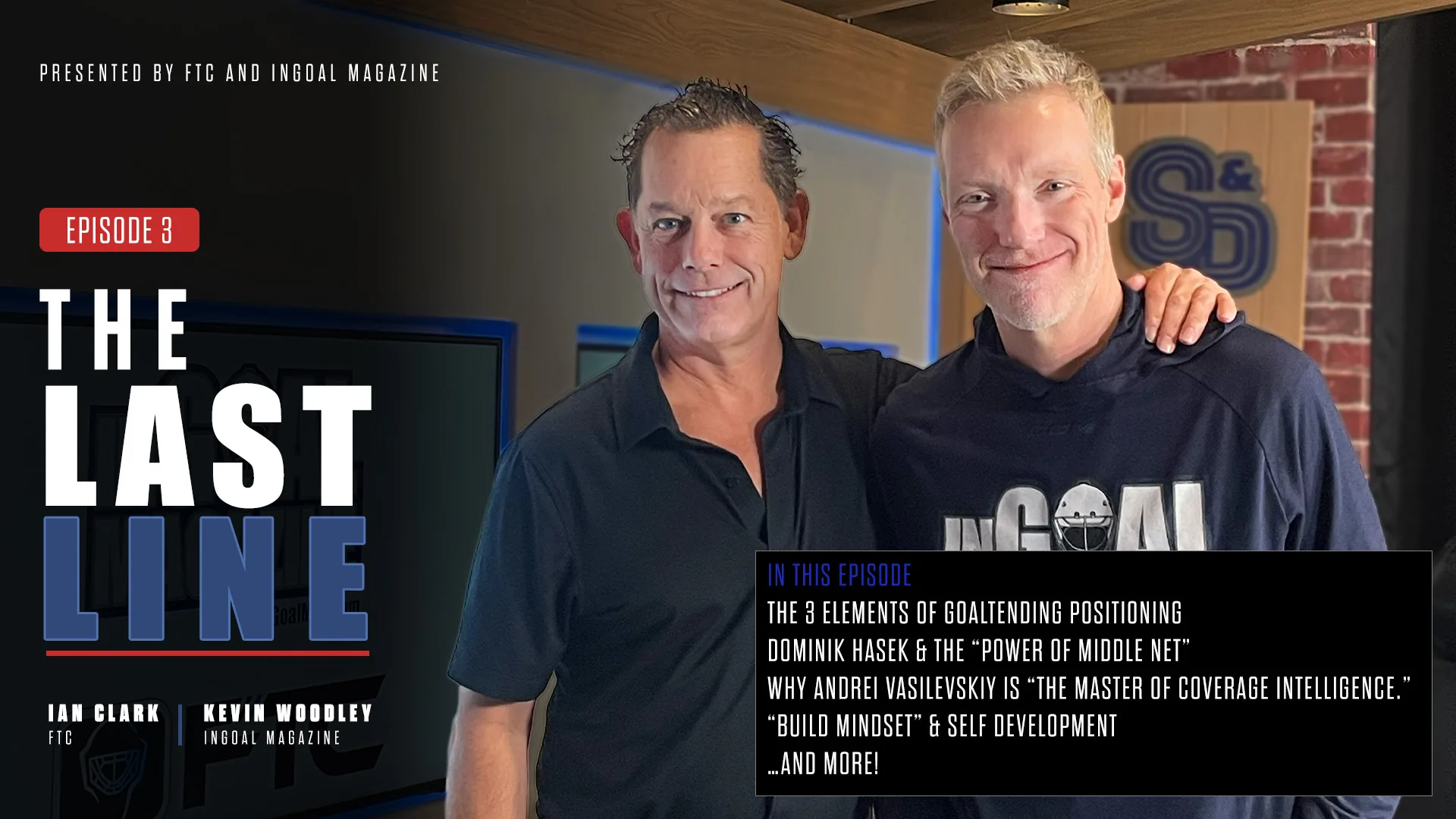
The Power of Middle Net & Coverage Intelligence (Ian Clark): The Last Line Episode 3
The goalie coach behind some of the NHL's best breaks down why angle is the foundation of every save, why “more depth” doesn’t always mean better positioning, and what Dominik Hasek understood about the “power of middle net” better than anyone who’s ever played the position.
- Of the three elements of goaltending positioning — angle, depth, and body position — only angle has inherent value on its own.
- Dividing the net into six 2×2 sections reveals that the low-middle is statistically the safest target for shooters, making middle-net coverage a foundational priority.
- Dominik Hasek's elite effectiveness was rooted in an exceptional understanding of middle-net coverage — desperation saves frequently work because pucks naturally return to middle net.
- Low coverage becomes the next priority after middle coverage; under pressure, pucks tend to stay low, making the 'flush and lengthen' technique and maintaining an ice seal critical.
- Equipment — including pad setup, toe ties, and skate sharpening — should complement a goalie's movement patterns, not work against them.
Presented by InGoal Magazine and From the Crease — the new app designed to bring Ian’s 25+ years of coaching experience to goalies around the world — this show dives into the evolving trends at every level of the position, right up to the NHL.
Each episode, we’ll break down what we’re seeing in today’s game and answer your questions.
Submit yours via social media or email: TheLastLine@InGoalMag.com
In Episode 3, we dive into one of the most misunderstood parts of modern goaltending: coverage intelligence. Ian breaks down why angle is the foundation of every save, why “more depth” doesn’t always mean better positioning, and what Dominik Hasek understood about the “power of middle net” better than anyone who’s ever played the position.
We also get into low coverage, flush seals, and the technical details behind maintaining ice coverage in desperation situations — including why pushing through the hip matters more than kicking with the toe. Then we shift into equipment and development, answering audience questions about pad setup, toe ties, skate sharpening, and why your equipment should work with your movement, not against it.
If you’re a goalie, goalie parent, or coach trying to better understand how elite goalies actually move and cover the net, this episode is packed with practical insights you can apply right away.
Let’s get into Episode 3 of The Last Line.
1:50 — The 3 Elements of Goaltending Positioning
Ian breaks down:
• Angle
• Depth
• Body Position
Core concept: Only angle has value by itself.
5:00 — Dominik Hasek & The “Power of Middle Net”
One of the best segments of the episode.
• Dividing the net into six 2×2 sections
• Why low-middle is statistically the safest target for shooters
• Why desperation plays almost always return to middle net
• Hasek’s genius understanding of middle-net coverage
• Why highlight-reel desperation saves often hit the goalie
Strong teaching concept: “Get something to middle.”
8:52 — Low Coverage, Flush Coverage & Seal Intelligence
Ian explains:
• Why low coverage becomes the next priority after middle coverage
• Limited time and space for shooters
• Why pucks under pressure often stay low
Key concepts:
• “Flush and lengthen”
• Maintaining ice seal
• Why goalies shouldn’t open inside ice
11:18 — Push Through the Hip vs Kick With the Toe
Major technical teaching segment:
• Why kicking with the toe lifts the knee off the ice
• Pushing through the hip to maintain seal
• Coverage sequencing.
Why Andrei Vasilevskiy is “The master of coverage intelligence.”
13:20 — Bridge Development Method (Applied)
How goalies actually build these movements:
• Introductory drills
• Self-development reps
• Dynamic bridge drills
• Building instinctive movement patterns
Strong developmental message: Small focused reps matter.
16:10 — “Build Mindset” & Self Development
Ian explains:
• Goalies must develop outside formal coaching
• Using small pockets of time effectively
• Importance of attention to detail
Core message: Development is self-driven.
Episode Transcript
Welcome to The Last Line with Ian Clark presented by InGoal Magazine and From The Crease, the new app designed to bring Ian's more than quarter century of coaching experience and expertise to goalies all over the world. I'm Kevin Woodley from InGoal Magazine, and joining me as he will every episode, Ian Clark, former goaltending coach of the Columbus Blue Jackets, the Vancouver Canucks, individuals like Roberto Luongo, some guy named Sorokin Bobrovsky, Thatcher Demko, heard of him. Each episode, and we're into episode three already. Each episode, we're gonna talk about some trends around the NHL, some of your experiences in the game. We're also gonna get the questions.
I promise. I promise. We're gonna get the questions from our audience. Reminder folks, TheLastLine@InGoalmag.com. That's where you can send your email submissions.
We're gonna try and ramp up the questions with each episode. Less from me, more from you is probably a good thing as we've already established. But to start this weekend, I wanted to go back to how we finished last episode. We were talking about the goat, Dominic Hasek, who has a new movie out.
He does.
Make sure you go see that folks. YouTube, Buffalo Sabres. But also we talked about you mentioned we're talking I was talking about the unique way that he solved equations. And one of the understandings that he brought to it was middle net and sort of the understanding of middle net coverage. When we think about angle over depth and some of the different philosophies, you you mentioned his understanding of that.
What like, can you walk us through that? Like, the importance of that and and why understanding that is so crucial to having success in this position as simple as it might seem?
Sure. So, let's start with this. There are three elements to any it doesn't matter what approach or style a goalie plays. There's always three elements to a goalie's position. You have angle, you have depth, and you have body position.
At the intersection of angle and depth, you place your body position. And if you dissect this a little bit more, and and what I'll do is I'll I'll take one at a time, and I want to show that actually the only one that has value in and of itself is angle. So K. Imagine this. Imagine a puck position.
Just imagine that we'll put a puck position, we'll say on the inner right hash mark. Okay. If I was to move away from my crease, distance from goal line, depth, that's the definition of depth, distance from goal line. If I was to go, say, 20 feet off my goal line out towards my left face off dot, we can imagine how much net coverage I would have on that puck on that inner right hash mark.
So the closer I get to the face off dot cutting down the wrong angle, I'm actually taking myself out of the net from where the puck is at the hash mark.
Right. So every puck position has a triangular relationship with the net.
Right.
I'm not in that triangle, therefore I have zero net coverage. So, lots and lots of depth in and of itself gives me no value. Let's imagine, we'll just say for a second that I have the world's most perfect stance. If I go place that behind the goal line over in my left corner and that puck remains on that inner right hash mark, we can imagine how much net coverage I have.
You'd look good, but you wouldn't be covering any net.
Exactly right. Once again, stance in and of itself gives you zero net coverage. Now, I want you to imagine this. Same puck position. I go stand on my goal line in the middle of my net, which of course is centered in that triangular relationship that we just discussed.
If I go do that with zero athletic posture, let's say I'm bolt upright, I have no meaningful stance position, I have zero depth.
I'm laughing because it sort of describes how I play golf, but yes.
Yes. And I've seen some of your video and I can attest to that. So the but you can imagine, not only do I have some net coverage on that puck, but you could take that puck place at anywhere on the ice, and I would have some net coverage. So that just working through that exercise shows us that only angle has coverage benefit in and of itself. Depth and body are added to a goalie's position in support of angle.
So I just wanted to just say that theoretically.
So I can be standing in the middle of my net with terrible stance, terrible posture, taking no depth, and I still got a chance of getting hit.
You could get hit.
That's how I and that's that's how I play goal. I as we said, but but it's a
good point. And and you might likely get hit because of the power of center or middle net. Now coming back to your question and how you related it to Dominic Hasek and and his history and his intelligence and all of those things. I I what he knew better than anybody. And if you take take the net, it's a four foot by six foot space.
If we divide that net into three columns, and we split them in half, you will quickly ascertain that we have six equal two by two squares. Okay. Only one of those squares is not adjacent to a post.
Bottom middle.
Bottom middle. Now why is that important? It's important because if that target is the least likely to miss. Okay. The closer you get to your post, the greater the chance, sharper you try to or you know, what's the best way of putting it?
The thinner the margin, let's say I wanna go bar down. Right. K. I have a chance a greater chance of missing that shot than if I put it low middle. Low middle gives you the greatest opportunity of assurance you're not gonna miss a net.
And so when you're under pressure, you're under duress, there is limited time and space for an attacker, you're getting cross checked in the back, you're getting pressured, you're off balance, whatever the case may be, the likelihood is that puck is going to return to the net more often than not than any other of those other five two foot by two foot squares into the low middle two by two square which is of course middle net. Dominic Hasek understood that, he understood the time and space dynamics of all of this. And so he knew and we often saw him as you know, sometimes he would spin backwards doing an underneath arc, swiping through that that low middle component, and he would come up with saves. And I would recommend any young goaltender to go on to YouTube and please go watch, you know, the Dominic Hasek tribute video on YouTube, and it is incredible, his understanding of the power of middle net.
Is this why we see and and it's funny. I wrote a story about this not that long ago for nhl.com, and we expanded on it at InGoal. But in an empty net situation, like, reverse this and take a look at it from the shooter, which which you you already sort of walked us through a little bit. But if they see an empty net, we're getting ourselves in a position where we don't have any coverage. We've lost our angle.
It's desperation.
Mhmm.
And that shooter's looking at a wide open four by six. The idea of getting something in the low middle is the most important. If you look at how many of those highlight reel saves are actually shots that are headed right to the middle of the net, like, it's uncanny to
me. Correct.
And so knowing that you have to get something there philosophically, just understanding that, like you teach that.
Yes, of course. Of course. And so a couple points here. Number one is it is human nature. You have that net staring at you.
As you indicated, it is wide open. And that puck is coming to you and you have limited time and space. You know, often that becomes and we've heard this term frequently, it's a tap in goal.
Right.
And so that's the nature of it. This player is gonna see that opportunity. They don't want to lose that opportunity. They don't wanna miss the opportunity, and they're going to tap or shovel that puck into low middle net.
They're not going bar down.
They're
not. Because they could miss. Correct. Nobody wants to miss an empty net.
Right.
Okay. So desperation moments get something to the middle. You also talk a lot a lot about low coverage. And, again, we talk about middle and low, and I wanted to ask a little bit about the idea of sort of if we're prioritizing low coverage, if we do have time to rotate and get a get a pat across as opposed to those moments where you just gotta dive or stick a glove out because there is no time. If we do have time to get rotation and get a push and prioritizing low coverage
Mhmm.
Seal along the ice. The way we move, reaching with the toe versus pushing with the knee. Like, sometimes in those moments, you'll see goalies feel like they've gotta get there, and that reach, that extension with escape will break the seal with the pad. Right. And then that shoveled puck right back in can actually go underneath an outstretched pad.
Right.
Is there a way to sort of philosophically teach that extension that isn't gonna cause us to break that seal?
Well, let me let me start with this. As you've and you you've kind of circled the wagons here on this. So number one
I like to just get everything all I talk all the way around, Iain, and then I need you to get to the heart.
I'm here. Here we go. So we've talked about the importance of middle coverage. We've talked about mid power of middle net Right. In in very brief terms here.
Okay. The next the next priority is low coverage. And the reason for that is a gain. Not every scoring situation is that offensive player in a position to do whatever they want. They're reaching, okay, they might be reaching for a puck, they might be off balance, they're under pressure, they're under duress, any number of things.
They could be on their backhand, they could be on their forehand, they could be just shoveling, might be in their skates. The bottom line is limit these are limited time and space moments. And for the most part, the shooter is not in a favorable position to put that puck exactly where they want it. So again, not only is it going middle, it's often going low. If I have to reach, for example, on my backhand, I'm gonna swing that puck probably along the ice.
So, we go middle. We go low. Now you mentioned the seal. We call that flush. We stay flush, and we lengthen, k, if need be.
K.
If we don't need to, we're not gonna lengthen, of course. But coming back to your point, what a lot of goalies have a tendency to do out of the urgency of the moment, and it's kind of like, you know, like a knee jerk reaction.
Right.
And what they do is they kick with their toe because they're they're thinking, as you said, they gotta get that blade out there. And when you kick with your toe, you tend to elevate your knee.
Right. And that's where we lose our seal.
So what what a goalie would want to do is is train themselves. Rather than kicking with the toe with this explosive reach, we're gonna push with our hip. We're gonna push with our hip and push flush out to keep that knee. It is knee to ice seal. That's where you're gonna get your flushness.
And what we don't wanna do is what we call open up inside ice or inside net. That's that underneath piece. Right. Always force the attacker to beat you to the small spaces. That's the slivers on the outside.
Don't open up the inside or big spaces. That's actually huge space for an attacker. So we want the goalie to develop that really strong coverage intelligence, if you will, in these close proximity moments by having middle, low, flush, lengthening coverage.
Okay. We talked in I think it was was it episode one or two? Episode two about the bridge development method.
Mhmm.
So when we talk about that pushing through the hip and keeping that seal, is that something that you have to be mindful of through all your work, would guess. But is there is there a good starting? Like, do you have, like, a basic drill that you'd start with for or is it just a mindset you have to maintain through all your stuff? And I think we've run some of them in InGoal in the past, like, of the, you know, some of those seal type Right. Then hand and support, I believe, was the drill series.
So leg first and then hand over top.
Right. So just to that point That's a progression. Yeah. Yeah. But also it's a coverage progression.
So not only is it a drill progression, but we're coming back to what we've now we've almost come all the way through the full sequence. Middle, low, flush, long or lengthen, vertical
That's our glove.
Close. Right. And now there's your your coverage sequencing, if you will. Now, if you ever wanna see this in action, you can quick go watch Andrei Vasilevskiy, the master of coverage intelligence. Almost impossible to beat this goaltender in when you're in close proximity with him because of his understanding of these types of things.
Now the coming back to the question. That's our that's our next task, which I have now forgotten. So I'm gonna ask you to bring that back to me.
That would make two of us. The question was about how do you teach, how do you start to develop, and and and starting with the first point of that progression being that low seal and making sure we're pushing through the hips and and maintaining that neon ice seal.
So there's lots of drills, you know, you know, but and there's there's different categories of drill within the bridge method. There is, of course, the bridge method basically takes a goalie from introduction introduction of concept through across the development bridge all the way to instinctive dynamic gameplay. Right. That's the goal with skill development. So that's the goal for the goalie to get there.
It's goal for the goaltending coach to help their goaltender across that bridge. So, okay, both parties are gonna be a part of this. The introduction of concept is likely coming from a coach or it's coming from a resource like FTC, where you're you're listening to this and hearing this. And so there's an introduction of the concept. Hey.
Now you're gonna get into with your goalie coach, you might be getting into some some introductory drills that that support that, and ultimately, you're gonna get into more and more dynamic drills because you wanted to take that progression. But for the goalie, there's drills they can do on their own. Just imagine a goaltender down in their butterfly just doing simple butterfly extensions. K? Of course, that knee is gonna stay flushed to the ice.
K? That hand can go, which we've talked about hand and support in a nice forward angle because we want to be square to the upcoming puck, and and and they can do simple drills like that. They can then extend that from a butterfly slide into what we call spread, which is that full lengthening of the body, again, with hand and support. It's a common move used today.
So you can just start like basically your you've done your warm ups, your practices about you can just go into the corner into a butterfly and just feel the difference between when you kick with the skate and when you push at the hip and what that seal does. And that that's that would be like a first step of the progression to get comfortable with that feeling.
Of course. And, of course, goalies for the most part are not with a goalie coach
Right.
Twenty four seven. So So it is paramount that goaltenders understand that they have they have enormous development opportunity when they develop what we call a build mindset, and they have these focal points. Just little pockets of time. Boom. There's 10 reps.
And you as you say, feel the difference between kicking with your toe or pushing through your hip and through the knee, keeping it flush on that butterfly extension with a hand and support, and you're starting to condition your body and mind for these types of skills.
Okay. So you start, you know, on your own in the corner, and then when you get into parts of your team practice where there's a rebound, you make sure in your recoveries, if you're on your knees, that you're continuing that type of push.
Well, you hope. I mean, again, the bridge development method is a is has a time element to it. It's not just a matter of, oh, of check, check, check, check. It's going to process. You know, it's a and it can be a lengthy process.
And, of course, the more disciplined and the greater the attention to detail that the that the goaltender has in the execution of the repetitions in whether it's their self development repetitions, whether it's those introductory drills that maybe the their coaches is is putting them through the the repetitions on the the better the attention to detail, the quicker they skill acquisition.
And, of course, Ian mentioned it already, touched on it there briefly, but this this show, The Last Line, is a joint venture between InGoal Magazine and from the crease, his new app, there'll be support and drills for all those types of things within the app that goalie coaches will be able to work through with their students or students will be able to work through on their own. And and several of those progressions. We've got some examples of sort of the higher end progressions
Mhmm.
At InGoal from from your work with the Vancouver Canucks, some of the videos we captured, but they'll be like a start through the end progression as part of from the crease.
Yeah. The app app is actually built around the bridge development method. So we have, of course, concept because of you know, there's so much learning in there and and detail. But from a drill or activity perspective, every on ice lesson has self development activities for goaltenders and it has PSM and intro, which is PSM stands for position specific movements. Some of them are skating movements or skating patterns.
Some are introductory drills which are typically close, you know, drills that require, you know, a coach can run on their own basically. Right. You know, or maybe with one other shooter. And then you go to the bridge drills again. Every lesson, coach lesson has bridge drills which are multi shooter, you know much more dynamic progression of the skill.
So we go from concept to self development repetitions to introductory repetitions to, you know, much more dynamic repetitions with the goal to get across the bridge.
Okay. So we talked about sort of that to sort of push through the knee and maintain that seal. We're gonna go to the question and answer period. And this is a question that I know there's a uniqueness to each goalie that makes this really tough for you to answer. Also know there's gonna be a section in the From the Crease app that will deal with this, but I'm gonna put it to you anyways.
We talk about equipment. We got a we had a question from a parent asking it wasn't specific. It was general. It was how much should my young goalie know about his equipment and how it performs? When we talk about pads and the way they seal, not from a brand to brand perspective or some of the different properties of the pads, but how you're doing them up even toe ties, allowing to what are some of the keys?
Obviously, by the time they get to you, they've got individual preferences in the NHL. They've got habits, but what are some of the setup keys that might aid in allowing a goaltender make sure that when they have that push through the hip, that knee is on the stack, and that ankle gets to the ice easy. So I think a toe ties, there's an example of one thing. Do you have different preferences and things that you teach? Let's start with the toe ties.
Well, let me be let me let
me
Or we
can start where you want to start.
Let me go way ahead, way way preliminary on this.
Okay.
Because you asked about the importance of equipment.
And then it went all the way around it. So you go back to
that. Right. So I'm just coming back to what you presented.
Okay.
So I'll just say this. If you're an expert craftsman, let's say you're an expert carpenter, how valuable are your tools in order to fulfill that craft? Whether you're a world class chef, how important are your tools to fulfill that craft? Doesn't really matter which one we pick. At the end of the day, goaltending is like a craft and therefore, I often say your equipment is a partner in your performance because they're your tools.
So I think it's very important coming back to the original point you made, the parent wondering how important is it important for my young goalie to, you know, be understanding of their equipment? You know, and and equipment does, you know, two big things. Number one, but does more than two things, but we'll go with the two obvious ones. One is protection and one is performance. Okay.
And so I think it's important to begin to wrap your minds around that, you know, at an early age. And so to your point, you know, we're talking about flush coverage, so we're talking about light pads really. And so what is it that allows that setup to help support that? If you were to cinch your pad tight tight tight tight, you know, your pad's basically gonna align itself with whatever your leg position is because it's so tight.
See, that's a great there's probably a lot of parents out there that maybe even played the position.
Mhmm.
But at a time when everybody did cinch it up tight. So that there's a great example for the parents that are like, why does my kids why are my kids pads on so loose? We now want the pad with that nice big thick knee landing area, which would help support that push through the hip. We want that to rotate and hit the ice flush. And in order for that to happen, you probably have to have a little looseness in terms of how you do it up so that when you drop to the ice, the pad will rotate properly.
And, again, I think a lot of young goalies are by the time they reach you at the national, they fully understand that. But for parents that are outfitting kids, that looseness, that's a feature, not a bug.
Yeah. And but I would also say you do want your pad to be responsive to your leg, so it's a fine balance. Right. And so, you know, we're not we don't we don't need sloppy pads out there. We want pads that are going to respond to the leg, but also with the recognition of some of the coverage elements we're trying to accomplish, you know, actually in game.
We want the right combination, excuse me, of protection and performance. And so that's of course the design of the leg channel we see in today's game. You know, it doesn't matter what manufacturer you're talking about, the goal is to support some width. Right. That that knee stack is going to elevate the knee, take some tension off the joints, which help spread, you know, give a little bit more width to the position.
Okay. Allow for some of that extended, pad and, okay, also help support that flushness. And then on top of that, you know, we talked about the toe tie and the skate being able to descend to the ice, which also you can imagine your knee is rising and your skate is lowering, you're taking tension off your joints.
Right. That relationship between the knee and the skate. Like, the knee needs to be higher, and if you've got too much tension in the toe tie, whether it's going with bungees that allow the skate to drop or adding, you know, knots as as NHL goalies do, a lot of them just add knots, there's a gap there that allows the skate to get to the ice. If you don't do that, you are adding tension to the knee, to the ankle, to the hip, the closer that relationship is. And, ultimately, you're sort of forcing the butterfly to narrow.
If you're gonna maintain a wide butterfly with the with the skate off the ice, it's at the expense of a lot more tension in the hips and probably not I shouldn't say probably, but you're increasing the odds of injury.
Increasing odds of injury and damaging performance too. So again, so there you know this is a big deal.
Two sided conversation.
Yeah. So yeah, so you're looking for as I said, you know we're not looking for knee and ankle to be at the same level. We would like to see the ankle drop and the knee would be up on top of that stack, okay, to support again, some of that flushness, some of that lengthening, some of that, you know, flare or width to that coverage. Sometimes all you need is coverage in one direction. You don't need coverage back the other way.
So we shouldn't just talk about the butterfly here. You know, we talked about a butterfly extension. We talked about a spread. We talked about coverage extending in one direction. K.
All of this setup can help that.
Okay. So toe ties, knee stack, I I'm guessing fit would be important. Like like, especially at a young age, and this is maybe a message to parents, and this is a tough one because gear's gear's expensive, and sometimes we wanna buy gear that our kids can grow into. But we we start them at gear that's too big and they drop to their knees and they're not landing on that knee stack. Now we've got a whole bunch of compensation things that'll affect both performance and probably safety as well.
Like, maybe not from a protection in terms of pucks, but in terms of protecting the joints against some of the damage there. So some some some important lessons there. We don't we don't all have to be Ichiro Suzuki keeping his baseball bats in a humidor at the right temperature, but understanding your gear matters. And and Right. Problematically, I see guys right up to the NHL wearing certain things, and then when you ask them about it, they don't all understand it.
And and that to me, that's, I would say, a problem because they got there, but it's probably not the best way to proceed.
Right. Right. And yeah. And so just to reiterate, for parents out there, your goaltenders equipment are the tools of their craft. And so, A, you probably need to be educated on that somewhat as does and we want to encourage our goalies to understand a little bit of how their tools support their craft.
And coming back to the knee stack, you know, it's paramount that the knee is landing somewhere in the central area of that knee stack because even if you were to land it on the front edge, it can you know, it's foam, you know, and depending on the density of the foam, it may hold up to that that plant of the knee or it might roll right off it. So again, you know, for whether it's front or back, it's really paramount that we get that knee into a solid landing position on that stack.
Okay. Now I got one more for you on the equipment because just, know, I I I lured you into equipment, which I know isn't necessarily a favorite topic. Now I'm just gonna keep going to the end of episode because we did have another question.
Of course. Sure.
Sharpening, skates, pitch, profile, all these things. Is there any sort of one answer for everyone, or is it just totally unique? And and and what is the generic answer as a starting point?
Well, I'm gonna give you the one answer. Okay. Yeah. There's an old adage out there that the goal and and forwards and defense might argue this and debate this.
Okay.
But there is an old adage that the goaltender needs to be the best skater on the team. Right. Now that may be debatable, but what I can tell you is the skating demands of the goaltending position are very unique as we can all, you know, observe. It's a very confined space largely. Largely, the goaltender is operating in what?
A the net's six feet wide, so maybe we're we're gonna go eight feet to you know, let's say it's gen the most we're gonna go out, let's call it seven feet, eight feet. Let's go eight feet. That's the most.
Especially the way the game is played.
Correct. So we are talking about an eight by eight foot square largely. And, of course, you know, depending on the goaltenders approach, it could be less. Generally, not gonna be too much more. Point being is it is a confined space.
We need to We need to go from a standstill, we need to get to maximum speed. And in very short order, we need a quick immediate balance stop for setup or possibly to change direction or who knows what the attack dynamics are demanding. And we have to operate with such efficiency and control and stability in that small space. I can assure everybody that is watching this that edge control is I mean it's really goaltending is not possible without edge control. So we're talking about sharpening.
There is no perfect answer for that.
Right. There's no one answer.
There is no one answer. What I can tell you is edge control is absolutely vital. Okay. Your goaltender does need to be an elite skater from an edge control standpoint. And once again, your tools.
Okay. All those other crafts I talked about just a few minutes ago, I'm quite certain they hone their tools properly. Our goalies need to hone their tools properly.
At a young age, would you not be would you recommend starting with a less deep we see like, when we get to NHL, you got guys who have guys who have incredibly deep hollows. Some guys have, like, almost no hollow. You've got guys with inside edge high again, but by the time they get there, they've honed their personal preferences within their edge work. At a young age, would you just sort of try and keep it neutral, like a like a half inch hollow, like not have them too deep? Would you recognize it if a kid's catching edges as he's skating around the crease, try and flatten it?
How do you, you know, if I'm a parent and I'm watching it, I'm like, man, my kid's always catching his edge. Like, are his skates too sharp as as odd as that may be to say.
I I would only say this, and I you know, we're talking about a young goalie here.
Right. Yeah. Specifically.
And I would say that, you know, you could probably go with a middle sharpening to start as you you characterize maybe a half. Somewhat neutral. Yeah. Some are neutral and see where it goes from there. Ultimately, goalies need superb edge control.
They may, okay, just acclimate themselves there. They may say, you know, as their skill set improves and their which includes their edge control, I need sharper skates. I need quicker stops. I always tell tell goalies this three real broad broad strokes. If you're a slow starter, you're a slow goalie.
If you're a slow stopper, you're a slow goalie. If you're a slow rotator, you will always be a slow goalie. And so
I don't know why he looked at me when he said that so specifically.
Yeah. We we we're not here to talk about your goaltending.
I know we're I know we're know
we're not. Everyone, whatever we're talking about here, we're not seeing that from Kevin.
No. We're not. Are definitely seeing a slow goalie.
So, anyways, the point the point being is they may, as their skill set increases, want those sharper edges. Let that exploration happen. Don't put them into a place where they can't handle the edge. Okay? But again, goaltenders do need edges in order to operate.
Imagine as well, goaltenders down on their knees and using their edges to push laterally. You know, what we would refer to as a backside push. You know, you're asking the goaltender to push not just the body weight of the goalie, but the resistance with the ice. Yeah. So if you don't have an edge for that to support and anchor that move, you're gonna find yourself your edges slipping out.
Now some of that's technique, some of that's equipment.
I need a deeper edge because there's a lot more body to push around these days on those butterfly recoveries. Now last one, some goalies go inside shot.
Give me a chance to respond to that.
Single edge. Well, I always thought of it as Henrik Lundqvist, and you revealed to me that Sergei Bobrovsky uses inside edge high or did at one point. He's and that surprises me a little because he's but probably speaks to just how incredibly controlled his movements are that he's able to look like a guy with no edge and actually just have one razor sharp edge.
Well, again, I I I mean, I can you know, I've seen so many examples of elite goalies with very sharp edges that just are so effortless out there Because they're at the nuances and the intricacies of their edge control. You've got to remember, we are training countless repetitions in very small spaces. And so, the nuances of that edge work becomes so impeccable. Just the slightest rotation of an ankle to support to bring that edge, know, engage
it or take it off.
Take it off. All instinctively under the pressure and demands of gameplay is, know, that's what this position's all about. It's that intricate.
I think when we see a trend towards more shuffling, like, as the game becomes lateral and and shuffles can sometimes allow you to beat plays laterally without having to open and close, and we do see a lot of that in the NHL. It surprises me that there are guys with inside edge high that shuffle so well. Bob would be one. Luukkonen is another inside edge high guy, and he moves from a narrow stance so explosively and so under control. So, again, there is no one solution for all.
I think that's what we love about the position. I thank Ian for taking the time to walk us through some of the philosophies behind it today. That is episode three of The Last Line in Clark, Kevin Woodley. Remember, if you've got questions for future episodes, we got to two of them this time. We're getting better.
The Last Line, all one word, at ingoalmag.com. Make sure you check us out at ingoalmag.com and check out In's latest app from the Crease FTC wherever you get apps. Apple Store, Google Play, all those places?
All those places, and you can find us on the web at fromthecrease.com. Perfect.