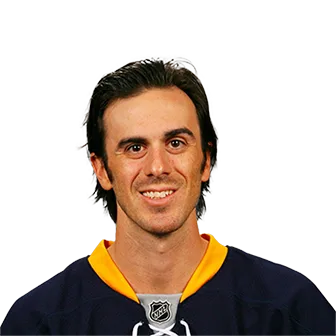
Born Jul 17, 1980 · East Lansing, Michigan, United States — Drafted 1999 · Rd 5, pick 12
| SEASON | GP | W | GAA | SV% | SO |
|---|---|---|---|---|---|
| 2018-19 | 20 | 8 | 2.76 | .912 | 1 |
| 2019-20 | 23 | 9 | 3.10 | .907 | 0 |
| 2020-21 | 16 | 4 | 3.51 | .882 | 0 |
| CAREER | 796 | 391 | 2.64 | .914 | 44 |
Ryan Miller
Career Statistics
| Season | Team | GP | W | L | OT | GAA | SV% | SO |
|---|---|---|---|---|---|---|---|---|
| 2020-21 | Ducks | 16 | 4 | 8 | 2 | 3.51 | .882 | 0 |
| 2019-20 | Ducks | 23 | 9 | 6 | 4 | 3.10 | .907 | 0 |
| 2018-19 | Ducks | 20 | 8 | 7 | 2 | 2.76 | .912 | 1 |
| 2017-18 | Ducks | 28 | 12 | 6 | 6 | 2.35 | .928 | 4 |
| 2016-17 | Canucks | 54 | 18 | 29 | 6 | 2.80 | .914 | 3 |
| 2015-16 | Canucks | 51 | 17 | 24 | 9 | 2.70 | .916 | 1 |
| 2014-15 | Canucks | 45 | 29 | 15 | 1 | 2.53 | .911 | 6 |
| 2013-14 | Blues | 19 | 10 | 8 | 1 | 2.47 | .903 | 1 |
| 2012-13 | Sabres | 40 | 17 | 17 | 5 | 2.81 | .915 | 0 |
| 2011-12 | Sabres | 61 | 31 | 21 | 7 | 2.54 | .916 | 6 |
| 2010-11 | Sabres | 66 | 34 | 22 | 8 | 2.59 | .916 | 5 |
| 2009-10 | Sabres | 69 | 41 | 18 | 8 | 2.22 | .929 | 5 |
| 2008-09 | Sabres | 59 | 34 | 18 | 6 | 2.53 | .918 | 5 |
| 2007-08 | Sabres | 76 | 36 | 27 | 10 | 2.64 | .906 | 3 |
| 2006-07 | Sabres | 63 | 40 | 16 | 6 | 2.73 | .911 | 2 |
| 2005-06 | Sabres | 48 | 30 | 14 | 3 | 2.60 | .914 | 1 |
| 2003-04 | Sabres | 3 | 0 | 3 | 0 | 5.06 | .795 | 0 |
| 2002-03 | Sabres | 15 | 6 | 8 | 0 | 2.63 | .902 | 1 |
| Career | 796 | 391 | 289 | 87 | 2.64 | .914 | 44 |
Ryan Miller grew up in East Lansing, Michigan, drawn to the crease before he could fully explain why. As he described in an early conversation with InGoal, his father would take him to Michigan State Spartan hockey games and try to direct his attention to the puck — only to find his son's head swiveling back toward the goaltender every time. By around age eight, Miller had staged what he called a small sit-down strike to force his way into net, demanding a chance to play the position after scoring three goals and three assists as a forward. He never looked back.
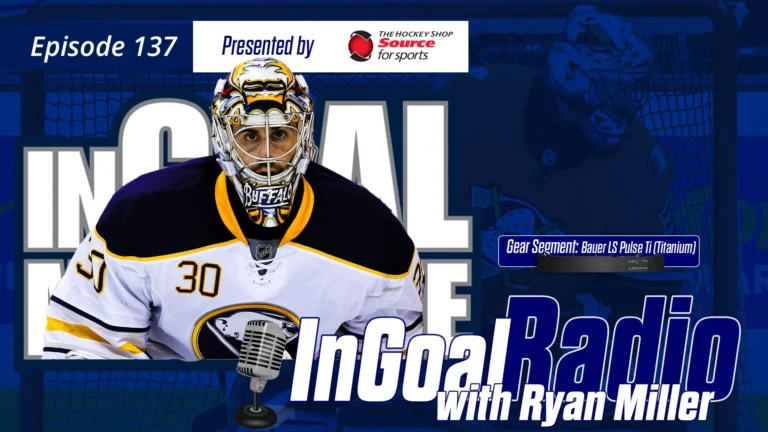
Born July 17, 1980, Miller was selected by the Buffalo Sabres in the fifth round, 12th pick, of the 1999 NHL Draft. He went on to play 18 seasons in the NHL — with Buffalo, St. Louis, Vancouver, and Anaheim — finishing with 796 games played, 391 wins, a career goals-against average of 2.64, a .914 save percentage, and 44 shutouts. Those 391 wins include the record for most NHL wins by an American-born goaltender, a mark he discussed in his first appearance on InGoal Radio [1], reflecting on the fact that the goaltender he passed — a player his cousin Kelly had roomed with on the New York Rangers — was someone he had met as a five-year-old on a hockey trip with his father.
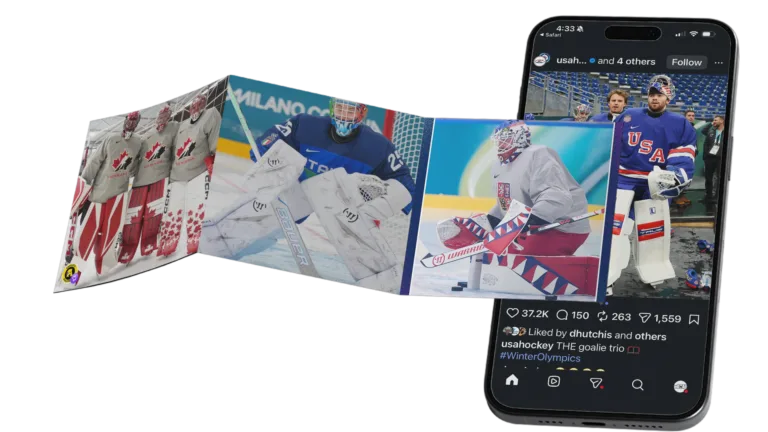
He won the Vezina Trophy in 2010 and earned a silver medal at the 2010 Vancouver Winter Olympics, where he was named MVP of the tournament and top goalie. He appeared in one game at the 2014 Sochi Games behind Jonathan Quick. At the 2026 Milan Olympics, Miller was quoted in an InGoal article [2] reflecting on his Olympic equipment choices: he wore his Buffalo Sabres gear at both Games, not switching anything in 2010, and using pad skins to cover the colors in 2014. "In my two Olympics, I didn't switch anything. I wore my (Buffalo) Sabres gear each time," he said. "In 2014 I just covered the colors up with those stickers."
Miller's relationship with his equipment ran deep. In his podcast conversation [1], he described building his own finger protection as a junior player — carving foam and plastic, raiding his mother's sewing kit, and stitching together a curved guard for his blocker using skills from a home economics class. He described a custom Vaughn pad setup so highly specified that when a set of his pro returns arrived at The Hockey Shop in Vancouver, staff were left examining all the individual tweaks he had dialed in. Later in his career, his approach to new equipment shifted. "Towards the end of my career, I would definitely switch a lot more," he told InGoal [2], explaining that manufacturing changes and a broader industry shift toward stiffer pads had changed what "broken in" even meant. "Our theories on rebound control are a lot different now," he said. "Nowadays pads are made to kick rebounds out hard and far away but things were made different back then."
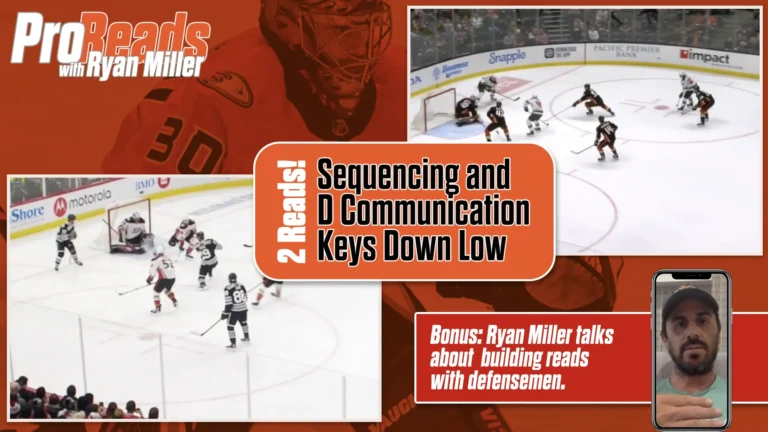
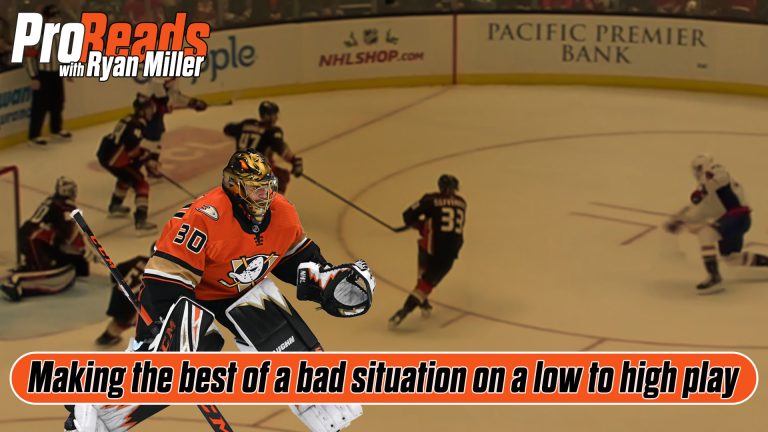
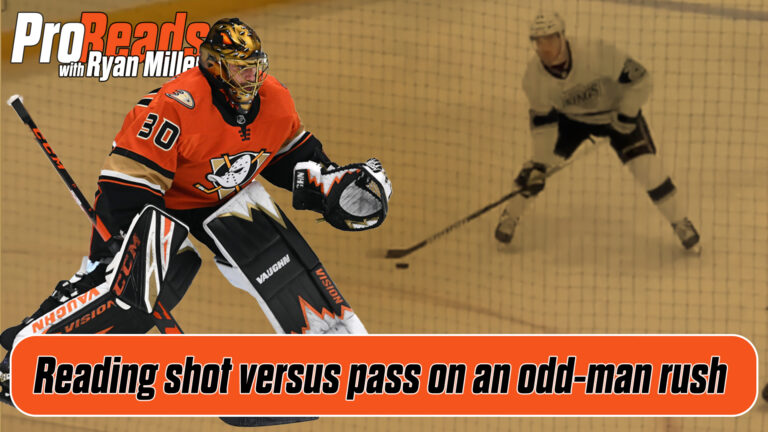
After retiring in the summer of 2021, Miller joined the InGoal Pro Reads series, working through video breakdowns of saves from his final seasons with the Anaheim Ducks across eight sessions [3][4][5][6][7][8][9][10]. The series covered a range of in-game scenarios — odd-man rushes, area passes, wrap attempts, power play reads — and in each, Miller connected his decision-making to larger principles about reading the game through pre-scout preparation and trust in his defensemen. "Those are the guys who are the most predictable," he said of his own defensemen in one session [3]. "We talk about how it's a game of patterns. We want the game to be something we can process quickly." Of being able to trust his defense to make the same read, he added: "It's a cheat code." [3]
In his podcast conversations with InGoal [1][11], Miller traced his development from a junior player in Sault Ste. Marie working with coach Terry Barbo — who spent roughly the first month on a single drill to get Miller square to the puck — through the stylistic evolution he navigated across nearly two decades at the NHL level. He also discussed his plans to return to the United States Olympic program as a goalie coach for the 2022 Beijing Games. He currently works for the San Jose Sharks as a goalie scout and development coach [2].
The Buffalo Sabres announced plans to retire his number. InGoal Magazine has covered Ryan Miller in two podcast appearances, eight Pro Reads, and one InGoal article.
People Are Asking About Ryan Miller
How old is Ryan Miller?
Follow the goalies, not the noise
InGoal Magazine covers goaltending at every level — gear, technique, and the goalies behind the numbers. Get our free weekly newsletter — plus 3 free premium reads to start.
Go deeper with InGoal
Members get every Pro Read — NHL goalies breaking down their own saves — plus full gear reviews and the deepest goaltending coverage anywhere.