

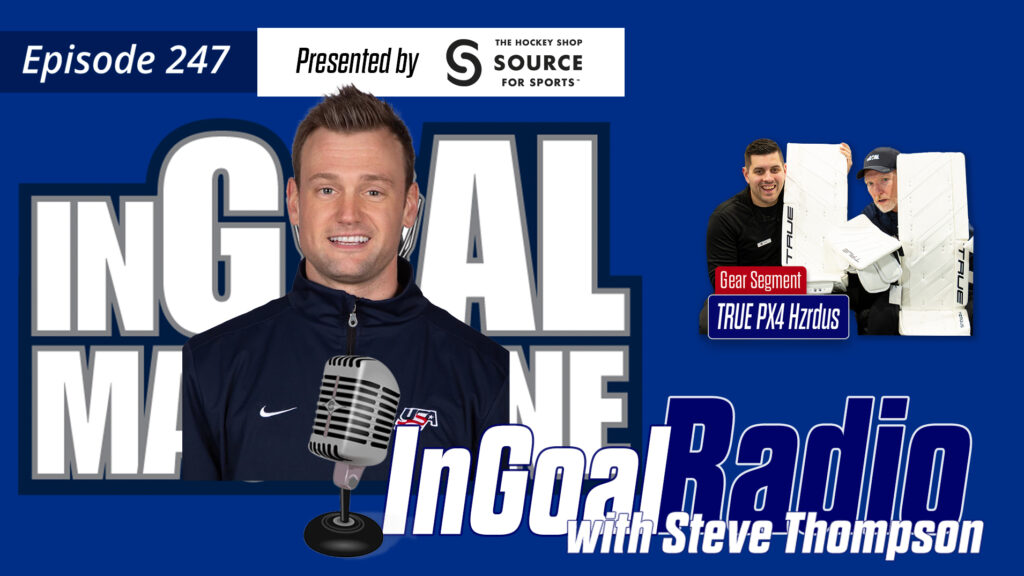
InGoal Radio Episode 247 with USA Hockey’s Steve Thompson

Please subscribe and leave a rating — it helps us reach more goalies!


USA Hockey Director of Goaltending Steve Thompson joined InGoal Radio to discuss the USA Hockey Goaltending Summit, running May 30–June 2 in St. Paul, Minnesota, which is open to the public with approximately 50 spots remaining. Thompson also outlined the US model of goaltending development, offering insight for parents and coaches evaluating long-term development approaches.
- The USA Hockey Goaltending Summit runs May 30–June 2 in St. Paul, Minnesota, and is open to anyone who registers — approximately 50 spots remain.
- Steve Thompson explains the USA Hockey goaltending development model, providing a framework parents and coaches can benchmark against their own programs.
- Recording shots on goal is discussed in the Parents Segment as a potentially misleading metric — InGoal Radio recommends shifting focus to more meaningful performance indicators.
- The TRUE PX4 Hzrdus pads and gloves are reviewed in person at The Hockey Shop Source for Sports, giving gear-shoppers a closer look at the equipment.
Episode 247 of the InGoal Radio Podcast, presented by The Hockey Shop Source for Sports, features a great discussion with Steve Thompson, Director of Goaltending for USA Hockey.
Feature Interview
presented by NHL Sense Arena
In that feature interview presented by NHL Sense Arena Thompson talks about the upcoming USA Hockey Goaltending Summit May 30-June 2 in St. Paul Minnesota – which everyone welcome to attend. Visit this link to register – there are only about 50 places left. In addition we cover the US model of goaltending development which is sure to inspire a lot of great discussion amongst parents and coaches.
Parent Segment
presented by Stop It Goaltending U
In our recurring Parents Segment we discuss methods of recording shots on goal for parents – and more importantly our thoughts on why it may not be the best way to go – and what we think you should focus on.
Weekly Gear Segment
presented by The Hockey Shop Source for SportsAll that, plus an in-person trip to The Hockey Shop Source for Sports for a closer look at the TRUE PX4 Hzrdus pads and gloves.
Episode Transcript
Intro
Presented by The Hockey Shop Source for Sports Langley, thehockeyshop.com. We are InGoal Radio, the podcast. Daren Millard back with you. A little gravelly. It's early in the morning.
That's what I'm gonna chalk it up to. Along with Kevin Woodley and David Hutchison, I have missed you guys so much, and I couldn't even talk to you because of laryngitis. And and I just I I'm I'm happy again.
It's nice to hear you're in your early morning whiskey drinks.
Exactly. Oh. I don't have a headache, and and and I'm still getting the whiskey feeling. Like, it's it's awesome.
It's just good to have you back, my friend.
Hutch, you know the whiskey thing. Like, you you how many times have you and I got up early and had had a nice stiff tumbler full of of happy juice?
I'm pretty sure the answer for me is zero, Daren. But, I've I've definitely had the bedroom voice in the morning. Wow.
So we're we're we're we're on the road here. It it should be, like, back to a 100%, but I've been saying that for weeks. Looking forward to, chatting with, Steve Thompson, the director of goaltending for USA Hockey. Also getting into our Gear Segment, which is gonna focus on the True PX4 Hzrdous line, and that's coming up in just a little bit. But let's give a shout out over to our friends at The Hockey Shop and Sense Arena.
Yeah. First and foremost, The Hockey Shop with, all the new gear coming in. We got another set today that we talked about with PX four and the Hzrdus. There's the new Warrior G7 coming soon. You've probably seen the Bauer customizer is live now for their new Shadow line.
So it's that time of year, folks, where everything is starting to come in, and there are always changes with this new gear. Subtle little things. You'll hear us when we talk about the hazardous line. How it fits may be different than other brands. You need to make sure you have those answers before you buy the new gear, and there's no better place to get it than from Cam and the rest of the goalies over at the hockey shop.
This isn't, you know, a big box store that just hires some high school kid off the street. Everybody that works in the goalie department, they are all goalies. They're all passionate about the position. They all know the equipment. They all know different styles, different ways of playing, and what type of equipment might fit your game.
So if you wanna make sure amongst all this new gear that's coming, you get the stuff that works for you, whether it's sizing or style, make sure you check out The Hockey Shop and thehockeyshop.com to get the gear that's gonna help you make more
sense. It just occurred to me, if you need a goaltender at the last minute in the Lower Mainland, call The Hockey Shop and just ask for the goalie department. And whoever answers the phone, they'll be able to maybe fill in for you. Like that?
May have may have done that once or twice, Daren, on a couple last minute cancellations for some of the skates I take part in. May have may have reached out to Cam and said, hey. Does anyone on the crew want to take this skate? Now the one challenge is they are all younger, so many of them are not old enough to qualify for some of my skates. But, yeah, I've I may have done that because they are all goalies, they have filled in for me at some of the, the various sorta invite only skates, that I take part in over the course of the summer or during the season, where they need a goalie who's good and they wanna get rid of me.
That's what I call the hockey shop. Most of these kids can really
Nobody wants to get rid of you. Come on.
Well, I mean, I do make the shooters feel good.
It's about building confidence, camaraderie, with with the shooters. Everybody feels better about themselves. What's happening over at, NHL Sense Arena?
I don't think shooters are gonna feel better about themselves if you happen to be a goaltender that's training with Sense Arena. So obviously, Woody hasn't had it out enough. Daren, minor hockey seasons are finishing up roundabout now. I've heard of a lot of teams that are in the playoffs, maybe finishing playoffs. And you guys know that at InGoal, we're encouraging everybody to get out there and play some different sports this summer and this spring.
But I know everybody's gonna wanna keep their hand in their goaltending just a little bit. And I've got two ways you can do that. One, why don't you spend five minutes a day looking through ProReads at ingoalmag.com? I think everybody should have an InGoal membership for their son or daughter and they can check out the ProReads each week. But the other way you can is spend twenty minutes a day on Sense Arena.
It's an incredible way to to go if you wanna do some training this spring. You got drills, you've got cool competitions, you've got NHL and PWHA shooters, you can play for your favorite NHL team. You can even recreate some cool drills that you've seen on InGoal using some of the things in Sense Arena like their puck cannon that can precisely, place the shots for you.
I've used that.
And it doesn't matter. Yeah. It's incredible. And it doesn't matter how nice the weather is wherever you're to be this summer, you can even train on an outdoor rink, Daren. So we really encourage twenty minutes a day.
Sense Arena is a great way to do it. It's going to make a massive difference for you this season. Guys, twenty minutes a day, that's like two hours a week. That's a lot of time to focus on your goaltending like a lot of people are lucky enough to do with private coaches. This is a really affordable way to get some great training.
The best deal now is on at sensearena.com. Head over there. Use the code IGM 50 and you'll save even more. Try it. IGM 50.
Yeah. Like InGoalmag50.
We were working on our outdoor rink in Vegas yesterday. It was snowing.
Yeah. Yeah. Really?
In my backyard, it was snowing. Not a lot of flakes, didn't have to shovel or anything. Didn't have to brush it off, but but there is snow. There are yearly yearly little fluttering of flakes.
Just so you know, Daren, it's golf weather up here this weekend.
I hate you.
It's always golf weather on the island.
I hate you. And and and and I despise you too in in, like, a very jealous angle.
Says the man living Vegas.
Exactly. Now listen. Unfortunately for me well, I guess not so much for me. I keep working and make more money standpoint, but I won't be getting the golf anymore soon. Even with the even with Thatcher Demko out, you don't go out for two to four weeks here.
We're actually gonna have playoff hockey in Vancouver, which, I mean, I I love I love going to the rink when it's, like, 20 degrees out and sunny. That's Celsius for our American listeners. Sunny days. I got to do it last year in Seattle covering the playoffs or nhl.com down there, and I am looking forward to it here in Vancouver. Hoping, as the fans are, the number one goalie, Thatcher Demko, will, as the team believes, be back in time for the start of those Stanley Cup.
Okay. They've got enough of a cushion that it's realistic to think that they will hold off the Edmonton Oilers. But I must give a stick tap to Patrick Alvin and company for the move they made in the summer when Casey De Smith was traded to Montreal and then acquired him from from the Canadians with a legitimate backup or a backup, I should say, with more experience than Thatcher Demko has had in the last couple of years. And it's helped throughout the season, but now it's got the opportunity to pay some big time dividends.
Yeah. Not just for the Vancouver Canucks, but for Casey De Smith himself. Right? Like, he's shown throughout this season that he can be the guy that plays well when he only plays every two weeks. Now he gets a chance to show that he can be the guy that plays well for two weeks straight.
Right? And, like, your ideal for an NHL team looking for a backup is find you one that does both. Yeah. Right? As the kids like to say.
And this is an opportunity for him. Now the challenge for DeSmith heading into the offseason and unrestricted free agency is his numbers got hammered by that game in Minnesota where they lost 10 to seven. Two were empty nets, so he gives up eight. I believe three were on five on threes, another two power play goals. Didn't give up a bad goal in the game.
It was all high danger, but seven of eight high danger chances mostly on the five on three go in. And, like, you just can't even with this two to three, maybe four week run of playing as the starter for Casey DeSmith, it's really hard given how little he's played to this point to dig yourself out statistically from an eight goal game against. So, that's the that's the challenge statistically, but he'll be in the spotlight here, and that that's a chance for him to remind general managers around the league of the good work he'd done up until that point even if that game wasn't on him, and that he's capable again of being a guy who can give you, you know, temporary starter minutes as opposed to just a guy who relieves the starter every, you know, fourteen days.
I'm looking forward to it. I'm excited for Casey DeSmith. I'm excited for the Vancouver Canucks to be in this situation and be prepared and not have people jumping down their throat with criticism. I think it just it it add it's not a perfect situation, but I think it it adds to the feel good story of the Vancouver Connects when things could go awry and they're instead, they're prepared for it and being able to excel beyond that.
Well, think there's enough educated people in the market to recognize, like, for example, his first start after Demko goes down, they're up to a three nothing lead. They lose four three to the avalanche in overtime. And he made some really good saves to have the three nothing lead, But as things fell apart, you can't get out shot 17 to three in the third period by the Colorado Avalanche playing the second half of back to backs when you're the rest of the team. And there's at least enough education in this marketplace now. I'm not sure there always was to recognize that, hey.
That ain't on the goalie. So, you know, when we talk about, you know, environments and measuring performance relative to environment, I think I think people start to understand those things and not just look at that game in isolation and say, oh, man. They're in trouble without Thatcher Demko because this is what happened the first game they didn't have them. There's a recognition that the team kinda folded on that night. And, yeah, maybe the goalie wasn't able to completely bail the model.
I think Casey now has points in something like, you know, 17 or of 22 starts, like, terms of at least getting them points and getting them to overtime. And, again, like I said, you always only given up two low percentage goals all season. To me that what more could you ask for out of a backup? Like, that's what you want. Just don't give up bad goals.
I'm excited. Really, really pumped up for him. There's a couple of pushes taking place in the Western Conference specifically right now. Minnesota and St Louis charging back into contention, trying to save their season. And is that just based on improved goaltending or raised level of goaltending, Woody?
Well, I'd certainly say in St Louis' case that that's a part of it. Right? Jordan Binnington, like, speaking of pushes, we now have a new leader as we record this on Friday, March 15, a top the goal saved above expected race from clear side analytics in Jordan Binnington. Nobody in the league. He finally passed Jacob Markstrom who had sort of lapped the field.
He was and remained still ahead of Connor Hellebuyck, ahead of Thatcher Demko, now ahead of Igor Shesterkin, ahead of Jeremy Swayman, guys that, you know, sort of get mentioned in the Vezina conversation. Markstrom's been above them, you know, pretty much since Christmas on. Jordan Binnington's finally caught him. Binner's been on a real tear. And I should point out on the nights that Jordan Binnington isn't starting, Joel Hoefer is giving them really good goaltending as well.
Obviously, he's not gonna have the cumulative stats, which is what goal saved above expected is. The more you get to play, the more chance you have to build that in the positive or negative direction. But sort of the more on a per shot basis, which is is sort of your save percentage differential, Joel Hofer sixteenth in the NHL plus 1%, you know, right there, you know, slightly above guys like Sergei Babrovski and Ilya Sorokin and Conor InGram who are getting a lot more sort of love for their play. Hoefer kinda sneaking under the radar. So for the Blues, Binnington, you know, frankly, playing his way into the Vezina Trophy conversation at least, even if it's Hellebuyck to lose.
He should be in that conversation now. And on nights when he can't go, Hockey has given them what they need. So it'd be interesting to see if they can make that push.
And Marc Andre Fleury and the Minnesota Wild, they they made that incredible decision, John Heinz, to pull Marc Andre in overtime, risking the point, but it worked, scoring four on three. And it seems to have developed some enthusiasm around the hockey club.
Yeah. And listen. Like like, this sorta there's that in isolation, but also just the decision to keep Marc Andre Fleury as their goaltender. He's now starting, you know, ahead of on a pretty consistent basis, Philip Gustafson, and he's on a roll. And this is, you know, around the trade deadline when people were asking me about Marc Andre Fleury, was he a viable option for teams, what did he have left in the tank, I kept saying, like, his numbers, his his adjusted numbers were really good, and they were good throughout.
You just couldn't see it in the raw numbers because he was getting the backup starts. He was getting the second end of back to back when the team gets in in the middle of the night and you're and you know they're not gonna have any legs. He was getting the tough opponents. Like, he was being, let's say, set up to fail, but that's just that's the nature of the gig. And he was again, you wouldn't see it in your day to day nhl.com stats, but the underlying numbers showed he was still playing at a very high level.
Since they sort of decided to keep him and not trade him and make sure he was sort of part of their stretch drive, he's been really good for it. Like, he's performing top 10 in the National Hockey League during this stretch. And over the last you know, if you if you sort of narrow that gap for the last six weeks, you know, his numbers his numbers are are even more impressive. Top six in the NHL, almost plus 4%. So, Marc Andre Fleury is not done for sure.
And the way he's playing right now, he's given the Minnesota Wild the chance to get into a playoff race. Nobody saw them being a part of it.
Couple of feel good stories, Hutch, with those two guys getting themselves back into relevance in the National Hockey League as far as a playoff surge goes.
Don't we love hearing those names? And, I'm I'm excited for Fleury, you know, above all others. He's just so fun to watch. And every time we think he's down, he finds a way to come back and as you say, not only be relevant but but be a leader in the league. So yeah, I know that's awesome.
I, I loved I loved that they, pulled him in overtime. I frankly, Daren, I know you and I disagree, but I hate that they have the rule that you could lose the point for pulling your goalie in overtime.
Why wouldn't everybody do that if if you there was no risk?
Well, because the risk is you lose the game. The risk is you're handing the game to the other team. I think I think it would give us more opportunities for some exciting hockey, which is what we saw the other night. And I don't think I mean, is this the only time it's ever happened? I'm not sure if that's true, but but it got to be close to it.
So if the rule is there to try and create some excitement, it's not doing that. It's shutting it down and making things more boring and anything that takes the risk out of the game is is no fun. So let's have some more fun and get rid of
that rule. This is the biggest disagreement we've ever had.
Woah. It's just gonna come to blows, isn't it? It's a good thing we're over Zoom here or we might have
to Woody, can you talk for a little bit? Because we it's getting too tense.
Too heated. Too heated. For the
record for the record, just based on the nature of Daren's voice, like, sounds tougher, so I think he's winning this one regardless. Like, you know, like, I've I've pictured him with bruises and scars coming on over to lean on somebody who hasn't paid a debt. You know? Absolutely.
With my whiskey in the hand.
Listen. Exactly. In one hand, crowbar on the other. Another game that me and Hutch talked about last week while you're away, Daren, who we were happy to see him back, and he's come back in a big way. Freddie Andersen's been really good.
So he talked about good stories that that are near the top of at or near the top of these adjusted save percentage lists. Freddie Andersen almost plus 4% since he came back, from the blood clots. Has and I was tiny sample, absolutely, but he's been really, really good for Carolina. And that bodes well for them because Kochetkov kinda found his legs and and looks like he's an option for them as well. All of a sudden, they've got a ton of depth in goal.
Spencer Martin's been good for them, but Freddie Anderson has been exceptional since coming back. And I think just because we know Freddie the person, we're all happy to first off, to see him back, but then to see him have success as well is, it's really nice.
Gear
My rival, David Hutchison, is going to be, by with the parent segment in just a little bit. But first, let's slide over to the Hockey Shop and bring in the Gear Segment, Woody.
Yeah. I think we just let him have it. Cam, it's on him. Tell us tell us all about the true PX4 Hzrdous because we don't test this gear. So Oh.
We rely on Cam.
Cam. Little subtle shot. It's up to you, Cam.
Welcome back to The Hockey Shop Source for Sports. I'm here with Cam Matwiv over in Goalie Utopia. We've got some True Hzrdous p x four. Now, Cam, we haven't tested any true stuff since they made the switch. So I'm leaning heavily on you for what's new.
And frankly, at this point, it's been so long, where we are compared to the old iterations.
For sure. I mean, it's for starters, classic goalie as usual. We have something that's spelled completely wrong to create the name. It's Hzrdous let that show up on screen.
Right there.
Yeah. I mean
Listen. Listen. Listen. Listen. Do you think the full spelling fits on there?
I like it. This is
It could. It could. Maybe. Who knows? Anyway, back to to this stuff.
So k. So we're coming off of that l 20.2 pad. So now what we're seeing in the hzrdous that's different, one of the biggest things that stands out is the thinned out thigh rise. So we saw this come out on the PX three pad. That's Catalyst line
So that thinned out thigh rise, that's helping create that easier cross in the lower stance. Right. As a result, quite, quite stiff up top because as soon as we thin that out, we need to have that stiffer upper part.
But that's what I always thought of along the L, sort of that that line, that 20.2, 20, like that line was always sort
of a straighter, stipper pad, no? Correct. And we can really kind of see that. I mean, nice soft boot, but again, quite rigid all the way throughout the pad.
Okay.
Now there's some new nice custom options though, in terms of for the pad that's on the customizer itself. So again, if you did like that thicker top, actually still get that in this as well. So you can kind of build out that, a little bit of that older pad to create, again, what you're exactly looking for in
terms of your Well, that's what we see a lot at the National Hockey League level is sort of goalies that as much as Lafayeve continues to evolve the true pad and come up with new options, a lot of the guys just sort of stick with their old. It's I mean, it's sort of something that It was always us.
Yes. Well, I mean, when you're, you know, betting a $9,000,000 a year contract on it, probably gonna wanna stick with what you know. Yes. Okay. Food and something quite interesting.
Drew in the faith have come out with their new tow tie system. The great news is you can still get the old one on the customizer.
You're not a fan, I see.
I think it's great.
I do listen. Okay. You're gonna explain it to me. I can see there's a lot of, like, non elastic here. I like the fact that there's, you know, a fixed sort of gap here for your skates.
Correct. So in your reverse feed situation, that is creating that gap that's making it a little bit easier to have that post integration.
Well, she got a tape measure. We could have measured whether it's the actual proper length. Is it? Hey. Fair enough.
One third the diameter of a post, believe. Two thirds the diameter of a post. That's what it is. So check it ingoalmag.com. We had one with that where they actually did the math on how long this should be.
You hit it in wall.
Add we'll add the measurements somewhere in there. So the whole concept behind this guy is is that you still will wrap this in and around your skate. You still get the elasticity up at the end where you actually have that Velcro, but that give isn't until underneath the skate. So, I mean, there is some science behind this thing, but
it's So, I mean, essentially to me, it's basically tying knots without having to tie knots. Yeah. Like, this is like a skate lace with knots except they've built in the knot tie.
And if you're a traditionalist and you really just And you
get the Velcro at the end. And
if you like just skate lace, you can get that on the customizers.
Okay. So Rest of the boot. Let's move on.
Flat tabletop boot design. Okay.
Flat tabletop boot design, which means the fit. It sits up high on the skate.
Correct.
How does this vary compared to other brands, other models in terms of fit? It sits taller, so you should be cognizant of not ordering your old size? Or
Well, True's remain somewhat consistent. So if you're still coming out an l, like, 20.2 pad, I mean, this is gonna be the same still. And then on the Catalyst, you still have that same flat tabletop boot. So if you're already familiar with True, to a point, you're rocking still very similar size.
If I was in PX three with a channel still in the boot, there'd be a difference?
You you invented something cool that I can't get.
It doesn't exist? No. So all their pads are all flat.
There is no channel. Tabletop boots.
Okay. If I'm coming from CCM and I've got a a channel in my boot. There might be some
sizing discrepancies and the best way to do that will be actually get the pads, you know, fully on your leg. Now, in terms of for accommodating this, in terms of how it sits, that obviously is quite a bit different from some of the other pads that are on the wall about how high it sits up on the skate naturally. So things like the addition of a bootstrap and stuff like that can affect the sizing a little bit in terms of for where exactly you're at. Normally, through trues, they have been fitting a little on the bigger side. However, say you're coming from a CCM, I would still start, say, a thirty three in this.
Whether or not the right plus sizing is there for you and things like that, that's all yet to be determined once you actually size the pad up on your plate.
Assuming you're a thirty three in both is what you're saying.
You started in the I'd start there first. Doesn't necessarily mean you're being a 100%, but, again, those different factors of how you're strapping the pad and whatnot, even if you're taking that outer knee flap out, strapping down behind to the cap and stuff like that, that's all gonna affect the sizing of this pad too as well.
Speaking of the knee, not much has changed there. I do like the the thin nylon strap less likely to gather behind your knee. It's a little bit of wiggle room in that Yep. In that knee stack. So having sort of fully adopted where other brands have gone to making sure that's more of a rigid fixed edge.
So your fast rotation system too as well. Makes it return. Popular. Great fit. Easy adjustment.
Nice wide open leg channel when you do kind of open this up. Good overall feel. I mean, the one thing about these nylon straps that we you've kind of touched on a little while ago was how much of a fixed point that creates for the pad as well, because of for when you're dropping in rotation out of it.
As opposed to elastic where you can sorta it still has some give and you can maybe come out of the pad. Correct. Especially on a knee stack that maybe, you know, isn't isn't quite as you're using a bigger knee pad on this knee stack, you might need to make sure that you've got a fixed end point to prevent that from coming off.
For sure. Okay. Glove and blocker.
Okay. So So this is a stiff.
Yes. Yeah. Let's clarify. 100 stiff.
Stiff, somewhat straight. This one's got a break in it, but still somewhat of a straight pad relative to the other line.
Exactly. And then, again, through custom, you can, again, set that up to, you know, exactly the way you'd want it.
Okay. Gloves. I'm obviously holding a 581.
581. Five
eighty. 580. This is what happened.
There are standard angles make the return. So five eighty, five ninety. We can also get a 600. This is the PX three, but we're just using it as an example.
I noticed skate lays in my pocket here. That's standard.
You can get whatever you want, but we make it standard here at The Hockey Shop. So not too much different to talk about the gloves. There's a bit of a change in terms of on the back end and in terms of how they cut it. But overall, pretty much the exact same thing. What has changed a little bit, and you actually have to kinda zoom in on this a little bit more to be able to see the differences, Walker's actually cut a little bit different, and it feels a little bit lighter overall. I don't know the exact weight, but Kevin's now holding a p x three. The sidewall has been cut a little bit more different. We can see that angle difference here and here. Overall, feel wise, I find that this is actually a little bit more balanced too as well. Yeah.
I I I think it's actually a little bit of an improvement over the blocker. So it's small refinement, but you definitely can feel it when you put
on your Six fifteen, five ninety five. Yes. Differences being?
We were just talking about that.
No. Hzrdous obviously, I have a catalyst and I have a hazardous, but in the past, there were different nomenclatures for bindingless or binding. Can you get that as well? Like, this is the new
Without binding, I believe, at custom. So binding is only available on the PX three.
So no longer can you get bindings. These are
why I ask questions. Yes.
They change names. They change things. I don't know. Spelling names. Yeah.
So people can figure it out. So you, the goalie people, can know what these things all mean. That's why we're here, Cam.
So if you have any more questions, you can give me call. 6 I
got lot of questions.
604-589-8299 or 1-800-567-7790 or check us out at thehockeyshop.com. Ask me some questions about the p x four. Ask me some questions about the p
x three.
You can still get the l 87. That's the old p x three, like, heads, glove and blocker, but with a nice vintage style design. Like, subscribe. Good night, Kevin.
Good night.
Alright. That's great. Cam did a good job there, and I look forward to a deeper dive from Woody whenever whenever that happens. Looking forward to being able to break it down with Woody on the ice. Yes.
Hzrdus. Maybe.
No. I'm not optimistic.
I'm not I'm not one to criticize names, but like Hzrdus, but it doesn't read confidence to me. Now, true, don't don't take this as a type of slam or anything like that, please. And if you guys wanna cut this out, you can cut it out. But Hzrdus doesn't it it doesn't inspire a good vibe to me. It's hazardous.
Yeah. I don't know who it's hazardous too, I guess.
I don't know.
Again. I got I got nothing.
Parent Playbook
If you're hearing this, they took the option to leave it in. So I I thank you for that. The parent segment with David Hutchison is a staple of the podcast nowadays. Oh, what do you what do you oh.
Not just with me. It's everybody. Speaking
of hazardous, let's talk about being a goalie parent.
Good point. There you go. What's your take this week?
Well, I mean, look guys, everybody can chime in here. But, as you know, I lurk in some of these Facebook parent groups and I accept questions from parents, parents@InGoalmag.com. If you'd like to send in a question. And, and I tend to answer some of the questions on the Facebook group. Don't usually point out who I am or where I'm from, but just give my thoughts.
Anonymous. And
well, it's not so anonymous, but I'm not just, you know, pounding my chest saying, hi, it's David from InGoal Magazine. Anonymous D. I'm just another goalie parent. And sometimes you see questions that spark a lot of emotion in this week. I wouldn't say this is emotion, but I could see excitement amongst parents as somebody asked the question, how do you all track the shots in your goalie's game?
And I pictured as soon as I saw that the parents standing on the glass in the corner watching their kid play with an app or with a piece of paper or whatever and there were a ton of answers in there. So I thought I'd get in. But before I do, what are you what are you guys thinking? I don't I'm gonna be Can't use my answer.
Can I be can I
be honest? My first response Yeah. That you said, like, popped into my head Yeah. Was like, y'all are really doing this?
You count the shots in your men's league game.
This is true. No. I just I just I
just complain when they're blatantly wrong.
Well, yeah. Hey. And and to me, that isn't even really my answer yet guys, but that's part of it. Because soon as you train goalies to count shots and worry about it, like Woody, they end up spending half the game looking at the scoreboard getting angry. I've done it too.
Let's face it. Getting angry that I didn't get credit for that one or there were three shots there and they only gave me one and it distracts you from the game. But that's not really my answer.
Know what screws me up? When they count shots
is is I start working on my save percentage. I'm like, oh, this is gonna hurt. Oh, you start calculating. Yeah. This is this is gonna hurt.
Well, I'm up to 12. I can let the next one
in and I'm okay. Exactly.
A 100% we've all done that. I gotta say my favorite one was I knew I was playing against far too young in age. It was three on three a few years ago when at the end of the game and we gotten absolutely pumped. It was the game where I actually asked the referee if he knew what the defibrillator was. And the guy at the other end actually came up to me and said, how'd you think I played?
What? And I'm like, dude dude, I'm just, like, hanging in there. He's like, oh, it's okay. It's okay. My dad's upstairs in the bar, and he's videoing the whole thing and counting the shots, so I'll look at it later.
And I'm like, I'm too old for this, I
have seen parents use, you know, those clickers, like Yep. Like bars or clubs will use to keep track of your headcount going into whatever event. I I I've seen that where they keep track and you don't have to have a running list or you're you're not looking down and losing track of the game. So that that's an interesting one.
No. It is for sure. Look, I I get it because I've done it. I've used paper, spreadsheets, different apps, and I've been the guy in the corner counting the shots. And one of the reasons I think all of us want to count the shots is well, there's a couple of reasons.
One, we wanna do something to help. Our kid maybe is on a team without a goalie coach. They don't have any support. They're nothing's being reported. And so it's at least something you can do.
Hey, here's where you were after the game. Some parents go so far as to track where the shots were taken from or so on. But I I actually I'm not a big fan of it. Having looked back now of ten plus years as a goalie parent, I I'm not a fan of it. And if I were answering it straight up, I'd say the best, method of doing it, Brian Daccord has an app, Stop It Goal Tendings Game Day.
It does give you a much better picture of the quality of the shots and and the sort of stuff that you hear Kevin talking about with NHL goaltenders. You can track a little bit about that. But even then, even then, I really only use it every now and then and only retrospectively. I I pick and I choose because sometimes, you know, your your son or your daughter comes home and they're really down because they gave up six, seven, eight, nine goals, whatever it might be. And stop it if you really know that they had a great game.
It's a good way of going back and saying, yeah, but here was the shot quality, here's how many the app thinks you should have let in and you actually did really, really well and that's got a place. But day to day guys, I'm not a big fan of it. I'm looking back and here's why. All the mental training experts say to us, focus on the process, don't focus on the results. And at the end of the day, save percentage and goals against average are results.
They're not they're not anything to do with the process. And you know, I even hate those stats on their own as it is guys, but there's their results just as much as goals are. And I know a lot of us are really excited when our kid has a 90% save percentage and we want to tell them that. But I would ask, do you happily report to your kid when their save percentage is 60 or 70 in a game? Or do you just think that they're not going to recognize that you chose not to bring it up that day?
It's it's it's just to me, I don't think it's a good way to go. And frankly, those save percentages at the minor hockey level, I think they mean next to nothing. You've got a three and a half foot goaltender defending the same net that NHL goaltenders are are defending. You've got shooters who develop at a different rate than goaltenders who dominate the game like you don't see in the National Hockey League. And, and I don't know that they'll say percentage even mean much anyway.
But but here's what I would say. I know you want to help. I know you want to be be there for your kid. So learn a little bit about the game. Maybe you're just doing it by talking to your son or your daughter after their their sessions with a goalie coach or their practices or you're reading InGoal Magazine together and focus on the process after a game with them.
So maybe ask a question like, what did you learn today? Was that fun out there? What was fun? What did you think you did really well? Give me a highlight from your game and let's talk about it.
Those are process things. Did you do something in the game today that you learned in a practice recently or you learned from your goalie coach? Or maybe if you've learned enough from reading InGoal or listening to the podcast, you can say to your son or daughter, tell them about a highlight you saw. So, hey, that was awesome on the power play in the second period. I saw you skated across to the guy on the backdoor instead of sliding.
Or I loved how you were really patient on this particular shot or you look super focused in your warm up. Those sort of things that lend themselves to having a better game down the road, I think are so much more important than than focusing on the shots. So celebrate the process, guys. Don't count the shots. Don't count the save percentage.
I don't think they mean much. I know you're trying to help. If you don't agree with me and you wanna let me know, parents@InGoalmag.com. And if you agree with me, let me know too because I'd love to hear a little bit more. What do you think, boys?
When do shots start to matter? Like, when should you sort of buy into that? At what at what level?
None. But you look
at the shot clock
all the time. Honestly, sure. They're there all the time and we have them, but it's also absurd. Like, honestly, what what does a 90% save percentage mean if your team gave up 57 shots and you know 25 of them were grade a's? It's absurd.
It has to be about shot quality and you don't even get that frankly with a lot of the public stats at the National Hockey League level. So why do it? You've got to focus on the process. And for me, with a son playing major junior hockey, trying to find his way in that league for the first time, I I still have to remind him of that. And I don't tell him how to play because he's got a goalie coach and we stay away from that.
But if he's feeling down because he only came out with an eight fifty that night, you can talk about, yeah, but let's evaluate the situation that you were facing there. And it's not to make excuses because there's other nights, frankly, when maybe it should have been a nine twenty if we wanna go with standard stats, but it was a pretty easy night and maybe there was a lapse in judgment in a few places. But but those numbers, you you gotta put them into context for a goaltender. They just don't mean anything on their own.
I was about to accuse Hutch of being way too fluffy and, you know, peace, love, and he's on the Island over there where they were Birkenstocks. But, I'm kinda with him, like and the thing is the thing that jumped to my mind is I do like, I do a ton of radio now in Canada, different stations, different markets, talking about goaltending, and they'll ask me about a goalie save percentage, and I'm not even I don't know. I don't know. I don't look at it. I don't even look like, for the longest time, I have eliminated goals against average from my stories, and sometimes my editors at nhl.com reinsert them because it's a team stat.
Increasing So is save percentage.
Recognizing that save percentage is the same. I don't even look at the who's got a nine twenty two. I look at adjusted numbers. I wanna see what it is relative to the shot quality face. And so I guess my answer then to parents would be if you feel like you absolutely need to know because you just can't help it and you have to and you wanna share that information, then I would invest in, you know, Stop It Tap.
So that at least you can add some context. It's not gonna be perfect. It's not gonna be clear side analytics, but at least add some context to the quality of chances they're facing so that you can adjust that, say, percentage relative to that. And even then, the Hutch's point, like, this reminds me actually to bring it back to the Canucks, Daren, a conversation with Casey De Smith at the beginning of the season. His save percentage drops in the NHL.
Like, we're, like, what, four years removed from the average save percentage or five years removed from the average save percentage of the NHL being nine fifteen, and now it's right around 900. And yet we still judge goalies as good or bad as to whether they're you know, if you're, like, at an eight ninety nine, oh, you're sub 900. You're not you're not good. Sub nine hundred five years ago wasn't good. Sub 900 now is right around league average.
I wouldn't mind being average NHL goalie.
Yeah. Exactly. And so, you know, some of the historical, like, the men you know, use a baseball term, the Mendoza line is shifting on an annual basis even at the highest level of the sport. How the hell are we supposed to know what's good and what the averages are in minor hockey where none of that is tracked? It it it is largely it's largely irrelevant.
And if I was gonna do it, I would wanna do it with as much context as possible. And so, yeah, I would probably invest in an app that allows me to do that. This this is not a shameless plug for for the Stop It app.
No.
You know, that's the one that does it.
And what's worse that I hear some of your colleagues using in in media, Woody, is they'll pull out a save percentage for a game.
Like, maybe maybe you
could argue over a season. Would all even out in terms of the games that
are in hard trend in the last two years. Oh,
it's because everybody thinks maybe I can analyze goal 10. Oh, he only put up an eight fifty yesterday.
In a single game.
Stupid. Yeah. So stupid.
Well, again, we we we we can I that's what I love about clear side? I can go pop in the next morning and look and be like, yeah. He gave up four in the ex like, there's been a couple where the expected are, like, six. Yeah. Demko Demko had a game this season early in Philadelphia where they lost two nothing.
He was brilliant. Everybody recognized it. Nobody was blaming him. But the Flyers generated seven goals worth of offense. Or Casey DeSmith.
You know, again, to go back to that example, he gives up eight in a ten seven loss. And, yeah, you gotta stop the odd high danger chance for sure. He was did not have a great night, but there were five on threes in there. And and what is judged as a bad of course, we're gonna judge eight goals against as a bad goaltending performance. Didn't give up a single bad goal in there.
Like, there wasn't a weak goal in the bunch. Like so if you don't have that context, it's really hard to stay away from the narrative driven conversations.
That that's a good example too. Right? What it because even if you don't wanna get into the was that a hard shot or not a hard shot and how do we evaluate it with save percentage? Five on five and five on three are not the same, but those shots count exactly the same in your save percentage and quite frankly same with three on three overtime.
Oh, three on three don't now we're talk this is a whole another rant I'm gonna have to go on. Like, three on three overtime, save percentage and what that should not be a part of an NHL Insanity. Percentages. Yeah. It's a total it's a different sport.
It's a different game. It's a totally different game. It's like two on o's and two on ones and yeah. No. I'm.
And from one eight to the next
And the five on three is even crazier, frankly. But
Yeah. But part of but a little more part of the game. That's why we do lean a little bit on five on five save percentage as well. Like, that that's the stat people look for when they're trying to evaluate goaltending. But, again, at the minor hockey league level, nobody's doing that.
Like It's nuts.
Nobody's add nobody's adding that context. So maybe you are doing a disservice by by tracking the shots and and trying to trying to measure based on standards of the best league without adding the context that the best league has available.
Yeah. And again, I'll just say it again. I understand why parents want to do it because I've done it myself and you're trying to help and that's awesome. But maybe, maybe even if you're gonna keep doing it, next game, look for two really good things your kid does in the game that you wanna highlight. And I don't mean the unbelievable backdoor glove save.
Of course, we all celebrate those things. But let's look for a few process driven things in a game that you can really pat them on the back for.
And next time you see a media person cite the individual save percentage from that game, just remind yourself that person probably doesn't understand the position and they're trying to be cool or sound smarter than they actually are. Because it's ridiculous doing a save percentage for an individual game. That's the process. I wanna represent the American listeners. Process and the process.
Oh, jeez.
It's said different. I don't I don't know I don't know why it's said different.
Tomato, tomato. I know.
It's weird. But when I first moved to Vegas, I would say process, and they would like, you're Canadian. So now now I'm process driven. Let's get into our feature interview with this week addresses USA Hockey with the director of goaltending, Steve Thompson. There's there's some really cool stuff coming up with USA Hockey.
Yeah. Director of goaltending development, Steve Thompson from USA Hockey. They have a symposium coming up. We're gonna get into that in the interview, but I think the best tease I could give for this interview there's a ton listen. At the beginning, folks, there's a lot of just information.
I think it's valuable information about this event and about why it matters, and you might wanna take part in it. The invitation is open. We're gonna make sure we have in the show notes links to register, for the symposium and more details on it. But the best tease I can give you for why you should listen all the way to the end is I actually posed to Steve a question that was asked on the parent segment just a couple of weeks ago, and I'm gonna I'm gonna I'm just gonna leave it open ended. I'm not gonna get but let's just say that the answer based on how other sports view how they do things compared to hockey involved the world, basically cited child abuse.
That what we do to goaltenders sometimes is like child abuse. Make sure you listen for that answer, if not for all the other great information about what's going on with USA hockey and why we're seeing you know, we talk about save percentage. I may not look at the list very often, and I may use it the adjusted numbers instead. But I can tell you when I do look at the list, man, is there a lot of Americans at the top of it.
You know, I I think it's a a little odd though that you guys talk such extensively about the goaltendering position with the goal horn going off in the background.
Oh, like, yeah. My apologies, folks. If you're wondering what the hell is going on in this interview, I was recording it. It it it sounds like it could be I recorded this interview during a Canucks game. Although, given the amount the goal horn goes off, it would have to be the Minnesota game.
It's actually, I was at the rink. It's true at Rogers Arena on a game day. There was a adult fantasy camp going on and evidently, the goaltending wasn't all that great in it because we got a we got a national anthem in the background. We got a lot of goal horns.
Careful, Woody. Woody, you know nothing about shot quality because you were focused on the interview. So the goaltending might have been great.
Yes.
True. That's true. InGoal members down there on the ice too there, Woody. So careful, buddy.
It could have all been breakaways and two o nos. I wasn't watching it, but you will hear it. I could hear it. It's it's it's in the interview. But the good news is through all of it, you can also hear Steve Thompson including what another what directors from other sports said about the way hockey treats its goaltenders, quote, unquote, child abuse.
Feature Interview - Steve Thompson
Really excited to welcome back actually, no. Welcome to the InGoal Radio Podcast. Steve Thompson from USA Hockey. You and I have talked so much that I felt like it was a welcome back. Really excited oversight on my part, which we're gonna correct now to have you on the podcast to talk about some of the things you've got going at USA Hockey and the goaltending world specifically, but also one in particular, the symposium that's coming up.
Let's start there. Let's start with, I know you participated in other symposiums. Why was now the time for USA Hockey to run its own? And what can people expect?
Yeah. Thanks for having me. It's funny you mentioned that it feels like I've been on the podcast before. I actually feel like I've met you before. This is the first time I've ever seen you.
I've talked to you on the phone so often that I feel like we've seen each other in person. We've done all these things. So this is a lot of fun to get together. And and again, hopefully, we'll be maybe at a symposium in person here in the future. Watching it.
Very nice. Now now you see. Now you know why they say I have a face for radio and why we don't use video on the podcast.
Exactly. Exactly. But, yeah, getting back to your question here. You know, we've been really working hard at USA Hockey to try and grow goaltending to make this more of a sense of purpose for the for the whole country. We use this terminology goalie nation, and we mean that.
We really want everybody in the country and the nation to feel like goaltending is a priority and that we're going to support our goalies, our goalie parents, our goalie families. And so we've seen some of these Scandinavian countries that have done such great jobs. I've had the opportunity to participate in a few of these now, and it just the time is now. We need to start to provide more resources for our goalie people across the country. So that's really the the genesis of this project.
Okay. So in terms of that, where does the symposium fit? Because this you have been working towards providing more resources for goalies through goalie coaching and goalie coaching certification programs already. How does this symposium tie into that? How much of this is building the community, and how much of this is development?
Yeah. It's funny you bring that up because that was a huge part of this discussion. And so just some history on how USA Hockey's coaching education program has started. When they held their first ever coaching symposium, it was welcomed to anybody that wanted to learn more about how to be a great hockey coach. And this was back in the '70s.
There was not this one through five, and you had to have the sequential order to earn the opportunity to go to the level five like it currently is. And so we debated that a little bit because we have had our bronze, silver, gold, goalie coach education course for probably ten years now, getting close to it. And so we debated, do we want to have this national symposium just be for our gold standard coaches and have it be really elite and really exclusive? Or because it is the first one, do we want to make this really inclusive? And really anybody that is a USA Hockey member is welcome to attend this.
You don't even need to be a coach. You can just be a parent, a kid, anybody that wants to come and learn more about goaltending, this is the place for you. And we went towards the latter. We decided that we want this to be we've been calling it kind of goalie con. We want this to be the comic con of goaltending. We were expecting people to be wearing their goalie masks and bringing their favorite equipment. And it's just going to be so cool and fun. And for those that love goaltending as much as we do, it's gonna be a lot of really passionate people there just to bring positive change to the position.
You don't even need to be a coach. You can just be a parent, a kid, anybody that wants to come and learn more about goaltending, this is the place for you. And we went towards the latter. We decided that we want this to be we've been calling it kind of goalie con. We want this to be the comic con of goaltending. We were expecting people to be wearing their goalie masks and bringing their favorite equipment. And it's just going to be so cool and fun. And for those that love goaltending as much as we do, it's gonna be a lot of really passionate people there just to bring positive change to the position.
Okay. Now there's multiple parts to the symposium. There's presentations that are more of a, you know, development in focus, but then also an expo where you're gonna bring in voices, displays, equipment companies, I'm imagining. Hopefully, InGoal Magazine there as well. We're working on that behind the scenes.
Yeah. Walk me through maybe let's start with the expo side of things and what where the focus is there and what people can expect if that happens to be the one thing they decide to take part in.
Yeah. So the expo is really gonna be the most inclusive part. That's gonna be from noon to 6PM on Saturday, June 1 at the Saint Paul Event Center in Minnesota, and it is welcome to anybody. You come to the St. Paul Event Center, and you are going to see the latest and greatest in goaltending equipment, goaltending apparel, anything anybody that somebody in the goalie world makes and wants to share with the goalie world, please reach out to me.
We'd love to have you there. And so that is going to also be our entertainment sector, where we're planning on bringing in some really fun speakers, whether it's NHL alumni players, NHL alumni coaches, international alums. We've got a lot of great speakers lined up, and we want that to be the more, there's going to be some informational pieces there for sure. And I think a lot of our coaches are going to take a lot from these conversations, but we really want those conversations more general so that people are excited to be there, whether they're a coach or not. And another goal of ours for that day is to reach different generations.
So for instance, we know a lot of people in our country were moved by the miracle on ice. And to potentially see a Jim Craig or a Steve Janasek is going to be a really cool moment for some of our folks that grew up and remember that. For our more modern kids, they might know of the miracle, but they might think of it just as a movie and not even have that relationship. So to have some current NHL goalies there are really going to hit the mark for our youngest kids to meet with some of their heroes that they currently see on TV. And that's our goal right now is to be able to have enough cool people from different generations.
So no matter who you are or what your passions are, you're gonna meet somebody that you really like and look up to.
Okay. So we don't quite fit the cool people, Bill, but I'm hoping we can still get in. Now the other side, the presentation side. I know the roster is still being built, but what kind of things can people who you know, if they are USA Hockey members, as you said, you don't need to be a certified goalie coach to to attend these to go and expand and learn. I think we hear a lot at InGoal Magazine from goalie parents who wanna learn more about the position so that they can be a resource to their kids.
Not necessarily be, you know, thumbs on, like, you know, controlling every aspect of their development, but have some knowledge so that they can be of assistance and point them in the right directions or find them the right voices. What kind of things can can maybe people expect and who can they maybe expect to hear from on those presentations?
Yeah. So before we get there, I do wanna mention if there's anybody listening to this that is international would like to attend, we're certainly not going to have you be here. So I don't want anyone to feel like, hey, I'm from Canada, I'm from Finland, or wherever you might be coming from, and you're not welcome at this event. This really is a celebration of goaltending. I'm saying this all the time at international events.
I feel strongly that three sixty four days out of the year, we're all on team goalie no matter where we're born. And then that one day that we're playing Canada or Sweden or Finland, that we're both rooting for our home teams, and it's awesome. And we love that. And we want a zero-zero game going to overtime from our goalie family. But we're certainly not trying to hide anything from other countries.
This is going to be collective. One thing that I've learned from Tomas Magnasson with the relationship that we've built is that he is so willing to share. And he says this every time that we have great conversations. He loves to share because every time that he has conversations with different people, he ends up learning so much himself that it's a benefit for Sweden to be so open and honest with what they're up to. And I really love that stance.
So we're trying to mimic that as well. As far as content goes, again, we know that there's going be a diverse group of people. We've already seen this from the current registrations. We've got some great people that manage the tri goalie space, and they run tri goalie for free events and 8U hockey and 10U hockey. So we want to make sure we're bringing in experts that really know how to manage entry level sport and how to get kids really excited and coming back to the rink.
We also have coaches on the far end spectrum. We have NHL, AHL, NCAA coaches that are already registered as students. So we want to make sure that if they're really trying to refine that high performance craft, that we're going to bring in some speakers for them. So we are planning on every level under the sun having some options so that, yes, everyone's going to get the cool fancy speakers that we all know on TV and enjoy. But maybe there's some other people that are really great at certain areas of the game that you might not know their name, but they're gonna have some really great opportunities to share.
And so, again, hopefully, everybody gets a little bit of what they need and what they do.
What's the plans for this in terms of big picture? And when we know about you know? And and and maybe some people don't, so we'll walk them through it. Like, there are there are already all these different facets of goaltending development in The United States. You talked about, the bronze, silver, and gold level coaching certification.
Think I everybody knows about the US national team development program. You've also got your annual national goal tenting camp. Used to be called the Warren Strelow Camp. Mhmm. Where does this fit with that and with, you know, the the desired goals, the the other sort of it's not necessarily a program as it is a mission statement of fifty one fifty one and thirty and having more than half of the minutes played in the National Hockey League and the PWHL be by American goalies by the year 2030?
Where does where does this symposium fit into that, and how often do you plan on running it?
So this symposium really represents fifty one and thirty at every level. And I mentioned this on the article that people may have seen recently. Fifty one and thirty to me, although it is directed at the highest level from a mission statement standpoint, we really mean when we say fifty one and thirty as being the world's best. And that we're motivated by that statement is we want to be the world's best at eight U. We want to be the world's best at fourteen U.
Now that's going to look really different. The world's best at eight U is not winning an eight U national championship. It's not eight U travel hockey with five A's behind it. Being in a world world class eight U hockey coach in our mind is making sure that you have 100% retention. Your wins and losses record may have been one in 22, but if you have 22 for 22 on kids coming back to the rink the following season, you are a very successful 8U coach.
And that's what we're really trying to brand is that there's these three different stages. There's the try, the develop, the master class, and 51 in 30 sits in there for all those. So the things that we're trying to measure and where this hit home for the symposium, at the Try stage, our goal in '51 and '30, and to be the world's best, is to make sure that our goalie population is 10% of our hockey population. So on a traditional roster, you have 20 kids. You usually have two goalies.
On, let's say, maybe a younger or more recreational roster, you maybe have 10 kids, one goalie. We want to try and measure our goalie numbers against our hockey population numbers and see if that's 10%. We know right now that we're way off that mark. We do have some shortages. So we're going to work really hard to make that be a metric we're trying to hit.
For the developed stage, that middle tier, our measurement for fifty one and thirty is having at least one rostered coach on every staff in the country that has at least their bronze. So at least there's somebody on each bench that knows enough about goaltending just to help them put their gear on correctly or to think about them when they're designing drills in practice so that these goalies are not just shooter tutors, but they're actually a valued member of the team. And then the master class, that highest stage, that's a 50 one-thirty that most people recognize. That's the one where we want to have 51% of the NHL in the PWHL minutes by the year 2030. But they're not they're mutually beneficial.
And sometimes people only think about the high performance side and don't recognize that we really got to do the things right at the youth hockey stage if we're ever going to meet those goals at the NHL. It's not just holding the Warren Straylow with 20 great American goalies and trying to give them some tips and tricks. It really starts before that.
Okay. So have you seen, like, we're you know, that was the focus of the article you mentioned. You referenced it. Had I had it as my, biweekly column on nhl.com, and we will have a version of that up at InGoal Magazine that people can read as well. We're seeing it at the top tier of the NHL.
I mean, it's been a great year for American goaltenders. You look at you know, I kinda shifted since I wrote the article. Some guys up, some guys down, but, you know, whether it's Connor Hellebuyck, Anthony Stollers, Jeremy Swayman, Thatcher Demko, Jonathan Quick, like like, at the top of the National Hockey League when it comes to save percentage, there are a lot of American goalies. Whether it's a guy like Quickie towards the end of his career, guy like Joseph Woll just starting up, Thatcher Demko in the middle. Talking to some of those guys, they feel like their experiences even Casey De Smith, who's a little older, wasn't at the NTDP, but did participate in one of the first.
They feel like those programs at when they were kids are playing a role in the success you're seeing at the National Hockey League level. Do you do you kind of feel like it's working?
Yeah. We're really inspired by this because forever, and this is no disrespect, I think it's just relative to everybody likes what they know. And so few people have played goalie before, so they just don't relate to it as often. It's just not on the front of their mind when they're thinking about different things. And forever, I felt like when we would bring up some goalie initiatives, it kind of just going to get waved at.
Like, yeah, yeah, yeah, you're just you're the goalie guy. You're always fighting for goalie stuff. But recently, within the last few years, I have a lot of colleagues and a lot of people across the country that don't have a goalie background that are really fighting for these initiatives. The amount of coaches that we now have on our bronze and silver, when we started this thing six, seven years ago, we would always ask who's a current goalie parent, former goalie parent, current goalie coach, former goalie. It was like 90% of the class always had ties.
And there'd be the token 10% that we'd always be like, thank you for being here. You're going to be the one that changes the needle, moves the needle. That's changing. We're now seeing about a fifty-fifty of people that are seeing this as an initiative that they want to get behind regardless of what their background is and their ties to it. So we're really inspired that the message is starting to be heard and that this is gonna start to really snowball as we get more people pulling on the rope.
K. And that fits into making sure that every every team has somebody with goalie experience, that stated goal. Were you ever tempted? Was there ever a temptation to just mandate it to just say, hey. Listen.
You gotta take the bronze program if you're gonna be a coach of any type, you know, with minor hockey in The United States.
I would love to. Sweden does that. So Sweden has
Oh, do they? I didn't okay. I didn't realize it was mandated.
They not only have a mandate, they actually fine their teams if they don't have it. And it's all the way up to their pro leagues. So the equivalent in in Sweden is if an NHL team didn't have their gold, we would actually find the NHL club, and they would pay us that would then go to goaltending development. And the minute that they were back in compliance and every NHL goalie coach had their gold standard certification, then they would no longer have to pay that fee. Now, we're not nearly in a place to do that yet, but what a dream that would be if we could have the ability to make sure that all of our USHL, NCAA, American League, you name it, if we could make sure that all of those coaches are on the same page with best tactics on how to help their goalies out.
And if not, then that club's actually going to pay USA Hockey a fine that would then pay for little gear for kids that don't have the opportunity to or maybe stipends for some of these goalie camps that we want to run that some families just can't afford. So we are not in a place to mandate. I know that our we're really strong in our department that we'd love to recommend and try and encourage people to believe in the mission without mandating.
So Well, I mean, fact you're at 50% that you've reached numbers where half your classes that want to learn it without having to mandate, I would think is a real positive.
It is. We are really passionate group. We have people that only take our bronze classes in elective. Now that's not the case for our general one through four course. So anybody that's a registered USA hockey coach, it is a mandate that you take your level one your first year, your level two your second, etcetera.
And the energy in those courses are different. You do have a lot of coaches that feel like they have to be there. They already know it all, why are they doing these? They played at this level. Why are they here?
And the energy is different relative to a bronze class where it's not a mandate. Come if you want to learn more. And personally, I do love that because people are so positive. They're excited. They have a lot of great questions.
They're really inspired to be there because, again, it's an elective. So we've gone back and forth on do we want to potentially go down to Mandating Road? And from my personal experience and some of the other coach educators that we have on our staff, I don't know if we want a group of people that maybe don't want to be there. As much as it would be great to maybe encourage a few of them to join and maybe we inspire them to be on the team if they didn't think that they were ever going to be, still might take away from the experience of all the people that do wanna be there that are now bumping heads with a lot of people that just feel like they're there because USA Hockey said so.
I like it. I like it. Inspiration. You talked about being inspired by seeing the success of American goaltenders. Are you seeing them inspire the next generation?
We've talked in the past about, you know, Finland. And as much as they've had sort of national programs, I would say probably predate everyone in terms of having those. They were sort of the OGs of of this concept. It was Mika Kipersov recently retired his number with the Calgary flames. That success spawned a whole bunch more athletes to wanna be goalies.
Henrik Lundqvist in Sweden. I know massive impact there. Obviously, but Brofsky, Vasilevskiy in Russia. Are some of the successes that we're seeing in the National Hockey League maybe maybe it's tougher for Connor Hellebuck in Winnipeg, not in an American city, but but a Jeremy Swayman in Boston. Like, are you seeing that impact inspiring the next generation to want to follow in those skate strides, so to speak?
Yeah. And there's a few things that come to mind when you bring this topic up. Number one being, we held a five nations tournament in Colorado Springs a couple summers ago. And part of the five nations event, we had all the coaching staffs from the five different countries that came and talked and shared ideas about what's going on within their country relative to development. And I asked a question to the four other nations, How are they managing this goalie shortage problem that we're seeing?
Because in North America, we're seeing it a lot. There's a lot of teams that are having one goalie or no goalies, and we're getting emails common or often. And I'm hearing the same up in Canada. I don't have numbers to back up what's going on there registration wise. But anecdotally, I'm hearing that there are a lot of teams with just one goalie on the roster or maybe no goalies.
And there's one kid that's playing on multiple teams. And those four countries looked at me kind of confused. They're like, goalie shortage? What do you mean goalie shortage? We've got a ton of goalies.
And I found it so interesting that those countries don't even know what a goalie shortage is because they have a lot of NHL goalies to look up to. And so when they think of making it to the league one day, Switzerland would be a good example. There's a high percentage of players that are goalies. And so a lot of kids there think if I'm ever going to make the NHL, I need to be like this West goalie that's ended up making it. And another thing that I learned with my time in Sweden was that it was it was a very prestigious position over there.
You had to earn the opportunity to be the goalie. And it was a great thing that everybody wanted to do, where in North America, it kind of feels like there's this stigma that the goalie is the crazy one, or the goalie is the oddball, or the goalie is the one that can't skate, so put him in net to protect him from the real game. And it just felt like if we're ever going to move the needle the way that the European nations have, we have to change the conversation. The brand of the position has just been too stigmatized the wrong way. So that's kind of my soapbox on what we need to do in North America to try and grow the position.
But I have seen success. And I would say that Vegas is a great example of that. If you look at Marc Andre Fleury back in the day, what he was able to do in Vegas when we started to roll out youth hockey in Vegas, they were asking us, how do we have a team? We've got 3,000 kids that want to play goalie. Nobody wants to be anything but the goalie.
So how do we manage this roster? Well, I know it can happen. I believe it can happen. And we just kind of hope that all these American NHL goalies become that light like European nations have seen to try and grow the position.
How much of it is cost too? Because the goalie may you know, like you said, there's stigmas attached to a goalie. One of them is the goalie is the one that's gonna bankrupt his parents. Right? Like, the position is really expensive.
Is there, you know, in terms of you talk about sort of getting kids into the position, is that one of the barriers that you're working on as well?
Yeah. So we've had a lot of faith in our country. California and Colorado are two really good examples. And I know there's others out there, so I don't want shed light on all of them. But California, for instance, just passed a grant where I believe any team in their state can apply, and the state will actually pay for goalie equipment because they've seen such shortages that they're working really hard to provide resources for some of these families that do see goal sending as a cost barrier.
Now, the other thing is, I haven't done a study on this yet, but I would love to. With how expensive sticks are these days, how often players break stick and have to rebuy new sticks. I'm not even convinced that goaltending is any more than being a player. Now that's just an anecdote and I would love to actually get some data behind it. But I think again, that the numbers might be different if we actually looked into it instead of just always quoting that goalie care is more expensive.
Don't really break your goalie stick. You're not having to buy another $300 stick two or three times this season. That adds up to goalie pads. You only buy those once every two to three years. I'm not sure that's to cost as much as a reality as we make it sometimes.
I think we need to maybe do something about the $450 goalie stick a little bit too with all due respect that the company's making them because that's not helping.
For sure. For sure.
You have seen some examples, though, when we talked before, about the inspiration. It's interesting to hear the Marc Andre Fleury story because, of course, he's not American, but it didn't matter. Just the way his personality comes through and the way he was marketed and just who he is as a person inspires people. In Boston, we see Swayman and Ulmark in that relationship. You've seen him on a regional basis as someone who's from Alaska inspire the next generation as well.
Alaska is a great example of right now where we have two athletes in the NHL, both goalies, one being Phoenix Copley, one being Jeremy Swayman, and then probably our next star who's on the brink is Isaiah Seville, who's not played a game yet with Vegas, but he's been pretty darn close. There was a headshot in the third period that we all thought for sure he was getting his opportunity to go in and it just didn't work out. But I do think that success follows success. When they have role models to look up to, they believe they have an opportunity and they want to be like their hero. And there are a lot of kids in Alaska right now that they see three individuals as an opportunity to make the league and a lot more goalie registrations right now relative to a few years ago when maybe Scott Gomez was the guy they always were looking to is the opportunity to be in the league one day.
So I do see chances for more opportunity given more success.
Scott Gomez, a guy I know actually really well. First ever hockey story I wrote in my backyard, Surrey, where the Surrey Eagles were seriously, where he coached, covered him in the NHL, covered him in the ECHL. He's actually back now coaching here in Surrey at the BCHL level. So, that that one definitely rang a bell for me.
As Gomer is the best.
He is. Absolutely. How much give back are you getting from these guys? Like, I know, for example, when you run the national program, there used to be more of a mentorship. I know that's tougher in this day and age post pandemic to necessarily get guys.
You know? But I know guys like Alex Nedelkovich, who's another name, you know, like, the top 20 and save percentage in the NHL with American roots and ties to the NTDP. I know he was back. Like, how important is that to sort of have when you get to that higher level, have guys who have made the final step there to inspire, mentor, and work with and talk to that next generation coming up, the Trey Augustines of the world?
Yeah. No. These guys have been incredible. I mean, Nedelkovich came to our national goalie camp, the former Straylow camp a couple years ago. Trae was actually one of the members there.
I'm guessing he was probably 17 at the time. And Ned gave one of the most heartfelt speeches to this group of kids about the ups and downs he went through when he was in the American League trying to crack the NHL and having unbelievable seasons at the American League level, but just due to the logistics of the game never getting that opportunity but not giving up. And it was so great for all these kids to hear that they're heroes too have these challenges that they have to work through and that there is a light at the end of the tunnel when they maybe aren't getting the minutes that they expected or they are injured and they're trying to come off of rehab, all these different things. And another situation, Casey De Smith last year, he came to our 15s national goalie camp. So we actually have two additional camps that we didn't mention in that article.
On our girls and boys side at the 15s age, we have a three day goalie camp that leads into the national camp for all the rest of the 15 year olds. And Casey came out last year with a bunch of 14, 15 year old goalies. For three days, he put his gear on. He was a coach. He was a mentor on the ice.
He was mimicking the drills in his gear. Absolutely no ego to be too cool to do that was such a rock star with the kids, such a great kid, such a great coach to these young kids. So that's a big part of this. We're actually looking to see if Trae Augustine is available to do that this summer. We've talked about potentially bringing in Dustin Wolf as another smaller goalie to be a mentor for kids that maybe feel like they're never going to make it because they're not an exact height that the NHL is looking for.
So we're always trying to find great role models that maybe break the norms and show kids, hey. You've got an opportunity here. Just keep going. Keep working hard. This is an example of what you can be if you keep doing it.
And and like you said, it's it's too early to know who's gonna be still playing potentially or or how their season's going, whether their their availability. But it sounds like if you can, you'll have maybe not necessarily those names, but there will be names that have been through the program that'll be a part of the symposium events as well.
And all the NHL guys have been so good about it. Even our women's national team alums, anytime we ask, they're like, I would love to be there. If I can, I will? And sometimes they have conflicts. There's so much that goes into their summers, and they do have a really strenuous winter season.
So we get it. But they've always been willing to, if they can't be there in person, maybe send a little video and then we can share it. Or we've even had we had Otter one time on a last minute because we had somebody that dropped out. He was driving to his lake house. We texted him.
Ten minutes later, he's on his phone on Zoom talking to 24, 15 year old goalies about his experience on his way to the lake house. And so these guys have just been great. We're so grateful that Otter, another thing that we're really proud of, he has the USA Hockey logo painted on his mask, on the back of his mask. And we feel that how can we make sure that every American goalie that comes through our programs feels so part of the family that they're moved to paint that logo on their mask? They really feel like they're a part of this family because they are.
But not always do they feel that way based on how certain circumstances happen in their career. And so we're really trying to provide enough resources that they feel loved regardless if they're getting the minutes they want or not when they are wearing that USA jersey. And we feel that if our third string goalies on some of our teams can feel just as much a part of the team as the one that's in the net with the bright lights and the gold medal game, then we've done our part in making sure that everybody feels loved and supported.
Okay. So I'm gonna put you on the spot here. This is a parent question we had. Yeah. And I didn't warn you on this one.
I probably should have. But we had this parent question. It was part of where we've got a new parent segment going. We had this one a couple of weeks ago. And you mentioned goalie shortage.
So for some teams, it's not gonna be a problem. But and and I apologize for not knowing this in advance. But where are you at as an organization? And I know it will depend on the age group. But in terms of when you do have two goalies, how you split the net?
Can you mandate it? Can you prevent one goalie from sitting and watching a whole bunch of time with you know, Alex Alt, who who played in the National Hockey League, was coaching up here. His son's not a goalie, but he coached on his son's team, and they actually split within the game where the kid would come to the bench. It was great because there's Alex all to say, hey. What did you see here?
And this is what I saw. Maybe try this. And then to be able to go back in ten, fifteen minutes later and execute it. So, you know, we do get this question a lot from parents because that is one of the things. Hey.
I just drove two hours to take my kid to a game and watch him sit on the bench. How do we how do we find a better balance? Where where's USA hockey on that one?
We have four foundations that we teach in every one of our coaching education courses right now as it comes to player or goalie playing time. Number one being every youth hockey player should play hockey when they go to the rink. In goaltending, we've always understood that it's okay for the kid to drive two hours and sit on the bench with a clipboard or open the door to be a quote unquote good teammate. But when we talk to other sports within our country, they say that's like child abuse. How would you ever have a kid play youth sport and not actually play? This is insane to them. They can't wrap their head around how we've normalized this and made it appropriate. And so we strongly feel if you're a youth athlete playing a sport you love, you should play every single time you go to the rink.
I'm so glad you asked this question. This is probably the most passionate item that I am about everything we do in goaltending right now. We have four foundations that we teach in every one of our coaching education courses right now as it comes to player or goalie playing time. Number one being every youth hockey player should play hockey when they go to the rink. In goaltending, we've always understood that it's okay for the kid to drive two hours and sit on the bench with a clipboard or open the door to be a quote unquote good teammate. But when we talk to other sports within our country, they say that's like child abuse. How would you ever have a kid play youth sport and not actually play? This is insane to them. They can't wrap their head around how we've normalized this and made it appropriate. And so we strongly feel if you're a youth athlete playing a sport you love, you should play every single time you go to the rink.
The second foundation is we want to make sure that there's age appropriate time under tension. It's a reality of the position. It is emotionally and mentally challenging. And as you mature, you can handle more of that. But we have way too many young kids that play full games by themselves, and they have to weigh the weight of the world on their shoulders of the wins and the losses.
And we see it. If you let in six goals and your team loses, you're quote unquote the loser. You're not sitting in the cool corner of the locker room. You're not invited to the sleepovers. There's a lot of social pressure that comes with these responsibilities.
Help manage those times better so that as the kids get emotionally and mentally more mature, they get more minutes. The third foundation is we want more coaching. Historically, we've always thought of goalies being late developers. It's the 28 year old when you hit your prime, but yet the forwards can hit their prime at 22. Why would there be this six year gap?
We feel strongly it's because we don't have the same coaching touch points throughout a youth goalie's career. When you have a goalie play the full game, they go to the net, they do their thing, they might come back to the bench in remission, But the coach says, rah rah team, let's get them. Here's your water, and sends them back. If you're a forward or defender, you go on the ice, you play your shift, you come back to the bench, you get a breath, you get to talk to your coach about what went well, what you can do differently next time, and you can reapply that new information. They have multiple coaching touch points throughout every single game to get better at the game of hockey.
If you could have your goalies have more coaching touch points, think of how many more interactions you'd have throughout your career and how much exponential growth would take place on all of these little skills that you now get feedback from an adult every time that you get to come back and take a breath. And then lastly is the growth and retention piece. We feel so strongly that the reason that we have such a shortage in goalies is because we have a lot of cities in our country that they identify the seven year old as the end all be all for that birth year and goal. And they're going to be the only goalie on that team. And I actually blame a lot of the parents for this sometimes because they'll hamstring associations in our country and say, hey, Timmy's only going to play for the junior Bruins if he's the only goalie on the team.
And the team really wants him because Timmy's great. But what the parent doesn't understand is that, in our opinion, the worst thing that you can do for a goalie is have them be the only goalie on the roster. Yes, they get a lot of playing time, but there's so much more to development than just standing in the crease. And when you can share that responsibility with a teammate, one, you get great opportunities to be that next Omar and Swayman. Managing that relationship is not easy, but the more opportunity you get to grow it, the better you will be at managing it once you have it.
So these are our recommendations based on those foundations. At the eight U level, we encourage that every hockey player plays every position, every game. Quick change of precise hockey, and there's opportunities for everybody to score a goal, get an assist, and make a save. And we're kind of branding that as the new Gordie Howe hat trick. We have little stickers that are made.
And if every game you get your goal, assist, and save, you get that sticker on your helmet. And these kids want these stickers more than anything in the world. So historically, we would see these goalies or forwards that are, I'm full time this. I don't want to play that. Well, the one strategy we found is that the one thing they like more than that is a sticker.
They want those stickers and those kids have so many on their helmet to represent how often they've represented the full game. So a couple of things there. One, they're learning everything about the game. The best way to anticipate what your defender is going to do is to have played D long enough to know what's easy and hard about being a defender. The best way to anticipate what a forward is going to do is to have lived in the skates of a forward to know where you're likely to shoot as a lefty or righty, etcetera.
So they're specializing later with a really great base understanding of the full game of hockey. So from a high performance standpoint, really important that you don't specialize early. And then the other piece to this is that there's that time under tension piece. There's a lot of kids that don't want to be goalie for the day, or they don't want be goalie for the week, or they don't want to be goalie for the month. But if you send them a net for three minutes, that's something they're willing to do.
And you could actually get a lot more buy in if you shorten that duration in that. And those quick change equipment pads have allowed that to take place. Moving into 10U, we encourage that the goalies alternate at the halfway point of each period. So let's say it's a twelve minute period at 10U hockey in your city. Goalie A would play the first six minutes, and then goalie B would play the second six minutes.
If you had more than just two, the other kids would play out for the game. And so you would always have two that would be in goalie gear that day, but the rest would be playing forward and d, and then you would alternate throughout the season as to who those two were. But that gives you three shifts in net each game, three opportunities to play for shorter segments, get coaching feedback. Moving into 12U would be full periods alternating from the first and third to the second. So you're obviously going to have one game, one goalie is going get two periods versus just the middle frame, but you're going to switch that from game to game to balance it out.
At 14u and older, we would encourage splitting the game at the halfway point, and you would alternate who's the starter and who's the closer. And we're really intentional with the closer language. In baseball, being the closer is cool. You've got music, they're bursting out of the tunnel, they're gonna shut down the game in the ninth inning and win it for their team. Yet in hockey, it's been the backup.
Who wants to be the backup? That's the most loser language. Nobody wants to be the backup. Ugh, that sounds gross. Why can we not empower that position where you're going have one goalie be the starter and one goalie be the closer.
Both are cool, both are hard, both have their challenges. Let's encourage them to do their high performance benefit to this. Most goalies get their start by that starter getting injured, having an off night. If you're a great closer and you prove to the team that you did your job when you got your opportunity, that opens your job to then be the starter. If they've learned that throughout their youth career, it won't be nerve wracking when they're playing college hockey or pro hockey and have to go in.
They've been doing that their whole life. It's just another day at the rink. Now, there is a high performance side to this. If we do encourage at 15 and older, if the team is more than recreational, we would encourage at the end of the year to play who's going to give your team the best opportunity to win. We believe that you would split every game at the halfway point September through March.
But let's say you're in your state tournament and you do have one goalie that gives the team a better chance to win at the highest levels to tier one, we call it in our country. At the tier one level, we do competitive athletics is important and the mental skills required are important to develop, but we don't want that to be seen in October. We only want that to be at the end of the year. So maybe the goalie that was the closer in April and didn't get the starts that they were hoping for, they now have a full summer to work harder to try and leapfrog that at their goalie, or they have next September through April to prove to their coach that they deserve the big game and the big moments. But it shouldn't be taking place in November.
So that's in a nutshell our recommendations from eight U to basically a youth goalie's career.
I love it, and I am so glad I asked that question, Steve. I wasn't planned. I do I'm gonna throw one more at you, one more one more curveball potentially.
Yeah. Please.
Through all the development, all the coaching that you're trying to add at every level and further down, you know, Sweden's model. Right? You want more great goalies, create more great goalie coaches. I love that mandate and that mantra. Yep.
How do you avoid creating cookie cutter goal like, how do you avoid making them all the same? And this is a question that actually comes from some of the NHL guys that have been in the program, that praise the program, that they're not saying it's happening, but when they hear about expanded programs, they worry about it. Because for them, they used to work with you know, for example, Thatcher Dempush, like, I used to work with I used he'd go to travel tournaments and his dad would find him a local coach, and he'd go on the ice with him and he'd take something new away from him. How do you maintain that that evolution of the position and give them the tools without making them all the same? I'm not sure that should be a bad thing, but there are some people that worry about that.
How do you find that balance?
Yeah, we're very worried about that. I would say this is the tightrope that I'm currently trying to walk. I've been accused lately of not being an ally to goalie coaches, because I feel like we encourage our goalies to be hockey players first that just happen to play goalie. They're not a goalie that happens to play hockey, and sometimes we get caught up in that. And we'll send kids to private lesson instead of practice, and we'll have them do their little goalie juggling of dumbbells in the gym instead of squatting a bar and getting strong as an athlete first.
And I think that we've sometimes swung that pendulum way too far into specialization. And we forget that we are hockey players. We are team members. We do have a body that we need to develop strength in first before we specialize in this little technique that goalies need. And I think the same thing's fallen into place with our goalie coaches.
We need to be hockey coaches that happen to have a goaltending background and not goalies on the goalie staff that only live in their world of coming to practice for fifteen minutes, running a private drill, and then leaving to go to the next rink, or not being a part of the coach's discussion on drill design and practice format and all the different things that come into hockey coaching. So we've been challenging in our country that our goalie coaches be more than a goalie coach. Be a hockey coach. You have so much value to bring to your staffs. You know more about goal scoring than anybody on the rink because you've been scored on so many times in your life.
Bring that to the table. Help your team get better at goal scoring. When you open those doors with your head coaches and assistant coaches, you now become a part of the team. You get a voice in the locker room. And that's going to be the biggest stride in our minds to changing the future of the position is when the drills are being discussed before practice and the goalie coach is just a part of that conversation like anyone else.
And they're saying, Hey, that's a great drill, but the timing between shots on that is a little too tight. I think that's going be the wrong habit that a goalie is going to get. I think too few times that conversation is being had right now. So we've really been pushing hard for our goalie coaches to maybe get away from the blocked skill based training and to be more about team practice and games and watching your kids play in the real live format. One I can't remember the person who said it, but we've talked often about we train our goalies as if they're in the zoo, and then we expect them to perform in the jungle.
And it's kind of this like zoo tiger versus jungle tiger. When you're in the zoo, you've got your food, you've got your water, you've got a warm place to sleep, no one's trying to eat you. And then you go to the jungle and it's chaos. And we wonder why that jungle tiger is winning every single game. And I think sometimes our goalie coaches, and I'm certainly a part of this problem, we train our goalies in the zoo, We tell them exactly where the puck's going to go.
We tell them exactly where we're going to shoot. We get mad at the shooters if they miss their spot because God forbid the kid has to catch a puck that isn't in the exact location every single time. And then we send them to the jungle we wonder why they still get be glove side. We spent so much time in the zoo, they should be masters of their craft, but we're not training them in this space that we need to. So I've been a little bit harder on our goalie coaches over the last couple of years, and I have got a little pushback for it.
But I do feel strongly that if we're gonna be the best coaches for our kids, we need to be hockey coaches, not goalie coaches. And there's a space for both, but I think we need to be a little bit more married than we have been the last few years.
I was gonna say not like, those those two things don't have to be mutually exclusive either. Like, there's still a time and a place to develop the skills, but sometimes you gotta open the car door and let it go so that you know how to apply them in a real words world situation, the jungle, so to speak.
Exactly, exactly. I think we all know that the balance is needed, but I think balance is just so hard for us all. We get really excited by one thing, and we run with that until we hit the wall, and then we have to bring ourselves back. And I think in the goalie world right now, we were the first in the space to really work on skills training and ran that so far to now we're so predictable. Everybody knows when the goalie is going to drop into an RVH because the goalie does it based on where the coach tells them to do it.
Now the players are starting to get to the skills coaching and the goals against the same percentage. The stats are reflecting that we are too predictable right now and that we need to get into the jungle a little bit. And the players have learned that the skills coaching is working, you're starting to see a really big influx of skills coaches for the players. So I think if we're going to start to swing the pendulum the other way and start getting goals against averages to drop, say percentages to rise, we've gotta start to challenge our goalies to think a little bit more within our drills and not have everything maybe so
That's how like I was gonna say, like, unpredictability. I've talked to NHL goalies. I mean, even Robin Layner, like, three, four years ago, kind of ahead of the curve when he talked about the importance of unpredictability on certain plays and that it becomes, an asset, a skill that you need to have. I guess the question is how do you teach unpredictability? And this is part of the answer.
We're hoping so. We know we need a new answer. Tomas gave a really great presentation in Sweden at his symposium about the history of the statistics in the NHL and then the ebbs and flows of what took place within that. And I know he feels very strongly as well that we have to start letting the environment teach if we're going to let our kids thrive in the environment. We can't have it be scripted.
We can't have it be predetermined. We can't have our kids just turning their brains off. Ken Martell, who's really been a master behind the ADM model, the American Development Model, he's been running with this lately that I really believe in. It's with what we're doing at the rink, are we narrowing our awareness for our athletes or broadening? And he feels passionately that too often we're narrowing it.
We tell our kids, just focus on the puck. Just do this. We narrow everything. But the real world's best athletes have a very broad experience. They understand where the play is on the weak side of the ice.
They understand the different threats. They're not just solely focused and narrowed on one thing. And so again, I think we can all be better about broadening awareness within our drills and allowing our kids to think more deeply and eat.
Okay. So, for those who have heard this and that their ears are perked, their eyes are wide open, they're excited to learn more, They wanna be part of a symposium where these are the types of topics that are gonna be discussed. They wanna come say hi to Steve Thompson at an open to the public expo. Where can they get more information, about what's happening about the symposium in Minnesota at the end of May and into the first day of June?
Yeah. So if you type into Google US Hockey National Goaltending Symposium, that'll bring you right to the web page to register for the event. You can also email me, steve.Thompsonusahockey.org. Would love to help you get there or answer any questions you may have on if maybe you're the right fit for this symposium or not.
Again, we said at the beginning, this is meant for anyone. Anyone, doesn't matter what your background is. If you're curious about goaltending at all, come and have a good weekend with a bunch of other people that love the position too. The other question you asked earlier that I never got to was how frequent this is going to take place. And our plan is to host this every two to three years.
And so we don't know for sure if this is going to be 2027 or 2026, but we do know that we're going to create enough of a runway to make it really relevant every time we host it, Not be a little redundant on speakers or topics. We kind of want the environment to start to change a little bit. Maybe post integration is way different three years from now when we have a new topic we can really dive into. So it won't be held really consistently, but we want it to be really powerful every time that it does. The other thing that we want to make sure is that it's held in a different district.
So we have 12 different districts across The U. S. The way that USA Hockey breaks it up. We're in Minnesota this time. So expect it to be somewhere other than Minnesota next time.
So if travel is an issue that you don't want to manage, then wait. Maybe we'll be in Seattle in The Pacific District one year. We'll be in Massachusetts. Exactly. We'll we'll make sure that we hit all the different markets over this span.
Some of you may be able to hear this. I'm hoping it's not too picked up on the podcast, but we're doing this live from the press box at Rogers Arena where the Vancouver Canucks are getting ready to play, and there's a fantasy camp today. So as I as I fist pump some at the idea of this thing coming to Seattle down the road from us here in Vancouver, the goal horn went off. So it was just perfect timing. Steve, I apologize for all the background noise.
I appreciate your patience with that, and I can't thank you enough for all the time you spent. I think there's a lot of people, hopefully, that read this story both at nhl.com and the expanded version will have at InGoal. I heard this podcast and wanna get involved in this. That's a great thing you're doing for goaltenders, for the goalie union, for the goalie community, And we're excited to to play a small role in it and hopefully a bigger role as we get closer to the event.
Yeah. I would love that. And I think we discussed this. If there's an opportunity to put the registration link in the show notes or maybe we can that way, that'd be a quick and easy for some of these attendees to listeners to come and be an attendee. I will say, I think I have not checked this morning.
There might only be about 50 seats left for this thing. So please, if you're hearing this, click on that thing right right away if you plan to be there because we are running out of seats fast after that NHL article.
That's that's a good news. That means it did its job. There's actually people reading my stuff. That's a good thing.
Yes. Very good thing. So I really appreciate that.
Okay. Thanks, Steve. Awesome. I really appreciate this.
Yeah. Thank you again for having me.
Outro
Symposium in St Paul, the St Paul Symposium at USA Hockey, dealing with Goaltending. That that's, like, tailor made for you two. I I want you in Vegas. I'm disappointed you haven't been to Vegas. I look forward to you guys coming to Vegas, but St Paul in the spring?
I'm come up.
I'm a fan.
Maybe you should join us there. Maybe we should all go.
I I wouldn't mind that. When is it?
Late May, right into the sort of last weekend of May into first, I believe, first day of June or first two days of June. A four day event, the one day expo, and then the rest is sort of classroom type environments like teaching stuff. So, we will have more information. Just look in the show notes, folks. If you're just automatically listening to us because it downloads, go to ingoalmag.com.
Click on this edition of the podcast, and you'll see in the show notes links to get into, or to get your way into the symposium. The the expo itself, which is like a one day sort of celebration of goaltending, there'll be featured guests speaking. Like I said, we're trying to get there, demonstration stuff from all the top manufacturers. That will be open to the public. You don't need to register for the symposium to attend that.
Symposiums, expositions. It's good. What's happening at the website right now, Hutch?
Lots happening at the website and we hope that, everybody as part of their spring training will end up as, InGoal members. We had such a good time talking through the parent stuff and it went on so long. I'll point out that every parent segment goes up on the website separately from the, from the podcast. So if you just want to listen to that segment, you can head over to ingoalmag.com and listen to what we had to say, as parents. There's some great ProReads as usual.
Good buddies, Devin Levi and Jet Greaves both have ProReads that are up there now. We were on the ice with them this summer and, recorded the ProReads in person and it was, pretty cool stuff. And, some great drills. There's more drills up with Thatcher Demko. Woody's always getting a chance to sit down and and work with him and goalie coach Ian Clark.
Got a Winnipeg Jets drill up there with Connor Hellebuyck and Laurent Broissot. There's just all sorts of awesome stuff over at the site. And and again, five minutes a day, make it part of your, make it part of your summer. Another thing I thought of bringing up as a parent segment, Daren, one time was I had a parent recently ask if he could cancel his membership because his son just wasn't making good use of it. I can't get him off Instagram, I can't get him off Snapchat, and onto the website.
Just sit down with them. We all wanna do something with their son or daughter. And I don't mean you must sit here and watch this with me. Just, hey, Johnny, I saw this cool save on here and this Devin Levi is talking about what he did, come see what he says. That could be a simple three minutes where you're just, sitting on the couch with your phone looking through a cool ProRead.
It doesn't have to be a study session. It doesn't have to be something that they enjoy for half an hour every day. Two or three minutes times two or three hundred days a year guys gets you far more value than the $50 Canadian that you're paying for an InGoal membership. And I think it's gonna be of more value to your young goalies than just about anything they can be doing off of the ice.
That's a great point, Hutch. We've talked a lot to coaches about how kids don't watch hockey anymore, and that's one of the reasons they believe, young goalies abilities to read the game has sort of dissipated. They've become a little too static in terms of the the goalie specific drills they do. This is a great way to just get it in small doses. You hear from NHL guys about how valuable film work is.
We're not asking you to sit down for forty five minutes a day with your goalie coach like they do. This is just a couple quick minutes a day, and you will get the benefit of sort of learning how these guys see the game. And does it all apply? Like, hey. We've got a few on there with Alex Ovechkin one tees, you know, queued up.
Does your kid, your 12 year old have to worry about Alex Ovechkin? No. But there's usually depth management tips and things like that that can be transferred down to lower levels in terms of how they manage some of these plays. There was a great one with Ovechkin and Joseph Wall the other day. As much as the focus becomes Ovechkin, for Wall, it was the pass options that Ovechkin had and how they were layered and that how that affected his depth decisions.
And I would argue that, you know, maybe not at eight or nine, but they certainly apply as you're getting up to 12 to 13. Those are all things you can bring into the game in terms of the tactics of how you manage, how you play. You will be better for understanding how to best do it.
And it is a rabbit hole that I've gone down several times in the last little while in my time away, just watching ProReads. It's you're on one and then you're on another and you and I'm sorry, I gotta admit to this. You click on it and it's like, there's that line where it's the link where it says skip straight to the video. Is it Mhmm. Do you do that?
The the written portion of it, I always
Mhmm.
Click straight to the video. That that
That's okay.
That's what it's there for.
It's totally there. Every know what? We you know what? We do that, Daren? The reason we add the learning the the written stuff and we show the screen caps of, you know, what are you looking for to try is is because everybody learns differently.
Most kids these days, they wanna go straight to the video. Most Daren's wanna go straight to the video and just watch what the NHL goalie says and how he processes it, but everybody learns differently. And so we wanna have a written element. Some kids learn by reading better than they do just by watching. There's different ways of retention, and we wanna present it in a sort of learning format, but also give you the option to just go straight watch it.
Hutch has got that great link at the top of ProReads where you can just basically click on Thatcher Demko and one after the other, watch his nine different video breakdown. Amazing. Hutch, we good?
Mostly. Mostly. I'm I I
kinda think I grudge harbor for a long time, Daren. Now, look, it's only happened once, hasn't it? Or I don't care.
Well, you you I just like it. It's only happened once. I'm a little more sensitive over here.
No way. I I I mean, like, pulling the goalie in overtime. Yeah.
Oh, sorry. Don't know how many times we've that we've offended each other. No.
It's all good, buddy.
Okay. Good. Love you, man.
My my my money's still on you, Daren, with that voice. You're killing him.
Oh, you should see. I've I've got this great tumbler right beside me. I can't
He's he's got a reach but I probably probably have 20 pounds on him so I got a chance.
You gotta catch me first. It'll end up being it'll end up be a a 1,500 meter race more than anything as as I run into after me.
No. We'll be running in opposite directions because we're both pacifists.
Nothing like Woody. Like, Woody be right in there. Snap tastic.
Snap show.
It's so good. Next time I'm up in the Lower Mainland, I'm gonna come and watch Woody play. And I'm just gonna I'm gonna do the wave. I'm gonna take shot totals, and I'm gonna do it all, and all in the hopes of watching him go snap tastic.
I got an idea. I I think I should live stream it on Instagram so everybody who listens to InGoal can watch Woody play next time.
Oh, man. Like, you know what? With the ProReads are a how to for goalies. I would be the how not to.
But but you would be like, Tukka Rask. Remember that one? When he was throwing the puck pail and the stick snapping and going just off his rocker, leaving the ice one time.
You you could Kinda sounds like a recent Brandon Wheat Kings game, Daren.
Oh,
really? Oh, yes. Oh, yes. There was a garbage can and sticks thrown out of the ice. It was old time.
Oh, I'll to check it out.
Yeah. You know who I see in the press box on an almost nightly basis up here in Vancouver? Speaking of great stories, Ernie Punch McLean.
Really? Oh,
yeah. Our our younger audience can Google that. The legendary coach of the new Westminster Bruins, there were some garbage cans tossed in that era and he is still
And they were garbage cans. They those were Yes. Like plastic pails.
Plastic hadn't been invented back then.
Those were garbage cans. Like, Oscar the Grouch cans thrown on cross, guys. Thanks, guys. This has been awesome. I love to be back with you.
I appreciate that. That's Steve Thompson discussion was outstanding, and and check out the hazardous line with troop even though I it gives me, like, a little bit of. We'll talk to you next week on InGoal Radio Podcast.
Comments
Comments are for InGoal members.