
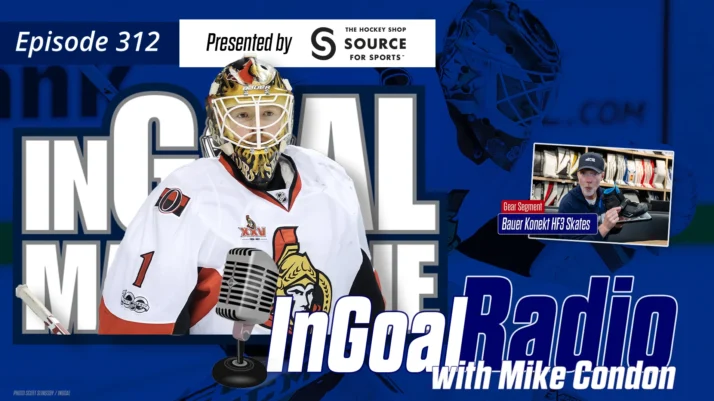
InGoal Radio Episode 312 with Mike Condon

Please subscribe and leave a rating — it helps us reach more goalies!


Former NHL goalie Mike Condon, who played for the Montreal Canadiens and Ottawa Senators, earned a Masters degree in psychology and now runs Condon Performance Consulting. He coaches goalies on managing tension, letting go when the puck drops, and how mental health away from the rink shapes on-ice patterns. Condon also coached Devon Levi at Northeastern University and worked with the MIT baseball team during his academic training.
- Mike Condon combines NHL playing experience with a Masters in psychology to offer goalies evidence-based mental performance coaching through Condon Performance Consulting.
- Condon emphasizes that tension management and the ability to 'let go and just play' when the puck drops is a trainable, coachable skill for goalies.
- Mental health and environment away from the rink directly influence a goalie's patterns and responses during games, according to Condon.
- Each goalie's individuality must be central to any mental performance solution — there is no one-size-fits-all approach to mindset coaching.
- Devin Cooley of the Calgary Flames breaks down the decision of when to take ice on a low-high pass out and offers a rebound positioning tip in this episode's Pro Reads segment.
Episode 312 of the InGoal Radio Podcast, presented by The Hockey Shop Source for Sports,features an information-packed interview with former NHL goalie and NCAA goalie coach Mike Condon, who went back to school to get his Masters Degree studying psychology is now combing his education and real-world experience to help other goalies manage their mindset.
Feature Interview
presented by NHL Sense Arena
In the feature interview presented by NHL Sense Arena, Condon shares stories and examples from both his recent educational journey, including working with the MIT baseball team, and a career highlighted by his time with the Montreal Canadiens and Ottawa Senators. The conversation is loaded with fascinating insights and advice from this blending of two worlds, as well as his time coaching Devon Levi at Northeastern University, including talks about tension, being able to let go and just play when the puck drops, how our environment and mental health away from the rink informs some of our patterns on the ice, and why the uniqueness that each goalie brings to that conversation needs to be a part of finding solutions in game situations.
You can contact Mike Condon, M.Ed, through Condon Performance Consulting, LLC at mike@condonperformanceconsulting.com or check out his website at condonperformanceconsulting.com
Parent Segment
presented by Stop It Goaltending U
In the Parent Segment, presented by Stop It Goaltending U the App, we share 8 great tips for getting the most out of your goalie camp this summer, and while most are for parents to help their young goalie, we have one just for parents too.
Pro Reads
presented by Vizual EdgeWe also review this week’s Pro Reads, presented by Vizual Edge, which Devin Cooley of the Calgary Flames breaking down the decision whether or not (and when) to take ice on a low-high pass out, as well as a valuable tip for rebounds.
Weekly Gear Segment
presented by The Hockey Shop Source for SportsAnd in our weekly gear segment, we go to The Hockey Shop Source for Sports for a closer look at the all new Bauer Konekt HF3, a second price point skate with several new features that may have some goals choosing it over the higher-priced option.
Episode Transcript
Intro
We're up and running. I love the beats to the music. Hutch, keep it going. There's been a, a comment or two that they changed it up, and you just steadfastly are committed to the tunes. I love David Hutchison, Kevin Woodley, Daren Millard.
It's InGoal Radio, the podcast presented by The Hockey Shop Source for Sports Langley, thehockeyshop.com. Had to throw that in, for my good buddy over at City National Arena in in Vegas. You guys have been busy this week just pounding out the content.
It's been pretty steady over at InGoalMag.com. We've got our, you know, our weekly ProReads continues to chug along. Every week, you get a new video from an NHL goalie breaking down footage, explaining their save selection process, why they show certain depths, what they're looking for in attack. But we've had a lot of, drills up and tips and advice. We had Thomas Speer pop down to Seattle, caught his camp in Pacific Coast goaltending.
Got a got a a series on breakaways where he's got young goalies out there. So the principles apply at all levels, but whether you're a young goalie, a beer leaguer, or an aspiring junior, there's something there for you. So the first of three from Thomas Speer talking about breakaways and then a drill to sort of help you understand how to manage your depth and matching speed on breakaways, that's up. We've got the first two and a third coming from Mike Lawrence on holding feet, a sort of a holding feet stance. And this is something we can get into a little bit because this is a trend.
I've talked to a few goalie coaches around the league that Mike identified in junior as a problem, and we're I see it in the NHL as a problem. And I've talked to a handful of guys that that that agree. The idea of the tall narrow stance, which has become a buzzword we've talked about it a ton. I've talked it about a ton with the goalies on this show, and a lot of guys are adapting it. Too wide, too low, too soon is a problem.
But we go tall and narrow without developing the ability to make saves from it. And so guys are getting caught in transition. So Mike's got a great series about sort of how to get comfortable with a narrow stance you can make save execution out of and finding that balance. For him, it's a two stance system, but there's drills to sort of help you get comfortable. We've got the second and a third one coming.
That's all up at InGoalMag.com. And then we also continued with the series we we shot with Colin Zulianello. It was with Coachella Valley when they came through in the playoffs. We did a bunch of drills with Alex Steschka and Victor Osman, and now they've moved up. Now we've got Colin Zulianello, the goaltending coach of the Seattle Kraken, moved up into that job.
We've got another from him that's up this week. Got one more to come next week. So we're just lot of teaching content at InGoalMag.com. You're getting more than your money's worth the past couple of weeks at InGoalMag.com when it comes to instructional content for the summer.
Hutch, what's been keeping you busy?
Like Kevin, I've been visiting some goalie camps. I think between us, we've been to five different camps over the last ten days or so. Got a chance to see, well, Eli Wilson in Edmonton. Spent the whole week with him there and got got out on the ice as as I do. And, that was obviously a really cool experience.
Our friend Connor Lacouvee who's been on the show a couple of times was running a camp here in town. So I got to go and see what he was up to and spend a little bit of time with him. And, then another camp, great group of young guys, the RB group, run a a camp up in Parksville just Northwest. So we got to see what they were doing too. So, yeah, lots of lots of great time seeing what people are doing at goalie camps, and I will be discussing a little bit of that in the parent segment.
Is there anything new on the horizon from a new save selection strategy that we're looking at right now, or is it mainly just fine tuning what we have? Because every couple of years, we do have something that that pops up, that changes the position a little bit.
It's interesting. I sometimes have said this about gear. You know, you look at some gear and you think, oh, it's they can't possibly do anything else to make it better. And the refinements in different lines are there are changes every year but they're incremental. But then you look back over the last five years and see what's happened to a particular line of gear, and it's actually made made a big jump.
And and I kind of feel like maybe goalie coaching is is in a similar vein. Is there a lot that's changed this summer compared to last summer? No. Probably not. But if we look at what's happening on the ice at a camp now compared to five, six, seven years ago, I think there's this fairly significant leap and different themes starting to come up.
You know, kids used to be sliding all over the place all the time and now we see coaches really reinforcing the need to hold your feet, you know, to refer back to that article what he was just talking about, and skating more on their feet. And, tracking is talked about much more. People were a little skeptical about the concept not too many years ago. Now you hear it coming up all the time. Just a lot of things being woven together to to see the game evolving over time as we're out there on the ice and and seeing it come up with the young kids.
And Eli makes an interesting point, quite often when we're at camps. Just, you know, having a discussion amongst coaches afterwards and he said, the NHL game, the changes that you're seeing at the NHL level are being driven from the bottom. These kids are learning new things. They're trying new things, and they come up into the NHL game, in many regards and not the reverse. You see a lot of guys playing pro and they have their way of playing the game.
They yes, they evolve. Yes, they learn things from their great coaches, but but a lot of the evolution in the game is coming up from the younger goalies who are able to do new things and able to try new things, and they're just sponges for the game. So it's it's interesting times out there.
Never thought of it that way, that it's the grassroots and the development that is driving the forward thinking of the the position.
Yeah. I mean, obviously, there's a synergy there. Right? But, I mean, there's kids if if we go away from the goaltending world for a second or something, maybe it's a little bit more obvious. There are kids that want to learn to do a Michigan, for example, because they see a Trevor Zeigress pull something off in the National Hockey League.
But there are so much more of that coming up to change the game because these young kids have such skill And they are evolving the game because they want to try things that, yeah, I'm sure their appetites get whetted by the pros, but then it becomes absolutely common. And, gosh, literally, I've seen nine year olds in house league hockey games pull off Michigan's now. So the game is evolving from the bottom up in in a lot of ways, I think.
That reminds me of when I first started sort of not covering, but learning about goaltending and writing about it back when Ian Clark hired me for Goalie News Magazine. We're talking about, like, 2003, 2004. And goalies in the NHL would talk about this. Like proper leg recovery, the idea that if I need to move left, need to get up with my right leg, was not a thing in the National Hockey League. Like, it wasn't.
There were guys who were all time greats, Olie Kolzig, Curtis Joseph, that had a they got up off their strong leg, not off their right leg. And if that was the wrong leg, they all off often ended up diving the other way. And they would talk about going to goalie schools and watching 12 and 13 year olds that move better than they did. And so it's interesting because I I do think that the concepts become more common and adapted at the younger ages. Like, don't see ten years ago when sort of the tracking stuff came and and there was a lot of talk about it.
It's hard to believe it's been ten years, but a lot of people thought it was just about looking at shots off the release, but a lot of it was the biomechanics and movement to eliminate counter rotation. Like, it was about getting to spots more efficiently and how top down rotation built that. Counter rotation, I couldn't unsee it in the National Hockey League ten years ago. Goalies, upper body swing in one way while their lower bodies were trying to move the other. It was common.
It was everywhere. Show me a goalie in the NHL that has that problem now. Like, it's almost nonexistent. There's a couple that there's some that don't rotate as well as others. There's a couple that when they get scrambling, they start swinging.
But compared to ten years ago, it was more common to have counter rotation than it was to not. And so actually having been on the ice as some NHL guys figure that out, being shown it by guys and coaches that weren't in the NHL. Yeah. I I I see that premises. I think it's a balance of both.
Goofy question. But is that a strategy something that you work into your game and you can perfect as a safe selection, or is that just drilling it into your body and its muscle memory?
I think it's first, it's understanding the concept of why, and then that allows you to and it's not so much a save selection as how you move. It's finding efficiency and movement. Right? You get you get to the top level, you're looking at one or 2%. Like, that's all you're trying to gain.
You know? Like, one or 2% is the difference between an eight ninety and a nine ten, like AHL or NHL star. Like, nine ten now, you're you're in the all star game. Right? So, you know, it's finding those 2%.
And so understanding the concept first and foremost, so you can execute it and feel it and then repping it till it's ingrained. And I just think the way those concepts are introduced, like, is so much more prevalent than it was ten years ago because because because there was a nobody was looking for it. Right? I I've been on the ice with NHL goalies that were when it first came out, they're like, yeah. Everybody tells me to look at the puck.
Nobody ever told me how. And when you understand the how and how it affects the way the body moves, it's sort of for some guys, it it's it's like a little on off switch. And ten years ago, you could see who was on it and who was off it. Now more often that more goalies are on it than are off it just by default, if that makes sense.
What what's the most recent big step revelation in goaltending? Would rotation, or puck tracking? Is it RVH? Is it overlap? What would be the last big thing?
It might be. It might be the I don't even know it's a big thing so much as a trend, but, you know, I don't know, Hutch, if you agree with this. Like, this isn't just because we've got the series up from Mike Lawrence, but, like, you know, I think about how often we have heard goalies on this podcast talk about as the game becomes so east west, the need to narrow up, the need to keep their edges to hold their feet to skate. So whether that's holding your edges, to me holding your edges is a principle, not sliding, and finding a way to do it, whether that's narrowing up in general terms or a more specific stance like Mike is teaching in the series at InGoalMag.com, that's the mechanism. You recognize the need because the game's east west, we can't get caught low and wide and locked in because then we can't move as well. Now how do we find the mechanism?
And so to me, that that feels and maybe it's not even a new trend because it feels like we've been talking about it for five, six years with guys in the NHL, but it feels like a trend that's all over the game. And now as as Mike points out and as we've seen, understanding that, okay, there's a reason for this, but, boy, you better be careful in how you execute it because guys right up to the NHL are getting caught transitioning from that into save. Maybe maybe that maybe that way we're just seeing the start of the understanding of of the next part of it. And I'm sure there's lot of coaches listening to this who are like, I've been teaching that for five years, and I'm sure they have.
The idea, can can players or do you think we're at the stage where players can see a a high narrow stance and take advantage of it? Are are are they at that point?
I mean, if they're listening to the pre scout, I know it exists. Yeah. There is a certain, you know, there's a certain there's a couple I'm not gonna, like, identify certain goalies, but there are certain goalies that a 100% the pre scout would actually be to shoot from further away and look for opportunities to catch them in transition. And to catch them in transition with shots just over the pads because there is extra pieces to the movement that delays them getting into a save set, and usually where the access disappears for them to pucks is low and just over the pads from that stance. So a 100%, Daren.
And then the other one is to catch them in transition widening out and look for look for that distinctive move from narrow to wide. And once you've got them in wide, if you can get that with a pass option, waiting until you see that before you move the puck because now their mobility is and their rotation is not that's I mean, some can still do it. Some of them are I mean, they're they're incredible athletes, best in the world, but but it's more limited than it was when they were in that narrow stance. So a 100%, this is pre scouted. Just like just like shooters look for a fingers up glove position and shoot low versus, you know, sort of handshake position they might try and go over the shoulder.
These kids are looking for it. I believe that the best of the best are, and at the highest level, they're being taught to look for it and told to look for it, especially in a playoff series.
Hutch. Yeah. If anything, the trend is the players and what they're learning, both by all the incredible skills coaches there are out there now working with players and from the ones that are smart enough to show up at goalie camps and engage the instructors there and to learn from them. I think that is something that's I mean, it's been around for a while, but you can definitely see it see it evolving and then they're able to pick guys apart. I was just gonna go back to the the question about the stance and and holding feet, and I think that probably would be one of the greatest trends right now.
I'm gonna go all in on holding your edges and remaining on your feet as long as you can and skating places rather than sliding places. Just to be devil's advocate maybe. I'm not as sold on the narrowness of a stance and being as strict as everybody thinks we need to be. And and I'll just give you two reasons, maybe more. We'll see how it goes.
One, look at other sports where we have to have athletes with extreme mobility. I I don't think I've ever seen a Major League shortstop set up for a pitch with his feet just barely wider than his shoulders because he needs mobility to both sides. I don't think I've seen a basketball player, you know, in a mobile situation set up quite so narrow. I don't know that it's as important, but this is just me talking, you know, off off the top of my head here. We also hear increasingly coaches talking about the ability of goaltenders to have power and explosiveness and access to their edges when they are wider.
I think there will be a trend that we can get a little bit wider. Yes. Guys look for guys to get wide and locked in before they make a pass, but locked in, I think, is really the key to that as opposed to wide. The ability of shooters to employ deception is a great trend right now. And you see that at goalie camps all the time.
The shooters are being told how to employ deception. And you see it with the most skilled players in the National Hockey League.
Are you talking about their releases?
I'm talking about their releases. I'm talking about you're on a two on one and you look pass all the way and then you can put a shot on net without ever moving your head, without ever looking at the net. The ability to freeze a goaltender in that two on one situation by showing shot all the way and then suddenly moving it without looking that you're gonna pass. And those guys who are a little bit wider can get locked in in that situation and sort of buckle the knees and not be able to get over there. I'm not suggesting that you're gonna see every goalie off the rush in five years employing a wide stance, but I'm just not as sold on needing to be narrow to be mobile as everybody else is.
Well, that's kind of the point of Mike Lawrence's thing. Like, it's not narrow. Like, it's different definitions of narrow. Like, his narrow isn't feet together, like, shoulder widths apart. Like, it's a little bit it's a save act.
You can save execute out of it. And that's kind of the point of the conversation is if you're just upright for the sake of being upright and your hands are above the crossbar from a puck perspective and you're just shuffling along without any ability to go into save execution, you've put yourself at risk for these types of shots. And so I think it's just changing the definition and our understanding, because let's be honest, narrow and wide, you're right. Like this is sliding scale and it's different for everyone biomechanically. Andrei Vasilevskiy can be like almost knees to the ice wide butterfly and still have incredible power to go east west.
And so, yeah, I agree. I think it's just it's it's an evolving conversation that is different for every goalie, but the key is to be aware of the conversation.
Yes. And the language is so important as you say, Woody. And and I think that's something that we we are guilty of sort of smirking at people that come up with cool new terms and all the language behind goaltending. And I know people, I see them in our comments, criticizing guests for the use of terms and trying to complicate the game through that but that's it's just not true. You're trying to create some precision in language so that people understand what you're talking about and I and if somebody comes up with a new term for a stance that is narrow ish but not just at your shoulders, they will help the goaltending world because just saying narrow confuses a whole lot of coaches and you've got a lot of people out there teaching the game whether you're a goaltending coach running a camp or a parent trying to help a goaltender on the ice with the local team and they hear narrow and they don't understand the subtleties of it.
So I think precision of language is super important. That's why when you get into the academic world, you know, that that dictionary expands in in a way that it doesn't anywhere else. And it's not just people trying to feel good about themselves because they've got all these great intelligent terms. It's precision of language that helps us understand what we're doing.
Your reference to other sports got me thinking. And and you're right about shortstop or a a tennis player receiving serve and a soccer goalie in a in a penalty shootout. Imagine a soccer goalie standing straight up being able to go side to side or or a tennis player receiving serve.
And to be fair, I wasn't talking about straight up and down. I was simply talk like, I I know
Narrow stance.
People teaching kids to be quite narrow even though they're in a lower stance in a situation where they might need to make a save. The other other example actually, saw my son engaged, he was coaching. I saw him engaged with a goaltender and just been drafted into the Western League. So quite a good goaltender and they were going over stance. Obviously, I was in the stands watching at this point and I went up to him afterwards.
I said, well what were you saying to him about about the stance there? Well he couldn't wrap his head around what I was saying and I said, okay, well just imagine we're about to get in a fight here. We're a couple of boxers. How would you stand so that you can be prepared to attack and receive what's about to happen here? And there's another sport influencing what's happening.
It was a great explanation to the kid and got him exactly where he wanted to be and was a big light bulb moment for him. But, yeah, we should we need to look beyond the bounds of just what we're teaching in hockey.
And definitions. Right? Like like, you you it's funny because you point to a shortstop and and, off camera there. I'm just basically going into my old shortstop session.
You did. I was just gonna say What the
hell what are you doing? Well, I mean, I played.
Physically thinking I felt bad saying that because I'm about to I was just waiting for Woody to be like, no, Hutch. I was a shortstop. Know what? Don't know what
you're No. But, it's about definitions of width. Right? Because, like, a wide like, a really locked in wide butterfly, like as a shortstop, you're right. My feet are wider than my hips for sure.
And I've got on the toes, you got on your toes, you sort of walked into that stance low and ready and ready to explode in either direction, including back or forward. And so that ready position that we were taught, I actually think as I get into it, I was trying to like feel it. I'm like, yeah, that's that's a lot narrower than what I would consider a lot a low wide butterfly, like a lot narrower. But, again, it's about definitions and understanding. And and you hear Mike Lawrence in the language talk about sort of pressure and press it and having that pressure on the skates.
It's about being able to feel in a position where you can move. And, we didn't mean to make this all about his articles, but the beauty is he followed up with drills that can help you find comfort in a stance that gives you that mobility, east west, is is is narrow enough that you're not losing the lateral mobility we need in today's game, but is still athletic and reactive enough and and wide enough, maybe that maybe we're just using the wrong words, that you can make a save out of it.
Is knee position, a sort of a forgotten part of this? And I talk about knee position, whether your your knees are locked together or there's a little bit of space up there because you can a wider stance and your knees locked is different than a wider stance, and I'm thinking of the short stop analogy again, where there the there's a space between the knees.
At the end of the day, like, can go knock kneed and you're digging in on your inside edge just as much as if you're you go knock kneed from a narrow. So there are
different elements. Still have a knock kneed in a narrow stance.
Right. And yet, I think it's James Wendland who wants it's one in one of our articles, Hutch, where he talks about, like, athleticism living on just the inside of the the foot, like the knee being having slight inside I'm gonna use the wrong terms. This is not what he said, but, like, I'm thinking of the knee just being slightly inside, not knock kneed, but at the end of the day, all of this is different for the individual. And the idea is to find ways to get comfortable and recognize what you need to be able to do in that stance. Whether you're in a two stance system or a three stance system, recognize that you need the ability in today's game to move, but it can't be at the expense once we get to a certain part of the ice.
And and, you know, some would argue anywhere in the zone, the way shoot the shots are that you can still make a save out of it.
I'm gonna loop back to something after we, do some business. But, Hutch, I want you to remind me about pads in the stance. Okay? It's all you have to say, and it'll it'll turn the light bulb on. Okay?
Do do you guys remember twenty five minutes ago before we hit record when we said, is there anything to talk about
this week around the league? Organic what we've just done.
Said nothing going on at all.
Yeah. But I I love these conversations, and I I feel like the luckiest person, in in goaltending to be able to talk to you guys every week and explore these different areas of our position.
Do you know what the best part is? That there will be coaches at all levels right up to the NHL goalie coaches that listen to this and are gonna reach out with feedback and wanna continue the conversation.
So let's And and please do that. And and and if you're new to the position, send us a note, your questions. Maybe we're we're talking in two, technical terms or, you wanna know a little bit more about, how it's transitioned. Or if you're a National Hockey League goalie coach and you're listening to this, give us some some guidance on on how we're we're handling this. But then
But go beyond the simple Woody's an idiot because we know that. Give us more depth than that.
[crosstalk] You're not an idiot. Woody, Stop it. Our Sense Arena feature interview, this week, Mike Condon. And boy, is it fascinating, Woody?
Yeah. No. Mike is, former NHL goaltender, a remarkable career full of all kinds of great highlights and big moments. He's been a guest on ProReads. He's been we believe we're trying to figure it out two times before on the InGoal Radio Podcast. I probably should have looked that up. Coached at Northeastern University where another curious mind in goaltending was one of his students, Devon Levi, walked away from that to go back to school to get a degree, a master's degree in basically, he's he's a psych like psychology, and he is now working on the mental side of the game. Now there's some specifics in terms of the correct label that we'll get into with Mike, and he'll explain it. That line between, you know, mindset, mental training, and actual psychology and the way he's blending those two, because there is sort of there's some gray areas.
There's some but at the end of the day, Mike is one of those guys that is no stone unturned, always looking to learn anything he can bring to the position. And now he's bringing that and all the experience with going back to school for psychology to the goaltending world, through his company Condon Performance Consulting LLC. So we're gonna get into all of that in the future interview. It's a it's a good one. There's tons of great takeaways and advice in there.
Lovely. No stone unturned people, because, when they're really dialed in, they're they're the best. Some of those rocks are heavy, and they get right to it and, leverage it and and flip them over. We've also got the Vizual Edge ProReads and the Stop It Goal Tending U, the app, parent segment. But right now, the Gear Segment brought to you by The Hockey Shop Source for Sports Langley, thehockeyshop.com, and, I got a chance to listen to, you guys.
Gear
And, boy, there there's there's a new twist on, one of the great new, advances in the goaltending equipment category. But what's going on over at, the Hockey Shop?
Well, we're gonna get into the new Bauer Konekt skate, the new version, which is interestingly, as you we'll tease it here a little bit, a second price point skate, but it's got a new feature that this one may be led by NHL goalies that changed the way they were wearing the original one. And to the point where when we had Cam Matwiv, longtime listener, come up, we were filming this segment the day he came up from LA to get equipment, including skates, and were so sold on this skate as the next step that he purchased it instead of the highest price point skate. So there's a tease for you. It is just one of many new pieces of equipment that has arrived at the Hockey Shop over the past weeks and months. They are stocked to the gills with the latest and the greatest.
Bauer, CCM, True, Warrior, Vaughn. All the new stuff for the upcoming season is in stock. And when I mean in stock, I mean 30,000 square feet warehouse in the back and another warehouse off-site. So if you need it on short notice, no time for custom orders, there's a good chance that The Hockey Shop Source for Sports in Langley has it for you as a goalie. And although a lot of these sales have been running and the merchandise on that end is running lower, Whenever the new stuff comes in, the old stuff's on sale, huge discounts.
Past generation, CCM, Bauer, where they had lots of inventory, 25% off and more. So whether you need the latest and greatest, they'll have it for you. Looking to save a few bucks by buying the previous generation? Good chance they still have some of that left too. Make sure you check them out at thehockeyshop.com.
The Hockey Shop Source for Sports Langley.
Getting into the new HF3 Power Konekt skate, and there's some real changes to the boot that has the ski boot, type of approach. Let's get over to Cam and Woodley over at the Hockey Shop.
What's in the box, Cam?
Oh, I love this game. We hit the plate. What's in the box?
Do I have to stick my hand in the box? You can Can I give the people a hint? Oh. Oh. Bauer Konekt.
But this one is different. This one is new. This one is a surprise. Let's show. Let's show.
The new HF 3. Oh.
It's pretty. It's pretty awesome.
Oh, I like that. Good job, Cam. Yeah. Okay. So people here, Bauer, Konekt, HF 3.
We're back at
the Hockey Shop Source for Sports. People
see it, people hear it, but do people know what it is? What is
the Bauer Konekt HF3? So this is replacing the HF2 at that mid price point level for Bauer. Some new features on here. I mean, one of the things that you're gonna notice right away, no bottom buckle. Velcro.
So let's get into this a little bit further. Okay. So what has changed? What's different? What has Bauer discovered a little as they've kind of gone through this line of no lace skates?
So the removal of that bottom buckle has come about for a couple different reasons. One, the HF 2 buckle, although it being good, had some issues. K. So they updated and gone with, well, if we don't have a buckle down there, we can't have a problem. So we're gonna switch to Velcro.
So this is still gonna give you that wrap and snug fit that you're looking for, but you don't have to have it, like, completely cranked. And that's something that through discovery of, you know We've seen guys
in the HHL take the lower buckle off completely. Exactly. Like a Conor Ingram, for example. I think there are others too.
Exactly. So that's giving you kind of, you know, that perspective of of why, for example, but you can still get that again snug fit. New for the skate completely is their new full wrap wider. So this is something that's definitely worth calling out because it does lead into what this piece is up here. So if you want to slide yours out all the way.
So now, as opposed to having that tongue in the front, you get that full wrap style. So very much more heavily inspired by that ski technology, for example. I really like the fit of this that allows that still that forward flexion in the skate.
You got some elasticity.
To help hold
onto it so it doesn't
flop all over the place. Nice. Good connect call out. But a nice cool little feature at the top here.
What's this? The last part of the liner.
Well, the problem of your toe tie slipping off that Velcro because there was nothing for it to hold onto. So now you can put your little Velcro toe tie through there so that stops it from sliding off the top.
Oh, so you wrap it around the toe and then it comes through on that. I like it. That's smart.
There you go. A good way to hold onto your toe ties. And again, some good notes that, you know, listening to feedback from throughout the lifetime of the old couple skates. Nice bit of improvement.
Okay.
So hold on. Because this is question's gonna come up. Yes. These liners do work with the previous models of Konekt, but it's something that is available aftermarket. If you were looking for a new liner, that is possible.
So overall, it will be the same price point as the current other liners that are on the Ultraland liners and whatnot. That said, it is something that will work in the other lines of boots.
Okay. So is this liner, it's got the new fit, the new wrap and all these elements, but is it a lesser material than the higher end ultra long? They
consider it the same. Okay. Again, now additional option.
So this is a lower price point skate with lots of new features that we might see it maybe adapted to the higher price point in in future generations, do you think? Or do you think we'll always see like, are there people that are going to even though this is a cheaper skate, like, from a price point Yeah. That are gonna want this Velcro on the bottom instead of above?
For sure. I mean, yeah, there's definitely that option there for like, and I don't see enough of a reason to be like, okay, well you really have to go down or like trade back up for example, because you're going to get X better out of the skate itself. That said, the shell itself doesn't have the exact same thermal modal qualities that the Pro, for example, Konekt 2 does. It still is, still will follow the same process and whatnot, but you will get a little bit of a better mold out of the Konekt 2, for example. That is starting to
flex point?
Still the same flex point. You're still getting your 22 degrees or yeah. 20 degrees of forward pitch. Okay. Yes.
Okay. So there you go, folks.
This is and when we talk about a second price point, so a lower price point, how much of a difference are we talking about?
So we're talking about $750.
Compared to? It would
be $1159, I believe it is off the top of my head.
Okay. So significantly, this is like a $400
less gate. Upgraded steel too from the previous model as well. So the h f two did not have LS five g. This does, so you get a better quality
steel pump. This is a lower price point skate with a lot of really great new features.
Exactly.
Alright. Power Konekt HF 3. If you've got any more questions for Cam and his crew, where do they get you?
(604) 589-8299.
Fitting? Can you answer questions over the phone about fit with something as, you know, like this or do you really need to come in and get it molded?
This is one that you should kinda come in. It says it's a bit of a harder skate to shop for online unless you've had it or been fitted before. Okay.
There it is. I'm glad we played What's in the Box, Cam. I'm quite excited by this great new look. Cheaper price point with new features.
Yeah.
I'm I'm excited.
There you go.
This is good. Alright, folks. Bauer Konekt HF 3. Now you know what's in the box. Now you know what's new from Bauer in skates.
The Velcro grabbed me instantly, and then I saw a picture of it. It looks fantastic. And that little loop for your toe ties, it's brilliant.
Yeah. And I never thought because I haven't worn them. We I haven't used the Bauer Konekt skates, but I forgot about the fact that, you know, having a place to tie in your toe ties kinda disappears with those. Can you guys tell me? Do you guys remember?
Because I think we were the first ones to show it off, Which NHL goalie was the first one to sort of publicly ditch that buckle across the top of the foot on the on on the original connects gate? Queue up the Jeopardy music.
I don't know who it was.
Hutch. Arizona. Arizona.
Always giving teases for you, Daren.
No. I'm just trying to I I know exactly who we're talking about here, and I'm just
having old man moments.
He has he has been he has been a guest on the InGoal Radio Podcast before.
Currently with Arizona?
Well, currently with Utah still. Oh. Summer's in summer's summer's in the Prairies, Daren. Come on. This is I mean, it's just one province over from your home province.
Conor Ingram? Conor Ingram. Ding. Ding. Ding.
Ding. Ding. Ding. Ding. Attaboy.
Attaboy. Yeah. Conor Ingram was the first one I remember seeing it in the locker room. It doesn't mean he was the first one to do it, but I hadn't seen it sort of discussed publicly, at least at the National Hockey League level. We had a lot of adoption of that that connect skate, and he was the first one to be like and we heard some people talk about the the top or the buckle over the top of the foot maybe not, you know, being too tight or not not really being able to close it.
He just ditched it completely. They took it off. So Bauer sort of following suit here and recognizing that it's the top one that matters the most and you can achieve and some savings in both weight, material, and obviously cost on the HF3, the second price points gate by putting Velcro there instead.
I wondered if it was rubbing against the pad and and that was causing an issue, but I guess that was
Honestly, we thought that would be an issue, Daren, and we asked about that in the early going. I have heard no one complain of that as as you know what mean? I suppose if you had a bootstrap on there and you're cranking it down really tight, I could see that being an issue, but maybe it speaks to how few people actually do that anymore. Yeah. I have not heard a lot of complaints about the buckle over the top of the foot causing issues in the boot of the pad, with rubbing or wearing out.
And you've got such a great fit if and you you do have to see the experts when you when you buy a Bauer Konekt skate, to to make sure that it that it covers your foot properly the way it is. That I'll I'll I think a little bit of sway with with the Velcro, the tiny bit that it would give might not be a bad thing.
No. I I mean, like you said, you got guys in the NHL taking it off completely. So so obviously, the give isn't costing them or they don't feel it's costing them from a performance standpoint. You know, it's you're right about the fit. It's it's not just the fit and getting fit.
It's it's getting it baked. Like, because there's a lot of sort of, what do they call it, thermal moldability in that game.
So it's Speaking of.
Quite a process. Yeah. Quite a process to sort of get it baked and and sort of wrapped around your foot properly. They gotta wear gloves. It's hot.
It's in the oven for a while. There's a whole thing with Bauer that I probably should understand better than I do, but I just leave it to the guys at the Hockey Shop Source for Sports just just like they did with Chris.
They have a a little inner boot that you have to wear that covers your toes when you put it in. They've got another insulating
boot that's on
the outside of the skate afterwards as well. There's a lot to it, so you really do need to get them fitted properly. One question that did come up in comments recently, Woody, and you're gonna have to help me with the number here, But somebody said, if you buy used Konekt skates, can you get them refit, for you? And I'm sure we were told it can be done, but I believe there was a limit something like four or five times and they don't like you going beyond that. Do you remember the number?
No. Because I think the limit we probably had that we probably established that limit with a pro that we knew that was trying them on. Maybe maybe lives near you and I think it might have been Connor Lacouvee that sort of entered in that conversation because he had to have his redone a few times if I remember correctly. I don't remember what the number was, but also to keep in mind that the thermal mold ability, look at me, I discovered a new word and I'm gonna throw it out there all the time, is different from the pro to the second price point. So Connor was if I'm remembering it correctly, obviously dealing with a pro skate, the second price point has less of that Yeah.
Cam was mentioning that.
Yeah. I don't know if that means you can do it less or if it actually means you can do it more, but the moldability in terms of how much it's gonna actually adjust is higher on the highest price points gate than it is on the second price points gate. So another thing to keep in mind when you're considering the HF3 from a fit standpoint, if you get it in there the first time and and it and it's too tight or doesn't but also on the secondhand basis. So I'd say it's a good question. It's a really good question.
Knowing the differences between the two doesn't help me answer it, but just understand there is a difference between the two. I would I would think less moldable means you can probably do it more times and you're just not gonna notice as big a difference.
But but the point is you can buy a used pair of Bauer Konekt skates in in all likelihood unless the person before you decided to remold them five times, you're gonna be okay.
Right. That's like it's like buying a used car. Right? Like, they change the
Buyer beware.
Time how many times did they change the oil?
Skate boots to go with carFAX. Yeah. carFAX now.
And the liner is is not what what you're molding for everybody that that's not familiar with that skate. It's it's just the shell. Yeah.
Yeah. They got a better there's a better word than plastic, and I wish I had it in front of me, Daren. There's a it's a very they have ski boot industry. It had a really great name, and now I'm cramping on it for the high end one.
Like But
it's interesting that that. Second price point is is something that offers great value and a couple of advantages that that make you think about, the the top of the line skate.
Well, and that this is where it gets interesting to the point where do you take the sec Like there are some guys that are looking at that second price point and they're like, do I want this instead? Now there are things it doesn't come with, but it comes with a lot to the point where it's actually a decision. Like you might be like, I want the top of the line, but then you try them on, you see the features, and you're like, I actually kinda just want the new one even though it's cheaper.
Mhmm. So if you if you're a recreational player, this is a great skate for you, the HF 3
Great skate. Great skate. Yes.
You know what I like about it? The white tuck. I'm a white tuck guy and top of the line has the the it's all black. I'm I'm I'm I love this part of it.
So the the all black is kind of a feature of the top line. Like Yes.
Guys are guys are liking the sleek look. We're gonna have to just grillemid. Was close. Them it. You were were you were sort of close.
Grill them it is the name of the material on the highest end skate. And it like I said, they got it from the like, this isn't just and I said thermal moldability, it's thermo thermoformability. See, I didn't even get that right. Hutch, we both were off.
You're close enough.
Tomato, tomato on that
one. At the end of the day though, like we talked about this, this isn't just like, hey, let's get some plastic and throw it on a skate. Like, to go back to our first review of the first Konekt skate, they really went to the experts. Right? Like, it's got a ski boot design to it. They went to the top ski boot builders and and and sourced materials that would make this work.
And, hey, has it been for everyone? Is every goalie wearing it? No. But we've seen a pretty widespread adoption. It's it's talking about innovations like we were earlier and what's changed in the game.
I almost forgot. This is this is a big one. And when you talk to the goalies that have switched, out of that that that, you know, that one piece skate, they feel like their hips and knees are having less wear and tear.
I'm getting new wheels, before the start of next season, and I've sort of gone down the path of where I was going to go, and this is this is altered things a little bit. So thank you. Appreciate it. It's it's it's making me take a step back and go, oh, the HF three. Let's consider the connect.
Shall we meet you at the Hockey Shop on your way home to Las Vegas this summer?
Yes. Let's let's let's do it. There's nothing more that I would like than to hang out with you guys. And, you know, like cycling, stores have coffee shops inside them? That's what we need.
Best. Told Cam that once.
We need we need a coffee shop inside the hockey shop.
100% they do.
With a little Sense Arena set up in the corner so we can get on our game.
Let's do that. And they'd be turning off the lights like you guys
Leave.
Get the heck out of here.
Kinda like they do when I go to work at the Starbucks. Buddy, you've been here for six hours. You've had one coffee. You didn't tip for crap. Get lost.
You can go to you can get free refills now too, at at Starbucks, at least in The States you can. So, that's a that's a real advantage. You take your new laptop over there. Before we get into the parent segment and the pro reads, Hutch, just a thought on pads that was going to me about the the stances. When you guys go into your stance, which pad overlaps at the front when when they overlap?
Or Oh, I love
that question.
I like, I've thought about it since I've been wearing my new AXIS pads, and I normally, it's the my right foot, my right pad that that is overlapping at the front. But every now and then, they'll click or the left one will go over up. I'm like, what? Is is it supposed to change every now and then, or is it always one pad that's in front? Answer me this question, please.
And is it like skateboarding and surfing? Do you do you have, like, a goofy foot guy and a regular stance guy depending on where your pads go?
Yes. Yeah.
I I'm virtually certain for me it's left ahead of right if they overlap.
Really? So I've got it backwards.
But I would actually stand the other way if I were on a skateboard for whatever reason.
Woody, which pad overlaps at the front?
Well, mine's the left like Hutch's, but I'm pretty sure I know why. And I I think it's because, like, my left hip is kind of buggered, and I don't have like, it's a lot harder for me to get any width there. So inevitably that little more width on the right side, unless much like narrow stances, we're talking about like, when we talk about wide, we're variations, baby. With this is the narrowest wide stance.
It's relative.
Yeah. It's all relative. But it like, because my left hip, I can't get as much internal rotation because it needs some fixing. That pad is inevitable. That that part of my butterfly is inevitably narrower.
So that that top of the pad, that thy rise is sticking more forward. Whereas I get a little more wrapped and and sort of five hole coverage out of the right one. So I I would think that how our body because we're not we're not sort of perfectly what is that phrase when you're the same on
both Symmetrical.
We're not perfectly symmetrical. So, like, having a little I knowing that my hip and my knee on the left side are worse and it's narrower on that side, that pad, that thyrist is inevitably gonna be shooting more towards the shooter, whereas the other one has a better chance of sort of coming in and and being flat. So it's almost always my left one, and I assumed that was the reason why.
So it usually is one that's more prominently in front. It doesn't just switch off depending on if your butts come down the one side to the other.
That's a great question. I've never thought
Please people respond. I I don't know whether this am am I just out to left field? Has anybody ever thought of this? Is it just me being bored during one of my my skates and and it got into my head, now it now it's rattling around in there? My buddy, Andrew Stewart, is gonna love this one.
I I I don't know. So please let let us know.
You may have just opened Pandora's box because right now I'm thinking situationally if if a play is coming down the right wing and depending on how you're moving and and if you're in a narrower stance, like, maybe maybe it goes the other way. Now I'm gonna be looking for this.
Like, would they ever teach that? Like, it's not getting up on right leg, wrong leg, but
you just cost Woody five more goals because the next time he plays, he's gonna be thinking about how his pads overlap.
Yeah. But it doesn't matter because And if
you think out there, you're dead.
Yeah. That's right. But it won't matter because I'll just go back to the bench and be like, sorry, guys. I was really focusing on my right pad crossing over from the left pad as the puck went between both of them and through my legs.
Guys, my my left thigh rise was was in front, I I didn't have time to correct it. I apologize there. Vizual Edge ProReads. Let's get into that before our Stop It Goaltending U parent segment with Hutch.
Devin Cooley is our guest on this week's was our guest. It's already up online at InGoalMag.com on our weekly ProReads segment. Had a great video breakdown of a low high play and walked us through when to grab ice. And when the proper positioning is just being center net as opposed to worrying about getting out to the top of the crease. In other words, as we've heard since the dawn of goaltending, angle over depth.
And so he walks us through that scenario about that decision making process with the videos. We look through the video of a save he made, and then we get a little extra tip on the rebound because the puck gets tipped on its way to him. He feels it hit him. He's not sure where it goes, and he makes a crucial mistake. One he openly talked about and chuckled a little bit at himself for making, got away with it.
But this goes to the story that we had online earlier this year about sorta tips from NHL goalies about surviving scrambles because we see more of them in the NHL than we ever have before. And that's just sort of stay home, don't get up. And so there's a great piece of advice in there as well as the low high, how to manage it, how to manage that decision on when to take ice, when to get up, when to just settle for center net on a low high pass out from Devin Cooley of the Calgary Flames. Gonna be, I believe, with the Calgary Flames this year alongside Dustin Wolf in a very inexperienced at the NHL level tandem, but but one with a ton of upside. So that's our latest.
It's brought to you by Vizual Edge as ProReads are every week, and it really is the perfect marriage. Because in ProReads, NHL goalies talk about how they see the game. So why not bring that to you by a company that helps you see the game better? Whether it's scanning the zone, looking off a puck, pulling back and seeing everything, or locking in on a shot and converging your eyes as it comes towards you, Vizual Edge will help you train your eyes to see and play the game better. It's not just a visual training tool.
It's a cognitive training tool. It's easy to sign up for. It's easy to use. All you need is a laptop or a tablet and the glasses that Vizual Edge sends you, and you can spend five minutes a day or you can be like Jordan Binnington. Every game day, he uses Vizual Edge to warm up his eyes and his brain, talks about how important it is to use it at the four nations on route to gold.
And, of course, InGoal mag is the discount, and we have a special membership discount. If you're an InGoal premium member, just go to any ProReads, any of the latest ProReads, and you will see a special member only discount code to save you even more 20% on Vizual Edge, the ultimate visual and cognitive training tool for goaltenders.
And you don't have to worry about your thigh rise preference. It's just it's all about just focusing on that aspect of it. Not just standing by with the Stop It Goaltending U, the app parent segment. What's happening over at Stop It Goaltending?
Well, we've got week the weekly, daily, daily, weekly. Every week, we get new daily primers. That's the best way of putting it.
That's pretty good. You you you rescued that out of nowhere. Well done.
Yeah. Hey. Listen. Much like my goaltending, I can spin in circles with the best of them, Daren. And quite often, I end up facing the wrong direction.
I would have been lost in a cul de sac for three hours there just going right around.
At the end of the day, what we come back to every time is the expertise from Stop It Goaltending. It comes from twenty five years in the business. It comes from being led by Brian Daccord, who has played as a pro, has coached in the NHL, as a goalie coach, scouted as an NHL goalie scout, been a director of goaltending in the National Hockey League. The Stop It Goaltending U app brings you the expertise from him and his entire staff at Stop It Goal Tending, including daily tips, quick one minute hits that'll help you be a better goaltender. This week, they look at five things you can do every day to get better.
What can I do today to get better? Log in to the app, watch a one minute video, and put it to work. Drill, they got a quick backdoor transition drill up there this week. That's a new one. You can take it out onto the ice.
Ask your goalie coach to run it. They got a video goalie one zero one talking about blade lock, so skate on post versus toe locks or that sort of the the toe your pad on post. They break that down, the benefits of both, when to use each in a video. They got a headspace tip. Pretty much a little bit of everything in the Stop It Goaltending U app.
And dare we say, not maybe best of all, but a big part of it, free subscription to InGoal Magazine, InGoal Premium. You get the best of both worlds when you buy a membership to the Stop It Goaltending U app.
Is there a category about what happens if you, get caught in a tough situation in a Coldplay concert? How do you say that?
We'll have to we'll have to see if we can work that into a future episode or a future, you know, primer, daily primer from
That dude wasn't staying on his feet.
No. No. No. He but he I mean, I mean, he that was a Dominic Hasek level type scramp.
That was. That that was it saved the internet, that situation. Feel bad for them, but but that thing the the memes, coming out of it have the Philly fanatic one, was was amazing. All all kinds of stuff. So, follow that one up, Hutch.
I don't know how I follow that one
If this if this was a a YouTube, if we put everything out on YouTube, we would've opened with Hutch and Woody at a Coldplay concert.
Steph and Jill would not be pleased.
What do you have going for us, this week? How how many different columns are we going to run down?
Parent Playbook
We are going to talk about having your best goalie camp experience. I am probably speaking more to goalies than parents, but parents, this is for you to help prepare your young goaltender as they head off to camp. I don't know how many tips, Daren. You can keep track as as we're going down here with your list and then I'll know how to title it later. As I mentioned before, Woody and I have both been to a bunch of camps in the last little while and there's more to come.
Quick shout out to the online directory. If you are still looking for a goalie camp this summer, head over to InGoalMag.com and there is a link at the top. You can go into our directory and you can search and find a camp in your area. I know I've seen people in the parents group saying, I'm gonna be in Saskatchewan this summer. Where do I take my kid to goalie camp?
And I just respond with, head over to the guide, type in Saskatchewan, and you will find several camps listed there or wherever you might be looking. I did want to share a few thoughts on making this, you know, your best camp experience because parents have invested a lot of money to give their kids a great experience at camp and and we want to make sure they get the best out of their time there. Number one I want to mention is nutrition. You probably think you need more food than you probably need more food than you think you do and it's really important that you ensure it's healthy. We're all in scramble mode.
We got a lot going on. We're trying to get our kids out the door to camp and sometimes that nutrition can fall by the wayside. Some of the camps you go to, if you're lucky, they're already catered. The Eli Wilson camp I was at last week, all the meals were catered for these, high end goaltenders and that was fantastic. But a lot of camps you have to bring your own lunch for example and snacks and so on and you're not gonna get out there for two ice times and a dry land session on junk food.
I was amazed. I am always amazed when I go to camps to see the number of kids that are passionate about goaltender. They love the sport. They love everything about it. They would do anything to become a better goaltender.
And then they're snacking on a bag of chips and a pop between skates. Can't let that happen if you wanna have a great experience. Nutritious food, plenty of it, lots of water. Go out there and have a great experience. Number two, put your phones away.
You don't need to remind everybody of the problems that phones can cause. We've got actually a great article with doctor John Stephenson over at InGoalMag.com. If you want to know more about that, I just want to remind the young goaltenders that you're there for the whole experience of the camp, not just the drills on the ice. Making friends, building relationships that are gonna last a lifetime, learning from fellow students and coaches just through random conversation that will not happen if your nose is buried in your phone. Put it away for the day.
Number three, sleep and recovery. As I mentioned before already, it is a grind at these camps and you they're putting in more than you normally would in a training day because we're trying to make the most out of a limited amount of time, and your body needs to be ready to handle those situations. So rest and recover. It's an important part of becoming an elite athlete right up to Olympians. Make sure you're getting rest.
Side note, parents, don't get FOMO, fear of missing out, and try and cram your kids through too much. I was at two camps that overlapped last weekend, and a number of the kids were doing both those camps. They were doing four skates and two hard dry land sessions a day and they were under 15 years old. It's too much. It's okay to stop, step back, and rest.
Next tip, have an open mind and work hard. It's not gonna be easy at these camps, especially later in the week. You're getting tired. It's okay. Push yourself to get the most out of each time you're in the net and try what the coaches ask of you.
Even if it's different from what you would normally do in that situation, give it a go. How many times have we heard a guest on the podcast say, it's more tools in the toolbox. You've got to learn. On a related note, we often comment on here about what makes a drill good, what makes a drill maybe not so good, having to be game related and so on. I actually saw a drill that I didn't think was super game related said to the coach, did you ever think about doing this to make it more game like?
And he said, sure. We could do that, but so many people out there are saying goaltenders need to be more athletic and do things in tough situations. We can't program every drill to be exactly like a game. We gotta have situations where kids must break from structure all the time and just be athletes. So don't be too critical of what you're seeing, in those things.
Don't worry about what you've heard from us. Just go out there and give it a go and make the most of it. Next one. Kind of related to that, it's not a tryout. You've got to go out there and learn and try to do your best in these situations, not thinking you have to make every single save.
It's okay to try something new even if it might be a step back in performance. Sometimes we have to take a step back so that we can take a step forward. I heard that from a coach talking to the whole group of kids, last week saying it's important that you understand you might need to take a step back. I watched my son go into the net this week and he announced to the coach, he said, just be ready. There's gonna be a lot of goals here.
I thought, what's that all about? He said, I am trying to practice what he called extreme patience. He wanted to be so patient on the release that maybe he'd be pushing it a little bit too far and some pucks would go by him. That was a pretty mature approach to, to what he was doing and good to let the coach at the station know that he was trying to do something special there. And then getting in towards the last one here, go meet somebody older, go meet somebody younger when you're out on the ice.
It's a little bit harder to say this to the youngest kids there, but the relationships that that happen on the ice between the younger goalies and the older goalies, I love to see that. The mentorship between the older goalies and the younger goalies when you're a junior age kid and you've got a 14, 13 year old goalie out there, go out there, take them under your wing. You will develop from the experience of working with another goaltender and they're gonna look up to you forever. And I think that's just one of those special things that comes out of these camps when I see mentorship, develop. As a bonus, parents, I see you standing quietly over in the corner watching the camp.
Take some time and reach out and meet another parent. I would love to see a goalie coach, by the way, run a camp where you put something on for the parents to do, during that camp. I've said it many times before. If any of you do, let me know. I'd love to hear that you've taken that innovative step.
But parents, you're part of a bigger, wider goalie community and it's fun to get to know the other goalie parents. As I said to the kids, we're not there to try and make a team. We're there to try and make everybody better. So don't feel you have to hide. Just just meet some other parents and learn from their experience as goalie parents too.
It's all one big goalie community. Gentlemen, I don't know how much I had, but would you like to add to the list?
Eight.
We got eight. Eight.
Tips on how to make the most out of a goalie camp.
Woody and I use one of your tips all the time.
What's up?
Guys, there's gonna be a lot of goals today.
We all do.
There's gonna be some goals today. Alright?
But you know
what I mean?
I am all about setting a low bar, baby.
Yeah. Yeah. But some people won't try because they're terrified to get scored on in all situations. Yeah.
It's not about how you look out there. Yeah. You can't be worried about how you look out there.
And what do you think about parents eavesdropping on the session, like, trying to get as close as they can to that end? Do do you like that part to be able to hear the conversation between the coach and the athlete? Or Well would you rather the parents step back and talk to their child after about what the the coaching aspect was?
Thinking from the perspective as a parent, I would love it if a coach let them in on as much as possible. I know some coaches invite parents into the room when they do off ice sessions with the kids, when they're doing lectures and so on. I think that's fantastic. Get everybody on the same page. We're all one team trying to help the kids enjoy their experience more and become better goaltenders.
I've never thought of a coach being mic'd up or something on the ice so the parents could hear what's going on. That would be that would be pretty cool to see that happen. I did have a conversation. Connor Ingram's name keeps coming up here. We had a conversation after his camp about, he had incredibly presented drills for all of his coaches, drawn up very professionally.
I said, hey, you ever thought of just sending those out to the parents the week before the camp? This is what your kids are gonna be doing. These are the teaching points in the station. I'm not asking you to be their coach, but just so you know what's happening when you when you see something going on out on the ice, you might not understand. I think that's a really, really neat idea.
Yeah. See how some coaches might not or maybe even kids. Right? Like as long as you're having the parent trying to listen in isn't at it, like, kids afraid to look, you talk about not being worried about how you look and trying things. Yep.
But you're but you're right. Increasingly, we see at InGoal, like, a big part of our audience is parents because they these kids go to these camps, they spend all this money, but quite often, sadly, are left to their own devices once the season starts. So having a parent that's educated that can help sort of be a part of their development when development opportunities are otherwise limited in the course of a season and helping them educate themselves seems like a really smart thing to do. I just I do get you have to be careful about how you do it.
Yeah. Yeah. But coaches from a business perspective, the more you can do for the parents, the better. They're the ones who foot the bill for these great experiences the kids are having. I can tell you I'm lucky that I get to go on the ice at a lot of these camps and sometimes I watch the sessions from the stands, sometimes I'm skating at these camps and, it's a heck of a lot more fun when you're standing there watching your kid up close, hearing the sounds, hearing what the coaches are saying, seeing the interaction between kids and shooters.
Yeah. It's a whole lot of fun. I don't know how you would make that possible. On a large scale, you got five nets going. You're not gonna have five coaches mic'd up and parents hearing everything that's happening out there.
But if there is a an innovative way of including the parents a little bit more, I'm not suggesting they're in there to ask questions and provide feedback during a drill. That would become pretty untenable pretty quickly. But, do get the parents involved if you can.
Thoughts of a daily journal at your goalie camp to try and remind yourself or lean on during the course of the season or what you worked on that day?
That's actually not a bad idea because Great tip, Daren. Reference point, you can go back to it during the season. Know, again, not everybody's even aware of it, but a lot of people let's help like, you know, in my kids, like that's one of the ways they studied was by making notes. Like everybody learns differently and sort of writing it down tends to allow you to absorb it more. And then you're right.
Like, just to have that reference point to go back to like, hey. Like, we worked on this in this camp. I'm struggling with it now during the season. I can't remember exactly what the coach said, but it really resonated at the time. Boom.
Check your journal, and there it is. I like it, Daren.
Yeah. Love it.
I do a lot with my golf. What's
that? I was just gonna say a lot of camps provide something like that, some sort of resource for the off ice sessions, and that's if they don't provide a space in there that I think, as you're suggesting, supplementing that with some of your own notes is a fantastic idea.
Outstanding stuff, Hutch. Let's slide over to our NHL Sense Arena feature interview with Mike Condon, which, is a name that you know of from the goaltending world and the National Hockey League, but this is a far different focus and angle. But first, NHL Sense Arena.
This is a place you can really focus in on your goaltending. As you know, NHL Sense Arena is one of the best tools for training off ice as a goaltender. You will probably see it at a lot of goal I know you will see it at a lot of goalie camps this summer. Supplementing the off ice program, kids working on NHL Sense Arena. It's a great way to do low impact training to train when you don't have to book ice, and it's got specific training plans in there that will mirror what you will be doing on the ice and sometimes letting you do things that you can't do on the ice.
Woody has been working hard at his next NHL Sense Arena review for InGoal. Woody, can you give us a sneak peek of what's going on?
Well, I think first of all, an apology because we did the first part. They've got this three different focal points in their goalie advancement program. And the first part we talked about was sort of reading release. And I kind of fell in love with it. The ghosting, the different exercises and immediately saw benefits.
So I kind of stuck with it. And that was one of the things we talked about in that review.
Did you get lost in Sense Arena
could actually go back and redo it. And it was like just a great refresher. And you just, you inevitably get better at reading releases. And so I maybe stuck around in the reading releases part, but now I've moved on to the angles mastery program. And we'll have our review up this week overview sort of walking you through it.
But one of the things you can't do on the ice well, I guess you can. We've seen goalie coaches try it. Fishing lines to the net, dog Dog collars leashes. Yeah. Dog leashes, dog collars, dog leashes, posts out in front of you to understand how small the net is in front of you that you need to cut off rather than worrying about the giant six by four behind you.
Now imagine because when you've got the posts up, you can't move around the ice. Imagine if you could be stopping pucks, and you don't have to worry about getting caught up in dog leashes or fishing line. You don't have to worry about taking shots from the same spot or the shooter delivering it from the same spot because the posts are very rigid. Imagine if you could have that box in front of you with a spot for the glove and a spot for the blocker, and as the play moved around the zone, it moved with you. That box control feature is turned on for large portions of the angle mastery program.
Sometimes you just get the lines sort of where your posts are. Sometimes they add the box control. As things get progressively more difficult, they add them and take them away. At the end of the day, what I love about it is it's a progressive program that starts to make the learning innate. So by the end of it, they take all the lines away, and you're just getting into angle.
I was getting into angle, but not into squareness. And I didn't realize it. And I was getting beat at times. They talk about getting ahead of pucks. So you know where it's going, so you get ahead of it.
And all a sudden that shooter goes back the other way. It really helped build positioning in a way and with a delivery method that you just frankly can't get on the ice. And so working my way through that, we'll have the review. Been on the ice once since starting to work my way through it, and it it it is interesting how it changed the way without thinking about it too much. Just inevitably got me into angle sooner and prior to prioritizing angle in my movements ahead of chasing pucks.
And yet at the same time, down tight, there's a lot of game reading situations where you got to get out and press and sort of cut off that angle a little bit. So it's all built into their, angle mastery program. We'll have a review up this week at, InGoalMag.com, which will be unlocked for everyone to read, sort of going over it, showing you some highlights usually of Woody getting scored on after he screws it up. But, yeah, really enjoying it. I know that was a a long preamble as we get ready for Mike Condon, but there's a lot to it that it's always been a tool that allows you to do things you can't otherwise do.
Now it's a tool with progressive teaching system built into it, and it it's one that from what I'm seeing really is effective.
I think it's the easiest way to improve your goaltending. Like, whether you're big, small, new gear, old gear, great skater, bad skater, if you've got box control and and, angle control, and you're good at that, you're gonna stop more pucks.
Stand in the right place, you're gonna get hit.
Yeah. Yeah. I mean, you know, I mean, we've heard this from NHL goalie coaches. Positioning stops pucks. There's obviously more to it than that, but being able to get in position and knowing what that position is and knowing what your coverage is is a big part of it.
Now the skating part, I can't quite replicate because I don't have an ice sheet to throw the Sense Arena headset on, and my skating may not be the strongest part. But understanding what that positioning is should make it easier for me to get to it once I hit the ice.
Less anxiety too when you know you've got the net covered. So you're not wondering, oh, this this I've I've been beat blocker side three straight times. What's going on?
And not that it's a worry for me because I suck, but if you master it, like it's the angle mastery program, it just keeps getting harder. So you get to keep developing and moving your ways up the ranks.
Nice. Woody was kind enough to count the parent tips for me. I've been counting the self deprecation. I think we're up to five times today Woody's told us how much he sucks. Five.
You would like to try NHL Sensor ina and haven't yet, head over to sensearena.com and use the code IGM 50 to save even more. And now I do think Kevin Woodley needs to book himself a session with this week's NHL Sense Arena feature guest.
Mike Condon on line three.
Feature Interview - Mike Condon
Really excited to welcome back to the InGoal Radio Podcast. Mike Condon, former NHL goaltender, seven year pro career. Last time we checked in with him, he was goalie coaching at Northeastern University. He had a one of his pupils was a friend of the show, as we say, and somebody were were a favorite of ours because, like Mike, he has a curious mind, Devon Levi, but Mike hasn't been coaching now. He went back to school.
He got his master's degree in psychology, and he's approaching goaltending from a different aspect now. Mike, welcome back. Catch us up on what the last couple of years have been.
Thank you, sir. It's it's great to be here. This is my third time, I think.
I I was trying to do the math in my head. I should have looked it up, but I'm, you know, you know, this whole professionalism and preparation thing falls short.
You guys should give out a jacket or something like they do on Saturday Night Live, like the five timers club or something like that. I don't know. Yeah. It's, obviously, always pumped to come here and talk to you. I this podcast.
I love this medium. You do a great job. Last two years or last couple of years, yeah, started a family, couldn't go on the road anymore. Loved my time at Northeastern, love everybody there. I love going on the ice and coming up with practices.
That was my favorite thing. But I got a family now. I got kids. I want to be present for them. It was one of my big goals is to be present with my family.
And the things that I was doing with Dev, like the conversations that we were having were really interesting. It's not only like when are we RVH ing, but it's like, what's the drive like in February? Are low today? Or we're having a skid? Or things are going really well and maybe I'm expecting the other shoe to fall.
We always have that, things are going well right now. When's it going to go bad? Those conversations were really fun for me. I was thinking about job and life. I started learning about this program at Boston University, is counseling psychology, which is the mental health, the clinical, how to sit with a person and how to help them face to face in a room because there's so much that goes on in that space and certainly what not to do as well because there are a lot of things you can do when working with someone's mind that you have to be aware of at least.
And I was so glad that I did that because I felt like I had the experiential knowledge to resonate with goalies to be like, yeah, I felt that too, man. But it's the therapeutic side of what it means to help somebody and what goes into that is what I learned at school. I got to deal, I got to work in a mental health clinic. I got to treat people. I got to see so many different things and it really, broadened my view of what it means to be a human being who's playing a sport and how does life, how does self, how does environment come into all that.
And the other side of the degree was sports psychology. So I got to learn what theory said, and I got to compare that to what I think. And I worked with women's volleyball teams. I worked with, men's MIT baseball. I worked with, a local high school.
So I got out of my comfort zone. Like, how do I bring the things that I learned to volleyball? I work with tennis. It was just really fun. That was two years full time, 80 credits.
Graduated in May and now I am starting my own consulting company. It's weird to say company because it's just me. So I guess I'm an entity and I got to make a logo. So the goal in me came out again. I went with the old little tree roots here because I was thinking, what's a good logo?
It's kind of cliche, but it's almost like I'm way more interested in what's going on underneath. I like nature too. You ever heard of Paul Stamets? He's a mycologist out in, actually in the West, in the Pacific Coast in America. So mycologists study fungi and fungus.
And it's that late night Netflix documentary and you're like, I'll give that a try. And then you shut it off and you're like, oh my Lord. I did not know any of that. But it got me thinking about like what goes on underneath and tree roots, foundation, trees communicating with each other? And I don't know.
I kind of went on a rant there, but
I like it. I like hey, listen.
I started Condon Performance Consulting. That's what I do. I work on a one on one individual confidential basis. And, yeah, it's been a lot of fun and, yeah, things are going really well. I'm very, very happy and provides a lot of meaning to to be like, you're you're doing something to help people, which is the the biggest thing that I wanted to achieve.
Got your master's degree. Like you said, started the business. We'll have links in the show notes for everyone. You're you've done some work where you've gone out to goalie camps. You were at Stop It.
You're heading to Marco Raimondo's camp next week in Montreal. So starting to take it out into the field. Where I'd be curious where the theory intersected with your experiences.
Yeah. I mean, there was a sport theory, which was like like interesting, like how to set goals. Like, how do athletes succeed? How do they maintain motivation? What goes into drive?
And and there were those, like, really interesting components there. It's hard it's hard to measure, though, those those things, like and we spend a lot of time on the word like mental toughness and like what that means. And then there's so many different variations and words like grit and, you know, Angela Duckworth had that famous book to grit that I think that everybody read and that's received some criticism since then. But it's a complicated thing. It's like how do athletes become more mentally tough?
Is it nature? Is it nurture? Or is it And every time you read one of those things, obviously reflect back on like, what does that mean to me? And like, how did I did Melba Tufts? What is confidence?
And sometimes there was times where I was like, I don't agree with that. Like, I'll ask you, Woody, like, can you think your way to being confident to feeling like, you know, you can do this just just cognitively, thinking your way there? Like, can you achieve that state?
I don't know that I can, but I don't know that I'm the best example because I can it's funny because I play golf with a lot of my beer league teammates and they laugh at sort of the negative self talk on the golf course and it's all self deprecating and and but they're like, oh, good. You're you're you're our goalie. It's nice to see that confidence come out. Now we can see why it all happens on the ice too. So I so I'm there's probably things you can do a lot better than I do to help stay in that state.
But to me, as just a Joe blow, for me, it probably comes in preparation. Yeah. Like walking into a test feeling like you're ready.
Yeah. And and and some people were of the mind that you could think your way there, but like my my own bias there was that like I only felt confident from doing things. Like I needed I needed proof. And it's like in the word like sweat equity, like the investment of that workout that you had, that to me was the thing that said like, I earned the right to have a chance to succeed. And, like, that was kind of the mindset.
I had to earn the right to have a chance, not to earn the right to actually win, to earn the right to have a chance to be there, like, you know and I always and and and that was kind of my mindset. Like, I would I would work hard all week just to earn the feeling before the game to say, are you prepared? Did you do everything you could do? Yes. Yes.
Great. Haze in the barn. Let's go out there and let's just play. And then afterwards, we're going to watch the film. We're going to reflect.
We're going to criticize. We're going to critique. But while we're out there, it's just pure intuition. During the week, we use a little bit of logic. As we get closer to the game, it's more intuition.
And the way I differentiate those is like intuition is something that's readily understandable without much thought. Like when you see that guy transfer forehand to backhand, he starts leaning on his on his stick and you see it bend like your intuitive side knows he's going to shoot. However, once you bring logic into the game, logic is a little bit slow. It slows you down a little bit and it doesn't help your performance. Problem is in the West, we're very good at thinking logically and that's like what we depend on.
It's like we need a to b correlation. We need proof in order to say something is true. Right? And we're always searching with that. However, logic does not help you in when in in the game.
There's no it's pure reaction. Like, you probably know the stats better than me, but like a shot from the slot at 60 miles an hour gets to the net in what? Like, point six seconds?
Yeah. There's good research on that. They they say there's not enough time to react like like that. That's how fast it is. Yeah.
I think it's like point four seconds. However, for you in your nervous system to see the puck, anticipate the trajectory, send the neural messages to your body, execute the motor movement, the fastest that you can probably humanly do that is like zero point six seconds. So, we're operating out of like this zero point two millisecond deficit, which tells me that you don't actually really go out and get the shot off the release. You are you are anticipating a general area where the puck is going, and then you're making that minor micro adjustment to the specific part as it comes. So it really comes down to, like, reads and understanding body.
It's like and I was also really when I played too, I was also really confused because with this tracking thing, like, I never, like, really saw the puck clearly. And I had this idea that other people were seeing this black biscuit travel at this trajectory and they were going out and meeting it. And that got me down this whole line of like, I can't see the puck, I can't do this, I can't do that. And that really caused a lot of problems because of my expectation of what I was supposed to be seeing. And then I talked to other guys like, no, I don't see it either.
But I have a general idea. You develop this Rolodex of shooter movements that your brain readily knows, and it's amazing that you have that. And then you can still go out and anticipate where it's going and but that's why goalies sometimes look really silly on a fake. Craig Anderson never went down and because he knew where guys were shooting, but he would look really silly when they missed their shots because it would just go on on the ice and he'd be like he'd come back to the bench. He he missed his shot.
I'm like, Craig, I know. Like, you're unbelievable at reading the shot, and he flubbed it. And you look silly. But you don't look silly very often though, Craig, so get back out there.
I love it. Nobody read that. There is nothing worse than, and at my level, it's the guy that flubs it, misses it, goes between your legs, and he rides a stick down the other end of the ice like he's Tiger Williams.
Gotta have some fun. Right? That's why we're out there.
Exactly. So that line, like, not to date myself, but when you're talking about separating the logic from from the instinctual and just go out and play, like, we always always make the joke with guys. It's like a test to see how old or young they are. It's that top gun line. Like, if you think out there, you're dead.
And this is a big question. I'm throwing at you right out of the gate, but like, do we get to that point where we can just go play?
I like to explain it as when you're playing, you're using something called working memory. And we have tons of different types of memories, semantic, procedural, short term, long term, and it's great we're grateful that we have those. Like, you hear those people who have like photographic memories? It's like a curse because like they remember everything they read. They have to be careful of what they read because they'll always remember it.
Like, that's terrifying. Imagine remembering every single road sign that you've ever seen. But it's also kind of cool how the brain works. Getting off topic here. But the one that we use when we play is working memory, which it's can be simply described as that like the procedural knowledge of how to perform a task.
And the task here is playing goaltending. The thing about working memory, though, is it's limited capacity. It's not unlimited. So, if I asked you to do like, hey Woody, I want you to count one to 10, I want you to tap your foot and I want you to spin around your chair, that is really maxing out your working memory for you to do all three at once and we're not good at multitasking, we don't really multitask. You you do procedural breaks and switching in between the two.
The question here is what affects your working memory? Self consciousness is a demand on working memory. The when you think about yourself and as goalies, that's probably one of the biggest things that we face after goals, after mistakes, you know, like we're sitting there and we're vulnerable to be judged and evaluated by people who really don't know what the heck we're doing in there. You know, Connor Hellebuyck went in four goals in the playoffs and everyone says he stinks. And then you go and watch the tape and you're like, I I don't know what he could have done on those four goals.
Like, I but only goalies really know that, you know. So how do we get to that state? We have to be aware of when we turn on that self consciousness, that ego driven talk and the way we kind of differentiate there's two differentiators. There's intuition intuition and logic. Right?
Those are two different thinking states. And then there's thinking which is task and ego. So, intuition is more aligned with task. What am I doing? I'm task focused.
Ego, and it's okay to have an ego, you need one to play, it gets a bad rap. If But you didn't have an ego, you just be like, go score. I don't care. You need an ego to be like, I'm going go out and win. Right?
So when we think of ego and logic, like we're using logic to think about ourselves, which is a different part of our brain. Once that turns on, all of a sudden, that working memory capacity gets depleted little by little by little by little by little to the point where when you're really, really only thinking about yourself, you almost like can't play because you're just you're not in a disconnect of performance in computation, self computation, which is not that we which we don't do very well.
Right.
So when we think about that step one, step one is awareness. What is my thinking right now? What it like, am I aware of my thoughts and where I'm at? And when I do, it's not that I'm trying to stop it. We are taught to suppress.
Don't think, don't have emotions, don't show your emotions. You can't suppress those things. You burn energy when you suppress it. You actually burn blood sugar and you get tired. So and that was my big thing.
I didn't want to feel that way because I didn't understand it. So I tried to change, change, change. And I was just fighting myself and I was burning energy before the game was even played. So it's more so like, I'm nervous right now. That's okay.
What do I do when I'm nervous? Okay. I have a routine. And all of a sudden, we have a little spike. Oh, I'm nervous.
Oh, okay. I understand what's going on. I have a couple of mental skills I can use, maybe a breath, maybe some eye movements, and then I kind of plateau and I'm good to go. As opposed to, I'm nervous. I don't like it.
I want to change it. Now I'm fighting myself. I'm burning energy. I'm peeking. I'm peeking.
And then I'm all the way up here before the game even starts. You're working for that change in between those two lines because that's energy. And the biggest thing that we can do is energy preservation and energy allocation. How do we conserve what we have, and then how do we deploy it when we want to? It's a long year.
Anyone can play five games. Can you play 56? What are you at like in February? All those little times that you didn't spike over seven months, it's a huge value is what I would say.
The working memory, like in some ways, and if I'm oversimplifying it, staying in the moment, which we hear so much, it's like, it's almost cliched, but but that's what you're talking about. Right? The ego wants to pull us into all these other thoughts about ourself, but finding tools that allow you to do it without suppressing it in a way that affects your performance both physically and mentally. Yeah. Is that kind
of Yeah. So it's like, you know, it's in the biggest one is after the your biggest threat to self I shouldn't say threat. The biggest opportunity for self consciousness to come out is after goals. Right? And I all like like I talk with goalies like, what do you feel after you let in a goal in your body?
Where do you feel it? Do you I used to feel like red flush in the face when I did something really bad and that's embarrassment. That's embarrassment. Like red flushing. Oh, that was bad.
Like, we like that where we get red in the face is an uncomfortable feeling. But let's name it. Let's talk about embarrassment. Okay, now we're going into emotions. However, when when we're the present moment.
All of your senses are rooted in the present moment, right? So that's why when people are having panic attacks or they're getting dysregulated, they do that routine of five things you can see, four things you can touch, three things you can smell, two things like you All of your senses are rooted in the present moment. They're not rooted anywhere else. So once you bring those, you're bringing yourself back to where you are, not that distant place of introspection and ego, and it's moving towards tasks. So we come up with a routine, and one of the most common things that you can do is a see, say, do routine after you let in a goal.
We know a goal is going to happen and we know we make it self conscious so we can put a routine in place to prepare for that moment so that we have something, you know, like some structure. Because the last thing you want to do is just sit there with everyone staring at you and the horns going off and, you know, you don't know if they love you or hate you and you're doing all this math. No, you want to give yourself tasks because the ego is going to come out. So we have that water bottle trick that we see people do, right? That's a task for you.
You squirt the water in the air and you count the droplets. You're using your eyes, which is a sensory thing to bring you to the present moment. And then you have something you can do. Guys usually get out of the crease and then they move around, right? Because when we feel nervous or vulnerable, we withdraw, we get tight, we want to avoid that, we want to move our body, get our senses, and then we come back to the net and then we have something we can say to ourselves and that's personal cues.
And that's always fun to come up with. But everyone says different things and it's something that is memorable to you that has meaning and value and reminds you of kind of like why you're doing this. So just in that moment, you gave yourselves three tasks. You can complete that in fifteen seconds And we still have about thirty seconds before the puck drops and maybe some cold water down the back. The ego will spike a little bit.
Self consciousness will spike a little bit. But the idea is that we're controlling that curve of versus.
See, say, do. So again, like you said, it could whether the phrase can be different, there's lots of it's it's a matter of having those three elements baked into your routine.
Yeah. Was that a good goal or a bad goal ego is ticking up? It's like, no. What's the task? Alright, I can what do I what do I to do?
Maybe I shovel my crease. Like, the goalies are already doing it when you watch them. Like, we're like, we're always fidgeting and doing things because it's like everyone else on the ice is moving around and skating and like but we're just sitting there and absorb and absorbing. And this is kind of a tangent, but, like, I try to understand why goaltending was hard, but it was kind of like the more you actively go out and try to make a save and want to save, it's almost like the further away you get from it. Because I want it, I want it, I want it.
We kind of get tense, like, give me, give me, give me that, give me that. But when your muscles get tense, it's hard to contract a muscle that's already contracted. So now I have to put myself where it's like my body's almost like a primed, like limp noodle where I can just go and it can react. And that's a hard place to achieve, which is why goaltending is so hard. I want it so bad, but I can't.
It's almost like I have to detach and let go and trust.
The one of the few you can't try harder. Right? Like, forward has a bad shift. He can go throw a hit. He can get in on the forecheck more aggressively.
He can take out that tension on somebody else. As a goalie, like, just we we've I've written stories about it. Like, you can't just go out and try harder. It usually the it goes the other way.
Like, your back's against the wall, you lost three in a row. In your mind, you know you need to win this one. But craving the win in that situation is probably gonna take you further away from where you wanna go. That is a a strange philosophical and spiritual place to be of wanting but not wanting. And we do a lot of philosophical work because philosophy is kind of like mindset. You know, like, what's your approach?
Like, your back's against the wall, you lost three in a row. In your mind, you know you need to win this one. But craving the win in that situation is probably gonna take you further away from where you wanna go. That is a a strange philosophical and spiritual place to be of wanting but not wanting. And we do a lot of philosophical work because philosophy is kind of like mindset. You know, like, what's your approach?
How are you in understanding this environment and your place in it and why you're doing it? That's philosophy. And that's really fun too because there's no wrong answers in philosophy. It's like, I don't know, Willy. I don't know.
Can soap be dirty?
Well, don't hit me with the, like.
It's fun though because you can't be wrong. I don't care about your answer. I I wanna learn about how you think. Right. And your and, like, how you explain it to me is what actually matters.
And it's fun because, like, you don't need to read a book to have an opinion on that.
It feels like rather than telling them what to do, you're it feels like a bit of a journey of self discovery. And maybe, you know, like, when you ask me that question, like, my my ego comes into play and be like, I don't know what the right answer is. I don't wanna on the podcast with everybody listening, what do I say? But, like, really, it's almost I think we use this phrase off camera before we started, like, sparking curiosity and getting them to start thinking about these things beyond just do I solve this problem now as as opposed to bigger looking at it from a bigger picture. And that will help you come to an understanding of how to solve that problem in the moment.
But it was cool what you just kind of said about yourself with that one simple question. You said, like, my ego is sparkling. So that tells me that, like, you have high awareness of what your mind is doing and what that is. And we're both old. We've had a lot of reps, you know.
Thank you.
Starting to it's okay to be old. Whatever. You know? It's it's fine. It gives you a construct.
We're not going there. But, like, but, like, starting that conversation with a 16 year old is really is really cool because they've never been asked those questions. They're told things. They're told things. Let me ask you.
Let me ask you. And one of the things is like when they get stuck when you ask a question, the follow-up is like, have you ever been asked that before? And they're like, no. And it's like, okay, well, you can't get mad at yourself for things you don't know. But we can start the process of understanding.
So it's kind of like alleviating the burden in this onus of like having to know and having to have an answer. It's not your fault that no one's ever asked you that. But I'm asking you it now. What do you think? Let's start.
And then that's the curiosity aspect. Because if you're self led, if you're motivated, if you're driven, and you're presented with a new idea, theme, skill or whatever, you're going to go and research it and you're going to do all that stuff on your own because you're motivated. It's not my job to motivate you. My job is to put out a menu in front of you or questions, ideas, themes that you haven't been presented with, and you're going to do the work on yourself. And you come back to me and it's like, I did x y z a little clunky.
Alright. Let's adjust the course a little bit. You were talking earlier in, like, the kind of the term that came to mind that kind of described the self introspective introspective part. It's like it's like a guided introspection because no no one's ever taught you how to do it. There's no correct way, but your brain's already doing it.
And when you do it a lot, it's not very fun.
Right. So helping sort of build the bridge understanding why your brain's doing certain things.
To the extent that it's possible, you're not gonna have an exact reason why. We're you're always gonna be kinda like an iceberg. You're gonna you're gonna be able to get like three or four slices of the pie and don't go searching for the other ones because you'll never find them. Like, we have pre verbal memory, right? So from zero to three, you're learning and you're remembering and you're learning and your memory storing things.
However, you don't have language to store it in the same memory centers of your brain that you have as an adult that relies on language. So things can have you your your worldview is established zero to three. Is the world safe? Are people safe? Or can I depend on people?
You're you're actually already learning that when you're in your mother's womb. You're getting the same stress hormones that she does. So when you come out into the world, you already your body already has an idea of the environment it's going into, and that's evolution. It makes sense. It's a hostile environment.
The body's going to prepare for that. It's if it's a safe and nurturing one, the body's going to be less on guard. And that's very important too because we don't learn when we're scared or stressed. You don't learn. You survive.
Sports can be scary and stressful. You're in the chronic yeah, that's a good question. It's like We get into autonomic nervous system talk, which is basically fight or flight, rest or digest, parasympathetic, sympathetic. Those are obviously fun things to talk about, but can you get into that rest and digest? How quickly can you get into that state?
Because it's important because that's energy. There's a book there on the shelf there by Robert Sapolsky. It's Why Zebras Don't Get Ulcers. And that basically explains that whole thing. He's like, zebras enter into extreme states of stress when they're near water or there's a lion or a tiger.
They don't. Tigers don't eat zebras, do they? I don't know. Are there tigers on the plans? There's probably one.
That doesn't matter.
Lions, tigers, I'm I'm not a biologist.
But the idea is they can enter that state of stress and then they get out of it and then they're back. So it's very acute, it's very short and we need that too. You need stress. That's what a workout is. However, when you're in a chronic state of stress, you're in a survival state, your body is prioritizing survival.
It's not it's not prioritizing healing. It's not it's not prioritizing immunity. So that's why when you're when you're stressed for a long period of time, you get sick, right? And so an ulcer in a human being is a indicator of extreme stress from stomach acid eating your lining. Zebras don't get ulcers.
Humans get ulcers. As how do we take that for a goalie or an athlete? It's like, I have a game sympathetic fight or flight, compete, survive, right? How quickly can I get into a parasympathetic state afterwards where I'm recovering, healing and resting? Because when you say to a 16 year old, hey, how do you recover?
Foam roll. Okay. Yeah, no. Yeah, you got to you got to do that. Yeah.
But your mind is the thing that's controlling that thing you're foam rolling anyways. How is that? That has metabolism too. People don't realize that. If we say metabolism, it's always like, what's what am I burning?
Your brain is responsible for, like, 30% of the calories that you burn. Vision is a 70% demand on your caloric intake in your mind. So vision is our biggest sense. It's the highest demand. Go play video games for five hours.
Okay.
Go play and be dialed in for a hockey game for four. Exhausting. Just by so it's interest it's just fun to put that. So I just for example, I would put that out to somebody and then like all of a sudden the curiosity has been sparked of how do I calm down? Calming down is a skill.
And you can it can be taught. And I've helped people try to learn that in a way that works for them.
And by understanding sort of the the science, the the the reasoning behind it, it helps you sort of both spark the curiosity, but find ways to manage it.
I mean, when we're talking about these things, it's important. Like, my whole thing is I like to explain the mechanism why. Once you understand the mechanism of how it works, then it's your choice whether you think you want to employ that or not. And one of the biggest examples is something like gratitudes and affirmations, right? I wasn't a big affirmation and gratitude guy because I'm like, Standing in the mirror saying I'm big, I'm strong is going to change things.
But that was a bad attitude because there is a part of your brain called the reticular activation system, which is basically basically like a filter of what you pay attention to. So when you go into the mirror and you say, I am big, I am strong, what you're saying is I want to add another filter into my filter here that pays attention to positivity and self compassion and self strength. You're turning that on a little bit. And if you do it enough, your filter starts letting that in in there. And it's the same thing of how commercials work.
You know, it's like you want that if I say like, you know, go go I want you to look for Volkswagen bugs or beetles. You're gonna go out on the road and you're gonna see every Volkswagen beetle. Like, I love BMW m fours or m threes, and I see them quickly everywhere and every single time. But it's just that one car. There's a thousand cars on the road.
How can I distinguish it that quickly? My reticular activation system is primed to search for it. When we are genetically programmed to be paying attention to the negative. We we we have a negativity bias. I don't know how these studies work, but they say like 80% of your thoughts are negative and that's for reasons to keep you alive. Survival.
You hear that sound in the middle of the night? It's not a million dollars falling from the ceiling, it's somebody's breaking into your house. Because the costs of someone not being there is less than the million dollars being there. So we're going to do it because it keeps us safe. Do I want to go into that dark room?
I know probably something's not in there. However, something might. That's the negativity side of being like, hey, be careful with tread light beam. That's a survival thing. So but that right there, it's like.
Oh, I'm so negative. Well, you are also evolutionarily and biologically programmed to be a little bit negative. So is that you or is that your biology? It's about kind of unburdening too of that, like, I am this, I am that. No.
Like, you have a billion years of evolution pumping through your system. You can't outrun biology. It's not your fault.
But we can find ways with self talk to maybe change the filter.
Yeah. Absolutely. That's what kind of that's what kind of self talk is. You can you can pay you can frame your mind to what you want to absorb and pay attention to because we can only absorb and filter so much. And that's a great thing.
Otherwise, if I'm looking at you and I'm in this room, like I have to process and pay attention to everything, I can't do that. So I'm grateful for that system. However, I can also program it to what I want it to see.
So I'm just curious how would this maybe inform looking back on your coaching side? Because inevitably, a lot of what we look at as goalies are failures. Right? We get better by analyzing goals against quite often. So to put a coaching hat on and not want again, like, that's part of the process.
You can't ignore it completely, but that balance between positivity and constantly looking at negatives, like how we talk about goals, things like that. Like, does that all matter? Or, again, not end all be all, but can you find benefits in changing the way we frame the that analysis? Would you look at fewer goals now with your with your student?
That's a great that's a great point. I think, like, when you look at them does matter. And if you look at them and are you looking at them first or last, that does matter. Like, but the thing there you said too, it's like one thing that came to mind for me was like this idea of toxic positivity. You're down eight going in the third and little Billy's in there.
It's like, it's okay, guys. We got them. We can do this. It's like everyone knows Billy. This is not good.
Like, you you're lying to us. It's it's not everything's not great right now. But can you at least extract one degree of positivity to be like, we're down eight, but I'm still gonna go out there and compete because dignity is important to me. We may play these guys again. I'm gonna send a message.
I don't care if we lose, but I'm I'm gonna go down swinging. Those are two different mindsets of being like, where everything is awesome and then like, no, it's not. But I have this little light and I'm gonna work towards that goal. Those are two different trajectories for people and yeah. Because you know if it's good or bad and you don't like being lied to.
So are we lying to ourselves?
Okay. But maybe even in the way language and framing, this stuff all this stuff all plays a role.
Yeah. Yeah. I was always very hesitant when I was working with Dev to if I saw something, I wouldn't name it. I would work on it with them subconsciously, kind of. So and he kind of brought it up too.
Sometimes he was talking about his blocker and I wouldn't be like, hey, today we're really going to crush blocker. We're really going to hammer it. Because what I'm doing is reinforcing his belief that he has an issue with his blocker, which may or may not be true. But if I support him as a person of authority in his career, then I just supported what he thought. And I don't know if that's true or not, but, hey, we're gonna what I did is I would go out to the court I would go out to the dot and I would tell the shooter, I go, hey, I want 70% of your shots to the blocker.
I didn't tell Dev that we're working on blocker. We just did 20 shots and a bunch of them went to his blocker and he worked on it. So he worked on the issue without the issue being magnified. And now he's not carrying that in the game. I always thought I had a bad glove.
Maybe it's because I grew up playing baseball and I caught with my right hand. And I had to learn to catch with my glove. That probably had something to do with it. But I had this idea of my glove, can't catch, I can't see. And then my hands started getting higher and higher and higher and higher.
And at one point I was like raising my hand on the ice and people were like, that was my It's a weird sport. It's so simple, but we make it so complex. You have one job. There's a black circle and a red line. Do what you can to not let that cross that line.
I'd be curious to hear your experiences working with well, there's a big part of me that wants ask about MIT baseball because all of a sudden, I'm thinking of a bunch of guys just working on angles and everything is about launch angle and this, and those are a lot of really smart people trying to launch a baseball. And there's a sort of science to baseball that's always
intrigue me. Very logical. Yes. Very logical. And it's just like, you know, that can help you.
But like I said, can you switch that on and off? And then then that becomes the question of, hey, how do we make you super logical, intuitive, super logical, technical aerospace engineer trust his intuition and his feel and his senses, which for him is uncomfortable because there's nothing to measure it. There's no metric. How do I know? Well, it's like, why Why are you asking yourselves those questions?
That's the fun part. And they're like, oh, and that's the curiosity. I just opened up. No, I Through the conversation, a new avenue was opened up into like, oh, I can maybe invest in this route. Maybe that will help.
Maybe. We don't know if it will. And but every time you try something and you get an outcome that you like or don't like, you're one step closer of refining your process, which is that didn't work for me right right now. So I'm not going to worry about it anymore. Maybe in a couple of years, but no, that's one less thing.
It's like Edison, like, you I didn't I learned like 1,800 times how to not make a light bulb. I didn't fail. It's like he failed 1,800 times, but that's another that's that's a frame. Right? You learned a way not to make a save.
How we frame the that's what we're talking about the language and where our brain goes when we talk about giving up a goal.
Yeah. Because you watch video a lot. Yeah. One of those is little it's a little dose of training your brain how to think about yourself. And you're like, oh, does that matter?
But it's an eight month season. It's a twenty year career. It does matter. Everyone's always about 1%. Well, that's a 1% thing.
Absolutely. Tennis. That's another one because you talked about and I I won't name I won't name the name, but I was talking with someone recently who has kids, really high end, like NHL level kids, but then another kid that's also in tennis and talking about the difficulty of that sport and because it's so singular and you're you're out there by yourself and my brain went to, yeah, kind of like a goalie, but at least the goalie has teammates. Comparisons, similarities working with the tennis team to the individuality of, like, we almost play a different sport within hockey?
I would say I mean, they do play doubles and there is the team aspect to it, but you are out there by yourself. And I would say it's a little bit oh, is it harder or easier?
Are there similarities?
Well, I think there's a lot of similar what I'm what I'm trying to think about is, like, the when you're when you have an when you have an outcome as a goalie in a team sport, it's like you have your own criticisms and thoughts about it and interpretations, but then you're also thinking about what everybody else thinks. Right. Because they depend on you. We have an a say in the outcome of the game. Obviously, if, you know, if you don't play well, the odds of you winning are less.
However, if your team doesn't score a goal, you're also not gonna win. So we do have a say in the outcome, but we don't have as big of a say as we think. And if you think that you do have the biggest say of the outcome, then all of a sudden the pressure you put on yourself is high and you may you may want to do that. That may help you. However, for other individuals, it may not be as great.
So there's there's an example of something that we there is no universal answer to that one because it depends on the individual. Part of the process with you is understanding which which are you the one that needs to put that pressure on yourself or are you the one that's needlessly putting that pressure on yourself? Does that that makes sense? So you were treating them as individuals, as people rather than one size fits all do this.
One of the things I learned was like when I was playing, I was like, I used anger and aggression and like spite, like that was my fuel. I'm a I'm a redheaded. I grew up with red hair.
You should have been a forward. You could have just taken taken it out. Yeah.
Yeah. But I but since I was getting chirped from a young age, all of a sudden the chirps didn't hurt as much. I I learned how to navigate them. I leaned into them more. I didn't fight a path of least resistance to that.
But was I still angry that I had to do that. So I was always kind of like an angry person. I liked having like an enemy. I liked having like something to work against, like like that that that thing that's out there that I'm competing with. That helped my competition and, like, and I love creating those things.
And when you hear Michael Jordan talking about, like, I took that personally even though it was not even anything personal, what he's doing is he's creating that anger and that spite. Tom Brady, when he runs in the field and he's saying, LFG, like, let's go. Like, he spoke about it on the Patrick Bet David podcast when he was like, what I'm really saying is like, let's go kick their ass. Right? What did they say about me?
He has this great quote. So he's creating these stories and these narratives to feed a mindset that he knows works for him, that keeps him hungry and that's anger and that's kind of aggression. However, if I'm sitting here and I'm like, that's what works, and I go to some person who's like more nonchalant, more more at ease, more more sport enjoyment, go with the flow, it'll be Okay. That's a different brain. That's a different personality.
It's a different person. Anger is going to mess them up. There's always those guys in the locker room who don't do like pregame warm ups who are just sitting there like this, and I always envy those people. And if I tried to try to harness their or understand their anger and deploy, it wouldn't work for them.
In in some ways, this reminds me too of the stigmas that sometimes surround goaltending. And I would imagine young goalies probably feel in certain ways a pressure to fit into them, whether it's the goalie thing or just even the how you focus. Like you said, like, you're a goalie that is laid back and that's your personality and that allows you to achieve success, but you go into a team environment where the coach thinks that's aloof and strange and weird, and he wants to see you bouncing balls against the wall for three hours before a game and be Henrik Lundqvist intense, nobody talked to him, and that's not who we are as a person, that could be pretty detrimental. Like, the hockey environment can actually force you into something that actually doesn't help you perform because there's expectations around it.
Hockey culture, I I think it's I think it's the best type of, like, values that are out there when you watch professional sports because it's self policing. Right? Like, if you do something, you don't have to worry about the the ref or the or the league. You gotta worry about the baddest kid in the playground saying, don't do that. There's an immediate feedback.
So, like, the the ideas of, like, sacrifice, honor, respect, dignity, courage, like those are so strong in hockey and they're great. However, they are to an extent. Like, if sacrifice and like playing through injury and being tough, it takes more courage not to play than it does to play. And that's something that I couldn't do. I could never take the option because I was it was so like, I have to do this.
Now what you're talking about is like the conforming to it. It's a great values to conform to because I think those are great ones. But if you embody them to an like the fullest extent, you're a robot who has no kind of like care for the self. Also, the other side of that is when you're always told what you should be and you're not that and the people around you don't like you or don't welcome you as you are and you have to fit into this thing, you're putting on a mask every day and that's a reminder that I'm not being myself, and what we get is loneliness. And goaltending is already very, very lonely.
So, I have to show up to this place where I can't be myself and I'm always worried and I have to conform and I have to be all these things and perform and prepare this way. That's a tremendous burden because it's not natural and you get tired. And then when you're around people who don't welcome you as you are, you will feel you will feel lonely. Right? There's a lone, lonely and isolated.
Like isolated is like where you consciously go out and do it. Henry David Thoreau goes out in the cabin in Walden and just writes a book. JJ Watt during the summer isolates in the cabin in Wisconsin and just flips tires, right? You choose to go out there to try to get silence and introspection. There's just being alone, which is like I'm by myself right now.
It's whatever. But then there's lonely, which is I'm around all these people who don't make me feel a part of it. Or like I
can be myself. Or I
can like, yeah. And you can't and to an extent, you can't be yourself in hockey. But the idea is that, like, this is the environment part. We're going in this environment part. Like, do you understand that?
Like, do you understand the optics in the political game? Because it's a game to be played and because people are playing against you.
They can't just ignore it and say, I'm just gonna right. Because then you you get cut. You get so finding that balance in these conversations
help. You wanna wear flip flops and sweatpants to practice? Everyone's reading into that. Right. Everyone's reading into that.
Whether that doesn't make you a bad person or not, flip flip flops and sweatpants are comfortable. But what are you I mean, is it the game's fault that that's the way you're judged? I don't know. But at the same time, like, the way you I think it's human nature. Like, you you in the first fifteen seconds I look at you, I already have an opinion on you.
Just that's how our brain works. We use simple cues to make broad broad conclusions, aka a stereotype. And you can see where stereotypes can get you in trouble. But that's what our our brain does. Our brain reduces to the simplest form so that we understand.
So something like that, like just having that conversation like, hey, you're arriving to the rink this way. It's like, what do you think is that saying to other people?
Right. And that's that's something that I think, like, I don't know of how you dress is changing who you are. You're making a bit of a sacrifice to conform. But actually changing who you are, like, trying to be super intense and you'd like you said, like, burning energy because nobody will talk to me because I'm supposed to be the goalie who's quiet in the corner and nobody talks to you. But, really, my personality is, hey.
I'm gonna play better if I'm relaxed and loose and having conversations. And, yeah, I did my warm up and my eyes are good and everything's fine, but being forced to be something you're not as part of your preparation, I've just seen examples of it, and it's just I you know, it it feels like hockey needs to we can't all be hanged in many ways.
Yeah. Yeah. That's true. We all can't wear 33 plus fives. I saw Lundqvist's first game in the preseason for the rangers at the Boston Garden, and, like, I remember where I was sitting, and he had those TPS X TPS X seed 33 plus fives.
And I would and then after that, I just got obsessed with, like, plus size and pads. And in college, I wore I wore 35 plus three, and I was like a robot. But the next year, went pro and the the legal dimension sizing came out, and my max size was thirty five point four. So I lost three inches on both. I lost six inches in the five hole.
So it was definitely a lot of experience.
Welcome welcome to the pros, kid. Here's the best shooters in the world. And by the way, we're taking six inches of coverage out of your pads.
That's funny stuff. Yeah.
Oh, hey. I gotta ask. A lot of this stuff, like, lot of this stuff really resonates. I love the idea that it's you're not just handing them, you're giving them tools, tools in a toolbox, so to speak, as opposed to telling them what to do, allowing them to be a part of that discovery. How much of this, like where's that line between sports psychology and psychology in general, mental health?
And and how do you how much crossover do you see? You talked about habits between zero and three, like that environment being important. So how we perceive sports, which is can be a stressful situation. Like, that's all gotta be baked into who we are as people too. You Like, is where's that line?
Yeah. I mean, that's probably the hardest that's probably the hardest question. So I I am trained clinically and I've done clinical work in the mental health context. And then there's this other side of the of realm, which is the sport context. And I am not a clinical person right now.
So I'm not a psychologist because I'm not a doctor. I'm not a therapist or a counselor because I'm not practicing licensed right now. But that's also kind of tricky too because if I were to get licensed and I can, I would only be limited to work with people in the state of Massachusetts? So, like, if you're in Vancouver and you wanna talk about, you know, I couldn't I couldn't work with you because of the rules. Right.
So
It limits you.
It limits you. So the way that I explain this, and this is the really hard one, is basically, like, if you're experiencing something that is prevalent throughout your life, so we'll say like you have pre performance anxiety in hockey, you have a and that was something that I really struggled with, was like anxiety in the like before the game. Like, that's a sport context because it's the sport causing that or we think or we don't know. But it's in relation to that environment. But however, if you have that same level of anxiety when you go to the grocery store, when you go to a social event, when you go to a concert or like when you leave the house, then we have to say like, Okay, this is prevalent throughout our life.
This seems to be more of like a clinical thing. Like, what do you think about that? Right? And I don't want people, if we start working together, to not bring those things up. It's the idea of like, hey, let's talk about it to see if I'm the right person for you.
Because if it's something that we suspect maybe like OCD, which is very tricky when we think about it in terms of, like, goal tending and superstition and the things in the routine and ritual that we do, it's it's complicated. I would I would say that I'm not the person for you. I want you to go see an OCD specialist who specializes in OCD because that person is an expert. I'm not an expert in treating OCD, nor do I want to do that for you. I wish I could.
And if that's what I want to do, I wouldn't do sport. I would just do OCD. That would be my my thing. But the expert, you don't want to go see a generalist. You have those people come over your house and they're like, yeah, we do landscaping, roofing.
We do we do plumbing and we do and we do electrical. And it's like, well, the jack of all trades is the master of none. So I love having those talks, but it is a really, really fine line. And that really is the hard part when it comes to sports psychologists on teams. And I don't want to make I'm not trying to make any or rock the boat or make any broad assumptions about anybody or anything, but this is a big debate in the field.
One of the licenses we have in sports or certifications is certified mental performance consultant, and I'm going to take that test in a little bit. We have like it's called CMPC, which in a lot of sport teams hire those people. They also hire doctors or sports psychologists, but then there's the mental health side, which is different. The job of a CMPC and a sports psychologist is to get the player back performing. And to me, that doesn't sound great.
Right. Because it's like you're not necessarily worried about fixing the whole player or per whole person.
Yeah. And and again, I don't mean to say that people who work with teams are doing that or that's their motivation. Somebody was speaking at a conference with the who worked in the Major League Baseball and kinda uttered that, like, our job is to get the player back playing. And in my mind, that just made me like, that is the, like, kind of, like, one of the grosser things that the guy I've heard because it just completely dehumanizes the experience. How about if we had this person understand themselves in their life context a little bit better so that they could enter this environment, have a little bit more fun, I think they're going to play a little bit better.
Being comfortable in your own skin as opposed to like, no, you need to set better goals. You need this visualization script. There's the mental skills parts which can help. And there's also like, hey, who are you? Do you how do we have fun?
Is it can we have more fun in here? If if you're having more fun, you'll play better. So there's two different ways you can look at it. And that is a convoluted answer to a complicated question. But I just want people who are listening to this that if they think that their concern is more of a mental health life one, it's prevalent throughout their life existence and it's affecting function, like your daily function, go contact your primary care, go get hooked up with a mental health counselor or therapist, and then they may refer you out to somebody who's more specific.
I just want people to know that I'm on the sports side and I try to kind of toe that line of, because it is mental health, you know, like, can you separate the person from the player? That's the question we're really asking. I'm like, you can't. You know, if your dog dies at home and you go to the rink, you're going to be sad. You know, all the things that got you to where you are happened when you were younger.
You know, like your attachment style, like that's going to inform how you behave in the environment. You know, like, did you have a stable upbringing? That's going to inform how you respond to adversity. So we have to go there, but I think you can go there and not do clinical work. And that's just a conversation.
I'm not trying to treat or diagnose you when we do those things. I'm trying to help you understand why you behave potentially in that way. And people who are listening to this will say like, oh, that's mental health work or like, and you need X, Y, Z to do this. But that's why I went back to school is to be able to say like, no, I am educated in clinical things. I know how to distinguish them.
And I'm kind of like the bridge between those two extremes, clinical work and peer, peer, peer sports psychology.
And I was gonna say, but what I love, it sounds like the sports psychology side comes with understanding the person as opposed to, again, just saying do this. Yeah. Try to help them discover why they're doing it and why it can help.
Yeah, exactly. And that that's kind of the the thing that happens when you work with someone who's employed by the team. Right. That's why I don't really want to be hired by a team. I want to be completely separate so that the confidentiality is of the utmost importance.
I had the opportunity to work with a sports psychologist, someone in the teams I had, and I think I told the captain that I was in the NHL and the captain well, there's three teams. You could probably try to figure it out, but you're not gonna know which one it is. So I only played for three teams, but the captain came up to me and was like, you're speaking to them? And I go, yeah, like, you know, they work for the team. Right?
And I was like, yeah. But that point 001% of doubt is enough for you not from was enough for me not to enter into that and I didn't end up go speaking with that person because of the fear of my information getting out is going to threaten my livelihood. You're a stock when you're a goalie or when you're an athlete, you're a stock, right? You're either rising or falling. People are buying you or selling you.
So what do people do within the stock market? They're trying to find as much information about you as you can. So my whole way of operating in that environment was don't give anybody anything they can use against me. The only thing you can hold against me is my performance. I'm going to give you nothing else.
And it worked. It worked. I shut up. I showed up and I was seen. I was always seen wherever I was.
You always saw my car. I was always there. And I don't wanna sound like I'm being manipulative or mischievous, but, like, that's the political game that you're playing. It's like, I I was playing that game because I knew everybody else was playing a game against me. It sounds really like Machiavellian.
No. But that's I mean, but it's the reality and to ignore it completely as part of how we act as goaltenders within that environment, especially once you get up to the higher levels, the highest levels would be to live in a world that doesn't exist and potentially do yourself harm. As much as that shouldn't be the way, that is the way. And the sad part is that I think it creeps down into the lower levels. Again, like, I have stories of guys that are, let go from teams because some of the non goalie people on the team just think they're a little too different.
Yeah. And it's your it's your I I don't like the word acceptance because acceptance is like, how do I do that? But it's your understanding of, like, this is the game, the game within the game. And I always got upset when general managers or coaches came to the locker room and said, this is a family. This is only a family so much as I, sir, I perform.
Doesn't really sound like much of a family to me because like family was big for me. My parents split up when I was young. So like this is the person and like you're seeing my response to what the coach said and this is happening 28 different times for everybody in the room.
They're all hearing it differently.
All hearing it differently. This is how I heard it is because like family was very, very significant to me because mine was split up and it was a big motivation for me to make money so that I could have a family and not be away and working, which is gonna tear it apart. That's my that was part of my intrinsic motivation. And in my mind, it was like, instead of saying that, like, you're not my family because you don't know me and you don't have my best interest involved because my value to you is how much I stop a puck. That's shallow.
Let's call what it is. This is a this is a mutually beneficial business arrangement. We can help each other in that. But the moment that I don't do my job, you get rid of me.
It doesn't sound like a family.
So like, but that's I think that's a really great point of how the person in your upbringing that happened to me at like at 10. Right? So it's super ingrained in my life because it happened early on as I developed. I learned, oh, relationships aren't safe. Oh, you could be in financial trouble because of that.
Oh, women might be dangerous. Or I just revealed something about me like divorced children usually pick a, you know, a favorite, right, or or to assign blame. That was my response to it, and I resonated to my dad. So here we go, you know, but this is is this But
under this great because this is understanding it doesn't just affect how your life, but it it this informs how you interact with everything in your sports environment as well. And so understanding that and having someone to sort of I don't wanna say hold that mirror up, but sort of help you understand that as an individual will, in theory, help you be able to find the tools that will help you navigate these environments and the realities of them without ignoring them.
Yeah. It's I know how I know how that environment affects me and I know how my behaviors or my mood or my thoughts or my emotions may be, I don't want to say triggered, but maybe, you know, brought up. So now the onus is on me to figure out how I want to operate that. Like, I don't I didn't like scouts. I I know a lot of scouts now and it's a job that needs to be done and, like, it's a hard job.
They have to they have to have twenty second pitches of every single player they see. So it's obviously very reductionist and it's very, like, impersonal. But that doesn't mean I still have to like you because you can judge me because you're here to judge me. Like, don't no one likes being judged. That's the that's human's biggest fear is public speaking.
What happens when you public speak is like it's this fear of being judged and then ostracized based off your actions. I didn't like those people because they would smile at me. But in my mind, I would be like, I'm like, you're the puppet master. You're the gatekeeper. You're the one who says yes or no.
And here you are smiling at me. And like, it's that's a hard like, you hold my career in your hand and like, now I gotta play this game and smile and Yeah, I did it. But I knew that going into it. Some of the question became like, how do I want to approach those people who may make me angry? I was like, I'm gonna kill them with kindness.
I'm gonna beat them to respect. I'm gonna give them nothing. So, I assume, hey, how are you? I always put my eye. You like you you beat two people.
If you smile at someone you don't know, it's a human reaction to smile back. So that's where the phrase beating to respect comes from, which I really like. Because there's always awkward when you see someone in like the airport or Starbucks and you lock eyes, you know, and it feels weird when you look away and you don't have an exchange. Try smiling. You're gonna get a smile back.
All of sudden, like, oh, alright. Hey. Okay. Alright. People are great.
Cool. Alright. Now now I'm moving on and now I'm moving on to it. Just that one little thing. So that that's beating people to respect.
But we don't do it because we're scared because we don't know we don't know the other. But they're you. Like, we're all I don't want to get too woo woo, but you get what I'm saying. I do.
I do. I love
the woo woo. I love the woo woo. That's that's my jam because there are no I I like, one of the so there's in in therapy, there are things called theoretical orientations, which is basically answer ask the question, why do people suffer and how do we help them? So in therapy, there's a bunch of different things and you've probably heard a bunch of bunch of different ways to help. So there's something like cognitive behavioral therapy, which is basically saying my thoughts affect my behaviors.
So can we work on our thoughts so that maybe our behaviors are a little bit different? That was a bad explanation. That's CBT. Then there's something like ACT, which is like acceptance and commitment therapy, which is a little bit more a little a little different, but it's still kind of this cognitive behavioral. Can I learn to accept?
Can I can I learn to, you know? There are lenses in which to help people and another one, though, that I really, really like and I think is very, very important and is one of my theoretical orientations is existential, which is basically the study of existence and what it means to exist, which is like, what are you talking about, Mike? But when you look at life and you look at what all this is, it's basically like a broad view of like what you're doing. And its main goal and its main question that answers the question, why do people suffer is people suffer because they have a lack of meaning and a lack of purpose. And that's what I really, really like on.
That's what I really had. I had meaning and purpose. I knew what I was doing. I knew why I was doing it. And the quote that supports that is Friedrich Nietzsche, who is who says, he who has a will to he who has a will, he who has a why can live to bear almost any how.
So it's basically that example of like a mother sees her child trapped stuck under a car, they lift the car. Right? We've always heard that kind of that anecdote, but that's kind of explaining if your why is strong enough, it doesn't matter. You're going to do it. So I like thinking about meaning and purpose and in order to do that you need to think of the whole lifespan and the whole experience of what it means to be a human.
There is anxiety. There is suffering. There is despair. However, there's also responsibility. There's also autonomy.
There's also love. There's also death. It's people don't like to talk about it, especially in the West. We have a weird relationship with death. But when we talk to other cultures, they're like, what what do you mean?
Why are you worried about that? And I can't believe we're taking it here, but that that's a framework that I would like to work on because it's like, hey, we're here for a short amount of time. Don't you wanna ride the roller coaster? The roller coaster is gonna go up and down, but it's a ride. Right?
You're going to hit those valleys. You gave a frame of context to what you're doing now in the grand scheme. And a lot of sometimes the work I do is like the There are regrets of people who are on their deathbed. Right? There's all those lists out there of like the 26 things that people regret the most.
And most of them are like, I wish I didn't worry as much. I wish I spent more time with my family. I wish I took that risk. Right? And they're all regrets kind of based off of, you know, a little bit of fear.
And the people who are staring down the most ultimately scary thing are talking about the fears that they had before. I think that I think that's pretty cool because that's what wisdom is. You talk to people who have done stuff. There are people who have intelligence and who are very, very smart, and then there are people who are wise. You know, that guy on the street who was a heroin addict and got clean and, you know, started a business, like, what a cool story, man.
Like, what? Like, what? Tell me about that versus going to an academic classroom and talking to somebody who loves theory. That person's very smart, but are they wise? Which one do you want to talk to?
I don't want.
I was just gonna say I wanna talk to the guy that did the classroom, did the theory, and played in the show and knows what all these things and is willing to go on podcast and talk about how his family history informed because there's an honesty and an openness there. And I think through all of this, some pretty good examples of why you're gonna be good at this, Mike.
Oh, I appreciate it, man. It's you can kinda see how it's it's complicated. I always love, like, when I do talks with people, I I always go with the whiteboard and, like, I I write down with what they're saying and the themes and then and I try to draw lines. Oh, like, isn't is that kinda like that? And by the end of it, the board is just, like, it looks like chaos.
And I just, like, say to people, like, it's complicated. It's okay. It's complicated. Understanding that matters. Yeah.
And you're starting and you're doing your part and it's and you're never gonna get there. There's no cure. There's no end point. And it's just like with practice with goaltending, you're never gonna achieve that thing of like, I am the goalie that I wanted to be. It's like, no, you're changing as you're going, you're adapting and you're a different goalie at 25 than you are at 16, anatomically and, you know, emotionally.
I talk with a lot of pro guys about, like, relationships. Like, it's hard to have a relationship when you're not on a five year guaranteed contract, you know. You spend your summer somewhere, you meet somebody, but then you gotta go. Are you bringing them? Are you staying?
Are you doing the distance? It's because you need that. I I I was somebody who was like, can't have anyone around me because it's a it's a distraction from my energy, and I don't want to have the burden of them potentially being affected by my by my performance. Hey, babe, we got to move. That's what we like.
Another layer of pressure.
So I'm going to go alone. I'm going sit and gutted. I'm going stare at my four walls. Not very healthy. You can do that for a couple of years, you know, fortnight and dominoes when you're 23, 24.
Yeah. Sure. But then 25, 26, 27, you start looking around, you know, these like, why don't I have that? That's that's sad. You know?
And the thing that you love, the game that you love is the thing that's kinda, like, getting in the way of the other thing that we all need. How do we wanna balance that? Because it's going to happen. You can't you can't outrun that. And it's just like, have these talks, man, you know?
Let's just let's just hash it out. Let's get rid of the labels. Let's get rid of all this stuff, and let's just have a conversation. And my job is to be somebody who you don't encounter very much in the day, which is somebody who is not there to judge you or to give you advice or to tell you what to do. Half of it is just being able to sit there and let people dump it out because they're carrying it.
The funny thing is, is, like, after the first session when I work with people and they and they and they and they dump it out and they get that kind of release, like, the next game they play, unbelievable. And they're like, oh, I figured it out. Thank you so much. And, like but I know that the next couple games are gonna be rough because they had this expectation that it's gonna continue.
Oh, expectation's a tough one.
I figured it out just with that one talk. What? No. You could no. You were carrying a lot.
You were carrying a lot, bro. Or or or I don't what what's the bro form for feet for a female? I don't even know.
I don't know. My my daughter calls me bra anyways either way. So it's I think it's mutually applicable.
Yeah. But it's you know, let's let's remove the labels. Let's just dump it out. And and like, I love analogy and metaphor, but it's like, if you take a piece of bread and you put some water on it and then you put it under your sink for two, three weeks and then you go back in there and you look at it and you got this thing of mold and fungus that you that's like, woah. Yeah.
It's gross. And then when you bring it to the light and you leave it outside and you dry it out, it dies. Right? Mold and fungus, back to like my mycology thing, look at this full circle. Holy smokes.
I do kind of make sense sometimes, but fungus feeds off of decaying matter. So when we suppress and we bury in emotions, and this is actually what makes you sick, is when you bury those emotions and you don't, like, actually acknowledge them, they fester, and it actually is like something is decaying inside of you. So the mold analogy is what I like to do is like, let's bring that mold out into the light. It's not going to be comfortable. The first reaction to the mold is, oh, gross, you know, but when you bring it to the light into the air, you can see it and understand it.
It's not there anymore. Well, it's still there, but you know what it is. And you and you get closer with it and you have a and then you can actually move to a point of appreciation for it. Like, my parents divorced now. Like, I I'm at a point of, like, gratitude for it.
I can do that at 35. And I'm at a point too of, like, forgiveness as well and assigning blame because I'm married and have a family now and it's like But I was only able to get there with time. And a little bit of introspection too. So that was kind of like the process with that. But separating the person from the player, it's hard to do.
Wherever you go, there you are. And it's not about running from those things. It's about having no bad parts. There's a book right there on the shelf by Richard Schwartz. It's a really great book called No Bad Parts.
And it's just really about how we have so many different aspects of ourselves and we are so many different personalities throughout the day versus, you know, like who we come across, who we interact with. And it's just the idea of like you have all these things about you throughout your life that you don't want to push away, you want to bring closer so that you can understand. One of those parts is the critic, like that critical voice we all have. And it's It can be mean, but it's trying to help you. What's it saying?
Is it a little bit too loud? Critic, you're trying to help me. I get it. Thank you. But not right now.
As opposed to, like, why am I thinking this? Those are two different states.
I love this. I feel like we could go for another hour. But that just means we have to have you back on so that we can get you your five appearance jacket. We gotta keep working towards our our our our Saturday night live.
Nice robe.
I like that. Yes. Yes. Bathrobe. Something I can steal out of a hotel while I'm on the road. Slap an InGoal label on it.
Mike, this has this has been awesome. Thank you for your time. I know how busy you are, especially with young kids and all this on the go and in the midst of, you know, camp season too and and the visits you're making. So we sincerely appreciate it. I hope the audience will be better for it, folks.
We'll have all the links to the website and contact information in the show notes if you're wondering now. Mike, thanks again. Really appreciate it.
Thanks for having me. My pleasure.
Outro
It was a great conversation, and now I want more.
That's the beauty. Right? Like, we're as he said, like, we have to come up with a prize for being on five times. He's only got two more to go. Maybe a robe.
We're we're joking about maybe a hotel robe. I could something I could steal when I'm on my travels. Don't steal hotel robes. Yeah. They try.
Don't steal hotel robes. Yeah. They try.
When's last thing you swipe from a hotel?
That's usually a pen.
Yeah. You're right. Sheraton pens. And a notepad all the time.
Pens. Yep.
But there's not much else. Maybe a hanger every now and then.
How many of the pens in my pen jar are from a hotel? Actually, it's only one or two. That's not bad.
That's pretty good. I I go through if I'm on the road for any length of time, all of my pens are hotel pens. And and if I pass the housekeeping cart, I'm dipping into that thing too.
Fairmont has beautiful pens.
Yes. There's some that, that that are outstanding. They don't last very long. They they they tend to have very small ink allotment to them.
Well, I mean, why would you invest in a lot of ink when you know that it's probably only staying in the room for a day?
True. Good point. This is where Hutch rolls his eyes and says, really? You guys?
Didn't get here.
Mike Condon was so good and we're now we're talking about pens. Stealing pens?
Yes. Dad's coming back.
That's It's a long it's been a long show, boys. It's been a long show. Remember when we said we didn't have anything to talk about? That was two hours ago.
Yeah. Remember Coldplay? That was great. It's very frustrating, Hutch. Hey.
Awesome stuff today, guys. Love the initial conversation too, the organic part about, the advancements in in goaltending, styles and training and save selections and what's on the horizon. That that was just a a cool moment, as part of InGoal Radio Podcast.
And let us know what you think of it, folks.
Where can they get in touch with us?
Podcast@InGoalMag.com.
Podcast@InGoalMag.com. NHL goalie coach, parent, or somebody that's coming up through the ranks of goaltending as a minor hockey professional youth hockey player or if you're a recreational player. I'd love to hear from you. Thanks for listening to InGoal Radio, the podcast presented by The Hockey Shop Source for Sports Langley, TheHockeyShop.com. Take us out keyboardist.
Comments
Comments are for InGoal members.