
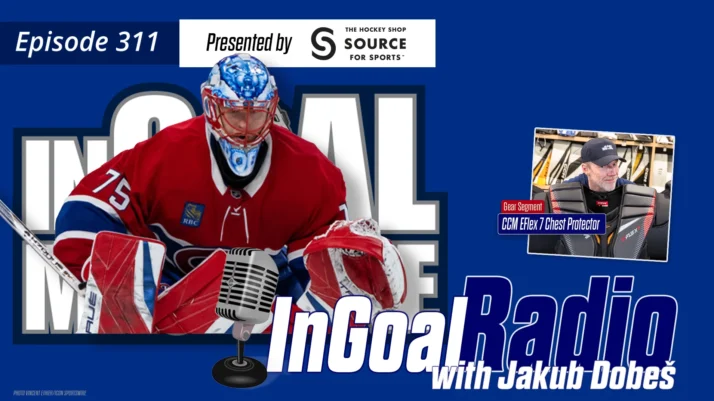
InGoal Radio Episode 311 with Jakub Dobeš
Please subscribe and leave a rating — it helps us reach more goalies!


Montreal Canadiens goalie Jakub Dobeš told InGoal Radio that he works on puck handling long before returning to the ice each offseason. He also uses visualization techniques with mental performance coach Pete Fry on game days specifically. Dobeš moved from Czechia to St. Louis at age 15 with no guaranteed roster spot, a risk that shaped his path to a two-year NHL contract.
- Jakub Dobeš begins puck handling training off-ice well before returning to the rink each offseason, building skills without skates.
- Dobeš works with mental performance coach Pete Fry and uses visualization techniques on game days as part of his routine.
- Dobeš moved from Czechia to St. Louis at 15 years old with no guarantee he would have a team to play for, a defining moment in his development.
- Charlie Lindgren breaks down breakaway management, covering depth positioning, hand placement, and reading a shooter's release.
- The CCM EFLEX 7 chest protector introduces new shapes and features compared to the EFLEX 6, which InGoal testers previously rated highly.
Episode 311 of the InGoal Radio Podcast, presented by The Hockey Shop Source for Sports, features Montreal Canadiens goalie Jakub Dobeš, who is coming off an impressive rookie season and recently signed a two-year, one-way contract extension.
Feature Interview
presented by NHL Sense Arena
In the feature interview presented by NHL Sense Arena, Dobeš shares important lessons from his first NHL season and the adjustments, as well as insights into his unique path from Czechia, moving to St. Louis as a 15-year-old despite no guarantees he’d even have a team to play on. Dobeš also gives us a glimpse into his offseason training routine, including how he works to improve his puck handling long before getting back on the ice, and his mindset work with Pete Fry, including how often and how specifically he uses visualization techniques even on game days. It’s a can’t miss interview loaded with tips.
Parent Segment
presented by Stop It Goaltending U
In the Parent Segment, presented by Stop It Goaltending U the App, we share 10 Good Habits Around the Rink that you can share with your young goalie to help make sure they are both getting the most out of — and making the best impression — even when they’re just there for a practice or a goalie lesson.
Pro Reads
presented by Vizual EdgeWe also review this week’s Pro Reads, presented by Vizual Edge, which features Charlie Lindgren breaking down breakaways and how to manage them, not only from the usual perspective of depth management, but also hand position and reading a release.
Weekly Gear Segment
presented by The Hockey Shop Source for SportsAnd in our weekly gear segment, we go to The Hockey Shop Source for Sports for a closer look at the new CCM EFLEX 7 chest protector, with new shapes and features from the EFLEX 6 model that InGoal testers loved so much.
Episode Transcript
Intro
Spanning the continent, it's InGoal Radio, the podcast brought to you by The Hockey Shop Source for Sports Langley, thehockeyshop.com. We get to do this every year from Vancouver Island to PEI. We've got things going. And right there in the middle, well, slanted towards Vancouver Island, it's Kevin Woodley.
I'm on the left coast.
You are.
Not the far left.
Island unto himself.
Are are you on you're on my right and Hutch's left?
I don't know. How does the map work?
Depends which depends which way we're
you're facing, Daren.
Depends if we're looking at a map, you would be on my left.
Well, it's only if you're pointing at the North Pole.
Yes. And so I'm sure what I'm doing. I'm looking at the North Pole. Okay. So you're on my left.
Okay.
That's true we
both are.
How are you, Woody? There's a song about this.
Right of me.
Stuck in the middle again.
We should put you
Clowns to the left of me. Jokers to the right. Here I am.
If we're gonna do this. I don't
know who's who on that one, but there you go.
Oh, guys. Week's social media clip done. Thank you, Kevin.
There you go. Yep. We're gonna plop you right in the middle of, Waskana, Saskatchewan, and I'll be in PEI and Hutch can be over on the island.
And I'll still have better Internet than you typically do in Vegas.
My Internet's fine. My uploadability is cumbersome. Let let let's call it level.
Whole lot of listeners around the world reaching for their maps right now, I think.
Look looking at it. Yeah. So so look at Charlottetown. I'm just
Waskana, Saskatchewan. What is that? A lot of people are
asking. I'm just a little bit Northwest of Charlottetown right now, and Hutch is in Nanaimo, BC. And Woodley is in Waskana, Saskatchewan.
There will be a geography quiz at the end, folks. Start studying.
People are like, can you spell Saskatchewan for me?
Come on. You can do it. Do it right now.
Idea. I may need a little help. S A S K A T C H E W A N. There you go, folks. Now Wascana, I can't help you with.
Nice. Hey. Nice tribute to the culture of billeting in junior hockey in Canada. Our son, Matthew's billet family from Moose Jaw, Saskatchewan was over for dinner here the other night.
It's a long way to go for dinner.
To Vancouver. I know they made a trip out to Vancouver Island for a week. They did have another excuse to be here but now that, Matthew's part of their family, they decided to, hop over to the island for a bit of a summer vacation which is really cool. It's just awesome the bonds that form between families. We talked before about, us going over to watch the AHL final because one of our former billets was there, and you just you build these lifelong relationships between your young kids and the junior hockey players that come into your home.
It's really cool.
The place I lived with in Dauphin way back when, Karen Koostras. She now is in Saskatchewan. Her son and I are very good friends. Awesome lady. So you're right.
And we were a billet family for the Wheat Kings a long time ago. I did not know that. Had a couple of kids staying with us. So, yeah, you're right about that. They play an important role in the world of junior hockey.
And in the world of the well, we got a great feature interview brought to my Sense Arena with Jakub Dobes. It's a two parter rolled into one, so it's a it's a cool discussion, with Woodley, our Gear Segment brought to you by The Hockey Shop Source for Sports Langley at hockeyshop.com, the EFlex 7 chest protector, and the Vizual Edge ProReads coming up, but our Stop It Goaltending U parent segment, Hutch, just give us a little bit of a tease before Woody, talks about the friends over at Stop It Goaltending U.
Little tease is we had a subscriber write in a good suggestion for kids that I then expanded into 10 good habits around the rink for your young goalie. So I think it's a good thing for, all goaltenders to hear about for parents to encourage in their kids. It might involve a little discussion amongst the three of us.
Well, that makes for a perfect segue into the Stop Goal Tending U app this week, not intended, but the five daily primers this week. And and and remember folks, you get five simple to digest minute, just a little over a minute videos every week with the Stop It Goaltending U app featuring Brian DeCosta with quick hit advice that will help you become a better goaltender. And this week, it's five things not to say to your goalie coach. So you'll have to become a member of this Stop It Goaltending U app. So that that applies to going out on the ice as well.
We could add that into the Hutch has got 10 good habits, and these are five things you should not say to your goaltending coach when you're on the ice, including did they have pads when you were playing with the aging goalie coaches out there. They've also got a video on the best US born goaltenders where they break down some of their styles, a a full video on goalie IQ, looking at Stuart Skinner and Sergei Bobrovsky from the Stanley Cup final, and the weekly drill is a coach screen hands warm up. So new content every week at the Stop It Goal Tending U app. That's a highlight of what's up there this week. You can go through the archives, look back at past.
You can basically spend as little or as much time as you want in the Stop It Goaltending U app every day. It's designed for quick digestion or deep dives, whatever you're in the mood for, all of it using their twenty five plus years of experience with Brian DeCosta as a NHL goalie coach, NHL goalie scout, NHL goalie director leading the way. Tap into all that experience at the Stop It Goaltending U app, and you also get to tap into InGoal Magazine Premium because every subscription to the Stop It Goaltending U app comes with a subscription to InGoal Premium. Make sure you check it out. It's the best of both worlds at the Stop It Goaltending U, the app.
Find it on your App Store or wherever you download apps. For those of you on Android, I don't know what that is.
I want to get your response. You have two seconds to answer when I call your name. First thing that pops into mind, alright, what should you never say to your goaltending coach? Woody.
What the beep do you know?
And Hutch.
My other coach says do it this way.
That's pretty good.
And I know there's a lot of kids that's That happened.
Yeah. That
happened coach and work with a private coach. And,
yeah, I'll go with, oh, you wanted me to stop it?
The corollary to me to mine might be, but my dad says what I should do is
I like when when kids pretend like they're so focused on on the technique, the safe selection, but they really are trying to stop it. And one goes in, they just say, oh, I I'm I'm just working on my technique. Slides in. And and that would be me at times. Oh, I I I wasn't really trying.
Parent Playbook
I was just working on my technique. So the the parent segment, you've got, you've got a little bit of a list going.
Yeah. I got a little list going. 10 good habits around the rink for a young goalie. This was inspired by our good friend we've mentioned on here recently InGoal subscriber, Chris Matola, sent me in a suggestion, that I decided to expand on. I'm gonna save Chris' suggestion for almost at the end of the list.
It seems to belong there based on how these all come out. And then I reached out to my son Matthew who was about to hit the ice with his, summer coach James Gartner and the two of them added a few more and then I rounded out the list. So thought maybe you guys could jump in on a few of these or maybe I'll go through the 10 and we'll we'll see what that inspires towards the end. So number one, take some time to warm up before going on the ice. Encourage that with your young goaltender even if their team doesn't do it, especially teams don't do it in practice times.
If you don't know what to do for a warm up, we'll have some suggestions over at InGoal. We have lots and we'll put a few in the show notes. Even a little bit of warm up is better than none. Before you hit the ice, take a minute to do something that this week's guest mentions in the feature interview and that's visualize. Not suggesting you take a whole ton of time before a practice, but just a few seconds to think to yourself, what kind of a practice am I gonna have today?
How am I gonna be when I hit the ice so that you don't just step out on the ice and do some lazy stretching as you wait to decide what your day is gonna be like. Number three, when you're out there, listen, pay attention, and try. You'll leave a great impression with your coaches who only wanna see you try. Even if you think you're not gonna be using what they're teaching, give it a go. Again, as this week guest says, it's another tool in the toolbox.
Number four. And while we're talking about trying, yes, you have more gear on and no, Skating lengths or lines is no fun at all, but try. You may be destined to come in last in a team skate, but how close can you make it? Can you kind of put a scare into one of those lazy players ahead of you? Coaches can see when you've given up and it leaves an impression that you don't wanna leave.
So dig in and go go for it. Number five, finish your save process. When the drill allows, because we know not all drills are goalie friendly, but when you can, track your rebound and follow it even if there's only one shot to the drill. It's an important habit, one that's gonna ensure that you don't have any delay in reacting during a game. Number six, cheer for your partner.
When he or she makes a great save or bust their butt in that skating drill neither of you like, let them know it with a good stick tap. Number seven, if you're getting frustrated, don't show emotion. Teams want to know that you're a rock in there. They don't want shrugged shoulders, hanging heads, slamming sticks. We talk about it as we watch games, but it applies to practice as well.
How could it possibly help you? If it's an issue for you, you could make it part of your pre skate visualization. How am I gonna react when things aren't going well? Number eight, don't waste time. If the puck's at the other end during practice, grab a puck and practice some puck handling.
Maybe work on your post entries and exits, do some basic skating. The old down on your knees and kind of stretch the groin. It's not impressing anybody and it's not helping. Number nine, almost last but not quite least is the one from Chris Matwiv. A good work habit is to not leave the ice and ensure the nets are pushed where the Zamboni driver wants them and all the pucks are picked up.
Coaches notice, rank employees notice. I've seen clips of Fleury and Lundqvist picking up pucks after sessions. If they can do it, us non hall of fame goalies shouldn't consider it beneath us. Thank you, Chris. And then finally, number 10, leave that dressing room clean.
Goalies are often the last one out, and it sucks when guys leave tape balls all over, but do a quick cleanup. It's a good habit. And even if you aren't the last one out, make sure you clean up after yourself, and even better, grab something that wasn't yours and clean it up. I'm sure everybody else has more. If you have any more, send them to me, parents@ingoalmag.com, and we might turn them into another segment.
Woody, Darren, anything we missed?
Flurries for the team?
Slurpees? Pardon me, Darren?
Slurpees for the team.
Yeah. I'm sure the team would like you to do that. Yes.
I'm too busy. I can't take them to 07:11 for Slurpees, Daren, because I'm too busy picking up tape balls. I will say that one resonated. I do that. I definitely used to do that in the beer league locker room.
Maybe that's a little of my cleanliness and OCD coming in, but just but the same thing. Right? Like, the poor guy has to come in afterwards and didn't have to pick up all that. So if you're last out, pick it up. I did like the, you know, in terms of not wasting time out there, plays at the other end for an extended period, reminding me of the Martin Brodeur recommendation.
Like, how do you get good at playing the puck, especially when there's so little time in practice? Play the puck, and that's a perfect time. Got a forward that's not part of the drill at the other end, have them go back and forth at the blue line, hit them on the move, like trying to hit a hit a receiver with a pass in football. Just get a puck on your stick, shoot it around, work on things that way. That's how Brodeur became the one of the best in the history of the game at handling the puck, and you can too.
So good list, Hutch. I like it.
You know what I do sometimes is work on my pivots to behind the net for stopping rims. Like, you don't need a puck necessarily. It's just working on my reps right side, left side, and seeing, if there's a way to expedite my process, behind the net and and be able to get to those boards a little bit faster.
As you're doing that, it reminds me of something, last week's parent segment was on skate sharpening, and we had a quiz at the end for Woody. So I'm gonna throw it to you, Daren, because I don't know if you listened to last week's show when you were on the golf course. When does a goaltender need their outside edge?
On on rims. Attaboy.
Attaboy. Yeah. There you go.
I feel like that's cheating. I got it without the context of how
You did?
Talked about handling rims. I did. Can you believe yeah. Daren can't believe it.
No. Good for you. Because that that
is Excellent. Yeah.
The only time that you would. Unless you're going to the net you're you're going to the boards for the extra attacker, and you have to stop and come back.
Yeah. And go back. Yeah.
Yeah. That and do a do a quick, cycle. We've and we've seen that a few times.
We saw that from this week's, ProReads guest.
You're right. We did. I also like the, idea of pushing the nets for the the Zam employees. That gets noticed and gets talked about by the rink staff, not just the person cleaning the ice at that particular time, but they will always mention it to their fellow coworkers, and you will become a rink favorite by doing that.
And why does that matter?
How it helps you when you get older, you can have a conversation with that rink guy and say, you know, when you're drilling those pegs in, do you think you could? Or there's a problem on the dasher over there that cost me a goal last game. Do you think we could fix that? You can have a little bit of help from those guys if you befriend them. Or get a job.
Help you at age five. Or Or get a job.
Or my crease looks like a soup kitchen. Can I please borrow a squeegee?
Yes. I don't see squeegees needed near as much as they were twenty years ago, twenty five. I may I gotta Maybe because I'm skating in NHL facilities.
So just the Vegas Golden Knights. Yeah. Yeah. Yeah.
That's probably I gotta I
got a rink that I'm not gonna call out, but it's pretty much an every time occasion. Even in the winter there, it's just like a puddle.
Really? Well, a lot of the Yeah. It happens. Lot of the high end rinks like you're in, Daren, don't even lay down the water. Right?
It's just the steam system or the misting onto the ice instead of gallons and gallons of water.
Well, if all you needed was mist, they just sent me around in the fog. It'd it'd be perfect. Dad joke. Sorry, Woody.
I will say the one thing I don't do on on Hutch's, 10 list of habits, is, and he recommend this is something you shouldn't do is the old, you know, just dropping to a knee and doing the groin stretch, and it's not impressing anyone. Yeah. I'm not doing that because there's a little challenge with getting back up after.
You might not get back up. Yeah.
It's good to stretch, though. It is good to stretch, especially late in your in your skate, because a lot of us aren't doing our post at at our age, anyway, aren't doing the post practice stretch out.
But in terms of that one, to be fair, I was I was thinking about I actually remember a session we had where I was the goalie coach for a team. I think it might have been u 15. And the coach decided that he was gonna take the team through a pregame warm up in practice time because they had their first game coming up of the season, and we're gonna go from leaving the dressing room to the exact warm up we're doing in the game. Think it's a great idea on a coach's part.
Such a great idea.
Yeah. But so then the goaltender skated onto the ice and just went over to the boards and started lazily stretching his groin. And I said, we have three minutes to be ready for this game in this league. I know some places you get 20 and there's more time. Do you really think that's the best use of your first three your only three minutes of warming up on the ice?
And a lot of kids do that. You don't have much practice time. You can prepare, as we said at tip number one, little bit of a warm up before you hit the ice.
Okay. I got one more.
Let's go.
And this is one that Hutch is because this was 10 good habits around the rink, not just on the ice. Right? Did we talk about picking up after? This is Slurpees? Are we going Slurpees?
This is wow. You know, Slurpees should be on there. It would
Tim Bits.....Tim Bits......be number 12. You
guys are not helping on the nutrition side of things. My wife, if she hears this, is just gonna be horrified after all the effort she's putting in to get my She is an
outstanding chef. I love going to Woody's house to work, by the way, because we get this incredible food presented to us every time. Always Shout out the CFO.
Yeah. It's always healthy. And so she's hammering away at my college bound athlete to eat better, and here we are talking about Slurpees and and Tim Hortons. But, Hutch, you've hammered on this one before, and this is a message for parents in terms of habits around the rink. Let them bring their own gear in.
Don't carry their bag for them.
Yes and no. Yes and no. Age dependent. Age dependent. I hate when I hear about a coach saying if you can't pack it, you can't play, and you've got a five year old trying to carry in all that gear.
By the way, don't use a wheel bag either.
Oh, that's silly.
Kids also have to be able yeah. And then you get a kid half injured before he even steps on the ice. But I agree. If you're older, you don't need daddy carrying your sticks for you.
Gear
Segue over to our gear segment brought to you by The Hockey Shop Source for Sports Langley. Thehockeyshop.com. Things are happening as we're in the middle of summer with the boys.
Yeah. Tons. Speaking of gear and having to haul it in, boy, is there a lot of new gear available at The Hockey Shop Source for Sports, thehockeyshop.com. All the latest. Bauer, CCM, we're getting into the EFlex 7 chest protector with Cam in this week's gear segment.
We brought you the Bauer Sticks last week, the new FlyLites. We've got new skates coming from Bauer. Like, it is that time of year where there is a ton of new equipment available. And the reality is there's so much new equipment comes in at once that we can't keep up in the reviews. So there are items we are not gonna get to until August that are available right now at The Hockey Shop Source for Sports, including those skates, new stuff from Warrior.
There's just a ton. So make sure you check them out at thehockeyshop.com. And as we always like to stress, when new stuff comes in, old stuff goes on sale. So if you're a goaltender, maybe a whether it's beer league or youth that doesn't necessarily need the latest and the greatest, there are opportunities to save 25 or more percent off previous generation products. Because they are such a massive store, over 30,000 square feet with more warehouse space in the back and off-site for the extra gear.
They have lots left over at a discount, but don't wait for long because it will go fast. Whether it's a new stuff or on sale, check them out at The Hockey Shop Source for Sports. You know what Cam
You know what Cam should have is a new arrival section just in the little section.
Just made Can reorg I think we I I'm gonna second that motion, Daren, just because I wanna see Cam have to reorganize everything.
I'm if it if it makes him suffer a little bit, I'm also in. Sorry, Cam. EFlex 7 chest protector.
You won't suffer in this one. Let's let Cam explain the rest.
Wider, little more protection, little more D3O, some neoprene. What's new in the EFlex 7 chest protector? Similar shape, similar feel to the EFlex 6, but we've got some new features, and we're gonna talk about them today at The Hockey Shop Source for Sports, Goal Utopia with Cam, who's gonna walk me through the new EFlex 7 chest protector.
Yes. I mean, we should talk about the presence and the fit of it right off the bat. In terms of how it sits on the shoulders, that's one of the biggest differences I find between this and the EFlex 6, just that presence of the goalie. So you get more of that, like, rounded, a little bit more narrowish shape kind of with the six. This definitely changes your presence in that.
A little bit wider, a little bit more aggressive.
Does it get me look bigger?
Yes. I gotta be honest. That's basically exactly what I was getting at.
I kinda feel like I look huge in the EFlex 6 already, so I'm upgrading. You know me? I'm all about, like, if you ain't cheating, you ain't trying, but, I mean, I'm What are going here?
Cheating. It's it's not cheating.
Lie. No. If you're gonna look bigger, I'm in. Yes. I'm in.
So one of that's
How do they do that?
Cap off one of the biggest differences for sure. So the way that those extra we call it shoulder pieces, shoulder extensions kinda come out and give you that extra coverage. A, they provide protection so they're not just there to make you look bigger. But b, that's what they do. They do make you look a little bit bigger.
Shoulder floaters, they've changed the design and the taper of it a little bit more as well. This gives us again that little bit more of that kind of triangle reverse triangle look, I would say.
And we You
can see underneath. Little extra D30.
D3O makes its return to the chest for sure all the way throughout. I really like the way that the the chest kinda segmented some of this protection, for example, that allows that flexibility of the chest. I mean, it is called an EFlex chest, so it better be flexible. Alright. Also, when
you pull the arms in in the front here, you're not gonna have any gathering. They
will sort of move. Exactly. It's moving with you, not against you, I think, is the big call out for sure.
Adjustability with the shoulder, you can sort of pull it out to the side and make that sit even wider, although there'll be a little more neck exposure, or you can pull it in. Again, find that combination for you in terms of presentation, but also range of motion for the mask. So when you're tracking down on pucks, you're not getting interference. I like that this is segmented, and as much as it presents big, it's nice and thin. Like, it's not gonna be a lot of mask interference with this shoulder floater, but, again, adjustability to move it around.
So adjustable arms too as well. I'll let my Velcro to get us up and down, find your fit for sure inside the chest protector.
Arms feel a little wider and beefed up too.
I would say just more protected, and it's probably the right word to put it. Like, it is a substantial difference between this and what I feel. A six in terms of where the protection sits. The arm and the cap has changed. No more neoprene sleeve on the inside.
Kinda hard to see. Another big improvement is just that little nylon grab loop as well. Pull it up. Be able to slide your arms on a little bit easier.
I kinda like they're gonna be honest. I kinda like the neo I know you're telling me most people didn't, but I like the neoprene in the elbow before, but I'm a weird guy.
That yes. That tough thing with that neoprene sleeve is that a lot of guys would slide their arm through and be on top of it rather than actually going through that sleeve. Exactly. Neoprene does feature on the wrist wrap. Correct.
So a lot of adjustability in here, little extra protection with the flats over the back. So you're in a reverse or you get your hand up, you can yeah. You've got that extra protection. Yes. And, again, through here, nice and wide and protective.
Yeah. A bit more beefed up and wrapped around onto the side as well.
So Oh, I think I said beefed up and bigger.
I did you did? Yes. Yes. Let's continue to the back. We do see that Air Tech suspension system.
Yes. So I don't know if it's yeah. A little harder plastic. You've got the mesh liner inside, so it's supposed to
be very breathable. I just It's the way it sits over the shoulders on the back to me is a big part of the presentation. The firmness of this and the way they've structured this allows it to sort of keep its shape over the shoulder and the way you set it up, again, it's not going to sag. It's going to sit nice and big over the shoulders. Alright.
Back to the front. Couple more features to quickly call out. We do see the legendary CCM side tabs that integrate with CCM pants specifically because they have those little snap clips.
You can snap them in if you wanna tuck it.
Exactly. You don't have to use that. You can use anything. This still will work with another pant. You've got your flap on the front.
Tie down. This front flap is removable. Something in years past it wasn't, and I You what I do?
What's that? It in, but then I just the other one was a little longer. Keep it in, but just tuck it a little extra, little thicker belly protection.
There you go. No right or wrong answer here. And this chest protector, you can find you know, it does both. You're not gonna be pigeonholed to say, okay. Tough versus untouched.
Adjustability. Yeah. Exactly. So you're gonna be able to find your fit. So We talked about adjustability
in the shoulders. I already showed you this one, but there's also a second layer under here. Again, we talk about the way that air knit, you can really sort of change that significantly with that adjustability and then combined with that, you can make this fit a lot of different ways. Correct? Okay.
CCM EFlex 7 chest protector new for this year. They have it in stock. Does that mean the e flex six is on sale? Surely. Does.
So make sure you check them out at The Hockey Shop Source for Sports at hockeyshop.com. If they got any questions, Cam, (604) 589-8299 or 1-800-567-7790 or thehockeyshop.com. Don't worry. I'll be flexible, and you can too with the new EFlex 7.
Oh, I'm just gonna leave it at that.
I was surprised to hear how differently the seven presents in the EFlex chesty.
See, because I kinda like the way the six presents. I feel massive in it. I feel protected in it. I wear that's mine of choice right now is the EFlex 6. So the fact that they've made it present a little bigger, but still give you that sort of out of the box feel and control.
That's the other thing I liked about the EFlex 6. You know, we always talk about chest protection is like there's a break in period, you know, like that's the standard. I really didn't feel like there was one in the EFlex 6 and it feels like we haven't got it yet, but it's coming soon. It feels like it's gonna be the same experience with the seven.
Yeah. Just to echo both the lack of a break in for for the EFlex 6 and how protective these off the shelf retail units are. Our son wore the EFlex 6 retail unit in the Western Hockey League for more than a dozen games last year because he was waiting through practice to break in the pro unit he had. And he was protected. I mean, yeah, it's not the same as the pro unit, but if you you can skate in major junior level in the off the shelf product, I think, the rest of us are gonna be safe in beer league and minor hockey.
What would be the difference between the pro unit and the off the shelf set?
Well, there's I mean, it's a different construction. There's two separate sorta. And there's the pro unit is NHL spec. Right? So there's limitations.
I think the the six Less adjustability. Yeah. So yeah. Because it's sewn up. I don't know if the retail one is sewn or not.
I'd have to take a look, but it should be if it's if it's pro. Probably a little more extra padding in the arms just in general. Although, interestingly
see the different thickness of the padding. You can in the seven compared to the six, can you not, Woody? I would have to check my note. I I think so.
So it's, you know, it's just a little beefier, and this goes for for a lot of the different models. But, again, it's also more streamlined and confined in terms of the space it takes up and and how it presents. Although interestingly enough, there's a reason the CCM pro models are one of the most popular in the National Hockey League is because when they paired everything down, they're still presented bigger than a lot of their counterparts. Now others have come a long way in sort of matching that, protective level. I think of the Brian's unit in particular, but there there's there's just sort of a a little extra beef, Daren, despite the fact it's leaned out to meet the restrictions of the National Hockey League.
A little more padding in the arms in particular, I think.
And the use of neoprene has changed from the elbows, more to the wrist. I I mentioned that just because anytime I can use the word neoprene, I I like to slide it in.
Is that because you want me to go put on my wetsuit for everyone to see?
I I I have a wetsuit, like, six feet away from me right now. Oh. Yeah.
What do what do do with a wetsuit on the East Coast?
Go in the water. You don't play golf in it. You know what? I got it my first year here. It was, like, fifteen years ago now, and we had the worst summer ever.
And it was so cold and and just miserable. So we thought we'd get wet suits to get in the water a little bit more and kayak and and do some paddle boarding, and it would help us. And it's been great weather ever since, and we probably used it six times. So if you want a wetsuit, come on by. I don't do a lot of snorkeling.
You know, you can paddleboard without getting in the water, Daren.
Yeah. Not me. No. I'm I might be the worst paddleboard athlete of all time.
I don't think you are because I'm on the list. Can literally get up on a surfboard and ride away, but routinely, I I gave you a hard time about not getting in the water with a paddleboard. I have to concentrate like crazy not to fall in every time we go paddle boarding.
If you've ever done it
If you've ever done it, it also bugs me that the that the paddle's only on one side because you gotta take, like, three strokes, and then you gotta turn over, and you gotta take three strokes on the other side. I want a kayak paddle on that thing. Anyway, I digress. We've got the Vizual Edge ProReads. Who do we got this week?
Well, we've got Charlie Lindgren this week, but first a message from another Vizual Edge user, Jordan Binnington. Jordan Binnington says that Visual Edge has added a quality element to his preparation as a goaltender. I use the game day drills every game before heading to the rink. That's right. Every game before heading to the rink, including at the four nations.
It's a combination of recognition, reaction, and focus that activates my brain and eyes to feel ready for what's to come. That's Jordan Binnington of the Saint Louis Blues and the four nations winning goaltender for Canada talking about his daily use on game days of Vizual Edge, a vision and cognitive training tool that you can access with a discount from InGoal Magazine. As a subscriber, you get double the discount. Just use the discount code, log in, go to a ProReads, you'll see the updated discount code. If you're not a subscriber, just use the discount code InGoal, all caps, to save $5 a month on Vizual Edge training, like Jordan Binnington, Cam Talbot.
There's over 50 American Hockey League and NHL goaltenders that use Vizual Edge to improve their sports vision and, as Bennington said, cognitive warm up and training tools. So speaking of warm ups and training tools, we've got Charlie Lindgren in this week's ProRead talking about managing a breakaway. And as much as we are often tempted to just limit that discussion to matching speed and positioning your depth relative to the attacking player. Charlie gets into a little more with hand position and reading a stick blade and where the shooter is to avoid falling for a pump fake. And he talks about sort of the body mechanics and hand position to be able to hold and stay patient on a guy as he gets down into the hash mark.
That's all part of this week's ProReads breakdown brought to you by Vizual Edge. If you're an InGoal Magazine subscriber, you can log on and watch the full video with Charlie Lindgren as well as almost 290 other videos including, as we launched last week, twenty two straight minutes of three time Vezina Trophy winner, Hellebuyck, going through his You no longer have to watch those one at a time. You can watch them with one video. You can screencast them up to a TV, watch with the young goalie in your life. That's all it's a new feature we've got over at InGoal Mag Premium, all brought to you by Vizual Edge.
Yeah. That twenty two minutes is spectacular.
So good. So good. We're gonna and we're gonna this will become as we said last week, it's a new idea, a new feature because we've gotten some feedback from readers. They as much as they enjoy ProReads, they don't want to have to go one at a time. They want to see it all at once.
We have an online tool where you go on the website and just sort of want one after another, but this combines them all. So you can you know, some people want to screencast it up to their TV and watch it. And so now you can do that. We will roll these out with some of our other goaltenders over time, but just just a heads up, this won't be a weekly thing because we would quickly run out of ProReads. This is a massive commitment from both us and the NHL goaltenders to give us all this time, but we're we're gonna start adding those to the weekly ones that they roll out like Charlie's this week.
On breakaways, is there a and Hutch, I'll ask you leaning on little Hutch's experience. Is there an accepted starting depth that, that we would lean towards? Is it a foot and a half outside the the blue? Is it on top of the blue? Like, where is that?
I think you see a lot of variations in how people play that. I think if you go back to a very recent ProRead with Joseph Woll, he explains his starting depth, and I think it was heels out at the top hash mark and then toes in at the bottom hash mark. If I'm correct. We labeled it on the on the ProRead as well so you can see very clearly what he's talking about.
And that's extreme. Like like, that's really far.
Well, not real. When I say heels out, just mean that the the edge of your heels touching the top of the crease.
Oh, I thought you said hash marks.
So we're talking about a skate blade distance here. Yeah. No. That when the player is there. I you will see people much more extreme than that.
I know when you and I played, we might come out to the hash marks as a guy was coming on a breakaway. And I think you're seeing people retreat more and more and start from a very conservative depth now. That's about all I have to say that I think that the trend is to have less motion because you can be more controlled and you can be more consistent in your play. But what do what do you see?
Well, it's interesting. I was at Pacific Coast goaltending yesterday with Thomas Speer, the goaltending coach for the San Jose Sharks. So was nice to see him. We just popped down to Seattle for one of his camps, the final day of one of his camps. And they had actually had a shootout competition the day before.
And the habits of the goalies, they were like, oh, these kids don't know how to do shootout or not to the degree we'd like to. So they spent the whole day focusing on breakaway and shootouts, including a video session that I sat in on that combined NHL clips with clips of how these goalies were doing it. And it was really interesting to me because you're right about the guidelines that Woll talked about. I think a lot of goalies do like to have their heels at the edge of the crease when the shooter's at the top hash. And by the time they get to the bottom hash, they wanna have the toes at the edge of the crease.
Like, that's that's just a skate length depth. But how they get there varies wildly. Like, WHL, as he said, doesn't take a lot. Like, he just starts there and moves back. Dustin Wolf, small goalie, does not take a lot of ice.
He's kind of like Joseph Woll. He's very conservative just at the edge and then starts his retreat. Igor Shesterkin is one of the best skaters in the league. He's got good size. We saw video clips of him.
He was out at the hash marks on breakaway. Again, when you broke it down, he would typically arrive at those same landmarks that Joseph Woll talked about when the shooter got to the top hash and the bottom hash, but he had a lot more motion backwards trying to match that speed. Devon Levi, we've seen plays it really aggressively and ends up in the same spot. So it really is a personal choice thing. The one thing that I would add to that is it varies big time on breakaways versus shootouts.
Because there is no pace or back pressure on a shootout, goalies tend to be way less aggressive. They can start at the edge of the crease like we talked about with Woll and Wolf in that situation and don't want to have a lot of backwards flow because the shooters can come in with pace and then stop and drift really slow and change it up on you a whole bunch. So that's the trend between and the difference between breakaways and shootouts. But you're right. There's no one way to do it.
We see this right up to the NHL with some of the best guys at it. And I think that, you know, that's it's it's worth noting even though they're all trying to get to the same spot, how they get there or roughly the same spot, how they get there varies wildly.
Funny you bring up the, shootout difference compared to a breakaway. I watched, a shootout in an all star game, and Gretzky was still playing, during this time and Yzerman. And it was a all star game competition for breakaways, and the speed at which the guys came in on the goalies was like they're being chased in game seven changed? Trying to beat the clock, and it like, nowhere like what we see today. How how it's changed for the the years.
Yeah. Never going wide back in the day.
No. It was it was Pick up the puck and skate as hard as you can and come in.
Well, I mean, the shootout and the points that are available there and how much that can be the difference in a a parody driven league between getting in and not getting in, like, the amount that goes into it. You're right. Like, it's like, they never would have thought about that at the time because it was irrelevant to their game.
Because they've always whenever they had a breakaway, shootout wasn't part of the league then, they were they were skating as fast as they could.
Because they're being chased.
About you, Daren, but but for me back in the day, the absolute highlight of Hockey Night in Canada was the showdown competition in the intermission. I mean, I didn't care about the game. I just wanted to see showdown.
Yeah. I've had some great conversations with John Shannon, who was part of Hockey Night in Canada during that time and and produced those segments, during the course of the summer and how much fun it was. And the guys took it really seriously too.
Might be fun to have him come on and tell us all about the goalie perspective.
And his son, was a goalie, and he love he he hired more goalies over the course of his time as executive producer of Hockey Night in Canada as analysts, like from John Davidson, Daren Millard, John Garrett. So you know what? That's not a bad
You know we're the smartest.
That's not a bad angle for us just to change it up little bit, Looking through the eyes of of a of a goaltender. We have a great one this week in the Sense Arena feature interview, don't we, Woody?
We do. Jakub Dobes, who we started you'll hear. We started this interview in person in or in Vancouver as Montreal visited, and then we picked it up after he signed his two year contract extension this week. So one way contract, couple next couple of years, we'll be in the National Hockey League for Jakub Dobes, who showed a lot of like, opened a lot of eyes this year and has a great backstory. And I I wanna touch on this a little bit before we get into it because we didn't get to dig into it in the detail I would have liked in terms of making him a storyteller.
I didn't wanna ask him to retell the story completely. But this is a young man who is coming to us in part two from St Louis, and people might wonder why a goalie from Czechia is talking to us from St Louis and has made that his first stop in his off season home. He left Czechia as a 15 or 16 year old. I think he tells his 15. I read a story.
Arpon Basu did a fantastic story in the Athletic out of Montreal on sort of this determined path and unlikely path that he took. He left as a 15 year old to come to St Louis because he did not have a team to play on in Czechia. And he basically came over. They took a flyer, hoping to get a a shot through mutual connections of his agent and former NHLer, Lubos Bartecko. Hopefully, I said that correctly.
It's been a while since I had to say that name since he was in the league. He was coaching. And so he came over to basically try and get a spot on a AAA team. But the problem is once he got there, the U16 team, which was coached by Hall of Famer Al MacInnis, already had two goalies. So his only chance was to make the U18 team.
And with some evaluation and coaching from another name that folks may may recognize from our past conversations, Bruce Racine, goaltending coach and former NHLer in the St. Louis area, he was able to do just that. He made the U18 team as a 15 year old, started this path, left his parents behind in Czechia, came on his own. I think he might have had a sibling with and started his path, took that chance to come all the way across, started his path at AAA, goes on to play junior, goes on to play college, and now he is signed to be a goaltender with the Montreal Canadiens. And think of what not just in the NHL, but a a franchise as storied as they come in the National Hockey League when it comes to goaltenders.
After taking that that self belief risk and coming overseas, that couldn't have been easy, but he's an impressive young man. He's he's got a lot of tools in his game, and it was fun to watch him play in the NHL last year, and we sort of catch up on the process.
The feature interview brought to you us by Sense Arena. Hutch.
Sense Arena. And, you know, often I do a little bit of a read here and tell you all about one reason that we think NHL Sense Arena is so fantastic, but I wanted to have just maybe a little discussion amongst the three of us here and starting with with Kevin because we have this fantastic new goalie advancement program in NHL Sense Arena. We published a review of the first part of that, which was about reading releases. Woody, just tell us what's going on.
Well, he's working on part two, which is all about angles. And so it's been really fun to go through, the variations and the progressions in this program, which which was put together with consultation and input heavily from who's a big part of their advisory board. We talked about him with Stop It Goaltending, all the experience he brings. Really like the way they did it on the shot reading using things like ghosting. And the thing I love the most so far about the way they move these progressions in angles is how virtual reality allows you to essentially set up a box control frame or basically like we've seen you've seen it in in on the ice, used to see this Pete Peters used to do this as a goalie coach at Edmonton Oilers.
They're like a fishing rod out with lines tied to each corner, and the goalie would have to stay in between it. Well, there's no more we've seen it with dog leashes. Well, there's no more messy ropes to get caught up in. You just go into virtual reality and that space that we're trying to create to let us understand how much of the net we're filling in front of us rather than worrying about the four by six behind us. It's all clearly defined in front of you in Sense Arena in a virtual manner.
So you can tell whether you're on angle, you can tell whether you're square. I was surprised at how often I wasn't actually squared up as I went through this, where I thought I was square on the shooter, but I wasn't completely. Maybe I left the backside behind and so as soon as obviously, as soon as you're flat in the net, you haven't rotated that backside into that space, you're opening up more net. You're making it harder to close on pucks and shut down the net. And having these guides built in in front of you really allows you to understand that better, to see it better without getting caught up in ropes and pulleys and all these things, and without having to worry about wasting ice time figuring it out.
And eventually it just becomes more and more innate and you learn how little you have to move when you're in the middle set and square to take away the net. Whereas sometimes when we think about that giant net behind us, we think we have to move to fill it out. And quite often the the space that puck has to travel through to reach that giant box behind us is tiny and it's just all little subtle movements. So having that in Sense Arena, I think has been a real I mean, it's always been there, but having it laid out as part of a progression and learning, I think, is improving. We'll see when I get back on the ice.
It's been a little bit, but we'll see if it actually helps, but it feels like it's paying dividends already.
I think it underlines the fact that NHL Sense Arena gives you so many different tools that you simply don't have access to on the ice. And, yes, maybe your coach could pull the dog leashes out on the ice, but this is something you typically can't do. And as Kevin said, you don't need to be on the ice to practice this. So that on top of things like reaction speed and tracking statistics, there's so many things that we can't get as a goaltender on the ice that NHL Sense Arena gives us off the ice. Daren, would you use NHL Sense Arena there at the cottage?
And if so, how much?
Probably, well, once a week. And and I do, come out to the to the monkey. And the box control is something that I'm always leaning into. It's an area where NHL goalies get loose at all the time and and have to work on being a square and and fine tune on that. And so if if they can get loose, all of us can get a little lost.
And so box control is one of the biggest advantages to NHL Sense Arena for for you to be able to work on. And I think it's, like, it's one of those little mental advantages. Like, it's where where you get a new driver and you just know you're gonna hit the fairway with it. It's you work on that box control, and like Woody said, you realize how little net they actually see behind you. It can give you confidence before you even face a shot just having that realization.
That's fantastic. Well, if every anybody would like to try it, if you wanna make it part of your summer routine and give you or your young goaltender all the advantages that Daren was just talking about, head over to sensearena.com. And as always, use the code IGM 50, and you'll save even more.
I haven't, seen anybody because I got the goggles on, but, people were on sort of on a walking path around the loop, in in Shelton Beach, PEI, and I am can't imagine what their their facial expressions are as I've got the headset on jumping around the bunkie. Oh my lord.
I want a photograph. We have a photograph of Woody at surfing using it. I have a photograph of my kid standing in the middle of Lake Louise doing it, so we need a photo of you from PEI, please.
I was gonna say wait till they come around the corner, and I've got you in the wetsuit with it on.
There's no there's no flattering pictures of me in a wetsuit. I can guarantee you that. What do you you know very well. That thing is a a humbling experience, the wetsuit.
It did there is no place to hide in a wetsuit. That is for sure.
Feature Interview - Jakub Dobeš
No. The NHL Sense Arena feature interview. It's a two parter rolled into one, done at, two different times, one in person, one on Zoom with Jacob Dobes. Enjoy.
I guess I'm just gonna start right away. Like, what's been the biggest adjustment for you this year coming up to this level?
Probably be try to be at your best every single day. You know, being a pro, it's pretty hard, but, like, being a pro in the NHL, it's feel like even more hard, you know, because you you are playing against the best players in the world. And a lot of them are still really hungry for more success and stuff like that. So I feel like the big adjustment was, like, bringing my best a game every every single practice, every single game, and being consistent pretty much the whole week.
We hear that phrase a lot, learning to be a pro. Yep. And it's a process. What does it mean to you? Because I think a lot of the young kids hear it, and they wanna know, like, like, what does it mean when you say being a pro?
Probably just, you know, hockey for kids, you know, takes maybe a couple hours a day. I feel like being a pro means having another level of kind of, you know, spending more time on hockey. Like, yeah. It starts in the morning, and sometimes it it ends, like depends how your practice is going or what time you do it. You know?
It's pretty much you have a one block in the in the afternoon, and after you have something at the night too, right, you gotta meditate or stretch. So, like, I feel like for me, it's like it's kind of a toolbox. Like, you have a practice where you try to get better, and I feel like at night, you're still kind of prepared for tomorrow. So that can be an example how how, you know, how much time it takes to to become good. And being a pro, I feel like it's, you know, the practices and everything you do before practice.
You know, you if it's like a balls or workouts, like, you kinda kinda give make sure your body is prepared. So I feel like when I was a kid and I was playing AAA hockey, you know, it was more like you show up for practice and you go home and that's pretty much it. So, you know, it just takes more time, more energy, and you also need to know how to stop thinking about hockey. But That's easier said than done sometimes. Yeah.
It's hard. You know, once you get kinda addicted to it, it's pretty much all year along, you try to become the best version of yourself.
You mentioned things like meditation. How does that play a role for you? Are there other examples of things that again, we try and give lessons for kids, like a little bit young goalies, right, or even kids going into junior Yeah. Without asking them to do too much because we still want them to be kids and playing. But, like, what word does something like meditation fit for you in the at this pro stage? I
I meditate a lot since, you know, when game day comes, you you try to do it as much as possible. So you you're you play here every other day. So meditation, when I'm not playing, it's still part of it. But even if I'm playing, it become became like a the night before, the morning skate off, and right, you know, like, an hour to the puck drop. So I feel like meditation to kind of open my eyes.
It's like, you know, with goalie, I don't think it's as much of of a physical. You know, players gotta hit, shoot, be strong, and stuff like that. I feel like for goalie, it's a straight mental, so I try to walk up on my mental part of the game as much as possible.
Any other things that you've learned on the mental side working with people over the years that you would advise?
Pete Fry. I'm going actually, two four I gotta make the 02:45 bus because I have dinner with him at three. Lunch. Sorry. I guess lunch, you can call it at three.
So he's my mental coach, and I've been working him since I turned pro, and he is really good. He gives me a little things that I can take into the game and just apply them. It's like, you know, kind of getting better. It's not a big step. Like, you get better by 50%, but, like, over the time, like, you put keys and pieces together and stuff like that.
And I feel like you can gain, like, 6% how to be better. So Five to six percent's a lot. So that's why I feel like over the years, over the Zoom calls, over the meetings we had, like, listening to it and, like, grabbing things that you might need in a game and it might work and try them. And if they work, you have something in your toolbox. So I feel like the mental side is pretty important.
I'm gonna text him right after this and give him crap because that means you gotta leave before I can get through my interview to go see him. So it's his fault. We'll blame him. Yeah. Who's your guy growing up? Like, who how'd you become a goalie?
My dad was a goalie.
It's the best way.
My mom was a figure skater. So, yeah, it's pretty obvious I was with you guys.
Dad, your first coach too? I'm just curious what kind of coaching you had, you know, in
The Czech Republic? A little bit. He was he was a GM back in Czech, so didn't have much time. But, yeah, he will he will always watch me practice and stuff. But after that, I moved to the bigger teams, and they're they had their own goalie coach.
So I was gonna say edge work in skating has become such
a big part of the position. Maybe your mom being a figure skater might have had as big an influence as your dad being a goalie.
Maybe. I maybe I have a good touch. You know, I can feel it, but I don't know. I'm not very sure. You came over at
the age of 16. Obviously, a tough decision. 15. 15? 16?
Yeah. Something like
I read 16.
Yeah. People it's just
He was young, and that can't be easy.
Yeah. No. It was yeah. It wasn't definitely easy the first couple of months, but it was a good decision overall.
I read there were some things that you had to work on at that point with Bruce Racine. Like, as simple as proper leg recovery, things that we might take for granted over here.
A lot of little things. It's you know, at some point, you you become you have all the tools. Sometimes you need a reminder. Sometimes it takes little tweaks. But, yeah, I remember every time I I was going back to the post, my stick will get kinda stuck.
So we work on, like, wrapping it, and now that I don't even think about it. But, like, back in the day, I I I was yeah. It wasn't that easy.
Okay. So reconvening with Jakob. Now back as the season ends, fresh off, a new contract extension. First off, congratulations on that.
Thank you. I appreciate it.
What's that like? Is that a little like, do you just leave it to other people? Is it stressful? What's that like going through that process? I don't think it's a question I've actually ever asked anybody, but but, you know, what's what's that part of the business like for you?
I mean, it's definitely I don't think it's stressful, but it's on your mind every day.
Right.
Because you're kinda waiting to see what the team thinks about you and the numbers. And you have idea in your head and you try to, you know, negotiate. And negotiating happens quick, at least in my scenario, but it's just the anticipation of, you know, what the teams think about you, what's what's what's the number they want you to play at. So it's, yeah, as I said, it's on your mind a lot, but it wasn't anything anything horrible. It was it was pretty smooth towards the end.
I would imagine that a lot of the things we talked about back in March in terms of mindset and and how to sort of stay in the molten focus probably play into it in similar ways in terms of, you know, learning how to manage these things mentally.
I mean, mentally, it's, you know, you try to stay busy and do things that you enjoyed during the summer and not try to be focused on hockey, twenty four seven. So, yeah, that that was pretty much it. Trying to stay as busy as possible so you can kind of free up your mind, and you don't need to worry about the hockey hockey stuff, throughout the day.
Well, that was one of the things you talked about when we first talked about, you know, be being a pro and how that meant doing more than when you were a kid just going to practice and coming home, but also being able to disconnect from the game and not think about hockey all the time. Once you transitioned into summer mode, walk us through your mindset. Do you put the pads away? Do you stay off the ice for a period of time? Is it important for you to find a little separation and breathing room from the game before you dig back in?
For me, personally, I like to take a longer break from the ice. I like to become stronger in the gym. So I'm focusing the first month and a half, two months strictly just getting stronger and more physical and working on my flexibility and all that stuff. And the closer you get to the camp, you kinda switch and you, you know, you take the workouts pretty serious but not as serious and you put more focus on the ice, so you kinda switch, you know, in like midsummer, kinda go from stricter workouts, not skating to normal workouts and more skating to become, you know, like kind of a and get into the hockey shape again.
For me, personally, I like to take a longer break from the ice. I like to become stronger in the gym. So I'm focusing the first month and a half, two months strictly just getting stronger and more physical and working on my flexibility and all that stuff. And the closer you get to the camp, you kinda switch and you, you know, you take the workouts pretty serious but not as serious and you put more focus on the ice, so you kinda switch, you know, in like midsummer, kinda go from stricter workouts, not skating to normal workouts and more skating to become, you know, like kind of a and get into the hockey shape again.
The now over my shoulder, we got the Carey Price jersey, and he used to put the gear away completely until August. And he used to tell us that he felt like it recharged him a little bit, like being away from the game, not putting on the gear. When he put it back on, he was excited again. Do you feel that at all as well when you when you finally and and is that around August or mid July? When you finally get the gear back on, does it make you more excited having walked away from it for a little bit from that side of it?
I think it depends what do you do. You know, a lot of goalies during the summer go to go on the ice just to go on the ice, and they become a shooter tutor for the players. You know? So I I try to not to do that at all because, you know, goalies specifically, I feel like they're different than the players. You know?
It's easier to practice for a player because you just need a net pucks and a goalie. You know, for for goalies, I feel like you need to have a good goalie skate and then get in in into the shots and stuff like that. So during the summer, I feel like it's important I would rather not skate and become a shooter tutor for an hour, hour thirty. So I feel like for me, if if it makes sense and if the ice makes sense and there's a goalie coach or something, can get better, then yes. But I feel like I changed from, you know, going on the ice just to go on the ice to pretty much pick and pick and choose the perfect timing. And I'm traveling tomorrow and travel pretty soon, so that's where I'm going to start skating and work on the stuff that I need to.
Okay. And you you mentioned you're back in St Louis now. So, obviously, we talked a little bit about Bruce Racine and the role that he played, you know, as a younger goalie coming up, all the work you guys did, habits, things like that.
Yeah.
Do you skate with him at all in the summer, or do you go back into Montreal and and and if that's where you start your skating, who who do you like to get on the ice with? And what's the focus right out of the gate? There's probably a lot of kids that are taking time off right now maybe, and they're wondering when I get back on the ice, what should I focus on first in those goalie specific skates?
If I come to St. Louis, only only prefer to work out and just spending time with my strength coach and work on my puck touches on the on the simulation ice, on the dry ice.
Okay.
Okay. That's what I do, just puck puck touches after a workout. And when I get to Montreal, by the rules, you cannot skate with a coach, with a coach of the NHL team. So I always always there's a lot of eyes in Montreal, so there's a lot of goalie coaches. There's a lot of chances to so it I think it changes every summer who I work with.
But by the camp, I try to work on things that will satisfy my goalie coach in Montreal. So we don't need to start from zero. We can kind of get in a you don't wanna show up to the camp and, you know, the things you worked on last year, and you don't wanna forget them. So I feel like when when you get to Montreal, when I get to Montreal, we'll try to work on the things that I was working on last year so we can start with that for a couple weeks, and after we can improve to different things that he has prepared for a season.
Hit the ground running. So when you say puck touches after your workout, do you mean like stick handling things on the on the dry ice?
Yeah. Just stick handling, passing, shooting, rotations. Try to visualize that I'm behind that rotation, pass the puck left, right, or just the things that Goalie does, you know, stopping puck, turn, look, pass it to the d, or, you know, clear the zone, or passing stick handling. Just nothing crazy. I'm not doing spinoramas or something like that. I'm just working and try to visualize on behind that and working on my back touches as a goalie.
Okay. And so I'm I'm like, are you still in, like, your I'm trying to picture this, Jakob. Are still in your, like, workout clothes? It's not like you're putting gear and skates on.
Yeah. Workout clothes, go to the shooting room, grab my stick, and start stick handling.
Do you put gloves do you put gloves on to simulate that, or it's just just feeling that puck in your hands?
Just feeling that puck because I have my all my gear in Montreal. So Oh,
okay. You don't even bring it.
Only have my sticks here, and, I switch bef sometimes I go hockey sticks, sometimes I go goalie stick, just try to find little bit and, work on my hands for a couple minutes, and, it's usually after a workout. So it's only for like five, ten, max fifteen minutes, and then I'm going home.
I like it. I like it. How important is that? Like, I I I we always hear, like, you know, puck handling and touches, increasingly important as a goaltender. We don't all have to be Martin Brodeur or Mike Smith or making breakout passes, but the ability to sort of put it in the right spot and to read a read a forecheck, is that become increasingly important as you move up the ranks?
For sure. I mean, that's the one thing, that I need to work on, you know, just being able to kill the other team's forecheck with a with a breakout. So I think it's it's definitely not the most important thing, you know, as being a part of goalie, you try to save a puck. That's that's the number one thing. But it's definitely helpful to help your team and teammates to take less hits, to spend less time in the defensive zone and just make it easier so on them.
So I definitely think it's it's a one thing that during summers, goalies can work on and just become better because it doesn't take much to just take a buck and a stick and just pass and work on your vision, you know.
Now that's what Martin Brodeur once told us, one of the greatest of all time at puck handling. He said the key is to just handle pucks as often as you can. Like, whether it's a break in practice, just just do it. So it sounds like you've adopted that into the off season. I love it.
Yeah.
You mentioned working with different coaches in Montreal, and as you get up there before you can sort of be on the ice officially with the Montreal Coaches, is that how you ended up? I read a story where you ended up getting some ice time with with the legend Marc-Andre Fleury. Was it last summer or the summer? Yeah. Is that how that all came about?
Can you can you share that story or or how neat that was for you?
Yeah. I was skating with with with goalie coach from a while having with Marco having Right. Just the skates during a during a during a summer. And they were different goalie coaches. It was kind of kind of a clinic. There were multiple goalie coaches, like three goalie coaches. He was one of them.
Marc-Andre Fleury was there and couple younger guys. And, yeah, he showed up. We skated together, and I was still in the minor. So couple couple months later, we play against each other. So it was pretty cool to to see, you know, how much or how hard he works still at his age and how determined he is.
So it was definitely cool to see and just being on the ice with him is that was cool enough. And, yeah, it was it was great. That was that was definitely one of my favorite skate last summer.
And then you end up on the ice with him for warm ups in his last game in Montreal, which was a pretty emotional and spectacular. That's kinda neat. Who was your guy growing up? Like, who was the guy that, you know, whether it was back home or after you moved to Saint Louis, were there goalies that you watched and, you know, wanted to be like, or was there a an age where it's like, hey. I'm gonna You started watching them in that, you know, with that different lens, looking at them and being like, hey.
He's doing this. I wanna try that. Who were the guys that really stood out for you when you were younger?
When I was younger, I wouldn't have like a a big role model
Okay.
In in the goalie world. When I got older, I started watching Vasi, and I really like Mackenzie Blackwood's game right now. So I feel like it it changes throughout, but the you know, when I got to pro or college, when I got older and start getting deep into the technique and everything like that, I really start liking Vasi for the last couple of years. And the last two years or the last year, I really like Mackenzie Blackwood's game in Colorado because I feel like he's he's really technical. He's really smooth, and he just plays so well.
So those are the two guys I I watched a lot last year, but I wouldn't say I'm like I watch someone every day and try to pick up things. It's if I have time, I I, you know, I watch those two the most right now. But it it changes. You know, obviously, Pricer, I watched a lot of his stuff, but it's so hard to play like Carey because he's so calm and so almost perfect that it's not easy to be like him, you know? Be special.
So it's, you know, obviously everyone wants to play like Carey Price, but I don't know how many people can do that.
That's a that's a great answer. We've had we've been lucky enough to spend a little time on the ice with him in the summers and years past, and and you're right. Everybody says it, but easier said than done when it comes to Carey. Have you had a chance to meet him through his various times that he's been in Montreal? And what's that like? Because like you said, I think for a lot of us, even us older guys like myself, it's like he was the guy for for a lot of your generation watching.
Yeah. No. I met him in Vancouver. He's he's amazing. He's an absolute legend in Montreal.
So yeah. He I saw him only met him only once.
Okay.
I'm not sure how often he comes to Montreal, but, yeah, he's great.
So you you talked about watching other guys. How has your game evolved? What's your focus right now? What kind of changes you've made? You you I know you you obviously had goalie coaching with with Bruce and and you mentioned, other goalie coaches in St Louis, but then Ohio State, Marco Marciano, who we've done a lot of stuff with, you know, in Laval, and Eric Raymond, who's very well regarded in Montreal.
What are some of some of the things that you focused on that have changed in your game that you think have made a big difference over the years?
I mean, I had a lot of good goalie coaches over the years that I always pick up some things from. So I was very fortunate to, you know, have a goalie coach or have, you know, even a good goalie coach is really important. But trust, I think over the last couple of years, puck touches, that's the or being able to play the puck well, that's the main focus. Making saves in front, not opening up while making saves, being more compact and together, using my thighs as an advantage, and just more like little details tweaks in a movement that can help you get to the shooter or being more square. So I feel like in, in Laval, we really work on details like if you're at the post, like how you set up your feed.
Also how you, how I catch pucks. You don't wanna catch pucks behind. You don't wanna catch them in front. Yep. Rotations using your hips and rotating properly.
Or your t push if you wanna go to the player across. You try to open up your shoulders so you can be squared to the puck right away. Just a lot of things that are, I will say, are little tweaks but so important as well. But there is there is a lot of them because Marco is really really good with all that stuff and with Eric. We all only worked together for five months, but I don't really wanna say what we work on right now because I don't know how many people listen listen to this.
So
Yeah. That's totally fair. I never thought of it in those terms, and we do have a lot of people that listen and a lot of NHL goalie coaches and goalie people.
So that's totally fair, Jakob. I did watch you guys work in in when you were in Vancouver, and I noticed a lot of shuffling, like like sort of rotations into shuffles where you were coming across, you know, without a t push and stuff. And I don't know if that's something you're working on. Don't wanna give like like I said, don't wanna give anything away, but is is is that something you've added to your game that's always been there? Because for a big guy, there was such a smoothness and efficiency over your edges.
It was really fun to watch.
Yeah. I feel like my edges got better over the couple of years just, you know, practicing more and being on the ice a lot because the season is long and you get get to practice quite a lot, especially in the minors I feel like. So playing my edges and just sliding and everything and controlling my feet, my feet work up a little better. So that's always good. I know having a good feet, it's it's really important.
So definitely, there's a lot of things I can still work on, but I feel like over the couple of years, did pretty good improvement, but there is still, as I said, a lot of room to to do.
So They well, the game's always changing. Right? So we never stop working as goalies or we fall behind.
No. That is true. You gotta always try to find a way to to get better to find some information or something that makes you better. And, yeah, I mean, that's that's pretty much it changes. As you said, it changes the game involves, you see different things.
And I feel like you're a different goalie six months ago than you are right now. You know? So yeah.
That's a great mindset. So last one for me because I and I guess those little things that you work on, you talked about with Pete Fry and your work with him, like, can get five to 6% better just by the way you approach the mental game. The little things you're talking about, technically, that's like it can be one or 2%, but at this level, that's all we're looking for. Right? Like that's a couple percent here and a couple percent there.
With Pete in the summer, we talked about a little earlier how you focus on meditation even on a game day. What kind of things do you do mentally in the summer? As much as you're just trying to get away from it, do you still focus on some of your mental preparation work from a goalie specific standpoint or even just meditate? Does it maintain a role in your daily routine?
So we had this conversation with Pete. He wanted to start Zoom meetings couple weeks ago, but I told him that I'm I don't feel I don't feel like doing it yet. So he's waiting for me to kind of get back to to, you know, to that. But
So so you're you you need a break. Right? Like, that's what we talked about. Sometimes you need to step away.
I just feel like I wouldn't enjoy it as much as I enjoyed in a season, so I still haven't haven't done that. But the mental game during a season is pretty intense. Then we have Zoom meetings once once a week, and then I call Pete before every game. And we visualize, and I have my own visualizations the night before and the game off. So there's a lot of visualizations during game days and a little bit during a week when we when we practice.
But right now I do twice a week I do yoga, so I guess I I visualize then, but it's more stuff outside of hockey. And once a week, I try to just visualize and make sure I don't forget my routines throughout the week and throughout the game days and throughout everything. Because once you get back to it and you take a longer break, you kinda forget everything and that's the most annoying thing. So I try to just remember as much as possible so it's smoother when, I get back on it, guys.
Well, makes sense. Right? So you stay in touch with it. You wanna don't wanna lose that. But you as you said, it it it's a lot mentally during a season.
So you don't want to you don't wanna grind at that level in the off season or it would be draining. I do have one last one because you talked about visualization earlier, you talked about it now. A lot of young goalies, yeah, could hear that and they wonder what it looks like or what it feels like. Are you watching like, a play in the zone through your own eyes? Are you watching it from, you know, bird's eye view?
When you visualize hockey, what does that look like to you? If you're okay sharing that so young kids can sort of be like, okay. I wanna try this.
Definitely, I'm taking it from my view.
Yes. And what I try to do is that I visualize the situations that happen more pretty much all the time, like two on ones, breakaways, power plays, shots from middle of the zone, shots of the outside of the zone, pucks or passes coming from behind the net to the to the front of the net, wraparound. And over the years, you add more stuff. But for the younger goalies, you can start with the stuff like two on ones, three on twos, and then progress and start doing more stuff that you may you might get score on more or something you need to work on. You just close your eyes, listen to some music, and you visualize, those things.
And your brain is, like, feel like so powerful that it remembers it. And when you get on the ice, it kind of naturally, like, tweaks it by itself. And that's what I do a lot is just preparation. Like, if I see tendencies from other teams and just things that, you know, when I get on the ice, I don't need to think. I just I just kinda do it.
And it's pretty simple. You just close your eyes, listen to music, and you visualize whatever you want or whatever you feel like you you might need, you know? Yeah. For everyone it works different. I don't I cannot tell someone to work on two on ones because they might be already good at it.
But, there's always, you know, goalies are not perfect, there's always something that we struggle with. So you always try to, I don't know, always try to work on it just in your mind.
I love it. That is great advice. And like you said, there is it's not there's I don't think there's anything in this position that is an absolute one size fits all. So you're right. Everybody has to find their own.
But you being willing to share that with us, it means a lot. It means a lot, for the young goalies listening, their parents. So I just wanted to say thanks for the time, both here in Vancouver early in the season and for today. It really means a lot to the InGoal audience, and we can't thank you enough for spending it, especially as you're trying to get away from the game a little bit here in the summer.
No. All good. Thank you, guys. Thanks for having me.
Outro
Thank you, Woody. As as you listen to interviews, you always have, oh, I I need a little bit more on that, and you really hope the interviewer is is thinking the same thing. But the idea of of going on the synthetic ice after a workout and getting his touches, I wanted more on that. So I appreciate you getting the backstory on that and exactly what he is. And I love the idea sometimes it's with his, goalie stick or goalie gloves, and sometimes it's just with the player stick.
Goes back to that Marty Brodeur interview. Right? Like, it doesn't matter how you do it, when you do it, just get more touches. You'll get more comfortable with the puck on your stick, and you'll inevitably get more confident and better at it.
So cool. What was your favorite part, Hutch, of, of that two part conversation?
Well, actually, I was just thinking about the the use of the player stick because for so many goaltenders, they shoot right handed with a player stick, and then they need to move over and shoot left handed, with a goaltending stick. And, I remember goaltending coach Angelo Maggio telling me to go and get a left handed player stick for our son when he was too young to be doing a lot of the puck handling stuff with that heavy goal stick and and the big gloves and just needed to get used to shooting left handed. So we went and bought him a youth left handed player stick and started doing some work with that. So just to kind of transition as I tend to do from the the pro experience here to to what's good for parents. It's a good tip for your youngest goaltenders to get them comfortable with the player's stick.
Little road hockey or floor hockey, ball hockey, street hockey, whatever you wanna call.
Nothing wrong with having fun.
It's it's great. And we all know the goaltenders in that environment are the best scores. Right?
They're the best at everything. Yeah.
Yeah. Always. We we don't necessarily wanna play goal and ball hockey, but we can go down there and we can snipe.
I never did. I never did. That's how I You were talking earlier about box control. I have no when you're out on the road, you have no idea where the net is because you spend your whole life getting used to lines and circles and things giving you your reference.
Mhmm.
And I had no idea on the on the road, so I hated it.
The only good thing about, what that I saw about playing goal in in ball hockey or street hockey was you didn't have to go chase the ball down the street if they missed the net. It was the person that shot it had to had to go do it. Good point. That that that was it.
We need more hockey. Ball hockey in university, and I was that was my first taste of goalie. And it wasn't, at times unpleasant taste because we had like ex WHL guys who were like in university now that were ripping that bloody orange ball and making it curve and do all kinds of crazy crap. And you weren't in actual goalie gear as wearing a baseball mitt and a chest protector. Those things off the arm, man, they hurt.
Now you know what Daren and I went through with
Yeah. What's real today. We're we're not giving you any sympathy.
Oh, I'm soft. We we we fully admit that I am West Coast soft boy. So there's there's just there's no shame in me admitting that. I'm not looking for sympathy. I'm just admitting I'm soft.
You were out there with, like, junior age kids or junior caliber kids?
They were all older, but we had a couple of guys on our team and there were a couple of guy UBC had different tiers, and this was the quote, unquote, super league, whatever the hell that means. And these some of these not all of them, but a couple of them could absolutely rip it. And it did not go straight. They curved it. There was yeah. It was and when it got you in a bear spot, it left a mark for a week.
Yeah. We may not have had great equipment, but at least we had equipment. Right, Hutch?
We did. But Not playing
hand those arms, Daren. Those arms were just Felt? Basically like borrowing grandma's quilted jacket to protect your arms.
I wish I had grandma's quilted jacket. It was two parts too. You had the chest, and you always wonder Absolutely. Do I put the chest on first, or do I put the arm thing on first? And then when they combine them, it's great.
Hey. Remember a couple of years ago, we had a lot of guys using different manufactured arms?
Franken chesties.
Yeah. Is that kinda waned a little bit?
I think it's waned a little bit. There are still some. I don't wanna speak out of turn and name names, but there was a couple NHL goaltenders this year. Because one of the brands, Kineski, I believe, is no longer operating. And that was one of the ones that was popular to do this.
A lot of guys really loved either the chest or the arms. I think we saw a lot of CCM pro chest protectors with Kineski arms for a little while there. I don't see that as much, but in the sort of the first generations of the new regulations. And I asked this a couple of these guys like, hey, like if you can't get those arms anymore, but you're using them on your chesty, like, have you stockpiled? Like, what's the plan here?
And one of them said that, yeah, like the training staff had 20 sets of arms set aside.
No way.
Yeah. This happens, right? Like you got out, it's like, you know, the old SK 2,000 buckets and the stories of like Chris Osgood using that and the Russian trainer, for the red wings finding a whole bunch in his garage when they were worried about running out. They were actually had roots in the red army. I remember writing that story.
I remember Devin Dubnyk with the old Reebok pump skates with, like, the super low profile cowlings, like the opposite of what all the NHL goaltenders want now with the big tall cowlings. He had to go find a bunch of those because they didn't make them for years. John Gibson, up until this past, maybe two seasons was in the same boat where you got training staff scouring for parts that are no longer made new. And at least in this case, there was the foresight when Kineski announced they were closing operations that somebody went and collected or bought a whole bunch of these arms to make sure it wouldn't run out anytime soon. Because they're NHL legal.
They've been NHL approved, and the goaltender loves them. So stay in them as long as you can.
Interesting on the NHL legal part though is they would have to build that Franken chesty and then send it back to Kay Whitmore, I assume.
I believe so. I'd Yeah. Right?
Because he he he can't just approve arms, approve chesty, and then, feel free to sew anything you want together.
Fair. Because you could sew it in at different lengths, I would imagine. But yeah.
Imagine walking into that storage room, just arms hanging everywhere.
Well, imagine the amount of equipment. I know they get backed up at times. Imagine at the beginning of the season when every piece has to go through there. I think people underestimate how big a job that is that Kay has to do. I think he's got help doing it in terms of the measurements and things like that.
And he records at all, you know what? We didn't plan on having this little aside, but when's the last time you heard anybody complain about the equipment being too big in the National Hockey? Like, Kay's done a really nice job. And I'm not hearing goalies complain about it, leaving them bruised or battered either. Like, both sides seem happy.
And to me, that's the ultimate cap tip to Whitmore, and the job that he's done sort of managing those both sides. And, like, you still see pucks. I still see pucks go in that I know are linked to the way he's sort of, you know, changed things with the knee stacks and and made it more difficult to get a seal. And I I'm not sure everybody appreciates that, but everyone every once in a while, one will slip under a pad before he gets to the ice, and I'll be like, That was that was Kay Whitmore making a change there, and nobody realizes it. But the goalies aren't complaining.
The shooters aren't complaining. Hat tip to Kay Whitmore for a great job.
Yeah. We need it back. We need big equipment, at least on the rec league level.
Listen. I'm happy to hat tip him for the NHL, but I'm everything I'm wearing is too big and oversized for me.
Yeah. I look I look like at the Calgary stampede, you know, the the one bullfighter, a rodeo clown that jumps in the barrel?
The clown that attracts the
Yeah. Yeah. Yes. I'm that, but I'm the barrel. Not the guy fitting jumping in the barrel.
That that that's me just walking around big, huge. I'll tell you. Be before they did the changes, I remember Curtis Joseph talking to him when he played in Calgary, and his pants were massive, and his his chest protector just slid in there. Like, it it was a barrel at the time.
And There was a lot of barrels,
and there were barrels that were linked to the chest in a way that would make the chest popped up and linked to the knees that they would all move up when you dropped into the butterfly. It was an it was an elaborate barrel there.
How about remember the table trays on the pads? Those thigh protectors?
Oh, yes. Yes. Yeah. Yeah.
Those things, they they were great too. Especially
for them up right now.
Oh, yeah. Yeah. You you got them right there.
We've got a pair of old cohos behind me. I just held up for dinner. They were
like in flight table trays that you you put your table tray up as we're preparing to land. Those things were outstanding.
Listen. By the
time it takes me to get to the ice and the butterfly, they could probably make that announcement for the entire everybody in the ring. Woody is about to drop into the butterfly. Please fasten your table trays and put your seats in the upright position.
We're gonna go back around. Millard's trying to get up. We can't land yet. Can't land yet. Fun being back with you guys.
Great job. I loved last week's episode. And, yeah, I I did cheat a little bit with the outside edge. So
You actually had listened?
Yeah. I I
That means a lot.
I I did listen, and I already knew that. And outside edge.
Atta boy. Right
on. Stop and pack, so on the rim.
Nice to know you're listening.
Be good. And thank you for listening to InGoal Radio Podcast presented by The Hockey Shop Source for Sports Langley, thehockeyshop.com. We'll talk to you next week in this wonderful journey of goaltending.
Comments
Comments are for InGoal members.