
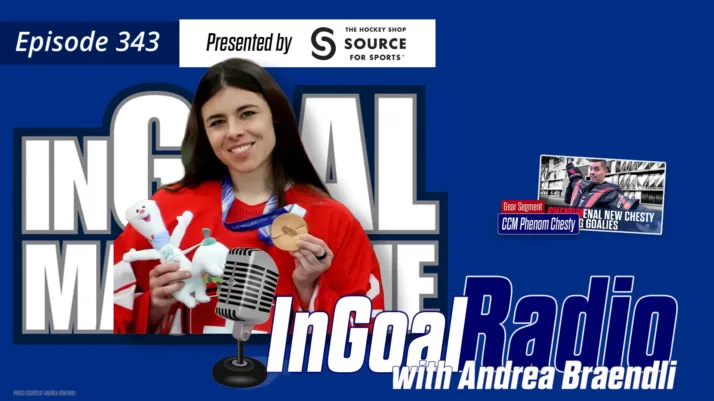
Episode 343: Top Women’s Goalie of the 2026 Olympics, Switzerland’s Andrea Braendli.
Please subscribe and leave a rating — it helps us reach more goalies!


Switzerland's Andrea Braendli was named the top goalie of the 2026 Milan Olympics after backstopping her team to a bronze medal with a 2-1 overtime win over Sweden, posting multiple 40-plus save performances en route to the medal round. The 28-year-old previously won an NCAA national championship at Ohio State before returning to Europe, where she was named the top goalie in the Swedish league. Braendli credits some of her worst goalie coaches as ultimately being among her most valuable.
- Andrea Braendli earned top goalie honors at the 2026 Milan Olympics after making 40-plus saves in multiple games to carry Switzerland to a bronze medal.
- Growing up playing mostly against boys in Switzerland built Braendli's foundation before she won an NCAA national championship at Ohio State.
- Braendli argues that adapting to different — even poor — coaching voices can become a long-term developmental advantage for goalies.
- Alex Lyon demonstrates how to manage rush depth and when to release conscious thought and play on pure instinct.
- InGoal introduces a new free shot-tracking app for goalie parents while advising that most youth performance metrics should be used sparingly, if at all.
Episode 343 of the InGoal Radio Podcast, presented by The Hockey Shop Source for Sports, features the Top Women’s Goalie of the 2026 Olympics, Switzerland’s Andrea Braendli.
Feature Interview
presented by NHL Sense Arena
In the feature interview presented by NHL Sense Arena, Braendli discusses backstopping the Swiss women to just their second ever bronze medal in Milan with a 2-1 overtime win over Sweden after a series of 40-plus save performances just to get to the medal games. The 28-year-old shares stories and advice from her roots in the game playing mostly against boys growing up in Switzerland, and how she ended up winning a NCAA national championship at Ohio State before heading back overseas to play in Sweden, where she was named the league’s top goalie. She talks technique, tactics and how to adjust to new coaching voices, including why some of her worst goalie coaches ended up being her best.
Parent Segment
presented by Stop It Goaltending U
In the Parent Segment, presented by Stop it Goaltending U the App, we talk about metrics and how to use (or better yet ignore) them, while also somewhat irincally introducing a new, free shot-tracking application developed by InGoal.
Pro Reads
presented by Vizual EdgeWe also review this week’s Pro Reads, presented by Vizual Edge, featuring Alex Lyon with some great advice on managing rush depth, and when to let go and just play on instinct. And in
Weekly Gear Segment
presented by The Hockey Shop Source for Sportsour weekly gear segment, we head to The Hockey Shop Source for Sports, for a look at CCM’s Phenom chest protector, which shrinks pro-level protection into a mobile unit for kids.
Episode Transcript
Intro
InGoal Radio Podcast brought to you by The Hockey Shop. Thehockeyshop.com and Source for Sports Langley. Daren Millard along with David Hutchison and Kevin Woodley. You guys look very excited about today's episode.
We almost had a goalie goal last night, so I'm just, like, jacked about that. That that's why I'm excited. I swear to god, they pulled Kevin Lankinen and the Canucks did in Seattle. It was like a four four four to one game with five minutes left. I turn to my wife Steph right there, I say, oh, it's coming.
I was covering the game remotely, and I was actually looking up stats for a goalie goal as soon as they pulled him with that much time and Joey Daccord in the other net. I was like, it's coming. I need to make sure I have this prewritten. It was almost like the night when Ullmark got his. I they pulled the goalie so early in that one that I'm like, I looked up the stats and had them at my fingertips, and he did not miss by much.
So that's why I'm excited tonight, Daren. It's not the sleep deprivation. It's it's that we almost had another goalie goal. It's not the fact that we've got goalie fights everywhere now. Holy.
Somebody set a trend. Somebody's trendsetter.
K. The the goalie fight was very one-sided.
Which one?
The Louis Domingue one.
Louis Domingue. Yeah. Louis did yeah. We Louis, Louis had some experience in that one by looks of it. Veteran savvy.
What was the other one?
Lefty. There's one in the Western League a couple nights ago.
I didn't see that one.
Regina Brandon.
Oh, look. That that had some emotion to it. They were chucking.
I'm gonna be the first goalie fight involving Brandon and Regina since Hexy back in the day. He had a couple of well, he might not have had a goalie fight, actually. He just fought the bench.
He didn't need the other goalie to have a fight?
No. No. He'd fight anybody back in those days. Joey Daccord must have been looking at the clock going, really? You you're gonna give me this chance?
Yeah. Like he said, like, it it went wide by about, like, four, five inches, and they were just catching up to it. Maybe if they'd known it was going in, they could have caught up and knocked it away. But the only difference was, you know, and it would have been a high degree of difficulty one in the first place because it was from behind the net. Right?
It what he didn't catch it out front above the goal line and give it a chuck. It it was came around behind the net, corralled it, and let it fly. Thought he had it. How much do you
think guys legitimately will spend a couple of minutes practicing that?
I live with one.
Really?
All the time. Yeah. Yeah. And I'm sure there are tons of young goalies who do the same thing. Like, it's it's just like we see all the skill coming up from the young forwards into the National Hockey League.
Goalies see stuff like that happen at young ages, and now younger and younger and younger, they're working at things and getting better and better at how they move the puck because it's it's an exciting opportunity.
I don't see it that much. I don't know about you, Daren.
[crosstalk] Don't see
it much in NHL practices anymore. The last guy
I saw time either.
Well, I remember a game day skate. The Edmonton Oilers in town, he wasn't starting that night. And so he was mostly out there with the the healthy scratches who were getting rinsed. He was basically out there for target practice. And when the scratches sort of went for water at the bench, he grabbed a bunch of pucks, went into the corner and started started or behind the net and started firing away.
And that was Mike Smith. And I remember just being like, oh my like, he almost banked it off the bottom of the scoreboard, like the giant scoreboard above center ice. That's how high he was arcing it. But but that's pretty few and far between at the NHL level in terms of seeing them practice. And I don't go to every practice, so maybe
they And there aren't a lot of practices, and they're shorter.
Yeah. These days, especially doing. Yeah. And I think
I don't see it.
it. Everybody's skating around, you know, like, that's when you'd be playing with your skills and everybody's skating around, but you don't wanna be the guy trying to chuck it a 180 feet while everybody's skating around either.
Yeah. The guys get a little irritated with that.
Yeah. You get pinged a couple of times. You'd be a little choked, and then they're gonna throw it off your bucket from the hash marks all day in practice. Yeah. Not a good mix.
That's coming back to haunt you. Hey. What's going on with the goalie guide?
Well, it's, getting released tomorrow, I guess, in terms of the directory. I mean, it's been live for a while now, but, the deadline was today for people to get in. So we'll see it in all its glory, tomorrow. I think to be honest, knowing how busy coaches are and how things go over the next couple weeks, things will get refined. But, in terms of its format, it's there.
The actual guide, the PDF magazine style guide is still a few weeks away, but, the the staff are all working on it as we speak and, and excited. And then I've also put it in into an iOS app. So it, we still need to get it through the App Store and all that, but it will be available, for people who want to peruse their favorite goalie coaches and goalie schools through an app as well. So we've added a ton a ton of features this year compared to what it was last year just to make it much more accessible for fans, for parents, for goalies who are looking for their next coach, and to give so many more opportunities for coaches to share what they're up to as well. So, all I can say is head over to ingoalmag.com, hit the coaches link, and you can go find your next goalie coach.
Hutch, why don't you tell them about Coaches Finder? Because I am fascinated.
Right.
Daren, Hutch has been delving into the world of artificial intelligence, which he's discovered quite quickly is a lot smarter than his business partner on this end of the microphone.
Well, you know, the other the other thing I've discovered is is everybody of course, if you get onto the socials and they'll be like, oh, you can build a website in two hours and you can do anything you want in an afternoon and well, you can put something garbage together in two hours, but to put something good together, it still takes a long time and all that AI has done for me has allowed me to work, longer and harder. It gives you that dopamine rush every 20 minutes as you send a new version of something out and get to see whether what you were trying worked or didn't work and now you tweak it a little bit more. So there's a lot of effort behind it. But, yeah, one of the things we've done is added AI enabled search both to the directory and the InGoal site itself. And, essentially, it allows you to use natural language in looking for what it is you are trying to find.
So previously, search worked on what we call keywords. So if, if a coach put down that they coach in Toronto, then you would need to say Toronto to go and find that coach. You you couldn't say he coaches in Ajax or Oakville or Southern Ontario. They wouldn't find it. But now there's a better chance that you will find them, because it will understand some of the language that you're looking for.
And you can get in there and say, you know, I have a 14 year old goaltender who is technically strong but struggles with his mental game, and it will help you find some coaches who work with goalies of that age on their mental game. There's a lot of things you can find through that, but what we've also done is deepened, the search. So you're not just looking at what they put on our site, but at least in terms of the top half of our directory, those coaches who've invested the most, you can get in and see what's on their website as well. So I did a search for a coach who used a particular technology, on his site but he didn't actually mention it in his InGoal listing but he still popped up because we searched through to their site as well. So, lots of opportunities.
And similarly, if you want to go to ingoalmag.com and there's a search link on the menu, You can also use the natural language search there and and I hope, make it a little easier to to dig into some of the content we have. We still got some work on our end to do in terms of how we tag some of our content. So it's just gonna get better and better as time goes. But, yeah, just one of those features we've added to try and bring more coaches and and better matches between goalies and coaches.
Hold on. I'm typing right now. Can you find me a coach to help a 52 year old
Just type I want to be a beer league hero.
With a bad attitude, but a great warm up stick. This AI is fantastic, Daren.
This AI is fantastic, Daren.
Yeah. It just came back.
Answer is no.
Nobody wants Sorry, Kevin. Sorry. Nobody wants to take you on.
We know this is you, Woody.
Well, the coach knows he won't get a word in edgewise.
How can you be coached if you never stop talking?
That's fascinating, though. Not surprising that you came up with this and not Woody and I.
I just love learning, though. I love doing new things. And you'll find out in the parent segment, there's another new thing I've done because I had a little bug that I had to, to work on.
I look forward to that. Also, something happened over at, From the Crease.
Or it will happen. March 3 launch, we've been teasing the content. We've got a new video up with Ian Clark. Just a quick short video part of our new partnership with him, but the big news in that partnership is the app itself is launching on March 3. That is Tuesday.
So by the time a lot of you listen to this episode of the podcast, it may be out. If not, if you're hearing this on Monday, you can still go preregister to get the free book, 10 ways to get killer stats from Ian Clark. Download the PDF ebook by registering. Doesn't mean you're committed to it. You're just registering to get early access when the app launches on Tuesday.
So, I've seen it. I've I've been behind the scenes in it. There's a lot of new exciting things, from the coach that brought you goalie news, from the coach that brought you the original from the crease sort of goaltending manual, one that's been copied internationally or at least used in parts to create some of the programs in other countries, all brought to you with app form, with videos, and just a real interactive environment. So can't wait for that to launch and everybody else gets a chance to discover it on March, from thecrease.comftc. The app is set to launch.
Some fun, conversations coming up, throughout this episode of InGoal Radio Podcast, brought to you by The Hockey Shop Source for Sports Langley, thehockeyshop.com, including our Gear Segment, where we will deal with the CCM Phenom Chest Protector. That's for the kiddos. But also a great, feature interview, this week as we, pay some attention to the fantastic women's tournament at the Olympic Winter Games.
Yeah. And, I mean, the final was fantastic, and Ann-Renée Desbiens was fantastic. Obviously, Aerin Frankel was unbelievable. She only gave up two goals on 99 shots in the entire tournament to win a gold medal for the Americans. Like, what an incredible tournament she had.
We're hoping to catch up with her when the Boston fleet come through Vancouver in about a week's time, a little more than a week's time. But but as good as she was, as good as Ann-Renée was in that gold medal game, the top goaltender in the tournament is Andrea Braendli from Switzerland, who had a number of incredible 40 plus save performances including to to win well, it wasn't quite 40 in the in the bronze medal game, but another great performance in the bronze medal game against Sweden to secure the bronze for the Swiss, just their second ever Olympic medal, and we were able to catch up with her. Already a week later having played two games for for Ferlunda in the Swedish women's professional hockey league and heading into her playoffs this week. She gave us a good forty minutes of her time. It's a fantastic interview.
I can't wait for everyone to hear it in our future interview.
Get to that in just a little bit. NHL trade deadline is on the horizon. We've been down this path of talking about the advantages of making the moves earlier with goaltenders. So with that in mind, do we expect much movement from the crease by March 6?
Don't know. I just genuinely don't know. You know, who where are the hot button teams that are looking? Edmonton continues to talk about too many pucks going in, but I think anyone that watches them play can understand it's not necessarily about the goaltending there. I mean, the defensive environment has just cratered.
We hear a lot of buzz around Montreal, but do do they pull the trigger? Like, I just think there's so there's not a ton of games left. And because of the condensed schedule this year, you won't be able to play it's not like you can play them all. And so it's just not a lot of time for a goalie to go into a new environment and get used to a new system and new teammates and feel like they're reading off of those elements at the at at the sort of peak of their powers by the time the playoffs start. I think we saw Colorado go to school on that last year.
We saw Edmonton pull the trigger on a trade around the same time mid December. And I I'm just not sure how many teams view a goaltending trade in the March as something that's gonna be effective in time for the playoffs by the April.
Quote of the week, goes to Daniil Tarasov, by the way. Was not happy with the situation, Rome.
Explain that one to me, man.
That way, it was an interesting call because from above, it it was interference in trying to catch a puck. Or Yeah. The glove was outside the crease, but
the body looked like this earlier this was it this season or late last season, there was a a very, very similar one, and they were at least consistent.
Mhmm. You're I I thought we had the right to make the save,
especially when you're there even outside the crease, they've got a right to go for the pocket.
Right. Yeah. I actually I saw it towards the player.
I'm a little more sympathetic on the player's side.
Your card is getting
[crosstalk] I know. I know. But there has to be some access to the to the player right to the to the player, to be able to make a a play on that puck, and it was a legal play on the puck, if I'm remembering correctly, Hutch. Daren, that's the
that's the door. That's the bully police.
They're at
the door.
They're they're
banging loudly. They're taking away your union card.
If it was me, I'd be sour about it. But the with all the, views that we had on it, I I give them credit for for making a a difficult call. The the easy one would have been, yeah, touch this glove. We're we're taking that one back. But, big picture wise
Okay. Fine. If you don't call it that way, like, where is where is the line Yeah. Where a player can go after the puck and touch the goaltender and it not be interference. Well, the line is the crease.
Like Mhmm.
It's I mean, I
I Didn't used to be this way. Like, I I remember in the Tim Thomas era, like, he played outside his crease, the butterfly, and and he used to say it all the time. And he and he got the calls. If I'm there first, I have the right to that spot.
If you're there first. But I think it
If it's simultaneous and it's outside the crease, it's it's a battle.
And I feel like there's something different between a player colliding with a goaltender versus a stick and a glove both going for a puck. Like, it it feels different to me. But aren't they all unfortunately, that's the problem is that it's all about feel. Yeah. Really.
And and they had multiple looks and were able to slow it down. Whereas, if you if you're in the junior a, if you're in A A A, U 15, U 18, like, it's that you're you're going by on the the, officials' judgment only, and that's a tough spot for them to be in.
Well, we had another one last night that was somewhat similar. Kevin Lankinen and out past the top of the crease. Jayden Struble skates through, makes contact with his glove, pulls it away from where the puck is going. And by the time Lanken goes back to catch it, it's already passed. So I guess in some ways, that's a similar play, but because he's outside the crease,
he's But I I don't think it is, Woody, because it's it's and I I only glanced at that play once, but
that's contact with his glove as opposed to going for the puck, the two of you at the same time. Well, neither one of them came back. So I guess they I mean, they both countered as goal. So and that's fine if we're gonna do that. I've seen you know what I would like to see then? Like, then start calling it in the crease when pucks don't go in because we're back to contact in the crease all the time, and the referees are just like, oh, you know, like, we're back.
If it goes in, it's not gonna count. Well, you know what? It's actually just a freaking penalty. So start calling
it. I hate that
commentary. Tired. I'm seeing guys get not run hard, but, like, stepped over, stepped on, tangled up, like, of injury. There was a couple the other night, and I'm just like, just call that. Start calling that.
If you're gonna be this absolute about in the crease and outside the crease on contact and goals counting, then in the crease is our spot and keep them the f out of there. Mhmm. Because there was a there was one I think with Joseph Woll the other night. I think it was him where the guy, like, behind like, you got skate blades. You got guys walking over top of the backs of legs of goaltenders.
He's all tangled up with them, and then he has to reset for the play. And, like, if a puck had come a second later, it would have been like, oh, you had time to reset. Yeah. It's freaking goalie interference. Call it.
That line from officials say it wouldn't have counted. Like Oh. Okay. They call it. Cop out.
Yeah. Matt Matty's actually had games where the officials have said to him in the middle of the play, don't worry. We got your back. If it goes in, it won't count.
That's that was a common refrain for years in the NHL. Goalies always used to tell me, I'm tired. And they would say, like, they'd say to me, they'd say, referee would be I'd ask them about a play where there's contact and be like, oh, the referee told me if it had gone in, it wouldn't have counted, but it's such and they would say to me, like, it's, again, what I was saying, it's such a cop out. Like, just call it and penalize them, and then we don't have to worry about it. And the replay was supposed to do this.
This was supposed to be the solution, but it hasn't changed anything. If anything, the fact there's been so much airing towards the side of goals counting, I think has increased contact that's allowed in the crease since we brought in the rules.
Yeah. I'm sure you're right. In in defense of the officials to go on the other side of this now, the rules do differentiate between intentional contact and incidental contact. And if it's incidental, the goal doesn't count, but it's not a penalty. So like, you know, they they could be reading it as that sort of a situation.
If you're cutting through my crease and skating behind my legs and clipping my feet and Of all those things course. Screw incidental. You made a decision to go behind me. That's on purpose.
But that's yeah. It is. But and it's not incidental.
Well, they seem to like, oh, well, he incidentally skated to the like, I I I don't even know half the time. I'm just in a mood right now. You guys got me off this We
didn't even cover that in the preshow meeting. I'm I'm glad we didn't because this is all organic.
I'll Didn't give us enough time in the green
from this conversation.
Fired
up. Woody's just upset because they left green green M and M's in the bowl, and that is part of his contract. No green M and M's.
It's in my rider, boys. It's in my rider. Is there such a thing as green M and M's? I don't know. So I don't think so.
Chris I was hanging out with my buddy, who's a stand up comedian. He he did a couple of shows in Vegas this weekend. And, he's like, what what do you have on your rider? What do got there? And it was a fruit basket, water, Coke Zero, and then there was something else.
And the the something else didn't happen. I'm like, let's go out there. Let's go out there. But, anyway, it was it was pretty cool that that I'm I'm with somebody that actually had a rider, which was awesome. Ian Bag from from BC.
Oh, wow. Good guy. Loves his hockey and and really gets dialed into it. So so does the orange slices podcast with Jeff Sharples. They don't talk all hockey.
There's a lot of comedy in it too, but it's pretty cool.
Don't suppose to play goal. Can we get him get him on here?
What's that?
Did he play goal? Can we get him on here?
Oh, we could get him on here. I'm not sure how much goal that he'd be able to he'd be able to make fun of goalies.
There you go. Most people do. Hey. What's in the fruit basket? That's what I wanna know.
It was, a lot of melon. Acceptable. Better than potato chips in there.
Right? I'm I'm assuming it's cut up because that'd a little tough to, like, you slice open your own melon and start digging in.
That would be that would be a challenge. Big challenge. The Hockey Shop Source for Sports Langley at hockeyshop.com brings us, InGoal Radio, the podcast, as well as the Gear Segment, the CCM Phenom Chest Protector coming up about what's happening with Cam and the boys.
Well, you know what? One of the things we haven't talked a lot about a lot, we talk about the great selection. We talk about all the new gear. We haven't talked a lot about their socials. THS goal on both x and Instagram.
Jono, one of their new back again employees after going away for school, has become their goalie geek. And he's in there with a lot of fun content and a lot of really informative content. Not to take away from our deep dives, but if you want ninety second versions of it, make sure you check them out on both of their social media channels. They do a really nice job there as well as highlighting some of the things that come in in really short order. Maybe by the time we're in there to visit them, it's already been on the shelf for a couple of weeks.
You can find it there. Things like Pro Return Sticks from Bauer that are on the shelf right now and all on sale. Vasilevskiy, Jake Oettinger, some of the biggest names in the game. Pro Return Sticks available now at thehockeyshop.com. So if you're looking for ways to find out more about what they got going on, obviously, listen to us, but also check out the social media channels for the hockey shop at THS Goal on Instagram, x, and The Hockey Shop Goal or Goal slash The Hockey Shop on Facebook.
Gear
Perfectly done. And now let's slide over to The Hockey Shop, with Cam and Woody discussing the CCM Phenom chest protector.
Just a hint. It doesn't fit me. You just wanted me to sing that Eminem song again, didn't you? I'm a phenomenon.
There it is. Technically, real one because that's copyrighted.
That's right. We don't have the money for that license, folks. So you get to listen to me do really bad rap. I'm gonna Okay. Let's wrap that up and welcome back to
The Hockey Shop Source for Sports. He's Kevin.
That's Cam. We're here in Langley, and we've already done the phenomenon, phenom phenom. CCM phenom pads and gloves. We have. But for some reason, Cam kept the chest protector hidden from you, so it's time to roll it out because this is a significant upgrade on their options for kids.
[crosstalk] You could say it's a phenomenal chest. Yeah. Okay. Just just leave the jokes to me. Let's go.
What what what makes what like, let's get into age groups, who it's for, what makes it special. I mean, first off, holding it like there's a lot of flexibility and mobility in it and still a fair amount of like inner and extra padding. We don't want our we don't want the young ones feeling like, you know, the puck hurt. No, but they also want to be able to move around and, know, back out of the driveway too. Right?
I don't know how many of them are driving out of the driveway, but yes, I got you.
Okay. So junior size specifically, just to be, you know, we're talking about that big seven year olds. Cam was a big seven year old. 10 years old, maybe 11. Eleven's probably starting to push into intermediate sizing at that point.
Two categories for sizing, small, medium, large, extra large. Okay. So in terms of for fitment and adjustment, it varies. Exactly. It carries over from CCM 7.9 chest protector.
So it's modeled after that unit.
So you could your young goalie could grow with this is what you're saying.
Exactly. Adjustable arms, easily done up by the Velcro. Also very flexible arms as Kevin alluded to there. Very, very easy to move around in this chest. It also is a bit thicker than the last year's model too in the CCM 6.5.
So they have So again, extra protection so we're not feeling the puck, but I mean, you can see just how much movement is in there.
Correct. So CCM is really focused on that mobility aspect side. It's usually a bit of a complaint, especially in the junior category.
Kind of feels like their EFlex 7, like it kind of presents and feels like their EFlex 7 just with a lot more mobility. They just chose a phenomenal name. Yeah. Okay. Just keep going, Cam.
It's got he's even got like the back arm protector, you know, not that we want kids that age doing reverse, but hey.
No. And also that hard plastic elbow cap is- because falling on your elbows suck. It does. It does. So easily adjustable back.
Again, can't stress enough about that flexibility. A lot of that comes from the segmentation of the actual belly pad itself. So nice and easily mobile. So if your young goaltender is looking for a chest protector, this might be a great place to start.
CCM, phenom. Got it right this time. First time. There you go. Probably last time for me to be honest, folks.
If they've got questions, Cam, about sizing, sizing charts, how to measure their kids to make sure which one they're in and whether it's gonna work for them, what the the range to grow into it is as we like you said, adjustable arms, adjustable over the shoulders. Where do they
get you? So for starters, you can check out the chest online at thehockeyshop.com or you can give us a call at (604) 589-8299 or the 1-800 number 1-800-5667 oh oh. I finally I finally screwed
up the 1800 number. We'll do it again then dummy.
One eight hundred five six seven seven seven nine zero. Hutch, can you make sure that's correct? Editing.
Take a puck off the head this week or what? Actually.
Did you try it on?
No. I did not. We should we probably should pretend that I tried it on and tell people to go check out the YouTube channel because it would be entertaining as heck. Imagine trying to get that over my head. I'm pretty sure it would just end up sitting over top of my face like a ball cap.
Didn't it look pretty sweet though, Daren? I mean, wouldn't you have loved to have that in about 1982?
Oh my when I was wearing arms and chest protector as separate pieces Yes. Of
Yes. Yes. So so good.
By way, you put the arm pads on first, and then you put the chest protector over top if if you're wondering how that worked.
And then the suspenders over all that.
Mhmm. Hold it down. And then close your eyes and say, please don't hurt.
Please don't hit me.
Please don't hurt. Please don't hurt.
Well, the kids don't have to worry about that with the Phenom chest protector. I I to your point, Hutch, it's it is remarkable. Like, they've made it way more flexible, like, way sort of softer feeling. So because kids gotta be able to move in it. Mhmm.
But the way it imitates sort of the pro level and the amount of protection it adds, like, you know, again, you don't want young kids being scared of the puck. And this is just a they've they've scaled down their pro stuff, but made it mobile so that kids can use it without being restricted. And when you see it in the store, it's like, damn, man. Like, to your point, this is good stuff.
It'd be harder to make entry level gear, kids gear, than it would be pro gear where you can just bulk it up, and the guys are gonna be able to navigate it. Being able to offer something that children can actually move in and still protect you would be a hell of a challenge.
Yeah. And they've they've found a nice balance with this one for sure. So it's nice to we we've talked about the Phenom leg pads and gloves and blockers, and this is a piece that we missed in the original run through that we wanted to make sure we get to because it is again again, as as Hutch knows, like, you don't want your kids being scared of the puck at an early age. That can form, know, that can create that that flinch, the bad habits that can be tough to break later on.
ProReads, brought to us by Vizual Edge. What's happening with Vizual Edge?
Well, I mean, let's start with Vizual Edge because if you want the puck to look like a beach ball, ever have those nights where it does? You know the ones. Every goalie has it here and there. The puck looks huge. You're ahead of every play.
You feel calm, patient, total control. Then there are the nights where you're half step late. You see it, but you don't really see it. You're reaching, you're guessing, you're fighting it. That's not your technique.
That's your eyes and your brain not processing the play fast enough. Vizual Edge fixes that. It measures how well your eyes track and process the game then gives you a custom plan to train improvement. Three fifteen minute sessions a week on your laptop or tablet, it's what NHL goalies use to make the game slow down when it matters the most. Remember, you can get 10% off using the code InGoal, I n g o a l.
You can get double that discount using our exclusive members only code. If you're a subscriber to InGoal premium, just go to the website, ingoalmag.com, click on any recent ProReads, and you will get that membership code. And that includes this week's ProReads featuring Alex Lyon. Now this is this one's a little bit tougher for us to discuss because there's a lot of feel in this one. One of the hottest goalies in the NHL, and and it's one of those moments where, yeah, there's a thought process, but in real time, it's just it's anticipation.
It's it's what you think is coming. But one of the key elements that he discussed leading up to what was a turnover inside the blue line, but just inside the blue line. So it created and we're seeing this more and more in the National Hockey League, at least, where turnovers inside the blue line or just out become rush chances. Like, even though it's in zone, they are coming downhill and guys are driving the net much the same way they would a rush chance. And one of the things that Alex talked about is where he sets up for his initial depth.
And so I'm curious for you guys, basically, even on a traditional rush, if it gets out to the neutral zone, where are you setting up on the initial point of entry? As that puck comes through center, are you out past the top of your crease and on angle, or do you wait till it gets further in the zone?
Oh, I'm neutral zone. I'm getting started in the neutral zone.
And and you're starting out and with flow?
Yeah. Okay. Yeah. I wish I didn't, but I I do because, I inevitably, I slide back, and I've I've I've just got I've gotta gain my depth to protect myself from the, end result of me being standing on the goal line.
Fair. That that's just the way
I have to do it.
Now the other way would be to not back up as much Wait. To start more neutral.
I I would like that. I just I can't figure it out how to do it.
[crosstalk] Okay. I think Second. Go ahead, Hutch.
Well, I was just gonna say, well, I think one of the lessons for for young goalies to take out of something like this as well is just how quickly things develop as you move up in the game. So for a turnover inside the blue line to turn into a downhill rush chance, you're not expecting that when you're 11 years old, when you're 12 years old, and suddenly you get your first taste of u 18 junior, and, oh my gosh, the game comes at you fast, not just because the players skate so fast, but because these things develop so fast and kids are gonna get caught. I've I've seen guys at high levels get caught because they're just a little bit relaxed, and then all of a sudden, you've got about one second to be ready and in position. So you have to be always ready these days.
Well, and then the one part of that in terms of Daren strategy, even if Daren wants to get out and take ice, the one thing that we're seeing around the league a lot and that Alex talks about is not taking that ice until the puck's over the blue line. Like, starting in a more neutral position. Because if you take that ice and it's not over the blue line, especially if there's a lateral ops, and chances are they're gonna make that lateral play around the blue line or up near the top of it as this one starts out with. And if you've taken if you're out past the edge of your blue crease, heels out or a foot out on the initial guy, just think how much further you have to get across to that second one. And then to Hutch's point about quick plays, if you're still moving on on the first pass and he's already one touching it back to somebody in the middle, you're behind, man.
And you and it's hard to catch up once you're behind in this game with all the pace involved. So, you know, Alex talks a little bit in his ProReads about taking less ice because the tendency can be to lose your net and get behind when you start out too aggressive too sooner. And I think that's a trend we're seeing around around the game quite a bit more rather than out and flow, unless it's very specific. So you read a breakaway or one on one chance. But rather than that, a lot of guys are playing, you know, a little more, like, three quarter depth.
And then once they've read where that play is gonna enter or that first pass is gonna go to, that's when they take that initial ice even if there's a retreat that follows it. So, you just one of those things that maybe not for everyone, but a a trend to think about something for young goalies to maybe think about trying in practice and seeing, you know, if it if it shortens their routes, you know, lessens the amount of work they have to do to be in position initially and limits how many times they get caught behind the play. So Alex walks through that and a whole bunch more in this week's ProReads presented by Vizual Edge. Make sure you check it out at ingoalmag.com. Make sure you check it all out.
If you're new, you haven't got a subscription yet to InGoal premium, did you know that if you go to the ProReads page, you can search and find from well over 300 videos featuring NHL goalies walking you through their saves, their reasons for their positioning, their reasons for a post integration decision, why they slide or skate on a lateral, like every different scenario, how to manage screens. There's a scenario that a goalie faces in the game of hockey, we've got an NHL goalie explaining how they manage it in ways that will help you think about the game and read the game better over at ProReads. Make sure you check it out.
And the way the pace of the puck movement in the National Hockey League or the speed of the players, I totally understand that about Alex Lyon. Like, you get yourself more trouble if you're taking that initialize a little more. Fantastic stuff. What an opportunity to be taken inside the crease of an NHL goaltender. The parent segment, with David Hutchison brought to us by Stop It Goaltending U, the app.
Well, we talked about Stop It Goaltending U product, Joey Daccord. One of the reasons I was so excited about him going for the empty net last night is because I know dad was in town. Oh. Brian Daccord Brian Daccord was up in the in the Pacific Northwest doing some scouting and was headed back down to watch him play that game. So I was thinking of both of them when I saw him go for it.
I'm like, he's gonna get to see it, which would have reminded me of that, outdoor game, that they played, at the home of the Mariners and Brian being there and the family getting to enjoy. What a great moment. So all that experience that the Daccord family has in the world of goaltending. It's twenty five years plus of NHL goalie experience, and it can all be at your fingertips in the Stop It Goaltending U app. Wanna tap into the goalie parenting expertise that helped Joey reach the NHL?
That's what you get with a subscription to Stop It Goaltending U, the app. All the knowledge from Brian Daccord has been an NHL goalie coach, scout, and director, as well as all the insights and expertise from his staff at Stop It, which last year celebrated twenty five years as one of the world's top goalie schools and includes a long list of veteran NCAA coaches on the staff, all delivered in easy to digest chunks, including five short daily primers, weekly style analysis and breakdown videos, and drills that you can take onto the ice with your team and your coach. Plus, when you subscribe to Stop It Goaltending U, the app, you get an included subscription to InGoal Magazine Premium. It's the best of both worlds, and it's all available to you when you download Stop It Goaltending U, the app, on the App Store or Google Play, so check it out today.
Parent Playbook
Let's get technical with Hutch.
I write these ones up every week, guys, and I give them a title. Don't usually use it, but this week, metrics, irony, and a shot tracker. So here we go, goalie parents. This one's for you. And as I said, it does come with some irony.
If you've listened to InGoal for a while, you know how I feel about traditional goalie stats. I like to get on my soapbox and go all Woody snaptastic about them.
Not all shots. Me some goals against average.
Yeah. There you go. Not all shots are created equal. A clear point shot through no traffic and a backdoor one timer after a seam pass count exactly the same on a score sheet. One shot.
Save percentage is a team statistic. Structure, coverage, breakdowns, what happens in front of your goalie shapes that number as much as anything your kid does. Judging a goalie especially off a single game save percentage without context just doesn't make sense.
But, of course, we know they're completely different issues for goaltenders to deal with. That's why I've always said that save percentage is a team statistic. Structure, coverage, breakdowns, what happens in front of your goalie shapes that number as much as anything your kid does. Judging a goalie especially off a single game save percentage without context just doesn't make sense. Drives me nuts.
And now we see media reporting the listing of the save percentage for a goalie per game. I I just think it's ridiculous, which makes this next part funny. I just built a shot tracking app, guys. What? I call it a save tracking app.
Look, I had to scratch this itch. I needed to test something and I needed, an app to to make to do this little testing. So of course, I I I dove in and I made a shot tracking app. And here's why. There are parents asking for them consistently.
There are lots out there, but I still see them asking, what are you guys using to track your kids shots and and goals and so on? And fair enough. They wanna stay engaged during games and they wanna contribute. They wanna help. So I thought if we're gonna track shots, let's do it at least with a little bit of a way that reflects what what I actually believe.
So, I called it save tracker by the way because because I think we should focus on the positive. And it tracks your shots. It tracks your goals and save percentage and game totals. You get emailed game reports after the game. You get a game history that you can check out all of them, and it even works offline in rinks that have terrible reception.
And InGoal members can actually go to your membership central and see the history of the games you've tracked there as well as in the app. As a basic tracker, and that's all it is, it does everything you'd expect and I think it does it pretty well. I'm kind of proud of it. But here's the part that matters. After every game, when you get your game review, you're prompted as a parent to write down one thing that you noticed that has nothing to do with the result because you know I believe in things being process based.
Something about their habits, their reads, their compete level, their response. It's up to you, but notice something because that's what your goalie really needs from you. Those notes show up in your game report when it gets emailed to you along with a reminder because I just can't help myself that numbers without context don't tell the whole story. If you want deeper context and you want true shot quality analysis, I still point people towards tools like Stop It Goal Tending's game day app that layer expected goals and expected save percentage. I think it's a great tool.
I've used it myself. It's the most objective performance lens that we as parents at least have right now. My tracker is not trying to replace that. It's just meant to, let's say, guide goalie parent attention. Completely free to use at the basic level.
Always will be. It's right now, it's just a web app, but if you dial it up on your phone, you will swear you're using an app straight from the app store and you can even save it onto your home screen of your phone and it works like a native app. The first five game reports are on us. Doesn't cost you a thing. There is an expense to running out those game reports, so we have to limit that.
If you're an InGoal member though, you get 10 of them a month and you can even, find cheap excuse me, freeways to, to get more of those as well over at membership central. You will find the app itself by going to the parent section at ingoalmag.com. There's a link there. Track if you want to track your kid with this. You don't want to track your kid, don't.
I actually don't. But whatever the numbers say after the final buzzer, make sure you can name something your goalie did well, something within their control, because to me, that's the point. Give it a look. Let me know what you think. parents@ingoalmag.com.
Hutch, you're gonna come over and track my next game?
Oh, well, the thing is I made the app.
Ten forty five.
If you look at
the app, I I purposely made the save button take up most of the screen and the goal button quite a bit smaller because, of course, we're gonna be hitting the save. I might have to reengineer the app for your games, though, Woody.
I'll never forget playing a game with three on three, and, I would have been a lot younger. It's about 10 ago, so early forties. And my stupid beer league teammates had signed us up for the spring summer three on three league, and they decided to sign us up to division one, which is like a bunch of, like, junior and college kids coming back. And they would have teams of nine, and we'd have six guys on the bench for three on three, and they'd all be dying. It's the only time in my life I've actually asked the referee dead seriously if he knew where the defibrillator was because I thought I was gonna die.
And at the end of the Didn't
wanna leave the ice, mind you. I'm gonna keep playing even though I think I might die, but just be ready, guys.
Yeah. It was my way of trying to get a little bit more time between whistles when I ever made a save and stop the puck and stop the play. So but at the end of it, I'll never forget this kid coming from the other side asking what I thought of his game. And I mumbled something about, I was so tired, my head was down, and I wasn't really watching. And he said, that's okay.
My dad was tracking it with video from the bar above watching. And he's like 19, 20 years old. And a, I felt really old. And b, I wondered where the hell Hutch was to track my game just to see in case One day we I literally died on the ice. Now we know we've got a tracker.
We can do it.
Was it hard to put that thing together, Hutch?
It was, relatively easy to get my vision into something and it was a lot of work to refine it to where I thought it should be and and frankly where it's safe. You've you've gotta invest a lot of time into making it safe on your website. So
Daren, the that answer would be you and I wouldn't have a hope in even starting this. I think that's what he's trying to say.
How many Lego pieces did it take?
A lot of Lego.
Because that's the only way I can make something.
Yeah. There's a it's not this app, but there's there's over a 100,000 lines of custom code on our site now.
So Oh, jeez.
There's a lot.
One of my big pet peeves, in The States is people call them Legos. Like, it's Lego.
Oh, yeah.
Yeah. They and then they argue with me. I'm like, no. It's Lego. Read the packaging.
It's Lego.
But for that reason alone, I'm we can't become the 51 state.
There's no way. Give you a few more reasons of that, buddy, but let's not get political here.
Warm up, warm ups, offside, offsides Oh. And LEGO LEGOs.
Do everything Oh, listen. Like like
listen. Listen. Listen. Like, we like, right away, you can't have warm ups. You have a warm up you can't have a warm up stick.
Well, it can't be warm ups stick.
Yeah. Mean, warm ups are stick.
Yeah. Only one ass in warm up stick, folks.
Fun conversation ahead in the NHL Sense Arena feature interview, with, Andrea Braendli, the Swiss goaltender, top goaltender at the women's tournament at the Olympic Winter Games. Some happenings over at NHL Sense Arena right now.
Yeah. Speaking of launches. So Tuesday, March 3, by the time you hear this, it may be out. Two of our favorite things in goaltending are being combined, NHL Sense Arena and Pete Fry. NHL Sense Arena is bringing mental training from Pete Fry into your VR headset.
And as scared as I am to put Pete Fry into my head, joking. I'm kidding. All those visualizations. If you've ever been around, Hutch has been around this. When Pete Fry, like because because we've been around because we've seen him do it out in public.
I gotta phone a guy and walk him through his pregame visualization. It'll be a guy in the NHL, and he'll Yeah.
He leaves the lunch table to run outside and Yeah.
Run outside and, like, basically do this, like, super hype up. You are it's awesome. Well, now you can just have that. All the you got the affirmations. You've got visualization that he walks you through all built into NHL sense arena.
I've started a review. I'll be continuing to work through the review, and hopefully, that'll be up on our site this week as well to give you a taste of it. But it launches on Tuesday. It's the this is what we love about NHL Sense Arena, not just everything it is, but the fact it's constantly evolving into new things. And in this case, it's our good friend, Fry, in your headset, bringing you affirmations, visualizations, and other ways to become a mentally stronger goaltender.
I love this development. Sit there with the headset on and just become better. Not going through drills, not working up a sweat, just becoming better.
Well, you get your visualization, but now one of the things they do is, like, he'll walk you through like, he walks you through scenarios where he's talking you through it as part of the visualization. And we all sort of, like, sometimes we close our eyes and we're trying to if you want, you can open your eyes, and it will actually repeat the play that he's talking about three times. First time, super slow motion off the release, and he's talking about seeing it coming at you off your blocker, follow it into the corner. And then the second time it comes through, it's a little bit faster. And then the third time it comes through, it's full speed.
And so you're you're training confidence on these different types of play, and you're also sort of visualizing all these different I think there's 10 different types of plays that they run through that you will typically see most often in a game. So it really is, not just a mindset tool, but a pregame preparation tool built into this. Kinda got two parts. It's got the long term, you know, mental strength training, but also that visualization get ready to play preparation side. So, again, I I've only sort of tipped the iceberg myself with this, but can't wait to dig into it even more.
It's a really exciting offering.
Right. Set us up for for the conversation with, Andrea Braendli.
Feature Interview - Andrea Braendli
Let's just hop right in. It's a get to know you because we didn't know much, and we should have. She was already 28. She's got a national championship at the Ohio State. She was the goaltender of the year in Sweden in the SDHL, playing two years with Modo in Örnsköldsvik and is now playing with Ferlunda, the home of Henrik Lundqvist.
There's just it's such a great background. It's very unique. From Switzerland via the NCAA and back over to Europe and soon to be back here in North America as she prepares to declare for the PWHL draft for the upcoming season. Let's get to know. Let's catch up with and learn about what the Olympic experience was like as well as a lot of great advice on handling bright spotlights and big stages, different coaches, adversity.
She's been through it all, and she's such an open book sharing lessons and advice for goalies of all ages in this NHL Sense Arena feature interview. Really excited to welcome to the InGoal Radio Podcast. First time guest, hopefully, first time of many. Andrea Braendli, the top goalie at the Olympics, bronze medal winner for Switzerland coming off a fantastic tournament. And if you're if if you're hearing that name or you watched her at the Olympics and you thought this was an out of nowhere story, you haven't been paying attention, national champion at the Ohio State, goalie of the year in the Swedish Women's League, has excelled throughout.
Where does the last week rank amidst all the accomplishments? Is that the is that the biggest?
Yes and no, I would say. Okay. I would say yes, obviously, because of the the outcome, you know, like, winning a bronze medal at the Olympic games. I think everyone can agree to that. That's just a dream come true.
You know? There's no doubt about that. But in terms of, like, personal, like, experience, it's it's one of the tops for sure, but maybe not maybe not the alone top top experience.
Okay. So where what like, where are the other ones? Like, what what am I missing here?
I would say another top one that we had that I experienced was the the U18 division one world championship where we won and got promoted to top division. I think that just, like, sticks out to me because it was my first, like, major event that I like, major tournament that I won of the national team. And I was young, and I was like, this is my, you know, first time ever just, like, being at world championship number one, playing all the games, and just winning and winning best goalie of the tournament. So I think just the fact that it's it that was my first ever tournament just, like, is also very high on that list.
What's these last few days been like since since winning the bronze? What's the celebration been like? What's the outreach been like? And you as I understand it, like, you're going right back into playoffs with for for Lundqvist, so not a lot of time to enjoy it. How's that how do you balance that?
It's been busy. Wow. Like, no one really talks about the aftermath of winning a big medal, I would say. And I think everyone can agree to that. Like, you don't really think about that.
You don't want to think about it because you, like, think if you think about the aftermath, you're like, oh my god. I'm gonna chinks it. Not. I think it's good if you think to, like, think about the aftermath and prepare for that a little bit too, whatever way it went. But, yeah, it's been it's been busy, very busy.
A lot of media stuff, a lot of, you know, interviews and podcasts and and all of that. And we love to do it. Don't get me wrong. But I also, like, went right back. I had two games since since the end of the the Olympics with Ferlunda already.
Playoff starting Monday. So, yeah, it's busy. You know? There's no times for breaks here.
Well, I appreciate you fitting us into that incredibly busy schedule. Let's let's re let's rewind a little bit because everybody got to see you on the Olympic stage. Mhmm. The roots of this, where did this all start for you? Where did where did the passion for goaltending and hockey how how did what's the origin story?
Oh, wow. Back in the days, if I may so. It's been, what, twenty twenty five years ago when I started. I was
So you were three?
I was yes. At the lovely young age of three years old, I was basically barely able to walk and run, and I was skating on the ice, and I fell in love with it, basically. But there's a fun story to that actually, because I wasn't like it wasn't me that was like, I wanna go on the ice. It was my mom basically just putting me out there. Because my brother I have a two year old, like, two year older brother, and he started playing hockey.
And it was a pretty, like, time consuming effort for my mom, I guess, to, like, go back and forth between my brother's practices, watching me at home, and, you know, like, you know, time management. So she, at some point, was like, you know what? It would be easier if both kids will be on the same eyes. So there we are. She put me out there and I, like, kinda, like, showed some talent, I guess, and just kept going with it.
So that was the origin story of hockey. Goalie came a bit later, I would say, but similar way. You know? Like, I watched I watched like, I had older brother. He needed the goalie.
So who would you put in that? The younger sister, obviously.
What do you what did you love about it? What do you what what do you love about it now? What what drives you and and fuels the passion for the position at all these years later?
I would say that uniqueness. You know? Like, you're you're the goalie is yes. You're still in the team sport. You're still with the team, but it's such a unique position.
You're so, like, by yourself in unique ways that no one really can understand you. And I think it's a mixture of that uniqueness, having that sole responsibility within the team. You're special in more than just one way, I would say, as a goalie. You're so special because you have so unique requirements, unique pressures. You the position itself, there's so much I don't know.
There's excitement around everything you do. You know? That's just like every time I step on the eyes, I'm like, oh, that's fun. I love it.
Now I know you studied psychology. The pressure that you mentioned there, learning to deal with it on a stage as big as this, even though you've been on that stage before, can you share tips or advice for other young goalies? I mean, for them, it may be the playoffs at u thirteen coming up next weekend versus an Olympic stage, but we all sort of feel those nerves in big moments. How, through all your experience as well as maybe your degree, I don't know, or you're studying psychology if that played a role, how have you learned to manage that as well as we saw you do it in in Milano?
It was a process. You know? Let me tell you. It wasn't it wasn't a talent or a gift that I had, growing up. And I think that's something young goalies or young athletes in general need to understand that it's not you don't really have a talent for that.
You're not better or worse of handling nerves. It's not good or bad if you get nervous or not. I think it's always like a process for you to find the right way. For me, what helped, and I think that probably will help a lot of goalies is if you realise that it's no difference between a playoff game and the practice or a preseason game or just a regular season game. It's the same sport.
You're not better or worse of handling nerves. It's not good or bad if you get nervous or not. I think it's always like a process for you to find the right way. For me, what helped, and I think that probably will help a lot of goal is if you realise that it's no difference between a playoff game and the and the practice or a or a preseason game or just a regular season game. It's the same sport.
You know? And once I realized that, it's so much easier going into into any kind of game because that's what you practice for. That's why you stand on the ice every day or the every other day or however many times you go on the ice. Because at the end of the day, it's the same sport no matter if it if the outcome is an Olympic medal or or just three points or one point or no point.
You know? Just a matter of, like, do you actively remind yourself that heading into a bronze medal game, or is it innate at this point or arriving at that process? Because sometimes a lot of the things I find in goaltending or we find in goaltending, like like one shot at a time mentality. Super easy for me to say standing here. But when you get in the moment, you you sort of need to develop different mechanisms that allow you to get there.
What what how have you sort of been able to arrive at, hey. It's just it's just another hockey game.
It was a learning learning curve for sure. You know? Like, I it took me a while to figure out on, like, how much I can tell myself that it's just a game because you want some sort of tension, obviously. You know, like, I always also, like, I I allow nervousness or, like, just in general, that excitement. Like, I don't suppress it because I think you can also use that for your benefits.
Like, turn it into a mode like, like energy or like drive or competitiveness, you know, that you really go for every pot. But for me, like, when it, like, when that nerve, like, the nerves hit you or their emotions hit you and it turns into something negative, you know, like you like it like, you can feel it makes you tense up or, like, makes you feel nauseous or or, like, you can't breathe anymore. That's, like, the moment I tell myself, hey. This is just an ordinary game. This is the same sport that I did literally yesterday.
There's no difference to that. And it worked out yesterday without any preparation for practice. You know? So why shouldn't it worked out today with everything I have with the pregame skate or whatever, you know? Like, it's the same sport, so it should work out.
So that's usually but I learned that through also, like, getting to know myself a bit more, like, and that's, like, with failure sometimes too. You know? Like, I I had to have some moments where I, like, told myself, well, it's just a game, and I had no attention at all in my body and then just played horrible that game. That's okay. But it that, like, made me learn, like, how much I can steer my emotions by telling myself this is just an ordinary game.
That makes sense.
It does. It is I mean, it's kinda one of the beauties of the position is those things as well as how you play it, like, technically, tactically, like, there is no one way. I think it's what I love about the position. There is no very few absolutes. Everybody has to find their balance in all these different sliding scale.
No. For sure. And I think it's the it's the importance of having a good goalie coach for me. Because a goalie coach if if a goalie coach really understands that aspect of a goalie and doesn't trying try you to fit into, like, a pre made, like, idea of a goalie, once he understands that everyone's different, like, he can really, like, really elevate your game by supporting your way, you know, by knowing what you need and what the other goalie needs. And that's, like, that's when a good goalie coach comes into play and can help you so much.
So who are some of the influences for you over the years? I was gonna ask about two things. Inspirations, but let's go to influences first. The goalie coaches along the path because once you committed to goalie, I mean, there's a lot of success here, a long resume. By the time you're 16, you're you're you're winning Swiss championships.
How did your game take shape and evolve? And I I'm imagining there's a lot of evolution from 16 through college, through national team, and playing pro. How has it evolved? Who are some of the key influences along the way?
Again, with that, it's like sometimes you get good and bad at, like, experiences with coaches. Of course. And you learn from both, I would say. Like, I almost learned more from having a bad goalie coach than having a really good goalie coach, if that makes sense. Because it made me It it's it's hard to explain, but having a bad goalie coach for me was always, like, such an eye opening moment that I can't rely on outside sources sometimes.
You know? Like, it it made me also, like, made me also, like, learn how to think logically by evaluating my game for myself because I can't rely on someone else.
So you needed to be your own role at Coach.
Exactly. Exactly. And I needed to develop those skills as well. And I think it helped me so much that right like, now, I don't rely on outside sources in any way, not in terms of motivation, not in terms of analyzing my game or my practices or every shot in practice. I do that automatically for myself, but I had to learn that through having, like, not so good goalie coaches, I would say.
That makes sense.
When you say not so good, like, just maybe hands off, not teaching you stuff, or or were have there been moments? Because I think a lot of goalies go through this, especially as they move up the ranks. And, you know, if you move to different teams, you'll get a new voice. And Mhmm. That voice also controls whether you play or not.
So that that you sort of need to do to a certain degree what they tell you to do, but sometimes what they want you to do might not fit your game. Did you some experiences there?
Oh, a 100%. A 100%. I had I had plenty of goalie coaches who tried to change me, into the way they wanted goalies to be. But then at some point, I I had to hit the brakes, and I'm like, hey. What you're telling me is not what fits my style or what fits me personally.
But I had to and that's, I think, an important lesson also for young goal is to speak up for yourself. Because, like, at the end of the day, yes, the goalie coach will decide if you play or not or will talk to the head coach if, you know, who he wants to play. But the end of the day, the head coach decides and the head coach watches practices. So if you listen to your goalie coach that will try to change you and it affects your performance negatively on the ice, that's just a cycle. You know?
Like a bad cycle, a negative cycle that's just gonna make you make it worse and worse and worse also mentally for you. So at some point, you need to speak up for yourself and be like, hey, I can't listen to you anymore, or we need to discuss it because I don't think that fits me. You know? I think it's always important to have a good discussion going on, whether that is negative or positive, but there needs to be some sort of discussion at some point because it's it's not gonna do you good if the goalie coach is trying to change you when you just listen, listen, listen because you think you have to. You know?
So
at the end of the day, you need to understand your game to know like, it you need to have a true understanding of your game as opposed to just try every like, try everything, but understand what
Exactly.
What and I guess why. Why it what does or doesn't work as opposed to just, hey. I don't like this.
No. Exactly. I think it's it's important to try things because, you know, I also had to learn I had to like, I I can be stubborn. You know? My head could be pretty stubborn when someone new comes in and be like, hey.
You need to do this and that. I'm like, absolutely not. You know? But I had a good a good discussion with who was that? Oh, yeah.
My goalie coach when when I was at Boston University, Brett. Like, he we had some good discussions going on, and he also, at some point, probably wanted to smash my head because he couldn't get into it. But we had a good discussion. What stuck with me with, like, what he said is like, you need to build your toolbox, you know? Like, it's like it's like having, like, a garage with all your tools.
You know? Like, the more you get, obviously, in in every situation, you're prepared for it. Whether you use that, I don't know, that drill once a year or 7,000 times a year. It doesn't matter, but you have it. And that's something you it's important as a goalie as well.
It's like try things. Maybe it sticks. Maybe it works out for you. Maybe it doesn't. But at least you tried.
At least you maybe, you know, came out out of it smarter because you can't you don't you can't know if someone works for you or doesn't if you don't try it. You know? So have your have an open mind, but don't, like like, try to implement everything. You know? Tools.
Sense.
Yeah. It does. We we talk about tools in the toolbox all the time and having an open mind, but also understanding if those tools start to take you away from the foundation of what you think makes you good. And so so what would flipping that on its ear a little bit, what is your foundation? What are what are your anchors technically or tactically that sort of allow you to play the way you do, which is I mean, there's so much it looks like there's so much precision and efficiency in movement, you know, just tracking mechanics, but willing to if you need to, go into battle mode?
Like, how do you find the balance between the two? What's your foundation?
It's tough because back foundation, I think that was built so many years ago. I don't I can't really remember all of it. Right. But but I think one of my core things that all I always try to do is, like, stay on your feet as long as you can. You know, today like, these days, I would say, like, every time I go to, like, youth goalie camps, the first thing the goalies wanna do is, oh god.
Can we do butterfly? Can we do reverse? Can we do sliding? And I'm like, no. We're gonna do the skating first because I think that's way more important than you know, everyone can slide.
My biggest, like, core strategy or technical point or foundation is stay on your feet as long as you can. Because I think it allows you to have that freedom to also switch into battle mode when you have a good stance, because then you can use your full force that you have in your legs and your core.
That's not that doesn't really require that much, like, technical skills, would say, even though it's fun, I have to admit that. But, but for me, my, my biggest, like, core strategy or technical, like, point is, or foundation is stay on your feet as long as you can. Because I think it allows you to have that freedom to also switch into battle mode when you have a good stance, you know, because then you can use your full force that you have in your legs and your core and wherever. So, yeah, I think that's my my foundation where I build everything on.
How do you become a great skater? You're working with young kids in some of these camps. Other than just focusing on it, is there any keys to you to the patience required to hold your edges as well as you do, but then also the power and precision to move around on them as efficiently as you do?
Well, in terms of, like, skating, like, getting comfortable with your skating, that's just a repetition thing, with everything. Get comfortable with staying on your feet. It's also trial and error in practices. Young goalies, I always tell them, hey, try to focus on staying on your feet even though you get beat low, even though you get a goal. Doesn't matter.
At least you you held your edge. You held your position and everything. You're you're you're there. You know? Because at some point, it will get you will build also the reflexes of understanding where the shot is coming from and your your instincts there will will kick in eventually too once you get that internalized.
So I think that's a that's a practice thing. It's just like repetition wise. You just gotta get get as as much repetition in as possible as with everything almost in in terms of goalie speaking, repetition.
Skate skate was skating a big part of because like you said, we do we see a lot, like, the reverse and sliding and skating a big part of just sort of your roots in the game? You probably like you said, you didn't start as a goalie, so I imagine playing out probably helped with that as well.
Oh, a 100%. And I remember my, we had a, like, a a power skating coach where I grew up in the in the team where I grew up, and his opinion was the goalie needs to be the best skater on the field. And I I never really understood why until now. Because now having that strong foundation within skating and I let me tell you, the hours I I spent even in my goalie equipment doing the same drills as the skaters. Whether that is like crossovers, turns, every I did everything, and I absolutely hated it.
I just, like, seriously hated it. But now I have to give a big thank you to to that guy because it makes learning new skills so much easier. Whatever, like, advanced skills, like, like, have, like, also, like, you know, like rotations and all of that makes it so much easier because I have that balance and that, like, feel, like, fine tuning into my, like, edges because I learned all of that when I was so young.
That's a great lesson because I think goalies, we always we always just wanna go to the crease and and even skating in the crease and doing crease movement patterns. And we had a story about Connor Hellebuyck when when he was a teenager and didn't get drafted. We used to go to stick and puck and just skate. And so skating is so important, but it doesn't always have to be within the confines of our crease. There's value to to different things that challenge your edge work and and you're proof that it pays off.
Exactly. No. It's so important, you know, to use the whole like, you have so much ice available. You know, the ice is so big. Use all of it.
You know? Even though it kinda is is is hard on your conditioning, I get it. Let me tell you. I hated it. But it works.
It works.
I love it. So when did at what point did you go who were some of your inspirations? Like, you know, as as you sort of moved up the ranks, who were the goalies that you looked up to, that you wanted to be like, that you maybe had a did that point where you start to emulate them and try and play like them? I mean, I I think of Florence Schelling as maybe one of the greatest women's goaltenders of all time. Was she somebody that you, through the national team, got connected with? Was she an early inspiration?
Who are who are the goalies that that made you wanna be a goalie?
We're actually I don't we probably don't know them. They're like Swiss goalies. One is called Reto Pavoni. He was, like, he was the goalie when I was in in in Cloten when I like, he was that last bit that made me commit to goalie. Okay.
Because when I was, yeah, I was when I was younger, I remember going to a game with my my dad and my brother and they won that game because of him, you know? He was the star of the show. He made, like, I don't even know how many saves but so many. Everyone was celebrating him and that. That was, like, the last bit that made me commit to being goalie.
And then I obviously inspired to be him. I also picked his his jersey number, number 20. I picked his number. Yes. And then he kind of was always my role model going forward.
But then, once I got a bit older, I also realised I like something like, obviously, you want to play like your idol, your, you know, like, inspiration. I pretty early realized that's not the way I want to play. That doesn't fit me, you know? So I realized really early that I want to kinda like like, I want to be like them maybe like mentally or like in their like body language, but not playing wise. I wanna create my own style.
So I looked up to all those goalies, but I never really saw them as someone that I wanna like copy and paste. So I always realized I wanna be my own unique self.
Were were there goalie coaches along the way in the early days? I like, I just not I mean, when I think of Swiss goaltending, I know there's a real strong history there of goalie coaches. We talk a lot about, you know, the Finnish program and the Swedish program, but there's always been a really strong goalie coaching fraternity within Switzerland as well. And, you know, I think too, like Francois Lair being there and running camps and remember talking to the Ray Taaffe of the world and the Jonas Hiller about those things. What was your experience with goalie coaching growing up in Switzerland?
I think I was very fortunate that I grew up in, like, a bigger club because they had the the resources to have goalie coaches for all levels. You know? Because I I like, they obviously, if you grow up, like, grow up in a smaller club, they didn't have the resources to to have goalie coaches until, like, later ages. And I think that has played a huge part in also my development because I got access to goalie coaches very, very early. So also bad ones, but I remember my worst goalie coach that I had was the one that, like, drilled into me to stay on my feet.
So I don't think he was the baddest one, but he wasn't the best. But he was he was the one that drilled it. He was one of the early coaches I had. I didn't like him, but he made me stay on my feet as long as I can, and here we are.
So The the decision to come over, for at what point did NCAA become something you were considering and the decision to go to the Ohio State, how how did you get there? And what was that? Again, new voices, new coaches, new influences. How'd you manage that?
It was pretty late in my career. You know? I went over when I was it was in 2018 after my first Olympics. That's when I went went over. So I was, like, years old, so pretty late.
And the decision to actually go over didn't come until my last year of 18, when first offers came in after the Under eighteen Worlds in top division, I think it was in Buffalo. That's when the first offers came in, and I realized, hey. It's actually something I I can achieve. Because before that, it was like, you know, you grew up in Switzerland. You you hear about college, and you I I obviously saw with Florence that went over to, like, play in Northeastern that it's possible, but I always, like, thought for myself it's so far away.
Like, I have no chance of even achieving that. And then once under 18 came, I realized, hey. It's something I can achieve, and I want to do that. And that's when I started actually, like, dreaming of it. And then Ohio State, you know, it was, I would say, like, love at first sight almost, or first, like, yeah, experience, you know, because I talked to them, I went to an official visit.
And once I was on campus, was like, this is it. This is this is the place I want to be. So pretty it was a pretty at the end, a pretty easy decision.
Style hockey different? Like, when when we we move from different leagues and different like, I and just not knowing what the style was like where where you're playing in Switzerland into the u eighteens, into N C like, what were some of the adjustments you had to make?
Obviously, biggest one, ice sheets. You know? Like, for going from the the big European sheet to the small American sheet was a major change for me because it was the first time actually playing on the small eyes, like, on a regular basis. And I started to love that because I think it fits my style of like, almost better when I don't have time to think too much. On the European ice, sometimes I have so much time to think that I'm like, okay, should I go now?
Should I not? Should I wait a second? It's too much thinking. On an American ice or Olympic size sheet, when we saw the Olympics, love it. I could just go for it.
You know, full blast out, slide over, safe, good, or fun. So I think that I I start to realize that the smaller eyes actually fits my playing side way better.
Did your did your style adjust as you got there? I mean, was there evolutions? Anything takeaways that things you tools you did add at that point?
Oh, made like, big ones. Yeah. I think, like, my my coach at Ohio State, not not really the goalie coach, actually, but my head coach at Ohio State, she like, really drilled some things into me about like, not taking so much like, going out as much out of the crease, you know, staying more in my, like, my perimeter in the crease, for example. I think that has helped a lot with also, like, being patient, learning how to be patient. Because I think it's easier if you go out and in, you're, like, in that motion.
It's easier to to kinda match speed sometimes. But if you go out and in and stop, I think it's harder for you to actually match, like, find the patients to stay there and move when they move. You know? I think that has been the biggest turning point for me and what I would call now my biggest success when I because I'm so patient, sometimes almost too patient sometimes. But so far so so far so good, I would say.
Well, you're right. That it's interesting. That's an that that's a big adjustment to sort of sorta what's the phrase? Like, just to sort of sit and, as they say, let it come to you. Again, one of these things that's really easy to say from my couch, but really hard to do when you're on the ice, especially if you're used to playing a backwards flow game.
Exactly. And it's like it's also like it helps you in your mind to stay sharp and not be too much. You know? I think it's easy for goalies to be, like, all over the place. You know?
You can still see that sometimes in in pro leagues when they're, like, all over the place because they think they have to. They think they have to be like, oh, I need to be there and there and this there. I need to be aggressive and not and all of that. No. It's not it's not necessary.
Just, like, take a deep breath. Calm down. It's one step. One step and done, basically, and not just go back and forth there and this and that. And I'm like, I just chill.
You're like
Eventually, it has to in order to go into the net, it has to come through you if you're sitting and waiting.
Yep. Exactly. Exactly. And if you're not there, something you need to check out why. You know?
Maybe it's position wise and everything, but, like, it will come to you eventually. Don't have to chase it.
2022 national champions, but not before the Olympics and the disappointment of of not winning the bronze medal game. I can't imagine what that emotional roller coaster must have been, especially at a time with pandemic and all the extra stuff that went into it to go from from the challenges mentally of of one of being so close and then right back into the competitive nature of a national championship and winning. Like, what what do you what do you remember that experience, and and what did you learn from it?
I would say hardest or more most challenging year of my career, like season of my career. Not only not only like playing wise going from, you know, like Olympics and back and all of that, like the strain on your body, but mentally, incredibly hard, you know, having that, like always like that mental side because I was in the in in college, obviously, before the Olympics. And at some point, they told us, like, our national team literally sent us an email. They were like, hey, if you test positive with COVID, by this day, you are not coming to the Olympics. And I was in in in The US at that time, and we had a positive case in my team during that time frame.
Well, that
was just
the stress would be unbelievable.
Oh my god. I was I I see you have you can't imagine that distress I felt every single day. So I talked with my and I was very fortunate that I was able to talk with my coaches at that time, and they also agreed of being like, hey, maybe it's smarter for you to step away from the team and just, like, go on the ice only with the goalie coach, you know, because then you can control who are you you were in contact with. And I talked to the team. They were also okay with that, obviously.
You know? So I was able to do that. So it took away some stress for me mentally. But, yeah, until I was in in Beijing at the Olympics on that, like, first game on the ice, I was major stressed, really. So then focusing on the game was was hard, but also kinda easier because it was so much relief that you're actually there.
And then losing the bronze medal, heartbreaking. But I think it was it was easier for me because I went right back in. You know, I didn't allow myself to have that breakdown, to have that tension get out of my body. Just kind of kept it in a small little box inside of myself and then just kept going. I think that helped with getting back into the flow and getting back into college hockey and actually winning that national championship by the end.
But after that season, was like, majorly sick for like one and a half weeks. The whole the whole tension just, like, released. My body was just, like, shut down. So now I'm done, guys. Bye.
So national championship, but you wouldn't recommend it from a health standpoint to bottle it all up like that?
No. No. Like, psychologically speaking, not healthy at all.
Okay. Okay. But in the moment in the moment, you had to go from one to the other so like you're like you're doing right now from an elation standpoint right into two games and playoffs.
Exactly. No. I think it helped at that point, but I'm not gonna recommend it to anyone. Okay.
Okay. And then the next year, you decided to go to BU. Was that more of a schooling thing than as opposed to the hockey side of that game? Would have been tough to walk away from a national championship team at Ohio State.
Yes and no. I think it was nice to to finish on a high note. I think it made made the the, like, transition easier to to go away. It also helped that I finished my my bachelor's in that that the same year, because it kind of gave me a clean-cut to Ohio. It made it easier to make the transition.
And yes, BU was mainly school, like academic decision, because they offered like a one year master's program and Ohio State unfortunately didn't. But I also felt like I needed a change, like playing wise, you know, sometimes you just feel like, hey, Ohio State, like, the coaches, the team, the whole experience gave me everything they could. Like, I can't evolve anymore from Ohio State. I need something else. I need something a new challenge, I would say, that, like, kinda, like, challenged myself as a player and as a person again because I got too comfortable in Ohio.
So I made the decision to go away and move to a different city again in a in in a country, you know, I'm not a 100% familiar with. It was hard and challenging. It took me out of the comfort zone, but after you know, like, looking back now, best position ever.
From there into the Swedish league.
Yes.
Walk me through that. And was I'm trying to do the timing in my head. Was PWHL an option as well, or were you always headed back there? Or walk me through that process, that decision making. And and and I'm gonna try I was always told just to call it OWHL, but you go to play the for Modo in Örnsköldsvik.
Is that close?
Good one. That was really close.
This is what happens when you cover Markus Naslund and the Sedin twins for most of their careers. You'll learn a few words. Yes.
Yeah. So we call it Oviqvik easier for everyone. Because I also had to like, on like, on an Instagram reel, I had to like, say the name my first week ever in Swedish or in Sweden. I was it was embarrassing. So this actually sounds pretty good for me.
But yeah, no, PWHL wasn't wasn't wasn't an option at that time. Like, was still the the other league, the PHF, I think, was it at that? Yes. Yep. So that I had the option between that and Sweden.
And Sweden just like, that was straight up gut feeling. And I like, going back now, I had a long talk with Florence Schelling at that point, because I asked her for advice because she also had a similar, like, I would say, path in her career of going to which places she played. So I asked her, hey, what should I do? And she gave me a good advice that I'm going still by now is that at the end of the day, good hockey, you'll find pretty much everywhere nowadays in women's hockey. You know, obviously, there's differences, especially now looking at PWHL and Sweden and all of that.
Like, there's differences. But at the end of the good hockey, you'll find pretty much everywhere, especially from a goalie perspective, because as a goalie, you just won't need to play. So we found that pretty much in a lot of places. The only thing that will change is how how you like it there, you know, and that's just sometimes gut feeling. Sometimes it's just, like, feel more natural going to one place or another.
And that's why I went to Sweden because you just felt more natural to me, I would say, or felt more comfortable with going there than going to to a team in the PFL.
Now the we talk about goalie coaching in Sweden. I mean, famous for their national program. What kind of, you know, what kind of goalie coaching how did you notice did you notice a difference? What kind of access to goalie coaching did you have in in Moto?
Pretty good. We had a goalie coach that was there three times a week in our practices and then was there for for games or if you want, like like, video stuff as well. Like, he was pretty much available for you. He was I would say, like, the biggest difference there, it was the switch between, like, college, kinda like youth hockey. I wouldn't call it youth hockey, but, like, more youth hockey, and going to a pro league.
Because I was a pro as as as I'm still I am a pro in Sweden.
Yep.
So it's like, you get treated more like an adult than in college. College is more like, also like hierarchies, like coach, goalie coach, and then you're, like, on the bottom, so you are not allowed to anything, basically. Right. So you're just, like, taking orders almost. And in Sweden, it was more a dialogue.
Like, and More of a back and forth. It was a back and forth. And I we I remember sitting down with him in, like, the first week I was there, and we talked about, hey, what do I need? What expectation he has? What he thinks he could give me?
And then we were discussing that too. Was a big dialogue going on. Then we were, like, kinda like, at the end of this this meeting, we're on the same page of what we both want, and what I need, what he wants or needs, and and, you know, vice versa and all of that. And that just, like, went on for for the whole season, and then we sat down again the following year. So it's like it was a big, big dialogue going on, and I really enjoyed that.
Did you and is that like, when we talk about the different experiences you've had with coaching, is that your like, if you're if you were speaking to goalie coaches right now, would that be your recommendation for the ideal? To under understand your athlete and what they think their strengths are. Add what you think you can, but not in a this is how we do it hammer way more of a conversation.
No. A thousand percent. Yes. I think it's it was that that was the biggest change for me and what what I would call my ideal goalie coach is that you have someone that is your mentor, your your friend, and your coach at the same time, whatever you need. You know?
And then it it's a big it's just like you're on you're not like it's not like the goalie coach is above you when you're, like, below him. It's more like you're on the same level. You talk with each other, and you you see what's going on. And I think that's it was a it was a game changer for me.
Top goalie in the SDHL in 2425, moved to Ferlunda. What sparked that? And, again, new new voice, new coach. How has that gone?
Oh, I mean, see, I think the main difference here is that the goalie coach here is is, like, a year younger than me. Oh, wow. And then, yes, I know
That's a different dynamic. Yeah.
Crazy. I know. It took me while. We call him it's kinda funny. My my my second goalie or my goalie partner here, we call him our middle child because he's, like, between us age wise.
He also acts like a middle child sometimes, so it's kind of funny. I think that was a big change. But the reason I came here was more like also a new challenge. You know, Olympic year, I knew I had to, again, step up a bit, get a bit more professional, just get that extra 5% in. You know?
And looking back now at the Olympics, perfect, you know, position, like, you know. So, yeah, it was good. But, yeah, it it that was the biggest change that my goal to go to now is, like, younger than me. So it's a bit a different dynamic. Yes.
I I would imagine. Yeah. And for Linda, obviously, I'm I mean, I I tend to you know, the Lundqvist jersey hanging behind me. It's mean, I'm imagining there's there's like, from a goalie standpoint, we talk about a guy who had intensity. You would you would sort of see him around, like, see his image and and all the things he does at for Lundqvist, and yet he was famous for that burning intensity and don't talk on game days.
And I don't get the sense you're that person. I get the sense that you have to be the dances and the the Yep. Looking into the crowds. That's important, I think, message for for goalies that we're just getting to that it's okay to be yourself, that that stereotype and and it worked for Hank, obviously, but that stereotype, a lot of goalies try to be that just because they think that's what they're supposed to be. And I think you're a perfect example in terms of approach that that's not always for some, yes, but not for all.
No. Exactly. It's it's about, like, having an idol, having a role model, but not copying him. Because, like, you gotta realize just because it worked for him doesn't mean it works for me. And it also it's it was also a learning process for me because I was I was also, like, dead serious sometimes when I was in college.
My first three years in college was like that.
Because you because you thought you had to be or just that was where you got to?
See, I don't even know why exactly. I think it was more like it worked for me one time when I was super serious. And you know how it is. Sometimes you just, like, get so superstitious then. Yeah.
You think you have to do it exactly like that again.
Yep. Some something works, and then you take you start to it you can quickly take it to an extreme.
No. Exactly. And it it got to the point where it got to an extreme where I was like, if you talk to me, I either gonna kill you or I'm like playing super bad, you know? And then it kind of like crashed. It crashed down to me because it got too much for me mentally to handle.
Like, I almost almost went into, like, I wouldn't call it burnout, but I I got so mentally tired because it was too much to handle that whole superstitions and all of that. And And that was
That's not who you are.
No. Exactly. I was trying to be someone else that I wasn't, but it it took me a big bang almost or, like, a big failure to to realize that. And that's when we lost the the national championship game or in the froze four, we lost to to to Wisconsin in the first the first game in the semifinal. That's when I realized that this is not who I am anymore at all.
And that's when I started to change and go back into my, like, loose self and just having fun and don't take it too serious because it's really not. And that's when the big success basically came on. Personal personally speaking, I thought that's when the success started for me. Yeah.
Teammates describe you as calm in these big moment games, the composure. These are the words that get thrown around, and yet you're having fun. Mhmm. Like, is it a good example that you that you you don't have to appear stoic to to be composed?
Exactly. But that again, that's just my way of maybe also dealing with that pressure and that, like, those big moments is that, like, I I I don't know, like, try to be as loose as possible in my, like, in that, like, scenario or in that, like, field I have some movements, you know. So I try to be as loose as possible without losing the tension. But that's a way like, I that's, again, trial and error. It took me so long to get to that point where I just, like, can switch like, I can hit the the flip, like, switch flip, and I am in that that, like, state of emotions or state of clarity where I'm, like, loose but focused.
That makes sense.
That state, is that where you find like, how is that where you find confidence? Obviously, you built confidence throughout the Olympics through all the games and all the success you had, but are there moments? It's I mean, everybody has them where maybe you're not feeling it. Well, how do you manufacture it for yourself? Like, how do you build confidence?
Any advice you can share there?
Yes. I think, obviously, I am no I'm not perfect in retaining that state of of, you know, focus and clarity and all of that. I, like, I I can just give an example during the bronze medal game. I had I had I literally switched within, like, two or three minutes between, like, oh my god. I'm the most useless person.
I why am I on this ice in between, like, the I'm the most the best goal in the world. Like, it's just like it was a roller coaster of emotions. I think what helped me there is that I I was so good in focusing on the little things. You know, it could have been like a like a the the least dangerous shot, you know, like a dump in from a Swedish player that, you know, hit me and I got the perfect rebound onto the stick of my defense. Like, I took so much confidence out of those little, the tiniest, most on, you know, like, necessary things probably on the ice that probably some people were like, didn't even see, you know, that this happened.
But for me, those little moments, those little saves, those little actions got me so much confidence that throughout the whole game, I built the confidence around, like, away from my my emotional state and more towards, like, I can do this. And then at the end of the the game, I was like, I'm fine. I got this. You know? But the first couple moments were horrible.
So is it, like, is that self talk? Is it is it just does it just happen those little moments? Like, hey. I got this. Yeah.
I got that saved. No problem. I did that perfectly. Like, how do you, like, doing it and having those little moments that, like you said, may may seem like simple save executioners or or a simple leave or a puck handle, but using it to feel the confidence. It is it an active exercise of sort of talking yourself through?
Hey. Like, I did that perfectly. I'm I'm great. Like, does that work?
It's it's a mixture between, like, talking. Yes. Being like, oh, what a save. You know? Sometimes just a little bit like that just gets you also, like, a little smirk on your face, makes you laugh, and that just also gives you some looseness.
Yeah. But also between, like, I just, like, I I kinda, like, hit the switch in my brain or hit the stop button in those negative pros like thoughts. You know, I had like, oh my god, what am I doing here? And I'm like, no, stop. And then just focus on it, on a safe.
It wasn't necessarily a talk, like a sentence I said, but more like a, in my brain, I like, just like focused on the next thing. I just stopped it and focused on the next thing. But you can for other goal is to be like an active word being like, hey, stop. You can say stop in your head or out loud because no one will hear you. And even if they don't if even if they do, who cares?
You know, if they hear you, talk to yourself. We're goalies. We're allowed to talk to ourselves.
We're supposed to.
Yeah. Exactly. We are supposed we are supposed to be weird anyways, so do whatever you want.
Oh, this is this is great advice. Fantastic advice. This has been a fantastic I'm I'm looking at the clock, I'm realizing we just talked about your busy schedule at the beginning, and I've taken close to an hour of it, Andrea. Thank you. Thank you.
There's so many great little takeaways that I know goalies of all ages are gonna listen to and be able to apply it. Like I said, whether it's, you know, their u eight u eight practice or playoffs starting over here or right into junior and pro. It's, thank you so much for the time. Congratulations on the Olympic bronze, and best of luck in the SDHL playoffs coming up.
Thank you so much for having me. Thank you.
That was an interesting commentary on on goalie coaches, good or bad.
And the I mean, as the I think the point on the bad coaches is it forces you to become your own coach. Right?
Like Self advocate.
To Ian Clark there. Gotta be your own best goalie coach.
That I mean, that's actually that's one of the slogans for the whole new From the Crease FTC app is be your own best goalie coach. It's something I know he stresses with them, like that, you know, you have to be you have to be able to manage your own game. And so I I did like her saying that some of the lessons she learned the most were from bad goalie coaches because every once in a while, I get asked about being a goalie coach, and I always say, no. That'll never happen because those that can't do teach
There's hope for you now, Woody.
Those that can't do and can't teach, they play or they they become journalists. Right? So that's me. But now, like, hey. Like, if you want the world's worst goalie coach, I might go out there and be that, and I'll help somebody by accident. I like it. I've got a chance. So you're saying there's a chance.
I would love to see Woody out there coaching young net miners.
Snap.
Snapping.
Coach, you need to get off the ice. The Zamboni's coming Yeah. Yeah. Just one more one more point I wanna make.
One more. Yeah. One more explanation.
Guys, the coach hasn't stopped talking for an hour.
We haven't done any reps.
K. We're gonna warm up now.
Who brought their warm up stick? If you didn't, you're out.
Everybody go to the bench and get your warm up stick. Come back. Everybody ready.
That was your solution to the three on three exhaustion, Woody, is you had to change your stick. There was a problem with it. You should have gone off.
Yeah. I couldn't skate to the bench and back by that point.
What about, like, the adjusting a pad or something like that? Couldn't you have done that?
Oh, like, trust me. I tried it's three on three, man. Like, there's no breaks at any point on the ice, especially when you play against really, really good players. Like, they can be coming out of their zone. They're not even at center, and they're a threat.
Remember we
had to tie our pads just so you could pull one end of the strap and pull it out real quick if you had to? Kids have it so easy now with that Velcro.
And then loop it back.
Exactly. Yeah.
Yeah. Like, I need I need it your
shoe or something.
I'm not sure why we made the kept this the pad strap so long. Why do we just cut them so they they fit us?
Excellent question.
I I just thought of that right now. Why do we have to loop it back?
All those those straps dangling there was style. I used to be jealous of the guys that had extra straps on their pads.
The other thing was I never figured out to do my toe straps before I put my skates on. And now I'm like, why
did I why did I put
my skates on and then do the toe straps?
Oh, I always did.
You did? Were smarter than me then.
I don't know.
Well, that's why Hutch is allowed to build apps and dance.
Good point. Might have just been the accidental learn. I don't know.
And trying to get the toe straps, like rounding them or putting them around to have them tight off top and you screw it.
And then that little rolly thing on your buckle would get dented by pucks and then it didn't roll over the strap properly. Look at these memories coming back.
Mhmm. There's And doing up that top strap tight.
To get this and nobody else knows what we're talking about.
The top strap up tight, so so your pads would flip up so you didn't get hit on the thigh?
I don't know what you're
talking about. Give you an explanation. Yeah.
A little explanation. Yeah. It'll be
a little InGoal lesson on what life was like in the forties.
You should do that. Daren and I just doing shorts over old gear talking about these little things.
Saw a guy in a tournament here in Vegas. There's a a recreational tournament on the weekend. They came out, and he didn't have any, like, under gear on or socks. He must have been wearing shorts under his pants and then just bare legs.
I saw that once for the I saw a kid like that who had a giant tattoo on his calf as well.
But I was like, I wanted
to knock on the glass and go, this is not safe. This is, like, something's missing here.
Is it warm down there right now? Or was he?
And not comfortable either.
It's ridiculous. Yeah. Well, whatever whatever turns your crank, we all have our own style, I guess.
And I didn't even see any any knee pads or anything there. It's just it was just
He's an animal.
Yeah. You're right. He he he's probably, like, the coolest cat going. Just didn't get a chance to
He rode in on his Harley and then just went out there with
Yeah.
Strap. With his gear on Yeah. On the Harley. Left it out front, and nobody said a word. If you're willing to park a Harley out front, with your goalie gear, carte blanche.
Outro
There you go. Good to be back with, with both of you at the same time.
Yeah. We had an Olympic we had Olympic break from each other. Now we're all back together. It's kinda nice.
You guys you guys had a little bit of a spirited conversation over there too. That was that was fun off the top of the show.
You mean I had a spirited conversation with everyone is what you meant?
Yeah. Yeah. It was more you against the world.
I like it. It's kinda how I like it. Hey. Before before we go, make sure you go check out ingoalmag.com. We got a whole bunch of great new content up there.
And stay tuned, folks, because we have a bunch of great guests coming up here on the InGoal Radio Podcast. Some interviews that we've already banked, from Olympians coming back from Milano. Just there's a lot of great stuff coming, so stay tuned. I hope you enjoyed this one top goaltender from the women's side of the Olympic tournament, and we've got a lot more great stuff coming.
You handling all the cool stuff. Very impressive.
What? Daren's making emojis go on his screen on our Zoom, and I'm kinda confused. That might be a sign to Say goodnight.
It is, but it's really cool. I just figured out how to do it. We'll talk to you next time on InGoal Radio, the podcast presented by The Hockey Shop Source for Sports Langley at hockeyshop.com. Thumbs up.
Comments
Comments are for InGoal members.