
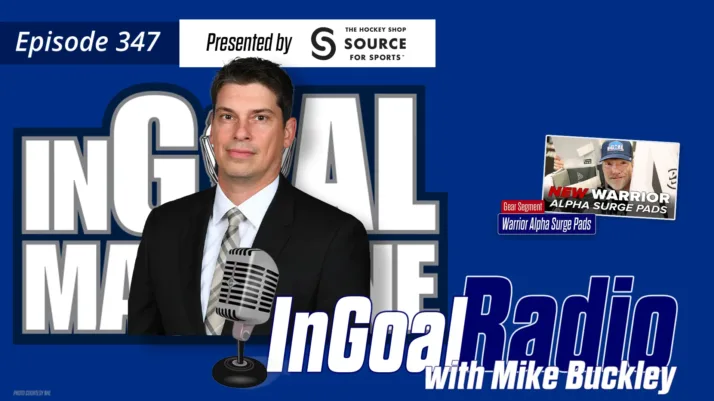
Episode 347: Team USA goalie coach Mike Buckley of the Los Angeles Kings

Please subscribe and leave a rating — it helps us reach more goalies!


Los Angeles Kings goalie coach Mike Buckley, who won gold with Team USA at the Olympics working alongside Connor Hellebuyck, teaches a movement concept he calls 'motion' — a variation on backwards flow that applies beyond rush chances. He also uses breath work drills with his NHL goalies, a technique Anton Forsberg credits with significantly improving his play this season.
- Mike Buckley's 'motion' concept extends backwards flow principles beyond rush situations, offering goalies a more versatile movement framework.
- Anton Forsberg credits a simple breath work drill from Buckley with meaningfully improving his performance during the current NHL season.
- Buckley's coaching philosophy blends technical skill development with psychology and mindset work, refined over a decade in the NCAA and seven years in the NHL.
- Working with Connor Hellebuyck at the Olympics provided Buckley with high-level insights he shares as teachable lessons for goalies at every level.
- The episode also covers sharp-angle shots and passes behind screens via a two-part Pro Reads breakdown featuring Columbus Blue Jackets goalie Jet Greaves.
Episode 347 of the InGoal Radio Podcast, presented by The Hockey Shop Source for Sports, features gold-medal winning Team USA goalie coach Mike Buckley of the Los Angeles Kings.
Feature Interview
presented by NHL Sense Arena
In the feature interview presented by NHL Sense Arena, Buckley talks about his experiences at the Olympics, including his work with Connor Hellebuyck, and shares some incredible lessons from a coaching career that includes a decade in the NCAA before the past seven in the NHL, first with the Pittsburgh Penguins and there last three in Los Angeles. Buckley talks about teaching “motion,” a variation on backwards flow (for lack of a better term) that isn’t limited to rush chances, and the psychology and mindset he’s brought to the Kings, including walking us through a simple breath work drill that Anton Forsberg said has helped him immensely this season. It really is a can’t miss interview loaded with takeaways for goalies at every level.
Parent Segment
presented by Stop It Goaltending U
In the Parent Segment, presented by Stop it Goaltending U the App, we ask whether that desire to protect our kids in minor hockey is really preparing them for life beyond it.
Pro Reads
presented by Vizual EdgeWe also review this week’s Pro Reads, presented by Vizual Edge, featuring Jet Greaves of the Columbus Blue Jackets with a two-part look at sharp-angle shots and passes behind screens. And in
Weekly Gear Segment
presented by The Hockey Shop Source for Sportsour weekly gear segment, we head to The Hockey Shop Source for Sports, for a look at the Warrior Alpha Surge pads, with so many new features we had to saves the gloves for another time.
Episode Transcript
Intro
Welcome back to the InGoal Radio Podcast. We got a bit of a change up. Millard is, on assignment, which is to say he's overwhelmed because the, National Hockey League team he fills in for at practice and covers on a daily basis and works for made a massive change with eight games left in the season, bringing in my old friend, John Tortorella.
Your old friend?
My yeah. You have not do you remember the day that Torts stormed the Calgary Flames locker room? Sure do.
Yeah. Hard to forget that one.
Do you know who angered him that morning?
Oh, was it Kevin Woodley?
Yeah. With the most benign question ever. I set him up with a softball because there was public criticism in the market for Henrik Sedin continuing to play through an obvious injury, and people felt it was all about his Iron Man streak. And so I set Tortz up with a, like I said, a real softball to shoot down that question, and he did vehemently. But he really didn't like the fact the question was asked in the first place.
And so he teed off pretty good on me and pretty good on the question. No big deal. That's part of the job. It was a great answer. Fast forward to the end of that evening, Bob Hartley dresses in Torts words, his idiots, towards response with his fighters.
Yep. There's there's a bench clear, and in the intermission, he goes down the tunnel. So, ultimately, he's suspended for that action trying to get into the Calgary Flames locker room. Came close to doing it. What do you think happens in the postgame media interview after that game?
Where would you assume the focus would be? Probably Kevin Woodley. No. I would assume it would be on the fact he just got tossed out of a game and went down the
Sarcasm, Kevin. Sarcasm. Yes.
But has he said, I I kid you not, you can go look up the presser. I'll never forget me and and and now departed, and we miss him every day here in this market. Jason Botchford just looking at each other like, is he really? Is this really happening? Before I get to what happened tonight, I just gotta go back to a question I was asked in the morning.
Still upset. So
I thought I dwelled on things. My heavens.
I don't ruffle many feathers, but that day, I did not intentionally. And I I'm not gonna say that that's why he stormed the tunnel to get but it was crazy to us that after everything that happened that night, the first thing he came back to was the question I'd asked that really ticked them off in the morning. So, Daren, enjoy for
all wanna know when he was heading down the hallway towards the Calgary dressing room, was he screaming where's Woodley? No. I'm pretty
No. I'm pretty sure he was after Bob Hartley. And he's probably lucky he didn't get in there because and it's been well accounted by many others. I think Clint Malarchuk was I think him and Clint, they almost came. They almost got close enough to come to blows. And, you know, Clint, you would not mess with Clint Malarchuk.
So, Daren, enjoy your new coach. Despite stories like that, I actually really enjoyed covering John Tortorella and his time here and all our interactions. We talked about it after the fact. But Daren's busy, so he's not here. So it's you and me, Hutch.
Welcome back. Yeah. I've haven't been here for
Yeah. I've haven't been here for a long time too. You're the only consistency on this show.
Poor audience if I'm the only consistency. We almost had to do this solo this week. I was thinking about just a Woody Podcast because
That's the royal we.
Yes. It it was, it was close. But thank God for our listeners, we get to hear your voice too. How are things now that you can actually talk?
Back from the dead. Yeah, I'm good. It was a pretty nasty couple of weeks here, but that's the downside of billeting hockey players. I stand all the time and tell people, you should billet hockey players. But for the longest time, it was just my wife and I in the house, nice and healthy.
And all of a sudden, there's three hockey players living with us and now every disease under earth comes back into our house and I managed to catch one. But gotta roll with the punches. It's still awesome having the boys around and I'm thankful for every day with them.
Is it worse than when your kids go to preschool?
Well, it's kind of the same thing. Yeah. It's it's exactly the thing. And then I'm just so weak that anything that comes to me really floors me. So
Well, we're glad to have you back. Mostly, we're glad you're alive because InGoal Magazine doesn't work without you, my friend. Your voice was missed on the podcast. Thank you for sucking back however many lozenges were required to do the Parent Segment as their last two weeks.
Multiple takes. Multiple takes when I did those.
I figured there might be a little, massaging of the voice using the electronic synthesizers or whatever it is that you do in the computer magic land to make a sound good.
Oh my gosh. I didn't even think of training some AI agent to do it for me. I probably should have.
Well, we could train them to host, and it would be a much bigger improvement on me leading this show. Listen, folks. It's the high it's The Hockey Shop Source for Sports bringing you the InGoal Radio Podcast. We've got a great featured guest this week, Mike Buckley. Gold medal theme continues.
Last week, we had Erin Frankel of the Boston Fleet, who, by the way, just continues to absolutely roll in her PWHL season. She is now up to a league leading, I believe, a record setting for a single season, seven shutouts with Boston, a 1.17 goals against average, and a 0.954 save percentage. The only thing more remarkable than that in 21 games played is that it took the last shutout for her to pass and Renee Debian, who was at 0. 952 with five shutouts on the season for the Montreal Victoire. So some exceptional goaltending from the two goalies that we saw in the gold medal game at the Olympics, but we continue our gold medal theme this week with our featured guest. Mike Buckley was the goalie coach for Team USA.
He's a goalie coach for the Los Angeles Kings formerly with the Pittsburgh Penguins. And without giving it away, let's tease it right now. This is I use the word can't miss interviews every so often. I feel like there's a ton. We got about twenty five minutes with Mike when the Kings were through town, and I felt like I needed forty five minutes more.
Just, an absolute delight. A lot of different thought processes from the mental side of the game. He gives you some takeaways that you can use to sort of help you with your training and your your mental focus in a game. I really enjoyed this interview.
Honestly, I say this a lot. That was one of my favorite interviews, but it really was. Instead of just sitting here thinking, oh, that's a good point. That's a good point. All I could think of is I would love my kid to be working with this guy.
The way he looks at the game from a mental perspective, I just think is incredible. I think it would support so many goaltenders in their growth and development. And he also mentions one of my favorite books as must read. We'll we'll leave it till the actual interview comes up to give away what that is, but I can touch it from here on my bookshelf. And, yeah, no, every little bit of that interview resonated with me, Kevin.
I've told several people that it's coming already and, I'm just thankful that he made the time and that you were able to get such great answers out of him.
Like and like I said, the only downside of being limited to twenty five minutes or me not wanting to push it too far because it was a game day for him and the bus was leaving, I had the sense he would have kept going. I just don't wanna be too pushy, but it sets us up for a part two.
I sure hope so.
And he was he was just so good in that interview. And so looking forward to, bringing that. We've also got a Gear Segment, an exciting one this week, the Warrior Alpha Surge Pads. We're gonna start they are so unique that we had to give them their own segment. We'll save the glove and the blocker for later.
You've seen the full breakdown overview we did at ingoalmag.com. Well, they've got them in store now at the Hockey Shop Source for Sports. And you know what? You know what happens, Hutch? What?
When the new stuff comes into the store. I've said it before. I think everybody listening knows what's coming.
Some really good gear goes on sale.
That's right. And that would be the Warrior G7 line, which we did our full deep dive on last season, still playing in here in InGoal Mag. Up to 30% off that line already as Alpha Surge prepares to come in the door, and they've got a lot of inventory. So that and a ton of other things on sale. Spring break, probably over for most listening, Maybe not for everyone.
It kind of varies depending on your region. I know up here, public schools had two weeks. My daughter going to university down in The States only had one. Of course, my daughter up here in university only gets a reading break, not a full spread. Like, it's different everywhere.
So that gives their friends over the Hockey Shop Source for Sports a chance to extend their spring break sale. In addition to 30% off the Warrior, there's 20 to 50% savings on a lot of other lines. Bauer, CCM, True, Pro Return Gear, Pro Return Sticks, tons of great sales. Make sure you check them out at the hockeyshop.com, and make sure you check out on YouTube the simulcast version of this gear segment we're about to run down with Cam and the new Warrior. Warrior.
Warrior? Warrior? They do sponsor the Boston Bruins practice facility. I promise that was just a a Freudian slip or something. The new Warrior Alpha Surge Pads.
Gear
Welcome back to The Hockey Shop Source for Sports. And for once for once, and it's even crazier because it's Warrior in particular, Kevin actually knows more about this product than I do. Right. Well, I mean Yeah. I guess I do.
Yeah. Guess isn't that wild? I know. We got a complete review on this, a complete overview, preview, spend some time with Warrior in Montreal. You're right.
It's at ingoalmag.com where we have gone over and let me tell you. Roll credits. Warrior Alpha Surge has got a lot of new features that we need to get into here. Yes. Where would you like to start, Cam?
I mean, are you gonna be asking me questions now that we got a He's Kevin. A roll reversal? A roll reversal. Yes. Gonna give you I'm gonna give you a little hint for the end.
There's no way I remember the phone number. Oh, so that's gonna be on mute still. Okay. Warrior alpha surge. Let's talk about what's been completely revamped.
Totally. What's been innovated on. Tons. What's why are there now screws attached to my knee? I almost there's so much here.
I almost don't know where to start. So let's let's start with the shape and the stiffness profile, sorta how this pad looks. So flat boot. It's stiff. It's stiff.
It's stiff. Very thin profile.
Correct.
Boot's got some flex, but 90 degree boot. 90 degree boot. The flex is up not much because it's 90 degrees, but it doesn't have the two way flex of the old Warrior system, not to the same degree of the old one. What's that help with? Well, this really helps with post integration.
I haven't had it on the ice myself, but when we were in Montreal, I watched a couple of guys playing it and boy, like, in terms of hitting your post with reverse, that flat boot tends to stick out a little bit. It just makes it super easy to lock into your post. That's what I noticed. Toe bridge, able to throw those laces on ready to rock and roll. Or you go with their bungee system.
Bungee system. There we go. Removable. Yes. Okay.
So, like, in terms of where to start with this one, let's I think we go with the advanced fastening system and the fact that we've seen companies integrate their new stack into their pads so that it's a fixed relationship. So when you hit the ice, you get to the ice faster, everything stays flush and sealed. Well, Warrior is the first company that's also doing it with their calf light. As Cam is velcroing out his, you can see that this is actually fixed much like the knee with there's there's a bracket, a carbon bracket. Actually, I I guess it's it's their carbon pro like, the Bauer has a bracketed system for their cap plate as well.
It's not screwed in. It's not screwed in, though. This is screwed in. It is. Very fixed.
What it does is it gives you a even more balanced sort of secure seal on the ice, and so far, where it is, it slides like a hot dam. So that's the big feature there. There's so much here. I almost don't know what we got the slide of this. This is wow.
So let's put some of these pieces back together. Got that? Slide plate? Yes. We do.
But, I mean, I already have this open. Let's look the strapping system here first. The hammock. The hammock. The Warrior hammock.
So a couple different changes on the inside. We've got this is they call this the hammock and you can see how it will hold rather if you want it wide open, it's adjustable like everything Warrior does. So you can take this strap and move it down to the bottom to make it like a normal strap, or you can keep it in the middle of the pad and almost sort of sits and wraps around your leg and forming like a hammock system for the calf. This seems to continue on their modularity that Warrior has done kind of in the last Again, incredible adjustability, right? So you have it tight.
It's a little bit loose. Knee strap or upper knee strap, sorry. Upper calf strap. Upper calf strap. Double elastic, super thin so it's not gonna get caught up, and, of course, removable.
You can strap it down here. You could I guess, in theory, you could go down there, but it's basically designed to be their version of the professor strap. What I like about that too is that with it being a little bit thinner, that can slide in behind your knee a little bit easier. Start to get caught up. Yeah.
Not just hanging up on the top of your calf and kind of grabbing and pulling the pad up and down. Adjustability on both sides, both in terms of where you want to put this larger area here, but also adjustable on the inside as well, and of course, I love what Warrior did with the g seven. If you're deciding you want to strap your knee down, sometimes, you know, when you put a strap on the bottom, don't have any place to put the Velcro. They put the extra Velcro on the back of the strap so you can attach it down here wherever you want. Just again, maintaining that flexibility to do this pad up a lot of different ways.
There's so much I'm, like, running out of like, I miss, like,
on You're
keeping so much. So much. Now let's talk about the knee specifically. So continuing on with what we were just gabbing on about I'm not used to having Cam Lee. System.
I know. It's crazy. I know. It's throwing me all off. So when we open up that new cradle A lot of Velcro today.
We do see the screws in it. Well, that again, that's their advanced fastening system. That is wild. That is it's fixed. It's fixed.
It's fixed. Now what you may have noticed is also adjustable like look at the adjustability in terms of where you want to put your knee strap. You want to run it down on the inside? No problem. Run it down on the inside so again it kind of goes behind your knee.
Want to run it to the outside through the middle? No problem. Just move it here. Wrap it around there. Now here's here's this is is a new feature.
Now, of course, slide plate removable. If it's too much, this this pad slides even without it remarkably well because it again, because of the fixed system, because of how hard this inside edge is, because changing this with the advanced fastening system look at how thin it is. Like, this is half as thick as a g seven. So the amount there's no binding anywhere. The amount of material that's on the ice is like, it's negligible compared to previous pads.
So it's gonna slide like crazy with or without the slide plate. Now last one, Cam. Because I'm like, I'm I'm like we're almost there. Notice how that came out? I did.
You did notice So how that came goes back in. No problem. Well, I would hope so. Yeah. Well, yeah.
Wanna thicken it up? Want a little Taller? A little taller knee stack. Put your hips up higher in your butterfly, anatomically put your off in a position that's putting less stress on your hips and your knees. They are gonna sell?
You will have it in store when it launches. Thicker versions of this. We've seen it in the past where you have to go to secondary markets. People build it up. We know the benefits.
The higher your knee is compared to the ice, the wider your butterfly get, the less strain on your knees, your hips, and your ankles. So because of the modularity of this, Warrior decided wisely, I believe, especially for young kids, like, wanna take the pressure off as your kid's growing up, you can have a thicker butterfly. You can have a thicker knee stack to take the pressure off in your butterfly. It makes you taller in your butt too. It's replaceable, but you can also have it beefed up and I'm pretty sure that they've even I saw it.
We had it in in our in our review that it actually overlaps here so that it creates a nice flush area all the way out to the edge of this more rounded knee stack as opposed to just having it in here. It actually continues out here sort of keeping it level as you raise it. So an exciting feature for young goalies. I think we've talked to people in the goalie training industry for years about the idea that, hey, if we take some of that stress off their joints when they're younger doing the butterfly by raising this butterfly stack and then you can gradually bring it down as they get older and ultimately to get to the NHL, you've got a fixed maximum thickness that you're allowed. Mhmm.
I've heard it suggested maybe for NHL goalies practicing, take some dress off the 200 times you dropped to the ice in practice by raising it up. There's a lot of different applications. First company to it, really excited to see where this goes, where you as goalies take it. Well, dope. It's a lot.
Yeah. You haven't We haven't even gotten to the the gloves. Yeah. No. We're to we're gonna have to separate these two videos.
So stay tuned for another video. We'll talk about the different gloves and what options are there. But thank you, Kevin, for walking us You still have to give the number because I'm your search pad. So if you can let us know where to reach out back to us at the number. Well, I mean, the only number I know off the top of my head, because we're so close and such good friends, Cam, is your personal cell.
Would you like me to get back? (604) 589-8299 or 1805677790. Give us a call. We can talk about it. You can order your custom pads pad a.
Oh, that's right. Yes. These aren't available at retail yet even though you have these, but you can custom order these through Cam. I forgot about that. Give us a call.
We can talk about it. You're pretty good at this. I hey. It's me. You're better in this role than I was in your role.
I don't know what that means. What does that mean? So I'm the only one that's gotten to see these, Hutch, in person because I you you you were busy.
So I'm the only one that's gotten to see these, Hutch, in person because I you you you were busy.
I was there, Woody. I filmed that one.
Oh, right. I was thinking, like, the the originals, like, the trip to Montreal with Yeah. Of the sure. So what'd you think when you saw him for for in person? Like, I was all excited after the trip to Montreal because they are so unique.
You got to see them in person at the Hockey Shop. So unique. Okay. Unique on its own does not require Sorry.
Just love doing my apologies.
I'm a little hyperbolic. Hyperbolic? You know, funny thing
is, I was more excited editing the video than I was on the day. And and maybe that's just because my head is somewhere else when we're recording these segments and I'm just praying everything is going to go well or whatever it might be.
Well, not to mention you've been up since four in the morning to catch a ferry to come up with the
That's actually true. Every time, every time you watch a gear segment, there's a very tired guy behind the camera. But today actually, as we were editing the video, looking at it, I got that little surge of, oh, I'd really like to get in the ice. That little surge,
And that's quite nice.
I didn't even
mean it. I like to pun and I didn't do that one on purpose. But yeah, it really got those sort of excited feelings looking at the changes, looking at the details, wanting to just get out there and know what they felt like. It's been a while since I've played, so it's interesting that a product would bring those feelings to me today.
I think for me, the most exciting part, and we've got a set coming here shortly, I saw them, the goalie content creator game in Dallas. You saw a lot of the goalies wearing the new Alpha Search pad and enjoyed watching some of the highlights from that and sort of getting some of their early feedback. We haven't had a chance to be on the ice in it yet. We've obviously have seen it since, like, last December. We did a pretty big deep dive on it.
Like I said, make sure you go check that out at ingoalmag.com, but I haven't been on the ice yet. And the thing that I want to try most is the different strapping options. Yeah. I wanna feel how it slides, with and without the slide plate because I think these things are so thin on that inner edge the way they've cleaned up sort of that calf area that they're gonna slide like a hot damn regardless, and that's the feedback we've gotten from other people that have been on the ice in them. But I wanna try all the unique strapping, like the calf hammock with six different points of adjustments.
Love You get on
the ice with any goaltender who asks you a question and you are on your hands and knees adjusting their strapping. Nobody knows strapping like Woody, honestly.
Because it it it changes and and it depends on the brand, but it changes how it feels and it changes how it plays, how it reacts to your leg. And I think there's some diversity that we played with in the g seven line for a relatively straight more straighter, definitely stiffer profile pad. You know, you just you think of those as always being worn loose, and there's an ability to dial that in a little bit on this. So I'm excited. I'm excited to get our set on the ice and and try and tinker with some of those very unique, very new strapping options.
K. Let's do something else that's very unique. We'll go off script here a little bit.
Uh-oh. Very unique or just unique?
I did that because you said that. I know. Know. Could you give me Woody's top two or three things to look for as you are tinkering with your strapping regardless of brand and how that might affect how the pads sit on you or play for you? What are you looking for when you're helping someone?
Oh, that's a good question. I've never thought of it in those terms. It's usually somebody asking a specific question.
Very specific. Jeremy, but there you go.
Not to toot my own horn, but I am proud of the fact that though that includes right up to the National Hockey League level with guys being like, this feels like this or this isn't sealing that. And it's like, no. You just gotta loosen off that strap and look at how much better it seals. To me, the biggest things are how your skate interacts with the boot and that and we talk about toe laces and toe ties and different things there, as and and how that integrates with the shin area. That's to me the the biggest connection point.
Explain that.
The knee can't be too tight or it just won't rotate at all anyways. Like, you can't crank it down super tight like they used to. The tighter the shin, you know, and it and again, it depends on brands because they've changed so much, and that's what I'm excited to see with this new Alpha Surge because it's also unique. Typically, the the tighter you crank in in the shin, sort of the less that pad moves around your leg, the more it moves with it. And sort of that interaction and where everybody's comfortable with the feel of connection versus the snappiness of a rotation.
How quickly does it get to seal and stay flat on the ice? And then does it come back square to your leg as you get back up? I think through the various options through the through different shin straps, you can tinker and change that quite a bit, and everybody has different preferences. I think we all want the pad to sit flat, and we'd all like it to come back to relatively square when we get back up. But there's different degrees of that and everybody's comfortable with a different level.
And how you tinker with the straps, especially around the top of the calf, affects that greatly. Does that make sense?
I think it makes sense.
Think so many different ways. Yeah. Like like because they're all like, everybody's gotta you know, I've never been in the true FRS. Heard good things about that strap. It might be one of the one of their better innovations to date since they they, you know, started building their they went the split and started with True.
But I haven't had a chance to try it and and feel that myself. Every company almost now has a slightly unique take on calf strapping, whether it goes across the back of the calf or over the top of it. I think companies are are going away from what we've thought of as a traditional professor step. They have their version, but it's not sitting the way it originally did for and on Ben Scribbins. So there's just so much variety within that in terms of a, how it performs, which is to me the most important, but b, how it feels in in relation to that performance because some guys just don't wanna feel that pad snug.
So you just have to play with it.
Which is what I do. Mhmm. And what everybody does. Right? Like, it's not special.
It's just I think the only difference would be being able to recognize how a certain strap might create over rotation or a lack of rotation or all these different things.
Okay. Let let me ask you differently then. In most cases, when you've helped a guy, were you able to get to a place that they were more comfortable with? Which is to say, can most things be fixed by playing with the strapping? Or are there some cases where it's just not that's not the pad for you.
We gotta do something different.
I do think most things can be fixed to an extent by strapping in terms of performance. The question is whether you're comfortable with the feel. Like pads that are on too tight and don't rotate, like the answers to loosen them up, but are you comfortable with it being that loose? And that's an overgeneralization. Again, it depends on the pads.
I mean, I remember getting on the ice with Eddie Lack and his ankles were killing him. And it's just like, why do you have a bootstrap on? And I'm I'll never forget him saying is that the bootstraps my bootstrap's so loose, it doesn't do anything. And then I'm literally I'm like, okay. Get in a butterfly.
And you there was a ton of tension. I mean, yeah, it felt loose when he's standing up. But when he got in a butterfly, there was tension on the bootstrap that caused tension on his ankles. And this was at a time when most people had bootstraps, and Carey Price was sort of one of the first to remove it. Eddie removed his and never looked back and never and never had the same type of ankle pain.
And this is going back a long ways. But, you know, similarly, like, we've seen companies that had problems with their pads not sealing at intersection of the shin and the boot and different options for how they do it up and the introduction of different pillows and padding that improve that. Like, we've we've had these conversations over the years. I I do think the pads have changed so much in terms of that relationship between the knee and the face of the pad, and the fixed relationships has improved that seal and allowed you to have more variation in your strapping without sacrificing it. I think the pads that have more give in the knee are more likely to have over and under rotation issues from what I've seen that require strapping to sort of be counterbalanced to it.
So as you get into your Bauers and then the way CCM has built their knee stack and and obviously with these Warriors one, that seal, as long as the knees on their flush, that seal should be there. Now it's more about how does the pad move when you get back up to your feet and does it sit in a way that's comfortable for you as you're moving around and you feel like it's facing the shooter as opposed to being twisted on your leg.
And I think you made the point that sometimes you can get somebody to a point where it is working better for them, but now maybe they're not so comfortable. Little tougher when you're a beer leaguer who only gets out on the ice once a week and it's a game and it matters to you to win or lose. But if you've got practice time, you can discover that spot that works better. Maybe you're not as comfortable, so now back it off and then sort of one week to the next, you can start moving towards something that you know is more functional and you will get used to it. But you have to, you have to try.
Or carpet flies, baby.
Yeah. But we know they're not the same. Right?
Well, not the same. But if you put on your as long as you put on your skates and your that's, you know, like Cam always talks about at The Hockey Shop about fitting pads, you know, and he wants you in your skates, which makes a ton of sense. But then he also wants you in your knee pad pant connection if he can Mhmm. Because that all affects how the pad sits. You know, how it rotates, how it moves around your leg, like having it similar.
So if you I I think you can accomplish a certain amount of it For sure. Carpet flies. Like like, if we had been in my basement instead of on the ice in Richmond with Eddie, we would have seen that tension in the ankle strap that he didn't think existed just by dropping into the butterfly, you know, in on the carpet versus the ice. But you're right. You can tinker.
Have fun, folks. Send us feedback.
Here you go. What are your tips?
Yeah. How do you do it? How do you get comfortable in a new setup? Where where do they send that feedback, Hutch? I need the I need to see if the voice still works.
So many places. Today, we'll go for podcast at ingoalmag.com.
The man could barely breathe, but coughing for the past two weeks, and now he's thrown out like the dark side radio voice. I love it. I love it. Okay. We're off and running.
We've got our gear segment. Next up, how about a little ProReads? ProReads. Little ProReads this week. Little Jet Greaves.
Favorite guys. Yeah.
Well, yeah. One of our absolute favorite guys. Although, you know, as much as we shout out Jet Greaves for the for the ProReads and we love them. Little, let's get you on the podcast here, Jet. I know you've been bugging you for a while.
Don't wanna be in that spotlight. Come on.
Humble man.
Yes. Yes. Love us some Jet Greaves, and he's so gracious with his time with the ProReads, and he's so open as he was this week to walking through not only, hey. This is why I do this, and this is why I like this, but pointing out the times where, hey. Maybe I'm behind on this one, and I can see some reasons, that willingness to sort of dissect his own game, show the strengths, and so some things that he would have done differently.
So when we present these, we often ask you, how how would you have played it? What are you looking for? Would you have done anything differently? And when you've got a guy like Jet Grieves who's so open and honest and thinks the game so deeply, you can be critical if you wanna be because he will be of his own play. And this week, we break down kind of a wild sequence.
It starts with a sharp angle play, and then we move into a screen and a screen with pass options. And so that decision around that screen. Because you can't see where the puck you you might have an idea where it's going based on your read, but you can't see the puck all the way through the traffic to the stick blade on the other side. So are you sliding or are you coming over on your skates? That's part of the discussion that we get into.
One of several aspects we get into this week with Jet Greaves on ProReads at ingoalmag.com. And, of course, when you log on to ProReads at ingoalmag.com as a member, you get a discount, a double our public discount rate, 20% off on visual edge vision and cognitive training tools. Not a member of InGoal premium? Just use the code word InGoal, all one word, all caps, I n g o a l, to save 10%. But if you are an InGoal premium subscriber, log in to any ProReads like this week's with Jet Grief, and you will get the special code to receive 20% off.
So what's he talking about, you're asking yourself? What is this visual edge? Well, do you want the puck to look like a beach ball? I'll ask it as simply as that. You've all had those nights here and there where the puck looks huge.
You're ahead of every play. You feel calm, patient, in total control. Then there are the nights where you're half step late. You see it, but you don't really see it. You're reaching, you're guessing, you're fighting it.
It's not your technique. That's your eyes and your brain not processing the play fast enough. Visual Edge fixes that. It measures how well your eyes track and process the game then gives you a custom plan that trains improvement. Three fifteen minute sessions a week on your laptop or tablet.
It's what NHL goalies use to make the game slow down when it matters most. We've used it at InGoal. My daughter is currently using it while playing division two college volleyball and discovered, and this is kind of important for a libero who's kind of the goalie of the volleyball team, her depth perception was a serious issue. Convergence, divergence, no problem. Should have been a goalie.
Depth perception, big issues, which is kinda tough when you're trying to find a ball being slammed at you as hard as somebody can through a bunch of hands trying to block it. So she's working with Vizual Edge to improve that. It's it identifies your weaknesses and it fixes it, folks. It's a great tool. Make sure you check it out.
Sounds like the apple doesn't fall far from the tree.
Well, no. No. Remember? Remember? All those all those years of me not what do you mean you see the puck all the way in here, bud?
Those were some funny conversations.
And then the and then my conversion scores absolutely proving that there was no way I was seeing the puck all the way.
Hey. You know what else? You know what else you see if you log on to our ProReads?
What else?
We can see what your streaks are now. How many ProReads in a row have you watched without missing the most recent one? You can also see streaks for how many days in a row you've been on InGoal. If you head over to the my account link, you can see where you rank versus other InGoal readers or other people within how you've classified yourself in your profile, like parents, goalies, coaches,
and so on. Just a fun way to make sure you're keeping up with all the content that, we're publishing here each week. Well, speaking of content that we're publishing here each week, how about that new piece from Colin Hockey on Francois Lair? Beautiful. Folks, if you haven't already, make sure you check it out at ingoalmag.com.
It went up today ahead of the podcast. So much more than butterfly. So much more than a butterfly. We often associate Francois with the with the butterfly. Right?
And and certainly a big part of of making it mainstream and a big part of goaltending, but it's the idea of systems. Like, really, he is the godfather of the modern NHL goalie coach. And in a lot of ways, the idea of that systems can be applied to goaltending and goalie coaching in general. He changed the game in a lot of ways. We've argued it for a long time, and there's a link to our story that argues it again.
He should absolutely be in the Hockey Hall of Fame along with Mitch Korn, along with his brother, Benoit. Add names like InGoal to that list. Obviously, we're biased friend of the program. We've gotta get goalie coaches in the Hall of Fame, and it makes so much sense to start with Francois Lair. He literally has changed the game, not just how goalies play it, but how shooters have to solve them.
And the idea he's not there, even with all the winning he did and the Stanley Cups is is frankly absurd. But I thought Colin did a great job of bringing a new lens to it rather than just talking about the butterfly, talking about all those other changes he brought to the game and I really enjoyed the piece.
Yep. Everything everything Colin does is, next level. Really really thinks through what he's seeing and then takes it a step further. He's not just taking the content generated, but but he finds another angle on the, the information he's been given and we appreciate all his efforts for us.
Yeah. He's killing it. He's killing it. Speaking of which, speaking of killing it, Colin and the parent segment, I'm gonna tie this all together. I think that I think Hey.
Actual good hosts would call this a segue without actually referring to it as
a segue. Like, I just have to say, hey. Did you see my segue?
Wasn't that smooth?
Yes. Put a bump in the road as soon as you do it.
Exactly. Devin Cooley will be the feature of an upcoming article from Colin Hodd. We're just editing it and waiting to hopefully add, see if Sports Net's gonna post his recent after hours appearance on YouTube so we can just embed it other rather than link you to it because he was fantastic as he always is. And Devin Devin Cooley was the subject of your parent playbook last week. It was.
He was. How'd you enjoy that, how'd you enjoy that after hour segment? One of the best ones.
Oh, it it was just incredible. As I do sometimes with these things, I sent him to my kid. I said, you need to find twenty four minutes and you need to sit down and you need to listen to every minute of this. What a great, great story. And and the fact that he had some, shall we say, suboptimal numbers when he was a junior hockey player and persevered and remade himself and found his way all the way to the top just through sheer hard work and love of the game is absolutely inspiring.
And then don't we always say how bland hockey players are? How whether it's the culture of the game or how the media gets interpreted by people in the game or whatever, but we whitewash everything these guys say and they end up with nothing interesting to say and that couldn't be further from the truth for Devin Cooley. Says what he's thinking, speaks his mind and it makes the game so much more interesting and refreshing. Thank God that he's playing so well because I feel like if he wasn't, somebody would probably try and beat that personality out of him, sadly in hockey. But yeah, Devin, thank you so much for everything you do for the game, for kids, for families.
The opinions that you're sharing with us, the experiences you're sharing with us makes the game better for everybody.
Okay. So we had him as one of those post game sort of top ahead diatribes that he went on was the subject in last week's Parent Playbook. Before we get to the Parent Playbook though, I feel like I'm gonna skip around here a little bit. I as like I said, had the segue, now I've screwed it all up. How about Cooley also sort of normalizing it as as Joy Decourt has done for us?
Our feature segment sponsor, NHL Sense Arena, by showing him using it on a day to day basis, including including the sailboat. I love the sailboat clips because if you remember back to our podcast with him, that was actually something, and this is back when he was with the sharks, that we suggested. I think we're recording. I don't think it was after the fact. I think it's actually in the podcast where he talks about going on a trip, and we're like, make sure you take NHL Sense Arena and send us the picture.
So I thought it was so cool to see that video on that after hour segment as well. Obviously, an avid user, and he calls it a part of his game day routine that will always remain.
He did. And you're we should be almost going to the feature interview here because you're just about duplicating what I've prepared to say about NHL sensor into this week before our feature interview.
Well, I
absolutely getting, like, a double read now.
I nuked you on that one.
My apologies, buddy. Production meeting beforehand.
Well, no production meeting. We also don't have the maestro, the master, Daren Millard this week to lead us seamlessly through. Instead, we have me stumbling and bumbling like I'm coming home from the bar at four in the morning.
No. You're awesome, Woody. You're doing great.
So well, hey. Listen. I I could have gone another way with the Devin Cooley segue. Stop the goaltending. Because that's where Devin Cooley went after meeting Joey Decord for five months to sort of remake his game and start this path to the National Hockey League.
And the experience and the wisdom that he gained, you know that you can have that in your phone. The Stop It Goal Tending app takes twenty five years of NHL goalie coaching experience and puts it at your fingertips. Wanna tap into the same goalie parenting expertise that helped Joey Decord reach the NHL? That's what you get with the subscription to Stop It Goal Tending U, the app. All the knowledge from Brian Decord has been an NHL goalie coach, scout, and director, as well as all the insights and expertise from his staff at Stop It, which includes a long list of veteran NCAA coaches.
It's all delivered in easy to digest chunks, including five short daily primers, weekly style analysis, breakdown videos, and drills that you can take onto the ice with your team and coach. Plus, with every subscription to the Stop It Goal Tending U app, you get included a subscription to InGoal Magazine Premium. So make sure you check it out now on the App Store and Google Play. Stop It Goal Tending U and InGoal Magazine, the best of both worlds to become the best you can be as a goaltender, and the presenting sponsors of The Parent Playbook with David Hutchison.
Parent Playbook
Here we go. I would like this week to talk about something that I spend a lot of time thinking about. And I'm guessing if you're a goalie parent, you might have lived some version of this. Your kid is splitting starts with another goalie and you don't think it's fair the way they're doing it or maybe it's not even close to equal and you know it's not fair. Maybe there's a goalie coach who only shows up once a month if you're lucky and your kid's getting almost no position specific attention on their team.
Maybe your kid took a headshot in practice today and nobody said anything or how about this one? Practice starts and they go straight into a three on o rush drill. No warm up, no skating, no nothing, and you're in the stands pulling your hair out thinking someone's gonna get hurt, probably my kid. Or maybe your kid gets pulled mid game. No explanation.
No conversation. He's just yanked while some skater who's turned over the puck five five times in a row doesn't miss a shift. Here's what I want to say first. You're not wrong. In minor hockey, two goalies should be getting equal starts, not roughly equal, equal.
That's not helicopter parenting. That's basic fairness and it's actually what the development models call for. Headshots to a goalie in practice. Yeah. They're a real concern.
These are kids. They're in a vulnerable position, and the culture around protecting goalies still has a ways to go. Throwing a goalie into high traffic drills with no warm up, legitimate safety issue and a performance issue. And being pulled from a game with no word from the coach while everybody else gets the benefit of the doubt, well, that's also a real thing, and it stings differently for a goalie than any other position because there's nowhere to hide and no way to earn your way back in. These are legitimate issues and as a parent, you have every right to care about them.
So I'm not here to tell you to calm down or to stop advocating. But I wanna ask a slightly different question today and I think it's one worth sitting with. Are we preparing them? Because here's the reality. Most of you listening to this, if I had to guess, somewhere in the back of your mind, you're hoping your kid plays junior or college hockey one day.
Maybe you haven't said it out loud, but it's probably there, and that's not a bad thing. That's a parent who believes in their kid and loves them. But let's talk honestly about what junior hockey actually looks like. Ice time, the starter plays. If there are two goalies on the roster and one is clearly ahead, the other one might get the odd game, but they could go literally weeks between starts.
And increasingly, this is becoming more and more common. There are three goalies on a roster. Three. And many junior leagues are pay to play, which means your kid might be paying for the privilege of being number two or even three. It's not equal.
It's not even close. Goalie coaching. Some programs have a dedicated goalie coach. That's fantastic. Some have ones who come in very sparingly, maybe even get little ice time to work with those goaltenders.
Just get to stand and talk to them during drills. And the position work falls to, well, whoever happens to be on the ice that day. That's not me being cynical. That's the reality with a huge number of junior programs. Development?
No. Coaches are coaching for their jobs and if they think your kid is performing, sorry, if they think your kid is not performing, they'll just bring somebody else in. Here's something Kevin talked about on a show that I think really lands. It wasn't that long ago that NHL organizations weren't devoting real resources to supporting their goalies at the ECHL level. Professional hockey players.
They made it further than almost anyone who ever laced on the skates, and there they were in a lot of ways on their own, figuring it out because the infrastructure just wasn't there yet. So if that's true at the pro level and it was, what do you think is waiting for your kid at 16 with their first junior experience? Here's where it gets interesting to me. Speaking of this week's feature interview with Mike Buckley, and it is a really good one. You said something that's been rattling around in my head.
He talked about how as he got more experience as a goalie coach, he actually started to pull back, Not because he stopped caring, but because he learned that sometimes the most valuable thing you can do is let a goalie sit on a problem. Design a drill so that they figure out the answer themselves instead of handing it to them. Create the conditions for them to figure it out. So think about that. One of the most experienced goalie coaches out here, an experience taught him to get out of the way.
The version of that, I think, that applies to us as parents as well because there's a difference between absence of support and intentional space to grow. When Mike steps back, it's deliberate, it's designed, it's actually more sophisticated than just jumping in with an answer. But what the goalie has to do in that moment internally, they have to solve it. They have to get uncomfortable, stay in it and find their way through. Like a muscle, these things need to be trained.
So here's the thing I keep coming back to. The battles we fight for our kids, the equal ice time, the safety concerns, the getting pulled, all of it. I understand every single one of them. But if we win every one of those battles and our kid arrives at junior hockey having never had to navigate an unfair situation, having never had to perform without adequate support, having never had to dig into themselves and find something where the conditions weren't right, what happens when the reality hits? Because it will hit.
Maybe it's their first junior camp, maybe it's their first season, but that moment is coming and the question isn't if they'll face it, the question is whether they'll be doing it for the first time or not. We want our kids to have the very best. Of course, we do. Advocating for them isn't wrong. Some of these things generally have to be addressed and you should speak up.
But there's a version of advocacy that prepares them for the road ahead and a version that accidentally protects them from the very experiences that would have built their resilience. The best goalie coaches in the world are learning to create space, not fill it. Maybe the best goalie parents can take a page from that. Think about it this week. Let me know your thoughts.
Parents at ingoalmag.com.
So good. Thank you. And and but also you ruin my segue.
Oh, no.
Because I was gonna be like, you know what? That sounds like the kind of advice that would tie right into what Mike Buckley told me in my interview, and he already outlined it. Yeah. And I think that just makes a a great tease for what's to come because this really was a fantastic interview that we had with Mike. Los Angeles Kings goaltending coach, goalie coach for Team USA, gold medal winning, talks a little bit about that and working with Connor Hellebuck and the other guys.
We get into all of it, whole bunch of stuff. And before we do, though, before we get to Mike in the feature interview this week, let's hear a little bit from our presenting sponsor of the feature interview each week, our friends over at NHL Sense Arena.
Yes. Indeed. This week's feature interview, as with all of them, is brought to us by NHL Sense Arena. And as Kevin pointed out earlier, you may have caught the after hours segment on Hockey Night in Canada recently. And if you didn't, we're going to have it on the site soon.
But Calgary Flames goaltender, Devin Cooley, sat down and talked at length about NHL Sensorina. And what he said really stuck with me. It wasn't just that he uses it, it's how he uses it. Pretty much every day, not primarily for tracking shots or technical reads, although plenty of pro goalies do use it for that. But in his case, he mentioned it was for pattern recognition.
As legendary coach Mitch Korn, I believe, is the person who said goaltending is a game of pattern recognition. And NHL Sense Arena lets you practice more than you'll get quite likely from your own team practices because it is set up for goaltenders unlike those practices just to add to my list of things that drives us parents crazy. And as Kevin mentioned, we saw a video of Devin on a sailboat on vacation pulling it out because Kevin Woodley told him to. I mean because he just didn't want to be away from his game for that long. And that's not a guy going through the motions.
Honestly, that is a guy who genuinely believes in the tool and of course loves the game. And that's what NHL Sensorina gives you. It gives you drills, training programs, neurocognitive tools, and now mindset training with our good friend Pete Fry. It's everything you need to develop as a goaltender away from the ice in one place, anytime, anywhere. Here's the part I really want you to hear.
For less than the cost of a single private ice session each month, a lot less, your goalie can be doing the exact same drills, facing the exact same shooters, taking on the exact same challenges as NHL goalies like Devin Cooley and Joey Decord every day, not just when the rink is available, not just when the schedule lines up, every single day. Check it out at sensearena.com, and, of course, use the code I g m 50 to save even more on the latest great deals they have.
You know who else uses NHL Sense Arena? It was an early adopter. Kevin Woodley. No. The Los Angeles Kings.
There you go. And he wasn't there at the time, but he is now. Without further ado, because we've talked a lot about this interview and I'm just excited for everyone to hear it, Mike Buckley, goaltending coach of the Los Angeles Kings and gold medal winner with Team USA. Really excited to welcome to the InGoal Radio Podcast. Overdue is a first time guest with us.
Feature Interview - Mike Buckley
Mike Buckley, come of the Los Angeles Kings, fresh off though, Olympic gold medal champion. How's that feel? How's that been?
It's been amazing. I can't really can't put it into words, in terms of just pride I have in those guys and the team and how everything, came together and, you know, the cherry on top was was was Connor Hallebuck performing the way he did. One of
the best performances we've ever seen. What's that role like? Because it's not like you're gonna go in there and change Connor's game in a short tournament. What does that look like for you?
I think just knowing that that's your role is is going into it that you can't come in changing too much. Right. You know? I've got to know these guys over the years and study their games, and I made it a point to, make sure that I I understood what makes each one of these guys better. You know, it's Connor, obviously.
You know, we did make a couple adjustments that he was very open to, and, they were helpful. And, but nothing major. You know, it's still his game.
You're not reinventing the wheel on on a week's notice.
No. Absolutely not. And, you know, to the team's credit too, like, the first five games, he got a really good amount of support and it allowed his confidence to grow every day. And he just got better every game. And by the time we got to that that final game where where we really needed him, he was there.
And I think that speaks a lot to, like, where the NHL is right now.
And what's that?
So if you go back, I mean, goalies used to have to steal a lot more games. There or had the ability the capacity to steal more games. You know, maybe let's just call it, let's say, fifty fifty. 50% of your wins are because you just dominated the other team. The other 50% is your goalie, maybe stole it for you.
The skill level in the league today is it's it's so high. And if you're gonna go chance for chance with another team, it's really a flip of the coin. Like, you're really hoping your goalie comes up with several more than too many big saves. And and in the most cases today with the skill level, this doesn't happen. So you're playing Russian roulette.
You know? So when your team is playing along in front of you, that boosts your confidence. So when on those nights where your team isn't as solid, you're there. Your confidence is is there, and you're in a good headspace to to steal that win versus the other way around, you know, where you're standing on your head every night, and then you have that one game where the team is feeling it really good, and they're scoring all the goals. And, you know, the paradigms kinda shift over the last x amount of years.
I had some people sort of suggest that, like, it kinda feels like similar vein that, like, the ability is the environment is loose enough, like, the ability to outperform that for an extent like, there's just not that many guys that can rescue a bad defensive team Yeah. For a sustained period of time, I guess.
Exactly. I I think I heard Devin Devin Dubin excited pass. It's it's it's very hard to be a good goalie on a bad team. I I think that was a quote around along those lines. And he's right.
I mean, it's really hard to be a great goalie even on, you know, a good team. Like, you you gotta have your nights for sure that you're gonna be outstanding. But the consistency, the skill level is so high, and the margin for error in today's game is so small. Stress is higher. There's more teams, less teams in the playoffs.
It all adds up to to kind of a different a different game for goalies.
Hey. It's funny. It sounds like you're talking the same language I'm hearing from a lot of guys over the last two years. Like, game's just never been harder.
No. No. Not for this position. It's it's you know, there's there's different ways to go about it. And, of course, you do have you know, you have your Shesterkins and Sorokin and Vizual Edge.
You know, you have some, obviously, some great goaltenders that that can still do that on on a night to night basis. But even they you know, if you look at past few seasons, there's been times where, you know, their teams are struggling. Like, they always can always dig you out of that ditch. And that that's a shift? Absolutely.
Okay.
So one of the things that shifted too, and I was talking to your guys about this, like and it's a mental challenge. I wanna get into you've got a background in psychology, and that's that's a big part of what you do, making guys feel confident. But, like, shots too. The quality's higher. The skill that that's coming at them is higher than it's ever been, but they don't get as many of those what we used to some of us would call feelers.
You know? The easy saves that got you into a game, and out of 30 shots in a night, you'd have 20 of those. Now it's like 20 shots total and maybe five of those. Yeah. How hard is and and how do you work with your guys to sort of get past that mental hump?
That's extremely it's a great point. And, a lot of it is preparation. A lot of it is just understanding the outcome before you go into that situation. Like, your expectations are extremely important. If you go in there expecting I I I got a shadow here.
Like, you're gonna be let down. You know, your ex you have to you have to change your expectations as a goalie. And what we usually do is is some nights that your expectation is to be the player that has the most fun in that game, or maybe you're just the most focused player on the ice. It has nothing to do
with an outcome. So it's process.
It's process. And and just, you know, enjoying that that process and, shifting that focus away from the numbers and the stats and the things that you cannot control.
And because funny because what I was asking was for an NHL column on, you know, save percentage keeps declining and a guy like Darcy has been in the league long enough that it used to be nine fifteen average. Nine fifteen would lead the league now. Right? So you have to shift your mindset. We're sub 900 for the first time in thirty years, thirty two years.
Yeah. You know, that requires a mindset shift, and it sounds like that's part of it.
That is part of it. Yep. For sure. And I think that's Darcy, last year, I think he finished with, like, a nine twenty or nine twenty two. Was really outstanding.
The best in
the league. Yeah. Yeah.
And it's hard to replicate that. And this year, they're even stricter with with what they consider a shot on goal too. So that's another, component of it. So I think mental toughness more than anything is the best commodity for a goalie.
Okay. So how do we I mean, you work, you know, through your goalie schools. We wanna make sure we give a plug there too with kids from young ages right up to the best in the world. Connor Hellebuck at the Olympics, the LA Kings, Darcy Kemper, Vizner Trophy finalists. Like, you've worked with some of the best in the game.
How do you build mental toughness, whether it's with the young guys or working with the guys at the top level?
Honestly, and and it's kind of a generic answer, but it's it really depends on the individual. Once you get to know the goalie, which is easy to do when you're working with them on a day to day basis, but once you get to know the individual, you know what makes them tick and what triggers certain, the best out of them. And, you know, a lot of it is is mindset. We like to, to use the term, being at cause. Meaning, I'm in control.
I'm not at the effect of the game. For example, a screen. You know? I'm gonna battle. I'm gonna fight for my sight lines.
That puts me on the side of cause rather than the side of effect. Handling the puck. You know, having good handles, being being confident, playing the puck, knowing what you're gonna do before you have to do it. Again, that's putting me on the side of cause rather than being in a in a state of reactivity. You know?
Yeah. No. So there's things we can't control, so why focus on them?
Yep. Controlling our rebounds, you know, as best we can. Like, that controls the game. Like, there's there's as a goalie, it's you're in a natural state of reactivity. Right?
You're you're reacting to what's going on around you. So we wanna shift that focus to put ourselves more on the side of of cause. And, this comes from a friend of mine who was a former Navy SEAL, TC Cummings. That that was his big thing is is being on the side of cause, and I kinda took that from him and and put it into goaltending. And, you see a big difference when when you approach the game that way where I'm not just a victim that's reacting to everything.
I'm I'm more in charge here. I'm I have more say on what's going on and and controlling this game than the players do.
As opposed to being like, oh, man. I only got 15 shots and they you know, my numbers are gonna be bet. Like, all the things that we say not to focus on, you're giving them a method Yeah. To focus on other things.
Yeah. 100%.
I love that. I love that. So any other like, it's funny because it's a generic one, but, like, little things like that. You you mentioned fun. Having nights and like you said, it depends on the individual, probably depends on the situation and circumstance, but, like, we've seen that of late.
Philip Gustison talked to me about it, about what he learned from Flurry. That it's important to have fun. Yeah. That matters.
Oh, it's extremely important. Like, you you know, what comes first, the chicken or the egg? Are you are you having fun because you're playing well, or are you playing well because you're having fun? Like, it's sometimes it's both. Sometimes it's one or the other.
But, yeah, to me, it always starts with just taking a step back, appreciating what you do, and enjoying it. And then when you do, you naturally those competitive juices, start to become more enjoyable, and then you're you're less fighting it. You know? One of the other big concepts and Connor and I had this going into the Olympics was the concept of just unconditional confidence as what we termed it. You know, essentially, you're going into the Olympics, you're going into an environment where you have very little control over, you know, the locker room, the how much practice time we had, the areas where you can do your stuff.
So, you know, most goalies have a routine and and they're very set to that routine. But when you're in, you know, Olympic Village or in that environment, you don't necessarily have control over over all that. So we've kinda broke it down to what we need versus what we want. And, yeah, you may you may need you may want certain things, but you, you know, not necessarily need it. And understanding those conditions and eliminating conditions, if you can eliminate every condition or any conditions that you don't necessarily need, it brings out more confidence.
Some examples for goalies, like, a lot of us, we want new equipment. Right? We love
We do. We love new gear.
Love gear. And when you get that new gear, you feel on top of the world. Right? But you don't need it.
Right? I do, but yeah.
So you eliminate that condition, you know, that's just an example. Or let's just say you have a very, very, very, particular, warm up. Now, I'm not not to say it's not important to have a routine. It is. But sometimes that routine gets disrupted, whether it's a late bus, you know, the game before you goes along, whatever it is, you can't be married to that.
You know, you have to be able to be fluid and be able to to not allow things like that to have an effect on, you know, practice. Let's just say you had a bad practice the day before. What does it mean? Doesn't mean anything. It means you just didn't have it that day.
You know, that's that's a condition that you wanna you wanna turn into an unconditional, thing. And and I think that goes a long way with unleashing a higher level of confidence in your game.
Reacting, relaxing, the line between those two. I had a great chat with Anton yesterday, and he talked about how he's just focusing on reads. It was hard to tell if he talked I thought he said breathing at first, but reads and breathing, think, were part of it. And he talked about, hey, being a goalie that comes from Sweden and having a very technical game, but there were times where he felt like he was thinking about how he had to move rather than just moving. And you guys have worked through breath work, it sounds like, to get him to play more relaxed.
Does that sound like a fair summary and walk me through that process from your end of it?
Yeah. That was, when he came here to us, that was our, you know, our big focus was to get out of his own head in terms of the technical detail of the game. Like, I always say play goalie, not goalie coach. You know? And he was playing goalie coach.
You know, every mistake he'd made, he'd run through his head. He'd overthink. You know? There was no fluidity in his in his, movements, in his drills because he'd wanna stop and talk and just time and place for that. You know?
So for any goalie coaches out there, every time you think you've gotta come in and disrupt and stop and save and fix this, don't. You know? Stop. Just let the goalie figure it out or or design a drill where they have to figure it out.
And for someone who's overthinking things, that's that's you wanna and it's hard for a goalie coach. So for any goalie coaches out there, every time you think you've gotta come in and disrupt and stop and save and fix this, don't. You know? Stop. Just let the goalie figure it out or or design a drill where they have to figure it out.
And that goes a long way, and it took me a long time to to learn that too as a coach. You know, at first, I'd you you see something and you just wanna jump in there and, no. No. You know? But it it takes some restraint, and the goalie has to be able to do that as well.
You know, sometimes they've you can become a crutch as a goalie coach, and it's really, really important to, allow the natural intrinsic approach to to to them learning the game.
You you mentioned there's a time and place for it because there's obviously, there's still if if something becomes a problem that's causing goals or it's not it isn't getting fixed, do you use video to do that, or do you set that time aside differently for when you get into those spots, or is that preseason versus once we get into season?
Yeah. I usually, I'll show video first, but I limit it. You know, it's I I I depending on the goalie, some guys are really dependent on goalie on video and and sometimes to to fault, and some guys need more of it. You know? So, generally, I I don't show too much video of what the goalie is doing, or I will frame it in this in this in the terms of being at cause or effects like we talked about earlier.
You know, you you you were deep here, so that means you're at the effect. Whereas you could have been at top of your crease or at your base step that we call it base step. Get to your base step. Now you're in a better position. You're presenting yourself bigger.
More shots are gonna miss the net. More shots are gonna hit you in the center mass, and you're gonna be able to control more rebounds. Again, that's just being on the side of cause, and that doesn't require a lot of video to show that. Right. Most of the video that that I show goal is is what the opponent is trying
to do in re reads. So more pre scout and then and then Reeds. And and talk to me about Reeds. Reeds and Flow and playing and how you get a guy like Anton to get to that stage, you know, with with more Reeds and motion, something we've talked about a little bit in the past, but we can introduce to our audience here. We've heard it with recoil and other things.
Other other organizations and coaches use different terms, but you've always taught it that little bit of backwards flow.
Yeah. I've I've I've never known any other way. It's just, like, from my first day of coaching a goalie, like, if you take a a young goalie who's never really played and you say, okay. Here's a backdoor option and you're bearing down on the puck, they're naturally gonna start drifting backwards. You know?
And that is gonna give them momentum to make that save. But there's other reasons behind it too in terms
of
just how much pressure and strain it takes off of your body by just having that little bit of a of a recoil or having that little bit of motion. And it has to be done right too. It's not just, you know, you often hear the term flow. Right. Right?
It's not flow. It's not just coming way out and come back in it.
It's not what it's not the old eighties backwards flow, and that's what separates it because it's also not just off the rush. You guys use it in zone as well.
Use it in zone. It helps you, get to rebounds quicker. It helps you, gives you the ability it forces you to read the game too. Because if I look and I see, a backside threat that that would require some motion to get across, I'll have that little bit of motion. Yeah.
There's there's some negative side effects. Like, the timing. You have to work on the timing. You have to you have to be comfortable and confident in that timing. Especially for guys at this level where they read the game so well, it's it's they pick it up very quickly.
You know? And then the more you work on it, the better, obviously, guys get. And then you see they're making saves that that normally would not make. Do you hear guys talk about the physical to like, do
you guys talk hey. Like, I'm not I'm not as achy as I was before? Like, there's not that not as much of that start hard stop, hard you know, hard start, hard stop, down. I gotta rotate everything. Like, it's it's all still there, but with a little bit of momentum already.
Oh, yeah. It's night and day. Like, especially the amount of times you go down in a practice and the amount of times you in games and the amount of strain that's on a goalie's body in today's game, it really it takes a lot off. There there were goalies that I've worked with in the past just weren't comfortable with it, you know, because they just grew up not everything was static. And I kinda wish I could go back and, like, say, hey.
No. Just do it. You know?
Like Trust me.
Yeah. Because you'd see, like, those guys end up having hip surgery or, you know, whether that was the reason or not. I I don't know. But, like, still, it's it's definitely a benefit physically, on your body in terms of and and mentally because it's it's activating your mind. When you get static, there's a part of your mind that just shuts off and you just puck watch.
Right. You know? So this this kind of enhances your reads too.
Okay. And Anton talked about reads. Talk to me a little bit with again, as long as you're comfortable with it without giving too much away, like, where the breath work comes into it in terms of getting him. He talked about having too much tension
Yeah.
In in his body and and therefore in his game.
Yeah. He did. He still does. He's still working on it as as all goalies are. Once you stop working,
you fall behind because it's always changing.
Yeah. You know, for sure. And you you hear about mindfulness in in most sports, and and for some athletes, they they can get into that state a lot easier than others. You know, Michael Jordan would get into it just because he's purely competitive, or Tom Brady would get into it just because he just studied the game so hard and wanted to win. You know, everyone gets into that zone in different ways.
Some people get into it a lot easier and a lot more often than others. So that being said, you need to practice. You need to work on your on your breathing, and you need to work on being mindful. If you don't, this is you're just flipping a coin and so when when it's gonna happen or not. You know?
I don't know if you've golf or Not well. But you play hockey. You play goal?
Not well. But, yes, on both.
But there are games that you go out there, like, who what goal am I gonna be today? You know? Or or or you're waiting to see if you're just gonna naturally get into that flow state. You have to work on it so that you're you it's almost like a switch that goes off, and that switch stays on for sixty minutes. And
The breath work helps you initialize or flip the switch?
100%. So it works for me or works for goalies is you know, the most important thing a goalie can focus on is probably the puck. Right. Right? So just grab a puck and and put it on a table and focus on the smallest detail of that puck.
And when a thought comes to your mind, whether it's a bill you have to pay or a friend you have to call or you're you're you heard your phone buzz in the background, bring yourself right back to your breathing. Right back to your breathing and bringing focus right back to the smallest detail of that puck. And you just keep doing that and you keep doing that. And, yeah, you are you're a human being just like when you read a book and halfway through a page, what the hell did I just read? Like Yeah.
Your mind is gonna go places because we're we live in a busy world. But if you practice that and you practice bringing yourself back to present, it translates into your game tremendously. But you gotta do it. You gotta practice it on a daily basis. So what I usually do is I have the goalies.
They everyone does it differently, but for Antoine, like, I have him grab a puck at the end of practice. And he sits there and he focuses on that puck. And as soon as his mind goes somewhere, he brings himself right back to his breathing, and it's up to him how long he wants to do that until he can find that that state of where he's feeling good. And then you get off the ice feeling good. Like, you're feeling present minded and you're feeling like, you you can even have a really bad practice that day, but at least you're coming off the ice feeling good about your game.
So it's like it's mindfulness as much as it is breathing, and breathing's a part of getting to the mindfulness.
Yeah. 100%. Can you walk me through the background
and and the psychology and how you blend that with the goalie coaching and how those two worlds intersected for you?
I think just reading other books, other sports. There was a goalie coach, back home in Boston. He was a he was a commissioner of hockey. His name is Joe Betania. And Joe, a long time ago, I remember him recommending a book to goalies called The Inner Game of Tennis, and it is, to this day, it's still, like, my go to.
I I always have goalies read that. The Inner Game of Tennis by Timothy Galloway. And it just talks talks about, you know, self one and self two. You you have a basically a doer and a sayer. You have a a conscious mind that talks.
Like, I gotta do this. I gotta do that. And then you have your subconscious mind that that just does. And the book teaches you how to to quiet the talker and trust the doer. So by quieting your mind and trusting, allowing your body to just play, That's that's kinda what got me into that, and the breathing is a part of that and and and helping yourself getting to to quiet that mind.
Big part of the
game too. Like, as much as we I technical and drills and all those things with all the pressures on the game, it's such
a huge part. Yeah. And no offense to all the technical stuff that people put out there, but a lot of it doesn't really pertain to certain goalies. It doesn't pertain to certain situations. The mental game is, in my opinion, far more important.
Perfect. We're gonna
leave it there because I've taken up more time than I said I would, but I feel like we're just starting. I have so many more questions I wanna ask. It just means I get to save a part two if that's okay, Mike. Absolutely. I love it.
Outro
How good was that?
It was spectacular. It was, it was so nice to hear him talk about something at the National Hockey League level that he is doing with his goaltenders that dare I pat myself on the back. I have brought up in the parent segment many, many times and that's process over results. Talking to his goaltenders about how things were going, not focusing on the data, not focusing on the score, the save percentage, you name it. So healthy to hear him doing that with a goaltender at that level of the game.
How important it is at that level of the game. So please, it's important for every goaltender. Great to hear it from him.
Yeah. And we talked about the mindset stuff and the psychology stuff, and I had talked the day before, for nhl.com with Anton Forsberg. And it was one of those conversations that started with me looking for a couple simple things for a column and ended with me hearing a lot about the changes he's made in terms of the breath work and the breathing and the mindfulness and how much of a difference that's made to his game. Now that I think about it, I probably should have pulled some of that audio for us here because he talks about being a Swedish goaltender and having roots that are very technical and trying to get into more of a relaxed play the game flow state, in his approach on the ice. So really, really enjoyed that interview with Mike.
I think the only downside of our interview with Mike is I and this wasn't him. This was me in my own head rushing it a little bit, and there were so many different threads that I wanted to pull on. I felt like we could have spent another hour there. Now after the fact, I found out he actually spent forty five minutes on the phone picking Jim Craig's brain heading into the Olympics. So that's just, again, a guy, no stone unturned, to learn.
He talked about the book. So I think you add all that up and we just have a very nice recipe for a return visit for Mike Buckley. And he was so generous with his time. I'm pretty sure we're gonna get it. Just can't thank him enough.
It was great.
You know the other one that, jumped out at me, Woody, is a guy we've credited here many times as being a little bit ahead of his time was our old friend Perry Elderbroom from Gold in the Net. Perry's no longer, working with Gold in the Net. He's he's now retired. Congrats to him being able to do that now. But I remember him specifically showing me the exercise of staring at the puck and clearing the mind.
Mike, course, put it a little bit differently and he was doing it on the ice and so on. He's taken it to a different level. But as with many things that Perry was doing back in the day, the overlapping another one, I feel like he was a little ahead of his time.
Yeah. No. It's great. It's it's great stuff. Great stuff.
Before we go, I wanna give a quick shout out. You weren't here last week, and this is a goaltender I know you've known for years. We shouted out his first NHL start, and it was a shootout loss in which he played very well, but he has since followed that up with his first NHL dub. So congratulations to Dylan Garon of the New York Rangers. I know it was a long time coming.
We spent some time with him and had him as a featured guest on the podcast late last summer, and you could just see how ready he was for this opportunity. He finally gets it. He's making the most of it. I think as you said, he might tiny sample. Yes.
But when your name's the top of the NHL and say percentage, that's a good thing. So good for Dylan Garron getting this opportunity and making the most of it behind a rangers team that hasn't always had great results and always been the friendliest environment for its goaltenders this year. So happy to see him do this. And I don't know if you saw it, Hutch, because another friend of the program, for that first NHL game, Darren and I talked about it a little bit, but Dan DiPalma was on hand at MSG for that first NHL start, and that just brought a massive smile to my face.
Yeah. It was great to see. And and even as a pro, Dylan returns to Kamloops to spend some time every summer training with Dan. That's, the impact that he's had on him. I think, without putting words in in Dylan's mouth, I would say that Dan is much, much more than a coach to him.
Yeah. Absolutely. And to put words directly in his mouth because they were words he shared with us, I don't wanna forget our our friend James Wendland too, who's done a lot of the on ice work with the with the tracking goggles, track optic goggles, and and has really gotten him dialed in. And and when I was up there with Dylan, he talked about that really being the foundation. You they talked on the broadcast about how efficient and how smooth the movement was.
And the work with Dan on the skating that he does on a on a daily basis combined with the the way he's dialed into the proprioception and the and the ability to feel his edges, you can just see how smooth it is out there. It's fun to watch.
Head over to ingoalmag.com. Hit up the site search. Look for Dylan Garand. Look for James Wendland. You will find lots of great content on there to, help you in your journey just like, just like Dylan's.
Our journey today has ended. We have survived an episode without our fearless director, Millard. Daren, I hope you're back soon, buddy, because I kinda suck at this.
You do not. You were great at it, witty.
But we survived. Much like Hutch, who is back and has survived Keep grinding. Two weeks of coughing hell. Three weeks of coughing out. Two weeks without you on the show.
There you go. Good to have you back, buddy.
Great to be here. For all
the rest of you, make sure you check back next week for another episode of InGoal Radio, the podcast presented by The Hockey Shop Source for Sports.
Comments
Comments are for InGoal members.