
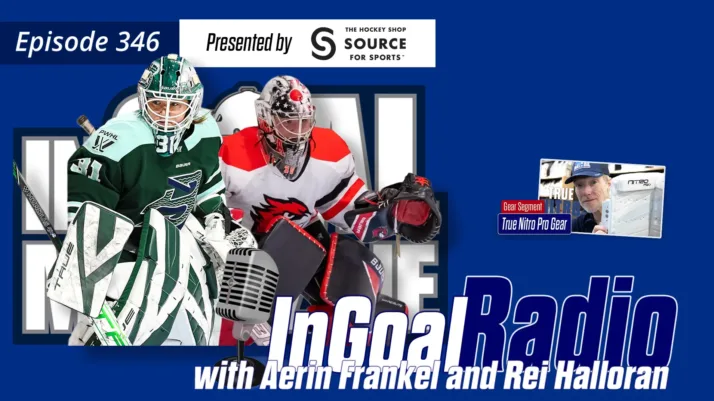
Episode 346: Olympians: gold-medal winner Aerin Frankel from Team USA and Rei Halloran from Team Japan.
Please subscribe and leave a rating — it helps us reach more goalies!


Gold-medal winner Aerin Frankel discusses managing pressure on the Olympic stage and her success with the Boston Fleet following a standout college career. Rei Halloran describes her unconventional path to the 2026 Winter Games with Team Japan, which included horseback riding, Div. 3 NCAA hockey at Wesleyan University, and professional stints in Norway and Sweden before earning her Olympic berth.
- Aerin Frankel credits pressure management as a key factor in her gold-medal performance at the Olympics and continued success with the Boston Fleet.
- Rei Halloran's late-bloomer path to the Olympics included horseback riding, Div. 3 NCAA hockey at Wesleyan, and professional play in Norway and Sweden.
- Devin Cooley's post-game philosophy u2014 finding personal wins within a game regardless of the final result u2014 is highlighted as a practical mental framework for developing goalies.
- Frederik Andersen's return to the Carolina Hurricanes is analyzed, with a tactical breakdown on reading and reacting to a 2-on-1 pass higher in the zone versus in tight.
- The new True Catalyst Nitro pads feature a patent-pending Post Connection System with a uniquely shaped toe bridge designed to improve post-to-post movement and coverage.
Episode 346 of the InGoal Radio Podcast, presented by The Hockey Shop Source for Sports, features a pair of Olympians: gold-medal winner Aerin Frankel from Team USA and Rei Halloran from Team Japan.
Feature Interview
presented by NHL Sense Arena
In the feature interview presented by NHL Sense Arena, Frankel shares insights from her gold-medal winning experience at the Olympics and success with the Boston Fleet after an outstanding college career, including advice on managing pressure on a big stage. And in our second feature interview, Halloran talks about her unique path the 2026 Winter Games with Team Japan as something of a late bloomer who did a lot of different sports, including horse back riding which has some interesting ties to goaltending, before playing Div. 3 NCAA at Wesleyan University, then professionally in Norway and Sweden, as well as the occasional practice fill-in stint with the Fleet.
Parent Segment
presented by Stop It Goaltending U
In the Parent Segment, presented by Stop it Goaltending U the App, we build on a recent post-game interview with Devin Cooley of the Calgary Flames and revisit the importance of finding wins within the game regardless of results.
Pro Reads
presented by Vizual EdgeWe also review this week’s Pro Reads, presented by Vizual Edge, featuring the return of veteran Frederik Andersen of the Carolina Hurricanes and a breakdown on how to play a 2-on-1 pass higher in the zone compare to in tight. And in
Weekly Gear Segment
presented by The Hockey Shop Source for Sportsour weekly gear segment, we head to The Hockey Shop Source for Sports, for a look at the new True Catalyst Nitro pads and their patent pending Post Connection System, a large, uniquely shaped toe bridge design to improve post play.
Episode Transcript
Intro
Cranking it up with another episode of InGoal Radio Podcast presented by the Hockey Shop Source for Sports Langley, the hockeyshop.com. You are so lucky. Daren Millard, Kevin Woodley. Woody, I am jealous of you every week that that get to go hang out at the Hockey Shop Source for Sports Langley. Just such a cool environment.
I'm just I'm stuck with the website. I love the website, but I would just give anything to be able to walk through the hallowed halls of the hockey shop.
Well, you know, you're always invited. So it's just a
It's not that bad. I gotta figure it out, but the and we have had busy, or I gotta get on the road with the team for a little bit.
Yeah. It has been a crazy year. But, hey. Listen. I was gonna say, like, we you know, Cam Mottola, one of our long time list.
Like, we have people that will fly into the hockey shop from The US to make sure they get the best of the best and Canadian dollars and then fly home on the same day with new gear. So, Daren, come on. Let's get you up here, buddy. It's a no better time, like, no better time to be at the Hockey Shop Source for Sports than right now. This week's gear segment's gonna be the True Catalyst Nitro, so new gear.
Got the Bauer Fuse launched, the customizer this week. CCM with the Tacks customizer has launched. Warrior, Alpha Surge launched their customizer a while ago, but we've got a review from The Hockey Shop coming out as well. Like, all the new stuff is arriving in store. Can't all be sold to you.
Can't all be sold to you yet, but Cam's usually got it around so you can check it out. So, it is a busy time. And as we know, I'll do a shameless little plug here. Every time the new stuff comes in, the old stuff goes on sale. Their spring break sale right now.
30 to 50% off on previous generations. So make sure you check it out at the hockeyshop.com.
We're we're sneaking up on that time where we'll hear about the the annual summer gathering of the Hockey Shop Source for Sports Langley. And I I'm I would just I wanna hang out over at the hockey shop. That's what I wanna do.
Well, let me Just go visit. I know. So we can definitely do that. It may not be at attendee fest because there isn't one this year. Oops.
But they've got a bunch of cool events lined up with the individual manufacturers for the summer. Some some goalie specific shut the store down and and let the goalies take over stuff. So there's some good stuff coming up, Daren. Keep your eyes on all their socials for it, and we'll make sure we drag mister Millard up for one of them.
Just to hang out with Cam. Does he make fun of you as much as you make fun of him?
Yeah. But I have the power of asking Hutch to edit it out.
Like, if I grabbed him for twenty minutes, would he spend 15 of them carving you?
I don't know about 15. Right? Because you know? But maybe five? Am I really on a 75% ratio?
15 of 20 is carving him, and and he's five of 20?
I might be selling you short there. By eighteen of twenty is carving.
Maybe 81, but it's all fun. We we have a great time. And you guys are good together.
Down to see you. So I'm sending Cam down to Vegas to see you next week with his family. Mhmm. So, you know, I cut him down. I'm counting on you to pump him up.
I'll bring them up to Section 117, and we'll have a blast. So watching the Vancouver Canucks take on the Vegas Golden Nights over at the T Mobile Arena. Big debut with one of our special friends from InGoal Radio Podcast, Dylan Garand
Yeah. Dylan Garand for the Rangers. Long time coming for that NHL debut. We talked about it after connecting with him and having him on the pod last summer, very much ready for that NHL debut. I thought he looked great.
Got a lot of praise. Certainly wasn't on him that they lost in a shootout. They were outshot badly by the jets. I just thought his game looked really clean, really tight. All the things we talked about in the summer, the skating, the edge work.
I watched the broadcast, the MSG broadcast of the game, and just a lot of praise. Cool to see the photo afterwards of him and Dan DePalma as longtime coach from the Kamloops Blazers. So, obviously, Dan made
Nice suit on Dylan too.
Stylish. Stylish for sure. You have to be when you're, you know, at MSG and following in the footsteps of the great Henrik Lundqvist. I think he gotta roll a roll a good suit. And I just I I don't know.
I liked everything about his game. Like I said, first of many for him in the show. Nice to see him get the opportunity this year. I know that every time it felt like in the past there was a chance, something would be going on like an injury or something that were just it just didn't become his chance. So nice to see him get it.
Nice to see him play so well. And sort of cool to hear a lot of the praise and talk around him focusing on some of the things that we have seen and known, like the skating, the edge work. You know, I know one of his teammates in the first intermission on MSG talked about the goggles, the track optic goggles that he wears in the summer, and that made me think of all the work he does off ice with James Wendland. And, you know, like, a lot of the drills like, folks, a lot of the drills that he does with those goggles off ice to prepare himself to play, and he's talked about how important James has been to this this this step in his career as well as Dan DePalma. Like, a lot of those things are at ingoalmag.com.
Like, a lot of the drills that James has taught him for proprioception and tracking and sort of getting the body working as one moving piece are all available at ingoalmag.com. So from our website to the NHL debut of Dylan Garand, you can work on the same thing.
I'll let, two things about his game. One, structure, but he he played he played goal too. Like, there was a couple of pucks that changed direction on him, and he just reacted to it. He he wasn't just boxed in to to being positionally sound. And the other one was his comfort in playing the puck.
They were on the power play at one time, and he went out and stopped a icing or a puck that was sent down the ice. And he just got out and played it right up. Like, he wasn't just defaulting to them coming back behind the net for a regroup. It was he took the initiative there.
And some big moments too. Right? Like, we talk about as as much as people hate the cliche of big saves and big moments, down to one shorthanded breakaway, some guy named Kyle Connor who's got some filthy mitts stops him on the shorty, and they score the tying goal on the power play at the other end, on the same power play shortly after. So, there's there's just a lot to love. And like I said, just happy for for knowing how hard he's worked to get that opportunity to get that moment to not just make your NHL debut, but make your NHL debut at MSG.
So But he got he got he got
denied by the white cage.
That's right. Eric Comrie now six and o in the white cage has not lost. The magic of the Wade Flaherty switch to a white cage advice continues to live.
Two goals are less in every game in those six games.
I told you I haven't had a chance because I haven't played since we talked last week, but I I got the white cage on order.
It it life changing. You put a dangler on there, and you will be unbeatable.
I don't know if I don't know if we're getting the dangler on mine, but after seeing Anthony Stolarz go down and warm up and seeing him now back on the ice today with the dangler on maybe maybe all those years of you lecturing me hasn't worked, Daren, but maybe it's time for me to throw one on there.
I don't understand why guys don't wear them. Doesn't make any sense. You you're part of that group of guys. I don't understand that.
I understand that. And there's a mask hanging.
In in your level, like, you you you play with good players. You're not playing with National High League players, but you're playing with good players. They're more apt to miss their spot than NHL players, which means they're hitting you up high or in the neck or the clavicle and
wear it. Or or in the mask hard enough to knock your front teeth out. Yep. That cost that cost me $5 grand in dental. No.
You're right. You know you know, I think you know where my problem is. I don't know how to tie it on there, so I'll need to come down and get some instructions from you. I literally, like, hanging in the backdrop of the office is a mask that Eddie Lack wore for the Shoresy game in charity. So we had it all done up for him, and he wore a dangler.
And so I had the dangler. I had the mask, but I didn't know how to attach it. So when I dropped the mask off to him, I'm like, hey. You you gotta put the dangler on yourself, buddy, because I I don't know.
Such a dork. I have I have two of them just extra ones lying around right now because they break every now and then. You gotta have you gotta you gotta have one on standby.
There you go. There you go. Actually, yeah, I you know what? I think speaking of day break, I'll never forget Braden Holtby, skating with a coach I know when I was there doing some video support in the summer. This is this is the year before they won the cup.
And on the final day of a two a day session, first shot, and I think it was Tyler Myers was one of our shooters, just walks into the hash mark and snaps his dangler in half. And it was like, oh, crap. Didn't have a backup. We've got, like, an hour of ice, and now we need to get this taken care of right away. So there you go.
Danglers, you need to have a backup. Lessons from Daren continued. And we're glad to see that Anthony Stolarz is okay. A little shocking, like, you see the guy leave the game after taking one up near the clavicle, but then to hear that he was headed to the hospital, alarm bells go off. So the fact he's back on the ice a couple days later, even though they've recalled Dennis Hildeby to be on emergency conditions, probably a good sign that it wasn't serious.
Be curious to see, Daren, how long the dangler stays on his mask.
He got hurt in warm up. Pregame warm up. Arguably, the safest space for any goaltender, the pregame warm up.
Come on. No. No. Guys are fine at your head when you're not looking.
Well, not in ours. Not in ours, but the National Hockey League. The safest space for a goaltender, and he still got one up high.
Yeah. Yeah. As someone who was once concussed by a teammate in warm up ahead of a playoff game, it is definitely not not an R. I'm not gonna say his name because I've shamed him enough over the years on this podcast. But,
Gear
yeah, got a great conversation a double conversation today. Aerin Frankel and Ray Halloran coming up a couple of women that played in the Olympic Winter Games in Italy. We also have the Vizual Edge ProReads, and David Hutchison will stop by with our parent segment brought to you by Stop It Goaltending U the app. But first, the Gear Segment presented by The Hockey Shop Source for Sports Langley, thehockeyshop.com. Where are you zeroing in on today?
We are zeroing in on the new, and it's in stock. You can buy it now at the Hockey Shop Source for Sports in person. The new True Catalyst Nitro Pad. We had a chance to see these in person actually, before they launched last summer with Cody Porter who's who's playing professionally over in Europe right now, but had them in the summer. He does a lot of testing for them.
And I think, you know, depending on who you talk to, it sounds like had a role in developing one of the key parts we get into on this new patent is the PCS, patent pending, Post Connection System, which is kinda like a an extra large toe tie tab. But let's let's let Cam explain to us how it works. Wait. Nitro pro. Nitro pro.
True Nitro pro. Cam, please, god, tell me that this is their top line pad. It is. Oh, a win for True right off the hop calling their top line pad their Pro pad. Thank you very much.
We're back. Welcome back.
These are the things that excite me, Cam. Apparently. These are the things that anger me to those companies that don't, but welcome back to the Hockey Shop.
That know Kevin's personal feelings Had peeves. Good morning.
He's Cam. I'm Kevin. This is the new Catalyst Nitro Pro. Yes. Top end pad.
Yes. Crafted by Le Fav in Canada.
34 folks in Montreal.
Alright. What's new? What's different? What changes in this Catalyst version? Oh, first of
all, let's start with the face of the pad. Alright. See, no no pronounced knee rolls. This is just stitching.
Look at that. Couple different whites on there too. Yes. White spice it up.
Spice it off.
That's you that's you, not them. That's that's us. That's Okay.
But so, yeah, first kind of striking feature, basically just that stitch line for the knee rolls. You're still getting that kind of aesthetic effect, for example.
But it's No knee rolls.
No knee rolls in the pad.
This is still their flexible pad compared to that it's super flexible, Hzrdus is stiffer than this.
Correct. So
between the two lines, Catalyst remains the flex line. Yes. Okay.
So the way that we've kind of set our pad up, which we would consider much like the stock break, so that's their thin stiff profile. So you do have a couple options on the customizer when ordering these custom. This and say what will be the next derivative line coming out soon for the summer, you will see a similar profile and a similar flex profile. Basically we're getting that nice bend still at the knee. And then the boot.
[crosstalk] And nice flexible soft boot. As we get your flex. Great combination to be able to get over top of your post a little bit easier.
So is there an internal brake or just the brake on lateral roll? So internal brake as well at the knee. You really feel that
as you go to go flex that fab.
Yeah. And then straight up from there. Correct.
Stiff. And very, very stiff on that.
Typical typical NHL preference.
So a bit of an update on the internal foams for Le Fave as well. Nice hard packed, hard rebound. This all of the pads that we order feature that long rebound technology too, so that will still feature a stiffer front face foam. Again, kind of aiding in that consistency and hard rebound over an extended period of time. Okay, move on to the back of the pad.
Strapping. Same, same. Not different.
Same, same, not different. What is different though? Ain't broke, don't
fix it. Inside the knee cradle, we have a bit of
an update. So FRS, as we go through the calf, same same. A popular system. Correct. Diamond Glide on the inside edge for better sliding.
Yes. So we we got all that. Featured that pad. Talked about Diamond Glide before. That ain't changing.
We are keeping that on the side surface of the pad. So now it's about the knee stack. So on the inside and the wobbly wobbly, we see this strap. Okay. On the other side, we see this stitch down too as well.
So the face kind of anchored this into the core of the pad. So once all assembled up together, we have essentially created more stability in the actual knee stack itself. So as you're done your butterfly, as you're doing your pushes, moving around the crease, there's a lot more there, especially of the previous models where we could take that and almost invert that 90 degrees. So on the right track, I'd still say there's other ones that potentially would be more
So more stable system. More stable than their pass pads. That's correct.
Yes. But there's still more flexure than most right now. At the moment, yes.
Yeah. Hey. Listen. Some goalies want that. They wanna go into they wanna be able to go into their post in reverse and have their have some give in the back of their pad as they lean forward on the pad.
Like, not everybody wants that to be a perfectly fixed thing. Some guys like balance, a little bit of balance between the two, but this is definitely compared to other brands one in the more flexible ranges despite trying to stiffen it up with that new strap.
And that plays off the description for the pad too as well, having that little bit more of that connection reactivity style of feel say versus the Hzrdus line.
Yeah. Makes it makes perfect sense. Right? More flexible path.
So we already talked about the soft boot, but there's also a new feature on that soft boot. Oh, this is a soft boot new feature. Oh. What's our acronym we got? What do we got?
Don't know, patent pending. What does that mean?
No, PCS, sorry. PCS. So what they've done, created that little carve out right there. If you notice, that's kind of getting in the shape of a post. So if I was to go into a reverse VH situation, pad's lined up against the post, I now have that bridge wedging up into that front there, creating that nice wedge to be able to push around, get that nice seal with that boot into the post, be able to push off a little bit easier too as well.
So I'm no longer relying on the gaps on the laces, I'm actually relying on the toe bridge itself. So a bit of a change, a bit of an innovation.
I mean, I'm thinking, I mean, if I'm coming downhill into a post and that's shaped like this, like, what's to prevent it? Like, do I have a margin for it? Like, do I gotta hit it perfect or do I have any margin for error here? So flexibility If you're coming in steep, well, it hit here. It's interesting.
It's interesting. We gotta get this on the ice and give it a try. Yeah. Absolutely. Like, I
love the idea. Love the That's why it's not a full fixed endpoint. So it's like, you can still technically go lace into post.
Right. Okay. That makes perfect sense. Yeah.
Yeah. So you have that ability to almost make that mistake and still have something there and not completely ruin where you're you're at. Okay.
So I noticed this. That's what
you should be able to get at the foam on the inside.
Okay. So I guess my question would be, if you decided you didn't like it and you've purchased this pad and it's a significant purchase, like if you decide because a lot of this is new, right? Like we haven't tried this. If you love the concept but the execution isn't the same, how hard or easy is it to remove and go back to something a little more stock?
Uh-oh. On the next episode of InGoal Magazine.
No, but like honestly, like you could take these screws out, remove the foam and just tie it up tight and you just basically have a piece of fabric.
You would essentially. Yes.
Okay. No, I'm just flat foot still
be there for sure. So that wouldn't be necessarily removable off. Okay. Without some surgery.
Well, is this is a new thing, right? Like this this is not the only brand that's coming up with it. You're gonna see something similar on the CCM Tacks, a similar type of technology, idea of going into the post for the reverse, and I think when we have something new, the idea that you can try it and decide whether you like it or not is is probably something to consider because it is a significant investment. The good news is here at the Hockey Shop Source for Sports, if you come in in person, there's a net over there and you can actually see how you like how that feels. I just I just made it so everybody's gonna come in and play dress up and play play goalie on your post, Cam.
Are you happy with me now?
Perfect. That's amazing.
Okay. So let's go to the catalyst nitro gloves. Okay. Locker real quick. We gotta get through this quick because we went spent too long on that.
Well, the good
news is there's not a whole lot changing here.
Oh, okay.
So we have 600. Kevin's got a five ninety. I also got a five eighty. So we've got all three angles of gloves in stock. Pro palm?
Gloves are pro palms.
That's correct. Yeah. Requires a little break in.
That's also correct. A bit of an update in terms of their internal foams of their gloves as well. So they're claiming that it's a little bit thicker.
Definitely feels thicker. That's correct. This needs some work to close.
Yeah. So they're claiming they gave more padding out of that Pro Palm.
More protection, more padding. Exactly. More break in process.
Exactly. Just natural. But beyond that, we are still the same trying to tested true gloves. I like how
you play with those words. Stock is what break you said? Your choice. Oh, so you've got them all in the wall and
all the colors? As evident with right in front of us here. So I got
a 590 on my hand? You do. 580? 600?
Well, 60580 at the time. Okay. Dealer's choice. Blocker?
Same same? Same thing? Angle?
No. Why? I decided not to go
with the up doggy. Really? Interestingly enough, Cam, I saw I've I've been I've been paying attention to what guys are wearing as they come in to town through the links. Brandon Bussi, up the angle the other day. A lot of guys in up the angle.
Freddie Andersen, up the angle.
Interesting. Little slower adoption, I would say with us, but Okay. Have our own quirks and feels for it. So standard true blocker, nice and hard packed, great rebounds, good traditional overall feel, old school Reebok guy, old school CCM guy, you're still going to find your blocker.
Alright, okay, there we go. If you got any more questions about this line, about the tow bridge, about your custom order options, obviously this is they've got a ton of selection here in store but one of the things that True does really well is custom. If So you've got questions about you maybe you want to change things up, maybe you're not a two tone white on white on off white as Cam has ordered here. Maybe you just want plain white. Where do they get a hold of you to get their custom order in with True?
604-589-8299 or 1-800-567-7790 or check us out at the hockeyshop.com.
If Cam sounds a little down, is he it's because he knows that I just basically there's gonna be a lineup of people putting this pad on and trying to see how this toe bridge works on the post behind me. Sorry, Cam.
Did you drop a patent pending on us?
Yeah. Cool. Patent pending.
I have no idea what that really means. It probably means exactly what it what it says. But
It means they've got a patent applicant out for it. It it's interesting because the new CCM Tacks pad as well has it's it's has a a similar type hinge style toe tie, larger block. It's not curved like the true one. And you heard me in that this is actually a good reminder, folks. If you're just listening to this on the podcast, go check it out on YouTube because that's one where seeing it is probably better.
You know, we took the pad and sort of slid it into the post to see how it would connect, at the Hockey Shop. In the net, they have it in the goalie department. And so we have all those visuals if you go check out the YouTube video. But it's it's basically like a really large toe tie tab with the reverse curvature of a post. So it's designed to just seal right up against the post and give you a a bigger area to sort of connect with the post when you slide into it.
And haven't tested it, obviously. We have talked to some people that have tested the CCM version, and the the feedback was at the higher levels, goalies that were already so precise with their integration, they didn't necessarily feel they needed or wanted it. But then at the lower levels with kids, it was fantastic. Now we've seen some adoption in the NHL of True's PCS system, this new system. I've talked to a couple of goalies who are using it in the NHL.
Not everyone is, but some are. And it was interesting because when I was looking at their pads, interestingly enough, these are guys who have a lot of lace hang, a lot of sort of big gaps between the still, know, a skate lace coming off of that. So big gaps between where it connects to this tab and and where their their skate is. And most of them still seem to be hitting on that lace as opposed to on the tab because the red marks of the post are actually on the bottom side of the tab as opposed to the part that's supposed to connect. And I thought that was really interesting.
So then the question would be why have it? And at least one answered me by saying, hey. It's like even if I'm not hitting it right on that spot, I still connect. They like how it connects, so it's not interfering with their connection with the post, and they just see it as more you know, it's extra coverage down there because it is a fairly significant chunk of HD foam down there, and so they see it as a little extra coverage in front of the in front of the toe.
I was wondering if you had to be more accurate with your post integration, your slides in and out with this new setup.
Well, the the idea is not, and and I should be careful because we haven't tested it. Right? The idea is not. The idea is that it gives you a bigger area, but I I don't think anybody was trying to connect to hit their toe tab, their toe tie tab on the like, I don't think that's what people are trying to hit. People are trying to have the bottom of the pad on or toe bridge is, I guess, the proper term, the toe bridge.
So people are trying to hit the bottom of the pad, the bottom edge of the pad in front, and then the skate sort of on the inside, and they use long gaps in the toe ties to sort of establish that. And that I guess that would be the point. If you're already at a at a level where that's the gap you're targeting, that's the gap you're hitting, then I'm not sure you're gonna hit right on this new toe bridge. But for younger kids, the feedback has been that they like having that larger space. And I wonder if maybe some of those younger kids haven't been taught or aren't using or maybe it's too early to use the big gaps in the toe tie.
So I it's something we wanna give a give a try ourselves, but I thought it was interesting to see that, yes, there is NHL adoption. But when you talk to the guys using it, they're maybe not using it the way we would expect.
I like the idea. All of them. I think I think it's really cool
to be
to be able to have that thought process that the the tow bridge connects right to the post.
Yeah. And the one on the CCM Tacks is like a hinge system, so you can sort of see how it would also not spring load, that'd be the wrong word, but sort of provide a a resistance when you push off. Like, there wouldn't be any give there. It would help sort of help with your exits as well as ideally giving you an easier target area with your entry because it's kinda got a hinge to it, which I think the I think the PCS does as well. The true one has a has a bit of a hinge system to it.
It's just laced right into the front. So it's interesting, you know, and again, we applaud innovation. So love the fact that that both these companies are trying new things. The one you know, my only fear on this is and I expressed this with Cam when we were talking in in the Gear Segment there is pads aren't cheap. Right?
And these things are stitched into the toe. And on I was looking at the CCM one. It because the block is smaller than the true one, I feel like you could slide that block out, tie the toe tie tight on the holes of the leather tab, and it would act just like a leather tow bridge.
With the true one, there's actually Velcro tabs on the outside to hold it in place. And if you remove those Velcro tabs, I think in theory, you could probably slide it out as well, but I'm not sure. Because it because if you spend well over $2,000 on a pad and find you don't like the system, what are you doing then? Right? That's sort of my so check it out.
I mean, the beauty is you can go into the Hockey Shop Source for Sports and check it out. They've got a net there. You can throw on a pair of skates, throw it on there. Cam's gonna hate me because I'm gonna put red red, red post paint marks on all of his brand new equipment. He he better pull a demo set out for the for the folks to try it out or set with black a black PCS instead of a white PCS so it doesn't get marked up.
But it's a big purchase. Right? And I think it is a significant enough change that you wanna try it out before you to figure out whether it's something you want on your pad or not.
Keep us up to date on that and the progress there as we slide over to Freddie Andersen with the Vizual Edge ProReads.
Do you want the puck to look like a beach ball?
Yes.
I know. It does for you, Daren, all the time. I see a much smaller beach ball. Every goalie has that night here and there. Maybe a less less here, less there for me, but where the puck looks huge, you're ahead of every play, you feel calm, patient, in total control.
Then there are the nights where you're half step late. You see it, but you don't really see it. You're reaching. You're guessing. You're fighting it.
That's not your technique. That's your eyes and your brain not processing the play fast enough. Vizual Edge fixes that. It measures how well your eyes track and process the game, then gives you a custom plan to train improvement. Three fifteen minute sessions a week on your laptop or tablet wherever you need to do it.
On the couch, kitchen table, it's wherever, whenever. It's what NHL goalies use to make the game slow down when it matters most. Remember, you can get a discount 10% using the code I n g o a l inGoal, all caps, or if you're a member to premium, go check out our ProReads for a 20% discount code exclusive to our members. And when you go to ProReads this week, you will find the happy return of Frederik Andersen of the Carolina Hurricanes, one of our initial, one of our first ever ProReads guest, Daren, we did Carey Price in Kelowna, and then one of the first guys we did at the rink was Freddie Andersen, sat down with my computer and a bunch of cameras outside around the corner from the Leafs locker room, and he did six different video breakdowns with us for the Leafs. He did another eight four years ago or three and a half years ago with Carolina Hurricanes, and we're so happy to have him back.
Soft spoken, but very insightful. This week, he breaks down a two on one where the pass is made a lot higher in the zone. And so you tell me, Daren, what's the difference in your mind between a two on one where the pass, say, connects around the dot versus a two on one where that pass is down towards the bottom of the circle? What are you looking for that's different as a goalie? What are you what are you what are you choosing for path?
Are you sliding? Are you on your skates? I know a lot
The lower it is, the the more I'm I'm sliding.
And and higher in the zone where you probably you're probably trying to beat that on your skates. Right?
Yeah. That's the goal. But sometimes I just feel like I I get there faster if I slide and then get pop up.
That is the Freddie Andersen. That's what he said. So he walks us through some of the whys on that. And he and he and interestingly enough, he takes a path that isn't to his post. He's well outside of his post, and he mixes in speaking of Carey Price and ProReads, he mixes in a save selection that I'm not sure we've seen or talked about since Carey Price explained it to us in one of his early ProReads.
So all that information and more, a great breakdown, three minutes of video, watching video, explaining his decision making process with Freddie Andersen on this week's pro reads at ingoalmag.com. And as I said, any ProReads, go check it out. Get your exclusive InGoal member discount code to save 20% off a subscription to Vizual Edge.
So Freddie and I play the game the same way?
I think his eyes are open when he does it.
Oh, good point. Flinching. Flinching. That was something Steve Valiquette told me that that and even NHL goalies do a little bit.
It happens.
Yeah. Can you imagine? I I I I had no idea that that actually did happen. He this is a funny story, but he said to try and get away from it when he played, he went to Home Depot, bought a couple of two by fours and some nails, and hammered these nails into the two by four and tried to train himself not to flinch at the sound or the motion to avoid flinching.
Parent Playbook
Man, you got better stories from Valiquette than we did. We gotta get him back on the podcast to ask these things. These are great. I see and that's that's that's the type of creativity when it comes and self development.
Did that on his own.
I that's what I mean. Like, that's those are the types of guys like, that's why he started a company like Clear Sight Analytics. Like, he didn't just go out and play. He wanted to know why he played well in certain games and why he didn't in others, and he went to great degrees to try and find improvements. I love that.
Sometimes you gotta you know, it's that it's that old saying about, you know, we see it from from the crease from Ian Clark. Be your own best goalie coach. That's what the whole thing is about. Right? And there's a guy who takes that outside the box.
Right? Not just, hey. I'm gonna run my own drills. I'm gonna try and understand my game, but I'm gonna try and find unique ways to improve my game. I love it.
That's why Valiquette's the best.
Another great avenue is our Stop It Goaltending U, the app parent segment with David Hutchison presented by our good friends over at Stop It Goaltending.
Wanna have twenty five years of NHL goalie coaching experience at your fingertips? Wanna tap into the goalie parenting expertise that helped Joey Daccord reach the NHL? That's what you get with a subscription to Stop It Goaltending U, the app. All the knowledge from Brian Daccord, who has been an NHL goalie coach, scout, and director, as well as the insights and expertise from his staff at Stop It that includes a long list of veteran NCAA coaches, all delivered in easy to digest chunks, including five short daily primers, weekly style analysis, and breakdown videos, as well as drills that you can take onto the ice with your team and coach. Plus, you get a subscription to InGoal Premium included.
So check it out now at the App Store or Google Play Store and get the best of both worlds with a subscription to Stop It Goaltending U the app and included a subscription to InGoal Magazine Premium.
Taking, it easy with Hutch and his voice, but, Hutch, is able to, provide us with the parent segment on InGoal Radio, the podcast.
Hey, goalie parents. Welcome to the Parent Playbook. I wanna start this week talking about Devin Cooley. You know the name, but let me give you the full picture because the backstory matters. Devin Cooley went undrafted out of college.
He signed his first pro deal and spent his early years in the ECHL and grinding through the AHL. Nashville system, Buffalo system, time with San Jose. He's 28 years old from California, and this season, for the first time in his career, started the year on an NHL roster. That's not a quick rise. It's years of showing up, doing the work, and refusing to let the game tell him the answer was no.
Now, he's talked openly about how the mental side of his game has held him back for most of his career, how a bad game used to send him somewhere dark and how hard it was to climb out of that hole, but he did something about it. He started reading about a book a week apparently, philosophy, neuroscience, psychology, trying to understand how his brain works and how he wanted to respond to adversity. Now it's paid off. He was named an AHL all star last year. He won the backup job in Calgary in a competitive training camp.
Just a few weeks ago, the flame signed him to a two year extension at 28. After years of people probably wondering if the NHL was ever going to happen for him. Now, I talk a lot in these segments about separating process from results, about finding meaning in the work rather than just the scoreboard. And I know that can sometimes feel like advice that's easy to give but hard to model for your kid. I know it is for me.
So this week, I wanna play you a clip of Devin Cooley talking after a win. Maybe you've heard it already on social, but I'm going to share it with you here. I want you to listen to what he's excited about because it's not what most people would expect from a guy who just got to the NHL after a very long road to get there. Listen up.
Yeah. It was awesome. And it wasn't just awesome because, like, we won. Like, yes, that was that was amazing. But the three things that I've been kind of grinding on and and working on, like like, I hit it tonight, like, puck play and I didn't miss a single pass and then, I've been working on my po checks.
Well, I haven't really been working on my po checks. I've just been doing it and missing it every single time and I finally hit hit it, hit the puck on the po check. I finally got on the breakaway and, of course, it goes right to the guy and then they freaking just hit. It could have been a goal easily, I guess that we got lucky there, but they got lucky, like, three other times so it evens out. And then, what else was I working on?
Shootouts.
Yes. And yeah. That's what it is. And then shootouts. Yeah.
I kept, I kept telling everyone. Was like, one of these days, I'm gonna I'm gonna be good in the shootout and then one of these days, I'm gonna, have no turnovers. I actually told my d today. I came in the locker room right before the game. I was like, d, my my passes have been hot.
All practice, I was like I was like, there's gonna be no turnovers today. I can feel it like get ready because they're coming and I actually did it. So that was great. Last time I said that was, I forget where we were last time but last time we said that and I turned it over immediately twice in a row and they almost scored on it. I was like, maybe I shouldn't say that again But I think if I just keep saying that and holding myself accountable, eventually it'll work out and it worked out.
So I was really excited.
Okay. Did you catch that? He won. Yeah. He says it.
That was amazing. But then he immediately goes somewhere else. What actually lit him up was his puck play, his poke check, his shootout, the specific things he'd been grinding on in practice that finally clicked in the game. He even told the story about calling a shot before the game, telling his defenseman, my passes have been hot. There are gonna be no turnovers tonight.
And then laughing about how the last time he said that he turned it over twice immediately. That's self awareness. It's the ability to try something, fail at it, be honest about it, and come back and try again without letting the embarrassment stop you. That is a mental skill, and that's exactly what he spent years quietly building. And here's the thing I want you to sit with this week.
Devin Cooley is in the NHL right now. He still has things he's been missing in practice. He still has skills he hasn't nailed yet. And when one of them finally works in a real game, that's the moment that feels like a win to him. That's what it looks like when the process becomes the point.
So the next time your goalie has a rough game, ask them, what were you working on tonight? Not how many they let in, not the score, what they were working on, what went well, and did they get a chance to try the things they've been working on? They can answer those questions. They're doing it right. Just like Devin Cooley.
See you next week.
He's not hoarse. He's he sounds like a a cow coughing up that straw in bar.
He's yeah. But at least he's not a total donkey like I am. That's that's the that's the upside. That's the upside. We're we're glad that that the vocal cords are healing.
It has been a very rough couple of weeks for mister Hutchison, but he still continues to keep our ship afloat here at InGoal Mag. We couldn't survive without him.
You're a wild burrow. You're not a donkey.
Feature Interview - Aerin Frankel
I don't even know what
a burrow is. Is that a jackass? Did you just call me a jackass instead of a donkey? Kinda. Maybe.
It's it's it's a it's part of a family. Let's let's just call
it that. Yeah. There we go. It fits. I'm not even I'm not even gonna run away from it.
Right? It fits.
Sense Arena presents our feature interview every week on InGoal Radio, the podcast. Today, a couple of conversations courtesy of our friends that make your journey through goaltending a little bit easier.
Speaking of making your journey a little bit easier, I had to get back on the ice after three weeks without playing, Daren. Last skate of the year with my group that is way over my skill level, like, all the guys are way better than me, and I was nervous. I actually thought about not going. I really wanted to play, but there's a certain standard of this skate that you have to hit. And I was worried about not not being competitive enough that these guys would just light me up and it wouldn't be any fun for them.
It was, after all, their last skate of the year as well. So what did I do? I threw on NHL Sense Arena, I got back to tracking pucks using NHL Sense Arena. I I went full, you know, Joey to court. I used it.
I didn't have an opportunity to get on the ice, so I used it to prepare for the game. I used it a couple days before, sort of did some some with the gap program on screen management to see through pucks, which is a great way to sort of get that NHL environment. I didn't have time to go through the full gameplay, but I used that, and I used the the shot release mastery program for reading pucks. And then on game day, I went through just catching pucks using some of the game day drills and honestly played better than I had three weeks prior when I'd been playing on a regular basis. So we talk a lot about the summer months, about how hard it is to find ice.
We talk a lot about goalie schools and goalie programs, and we have lots of recommendations in our goalie guide for that. But sometimes you need a break, but you don't wanna lose touch. NHL Sense Arena is perfect for that. We had a parent reach out to us last year talking about how he was worried his kid wouldn't see enough pucks. They decided to to just get away from the ice, do one camp but not four like they've done in previous years, take time away from the rank.
But they kept using NHL Sense Arena. And so when they got back to tryouts, like me hopping back on the horse after three weeks away, the kid performed at a really high level, and he thought it was all about NHL Sense Arena. So if you are worried about not getting enough reps, not getting enough touches this summer, don't worry if you've got NHL Sense Arena and their wide array of drills at your disposal. You don't always need ice to improve as a goaltender. NHL Sense Arena is a great way to do that.
Couple of conversations for everybody this week. First up from, team USA, the Olympic champions, Aaron Frankl.
Yeah. And just a quick conversation. Would have loved to have had a longer deep dive into her roots in the game, but, this was post practice on a long road trip for the Boston fleet. It has been a whirlwind. I I mean, I think you know, Daren, Olympians at at all levels in both leagues.
It's a lot to come back off that emotional high, the ups and downs, the roller coaster, the Olympics, and right back into your pro season. And so we only had, like, ten, fifteen minutes to catch up with Daren after a practice here in Vancouver, but we'll save the deep dive for another day. This is a quick catch up, and still a really enjoyable interview.
Really excited to welcome to the InGoal Radio Podcast, first time guest, Olympic gold medalist. I feel like we could spend the whole ten minutes of me sort of listing off your achievements today, but, Aerin Frankel, thank you so much for for being here.
Thank you for having me.
What's it been like coming off the gold medal? I mean, you've won so much, with that stage, the gold medal, everything that went into it. What's it been like coming back to this since? It's gotta be an adjustment.
Yeah. It's been awesome. Had so much fun playing in my first Olympics with my team, and being able to bring home gold was incredible. And now I'm really excited to be back with the fleet and the PWHL and being back in our season and, yeah, have our goals set on the Walter Cup. So that's kind of where we've all shifted our focus to.
So much about goaltending is next shot mentality. Sometimes it's harder to do. What's it been like? Like, has it felt like a bit of a whirlwind coming back from there to here and all the attention that comes with it? Have you had to kinda refocus a little bit?
Yeah. There's definitely been a lot of attention our team has gotten, and I think it's really exciting for women's hockey and USA hockey to bring home not one, but two gold medals. So it's been really awesome to see the support from back here. And I think, yeah, for us, it's it's back to focus on the PWHL, but it was awesome to have, yeah, the experience we've had and the opportunities that we've gotten since returning from the Olympics. And it's been, yeah, definitely a dream come true.
Okay. So you've been on massive stages before. The Olympics might be the brightest lights there is. How do you manage the spotlight and the pressure? Like, what techniques have you come up with over the years?
Is it just experience or the things you've learned over the years? I know you were psych or took psychology in school as a goalie to make sure that you're at your best when the spotlight is brightest. Any advice you can pass along to other goalies on that?
I think for me, I just try to stay present. And, obviously, with, you know, the world we live in, there's a lot of social media and a lot of distractions going on. And I think, you know, the better you get and the the brighter the lights are, the bigger the stage. There's obviously more people always looking to talk about you and your team. And I think for me, just being able to stay present and focus on what I can control, which is only myself and, my preparation and not everything that's going on, you know, kind of the outside noise trying to tune that down.
Do you stay off social? Like, when you're over there, did you stay off social completely? Or, like, I know like, how do you find that balance? Because it's it's sometimes easier to say and harder to do.
Yeah. I def I don't go on social media at all on game days, but, yeah, I think just limiting my time on it. But more so just, yeah, like, I mean, not necessarily not using it, but just, yeah, focusing on what I can control and kind of letting the outside noise just go in one ear out the other.
Okay. So once we get into game time, what how do you manage to when, again, crowds you've seen big crowds here. You've seen big big crowds in college. What do you do to sort of stay in the moment as the game goes on? Is there anything like, is it just natural to you at this point?
Are there we've heard different people. We've seen people write a note on their blocker. They'll write a note on their on their stick. I think I think Mash Meyer writes something on the inside of her blocker, just things to keep them in the present. Is there anything that you've done over the years that helps you with that?
I think at first, like, I was nervous playing in front of bigger crowds, and I think now I've just kind of learned to just focus on my own game. And I think staying present helps a lot with that and just thinking about myself and my teammates and not really, yeah, getting too wrapped up in what's going on outside the glass, just really focusing on what's inside. And I think, yeah, now that this is my third year playing in the league, I've been able to adjust more to it. But I think for the first year, it was a new thing, and I didn't have a lot of fans when I was in college at the arenas. So it was definitely an adjustment, and I think just learning to to play my game regardless of what the atmosphere is.
Was that a process? Like, the first time you were in front of a big PWHL crowd, did you like you said, the nerves, were there things you learned to deal with? Or is it again, is it just experience, or are there little things you can do to like, staying in the moment, you say it may you make it sound easy, but it's it's oftentimes difficult to do.
I think, you know, sometimes you're kinda just forced into it. So for me, it was just, like, kinda got thrown into the fire and had to get used to that. And, yeah, there's definitely an adjustment period, but I think just, yeah, leaning on my teammates and our veterans on our team who had played in front of huge crowds before and people had been at Olympics before, world championships, just learning from them.
In terms of managing your game, you talked about focusing on your game. How's it evolved over the years? Actually, let's how would you describe the foundations of your game to another goaltender?
I think I rely a lot on my skating. It's really important for me to be a good skater. It's something I still work on, and I think, you know, you can never be good enough of a skater. I think it's it's super important for goalies. So I think, for me, I I rely a lot on my speed and my skating.
Edge work drills, things like that would sometimes that's the boring stuff. Like, all the young goalies wanna have, like, the Instagram style drills, but people flying everywhere. What for you is the core of being a good skater? What do you work on the most? Is it just, like, crease movement stuff, or are you doing different things in terms of around the rink with edge work?
I think, yeah, crease movement stuff and just, yeah, stuff that my goalie coaches have given me over the years that maybe might seem like elementary, but I think, you know, you're never too good of a skater. So for me, just continue to work on the basics that might be easy, but I think, yeah, you can always be faster, be stronger on your edges.
So What's one of the biggest misconceptions you hear about as a, quote, unquote, undersized goalie, what's one of the biggest misconceptions you hear about how people expect you to play?
I'm not really sure about, like, expectations of style. I think, like, obviously, bigger goalies are expected to cover more net, but I think yeah. Like, just
The people's I think, I guess, skating is sorry. I didn't ask that very well. My bad.
No. You're good. I
I think people sometimes think, oh, a smaller goal. They gotta be super aggressive. Mhmm. When I watch you, you play a really contained controlled game. Is that maybe one of the misconceptions that comes, maybe not to your game, but with smaller goals?
Oh, they have to be super aggressive to make up for that lack of size. But I don't see that in your game necessarily. Is that right?
Yeah. I think, like, for me, skating has been most important. Like, I definitely have played around with my depth. Like, I think in college, I was, like, more aggressive, but have learned kind of what I'm comfortable with. And I don't think there's, like, really necessarily, like, any right or wrong, but just, yeah, playing to your strengths.
And, like, if if you are a stronger skater, like, maybe you can afford to give up more depth and vice versa.
Right. You can get get there, beat it on your feet. Yeah. Who are some of the influences over the years? You mentioned goalie coaches that have helped you.
Who are the some of the ones that have helped you the most sort of as your game has evolved? And I know that's a big question, but there's a lot of years there. Who are some of the ones that jump out?
Feature Interview 2 - Rei Halloran
I think my head coach at Northeastern, coach Dave Flint, was probably one of the biggest influences on my career. He recruited me to Northeastern, and he was also a goalie and our head coach. So he was able to focus so much on helping me throughout my five years there. We did a lot of film sessions and a lot of time goalie world and stuff. He really did a great job with all the goalies at Northeastern.
We've had so many great ones come through, so I think it's a huge credit to him. And I think, yeah, I developed a lot as a player while at Northeastern.
I'll just say last one. But having a goalie coach who's also a head coach, like, what's the advantage there in terms of them understanding how you fit within the system?
Think, yeah, playing the position is the best way to relate to it. I think people who have played goalie can relate to it the most. They kinda know what what you go through and the needs of a goalie that some people who didn't play the position might not understand. So I think it was a huge advantage to our team to have him because he he knew, yeah, how to help us and kind of what we needed throughout the year. And I think that was also a big reason why I chose Northeastern is because I knew he was gonna look after the goalies.
K. I got I lied. I got one more. What do you love about the position? Like, what drew you to it? What do you still love most about her?
I think the the compete that comes with the position, like, being able to win games for your team and help them, give them a chance to win. And I think for us, it's kind of a whole different sport, and I think some people don't understand that other than other goalies and stuff. So I think for me, it's just, yeah, being that Last Line defense and being able to help my team, allow them to play free in front of me, and give them a chance to win.
Pressure that comes with that. You've always embraced it?
Yeah. I think so.
Think you have to want to be that that that last line?
Yeah. I think so. I mean, it definitely is a choice to be in the net and have fuck shot at you. But I think, yeah, for me, it's just always been something I enjoyed doing. And, yeah, it's definitely a unique unique position for sure.
Thank you so much for your time.
Thanks for having me.
That just gives you anticipation for the next time that you're able to catch up with her.
Yeah. There's I mean, she's won at every level. Right? Like, just dominated at every level. And so despite being, hey.
Like, small goalie. Like, not the biggest goalie. The way she holds edges, the way she moves, there's so much such so much impressive about her game. I'd love to, you know, find some more time to to get into sort of the roots of how she built that up, a little more than we did there. But what an what an incredible season she's had.
She comes back from winning gold at the Olympics. And, hey. Listen. Like, as much as the drama at the end of the game, Hillary Knight tying it and then the winner in overtime, none of that matters if she doesn't keep it at one nothing throughout that game in a game in which the Canadians had the majority of of of chances. She made some huge saves in that game.
And then she comes back and sets the PWHL shutout record for a single season. So she's been elite just as she was in college at every level, and so it was fun to catch up with her, and hopefully, it's the first of many.
Follow-up that discussion with a conversation with Ray Halloran from Team Japan and a different journey for Ray.
Yeah. And one that's ongoing. And interestingly enough, as you'll hear from her, she does some practice goalie stuff with the Boston fleet and and is hoping to maybe as she continues to grow her game, get some traction and and get one of those spots in the PWHL maybe starting as a third goalie. This is an athlete who played a lot of different sports, an athlete who sort of came to goaltending late, born in Japan, ends up representing Japan and getting into a game at the Winter Olympics. Went through some tough times in COVID, including national camps in the midst of it, flying all over the place.
Just a really fascinating winding path ultimately to becoming an Olympian, and hopefully that's the start of even more opportunities for Ray who played went from div three college at Wesleyan to international spotlight in Italy, and so she caught us up with her story. This is a little longer, but lots of great anecdotes and advice in here. Really excited to welcome to the InGoal Radio Podcast, first time guest, Olympian Ray Halloran. How are you?
I'm good. Thank you so much for having me.
What's the adjustment been like? You're back in Boston right now as I understand it, but just back from the 2026 games in Milano Cortina representing team Japan, got into a game against Sweden. How is the adjustment back?
It's been super weird. I've been trying to keep busy, just getting back into normal life, taking care of my dog. And, yeah, for me, it's the start of the off season. So I'm taking a few days to adjust back with the jet lag and stuff, but gonna get right back into the gym and skating in a couple weeks. So, yeah, just trying to go back to normal life a bit.
Okay. So I buried the lead there a little bit.
What was that like? Like, you're
an Olympian. What like, what what what was the what were the moments like getting into a game, the games, the opening, the quote? Like, what's what jumps out to you? Have you had a chance to process it all just a just a week or so later?
Yeah. I mean, I'm still processing it a bit, but it was so surreal. It was super exciting. I never thought I would make it to that stage ever. So, still just kind of processing it all and the excitement, but, yeah, it was amazing.
It was amazing just meeting other athletes, from different sports that I've, like, seen on social media, on TV, people I've watched at previous Olympics on TV and stuff. So that part was amazing and how down to earth a lot of these athletes were and super open to talking about their experiences and learning a little bit more about their sports and stuff like that too. So personally, for me, that was the greatest part of the Olympics, think, was just meeting a lot of really, really cool people. But, obviously, hockey wise, getting into a game, that was super exciting for me. I honestly counted it out.
Going into the third period, I was like, either I go in now at the beginning of the third period, or I'm gonna go this whole Olympics without, you know, touching the ice. But I you know, my coach put me in for the last fifteen minutes of our last game, which was super, super cool, amazing. I was very nervous, though, playing Sweden, but it was amazing.
So the the our first lesson, and I've asked this of some of the other athletes that we've talked to coming back, You're used to playing played played pro overseas already. Mhmm. Played college hockey at Wesleyan. So you're used to you're used to big moments and pressure, but the Olympics hit different. How'd you those nerves you talked about, how'd you find that balance between embracing them and not being overcome by them?
Yeah. I think I was a little bit lucky in a sense because it was a no pressure moment. I think for me, we were already out of, you know, making it to the next round, and we were losing four zero already. So I think in my head, I kind of really repeated that a bit a bunch just saying, you know, it's a no pressure moment. I let in a goal.
I let in a goal. It's the best team in our group, but I just wanted to have fun. I think it was the first time in a long time that I had so much fun playing hockey. And so I think that's what helped me stay loose, helped me make big saves and whatnot, was just kind of playing free and being myself and having so much fun playing with so many great players.
So, like you said, didn't let in a goal, even if that was the mindset going in. Like, can you take something away from that experience in that moment and the way you embraced it that you think you might be able to apply in the future going back to playing pro?
Yeah. Absolutely. I think the past couple years just trying to make the Olympic team, I've put a lot of pressure on myself. And I think, I've been really focused on, like, the mistakes I make in practice and games. And in tie at times, it was kind of overwhelming.
And I think being able to play those fifteen minutes super, like, free and just really enjoying the sport has kind of allowed me to reshape how I wanna go into my next years moving forward. I just really want to, you know, have fun playing hockey. And if I don't have fun, then I don't wanna play anymore, I think is the mindset I'm going with. So I think that was a big turning point, and I'm hope hopefully, it is in a positive way, moving forward. But, yeah, I just wanna have fun playing hockey and kinda take that pressure off.
Because being a goalie, there's just so much pressure anyways. So why put more pressure on myself?
Yeah. There's there's plenty already in this position. That's a big part of it. So I got I'd like I'll use that as an opportunity to rewind, Ray, and ask the path to here. How how did it start?
Where's the origin story? Because, you know, obviously, went to school in The States. Did you grow up in The States? Born Japan?
Yeah. I was born in Japan, and then I lived there till I was 12 or 13 before moving to Boston. Okay. So I actually started playing hockey in Japan alongside my brothers. I have three brothers.
So I played with them on a boys team. I started out as a defense. And then, obviously, as a girl playing on a boys team, it's a bit hard to get that playing time when there's, like, hitting and stuff. So I volunteered myself for playing goalie a few games, and I really enjoyed it. And the spot opened up, so I was like, I'll do it.
That's how I became a goalie.
Reluctant beginning. What'd you like what'd you what'd you like about it as you got into it? What what what drove you to keep playing it?
Yeah. I'm a bit of, like, a unique human, I think. And I'm, like, the only girl in my family like, only girl out of, four siblings. So I think I've always liked being a little bit different and being unique and doing what makes my parents' life a lot harder. So I like the individuality of, like, being a goalie, and it's, you know, being a team sport, but you're kind of in your own world.
So I really enjoyed that. I loved being with the team, but I also loved, you know, being able to be in my own world at the same time. So, yeah, I think I just got really hooked after, like, the first year.
Were you a were you a big gear fan? Like, some for some, the the gear is part of the attraction. Like, when you talk about individuality, for sure, there's an isolation that exists within the position. You're a part of a team, but you're playing your in your own world. But you also get to express some of that individuality with your equipment and your masks. Did it draw you to it at all?
Yeah. I think I always just really loved, you know, the different helmets that goalies were wearing. Obviously, like, being able to pick whatever gear you wanted to wear, the different play styles. I think those aspects really kind of I really enjoy it now, and I think I definitely, though, was drawn to it. You know, watching NHL games on TV, I've always was drawn to watching the goalies.
So, yeah, it's always been I love, like, helmets and everything too. So
So you get started in Japan. What type of are you just going out there and playing? Did at what point did it become something where when I guess if you're coming over to to North America at 12, 13, maybe it's after you arrive. But when did it become something where there was a little more structure to it as opposed to just going out and playing, you started to get coaching or position specific coaching and maybe think about it in those terms?
I think per as, like, just my personality, I've always been kind of an all in person. So even when I was eight, nine, 10, when I first started playing goalie too, I was kind of all in. I always wanted to win. I wanted to be the MVP of the tournament and everything, but I really started taking it seriously once I moved to The US and was playing girls hockey. But I don't think I'm my parents were a big fan of me playing different sports and exploring all the different things that I can do.
So I wasn't one of those players that played hockey year round necessarily. I just played during that season, and then I picked up a different sport in a different season. So, in that sense, I was a bit of, like, a late bloomer, so I didn't think about college, hockey at all. Like, a lot of these girls do when they're in, like, fifth, sixth grade, I that wasn't on my mind at all. It was something that became a topic of conversation, I think, when I was, like, a sophomore in high school, so super, super late.
But in a way, I think that's helped me, because I've been able to grow my game even after I've graduated college. So I think it's helping me professionally, but maybe it wasn't, you know, something I thought about when I was in high school. Like, I wasn't getting heavily recruited or anything. So it made my life a bit harder when I was trying to go to college. But right now, I'm like, oh, thank god I didn't, like, hyperfocus on it super early because now I can I can still grow my game, even though I'm 24?
What, what kind of things what other sports do you play? Because you talk about growing your game now at the age of 24. All those other sports would have grown you as an athlete, I imagine.
Yeah. I played field hockey in middle school and high school, but, you know, when I was younger, I played baseball. I played soccer. I'd played honestly any sport that was thrown my way, and I also am a huge, like, horseback rider. Yeah.
So my mom horsebacks ride rides, so I like to do that with her, in the off season. So I would not pick up a hockey stick for, like, months, in the spring and summer. And I would just go out and, like, ride horses. And then I would pick up a stick in the fall again and just start playing hockey.
Carryover. This is sound like a really weird question, but, like, riding horses isn't just sitting on your ass.
No. It's
Like, it's definitely not. Yeah. The ability to sort of hold posture from that the sitting stance required. We've had a few people theorize that, like, Carey Price and riding horses and some of the posture and hip mechanics that go into making him special. We've had a few people be like, hey.
Like, there's a tie in here. So as absurd as this question may seem for me, do you is there any carryover from, you know, riding horses to playing goalie in your mind?
Yeah. I think, you know, like, that core strength and, like, being able to have, like, your core and your legs move differently from your hands, like, while keeping your hands steady and stuff like that. And I actually did, like, a testing, like, a balance testing on the ice once when I was in high school. And they said, like, my balance was comparable to, like, college men's college elite goalies, NHL goalies. And I was, like, very shocked because I am nowhere near as good as them.
But we think maybe it was because of my horseback riding and, like, being able to be in that position, hold your posture super well for long periods of time. So I do think there's, like, a correlation a bit, but I don't know. I think there might have to be a study done.
Okay. Okay. So so you totally bailed me out on that. It wasn't as crazy a question as it seemed. I appreciate that.
Was there a point before college? Did you did you like, as much as you said you played other sports and hockey wasn't the focus, did you start to add some technical elements, whether it was when you were playing high school or or playing, with the girls with the women's teams, were you starting to think about the technical aspect of the game? Were you were you more just watching others and emulating? And I gotta ask, you know, who were the inspirations in the early years?
Yeah. I think I do I did have, like, a goalie coach, and I would go to goalie trainings, and I loved watching film and watching video. Growing up, I loved, like, Tim Thomas, and I love Marc-Andre Fleury and that, like, very unconventional goalie style, but I can't really put that into my play too well.
There's so there's no there's no Tim Thomas butterfly in your style right now?
I have my moments, but not, like, my, like, my core style, I would say. But, yeah, I just I love watching kind of all goalies and being able to kind of pull from any type of goalie and see how I can put it into my game. And I love just trying new things. I'm like a goalie coach in my free time. So I just like studying the game, and I've loved watching the game first, like, since I was little.
So ever since, you know, high school where we would actually watch film as a team and stuff, I've I've just, like, been obsessed with it. So I think that's kind of helped me grow my game a bit, but also I've had great goalie coaches growing up.
You mentioned doing some coaching. What ages? And we've we've had a lot of, you know, right into pro, goalies tell us that going back and working with kids of all different ages actually can help them with their game, help them think about things in a different light sometimes. Because in order to teach it, you have to really understand it.
I coach, like, all the like, super young. Like, there's, like, sometimes, like, three year olds on the ice. I just don't understand how they're playing hockey all the way up to, like, high school, college level goalies. And, yeah, I think I just love watching these little kids grow up. I've been coaching some of them since, you know, I was I was a senior in high school or I was in college. So being able to watch some of them really grow up and become their own goalie and see their style kind of evolve as well, has been super amazing. I just I love watching it.
But, yeah, I think in ways it has helped my game too. Just like, I noticed myself saying things to them, and I'm like, wait. I think I do the same thing on the ice, so I feel so hypocritical. And then it makes me remind myself when I'm playing. Oh, I always tell the kids to do this, and why am I not doing it myself?
So in many ways, it's reminded me to become better as well.
I should have asked this at the beginning, but, like, how like, if you were to describe your own like, the foundations, the building blocks of your own game at this point at at 24 after a couple pro seasons and as an Olympian and how they've evolved, what what would you say?
Yeah. I mean, I play I don't play, like, a very certain style, but I perhaps maybe a little bit more of a blocking style, if I had to lean one way or the other. But I I don't know. I like to say I'm, like, kind of an athletic goalie. I'll do anything to keep the puck out of the net.
Like, I'll be on my back. I'll be diving for pucks. So I just I I think I'm a hardworking goalie, and that's kind of, like, the best way to describe me. I'm not always, like, the prettiest goalie out there.
So there is a little Tim Thomas in there.
A little bit. Yeah.
So walk me through the path to Wesleyan and your time there and how your game maybe evolved at that level as well. And would did you get a little more coaching, or was this still mostly on the private side that you were getting sort of outside influences working on your game? And, again, you know, video. You had the role that video played in you evolving and helping be your own role at coach.
Yeah. So I was recruited to Wesleyan super late, my, like, senior fall, so when everyone applying to college, But I didn't have much interest, but I really kind of prioritized my academics. And so Wesleyan provided that for me with the NESCAC school, and I had no beef with d three. I think it's the way to go, honestly. So I went to Wesleyan, and my first year, there was an all American goalie who was a senior when I entered.
So I knew I wasn't gonna play, but I didn't even, like, dress half the game. So it was a bit of a disappointing season in that sense, but I had great mentorship with the senior goalie, and she was amazing. And making me a better teammate, making me a better goalie, I learned so much just watching her in practice, and she really took me under her wing.
Any examples of lessons from her?
Yeah. She plays a blocking style. She's also a lacrosse goalie, an an all American lacrosse goalie. So I think and she's, like, super reactive when she's already down. So she she also played, like, a very unique style.
And so I just loved watching her. She had, like, a lot of desperation saves and that no no give up kind of attitude. And so I just loved watching that and seeing, like, just her, yeah, work ethic on the ice. And just through practice and stuff, she always pushed me to become a better goalie in that sense. Even though I knew I wasn't gonna play, like, she always kind of encouraged me, to do my best and, you know, I was gonna get my shot.
So she she was just a great teammate. And so that was kinda what kept me going my freshman year, not touching the ice once. And then I had COVID, so that kind of also was a little bit disappointing. But I got lucky because I stayed home for a semester, and I just got to train, on the ice on my own. And I finally got my shot when I was a junior, and I played almost every game, which was great.
It was a lot for me, but I think the two years of just being able to train and focus on myself and focus on my game and allowed me to perform well my junior year. And then I did two more years at Wesleyan. I did a grad year as well. So I felt my game really grow over the three years that I got to play a lot. I was able to, like, understand NESCAC play better.
I was getting better at play reads and kind of understanding which teams like to play, what kind of style with the forward checking, what kind of shooters they have. And so I think my maybe I wasn't growing as much in my skill on the ice and, like, technically talking as a goalie, but I think my mind got better, and I was really able to grow my hockey IQ. And I was starting to learn a lot more how to do game reads and how can I direct my my d so that they're playing how I want them to play in front of me to make my life easier? So it really helped me become more of a leader on the team as I got older.
That understanding of what's going on around you is so important. It sounds like those were some, you know, some great opportunities to take huge strides in that regard because I think that's the one thing we hear, you know, right up to the top levels of pro or Olympics is the ability to process and anticipate what's coming as opposed to just always reacting to it is a huge part of that transition.
Yeah. Yeah. For sure.
So I'm I kind of missed one. Like, because you did represent Japan at the U18s as well through that. Walk me through that experience and and sort of being on the radar, being a part of that program and how that transitioned through your time at Wesleyan in The States to knowing or hoping for the opportunity to be a part of the Olympic program.
Yeah. So I represented them for u eighteens when I was a senior in high school. And so I was just contacted to come to a tryout, like, the summer going into my senior year, and then they just kept inviting me to overseas camps. They understood, like, I had a commitment to school and
Right.
Lived overseas. So I couldn't go to, like, domestic camps, but, I went to a few, like, four nations. I we went to, like, a showcase in Canada. So I did a few of those before heading to world championships, which was actually in Japan that year. And so that was, I think, like, over New Year's.
And, yeah, that it was amazing. It was obviously always representing your country is an amazing opportunity, but I think, as, like, an 18 year old or 17 year old, you know, it's it's really hard to leave your friends your senior year. Everyone's, you know, having the time of their lives, like, enjoying the senior year, and I'm, like, at a training camp, like, getting bag skated and, running all the time. And so it was a little bit hard, I think, mentally for me, especially being the new kid, and people just didn't understand who I was. There's no one that's half American, half Japanese on the team.
So being kind of thrown in the deep end of it socially, and, like, in that team culture wise, it was a bit hard. And so it was a great experience for me to, like, grow as a person and kind of understand if I wanted to keep playing hockey at this level and whatnot. But I think there are moments of it I came out of it being like, never wanna play hockey, you know, for Japan if it's, like, like this. And, you know, I I just didn't have the greatest experience socially, I think. But hockey wise, it was an amazing opportunity.
But I got lucky because I got invited after the world championships. I didn't have a great showing at that u eighteen world championships, so hopefully no one looks me up. But I was invited to in 2019 with the older girls with the senior team to, like, a showcase in Canada, and I had an amazing experience there. It, like, really reset my mind on playing for the national team. I, you know, I had people who I've looked up to for so many, so many years of my career.
I got to play with them. Nana Fujimoto, who was a longtime national team goalie for team Japan, she's, like, a goddess to, like, everyone in Japan. And I got to play with her for a tournament, and everyone was super nice and welcoming. So it was polar opposite experience that I had at u eighteen, and that really, I think, shifted of, like, if it's always like this, I I I wanna play for Japan. I I wanna represent that part of my identity, and I I really wanna take it to the next level.
And so that was kind of that point in my head where I'm like, okay. I think maybe I can try and go to the Olympics with this team because I just had such a great experience, and everyone was super supportive. But, yeah, u eighteens is a bit hard, I think.
Well and and you're you're a high school you're you're a high school student missing a whole bunch of key parts of high school on the other side of the world. So I think to be socially isolated like that, that can't, you know, that can't be an easy thing.
Yeah. But it was amazing, honestly. And then we had it was really hard because we had COVID after that. So I was invited to a couple camps, but then COVID happened. So I kinda went it was a little bit radio silent from team Japan for, like, four years.
COVID ruined a lot of things for a lot of people. Right? Like, that's so you you graduate, you finish at Wesleyan, and you end up in Norway. So walk me through how the next step is Norway and then Sweden this past year, what that was like, and just, yeah, what catch us up a little bit on sort of what the options are. We've we've increasingly, you know, had guests on the from as the PWHL grows, we've had a lot of focus in North America on that.
But sometimes it's at the expense of remembering there's other options out there on the women's side.
I kind of made, like, a timeline, I guess, for myself after my fifth year of I wanted to try for the Olympic team, and that was kind of my goal. So I had to find somewhere to play for two years. But I'm I obviously went to a d three school, and we're often overlooked and or don't think we're good enough. So, I didn't have a lot of options. You know, the SDHL is huge, and it's a great league to play in, but it's super hard to get into if you're a goalie and if you're an import, so if you're not from Sweden.
So that was kind of shut down really quick. And then I wanted then to go to the second division, but that also didn't happen. So I just got an opportunity from a team in Norway when I was reaching out to a bunch of different teams. And, yeah, so I ended up going there, and it was amazing. I I loved it.
My team was great. Everyone was super nice. I had opportunity to train with the Norwegian national team coach, the woman's side, and some of his players. And so I had a lot of opportunity to grow my game when I was there. We had, like, a goalie coach who also did, like, the men's pro team, and, I had a lot of, like, ice time opportunities to even play with boys.
So it was a great place for me to, like, get my foot in the door with the European side. And, obviously, I can't complain about living in Norway and Oslo. It's a beautiful city, and I made a lot of friends and it was super fun. So, yeah, that was kinda like my first year. Wasn't the greatest hockey, I would say, but it wasn't bad.
It just it's not, you know, the PWHL. It's not the ECHL, but it's a great stepping stone, I think, to get to the next level.
So you you mentioned a little recovery here after the Olympics and then right back into training. Do you still looking for opportunities for next year? What are the plans moving forward? Obviously, you you you I'm guessing you wanna be a part of this program after getting this taste and and continue with the national team. So now you have to find that path.
Are you still in search of that?
Yeah. I currently don't have a contract anywhere. So I, yeah, I have to find a team, and so I'm trying for Europe. Maybe the SDHL still really hard to get into, even if you're on a national team, but trying there. I'm entering the PWHL draft.
Outro
I'm definitely not gonna get drafted in my mind, but hopefully maybe as, like, a third goalie, somewhere there. Or, honestly, the second division for Sweden is something that I'm really trying hard for. It's a great place to get opportunity to maybe get called up, and it's good hockey as well. So, yeah, just trying to find somewhere to play so that I can continue with the national team. And, yeah, maybe for another four years, who knows?
It's a long way away, so going year by year.
That third spot in the PWHL like, we've got Kimberly Newell here in Vancouver with the Goldeneyes who represented China at the games in in Beijing. And it's an opportunity to sort of get your foot in the door at that level. Do do you view that as as a positive? Like, having that that third spot as almost a development opportunity in the PWHL.
Yeah. I think I mean, I've had some opportunity to practice with the Boston Fleet a couple times when they're down a goalie. So and I feel that even in those practices, like, the pace is so different, and you're getting shots from amazing players. And as a goalie, obviously, I think playing in games is super important, but you kind of get a taste of those game reads in when they're playing five on five scrimmages, just like game like situations in practice. So, as important is it as it is to, you know, get into games, I think, though, you can really grow your game just in practice.
And I think for me, it would be, like, an amazing opportunity if I could go be a third goalie somewhere just because I think I can really, really grow and take my game to the next level being a third goalie and just practicing with them for a season. But I don't I think for some people, knowing that you can't get into a game, as a third goalie is it's not motivating enough sometimes. And as a goalie, being motivated, I think, is super important. So and for some people, being the first goalie is the only option, but, I've had a lot of adversity getting to where I need to get to, whatever my goal is. So, any opportunity is something that I'm looking for.
The mindset is important for that position. It sounds like you have the exact right one. Do you opportunities to skate and practice with the fleet? What what are some of your takeaways other than you're you're facing the best players in the world as you did at the Olympics? Do you goalie coaching, any little things you pick up on there?
Yeah. I mean, I think for me, it's been the last few years has been my mind and growing, like, my mindset and being mentally tough. And I've there is a lot of moments where I felt like I wasn't a good enough goalie, you know, being told no a bunch, you know, not being heavily recruited, not having all the awards, after, you know, my my collegiate career and stuff like that. So being able to, for me, just, like, keep up and, like, make saves. I wasn't getting lit up, I don't think.
In my mind, like, I I felt like I could I belonged out there, and I wasn't really just some girl they pulled off the street, like, just because they needed someone to stand in net. So I think just the lesson I learned there of, like, knowing that, yeah, I can stop these shots, and I I could be a third goalie here. I I could if you put me in a game, I think I could do an okay job. So, I think that lesson was, like, a huge lesson I learned in in my confidence and stuff as well.
So last one then. You've had to battle a lot of adversity, like you said. Mindset tips for young goalies that, you know, have those moments where they wonder if they belong or they you know, can I hang here? How do you how do you build that confidence? How you internally manufacture some of that confidence?
Yeah. I think, honestly, I preach, like, film. Watching film and, looking at some of your big saves and seeing the saves that you're making throughout a game, like, to keep your team in it, those are things that that can really build your confidence. And, yeah, it sucks to let in a goal, but a goalie is gonna that's your job. Right?
Like, you're gonna let in a goal every now and then, and it's a team sport as well. So it's not always just on you. Obviously, don't blame other players, but
Right. Right.
It's important to also kind of be nice to yourself and take it as a learning opportunity. Just like, how can I play that kind of similar situation better next time? And I think it's how you shape kind of the criticism towards yourself is really important. But, yeah, I think be your own cheerleader. Hopefully, you have teammates that will be your biggest cheerleader, and, obviously, your parents are always gonna be your biggest cheerleader.
But, yeah, don't get so down on yourself and don't, you know, focus so much on the stats because it doesn't always show how well you played and the big saves that you were making.
Love it. That's great advice. Ray, thank you so much for taking the time to talk to us today. There was lots of great stuff in there that I know our audience is really gonna enjoy. Congratulations.
There are very few people in the world that get to call themselves an Olympian, and you're one of them. So congratulations on that, and I look forward to following next steps.
Yeah. Thank you so much for having me.
Now everybody wants to win gold medals, but but Ray's path, like, that that's cool. Leaps and bounds, jumping levels, and so much on the horizon for.
Yeah. And some lessons in there, but, you know, it doesn't always have to happen. Like, you don't have to have your path chosen by 13. Right? Also, some interesting conversations.
We we used to talk about, you know, riding horses and Carey price. Right? And and neutral pelvis and all those things. And and she had a competitive like, she she did a lot of riding and sort of how that sort of sets you up in terms of body control and the way you sort of are able to hold your stance and and power through the core and strength through the core and all that. I thought that was really interesting.
Just hope that this is the first of many with her as well, that there's there's a path that continues for pro. She was overseas for a little bit leading into the Olympics as well. So, just everybody's got a different path. At the end of the day, hers led to becoming an Olympian. Like, it's a pretty small list of people that get to say they are an Olympic athlete.
And so congratulations to Rei Halloran on on not just going, but getting into the game and showing well in a in a short period. And, hopefully, it's like I said, hopefully, those opportunities to practice with Boston lead to more opportunities.
Thanks to our friends over at Sense Arena for providing the feature interviews each week on InGoal Radio, the podcast. The dangler's a big part of this conversation. Will we ever win you over?
Well, I have been trying the dangle pro in NHL Sense Arena to try and improve my puck handling. Mhmm. So maybe we can go from dangle pro to dangler. I just need you to come up and show me how to tie it to the mask, Daren, and we're good to go.
Seriously, what what don't you like about it, or what do you think the biggest reason guys don't wear one is?
I don't know, and I should probably ask guys. I know I hear a lot about the noise and looking down and things like that. I'm gonna be brutally honest here, Daren, and I know you're gonna judge me for it. Have never played with one.
You never even tried it?
No. I've just don't forget, I didn't start till my mid thirties. Started without one. Some of the things I learned sort of my chin is pretty tucked. I keep my head down.
You know, let's be honest. I am West Coast soft, so I have always had a rather large protective chest unit dating back to the first one I ever tried. Was it maybe that's it. Maybe I was spoiled because the first time I played goal was in a was in an NHL certified Reebok p one. So I was well protected.
Have always you know, that's the the gift of of InGoal. Right? We've always got pretty high end stuff in terms of the protection I wear under the chest. Currently in the Warrior, loving the Warrior one reminds me of the Maltese, the amount of protection, the soft foam, how easily it moves. Honestly, I wait carefully.
You're like, go find some wood to knock on, but I've only taken one or two in the now fifteen years I've been playing that left a mark on the on the collarbone. So knocking on wood as I say that, yeah, just haven't tried it, buddy. So I need to follow your lead.
Yep. And the noise is an issue. Like, it is. I I can
see worried about things like enough
head, you get it gets stuck a little bit, and you're like, I don't I hate this thing.
Well, I mean, let's be honest. Like, there's enough noise rattling around in between my ears with all the voices that I'm not sure I wanna add. You know? I don't want the voices to get distracted by something rattling around on my chin.
Or it might might silence them a little bit or muffle them.
Drown them out a little bit?
Yeah. Why do you suck?
I mean, I can't hear you. I'm playing great. This this is awesome. Thanks to Cam. Thanks to Aerin, Rei as well, and, of course, Hutch for being with us on InGoal Radio, the podcast presented by The Hockey Shop Source for Sports Langley, thehockeyshop.com.
We'll talk to you next time.
Comments
Comments are for InGoal members.