
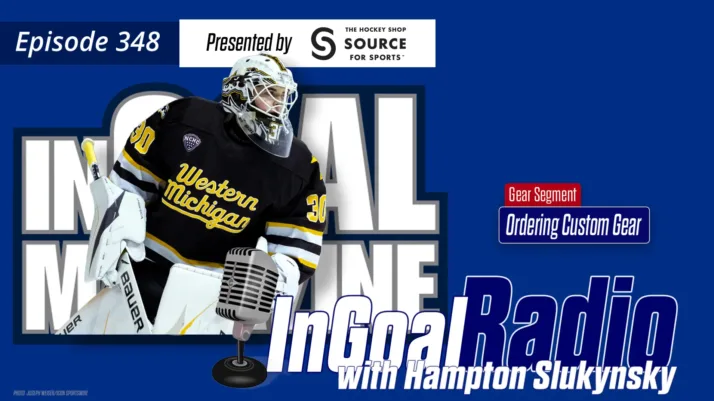
Episode 348: Los Angeles Kings prospect and 2025 NCAA champion Hampton Slukynsky
Please subscribe and leave a rating — it helps us reach more goalies!


Hampton Slukynsky developed without a dedicated goalie coach until reaching the USHL, relying on YouTube for technical instruction before that. He won a USHL championship as a rookie, a 2025 NCAA title with Western Michigan, and gold at the U18 Worlds, World Juniors, and World Championships alongside Jeremy Swayman and Joey Daccord before signing his entry-level deal with the Los Angeles Kings.
- Slukynsky had no dedicated goalie coach until the USHL, using YouTube videos as his primary technical resource during his early development in Minnesota.
- Winning the 2025 NCAA championship with Western Michigan did not prevent Slukynsky from turning pro early u2014 he signed his entry-level contract with the LA Kings one year after the title.
- Older brother Grant, a forward, played a significant role in Hampton's development path, including backyard rink sessions that shaped his early game.
- Slukynsky used NHL Sense Arena as part of his training and discusses specific ways the VR tool fits into a modern goalie's preparation routine.
- The Parent Playbook segment offers practical advice on finding diverse coaching voices and camps during the summer to accelerate goaltender development.
Episode 348 of the InGoal Radio Podcast, presented by The Hockey Shop Source for Sports, features freshly signed Los Angeles Kings prospect and 2025 NCAA champion Hampton Slukynsky.
Feature Interview
presented by NHL Sense Arena
In the feature interview presented by NHL Sense Arena, Slukynsky talks about the decision to leave Western Michigan one year after winning a national championship and sign his entry-level deal with the Kings alongside older brother Grant, a forward who has been a big part of his path. Slukynsky shares insights and stories from his unique development route, from backyard rink sessions with his brother and older friends in Minnesota, to relying on YouTube for coaching until he got to the USHL, where he also won a championship as a rookie while having a goalie coach for the first time. He also talks winning gold at the under-18 world Championships, under-20 World Junior Championships and World Championships alongside Jeremy Swayman and fellow NHL Sense Arena user (we get into how he uses it) Joey Daccord. In the Parent Playbook, presented by Stop it Goaltending U the App, we talk about the best ways to find growth opportunities this summer with different coaching voices and camps.
Parent Segment
presented by Stop It Goaltending U
In the Parent Segment, presented by Stop it Goaltending U the App, we look at how to find the right goalie coach or camp this summer.
Pro Reads
presented by Vizual EdgeWe also review this week’s Pro Reads, presented by Vizual Edge, featuring Casey DeSmith of the Dallas Stars with a great breakdown on how to manage plays when you feel behind laterally. And in
Weekly Gear Segment
presented by The Hockey Shop Source for SportsIn our weekly gear segment, we head to The Hockey Shop Source for Sports, for a look at they steps required to go from designing your dream gear on one of the many recently launched customizers, to making sure it fits your body and your game, and placing that custom order.
Episode Transcript
Intro
On episode dedicated to Kevin Woodley. It's InGoal Radio Podcast brought to you by The Hockey Shop Source for Sports Langley, thehockeyshop.com. Got the chance to catch up with our good friend Cam Matwiv, just recently at a Vegas Golden Knights game. We'll get into that in just a little bit.
Nothing really intriguing about it, but I love, hanging out with, Cam. But before we get into it, David Hutchison, do you know how high highly regarded we should hold Kevin Woodley?
Changed my life so very high.
I'm in suspense here.
I wanna know where this is going. Me too.
Vegas plays Vancouver, Rogers Arena, and postgame, Woodley asked a question to Torts about
Oh, that's right. Carter Hart.
And Torts comes back with, well, you played the position, like, middle of the scrum. So I come come on in our postgame show and say to explain it like that. That's nhl.com's Kevin Woodley, also the cofounder of InGoal Mag.
Oh, nice plug there, and I didn't realize that. Attaboy. Thank you.
I did everything but wear the hat.
It didn't
match the
suit. Attaboy. Attaboy. I like
But Tortz is is looking at you going, well, you played the position.
Caught me off guard.
Pretty
cool. Yeah. It was it was kinda neat. It caught me off guard. A, that like, he was only here for a year as he pointed out in earlier scrum the day before, and didn't actually spend that much time in Vancouver.
Shout out Point Roberts. But he, yeah. I guess he remembers or knew that I actually played a little, and I almost spat back, you know, not at this level. But, yeah, it was cool. Neat moment.
I put put a smile on my face.
You got a lot done around the goal then I'd stop.
Yeah. It was it was good. Caught up with Sean Burke, caught up with Carter a little bit, caught up with Aiden Hill. You know, it was not often. This has been such a grind of a season. We do not get a lot of practice days. And so they came in. They had two days off. They had a practice day. Got to watch a practice, watch a bunch of drills. It was good. It was good.
And you talked to Carter Hart about the goggles?
Which you guys profiled on the I didn't realize that, obviously, I'm familiar with the TracOptic goggles, and you were gonna, highlight them on the show.
Yeah. Ashley Vizs did that on the, on the broadcast.
Yeah. And so she was when we went into the room, I went and catch up with him, and she had some questions about it. And she and very politely was like, hey. Let me I'll get, like, get get her questions out of the way so we could chat. And I'm like, oh, I want in on this because actually I wanted he's actually wear like, I watched it the next morning, game day skate.
He actually wears them out for the hands drills that goalies do in the warm up. And so he was explaining that, you know, we've we've heard a swivel vision blocks off the peripheral. This actually blocks off the bottom vision, in a way that creates what you would call binocular vision. They're a product of Lyle Mast. They're called Track Optics.
I think they're gonna be at retail pretty soon. And he explained them in that environment, and then we talked a little bit more about them. And and I think to me, the one real eye opener
No pun intended.
Oh, that's good. Yeah. If I was Hutch, we would know I was intending the pun. But was him talking about his use of it off the ice, coming off the injury, and that he started using it in sort of not just his training, but just sort of, like, alpha, I say, activities in general heading into going back on. He missed three months.
He couldn't believe how good his edges felt under him. And he was surprised by it. And he thinks it's the goggles because they kind of set up your proprioception balance and a lot of sort of your vestibular. Like, it's not just about tracking. It's about how you move your head and how your body reacts to it.
And he felt like getting back on the ice, he was dialed and he credited to the goggles. And so, you know, I mean, we can have placebo effects for sure when you're trying something new, he's obviously a big enough fan that he takes them out there just like Kevin Woodley does much to the mocking of the guys on the ice at his Monday night hockey skate and stops warm up pucks with him on. So that was I thought that was really interesting to see.
Hold on. You do it on your Monday night skate?
Oh, and I get chirped relentlessly. But just no. I don't wear them for the game. I just go out there for warm up and just help sort of set your yeah. Because I as if, like, having my eyes closed isn't enough.
The goggles won't help if your eyes are closed. That's for sure. Hey. I watched our good friend James Wendland who also does work with the goggles and and we've even got some articles up at ingoalmag.com with him doing that. I think it was with Kristen Campbell. I've seen him advise guys to actually put them on the moment you get out of bed just for that first little part of the morning, for exactly what you were talking about there, Kevin, setting your vision basically for the day and setting those visual habits. He actually saw that in many ways, if I understand you correctly, James, as as more important than anything else.
Because it's not just it's not even just the vision habits. It's sort of like the way it ties to vestibular, the way your gaze is pointed and the way your body reacts based off of that. There's actually some research going on right now with this in terms of even concussion recovery and making it part of the protocol. So a lot of this is sort of in the works, not necessarily firmed up. But in addition to Carter sort of going public with it and wearing it so visually, like, you know, ask Devin Cooley.
He'll tell you the same thing. Cooley, Dustin Wolf uses it in Calgary. I think the guys in Carolina, for sure, I know Freddie Andersen uses them. The guys in Washington, I've talked to Charlie Lindgren. I've talked to Logan Thompson a little bit since he got there.
They're using it there. So, this is kind of one of those things that I I when I get chirped as I pull them on on Monday night hockey, it's, oh, hey. Like, there's some guys using this in the show and and kinda like reminds me a little bit of NHL Sense Arena in terms of, you know, it once you see a guy actually in the NHL with these on as part of his warm up routine, it feels a little bit like, hey. It's okay. I can do this too.
Distibular. Just put that in plain language for people.
The way your balance is it's basically your body's balance and and the function of your head and how your body reacts into achieve balance based on where your head is positioned.
And these goggles are not just peripheral and it takes away the the bottom part of your vision?
Yeah. Which isn't like, if you think about what you're trying to achieve is center of socket or what they call binocular vision. And I'm listen, I don't have all the science. Like, this is sort of layman's secondhand.
You're doing a pretty good job.
And it just sort of forces in the case of hockey and trying to watch a puck, it forces a little like, I think it's three degree down head tilt, which is what you want. If our heads up, our body thinks we're falling backwards. And so it wants to counterbalance. So if our head is up, pointed up and our eyes are looking through the bottom, like your brain thinks you're falling backwards. So if you're on a butterfly, for example, it's gonna wanna narrow that butterfly to counteract that balance.
And you end up with a lot of counter rotation and movement, and that's your body trying to move things one way to balance everything the other way. And it ties into you can try and train the crap out of it and train your body to move a certain way. But if you put your head up east west over your shoulder with your chin, your body's naturally going to want to counteract that by counter rotating the other way. And so a lot of this stuff in goalie terms keeps that head down in a way that forces what I would call my phrase. I use top down rotation.
So the head goes first in a way that pulls the shoulders with it rather than them wanting to go in the other direction. And then listen. Like, a lot of this stuff is taught on a more common basis now. But you go back even five years ago and watch NHL goalies play games and watch how much counter rotation and coming off pucks there is. It's go back ten years, it's remarkable.
And so the emergence of this as a thought process towards movement and save execution, I think, has been, you know, a big part of it. I've had goalie coaches that at the NHL level talk about it being game changing is too strong a word, but a massive change in how they coach and approach.
I've been thinking it would help with puck tracking. Like, that was my first instinct.
Yeah. I I mean, that that's that's the prime that's what most people think of.
For sure
it does.
But we haven't even mentioned that part. But
I get see, and that's the obvious one. Maybe I get caught up in the other stuff because it is about more than just puck tracking. Sure. Getting your head in that position and and having all those balance elements will help you move into pucks rather than pull off of them or away from them. They should know, whether they help you react better, different things like that.
But there's so much more to it than just watching the puck and puck tracking, even if that's what Carter primarily uses it to reset in those early shots.
And are these goggles on the market yet, or they're coming to market?
They're not. So K. I have a set. No. They should be soon, though.
I don't know when, but I do believe they they hopefully hit the market this summer.
Biggest challenge with them is getting the mask on. You have to undo, both straps sometimes, pull it over, do it back up, because you can't just slip the mask on like you normally do. I can. Because the goggles get caught inside.
I can a little bit. I've got I figured out a way. I'll teach you, Daren. We'll get you a set, and I'll teach you how to do it. Maybe you can teach Carter because I saw he had to unstrap the bottom straps.
There's a way to do it. Really?
Yeah. I'm I'm I'm curious.
I'm I'm I'm tricky like that.
Hey. You know all the scoop side, don't you? I was gonna get to the, multiple goaltenders in the playoffs. Well, let's save that for next week because we'll go into the Stanley Cup play as well, the better idea of who's in and who's out, right now. If there's a bit of, fluidity, to the Stanley Cup playoff races in the National Hockey League right now.
We've got our Gear Segment, coming up, with Cam over at the Hockey Shop Source for Sports Langley.
Oh, it's that time of year. Right? Like, all the new stuff is coming out. You know, we've got launches pending. You all you've all seen it.
You know, you've seen the new Bauer line. You've seen the new CCM with the launch of Tacks. We've talked and gone over the complete sort of overview of what's coming from Warrior with the new Alpha Surge. The customizers are live. But how do you order it?
That's what we're gonna talk to Cam about. But first, a reminder that when all this new gear comes, poor Cameron has to get rid of a whole bunch of old gear. And the sales continue as he tries to clear space ahead of some launches at the end of this month in April. That's when two of the primary launches are, and he's gotta get stuff off the shelf. So make sure you check out the Hockey Shop Source for Sports, the hockeyshop.com for sales on past products and releases on upcoming products.
Our reviews, they do overviews. It's all available on the website. And if you've got questions about, hey, the customizers are live, that means I can order the gear, but I'm not sure about sizing. I'm not sure about, hey, I did my whole design. Now what do I do?
Cam's gonna explain that right now.
Got a little bit of a how to theme this week on The Hockey Shop, as we head over to, The Hockey Shop Source for Sports Langley, thehockeyshop.com.
Gear
Welcome back to the Hockey Shop Source for Sports. I'm here with Cam Matwiv. And, Cam, it's that awkward time of year where there are a lot of customizers out, but the gear is not available at retail. So I can go design my sets. I can order my set, and I wanna order them from you because I trust The Hockey Shop Source for Sports will help me get it right.
But walk me through the process between me designing it on the customizer and me placing an order. We've got Warrior, we've got CCM Tacks, we've got Bauer's new line, all sort of up for the customizer, but not necessarily for sale at retail. Maybe there's some differences. Maybe it's the same, but what would be the first step towards taking the next step getting me into that gear ahead of everyone else?
Well, first step is obviously getting in contact. That's a great place to start. So we start that communication process. So either, like, calling the store or reaching out to us via email. So it's super easy.
Even just sales at thehockeyshop.com for those that are ready to rock and roll right now.
Do I get to talk to you?
You possibly can. It would be probably myself or for Andrew that you would talk to, and we would walk you kinda through the next steps. So what would next step be one? Okay. I'm interested in a custom set.
My response immediately would be like, well, what brand are you interested in? So let's say let's for the ease of, kind of this segment, let's say you're focused on Bauer first. So you're wanting to do a new Bauer few set, Kevin. Is that correct?
Actually, I want a new CCM Tacks set, but I'll let you build me a Bauer one, Cam.
Okay. We can build a CCM one set after if you want. That's easy.
So what are the key questions?
So key questions for starting out ones. One, have you already made a custom mock up? Two, are you familiar with the pad? Have you worn Bauer in the past? Are you changing size, changing specs?
You know, if all of those answers are yes, okay, there's a further deep dive. If no, you you've already done this before. This is very simple. Basically, all I need is a reference code off of that Bauer customizer, and that's what I use to submit to the manufacturer. We take a deposit from you as well.
That gets our order placed, and the rest of the amount would be due once the gear actually physically shows up in store.
Okay. What if I've gone into the customizer, I've designed my beautiful, gorgeous, I am practically an interior designer look. I've gone through the specs. I've picked the size I used to use, but I haven't had a new set of pads in three years. How do I know that it's gonna fit the same?
My thirty four plus two from three years ago is still a thirty four plus two sitting on my skate now because I know there's a lot of changes from year to year.
Yes. So now there's a further bracket branch from here on out. Now so are you guys close to the store? Are you close to the store, Kevin? Can you come in for a personal fit?
I can. I like being at the store, but what if I can't?
Great. So, ideally, again, if you can come into the that's perfect because then we can go through. We also have
Let let me ask you that. If we we're gonna do it in person, do I just come in and strap the pads on, or do you have me, like, get outfitted? Am I get to play dress up?
You would get to play dress up, Ascension. So, yes, if you were to come into the store, ideally, what
I would
have you in is skates, knee pads, and pants. At a bare minimum, I can do it with just skates and just your legs. That's totally fine. I mean, obviously, we've got a selection, so I can grab stuff off the wall at any time to be able to use in terms of our fitting process. If you are unable to make it to the store, what I usually riddle back to you, the consumer, would be, you know, what are you currently wearing?
What reference points can you give me for sizing, your floor to knee, your ankle to knee, depending on the company, you know, your previous history in pads, you know, any potential injuries that are preventing you from flaring, things like that, you know, different goals that you want out of the pad. I want my pad to rotate here in this certain situation. You know, I want my pad to have a better seal up on the toe on the post so I can get a better reverse VH, things like that, would be all those questions that I would ask her. The basic of that question, though, is always the soft versus stiff conversation. You know, how I want that pad to feel on my leg per se and that playability.
And then from there, it's usually branching out. It's like, okay. How can I now best fit the specs of what you've chosen to you as a personal goal?
So the new line for Bauer is Fuse. It's the latest in their supreme line. Have you checked to see whether a 34 at the knee is gonna fit the same as the previous generation of supreme?
So that is correct. So shadow versus a fuse is still giving me the same correct size.
CCM, have you tried that with a tax versus an AXIS XF?
So at the moment, no, because we're still waiting on some of our tax sets to show up. Inventory. To my understanding, it will still be the same.
Okay. So these are important questions to ask, folks. It's not just about designing your pads and clicking order. You wanna make sure they're going to fit and work for you. Any other new features that guys and girls need to be aware of when ordering?
Let's say, alpha surge. That's a very unique new pad. Is that a tough one to order ahead of time? Are there things you gotta be aware of, fit, and feel?
Yeah. There are this is one of those things that does come with, like, sight unseen. You're always at a disadvantage blindly ordering, to coin a term. Ideally, if you can get something in your hands, it can be walked through quite easily of, like, why, the what, the how, for example. So sighting a Warrior pad.
If you're familiar with Warrior in the past, yes, I can walk you through an order, you know, potentially remotely very easily. If you haven't worn a Warrior pad before, this is a bit of a harder one to nail kind of sight unseen. There are certain
You need to get in store.
Exactly. And to get fitted is important because even now that the Alpha Surge doesn't fit like the g seven. Slider boot. Not a comparable in size. However, you can order the Alpha Surge with a steeper boot so that it would get a little bit closer.
But, again, those are all conversations that kinda need to be had based off of your specific style.
So it sounds to me like all the fun I've had over the Easter long weekend on all these different customizers designing all these different looks is really just the starting point. I made them real pretty, but I need you to help me make them fit and work.
Exactly. That's what we call the secret sauce, Kevin.
The secret sauce in Cam. If I've got questions and I need to access the secret sauce before I place my order, where can I get ahold of you?
(604) 589-8299 or 1805677790, or just toss those off an email. Super easy. Just sales@thehockeyshop.com.
Perfect. Okay, folks. There you go. All jokes aside about me not wanting to spend more time with Cam. If you can get in, that's the best way to make sure your new order is gonna fit, not just your leg, but your game.
But if you can't, you've heard him talk about gear over the years. It's not just Cam. It's his whole crew. They're there to answer your questions. If you wanna get ahead of everyone else and order off the customizer before the new lines launch, we talked about Warrior Alpha Surge.
We talked about the new Bauer Fuse, CCM Tacks, a lot of changes in these pads. You wanna make sure it's dialed in and fit for your game? Check them out. Give them a call. Everybody there plays the position, knows the latest gear, and they know how it's gonna work for you.
That's why we call them the experts. They're here for us, and they're here for you. Cam, thanks for taking the time this week.
Thanks, Kevin.
Hey, Hutch. Do ever just go on and play with a customizer? Absolutely. I love how that they design a funky set.
Absolutely. I love how that they design a funky set.
Yeah. And how is the technology just of the customizers themselves progressed over the years? It's really, really exciting to be able to get those full 3D, views of what it is that you're designing. And, I love to design new gear, but it always becomes a family affair in our house too. We get everybody around the customizer together deciding which are the best ones or we ship designs around the family group chat. It's, it's a lot of fun to do together and get everybody's opinion on.
Frozen four is in Vegas right now. I watched Michigan practice at the team facility yesterday, and there's a great day set up there. One pad's yellow with blue and the other pad's blue with yellow.
Turco tribute.
Yeah. It was neat.
Jack Ivankovic, am I if I'm saying that right that right? Nashville Predators prospect. Heck of a goalie. Not that big, Daren. There's hope for all us like that.
Well, you played the position.
This is gonna become a thing, isn't it? Not well, Daren.
Not well. Vizual Edge ProReads, this week, with Casey DeSmith, but, tell us what's happening at Vizual Edge.
Well, basically, Vizual Edge is for everyone that wants the puck to look like a beach ball. We've all had those moments, those nights where you're on the ice and the puck looks huge. You're ahead of every play. You feel calm. You feel patient in total control.
Then there are the nights where you're half step late. You see it, but you don't really see it. You're reaching. You're guessing. You're fighting it.
It's not your technique. It's your eyes and your brain not processing the play fast enough. Vizual Edge fixes that. It measures how well your eyes track and process the game, then gives you a custom plan to train improvement. Three fifteen minute sessions a week on your laptop or tablet.
That's all it takes. It's what NHL goal is used to make the game slow down when it matters most. And, of course, remember, use the code InGoal, I n g o a l, all caps, to save 10%. But if you're a member of InGoal Premium, if you've got a subscription to InGoal Magazine, just go to any ProReads, including this week's featuring Casey DeSmith, and you get a code for double that discount. 20% off.
It's summertime. We're heading into the off season. No better time to train your eyes. No better way to do it than Vizual Edge. And if you've got a membership for InGoal, if you don't buy one, it will save you that much on you'll it'll pay itself back just on the Vizual Edge subscription.
Win win. Is that what we call it, Hutch?
That's how we like it around here. Rising tide floats all boats.
I don't I cover the Vancouver Canucks. Don't get a lot of wins.
Boat sinking.
I don't even get a lot of wins.
I love watching Casey DeSmith play.
Do you know what the irony here is? So does Hampton Slukynsky, our featured guest this week. He talks about it in the interview as a guy who's very self taught and just watched a lot of other goalies and tried to learn from them. Casey DeSmith was one of the guys that he singles out. And so no surprise that Casey DeSmith is a guy who thinks the game well, and he's been so good in this ProReads format again this week.
It's kind of a it's a play where he's late on. There's a two on one down low, and he's late. And he walks us through, you know, essentially, it's a double push. You might see a double push across the ice on a on a two on one pass down low, and you'd be like, oh, man. Like, looks that doesn't look all that clean.
But he walked us through the thought process. And if you watch the video and listen to him, there are keys that allow him to get across and make what I I think for a lot of goalies would have had to been a sprawling or spectacular save, but he gets there under control and makes it look, you know, on a point blank chance, I think Hutch is somewhat routine. And so he walks you through the keys to that in terms of the way he moves, some of the rotation keys, you know, just some of the various elements that allow him to turn a tough chance into a relatively easy save. It's a great breakdown. The third one we've had from Casey on the website at ingoalmag.com, and another example of the hundreds and hundreds of insights that you can get from watching our ProReads segments at ingoalmag.com.
More with Hutch coming up in the parent segment that is presented by Stop It Goal Tending U the App.
Twenty five years of NHL goalie experience at your fingertips. That's what you get with the Stop It Goaltending U app. Wanna tap into the goalie parenting expertise that helped Joey Daccord reach the NHL? Hey, Joey Daccord, another guy with ties to Hampton Slukynsky. That's what you get with a subscription to Stop It Goal Tending U the app.
All the knowledge from Brian Daccord has been an NHL goalie coach, scout, and director, including currently with the Detroit Red Wings, as well as all the insights and expertise from his staff at Stop It, which includes a long list of veteran NCAA goalie coaches, all delivered in easy to digest chunks, including five short daily primers, weekly style analysis, video breakdowns, and drills you can take onto the ice with your team and coach this summer. Plus, you get a subscription to InGoal Magazine premium included. That's right. Stop It Goaltending U, the app, includes a subscription to InGoal Magazine. So make sure you check it out now on the App Store or Google Play and get the best of both worlds when it comes to stopping pucks with a Stop It Goaltending U, the app subscription.
Parent Playbook
Hutch.
Spring's here, guys, and, that means there are goalie parents everywhere who are thinking about summer development for their kids, what they're gonna do this spring, maybe it's extra ice segments. Lots of reasons that people are looking for their next coach, and I wanted to talk a little bit about that today. Where do you start? How do you go about it? rnrnFor a lot of families, the answer is just in the group chat. They ask around other families with goalies in the area. Few names come up, and they have their list. And, honestly it's a good starting point, obviously. If your goalie's friends have worked with a coach and loved them, then that's worth paying attention to. A recommendation from somebody you trust and somebody that's actually experienced a coach carries real weight and that's important. But here's a thought. Why stop there? rnrnUse your network. Cast a wider net. If your buddies love their coach, great. Put them on the list. But summer is also the perfect time to add a new voice. Different coaches bring different strengths. Some are movement specialists. Some are elite at compete and battle drills. Some are exceptional at developing hockey sense and reading the game. Some really work well with younger goalies who need confidence as much as anything else. No single coach covers everything equally, and the goalies who develop the fastest, in my opinion, are usually the ones who've been exposed to more than one set of eyes over their career. Something that clicks with a new coach in July might just be the thing this year that unlocks a whole new level come September. Shameless plug is always around here.
Our coach directory is a great place to start your search. The InGoal Directory is live now. It's got coaches and programs across North America, actually a few worldwide as well, searchable by your location, Many other ways as well. And if you're not sure exactly what you're looking for, we now have AI powered search that can help. You just describe what your goalie needs in plain language and it'll surface the coaches and programs that match.
When something catches your eye, there's an inquiry button on every listing, and I encourage you to use it and reach out directly to the coaches. Ask about their approach, their ratio of coaches to goalies, what a typical session looks like, maybe the age and level they work best with, contact a few, several, see what those responses resonate with you, whose philosophy fits where you think your goalie is right now. The 2026 Coaches and Camp Guide is also coming very soon. Lots of fresh editorial content that you and your goalie can learn from in a magazine style format. It will also have lots of great listings to help you pick out a coach you might like to work with.
One more thing worth saying, guys, if your goalie does exactly what every other goalie in your area does every summer, they'll develop alongside those goalies, and that might be fine. But if you want an edge, a different perspective, a specialized focus, a program that nobody else in your group has tried, it's out there, and our directory is a great place to start looking. Your goalie's got one development window. Make the most of it today. Any thoughts?
Anybody you like working with? Let us know at parents@ingoalmag.com.
We should get on that, Woody.
We should be
A goalie camp for you.
Think we're planning our summers right now.
That's how we met because Daren went to Eli Wilson's camp.
You're right.
[crosstalk] And I was helping Eli out a little bit and The puck handling camp. InGoal, and so I reached out to Daren and we started a conversation. Yeah.
Like that. That was in Brampton. Yeah. That's where the, the Brampton Steelheads play now.
That's right. Great.
Well, if you guys if you guys if you guys want it want, there's, I got I got a note about the watch the puck old timers goalie camp in Rochester, New York. It's supposed to be an absolute beauty July this year.
Oh, I'd love to have
you there. Sells out, and there's usually a waiting list. But, you know, maybe we could maybe we could flex our InGoal muscle and and and get a spot on the bench as the backup.
Wouldn't that be a hoot?
Bring a towel? Backup towel? I could just, you know, squirt water in your mouth while you between reps.
With ambition. I wanna be a back goalie at a camp.
Well, he played the game.
He played the game here, Hutch.
When your kids in those nets get hurt, just call me. I'll get over there for a couple of reps.
Talking about, over in, that neck of the country, Western Michigan, great, couple of years, with Hampton Slukynsky, manning the net, there, but, he's, managed to turn pro, signed his entry level contract with the Los Angeles Kings in the subject of the Santorino feature interview this week.
Yeah. It's a great one. Really enjoyed our time. Thanks you to the Ontario reign for facilitating it. We continue our Kings theme.
We had Mike Buckley on last week. We've got Hampton on this week, and I'm catching up with Adam Brown, who's the goalie coach of the Ontario rain later today for a future episode. So, good goalie organization. They keep, you know, Billy Ranford at the head of the department. They keep producing and finding great goalies.
And, boy, I can't wait for everyone to hear this interview. A really unique story from Warroad, Minnesota playing on the backdoor backyard rink, signed his pro contract at the same time as his older brother Grant, who's a forward. So you can imagine how that origin story goes as he explains to us. Sense Arena user has won at every level and get this, did not have a goalie coach until playing junior in the USHL. Self taught YouTube.
I'm gonna let Hampton take it away and explain the rest.
No, you're not. Because I might jump in first. Woody loves to talk so much.
Oh, such a good That was such a good intro too. Damn it.
Well, I you could try again after this. You get yet another chance to talk when I'm done, Woody. But first, we need to talk about NHL Sensorino, which is fun and serious. Real goalies doing real mindset work. If you followed Sense Arena over the past few years, you're gonna know the ARC.
It launched as a goalie training tool in 2018. It picked up by some NHL teams and goalies. It was rebranded in 2023 as NHL Sense Arena with team logos, uniforms. The latest step is the biggest yet. NHL Sense Arena '26 is now licensed by both the NHL and the NHL PA, the first and only VR hockey platform to carry both badges, and that second partnership changes what's possible.
Real likenesses, real movement patterns built from the players who are actually stopping pucks at the highest level right now. That's a different kind of training rep. But the recent addition that caught our attention is the Pete Fry goalie mindset module. Pete, who we've worked closely with almost as long as InGoal has been around, has built an integrated mindset training experience inside the platform, and it's worth paying attention to how it's structured. This isn't a motivational video tucked into a menu.
It's a guided pregame routine built around visualization and identity based affirmations delivered in VR where you're already isolated from distraction and physically present in a hockey world. The logic sound, the hardest thing about putting on putting a goalie in a VR headset for mental prep work has always been the gap between the content and the context. Watching a visualization video on your phone in the locker room is one thing. Doing it inside the same immersive environment where you're about to face NHL caliber shots is another. This module works through that problem by meeting goalies where they are already in the platform.
It's designed for every level, minor hockey through pro, and you can use that same tool that NHL goalies use today. The Pete Fry module is available inside goalie development. If mental performance is already part of how you or your goalie prepares, and it should be, this is worth a look. Check it out today. Sensearena.com.
And as always, use the code I g m 50 to save even more.
Okay. So now I gotta follow-up with another introduction. Let me just say that Hampton Slukynsky is gonna talk about how he uses NHL Sense Arena as part of this fantastic interview, not because of me, because of him. He was so good. I think everybody's gonna love it.
Conversation of two guys that played the position.
Really excited to welcome to the InGoal Radio Podcast. First time guest, but I as I understand it, he's listened to a few over the years. Recently signed with the Los Angeles Kings, Hampton Slukynsky. First off, congratulations on the contract.
Yeah. Thank you. Yeah. And thanks for having me. I'm pumped to pumped to be a part of the podcast.
What's that thought like, walk me through the process. The thought process of, hey. College ends. You've been there for two years. You already won a national championship at Western Michigan.
That decision to turn pro, both signed with the Kings and then AHL, I I think it's like an ATO they get you on to to get down there and get some experience this year.
Yeah. Just finished up my second year at Western and, you know, I thought, you know, I had a good year, a really good fresh man year and I just thought we won the national championship last year and I learned so much this year playing every minute for our team and being a full time starter. Just thought that I'm ready for the next step. When the Kings offered to sign me, definitely to think about it a little bit, but it was I'm pretty happy with the decision I made so far. I'm fortunate to be up with the rain right now.
Just got here a couple of days ago and everybody's been treating me so well and first class organization and it's been great so far and yeah, I'm loving it.
What does it mean? And I know you've probably gotten this question lot of times over the years, but everybody sees that you signed at the same time as your brother. What does that mean to you?
Yeah, it's cool. A lot of people don't know like he's three years older than me. So the first time we played together was was last year at Western Michigan. So we played two years there together, and then we were both fortunate to sign here. So go just going through everything, you know, both going to to Western at the same time and just going learning everything, you know, going through it all together has been really cool and, you know, same thing coming here.
Just having someone to to kinda it all with and and go through. It's been really cool and fun and and really cool for our family. And, you know, I'm sure that'll continue here in the next year or so. I'm just, you know, going through it all, highs and lows, and just everything has has been really special.
Okay. So if you've listened to the podcast before, quite often I go back to origin stories and I'm guessing with an older brother, how you ended up a goalie is probably self explanatory, but I got to ask it anyways.
Yeah, that's the classic story. So had a backyard rink, my dad would make it for us every year ever since my brother's been super young and he's three years older than me so he'd have his buddies over right and I can't keep up being so small so yeah they stuck me in the net and it kind of stuck ever since so that's how it started. Then I really like to play player. Really like to score goals, but I started playing full time goalie probably around seven or eight, which is pretty young. But yeah, just stuck from playing with my brother and his friends and yeah, I'm happy with that I chose this position.
Now you're from Warroad, Minnesota. So I think most of us know Warroad from the TJ Oishi's undergarment line. But I understand when you say backyard rink, you might be underselling it a little bit.
Yeah. It's pretty cool. It's board's probably two or three feet tall. Know, we got lights. We got ads on the boards, speakers for music.
So, yeah, we were spoiled. My, my dad would, you know, put a lot of work into that. Know, we have a lot of really cool memories and and fun memories out there of of playing with our buddies, and, you know, that's kinda where you just you develop the love for the game and just competing out there.
In terms of the process, like you said, he became a goalie 78, pretty pretty young. How much at what point did it become something where you started to add some of the technical elements that you'd be working on now as a pro and in college and in junior? And how much of it was just compete? Because we hear a lot about that need to sort of find the balance for young goaltenders. And, yeah, sometimes it can get a little too technical.
I'm guessing having a backyard rink where you just went out and played was a positive.
Oh, a 100%. Yeah. I never had a goalie coach growing up, so the first time I ever worked with a goalie coach full time was when I was in Fargo in the USHL when I was 18.
Wow.
I played honestly just for the fun of the game until I was 15 and then I was pretty good. I started to do some more research and a lot of YouTube videos and just learning from coaches online. I'm just taking whatever I can from NHL goalies, just watching them practice and just watching, like I said, coaches on YouTube. That was a lot of it. So just kind of on my own kind of, I guess, creating my own game, not really getting advice from someone specific.
So I think that helped me a lot because I was super raw and I still that still is a big part of my game just to compete and kind of the athleticism. So I think that helped me a lot even in, you know, playing now in college in the American League that just being super athletic and what and I kind of developed from not having a a goalie coach. But, yeah, that's that's kind of how that that went.
You said '18 Fargo? Like, sorry, Fargo 15, your first goalie coach?
Yeah. So I I never had a goalie coach till never well, I still have never had one, like, in this the only time I've worked with goalie coaches is Yeah. Teams I've So I never had one up till I was 18 when I was when I was in Fargo. Yeah, just basically kinda not taught myself, but, you know, learned a lot just from from social media and YouTube and stuff like that.
We love to hear that. We we we should it would have been better if we had you on the InGoal subscription earlier on, and you could have said, I learned everything from but we'll get there. The who'd you look for? Like, who'd you look at? Or did you have a favorite guy that you tried to emulate?
I mean, that's a fascinating process, Hampton.
Yeah. So not like not like anyone specific, I would say. I just I love watching the guys that are super athletic. So guys like Vasilevskiy, who's obviously, you know, probably the best to win the league. He's he's so fun to watch.
But also guys like even like Casey De Smith, like like, I'm six two, which, not you undersized, but De Smith a smaller guy and he moves so well. So just growing up watching, I was a smaller kid too, grew up really watching Saros and like I said, De Smith and those guys. I was fortunate to hit a growth spurt when I was, you know, around 16 or 17 to grow a little bit. But, yeah, just watching some of those smaller guys who move so well and are and are so athletic was was big for me.
Okay. Six foot two now. Is that that sound about right? So you you grew a little bit. I I'm guessing, like, is there a benefit to having sort of grown up playing undersized, the the need to sort of skate well and and have great edges and and be patient, and now you've got a little more square footage to work with?
Yeah. A 100%. I think, that kinda goes back to, like, just the competing and the the athleticism part. You know, it's always been a big part of my game, and, you know, part of that is because I was undersized. So, you know, it's it definitely helps.
It's, you know, kinda just a benefit to have now that, you know, I'm a little bigger, take up a little more more room, but still have that, kind of aspect of my game. And, yeah, it helps so much.
Was there anything else you would do to as as you're sort of evolving and learning? Like, you talked about YouTube. You talked about watching other guys. You mentioned watching NHL guys at practice even. Do you have opportunities to to see NHL practices?
Not live. I'm from a small town Warren, Minnesota. It's six hours from the wild or two hours from the jets, so there's not too many professional or NHL teams around. Not too much in person, but like I said, just on YouTube. I really like to watch the NHL goalie warmup videos and just take a lot from that.
Really enjoyed that and always have learned a lot from that too. I had a skills pitching machine that used probably when I was around 14 years old. Would I'd go down in my basement and and use that, put it probably twenty, thirty feet in front of me and, the little yellow foam balls. I don't know if you you know about that. But
I gotta be honest. We had an article on that right around the pandemic, and so it sounds like you were ahead of the curve on that. But I think it was around the pandemic, and we had guys like Jeremy Swaiman actually go out. And I remember Dustin Wolf reaching out to us and saying, hey. Like, is this legit?
Can you use this? And absolutely, they went out and bought the same machine you're talking about.
Yeah. I really like to use it off the ice. I just get down on my knees and basically the butterfly and glove and blocker, like I said, put a twenty, thirty feet in front of me and just let it fire. I thought it was really good off ice. I never used it on ice.
I didn't want to be chasing the balls all around, but yeah, it was really good. Like you said, that was kind of during COVID too, so that just helped keep my eyes sharp. You know, that was something I would do every day probably from my, you know, tenth grade to twelfth grade year in high school and thought it helped a lot.
I think I think Wolf, he added a slide board underneath it, he'd move around in sliding as the rhythm of the balls was coming at him as well. I love that. I sounds like a real no stone unturned guy. Any other things that, you know, tools that you've used over the years, whether it's vision training or anything that sorta little cues that might help somebody else who doesn't have a goalie coach, doesn't have somebody else guiding their development to sort of follow that path?
Yeah. Not much. Up until this past summer, started using Sense Arena. Okay. I'd heard I'd heard a lot about it, so I decided to give it a try and I like it a lot.
It's something I was using in the summer you know, almost every day, you know, because you're not you're not skating every day in the summer and facing shots. So just to keep the eye sharp and continue just to to develop that part of your game. You know, it's really cool. You can, you know, simulate a game situation in it. You know, you can do anything from just point blank, you know, guys ripping it at you to just some standard tracking exercises.
So, you know, I like that a lot and definitely something I'm gonna continue to use.
Have you was that introduced to We know the Kings are an organization that was one of the early develop or early adopters for NHL sensor. Is that something you learned from maybe going to camp or just you'd heard about it and wanted to try it out yourself? I'm curious too, you mentioned some of the ways you use it. What do you like? What are some of the drills you love most?
Yeah. So I just heard about it. I'd heard about it for a couple of years. Just had never got around to purchase headset and the subscription but once I did that I'm glad I did and something like I said I'll continue to use. And I like a lot of the kind of lateral stuff so it's a little different.
You're not key pushing but it's kind of a shuffle but like kind of the three on one or kind of the three on all the high low kind of rotations I like to incorporate. Then just kind of when I'm starting just kind of the simple, the cannon, the tracking at the start of like that just to get the eyes going. But yeah, there's there's a lot of different modes and and, you know, things I've kind of played around with, but something I'll definitely explore more this, this summer.
Well, I'm I'm the one thing about pro hockey that at least from the guys that come into it for the first time in the past have told me, traffic is about to hit another level for you in this game, and that that's another tool that I've heard guys like because it's tough to get in practice. Right? Tough to find the right reps for traffic in practice, but they've got a great job where you can sort of be looking around bodies and trying to find pucks off the release. So Yeah. Lots to come in the American League too, I'm sure.
Yeah. And I'll I'll add some on that. Like, I, you know, I've practiced with the rain now, you know, two optional morning skates in one practice, and that was something that, you know, caught my eye that, you know, I've been, you know, telling my parents and stuff that's just been different is that the traffic, Like in college guys are big, but it's nothing like here. Almost everyone's massive and super hard to see around. That was something that definitely caught my eye in the first practice.
Then just the the details too of the the tips. Right? Like, these guys are so so dialed in that, you know, some things you might be able to get get away with in college. You know? You don't think you can hear me.
Obviously, you haven't played a game yet, but just, you know, experiencing practice. There's there's, just everything so much more detailed here at the pro level.
Yeah. I'm gonna say any advice you and from our our good friend Adam Brown yet about how to manage some of those tips in traffic? Because it like, it's it's a little bit of an art, like, the feel for when to, you know, when to shift off short side, middle, things like that, but there's also some technique to it in terms of how best to manage some of those sight lines and lanes.
Yeah, for sure. I mean, something I struggle or have struggled with and still continue to do is just kind of getting too wide sometimes. Just really staying narrow in traffic and that helps so much just being able to switch sides to the screens because, you know, if you get too wide, you get stuck and you can't move. So just, yeah, just really kind of emphasizing that that staying narrow and keeping my feet under me allows me to to keep eyes on that puck while still being able to move in and that's helped a lot.
Okay. I I didn't ask you. We you talked about your development path and and the unique nature of it. How would you describe your game now? Like, what what do you see as the strengths of it and how it's evolved, you know, even over the last couple of years in college?
Yeah. So I would say ever since, you know, around 16 or 17 when I really started to kind of work on my skating and stuff like that and then starting to work in with coaches around 18, become a lot more technical. You know, I think my skating is a big part of my game. That's something that's really improved over the last couple of years and along with my athleticism. So would I would say just pretty athletic, you know, good skater.
You know, there's times I can get too aggressive. So I think just working on staying calm and poised is something that that just needs to continue to develop. But, you know, I like where my game is at. Just looking forward to continue to work here with the the Kings development staff, and, you know, they've they've done a great job here with what I've been working with them the last couple years. So I'm just looking forward to to continue with that.
Now were you able and I apologize for not knowing in advance. Were you able to attend the development camp? I know the rules around NCAA can be a little bit depending on the timing. And and also, I know you went to a world championship, you were busy for a summer there. Were you and and then obviously a run to an NCAA championship.
Have you been able to attend and sort of get familiar with their staff and what they do?
Yeah. I was drafted in 2023 and I've been fortunate enough to go to the '23, '24 and '25 camps. I've been to three of them so far. I'm pretty familiar with the people around the organization, which is nice coming here. Yeah.
So now this is kind of the first real time that we're just having some, you know, good amount of time with these guys and and really honing in on the details.
And so I guess you've learned, like, that there's some some different things that they some different tools they give you, like the sort of left shoulder view behind the net on some of those different post plays, things we've worked on with Bill, at InGoal as well and and showcased over the years. Have you learned some of that stuff and been able to add it?
Yeah. So that left shoulder dominant, that was something that, you know, they they talk about every year at camp. And I think last year, I used to kind of do the double seal skates on, I'm pretty flexible, it's not too tough on my body, but I was getting a little bit of pain just in my knee. I kind of switched to that left shoulder dominant and I've had zero pain and it's helped a lot. Simplifies the game as having a system because if you're in that double seal, you're looking, your head switching ways.
Just having that kind of anchor on your blocker side post just makes it a lot easier knowing the puck's behind the net, just get to that post, find it, and then shift to your glove side if you need to or just stay in and wait for it to come off the blocker side. So that is something that I was a little hesitant at first. It's something really new, but as I've gotten more used to it, I like it a lot and Definitely will continue to use it.
It's funny because the double seal, like, I I I mean, first off, my hips hurt just hearing you talk about it. And second off, I'm jealous that you can actually get a skate on each post and do it. But and and it's a nice home base. Right? Like, you you know nothing's beating you along the ice when you're in it, but there is a wear and tear standpoint to it.
Yeah. And I think just, like, it's so it's so, like, for me, it's just being comfortable, and it was a habit. So I'm just trying trying to get out of it still, but, you know, I thought I think I've done a pretty good job of of getting used to that, the left shoulder dominant.
Okay. So you have won at so many levels. USHL, with the Clark Cup with Fargo. Obviously, NCAA championship. You've been a part of u eighteen world junior, and you were part of a world championship victory for USA last year.
Lessons that you can pass along to young kids about big moments, pressure moments, and how to be your best in those moments, things you've learned about yourself along the way.
Yeah. I think in just in those big games, it's, you know, it's easy to to kinda make it bigger than it is. It's still just a you it's kind of a classic cliche, but just it's it's another game. It's, you know, it's still the game you've been playing all season. You know, just sixty minutes.
You know, obviously, you're gonna be playing a really good team, so, you know, it might be a tougher game. But, yeah, just going out there, you know, making sure you you stick to your routine and and things that you know that that work for you and just treating it like a a normal game like it is. You know, that that's helped me kind of with the nerves and the, you know, some of the expectations or, I guess, you could say, in those big games.
Has that is that something you learned over the years going through all those big games, or did it kinda come always come natural to you?
Yeah. I think I think it kinda came natural. I think, you know, I was pretty fortunate to play in some big games growing up. Like, I've, you know, I was able to win a PWE and Banner state championship, which obviously is not you know, it's youth hockey. It's it's big in the moment, but looking back on it, it's, you know, it's it's just youth hockey.
But But
you're still dealing with pressure. You're still learning
how to manage. So so growing up, I think it was just kinda part of me. It's something that I was used to and and just kind of expected to to be in those games and playing in those moments, and it's kinda translated to this level. And, you know, I think, you know, that helps me now.
Okay. So, like, is there a memory that stands out amongst all those? Like like I said, you've been a part of a lot of championships at a very young age. Is there one that stands out above the others, or is there moments from each one that still stand out for you?
Yeah. I think there's moments. Right? Like, it's different. Like, the USHL is is a series, so it's a it's a best of five in the last couple rounds there.
So it's, you know, it's not win or go home in every game. You know? You You don't want to have a tough game, but you'd know that kind of in the back of your head, you have a tough game, you can rebound and win the next couple and still move on. I think those are a little different versus the NCAA last year where once you get to the tournament of the top 16, got to win four straight win it, and you can't really have an off off period or off game. Otherwise, you're going home.
They're different, but I would say just that NCAA run, just being able to play four really good games in in big moments and give my team a chance to win.
Is there any other than just treating it like another game, is there things you've learned along the way, that help you get to that? We've seen guys write messages on blockers or sticks, little things to bring them back, ground them, breathing techniques, anything like that, or are you is it just for you just going out and playing?
Yeah, no, those big moments that is something I'll come back to is just a couple of sayings and some things in my head, but something this year would really focus on was my breath. Doing some box breathing during TV timeouts, just four in, hold for four out, hold for four. And same thing with during like the national anthem, you know, when, you know, you might have some nerves and, you know, the hearts going. It's, those are some things, the breathing this year was something that I implemented that has helped a lot. Just keep me kinda, kinda calm and and, you know, ready to go.
But, yeah, just a couple reminders that, you know, I'll repeat in my head that that help keep me, level headed and and calm.
Nothing written down. You need to just like little mantras that you sort of bring you back. Think everybody says, oh, you gotta, like, maintain your focus. Like, nobody can focus for sixty minutes. It's about recognizing when it slips and things that you can bring you back to your foundation.
Yeah. A 100%. I mean, there's there's times during games where, you know, you get caught looking at the crowd or looking at the scoreboard, the time, the shots, stuff that, you know, doesn't doesn't really have a big effect on you making that the next save. So, yeah, just little mantras like you said that that bring you back and keep you keep you calm and keep you present.
What was your experience like at the world championships? I mean, I know the world juniors and u eighteens, you know, u n USNT DP, like, you've been a big part of the program. But to get to see you know, and I think it was it was Sway and and Joey that were there with you. Yep. Any memory, anythings you took away from that that might have been different?
Yeah. I think that was an unreal experience. Obviously, that was right after we won last year, so that was kind of a quick turnaround to go right there. But I was in Europe for a month with all those NHL players and obviously, were great to me. And I I learned so much from them just being around them and, you know, seeing the way they, you know, just treat everything, the little details of their games.
You know, some things you can get away with in college that you can't get away with in the pro level. Like I kinda talked about earlier, those little details that everything's gotta be know, in practice, everything's gotta be so dialed in because, you know, if it's not, it'll cost you in games. So just learning stuff like that from them and just little bits and bits and pieces that I, you know, took from from what they were saying and, just some of the stories they had were were really cool to hear.
I I I guess NHL sense Arena too. Joey probably would have had his headset with him.
Yeah. Yeah. He did. He was using it.
Is there anything like can you give me any examples? Like and if not, that's fine, but any, like, a little detail that you might have learned from a sway that you hadn't thought of before in the same way or moments as they got through to that high pressure, the gold medal game, and and the way those guys handled it. I mean, it been been a long time since The US won a a world championship. That was a big game. That was a big moment.
Yeah. I think just kinda hearing the not too many, like, details about, you know, kinda in game or high pressure situation, but just kinda learning about their careers. Right? Like, Decord was, you know, spent three years at Arizona State and just kinda learning about his process there and, how he felt ready and he just said to make sure that when you make that jump to pro you got to be ready because there's no kind of getting your feet wet it's go time once you sign. So just learning stuff like that was super important and something that I kind of took into consideration this year.
Yeah, like I said, just that was kind of the main thing, but just some more little details.
And you you would have been Thomas Spears, your goal effort. I was trying to rack my brain to remember who it was. And, course, it was another friend of the program, friend of the show, Thomas Spear. Any takeaways you had from working with him over there? Because like you said, you were there for a while and probably would have had more reps with him than anyone else.
Yeah. Yeah. So, obviously, I wasn't playing, I got to know him and spend a good amount of time with him just kinda, you know, trying some some new things in my game and just, you know, we kinda talk like I talked about earlier, how there's there's times where I'll get wide. So just, you know, we worked on just continuing to stay narrow because, you know, at this level, the play is so so fast and, know, you get stuck or wide, you're you're gonna be in trouble. So that was one thing we really focused on there and just not getting, you know, like I said, too wide and stuck in the ice.
That process, because we hear it a lot. You know? Like, that's a trend around the league, as you said, as the play becomes more east west and the offense becomes more east west, you have to be able to move. And the lower and wider you get, the harder it is to do. So we've we've heard a lot of guys talk about it.
The transition to sort of managing it as a goalie and sort of making it more habitual. What are some of the challenges to sort of keep your feet under you? Because sometimes, especially as you get taller, you know, being narrower, you can feel a long way from the ice. How did you sort of navigate that process?
Yeah, and that's something I'm still working on. I think it's just like, it's more comfortably wide. It's easier to kind of just be wide and go down a block. So just being able to be narrow and it just takes some getting used to. So just, you know, getting used to it and and making sure you're staying narrow and and staying on top of the pocket and tracking it.
You know, I think a big thing that comes with that is tracking, right? Because like I said, when you're wide, you kind of just fall and block. So when you stay narrow, you you know, you it's a lot easier to track it.
Sort of stay over top of it. Exactly. Okay. Love it. Love it.
Okay. Last one. Are you a gear guy?
Yeah. I would say not a big gear guy. Like, I like I like mine, you know, pretty simple. Good amount of weight, but, yeah, I I enjoy some some cool setups.
Okay. And and, like, you're a Bauer guy, if I'm not mistaken? Bauer. Yep. Okay.
So always been a Bauer guy or walk
me Yeah. I've
Like, are you are you like there's there's different levels. Right? There's guys that are just like, I know what I want. I know what I like, and I stick with it. Then there's, like, Ichiro Suzuki putting his bats in a humidor.
You know, like how much where do you fall on that scale of knowing your gear and knowing how it has to perform for you?
Yeah. I've I've always worn Bauer so it's just something I'm comfortable with and don't plan on switching. I've always been in the Bauer vapor line and you know, I really like it, so I'm definitely gonna continue with it.
Hey. Well said. Hampton, this has been awesome. I look forward to sort of following along and keeping up with you as the career progresses. Congratulations on the signing, and thank you so much for spending the time with us today.
Yeah. No problem. Thanks for having me.
Love this time of the year where you see guys at their college seasons are over and starting their professional careers.
It's mass like, I I think I think we overlook how important this is for a lot of guys, these last few games and getting into them. And Hampton, my understanding is will get into a game with Ontario here. I talked to him on a game day, so clearly he wasn't playing that night. Was gonna watch that first one with Adam Brown from from from the press box.
Tough decision, though, because some of these teams are in the middle of playoff races.
A 100%. A 100%. And, obviously, that's the priority. Also, some of these kids are damn good. But as you heard Hampton say, like, even the traffic even in practice was noticeably different.
And that's one of the biggest adjustments to pro hockey is the size, the intensity, and the purposefulness of net front traffic and how teams play off it so much. We saw that last night in the Vegas game, Daren. Like that, you know, a lot of people here in Vancouver, the goal on Nikita Tolopiol, the tying goal of Brad Braden McNabber. Was like, oh, it's like a shot from the top of the circle. He's gotta have that.
But just a brilliant flash screen by Thomas Hurdle that takes his eyes away right at the point of release and learning how to manage that. There's so much there. I do talk to a lot of guys, though, that when they have success the following season earlier in this in their early in their careers, and sometimes this is a late season call up to a struggling NHL team where you just get a game in, you know, your first taste of the NHL, and then it carries there's so much to be learned. Like, a lot of times guys will be like, oh, man. Like, I knew it, but I didn't know it till I experienced it.
And sort of getting to experience it kick started or changed the way I approached my off season. I came into this year so much more prepared because I had an understanding of how much harder it was. And so you're gonna see this around the leagues. We've got a bunch of them lined up that I'm hoping to talk to. Some of these guys who have signed late season and are hoping to get into games and hope to bring you those interviews over the coming weeks and their names that you're gonna see a lot in pro hockey right up to the NHL as early as next season.
I didn't know that you wore the goggles in your mentally warm up with your warm up stick.
First time that I wore them, I got chirped so hard, and then I played probably the best game I played in, like, ten years. And so the guys were like, okay. You're allowed to wear them in a warm up. I'm not pretending that they were the only reason, but I just had one of those nights. You know, the horseshoes were shoved so far up my butt, they couldn't fall out.
But, yeah, I've heard everything wearing them. It's like the guys will take a shot, skate by, and he is Batman. Stuff like that. But the best chirp ever was the most subtle. We're wrapping up warm up and Bob Rouse, who's got a couple of cups on his resume, just skates over and says, hey, kid, you got something on your face.
You might wanna take that off before we stop.
Do you ever think about playing in the in the actual scrimmage with them?
No. I mean, because they they're taking away your vision on purpose. Right? So when you take them off after a warm up, it feels you you like, you it feels like it just everything feels easier and
bigger. But think about the excuses you'd have.
Oh, dude. I got lots of excuses. You think I don't go in? Like, what do you think? We get all this gear testing.
I go in with a new excuse every day. Guys, I got this on today. Might not be that good. Guys, I'm old. Might not be that good.
Like, I I I am all about the excuses, Daren. I don't need to look like Batman to to have another.
You know, when you're using different pads all the time, it's a little challenging trying to find the right fit. I had to do up the straps, how tight, how loose, all that?
That's part of the that's part of the process. Like like, I mean, we're we're waiting on, and we should be here real soon, our Warrior Alpha search set. And, like, there are so many unique elements to how you strap that pad. You know, I've got a few skates booked, at different lower levels than the ones I talk about on here so that I have a little wiggle room to play with strapping and get comfortable with them. And and, yeah, it's absolutely not easy to do.
And and but that's the whole point of our reviews is we've got a bunch of these ready to launch is to be able to tell people how it fits and feels before they go out and shell out $3,000 for a set of pads. Give them an idea like, hey, this is this shape is going to feel this way in your leg. This boot flex is going to interact this way with your with your skates. You know, the that's that's what the that's what our our reviews are all about. Trying we suffer, folks.
We suffer. Well, and the biggest problem is don't have to.
Yeah. The biggest problem is not figuring out how they fit, Daren. It's trying to play a game of hockey where your friends would like you to stop a few pucks and going through the back of your mind is, Oh, should this feel this way? Is this the flex? This flex is different than what I was feeling last week, or I don't like this break on my hand quite the same way or for this situation, evaluating the entire time what's going on when you should probably be thinking about stopping the puck.
See, and that's where I'm I'm so good at lowering expectations, Hutch. My friends don't expect me to stop any pucks.
Here he goes again.
Well, he's played the position, so he couldn't say that.
Poorly, Darren. Poorly.
Kevin's new byline is gonna be Kevin Woodley, please.
Play the game. Play the position.
Dot dot dot in div nine beer league.
But you were weren't weren't you a college football player?
Oh, that's not going there.
Oh, that was the best.
Poor Hutch editing it. I tore my ACL playing football in college, flag football, intramurals. I was not pretending to be
college football. But you never
said that. My buddies in the parking lot.
I tore my Achilles playing football in college.
ACL. ACL.
ACL. Flag was not in there.
Should've should've said flag football. Should've said flag football. That was not my intent to mislead.
Little bit like the first year psychology student claiming to be a trained counselor.
Yeah. Played that position too, Daren. Hell of a quarterback.
Hey. I I believe he won a couple championships with that team. So that's that's more than I ever did in any intramural sport. Listen. I was
an intramural king. I got I got trophies everywhere. T shirts everywhere. They're, like, 25 years old. I don't throw them out.
They're all ratty, dissolving
on my
body, but I keep my intramural championship T shirts.
They look great in the hot
some odd years ago.
I don't. Week left in the National Hockey League, season, so we'll be able to give you an idea of, who's in, who's out, and, what kind of approaches we'll see from, the crease out, for NHL teams qualifying for the Stanley Cup playoffs. We'll talk to you next week on InGoal Radio, the podcast.
Comments
Comments are for InGoal members.