
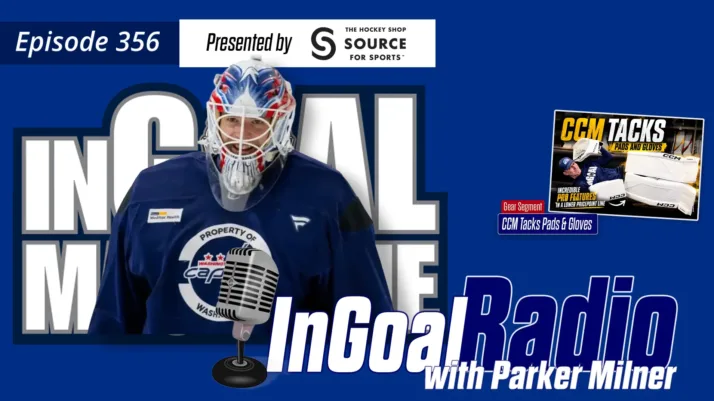
Episode 356: Washington Capitals practice goalie-Parker Milner
Please subscribe and leave a rating — it helps us reach more goalies!


Parker Milner, 35, has served as the Washington Capitals practice goalie for three seasons, facing Alex Ovechkin one-timers and working on his own game with goalie coach Scott Murray. A two-time NCAA champion at Boston College and former top ECHL goalie, Milner also served as an emergency backup goalie (EBUG) this season. New NHL rules requiring every team to carry an official practice goalie will end his current arrangement.
- Parker Milner won two NCAA championships at Boston College before becoming the top goalie in the ECHL and then retiring.
- After a couple of years away from hockey, Milner joined the Washington Capitals as their practice goalie for the past three seasons.
- Milner works on his own goaltending development with Capitals goalie coach Scott Murray during practice sessions.
- Milner served as an emergency backup goalie (EBUG) on the road bench this season.
- New NHL rules mandating every team have an official practice goalie will prevent Milner from continuing in his current role.
- Goalie gear costs don't have to be prohibitive — 10 strategies can make the position significantly more affordable for families.
Episode 356 of the InGoal Radio Podcast, presented by The Hockey Shop Source for Sports, features Washington Capitals practice goalie — and one-time EBUG — Parker Milner.
Feature Interview
presented by NHL Sense Arena
In the feature interview presented by NHL Sense Arena, Milner walks us through his path from Pittsburgh minor hockey to two-time NCAA champion at Boston College and the top goalie in the ECHL before retiring and, after a couple years away from the game, becoming the Capitals practice goalie for the past three seasons. Milner, 35, shares tips and insights into his life in the line of fire, whether it's Alex Ovechkin one-timers, being a target during lengthy skill sessions, or the game-improvements of his own with goalie coach Scott Murray. We also get into his road stint on the bench as the EBUG this season and his thoughts on the NHL rules that will prevent him from continuing as the practice goalie now that every team has to have one.
Parent Segment
presented by Stop It Goaltending U
In the Parent Playbook, presented by Stop it Goaltending U the App, we share 10 tips to make the the position more affordable, and explain why cost doesn't have to be as scary as most say.
Pro Reads
presented by Vizual EdgeWe also review this week’s Pro Reads, presented by Vizual Edge, featuring Casey DeSmith of the Dallas Stars with some great advice on alignment on the post to manage net drives and pass options. And in
Weekly Gear Segment
presented by The Hockey Shop Source for SportsAnd in our weekly gear segment, we head to The Hockey Shop Source for Sports, for a look at the new CCM Tacks pads and gloves, the second price point with a long list of pro level features!
Episode Transcript
Intro
Welcome back to the InGoal Radio Podcast presented by The Hockey Shop Source for Sports, The Hockey Shop in Langley, thehockeyshop.com. I am Kevin Woodley. With me is David Hutchison. And because you're listening to my voice first, that means Daren Millard is very busy with something called the Stanley Cup finals, which mister Hutchison, have you had a chance to tune in to any of the first three games? Because it has been crackerjack.
Not real goalie friendly, but crackerjack.
Exciting hockey. Do you know? Oh, my heavens.
Tough environment for the goalies. That's I will I will leave it at that. Based on the percentage of chances that are high danger, I hadn't done the math on the whole series, but, like, in the first game, it was 47% of the shot 47% of the shots Frederik Andersen saw were high danger and 38.5 on on Carter Hart. Like, and that's kinda continued, maybe not to the same degree. But we talk about this with Carolina.
Everybody thinks it's a goalie friendly environment, and from a quantity business standpoint, it is. But from a quality standpoint, they had three of the lowest save percentage or expected save percentage in the NHL this season. Frederik Andersen dead last at eight sixty eight, which tells you of the shots he does see, it's actually the toughest environment. He just doesn't see as many as other goalies. So Carter Hart getting a taste of that here in the Stanley Cup finals at the other end too.
It's been it's been a humdinger. There's a decision heading into game four. Frederik Andersen, Brandon Bussi, I imagine by most of our listeners' times they tune into this, it will be underway and we'll have an answer. What's your guess? We're gonna go on the record here.
We're gonna go on the record? It'll be Bussi driving the bus.
You think so?
I think so.
Do you think it's the right call? That's
a tough one. Yes. Yes. Not looking at it from the specific goaltender or the performances. Freddie absolutely deserves to be back in there because he's the guy that got them here.
I just think that's the way hockey works. I think all the players will have in the back of their mind what happened. I know they didn't win the last game, but they sure made that unbelievable comeback. Bussi didn't score the four goals, but but I think that's the way hockey players and coaches think. So that's why I think it's gonna happen.
Oh, that's interesting. I I like, I would have gone the other way. I no. I'm I'm not disagreeing with you. I would probably start Brandon Bussi.
And, again, this is with no disrespect. Frederik Andersen was you know, it's funny. They finished off the series quick and fast, but he was so good, especially in that Ottawa series. Like, he was exceptional. And I'm with you.
He deserves. And I think sometimes we make decisions at the NHL level or we see decisions made at the NHL level based off safe bets and legacies and things like that. All the time. And so that would tell me Frederik Andersen goes back in. But when I look at this series in particular and like, hey.
If you're the Carolina Hurricanes, maybe stop giving up breakaways, handing them out like they're Halloween candy. Like, wait. Not not to mention two elite players, by the way. You know?
Mitch Marner's pretty good.
Pretty good. Pretty good. But at the same time, the numbers are what they are in this series. And I just think if you believe that Vegas has confidence against Frederik Andersen, and I'm not sure why they wouldn't given that they're averaging four goals a game against them, Does Brandon Bussi just not represent the ultimate, like, change up? Like, you could not have a more different goaltender from a style standpoint.
Never mind the fact that he catches with the right hand, which Everything's different. Caught Mitch Marner off guard. Like, he admittedly didn't realize they'd change goalies and didn't realize the backup caught with his right hand. He admitted that when it came to the both the breakaway and the penalty shot that caught him off guard. But the way he attacks Pucks, attacks plays, the aggression he plays with, the length he has, whereas they've been exploiting Anderson on breakaway dekes and quick shots, longer pads, more reach.
Like, there's just there's a different element. He is there's unpredictability in his game. He'd be a tough goalie to pre scout anyways, but if you feel like Vegas is comfortable facing Frederik Andersen, this would be the ultimate change up.
It's funny be I'm I'm gonna admit to being a little bit like Mitch Marner in this one because we were watching the game and my wife said to me, because we expected that probably there would be a change, she said, oh, did they did they change goalies? I said, no. No. That's Frederik Andersen in there as the breakaway was about to happen. And then suddenly I went, hang on a second.
He's catching with his other hand now. So either Freddie switched gloves
or It's the it's the similar I mean, they're actually different style, like different graphics on the pads, but they're both I know. Pads.
It's it's very weird. I looked at the pads and I actually thought that it's
Listen, the other part too, like, I think a lot of people including, like, Rod Brind'Amour said this going into the playoffs that they might need both. But the question became, has Freddie played so well for the first three rounds? Had it been too long? And and were you worried about I mean, what Brandon Bussi did coming off the bat, he hadn't played in almost two months. Like, that was No kidding.
That was remarkable.
No kidding.
But it also answers does it not answer that question for you? Like, hey. Going in cold and being great is one thing, but he had a couple of periods to sit on it, intermissions, and he didn't change his game. Like, I I think the rust element is answered. And if that's answered, yeah, I'm I'm fascinated.
I don't know that there's a wrong answer, but I I am fascinated to see what our good friend Paul Maurice, Rod Brind'Amour, the Carolina Hurricanes doing that.
Yeah. My I think, the other piece to this, Kevin, is if they go down three one, I don't wanna say it's over, but it's getting pretty darn close. So I think they'll be itchy to go with the guy that didn't win the last one, but but helped as as part of the comeback. Interesting you talk about the two months off without playing a game. People should not forget that they're Although they had some long layoffs, he would have had practice time, but typically during the playoffs, there's not much practice time at all to keep him sharp.
But here's a woody type of question. Is there something in the way Brandon Bussi plays that makes it easier for him to come in cold than some other goalies
or harder? I I my instinct would actually be say to say harder because, like and he's he play it's not like he's all over like, when we talk about aggression, I mean, it's all we're talking about a sliding scale where nobody is like, we're we're not this isn't the eighties. Nobody's coming out to the hash marks and retreating. And he actually plays I mean, it was the same with Dobes. Everybody talked about how crazy aggressive he was.
And, like, yeah, he he was a little aggressive, but it's not like he was playing with a ton of flow or backwards movement.
No. They picked their spots.
Yeah. Exactly. And Bussi played, played, I thought, in that game, like, he his positioning was really conservative. It was efficient. Where he's different is on a backdoor pass.
Or, like, even we saw the pass from behind the net through the slot line across the other side, the way he exploded out off his post and makes the pad save outside of his crease and still moving in that direction. Like, there's just he does not hesitate to cut off angles and cut off pucks and cut off plays. And I thought there were a handful of saves he made as a result of it, and I just think that's a different look. And it you know, the one thing that Vegas has done better than any team in the entire Stanley Cup playoffs, and I think a lot of people might be surprised to hear this given all the attention and rightfully so on their skilled players like Marner and and obviously, Iu010do and Shea Theodore has been a revelation on the back end. I mean, it shouldn't be a revelation.
Maybe that's the wrong term because everybody should know how damn good he is, but he's been unreal. But what they've done better than any other team in the Stanley Cup playoffs to lead the Stanley Cup playoffs in five on five high danger chances for is they've won all the gritty battles. They lead the Stanley Cup playoffs in in in expected and actual goals off of screens, broken plays, rebounds, and deflections. And when I look at Brandon Bussi's chart for the regular season, screens plus seven and a half goals above expected. Like he manages screens.
He uses that big frame effectively as well as anyone in the NHL this season. That's how good it was. Rebounds plus 4.6. Deflections around plus one. Broken plays right around even.
So, some of the ways that Vegas has dominated in the in in these playoffs and even in this series, you look at the game winner in game one against Frederik Andersen. And, yes, it's a slot line carry by Thomas Hertl coming across the middle of the ice. But what what creates the delay in Freddie getting out to the top of his crease and being able to track him across is a screen in front of him. And so, you know, Vegas does the dirty stuff really well. I thought, Bussi handled it well coming off the bench.
And I think his underlying profile says that he's gonna handle it well overall, just based on how he played all regular season. So that might be, I doubt they're looking at it to that degree, but that might be one of those things that when you're making a decision, does that tip it ever so slightly in, his favor? Breakaways, slightly above expected because Before
we jump ahead to breakaways,
Daren, give me a second. Yeah.
Before you jump ahead
Stop giving up breakaways Carolina Hurricanes. I'm gonna leave it at that.
Stop talking Kevin Woodley. I know you charted all all the guys, for the playoffs. So now, you said he's this good with, with screens. What did you see as you were watching Busy play that made him good with screens for those people who wanna learn a little goaltending today?
You know what? And, I wasn't I looked up the numbers after. I wasn't paying attention to it specifically, but in sort of having done a little little film and stuff with like, I just think he's he's got that size and that patience and hold that stance and find his sight lines and stay true to it rather than getting low and wide and getting caught looking around it. Like, he's active in finding sight lines, but he's not overactive. And when you're as tall as he is, you're able to, you know, pick a shoulder and look over as opposed to having to get into your stance.
And a lot of that is where the play is. Obviously, if a puck gets into the slot, you've gotta get into your safe stance. And now you gotta look around a hip and find around a body as opposed to looking over. I think he's really patient staying in the high stance and looking over stuff. Again, part of that is Carolina probably not allowing guys to get into shooting positions with the traffic, but to me that would be the one takeaway.
And I when I asked you the question, I did not intend to be leading to this, but as we're discussing it, it got me thinking about your feature interview today. And Parker said at one point that one of the things he had to work on was overreaching for pucks. He was reaching for too many pucks and that makes me think about the actual save sequence on screenshots where a lot of guys find more success when they shift into pucks as opposed to just reach for them because of course you reach and then that stick comes out for a tip and there's big holes around the around your arm. I don't know if you saw something in how his save selection works.
I just think he he manages the initial and then there's a shift in. I mean, I I don't know that there's a lot of reachers anymore in the game. They're more shift shift. But I
But again, again, we're here for the we're also here for the goalies and the parents that are listening saying, well, how do I do that if I wanna be good at dealing with screens?
Probably easier at six foot five
about it.
Parker Milner is our featured guest. We probably I mean, you mentioned Parker. I hadn't introduced the fact that we have Parker Milner. And if you're wondering who's Parker Milner, because it's not necessarily a household name, he is a two time NCAA champion. He is a one time ECHL goalie of the year, a two time all star who is probably more commonly known as the Washington Capital's practice goalie for the past three plus seasons.
He got in and onto the bench as an EBUG in this past season, so we've got him as our featured guest because he's officially retired from that position in part because life is changing for him, but also in part because of the new rules around practice goalies actually prohibit him from fulfilling the role because he played too much, which is something we talk about in the interview. So, there is you may not recognize Parker Milner. Like I said, not a household name even though he was a hell of a goalie through college and even in minor pro. But this is a guy who has stood toe to toe with Alex Ovechkin in practice. The Capitals having two right catching goalies in Logan Thompson and Charlie Lindgren lean on him heavily for shootout and breakaway practices.
He gets into that. All kinds of great subject material, Parker Milner, coming up in our feature interview. But first, we should probably get over to our friends at the Hockey Shop Source for Sports. Cam is waiting. They have so much new gear coming in, almost on the daily folks.
Like, every time I'm in there, boxes upon boxes being unpacked and placed on the walls. It is that time of year, including the gear we're gonna talk about today, CCM, Tacks, pads, gloves. And if you're saying to yourself, hey, they already talked about Tacks pad. No. That was Tacks Pro, which thank you, CCM.
Pro is for the highest level. The next one without the pro label is the second tier. But, man, has it got pro features. So we're gonna get into that in a minute, but this is a great time to remind you that as all this new stuff comes in, not only do they have the greatest selection of goalie equipment, different patterns, the best staff to help you find gear that's actually gonna fit how you play the game or help you out with a custom order, but they also have the best prices. And as the new stuff comes in, there is sale, merch from the previous generation.
Tacks, of course, replaces the EFlex, and all remaining stock of that line is at blowout pricing right now at the hockey shop source for sports on the hockeyshop.com. So without further ado, I guess I'm throwing to me and Cam at The Hockey Shop Source for Sports for this week's Gear Segment looking at the CCM Tacks.
Gear
You might be wondering, haven't I seen this before? Didn't these guys already do CCM Tacks recently? We did, didn't we? Yeah. Okay.
We did. You're right. So what are we doing here? Oh, Cam wanted to do it again because now that he's a star on the show Off Campus, and if you haven't already watched it, make sure you can see him in the net getting scored on horse poop technique on a wraparound, but that's what they were paying him to do.
Which means I can follow direction.
That's right. You do follow direction well. Let's see if you can do it now with the new CCM Tacks, not pro. We're here not because he needed a second take, but because there's a second price point, a second line with a lot of pro features. Yes.
So Cam, and quick time out here. CCM, thank you for calling your top end pad pro and taking pro off of your second price point, helping us avoid the needless confusion that we have with so many other companies. Okay. Back to Cam. CCM just tacked.
Yeah.
Don't make me tack it to you.
Second price point, walk me through the differences. What's the same? Clearly, I see a similar shape, steep boot. Yes. We got that sort of 150V core shape.
[crosstalk] Yes. But do we have the same materials? No. Okay. So walk me through it. Let's go.
This is your chance to shine.
Oh, thanks.
Do a better job than
you did on that wraparound and off campus. CGT. We'll talk about that first because that still makes Look.
It's the slide technology on the second price point, Pat. So ding. There's one for CCM.
Come off in the EFlex 7 is why we started seeing that. Now again, continuing on and honestly, it's working quite well. Feels just been pretty fantastic.
Yeah. We've had a ton of good feedback on this and especially noticeably on the stiffer profile of this pad in the Tacks Pro line. Again, stiffer pad usually means stiffer materials on the inside and then you get that sort of stiffer edge combined with CGT slides really well. We've built out a really stiff EFlex seven pad and the difference between stock and stiff. It it helps your sliding for
sure. For sure. So you already kinda talked about the actual Shape? Shape of the pad with that 150V kind of style. So guys with a little bit narrower of a butterfly, you know, we've always been said, oh, narrow butterfly.
You need a soft pad. I don't think that's correct. I've been saying that for a little bit of a while now. I think it's different.
You were ahead of the curve, weren't you?
I but I I'm one fifty the curve. So what I mean by all this is that because of the shape of that pad being a little bit stiffer, you can butterfly with your knees a little bit tighter and still get that closure that you're kind of looking for instead of
[crosstalk] having this gaping five-hole. And it's all designed to also be a little easier on the hips. Something we heard specifically from Ann-Renu00e9e Desbiens of the Montreal Victor. She's noticing reason for that though? Because of the knee stack.
Because of how thick it is? Yes. Also with that knee stack, one of the things that we do notice here and how they've connected it into the pad as well, a) we're getting a lot more of that stability but it's almost like you have a little bit and it is I have to use the term, bit of a knee drive system here that we found.
Yeah. Warrior asked for sure. They were the first ones to do that, but that little bit of that angled connection helps reinforce it a little bit, but also just it man, we keep going back to that term connection, but there's a lot of connection with the knee.
There it is. Connect counter.
Yep. One thing I forgot, we do get the CGT on the inside edge, but you'll notice folks, there is no speed channel. So on the CCM Tacks Pro, this was segmented. You had a gap, and then it was sort of angled to where the calf actually contacts the ice. Lace in it.
And and so that indent creates a space where there's less friction. This is flat, so more pad contact in the ice that you're sort of sliding against, more material on the ice that you're sliding and pushing against. But, again, because of the CGT material and the stiffness, it's still gonna slide really well. But that's one of the differences. You're obviously getting less when you don't have the full pro line.
That's one of the things
you get less stuff. Okay. Next. So still that same adapt fit. Correct.
Adjustable as well on the inside. Nice wraparound connection to that calf. Again, too tight, make it a little bit looser, not tight enough, crank it down but you crank down on this type of pad. You are, unless you're really, really flexible in your hips, might cause yourself some problems.
Yeah. We've we've and the interesting thing about this is we've had goalies test it that want it looser. Yep. But we've also had goalies that really like this system because they can pull this pad up and tight over their calf. So again, with wider butterflies and they don't need to worry about it, but the ability to do both.
Yes. We've lost have we lost
the strap from the Again, something that changes when you go into this. Again, more of those pro guys are asking for that strap kind of download to kind of close it off. It's not here. It's not here. A little bit kind of on purpose.
I'm not finding that as much in that kind of like mid price point. Also, again, not to say that you should just bump up just for a strap to go to the pro, but that said, some of the differences that start to separate themselves when you come to the mid price point. I noticed this has
[crosstalk] bootstrap connectors. It's got Which aren't stock The Podcast. Pro. Doesn't come with the bootstrap? No.
But you have the ability to add it?
If you do. K. Yes. Good to know.
They still have their hybrid
kind of style toe type. Noticeably absent is lock and push. Yes. Exactly. Again.
So more of a standard pro feature. Onto the pro pad. Ironically, we've had again, on the lock and push, that thicker sort of triangular shaped toe bridge that we saw on the pro. Mhmm. It you call it a pro feature.
Ann-Renu00e9e's loves it. So for her, it's a pro feature. Didn't even notice it. Felt like maybe it gives her a little more push off. A lot of the higher end junior goalies that we've had tested are like, you know, like, I hit my laces perfectly.
I don't need this. I would prefer not to have it because it's different. So don't have to make that choice on this one.
Yeah. Last but not least, just quickly talk about how they've again angled that outer tapered. Tapered. Exactly. And they all that is to do is to move more material from the pad that's not necessarily needed.
Help lighten up the weight of the pad itself. Right. Because when
you have a stiff pad and this is this as stiff as the Pro? Probably not quite, but still Because
you don't have that same rebound material on the front.
[crosstalk] Again Infinite power. Infinite power. Again, you're paying less. You're getting less materials. That's one of the differences.
But still a relatively stiff
Oh, yeah. It's quite a stiff for especially a mid range level pad. And so when you use when
you stiffen up a pad and you use HD Foam, weight goes up, and that was one of their ways of keeping the weight down. I know on our ProPad and a thirty four two, we were just right around five pounds. Correct. So alright. Okay.
Glove, five ninety. Vortech palm or pocket. Look how
big it is. So plus one inch depth being the mid range level glove, they can get away with adding that as a stock feature for making that a little bit deeper. Skate lace pocket as well. Great. Fine.
With the
the nylon in between? Nylon in between. Correct. Which actually might be a good thing, to be honest. Our Vortex pocket and our stock glove had skate lace, and it felt like they tied it a little tight, which kind of didn't allow it to take that form.
A running change, think they're making it the factory right now. Yeah. Close that glove. I mean, that's brand new out of the box. You
nobody else has tried that on. Yeah. Pretty good. 590. Great overall feel that's in cross form on the back in terms of for the strapping as well.
So similarities, differences, just materials on the inside? No d three o?
No D30. Open that up a little bit so we can let everybody
see what we're actually dealing with here. Oh, I feel like this Castanza, like I'm
a hand model. Finger stalls. Finger stalls. So not like the AXIS XF. This glove's completely different.
Redesigned. Much better fit and advancement in the five ninety line. Not something that's like completely different. Still has that same style of closure, but again, that deeper pocket reduced overall palm size to create that deeper pocket and wider pocket surface as well. Definitely worth checking out.
You've had CCM gloves in the past and you're like, bah, this is definitely something to come back to and check out.
They made significant changes to their gloves. Some were a little hit and miss, but the weight on them compared to when they sort of redid their manufacturing noticeably lighter now, and they've come back to the same field they used to have. They've really made strides in the glove over the last couple generations.
[crosstalk] It's kinda from EFlex seven. You're a five ninety fan, you should lose a good size.
Blocker. Last one. Let's go.
Alright. Okay. Still get light core. Right over here.
Still get light core in the second price
Blockers like noticeably light. You really do feel it. Okay. Right off the bat, you're still gonna get a nice hard punch. Again, you don't have the exact same core material as what you would find in the Tacks Pro.
No D30 on the index finger. Another place to kind of
call it out. Still get that. Love the flex motion cuff. Big fan of the flex motion cuff and the ability to just prank that thing wide open.
So very, very easy to then this blocker forward.
Love that they continue that
in back end. Price point.
Yeah. This blocker feels great for especially a mid price point. If you were in a
blind taste test, it'd be really hard to be able to tell. Gonna say, like, it it it's unreal how much things have changed. Correct. Second price point, like, I bet you if I were to find a time machine, I don't know if this is how I'd spend my time if I actually had a time machine. But if I could, I bet I go back, what, five years, grab a pro set of gear off the rack and compare it to this, and it would be very similar.
There's so Do
I even have to go back that far?
There's so
How far do I set the dial cam? Yeah. My point is second price point gear has come a long way. Yes. It has.
This feels like again, thank you CCM for not calling it pro, but this feels like pro level gear. Yes. And what? Ballpark? Half price?
A little little above half what a pro
Hold the phone here for a quick sec because the one thing that we almost didn't talk about was where to
phone you. Well, that, but custom. Come on. This is the second price point pad. What do
mean custom? Available custom. So you can change your colors. You can pop your name on it. You get your name on a second price point pad.
Few minor specs, including the option for 580 to order at the customer.
You can order the 580 in a second price point.
That's correct. So if you wanna learn more about that, you can give me a call. (604) 589-8299 or 1-800-567-7790 or check us out at the hockeyshop.com. Oh, CCM,
I was, like, so full of praise for not putting the word pro on this, but then you gave us so many pro features. I'm now confused. But thank you.
It is remarkable, my friend. Just how good the second price point stuff has become. Unbelievable. Like, genuinely, I I I do have a little trouble sorta how long ago would we how far would we have to go back? But I I I think it's, like, probably less than five.
Unbelievable. Like, genuinely, I I I do have a little trouble sorta how long ago would we how far would we have to go back? But I I I think it's, like, probably less than five.
You could take the second and including this CCM Tacks stuff and put it up against the pro level stuff, like, what, four, five years ago. And it's I mean, it's right there. It's right there. You don't get everything. You're not getting D30.
Cam walked us through all the things you don't get. But to get their sliding material, to get a lot of the same innovations in terms of the strapping, the knee stack, and all the things that have made this patent, we've really had good feedback from our testers, the glove at that price point. Like, it's As
you and Cam were going through, what separates the two lines, I sort of thought to myself, really? Like, that's it? Like, there's a strap that's different. There's the way the toe ties attached to the pads is slightly different. Like, I'd find it tough to tell my kid he needs the pro pad or to let my kid have the pro pad if if we had to order something new.
Those are just remarkable. And as we've seen over the
years with our own testing, they're like pro level gear might last a little longer for sure because there's there tends to be higher density foams and things that don't break down as much. But, man, if we had some success with some of our second price point stuff lasting well through a season, even at rep level hockey where kids are on the ice five times a week.
Got one of those sets from many years ago. Bauer's second tier in this case was playing junior hockey actually And in its second or third year of life.
Yeah. And and here's full credit too. Right? Like, like, let let's give the the hat tip as they say, the stick tap as they say to Bauer, I think, was one of the companies that led the way in terms of making this second price point stuff as good as it is now. And kudos on CCM for following suit.
Make sure you check it out, folks. If you have any questions, check out the hockeyshop.com, Hockey Shop Source for Sports, Cam and his crew. It's not just him. Everybody there plays the position. They can answer your questions about, hey.
What level are you at? Which which price point do you need? And other part too, like, this is a unique product, the Tacks pad, different shape, the v shape, little easier on the butterfly, stiffer pad. Is this for you? Is this gonna fit your game?
So make sure you check them out. Okay. Before we get to our parents segment next
Mhmm.
I think we got a little congratulations are in order. Andrei Vasilevskiy. No. Thank you. What do you oh.
You don't get a trophy. No. I apologize. Andrei Vasilevskiy, second Vezina Trophy. Huge.
I got a chuckle out of the way they announced it, hiding in his car and having the drug sniffing dog come and signal that he'd found something. Great story. There appeared to be a little apprehension, and I saw a great meme online, social media, and it was basically all the other awards. We're gonna work with your family to surprise you on the golf course or at some type of charity outing. Andrei Vasilevskiy, and then they they just dot dot and there's the John Mulaney skit.
We're gonna frame you with murder. And it was I mean, honestly, it was pretty funny, but kudos to Vassi.
I this hope this means he's an absolute goody two shoes, and they know he's the last guy that this could ever possibly happen to, and that's why
they The dog is not they had to know very confidently that the dog was not finding anything nefarious in Andrei Vasilevskiy's and I So
he's a good guy.
I mean, we know that Andrei Vasilevskiy is a good guy. He's also a guy with some serious style and taste when it comes to his automotive selection.
Mhmm.
Car in question, I know you haven't seen the video, was a 09/11 GT three RS. So yeah. Is your dream car? I mean, honestly, if I'm gonna be if I'm gonna be truthful as a Porsche snob Mhmm. I'm probably going GT 3 touring.
The wing isn't really my style. I think in the in your fifties, you're not really allowed to to have a wing or maybe a GTS Targa, which I have a friend who has one and I'm very jealous of him. But at the end of the day, he's a Porsche guy, so we love that. All things we can never afford in our lives. You need to make the NHL to get those.
But but kudos to him and, boy, we make jokes about the video of presenting the award. The one I really loved and the Tampa Bay Lightning shared it, calling Frantz Jean in. Long time goalie coach. I think they've been together over a decade now. His coach since he got there in Tampa Bay.
A lot of lot of lot of ups for them, a lot of cups, another Vezina Trophy. But there's been some years where I think he deserved it and didn't get it. And to see him share it and go over the trophy with Frantz and and wanna share that with Frantz right away, I thought was really cool too. And another sign of the quality person that Andrei Vasilevskiy is.
It tells you a lot about that relationship, doesn't it?
Yeah. It absolutely does. Now hey. Listen. We had an article up at ingoalmag.com about who should win, and I still think it was a snub that Logan Thompson, not necessarily to win, didn't make the playoffs.
I get it. Some guys don't wanna vote that way, but when the voting came out, I was surprised how many left him off their ballot completely, Logan Thompson. And and then we see Ilya Sorokin finished second in the voting, despite at the end of the day having worse numbers, worse adjusted numbers than Logan Thompson also not making the playoffs and frankly leading the way for three quarters of a season and then kind of falling off a cliff for the final three weeks of the year and still finishing as a finalist. At the end of the day, though, Jeremy Swayman and third these are all exceptional goaltenders. I think Logan Thompson is gonna get his time as well, and, maybe it's a finalist first and then a win.
But I thought he deserved to be a finalist this year. So that's, you know, it's it's not taking anything away from the guys that did. Vasi fully deserving. You can read that article at ingoalmag.com. I just thought that, you know, there were some omissions there that were perhaps bordering on glaring.
So, yeah, make sure you go check that article again in goalmag.com. Also, before we move on to the parent segment, which is presented by our friends at Stop It Goaltending, we have part two of the Dylan Garand skating is up at ingoalmag.com. Folks, if you didn't see part one, a lot of you will, like, look at it and be like, oh, I've seen goalies do these drills and whatever. This is not just a warm up drill. We've got the first two parts and they are a warm up.
But starting with the skating sort of along the blue line side to side, getting his edges warm, engaging all his muscles, all that stuff in part one. Now part two, we've got five pucks on the ice. He's using them as positional targets. It's like crease movement patterns, but not in the crease. That's up right now at ingoalmag.com.
You'll see him wear the TrakOpti goggles, and he talks about that a little bit. Same goggles we mentioned last week, Carter Hart wearing them on the ice for morning skates with Vegas. You know, Logan Thompson uses them with the Washington Capitals. I know some of the Carolina Hurricanes goers have used them, Devin Cooley, Dustin Wolf, but part two is great. Just a lot of skating drills and a lot of emphasis on the his key points in his crease movement and why it matters to him.
And then in part three next week, we're gonna move into the crease. And the point here is that a lot of you will might see part one on its own or part two on its own and think it's just regular goalie skating. The focus here is that this is what Dylan does all summer. Like, his focus, and he talks about it in this episode. Why so much of it, all of it, pretty much.
There's not a lot of pucks flying around and crazy shooting drills. It is all about his skating. Some good takeaways there no matter what age you are on the importance of skating. So make sure you check that out at ingoalmag.com. Speaking of ingoalmag.com, did you know that you get a free subscription to ingoalmag.com if you buy a subscription to Stop It Goaltending U the app.
Would you like to have 25 of NHL goalie coaching experience at your fingertips? Wanna tap into the goalie parenting expertise that helps Joey Daccord reach the NHL? That's what you get with a subscription to Stop It Goaltending U, the app. All the knowledge from Brian Daccord, who's been an NHL goalie coach scout and director, as well as all the insights and expertise from his staff at Stop It, which includes a long list of veteran NCAA coaches. It's all delivered in easy to digest chunks, including five short daily primers, weekly style analysis, and breakdown videos, and drills you can take onto the ice with your team and coach this summer.
Plus, as I mentioned off the top, with every subscription to the Stop It Goaltending U app, you also get a subscription to InGoal Magazine. So check it out now at the App Store or Google Play. They are also proud, proud sponsors of The Parent Playbook, which we go to now with our cohost, David Hutchison. What's up this week, Hutch?
Parent Playbook
What is up this week? Something all goalie parents need, 10 tips for making goaltending more affordable. And Woody?
Yes, sir.
As you're listening, I want you to see if you can see how this was inspired by two things you've already talked about on the podcast today.
Oh, I was told there'd be no test. Okay.
K. So she wants to be a goalie, and it terrifies you. The pucks, the pressure, and somewhere underneath all that, the quiet one, the cost. You've seen the price of pads, and a little voice went, maybe she should play forward. I get it.
I won't tell you it's free. It certainly isn't. But goaltending's reputation for being expensive is while not untrue, there are options to make it more affordable. So here we go. Here's 10 of them.
Number one, don't buy yet. Go with the loaners. Lots of associations still keep a gear pool. They now run some try goaltending sessions. Ask yourself the question ask them the question, excuse me, do you have loaner equipment?
Your kid can play a whole season and more to find out if she loves it before you spend a dime. Number two, when you do buy, maybe start buying used. And here's one, treat it like a rental. Kids outgrow their gear so the used market is huge. Go out and buy something quality, keep it clean, resell it when she grows.
Your cost is actually just the gap between what you paid and then what you got back. Make sure though that it fits well. Don't buy too big and hope she'll grow into it. Oversized pads make it so hard to play the game. Number three, the second price point gear is excellent.
When it's time to buy, as we've mentioned, we've watched these lines for years. They're not good enough. They're genuinely great, and they last multiple even triple a and junior seasons. Number four, save on the stick but not the mask. You don't need a $400 stick for a nine year old.
And like we tease Woody, the warm up stick is plenty good. You can go with cheaper lines or if you really have to have something top end, go more affordable for practices. The mask though is the one thing I don't think you should ever cheap out on. Get fitted, certified, no exceptions. If you really want to look cool, go for a vinyl wrap from maybe our friends over at Custom Cages or many of the other companies out there that beats the custom paint bill.
Number five, ask for the goalie break. Goaltenders are scarce, so a lot of associations knowing what you have to invest in gear and training quietly discount registration but they might might even chip in to help you with some training, but you may have to ask. And if money's tight, there are some programs out there. I know in Canada here, we've got jump start and kids sport that exist exactly for that and there's no shame in using them at all. We want everybody to be able to be a goalie.
Number six, use your association's goaltending program for training. Where these exist, they are often excellent and very affordable, even built into the fees you're paying sometimes. Check with your association before you go shopping for private help. Number seven, camps for some affordable reps. Yep.
Check out our camp guide. Camps can be a cheaper way to bank real reps and your kid builds some great relationships with other coaches and goalies that are worth as much as the ice time. Shop around for more affordable options. There's lots in the directory. Some people have shorter camps that cuts down on the cost.
Our good friend Kyle Konin is even offering a free session in Calgary coming up soon. The free reps are right here. This is number eight. Watch the drills on InGoal and then go do them like a public skate, drop in, stick and puck, a parent, a bucket of pucks, drill off her phone is real development. Just ask Dustin Wolf and Connor Hellebuyck who did exactly this.
Number nine, off ice training, try other sports. The goalie specific off ice programs are great if you can swing it, and they're good programs run by some really great people. But you've also heard me say it before, baseball, soccer, tennis, phenomenal off ice training for you. Nice break for your mind, same skills, rec league price. Number 10, borrow an older goalie.
This is one of my favorites. Invite a high school or junior netminder from your association to come help out your younger kid in practice or maybe join them for one of those sessions at stick and puck. A lot of them need volunteer hours for school. They can get them coaching your kid and your kid gets a hero out of it and some great coaching. So goaltending, definitely not free, but it doesn't need to be as bad as the number that scared you.
Right size the money and you're left with the only question that it was ever really about, does she want to do it? Don't let the price tag answer it. Let her. I'm glad my parents let me.
Okay. What was my homework assignment?
Quiz time. Two things that you've already talked about today that inspired this.
Well, the the second price point gear was one of them.
Yeah. That's a no brainer.
And the subscription to InGoal?
You're getting warmer.
I'm trying to think of what I talked about. I just see, here's the thing, folks. I just talk. I don't actually think when I talk, so I don't remember therefore what I talked about. So which one of
great thing to take to stick and puck or wherever you're gonna get some cheap cheap skating is Dylan Garand skating drills that you can just pull off your phone and go try them yourself. I think do not need a coach. You do not need anything except a little bit of ice, and it is available cheaply in some places.
Yes. There you go. And we talked about the stick and puck. I heard you talk about that. And whether it's Eric Comrie or Connor Hellebuyck or so many of the guys, you don't need necessarily you just need a little bit of oh, what's the word I'm looking for?
Competitiveness isn't even that. You just just need to have some motivation to go get better, and the tools are there. You don't need to have a goalie skate and a goalie coach and everything set up perfectly and 10 people looking at you and iPads all over the place. If you can't skate, you can't play. But And you can skate.
Make the opportunities available for them. We're not telling you to force your kid to go off to stick and puck and start practicing when they're nine years old. If they wanna do it, that is awesome. Show them opportunities. Let them decide.
Well, it doesn't have to be nine years old either. Right? Hellebuyck was.
I'm picking a number.
In high school at 16 when he was doing it. So Yep. Great stuff, my friend. Great stuff, mister Hutchison. That, of course, presented the Parent Playbook by our friends at Stop It Goaltending U.
The app reminder, that subscription we just talked about to InGoal that can help you become a better goalie, it is $50 for the year. Free if you get this Stop It Goaltending U app, but $50 on its own for the year. Canadian funds. If you're listening to this from The United States, I'm pretty sure that's two large lattes at your local coffee shop. Thank you to our exchange rate, which by the way, as an adult with a child going to school in The United States is to quote the Mulaney skit and it's murder.
It is murder. That is a murderous. But for those of you on the other side of the border, it means InGoal is even cheaper folks, like $35 to get yourself one year of instruction from us. So make sure you check that out, including, you know what else you have at InGoal? Because we hear a lot about how the goalie school goalies, even the ones that have the parents with the deep pockets to send them to all the different goalie schools, They move well, sometimes as well as NHL.
As you know what they don't always do? They don't always Read the game. They don't read the game. And we hear that a ton. You know what else we hear a ton from goalie coaches, Hutch?
What do kids not do? What do they not?
Oh, I thought the coaches were gonna say the best way to learn to read the game is
InGoal, but they don't watch enough hockey because they just watch clips and save clips.
Watch highlights.
Which is why we go beyond the highlights. We rewind it. We go right back to the zone entry. What are you looking for from these goalies? Handedness.
Where do you take your ice? When do you start your depth? A lot of different things go into it, and that includes this week's ProReads, not off the rush, in the corner, featuring Casey DeSmith of the Dallas Stars who has been one of the best bargains in hockey since signing in Dallas. Unreal, numbers relative to environment, all on a rather bargain million dollar a season contract with the Stars. He's been great for Dallas, and he's been even better in our ProReads.
And this week, he's looking at a walkout from a dead angle with pass options. It is a pass down to the goal line to Jordan Eberle. So as you go into your post and Eberle's got the puck above the goal line, so he's a shooting threat, What is the first factor that matters? What are you looking for, mister Hutchison?
I'm looking for the location of the shooting threat, and that helps me decide how I'm positioned on the post.
Okay. So for in this case, handedness matters too, and that dictates position. Is he a shooting threat? If he's catching it down near the goal line on his backhand, are you as worried about it? Probably not.
So handedness is one of the factors.
I'm like Mitch Marner, though. Like, I don't even notice what hand the goalie is, so I mean, the player is.
And this is why you're you you, like me, my friend, are writing and talking about goaltending and not doing it at the highest level. We are we are together in that. Anyways, just some great advice on not just this is a situation where he has to commit because he knows a little bit about Eberle and who he is as a shooter and what his tendencies are. But then if and when a pass is made, DeSmith gives himself self access based on how he sets himself in that post with something called alignment and that way he aligns and sets up that inside edge skate relative to the goal line. That was your answer.
I know you were going there.
I just didn't give it all away.
So to have an NHL goalie walk you through what angle that should be, why that alignment is important, and when you can cheat off of that guy down near the goal line and when you can't, and why a proper alignment will allow you to live in both worlds, go check out this week's ProReads at ingoalmag.com, and, of course, presented by our friends over at Vizual Edge. Because ProReads helps you read the game better. Our friends at Visual Edge are gonna help you see the game better. Do you want the puck to look like a beach ball? Every goalie has that night here and there where the puck looks huge.
You're ahead of every play. You feel calm, patient, in total control. Then there are the nights where you're half step late. You see it, but you don't really see it. You're reaching, you're guessing, you're fighting it.
That's not your technique. It's your eyes and your brain not processing the play fast enough. Vizual Edge fixes that. It measures how well your eyes track and process the game, then gives you a custom plan to train improvement. Three fifteen minute sessions a week is all it takes on your laptop or tablet, sitting at your desk, lying on your couch, even in bed.
You just put on the goggles, grab your tablet, grab your laptop, and you go to work. It's what NHL goal is used to make the game slow down when it matters most. And, of course, you can get 10% off a subscription to Vizual Edge using the code InGoal, I n g o a l, all caps. Or if you are a subscriber to InGoal Magazine, double the discount. Just go check out any ProReads on the website, ingoalmag.com.
Click on the ProReads section. Go to the Casey DeSmith one, the latest. And within that is a special members only discount code to save 20% off Vizual Edge training tools to help your eyes and your brain work a little better than mine does. Same with you, Hutch. That's why we're here.
Right? Yes. Your eyes and your brain. Brain not working fast. Brain not working fast.
Eyes no good.
That discount code is right near the top in the header of each article.
There we go. See? Hutch see his his eye his eyes, he's been training. He found it right away. Me, a little more problematic.
I just remember where I put it.
That's yeah. It helps that you're doing the layout. That definitely helps. Okay. Before we get to our featured guest, a little bit of news around leg.
I gotta be honest. I feel like this is a little presumptive, a little jumping. We're jumping the gun a bit. Not presumptive because it's actually happened, but it's not complete. It is a I'll admit a little bit of a difficult at times to understand process, PWHL expansion.
Oh, I tried reading and I just stopped. Yes. I was so confused.
See, we needed visual edge to train our brains so we could read the PWHL expansion rules. All I know is that two goalies have are on the move already. Corinne Schroeder from the Seattle Torrent is on the way to San Jose, and Kayle Osborne from New York to Hamilton. So we'll see if there's any other changes. It would be great.
I think we'd I think it's I think we're overdue. We had Corinne on the podcast, like, pre PWHL day, so I think we might be overdue for a catch up there. Kayle, we had on this year, but it'd be always be great to get a chance to catch up with her. Tough time of year. I mean, when you're adding four teams, you know, you go through your whole season trying to build chemistry, and now this is two years in a row.
First two two expansion teams for this season, four for next year. That's a lot of player movement. That's a lot of disruption in a locker room within team systems. So a lot of a lot of unsettled feelings, I would imagine, as they get going. It's gotta be so hard.
Well, you know, and and we're not talking about millions and millions of dollars like NHL players. And here, pull up your life and go live somewhere else and do it differently. I know talking to, well, I'm trying to think think of what how I can if whether I'm allowed to what I'm allowed to say. But I I know that Kristen Campbell would very much like to stay in Vancouver. And they protected, of course, Emerance Maschmeyer, so she's got a level of exposure.
But there's a case where her coming back to Vancouver in order to facilitate it from Toronto in the first place to be on the West Coast where she wants to be, she had to agree to take a I won't say how much, but a significant pay cut to come here. So then to have the risk of taking less money to come here and then potentially have to move somewhere else in an expansion draft. There's a degree of this that is a little unfair, but as we say often in pro sports, life isn't always fair. And so I just hope in her case and other players cases that it works out as best it possibly can. But Amen.
Goalie movement already in the PWHL over the summer, much more to follow as we head into the end of the expansion process and then the actual draft. And like I said, just thinking about everybody because I know I see we say this about the NHL too, like families and and just it affects so much more. We see professional athletes as just these, you know, these sort of we put them on a pedestal and we look up to them and those are all great things, but there's a human element to this that sometimes gets overlooked. So we're thinking of everybody that's going through this and going through a lot of uncertainty right now, Mr. Hutchison.
Absolutely. Look. Even if even if you end up sticking with your current team and those protected lists were tiny, three people. I know it's much more complex than that, that's why I dove into reading about it. But with the number of teams they brought in this year, the size of the protected lists and probably just the confusion over how it all works, there are a lot of families sitting on pins and needles wondering what's happening here for them.
Feature Interview - Parker Milner
Yeah. Absolutely. Absolutely. Well, speaking of families and big changes in life, our featured guest Parker Milner is waiting as Daren likes to say in the green room. Some big life changes for Parker who'd re I think nine months ago now became a dad, first time dad.
He's a writer, so automatically close to our heart. He is a food editor in Charleston. We'll get into that a little bit. He's relocated from the DC area to Charleston. His wife is a doctor, and that's part of this relocation in terms of where she'll be working, and that all comes into this.
But before we get into the introductions and a career that includes two NCAA championships and a frozen four most outstanding player, some years in minor, and the last three years as a practice goalie, I think we should talk a little bit about our friends over at NHL Sense Arena, our presenting sponsor for the featured interview.
They sure are. This episode's feature interview, like all of them, is brought to you by NHL Sense Arena, the off ice training tool that builds the part of a goalie's game you can't always drill on the ice, that's the Reeds. By the way, looking back at my parent segment, there's an affordable way to get some training because it's available now for about $35 a month. Cheap way to get some incredible training all summer long, in fact, all year long. And they have just dropped something built for that summer grind, new monthly summer training packs, a focused set of objectives that you work through each month.
So instead of just aimless reps in the off season, you've got a plan, a path, and a way to actually track your progress. Got an email this morning talking about how many drills we've done and where we are in it. It's really cool. June kicks it off with elite campus prep built around exactly what coaches are looking for at summer camps and showcases. For goalies, that means tracking, reads, reactions, positioning, worked through a structured progression of drills.
And here's the part that's kind of fun. The shooters in these drills are pulled from real d one programs. Boston University, Boston College, UConn, Quinnipiac. You're reading real college caliber shots in the headset all summer long. Every pack comes with a goalie checklist you can print or keep on your phone plus weekly emails like I mentioned to keep you on track.
If you complete every objective in June, you'll earn an exclusive reward, but only during that challenge window. Oh, and they're giving away a stick as well. Entries come by doing the campus preparation, and you can also get more entries by using the goalie advancement program as well. Right now, as I mentioned, off season pricing, annual plan, $399 savings of over $549 on the ultimate hockey training tool. And there's more to be saved when you use the code IGM 50 at checkout.
Head over to sensearena.com and start checking off your first objectives today. NHL Sense Arena, train your hockey sense.
Parker Milner, our featured guest.
Parker Milner, great interview.
On this week's episode of the InGoal Radio Podcast brought to you by our friends at NHL Sense Arena. Really excited to welcome to the InGoal Radio Podcast. First time guest, but somebody I feel like I've known through all the stories I've heard over the years from Scott Murray, goalie coach for the Washington Capitals, and, of course, the legendary goalie coach and director, Mitch Korn. We have some mutual friends. Parker Milner recently, do I say retired from the E BUG practice goalie role of the Washington Capitals, but also, let's not forget, two time NCAA champion with Boston College, ECHL goalie of the year, two times all all star in that league.
Welcome to the InGoal Radio Podcast.
Yeah. Thank you so much for for having me. I've I've certainly followed, everything that that you guys do amplifying our our, odd little goalie world that we live in, and and so, really honored to to be included.
Well, I wanna get into the nature of the job that you've done for the past three years with the Washington Capitals, including getting on the bench as a backup in the E BUG role and how everything is shifting. But first, let's let's find out a little bit more about you as a goaltender growing up in Pittsburgh. What attracted you to the position? Who were your guys?
Yeah. That's a a question I I get often. And so I was obviously a Pittsburgh Penguins fan. My my parents didn't play hockey. They grew up in the Midwest, Indiana, and Ohio.
But I was born in 1990, so that was kinda the the cream of the crop for the Pittsburgh penguins. You had Barrasso and Mario Lemieux and Jaromir Jagr and Ron Francis. And so all the kids were playing hockey, so I just kinda fell into that. Goalie, I I've really started pretty much right away. I I wanna say it was the gear kinda like a lot of people that attracted me, but, I think from a young age, I liked that it was a little more methodical.
I'm kind of a natural introvert, and so I liked that it was kind of my position and I was in the net by myself and I kinda got to do my own thing. Played lacrosse and a few other sports, but it was really just goaltending. That was my main thing. I'd go to hockey camps for six, seven weeks every summer, spend two weeks with Mitch Korn in Buffalo. Yeah, it was really my life from age seven on.
You mentioned the camp in Buffalo. Is that just as a as a young goaltender student? Like, is that where your first interactions with Mitch were?
Yeah. So I got introduced to Mitch through Chris Economou who you probably know. He's he's out in the Philly area now, but he, would we had this little rink, literally probably 500 yards from from my house in in Mount Lebanon in the Pittsburgh area, and it it had a full size rink, but then also this little, kinda miniature rink. And so Chris, being kinda the the wild person that he is, he would drive five and a half hours on Monday nights to run this goalie clinic for, like, 10 year olds. And so he would take us out.
There were no shooters. We just do all goalie skating. And so this is the late nineteen nineties, and so the idea that goalie
Way ahead of its curve.
Yeah. So the idea that goalies were just going out there and just skating, was pretty wild at that point. And so I I I don't think I love that, but, you know, I I got involved, kind of at that level. And he suggested he was working, pretty heavily with Mitch at that point, and he suggested I go up to Buffalo. And before I knew it, me and my mom and my two little sisters were up there two weeks every single summer, staying at the residence in in Amherst.
So from there, walk me through the path. Did you end up going to play prep school a little bit? And is that ultimately in a in a year in the USHL before ending up at Boston College for four years?
Yeah. I was, playing for the Pittsburgh Hornets, who actually have a fair bit of NHL alumni now, Vincent Trocheck, JT Miller, John Gibson. So I was playing for them, and I ended up spending my junior year of high school at Avon Old Farms. I was the goalie for what had to be the most incredible prep school team ever. We had, like, Cam Atkinson, Pat Mullane, Quinn Smith, who were all my teammates at Boston College.
Danny New played at Providence. So it was a stacked high school team and that I think we lost one game. And so that experience enabled me to make the jump to the USHL the following year. And I I spent one year in in Waterloo, and I didn't really have any college that much college interest until the very end of the year. John Muse, who we're talking about earlier or before the the the call, who played in China, he went down with a hip injury late in the year, and they were looking for someone to come on and, you know, maybe play some games as a freshman.
And so I actually went on my official visit to Boston College in, like, late May. I committed a week later, and then I was there in September. So it all happened, pretty quickly.
Okay. So now you're also at at a time when the position is changing rapidly. You know, you mentioned it, Chris, being ahead of the curve with goalie skating stuff. We hear a lot about that now with the the trend towards rushing goaltenders and finding them. And when I get to talk to them, I find out a lot of them did a lot of skating at a young age, not always with pucks.
But how was the game evolving? How were you evolving within the game? You know, take us back to what the position was like then compared to what you'd be learning in in your later years in your time with Washington and and in minor pro.
Yeah. That kind of, like you said, I was in in between two eras, like a lot of goalies my age. And so we we grew up in the two pad stack and half butterfly era. And when I was wrapping up, it's the the RVH era. So you are kind of teaching yourself along the way as the goalie coach coaches who are teaching you are also teaching themselves along the way.
getting away from some of those things that I was doing in that earlier era. An example would be kind of reaching for pucks and taking myself out of position more than I need to be, and really, kinda dialing it back, focusing on head control.
And so just relying on some mentors throughout my career. I've worked with Steve Valiquette my first year pro and the fact that he was in Bridgeport in the AHL was remarkable because he's one of the most intelligent goalie minds I've ever been around. And so that was maybe the first person at that level who who really made a mark, aside from, of course, Chris and and Mitch as a kid. And then a couple years later, getting to work with Scott Murray, it it really helped me evolve my game from getting away from some of those things that I was doing in that earlier era. An example would be kind of reaching for pucks and and taking myself out of position more than I need to be, and really, kinda dialing it back, focusing on head control.
That's something that Scottie and I worked a lot with. Shifting how I move into pucks and and just, you know, making my game a lot more subtle, while still being active and athletic and doing all the things that I try to do when I was, coming up.
Yeah. It's funny you mentioned that, like, because, obviously, this is a an audio format, but as you as you as you talk use the word reach, I could see you sort of pull the shoulders and the head back. And it's it's funny. Like, we're not that far removed from a lot of goalies right up to the NHL kinda doing a lot of the way they went after pucks actually opened a lot of net. Like, we're not that far removed from that being pretty common.
Yeah. Because there was, this, you know, kinda thing when you're growing up. You don't wanna sit back too much. You wanna be active and engaged. And I think in today's game, those, elements are still really important, but you have to more now more than ever, you really have to have a plan with that and and be doing those things within a a a kind of structured framework that doesn't, like you said, take take you out of the net and out of position.
Okay. So you mentioned Valliquette, in your first year, with Bridgeport and having him as a coach. Does that mean that you're a two time NCAA champion largely coached on like, did they have a goalie coach at that point at Boston College, or were you still sort of largely self taught?
So so he did. He's he's a legend. Jim Jim Loach, he he won himself at Boston College, but he was from, you know
A different era.
Even a previous era to me. So I would say more of he was there to to run me through a lot of drills, and and I would say, you know, more the mental side of it dealing with the pressure of of being at a school like Boston College. I think he was a kind of a a great person to lean on there. But in terms of the technical elements in in college and and even into pro when I was in the ECHL. You know, you're you're kinda doing it yourself.
Hey. I should mention too, like, that second NCAA championship, like, 19 game winning streak, Frozen four most outstanding player. Like, you got on a roll.
Yeah. It was fun. I don't I don't know if, well, I know that I could never recreate that. You know, you you you it's it's hard to imagine something like that happening, but, yeah, we we had a a really strong team and and lots of guys who would go on to have incredible NHL careers. And, yeah, when when you it it was a cool example of just getting into a rhythm and kind of trusting yourself and and all the work that you've put in.
And it's, I mean, goaltending is so much fun when you get to that point where you're not just thinking, you're playing and and, it's so much easier said than done. So you try to just appreciate those moments when they do come along.
That's funny. But, I mean, it's so easy to say some all the the things that make goaltending simple or make it sound simple, you know, one shot at a time, they're always really easy to say and really hard to do. As you moved through seven years of pro hockey and an ECHL goalie of the year, two time all star in the ECHL, did you did you find any tips that allowed you to sort of get into that what what a lot of people today would would call a flow state more often, more regularly? Any tips that you could pass along to younger kids?
for me, it was actually some of the most important parts of my life were getting away from the rink and exploring my passions outside of hockey so that when I was at the rink, I was really happy to be there and I felt refreshed and it felt like it was time to show up and do the work.
Yeah. I I think just, figuring out the things that I needed to do to get myself mentally and physically prepared for the games. And I think that's different for every person. For me, the minor leagues can get so draining at a certain point with all the road trips and all of that jazz that for me, it was actually some of the most important parts of my life were getting away from the rink and exploring my passions outside of hockey so that when I was at the rink, I was really happy to be there and I felt refreshed and it felt like it was time to show up and do the work. I was happy to be there doing that because I had taken the time to let my mind kind of breathe and step away from it.
And you can't always do that. You know, there'd be some rush rough stretches where you're just all hockey and and you, can't really let go of it, but I I really tried my best to to make that a part of my life while I was playing pro.
Is that where the the food food writer started to come in? Like, it was while you're playing minor pro that you started to was that part of your escape? Your your Yeah. Yeah. Separation from the game?
Yeah. That was, really my main escape. I'd say it started with my dad. Also hockey related, But when I was a kid, we'd no one wanted to come to Pittsburgh to play the Pittsburgh Hornets. So we'd be going to Chicago and Detroit and and all these Midwestern cities, Toronto, and and we would always find or he would find some of hole in the wall restaurant to go to, typically some type of global cuisine and really got me interested in food from a start.
Now, when you're in college and you're just living hockey and college life, would say I kind of stepped away from that a little bit and was just being a college kid. When I got to pro, I realized how much free time I had all of a sudden, and I needed needed, you know, to do something with it. I tried a few things, and eventually, I just found that visiting restaurants and and writing about what I was doing, even if it was just for myself, was a neat escape for me, and I I certainly didn't think that it would lead lead to, a post hockey career.
A food editor at the Post and Courier in Charleston, South Carolina, which is, like, that's a big deal. That's that's a big deal. We're talking to a hockey hockey group, but I'm also from the journalism side of things. I know how big a deal that is. That's fantastic.
Congratulations.
Thank you. Yeah. It's it's it's a fun job. I, I I feel fortunate the editor in chief now, our former executive editor at the newspaper definitely took a chance on me. It's a big position in Charleston, like you said.
It's a big food city and I think she saw something in in me and and maybe some potential and, I have done my best to, you know, kinda make the most of of the opportunity that I was given.
It's still a job. It's still hard work, but kind of like me talking to you right here when you when when you love what you do, it feels less so.
Yeah, definitely. I get to go eat at restaurants and and, you know, write about write about my experiences. It's it's pretty great.
Okay. So along that path, as you're you're delving into food writing, not to the level you're at now, but as you're starting in the minors, you work with Scott Murray in the in Hershey, in South Carolina as part of the Capitals. Is that where that relationship started? You also played with LT, Logan Thompson, while you were down there. Is that where that relationship started?
So we're we're talking about Mitch Mitch Korn earlier, and, I I owe a lot of I mean, really, the last decade of my life to Mitch. He I I had just wrapped up a second stint with Bridgeport. I was kind of at that point. It it I'd played three years in the minors, and I was kind of, you know, how long am I gonna do this? Should I go play in Europe?
I had maybe an opportunity in Bolzano to go with a friend over there and was seriously considering it. And then Mitch called and was like, we're looking for a guy to, you know, maybe spot in Hershey, but mostly be in South Carolina, in Charleston, and help mentor some of the younger goalies. And I I heard Charleston and and, you know, Hershey, obviously, one of the great AHL franchises or really just hockey franchises in North America. And I I you know, that was a a pretty easy sell. And and from there, Scott Murray was Hershey's age or Hershey's goalie coach at at that time.
And he he had gotten a hold of some of my video, and I think he was excited to to work with me, but he also, you know, knew that there is some work that we could get to right away. And so I wanna say even before we met in person, we started studying film and and talking about ways to improve my game. And before we knew it, I was at CAPS training camp and and just kind of, you know, went on from there.
Yeah. I've seen some interviews where you've talked about that work, and you already mentioned sort of the moving into pucks rather than pulling away from them. Any other things that when you talk about those video sessions and, you know, especially video, like, being able to recognize your game at the already at that level and see things you can change through a video session. Walk us through what's that like and maybe how other people can look at their own video and look for certain things.
Yeah. I would say I I I was an active goaltender. I moved way more than I needed to, but I a part of the reason why I did that was to really engage my mind. Like, if I was sitting back too much, then I I felt like I wasn't going to be attacking pucks and attacking the games the the game in that way. And I I would say that I I'm not necessarily a total natural athlete, like maybe a Logan Thompson who you mentioned who who is just, like, insanely athletic in the goal, and you can just see it right away.
I I kind of had to bring that out in myself. And so the way I would do that would be to move a lot. And but when you watch it on video, I we called it happy feet. I was just my feet were moving too much. And with Scott, we found a way to redirect that energy and to make it so those movements that I was doing, I was doing less of them, but they were very determined.
A lot of that started with just simple head, tracking drills. One of them, we would come in it would be like a forward coming in, and you would just kinda cross, around the top of the circles and and come straight across, and we would just work on super simple push like, shuffling with them, maybe one or two steps, falling with my head. And we would kind of build off of drills from there. And I with that headwork, I was able to naturally take my reaching. I was doing a lot of reaching with my arms.
there was this period when I was playing in South Carolina, and I was kind of an established ECHL goalie at this point. And we were working on a lot of this stuff, like, in real time. And there were maybe a stretch of five to 10 games where I was just terrible because I was in between, you know, reaching forward for pucks with my gloves versus reaching with my shoulders, and I just felt super awkward. And then once it clicked, it was like it just brought my game to a whole another level, but it did take that kind of uncomfortable period where I was really in between to get there.
I was able to pull that back and start to make more saves with my shoulders and lean into pucks in that way. But there was this period when I was playing in South Carolina, and I was kind of an established ECHL goalie at this point. And we were working on a lot of this stuff, like, in real time. And there were maybe a stretch of five to 10 games where I was just terrible because I was in between, you know, reaching forward for pucks with my gloves versus reaching with my shoulders, and I just felt super awkward. And then once it clicked, it was like it it just brought my game to a whole another level, but it did take that kind of uncomfortable period where I was really in between to get there.
And some incredible seasons in the ECHL, as we mentioned already, goalie of the year, some all stars as well. The decision to stop playing and like, walk us through what led you to that decision and then ultimately the opportunity with the caps.
Like a lot of players in the last several years, my career ended with COVID. But that for me was actually not that far off from when it was gonna end. I had realized that my food writing gig could be something more, and I'd actually accepted a job with another newspaper that I worked with for for about a year and a half and was gonna jump on with them at the end of the year. And I've you know, I I I love the game. I loved playing, but it it was those those bus rides and and, you know, not being able to go to a friend's wedding in the middle of the season.
It just it was it was life stuff that at the end of the day, I was just, you know, I I felt like the game had given me a lot, and I was just ready to move on to something else. And so, yeah, I really, from about 2020 until 2022, I don't think I put on my goalie gear, really once. What brought me back was this three on three league called three ice Yep. Which
another thing that I kind of I I've I've always kinda taken pride in just seeing an opportunity. Maybe it looks interesting and just kinda giving it a try, and that was three eyes for me. They were holding tryouts in Las Vegas. I was like, sure. I'll go to Vegas for for a weekend and and put my gear on and have a good time, and maybe it'll go nowhere.
And so I ended up getting on a team for this three on three league. And and that year, it was I think we played in nine different cities, and and I was working at the Post and Courier full time at this point. But it was a Friday to Sunday thing, so I was able to manage it. And I had a good time. Our team ended up winning, and it was around that time that I started talking to Scottie again.
This is kind of a long story, but my wife ended up in Washington DC. She's a doctor. She was doing a residency here. So I was going back and forth and that started in 2022. And so I reconnected with Scottie and told him that if they needed, you know, that I've been on the ice a little bit, if they ever needed someone for practice, give a shout.
And nothing really happened with that all at 2022. And then I I wanna say it was July of the following year, '23, he gave me a call and said, I've I want I have this goal idea for a practice goalie. We'd really like to bring someone in. I, of course, thought of you, and and I'd love to discuss it further, and and we just kinda went from there. And a couple months later, I was on the ice for practice.
So there's a lesson here, putting yourself out there, what you know, whether it's three ice or what, like, you know, a little bravery. Right? Not just sitting back and waiting for that phone to ring. You gotta put yourself out there sometimes.
Yeah. And I I think, you know, your hockey career is not always gonna go exactly as as you planned. You know? I I was I was pretty bummed when my last game ever was this random, Wednesday in Orlando, an arena I'd played in a million times. So it was hard, but I I think not, limiting myself to like this my retirement has to be exactly how I want it to be and and accepting, you know, something new down the line.
Yeah. I I think, it it really led to to something pretty special.
Something special is basically being on the cutting edge of what's about to become a full time job. We'll get into how those rules prevent you from doing it in a bit. But the role, like, listen. I have been writing about the need for and the benefits potentially of having an extra goalie around a team, and we've seen it. Washington had their video coach for a while was doing it.
There are teams the Penguins travel one of Sid's old buddies from Nova Scotia. Toronto was quietly traveling a guy for a couple years, but the the role of the practice goalie, I guess, technically, bug, but that role and the importance that it can play, like, walk me through what that experience was and what you saw the benefits of the role.
Yeah. So the I did it for three years. The role was very much evolving. But when I first started, what they wanted was a per a person to be in the net for the young guys who are doing skills work with Kenny McCudden, who is just a brilliant mind in the world of of hockey skills. I've I've never seen anyone with a bigger arsenal of
drills who could just kinda pull him from the back of the brain whenever he felt like it. And and so it started that way, really simple. I would do about thirty minutes before every practice with anywhere from seven to to 12 guys. And so we'd be in one end, and then, the starter or the two real goalies, as I call them, would be in the other end with Scottie, and a few shooters doing, goalie drills. And so I would just get pepper.
They'd be scoring drills, and and that was the extent of it that first year, really. I would and then I would kinda sit and watch practice, but, wouldn't really get involved. And then after after practice, I would usually hop in the net and and do those kinda shots where guys wanna stay out and take some breakaways, that whole thing. And then once it became Logan and and Charlie the past two years, I I feel like we really got into this good rhythm where they saw me as a resource for them where they could be in the net and get the most out of their time in the net. And when a drill got to the point where that wasn't gonna be the case or or they had had you know, Logan had some stretches this year where he played a lot of games, and maybe he didn't wanna go on the ice or felt like he would be better to not do that, then I could just be there to step in for the full practice.
So I feel like we got into this really, like I said, good rhythm where they knew, when they wanted to use me, and I could kind of anticipate that. And it was just just really seamless. But I I think another thing about me in this particular role or someone like me that was really key is I was never competing with them. I I'm, you know, 35. I I'm not gonna play in the NHL at this point.
I wasn't trying to steal the net from them or or battle with them. I was there for them. I I was there to help them in any way I could and help the guys in any way I could. I knew that's what I was there for. And so there's a couple little things that that meant.
That means whenever you get hit in the head or are doing a drill where you're getting backdoored five times, you you can't get frustrated every year. Just you know, you're there for them and constantly reminding myself that. And and it was easy with with the guys. You know, they were they were great. They treated me like I was part of the team.
So it was easy to kind of accept that role, but you really have to be willing to to not do it for yourself and and, know that that's why you're there.
I was gonna say being the goalie on the other end of extended skill sessions, especially at the highest level of the game is I mean, that's you're you're a target to some degree, but you're not a shooter tutor. Like, you need to be active and engaged, and that's a difficult thing to handle mentally too. Any advice? Because we do see this a lot. It's actually now is the perfect time.
The amount of skills coach skills coaches have caught up with goalie coaches. Right? Like, it used to be the goalies did all the work in the summer, and the players went and got bigger, stronger, fitter, faster, whatever, but they didn't do skill now they do skills work. Now they need a goalie. And so we got a lot of elite young goalies that are being asked to come out and be a target for these skill sessions.
And we've always issued a bit of a caveat. There is a point there where you have to be careful. How any advice for how to handle that? Obviously, your role was different, but, you know, you come from a goalie mindset, played pro for for a long time. Any tips?
First of all, hit hit the cardio hard. I'm I, that that was one thing I learned really quick having taken a few years off. And and I, you know, I tried to keep myself in shape just to feel good, but I certainly had to bring it to another level to be able to withstand the amount of rubber I was facing even if it was thirty minutes. I mean, as as you know, you face a ton of shots and you're moving a lot in thirty minutes.
And you're not subbing out with anyone.
Yeah. You're you're in there and and you wanna, you know, give your best. It it's hard. And so getting my level up there was important. And, also, being intelligent about the drills.
Like I said, I'm not doing this for me. I'm I'm doing this for them. So if if there's three passes in a drill, I'm maybe not following all three passes. I wanna make it realistic for them so I'm not just standing there at the end to just eat the puck at the end that you don't wanna do that, but you also don't necessarily need to follow every pass like you would if you were working on it for yourself. So maybe you you follow the last two passes, so it's realistic for them, but you're getting there in a reasonable time so they're facing, a a shot like they would in a game.
So the those would be two suggestions. And then the last one I already mentioned, you you can't get frustrated and you gotta compete. You've gotta have fun with it. I I think that was, probably the biggest thing that that we always brought to it and the guys did too is is we had fun. They were working hard, but we joke around.
There may be a little chirping back and forth sometimes. But was hard work, it was fun. And so kind of bridging that gap between seriousness, but also keeping it light.
Do you did you ever hear from the guys in terms of the benefits, like, from from the other two goalies, in terms of, you know, that rest on a game day, not having to stay out late for the because as a goalie, even sometimes as a backup, like, there's that pressure to be out there with the guys that aren't playing or the extras or the guys that wanna work on skills. But at some point, it's at a cost of your own you know, there's an expense to your own sort of battery and and being able to be at your best when the puck drops six hours later.
Yeah. I I'd say they were more complimentary of me than than they needed to be, and and I think that's just, how the Capitals roll just from Spencer Carbery who I played for in Hershey, and and, obviously, we had the Stingrays connection down. They just treat everyone involved in that organization with with a ton of respect. And so I they they did definitely show their appreciation for me in in that way. But, yeah, I I think they liked having someone who they felt like they could really work on their game with and not, you know, feel like they needed to hold back in any way.
And and so I was, happy happy to fill that role.
And you also Spencer told me, when they came through town, was asking about the, you know, having two full right goalies. And one of the things he mentioned was that when it came time for shootouts and breakaways, you were the guy because they wanted to shoot on a goalie who caught with, with all apologies to LT and Charlie, the proper hand.
Yeah. Yeah.
You you got a lot of breakaway work, I guess.
Yeah. That was super rare, to to be with, to to off play, opposite handed. We would always call them grown up goalies. So, yeah, we we worked on a lot of shootouts. I I remember Nick Dowd who's having a nice run with Vegas now.
There was a stretch where we worked on shootouts a ton. And he got he finally got into one in Detroit, and he did this move that he'd scored on me a few times on. And so that that was one of those, you know, rewarding moments where you see someone benefit from the work you've been doing with them, and no one else besides maybe me and him knew about that. But it it was cool to to see that. So, yeah, I I would take, you know, as as many breakaways as, the body would allow some days.
Do you you know, is there any back and forth? Right? Like like, I've seen in the summers with NHL camps and stuff where some of the best ones, like, the goalies are talking to the shooters. Like and the shooters wanna know, hey. Like, what what is it that gets you to bite?
What is it you're looking for? Or what I'm what are you seeing from me? Was there did you have those types of conversations obviously with the skills coach too?
Yeah. Definitely on the shootouts. Yeah. And guys like Doubt are really curious, I guess, you would say. They they wanna, learn more and know more.
And so he yeah. He he was one, and there's a few more who who would really wanna know kind of the goalie's perspective. And and, again, you're not that's that's what makes kind of a practice goalie a really valuable resource. You're not gonna go up to LT on a game day and be like, hey. What are you thinking when, I'm on this breakaway?
You know, you wanna kinda leave the goalies alone and let them have their minds available for for when you really need them. So, I I think that's just one of the many values of of having a practice goalie available in the NHL.
Okay. So I know I normally stay away from the non goalie cliche questions, but I feel like I have to ask this one. You've been asked that I'm sure a million times. But in addition to all those shootouts, you got to see the OV one T. Probably quite a bit.
Braden Holtby used to tell me a couple things about it. One, early in his career, had to tell him to keep it down. And two, that thing moves. That thing curves. He said it's like a slider to your blocker and like a curveball around your glove as a as a left catching goalie.
Do you get to see that firsthand? Is he is he telling the truth? Because that that thing actually curve?
Yeah. Yeah. There's something about the way whether it's his slap shot or his wrist shot, the way it comes off his stick.
A toe hook.
I mean, it is it is hard to read. And and also just I I got to do a lot of in tight drills with him when he was coming back from his leg injury a few years ago, and you just see how the puck could be off his right foot, like, two feet away. Somehow he'll find a way to quickly corral it and and get it on the net. So you got to see both kind of that heavy side of of Ovi where he can really rip the puck, but also just the little things of of his hands and tight and his ability to to get the puck up or get it around the goalie in ways that you wouldn't think are possible. So that that side of him, I I think, is a big part of his game today too.
You mentioned gear earlier as being one of the things that attracted you to the position. And gears come so far since you started, obviously. Because if you tried to do what you did for the past three years in the gear you wore when you first started playing, you would probably just be a walking bruise. But did you like, in that role where you're seeing so many pucks where you mentioned there are gonna be some off the melon, like, you alter anything? Like, you wanna be mobile, you wanna be able to move, but did you pad up a little bit extra?
Because, hey, you still got a day job to go to.
Yeah. I'll I'll I won't go too much into this, but I did end up wearing a second cup after a shot from Jacob Verana a couple years ago. So that was something I added to my, repertoire. And and, yeah, luckily, now they have these super padded gloves. Practice
gloves, yeah.
So I would just say, just give me the practice glove and I'm not going to squeeze it. So that was really helpful. Then of course the dangler, there's no way I was going out there without plastic thing around my neck. So the the gear has really, really come a long way. I I think every goalie, whether it was Charlie and Logan or or Clay Stevenson and Garrett Pilon when they came up.
I think they'd look at the buckles on my pads and say that I was crazy. I I mean, for me, it's crazy that they don't have any any buckles on their pads. So I I still definitely had some of those old school touches to my gear.
Were you what were you wearing? You got now that you said buckles, gotta share with us.
Yeah. I'm Vaughn Vaughn.
Vaughn guy? Okay.
I actually used to use a CCM glove up until this year, and then I was like, I'm gonna try this Vaughn glove, and I ended up loving it. And I'm like, why didn't I just go with that earlier? But, yeah, I've I've I've worked with Vaughn. Vaughn and a Warwick helmet, those were, you know, the things that I've used prior for the last twelve years or so.
Okay. So walk me through how you got into a game. You're on the road. You're in Anaheim. Just tell the story to how you ended up on the bench.
Yeah. So I, I I started doing road trips. I did one last year, and then this year, they asked me if I wanted to do a few more. They actually let me come on the mentors trip and bring my dad, which was a really neat experience. But the California trip, they I mean, when they ask you which ones you wanna go to, you're gonna probably pick that one.
So this was the last day of the road trip. So we'd already played in LA and and San Jose. I'd actually grab dinner with Logan the night before just kinda catching up. It, just so happened that it worked out that way. And the next morning, we're at morning skate.
I'm kinda doing my thing. Those days, morning skate days are pretty heavy for the practice goalie, especially if the starter doesn't like to take a lot of rubber. So I was just kind of down there, trying to stay alive and I didn't even realize that that Charlie had gotten off the ice early. And so, I get off the ice and one of the equipment guys kind of subtly slides game socks over in my stall and I just made a joke like, You know something I don't? And he was like, I'd maybe like be a little ready.
So, then I saw Charlie walking out and his back had just totally gone. He couldn't really even walk at that point. And people when I told people what I did, I think they just automatically assumed that I was the e bug and that so the the next question would be, so what are the chances that you're getting a game? And I would be like, they're honestly probably about 2%, but there's this one sit situation where if I'm on the road and we're in California and they can't get a guy from Hershey or South Carolina there in time, that's maybe the one time that it would happen. And so, of course, it was like this perfect storm where we're three hours behind and there's no way someone from the system is getting out there in time.
But now there's this other complication because, like I mentioned, this e bug thing, I'm I'm not the e bug. I'm not allowed to be under the rules last year and the the new rules, next year, which we can get into. So it's not as simple as I'm on the road. They can just throw me in the game. They had to actually figure out how to do it.
And so, it probably wasn't until 02:30 when, the the general manager gave me a call and was like, alright. We're we were able to figure this out. We just need to sign you to a one day contract. And so, maybe around 3PM, I'm signing this one day contract. And then before you know it, you're on the on the bus heading heading to the to the rink.
And, yeah, from there, was just super surreal. You're playing, you know, soccer before the game with Ovi, and then you're, doing a rookie lap and taking warm ups and then you're on the bench kind of nervous because, you know
Everything can happen.
It's going to happen. And then it goes to the shootout. Funny story about the shootout, and this kinda speaks to to how incredible the guys on the Caps are. I'm sure you know and and most listeners know about money on the board in Pro. It's basically you you put money on the board and, if the team wins, it goes to the team fund.
But for this specific game, they had, put all the money on the board and they were gonna give it to me. And there's a sizable amount of money on there. And so we're in a shootout and I mean, I've never been more invested. Of course, I want the guys to win, but you see that money on the board and we ended up losing in the shootout, unfortunately. But it was just a really nice gesture and just speaks to who they are, that they were willing to do that.
And then after the game, which he doesn't normally come in after losses, but he came in and said something about how special it was for me to be involved in a game, and then all the guys are shaking my hand. It's just, you know, start to finish a day that I will, never forget.
And a little deja vu too because it was LT you would have played with in in South Carolina. His first
game would be on. My last game in the ECHL and my last and only game in the NHL were with Logan Thompson, so pretty full.
I do gotta ask because, you you know, you you said you moved moved down to Charleston and doing the full time Post in Courier. This is a job now that what you've been doing for the last three years is a job, but you don't qualify because you played too much. This is not a role that I think is gonna be easy to fill. I've talked to a lot of goalie coaches, and and I think a lot of them are scared that they're gonna get guys fresh out of college, don't have enough games to qualify, but within a year, they're gonna wanna try play pro again because they've gotten this taste in their stopping pucks. Did they do it right?
I I don't wanna I don't want I don't wanna put you on like, is this something you would have been interested in if if you'd been able to continue it?
Yeah. I I for me, life life took us back to to Charleston, my wife's work, and, it's a place where I've been working this whole time and I love. So, I don't know if it would have been in the cards for me anyways, but I
Would it have been nice to have the option?
Yeah. It would have been. And and I think for someone like me who's who never played in the NHL, I I did play, you know, I I don't know, hundreds of of minor league pro games, but I haven't played one in six years. So the idea that I would be ineligible, with the thought process being I could step into an NHL team and maybe make a difference, I I think is just a little wild and and maybe shortsighted. I'd I'd like to see more guys like me get an opportunity, guys who played who dedicated their life and and a lot of their adult life to pro hockey, and and now they get to be a part of an NHL organization.
there's no part about the practice goalie position is trying to win the net. You're trying to be the best possible version of yourself so you can, help your teammates, grow their skills and and help the two goalies who are actually playing in the games be fresh, throughout the season.
So to maybe limit, I I think you're missing out on a a whole group of guys who who have who really could bring a lot of experience to the position and and and do it justice. Like like I said, you don't want someone in that role who's really gonna be competing and and trying to win the net. You're not there's no part about the practice goalie position is trying to win the net. You're trying to be the best possible version of yourself so you can, help your teammates, grow their skills and and help the the two goalies who are actually playing in the games be fresh, throughout the season.
Did you did you do you do, and did you consider coaching? I mean, you've obviously I mean, you've been exposed to some of the greats. Right back to Chris Economou. Right? A guy that maybe isn't a household name for our audience, but we've heard over the years here and all the great work that he's done.
I remember Mike McKenna raving about him in our early days of InGoal to Mitch, to Scott. You've been on the ice with all these guys, worked with skills coach, you've seen it from that side. Is that something you ever considered or is that just not a path you were thinking about?
I I like I like talking about the game. I'm I'm sure you can sense that from from our discussion. I think for me, the effort and I'll I'll give, you know, guys like Scottie and and others a lot of credit.
You you gotta grind. Yeah.
You gotta grind to get to where he's at. And even once you're up there, you're still grinding. And I think I've kinda done the grind, and and I don't know if I have any more grind in me. So I'm gonna do a little coaching in in in Charleston, you know, with with the youth programs, and and I I think I'll get a taste there. But I think, you know, that that local stuff is is probably the extent of it, for me.
Okay. So the only grind we'll be doing is would you like a little pepper on this on this meal tonight, sir?
Nicely done. Yes.
Parker, this has been fantastic. Way more time. I probably should have checked how much time you had as we go forty five minutes, but so many great stories. I've heard so many great things over the years from all the guys that you've been around with the Washington Capitals. And and and to hear you talk about how they are as an organization, how they treat people, you know, that that rings true to everything I've seen as well.
So thank you so much for spending the time with us. Thank you so much for everything you've done for the game and for them and for goalies everywhere, and a lot of good lessons and and PSAs in this interview as well for anybody who hopes to follow in your footsteps in this new role in the National Hockey League. I hope this is the first of many discussions.
your dream of playing hockey, it might not go exactly as you planned, and I think I'm a good example of that. But just because you maybe don't make it to the pinnacle doesn't mean that you can't live out your dream in a different way.
Yeah. Thank you for for having me. And, yeah, one, like like we talked about, your dream of playing hockey, it it might not go exactly as you planned, and I think I'm a good example of that. But just because you maybe don't make it to the pinnacle doesn't mean that you can't live out your dream in a different way. And so, I would encourage goalies to to be open like what like we said, and, you never know what's gonna happen next.
And so just keep working hard and put yourself out there and, hope for a good result.
Love it. Well said. Thanks again. I don't know how this affects our friend, Millard. He's not here to ask him directly, But I I gotta say, I've heard this from a few guys.
Outro
Like, the guys that have been so perfect in that role as a practice goalie for a number of years to have the change sort of cost them the ability to continue to do that job. Even though for Parker, maybe it would have been the year to move on anyways. He taught you heard him talk about the job and his wife's location and how much harder it would have been, especially with a young one at home to be away. But, yeah, I kinda see what he's saying when he's like, can't have played too many games a pro. He doesn't qualify because he played too long as a pro, but he hasn't played in he hasn't been in a pro game.
It's not like he's hopping in and winning
It's crazy.
Washington Capitals versus the Stanley Cup.
Do we know where that came from? I'm guessing it's the players association making sure that no guys can get sort of screwed out of a chance at a career and told to just take this route.
Probably a bit of that. And just probably the NHL going like, hey. Like, if this is a job that doesn't count against the cap, could an NHL team find a guy who's a really high ranking prospect pay him very well to be the practice goalie and essentially have an e bug who's, you know, maybe not NHL quality, but not far from it if that guy was willing to do that. So, I'm sure there's a reason for it. I don't wanna be dismissive of of the thinking behind it because I'm not privy to all of it.
But it does, you know, that he's and Parker's not the only one. There's a number of guys around the league that I feel like are getting pushed out here, in a way that, you know, like, it's it's such a fine line. Like, you you don't want the quote unquote Zamboni driver in his forties. Like, I understand why the league wants to get away from that in an E BUG situation. And I've been pushing for practice goalies for a long time in terms of, you know, the benefit it can have.
But I feel like there's there's also a balance to be had there and and and maybe in trying to make sure teams didn't take advantage of this too much, they've pushed out people who were perfect. Yeah. This is gonna be a tough I've talked to a number of NHL goalie coaches around the league. They've got a desk full of applications for this, and they feel like there's your ideal candidate might be a guy like a year or two removed from college or or just out of college, doesn't have a great pro opportunity, but can still clearly play at a high level. And as Parker said, I hope they're prepared to put their egos at the door and be absolute target practice guys because that's what the job requires.
And then the fear though at the NHL goalie coaching level is that these guys are gonna face NHL shots for a year, maybe two years. They're gonna get a chance to work on their games a little bit, even though a lot of it is the target practice nature. You as we heard Parker talk about, you get but you can get better through this. And they're gonna think, oh, I wanna play. And so it's gonna be short little snippets with these guys before they wanna move on to something else.
And, I mean, there's gonna be probably a transient nature of this anyways because one of the other alternatives that I've heard suggested is somebody who's, you know, played a little bit, not quite enough, wasn't quite good enough, but is still close enough that they can play at a high level and challenge the NHL shooters but wanna become goalie coaches down the road. So this might be a great transition period for that. But in that case too, you're gonna lose them after a certain period of time. So, it'll be fast and to see And
I assume it's not paying well enough that it's easy to live in some of these big cities.
I would go big cities. The big city part
I'm just thinking what it cost to live in Vancouver.
I think you'd I've heard that this job is gonna pay anyone, depending on the team, anywhere between 80 and 100 or maybe even slightly more. And considering I know that there are some teams.
It's getting into goalie coach territory for some.
I was just gonna say. And then I didn't wanna put anyone on blast, but I was told recently that there is a team paying its American Hockey League goalie coach 60,000 a year right now. And it's actually ironically a team that really needs a pipeline to be built. It doesn't just because you're not making ton of money doesn't mean you can't be a good coach. But at that money, you know, like, you probably need other jobs.
You what I mean? Like, it's not a full timer at that. So it's
Unless you're 21 years old, you can't live in Vancouver, New York, Toronto on $60,000 a year.
No. Yeah. And this wasn't, you know, it wasn't New York. It wasn't Toronto. It wasn't Vancouver.
It was a Canadian city, and it was being paid in Canadian funds, which makes that do the math on that when we talked about our subscriptions, like 40 US. So listen, I the point
is goalie coaches wanting to quit their jobs to become practice goalies.
That's right.
And Not the other way
around. It's, so it'll be really interesting. I think like a lot of cases, you'll have have and have nots in terms of how teams approach this position. I'm fascinated to see how it goes. I've talked to a lot of goalie coaches that have a plan, and a lot of them that feel some uncertainty around that plan.
So we'll see which way each team goes. And at the end of the day, though, none of this to to you know, like, what a great interview. Thank you, Parker Milner for the time. We look forward to catching up with him again. Believe me, the mind is churning.
So long in the position, clearly a student of it. Great to talk to about the position, and he writes for a living. So maybe we'll see Parker Milner, not on the podcast next, but with a byline@InGoalmag.com.
There you go. My fingers are crossed. He's got a lot of great stuff to offer. I his first article is gonna be how you can handle those skill sessions and make the most of them because we just like to complain about them here, and he spoke of them positively.
Which is what I told them. We just complain. They don't do them. So how do you manage them? So well done.
Parker, thanks again for the time, folks. We've got lots of great guests coming up on the InGoal Radio Podcast. We hope to have Daren back. Although, to be honest, the hockey's been so damn good that I'm I'm I'm here for
Hope it goes on a little longer.
I'm here for seven games, and that might mean missing Daren for and poor Daren having to go back to Carolina twice more and a lot more travel and wear and tear.
Darren. It's tough job.
It hey. No no jokes. Have covered a few cup finals right through to the end over back in the day for USA Today. Obviously, the Canucks in 2011. By the time you get to the end, I know you're playing the world's smallest violin.
It's a grind. So, Daren, despite Hutch mocking you, I am thinking of you, my friend, and hope we have a chance to get you back soon, but not until we get at least four more games of this incredible series. Hopefully, with a little defense mixed in once or twice for the goalie's sakes.
Or not so we can see some big saves. Look at the positive side of that.
Yeah. Okay. Okay. I'm pretty sure the cup final shouldn't resemble my weekly three on three skate from a breakaway perspective. But hey.
Probably shouldn't, but it's
Who am I to say?
I'm just looking for the positive, Woody.
I appreciate that you are a positive person, and I am always on the negative side of things. I will try and improve my attitude. By the time we reconvene, folks, if you wanna improve your attitude towards goaltending or your ability to do it, make sure you check out ingoalmag.com. Get yourself a subscription. What have you been waiting for?
There is no better way, as Hutch said earlier. And as NHL goalie coaches have told us, to improve the way you process and read the game than a subscription to InGoal Magazine and a chance to check out the now more than 350, I believe, ProReads videos featuring NHL goalies breaking down footage. With that, we will leave you. Keep the pads on the ice, the glove in the air, unless you wanna stack it, something, I don't know, terrible at the send offs. That's why they don't usually let me drive the bus.
For Hutch, I'm Kevin. Good night.
Comments
Comments are for InGoal members.