
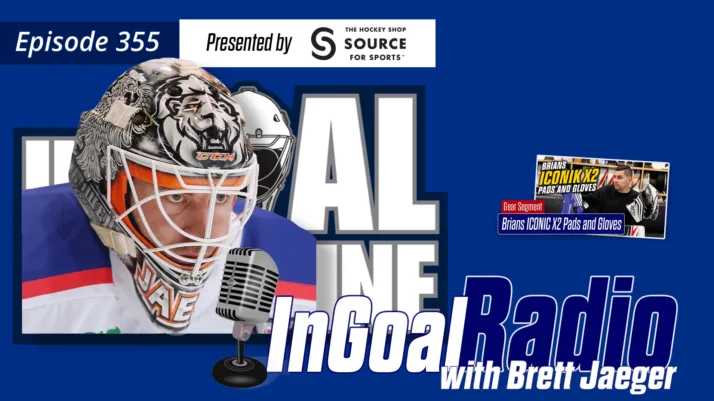
Episode 355: Brett Jaeger

Please subscribe and leave a rating — it helps us reach more goalies!


Brett Jaeger retired after 22 years of professional hockey, including nearly 15 seasons in Germany following stops in England and Denmark. The 5-foot-10 Alberta-born goaltender was named AJHL MVP before playing in the WHL and ECHL, and is now transitioning into goalie coaching. In this InGoal Radio interview, Jaeger shares the lessons he gathered throughout a long European career.
- Brett Jaeger played 22 years of professional hockey, spending nearly 15 seasons in Germany after establishing himself in the AJHL (MVP), WHL, and ECHL.
- Jaeger grew up in rural Alberta inspired by his father and is now channeling that experience into a goalie coaching career.
- Dustin Wolf of the Calgary Flames breaks down how to read shot threats and the ideal mechanics for a backdoor push in this week's Pro Reads segment.
- The Parent Playbook segment offers 10 tips for tournament success, timed to coincide with the World Championships and Memorial Cup.
- Brian's Iconik X2 pads and gloves are reviewed as a lower price-point option that still delivers several pro-level features.
Episode 355 of the InGoal Radio Podcast, presented by The Hockey Shop Source for Sports, features Brett Jaeger, who recently retired after 22 years of pro hockey, including more than a decade overseas.
Feature Interview
presented by NHL Sense Arena
In the feature interview presented by NHL Sense Arena, Jaeger walks us through a career that started as a kid looking up to his dad in rural Alberta, including time in the AJHL (where he was MVP), WHL and ECHL before heading to Europe for stops in England, Denmark and finally, almost 15 seasons in Germany. There were a lot of great lessons along the way for the 5-foot-10 puck stopper, and he shares them openly with us as he begins a transition into coaching.
Parent Segment
presented by Stop It Goaltending U
In the Parent Playbook, presented by Stop it Goaltending U the App, we share 10 tips for tournament success, a well-timed lesson coming off the World Championships and Memorial Cup, which are also discussed at length during this episode.
Pro Reads
presented by Vizual EdgeWe also review this week’s Pro Reads, presented by Vizual Edge, featuring Dustin Wolf of the Calgary Flames with some great advice on reading shot threats and ideal mechanics for a backdoor push. And in
Weekly Gear Segment
presented by The Hockey Shop Source for SportsAnd in our weekly gear segment, we head to The Hockey Shop Source for Sports, for a look at the new Brian’s Iconik X2 pads and gloves, a lower price point option with several pro features.
Episode Transcript
Intro
Welcome back to the InGoal Radio Podcast. If you're listening to me, that means our our fearless leader, Millard, is preoccupied. He might have something on his plate. They'll have something called the Stanley Cup final. But, in Carolina, a little busy this week, Hutch.
So it's me and you. So all the best wishes to Daren as he's off to cover the cup final with the Vegas Golden Knights. As he's told us over the past couple of weeks, no longer doing the practice goalie thing. They've got a Akira Schmid for that. So, we know he'll kill it.
Unfortunately, it means you're stuck with me driving the bus here. I will try not to take all the wheels off the road or over a cliff. Mr Hutchison, it's actually been a bit it's still pretty like, we got the cup final starting tomorrow. Carolina, Vegas, heavy hearts for Freddie Andersen, and the Carolina Hurricanes after the tragic passing of Claude Lemieux this week. I don't know if you remember this, but we met Claude at one of the early play hockey expos down in Vegas.
And I feel like it was the he was consulting with the Sherwood group or the group that bought Sherwood and Louisville. And, man, you know that it's funny. Obviously, incredible career. I covered a little bit of it as a journalist, but my memory is actually from that meeting and that conversation because I was wearing a pair of shoes that he also wore, and we ended up in a five minute chat about my shoes. Literally, when I told my wife about his passing, she remembered because I'd shared this story with her.
I literally came back and bought another pair of the same shoes. They're like a casual dress shoe because he had talked to me about but, like, just the kind of that that's the person that we lost. You know? Here you know, like, a guy who had all the success on the ice, and he would engage in a conversation that didn't necessarily have to be about hockey. He brought it back to you as a person.
And so our condolences to the friends and family of Claude Lemieux, including Freddie Andersen who, you know, clinched that series in the Eastern Conference final with a heavy heart and will be playing for Claude and his family here in the Stanley Cup final. There is a lot going on in the world of hockey, and I think we've got a little tie in. This week's parent segment, you told me, is gonna be about 10 tips for tournament hockey, and we just finished one of the biggest tournaments outside of the Olympics, the world championships. Two. Two, I guess, with the memorial cup.
Yeah. That tournament style as well.
So It's a big weekend with some big goaltending performances.
Some amazing goaltending performances. Let's start at the World Championships. Justus Annunen of the Nashville Predators with a really good performance in the gold medal game, wins it with a 19 save shutout. I gotta say, loved his game in the playoffs. An old friend of ours from the goalie coaching fraternity, James Jensen, who was with the Everett Silvertips who were at the other tournament In the memorial cup.
Recently moved to Nashville, texted me out of the blue, I wanna say two months ago. He was at a Predators game. His son is a goaltender, and he was so impressed with Justus Annunen watching him live in that game that he's like, I'm gonna teach my kid to play like this guy. Like, that's how No kidding. That's how impressed he was with Justus Annunen.
Now I gotta be honest. Annunen had some numbers early in his Colorado avalanche days that the adjusted numbers on clear side analytics were really promising. And then he had a bit of a dip one year, and they traded him to Nashville. And ever since then, it's like he's been building back up to what we saw originally. Like, there's a goalie here that I think has a really bright upside.
The numbers sort of indicate that he's a guy to watch. And as he continues to build that case with Juuse Saros under contract for a long time in Nashville, it'd be interesting to see what happens, especially as we enter a cup final and come off a Stanley Cup playoff run where there's a lot of sort of 1B's, the Scott Wedgwoods of the world that have emerged as starters for other teams. So a heck of a performance by Annunen. And now the bad news, at the other end, Leonardo Genoni. I mean
Well, hey. Let's not call it bad news. I mean, it's tough to not win. Yeah. But you know what I always say in the parent segments.
Let's evaluate the performance, not the result.
Well, the the result is heartbreaking because, like, has this guy gotta start being a forward too and score some goals? Is that three straight gold medal games where he has played behind a team that did not muster a single one? He lost one nothing to the American's in overtime last year, One nothing to Finland this year. And this year, of course, for Switzerland and Leonardo in overtime. Right?
Home host. Like, the crowd was create what a big moment that would have been. Still, like you said, he was incredible at the Olympics. He we gotta get him on the podcast. I've tried.
I'm gonna keep trying. I think when he's at the Olympics, all the media from outside Europe, all they asked him about was why didn't you make the NHL. I wanna talk to him about goaltending. Forget why the NHL never happened for him. Every time I watch this guy, he's exceptional.
He's clearly on big stages, performs really well. I'd love to pick his brain about the position and how he's evolved in it. So silver medal for the host Swiss and Leonardo Genoni, and and let's get you on the podcast if anybody hears this and knows him and gets it back
to And you mentioned two one nothing losses, but I believe it's actually three consecutive gold medal games lost one to nothing.
Somebody score a goal for this guy in the gold medal game.
Can't do anymore. Oh my gosh. Unbelievable. And and absolutely outmanned in all those games too. Like, this isn't like he gave up one goal facing 10 shots.
This is
Well, speak Yeoman's performance. Speaking of outmanned in the world championships, let's wrap up with the bronze medal game where another shout out is well deserved. Henrik Haukeland, I hope I'm saying that right, Norway beats Canada in the bronze medal game in overtime, an exceptional game from him, an exceptional tournament from him. First ever bronze medal at the world championships for Norway, who seems to quietly, as we've seen them do in other sports, be a rising power for a small country in hockey as well. And do you remember the and and also for the record, we are efforting to get Henrik on the podcast as well, and I will try and get used to standing in on as well.
Pretty sure I have a number for him. So these are exceptional performances, and we wanna get you on, guys. But USA hockey, this is the irony here. USA hockey's presentation for the bronze medal where they talk about how they're trying to develop athletes pointed directly at Norway, not hockey specific, but just the way Norway has to develop their athletes by impart taking score out of the equation completely and results out of the equation completely at a young age. You recall that?
Absolutely recall it. And I think we saw a lot about that during the the Winter Olympics as well, a lot of coverage of the Norwegian development plan. It's not just take the score out of it. I don't even think you're allowed to keep score. It's not that we choose not to.
I think across the board you're not allowed to and making all sports available for kids regardless of socioeconomic background, keeping everything about skills and having fun, it's we we really should present that whole program here in some way because I think it's good for everybody in the hockey and sporting world to take a look at what what Norway is doing with a population that is about the size of a Canadian province. It's we're not talking about a massive power here that can draw from hundreds of millions of athletes. Imagine your your local state is now dominating the world sports, at least winter sports. Yeah. It's it's just an incredible testament to the way they raise young athletes in Norway.
And I I gotta say though, you I mean, you run the Parent Playbook. We'll present it by Stop It Goaltending U, the app. We'll have that a little later in the show. Chances of parents in North America accepting scoreless hockey even up to age 12.
Oh my gosh. They can't handle when when the younger ages here switched over to cross ice games, parents went ballistic. How are they supposed to learn to play a full ice game when they're starting like this? I mean, they're practicing small area games at the National Hockey League level, and your kid's only seven years old. Relax.
People who are smart are doing the right thing here. Just go with it and see if it works, but, it becomes something that's super important to parents. So
0.0001% is the chance of parents allowing scoreless hockey to exist up to age I think it's 13 in Norway before they're allowed to even
Is it really?
It it is it is remarkable. So if I've got that wrong, I'm sure listeners will send me a note. Actually, Steve Thompson will send me a note because he runs all those excellent programs at USA Hockey, and and that was a standout to me when they shared the way they are doing things over there. Okay. We got a busy show.
We got lots going on. We got Brett Yeager.
You just you just let let's not forget the Memorial Cup, which you glossed over there a little bit quickly.
I was too busy with that. Yep. There you go. Shout it out. Tournament hockey before we get to
Yeah. Yeah. So so the Memorial Cup is the top junior hockey championship in Canada, the CHL. Over 60 teams compete to win this tournament, at the end of the year. Obviously, you have to win your league or be the host to get into the tournament, but, one of, if not the hardest, tournament in hockey to win. Congratulations to the Kitchener Rangers and starting goaltender Christian Kirsch, who is a San Jose sharks prospect for having won that yesterday over the Everett Silvertips where you just mentioned James Jensen is the goaltending coach along with goaltender Anders Nilsson out of Anchorage, Alaska.
And also Oh, Woody. I've forgotten the name. I'm going get in trouble. I'll see if I can sneak it in. The head coach of the Kitchener Rangers who is a Finnish head coach, first time it's been won by a Finn, was a goaltender who even played a game in the British Columbia Hockey League.
Congratulations to the Kitchener Rangers for that that win and and to Everett and all the teams that competed across the country this season in junior hockey.
I was gonna bail you out here with a quick Google search. Please. It was UC Ahockey, but I don't know if I'm saying that right because I did not watch a minute of the memorial cup. I was preoccupied with the world championships and a little bit of travel. So hopefully, I got that right.
He's a goalie, so he'll forgive us because he's a part of
the It's the last minute I discovered that he was a goaltender, but it's always excited with some when somebody from the goaltending fraternity does well at something.
Excellent. Hey. Also, let's go back to the world championships because I know they lost in the bronze medal game, and he'll be disappointed. But Jet Greaves with the shut out
Of team USA to get them to the semifinals. Exceptional game there. And I think that on behalf of the Woodley family, we'd like to thank Jet. Apologies to Devin Cooley, who's also a fan favorite here at the InGoal Radio Podcast, but my poor daughter is going to school in The United States as a Canadian in a part of The United States where they think we live in igloos and all the stereotypes, including hockey, and she has taken a crap ton of heat ever since the Olympics. So she gets a little pushback.
We were we were we were on the island on Tofino surfing when it happened and immediately lit up the text messages of all her college teammates who have been giving her a hard time about the Olympic results. Thank you, Jet, for giving her something to push back with in the quarter final. Alright. So we mentioned featured guest. I teased it sort of.
Got started. Got cut off because I hadn't finished the other thought. What do you know me not driving the bus in a straight line? Kel Suprise. Darren, we need you back when you're done with that little thing they call the Stanley Cup final.
Brett Yeager, twenty two years as a pro. Local kid here in in in the Lower Mainland that we got to know, played junior here in Alberta, was on the ice with him working with a couple different coaches over the years. We'll get into that in the interview. Coming off a twenty two year career in Europe. Played as high as the DEL, finished up in lower slightly lower levels in Germany, is now transitioning into coaching and working with kids. And we just wanted, when we found out he was retiring, to pick his brain on that journey.
Gear
I think a lot of us in North America, we look at junior, we look at college, and we look at the road to pro, and we don't even consider the options that exist, not just to continue playing hockey and get paid professionally, but to build a life in some pretty sweet places across the world. And so Brett's lived that, and we're gonna get into that as well as some of the lessons that he picked up along the way in our feature interview presented by NHL Sense Arena. But first but first, we need to talk about what's going on over at The Hockey Shop Source for Sports because there is new gear coming in every week. Last week, we told you about the Bauer Fuse pads and gloves. We've got the Bauer Fuse chest protector coming up in a couple weeks.
Second price point equipment is coming in on a regular bay. Like, every week we've talked about this before, Hutch. Man, second price point stuff is Unbelievable. Good as pro was even three, four years ago. Half the price, little more flex to it.
And so this week, we're gonna take a look at. There's a ton of it. There's the new CCM Tacks, not pro, second price point. The Bauer Supreme line has a second. Like, all of these, there there's a new second price point from True.
All of these options are in store at The Hockey Shop Source for Sports, including this week's featured segment that Cam is gonna explain, the Brian's Iconic.
Iconic.
Cam likes to think he's iconic. I think not, but it is the Brian's
The sound editor hates it every time he whispers iconic. Brian's Iconic x tube, I won't whisper it. I'll shout
it from the rooftops, and I'll let Cam explain why in this week's Gear Segment presented by the Hockey Shop Source for Sports, The Hockey Shop in Langley. Top level sliding material
Prevo.
On a lower price point pad. Yes. I like it. The new the new Brian's Iconic x two. X two.
So this is a second mid price point pad.
This is the mid price point.
So not as expensive as the highest end. Not as expensive
as the Iconic 2.
We've got some Iconic two features on it, including Primo on the slide surface, one of the premium sliding surfaces in Goalie equipment.
I don't know how else you were gonna string that one together, but
It's as good as I got, Cam. It's as good as I got today, buddy. You know the secret to being a good goalteller, Cam? Actually, keeping the puck out of the net? No.
It's being able to perform when you have your b game. So, premo premium is all I got today. I'm gonna need you to walk me through the rest of why I care about the Iconic X two pad. Ladies and gentlemen.
So, new Iconic X 2. Pad wise, we're talking about construction wise, what Brian considers our modern butterfly style pad. Okay. So more flexible. I noticed that.
Very flexible. I like that. Versus, say, the optic See those reactions as I dropped them? Yes. I think I noticed that.
So what we find with that optic pad, we're gonna get more of that, like, zed shape kind of style of a profile. This pad, a lot more acceptable flex. A little more rounded. Correct.
Will hold the shape as you break it in?
Yes. So if you get a little bit of that profile to it, pop it down. It will start to hold that shape a little bit more so you can get more of that rounded shape there, but if you wish.
Doing all these things we're not supposed to do in the store.
Yeah. I don't I mean, it's not really a good gauge of the way that the pad performs. I know. We've this conversation before.
We've had this conversation. But what
it does tell you is that it has a nice soft boot, so that's already a good start to it as well. Okay. Moving on to the back of the pad. Big knee stack. Yes.
So something that we saw That's a big old knee stack. Coming from, again, their previous versions. So we have that updated knee stack as well. Great overall feature for getting you up a little bit higher in your butterfly. Overall stability in the pad too as well.
Obviously, a giant improvement with having that bigger, thicker knee stack.
And, again, sort of flat inside edge. There's a lot of connection between the ice. Normally, you'd say that means a lot of resistance while sliding, but this material is so good. It makes such nice shapes or sounds. Yes.
Cam's gonna, like, do some wrapping soon.
Oh, I hope not.
It'll slide good. Yes. Whiskey, whiskey, whiskey, whiskey,
Great. K. Simple bite strapping. So one thing that the Iconic pad has really pushed forward is literally only two straps pretty much. So Simple.
Calf. You're done. Pillow. Nice and thick. Well, I can use a nap.
Segmented pillow. Correct. It's gonna again Contour and allow that.
Gonna hold your ankle high in the air, which is not good for your hips or your knees. Nice arrow mesh shin pillow. Connectivity. Little pillowy to it. Correct.
Nice arrow mesh shin pillow. Connectivity. Little pillowy to it. Correct.
Is this a bootstrap?
It is. They're smart bootstrap. I mean, it's removable. I forgot what bootstraps were. Yeah.
I probably say in most cases, it's definitely worth getting rid of. It's been deleted off of the Pro series.
But understand, like, hey. If you've got a youth goaltender, right, if the second price point, you're not buying pro, second price point, you've got a young goaltender, and you're worried about, like, hey. It might be a little big on him right now. Not that we encourage buying them too big. We want them to fit, but a little like, the one thing a bootstrap does is hold the pad down a little bit.
Mhmm. And then as you go into it, you can as you said, it's removable. Like, are there are uses. There are a guy Jakub Dobes. There's a bootstrap going through the middle of his skate, not necessarily the back
[crosstalk] of skate. Elastic toe ties, one of the few. There you go. Yeah. But I digress.
So You do. Elastic toe ties at my back tier. Do their same smart toes. Do with what you wish. Switch to laces.
Obviously, you have the option there or continue with that
smart toe. Hey. They still got the little flap for the knee.
For those knee pads. Yes. Specifically, they're
I'm gonna take it out just so you have to put it back in after.
Oh, perfect. Thank you for that.
Alright. Velcro's right in, folks.
Moving on. Cam, you wanna
put that back in for me when I'm done? Later. Show me the glove, Cameron.
Okay. So did you like the Iconic glove? Then you're gonna love the Iconic X2. Why? Because it's the exact same break angle.
And which is? Same overall feel. What do
they call this break angle, Cam?
So it's their 35 degree closure, which is closer to a 600 break kind of kind of. We got a video that
you can go find that sort of breaks this all down as the different brands have different names for their brakes and how they all sort of match up. Just so you know. It's You can go find that.
Yeah. Hey. The V fives are back though.
Oh, I like the thief eyes. Those are cool.
So double t. Nice wide open closure. Reinforced on the actual finger rail itself. Bit of a problem with the iconic original that did tend to split a little bit. They had some problems with the plastic, so this is something they did fix a little bit better.
Blocker. It's a blocker.
It is. Don't make me punch you with it.
And fans of the Iconic, you're gonna feel pretty much the exact same. It's got a new graphic. And, you know, that's that's neat. Right? Basically, what I'm getting at folks, this hasn't really changed a whole lot and it didn't need to.
Nice solid blocker. Fingers
wraparound Little extra, like, wraparound foam on index finger. I like that.
It's not necessarily called out as any specific, like, crazy foam or anything like that, but does give you a little bit of that impact protection as well.
Hands off my fingers, Cam. Is it adjustable? Like, with the Velcro on the back? Okay. Then Yep.
It's in.
Okay. Alright. So we're talking a lot about how this Iconic X2 is very similar to, like, Iconic, and you're like, so why is there an Iconic X2? Well, because it's what? Half the price?
Yeah. It's a second price point, folks. So what are you gonna get less of? Cameron talked about the glove feeling the same. Probably gonna be a little less materials.
The flex in this. You don't get the dials. You don't get the right. No dials. The durability might it might not quite be the same in terms of the foams that are used on the inside.
It's a little softer,
a little more flexible. Durability is fair in this price point because I think you can still get a quite a long lifetime out of the pad.
It's just what you are gonna not The frames might soften up a little
You don't get Bri core into the pads. You don't get Bri core into the blocker. You don't get Bri core into the glove. So there's gonna be some sacrifices of those internal foams. That's why he's the two different price points.
That's why you pay less. I oversimplified. Cameron had a good explanation. That's why we come here. And if you have questions about whether this is for you or the young goaltender in your life, what age group it works for, what level of play it works for, I would suggest giving Cameron and his crew a call.
Where can they get (604)
(604) 589-8299 or 1-800-567-7790. And of course That number again is (604) 589-8299.
And if they wanna email you?
Goalie@theHockeyShop.com.
Goal. It's simple. Oh, simple. Questions about goaltending, ask the experts. Hockey Shop Source for Sports in Langley, Hockey Shop Dot Com, Brian's iconic x two.
We just got through an entire segment of the Iconic line without Dippy Doo going, iconic. It's because I'm iconic. No. You're not. Alright.
Another option. Like to see.
Option. So many. Brian's in the Stanley Cup final. Maybe not that exact set, but
think I think Carter Hart is an Iconic guy.
Is he?
I believe he's an Iconic guy. I gotta double check that. So, yeah, you're right. I forgot about that. So a little older we got in the Stanley Cup final.
We got a True and Brian. You know what else we got in the Stanley Cup final? We got a we got we this is two teams that use the tracking goggles.
Oh, yeah.
Carter Hart uses it every game day. There's gonna be more emails coming in. It'll be very interesting to see whether see whether media picks up on it. They may just see him with goggles under his mask during morning skate and assume it's just another set of swivel vision, but it's not. It's a new track optic goggles.
And I know Freddie Andersen's not using them as as much anymore or or using them at all anymore, but I know Pyotr Kochetkov uses them. I know Paul Schonfelder, the goalie coach from the Carolina Hurricanes has used them. Dustin Wolf, Devin Cooley. But Carter is one of the first ones that that's using them as publicly as he is. Like, every morning skate it's on, I've got video of him using it here late in the season, talked about he actually felt while he was out for those three months.
He expected to come back on the ice after missing three months and feel real sloppy, but he started using it wearing them off ice. And there's a lot of science behind it how it can reset vestibular function. He got on the ice and said his edges were dialed. So keep an eye out for that if we see footage from the Stanley Cup final of Carter Hart wearing the new track optic goggles, which should be out later this summer.
The other one I'd love to hear you comment on is I am sure people will be watching Freddie Andersen in the playoffs and say,
[crosstalk] those pads look short. They are short. We've discussed this in the past, I think.
A little bit. I actually was in the locker room when he was with Like, I didn't know you could order a 34 minus two, but that's what it looks like he's wearing.
Yeah. They definitely look short. And now listen. Some of this is just the you know, everybody's body is built different, and there's measurements, shins and thighs, and maximum heights for each goalie. But Freddie's not a guy that's ever worried about maximum when it comes to his thigh rise.
I remember being in the Toronto Maple Leafs locker room with Freddie. He was still wearing Bauer at the time, and he had actually sent his because, obviously, Bauer pads at the time were, you know, small, medium, large. There wasn't a lot of plus one option available there. I believe there is now a pro. Just for the pros, they can order slight alterations on that.
I should just probably double check that before I put it out into the wild. But he actually had taken his Bauer pads, had them sent to somebody locally that basically chopped an inch off the top of each one, maybe an inch and a half. Trying to remember off the top of my head. And we're in the locker room, and he's showing me how it's stitched up. And I'm like, why wouldn't you want the extra coverage?
And he just showed me. He did carpet flies in the Maple Leafs visit the visiting room of the maple leafs in town about showing me, and he's like, it was perfect. Like, it just sealed perfectly. Like, when he drops into the butterfly, the tops meet right at the top, and there's no five hole. So, yes, folks, if you are seeing that and noticing that, he does wear a pad that is, you know, my understanding is a little bit below his maximum height.
Was it simply because they sealed perfectly at that size, or was there more to it about wanting mobility?
Well, he felt I mean I mean, he felt like there was no interference at the top of the pads as they as they clicked together in his butterfly, but right right in that right spot with the coverage. They weren't hitting each other. They weren't you know, sometimes when I hit each other, you can push your legs apart a little bit, create a gap between the pants. He just felt like he was more mobile, moved better, and he didn't need the extra height on the top of the pad. So I know Bobrovsky years ago did the same thing.
Now he's since you know, I know they've talked him in Florida to adding a little bit more to the top and go. I don't know if he's at his max or close, but it's really interesting theory. Like, it's it's funny. We don't hear a lot as goals go in and save percentage drops below 900 for the first time in forever in terms of shrinking the equipment, but it is funny that as they started to shrink it, goalies felt more mobile and some have shrunk it beyond the maxes that they currently play at. So something else to keep an eye on.
Daren, if you're listening, you're all over these angles live from the Stanley Cup finals starting in Raleigh, Carolina. So back to us, Hutch. See if I can pull this bus back on the road. ProReads this week. ProReads.
Presented ProReads. By our friends over at Vizual Edge. Would you like the puck to look like a beach ball? I know I would. Every goalie has that night here and there where the puck looks huge.
You're ahead of every play. You feel calm, patient. You're in total control. Then there are the nights that I know far too well. You're a half step late.
You see it, but you don't really see it. You're reaching. You're guessing. You're fighting it. That's not your technique.
Thank goodness. It's your eyes and your brain not processing the play fast enough. Vizual Edge fixes that. It measures how well your eyes track and process the game that gives you a custom plan that trains improvement. Three fifteen minute sessions a week on your laptop or tablet, that's all it takes.
It's what NHL goalies like Jordan Binnington use to make the game slow down when it matters most. And, of course, remember, 10% off using the code InGoal, all caps, I n g o a l. And if you're a member of InGoal Magazine, you have subscription. Just go to any ProReads, including this week's, for the exclusive membership discount to save even more. 20% for all members.
Make sure you check it out at any ProReads, including this week's, which features Dustin Wolf with some advice on shot no shot threats on a power play, how to read the difference between what makes a guy a shot threat and what doesn't. This is a tough one for me to present and ask questions, and we don't have Daren here to lead the way. So I'm just gonna explain it a little bit. Dustin walks you through some of the tells about whether and in this case, it's Nathan MacKinnon of the Colorado Avalanche getting the puck in a similar spot at the top of the circles once and then a second time, and what factors around him make him either a shot threat or not a shot threat. And so it's a really interesting breakdown because there's one where he's in the same spot on his forehand, and Wolf's like, he's not shooting here.
And there's another one, same spot, other circumstances have changed, and he's absolutely locked in on on Nathan MacKinnon as a shot threat there. So that's part of it. And then he gets through the mechanics of a backdoor push in terms of getting access to pucks on backdoor onetimers on the power play. I mean, Carol Colorado's power play this year struggled, but last year, it was a wagon, and we're breaking down some of the footage from last year. So that's all at ingoalmag.com right now featuring Dustin Wolf, one of over 300, I think 350 now, Hutch, in that neighborhood.
ProReads that you can watch of NHL goalies breaking down footage, explaining their decisions, explaining their depth, explaining their save selections, all things that will help you read the game better and make you a better goalie. So Vizual Edge presents ProReads. They'll help you see the game better, and ProReads will help you read the game better.
Make sure you check it out at ingoalmag.com. I would suggest that in this one, Dustin Wolf ends up in a position very few goaltenders could ever get themselves twisted into. However, everything about how he got there before making the save applies to every goaltender everywhere. So I found it kind of an interesting one from that perspective, and he didn't mention. He talks about why he thinks the Colorado power play is, quote unquote, terrifying.
He sounded awfully relaxed about Nathan MacKinnon standing there, and he's not gonna shoot for a guy who calls something terrifying. So it's interesting juxtaposition right there.
Yeah. And and and like I said, we did this video at this with with Dustin at the start of this 25-26 season, and it involved footage from last season when the Avs power play was indeed terrifying, I would argue, it lost a little of its terror element this year. Maybe not from the goalie perspective, but from a results perspective.
I would argue if one of us was standing in Dustin Wolf's place, it would be terrifying.
Oh, if I was standing in the crease of the National Hockey League, it wouldn't take the Colorado Avalanche to
It'll be terrifying for your Calgary teammates if you
were there. It'd be terrifying. Yeah. It would be terrifying for everyone if I was in the crease, including myself. There's a good chance we'd need to change some shorts pretty quick.
Alright. So on to the parent segment. I'm gonna turn it over to you, Mr Hutchison. But first, the parent segment is presented by our good friends over at Stop It Goaltending and Stop It Goaltending U the app. Would you like twenty five years of NHL goalie coaching experience at your fingertips?
Wanna tap into the goalie parenting expertise that helped Joey Daccord reach the NHL? That's what you get with the subscription to Stop It Goaltending U the app. All the knowledge from Brian Daccord has been an NHL goalie coach, scout, and director, including currently with the Detroit Red Wings, as well as all the insights and expertise from his staff at Stop It, which includes a long list of veteran NCAA coaches, all delivered in easy to digest chunks, including five short daily primers each week, style analysis, video breakdowns, and drills you can take onto the ice with your team and coach this summer. Plus, you automatically get a subscription to InGoal. That is InGoal and Stop It Goaltending U, the best of both worlds coming together to make you a better goaltender.
Make sure you check it out now at the App Store or Google Play. Stop It Goaltending U, the app. Hi. Right on. So today, Woody, I have 10 tips for tournament success and a bonus about travel at the end.
So today, Woody, I have 10 tips for tournament success and a bonus about travel at the end.
Parent Playbook
Spring tournaments or tournaments in general can feel like a big moment, but really, they're just an opportunity to enjoy the experience with your goalie without the pressure of results. I know everybody wants to win and we build these up, but that rarely is the point at least. I don't think it should be. It should be just about going out there and having fun because look, this isn't your league, this isn't heading into a Provincial Championship or a National Championship, it's just a chance to get together and compete against some other teams. I know there are some travel teams that really build this stuff up but go out there and have some fun because for most of us, that's all it is about.
So here are my tips. Number one, keep your sleep consistent. Just maintain healthy sleep habits. Don't treat this tournament as something special because, you know, I want everybody just to treat every game as the same, but be prepared. And since travel changes the logistics, don't make it a big deal but make sure that every day and every game gets treated the same and kid is getting the sleep that he needs because there's a whole lot going on that weekend and a chance to sort of spin things out of control if we don't have a routine that we've been maintaining for a while, not just that weekend.
Number two, have a nutrition plan. Just think ahead a little bit. You are going to spend some time in restaurants so think about what the healthier options are that are available. There's no shame in bringing your own food from a local grocery store whether that's about saving money or staying healthier, maybe even using a healthy cooktop in a hotel, which I've done before, keeps things healthy and like I said, helps with the costs. Just balance that though.
Don't forget with letting your kid enjoying being around teammates and out with the team. We don't want to be pulling little Johnny from a team activity because we think that we can make something slightly healthier in the hotel room. Number three, build a gear checklist. There's a lot of moving around, differences from routines. So having a checklist is important.
Everybody's is gonna look different, but it is important to keep yourself organized. Something like maybe backup blades because mid tournament sharpenings aren't easy to find. You don't want to be racing all over whatever town you're for the first time looking for a place to sharpen Johnny skates. Those racks in your room for drying gear, massive help. Roof of your car in the sun is a nice fallback if you have to.
Number four, have a talk with your kid about what success looks like. Have a mental preparation conversation with your goalie about their own goals for the weekend. And, as always, separate them from the wins and the losses. You can refer to some of my previous segments for more about that. Number five, embrace the unknown.
Spring tournaments are unpredictable. You don't know which teams you're up against. I think that's part of the fun. It's a big change from your local routine. Six, stay calm between games.
Resist the urge to overcoach or critique your kid. It is a short and quick weekend. Your goalie needs support, not a play by play breakdown from you. Number seven, debrief but don't dwell. Help your goalie process the games afterwards as we've talked about many times before without getting stuck on the mistakes or the losses.
If you've listened for a while, you know the drill. Focus on the process and what they did well. Number eight, prioritize recovery. Rest between tournament days is part of performance, not a break from it, but don't forget to have fun at the same time. I'll just stand here on my soapbox and say stopping your kid from swimming at age seven because they've got a big game.
Let's just say I don't really approve of doing that. Moderation is the key. Don't forget they're there to have fun with teammates. Number nine, model the enjoyment. Your attitude will set the tone, how you carry yourself throughout the weekend.
If you are present and having fun, your goalie will too. And number 10, remember the big picture. As I've already said, spring hockey is about growth and experience, not results. And here's my bonus. I see this question come up a lot for parents who are traveling for the first time.
Maybe it's to a camp, maybe it's to a spring tournament. How do we travel with gear on a plane? I'll tell you for the most part, it's pretty easy. Call ahead to confirm with your specific airline but in my experience, airlines treat your gear as just a piece of oversized check-in luggage. Get yourself a bag that's big enough to fit the pads in with the rest of the gear.
Keep it under 50 pounds. Again, confirm that figure with the individual airlines. And your sticks will often be included even though they're not in the bag as considered that one piece of checked baggage. I suggest you use sock tape to tape at least two sticks together because it gives them extra strength and put them in some sort of protective bag but it doesn't have to be fancy. One airline gave us a plastic bag they kept just for putting skis in in the wintertime and that worked just fine.
So should be fairly easy. Make sure you call ahead though to be sure that the individual airline you're working with has that same policy. So there you go. 10 ways to set your goalie up for success this spring or at whatever next tournament you're headed to. All parent segments, as always, are presented by Stop It Goaltending U.
And I will remind you that they're published on the InGoal website with a complete transcript. I would love you to go to the post for this week's one and let me know your thoughts and tips in the comments so that others can join in on the conversation.
I love it. Great advice. The one in particular that resonates is the packing your own food a little bit. Can be both a cost saving, but also and, like, just have control over what's going into your body. Like, how we feel is so important.
I'm living this a little bit with a young college athlete in the house and some tough decisions when she's on the road or, you know, even even dorm life where it's not athlete specific at her college, and so there's a lot of heavy foods there. It's an important factor in performance, how you fuel. And taking your own snacks gives you an opportunity and your own food can give you an opportunity to better control that because last thing you wanna do is feel that McDonald's rumbling around down there in the middle of the second period. Have a Roberto Luongo moment in overtime.
That's for sure. And having the snacks that are healthy, I think, is a really tangible way of putting that one. I do I I said it already, but I'm gonna say it again. Don't forget you're balancing the social with the practical. You also don't want your child to be that one kid on the team that's held back to eat salad in the hotel room while the rest of the team is out having fun because that puts them in a difficult social situation as well.
But you can make some healthy choices restaurants.
Why were you looking at me when you you said that, Hutch?
I was actually remembering somebody else and it's not you, but I can remember some spring experiences where another particular little Johnny was not allowed to go to the restaurants, was not allowed to go in the pool with the rest of the team because this was so important And I guarantee, thinking back to age seven, mom, dad, and child will not remember that the tournament even happened, let alone what happened at the tournament.
Oh, the pool's a tough pool's a tough one. Right? I remember even playing, like, baseball at pretty high levels and at, like, 12, 13, and they were like, nothing nothing drains you. Nothing wears you out faster than swimming, and we weren't allowed to do it at those ages. But that was at least, like, Provincial Championships and stuff, and I'm still bitter about some of it.
Well, yeah. And it I mean, sure. Take your kid's age into consideration to an extent, but let's just not get over serious about these, spring tournaments. And and it's not the swimming because the kids aren't swimming. It's the running around while they're in the pool.
And you can do it with some moderation, and maybe you do it after the last game of the day and not in between games. Like, there's ways of pulling this off and staying sane.
Yeah. It's it's it's it's I get it. It's tough. It's tough sometimes. But, I mean, I don't wanna I'm I'm I'm I'm hedging here, Hutch, because this is still we're still technically on the parent playbook, so maybe I'll have to cut this out if you disagree.
But, you know, the kids that are never allowed to have a single thing with sugar in it, and then eventually they're allowed to or they go to a birthday party and they lose their minds? Or in my case, I remember first year university, I actually quit the baccalaureate program at grade 12 so that I could live a little. And all the and I should say all, but a lot of the IB baccalaureate kids that got to first year university, and all of sudden, there wasn't somebody watching with a thumb on them when crazy in first year university. And, boy, did a bunch of them not go to second year university. So Well, that could be
a whole parent playbook on sending your child off to university because we have certainly lived that both as parents and individuals. Don't know if I'd blame it on the IB program, Woody, but definitely
No. But
on your kid is a
different Yeah. I mean, if you if you at some point, your kid's gonna have the freedom to live a little. And if you deprive them of all those things, maybe they stay deprived or maybe they embellish in their first attempts. We'll see. Woody should not be giving parenting advice.
Kids have turned fine, but I am an example to know of.
I'm I'm trying to look for the the the comparison to hockey here. So I guess if you're too tough on your seven year old kid at spring tournaments, when they make it to the Memorial Cup and you're not watching over them, they're gonna go crazy.
They might. No. Maybe not. Yeah. Team team might
The team's probably keep them pretty locked down.
A little little thing called curfew. Alright. We're on to our feature interview presented, though, by our friends over at NHL Sense Arena.
It sure is. And we thank our friends at Sense Arena for featuring or presenting all of our feature interviews. Listen, goalie month might be behind us now, but summer is just getting going. And as we just mentioned in the Parent Playbook, that means travel. Tournaments, camps, the family road trip, all the stuff that's good for your goalie and all the stuff that makes it feel like work stops for a couple of months.
But here's the thing. You've heard me say take a break and have some fun. Well, if you've got one of those kids who thinks that fun means goaltending, then NHL Sense Arena is a great way to change things up, stay sharp, and have some fun while giving your body the break that it needs wherever you might be this summer. You can't pack a net and a shooter in your suitcase, but you can pack a headset. Sense Arena's NHL goalie drill collection is 12 drills built from the real routines of NHL goalies.
You've heard it before. Joey Daccord from Seattle. We've got Utah Mammoth, Calgary Flames goalies doing reaction speed, puck tracking, game speed reads, all the stuff that fades when you go dark for the summer. And these aren't exhausting workouts. They're just quick focused reps you can jump into anywhere.
A travel week between camps, an airport delay. I could see Woody putting his headset on in the airport wherever the ice isn't there. And if you do, please send us a photo and be creative. We've actually got one of Woody on a surf vacation using his headset. Got another of a goalie standing in Lake Louise near Banff using Sense Arena.
We love getting those photos, so run a few reps, stay sharp, be ready for next season. The NHL goalie drill collection is live now inside NHL Sense Arena. And as always, use the code I g m 50 when you get NHL Sense Arena.
Gotta say sharp Hutch, even if I'm on a surf vacation to Tofino. I haven't seen you have the guts to surf while using the headset. I've seen you standing by the edge of the shore. Absolutely spectacular photo. I'd like to see you try it on the surfboard.
I haven't seen you have the guts to surf while using the headset. I've seen you standing by the edge of the shore. Absolutely spectacular photo. I'd like to see you try it on the surfboard.
I don't think that'd be a good idea with a functioning headset. Last I checked, the VR is not waterproof.
Oh, but you're such a good surfer. You'd be fine.
There is
no waves way you're going in.
There is no way to get out to the waves without submerging at some point. I think
you can do that in the baby waves, Woody. I'm sure you can. I've seen people take the dogs out. The dogs aren't submerging, are they?
No. That's that's fair. We could probably do it in the in the wash waves, not in the green waves, but we we'll we'll we'll work on that. Okay? We'll effort that
waves and green waves. You're getting into stuff I know nothing about. I tried surfing once, and I didn't catch a single wave.
Feature Interview - Brett Jaeger
Well, that's most of my trips too, but beside the point. To our featured guest, who I I I got it wrong earlier. I mentioned he was from area, local guy. He's actually not, and he's gonna get into that at the beginning of this conversation. From Alberta, Peace River, Alberta.
Small community in Alberta, but also a one time Alberta Junior Hockey League MVP, AJHL MVP, played in the WHL, the ECHL, the CHL, before heading overseas. A year in England, a year in Denmark, and then finally in Germany about fifteen years ago, he settles in. And like I said, over a decade playing pro over there is now transitioning into the coaching side. Rather than me try and recap a career that long, let's just get right to Brett Jaeger with this week's NHL Sense Arena feature interview. Really excited to welcome to the InGoal Radio Podcast, first time guest.
And I got a hunch it might be first to many because it's long overdue. Brett Jaeger, as he winds down a twenty plus season professional career over in Germany, making some transition into some consulting and into some coaching. A guy that I was blessed to watch in his younger years as a pro over North America, working out here in Vancouver in the off seasons on the ice, and a guy I know is a true student of the game. So I can't wait to hear what's next. Just really quickly, Brad, I wanna get into the background, but catch us up with where you are now physically as you wind down your career and what the next step is before we sort of dig into some of the origin story.
Yeah. Well, I'm over here in Hanover, Germany. And, yeah, I've been playing here in Europe for the last probably twelve, thirteen years. And, yeah, winding down or winded down my my career and now gonna look into getting into the coaching aspect of things and, yeah, excited to pass all the knowledge down to the younger guys.
Okay. So just for those that don't know, mean, you could the HockeyDB takes some scrolling from the AJHL originally from Alberta to the WHL to the coast, little CHL, one call up to the AHL, and then overseas to Germany. So more than a decade playing overseas, you also played in England and Denmark briefly. First off, that career path and career option overseas, like, there's a lot of guys in North America that don't necessarily even look at that. What's it been like for you?
Like, what what what would you say are so other than getting to continue to play till you're 43, which, by the way, is remarkable. We need some advice on that from a health standpoint. The the biggest benefits of of, you know, playing overseas for as long as you have?
Well, for me, I was I was lucky to to play for some good teams. And well, England was more of a North American style league. There's more physical play, lot of games. I think I played over 50 games that year.
Yep. 50 plus playoffs for Coventry Blaze.
So it's a it's a you know, if you're an import goalie in that league, you're playing a lot of minutes and that's kinda I wanted to use that league as a stepping stone into, you know, Denmark or Sweden or Germany, and I was lucky enough to get on with a smaller team in Denmark. And then kinda partway through that year, a German team, you know, came up and scouted me or and looked to to buy me out of the contract and, you know, we weren't gonna make the playoffs. And they that team is kind of renowned to look for, you know, German Canadians or German Czech guys kinda with the last name that is German so you can get your passport. And I was lucky enough to, you know, go to the government and get get the passport with the team. And that also extended my playing career.
I wasn't an import goalie then, and so that helped me out a a lot by extending my career. So I was very lucky for that to happen. So yeah.
Okay. So let's go back, origin story. How did it start for you growing up in Alberta?
Well, I grew up very small town, Northern Alberta, Manning, Alberta. So that's probably an hour north of Peace River. And, you know, I I my dad played senior hockey, and so I would go with him to the rink and watch his games and fell in love with the, of course, the goalie equipment. His goalie, his name was Eric Hinetuck. He was my idol growing up.
He was a smaller guy, but could move around, loved playing the puck. He played the puck better than some of their demons. So that's kinda, like, the first goalie I laid eyes on. And so after the games, well, you know, the parents are having some adult beverages. I was trying on Eric's glove and getting people to shoot things at me, kick things at me, whatever it was, and I was pretending to be the goalie.
Even my my grandpa was coming to watch my dad play, and he'd be having to kick a puck at me in the corner and always wanted to be the goalie and fell in love with the equipment. And yeah.
That's I mean, we've had a lot of different origin stories. I'm not sure and a lot of different early inspirations. Usually, they're big names in the NHL. I'm not sure we've had any senior men's hockey from Northern Alberta inspiration stories. That's that's one of our first.
I love it.
Yep. No. Eric was a great kind of like a legend in that league. And like I said, he could play the puck better than some of their demons. So
Love it. So into Drayton Valley, AJHL, and into the WHL, was difficulties, challenges coming from a more rural area? How did the opportunities present themselves, and how did you go from, you know, in the locker room with the senior men's team to to playing at that level? How much was it coaching? Who were your influences early on, or was it just you out there competing?
Well, I was I was lucky actually to grow up in a small town. And when you're in a small town, there's not a lot of goalies. Upside. Basically basically, we practice, I remember, Tuesdays and Thursdays. And so if I was, like, a peewee or an atom, I would be, say, on at 05:00 and then say the peewee team would need a goalie.
So I'd stay out for the second practice. And then, well, the Bantams would need a goalie, so I'd stay out. And sometimes, like, the the midget guys would need a goalie, so I would stay out. And sometimes my dad's team would also need a goalie. So sometimes I was on the ice maybe three or four hours night.
And then also that also worked for games too. Like, if for provincials and stuff, you could go with the older team and get some work in there and get some reps and play against older guys. And small town. Nobody really kinda you know, they kinda knew people in the area heard of me. They my dad was a was a decent player too, so they I think he led the the league in scoring a couple years when he was younger, so they knew that name.
And and then there's, like, a couple tournaments we went to. I think my Bantam draft, we went down to, like, Edmonton and yeah. We were we were a c team, and we were playing against triple a teams. And we were getting beat in this Christmas tournament eight or nine nothing, and I was seeing 70 shots. And that's when some scouts kinda started taking notice and talking to my dad and a little bit dub dub scouts.
And then, I played in the Alberta Cup back then and actually ended up winning it. And my coach at the time was Barry Medori, and he was joining the Drayton Valley Thunder as the expansion team as the assistant coach with Milan Drakulic.
Okay.
And so I was also with him at under what was it? Under 16. He was my coach at under 16, and Cam was there, and had a good camp there for Hockey, Alberta. And then, yeah, I always wanted to play for the Grande Prairie Storm.
Okay.
And went to their training camp, and they wanted to win a championship and didn't need a 15 year old goalie. And so, yeah, I ended up getting drafted by Medicine Hat and got cut from Grande Prairie, and then Barry was talking to my dad a lot. And I went down to Drayton Valley and ended up making it as a 15 year old on the expansion team.
So And then and then Medicine Hat a couple years later. They had your rights. Couple years with them. Little stint with the Giants. I'm wondering if that's a Dragacevic thing as well if he was there at
the time. Yeah. Yeah.
Finish it up with the Saskatoon Blades.
Yeah. No. I mean, there's that first year in Drayton, you're going down to play against the Calgary Canucks and Calgary Royals. And, I mean, we had, like, 10, 16 year olds on the team, and you're get the shots were, like, 77 to 10 or 13, and you're giving up maybe eight or nine. But, I mean, that year, I I did a lot of developing as a 15 year old.
And 16 year old. I was an all star and played in the Viking Cup, and then had to make a decision if I was gonna go NCAA or Dub, and we chose after the Viking Cup. I I played well to go the Dub and, yeah, went to Vancouver too with Milan and also an expansion team. Saw a lot of rubber there. Not a lot of wins, but yeah.
And then Saskatoon traded for me and, yeah, finished off there, and that was that.
What advice parents, we hear this all the time. It's actually was a recent parent segment that Hutch did. Parents wondering like, hey. Do I you know, like, where do I put my kid? That that we always sort of weigh in that the positives and negatives of ending up on an elite team where you don't see much shots or the benefits of as you grew up, being on a team where, you know, you're peppered and you're under pressure and maybe the scores get a little crooked sometimes.
Any advice on parents that face for parents that face that decision and maybe even more so for young goalies going through it? Like, that can't be easy, Brett, you know, being on the other end. I know it was a long time ago, but being on the other end of some lopsided scores, how'd you balance that mentally as a goaltender?
Well, yeah, it's like a double edged sword there. You know? You wanna get a lot of work and develop, but you wanna still feel good about your game and win. Right.
And, like, I had a mix of everything growing up. I remember, like, even in minor hockey, we won, like, I don't know, seven Provincial Championships in a row. Like, so you kinda, like, learned how to win Okay. Playing, like you're playing in big games, I guess, when you're 13, and you felt a little bit of pressure there even though it's sea hockey. You wanted to win for your town and, you know, you wanted to keep the winning streak alive at 50 or whatever we had.
And then you go into juniors and you're faced with games where you're getting blown out of the water and getting fifty, sixty shots. And
Any any advice from back then that that somebody gave you that stood out? Because that's that's quite a juxtaposition to go from one extreme to the other.
Yeah. You know, it it was it was hard. Yeah. But it was it was easy, though. Like, you kinda just told yourself after those lopsided games, like, did what you could and you and I was so young at 15, 16, just kinda, like, took everything in stride and tried to get better.
And then I remember 16, was like an all star and was having a tough time after that Viking Cup. I played a lot of hockey and was the number one. And, you know, and I remember actually, my first year in Drayton Valley, Glen Hall came up to a couple practices.
Wow.
And he was he was great. All the stories he had. And and then the next year, I'm at the all star game, and I'm just going through the mud. Right? The only coach was Dennis Brockston.
He's taking me out for lunch trying to get me out of my funk. And then we had the all star banquet, and Glenn Hall pulled me aside. And, you we had a nice talk, and he's like, yeah. I hear you haven't been playing as good as you normally do, but, hey, there's two nets for a reason. And I'm like, what?
What do you mean there's two nets for a reason? Yeah. The puck's supposed to go in the net, Brad. That's what the game's designed to do. So that, like, right there, he he's such a a lovable guy down to earth at all the stories, and he was like an NHL legend telling me, hey.
It's okay to let goals in. And that night, went out and I remember was MVP of the all star game in one period of work, and that kind of flipped the switch that year for me. Just having a guy like that to calm me down and and say, hey. It's a game, and there's two nets for a reason. And that's the name of the game is to put pucks in the net, and somebody's gotta win.
Right?
I I love that. So you she stopped I mean, was it a you know, again, it's twenty six years ago plus. So that flip the switch in terms of just not worrying if one goes in, like like, not dwelling on it and just moving on like that. We always hear stay in the moment, next shot mentality. Can advice like that help you get to that stage?
Well, yeah, I was just more of, like, calming me down because I just kinda felt, you know, at 16, you're playing in these international tournaments tournaments. Like, Karri Lehtonen was the Finnish goalie, Lundqvist was the Swedish goalie, and I'm 16 years old. I think Lehtonen was 15 then. And your team's in first place, and you're supposed to kinda carry the mail and
There's pressure.
You know, after there's pressure, and that's kinda I started feeling it then, and then he kinda just kinda talked me off the ledge, and the goalie coach was trying, the head coach was trying and-
You just needed a hall of famer.
Right, I just needed Glenn Hall to come and give me a pep talk. So I love talking with Glenn, and I got to meet him three or four times, and he his stories were were amazing. So
That's awesome. Okay. So you finish up with Saskatoon, undrafted, end up in the ECHL. Walk me through that path, the decision making. Obviously, you still wanted to play because you played for another twenty one years, but transition to pro, what your options were, what some of those decisions were like early on.
I mean, I look at your first year in the in the ECHL, played 37 games and posted a nine twenty seven. Most guys in their first year pro struggle. That's a hell of a transition.
Yeah. No. I I was a free agent, so I was looking for a a situation where I could go in and try out, basically. I was gonna go to UBC, but I had to do a little bit of schoolwork to to get in there. Milan was the coach there, Dragacevic, and he wanted me to come on with him there, and that was the intention.
And then in the meantime, I could play, I think, half a year in the pros and then come back at Christmas or something. I don't I forget how the rule works. Was the plan.
So you were intending to go to UBC then?
So so I looked at couple options in the East Coast League, then Fresno kinda like jumped out at me, and they were affiliated with San Jose. San Jose though at the time had Nabokov, Toskala, Kiprusoff.
Yeah. They were stacked.
Yeah. So they had two spots open in Fresno, and they already signed two guys. I think one was, like, a ex first rounder from the senators, Simon Lajeunesse.
Okay.
And then they had a college guy come in as the backup, and they took me on as a tryout. And I went in there and kinda outplayed the the guy they had signed and while the contracts in the East Coast League can be ripped up in a week. Yep. So, basically, I went in and, yeah, got the backup job and ended up playing better than the other guy. And then they got rid of the starter and brought in Jamie Storr.
Oh, wow.
He was with the Leafs and spent a lot of time, I think, working with Ian Clark with GDI then back And so I always thought as in my junior career that, yeah, I worked hard on the ice and, k, maybe I wasn't the most dedicated in the gym. I didn't think that was important because I just I had raw talent that would get me by in games. Right? But Jamie was the the guy as a rookie in pro hockey that showed me, like, how to, like, work every day after practice on the goalie stuff, extra work, drills, stretching, how to really take care of your body, just how he prepared. And I think he played some games with Toronto Yep.
A little bit. And so just kind of picking his brain a little bit. I think actually before that, Rob Tallas was in too trying out.
Really?
And so he was around there because I think he was playing in Finland and he was coming off a bad injury or a health thing. And so he was gonna come in and be my partner, and then I don't know, something didn't work out. But even having Rob there, I remember just little tips and tricks he would tell me with playing the puck and all that. And I think he's from Alberta too.
He's yeah. He's he's in a he's in Edmonton. Yeah. Spent a lot of time here, actually Seattle and Surrey, but He's he's originally in Alberta.
Right. So we kinda clicked there too a little bit, and then all of a sudden he was gone and Jamie was there. And so Jamie's my partner showing me the way how to work and yeah. And then Jamie moved on, and I stayed there. And the next year, was a ECHL all star.
And I think I went to Oilers camp that year, and they didn't have a farm team for me.
Okay.
And and kinda like I was up and down with San Jose and Cleveland a little bit. Got to practice with the sharks during the Olympics while Nabokov was going to Nagano for two weeks, so that was cool. And Wayne Thomas was the goalie coach there. So I just remember doing shuffles until I couldn't do shuffles anymore there.
Little little old school there.
Yeah.
Wayne and the Warren Strelow philosophy, like a lot of the origins of, like, OG goalies goalie coaches. I love it.
Right. Iives Iives was a great guy too, and he kinda, like, took me under his wing. And my mother's side is actually well, couple of my grandpa's brothers are born in Finland. My grandpa's born in Canada, but we got some Finnish roots to us. So yeah.
So I kinda told him I have family in Lotte, Finland. And so he was he was my new best friend. So for two weeks while I was in in San Jose there, he's a great guy.
An experience. What an experience. Okay. So I'm curious. Games evolving at this point.
We're into the mid two thousands. You know, you talked about the shuffling till you can't skate anymore. Like, very different philosophies were starting to evolve around the league. You also mentioned earlier undersized. You're you're listed at five nine.
We were starting to see a transition towards bigger goalies at that time. Maybe not in San Jose, but around the league. Walk me through some of your experiences with that. Were were there some times where maybe performance didn't matter so much as square inches for some teams? And I'm curious how your game started to evolve.
You mentioned the tips from Talos on puck handling that you know, who were some of the influences? Because by the time I meet you, you know, we're we're we're you're you've been in playing pro in North America for a little longer, and I think it was with Pascoe Vaughn, and I'm watching your technical game and seeing, you know, how tight everything is. But you came up in an era where there wasn't necessarily a lot of that coaching available.
No. I mean, I think it would have been my last year junior, I actually learnt the proper way to butterfly recovery. Right. Proper leg recovery,
which which was not uncommon. Right? We had NHL goalies at that time that didn't have proper leg recovery.
Right. And so I just remember kinda couple years pro, then I started working with Pasco. And we really, like, worked a lot on, like, different patterns, different like, the skating with, like, driving the knees down. He's, like, the first guy that we had a system where if pucks in zone three, my toes had to be at the top of the crease Right. Just due to my size.
And kinda that's kinda where Pasco really drilled the the depth and the, I guess, reads came into play. And then I think I worked with Pascal for one or two years, and then Mike Valley kinda came along and partnered with him. And we started really talking about, like, the flow and the kinda, like, more of the mental side. And, you know, was this guy there in Dallas then, and we worked a ton on hands. And I always could catch the puck and had good hands.
So it was kinda just picking things up as I went along, and then Alex all joined those guys. And that that's when he I think when Alex and Lyle mass were kinda working with Eddie Lack, and so there's a couple ice sessions with Eddie and I together with Alex all and both the, you know, head trajectory, and that was a game changer for me. In what Was
And and I think that's probably like, I think I met you at past, but, yeah, I think I was out for some of those. And and and how in what way was that a game changer?
Well, it just gave me like, I was always an over analyzer, so I wanted maybe it was a bit of perfectionist, but I always kinda wanted to control every puck with my hands. I wanted to control the play. I wanted to be no rebounds. I was playing a lot like Kiprusoff. He was I mean, he was dominating the NHL then and one of the best goalies in the world.
Yeah. Not a bad guy to model.
Right. Loved how he played. And then Alex kinda came along, and we kinda, like, cut the extra movement down.
Right.
There's a lot of flow to my game. So it's just making things a little bit more simpler. And sometimes when you're every goalie, when they're not playing well, you're thinking too much. And this gave me a good practice, I guess, point of focus was, okay, chin down, you know, get over the puck and make simple saves and make it easy.
Right.
And that kinda, I think, prolonged my career too. It's just kinda having that mindset. And also in games, like, you don't wanna be thinking in games, but that was one of my cues is just, you know, chin down, you know, get over the puck, make saves over the puck. And I also have to I also worked a lot with Jeff Battah too.
Oh, right. Of course. Yes.
In the years.
Yep.
I have to give him a lot of credit, and we still talk every second game.
He's coaching over there now.
Yeah. He was Hungary for a while, Austria, and this year he was in France. So Jeff's been a great friend, first of Yeah.
He's a great coach
too. And great coach. And, you know, we've haven't lost contact and, you know, I still would send him my videos and clips and we'd go over stuff and he gives me a kick in the, you know what, when I need it. And so it's now he's kinda helping me in the transition with the with the coaching too. So it's great to lean on a guy like that.
So I also have to give a lot of credit to him for prolonging my career and helping me out during all everything, and he was also helping out at the elite goalie camps too. So but Alex kinda like we worked on it that one summer, and I think I had probably my one of my best year pros was was in Dresden. There was just the simple I felt good every night. I just had something to focus on every day at practice was just getting over pucks, chin down, and not opening up. And it just seemed like you had more time.
Yeah. But yeah. It's interesting because To read fifteen, sixteen. It's funny because I I think nowadays, it's not as common, but this is ten years ago. You know, your year in Dresden is nine eighteen save percentage, but ten years ago, if you watched video of a lot of goalies around the league, man, if you really broke it down, they were actually opening the net on a lot of save execution.
Right. And so I that that's one thing Alex and I really hammered home was a lot of skating Yeah. With no delay And just being over the puck, making saves simple. Like, we didn't even do any lateral passes. I don't even think until the end of the summer.
It was just all from the post to the near dot into a bad angle save. We didn't reinvent the wheel, we just wanted to get the mechanics down. Felt felt good all year that year. And then, yeah, went to Frankfurt and we won a championship the next year. And, yeah, kind of all that that work paid off and was playoff MVP and
What a good title.
Got hot at the right time. Our team was very offensive, I should will say.
Yeah. That usually that usually comes with a cost at the other end.
And at the first half of the year, I I you know, that's kinda when I started working with with John Stevenson as a mental performance guy. Just got into I mean I mean, Mike really talked about the meditation and stuff before.
Oh, yeah.
Yeah. All that, but I I was the kind of guy I wanted to play like Kiprusoff and make, you know, every glove save, you know, every save every save look nice or anything, but just wanted to play like kipper. Right? And Alex kinda calmed me down and, like, kinda started looking at goaltending a different way. Yep.
And then, you know, got to meet or got to know Lyle, Max, And still talk with him a little bit about the, well, the goggles and
Yeah. Yeah.
All this stuff. And he's also a great guy and helps me out when I when I need some help and has sent me some video on things and like you've sent me some stuff. And I'm always trying to, like, get ahead of the game and kinda learn from what other guys are doing to make things look simple.
I love it.
Because, I mean, the game is so hard and it's so fast now. We might as well make it as simple as we can to give us you know, to give ourselves a fighting chance for it. So yeah. No. It's kinda with all the coaching.
Tim was my goalie coach in Saskatoon. Nice. So that was more of an old old school kinda thing. And, I mean, I remember one thing he said is never look at the newspaper.
So,
yeah, I mean, it's it's been a good good ride, and I got to meet a lot of great people, got to meet a lot of great goalie coaches and goalie minds.
Right.
I consider you a goalie mind too. So, it's it's been good. I think I've done a good job of picking little pieces along the way from from all these different guys that have helped.
How does that shape as you transition now into some consulting and some coaching, after wrapping up your career? How do all those how do you put all those pieces together, and is it important to recognize that they're all gonna fit differently depending on the athlete you're working with? How big a part of the puzzle on the coaching side is that?
Well, that's kinda what I'm gonna have to learn too, is it's a whole new game for me now. Yeah. A lot depends on the goalie.
Well, you you took on a mentorship role you mentioned with me in in your last couple seasons here with some of the younger guys you played alongside in Germany.
Right. I think it's like anything. You have to get to know the athlete. You have to get to know your goalie.
Right.
No two goalies can play the same way, I don't think.
Right.
And maybe that's part of the problem with maybe the development of not saying Canada has a problem with developing goalies, but I think if you look around the CHL and coming up, I think a lot of goalies are being taught the same way.
We're trying to put them all in the same box for sure.
Right. And what I'm seeing over here and, like, even in Russia and stuff, Finland, I think the best athletes are wanna be goalies. Lots of the guys in Russia wanna be and, you know, and so that attracts kids to do that. Finland was for a while well, like, kind of got everyone going up and, you know, RAS came out of there, and I can't even name all the Well, you mentioned mentioned for a while.
You mentioned Latin in, guys like that that you play played against as a youngster. And then Sweden, one of the you mentioned playing against Lundqvist in one of those international tournaments. He's he's sparked the whole interest.
So so for so for me to, like, start coaching here, what I'm gonna give back to them is you know, I haven't even thought of that much yet, but it's gonna be depending on the circumstances, depending on the kid or the athlete or or whoever I have in pro. It's a lot as their mental makeup, but there is a foundation you wanna get to and that's, you know, a good tracking. I'm always a big believer. The eyes are probably one of the most well, they are the most important muscle
Right.
For us. You know? If any if you're behind with your eyes, then that makes your job a lot tougher, you know, with our reads and our scans. The eyes do everything for us. So that's that's one thing about coaching the kids.
I really try and preach is is the eyes and the hands. We don't wanna just be blocking. We wanna, That comes from me wanting to control the game and no rebounds, you want to make it easier on your defensemen. If you're just blocking, there's a time to block and a time to react. Yeah, I mean, it's going to be different for me, but I'm excited about the challenge and I'm going learn along the way here in the first couple of years.
I really try and preach is is the eyes and the hands. We don't wanna just be blocking. We wanna, That comes from me wanting to control the game and no rebounds, you want to make it easier on your defensemen. If you're just blocking, there's a time to block and a time to react. Yeah, I mean, it's going to be different for me, but I'm excited about the challenge and I'm going learn along the way here in the first couple of years.
That's why I'm starting off a little bit slower and and that's fine with me. It's a process.
Walk us through what that next step is. I guess I guess, like you said, like the like, I mean, in terms of who you're working with, what the plans are, teams, different ages. You're explaining to me before we started recording sort of some of the things you have in place, but I guess that is part of the process for you. You're gonna need to learn which goalie needs the Glen Hall speech, which goalie needs the Pascal Vallana zone system, which goalie just needs a little like, that's part of learning to be a coach is figuring out what things are gonna help different, not just athletes, but who they are as people. Who's who who's overanalyzing like you said you used to do, and and who needs that speech, the John Stevenson stuff?
Yeah. No. I'm so I'm gonna start working in Hereford, and they're a German third league team. And so, yeah, they've they've got me coming in as the the pro guy, helping the goalies out there. So there's gonna be, there's a Czech German guy, Jacob Urbisch.
He was my backup for a little bit in Hanover with the scorpions. So he's a Czech guy. He's very competitive. He's like your typical Czech goalie. He doesn't give up on pucks and will do anything to make the save and loves to play the puck.
Yeah, he's he competes hard, so I'm excited to work with him. And I think they're gonna sign a a younger German guy with him. And then I'm also going to well, I'll be spending a lot of time with the young guy developing him, obviously. And then I'm gonna work also with the the minor hockey team for them. So I'll go in there one or two days a week, probably on Tuesdays and Wednesdays, and work with them.
All the way down all the way down to the young guys?
All the way down. Yeah. All the way down to the young guys, and I'm kinda and I'm gonna start the video, I think, with with the younger guys and kinda get them because they can learn so much from that. And, you know, game situations, you can practice all you want, but games game situations are game situations. You you can try and reenact as many as you can in practice, but, you know, the habits start to show in games, I think.
Some value. And, like, I I guess, like, what we do, the InGoal ProReads, you see some value in in these kids watching watching and seeing and learning how those decisions are made.
Oh, exactly. And that builds hockey sense. So that's another thing. I wasn't allowed to play net until full time until I was 13. I would play forward half and half.
So I could learn to skate well. This is one of my dad's things. So I could learn to skate well and, you know, I'd score the odd goal. So I I learned a lot of stuff with the hockey sense with that and that I'm was not happy with my dad at the time. I wanted to play net all the But if I didn't have my skating, then I wouldn't be where I am today.
So I'm very thankful for him to that he kinda chose that path for me. So, you know, with the young guys, it's all foundational to skating, eyes, tracking stuff, and then really reinforcing, I think, like scans, stuff like that to to develop that at a younger age so that it's automatic when they get into the higher ages when when the game gets faster.
Now you can you share what it's like over there in Germany in terms of, accreditation for goalie coaching? Like, do they have a program? What kind of goalie coaching did you have available to you in the more a decade, like fifteen years that you were playing pro? And how do you compare it to what we're seeing? You mentioned, you know, we know that it's quite, institutionalized, but regional in Finland.
Institutionalized, national in Sweden. We're seeing, you know, programs and guides in Russia as well. Like, where does the German model fit in from from what you've seen? And and, you know, as I understand it, you have to get some some some licensing as you make these steps.
Yeah. Well, they have, like, a I guess they have, like, a star program here. So every team or every association that it pro team that has a minor hockey association is ranked with a star program, and this is from how many a lice a licensed coaches there are to c licensed coaches to goalie coaches and how the ring conditions are, gym, all this for the kids. And having a goalie coach, you get, I don't know, half a star or a full star. I don't even know what what the rules are, but you have to go to the ice hockey federation here in Germany and take a you know, I think it's a three or four day training course there at their headquarters in Fusen.
And then there's some online Zoom meetings, and then you have to do, like, a a written test. And, of course, like, they they give you they give you, like, a a a subject to do. So maybe, for example, mine is depth. How am I gonna have a full hour of goalie like a goalie practice of coaching depth?
Okay.
How to gain depth or whatever. So how
to build out a lesson plan and and curriculum. Exactly. Exactly. Years after not going back to UBC, you're going back school, buddy.
Exactly. And so then you have to put submit that into the federation and then you get your license and
yeah. So You see value you see value in that? Like like as a guy I mean, you've like, it's you've done this at such a high level, but, know, maybe for others too that, you know
I think it's a I think it's a value for, like, the guys that haven't played pro that wanna learn something and wanna get back to their association and they, you know, it it's good that they have to go down there and and take the course. And, you know, there's there's all the there's guys like ex pro guys in there all the time too. So everybody learns from everybody. Okay. And I think that's cool.
And
That's good for German goaltending, I guess, if if that knowledge trickles down to the youth levels like you're you're talking about.
Right. And I and I think they I mean, everyone's like a from what I see at the normal team training, everyone's like a good athlete.
Okay.
There's you know, that's that's kinda what I see here in Germany is all these kids are big. They're tall. They can run. We got one thing they have to learn learn here, and and I'm trying to do that is with just simple ball exercises off the wall.
Right.
It's just to catch
Right. Because they don't they don't grow up playing baseball like you would have.
No. Exactly. So that's kinda that's kinda what I see. But you look at the the NHL guys with Drew Bauer, they all move good. They all skate good.
They're all good athletes. This is up in Dallas' system. So there's I think tonight, Jonas Stettmer, he just won playoff MVP for Berlin, and he's 24.
Nice. So There's some coming.
They're all they're all big lanky guys, and they can move. So that's what the NHL is looking for. So I think these guys are on the right path here with developing developing goalies.
What excites you the most about becoming part of that path for the next wave?
You know what excites me is just giving back just giving back my knowledge, just kinda giving back to the game because, I mean, the games provided me with, you know, twenty years of not having to do a real job, and it's been fun. Mean, there's some bad days, but you know, it's been a good ride and just to give back just the mental kinda points that you kinda learn along the way and kinda see where they are at their career and what lies ahead of them that excites me to help them out and kinda give back and push them to get to that next level. Yeah.
Excited. Well, I'm excited for you on this next step. I apologize that it took twenty one years of pro playing to get you on the podcast and retirement for us to have you as a guest. Long overdue. I'm so glad you reached out and we touched base and caught up a little bit.
Brett, this has been fantastic. I'm excited for for the next step for you.
No. Thanks for having me. Yeah. We should have did it earlier, but I was I don't know if I was trying to be like Kiprusoff and just disappear into the the lake into the lake zone up there in Manning, Alberta. I don't know what yeah.
I kinda like to keep to myself sometimes, but I've been just kind of like, you you're focused on your career and you're just you know, you got a family and you're busy with that and you're, you you just kind of try and do your own thing and focus on your on yourself. And but I love the content you guys put out. I was subscribed to you guys and love watching the ProReads and all this stuff. So you guys do a great job giving back to to the to the Goal Union.
Well, we appreciate it. We're proud to have you as a part of that Goal Union and as a subscriber for sure. So thank you very much for your time today, and don't hesitate. Like like I said, this is let's make this part one of many. I can't wait to follow your coaching career and your consulting career.
Alright. Thanks, Kev.
Outro
Alright. Lots of great takeaways in there. May not be a household name for most of you. Obviously, probably not a household name for most of you. But a guy that I remember watching him train here, Jeff Battah, Pascal Molana, Alex Auld.
He talked about some of the influences that he had here locally, and that's where why I thought he was a local guy, when we talked earlier. Just real student of the game. Not the biggest goaltender. If I if I remember correctly, he was he's listed at five ten. So to play pro for that long as a five foot ten goaltender, but just a real, real student of the game.
And and now that he's transitioning away from playing, I know he's gonna have success on the coaching. And if he wants to get into scouting, hey. Any any NHL team's looking for a entry level evaluator or talent scout who has eyes on Europe right now. Give him a shout. Just know he's going to figure out this next step in the game because he thinks about the game so passionately, but also, like, really clearly.
Like, there's a columnist to sort of how he approaches everything and a real educated, sort of take to it. So, congratulations on a great career overseas, and thank you for spending the time, Brent. We look forward to seeing what's next for us, Hutch? Oh, I know. Ingoalmag.com, folks.
You gotta check it out. We kinda buried the lead here. Got some great drills with Dylan Garand of the New York Rangers walking us through his entire skating routine during the summer. We started with six video drills that are live now at ingoalmag.com, and that is just the tip of the iceberg. I think that's, like, ten minutes into an hour long session, which features minimum pucks.
Now Woody screwed up a little bit of the audio on it, but we've made we've made it work. It's gonna be quiet. You're not gonna hear the of the skating all the time because of Woody's audio incapabilities, but we've got some great feedback. And Dylan actually walks us through the drills afterwards, so you'll hear his take on why he does certain things a certain way. So make sure you check that out.
Gwyneth Phillips, great piece by Colin Hodd up there right now. Colin Hodd, sorry, up there right now on Gwyneth Phillips as well as he's had some great pieces lately. Mackenzie Blackwood, Scott Wedgewood, Frederik Andersen talking about practice. Lots of great material up at ingoalmag.com, so make sure you go check it out. Anything else for this week, Are we on to next?
Well, you gotta give yourself a break on the audio there, Woody, because interesting contrast here. Cam told us about his appearance in the movie Off campus? Off campus, and all Cam had to do was get scored on scored on on a wraparound. You'd think it'd be pretty quick and easy. Didn't he say it took something five or six hours of filming to get that one shot?
Because Cam's too competitive. He didn't wanna get to court.
Probably. Probably. But but look, you do hear similar sort of things. It takes hours to get a single shot in the film industry. We get to quickly step on the ice in a place that we're not used to doing anything, having just ripped out of the car with all of our gear and you've got to get it in the one take because Dylan wasn't setting this up for us.
He was just doing his routine, and we're welcome to film it if we feel like it. And that's our experience all the time.
Well, and the other part too is that one, there's some sketchy let's just say I picked the wrong hotel overnight, arrived at one in the morning, drove up late to Kamloops, arrived at one in the morning, didn't pick the best area to stay in, didn't get a lot of sleep, was a little groggy by the time we got on the ice. And when Cam's at the out there, they got, like, what, 12 people for off campus listening to the audio and the mics and making sure everything is perfect. There's the irony here
is the mic was working fine, and it came loose during one of the skating drills. So you can see you won't see it at ingoalmag.com, but you see in the video, the raw video, I go out to clip it back in, and what I don't realize is that my fat fingers hit the mute button as I was clipping back in. And, of course,
I didn't have these things to happen.
I didn't have headphones plugged into the camera, so I couldn't hear that it had gone silent from that point forward. But don't worry, folks. We got lots of great video, and Dylan already sent me a text. He's if there's any gaps that need to be filled in terms of what he's doing, he's more than happy to expand. So look for each week.
We'll keep building out this video series with Dylan and his skating that got him not just to the rangers this year, but an exceptional showing during his three games up.
And I've seen him do those skating routines with goggles on too.
Another Yep. Yep. Another Another user of the track optic goggles for sure. Alright. That's it for this week.
Will we have a Stanley Cup champion by the time we reconvene? That would be a sweep. I have a feeling we'll Daren will still be busy and we'll still be playing. This is gonna be a fantastic final. Enjoy it, folks.
Until we talk to you again next week, keep your pads on the ice or at least facing down. Unlike Woody, tends to get a little sprawled out. That's not goaltending. It's falling with style as as Woody would say, the other Woody. Okay.
This bus is fully off the rails. We'll talk to you next week, folks. Thanks for listening to the InGoal Radio Podcast.
Comments
Comments are for InGoal members.