
Mike Condon: Mastering the Goalie Mental Game (Ep. 360)

Please subscribe and leave a rating — it helps us reach more goalies!


Former NHL goalie Mike Condon, who earned a Masters degree in psychology, now works through Condon Performance Consulting, LLC to help goalies at all levels — including pros — manage their mental game. At the Montreal Canadiens development camp as a coach, Condon addresses self-talk, daily deliberate detachment, fear, and growing concerns around hockey mortality among young goalies navigating a rapidly shifting junior and college landscape.
- Mike Condon defines the goalie mental game precisely — and explains why that definition matters before any improvement is possible.
- Self-talk and daily deliberate detachment are two core mental skills Condon teaches goalies from youth levels through the pros.
- Fear and 'hockey mortality' are rising concerns among young goalies as junior and college environments shift rapidly.
- Coaches need specific strategies for managing goalie personalities — Condon offers direct advice for handling this unique dynamic.
- Condon combines an M.Ed. in psychology with NHL playing experience, and recently worked as a coach at the Montreal Canadiens development camp.
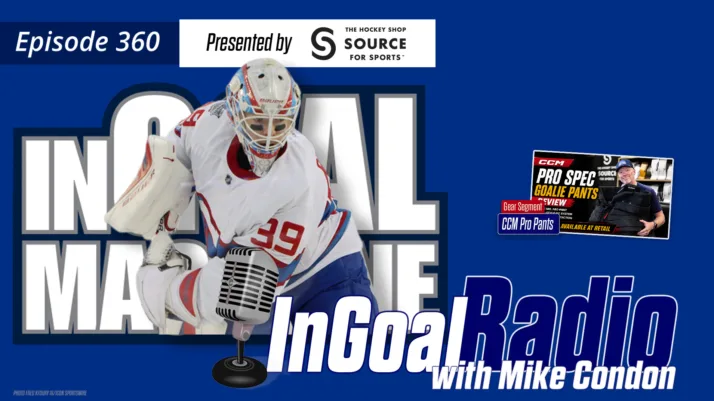
Episode 360 of the InGoal Radio Podcast, presented by The Hockey Shop Source for Sports, features the return of former NHL goalie and NCAA goalie coach Mike Condon, who went back to school to get his Masters Degree studying psychology and is now combining his education and real-world experience to help other goalies manage their mindset.
Feature Interview
presented by NHL Sense Arena
In the feature interview, presented by NHL Sense Arena, Condon shares stories, examples and insights into his ongoing quest to help goalies right up to pro better manage their mental game, starting with a great explanation of what exactly that is, and why defining it matters. Condon, who was recently at the Montreal Canadiens development camp as a coach, talks about self talk, the importance of daily deliberate detachment, fear and the rise in concerns over hockey mortality for young goalies facing a fast-shifting junior and college environment. All that, plus advice for coaches on managing goalie personalities, in a can’t miss, hour-long interview.You can contact Mike Condon, M.Ed, through Condon Performance Consulting, LLC at mike@condonperformanceconsulting.com.
Parent Segment
presented by Stop It Goaltending U
In the Parent Playbook, presented by Stop it Goaltending U the App, we check in with another old friend, Josh Tucker of True Focus Vision, for 5 things every parent needs to know about vision.
Pro Reads
presented by Vizual EdgeWe also review the latest Pro Reads, presented by Vizual Edge, featuring Dustin Wolf of the Calgary Flames and a great explanation of getting ahead of — or behind — a shooter after a long lateral pass, and how that decision affects exposure and the preparation required.
Weekly Gear Segment
presented by The Hockey Shop Source for SportsAnd in our weekly gear segment we go to The Hockey Shop Source for Sports for a look at the new CCM Pro Pant, an NHL-approved spec with retail add ons never before available to the public.
Episode Transcript
Intro
Never before have I had to offer this warning. Welcome to InGoal Radio Podcast presented by The Hockey Shop Source for Sports Langley, thehockeyshop.com, Daren Millard out in Prince Edward Island, Kevin Woodley in the Lower Mainland, and David Hutchison on Vancouver Island. We are truly coast to coast in Canada today. Just so you know, I'm in our bunkie, which is sort of where kids hang out, and there's a couple of beds in here for overflow. And it hasn't been open in a while.
And so I opened the windows to get the stuffness out of it, but the crows are back. So if you hear crows in the background, it's legit. They tend to get a little yappy too.
I hear they're smarter than the three of us put together anyway.
Guarantee. You should you should see them work around the yard.
Pretty low bar, boys. Pretty low bar.
They don't have enough size to play net though. Let's be honest.
Yeah. Yeah. No. Okay. So they can't 10 goal, but I tell you, those SOBs take the stuff out of my golf cart pretty much every time I come around the turn and go to tee off on the next hole.
You're right. Somebody took a muffin of mine a couple of days ago. One of them.
My favorite is when they take like something that's actually in packaged and then you see them fly off with it and you hear them trying to open the package. It's like they've got it figured out.
They get they get to it.
Oh, yeah. Get it. Yeah. They get those beaks in there and tear it open. It's yep.
I I have a
of They might be the ones to talk to about whether or not the RVH is overused.
They might have opinions. Might have opinions.
They might have the answer.
That's true. That's true.
And now if anybody's still listening to the show
See, there's the voice of reason coming back to us.
Thanks, dad. Sorry. Sorry, dad.
His name's not coughed. So we've got a good friend coming back on the show today in the Sense Arena feature interview, our Gear Segment, the Parent Segment, also coming on board with David Hutchison and his latest offerings of advice for parents in and around the goalie community. Also, we have the Vizual Edge ProReads. A lot to get to today as we really sift into the start of the off season.
Hey, hot tip, Daren. I'm not doing the parent segment this week. Why? Because I brought in a guest.
Oh, so there is a parent segment.
There is. I just figured people might be a little tired of listening to me, so I brought in our good friend Josh Tucker from True Focus Vision.
We know that people are tired of listening to me. Can I just leave now?
No. You've got a chat with Mike Condon.
Oh, and he was so good. Fresh off, Monte speak speaking of the off season, getting into it, development camps are all kinda winding down, winding up now. Mike Condon was at the Montreal Canadiens development camp. So we get into that a little bit in the conversation. Obviously, Mike played pro for a lot of years, did some coaching in the NCAA, went back to school, is now got a degree in psychology, I believe a master's degree.
I should probably know that off the top of my head before I introduce him, and is doing some, you know, consulting on the mental side of the game. So he's done a lot of work, worked with the Canadians goalies over the summer at development camp, and we're just gonna dig back in. It's such a great time of year to think about your mindset and how you approach that, and I thought Mike would be the perfect guest. And it's all besides the fact it's always good to just catch up with him.
Hutch, question for you. Sports psychology and and aiding our abilities to handle things between the ears is such a big part of goaltending. If you have a choice between seeing somebody who's a former goaltender and seeing a professional, who's obviously qualified. Would you lean towards the the former goaltender?
I think the relationship with the individual is the most important thing. There's obviously some real advantages to a former goaltender because they've been through it. But, I think you're looking for the person that is going to fit with you and your child as a as a personality. You know, Pete Fry didn't get to the NHL, but he does amazing things for a lot of amazing goaltenders, partly because of his own personal story. Mike Condon, I have no doubt would bring some incredible things to the table.
I'm actually going to hear him speak next week in Boston, looking forward to that. And at the same time, have also spoken to some non goaltender mental performance coaches who have certification as clinical counselors as well because sometimes you got other things beyond hockey that you need to bring to bear in a discussion. There's a whole lot of reasons. But at the end of the day, I think you just need to be really comfortable with the person you're working with.
Well, and I think one thing to point out here is I mentioned Mike going back to school, like, he checks all those boxes too. Not just That's right. Not just played and and tips from his career and mental performance, but psychology. Right? And he and he talks about it in that in this interview, and he talked about it last time when we had him on a year ago, but there you know, there's difference between tips on refocusing after a goal and other things in your life, your past, your history that may be affecting your ability to do certain things on the ice.
And so what's that saying? Find you one that can do both? Mike checks a lot of boxes, so it was great to catch up with him.
Gear Segment, as we roll into the off season transition time period where so many goaltenders in the professional ice junior ranks will be experimenting with the equipment. How often do you think guys would would change during the season? Sorry. The off season from the gear that they used last year to the primary set that they would go with manufacture for next year.
I think it depends on the level, no? Like, it depends what you have access to. It depends what you're testing. It depends what equipment companies are offering, including finances. Right?
Like, as that shifts, as you move on in your career, you might be trying something new because, hey. You're you're willing to try something new and you want it, but there's also a paycheck involved. And for some, at the highest level, it can get, you know, relatively significant. So I always go back to the Corey Schneider saying, which he, of course, got from Mike Liut, his agent, and that's a good reminder. We've never had Mike on the podcast, note to self, but you will always make more money stopping pucks as a mutt than you will make getting paid to wear 1Brand of equipment.
So that's the important lesson. It's also why we at InGoal when we have all these gear sightings in the summer and, you know, a lot of guys trying out different things, we are often made aware. We get photos from people. We often are on the ice with guys. We've actually been on the ice with guys testing gear that we didn't use video from specifically because it was like I remember a few of those. This is gonna be a problem. And then turns out the guy didn't switch. And so that's why we don't jump the gun on a lot of that stuff because the the Internet kinda loses its mind, and then it's like, oh, that didn't work. They're back in what they used last year.
And I'm not gonna name the prime example, but it it kinda sucks because he stuck with the equipment company he was in before, and we had a good two hours of footage of him on the ice moving that we could have used for, you know, InGoal Mag and some drills and stuff, and it just it just didn't feel right because everybody would have lost their mind. And for the next year, it would have been him in something that he never had any intention of wearing. So it's a weird spot for some guys in the offseason. We try we try not to make it weirder.
If you've got a 100 NHL goalies, some guys play a couple of games, some guys play 60 games. What percentage do you think would test equipment?
Oh, that's a great question, Daren.
Wow. I would think it would be pretty high. Enough.
I I I I think you're more than 50.
Oh, I was going higher than that.
I don't know. Like, a lot a lot of well, I mean, just think of the guys that are already under contract. You know, sometimes it depends on some of the shifts. We see we see ownership shifts shifts in certain companies. There may be a change in what what companies are willing to pay guys as those ownerships ownership shifts occur.
It it it really depends on the summer, but, you know, I
Think it depends on what you mean by test gear as well. Is it gear within the company that they're working with or are we talking about guys
Oh, I assumed I assumed you meant total changes. Yeah. Like like because I think you
see a pretty high high percentage if it's we've got a new stick we need you to try or a new pair of skates or whatever it might be.
I you know what you know what I think gets underestimated? Like, by the general public is how tight the timelines are on these decisions. Because there are some teams that want their guys to have their order in, like, a week from now, two weeks from now.
That's right.
And a lot of these guys are just barely getting back on the ice. This is it becomes a really tough window for the gear companies. These guys wanna try new things. They might they might try it once and then ask you to tweak something for them because let's be honest, most of the guys at the NHL level aren't wearing bone stock, same thing you and I. They've got little personal touches in there.
So they might want things changed and they're running out of time and then all of a sudden, the equipment manager is like, I want my order in now. Can you please tell me what you're wearing next season? And a lot of times, guys will be interested in changing and will be like, I just I don't have I'm just I'm just gonna stick with what I've got.
Right. I know the conversation you're talking about because we were both in on that one and and I I must say that one surprised me that the team needing to place an order was putting a constraint on the goaltender because you hear all the time about equipment companies coming in and saying, Can you try this for me? Can you try that? Goalie asked for a tweak. It sounds like an ongoing relationship between goaltender and equipment company and we also know that the companies will turn over new gear for these guys really quickly, much more quickly than than certainly us consumers get.
And yet, there are some constraints from the team needing to get an order in too and that was surprising to me.
All depends on the team, man. I know one team where the goalie switched brands and in particular really loved the other brand stick. The NHL team forced him to play his way through his previous brand sticks, all of his existing inventory that they had ordered from the season previous or had already ordered early for the season upcoming before he was allowed to switch to the other brand despite moving into a contract with that brand.
Yeah. Well, there's big big money there for the for the for the organizations. Yeah. It's a stock built up.
Yeah. I mean, it it it for sure, it costs money, but, I mean, the organization could also be like, here, throw a John Hancock on these 20 sticks, and we'll sell them in the team store
for double what they were. Not hard to fix.
Yeah. Like, they they find other ways to fix it, Daren. Like like, when you go into a team sale to buy used equipment and team gear, it's often not at a discount. That stuff is pricey.
We have the goalie, carousel that just took place, over free agency, PWHL in Toronto, a Marksham in New Jersey, couple of other switches along the way. Anything catch your eye?
Frederik Andersen, the Stanley Cup champion going to the Edmonton Oilers. Devon Levi, who were massive fans of here on the program and of and just, like, as a person as well as the talent he has as a goaltender, moving to the Edmonton Oilers. Tristan Jarry still being with the Edmonton Oilers. That's gonna be a task for Peter Aubry because you've got three guys that play very different styles, and he's gonna have to manage all three and work with them and try and get improvement out of them. So I know he's up for it, but I I think people sometimes underestimate how big a task that can be.
And you got a system change in there, new head coach, new coaching staff, new reads to make. Like, that that's gonna be that's gonna be an interesting sort of training camp, an important training camp for those goalies, that coaching staff. Bob, you know, Bob to Toronto, but also what that does in terms of the move they made to Tampa Bay to get Nick Paul and trading a guy that I think a lot of people felt wouldn't get through waivers and was gonna be with the Maple Leafs, so they move in on. They got a new tandem with Stolarz, and they've got Akhtyamov who just wanna call the cup ready to move up. So I like the way they shuffled their chairs.
It's funny. I put it out on Twitter, social media, and people reacted in different ways, but the reality of Bob's seven years in Florida was in the regular season, he underperformed his expected save percentage in six of the seven years. But in the three runs to the Stanley Cup playoffs, he was way above. And so, like, you sorta need a team. It's not like his and it's not like other than this past season when the numbers really fell off a cliff, and I think it's fair to say that was just a team that lost its defensive identity in part with no Barkov, but also, you know, Sergei Bobrovsky playing an absolute ton of hockey in the three previous seasons, maybe catching up with him.
Like, I wouldn't be surprised at all if he bounces back. But understand that his regular seasons tend to be just a little bit below league average. So if you can get to the playoffs with how he plays relative to environment, man, like, what a win. Like, I he's the first ballot hall of famer. He's one of the greatest goaltenders.
Like, he's on he's not quite on the Mount Rushmore, but he he's he's he's got an etch. His his face is etched next to it. So I'm really curious to see how that works out and what the expectations around him are in that market because we see the cups, but the path to the playoffs often isn't quite at the same level. And and see, even that came out as sounding critical, and I don't mean it to be because we know how good he is.
Connor Hellebuyck, number of games we expect him to play, is it different with Stuart Skinner joining the Jets?
Do you expect him to still be with the Winnipeg jets?
That's the other situation. But Kevin Cheveldayoff, the general manager of Winnipeg, said the the acquisition of Skinner was independent of anything happening with Connor Hellebuyck.
It had nothing to do with the fact that the deal in Buffalo fell apart as soon as they waited till July 1, and UPL got a five team no trade list he could throw at them. Nothing to do with that? I don't know. Listen. Like, I've heard some things.
So at the end of the day, no. Are you gonna put a regulator on the best goalie in the league? You're gonna be like, hey. We we spent money on the backup here, so we need you to watch from the bench five, six, seven, eight more times than you normally would. Now if you're doing it because you think you get more out of Connor Hellebuyck playing less games, if you think as as he's getting older, there's a wear and tear factor.
I mean, we're talking about I know he had knee surgery last year, barely missed any time, was back remarkably fast. Probably one of the most durable actually, two of the most durable goaltenders in the National Hockey League over the last five, six years, Stuart Skinner and Connor Hellebuyck. So if you think you get more out of Connor by playing him less, then maybe, but I don't know that you're the Jets. You're going like, hey. You're three time Vezina winner and and MVP and gold medal winner.
You're just gonna sit on the bench a little more often just because we have this other guy who's who's a good goalie too. I I don't know. That that's why it it's a bit of a head scratcher. Of Hutch?
Pretty much exactly the same. I'm not sure that I expect him to be there in the fall. And, if you're going to acquire him and his contract and everything that it would cost you to get him, you're not going to put him on the bench. And I think we've seen over time even when Eric Comrie is playing well, Connor Hellebuyck gets most of the starts in Winnipeg, so I don't see how that's gonna change with Stuart Skinner coming in there. Maybe the more interesting question is how many games do you think Stuart Skinner's gonna play for all of the same reasons, especially if Hellebuyck moves.
Yeah. If Hellebuyck's there, he plays twenty five, thirty. Hellebuyck's not there, does he play 50?
Yeah. Probably.
It's it's it's a weird, interesting, unique situation for Stuart Skinner.
Well, I guess and there's the benefit because he can do both. Right? Like like, that's the benefit of Stuart Skinner is he he has shown that he can do both. So but, I mean, you look at the games played for you know, Eric Comrie had a nine fourteen two years ago, played 20 games. Connor Hellebuyck missed time with knee surgery, and Eric Comrie started 24 games.
Like, that's that's that's not a lot of games. If if Connor Hellebuyck is healthy, he plays the majority of games, and I don't know that that changes because Stuart Skinner's there. To me, the question is not so much what they look like as a tandem is whether they're a tandem when the season still starts.
Same question. How many games does Sergei Bobrovsky play in Toronto?
I would there's where you'd I would probably have a regulator on.
Yeah.
Just based on age and based on and
and and what you have available to you.
Stolarz. Yeah. Yeah. Yeah. And and, again, like, it all depends.
Right? Like, if Sergei Bobrovsky comes out and plays like he did in the Stanley Cup playoffs and is giving you elite game changing goaltending, then you're probably gonna play him more unless you see signs of fatigue. Like, like, at the end of the day, we ask these questions. Everybody always says, oh, what are the what are the starts? What are the mixes?
We don't know. Like, it's a performance driven business, but it's also a health driven business. And, you know, like Jacob Markstrom in Florida. Like, Jacob Markstrom, you can see when he plays too much. You can see his game start to, you know, loosen up.
Like, all of these guys have an ideal threshold, and it will depend on their health. It will depend on their workload because that's different too. Like, it's not just that Bob's going from Florida who, by the way, you know, short of last year, was one of the better defensive teams in hockey for most of his stay, to Toronto where we don't know what they're gonna be defensively. They have been pretty good. They were pretty good defensively under Craig Berube.
Not as good last year as they were two years ago, but, like, that all matters. It's the same with Frederik Andersen and Edmonton. Like, what's the games played gonna be there? Well, part of the question is I don't know how they're gonna defend. Like, if Kris Knoblauch decides to, you know, protect the house and have everybody collapse towards the net and let teams take shots from the outside, but cycle around, and Freddie's pushing and stopping and pushing and stopping way more than he ever did in Carolina where they pressured and got out of their zone immediately, but gave up a ton of rush chances.
I think he probably plays even less because the amount of wear and tear that that puts on a goaltender is not like, it could be better defense and more wear and tear. So, like, there's so many different factors that go into these things. They're almost impossible questions to answer. Thanks for asking anyways, Daren.
Okay. Here's the last one. For Hellebuyck, who controls his destiny, what's more important? Chance to win, or does he factor in his fit with the defensive structure on a potential team?
I think chance to win.
How many
And the rest takes care of itself.
Well, be because be well, I mean, I'm not saying it's the right answer. Like, I think you should consider both. Like like, I heard the Carolina Hurricanes rumors, and Mhmm. Like, I don't know that that lines up from his strengths to what they give up. Like, I don't know that that's a great fit.
But if you're caught if you're caught at Hellebuyck, you just think I'm the best goalie in the world, and I can doesn't matter where I go. I'm leaving Winnipeg only or largely because I don't think they've done enough to stay competitive. So obviously, I would choose a place where I have a chance to win because that's why I'm leaving Winnipeg in the first place. I don't think they've been giving me enough chance to win. Right?
Exactly. I would be shocked if there are any goaltenders in the National Hockey League or many goaltenders in the National Hockey League that don't believe in themselves to that extent, much less one who's won the Hart trophy and the Vezina trophy. I I just can't see somebody sitting there saying, oh gosh, I shouldn't go to this team because of their defensive structure. I think they just believe in themselves deeply and that they can perform wherever they go. Certainly, they're smart enough to say, don't want to go to one of the bottom feeding teams in the league that bleeds chances all the time, but I doubt it would be like that old horses for courses thing, what he likes to talk about all the time.
Connor Hellebuyck wants to win and if you go to a team that can win, they're going be a team that knows how to play defense in front of you, would assume.
Where's the horses for courses thing come from?
Golf. Horses don't play golf.
Horses don't play golf.
Probably came from horse racing before golf. Woody, no?
I don't know. It's it's a golf analogy. Right? There's certain horses for courses. There are guys that play very whose games fit certain courses and and so from a betting standpoint, you always know that certain guys play well on certain tracks.
I was thinking about the the horse angle. Like, they're just running a track. So why isn't that called horses for tracks?
I think different tracks have different makeups, don't they? Like, they're not all the same dirt.
They're not all the same.
There's I
don't know. Well, we've got from the crows to the horses to the golf. Let's get us some hockey here. Let's go.
Gear
Gear Segment brought to us by Source for Sports Langley, The Hockey Shop, thehockeyshop.com.
I just got off the ice there, that's why I'm in my car right now, and I was wearing the new CCM pro pants. They have them in stock at the hockey shop, source for sports,thehockeyshop.com right now. It's your first time ever that these have been available at retail. They've been pro only models, NHL legal. So the smaller barrel, but certainly no shortage on protection as I can attest to after today.
Now it's not all they've got there. This is why you go to the Hockey Shop Source for Sports. If you've got questions, all the new gear they have, including the newest from CCM, the newest from Bauer, and the experts that they have on staff to help you know, do I need this? So one of the questions you wanna ask yourself in this case, do I need a little extra protection? Sure.
Am I willing to live with a little less coverage? Because the barrel is nine inches wide and it's rounded per NHL specs. Whereas a CCM XF pant, XF pro pant has got a squared one. Those are the types of answers you get from people like Cam and the crew as well as the great inventory at the Hockey Shop Source for Sports, thehockeyshop.com. And as I mentioned, with all this new stuff coming in weekly, there's still new stuff coming in weekly.
The old equipment, the previous models are all on sale. So make sure you check them out. Get the best equipment. Get the best prices at the Hockey Shop Source for Sports, thehockeyshop.com. Get the best advice from my friend Cam who's gonna explain to us what the CCM pro pant is all about.
Hey. We're back at the Hockey Shop Source for Sports and we
actually have something new this week. Been running through a lot of lines that are sort of just updates, but this is this is like Christmas in July. Never before available at retail. CCM's NHL level pro pant. They're making it much like they did with the chest protector last year.
They're now making it available to you. So let's walk through some of the features. The first thing we notice, obviously, is because it's NHL legal, we've got that rounded barrel. So it's no longer it's not as flat in front but a lot of protection. I think your excitement is What am I missing?
Yeah. You've kind of just like Jumped the shirt? Yeah. A little bit. Okay. You go, Cam. So, hey.
It's Cam. Hi, Cam. From the InGoal Hockey Shop Source We're for Sports. Back. It's okay.
Kevin, I got this. It's fine.
Okay.
So, let's talk about something that used to not really be available. It was always this ghost pant that nobody could ever really get. I'm talking about I'm play hockey in a ghost pant. People will see my underroots. They wanted them.
They wanted them. The HPG 12 k 14 k pants should not really be available. Oh, were little old school.
Oh, were little old school.
You'd occasionally see one around. But secondary market. And those that had one, no, was an unbelievably great gold pant. Now we have something available at retail that we can actually sell. More in, like, CHL, NCAA as well.
Right? Like, that was the pant that you'll get correct. And now again, we have that exact same thing. So similar to what we've seen with the CCM pro unit chest, now we have the pro unit pant to go along with.
Hold on, Kevin. We go.
Beside the whole ghost pant thing. Was really well done.
Back on the introduction, let's talk about some of the features of the pant. So as Kevin already alluded to, yes, because we are talking about more of that NHL style legal pant, we do have that rounded five barrel. Tons of protection on the inside though. Yep. Very, very thick.
So you're not gonna have like with your other with your non pro pants, you're not gonna have those removable sections on the inside, but there's a this lot of pant isn't chasing weight and that's for a reason because again, a lot of you more of these heavy duty pants because there is that more protection, that's great. Pants gonna weigh more, but it's something that you can kind of alleviate due to either suspenders even with that internal belt of how you hang it on your hips. Doing this is gonna make it feel heavy once it's actually on your legs. Are you gonna feel that bad? Or you could just mix in a leg day like most pros do to wear their pro pads.
Exactly. There you go. So we already talked about similar segmentation to what they've had in terms of their hip pads previous models. So one of the things that I think we should cover too as well before we go too much further extra coverage? Exactly. Is the difference between this and say the XF Pro app. Okay. So XF Pro still has the full wide flatter five barrel.
CCM's claiming, again, we're still getting a similar level of pant between the two. So if you're looking for more maximum coverage, go with that XF. Right. If you're looking for more of what would be that At the end the fit? Yeah.
At the end of the day, NHL pants are designed to be tapered tighter and smaller. It's one of the sort of juxtapositions of this. Everybody wants the pro level, but inevitably, it's going to be a little smaller than the XF model. That's correct. So that out of the way, one of the differences too as well, a belt that's actually removable because it's velcroed in.
Yay. So proper removable belt. Just so you know, Cam set that up so it
will be easily removable. It's not gonna fall off mid game folks. No. It's about good. So features that have carried over to that hidden zipper that runs around the perimeter of the pant.
Make it a little longer, add an inch. Correct. So whether it's adding some extra growth with the pant itself or being able to dial in your fit a little bit more, you have that options. So when it comes to fit, there are a lot of there are a lot of like course to this. Yes. It's no longer small, medium, large because it's not designed to be a retail thing. You are actually looking at the way the NHL does their sizing, which is fit one, fit two, fit three. Zero through to five.
There we go. So I don't know how you have a fit zero. Does that mean you don't wear a pant?
Or you a skinny little guy.
Or you or it's that. So we're dialing in our sizing charts. We're gonna have those. Again, if you wanna talk more about it, you can give us a call. (604) 589-8299 or 1-800-5677 We're gonna a sizing chart on the website.
I will say this, fit three as we understand it and based on our experience, because we have two pairs of these and we've got testers wearing them already. And by the way, folks, the feedback is phenomenal. Fit three is roughly a large Yes. On So starting from in an XF Pro. Starting from that point and kind of tearing our way up.
You can kinda yeah. So, exec three is a large and that would mean fit zero is probably like a An extra small. Yeah. Kind. I'm not fitting in that one.
That's okay. So, one more feature before we wrap this whole thing up. Okay. But I really really like We saw it appear on some pants over the past couple years. Oh, cut proof on the back.
Safety first folks. There are too many idiots stepping on goalies in the crease. Great additional feature having that extra proof, having that Kevlar in there. Again This entire section. Yes.
It's an area where it can get get caught and you can
Is it likely? No. But if it ever happens to you, you're gonna wanna have that cut proof. Exactly. Hamstrings cut easily. Just get it.
On the hat, unbelievable bombshell. Wanna check these out? You can see them up on the website. Hockeyshop.com. That that's where the website is.
Yes. That is where the website is. Yeah. CCM ProPant. Make sure to check it out if you got questions.
He dropped the number. You can give him a call. Check out the website. There's emails there. Him and his entire crew will answer your questions.
We out.
When you wore that pant at your outing, was it brand new?
Yes, sir. It was. I was actually first first for we we actually got two of them. We've got another set that's been out a little bit more with my testers, but I'm a bit of a princess. I like to keep one set aside for myself.
I don't want anybody else's germs in there even though I've got germ killers in the garage. Yeah. It was brand new. How's feel? It was a little rigid as new pants tend to be, especially at the pro level, but I was pleasantly surprised at how mobile they were out of the box despite being a smaller size.
I wear a CCM pro knee protection, still slid in. No problem. Like, right inside the barrel, I had no problems with that. No interference. So, yeah, like, mark.
I liked it. Will it go in the bag instead of the XF pro pants that I wear? I did not have any pucks go off the side of my legs and in thanks to a smaller barrel today, but my bet would be as a guy who doesn't need to be size restricted that I will probably switch back to the one that's square and bigger and provides more coverage even if this one felt today like it might have a little more protection.
I have a helicopter flying over. Can you believe that?
They're looking for you.
Yeah. This is this is a day. There's a lot of action around Prince Edward Island.
It's the crows. They're after the crows.
They're after the crows. Well, the crows are hiding right now because they're silent, and then the helicopter goes by. And I can't tell you how many times I've seen a helicopter. Be a handful in in my twenty years here.
Postcard. So
that's that's interesting. Do you throw your pants in the in the sauna or the steamer or anything like that to to try and improve the break breaking process or just
Never thought of a sauna, Daren. That's a pretty cool way to break it.
Oh, yeah. Yeah. Guys do it. Guys throw it in the steamer.
I I would, Daren, but I don't have a sauna.
Oh, okay.
That's on the next bonus when when the option for extra pay comes up. Yeah. I'll just They just
We we should just cut a deal. We need another sponsor for another segment. We'll have a sauna sponsor.
Note note to everybody out there, Daren is not suggesting you put all your goalie gear on and go sit in the sauna. No. No. Think the pants go in on their own.
Yes.
Daren is steamer? Daren's trying to kill me.
More the steamer. Just just, so so we're at. Let's slide over to our ProReads brought to us by Vizual Edge.
Do you want the puck to look like a beach ball? Every goalie has that night here and there where the puck looks huge. You're ahead of every play. You feel calm, patient, in total control. Then there are the nights where you're half step late.
You see it, but you don't really see it. You're reaching, you're guessing, you're fighting it. That's not your technique. It's your eyes and your brain not processing the play fast enough. Visual Edge fixes that.
It measures how well your eyes track and process the game then gives you a custom plan to train improvement. Three fifteen minute sessions a week on your laptop or tablet. It's what NHL goalies use to make the game slow down when it matters most. Want 10% off Vizual Edge if you're thinking of trying it? Use the code I n g o a l, InGoal, all caps.
And if you're already a member of InGoal Magazine and you have a subscription, you can go to any ProReads and you will get a double discount code exclusive to our InGoal members to save even more 20% off your subscription to Vizual Edge. So the best of both worlds, to be honest, that 20% savings is probably enough to actually cover the cost. You probably save more doing that than you're paying. And, course, you get InGoal Magazine. And with InGoal Magazine, you get over three three hundred, 350 ProReads, including now, I believe, 14 from Calgary Flame sensation Dustin Wolf, who is our guest this week on ProReads.
Dustin breaking down sort of. It's a bit of a tricky one in terms of sharing it on the air and asking you guys for your advice. There's a lot of it's a it's a rush chance, and it's kinda dynamic, but he's it's a little bit of a tough one for me to explain, but the idea of being a header behind a shooter on lateral passes. Daren, concept, east west pass off the rush, so you gotta retreat. That guy is a left shot coming down left wing, so he's gotta catch it cross body.
That's the situation we're looking at here. If he gets ahead of you or behind you, what are the benefits of either one in terms of him beating you to angle and being a little bit ahead of you or you getting a little bit ahead of him on that lateral movement?
The thought process is to be that I follow is being a little ahead. And then when I try to square up, he skates into me. What's the answer?
I'm kind of the opposite.
You want to let him get ahead?
Yeah. I just I try and be a little ahead, and then I stop. But that's I I'm not saying I'm right.
Well, you're not. I'm sort of the opposite. You guys you know what? Honestly, I don't know that there's necessarily a right, but it's what it sets you up to do either way. Right?
I'm sort of the opposite. You guys you know what? Honestly, I don't know that there's necessarily a right, but it's what it sets you up to do either way. Right?
You guys you know what? Honestly, I don't know that there's necessarily a right, but it's what it sets you up to do either way. Right?
So if he's if if he's ahead of you and you're loaded for a push into that short side, you know you have that covered. And if he goes against the grain, you're in position. If you get ahead of him and he goes against the grain, it's a little harder to have that momentum going to your right and then push back the other way. So that's why I might air on Hutch's side and let him get a little bit ahead of me. Sometimes it's not about doing it on purpose.
The play itself can be either dynamic or hard to read or a broken play and it just happens, and then it's all about sort of reacting and understanding those dynamics. If he's ahead of you, do I have an edge to push into the short side if that's the way he goes? Do I have how do I stay patient on the on the stuff to the backside, the against the grain stuff? So these are the type of answers that you get from Dustin Wolf in this week's ProReads. There's other elements that he touches on as well in this exclusive video session breaking down one of his saves from a couple of years ago, this time against the Seattle Kraken.
So, check it out at ingoalmag.com. Watch the video breakdowns, not just this one, but over 300, I think over 350 now with different goalies like Dustin Wolf, like Connor Hellebuyck, like Thatcher Demko. It's all there at ingoalmag.com for you to learn how to read the game better and anticipate better, and in Daren's case, answer my questions better.
And I get to learn things because I was wrong on that. But my I was a it was a practical way of thinking because when I would get set
He didn't say you were wrong.
Would skate into me.
Yeah. He didn't say you were wrong. He said there's different ways of doing it. He just said we'd do it different.
Yeah. And there's different yeah. And understanding your exposure. Like Yeah. Doing doing it a certain way.
Everything in goaltending is give and take, so it's understanding what we're giving and what we're taking.
I guess if I'm doing any type of overlap of coverage, if it's a left hand shot down the the left side, then I'm okay. But I'm not I'm gonna not try and overthink it too much.
Me neither.
How was the skate today? How was it?
I'm so well, I don't know. Like, I didn't want skate was okay. I was okay. I survived the skate. That's the biggest thing at this point.
But I'm not gonna lie. It's 28 degrees out right now, and I I didn't feel like having the air conditioning blasting would be conducive to, you know, to good sound quality in the cars we recorded this, so I might be melting. That might that might be the on the on you just heard there is is me perhaps getting ready to pass out in the SPCA calling to tell me that you shouldn't lock dogs or old old aging goaltenders in cars in the heat.
Parent Playbook
Given my peanut gallery behind me, I I think the air conditioning blasting would be just fine, buddy. Parent segment brought to us by Stop It Goaltending U the app.
Do you want twenty five years of NHL goalie coaching experience at your fingertips? You don't have to be like Hutch and actually go to Boston to work at the Stop It Goaltending schools and work with them.
If you wanna tap into the goalie parenting expertise that helped Joey Daccord reach the NHL, it's what you get in a subscription to Stop It Goaltending U, the app. All the knowledge from Brian Daccord has been an NHL goalie coach, scout, and director, as well as all the insights and expertise from his staff at Stop It, which last year celebrated twenty five years as one of the world's top goalie schools. That includes a long list of veteran NCAA coaches and minor pro coaches. It's all delivered and easy to digest chunks, including five short daily primers, weekly style analysis and breakdowns, and drills you can take onto the ice with your team and coach, plus you get a subscription to InGoal Magazine included. So check it out now at the App Store or Google Play and get the best of both worlds for goaltending with a subscription to Stop It Goaltending U, the app, and a subscription to InGoal Magazine.
Hutch.
Daren, I thought we'd have a little change up for parents today. This one's not coming from me, but I sat down with Josh Tucker of True Focus Vision to go over five tips for parents concerning vision and your goaltender. It's a little longer than usual. I think it was about seventeen minutes that we, we had together. Josh has worked with multiple National Hockey League goaltenders, multiple NFL quarterbacks.
If you look at the sort of rogue's gallery of people he's worked with in his office, and I did have the pleasure of visiting him a couple of summers ago. Just a great engaging guy, passionate about the game, and has been a guest on the InGoal Radio Podcast before. So we will leave a a note to that show in the show notes. We'll also leave some notes about how to get in touch with Josh because he's got a few ways that you can work with him, whether it's in person or virtually. And with that, I think I'll just hand it over to Josh.
We're gonna change it up a little bit today for the parent segment. I've brought in a new voice, Josh Tucker of True Focus Vision, has been a friend of the show for a very long time. I've had the pleasure of visiting him in his office in Minnesota to do some training as well. And today, we would like to talk, Josh, about some tips for parents around vision. What do you got for us today?
Alright. So we're gonna hit five things that parents should know about vision. Perfect. So number one, anytime I talk to anybody, this is an absolute non negotiable. Seems common sense, but get an eye exam.
And if it's been if your kid's never gotten one, absolutely get one. And if it's been a number of years, even if the last one was good, things can change. And so to me, it's a nonnegotiable for a couple reasons. One, it's a quick visit. Insurance should cover it.
And with all of the time and dollars that's and you're gonna pour into this wonderful sport and position. If there's something that is very quickly fixable or something that can make things a lot harder for your kid if it's not caught, you know, I've met people who have gone through their entire career and find out at 20 that they needed glasses the whole time. And and then they put on the glasses. They're like, this is what it was supposed to look like. And, you know, a lot of parents say, well, my kid never complains.
You know, don't assume everything's fine. Just go get the exam. Easy, quick, done. And in terms of improving, most things take years to improve at where if you can just pop something in your eye and see better like that, that's awesome. That's quick quick improvement.
So number one, get an eye exam.
Alright. Number two.
Alright. Number two on our list, there is way more to vision than just our twenty twenty score. And so the twenty twenty just tells us do we need corrective lenses to see, you know, have an even starting line with the rest of the world at certain distances? And that's really important. But beyond that, I like to think in terms of athleticism, where to be athletic, it's not just being strong.
You also need to be fast. You need to be able to jump high. You need to be able to change directions. Right? And so if you just have one of those, just because you're strong doesn't mean you're athletic.
We want all these other things. And so a couple examples. We wanna make sure that the eyes move smoothly, fluidly, and with control, and that they're going where my brain's asking them to go. So for the because we're talking to parents, we all remember when the computer mouse had the little rollerball in it. If you're ever stuck without a mouse pad, it was really frustrating to try to get the cursor to move across the screen.
And so, you know, you would move it a little bit and it would shoot across, or it would take four rolls to get where you wanted to go. And so if there's a path on the ice from a to b, and instead of the eyes going from a to b, they go a b c d e. And it sounds crazy, but I see it all the time. There are people whose eyes just don't go where we want them to go, or they take a little scenic route. And so the tools we use to do a job are really what we're getting at here where if my legs are weak, I'm not gonna push very hard.
If my eye muscles aren't coordinated, now relative to that, I'm gonna process things more slowly or inaccurately, and I'm gonna have a hard time. So beyond the eye movements, we want our eyes to be able to work together as a team. So we're not always looking in one direction. As things get closer to me, my eyes need to turn inward, and that's called convergence. And some people, their eyes don't like to do that.
And so in those cases, when the puck's coming in, the eyes are not truly staying with the puck. And I've seen this battle before where, the goalie coach is saying, watch it all the way in. And the goalie says, I am. They feel like they are. Right?
And sometimes they aren't.
One of the key parts of what you're saying here though is this isn't covered in your standard eye exam.
Correct. Thank you. Yeah. So in the testing realm, there's the eye exam. And so the term I would have you look for is vision therapy exams.
And what they're gonna look at there is not just whether or not you need lenses. They're gonna look at how well do your eyes converge, how well do they diverge, can they change focus from close to far. They should be able to look at some of those eye movements, it's not even always on the x axis or the y axis. Some people have one eye that's higher than the other. So now we've got a puck that's coming at us.
Our eyes are having to converge and come down, and it's really hard to get everything to come together perfectly. Right? And so, just getting that information, you might go in and knock the test out of the park, and that's awesome. Most people are gonna have some room to improve. But the big thing that I just really, you know, strive to to do when I have audiences like this is to find the people who have deficiencies.
So within this bucket, going beyond the rink, these same visual skills, they're super important for tracking pucks, reading the play, anticipating where things are gonna be, but it also has a huge impact on a child's ability to read and learn. So if we go back to the eye movements, if I'm trying to go from one word to another to another on the page and my eyes are battling me on that, you know, it's not always an effort thing. You can have great teachers, a kid who's trying hard, but it's like trying to learn to skate on really bad dinged up blades.
Mhmm.
Just the tools can be really deficient to where you know, and especially if you couple that with an inability or a difficulty in converging where the eyes won't meet at the word, It can be as significant as, like, words moving around or overlapping. And, so improving vision while it's you know, we're here to talk about goal tending is pretty cool because it really if you go through the process of vision therapy training, it has so many bearings on the other parts of a child's life.
Number three.
So this is just part two of that. Part number three is visual skills can be trained, and they can be improved. Most people just assume, you know, my vision is what it is, and that's what I've got. Or they say, oh, I need contacts, and they just, you know, hang their hat on that or I don't need contacts. I've got great vision.
And in some in that facet, they do, but the other stuff isn't guaranteed. It's not one on one. And so plain and simple, much like we can train the rest of our body, we can train the visual system to improve how our eyes move and how they work together as a team. And one of the coolest things, not the exact term, but it's more akin to muscle memory than it is hypertrophy or muscle growth or something like that where I, you know, I used to be in really good shape. You know, I had the muscles.
I used to look like our logo. Right? But I had stopped strength training, and now my muscles are gone. Right? And so I can get them back, but, you know, a well done vision therapy program with, you know, some some minimal maintenance along the way is something that, you know, vast majority of our people, they just they do our program once, and then they maintain it.
The one thing that can really derail some things is a concussion, and that's worth noting too. So if you have a child that's had a concussion, I would put extra emphasis on having that vision therapy testing done, or if they're in the recovery process right now. More and more research is showing that, you know, depending which metric or skill they use, I've seen as high as eighty seven, ninety percent of concussions yield some drop in visual performance. And those things don't always just snap back out of it. I'm a case in points.
My visual scores were off the charts on everything for fifteen years. Was in a car accident, smoked my head, and then my convergence was abysmal. My eye movements were all off. And, you know, I I'm fortunate. I have keys to the office where I could kinda retrain myself.
And, you know, vision is not the silver bullet one and only thing to concussion recovery, but it's definitely something where at least be aware if your child gets a concussion or if they've had one. I encourage you to have it on your radar because it can be an important part of the recovery process.
Perfect. That's kind of a three b, I guess.
Yeah. Yeah.
Yeah. Perfect. Okay. And number four.
Number four would be do eye hand training. You know, if you're not doing something for it, please start. And where you know, what to do, that becomes the second part of this. At a bare minimum, throw a ball and catch a ball. K?
Now, two two caveats to that. One, wear wear your goalie glove when you do it or at least a baseball glove. So we wanna reinforce that we're catching in the pocket, not in the palm of our hand. So there are drills we do where it's not a direct goalie drill where we're catching the palm of our hand. But if we're reinforcing catching here, you know, it's multiple inches or centimeters from the palm of the hand to that where we want the brain catching here.
So let's say, you know, Johnny or Susie at home are already yeah. They're always outside throwing a ball off the house and then catching it. So something I wanna encourage you to shift is if they're gonna put time into that, which I hope they are, think about the trajectory at which they're catching. So I I was a ball off the house guy, and, I'm still making payments to my dad for all the garage panels I knocked out. Right?
But to catch it here, to hit it off the wall, they have to throw it seven, eight feet in the air because it's gonna fall down at them. One, that's not what pucks do. And two, the angle of my wrist, I have to go like this to catch a falling object, and it's really weird. And I'm reinforcing improper mechanics. And so, ideally, you wanna have something where just some simple geometry, something at an angle where you throw down at it and then it comes up to you and you're catching it like this.
And so the simplest place to start is if you're like me and you have way too much spare wood just in case someday. You know, if you have a sheet of plywood, that's a great place to start. And it's always a slam dunk because now you can justify some of that wood you kept in the garage all these years.
Perfect.
And, yeah, lean it on the wall, put something heavy in front of it, and then you just play with the angle until you find, you know, the right one. And so I always look at I remember the forwards and defense when I was growing up. They had the 100 puck a day challenge. Right? And it's like, alright.
I'm gonna shoot a 100 pucks a day. Where for forwards and d, it's typically been easier for them to go out and stick handle and shoot, and that's the main thing they need to work on. But for goalies, if we're not on the ice, it's it's not as easy, where this simple approach, have a board, throw it, catch it, set a goal to catch 50 balls a day, catch a 100 balls a day, something. But you do that with your glove on, and if it's not too hot out, wear your helmet too because then you're looking through the bar. It feels more real.
That alone, I've got multiple kids right now where so for them, we built them one of our reaction boards, which allows you to adjust to any setting Mhmm. Like this. And parents are saying, yeah. You know, Johnny's using it. He's used it every day.
And now on the ice, his glove used to be a liability, and now it's just lights out, just automatic where, we need reps to get better. And so that would be the starting point for eye hand training.
Perfect. And if I could just jump in there because I think there's probably a few parents like me that are thinking, Well, why don't I just have the ball hit the wall first, then it hits the ground and now it's coming on an upward trajectory to me? But I'm guessing by using a board, you get a lot more consistency in terms of the angle that is coming back.
Slam dunk. Yes.
There you go.
And so I I kinda look at, like, good, better, best. Throwing a ball off the wall is good. It's good. Going ground wall or wall ground is definitely better because we're gonna get that upward trajectory. So the limitations of that, there are two.
One is consistency, where you really have to hit the right spot. Two is you lose a lot of speed because it there are two impacts. Mhmm. And on top of that, there's some funky spin, especially if if you hit the ground first where you're gonna lose some speed. And what I've found is to find the sweet spot where the ball's really humming and staying on a line like this, you know, with the ground wall or wall ground, I either have to get really close to it to get the right trajectory where now I can't throw maybe as fast as I would like to
Mhmm.
Or just the spin that you get off the ball, it's inconsistent. And so by having one singular flat surface, that ball should maintain its pop. And on top of that, when we talk about mechanics, to execute a ground wall throw, you kinda have to do, like, a low sidearm, which tends to swing my body off, and now I'm kinda doing this. Where if I'm in a position where I can be in my stance and just throw, I'm way more in my stance. And so that I would say an angled board would be then the best.
And, then you start to get lots of situations where, mom, dad, brother, sister, friends, they could throw the ball for you. And there's different ways where, you know, a lot of this when we dig deeper into I use these for I'll have a kid actually in the net on knee pads, glove blocker, helmet stick, where they're getting reps working on their hands with no wear and tear on their hips or knees. And that's I'm sure you guys yeah. You know, that's a big issue right now. I've got a 17 year old who's had both hips done.
So once you get into that, now you can really get creative. You can do throws from the side, change the angle, that type of thing, and everything's gonna result in an upward trajectory throw. You just gotta play with the angles a little bit and get them dialed in.
There we go. And last, number five.
Play other sports. Number five. Play other sports. Baseball. Yeah.
I mean, you know, I think racket sports are great. Baseball is great. Lacrosse is great. Throwing and catching a football. I mean, really, in addition to my work in the visual field.
So I was a goalie. I admit I was a goalie coach. I did private lessons. I coached high school hockey in Minnesota for a number of years. And especially in the private the private sessions, you see a vast difference in coordination and ability to make adjustments.
Right? And so the way I've always put it is every goalie who's ever played the position knows what they want their body to do. The good ones are able to do all those things, and the great ones are able to do it just really fast. And so goaltending requires just a multitude of micro adjustments, timing, and, you know, the bulk of our save selections are you know, it's it's one of these types of moves. But the in betweens, the puck changes directions or the guy you know, you know, the puck hops and now the shot that we thought was coming doesn't come.
And now how do we change? And so, really, honestly, I think gymnastics absolutely has to be on this list. So that's not from as much heavy on the visual end, But from a body control standpoint, I think it's just the ultimate base of the pyramid sports. It just translates. It does.
And I think it also gives a bit of a mental break where the way things have gone where it's if you're not playing your specialized sport every day, you feel behind. And I don't I don't feel that's true where if you're doing something else, it's in the grand scheme long term, like, as you get older, and that's where you really it matters more, you know, how you perform. You're putting money in the bank by diversifying your athletic portfolio. And from a visual standpoint, you're seeing things from different angles, from different speeds, and you're gonna see all that with a puck. It just doesn't always have to be a puck.
Perfect. Yeah. Good for the mind as well. Yeah. Josh, thank you so much.
We will share news in the show notes exactly how people can get in touch with you, whether whether they want to visit you in person as I did or some of your online programs. Do you want to just give us a quick shout out here though how people can find you?
Yeah. Truefocusvision.com. And we have a page on reading if that resonated with you and concussions. And then goalies, you get your own page. Right?
So we work with a lot of different people, different sports, but goalies are for sure our specialty. So if you go on the goalie page, you could see just a few of the goalies we've worked with, not all of them, but we have our online database. We have a membership for I hand drills. So where we come in is we we show you the next steps no matter where you are on the spectrum. If you're a beginner or if you're already a pro, there's stuff in there that'll keep you challenged for a long, long time.
And so a b c, always be challenged when you're doing your eye hand training.
Perfect. The ABCs of eye hand training is probably better than the five top tips. That's that's great. Thanks for joining us today, Josh.
Thank you for having me.
When I say Josh, what what jumps to mind first for you, Hutch?
Oh, well, you have to meet him because his personality is what jumps to mind. I actually reached out to him and I said, man, I'm I'm having a bit of a a tough time and, going through some stuff. I need a real positive person to be on the show with me this week. And Josh is nothing if not positive. Very uplifting, engaging.
He is that guy that everybody wants to be around because they are just so full of energy and enthusiasm and yet completely professional about everything that he does. So, it's all about the person. And what did I say earlier when you were talking about who you want to work with? I think it's got to be somebody you connect with as a person.
I think that's a great way to frame it.
You know what? You know what? The first thing that jumps out to me, Hutch is right. It should be the personality, but it's like the symbol for True Focus Vision is like an eyeball with like two arms flexing out of it. He refers
to it in the interview.
Oh, the and there you go. So it's funny because, yeah, obviously, seeing him wearing the T shirt and just like but also walking into NHL locker rooms and seeing NHL goalies like Jake Oettinger with a bag of Josh's goodies sitting in his locker room and and knowing right away what's in that bag and that it's a bunch of, you know, training aids because on the bag is the eyeball with the flexing muscles. And you're like, ah, I remembered. I ended up writing an article about it for us and for for nhl.com. Like, me walking into the Dallas Stars locker room and seeing that bag and be like, Josh, you started working with you started working with Josh. And and Jake just like, yeah.
Wanna get more into it. Spent the summer and walking you through it. So, yeah, it's it's the symbol. Good job marketing and branding by Josh because every time I walk into a room and see it, I know that this guy's been working with him.
Feature Interview - Mike Condon
Our friends over at Sense Arena present our feature interview every week on InGoal Radio, the podcast.
Yes, Daren. NHL Sense Arena supports us, by sponsoring all of our feature interviews. And I would like to talk about the fact that the next off season challenge has now arrived because we were talking last month about the challenge they had through June. We have now moved into July and they've introduced the Train with Team USA challenge. It's a monthly drill pack that you can find inside the headset in NHL Sense Arena.
It's inspired by the habits, awareness, and decision making skills that define elite American hockey. This month's challenge is designed to help players and goalies elevate their game through guided training plans, competitive objectives, and focused skill development. If you complete the July training plans throughout the month, you'll sharpen your hockey IQ, build consistency, and develop the confidence needed to perform at your best when pressure is on. Finish all those July training plans, and you'll earn the exclusive Team USA training plan award badge to prove that you've met the challenge. So explore the July training plans and start building your edge inside NHL Sense Arena.
And, of course, head over to sensearena.com to grab your subscription. And as always, use the code I g m 50 to save even more.
What do you scrape the crease on this interview that you have with Mike Condon?
Honestly, as we talked about before, I knew he's coming off the Montreal Canadiens development camp. Wanna talk to him a little bit about that, what that experience was like. And then just, like, he's just new into this side of things since graduating and finishing his school. Obviously, he's been through work with mental coaches, and so just kind of the constant evolution of his process as he gets into this with more and more kids, works a lot of high end junior kids. I don't because of the even though he's working with them as a mental skills coach, I'd be careful.
I don't wanna drop names because he has to be careful with that too as well. But some really high end guys that have started working with him and are having success and just wanted to talk to him a little bit about the process and how he's balancing sort of the the tools side of it, you know, the the managing saves and things like that and goals and stuff like that with the the more pure psychology side of it. And as usual, Mike's such a thoughtful individual with so many different experiences. We wandered, and this thing went on for a while, but it's it's full of great information for goalies, for goalie parents too probably, and even for goalie coaches. Some advice on, you know, how we treat goaltenders and and how we have to be careful not to throw them into stereotypes that a lot of coaches do because it's it's not necessarily the best for the goalies themselves.
Let's go for a skate with Woody and Mike Condon on InGoal Radio, the podcast with our feature interview presented by Sense Arena.
Big day today on the InGoal Radio Podcast, the return of Mike Condon. Mike, I could not let you go more than a year without joining us. Our audience enjoyed the last show so much. For those that haven't, I would say just go check it out, but the quick Cole's notes is longtime NHL goaltender, worked his way through the ranks, had some spectacular some some big moments in his career, retired, did a little coaching, worked with Devon Levi in college, now doing psychology sports performance consulting, condonperformanceconsulting.com. Was just at the Montreal Canadiens development camp working with the goalies there. We're trying to learn about the mental game, my friend.
We're trying to learn a little bit. Pick your brain a little bit today. So let's start with the trip to the development camp, how
it came about, what it was like for you to be back on the ice. And I'm curious what the role's like because you did the coaching thing. Now you're doing the mental coaching thing. You're on the ice with these guys. Is there any tug back into the the instructional world of tactics and technique, or is it all between the ears and not between the pipes?
Well, first and foremost, it's great to be back here. Woody thank you for having me. Yeah, going up to Montreal was ten years to the date when I was put on waivers from there. So it was ten years. It was kind of cathartic, nostalgic, you could say.
Staying at the same hotel, I think I have like 200 nights in, and I can remember parts in that hotel, or not panic attacks, I'll call them, but maybe a dark night of the soul, so to speak, in that room. But yeah, I was long time goalie coach Marco Marciano got promoted to the the head goalie coach up there. He was my goalie coach in Hamilton in the American League. And, you know, he gave me a ring to see if I wanna come up top of the goalies, whether it's in the mental side, whether it's like what it's like to climb the ladder, so to speak, and also to get on the ice and just talk goalies. So it was hard for me to know my role there.
There was a lot of great coaches there, and I was kind of more sitting back observing and talking with the guys in the line of trying to simplify things. What are we saying to ourselves before we start the drill? How did that feel afterwards? How are we being cautious with how we're labeling? What is going on while we're playing and judging during a practice?
So it was great to be out there. I don't skate as well as I used to, and that's another cautionary tale about what we're doing in the gym. But it was overall an unbelievable experience. Like, they're the team that gave me a chance when nobody else did, even know, they did put me on waivers. But in our job, you're you're hired to get fired, so it's still still great to go up there and see everybody.
Well, I was just I was just gonna say, like, okay. Maybe I didn't set that all up that well, I'm not knowing about the tenth anniversary of the waivers, but after sort of coming up with the Montreal Canadiens played for Pittsburgh, played for Ottawa, but the moment I think a lot of us remember is obviously the winter classic in your hometown of Boston and all those things. That experience being at at the dev camp, what like, is there an introduction to them? Like, we talked about, like, are so many aspects of the mental game. So how do you introduce it to these goaltend and these are obviously high end goaltenders.
Some of them have probably had touches with with, you know, sports psychologists and mental consultants over the years. So whether it's them or whether it's how do you introduce the concept of what is the mental game for goaltenders?
Yeah. It's it's the first question I ask mainly to gauge, like, what they know already or and and what they believe and how they understand it. When when I think about what my job is, a lot of it is just, like, definitions. Let's define all of these words and make them clear because, you know, you can ask someone what is confidence and they'll say, I know. And then, okay, like, not challenging you, not judging you.
Can you define it? Can you explain it to me like I'm five? Because we don't really know things unless you can explain it in layman's terms, and most people can't. I can now because I do it every day and I have to ask that. So I've actually learned the definitions, but, yeah, it's just making things clear.
I just ask them, especially in a group setting. It's the best when we're in a group, five or six guys or girls. And I'll ask the question, what is the mental game? And there'll be a one minute pause because no one wants to go, and I'll get a marker on the board. And, you know, there'll be motivation, and then resilience, and then emotions, and then thoughts, and then fears, and then meaning and purpose.
And by the end, like, it would take, like, forty minutes to answer that question because there's so many terms within it. And I think that's the first step to say, like, there is a lot out there. Can we then take all of these terms? Sometimes there's been 60 or 70 terms on the board. Wow.
That tie into the mental game. So we can make it incredibly complex and that's a good place to start. But then it becomes about reducing it and simplifying it. Can we group these together into different words? So now that when I ask you this word, you can branch it off.
Best example is like everyone's told their work ethic and attitude is the only thing they can control, work ethic and attitude. But with those two words, we can make a tree of roots of roots of, like, words beneath each one of those that make it a little bit more complex. So I just go about asking that to gauge where they're at, and then we start asking the question, all right, well then, what can we do? What can you do? And that is a more personal 1Because some people need to work on regulating, you know, their anxiety before a game.
Other people don't experience nerves before a game. So it's also about understanding what you need because you can go That's the other problem, is there's so much access to information that kids may be doing things that they actually don't need to do when there's another area of focus that can serve them better. And it's so it's a complicated question, what is the mental game? But it just starts with getting all the terms out there.
Is that are you looking for clarity as you try like, and and is the clarity not so much absolute definitions, but what it means to each individual as part of that process?
Yeah. They're they're everyone is told it's so important. I was told it was so important, but my understanding, it was like breathing and visualizing. And it's like, yep, those
That's part
of No. That is part of it. Why are you visualizing? How do you visualize? What does it do for you?
How do you understand how it works in your body? Affirmations in the mirror were something that I laughed at for a long time, but I didn't know that we have filters in our brain that can tune into the negative or tune into the positive. If I knew that how that system worked, then I would be more motivated to do it. So it's just I mean, we could all that just the clarity of understanding what it is gives them a little bit more belief that they're doing what they need to be doing or should be doing because that's another hard part too is what should I be doing?
So knowing and having confidence in what you should be doing and and and a little bit of why probably means you're gonna get more results out of it.
Yeah. Let's let's teach you what visualization is. Let's teach you what meditation is and how it's different from, like, deep relaxation breathing. Let's let's let's talk about what writing and or or drawing for that matter, how they work and what they can do for you. And then once you have this menu out that and you know how everything works, you can act and then the secondary skill would be like being able to observe yourself and say, what do I need right now? Here's my menu. I can put this together myself because I know how it works. And you don't need to do five years in school, ten years in school to read all this stuff, to understand it and to make your own process, but it's clarity in creating a mental process. Because one day, you know, you, oh, I should visualize. Oh, I didn't win.
Yeah. Let's let's teach you what visualization is. Let's teach you what meditation is and how it's different from, like, deep relaxation breathing. Let's let's let's talk about what writing and or or drawing for that matter, how they work and what they can do for you. And then once you have this menu out that and you know how everything works, you can act and then the secondary skill would be like being able to observe yourself and say, what do I need right now? Here's my menu. I can put this together myself because I know how it works. And you don't need to do five years in school, ten years in school to read all this stuff, to understand it and to make your own process, but it's clarity in creating a mental process. Because one day, you know, you, oh, I should visualize. Oh, I didn't win.
Oh, I didn't win. So visualization doesn't work. Right.
I'm not so sure. I'm gonna try drawing now. And then we start bouncing around and then we don't really value the mental game anymore because maybe we didn't create a process that stuck.
Is it how important is sort of finding your like, belief in process, belief in what you're doing? And and I guess, again, having some clarity will will allow you to sort of have that belief.
Yeah. Like, the the word placebo comes to mind. And placebo is just, you know, your belief in what you're doing working.
Right.
I've read somewhere that it's up to 30% of all outcomes, your belief in what you're doing. You may be doing the wrong thing, but if you believe it's working for you, that's 30%. So you belief and there's tons of funny studies about that. So, you know, believing in what you're doing, but that comes from understanding and having clarity of how it works. So once you have that, then you have more confidence in your mental process because you know the basics.
Right. Under the understanding of it's it's the journalism would be the the the five w's, right? The the why, the how, the who, the where, the when. So understanding how those things work would help. You talked a little bit there about self talk.
How important is it sort of our ability to identify it and be aware of how we talk to ourselves?
Yeah. The the word that comes to mind is this idea of ego, which is just Latin for the word I. But in our culture, when I ask kids about, like, what what is ego? How do you hear it in a sentence? It's usually like, oh, somebody has a high one or somebody has a low one.
That's how we understand ego. It's either high or low. But we all have one. We all have an image of ourselves or or who we are, who we're supposed to be, and we need that. We're not trying to get rid of it, but it's been programmed, it's been tuned by parents, culture, and society, and we get so used to it that we can't hear it anymore.
Most people are so, myself included, are so unaware of how out of control their mind is and how much their behavior is influenced by it. That is what introspection is, is becoming aware of what that voice, what it's trying to do, and how it talks to you. Like the other day, I was taking the trash out and I missed the trash truck. Right? And I was beating myself up like I let in a bad goal, I was walking back in.
I can't believe because if you miss trash in the household with two kids, you got a week Yeah.
Yeah. You're in trouble. That piles up pretty quick. Been there, done that, my friend.
Yeah. Probably
had the same conversation with myself on the way back into the house.
Yeah. And and and I had a moment of clarity. I could hear myself. I heard I heard myself say, like, you know, like, you idiot. What are you doing?
I can't believe you would do this. You're 36 year old. And it kind of gave me chills on my neck a little bit because I was like, why is that voice saying you? If it's me, shouldn't it be saying I? And I was kinda like, oh, that's kind of a trippy one, which is just goes to show you that that voice, that criticism and judgment I was saying to myself was being talked at me based off how I should be treating myself, and that was taught to me by, you know, other people.
And then here I am still sitting in my robe in the driveway having a profound moment, and I was like, oh, okay. But that is that's identification. That's awareness. It's being able to observe yourself. I don't do it all day, but if I get, you know, one or two minutes where I'm like, Oh, I'm doing this right now.
Okay. Once you say I'm doing it and you call it out and you observe it, it doesn't go away, but it changes. We can't stop thoughts. We can't stop emotions, but we do have a huge say in how much we suffer from them. And I didn't suffer after I called it out when I walked back in.
Took a deep breath back in the house, back in the trenches with the kids, and it was like nothing happened.
Recognizing it and how like, can you give me any examples of, like, say, after a goal or, you know, what and it would change based on the individual. I know that. But, like, as somebody who, you know, pretty much has, like, you know, a dialogue from the movie Venom going on every time something in my head. Every time every time I let a puck in, which is often. Let me tell you.
I guess, like you said, the first part is is sort of taking a step back and recognizing how we're talking to ourselves, but then how do we find ways to do it in more positive manners? Is it unique or are there generalizations that that apply?
Are you talking about, like, how we hear the voice or what do we do after after we hear it?
Well, maybe a little maybe both. I mean, you know, like I said, I literally I told my last last mask painter, I'm like, maybe we should do a Venom theme here because it just feels like there's an ongoing dialogue up there right now.
So maybe recognizing that, but then understanding that if we change the nature of that dialogue, it might help us with some of the, you know, broad term mental game focus, refocus elements.
Yeah. I kind of answered my own question there. It's like, well, you can't address it until you become aware of it. We can't enhance before we become aware. I think one of the tricks that is good for people to understand how to hear it is it's when you're about to do something that is uncomfortable to you and that could be different for anyone.
I've had a lot of I've had to do a lot of work with, you know, healing my body from a playing career, and I worked with someone intensely. And as I see what he was doing, he was exposing me to as many uncomfortable things as possible. So extreme cold, cold tubs, extreme heat, saunas. He had me swim in a dark murky pond in his backyard, you know, like I'm talking
like cringe.
You know, when you put your foot And here's a mental image is like when you step in and your foot goes through like three layers of old leaves and it's mushy and it's gross. And another uncomfortable thing was needles in weird areas around the eyes and the feet. All that was doing was me tuning into the voice that was not wanting me to do that because it was uncomfortable or I had some fear associated with it. I can I can go back to those times and be like, I don't want a needle between my toes? Nothing's gonna happen to you from that needle.
There'll be a brief there'll be a brief sensation, but my narrative, my story, I was telling myself about it, the images associated with it were making me suffer way more in my mind than what was actually going on. When you get into a cold tub, are you white knuckling it like a Viking breathing in and out trying to heat the tub, or do you let go and just say, This is just a sensation my body is providing. It's easy to say, once you get a few reps and you let your shoulders down and you let that water get into your armpits and you just sit with it, that is tuning into the voice that we're all saying to ourselves. Another time for people who aren't doing those things when you're in traffic, You want to hear your ego. You want to hear your inner voice.
What do you say if someone cuts you off? What do you say when, you know, someone is rude or does something? You'll be able to hear it, but in those extreme emotional states, it's very, very hard to hear. It's very hard to hear the voice after you let in the goal. I would always hear it right before I walked on the ice or on my drive to the rink before I was busy doing tasks.
It was the silence where I heard it, and it was uncomfortable. Like, you're gonna get lit up, you know, the other team's really good. If you don't win this game, it's over. All those things. But what my mind was trying what my ego was trying to help me do was it was trying to take me out of uncomfortable environments.
Playing a hockey game is uncomfortable. It's unpredictable and uncontrollable. There's emotional and physical pain. What in your biology wants you to voluntarily enter into that? Doesn't make sense, right?
You have this programming of what's uncomfortable along with the true wishes of yourself. When those meet and they don't align, that's where we get conflict, suffering, and stress. And it's just a matter of bringing your attention to that. It's not all of the work, but once you have that, you can hear it, you can see it, then you can begin to challenge it. And I think, like, that's a very, very tangible thing that is within all of our grasps.
You have this programming of what's uncomfortable along with the true wishes of yourself. When those meet and they don't align, that's where we get conflict, suffering, and stress. And it's just a matter of bringing your attention to that. It's not all of the work, but once you have that, you can hear it, you can see it, then you can begin to challenge it. And I think, like, that's a very, very tangible thing that is within all of our grasps.
Challenge it by changing how we talk to ourselves?
I would say there's no directive after you hear it. Just hear it for a second. What'd you say? What are you saying? You're saying that.
Okay. Why? And it's because that's almost like a Western thing. It's like, I see it now. Get rid of it.
I see it now. I wanna challenge it. I see it now. I wanna, you know, transcend or overcome it. No.
It's just there with you. It's a part of you. You want to integrate your ego, not get rid of it or make it bigger or smaller. Where it gets in trouble for us is when it gets so far away, when we can't become aware of it, is when it gets us in trouble. Hugging the cactus, so to speak, I heard the other day, a great analogy.
No, thanks.
Yeah, introspection is uncomfortable. These conversations can be uncomfortable, which is why our collective egos may not allow us to ask for help or to enter into these things because it's like, I don't wanna tell a stranger that. That that takes vulnerability. That's another thing we don't like. Around and around we go.
Right. Okay. So in those moments after a goal, when you like, on the on the sort of mental training side of things, once you recognize maybe, say, it's you're beating yourself up, or you're you're looking into the future, like, oh, like, this goal is gonna lead to another goal, and I'm not gonna get to start next week, and this might be the end of of me with this team, or
I'm gonna get cut, like, that spiral, you know, from a from a mental training standpoint, recognizing it and recognizing that it doesn't help us is one thing.
I guess you would hope that once we recognize it, we stop doing it, but are there ways to sort of help us find other replacements? Like I said, as much as it's it almost finding the placebo.
Yeah. Yeah. There's absolutely ways. And then I should, I should have caveated that. Like, in the game, in the moment when your heart rate's going and you're in the fight, I'm not asking you to to get introspective about, like, what you're doing with yourself, not the time or the place, but
Let me just pull up a couch here before they drop the puck.
No. After a goal, what you'll see, what is commonly recommended is giving yourselves tasks, giving yourself something to do. A simple way to think of that is a see, say, do routine. We've talked a lot about the water bottle and the counting of the droplets. That's a task.
Right.
Right? If you're doing a task, you're less likely to spend more time becoming self conscious. Being self conscious is the opposite of a flow state. It's the antidote. I mean, it's the opposite of performance is when you become self conscious.
It jams up your machine. So what you'll do when you see a lot of goalies do is they have these pre preplanned routines or sets of tasks that they do that at the very least don't let them stand in the crease while everyone's booing or cheering them. That's when, oh, do they like me? Do they not like me? Am I good?
Am I not? That's that's gonna get in the way of performance. CSA do tasks, and also preinstalled images or mindsets or stories that you can tell yourself. I always wrote on the inside of my glove CCK, which stood for cold calculated killer. I'm not a killer.
I've never been in a fight. Right? I've never been in a fight. But what that meant to me, really quickly, Cole was like, I don't care. You score on me.
I don't care. I'm emotionless. Like, I have emotions, but not right now. Calculated is, I'm already planning. I'm already watching.
I'm already anticipating the next play. I'm back in it. And then killer was like, you need something that allows you to stick your face in a one timer. The hardest thing in hockey is when someone's coming down so fast at you and they're charging the net, how do you hold your ice? There's something that you need to say to yourself that allows you to do that.
And I remember this was another sports psychologist, I forget too, but he was like, you know, who's the scariest monster in movies? And, you know, there's a bunch of scary ones out there. Right? But the one that he said was the scariest was Michael Myers from Halloween. And I was like, oh, yeah.
He wears a mask and, you know, and he and he and he has a knife. And it's like, there's that. But in all of the movies, the Halloween movies, there's like 12 of them. He never runs once. He walks.
He walks after you because he knows he's gonna get you. That's the scary thing about Michael Myers. So I have that little phrase CCK, and then I have that mental image of Mike Myers that allows me to, at the very least, fill the vacuum of self consciousness with, you know, a story, a narrative about me, my identity, who I am, and then that responds in my body language, my behavior, and I'm back at it. There's c-, say, do. There's, you know, cues, which was what the CCK could be, cold calculated killer.
And then there's images that we all have because we are visual beings. So and and if that doesn't work and you're still thinking about yourself, you know, give it a name. Mine was Michelle. The little voice in my head was Michelle because when I went to Montreal, my name was Mike and they all called me Michelle. I love everyone up there, but, you know, with my last name and everything, I'm very sensitive about my name and I'm very proud of my Irish ancestry, but it was like, my name's not Michelle.
Don't call me Michelle. So I could hear that voice, and then I could be like, you know what, Michelle? Not right now. Michelle, you're not in control. I was still maybe a little nervous, still maybe a little apprehensive, but I suffered suffered less after that.
There's no getting rid of. There's just a lessening and replacing.
Tools to manage.
Yeah. Man, that's a that that is management. Yeah. That's a better word for it.
Some pretty intense thoughts can can creep in there as all part of that. One thing that jumped that that I wondered about, we've heard it we've heard it a lot, and it might be the most it's probably just this huge oversimplification, but it's actually one of Marco's longtime pupils in Montreal, in in in Quebec. And that's the whole we used to hear this a lot. Like, he was super intense, and he competed. But we always used to hear about Flower and Marc-Andre Fleury and the fun and the smile and the joy and we've had other guys talk about how they're just so that ability to go out there and just have fun and detach from the results. Like, is there I again, I know everybody's different, but the is there a I was gonna say what's the lesson there, but is there a lesson there, or is or is it kinda throwing it at you out of left field here? But, like, you know, like, because we it it jumps out to me as you start talking about how, you know, all the different things that we attach to that goal or that performance or what might happen in that game. And, you know, here's a guy who carves out a hall of fame career, never stops smiling.
Competing, yes, but finds the joy in the game, whether it's practice and banter or pranks off the ice, like, just the the constant fun. Is that way, way oversimplified, or is that just another tool?
It is another tool, but from my own experience, I I had the expectation that it was gonna be fun, and but fun is a weird word. Here we are back to clarity and and definitions. Right? Fun is, you know, ding dong ditching. I don't know what you guys call it over there, but when you ring a doorbell and run away, like, when you're young, like, that's fun going to Topgolf with your buddies.
That's fun. I never felt that in a game that fun. I never felt that. That was something that bothered me a long time because people would always ask me, like, are you having fun? And it was like, it's not ding dong ditching.
It's not that. So I guess I must not be having fun then. But what my journey was, what I was doing was that it was incredibly rewarding. It was rewarding to feel all of those things and go out on the ice, and regardless of winning or losing, staring that in the face, I got a lot of meaning and purpose from that. Fun is a weird one.
For some people, they can do it. In the game, it was never really fun for me. In practice, I would have fun. And I think when you look at Mark, I only play with him for two weeks. It's real.
Like, he he he does have fun. He's silly, but he's Yeah. Child
He's not manufactured.
He's not manufactured. No. It's genuine. It's childlike in the best way possible. A child, being a kid, being a joy, and, you know, you get jaded over the years.
And I always ask myself, like, my barometer for being, like, jaded or taking things for granted was that when I got a new set of gear or a new set of sticks, what was my reaction to it? Was it like, oh, I have to tape these now or oh, I have to break these in? Or was it a new set of pads, a new set of sticks? What?
It used to be.
Like I used to be. That is that was my barometer for me to be like, spiritually, it's like, okay, you need to check-in because you just got $10,000 worth of gear and you're like upset that you have to like, tape your stick. I mean, guys, I would see it with older guys too. Like, you're on a plane, a charter plane, 30,000 feet having a rib eye and, you know, having somebody deliver your food and you're not smiling, you're not at least a little bit grateful, no judgment, but there's a barometer, there's a measurement inside yourself that isn't valuing it anymore. That's a call to action.
It's not something that has to be fixed. It's a call to action. You need to look inside yourself and be like, why don't I enjoy this? Why why am I not paying attention to this? I think is the other thing.
It's an intentional thing. You're not paying attention to what you have anymore. But the fun conversation is a weird one. Sport enjoyment. How do you asking a 17 year old with the, you know, the hockey landscape that is the way it is, it's like, are you enjoying this?
It's like, there's more uncertainty in hockey than there's ever been. I went to a prep school. I was in there for six years. Then I was at college. I was there for four years.
I had ten years, two places. I knew where I was gonna be. That is not around anymore. You may have three teams, four teams every year for four years. Have fun and do it.
Yeah. Yeah. Yeah. Yeah. Give us a smile.
Give us a smile. Yeah. And then you fake one. Right? And then you fake one.
I'm okay. It's okay. Okay.
So I'm gonna rewind real quick because I think I've had this conversation with you. We're just gonna we're just gonna, like, put we're we're gonna, like, detach a little bit here for a moment.
Okay.
You've got a you origin story's on gear. You have, like, a you have, like, a matching set story from your past. Do you not? I think we've had it in our Christmas guide in the past. Matching set? Gift, or it was it was somebody that you gotta you gotta set for Christmas, and it was you look wanted to be out there looking like somebody.
Oh, it's it started with Henrik Lundqvist. Okay. His first preseason game at the Garden, he had those TPS pads. And I was looking at them. They looked so strange, you know, the Internet wasn't what it was today, but I got some information.
He was wearing a 33 plus five.
I I knew that I knew. That I could have told you.
And I was like, plus five? Like and then so my whole thing became about, like, customizing, and I didn't know you could add inches to the top. And I remember my senior year in college, I wore a 35 plus three. And then when I went to pro, I was only allowed to wear a 35.4.
Yeah. Those stupid sizing charts.
Yeah. And and but I became a much better skater after that. Like, my mind was like, you're gonna stink. You're gonna suck. Like, you lost you lost five and six total inches, and I became a much better skater.
I had the best year of my career. So it was like, the the how funny the the mind can be of, you know, all the judgments it gives us.
Abs okay. So I talked about I I was trying to do a detachment there, and now I feel like I totally lost the plot and forgot about a Christmas set that you got that I wrote about years ago.
I'm trying was it in the was it in the NHL or when when I was younger?
When you were younger.
When I was younger.
So I feel like I've totally missed it. But by missing it, we have detached a little bit. We pulled away from the conversation we were having. And one of the things that, you know, I know you work with your guys on or your girls, your goalies, is daily deliberate detachment. So this is me with a segue.
We just detached a little bit from a mental performance conversation, but the importance of doing that.
Yeah. Daily deliberate detachment. It's basically taking a very, very small chunk of your day, and this isn't unique to me, it's not mine. It's ancient. It's in pretty much every book that's out there.
It's just taking five or 10 or whatever part of your day in the morning or the night, whichever you deem is best for yourself, where you just kind of check out to check-in, so to speak. It could be meditation. It could be, you know, deep breathing. It could be a walk without headphones in. It could be just sitting and watching the sky, watching the trees, watching the cars where you're just sitting back and you're detaching from the busyness that is life.
It's almost like we wake up and as soon as our feet have hit the ground, we're already spinning around with the musts and the have tos and the shoulds, and maybe you grab your phone. Not here to lecture on phones, but everything is so busy. Everything is so fast. And in that busyness, we lose attention. And then, and it just kind of, it sucks everybody up into this, you know, this stressful ball of processing and predicting.
Taking five every day where you can just check-in on your attention, see where it's at, that's a skill, that's a habit, that's a mental reflex. I mean, you know, looking at short form videos, which are like five seconds, you know, lowers your attentional capacity. The same is true for the opposite. Taking five minutes and checking in will increase your attentional capacity.
Taking five every day where you can just check-in on your attention, see where it's at, that's a skill, that's a habit, that's a mental reflex. I mean, you know, looking at short form videos, which are like five seconds, you know, lowers your attentional capacity. The same is true for the opposite. Taking five minutes and checking in will increase your attentional capacity. I think another key point is like explaining what meditation actually is.
Meditation is simply just training your attention, your attention. All we have in this world, if we want to get reductionist, is time and attention. Can't do much about time, but time can move up or slow down depending on what you're doing. Right?
Right.
So that one's kind of squirrely, but attention is something that you can absolutely train yourself. And that's a good way to understand what meditation is. It's it's not instantaneously. It's that once you are so aware of your attention, then you can transcend the busyness of life, the illusion that we all live in, you know, media, comparison, materialism, future tense, past tense, all those things. You once you can become aware and have attention, you can just be like, do I wanna keep thinking about that?
Or I am thinking about that a lot. Now you have options. Before, it was like something else is almost like a puppet master pulling your strings, the ego and daily life as it stands today.
I I understand why it's important, but, like, that's kind of a I don't say non negotiable, because you probably can't have non negotiables on on this side of things, but you you're stressing that importance to your clients, just doing that on a daily basis.
And you go to the gym for an hour, you're gonna skate for an hour, you know, people talk about how the mental game is important. It's like, well, you can do that in five minutes, you know. You don't need to don't need to do an hour long meditation. That's incredibly hard to do. But you're spending time in all these other ones.
I like to call the mental game, like the glue that holds everything else together. And you definitely know when that glue is not there. You may have the technique, the skill, the strategic approach. But if you don't have something that holds that all together, then what's the point of it? You feel, you know, disconnected.
You feel I don't know the the word's escaping me right now. You just don't feel you. Right? Because you because you're missing the the thing that holds it all together.
Deliberately detaching like that meditation, you're basically training your ability to focus,
no, like, as part of it. Like, as much as you're getting away from everything else, like, that is what you talk about, the ability to sort of recognize and control where our focus is.
Yeah. It's like, I wanna focus better. How do I get better at it? It's like, well, you have to do things that require your focus.
Right.
Your focus could be here just for meditation, the cue is just pay attention to the sensation of the breath, and you'll be surprised how quickly you'll lose that. And if you can catch yourself, oh, I'm thinking about homework, just begin again. Right? And then, okay, sensation of the breath. What does it feel like?
Oh, what am gonna have for dinner? Oh, nope. Begin again. Begin again. That's identification.
That's awareness. And then sooner enough, you're gonna be the guy in his robe taking his trash out and getting mad when he misses the trash truck.
It's funny what that you know what it reminds me of? John Stephenson talking about Braden Holt being their first meeting and just telling him to just hear just I want you
to just think all I want you to do, put an I think
he just put a puck down. So I just want you to see if you can think about just this puck for five minutes. And hopefully, thinking piece of cake, man, and not even getting through the first minute and being like, whoo. That's hard. And that's essentially what we're trying to do out there is direct our focus.
Yeah. And it's like, that is gonna show up on the ice absolutely. I mean, and if you don't have it, you're gonna feel it. You're gonna be, you know, thinking about, you know, what do they think of me? What's gonna happen next?
What just happened? Versus of like, you know, where am I right now? What's the task? What do I see? What can I process?
What do my senses tell me? That's how we get back to the present moment is paying attention to your senses. There is a difference between thinking and processing. Processing is like autonomic, automatic. You just see it.
You know it. It's intuition. Thinking requires logic. It's slower. It's not that you won't make the save, but it takes longer.
It's not as it's not as fast neurologically.
Right. Okay. This is why we I'm a
I'm a go different movie on you. If you think out there, you're dead.
Oh, I don't know. Come
on.
Was that a miracle?
No. It's Top Gun.
Not at least. Knew it was a fighter pilot, I was gonna say flight of an intruder.
Yeah. See? Mav got me. Yep. Good old Mav.
Hey. Speaking of, heroes and antiheroes and storytelling, the picture the the story we tell of ourselves, the narrative, the identity we tie into this, Why is that important? Understanding that. Is that part of the process here?
Yeah. I think a story is being written whether you're aware of it or not. And it's almost like, you know, the ego is the writer of the story, so to speak, the conscious story that you know about yourself. And as you go through life, you are going to say things about yourself based off your outcomes. And it's just like, you know, like, lost.
The ego will say like, See, I told you. See, I told you. This is the story about you, and whatever happens in your life, I'm going to reference it and bring you back to it. Oh, you won, you got lucky. But that's a self image, a self narrative, a story about yourself that, you know, you don't earn good things and you're not deserving of good things.
Right? Where when you really peel back, you know, we're a storytelling species and we use stories to understand complex things. The Bible is a book of stories. Marvel movies, you know, you pay $20 to go see that. But in those stories, there's characters, there's reflections of daily life.
And the idea is, are you aware of the story you're telling yourself about who you are and where you're going? And you have a ton of You have a lot of authorship in writing what that story is. One of the most common characters in stories is the hero, or the common story is the hero's journey. And it's and, you know, pick pick your story, whatever you want whatever you wanna use, we can find the character. But, like, you know, Lord of the Rings, Frodo.
Like, he's he's not perfect. He's flawed. He doesn't know if he's gonna make it to Mount Doom and toss the ring in, but he works up the courage with people around him, and he takes this first step of leaving the Shire. Doesn't mean it's gonna be easy. Doesn't mean it's gonna be not filled with danger or, you know, pain, but that's the point.
And you have a lot more say in writing that story than we know. Who are you? Why are you doing this? Who are people working against you? Who are those people?
What do they look like? Like, what do you look like when you play? Your brain understands those stories way more than just the constant talking in your head. That's why images, and I mentioned that Michael Myers image before, it's like, I can look at that and understand a bunch of things very, very quickly without having to use all this cognitive control. But no, narrative story.
What are you saying about yourself? Where you're going? Is it a self fulfilling prophecy? Like, oh, I'm not a winner, and so I keep losing. Oh, see, told you.
That's not the case. It's not the case unless you want it to be. What do you want your story to be? And you have definitely have a way of of writing that yourself, and that's definitely something that we that I do with with the clients I work with.
Where does adversity fit into the store? Like, how we frame adversity in terms of the story we tell. You know, every like, can't catch a break. You know, I keep getting thrown into the games. Oh, sure.
My my my partner got into the game where, you know, all 20 shots were, you know, can of corn. I get in there and, like, half of the 20 shots are backdoor tap ins. Like, the you know,
that that all those narratives, like and some of them could be true. That might be happening, but how do we how do we manage
that as goalies? Like, do we have to be careful of falling into that?
Yeah. I mean, yeah, careful if we're not aware of the story that we're writing. I think like another thing that we realize if we use the adversity example, it's like in a lot of our stories across cultures too, there's common themes of like the rise and the fall, the light and the dark, you know, like rebirth is a common human story. And you can have a story in a game, you can have a story of a season, And it's just a matter of like, oh, you letting a bad boy, you letting a muffin from far away. Like, this could be the fall before the rise.
What a cool story would be. And I can remember myself doing that in games. I let in a terrible goal in Montreal. I can remember clear as day I was on the post, and the guy kind of did like a half dump, and I lost it in the crowd. I kind of put my hand up thinking it was gonna be there, and it wasn't.
And it wasn't. And nobody even knew it went in because it was like it was such a nothing shot, but I just lost it. And I remember looking up on the board being like, you know, what a cool story it would be to come back from this. And that motivated me in a second because I I kinda leaned into that that that warrior mentality. Now I didn't always feel like a warrior, but a warrior is a character.
A warrior, you know, gets ball gets cut, gets arrows, but he still keeps going. And I can I I have never celebrated harder after we won against the Red Wings in that shootout? But I I have vivid images and moments where I was I was doing that. I was like, what's the story here? You can feel sorry for yourself and let another one in and have the night be over.
That is very easy to do. Or are you gonna stand 10 toes down and just say, if I'm going if I'm going down, I'm going down swinging. Viking Viking funeral, whatever, you know? But as you can hear me saying it, it's like there's an image, there's a story there, and there's pride and there's honor even if you did lose.
Well, I think because the other story you could've told yourself is, oh, now I how am I gonna explain, like, that I lost it in the crowd or that I because because it happens. Right? Like, it happens. Tough game with weird bounces. Jeremy Swayman at the Olympics.
Right? Like, that puck went in and out of a whole bunch of different things and somehow ended up in the net. But you're right. That's interesting. That that story of, boy, this is gonna be a great when I come back from this as opposed to, oh, like, how do I explain what just happened?
Or, you know, what are they gonna be saying about what just happened in terms of how I'm evaluated? It matters, I guess, the way we frame it.
It takes a little bit of bravery or courage to say that, though, in a moment where you don't have any. Like, you're lowest when, like, you're just exposed in front of 22,000 people. And in Montreal, don't boo, they whistle. And I didn't
know that. I'm like, why are
they all whistling right now? Like, that means they don't they're not happy. And I'm glad I didn't know that. Things could have been different. But it's having just the the Rolodex, the menu of what you have at your disposal there and having a little bit of courage just to be like, you know what?
Like, this this could be a cool story, and I'm gonna I'm gonna play the best five minutes, the most intense attention filled five minutes. That's all I can do. And then you make the game smaller. That's the task. Right?
We have a moment of awareness or identification of what's going on. We have like a motivating cue or an image, and then we have, you know, a task or a process. And when you're not feeling good and you're thinking, you know, counting out blades, lefty or righty when the puck's in the other zone, five minute games. This five minutes, I'm gonna have the most attention, and I know there's a break at that five. Get some water, and then I challenge myself again, gonna play another five.
Almost like there's four games in every period.
And interesting that you you would challenge yourself to pay the most attention, not to make all the saves.
No. Pay attention. Find it. Find it. Where is it?
Can I beat it? Like, the other thing I say too is, like, we always say to goal is, like, beat the pass with your feet. And but sometimes we don't have access to our feet if we're not feeling if we're not feeling confident. Like, your first NHL game, I remember, like, I'm not making a crisp T push across. And if if I'm trying to, I'm going into the boards because I'm not stopping because I don't really have my legs.
But one thing you can always, always, always do is you can beat the pass with your eyes. Not your head, just your eyes. Then that becomes a task. Your brain understands what that is. You know how to do that.
It's a simple thing for you to do. And then once you do that task, you'll be surprised of how your body and your machine and your system fills in that space.
I love it.
But that's that's trust. That's hard.
Well, trust, fear. We talked about Michael Myers. Fear is a big part of this. Like, how so is is, again, recognizing that? Like, when how do you talk to clients about fear?
Yeah. I've I've kinda getting back to the human condition as well. It's like, you know, one of the core things that we all experience, truly the foundational thing is this idea of fear. Fear of judgment, fear of abandonment, fear of failure, fear of there's there's the problem is there's an endless amount of things to be fearful about. There's 50,000 satellites above us right now.
There could be a sinkhole under my house. There there is an there is an unlimited amount of things to be fearful about. Can you bring your identification skills to that fear? No, it's the core thing that's going on with us. And, you know, fear is a Fear is time based.
I'll ask you this, Woody, can can fear exist without the future?
Oh, man. Don't don't make me think.
I do it. Can can fear exist without the future?
No. Because I got nothing to be scared of if I don't have to worry about what's happening next.
Yeah. Right? Like, can can anger exist without the past?
It could probably work my
I I'm gonna you know, I'm like, what's that Bruce Banner? That's the secret. I'm always angry. No. Probably not if we're not thinking about past things.
Yeah.
These these are deep philosophical things, but when, like, when like, fear, if you're scared, that is a a message to you that you are in the future. You are thinking in the future too much.
Gotcha.
If you are angry, if you're sensing anger in yourself, it means that you're in the past. Thoughts and emotions are almost indicators of where you are in time. Because when you ask someone if they're present, if they're truly present, the words they say are usually I am, like the verb to be.
Okay.
And it's kinda hard to describe their emotional state, like, when they come out of a, like, a a meditation or something other than just calm or content or peaceful. Anything else outside of that is almost like, well, you're not here now. So fear in this case isn't something to be avoided. It's something to be paid attention to. It's a message saying that you're not where you're at.
You're not where your feet are, as Alfie would say. So it's almost like, oh, thank you, fear. Now I always tell me I'm too far in the future. I gotta get back. What's in front of me right now?
What's the task? Alright. Okay. Maybe the task is I need to detach. I don't know.
But fear is the ultimate kind of like human thing. I mean, animal animals too that we all have. But mammals, primates, you know, fear is a it's debilitating too. It can become debilitating, and it and it can be everywhere if you're not cautious with it.
Okay. And so it's an indicator we're not in the present, which is what ultimately what we're trying to achieve here.
Yeah. And that's the that's the ego's job. The ego's job is to help you to survive. However, we conflate social survival with literal survival. You need the ego to say to yourself, don't cross those train tracks or be careful onto this high ledge.
You need that. However, it starts dipping its toes in, do they like me? Am I safe in this tribe? Am I going to get judged? The number one fear of humans is apparently, like, public speaking outside of, like, spiders and heights, but it's not public speaking that they're actually scared of.
They're scared of judgment, which could lead to abandonment. I don't wanna I don't wanna ruin zoos for you, but if you ever see a mammal by itself in an enclosure, it's the worst thing you could ever do to a mammal, leaving it by itself, solitary confinement, or pack animals. Your emotions are evolutionary there to maintain your status in the pack.
So how much because it's
funny where you were talking earlier about the how, like, how hard it is right now. The game's changed. You talked about having six years at a prep school, four years at, you know, at college, like, having some permanence in your career early on. Even if it, you know, didn't continue in the NHL, you you had to move around a bunch. But hockey mortality.
And we talk about staying in the present. Like, I didn't make this save. I'm gonna get cut. I'm gonna like, how much of and then then where do I play? And then what happens?
And, like, amidst all this uncertainty, like, is this part
of the conversations you're having with young goalies right now? Because I'm guessing it's becoming a massive part of of the game. It's see, it is a part
of the game. We tend just not to think about how it affects these young athletes.
Yeah. I mean, it like, especially in the formative years, like 13 to 18 or to 20, 13 to 20, like, I from from 13 to 22, I knew where I was gonna be. And so and I and I got my college degree, then I could go play hockey, and, yeah, I could get traded a bunch of times. It doesn't really bother me that much. Right?
But if you're 15 and you're on your third team that year, what is the world saying to you about you? Like, you're gonna internalize that as something with me. Something is going on with me. Hockey mortality is another way. Like, we all have this going back to fear, this idea of, like, fear of death.
But when you read other ancient cultures, and I'm not like a huge world philosopher, I picked up a few things here and there, but every culture did this. They thought about the end. They thought about the impermanence of life. The stoics would say, you know, memento mori, which means like remember death or remember that you're going to die. Buddhism has a phrase I always butcher it.
It's like maranasati, which is just mindfulness of death. What that does when you think about the end and you have the courage to do it is that it brings more attention to the present moment. Like going back to movies, Woody, like, what's a vampire's number one complaint?
You lost me on that one.
Other than the sun, like, what are what are are
vampires Immortality. Like, this yeah. The the permanents live forever, and everybody else moves on.
It's like the curt the curt the curse of immortality is what they talk about.
They Right.
They pass on. Everyone's listening, like, what is this guy talking about right now? No, like when I think about my career, what I did was I played it out to the end, I catastrophized on purpose. I was just like, okay, say this all happens and I'm done, like what am I left with? It's like, yeah, there'll be a void.
There will be a transition. There is going to be anyways, whether you're 18 or you're 36, there's going to be a time when this is over, and you will have another decision to make then about what you wanna do, and we all have to do that. But in the meantime, think about that. That's gonna inform how you live on a day to day basis, and it allows you to become that character of, like, the warrior or the person who is willing to, you know, go down in a burning ball of flames like I like I wanted to, almost. It was almost like romantic.
So you're so you're using it as motivation in a way?
Yeah. It's like, you know, if we know that there's a comet that's gonna hit the planet tomorrow, then, you know, I'm gonna hug my kids a little bit more. I'm gonna enjoy the sunrise and the sunset. Knowing that it's going to go is gonna make me work harder or at least have more attention and to appreciate the little things, those goalie pads, those sticks, that flight, that practice, that fun, you know, are you playing three puck at the end of practice just because you don't want to be judged for getting off, or are you playing it because you're being like a kid, and it's fun to chirp and to compete like that. Those are two different things.
So contemplating your, you know, your hockey mortality, it's gonna end, it's gonna energize you in the present moment to hopefully to kind of leave no stone unturned. So that way, when you're over, you could say, you know what? I wasn't the best, I wasn't the fastest, I wasn't the most flexible, but I tried, and I'm proud of myself for trying. If you don't do that, then you're just going to live your life with regret, and you're going to be the guy at the end of the bar saying, you know, I had a cup of coffee here, meaning the coach didn't see eye to eye. That's regret that you didn't do all that you could.
Think about the end so that you do more today. The end will come, and you'll be grateful. Like, I I I have no regrets about what I did. Maybe stretched a little bit more, maybe less back squatting. Right?
But I I look back in my career, and I have, even if I let in the goal in from the other end of the ice, this or that, I have no regrets in my career because every day I did that. I thought about my hockey mortality and I did my best. I did my best. And sometimes it's not going to be good enough. That's okay.
But the trying is what matters. That's what the hero does. That's what the warrior does. He tries even though he doesn't know. And I think that's a yeah, I think that's a good I think I landed the plane on that one.
That's a tough subject to
Well, it won't but it's one, like, it's one that I think is increased like you said, like, there's an there's an impermanence to like like, we've never seen before. Right? Like, I would I mean, we if I were to go on a soapbox, I would argue it's one of the big issues. We keep talking about, you know, what's the trouble with Canadian goaltending? Well, the fact their window closes at nineteen might be a problem.
Like, that might be a problem for Canadian goalies. You know? So that that it is a subject that's that's massive right now. So I was I was curious how that I mean, I guess if it happens to everyone, you you might as well face it as opposed to just talk your way around it.
Yeah. All all those people who live much harder lives than we did, they wrote about this. You know? And if you if you like the Greeks or the Romans, you know, go go to stoicism. You know?
If you like more Eastern, you know, go to Buddhism, Native American cultures. Every culture had to do this because we're all humans. We all have to face it. Right? And this context just has to do with sport, and there will be a time it ends.
So have the courage to look at it. If you need help with it, talk to somebody who you trust and who's close with you. They may look at you funny. That's fine. But I also say too is that, you know, talk.
It's always good to have at least one person. I've worked with sports psychologists, but some of the people who helped me the most were just wise people who went through hard things in life. You know, one of my greatest teachers didn't have a sports psychology degree, but he got a PhD from the school of Hard Knocks, and they don't give diplomas, you know. You know, we'd be like riding the bike and he'd be like blowing smoke in my face, a cigarette smoker. And I'd be like, what are you doing?
He's like, someone just snowed you in the crease. What? You know? What are you get on the bike, keep riding. So there's plenty of people out there.
I try to be that first for the people who find me, but there's wisdom everywhere. And I got some of my best teachers didn't have degrees, or they didn't have titles. So talk ass. But also make sure it's somebody who will keep it confidential, because we've also made those mistakes well, as well.
You are one of those people that will, Condon I mean, condonperformanceconsulting.com.
Yes,
sir. I was just gonna say you have the degrees and the website. So if anybody listening right now is is listening and being like, I could really use that. Or here's a question. Parents listen a lot to this.
My young goalie could really use that.
Is there an age where you or or is this sort of doesn't matter what age? Because you we all know there are parents that are
gonna be like, they're not they're gonna be like,
I want my kid to be a better goalie, and this will help him as opposed to I just want my kid to be able to manage all these things better. Is there an age where you're willing to start working with people, or is it case by case basis?
Yeah. I mean, for a while there, I was like, I don't wanna really I mean, for a while, I was, like, below 16. I feel like should be more in person, like, because I do everything virtually. Right. It is different sitting in a room with someone versus talking with someone on a computer screen.
Right? So that that that it is completely different. So that's why the people I work with are, I would say, like low acuity, which mean like acuity is just a word for like severity. I know. They like to use euphemisms in this world, but, you know, if something is really going on and it's maybe like severe, severe, severe, and it's, you know, hurting your daily existence, go you gotta sit with somebody in person.
You know, I'd love to do that. And if you're in the Boston area, sure. But in terms of age range, I had some courage and I decided to be like, yeah, I'll take on a couple 14 year olds. And they were driven, motivated, were able to sit on the screen and ask questions. And even 14 year olds, here I'm saying, even 14 year olds.
I'm not insulting 14 year olds. 14 year olds don't me, all right? But also, I think below that though, there is a time where it should be more parent based or it should be more clinical. But once kids kind of and also kids mature at different ages. Very mature 14 year olds, and then there's very immature 17 year olds.
So I usually gauge that out just by talking with parents and the kid. And the other thing is too is that the person who's doing the sessions needs to want to do it. And I always ask them, like, you don't have to do this. And some of them had said no, and that's great. Good for you.
You gotta talk on it.
If if mom and dad are driving the bus just based on a performance standpoint as opposed to some some real issues, that's probably probably not gonna be it's probably not gonna work.
Yeah. It's it's like, hey. Like, why do you wanna do this? This is a lot. You know?
I I I usually do ten hours, which is 10 sessions over two months or two and a half months, which is the, like the initial initiation, so to speak. But we do that. That's a lot of time. That's ten weeks. That's ten hours.
And you're not some people need it and other people don't. Some people are good and like, I got this. Like, fine, great, go for it. Other people are like, I got some questions, or maybe I want some clarity, or I have this going on. That's cool too.
You know, it's just a matter of Yeah, I think fourteen is the youngest that I'm able to do virtually right now. Younger than that, I would recommend going in person.
Alright. Okay. Mike, it's gonna become an annual thing,
my friend. I'm glad you got
a chance to to to revisit on the ten year anniversary of the Canadians development camp. I know you've done some other camps also in that area with Marco Raimondo, and is there anything else this summer that where you're gonna
be out and about, or is everything pretty much settled into these types of sessions virtually?
Yeah. I teach a class every Friday morning at Stop It Goaltending and Woburn, which is basically just, you know, psychology ask me anything, or sometimes there's a curriculum, but we have goalie class, goalie psychology class Friday mornings. I'll be up in middle of July back at Marco's camp again. And other than that, you know, it's kind of a kind of the the lull, the the dog days of summer right now, so to speak. I always anticipate usually three weeks after the season starts, I get a lot of phone calls.
And if you can guess which month, what is this what's the other month that you think call volume increases? If you had to guess which one.
But who? I mean, I I would cheat and guess too. One would be around Christmas time because you got a lot of mid season cuts and evaluation of how my season's going. The other one would be at the end of the year.
February.
February. February.
Christmas break, you're you're you're losing the energy you stored up from Christmas break. Haven't seen the sun in a long time. Vitamin D is hitting a critical low level. And the season is close to being over, but it's still very, very far away with much more serious hockey being played.
Right.
Okay. Your body is weaker. So it makes sense. February. February is the month where and that's what I experienced too.
I'm not saying, like, you know, you know, these there's something wrong with these guys, but February is a very, very revealing month.
It's interesting because I do think that I always assumed that goalies looking to find ways to improve outside of the scope of the mental game that the off season, like, this is where we
have our time. This is
where we go to summer camps. This where we go to goalie schools. Why wouldn't you focus on these things in the off season? But talking to other companies that have products, like, say, an NHL Sense Arena, I I don't wanna speak out of turn, but, like, top ahead, I'm pretty sure I've had the same conversation with them. Like, one of their highest sales month, one is around Christmas, December, because they're you know, it's a gift.
But then the other one is kind of in in those same dog days, Mike. So it's I I get it on one degree, but also part of me is like, hey. Like, if we're taking care of this stuff beforehand, maybe the dog days are less doggy.
That is a that's wisdom though. That's something you have to learn from experience. If you're you can't tell somebody you should do this stuff in the summer until they learn themselves that I should have done this in the summer, but that's fine. That's the point. Right?
That's the point. Do you have the ability to identify that? But at the same time, you know, you're in hockey all year. I get it. You don't want to sit down and talk, you know, and the summer is your summer.
When do you actually get to be a normal person? When does a hockey season ever actually end? That's another kind of philosophical one. Some guys get three weeks, two weeks, and they don't even enjoy those two or three weeks because they want to get back at it. So does it ever really end?
And every summer is the biggest summer of what you don't forget. This is a big summer. This biggest 1Biggest one coming up.
Guys, really easy it would be really easy for me to say channel your inner carry price and throw the gear away till August. But the reality is it's just it's just not possible these days. Just too much pulling you into the game. If you did that nowadays, you probably would never get to that level because people would
be like, he's not working
hard enough. Narratives. Stories that people tell about us and ourselves.
There's a lot of and then there's that one. There's the one that you spin, the narrative that you spin, and then there's the other one that others people spin. You can influence that one too, but it's not it's not great to know that you're not influencing the other story. And I kinda call that more like the political game. Because the game is being played, you may not wanna play it, but other people are.
Yeah. How do you want to go about playing that game? And, you know, that's not dark psychology. That's not manipulative. That's more so of actually controlling what you can control.
Are you not invested if you wear sandals to the rink? A lot of people in hockey will say yes. But is that actually an indication of who you are, your quality, your character? No. But are you going to wear sandals now?
You you me and you are laughing right now, but you'd be surprised.
No. It's no idea. I'm I'm not laughing. I'm like, I realize just how true that is and how those perceptions get formed. And, you know, it's funny.
I was trying to wind this down, but I'm gonna throw one more at you here. The idea because you mentioned Lundqvist in the pads.
Mhmm.
And for Henrik, it worked for him to be the hyper focused, stoic, nobody talked to me guy on game day. But, man, there's a lot of people in hockey that thinks that's how goalie's gotta be. And I keep running into goalies that it takes them a while to realize that that's not who they are and that trying to be that is actually detrimental to their performance. Eric Comrie is the one who's been bravest enough to speak most about it with us. But early
in his career, he tried to
be that guy. And if you know Eric, that's not him. He's the most talkative bubbly guy you can imagine.
He's the best.
Yeah. He is. He's the might one might be
one of the best people in hockey, but he bottled all that up on game days because that's what you were supposed to do as a goalie, be this this, you know, super intense focus, nobody talk to me guy, and he couldn't perform as that person that he was pretending to be. And it's just man, this this isn't a message just for goalies, but I feel like for coaches and parents and teammates, like, the stereotypes we attach to this
position can be quite harmful.
I mean, that that's probably we should have started with that one, but it's just like, are you putting on your headphones and going in the corner and, like, doing this routine of trying to be stoic as you said? The biggest not the biggest I shouldn't say the biggest. A lot of people had positive outcomes when they started just talking more and interacting with their teammates. Having fun when you're playing sewer ball, talking to the equipment manager, your backup goalie during TV timeouts, talking in between. I was listening to Tony Robbins the other day, and he was just like, an over focus on the self is a recipe for depression.
And it's like, when you really think about that, like, it hits the nail true. If you focus on yourself all day long about, you know, what you're thinking, what you're doing, how you appear, it's never going to be good enough. The ego is having a field day. And one of the things they recommend when people are severely depressed, it's like, you know, go volunteer, go engage, go do something, try to do something for somebody else. Is it a task?
Is it a distraction? No, biological It's programming that we need each other going back to the mammal and the zoo. Like, we need each other. And if you tell yourself that you don't and you purposely use energy to get away from that, something in you is gonna say, No, no, no. You shouldn't be doing that.
You need to go It's a call to go engage more. It's a call to go engage more. Last last knowledge bomb, would say, the Greeks have two terms. They have hedonism, which is the pursuit of pleasure. Like hedonistic, like pursue pleasure for yourself at all costs.
But then they have another term that we don't hear as much, and it's called eudaimonia, which is the pleasure you get from serving others or helping others or interacting with others. Hedonistic pleasures are very, very short lasting, which explains addiction. You need more and more hits of it because it's a short fuel. Eudemonic pleasures, the ones where you go out and you're focusing on others, trying to help others attain their highest and best, or just being kind is a long, long lasting fuel that helps you as a human exist. So I think that's a good point that you brought up there is talk, engage, interact.
At the very least, you're not in your own world, which sometimes isn't a great place to be.
And and to the coaches that don't think that's the norm or shouldn't be the norm because you heard about. Yeah. And I I actually feel bad for throwing I and I'm not throwing Henrik Lundqvist under the bus here, but, like, that worked for him, and that became part of the personality, and we heard so much about it. That story was told, but the the reality is it doesn't work for everyone. So
Yeah. Colby Colby was like that what I hear, you know, the mamba mentality, quiet, reserved, meditative, stoic. That's fine. But that that that's also trying you to conform to, you know, very, very unique individuals. You know, not everyone's a Navy SEAL.
You know, there are some I mean, are other characters the jester or the clown or the joker? Why can't that person be good at goalie too?
Well, they already juggle, so they should be.
That's true. We already are kind of jesters. Yeah. That is very true.
Mike, this has been fantastic, my friend. One thing you left off your itinerary is I will see you in Boston at the USA Hockey Symposium as well. Yeah. Look forward to that. Look forward to catching up in person.
It's been far too long. But in the meantime, thank you so much for making time for us here at InGoal and for our audience. I know there's a ton of goalies that are gonna get a ton out of this, and quite a few of them, I hope, will be reaching out soon.
My pleasure. Always love coming on. I'll see you in a year.
He's a good egg. I like him.
Oh, yeah. One of the one
of the truly good ones, and you just you knew once he like, Mike's a guy who could have been an NHL goalie coach if he wanted to. He'd already had some success in the NCAA. We're starting to hear great feedback from the guys that work with him, but he went this route. And I think just you know he's going to help a lot of people. Some with performance, some with things that go well beyond performance that but then might also improve performance.
So, always fascinating to talk to Mike. Always good to pick his brain, and and grateful for the time that he gives us. So far, each of the past two years, we might have to make this an annual hit.
Outro
Long one today, but, a fun one today. Coming off the free agency, situation when they're around the National Hockey League and a bit of a goalie carousel and some moving pieces there. We'll let you, get back to it, Woody. You can turn on the car, blast that AC, and get on with your day.
I'm starting to get a little delirious. Thank you.
And Hutch is our steady Eddie. Right? He's always in the right spot at the right time taking care of us.
Hutch is You don't even know what to say to that? Hutch is contemplating mocking me because here I am complaining about being in in the car. I probably could open some windows, you know, because it's 28 degrees out there.
Through our solutions. Yeah.
He he's in his office. I'm I'm complaining about not turning the AC on. He's in his office and he's like, we don't have AC here. You jerk. Jerk.
We finally invested in one of those portable air conditioners so we can at least get a little cool air in here.
Okay. Good. Good.
And you can see the redneck solution I have. I've got the foam insulation over my window behind me.
Oh, really? To block out the sun?
Yeah. It's like looks like tinfoil on the outside of the house and then it's foam insulation on the other side. It looks really bad from the front but I need to survive in the afternoon.
Dude, that makes that helps though. That that's hugely effective.
Oh, it's massive. You know what
else it's really good for? You make a hat out of it after.
Don't chew it though.
Oh, gosh.
If you got fillings. Actually, even if you don't have fillings, I I can't imagine it's it's a really enjoyable experience.
You should go outside and ask the crows. Bet, yeah, they chewed on a few tinfoil roofs.
I might bring a rooster by next time.
Hey. That would make me feel at home. Like, that's just like going back to the, you know, vacation in Hawaii. That's my daughter's campus. They're just wandering around everywhere.
Oh, feeling bad for you again, Woody. Exactly. Exactly.
Sympathy with this.
Sympathy off the charts.
InGoal Radio, the podcast presented by The Hockey Shop Source for Sports Langley, thehockeyshop.com.
Comments
Comments are for InGoal members.