
Callum Tung: From Undrafted to the New York Rangers (Ep. 361)
Please subscribe and leave a rating — it helps us reach more goalies!


Callum Tung went undrafted in both the CHL and NHL before playing one year of college hockey, then signed with the New York Rangers. Now 22 and through his first professional season, Tung discusses the patience and perseverance that defined his path, the adjustments required in the transition to pro hockey — widely regarded as the hardest season for young goalies — and how the Rangers develop their goaltenders.
- Tung went undrafted in both the CHL and NHL, proving college hockey can still be a legitimate path to an NHL contract.
- One year of college hockey was enough to earn Tung a professional tryout and ultimately a signing with the New York Rangers.
- Tung identifies the first professional season as the hardest transition in a goalie's career, echoing a widely shared sentiment among pro netminders.
- Harvard University goalie coach Brian Robinson offers a roadmap for players and parents targeting NCAA and Ivy League goaltending opportunities.
- Eric Comrie breaks down post management and sight lines on plays behind the net in the Pro Reads segment.
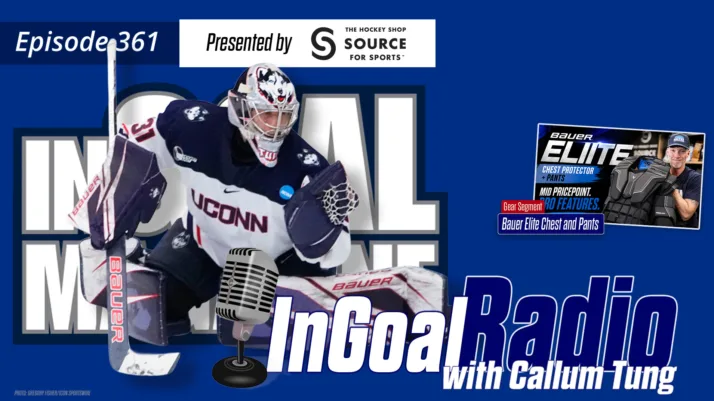
Episode 361 of the InGoal Radio Podcast, presented by The Hockey Shop Source for Sports, features New York Rangers prospect Callum Tung.
Feature Interview
presented by NHL Sense Arena
In the feature interview, presented by NHL Sense Arena, Tung shares some lessons on the patience and perseverance that allowed him to go from not being drafted in the CHL or NHL, to playing one year of college hockey and signing with the Rangers. The 22-year-old also has some fantastic lessons from his first year pro, including some insights into the New York system for goalies and the adjustments in a transition most look back on as their hardest season of hockey.
Parent Segment
presented by Stop It Goaltending U
In the Parent Playbook, presented by Stop it Goaltending U the App, we speak with Harvard University Goalie Coach Brian Robinson. Want your goalie to play NCAA hockey and Ivy League in particular? Brian has some great insights for you.
Pro Reads
presented by Vizual EdgeWe also review the latest Pro Reads, presented by Vizual Edge, featuring Eric Comrie breaking down a play behind the net and how he manages his posts and sight lines in those situations.
Weekly Gear Segment
presented by The Hockey Shop Source for SportsAnd in our weekly gear segment we go to The Hockey Shop Source for Sports for a look at the second price point Bauer Elite chest and pants and break down what level it’s good for.
Episode Transcript
Intro
David Hutchison on assignment this week. You are with Daren Millard and Kevin Woodley, InGoal Radio. It's a podcast presented by The Hockey Shop Source for Sports Langley, thehockeyshop.com. Boy, things must be happening over there with the boys.
Oh, busy times. Busy times. I busy myself, so I haven't had a chance to go over and drop in on Cam and, you know, as I tend to do, pull things off the wall, try them on, leave them lying around for him to pick up. I feel like as a child, my mom made me clean my room a lot. There's a little OCD that ran through our family, so I feel like the Hockey Shop is my place to go to just leave a mess behind.
Apologies, Cam, but they're they're so busy there right now, Daren. Like, it's that time of year and we're getting into this in the Gear Segment where you're into that sort of second price point too. Like, you you you don't have time to order custom right now, so you need a store that has tons of selection and both at the top price point, like pro level gear without the custom order aspect and then that second tier which is increasingly capable of playing at a really high level, nobody has a better selection than the Hockey Shop Source for Sports. They are the place to go to just walk in the store and walk out with what you need, color matching because they have so much inventory, no better place to be than there and as we always say, there's still some sales items left from past generations as all the new stuff continues to come in including offerings. I think we've got we've got we've got some new offerings that we're we're talking about this week in terms of that that second price point here.
We'll get to the Gear Segment, as well as, what's happening in and around the hockey world. But first, I wanted to touch on a great story that you've got coming up in the NHL Sense Arena feature interview.
Yeah. Cal well, we got Callum Tung is our our feature interview guest. And if you aren't familiar, Callum is a guy with some great lessons to share on sort of going undrafted into the Western League, playing BCHL, playing junior b locally here in the Lower Mainland on the island, playing in the BCHL, getting a opportunity to play at the University of Connecticut, having a great season and signing with the New York Rangers. So late bloomer is I believe the phrase he uses in our conversation, but from there to one year of college to pro contract to right into the American Hockey League two years ago after his college season ended, one one goal away from making the frozen four. Right back into the American League to start the season, some time in the ECHL, which is very common now.
And so an an opportunity to catch up with him and sort of get some really great insights into his development path, I but also got a chance to be on the ice with him. Him and Emmett Creuteau of the Montreal Canadiens draft pick. I think believe he's at Dartmouth right now. Just on the ice in North Van this week. Chance to catch up with both of Chance to watch them work with an old friend of ours who we've worked with for years, Lyle Mast, who is OR Sports, kind of the Head Trajectory tracking guys, how a lot of people would know him, but he's got a new product coming out soon.
I actually have a sample of what it looks like in the box, the presentation, in the package at home now and with me of the tracking goggles. And so we're seeing, you know, a lot of success with these being used. You saw it. Carter Hart using it in warm ups in Vegas, taking it on the ice. Calgary Flames goalies, Dustin Wolf, Devin Cooley taking it on the ice, warm ups.
Callum, as he'll talk about in the interview, takes it on the ice, uses it in his first year pro, and watching it with Emmett this week sort of just transform them a little bit in terms of some some of the mechanical side of the game, but also sort of how they think about positioning and access to pucks and access to ice. It's really fun. I've I've been out there for two hours already. I've got another two hours left before the week's over and hoping to share some of that over at ingoalmag.com in the coming coming months as well, as well as the new product. Before the full launch and we'll know and get to insight into the product in more detail, just what what do
the goggles do? Where what do they block out? Where where do they train you?
Oh, simplest terms, they create binocular vision. Center socket, looking through the middle of the socket vision. You know, like, it is incredible how that understanding well, understanding it is the first part, understanding how that fuels not just access to pucks in terms of shots and releases and them coming at you, but how it triggers efficient movement in terms of early rotation and sort of how we start our movement mechanically and how that can be a trigger for the efficiency we want that allows us to build early rotation and arrive at our next spot set and on angle rather than if you don't emphasize it, if you tend to lift your head up and over your shoulder before you, for example, make a t push, that automatically sort of pulls your lead shoulder back, pulls your body back, takes you away from the puck. It's movement that isn't actually gaining you anything. It's movement for the sake of movement.
You're counter rotating. You're not actually adding you're not getting access. You're not gaining space. You're not getting angle, and it actually leaves you arriving in your new position and then having to build your squareness and your set. So this it's it's a trigger that touches I'll go back to the first time I'll go back to the first time that I learned this stuff.
It was with Alex Auld, and it was a skate with Eddie Lack, and they were learning from Lyle. This this goes way back because Eddie was with the Canucks at the time. And after the first hour, Daren, I'll never forget, it was Alex All that said to Eddie, and this is pre pre Goggles, but just the concept of it, he's like, there's nothing in your game that this doesn't touch, and in a lot of ways, there's nothing in your game that this can't help fix. The problem for a lot of time was you had to think about it, the conceptual nature of it, and guys would learn it, and then they'd go away, and I'd be watching them two months later. And it's like, okay, it's gone.
Like, where'd it go? And people are like, oh, the tracking's not working. I'm like, no. Because he's not actually tracking anymore. Can't you see this?
And the goggles have become like an on off switch for these guys to sort of self regulate and understand when they are and when they aren't.
And you can just use it for fifteen minutes a day or ten minutes a day and and it helps train
Honestly, yeah. Like, Callum talked about using it and he'll talk about the interview about using it for releases, also for a little bit of skating. Some guys use it for skating because again, like I know in Washington, they use it for some skating drills, again, to build some of that proper rotation into angle with the Capitals goalies. Some guys just want it. I know Carter, you've seen it.
He just uses it mostly for the first few shots in warm up just to make sure, you know, he's keeping his head down on those releases and he's not losing that puck underneath his vision by coming up and off it. So there's a lot of different uses. Honestly, Daren, the applications are kind of interesting. They go beyond hockey. Somebody may have fixed his golf game with him, hand raised.
But also, there's been some interesting developments around because it triggers a sort of angle that creates a lot of sort of vestibular function ties. Like, there's a lot of science and biomechanics behind this, and there's a lot of, like, throw a pair on if you've just gotten a knock, like a concussion, and it sort of helps reset some vestibular function recovering from that. I've started to use it a little bit for that and had a little bit of success, and there's a lot more research behind the scenes in sort of adapting it for those. But we've got everything. We've got a we've got Red Bull looking at it for surf team members and using it for some of their training.
The applications go so much beyond hockey, and yet for goalies because the puck's coming from the ice, it it's sort of the birthplace of this and this discovery and this development, but the application for hockey and for goaltenders is is just like it's natural. It's perfect.
Look forward to learning more about Lyle Mast's evolution and goaltending and these goggles when they are released, for, the public's consumption and, ability to dial in with them. Time for the Gear Segment presented by The Hockey Shop Source for Sports Langley, The Hockey Shop dot com.
Gear
Well, we talked about second price point gear, and we've got a bunch of it coming up here. The kind of stuff you can just walk in and buy because they've got so much of it in so many sizes and in a lot of cases, color ways. That's where we're gonna continue this week with Cam walking us through another new option on the second price point level. Welcome back to the Hockey Shop Source for Sports. I'm Kevin.
I'm here with Cam. That's me. I've got our elite.
Well, if you were about to say that this already existed, you're kinda correct.
Okay. So why are we here today?
Because it's got a bit of a facelift.
But what is it?
What is it?
It's like where where does it fit in their in their lines?
Their mid tier price point gear.
Okay.
So this covers
Good, better, best? Good is GSX? Better. Is Elite? Yes.
Best is like your Fuse and your Hyperlite. Your Fuse
and so on and
so forth. So it's their midpoint? Yes. There is a couple
of updates to the chest over this, you know, this version versus last year's version. One of the things looking into the unit a little bit more that I really really like, we've updated like some of the segmentation on the shoulder floaters. This is all actually one fused unit now as opposed to being segmented as it went through. The problem with that segmentation that it would catch and kind of grab underneath the floater as you went to go flex your arm up. So this allows a little bit better mobility and then also it just adds to the coverage of the chest as well.
Actually
Oh, it's got shoulders look a little bit wider.
For mid price point, it's got adjustable arm length. That's correct. I like
that. Continuing on from so easily adjustable arm. Again, something we can ideally fit a little bit bigger and then basically shorten it up and then long it out as as the kid grows. Moving on to the backside of the chest, there still is there's similar familiar arm design that we've seen previously. So still the elbow cup.
Soft soft double they have a hard cap in the pro stuff? Is that That's one of the correct. So you get a soft cap there. That's the difference.
Still that tricep pad that wraps around so again you're getting those reverse
I don't need it. I don't have triceps.
There you go. Sweet. Little little back protection.
You get caught that way. There we go. Yeah. Glove up. A little bit of
a wrist guard to give you some of that impact protection as well. Easily adjustable backplate. That doesn't change the inclusion of the fight strap as well. Do you need to fight down?
Your mid point because some people get a little aggressive when they're playing mid.
It can happen. It can happen. So a couple of cool additionals this year. Tie down loop on the
inside. Down loop.
That's correct. Yeah.
On the mid price point Bauer Elite chest. Yeah. I like it.
So again, giving you more options in terms of how you wanna wear your gear. You want it to fit, how you want it to integrate with your pants.
And of course, I I mentioned this was already on there. The belly and the side flap extenders come stock.
Dial in that fit whichever way you need.
Okay. Perfect. Now Yes. When we're talking about fitting a chest protector, not just the arm length, but this is adjustable, obviously your shoulder length, how it fits on you, but how it integrates with your pants. And we have the pants.
Bauer Elite pants. Again, it's good.
Good, better, best? Better. Mid. But not in the mid the way the kids use it as a derogatory term. Middle.
Mid as in it's still good. Really really even more so than the chest. The pant is pretty close to the same thing as it was.
Okay. So walk us through some of the features.
The good news is is that if it ain't broke don't fix it. Great overall fit in the pant, a little bit of wider set, You know, can tuck in It and depends on you. Inner belt. The one thing that irks me a little bit about these things is when they do say removable belt on the inside. It is actually stitched in so it does make it a little bit difficult to remove. Listen, removable, I mean you could just, you know Pair of scissors. Pair of scissors. Still remove it.
Listen, removable, I mean you could just, you know Pair of scissors. Pair of scissors. Still remove it.
But like the option is there.
Yep. So if
you're crafty, you can get rid of it and then hey, if you're crafty again, you want to stitch it back in, also a possibility.
Cam does a lot of crafting.
Just crafting is all it's what you do around here. Removable inner and outer thigh pads. In most cases, I do say get rid of these because they do tend to get in the way. What it is designed to do is center the leg inside the leg channel. What it can do is get ripped off every time you put your pant on and put your leg through.
Depends on the size of your knee pads. Cam wear super big cheater knee pads.
It can also interfere when you have some of those bigger knee pads and things are actually closing that five hole too as well.
So Okay.
One thing to just remove potentially, they do have the length extender from the pant as well again. So by unbuttoning that pant down one all the way throughout, I can get an inch of extra length out of that pant. Okay. So I like that.
So some size adjustment. Now the one thing I noticed here, like clearly it's a really mobile pant but when you're got this much mobility and there's layering of segmentation and duplication of protection, but anytime a pant moves like a pair of gym shorts, I have questions about protection. So in fairness, what levels are we looking at here in the middle price point Bauer Elite? If you're not wearing this out to a pro skate?
No. I mean, I necessarily wouldn't. Don't get
invited to a pro skate.
Quite often actually. It used to and you used
to invite me out and then we'd
make fun of how bad you were.
Well, yeah. Like now that you're on Off Campus, you you get invited out to all the Superstar.
So the overall fit and feel and like who it's for, this depends a little bit on exactly what value you're looking for out of your pants.
Mid level beer leaguer surviving this?
Exactly. Even a high level beer leaguer is a quite thick pan for what's being offered kind of now. The mid tier
price point There is a fair bit of padding, but like this Yes. It's just there's a looseness to it.
Yes. That doesn't necessarily mean that's a bad thing.
Okay.
Being out of the pant game for a little while there, he forgets that that looseness actually can aid in that mobility. That mobility, as long as those plates are interlocking and cover each other, you're not creating that gap in protection. So even as this pants slacks out a little bit as you play in it, which will naturally happen with that one, you're still getting actually a lot of coverage of the thigh. So overall, yes, I, you know, hey, as a kid that's growing, a little bit more cost effective looking for my gear, this is still a great option. Is it the best option? No. That's why there's the Pro Pant. That said, I still think this can cut it some of that higher level hockey too as well.
Okay. So GSX is here. Good. Better is Bauer Elite, which we have here and then best you're gonna do your Fuse and your Hyperlite in your pro models. Correct.
Okay. So there you go. There's if you got any more questions about who this is for, whether it's for you, sizing, fit, availability, where do they get you cameras?
(604) 589-8299 or 1-800-567-7790
or the hockeyshop.com
where you can also find the sales stuff from last year.
Is this a fun time of the year for Cam or is it stressful for Cam?
I think it's probably more stressful for everybody there. Once the kids are out of school, right, like, they're at the hockey, it's it's a fun and exciting time, but it's just a really busy time. So, like, when you love your job, it's fun. But at the end of the day, there probably isn't a chance to because Cam does so much more than just sell gear, but if he's being pulled onto the floor and into the sales side, which I think he enjoys, you know, there are other parts of his duties that end up having to be done probably after hours or or at other times. So busy is good.
I always say that busy beats the alternative, but it's probably there's probably a stress element element as well for Cam and his entire crew. And that's the thing, like, we we pumped Cam's tires pretty good. I give him some jabs on this on on the on the gear segments and playful, but it's not just him. It's the entire team he's built there. Like, they know goaltending.
They're not just hockey players. They're goalies, and they they live it. They breathe it. They try all the different gear. They've got, you know, truly expert opinions.
This isn't like another store where you're just getting some kid in high school that may or may not have played the position. Everybody in the goal department at the Hockey Shop Source for Sports plays it and understands it and will help you play it better by finding gear that works for you.
Staff is a difference maker over at The Hockey Shop Source for Sports Langley, thehockeyshop.com. Just like our Vizual Edge ProReads on InGoal Radio, the podcast and InGoal Magazine, what do we have this week?
Well, first off, do you want the puck to look like a beach ball, Daren? Yes. I know Yes. I know it does for you. We've all had those nights, you know, here and there, some of us a little less often where the puck looks huge.
You're ahead of every play, you feel calm, patient, in total control. Then there are the nights where you're half step late. You see it but you don't really see it. You're reaching, you're guessing, fighting it. It's not your technique.
It's your eyes and your brain not processing the play fast enough. Vizual Edge fixes it. It measures how well you your eyes track and process the game, gives you a custom plan to train improvement. Three fifteen minute sessions a week on your laptop or tablet. It's what NHL goalies like Jordan Binnington use to make the game slow down when it matters most.
And, of course, you can get 10% off on your Vizual Edge subscription using the code InGoal, INGOAL all caps, or if you're a member at InGoal Magazine, a subscriber at InGoal Magazine and, no, folks, that doesn't just mean you get our CSS stuff on an Instagram. That means you actually can go to the website and log in and see the full ProReads where NHL goalies break down video and explain their decision making process. Contained within each ProReads is a special member only discount to Vizual Edge. 20% off, double the discount. More than covers the cost of your InGoal subscription.
Make sure you check it out at ingoalmag.com. Just click on any ProReads to get the double discount code. And of course, this week, we're going back to Eric Comrie right here. With Com signing in in San Jose, I felt like we need to burn through his his Winnipeg stuff. It's so good, but we had so many different guests this year.
They I kinda rolled him into the rotation, like, once every two months, basically, because we had so many different ProReads. Well, now he switched teams. I have a whole bunch of video of him in Winnipeg which is, to be honest, where he always seemed the most natural and we're gonna roll through that. This week, puck goes behind the net, you're on your left post but it goes around all the way to the right post. Are you holding that post edge?
Are you looking over the left shoulder? Are you switching the head early? Like what's your priority as a goaltender on that one? And remember, there are no right or wrong answers. This is individual, personal preference.
I tend to switch over quickly.
Visually or with your skates and which post your your foot is on?
Visually for sure and then then skates follow.
Okay. So Yeah. One of the things and we've we've also talked about windows, right, where you Yeah. Lean off the post
I don't use the windows nearly as much as I should.
I don't either, probably because I'm not fast enough, like, to sort of open the window, look, and then turn my head. Yeah. And in this one, it's a pretty quick play. Puck gets rimmed around. So there's no sort of slowness.
It really immediately, he's gotta go left shoulder, right shoulder. And Eric talks about why, and and in this case, he goes he keeps his left foot on the post and he goes over his right shoulder. And the play comes back and then something different happens and he ends up behind a little bit. And he talks about his coverage on a pop pass afterwards, is a really important part of the breakdown, how he prioritizes middle net, something you've heard us talk about in his coverage after falling behind and ending up late back to the other post. But his preference is to pick a post and stick with it, and it's something he talks about the video they do with Wade Flaherty or did when he was in Winnipeg, Connor Hellebuyck, about why their preference is to pick a post and stick with it.
So he stays on that short side post, changes his sight line first without giving up that coverage on that post. He walks us through the whys specifically to this play and in general. And, we're not there are other guys who do it differently, but Eric explains why this works for him. So a great chance to sort of dig into his mindset and see if it might be something that you can apply to to your game. As well as, like I said, really important on the pop pass.
He's late, still makes the save because of how he prioritizes his coverage after getting behind and having that puck end out up in the middle of the of the ice. So some great tips as we get every week. Make sure you check it out, folks. InGoal Magazine, ingoalmag.com. The latest from Eric Comrie.
And a reminder that we've got over 40 goalies and over close to 400 now, over three fifty, I know, of these types of videos, three, four minute videos each, where an NHL goalie watches video with us with you and explains his decision making process. Why does he choose a certain depth? Why does he choose a certain save selection? What's he looking for from the opponent? What's he trying to read off from his defenseman?
This is the way you get better at reading the game by understanding some of these little keys and tidbits that the guys at the top level use to read the game themselves.
Parent Playbook
I hadn't heard a quite phrase that way, pick a post, but it totally makes sense. I look forward to getting more of that, with Eric Comrie, now the San Jose Sharks, as we slide over to Hutch, who will join us now, but he's he's on assignment, but, gave us this, edition of the parent segment brought to you by Stop It Goaltending U the app, which is front and center in his life right now.
Well, is. I mean, what a perfect segue because Hutch is actually in Boston at Stop It Goaltending's prospect camp and tapping into in person all the experience of one of the biggest goalie schools in the world. If you can't make it to Boston, but you still wanna tap into that experience, into the twenty five years of NHL goalie coaching experience from Brian Daccord, you can do so with a subscription to Stop It Goaltending U the app. All the knowledge from Brian who has been an NHL goalie coach scout and director as we said with the Red Wings currently, as well as all the insights and expertise from his staff at Stop It, which includes a long list of minor pro and veteran NCAA coaches, as well as others that work in other departments around the National Hockey League, all delivered in easy to digest chunks, including five short daily primers, weekly style analysis and breakdown videos, and drills that you can take onto the ice with your team and coach this summer. Plus, you get a subscription to InGoal Magazine included.
So check it out now at the App Store or Google Play and get the best of both worlds with a subscription to Stop It Goaltending U the app and a subscription to InGoal Magazine. The best of both worlds. It's kinda like Hutch being at Stop It Goaltending this week.
Over to Hutch.
Alright. Thanks, guys. I'm with Brian Robinson, goaltending coach for Harvard University and managing director at Stop It Goaltending. Very privileged to be at Stop It Goaltending's summer prospects camp, and I cornered Brian pretty much literally to have him talk to parents directly. And five tips for parents, something like that.
We'll see where the conversation goes, Brian.
Awesome, Dave. Thanks for having me. It's been great great talking to you this week. Great getting to finally meet you in person after seeing you only digitally and I guess audibly through the the podcast. So this has been a lot of fun.
You know, big thing with parents, you know, obviously, when they when they see me, they see the Harvard, the Ivy League, obviously. The education is great as parents. You know, I'm a I'm a new parent as of as of the last three years here, and, you know, we always want what's best for our kids. And education wise, it usually doesn't get much better than Harvard. So I I at these events when there's lots of kids, lots of parents here, I usually do get, you know, a lot of parents coming up like, oh, you know, asking not cliche questions, but the common ones.
You know? Like, what do you look for? What do the kids need for test scores? This, that, the other thing. So the big thing for me, at least, as far as as it relates to Harvard, like, you know, I'm I'm lucky or I've been lucky over the years.
You know, obviously, we just had a regime change going into this season, but before under Ted Donato and the the good the great assistants actually he's had over there, they do most of the legwork for me in a sense that, you know, I don't even look at a kid unless we already know they have the grades to get in. Now with this major junior stuff, you know, as I was mentioning to you before we started recording, we need test scores. So, like, we're one of the few institutions, you know, remaining out there that, you know, we require either an SAT or an SAT, and we need usually to get a certain test score. And obviously, that combined with the the GPA or the weighted GPA depending on where they got their high school education, that kinda dictates whether or not we're gonna be able to need a kid kid to get in. Now take the education, take all the strict academic guidelines away from it, we want good players.
We're we're doing the same as you know, all these other big schools are trying to do is we're trying to win games, we're trying to win Bean Pots and league championships and Frozen Fours and National Titles. So you know, it's a it's a special type of kid we need, you know. We need we need kids that can can think on their own, they don't need their hands held, they need to be able to manage the life of being a Harvard student and the life of being a full time division one athlete. You know, both require, you know, a lot of time, a lot of effort, a lot of energy, so we need kids that can kinda kinda manage those things, if you will. So, you know, before before we ever even have kids on campus, you know, I usually do phone call first, Zoom call next, and try to pick their brains.
You know, I wanna know how they are personally. I wanna know the basically, I wanna know those kids inside out, know, what are their family values? What do they like to do for hobbies, you know, I then need to figure out who their goalie coaches are, who their head coaches are, need to figure out what type of kid they are, what type of teammate, all that type of stuff. So, yeah, it's it's not much different than other schools other than the fact, you know, we can't throw a scholarship at these kids. Know, if if for anyone that's not aware, Harvard is all need based.
It's only academic money. We don't have athletic scholarships over there. You know, the big thing we sell is, you know, we have that Harvard Ivy League education. Not only the education, but, you know, the other the other type of students that are coming through there and the, you know, the the people you get to rub elbows with, you know, your roommate might end up being the the next maker of Facebook. You never know.
So that's that's kinda one of the the big selling points and big benefits for us, you know, and we're also, you know, we're in a city with a lot of other really good hockey schools. All the other bean pot teams are really, really strong programs these days. You know? We it's been shown over the last ten plus years now. It's almost any man's game now with the bean pot.
You know? When Northeastern's won a few as of late, we got we finally got ours a couple years back. And then, obviously, we all are aware of the BCs and the BUs of the world. So, you know, we're we're trying to battle with them every single year. That bean pot for anyone not familiar, not from the New England area, like, that's that's a big deal for us.
That's kind of at that point in the season, that's like our Stanley Cup. And then once we get past that, we're we're trying to, you know, finish down the stretch in the playoffs and, you know, and trying to make the NCAA tournament, which which is never an easy task. You know? And now with this this major junior stuff, hockey overall is getting better. We have a bigger pool of good kids to pick from.
And and again, since we've started, been able to recruit the kids for major junior, the big thing that I've found out with the kids I'm trying to recruit and get on campus is that they're not even aware that they need to take test scores. So that would be my one thing, you know, if you're a you're a younger student athlete, you know, playing in Canada and growing up up there, and you know, you do wanna try to get into a place like Harvard is just know that you will eventually have to take one of those test scores. It's just a requirement of the of the institution.
One question on that for the unfamiliar Canadians. When do they need to start preparing for that? Is this a grade 10 thing, grade 11 thing? Can they just take them in the summer of grade 12? Do you know enough from academic people who probably get on you about your recruits to to advise people a bit?
Yeah. So as far as the timeline goes, it it's pretty much just when when you're ready to like say we're trying to recruit you to Harvard and we need you to submit your application, you need your test scores by then. There is no I mean, you need to wait until a certain point in high school before you can actually take the test, and you can take them multiple times as well. With the SATs, can do what's called a super score. So there's there's two sections of the test, if you, you know, you take it once and you do really well on one part and poorly on the other, you can take it again.
And if you do better on that part you did poorly on the first time, you can combine your two different scores for a higher potential score, which which is good. I think, you know, when you think about, god. I need to do I need to get this score on this test or I'm not gonna be able to go to school I wanna go to, it can be it can be a daunting task for kids. Right? It could kind of freak you out and be you get anxiety and real anxious thinking about it. And it's I think that kinda helps knowing, alright. If I don't do that great the first time, I can can get a second crack at it.
But, yeah, so with the admissions process, if it's, you know, it's coming down to the deadlines and you didn't get your test done by a certain time, it's we're gonna have to wait till the next admission period, which is another one of the hurdles that we need to deal with.
You mentioned having to get the test scores in with your application. When are those applications due? And I'll just add another one to it. There's a perception out there that your academic average is basically your save percentage and you're good and you'll get in, but it's probably not true in an Ivy League school, is it?
That is absolutely correct. It is not true. They have what they call, you know, weighted GPAs, and it's based off of the academic institutions that the kids went to when they were in high school. But yeah. So the deadlines, we have what's called restrictive early action, which is a November 1 deadline.
And then we have a regular decision, which is January 1 of that the year leading up to the following school year.
Okay. That's perfect. Any as we as we leave your amazing camp, it's been an incredible week here. And I should mention, Brian is also in charge of the SIGU app, which sponsors all of our parent segments. Thank you so much, Brian.
We work, super close together on that to make it a great app for everybody. As we wrap up the camp here, any thoughts for parents between, now and the beginning of season, how they can support their kids?
So big thing for me, you know, so we have a lot of goalies here this week, a lot of different ages, a lot of talent. Big thing for me is show up on time. And I feel like that's something that that the parents can help instill into their goaltenders, into into their kids, their children. Right? So yesterday alone, my 9AM puck handling skating session, we had four kids on the ice late.
Not ideal. Right? So and, again, you only you only get one first impression, and those four kids was my first time being on the ice with them, so not not ideal. So to me, it's try to instill into your kids, into your student athletes, control the controllables. To me, unless you blew a tire or got to a car accident on the way to the rink, showing up on time should be one of those controllables, you know, bearing any extenuating circumstances.
As far as your kids, you know, especially for bringing to a camp like GCG, and, you know, there's there's plenty of good goalie coaches and camps all over the country, North America, the world. Right? The kids need to be a sponge. They need to be respectful. You know?
And if they can show up on time and control their effort and attitude and and in any aspect of life, whether it's on the ice, off the ice, in the classroom, at work, whatever, I think I think that type of stuff can can go a long way.
Perfect. Thank you so much. Speaking of being on time, you and I are on the ice together in twenty minutes. Thanks for joining us on the parent segment this week, Brian.
What's more frustrating for him? Being with us or having to edit it when he's not with us?
Oh, I think being with us is a frustrating experience for anyone, so I'm gonna go with
because he has to live it twice.
Yeah. Yeah. Exactly.
The little Easter eggs that we planted here for Hutch to to listen to, that, that that we just enjoy. Pulling along, the InGoal Radio Podcast presented by The Hockey Shop Source for Sports Langley, thehockeyshop.com. Our Sense Arena feature interview this week just profiles an a really cool journey to professional hockey.
Yeah. One that's just starting. But first, before we get to Callum Tung of the New York Rangers, I wanted to talk a little bit about our presenting sponsor, NHL Sense Arena, who brings us this feature interview. No better way, you know, and it's funny because part of this conversation is about the chaos and and and I kept trying to remember whether me and and Callum talked about how much harder life is in terms of managing screens and the chaos of pro hockey. It's such a big adjustment and that he told me that was one of the biggest, and I don't know.
I'm just trying to remember whether it was on or off camera for this interview, but it's one of those things. It's one of many examples of the kind of thing that's really hard to train during a regular season or in a practice because nobody wants to go to the net and be the guy that's standing in front to create the broken plays, the deflections, the tips, the screens. It's just not realistic to what you actually see in a game, but it is an NHL sense arena. It's one of many things you can focus on. Puck tracking, angles, all the different things that they bring into NHL Sense Arena at an NHL level used by NHL goalies to help you get better without having to get on the ice.
Like I said, I've been lucky to get on the ice this week. Hutch has been lucky to be on the ice this week, but we know that's not the case for everyone. And there is no better tool when you can't get on the ice. Frankly, even when you can get on the ice, there's no better tool to supplement that training than NHL Sense Arena with all their drills, all their different position specific focuses to help you become a better goaltender, including, like I said, the opportunity to work on screens and actually have it feel game like. Something that I think we're gonna see an increase of among the NHL users of NHL Sense Arena.
So make sure you check it out and use the code I g m 50 to save an extra $50 on your subscription to NHL Sense Arena.
And enjoy this conversation. The NHL Sense Arena feature interview on InGoal Radio, the podcast.
Feature Interview - Callum Tung
Really excited to welcome to the InGoal Radio Podcast. First time guest, but I understand a longtime listener, which is music to our ears. Callum Tung of the New York Rangers, Hartford Wolfpack coming off his first professional season out of college. There's so much that I wanna get into, but first off, just on the ice today watching you work, walk us through what summer is like as we hit mid July for you in your first off season as a pro? I guess second off season last year would've counted too.
Yeah. Yeah. No. It's been it's been a good off season so far. It's been a lot of training working on kinda just, like, my my strength in the gym.
That's kind of been my focus in the the first part of the off season here is just building that found foundation. And then as we kinda get into the second half of the off season coming up here, I'm gonna, you know, be focusing a lot more kind of on, like, speed work, explosiveness, and, yeah, just really ramping up being on the ice as much as possible and kinda getting back into game speed.
What in terms of on and off ice, is there a balance for you? Like, do you like to take a break? Is that evolving as you as you move into the pro side of things in terms of, you know, on the ice and off ice work?
Yeah. I think for me, like, as a younger guy, I like my body can can take being on the ice, like, earlier in the off season as opposed to maybe, like, some more veteran guys. But, yeah, like, as you as I've been told and as you progress through your pro career, you wanna, you know, like, give your body that that time to rest and recover. But it's also obviously really important to to take big steps in your development during the off season because for me, I think that's when a lot of my my growth comes is really just honing the details in the off season and and kind of just, yeah, just perfecting little bits of my game.
Okay. I wanna hear about all the people you've worked with in the off season sorta to get to here and and some of the different changes you've made when you when you talk about it in those terms. But let's go origin story a little bit. Like, walk me through like, how'd you become a goalie?
So my dad actually never played hockey. Really? He he he grew up in Hong Kong or he he lived in Hong Kong until he was about three years old, and then he immigrated over to Canada with his family. So as soon as he landed in Toronto area, he fell in love with hockey. So he was, you know, growing up watching Maple Leafs, big Maple Leafs guy.
But, yeah, it was really, my dad was really into hockey, so he put my brother and me into skating lessons. And my brother started playing hockey, so I was like, oh, I gotta do that too. As most goalies are, I started off as a player for first couple years, two, three years. And then, yeah, my one of my coaches was like, yeah, Callum, you gotta get a net for one of these games. And, you know, got a net for that for that one game and kinda just fell in love with it from there.
But, yeah, it's been it's been a journey so far.
K so, what'd you love what'd you love about it then? What do you love about it now?
I think I liked just, like, the control you have over the game. You know? Like, goalie, it's is a big they can play a big impact on the outcome of a hockey game, and I like kind of being, like, that x factor in a game and having both the pressure of the good and the bad.
I think I liked just, like, the control you have over the game. You know? Like, goalie, it's is a big they can play a big impact on the outcome of a hockey game, and I like kind of being, like, that x factor in a game and having both the pressure of the good and the bad. So I feel
like you almost have to have that. Like, you have to embrace that to sort of survive this position, to thrive in it the way you have, But there's a flip side to it. So, like, you embraced it. Was there ever any point where you had to work through anything in terms of that pressure and what comes with it? Any sort of tips from the mindset side of things for those that maybe don't have it as innately?
Yeah. Yeah. Totally. I think, like, especially today in today's game, goaltending is so mental. And like you said, the pressure of that just adds on to how difficult it is as a goalie to perform.
So, like, for me, I remember, I'd say probably, like, college is when I was really there's a lot of mental kind of more pressure, I'd say. I started working with mental coaches and developed strategies to kind of control that aspect of the game. Because before, like, I didn't really work on the mental part of the game at all. And, honestly, like, it's it's probably 90% of the game in in today's day and age. So, yeah, just, like, working on, you know, like, little techniques, like, to kinda ground yourself during the game, after games, not not, you know, ruminating on bad games or bad goals.
Just kinda having that mindset of its its next shot. And because that that's so much of what goaltending is. It's just being in that moment. And if you can fully embrace the moment and be in that moment, you're gonna give yourself the best opportunity to to perform at an elite level.
Okay. So couple years in the BCHL, and you mentioned going to college, NCAA, University of Connecticut, and that was where that those pressures and started working with a mental coach. Any methods you can share or that you're comfortable sharing, like, to pull yourself back into a moment, whether it's during a game or after a game. We hear about that because next shot mentality it's easy. Like, I've I've been saying this for twenty years with goalies right up to, you know, the NHL.
Easiest thing to say, sometimes the hardest thing to do. So were there any little tips you consider with maybe young kids listening right now? Like, I just gave up a goal that I didn't love. How do I get back into the moment? Is there anything you learned in that year with Connecticut that that you think might help other kids?
100%. I think it's, a lot of it comes back to just, like, routines for me. K. So both my pregame and my postgame routine, those help with kinda just, like, grounding myself and knowing that, okay. I'm in the right mental space to to play this game.
And then during my postgame, I'll kind of, you know, I'll go through, like, a breathing exercise, and I'll reflect on the game. But once I'm done that kind of exercise, then I'm moving on to the next thing and it's a new day the next day.
So you give yourself a period to not dwell on it would be the wrong word, but to process it.
Yeah. 100%.
What's your period? Like, what like, do you give yourself a half an hour after the game before you just set it aside?
Or Yeah. Yep. Usually, like, I'll kind of I'll reflect on it, like, while I'm while I'm stretching or cooling down.
Okay.
That being said, though, like, I'll go over video Of course. With my coaches and we'll reflect on it during that period
of time. But you're not taking it home and sleeping
on it. Exactly. Yeah. Because, you know, the last thing you want is for a bad game to keep you up at night, and then it's interfering with with your recovery in the next day. So but, yeah, in terms of, like, after a goal, for me personally, I'll have I have, like, kind of a reset routine.
So, you know, I'll flick up with water, take a look at the water, you know, skate to the boards. And during that during that time, I'm just I'm taking deep breaths, and, you know, you can reflect on the goal during that period when you're going to the corner, when you're flicking up the water. But as soon as you get back in the net and I tap my posts, then it's just I say to myself, one shot at a time, next shot, and that's it. And that's that's kinda what snaps me back into, alright. It's go time.
And, you know, I've been doing that for so long that it's kind of a routine that just works for me. And it, you know, it's kinda just like muscle memory that's like, alright. It's it's next shot. So
I love it. I love mantras. Right? Like, some guys will write it in their blocker. Like, we've seen that.
Eric Comrie puts it on the back of his stick, just that little reminder to you know, I think for him, sometimes it's as simple as have fun, but I love that. We we talk about next shot mentality. Why not make that part of your actual mantra?
Yeah. Is that simple?
Is that something you've done for a long time, or like you said, was that developed at UConn?
Yeah. Yeah. No. I'd say I think I've I've been doing it since juniors. So when I was with Port Alberni, I think I started it probably my junior b year, and then I went up to junior a.
I continued it. But, yeah, I just, like, yeah, I'd say it's it's continued, and it's worked for me throughout juniors, college, and and now, probably, it's kinda just been something that I've that's worked for me.
So Anything you changed during that year in in university to sort of matter? Like, that's one that you've stuck with through. Is there anything you added there with the work with a mental coach that might have been different from what you were doing in junior?
A lot more kind of visualization.
Okay.
Like, I I didn't do any visualization work in games. Yeah. Pregame. But I added that into my routine in in university with UConn, and, yeah, I had success with that. So, yeah, that's that's another thing I've added to, like, kind of my pregame routine.
Visualization's one that I think a lot of listeners and we've done this enough on the podcast that they've heard this answer before from other people, but it can become a bit of a nebulous concept for kids. Kids like you are like, oh, visualize. What does it mean? Like, are you looking like your eyes closed? Are you picturing a puck moving around the rink?
Are you looking at an overhead? Are you looking like your eyes are open? Like, you're looking through your mask? How does how do you like to visualize?
For me, I like to visualize, like, from first person.
Okay.
So, like, I'm looking out my mask as if I were, you know, playing the game. K. And yeah. So I'll I'll visualize kinda, like, three different scenarios of, like, like, a cross ice, like, a a shooter coming down, cutting across. So just, like, staying over the puck, having my eyes on the puck, you know, really tracking the puck, not the player.
So and then, obviously, making the save. I'll I'll do one of, like, a rush a rush scenario. So, like, you know, a quick pass over. So, like, a quick push and set, so, like, snapping my head. And then, obviously, like, as you're visualizing this, you're kind of imagining, like, what the rest of your body is doing, and it kinda just primes, like, your subconscious to kinda, like, be ready for when you do step on the ice.
Like, it's kinda more natural.
It's like a warm up.
Yeah. Exactly. Do you
ever change those scenarios based on a team specifically?
No. It's it's usually the same for for for these three.
And those are scoring scenarios or or shot scenarios that are common?
Yeah. Exactly. It's just, like, pretty generic, like, everyday plays that happen in game. And it's, you know, it's like you said, it just kinda primes you for for when you get on the ice. So that's
Once you're out there, is it did it make you feel sort of more prepared?
Yeah. A 100%. Like, I think especially, like, I think it just it takes away from the pressure of it makes everything kind of, like, more subconscious and more, like, flow naturally. Whereas, like, if you're just hopping on the ice, things might feel like a little bit not forced, but, like, just, like, a little bit more friction as where if if you prime yourself and you prepare, you can just hop on the ice and you're you're in game mode right away, right from the get go.
Love it. Any voices like, we we I've got to college. Any voices along the way that you wanna show guys you've worked with over the years that helped you sort of build this foundation of who you are as a goaltender? Maybe as part of that, somebody were to ask you, what is Callum Tongue as a goaltender right now? How would you describe your game?
Yeah. Yeah. I've had a variety of goalie coaches throughout the years. You know, growing up, I played with the Vancouver Northeast Chiefs, and Matt Korshmaar has been a a huge, you know, coach in my career development path. I worked with him for what was that?
Four four years. So the year before Midget, and then I I worked with a minor midget, second year midget, and third year major midget. So, yeah, he's been a huge part of my development. And then going into to juniors, I worked with a couple of different guys in in Port Alberni, but Jamie McKeag was he was the main guy.
Yeah. I know Jamie.
Yeah. Out there in in Port Alberni. So he was he was awesome. Yeah. I I love working with him for that year with him.
Yeah. And I went to University of Connecticut, and I was working with Vince Delisle and he was he was a great goalie coach and very details oriented, very analytical with with video and is
that new for you? That level of video? I mean, you would have done it in junior, but maybe not to the same degree?
Not to the same degree.
Yeah. Any any tips on what you learned there? And we'll get into pro too because, obviously, I know, like, Brendan Burke and and Jeff Malcolm and new voices with the rangers. But if you were to now, knowing what you know, go back to junior aged you and go into those video sessions, would you look at it any differently?
Yeah. I'd say, you know, having a purpose with what you're looking for, pulling apart details and like, for us, with me and Vince, like, we go into a goalie session and we kinda focus on one thing. Like so it'd be, like, you know, presentation. And I'd really, like, focus on that for the session and, you know, video, obviously, especially for presentation, like your stance in the net is awesome for that because you can see how big you're looking in the net. And, you know, if you have the right camera, you can see, like, the angle of what the puck sees.
Puck perspective matters. Exactly. Because quite often, we feel not as big as we look from where that puck's coming.
Exactly. Yeah. So that was a super helpful tool and and just you can you can imagine that you look one way in your head, but, like, you, like, you video doesn't lie. So if you see, like, how big you're looking or if you look shrunken down, then you're like you can say, okay. I need to make a change or that's looking good.
So I definitely say, like, having, like, something that you're looking for and and really kinda honing in on that, like, that one or two things can be, like, a really helpful tool.
Rather than trying to go into every video session trying to solve everything.
Yeah. Yeah. Exactly. Exactly.
I like that. I like that. That's great advice. What about looking at goals? How do you you're looking for improvements, but this is a game that is so dynamic, so fast, and frankly, it's played on a frozen sheet device with a odd shaped object that can bounce in a many million different directions.
Is it important to, like, have that honest analysis, but are there times where it's just like, yeah. I wouldn't have done anything different. Is it important to also have those moments so you don't start chasing changes?
Yeah. No. Absolutely. I think you hit it on, like, a nail on the head there. Like, a big thing that I worked on with Vince was, like, we called it, like, our process.
And so at the end of the day, if your process and, like, your fundamentals are right, that's that's ultimately what matters. Goal like, bad goals are gonna go in where, like, you know, you're doing everything right from a goalie fundamental standpoint, but it's like a double deflection, like ping pongs off a guy's skate and just ends up in the back of that. You know? So in cases like that, you have to that's where, again, video comes in. You analyze the goal.
You look at your process of, okay. Am I doing what works for me and the fundamentals of my game properly? And if I'm doing that and a goal goes in, then that's just that's hockey. That's part of hockey.
Do you have checkpoints for your process? Like, is it like, okay. My angle, my depth, my presentation, as you mentioned, do you are there different things you check off on that list? Again, to make it a little more like you said, process is the word as opposed to just nebulous. You know, that sort of like, oh, maybe I should've done this.
Like, it's it's very detailed.
Yeah. Yeah. 100%. Like, working with Vince, it was a lot of and and the guys in Hartford, it's it's very details oriented. Like, goaltending is such a the littlest detail can make a huge difference.
So making sure that those little things are are dialed in. And like I said, if you're doing that and a goal goes in, then that's hockey. But, yeah, like like you were saying, like, presentation, depth in your crease, are are your feet set, are your are you drifting, You know? And, you know, there's a time and place for a drift, but just like, is the are you answering what the play say the the play is a question, are you answering that question with an answer?
That sounds like a guy who's been in the Ranger system for a year. Ben Benoit Allaire. Yeah. Question, answer. Yeah.
Absolutely, sir. I've heard that a few times over the years.
Exactly. I
love that it's continuing. Before we get to Hartford and and and your time with the Wolfpack and the Rangers organization, you weren't drafted. Were you drafted in the dub? No. Okay.
So there's a lesson here. Yeah. Right? As you take this path from, you know, the PIAJHL, VIAJHL into the BCHL into NCAA for one year and now as a pro, signed to a contract by the New York Rangers, playing in in the American League in your first year, the path is not the same for everyone. Is there any message for kids that are right now going, I didn't get drafted this summer that you might like to share that they might need to hear?
Absolutely. I think goaltending, it's such it's not linear at all. It's it's full of of ups and downs. And, you know, especially for me, I was a late bloomer, so I didn't really hit my my peak height or or even, like, weight or anything like that until I was, you know, like, like, kinda, like, 16, 17, 18. So, yeah, I guess my message to kids would be, like, if you're not where you're at right now, that's don't be discouraged by that.
Like, you can look at plenty of stories of guys who who are late developers, late bloomers, and they just kept that belief in themselves, and they they kept true to their to their selves and their goal. And, you know, they kept their head down, kept kept working, and, you know, eventually, results will come.
Anybody you wanna shout out that helped you with that? Because it's not easy. It's it's probably easier looking back now to say, but I've seen it. Like, I know how hard that can be in the moment sometimes as everyone else is, you know, celebrating some of these things that I think the hockey world sorta puts on too big a pedestal at times, like getting drafted into certain leagues and things like that.
Yeah. No. There there is obviously, you need a a great support group to to help you through the hockey world in general, let alone being a goalie. So, yeah, like, just there's so many people that I I could thank to to get to get me to where I'm at right now. But, yeah, just obviously, my parents, you know, they were monumental in my my hockey growing up and especially, like, some of, like, you were saying, some of those times of, you know, where you can get down on yourself, you're not drafted or you see other guys or, you know, a little bit ahead of you.
They were huge and, you know, just supporting me and saying, keep going. And then, obviously, yeah, like, my goalie coaches growing up, like I mentioned, Korshmaar, Jamie McKeag was was huge in in my junior junior growth and development. And, yeah, like, Vince Delaney, all these guys, there's there's so many to to name. So, yeah, it takes So you army.
You go from NCAA one year to signing with the rangers the next year. Walk me through that process because that's pretty quick. Was there any temptation to go back, or was it just that now that was the time and you wanted to make that jump? Yeah. Opportunity.
Yeah. No. It was it was a really tough decision. Obviously, we had a great year at UConn there. You know, made
15 games as a freshman and a nine thirty three? That's a heck of a first year, my friend.
Yeah. No. It was it was a blast. And, obviously, like, like, our our team had so much success with making it to the tournaments and, you know, one goal away from making the Frozen four. So, yeah, it was it was a super tough decision stepping away from college hockey and, you know, just the lifestyle of college and and classes and being around, like, this community of people.
But, ultimately, for me, like, I talked to them for hours with coaches and my parents and just for for my development and my career path, I thought that, you know, signing a three year contract was was the best step for me. And, yeah, I I took that step, and I haven't looked back since.
Okay. You go from, like you said, playoffs and one goal away from the frozen four to right into Hartford at the end of the season. So you get it. How important was that taste, those couple of games at the end of right after you signed to prepare you for last year? Like, just getting a taste of what it was like.
No. They were they were huge. I think, like, just kinda getting my feet wet with pro and and having that experience after our run with Yukon was was huge. Like, obviously, everything happened so quick. It was
Different game too. Yeah. Yeah. 100%.
It was it was a whirlwind, and just going from college to the pro level like that was, you know, it was it was really fun, but it was also obviously a challenge. But, yeah, just being kinda getting acclimated with the guys in in Hartford and just, you know, kinda getting a taste to dip my toe in of what, you know, the coaching staff and everything expects of you as as a professional hockey player now was was monumental going into my my first year of professional hockey. And, obviously, you know, like, as a as a first year rookie, like, this was such a learning year for me. Like, you know, just as you said, like, a jump from college to pro is
The hardest the hardest I mean, you just made it, but, like, literally, every goalie I've talked to for the last twenty years has agreed that that is the hardest jump, that first year pro Yeah. Whether it's junior or college, harder than going to the NHL is that first year pro that you just went
through. So it's
not just you saying.
Yeah. No. I would agree just because, you know, it's it's all on you now. Like, you have to take your development into your own hands. Like, there's no one holding your hand through it.
So, yeah, just, you know, like, really developing that mindset of, like I said, owning my development and, you know, just, like, creating routines and practices that work for me was a was a huge huge learning thing for me this year being a first year pro. And, yeah, I'm excited to carry that into next year and see how much more I can learn and build on that.
Well, I didn't ask you. I should have asked you. What's the recruiting process like? It's different for everyone. Like, we know of guys that have you know, I'd speak into the ranges.
We know guys that have lunch with Henrik Lundqvist as part of their recruiting process. What was yours like?
Yeah. It was it was I didn't get a lunch with Henrik Lundqvist, unfortunately.
We'll have to we'll have to see if we can make that happen in the future.
Yeah. But, yeah, I think they rented out a restaurant for me, so that was pretty cool. Yeah. So we went In New York? No.
In in at UConn. Came to UConn. They came to UConn. So it was, like, this this nice restaurant close to UConn campus. I sat down with the staff there, and, you know, we had a we had a nice dinner with with my dad and because he was in town.
So, yeah, really, really good chat with them, just kind of talking about, like, what they what they have to offer and their organization and everything. And, yeah, just after hearing after hearing that and having a great chat with them, it was it was a no brainer to saying to sign with such a great organization. So
I didn't ask you. Who was your guy growing up? Like, in this area, you were from the Vancouver area. So who was your like, as you're this young goalie learning the position and loving the position and embracing the pressures, as you said Yeah.
Who was your guy?
My favorite goalie? Yeah. I was Carey Price. Guy. Okay.
Yeah. Okay. He's just like his calmness in that, like, it was unbelievable. I I did really like watching Henrik Lundqvist too. He was he was probably
You have to say that now that you're in the Rangers organization.
It was a close it was a close one too there. Yeah. For sure.
Okay. So you head into this season. Brendan Burke is your goalie coach in the American Hockey League. You're doing development camps and stuff. Jeff Malcolm, you already said it.
Question, answer, The philosophies of Benoit Allaire. I'm guessing depth and how you think about depth has probably shifted a little bit since you turned pro. Can you explain without asking you to give any other secrets away, but explain sort of how the mindset towards positioning shifts with their philosophies.
Yeah. 100. I like working with Burky and, like, all the all the guys in the New York Rangers organization, they kind of all push the same they're all on the same page.
I love that.
So it's really easy to, you know, go from development camp down to Hartford or even in Bloomington last year
Right.
Working with Jean . It was it was all the same message.
So Jean and Filetro? Yeah. Okay. You said it better than I. Like, I don't I apologize to him.
I'm I don't have the good accent. I can't. But it's funny. We had we just actually published a recent article with and we've got a series of skating drills with Dylan Garand. Yeah.
And he talked about, like,
the things he learned from Johnny in as well.
Yeah. Yeah. Well, it's awesome. Yeah. They're all on the same page and yeah.
Just like to get into specifics without giving away, like, you know, the keys.
Yeah. I don't wanna put you on the like, what are you doing giving away the secret sauce?
Big thing that we that I I changed in my game, like, right from the get go as I got to Hartford was, you know, just playing more conservative with my depth. You know, at the end of the day, like, goaltending is such a positional sport, and you don't need to overcomplicate it. So you don't need to be coming out chasing pucks and being overly aggressive. So, yeah, just being a lot more conservative with my depth, being a lot like, playing a lot more, like, smarter versus harder. So, like, not like, speed and and power isn't necessarily, like, the end all, be all.
Like, just being smarter with where you are, where your feet are, you're tracking, all of that. Just kinda simplifying the game for myself. That was that was, like, a a lot of the big key focuses that those guys were were pushing on me and, yeah, definitely helped helped in my game.
Any input, like, whether it was the first year when you went up after the season at UConn or last year, goalies that helped you along the way? I mentioned mentioned Dylan who would have been in Hartford last year. You know, he's talked about Louis Domingue and and the and the importance of sort of him impacting him as a young goaltender. Is anybody taking you under their wing a little bit?
Yeah. No. Absolutely. I think just watching Dylan and and getting to know him, he's, you know, he's obviously an unbelievable goaltender, and the work that he puts in to get himself to where he's at now is is unbelievable. And you you see him showing up to the rink day in and day out.
You know, he's, like, one of the first guys there, if not the first, Last guy out. He's he's doing his routines, like clockwork. It's it's impressive to see. So just, you know, learning from him. And then, you know, having Spencer Martin kind of being more of a veteran guy, kinda taking me under his wing.
One of the all time great people in the game too.
Yeah. Yeah. Great guy. So, yeah, having those guys in Hartford and yeah. Even at Yukon, like, having Tyler Musielak was my goalie partner, and and we we got really close.
We were close buddies there. And just having him to kinda push me and myself push him was was a really good dynamic.
Okay. So on the ice this year, you mentioned Bloomington too. Like, the ECHL is such a key part of development now. Chance to go get reps because there's so much pressure, and every organization, you know, goes down five six sometimes. Right?
So it's just a real difference in the game, though, when you got down there for you. Was there an adjustment to the style of play at all compared to the American League? Does it get a little more chaotic?
Yeah. 100%. I'd say it's definitely more unpredictable in that, you know, it's it's obviously not as as skilled of a league, but, you know, at the end of the day, guys can still they can still fire the puck. They can still skate. It's it's still a really good league.
So I think the biggest thing was just kind of, you know, pacing. Guys were able to kind of pass it around a lot quicker in the a versus in the in the coast. But, yeah, like I was saying before, I think just being smart with my positioning and treating the East Coast like it was the AHL helped me have success at the at the coast level, and I could take those habits and that mindset into the AHL when I did get my call ups to, you know, give myself the best chance to succeed there as well.
Is traffic just another world in pro hockey? Yeah. Yeah. Think the biggest adjustment. Yeah.
Like, least tactically. Yeah. The the amount of traffic that goalies face at the NHL, AHL, and I'm assuming ECHL as well is just any tips or advice on how like, have you had to learn how to manage that one?
Yeah. That was that was a big thing for me was, you know, trying not to get too small through traffic. So for me, using my size to my advantage, looking over guys, looking over their shoulders as opposed to looking by their hips and getting small. But, yeah, that that was a huge, huge adjustment, but it's just, you know, the amount of traffic, like, the size of guys, they're bigger, they're taller, you know. Whole Purposeful nature of it.
Yeah. Exactly. They're they're just they know how goalies interact with players, and they know, like, the spots to go do, flash screens. They're a lot better at that.
So They're trying to push you to a very specific decision now. They they don't just go there, like, oh, we're getting his eyes. They know where the eyes are, what lane to try and move you. It's become so hard.
Yeah.
So Yeah. I'm I'm not surprised that that's been a big adjustment. You mentioned Dylan. It's funny because when I watched his first call up, his first Rangers game, they talked about the goggles, which, of course, I know all about from work with Lyle. We just you just got off the ice with him.
Have you used those before? Was today your first time using the the Trac Optic Goggles, or is that something you've had a taste of before? Because it looked just the way you move in one piece, it looked very easy. Like, easy is probably not a fair word, but it looked natural for you.
Yeah. Yeah. No. I I worked with Lyle last summer, actually. So I worked with him for a week.
And, yeah, obviously, he gave me those goggles during that week, and he he was pushing like, teaching his philosophy of, you know, having your your eyes down on it and tracking with essentially, like, your nose and having everything on the puck. So, yeah, I, like, I was I was used to to using those, and I actually gave me the pair, and I I I used them throughout the entire year just for for morning skates and just for, like, warm up shots before practice would start. I'd I'd start off those first couple of drills with those on, and I found that it really helped me kind of you it becomes, like, second nature, like, once you take them off. So, like, for the rest of the skate, I'm feeling I'm I'm down on the puck. I'm really seeing it in.
And, yeah, they're they're awesome. They're a great tool to
Oh, it's interesting you use them. Did you use them for any skating too? Like, some guys just releases. Some guys like to use them for first couple just east west drills keeping head down. Is that is that something you did it as well or mostly just a shot?
I actually I do, like, some crease movements with them. So, like, I'd I do, like, a, like, a locate push set before shots. But, yeah, I do that, and then I'd go right into kind of just, like, warm up shots from the slot, and then I do, like, a push set. So, like, a dot angle to dot angle shot.
Oh, I love it. I love it. It's I mean, it's funny. You mentioned the water bottle in the air, and I think of Carter Hart when I think of that, but I I don't think I got much attention. But right into the Stanley Cup final, he was wearing the goggles onto the ice for his game day skate routine as part of it
and his the warm up shots, you know, glove glove blocker chest. Yeah. He he I mean, I watched him do it at the end of the season, and I know talking to people that were around and right up to the cup final, he was still using them. So that's something that we're starting to see a lot more. So I was curious your experience and interesting to hear that you used it during the year.
Last one. I I I feel like I I can't let you go without asking about the kyvos skates too because I've seen you out there. Yeah. That feels like nightmare fuel as a goaltender. How do you make sure you get the right things out of it when you're walking through these elite speed skill sessions with Bedard and Celebrini and some just some of the best young players in the game shooting on you.
How do you make sure you're getting positives out of it in an environment where, man, it looks hard. It just looks really hard. They got a lot of time and space. They're the best in the world.
Yeah. Yeah. No. There's some good players out there for sure.
Yeah. Understatement.
But yeah. Like like you said, I think it comes down to going into the skates with with a purpose. And whether that's a goalie skate, whether that's, you know, one of these, like, more player focused skates, just really focusing on, like, my process. Again, back to the process and just, like, the fundamentals of my game. So, you know, setting my feet, being down on pucks, tracking pucks in and out, you know, competing on pucks.
It's, it's easier said than done to to do to do that in in certain drills than others. Like, if it's a rapid fire drill, you know, maybe maybe, yeah, you gotta pick up one or two of those. But, yeah, just going into those skates with a purpose and and really, like, focusing on those is is important.
I imagine that's a good lesson too. Like, I mean, because we hear it a lot. Like, like, the reality of pro practices is they're quite often not for us as goaltenders. Right? Like, I've seen it right up to the NHL for decades now.
A lot of it is tough on goalies, but being able to sort of separate yourself from that, oh, this is no good for me mindset and make sure you're getting something out of it, probably from Kyvos to pro hockey translates.
Yeah. Absolutely. It's huge. Just having a mindset of even if it's not the best conditions, making the most of that skate. Every time you hop on the ice, make the most of it because, you know, you only have so much time on the ice every day.
So
Speaking of time, Callum, you've listened to this podcast enough to know that I probably say this a lot, but I've taken up more than yours more of yours than I said I would. Thank you so much. I learned a ton. I really enjoyed it and I know our audience will too. Thank you for the time today.
Awesome. Thank you so much for having me on. Appreciate it.
Outro
Can't wait to follow him.
He's gonna be one of your favorites now. Right? Like, discovered on the InGoal Radio Podcast. I go back to the Jeremy Swayman days where you first discovered him, and now look where he is, star in the National Hockey League. So, yeah, really great young man and really
Ranger's got a couple of these kids that that are gonna be fun to watch.
Ranger's got an eye for talent, for sure. You know what I mean? You know, funny enough, I talked about because Dylan Garand did talk with us, another Ranger prospect about how Louis Domingue had helped him with some certain things along the way. And I forgot that Spencer Martin came back from the KHL and went right to the the rangers system last year, and Callum shouting him out for helping him sort of learn. It's such tough biggest adjustment ever is first year pro.
Don't care what level you're coming from. Most goalies will tell us eventually later in their careers, be like, that was a tougher year than my jump to the NHL. It's such a big jump and a guy like Spencer Martin being there to help Callum with with some of the different elements of it. Can't say I'm surprised, one of the all time great human beings in the game that he was there to help a young goaltender, you know, make a pretty big jump this year.
Rangers goaltending and from the coaching side of it going through a transition, but Brendan Burke doing a great job in Hartford and the American Hockey League, one of our buddies.
Yep. Lots of good lots of kudos from Callum about that adjustment working with him and Jeff Malcolm. Just yeah. I think they're as a coaching staff, they're in the goalie department. And it's funny because as soon as Callum started talking about question and answer, I knew that was the Benoit Allaire philosophy still riding right through there.
Yeah.
You know, from not just, like, down into Jeff Malcolm's teaching, but obviously, with Brandon being Sean Burke's son and Sean having that just rooted in in the way he approaches the game. It was just really fun to sort of listen to that. And I think, honestly, as the game has changed around these goalies, you know, the Benny stuff has always been ahead of the curve, but I think now it's more important than ever. And I think that's the reason you see these goalies having successes, you know, how it's ingrained in them to truly understand positioning in a game where, you know, the the increasing dynamic nature is is putting more more demands on your ability to get to and be in position early.
Thanks so much for exposing people like Callum to us as we can dig into their progress, through the development from, Amateur status to now professional hockey. It's, it's gonna be fun to, go on that, that journey with them. And you're back on the ice again later on this week?
Back on the ice tomorrow morning and then, Friday morning as well. That one's an early one and it's a bit of a rough commute for me from the South Side Of The Vancouver Suburbs to the North Side Of The Vancouver Suburbs. But this is where hockey is headed. A lot of lot of big names coming out here to skate with. Macklin Celebrini and before the injury, Connor Bedard.
We've seen Mark Scheifele. We've it's it's been an interesting summer out here. This is the rink I was at is quickly becoming a place that kinda like not quite your end, Daren, like not quite to the level that you've got there, but that skate with Macklin is sort of starting to become around the league regarded in the same circles working its way towards the Sydney Crosby invite to skate with him in Nova Scotia.
That's pretty cool.
Is there some pretty there's some pretty good shooters out there. That's for sure.
Enjoy it. Thanks for joining us, everybody on InGoal Radio, the podcast presented by The Hockey Shop Source for Sports Langley, thehockeyshop.com.
Comments
Comments are for InGoal members.